POLARITY Polar Molecules A polar molecule is a
- Slides: 56
POLARITY
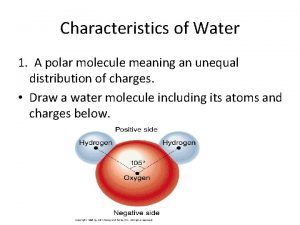
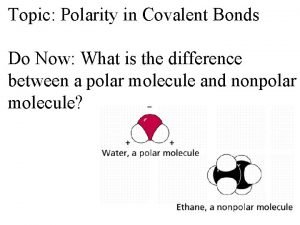
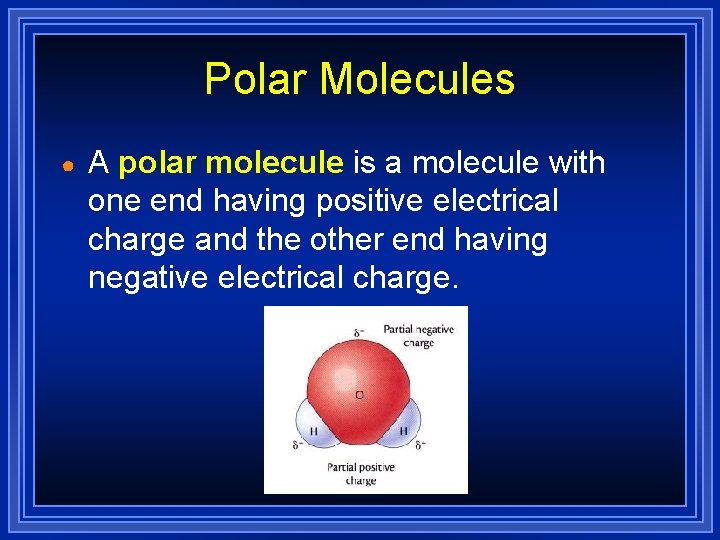
Polar Molecules ● A polar molecule is a molecule with one end having positive electrical charge and the other end having negative electrical charge.
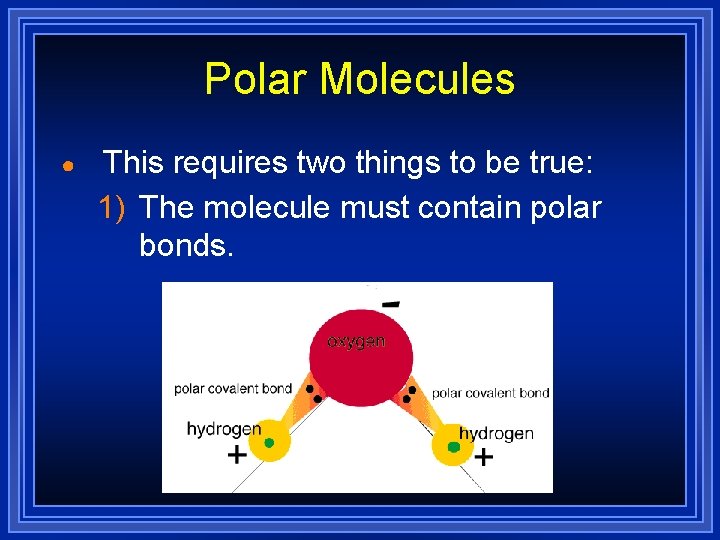
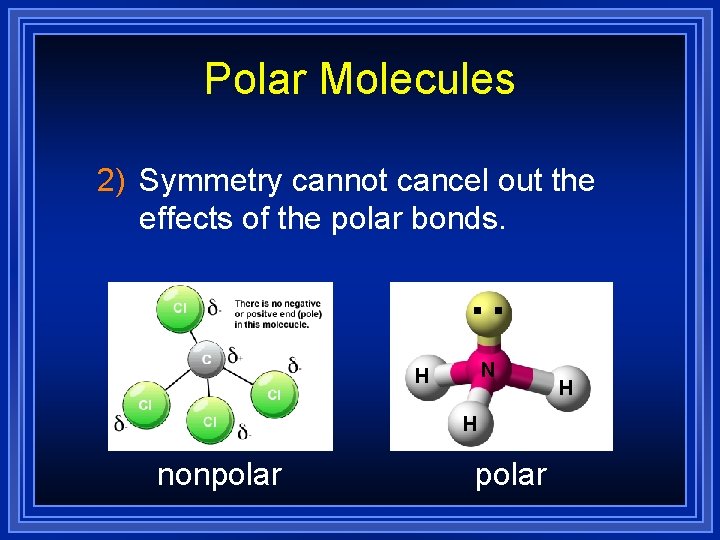
Polar Molecules ● This requires two things to be true: 1) The molecule must contain polar bonds.
Polar Molecules 2) Symmetry cannot cancel out the effects of the polar bonds. . . N H H nonpolar H
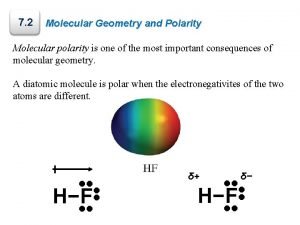
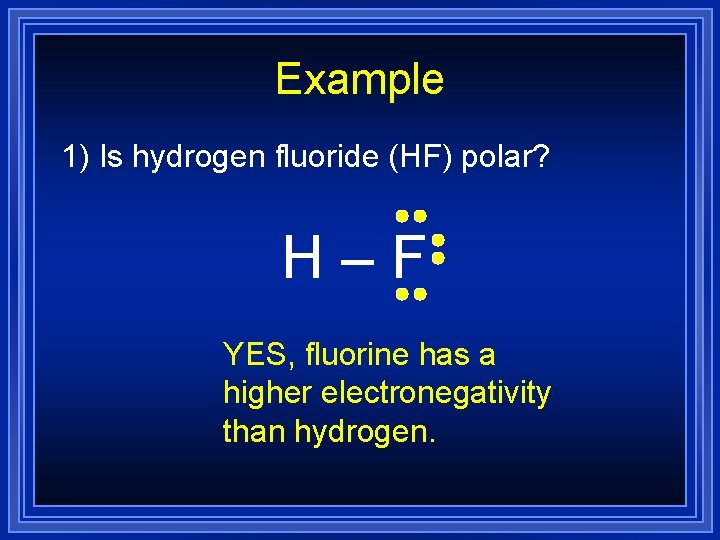
Example 1) Is hydrogen fluoride (HF) polar? H–F YES, fluorine has a higher electronegativity than hydrogen.
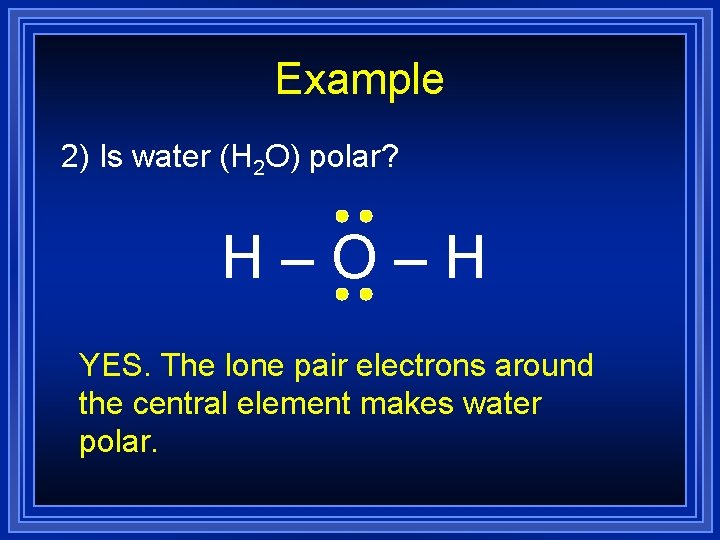
Example 2) Is water (H 2 O) polar? H–O–H YES. The lone pair electrons around the central element makes water polar.
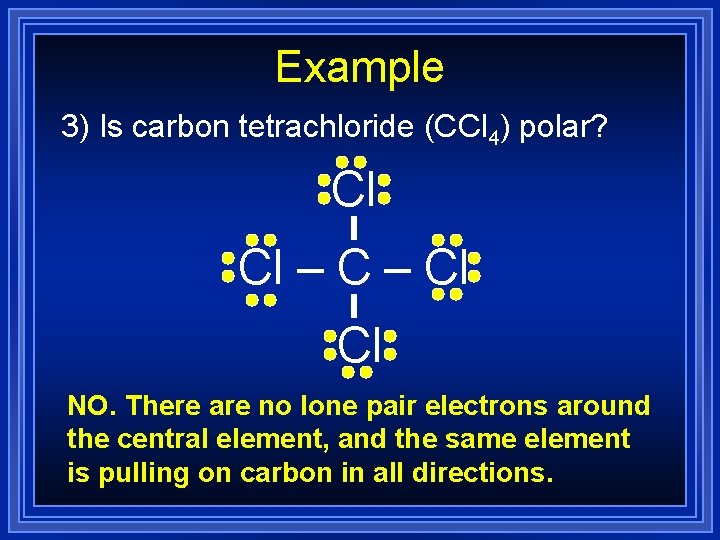
Example 3) Is carbon tetrachloride (CCl 4) polar? Cl Cl – Cl Cl NO. There are no lone pair electrons around the central element, and the same element is pulling on carbon in all directions.
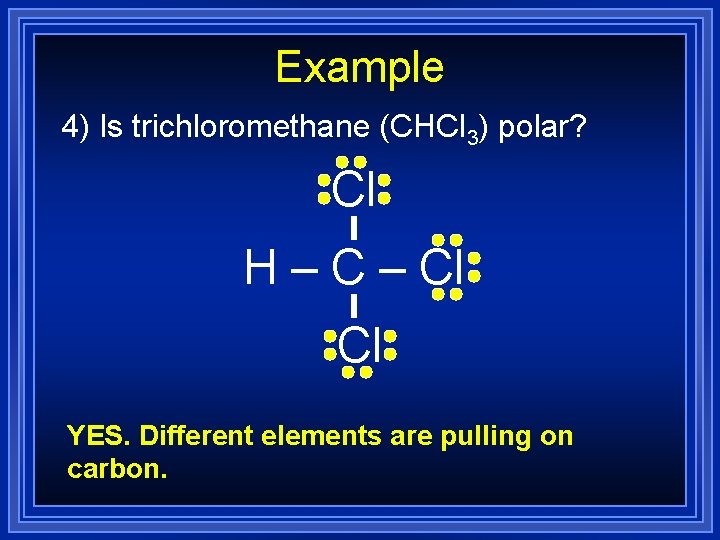
Example 4) Is trichloromethane (CHCl 3) polar? Cl H – Cl Cl YES. Different elements are pulling on carbon.
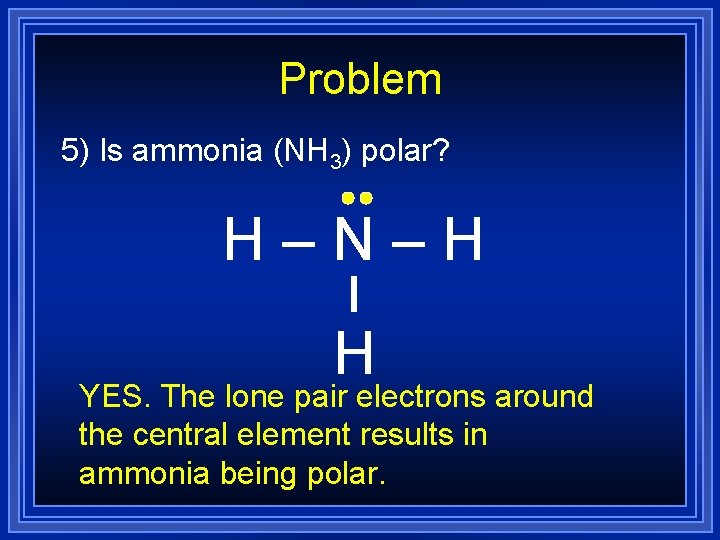
Problem 5) Is ammonia (NH 3) polar? H–N–H H YES. The lone pair electrons around the central element results in ammonia being polar.
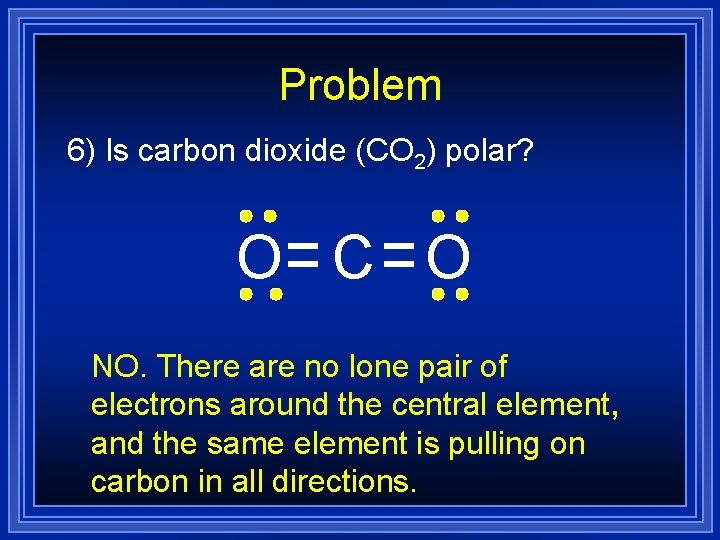
Problem 6) Is carbon dioxide (CO 2) polar? O C O NO. There are no lone pair of electrons around the central element, and the same element is pulling on carbon in all directions.
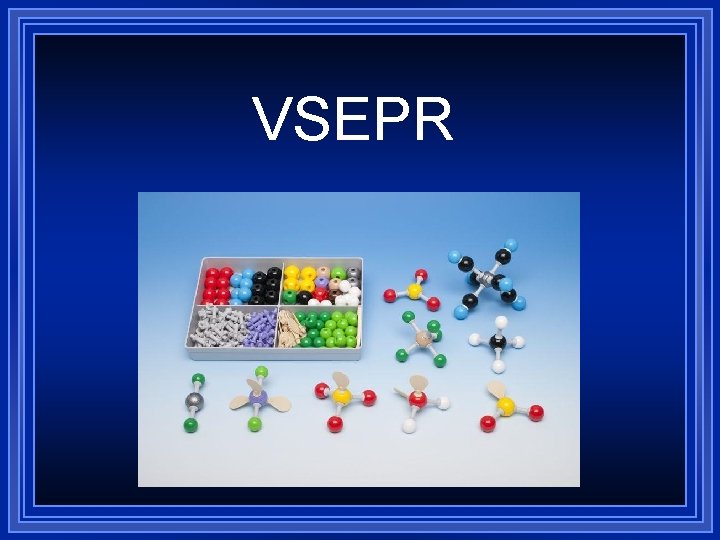
VSEPR
VSEPR ● ● ● VSEPR stands for Valence Shell Electron Pair Repulsion. It predicts the three-dimensional geometry of molecules. The valence shell includes the outermost electrons.
VSEPR ● ● ● The electron pairs try to get as far away as possible to minimize repulsion. VSEPR is based on the number of pairs of valence electrons, both bonded and non-bonded. An non-bonded pair of electrons is referred to as a lone pair.
VSEPR ● Use the Wetter Way to calculate the number of bonds and then draw the dotdash diagram. The shape of the molecule, bond angle and polarity can be determined from this diagram.
LINEAR ● Perform the Wetter Way for H 2. How many bonds are in this molecule?
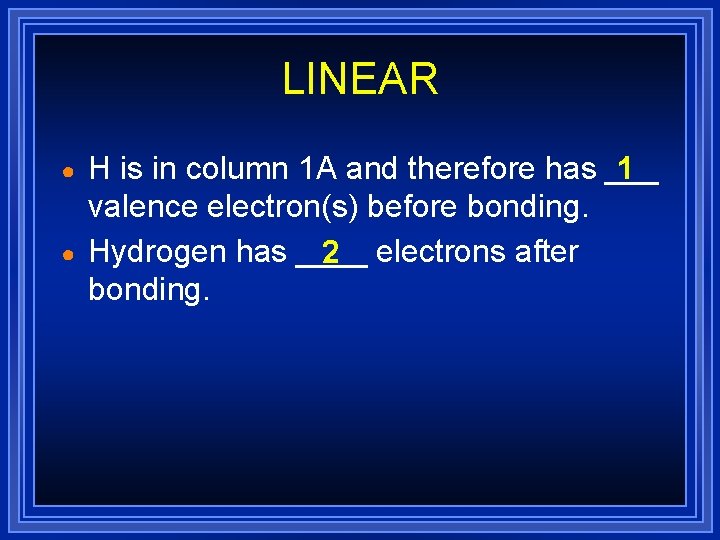
LINEAR ● ● 1 H is in column 1 A and therefore has ___ valence electron(s) before bonding. Hydrogen has ____ 2 electrons after bonding.
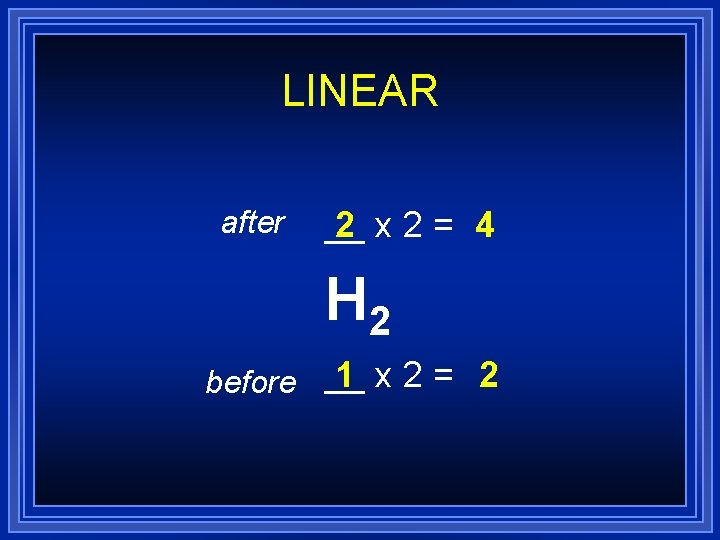
LINEAR after __ 2 x 2= 4 H 2 1 x 2= 2 before __
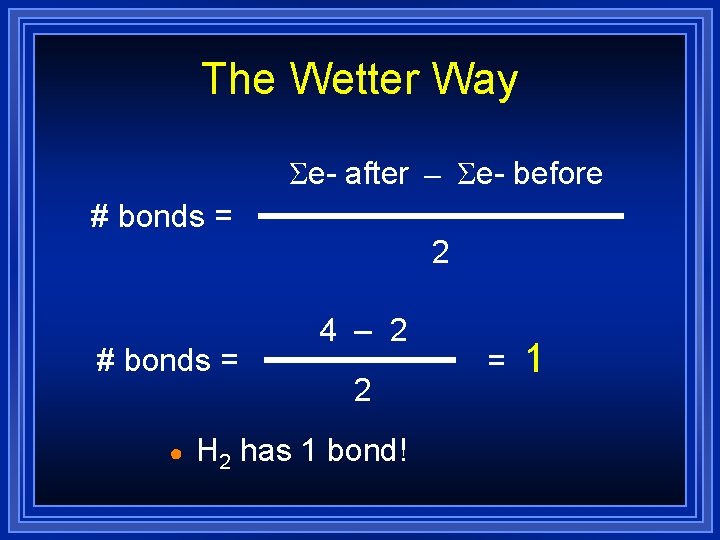
The Wetter Way Σe- after – Σe- before # bonds = 2 # bonds = ● 4 – 2 2 H 2 has 1 bond! = 1
LINEAR ● Sketch the dot-dash diagram for H 2. Please include all electrons.
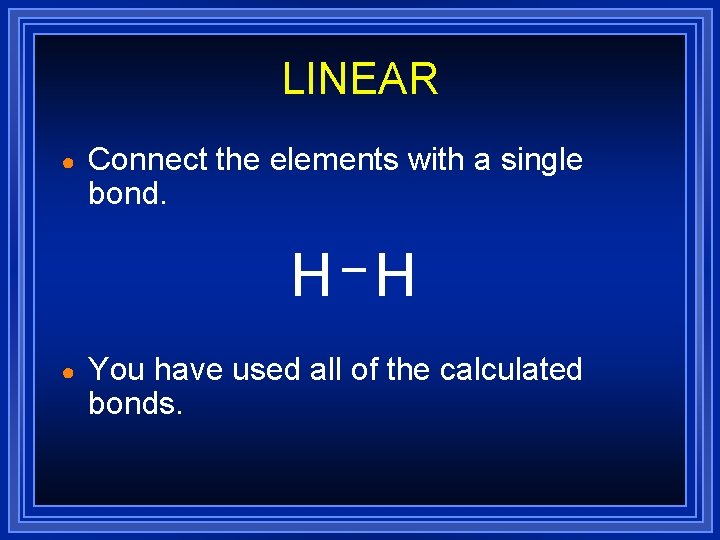
LINEAR ● Connect the elements with a single bond. H H ● You have used all of the calculated bonds.
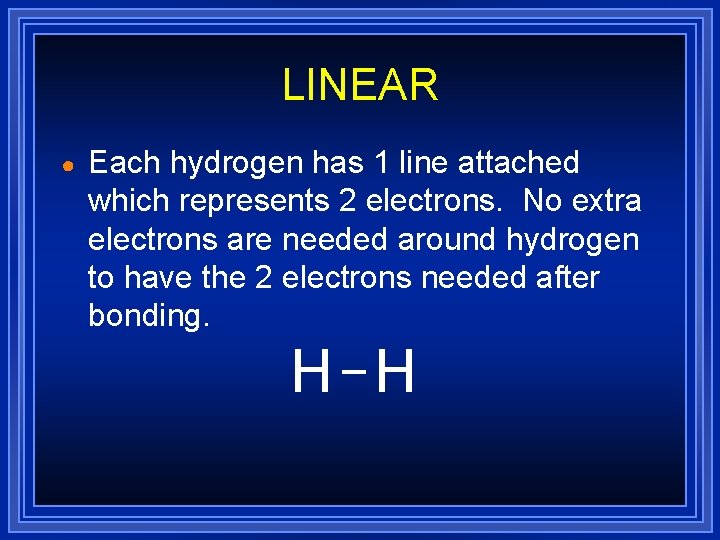
LINEAR ● Each hydrogen has 1 line attached which represents 2 electrons. No extra electrons are needed around hydrogen to have the 2 electrons needed after bonding. H H
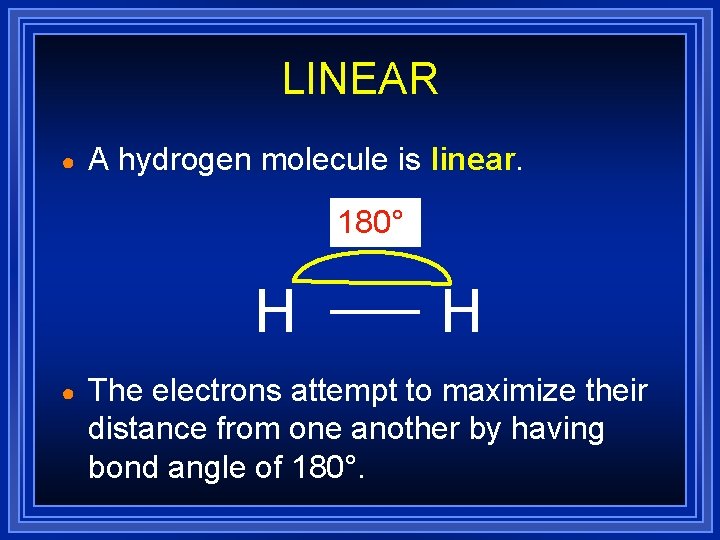
LINEAR ● A hydrogen molecule is linear. 180° H ● H The electrons attempt to maximize their distance from one another by having bond angle of 180°.
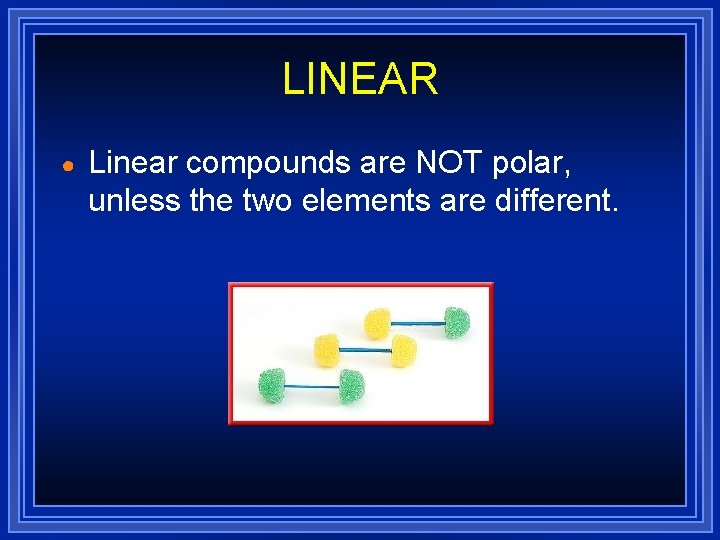
LINEAR ● Linear compounds are NOT polar, unless the two elements are different.
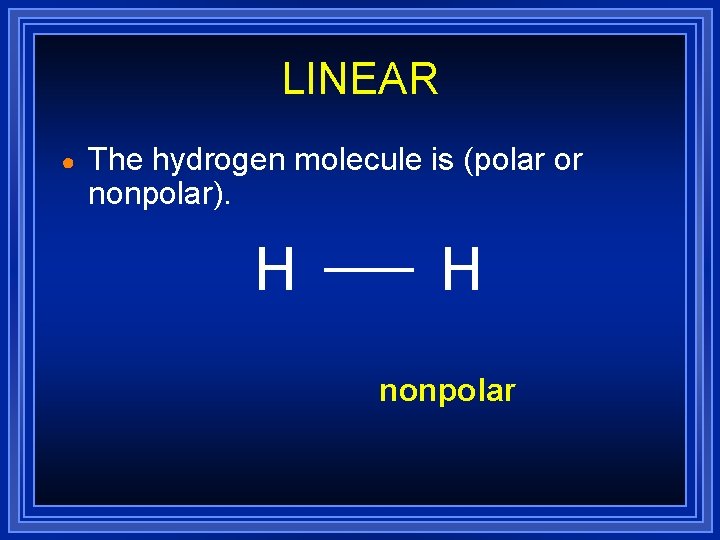
LINEAR ● The hydrogen molecule is (polar or nonpolar). H H nonpolar
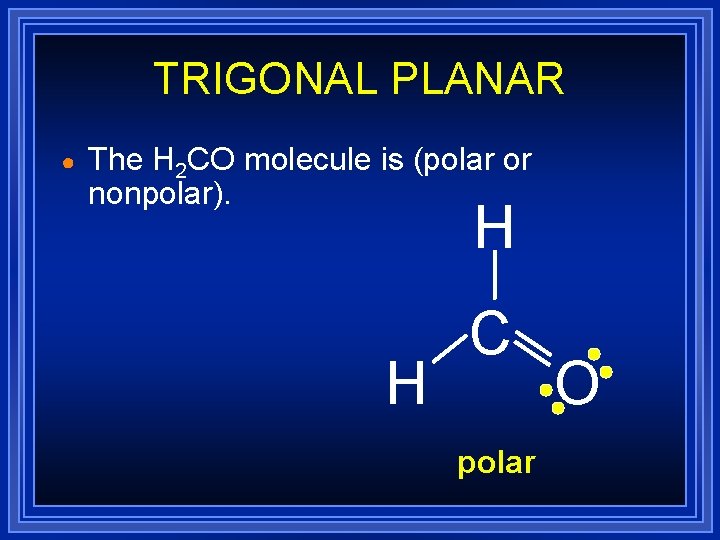
TRIGONAL PLANAR ● Perform the Wetter Way for H 2 CO. How many bonds are in this molecule? 4
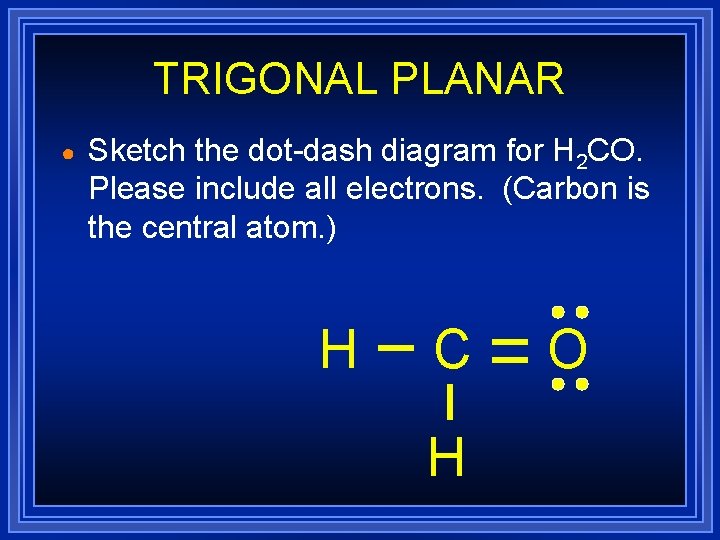
TRIGONAL PLANAR ● Sketch the dot-dash diagram for H 2 CO. Please include all electrons. (Carbon is the central atom. ) H C H O
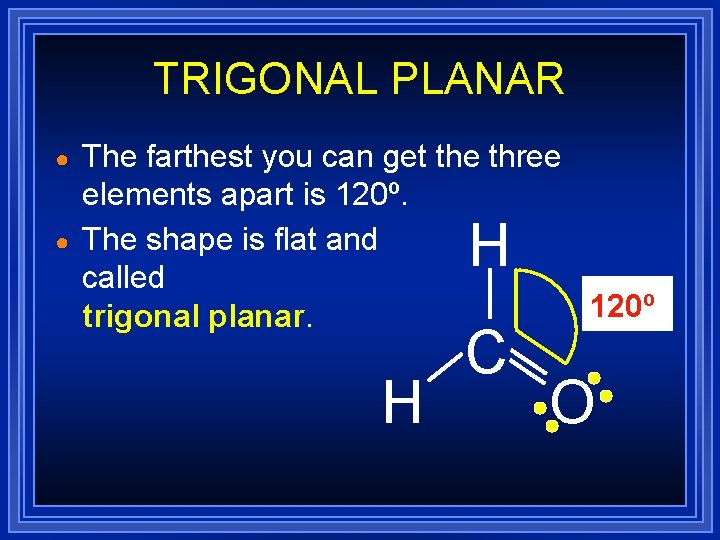
TRIGONAL PLANAR ● ● The farthest you can get the three elements apart is 120º. The shape is flat and called 120º trigonal planar. H H C O
TRIGONAL PLANAR ● The H 2 CO molecule is (polar or nonpolar). H H C polar O
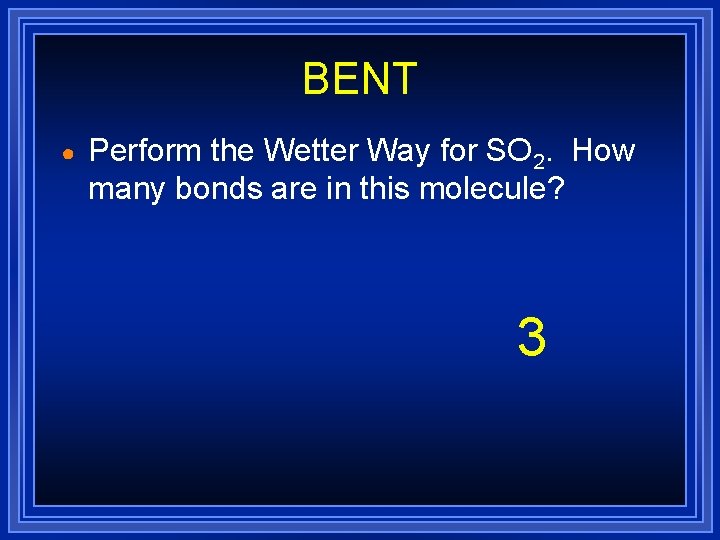
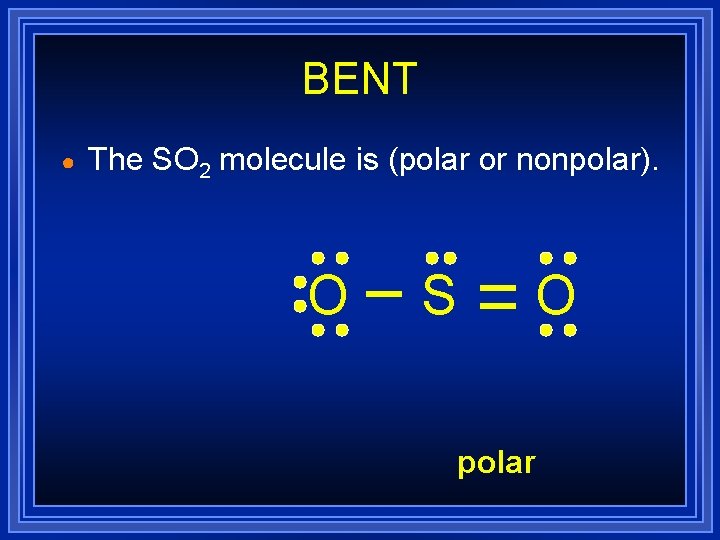
BENT ● Perform the Wetter Way for SO 2. How many bonds are in this molecule? 3
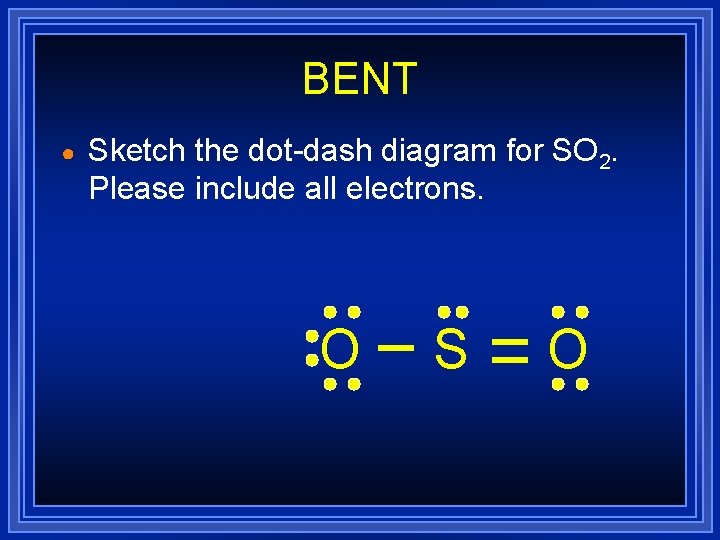
BENT ● Sketch the dot-dash diagram for SO 2. Please include all electrons. O S O
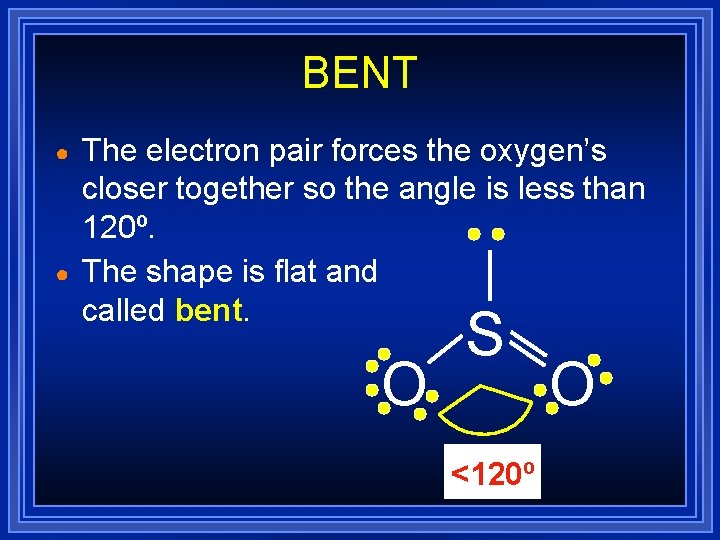
BENT ● ● The electron pair forces the oxygen’s closer together so the angle is less than 120º. The shape is flat and called bent. O S <120º O
BENT ● The SO 2 molecule is (polar or nonpolar). O S O polar
TETRAHEDRAL ● Perform the Wetter Way for CH 4. How many bonds are in this molecule? 4
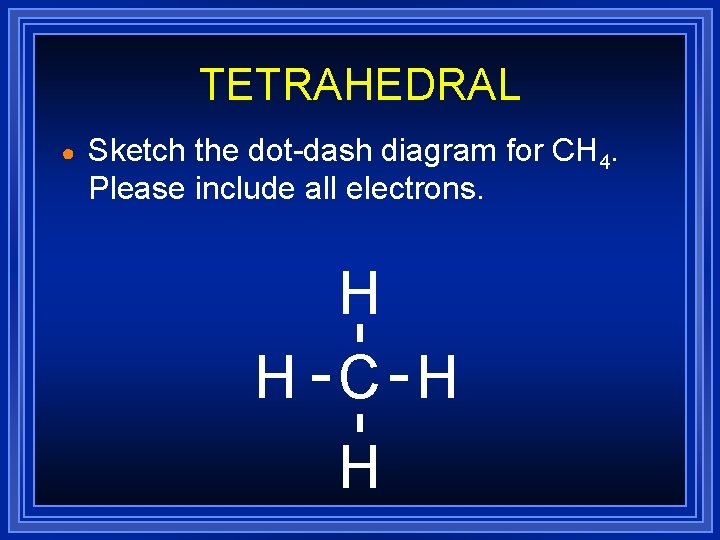
TETRAHEDRAL ● Sketch the dot-dash diagram for CH 4. Please include all electrons. H H C H H
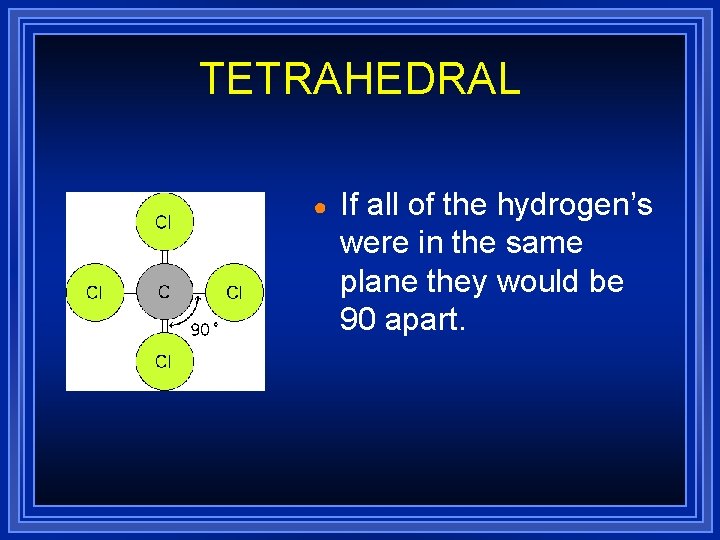
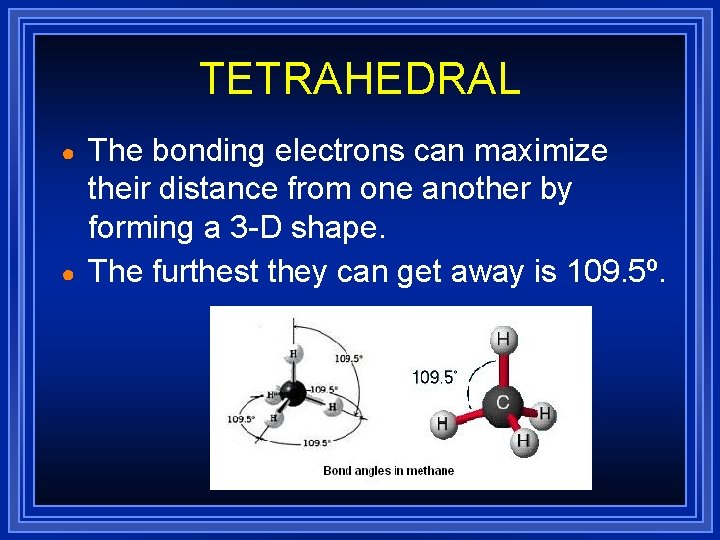
TETRAHEDRAL ● If all of the hydrogen’s were in the same plane they would be 90 apart.
TETRAHEDRAL ● ● The bonding electrons can maximize their distance from one another by forming a 3 -D shape. The furthest they can get away is 109. 5º.
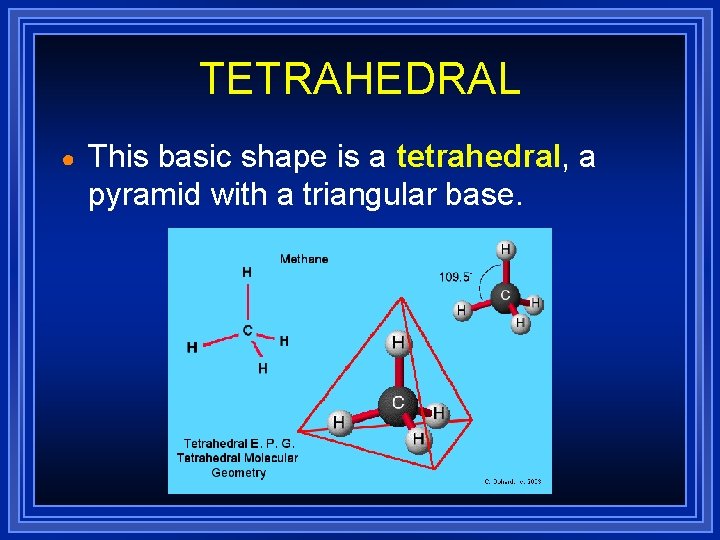
TETRAHEDRAL ● This basic shape is a tetrahedral, a pyramid with a triangular base.
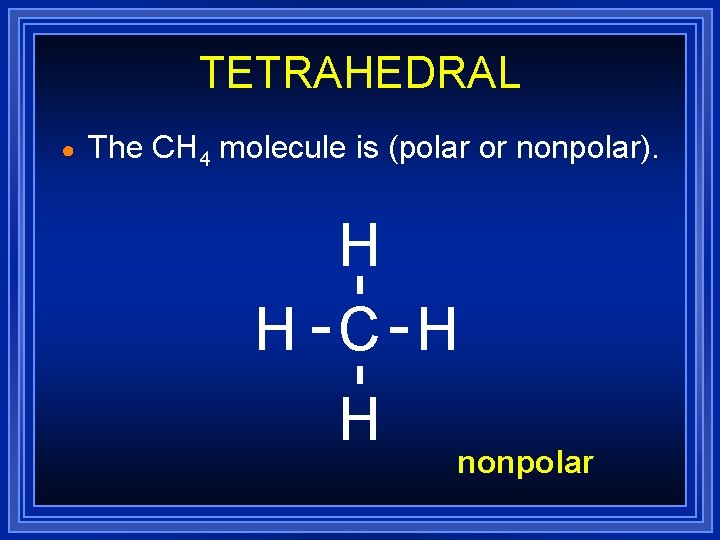
TETRAHEDRAL ● The CH 4 molecule is (polar or nonpolar). H H C H H nonpolar
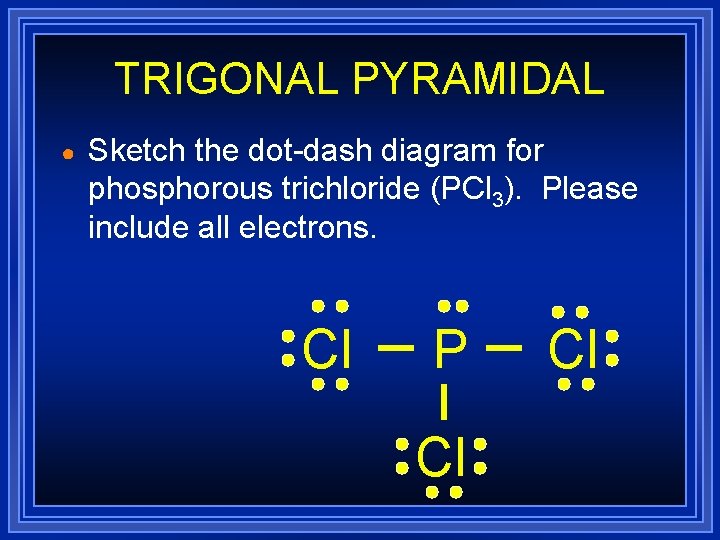
TRIGONAL PYRAMIDAL ● Perform the Wetter Way for phosphorous trichloride (PCl 3). How many bonds are in this molecule? 3
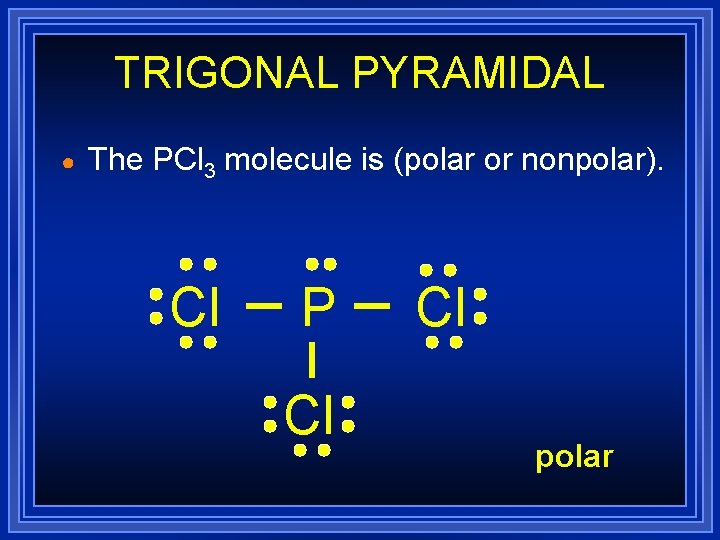
TRIGONAL PYRAMIDAL ● Sketch the dot-dash diagram for phosphorous trichloride (PCl 3). Please include all electrons. Cl P Cl Cl
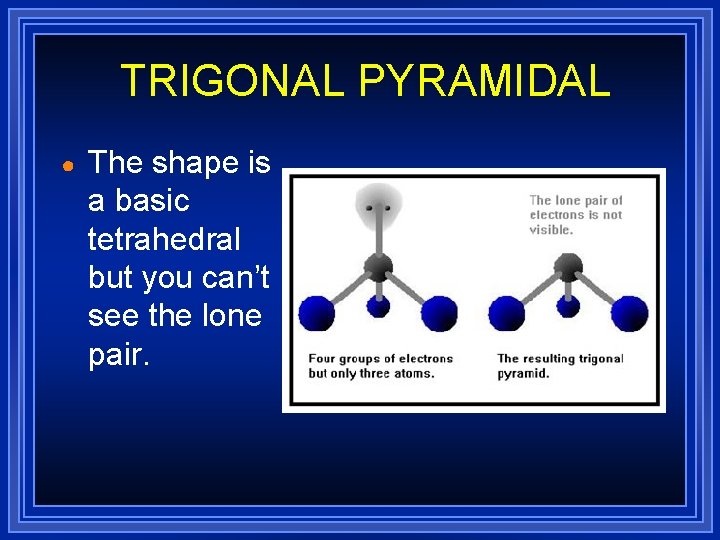
TRIGONAL PYRAMIDAL ● The shape is a basic tetrahedral but you can’t see the lone pair.
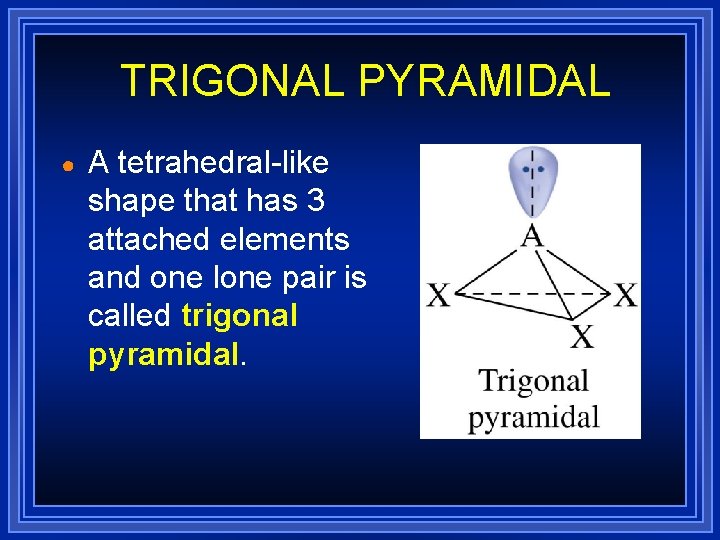
TRIGONAL PYRAMIDAL ● A tetrahedral-like shape that has 3 attached elements and one lone pair is called trigonal pyramidal.
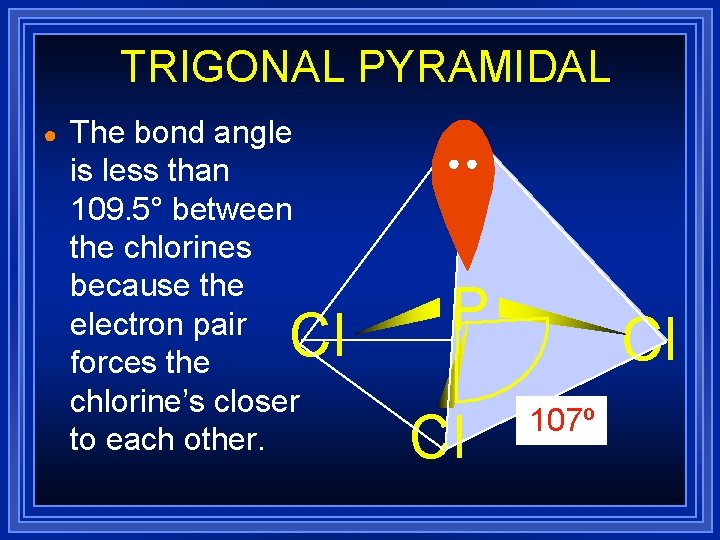
TRIGONAL PYRAMIDAL ● The bond angle is less than 109. 5° between the chlorines because the electron pair forces the chlorine’s closer to each other. Cl P Cl Cl 107º
TRIGONAL PYRAMIDAL ● The PCl 3 molecule is (polar or nonpolar). Cl P Cl Cl polar
BENT ● Perform the Wetter Way for water (H 2 O). How many bonds are in this molecule? 2
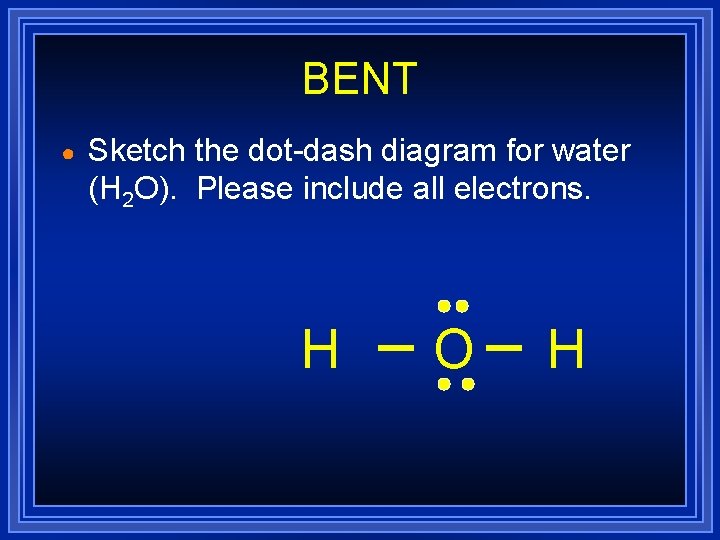
BENT ● Sketch the dot-dash diagram for water (H 2 O). Please include all electrons. H O H
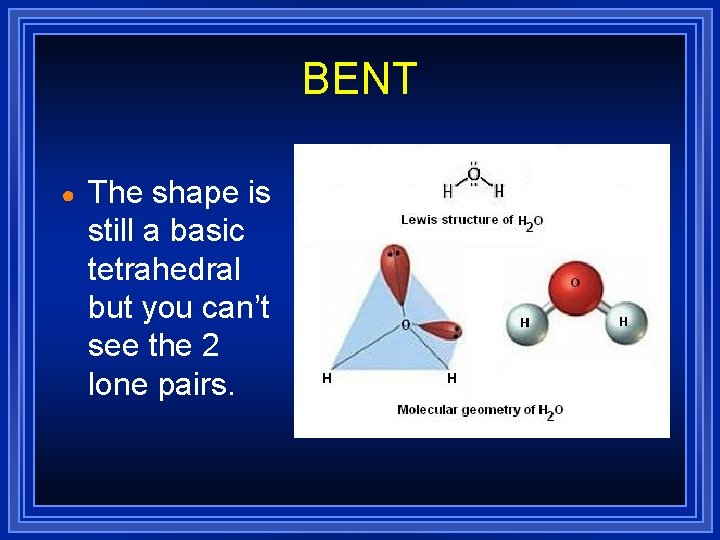
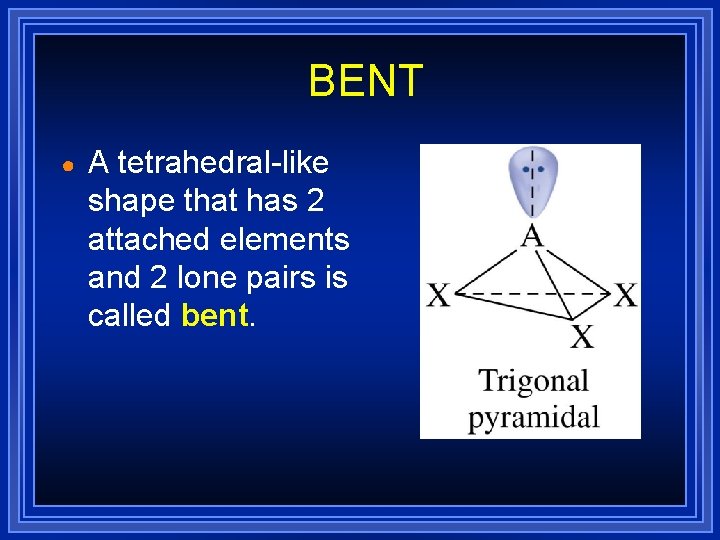
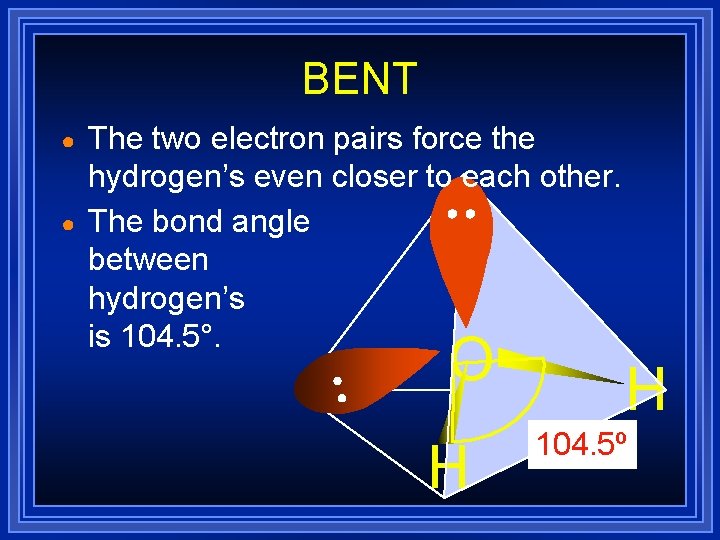
BENT ● The shape is still a basic tetrahedral but you can’t see the 2 lone pairs.
BENT ● A tetrahedral-like shape that has 2 attached elements and 2 lone pairs is called bent.
BENT ● ● The two electron pairs force the hydrogen’s even closer to each other. The bond angle between hydrogen’s is 104. 5°. O H H 104. 5º
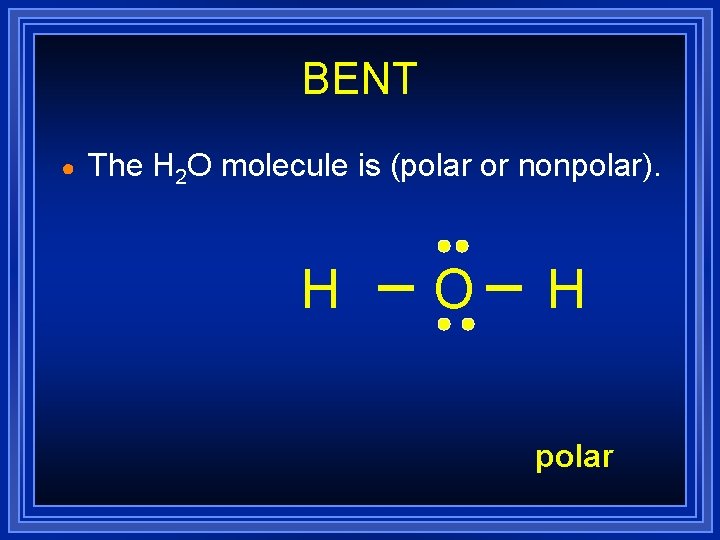
BENT ● The H 2 O molecule is (polar or nonpolar). H O H polar
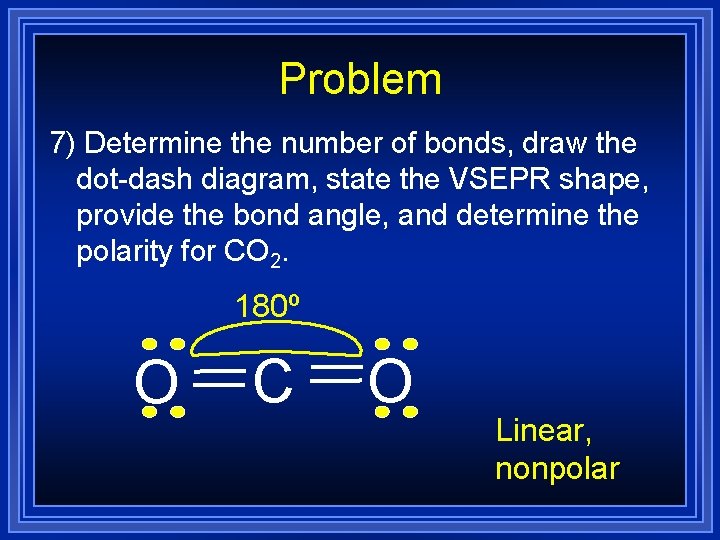
Problem 7) Determine the number of bonds, draw the dot-dash diagram, state the VSEPR shape, provide the bond angle, and determine the polarity for CO 2. 180º O C O Linear, nonpolar
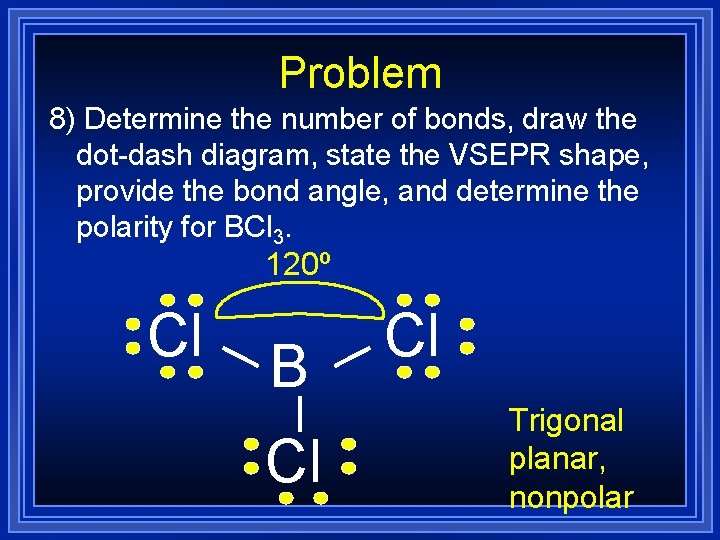
Problem 8) Determine the number of bonds, draw the dot-dash diagram, state the VSEPR shape, provide the bond angle, and determine the polarity for BCl 3. 120º Cl B Cl Cl Trigonal planar, nonpolar
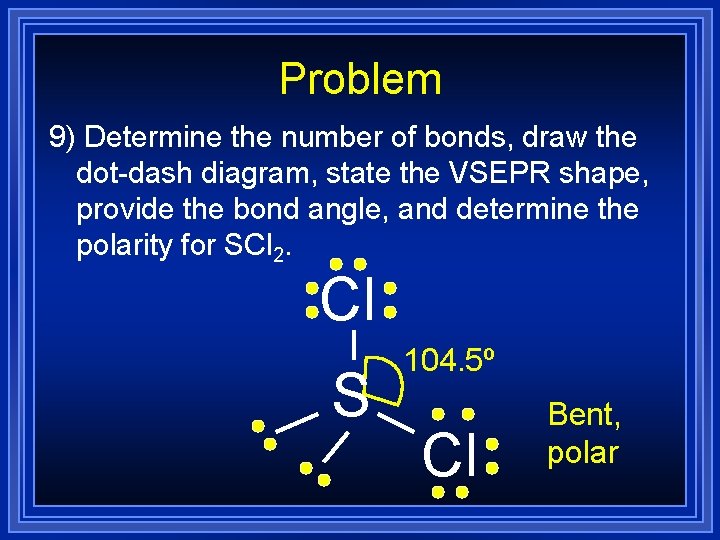
Problem 9) Determine the number of bonds, draw the dot-dash diagram, state the VSEPR shape, provide the bond angle, and determine the polarity for SCl 2. Cl S 104. 5º Cl Bent, polar
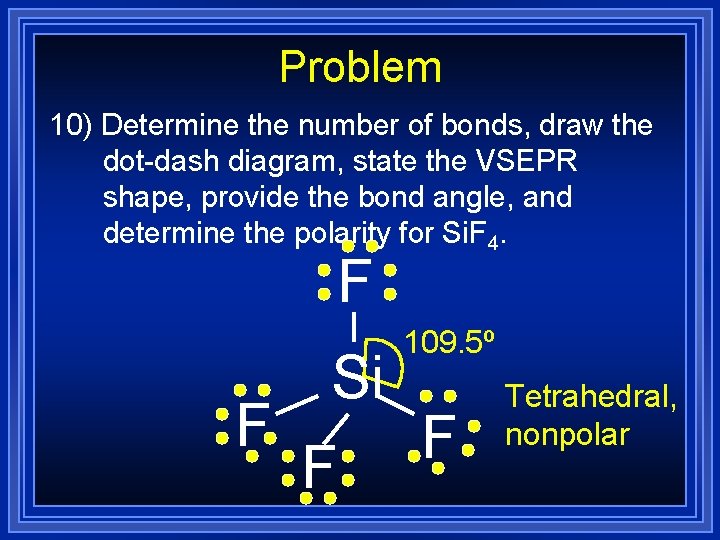
Problem 10) Determine the number of bonds, draw the dot-dash diagram, state the VSEPR shape, provide the bond angle, and determine the polarity for Si. F 4. F 109. 5º Si F F F Tetrahedral, nonpolar
Like Dissolves Like Although water dissolves an enormous variety of substances, both ionic and covalent, it does not dissolve everything. ● The phrase that scientists often use when predicting solubility is “like dissolves like. ” ●
Like Dissolves Like Polar substances will dissolve in other substances that are polar. ● Nonpolar substances dissolve in other nonpolar substances. ●