
Topic Polarity in Covalent Bonds Do Now What
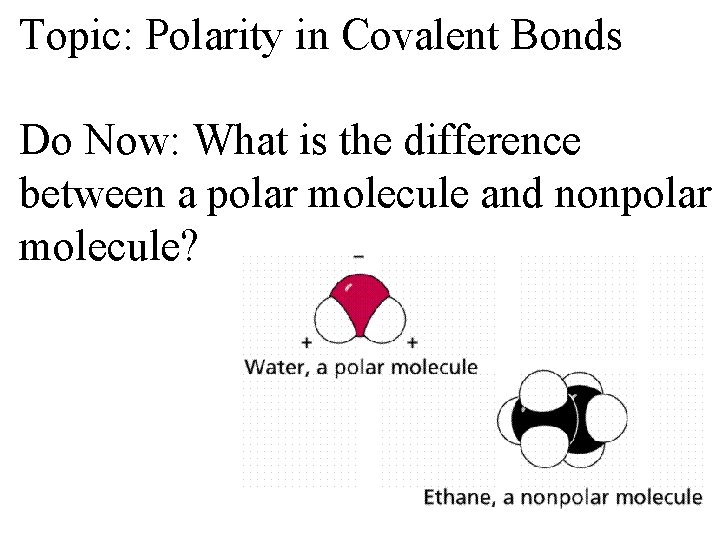
Topic: Polarity in Covalent Bonds Do Now: What is the difference between a polar molecule and nonpolar molecule?
How do you tell Polar from Nonpolar? ? • From the IMF unit we learned…. • If it’s dispersion (diatomic, noble gas, pure hydrocarbon, small symmetrical) it’s nonpolar • If it’s not it’s polar
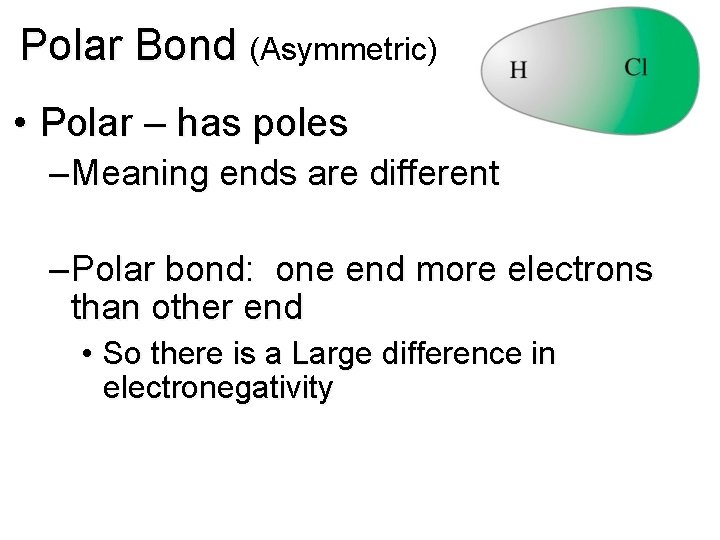
Polar Bond (Asymmetric) • Polar – has poles – Meaning ends are different – Polar bond: one end more electrons than other end • So there is a Large difference in electronegativity
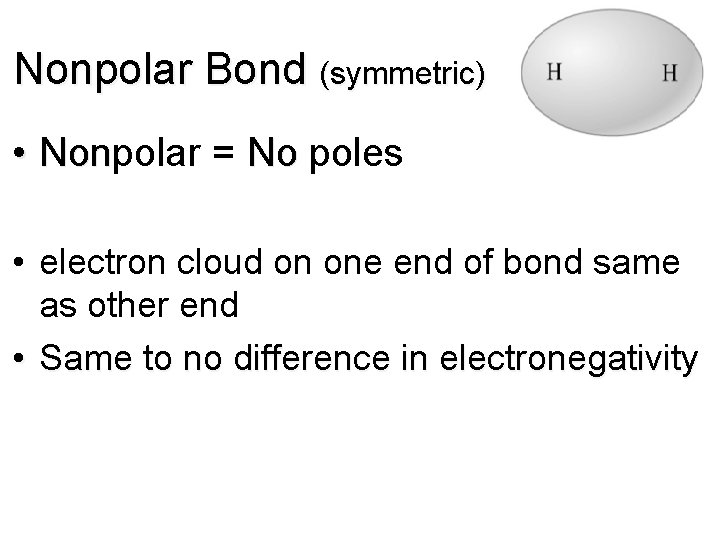
Nonpolar Bond (symmetric) • Nonpolar = No poles Non • electron cloud on one end of bond same as other end • Same to no difference in electronegativity
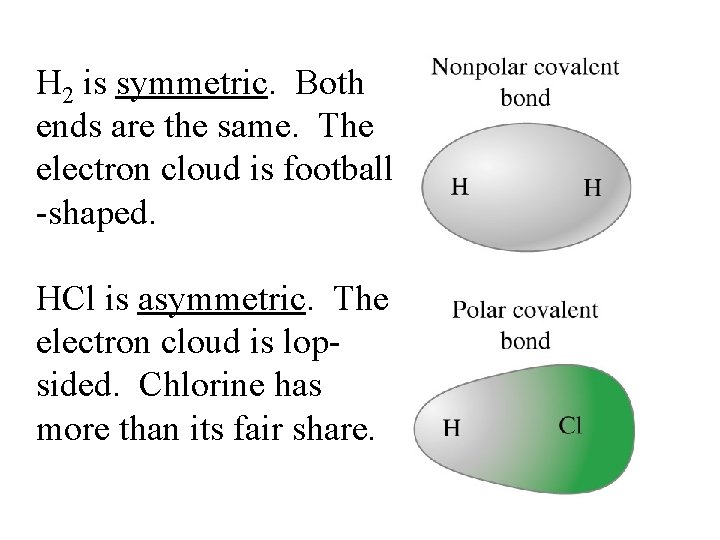
H 2 is symmetric. Both ends are the same. The electron cloud is football -shaped. HCl is asymmetric. The electron cloud is lopsided. Chlorine has more than its fair share.
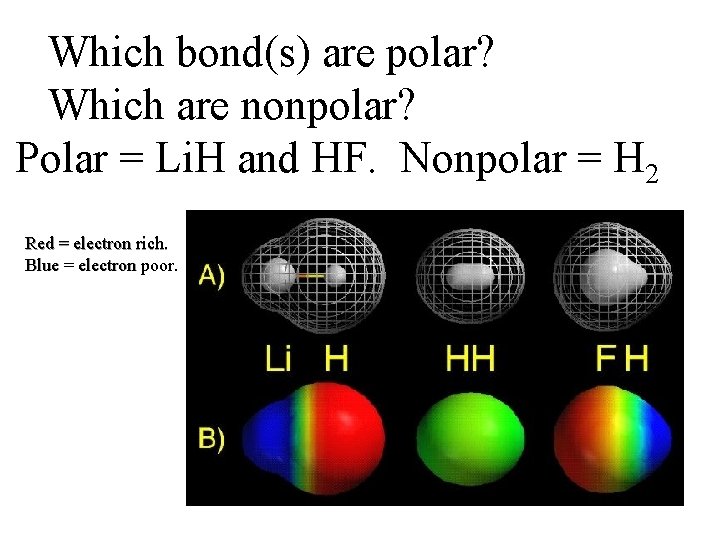
Which bond(s) are polar? Which are nonpolar? Polar = Li. H and HF. Nonpolar = H 2 Red = electron rich. Blue = electron poor.
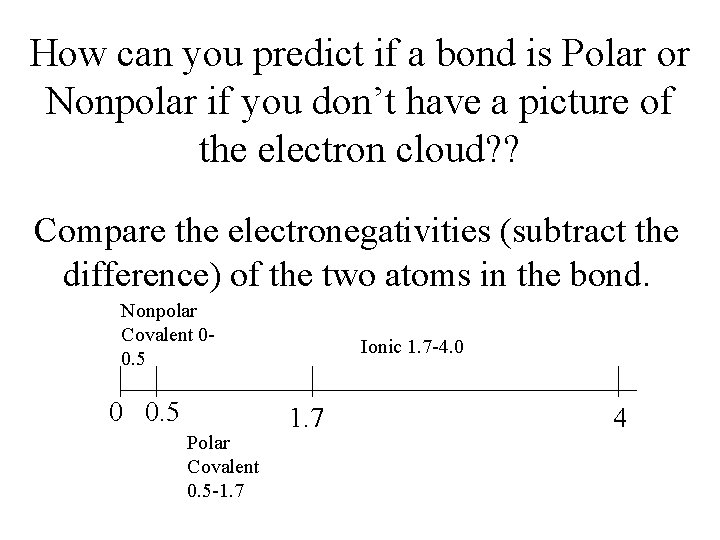
How can you predict if a bond is Polar or Nonpolar if you don’t have a picture of the electron cloud? ? Compare the electronegativities (subtract the difference) of the two atoms in the bond. Nonpolar Covalent 00. 5 0 0. 5 Polar Covalent 0. 5 -1. 7 Ionic 1. 7 -4. 0 1. 7 4
Electronegativity • Ability of an atom to attract electrons in a bond. Look it up in Table S!
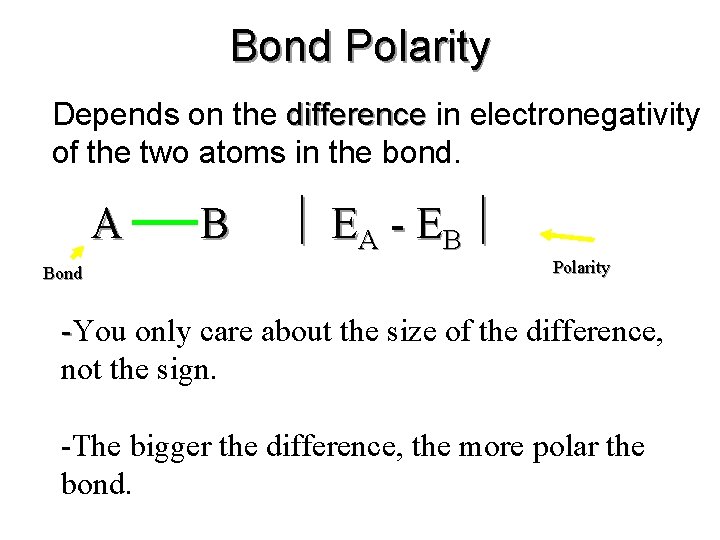
Bond Polarity • Depends on the difference in electronegativity of the two atoms in the bond. A Bond B EA - EB Polarity -You only care about the size of the difference, not the sign. -The bigger the difference, the more polar the bond.
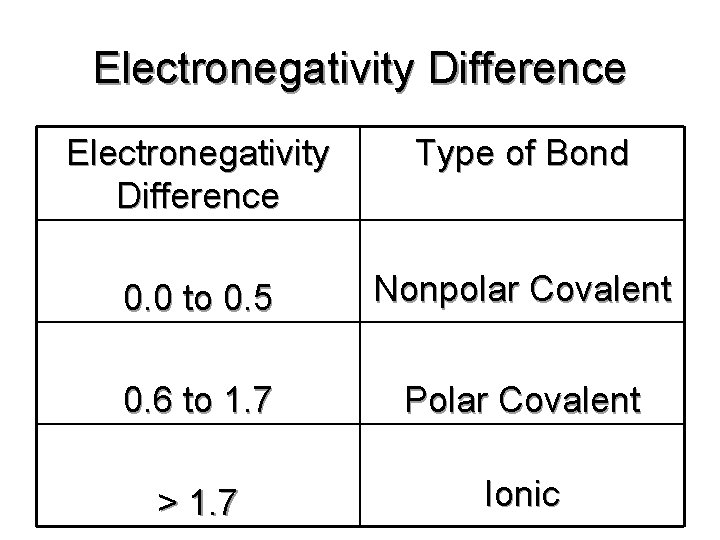
Electronegativity Difference Type of Bond 0. 0 to 0. 5 Nonpolar Covalent 0. 6 to 1. 7 Polar Covalent > 1. 7 Ionic
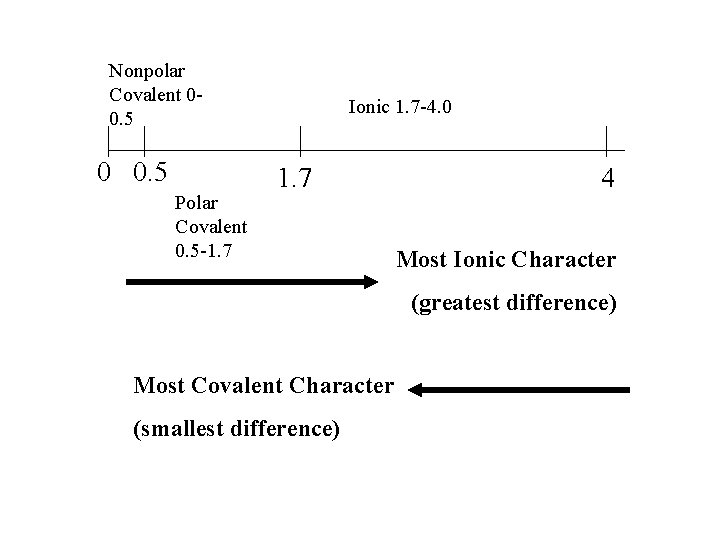
Nonpolar Covalent 00. 5 0 0. 5 Polar Covalent 0. 5 -1. 7 Ionic 1. 7 -4. 0 1. 7 4 Most Ionic Character (greatest difference) Most Covalent Character (smallest difference) Most Ionic Character
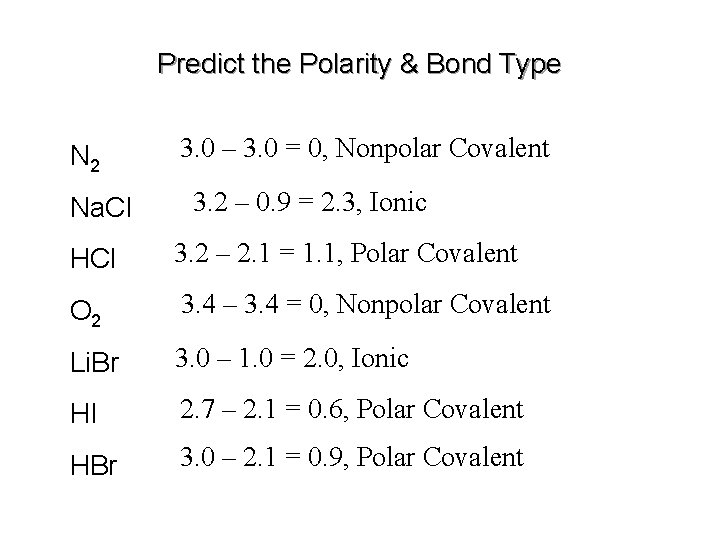
Predict the Polarity & Bond Type • N 2 • Na. Cl 3. 0 – 3. 0 = 0, Nonpolar Covalent 3. 2 – 0. 9 = 2. 3, Ionic • HCl 3. 2 – 2. 1 = 1. 1, Polar Covalent • O 2 3. 4 – 3. 4 = 0, Nonpolar Covalent • Li. Br 3. 0 – 1. 0 = 2. 0, Ionic • HI 2. 7 – 2. 1 = 0. 6, Polar Covalent • HBr 3. 0 – 2. 1 = 0. 9, Polar Covalent
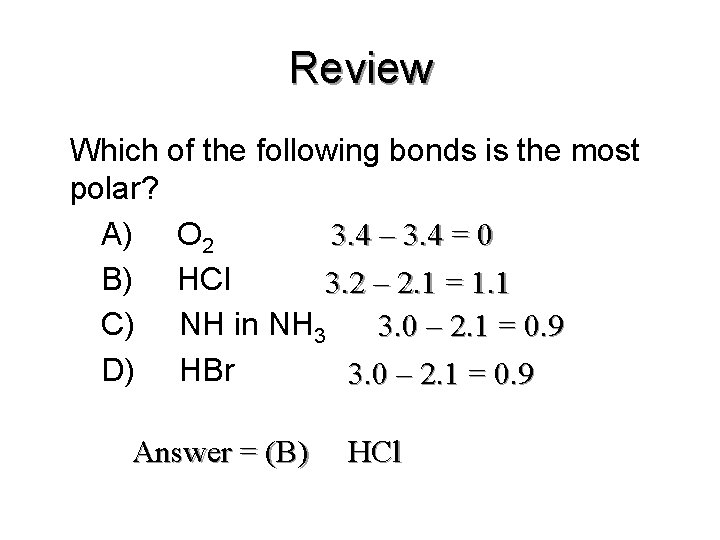
Review • Which of the following bonds is the most polar? 3. 4 – 3. 4 = 0 – A) O 2 – B) HCl 3. 2 – 2. 1 = 1. 1 – C) NH in NH 3 3. 0 – 2. 1 = 0. 9 – D) HBr 3. 0 – 2. 1 = 0. 9 Answer = (B) HCl

Review • Which substance contains a bond with the greatest ionic character? 3. 2 – 0. 8 = 2. 4 – A) KCl – B) HCl 3. 2 – 2. 1 = 1. 1 – C) Cl 2 3. 2 – 3. 2 = 0 – D) CCl 4 3. 2 – 2. 6 = 0. 6 Answer = (A) KCl
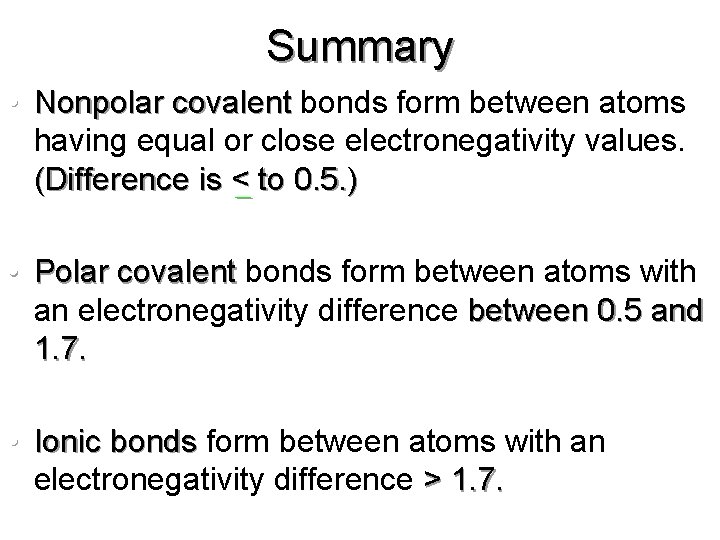
Summary • Nonpolar covalent bonds form between atoms having equal or close electronegativity values. (Difference is <_ to 0. 5. ) • Polar covalent bonds form between atoms with an electronegativity difference between 0. 5 and 1. 7. • Ionic bonds form between atoms with an electronegativity difference > 1. 7.
- Slides: 15