
OVERUSE INJURIES IN THE ERA OF SPORT SPECIALIZATION



- Slides: 60
OVERUSE INJURIES IN THE ERA OF SPORT SPECIALIZATION Lauren Shull, MD-R PGY-3
THE THEORY OF SPORT SPECIALIZATION IS BASED ON AN INTERPRETATION OF A STUDY DONE BY ERICSSON. IN HIS STUDY, HOW MANY HOURS OF PRACTICE WERE THOUGHT TO BE REQUIRED TO REACH MASTERY LEVEL OF A SKILL? 1. 100 2. 1, 000 3. 10, 000 4. 100, 000
PRESENTS TO YOUR OFFICE WITH A CHIEF COMPLAINT OF ANTERIOR KNEE PAIN. HE STATES THAT THE PAIN WORSENS WITH RUNNING AND JUMPING. ON PHYSICAL EXAM, HE HAS EXTREME TENDERNESS ON PALPATION OF THE INFERIOR PATELLA. YOU ALSO NOTICE THAT HIS QUADRICEPS SEEM TIGHT. HE HAS GOOD RANGE OF MOTION OF THE KNEE JOINT. WHAT IS THIS PATIENT’S 1. Osgood-Schlatter disease DIAGNOSIS? 2. Sinding-Larsen-Johansson syndrome 3. Osteochondritis dissecans of the knee
SHE HAS RECENTLY STARTED PLAYING SOCCER AGAIN AFTER TAKING SEVERAL MONTHS OFF. SHE HAS NOT YET PURCHASED NEW CLEATS FOR THE SEASON. SHE DOES NOT HAVE ANY HISTORY OF PREVIOUS INJURY TO THE FOOT. ON EXAM, SHE HAS TENDERNESS TO PALPATION AND PERCUSSION OVER THE 2 ND AND 3 RD METATARSALS. YOU SUSPECT A STRESS FRACTURE. WHAT ASPECTS OF THE PATIENT’S 1. Female HISTORY PUTS HER AT RISK FOR A STRESS 2. Recently starting soccer FRACTURE? 3. Wearing old cleats 4. All of the above 5. A&B only
PHYSICAL FOR BASEBALL. HE CURRENTLY PITCHES FOR A RECREATION LEAGUE TEAM AND A TRAVEL TEAM. THIS YEAR, HE WILL ALSO BE TRYING-OUT FOR THE JUNIOR VARSITY TEAM AT THE LOCAL HIGH SCHOOL. WHEN NOT PITCHING, HE USUALLY PLAYS CATCHER. LAST YEAR, HE PLAYED IN OVER 100 GAMES, AND PITCHED MORE THAN 120 INNINGS. WHAT ADVICE SHOULD YOU COUNSEL BOTH THE PATIENT AND PARENT IN REGARDS TO PREVENTION 1. He should pitch no more than 100 innings per OF OVERUSE INJURIES? year. 2. Take at least 2 months off from pitching per year. 3. Play on only 2 teams at one time. 4. Limit total number of games to 100 per calendar year. 5. It is ok to continue playing if you experience elbow pain only if college coaches are watching.
OBJECTIVES 1. Discuss the benefits of youth sport participation. 2. Define theory of sport specialization and how it applies to current sport participation trends in the United States. 3. Recognize common overuse injuries in pediatric athletes.
DISCLOSURES No financial disclosures to report.
YOUTH SPORTS PARTICIPATION
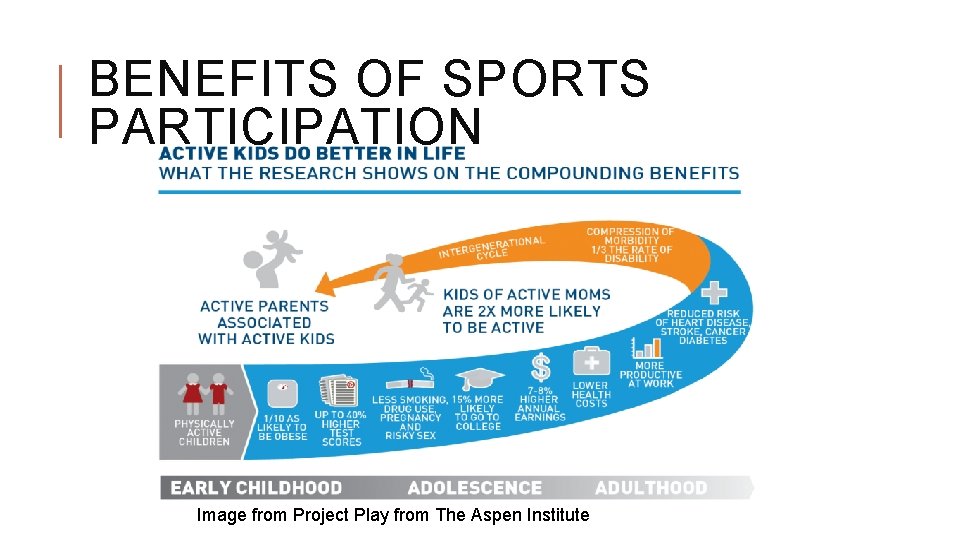
BENEFITS OF SPORTS PARTICIPATION Image from Project Play from The Aspen Institute
YOUTH SPORTS PARTICIPATION BY THE NUMBERS • In 2007, 21. 47 million children between the ages of 6 and 17 participated in competitive sports. • Participation is starting at younger ages. • Girls begin participating on average ½ year later than boys. • By the age of 9, basketball is the most popular competitive sport. • Upward trend in year-round participation • Activity in youth organized sports is on the rise but youth are becoming less active.
CHANGING LANDSCAPE OF SPORTS PROGRAMS Agency sponsored Club sports Recreational sports Intramural sports Interscholastic sports
SPORT SPECIALIZATION
WHAT IS SPORT SPECIALIZATION? • Aspects of typical definition • High volume and intensity of training • Duration of training at a young age • Minimal rest or time off • Structured training with emphasis on physical development • Exclusion of other sports • Goal is to optimize opportunities to develop athletic skills in 1 sport to enhance chance of competing at the next level
THEORY OF SPORT SPECIALIZATION • Based on interpretation of a study by Ericsson from 1993 • High volumes of deliberate practice at a young age was the strongest predictor of becoming an expert performer • Led to the “ 10, 000 hour rule” • Expert status for musicians, mathematicians, and chess players NOT athletes • No specific number of hours was proven as enough to master a task.
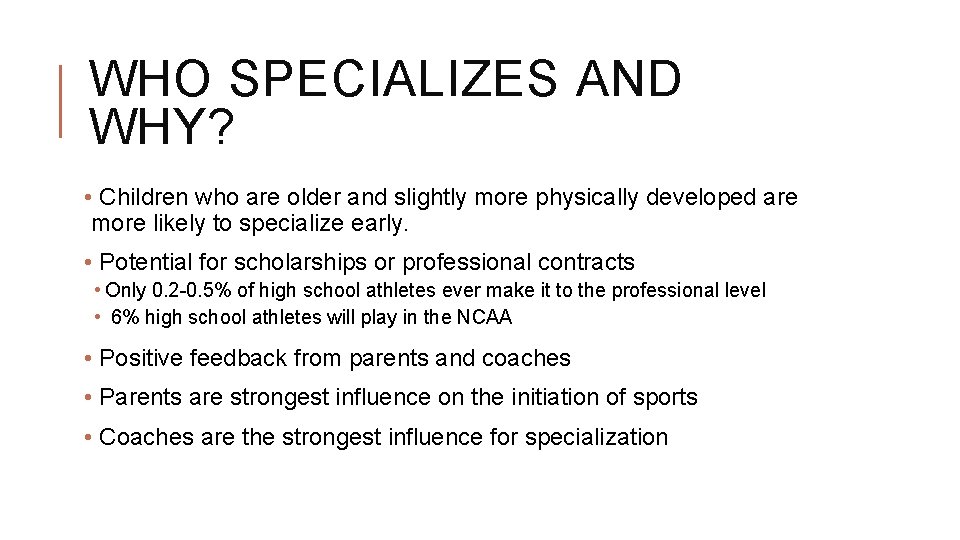
WHO SPECIALIZES AND WHY? • Children who are older and slightly more physically developed are more likely to specialize early. • Potential for scholarships or professional contracts • Only 0. 2 -0. 5% of high school athletes ever make it to the professional level • 6% high school athletes will play in the NCAA • Positive feedback from parents and coaches • Parents are strongest influence on the initiation of sports • Coaches are the strongest influence for specialization
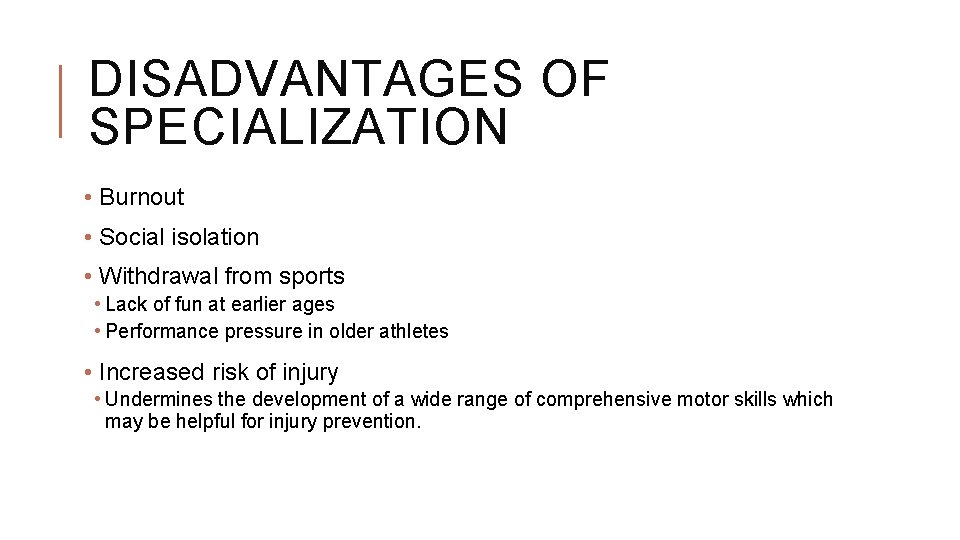
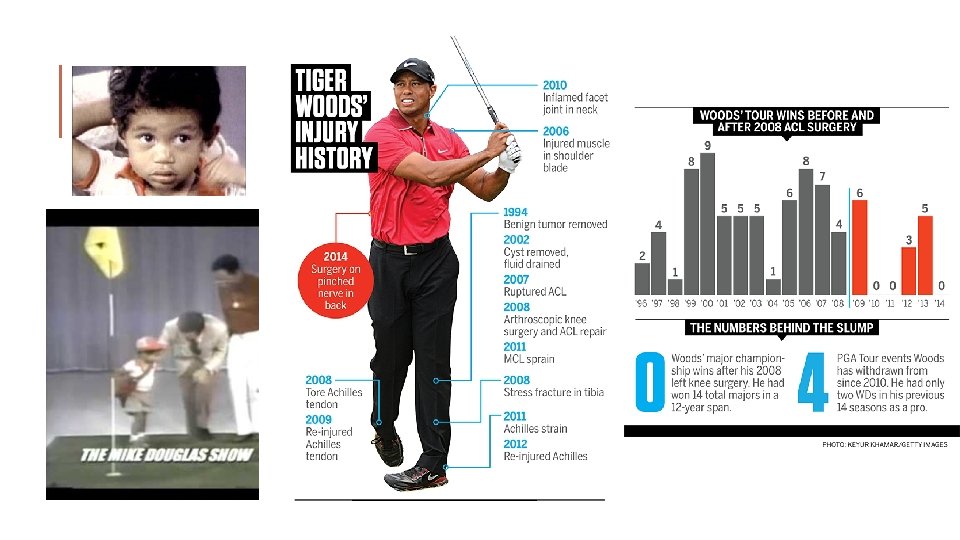
DISADVANTAGES OF SPECIALIZATION • Burnout • Social isolation • Withdrawal from sports • Lack of fun at earlier ages • Performance pressure in older athletes • Increased risk of injury • Undermines the development of a wide range of comprehensive motor skills which may be helpful for injury prevention.
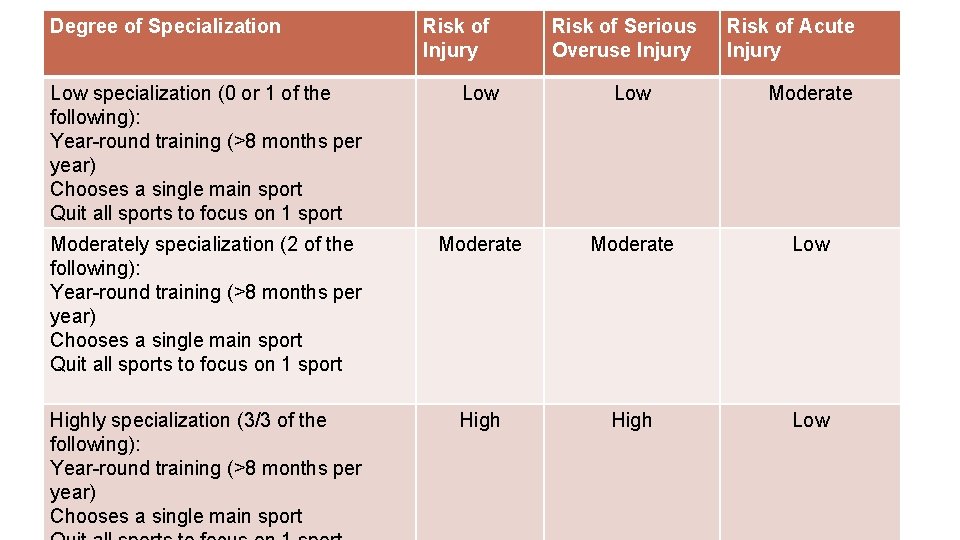
Degree of Specialization Risk of Injury Risk of Serious Overuse Injury OVERUSE INJURIES Risk of Acute Injury Low specialization (0 or 1 of the following): Year-round training (>8 months per year) Chooses a single main sport Quit all sports to focus on 1 sport Low Moderately specialization (2 of the following): Year-round training (>8 months per year) Chooses a single main sport Quit all sports to focus on 1 sport Moderate Low Highly specialization (3/3 of the following): Year-round training (>8 months per year) Chooses a single main sport High Low
OVERUSE INJURIES
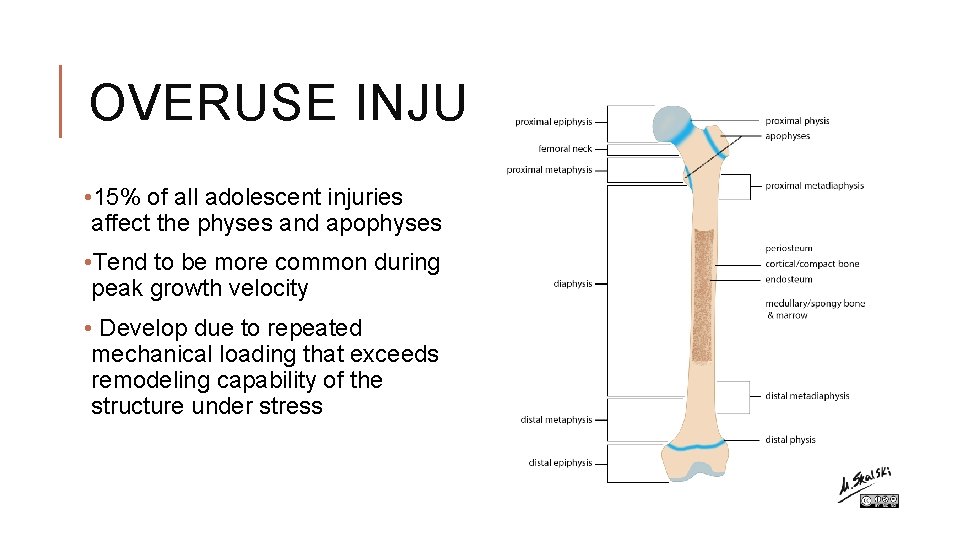
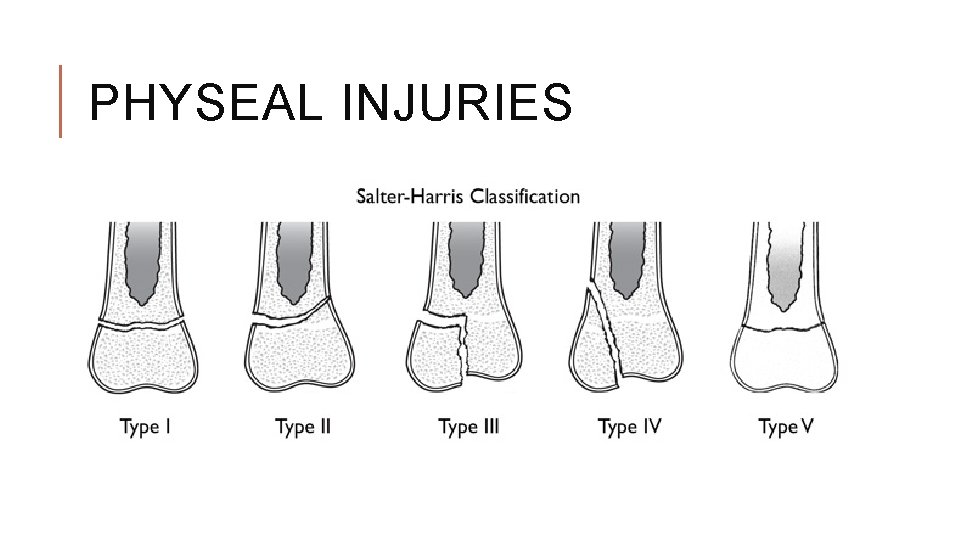
OVERUSE INJURIES • 15% of all adolescent injuries affect the physes and apophyses • Tend to be more common during peak growth velocity • Develop due to repeated mechanical loading that exceeds remodeling capability of the structure under stress
PHYSEAL INJURIES
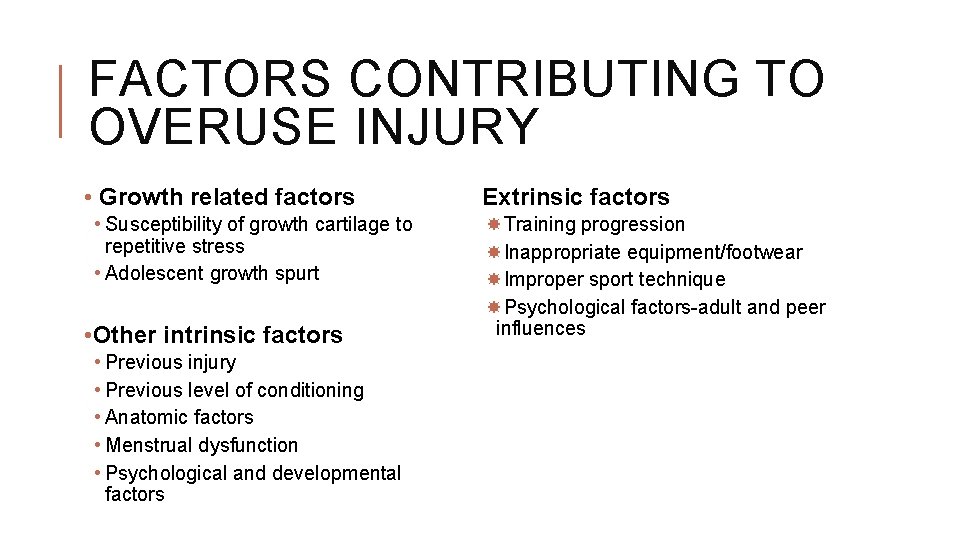
FACTORS CONTRIBUTING TO OVERUSE INJURY • Growth related factors • Susceptibility of growth cartilage to repetitive stress • Adolescent growth spurt • Other intrinsic factors • Previous injury • Previous level of conditioning • Anatomic factors • Menstrual dysfunction • Psychological and developmental factors Extrinsic factors Training progression Inappropriate equipment/footwear Improper sport technique Psychological factors-adult and peer influences
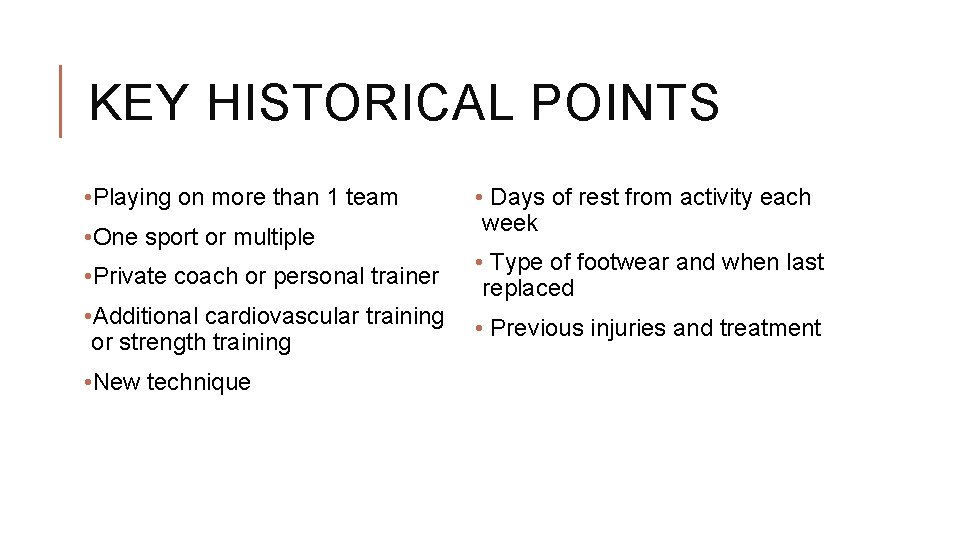
KEY HISTORICAL POINTS • Playing on more than 1 team • One sport or multiple • Private coach or personal trainer • Days of rest from activity each week • Type of footwear and when last replaced • Additional cardiovascular training • Previous injuries and treatment or strength training • New technique
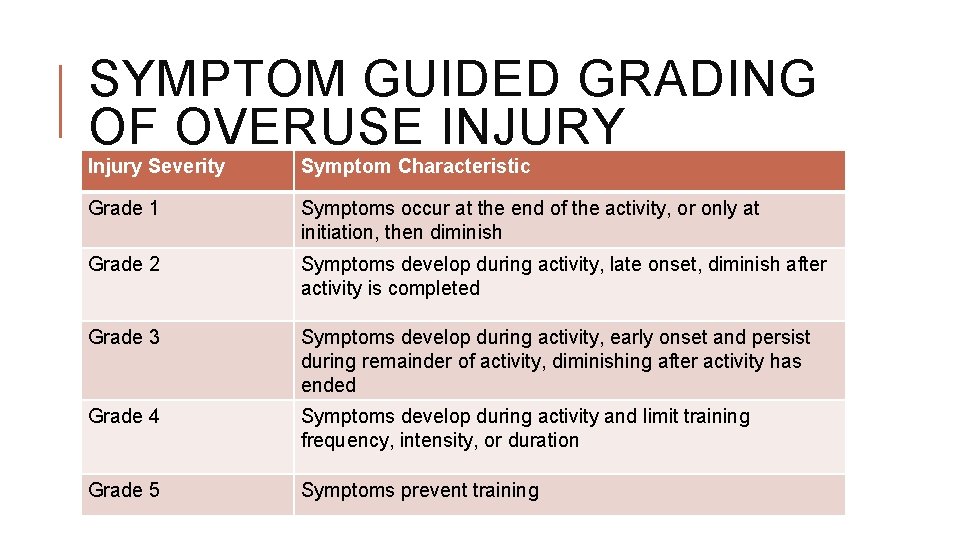
SYMPTOM GUIDED GRADING OF OVERUSE INJURY Injury Severity Symptom Characteristic Grade 1 Symptoms occur at the end of the activity, or only at initiation, then diminish Grade 2 Symptoms develop during activity, late onset, diminish after activity is completed Grade 3 Symptoms develop during activity, early onset and persist during remainder of activity, diminishing after activity has ended Grade 4 Symptoms develop during activity and limit training frequency, intensity, or duration Grade 5 Symptoms prevent training
GENERAL PRINCIPLES OF OVERUSE INJURY DIAGNOSIS AND TREATMENT Diagnosis Treatment • Careful physical exam • Restriction of activity • X-rays should be obtained if unsure of the injury • Most X-rays will be read as normal, especially early on in symptoms
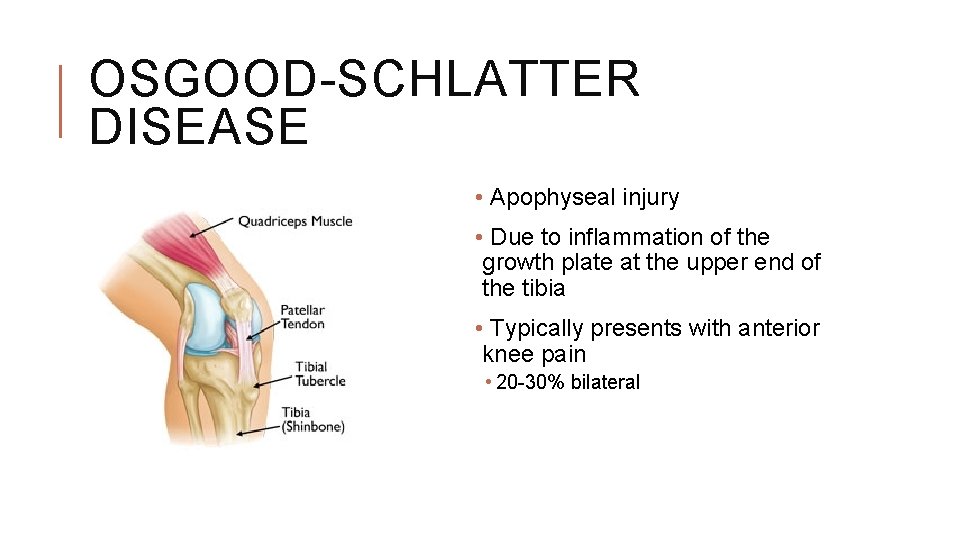
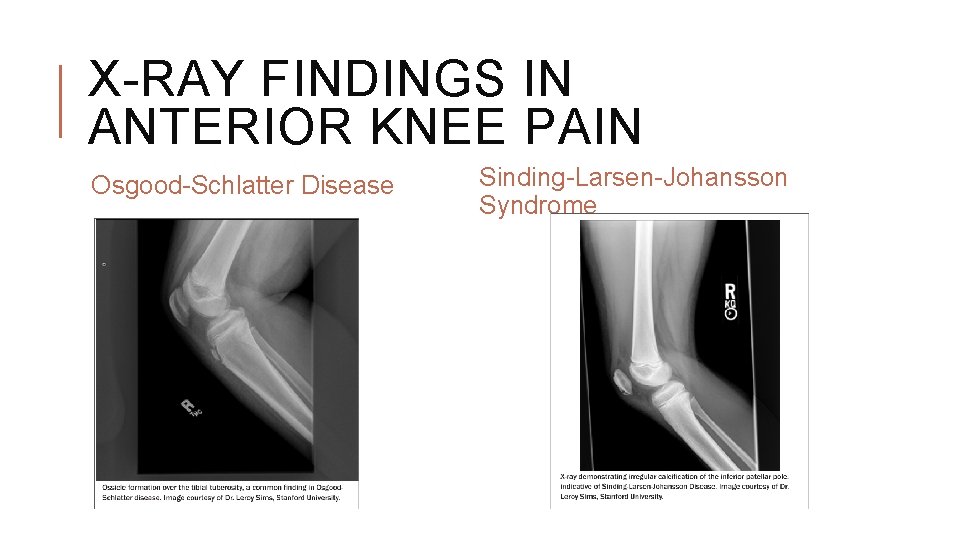
OSGOOD-SCHLATTER DISEASE • Apophyseal injury • Due to inflammation of the growth plate at the upper end of the tibia • Typically presents with anterior knee pain • 20 -30% bilateral
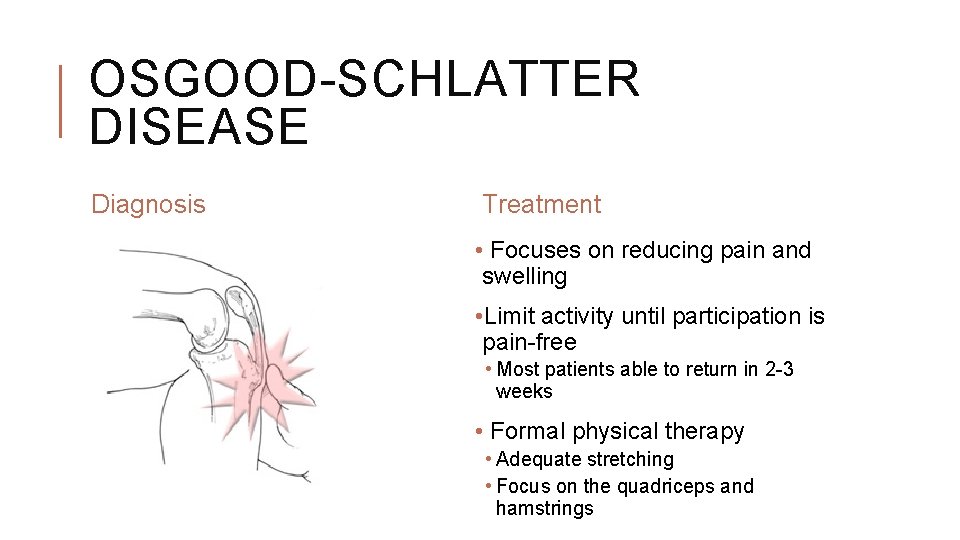
OSGOOD-SCHLATTER DISEASE Diagnosis Treatment • Focuses on reducing pain and swelling • Limit activity until participation is pain-free • Most patients able to return in 2 -3 weeks • Formal physical therapy • Adequate stretching • Focus on the quadriceps and hamstrings
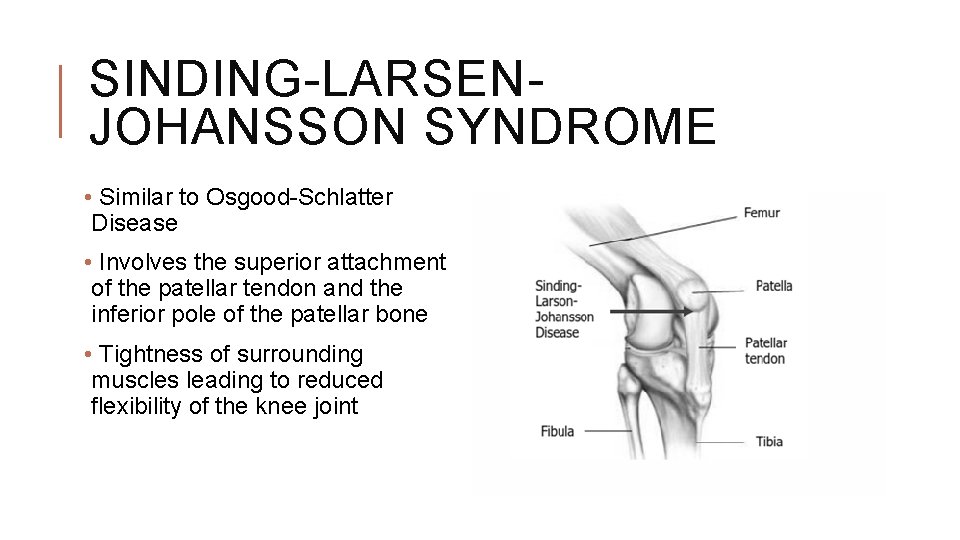
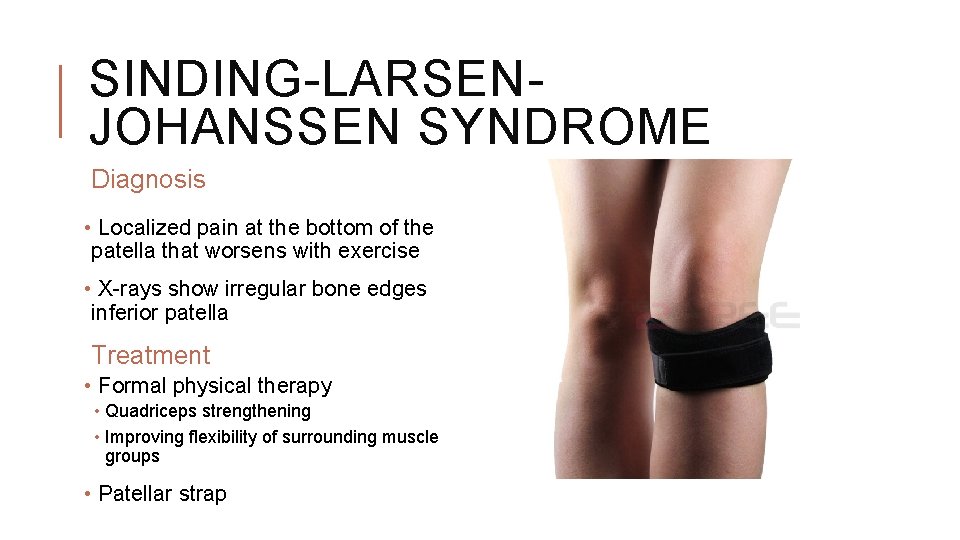
SINDING-LARSENJOHANSSON SYNDROME • Similar to Osgood-Schlatter Disease • Involves the superior attachment of the patellar tendon and the inferior pole of the patellar bone • Tightness of surrounding muscles leading to reduced flexibility of the knee joint
SINDING-LARSENJOHANSSEN SYNDROME Diagnosis • Localized pain at the bottom of the patella that worsens with exercise • X-rays show irregular bone edges inferior patella Treatment • Formal physical therapy • Quadriceps strengthening • Improving flexibility of surrounding muscle groups • Patellar strap
X-RAY FINDINGS IN ANTERIOR KNEE PAIN Osgood-Schlatter Disease Sinding-Larsen-Johansson Syndrome
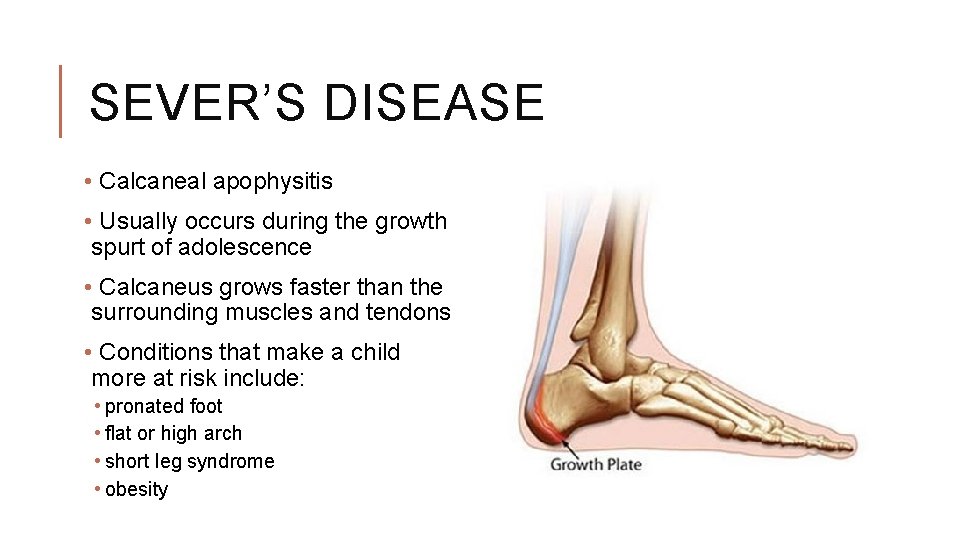
SEVER’S DISEASE • Calcaneal apophysitis • Usually occurs during the growth spurt of adolescence • Calcaneus grows faster than the surrounding muscles and tendons • Conditions that make a child more at risk include: • pronated foot • flat or high arch • short leg syndrome • obesity
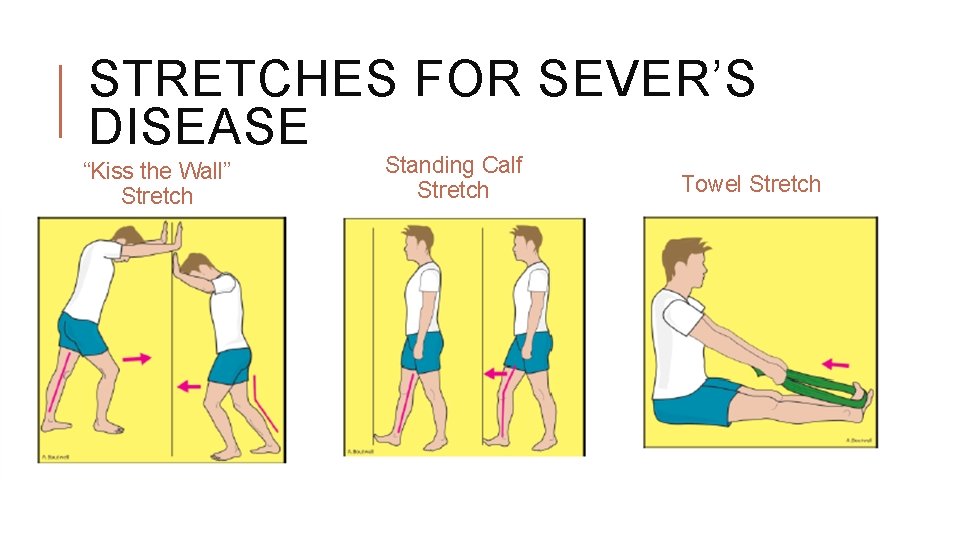
SEVER’S DISEASE Diagnosis • Pain that occurs during or after exercise and is relieved by rest • May worsen with wearing cleats • Swelling and redness of the heel • “Squeeze test” • X-rays are normal Treatment • Short period of rest • Ice when sore • Proper stretching • Heel cups or supportive shoe inserts
STRETCHES FOR SEVER’S DISEASE “Kiss the Wall” Stretch Standing Calf Stretch Towel Stretch
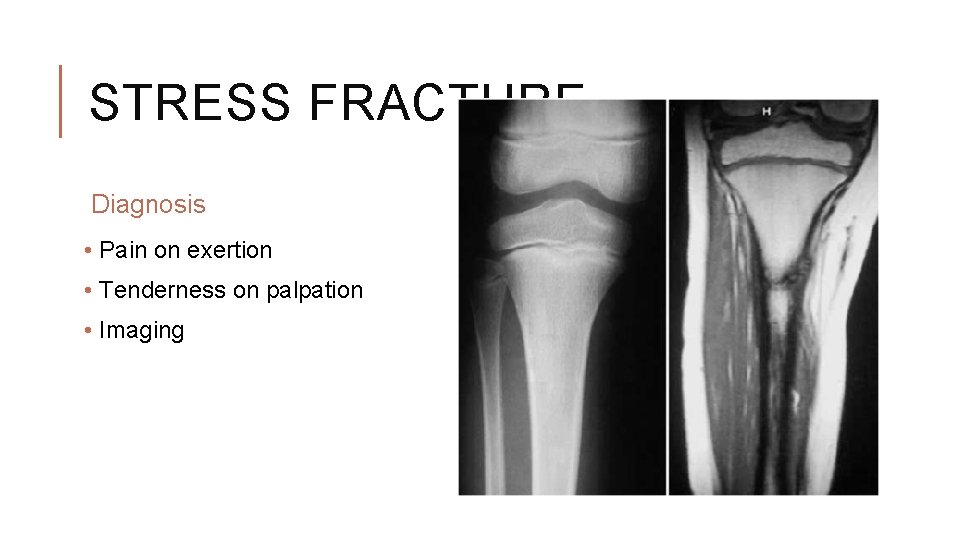
STRESS FRACTURES • Often overlooked as “growing pains” • More common in lower extremities • Tender to palpation and percussion • Risk factors include previous stress fracture, increasing intensity or length of work-out, improper shoes, and starting intense training program after period of inactivity
STRESS FRACTURE Diagnosis • Pain on exertion • Tenderness on palpation • Imaging
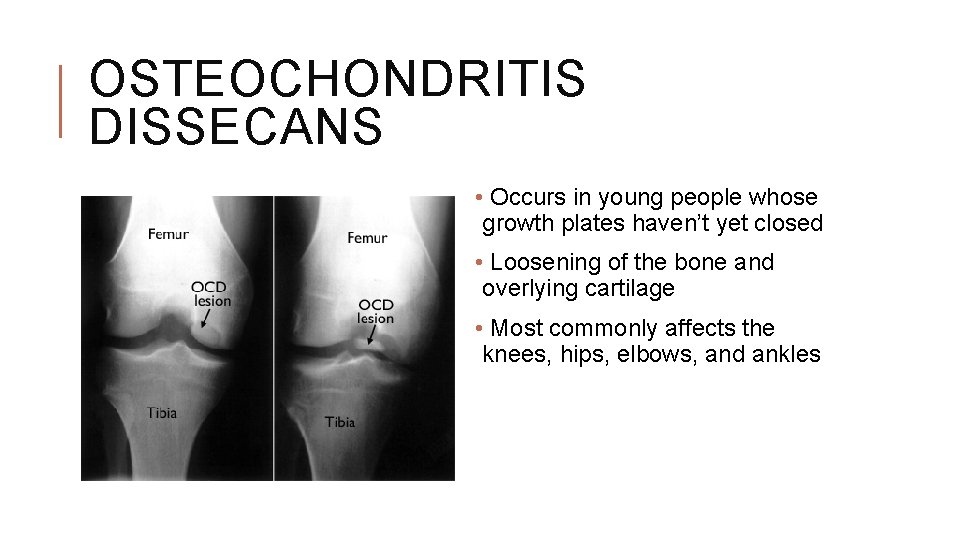
OSTEOCHONDRITIS DISSECANS • Occurs in young people whose growth plates haven’t yet closed • Loosening of the bone and overlying cartilage • Most commonly affects the knees, hips, elbows, and ankles
OSTEOCHONDRITIS DISSECANS Diagnosis Treatment • Symptoms may include a joint that “locks” or “gets stuck” • Conservative treatment at 1 st • X-rays may show small pieces of bone that have separated • Long period of rest • May require casting or bracing • Surgery may be necessary
YOUTH BASEBALL AND OVERUSE INJURIES
BASEBALL IN THE AGE OF SPECIALIZATION • Approximately 5 million children ages 6 -17 yo participate in organized youth baseball leagues in the US • Since 1990 s, increase in independent baseball and travel teams • Typically for pitchers, talent recognition occurs in the latter years of high school (ages 15 -18). • Peak performance in mid-late 20 s • Retirement before age 40 • In the 21 st century, approximately ¼ of UCL surgeries are performed on youth or high school pitchers
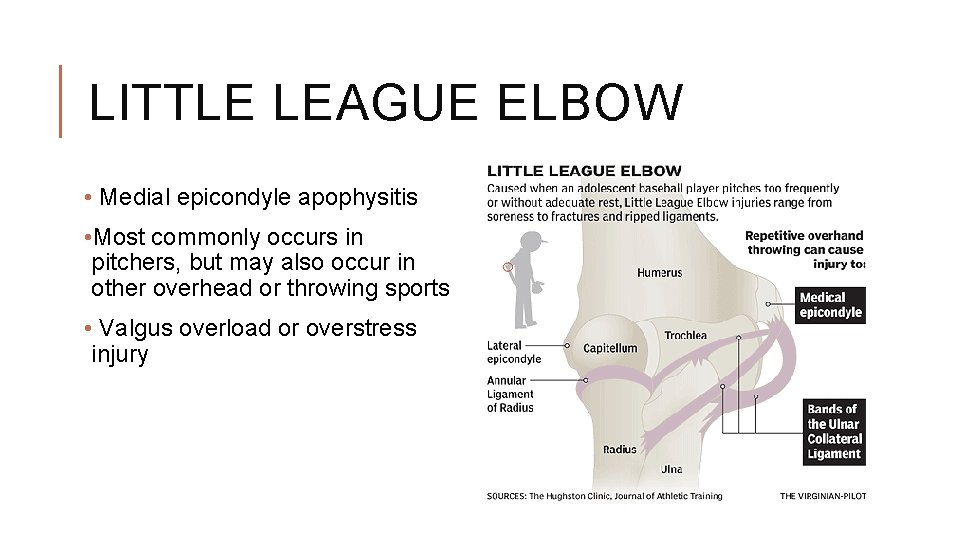
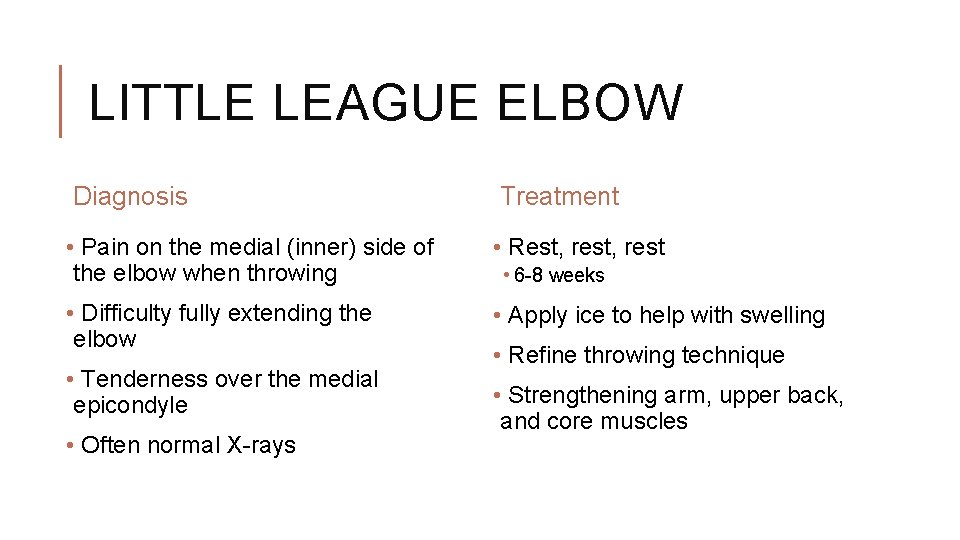
LITTLE LEAGUE ELBOW • Medial epicondyle apophysitis • Most commonly occurs in pitchers, but may also occur in other overhead or throwing sports • Valgus overload or overstress injury
LITTLE LEAGUE ELBOW Diagnosis Treatment • Pain on the medial (inner) side of the elbow when throwing • Rest, rest • Difficulty fully extending the elbow • Apply ice to help with swelling • Tenderness over the medial epicondyle • Often normal X-rays • 6 -8 weeks • Refine throwing technique • Strengthening arm, upper back, and core muscles
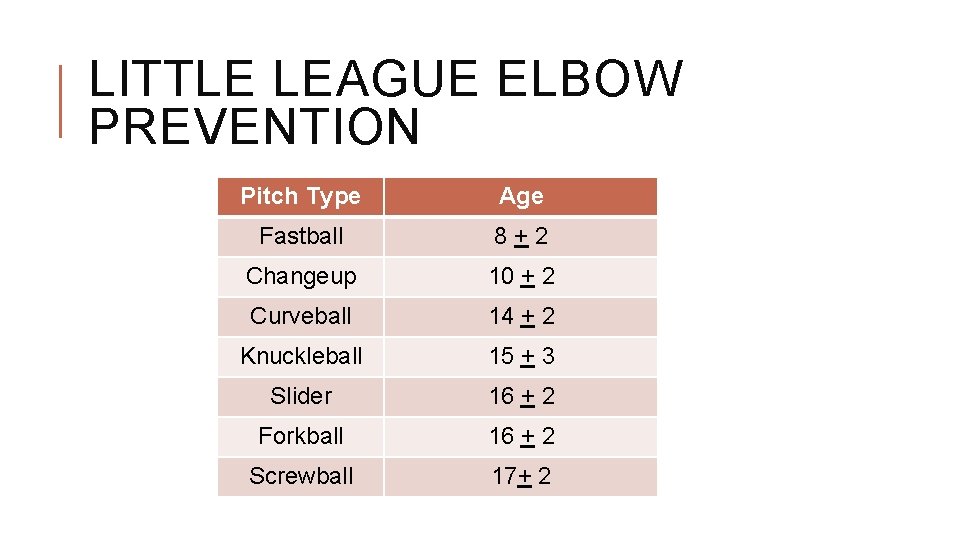
LITTLE LEAGUE ELBOW PREVENTION Pitch Type Age Fastball 8 + 2 Changeup 10 + 2 Curveball 14 + 2 Knuckleball 15 + 3 Slider 16 + 2 Forkball 16 + 2 Screwball 17+ 2
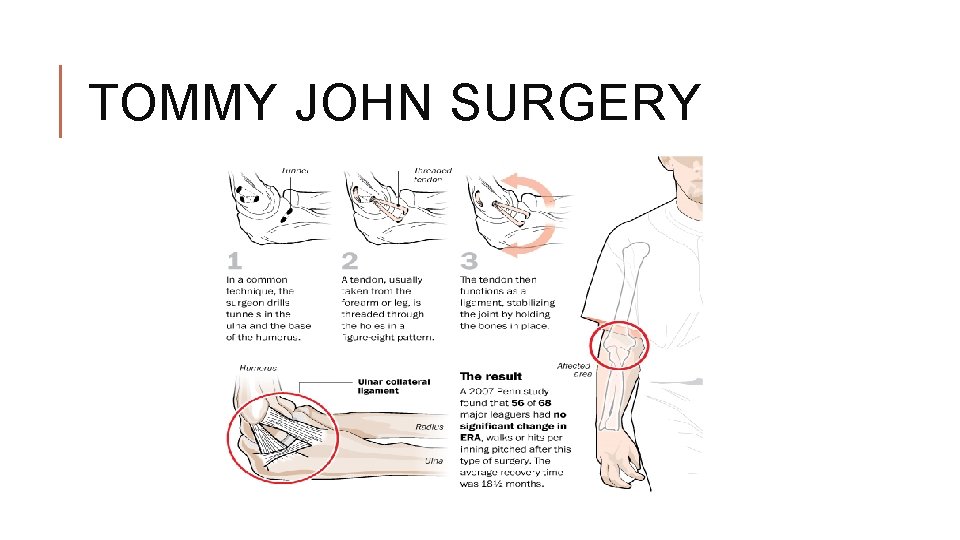
TOMMY JOHN SURGERY
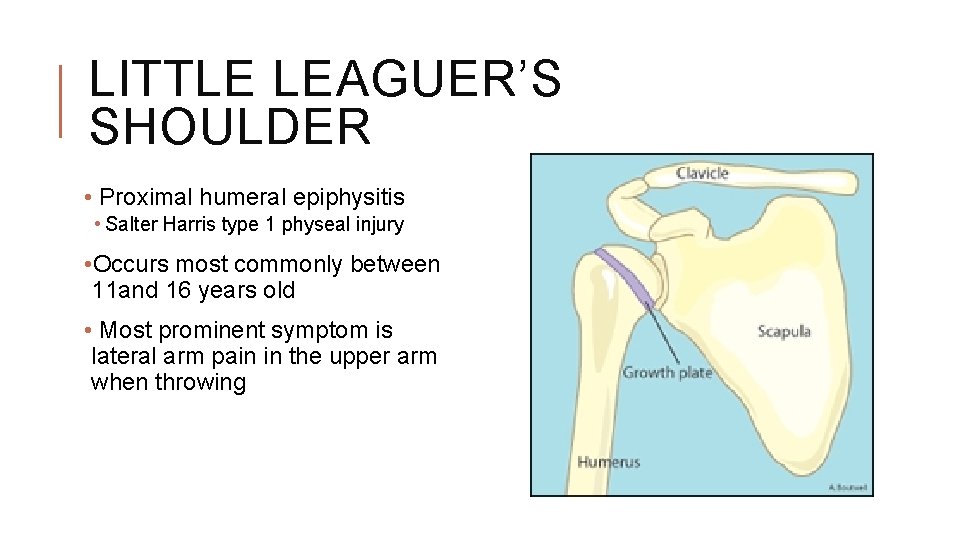
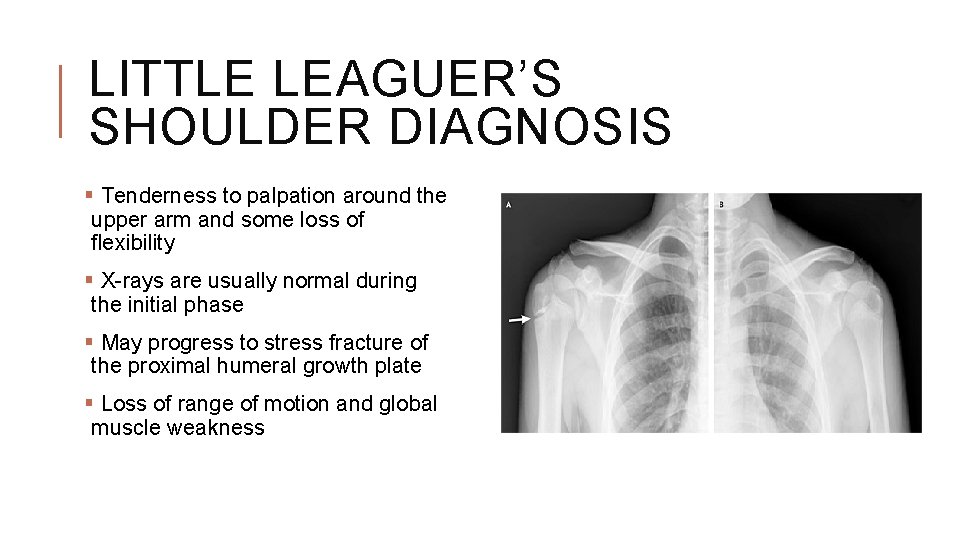
LITTLE LEAGUER’S SHOULDER • Proximal humeral epiphysitis • Salter Harris type 1 physeal injury • Occurs most commonly between 11 and 16 years old • Most prominent symptom is lateral arm pain in the upper arm when throwing
LITTLE LEAGUER’S SHOULDER DIAGNOSIS § Tenderness to palpation around the upper arm and some loss of flexibility § X-rays are usually normal during the initial phase § May progress to stress fracture of the proximal humeral growth plate § Loss of range of motion and global muscle weakness
LITTLE LEAGUER’S SHOULDER TREATMENT § Initial treatment is immediate restriction from activities § 6 -8 weeks § Gradual return to play § Truncal core strengthening and isometric upper extremity exercises
GUIDELINES FOR YOUTH PITCHERS 1. No competitive baseball pitching for at least 4 months per year 2. Pitch no more than 100 innings per year 3. Avoid pitching on multiple teams with overlapping seasons 4. Do not play both pitcher and catcher 5. Play other sports 6. Discontinue pitching if complaints of elbow or shoulder pain
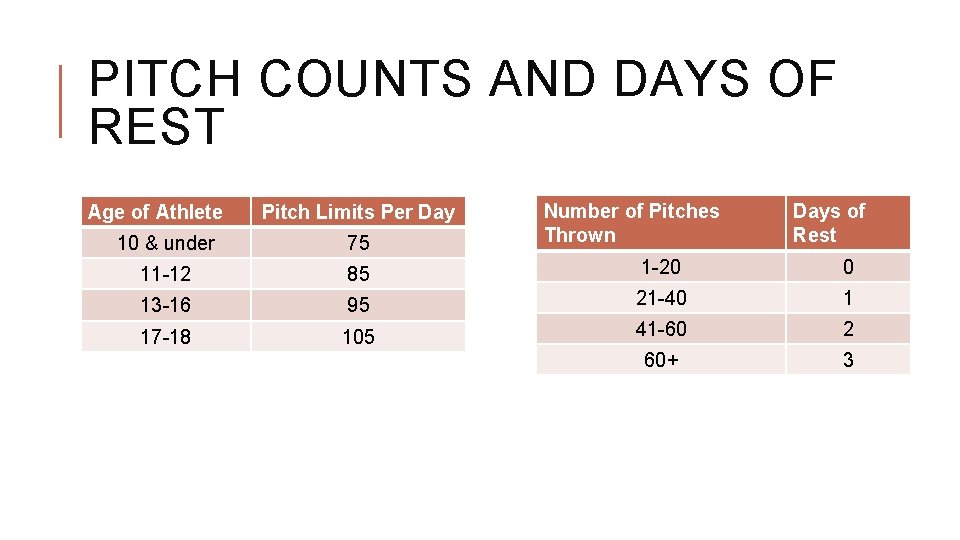
PITCH COUNTS AND DAYS OF REST Age of Athlete Pitch Limits Per Day Number of Pitches Thrown Days of Rest 10 & under 75 11 -12 85 1 -20 0 13 -16 95 21 -40 1 17 -18 105 41 -60 2 60+ 3
CONCLUSIONS • Participation in youth sports has numerous benefits that go beyond the well-known health benefits. • Sport specialization is a growing trend in the nation. • Overuse injuries are common in pediatric athletes and the mainstay of treatment is restriction from activity. • Youth baseball pitchers are at especially high risk for overuse injuries if recommendations for adequate rest and pitch counts are not followed.
THE THEORY OF SPORT SPECIALIZATION IS BASED ON AN INTERPRETATION OF A STUDY DONE BY ERICSSON. IN HIS STUDY, HOW MANY HOURS OF PRACTICE WERE THOUGHT TO BE REQUIRED TO REACH MASTERY LEVEL OF A SKILL? 1. 100 2. 1, 000 3. 10, 000 4. 100, 000
PRESENTS TO YOUR OFFICE WITH A CHIEF COMPLAINT OF ANTERIOR KNEE PAIN. HE STATES THAT THE PAIN WORSENS WITH RUNNING AND JUMPING. ON PHYSICAL EXAM, HE HAS EXTREME TENDERNESS ON PALPATION OF THE INFERIOR PATELLA. YOU ALSO NOTICE THAT HIS QUADRICEPS SEEM TIGHT. HE HAS GOOD RANGE OF MOTION OF THE KNEE JOINT. WHAT IS THIS PATIENT’S 1. Osgood-Schlatter disease DIAGNOSIS? 2. Sinding-Larsen-Johansson syndrome 3. Osteochondritis dissecans of the knee
SHE HAS RECENTLY STARTED PLAYING SOCCER AGAIN AFTER TAKING SEVERAL MONTHS OFF. SHE HAS NOT YET PURCHASED NEW CLEATS FOR THE SEASON. SHE DOES NOT HAVE ANY HISTORY OF PREVIOUS INJURY TO THE FOOT. ON EXAM, SHE HAS TENDERNESS TO PALPATION AND PERCUSSION OVER THE 2 ND AND 3 RD METATARSALS. YOU SUSPECT A STRESS FRACTURE. WHAT ASPECTS OF THE PATIENT’S 1. HISTORY PUTS HER AT RISK FOR A STRESS Female FRACTURE? 2. Recently starting soccer 3. Wearing old cleats 4. All of the above 5. A&B only
PHYSICAL FOR BASEBALL. HE CURRENTLY PITCHES FOR A RECREATION LEAGUE TEAM AND A TRAVEL TEAM. THIS YEAR, HE WILL ALSO BE TRYING-OUT FOR THE JUNIOR VARSITY TEAM AT THE LOCAL HIGH SCHOOL. WHEN NOT PITCHING, HE USUALLY PLAYS CATCHER. LAST YEAR, HE PLAYED IN OVER 100 GAMES, AND PITCHED MORE THAN 120 INNINGS. WHAT ADVICE SHOULD YOU COUNSEL BOTH THE PATIENT AND PARENT IN REGARDS TO PREVENTION 1. He should pitch no more than 100 innings per OF OVERUSE INJURIES? 2. 3. 4. 5. year. Take at least 2 months off from pitching per year. Play on only 2 teams at one time. Limit total number of games to 100 per calendar year. It is ok to continue playing if you experience
REFERENCES 1. Brenner J. Overuse Injuries, Overtraining, and Burnout in Child and Adolescent Athletes. Pediatrics. 2007; 119: 1242 -1245. 2. Di. Fiori J. Evaluation of Overuse Injuries in Children and Adolescents. Curr Sports Med Rep 2010: 9; 372 -378. 3. Feeley B, Agel J, La. Prade R. When Is It Too Early for Single Sport Specialization? Am J Sports Med 2015. 4. Ferguson B, Stern P. A Case of Early Sports Specialization in an Adolescent Athlete. J Can Chiropr Assoc 2014: 58; 377 -383. 5. Fleisig G, Andrews J, Cutter G, Weber A, Loftice J, Mc. Michael C, Hassell N, Lyman S. Risk of Serious Injury for Young Baseball Pitchers: A 10 -Year Prospective Study. Am J Sports Med 2011; 39: 253 -257. 6. Goncalves C, Coelho e Silva M, Carvalho H, Goncalves A. Why do they engage in such hard programs? The search for excellence in youth basketball. J Sports Sci Med 2011: 10; 458 -464. 7. Jayanthi N, La. Bella C, Fischer D, Pasulka, Dugas L. Sports-Specialized Intensive Training and the Risk of Injury in Youth Athletes: A Clinical Case-Control Study. Am J Sports Med 2015: 43; 794 -801. 8. Jayanthi N, Pinkham C, Dugas L, Patrick B, La. Bella C. Sports Specialiation in Youth Athletes: Evidence-Based Recommendations. Sports Health 2013: 5; 251 -257.
REFERENCES 10. Makhni E, Morrow Z, Luchetti T, Mishra-Kalyani P, Gualtieri A, Lee R, Ahmad C. Arm Pain in Youth Baseball Players: A Survey of Healthy Players. Am J Sports Med 2015: 43; 41 -46. 11. Merkel D, Molony J. Recognition and Management of Traumatic Sports Injuries in the Skeletally Immature Athlete. Int J Sports Phy Ther 2012; 7: 691 -704. 12. Myer G, Jayanthi N, Difiori J, Faigenbaum A, Kiefer A, Logerstedt D, Micheli L. Sport Specialization, Part 1: Does Early Sport Specialization Increase Negative Outcomes and Reduce the Opportunity for Success in Youth Athletes? Sports Health 2015: 7: 437 -442. 13. Niemeyer P, Weinberg A, Schmitt H, Kruez PC, Ewerbeck V, Kasten P. Stress Fractures in the Juvenile Skeleton. Int J Sports Med 2006; 27: 242 -249. 14. Paterno M, Taylor-Haas J, Myer G, Hewett T. Prevention of Overuse Sports Injuries in the Young Athlete. Orthop Clin N Am 2013: 44; 553 -564. 15. Seefeldt V, Ewing M. Youth Sports in America: An Overview. President's Council on Physical Fitness and Sports Research Digest 1997. 16. Wojtys E. Sports Specialization vs Diversification. Sports Health 2013: 5; 212 -213. 17. Yang J, Mann B, Guettler J, Dugas J, Irrgang J, Fleisig G, Albright J. Risk-Prone Pitching Acitivities and Injuries in Youth Basebal: Findings from a National Sample. Am J Sports Med 2014: 42; 1456 -1463.
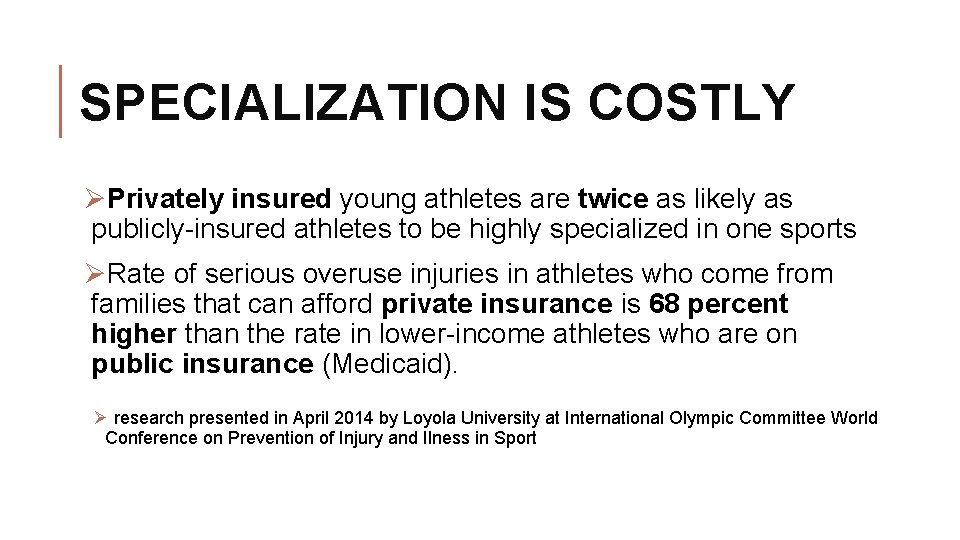
SPECIALIZATION IS COSTLY ØPrivately insured young athletes are twice as likely as publicly-insured athletes to be highly specialized in one sports ØRate of serious overuse injuries in athletes who come from families that can afford private insurance is 68 percent higher than the rate in lower-income athletes who are on public insurance (Medicaid). Ø research presented in April 2014 by Loyola University at International Olympic Committee World Conference on Prevention of Injury and Ilness in Sport
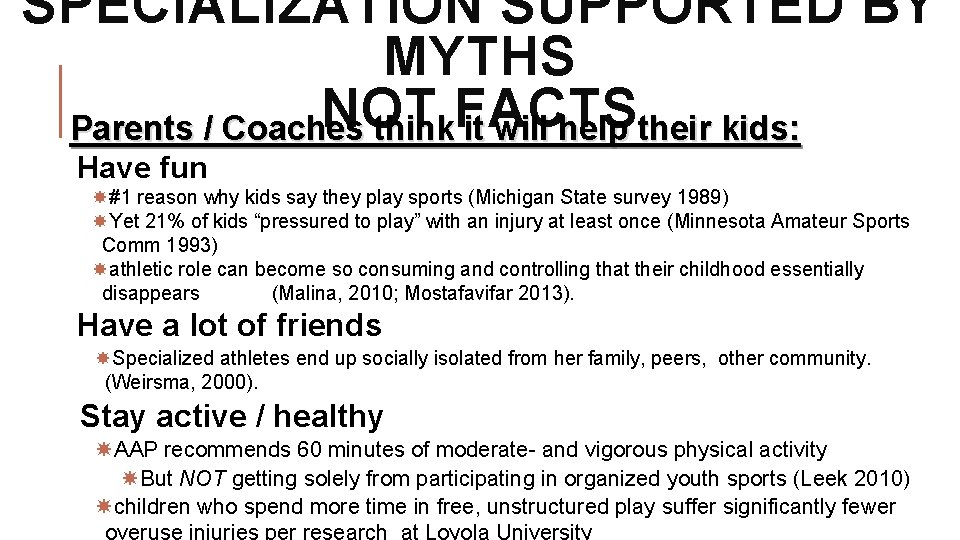
SPECIALIZATION SUPPORTED BY MYTHS NOT FACTS Parents / Coaches think it will help their kids: Have fun #1 reason why kids say they play sports (Michigan State survey 1989) Yet 21% of kids “pressured to play” with an injury at least once (Minnesota Amateur Sports Comm 1993) athletic role can become so consuming and controlling that their childhood essentially disappears (Malina, 2010; Mostafavifar 2013). Have a lot of friends Specialized athletes end up socially isolated from her family, peers, other community. (Weirsma, 2000). Stay active / healthy AAP recommends 60 minutes of moderate- and vigorous physical activity But NOT getting solely from participating in organized youth sports (Leek 2010) children who spend more time in free, unstructured play suffer significantly fewer
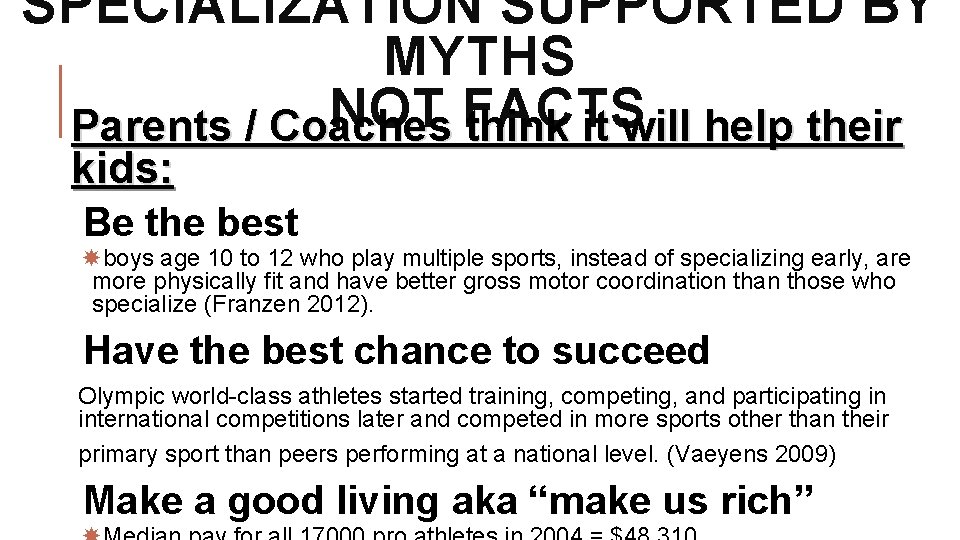
SPECIALIZATION SUPPORTED BY MYTHS NOT FACTS Parents / Coaches think it will help their kids: Be the best boys age 10 to 12 who play multiple sports, instead of specializing early, are more physically fit and have better gross motor coordination than those who specialize (Franzen 2012). Have the best chance to succeed Olympic world-class athletes started training, competing, and participating in international competitions later and competed in more sports other than their primary sport than peers performing at a national level. (Vaeyens 2009) Make a good living aka “make us rich”