
Introduction to Medicines Calls for Health Advisors Your


















- Slides: 58
Introduction to Medicines Calls for Health Advisors Your name Medicines Information Pharmacist Your Medicines Information Service
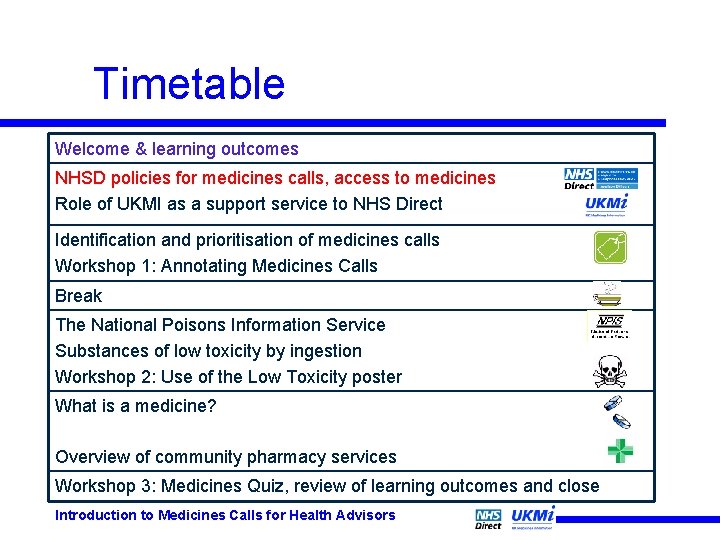
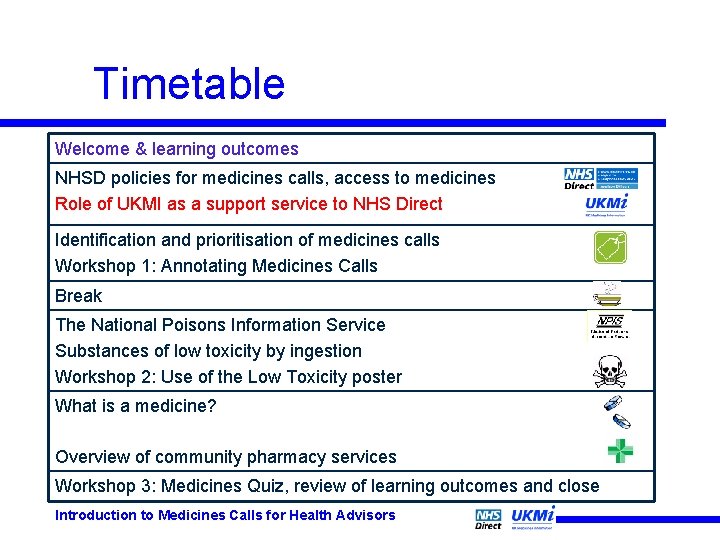
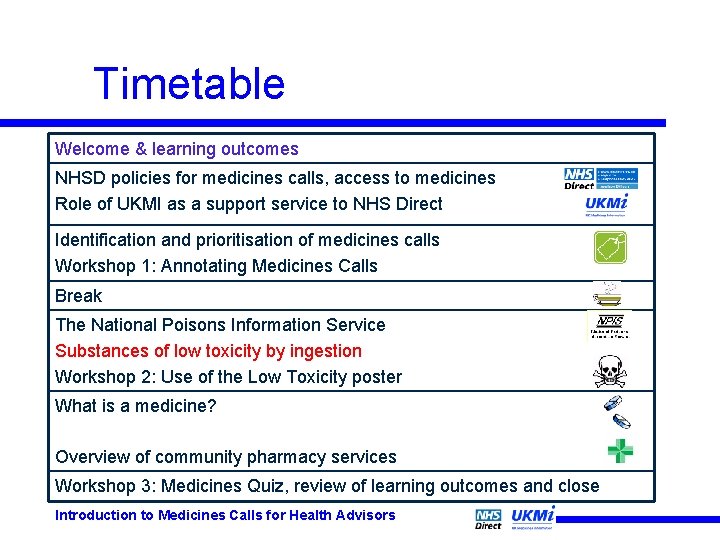
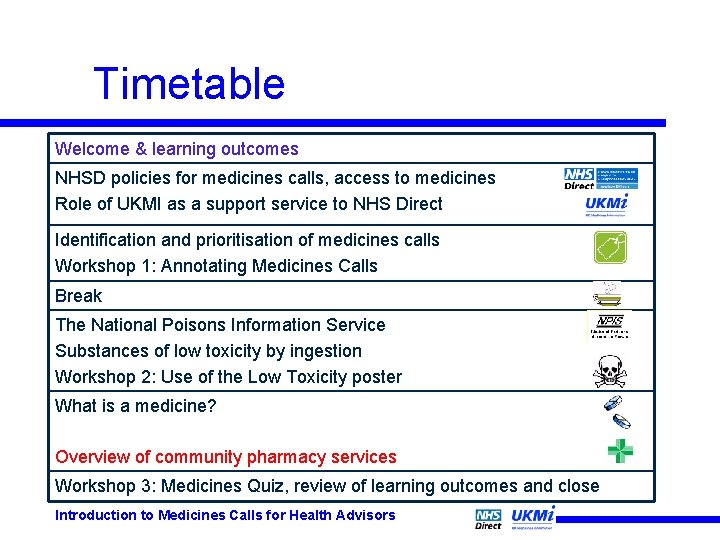
Timetable Welcome & learning outcomes NHSD policies for medicines calls, access to medicines Role of UKMI as a support service to NHS Direct Identification and prioritisation of medicines calls Workshop 1: Annotating Medicines Calls Break The National Poisons Information Service Substances of low toxicity by ingestion Workshop 2: Use of the Low Toxicity poster What is a medicine? Overview of community pharmacy services Workshop 3: Medicines Quiz, review of learning outcomes and close Introduction to Medicines Calls for Health Advisors
Timetable Welcome & learning outcomes NHSD policies for medicines calls, access to medicines Role of UKMI as a support service to NHS Direct Identification and prioritisation of medicines calls Workshop 1: Annotating Medicines Calls Break The National Poisons Information Service Substances of low toxicity by ingestion Workshop 2: Use of the Low Toxicity poster What is a medicine? Overview of community pharmacy services Workshop 3: Medicines Quiz, review of learning outcomes and close Introduction to Medicines Calls for Health Advisors
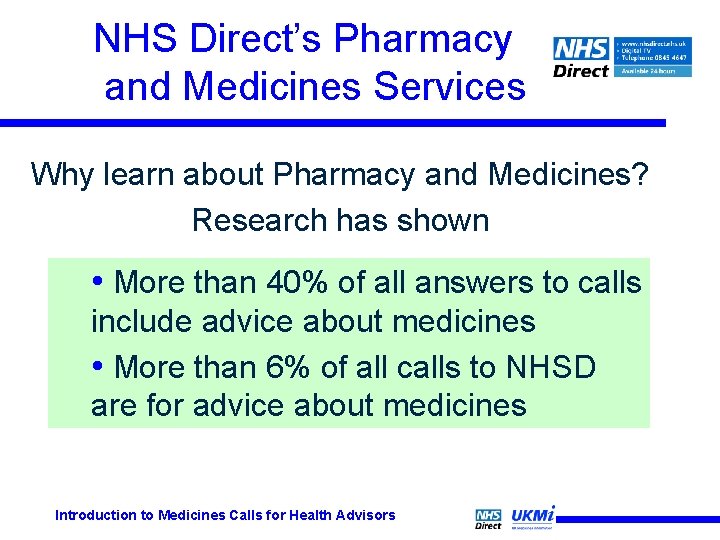
NHS Direct’s Pharmacy and Medicines Services Why learn about Pharmacy and Medicines? Research has shown • More than 40% of all answers to calls include advice about medicines • More than 6% of all calls to NHSD are for advice about medicines Introduction to Medicines Calls for Health Advisors
NHS Direct’s Pharmacy and Medicines Services Definition of a medicines call? Medicines prescribed by the doctor Homeopathic medicines Medicines bought at a pharmacy Food supplements and vitamins Medicines bought at a general shop Herbal medicines Recreational drugs and drugs of abuse Steroids in sport Introduction to Medicines Calls for Health Advisors
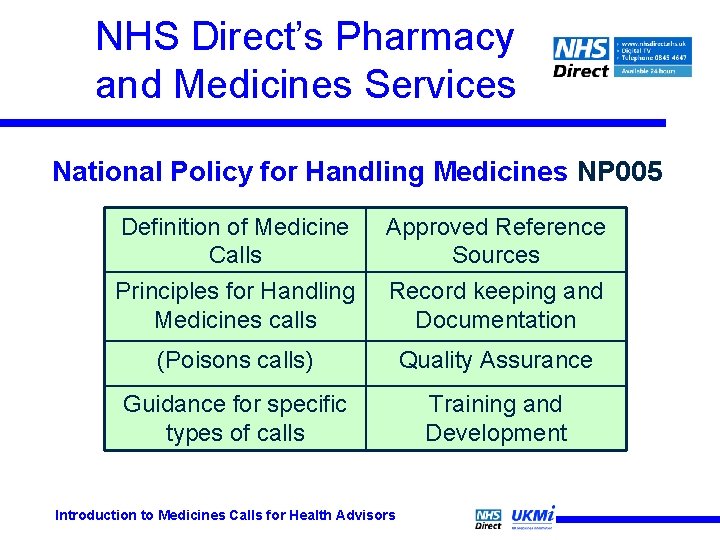
NHS Direct’s Pharmacy and Medicines Services National Policy for Handling Medicines NP 005 Definition of Medicine Calls Approved Reference Sources Principles for Handling Medicines calls Record keeping and Documentation (Poisons calls) Quality Assurance Guidance for specific types of calls Training and Development Introduction to Medicines Calls for Health Advisors
NHS Direct’s Pharmacy and Medicines Services Health Advisors P 4 “Quick Calls”: Information on access n Locations & opening hours of pharmacies, family planning clinics, walk-in centres. n Where can I get EHC? n How do I get a repeat prescription? n How do I get a new oxygen cylinder? Interim information on Low Toxicity ingestions Interim care instructions for dental pain Health Information P 4 Calls (M 1, M 2 or M 3): Information about medicines Advisors n No new or worsening symptoms. Nurse Advisors P 1 -4 Calls: Advice or information about medicines n Symptoms. n No new or worsening symptoms. Dental Nurse Advisors Information about medicines for dental conditions Introduction to Medicines Calls for Health Advisors
Timetable Welcome & learning outcomes NHSD policies for medicines calls, access to medicines Role of UKMI as a support service to NHS Direct Identification and prioritisation of medicines calls Workshop 1: Annotating Medicines Calls Break The National Poisons Information Service Substances of low toxicity by ingestion Workshop 2: Use of the Low Toxicity poster What is a medicine? Overview of community pharmacy services Workshop 3: Medicines Quiz, review of learning outcomes and close Introduction to Medicines Calls for Health Advisors
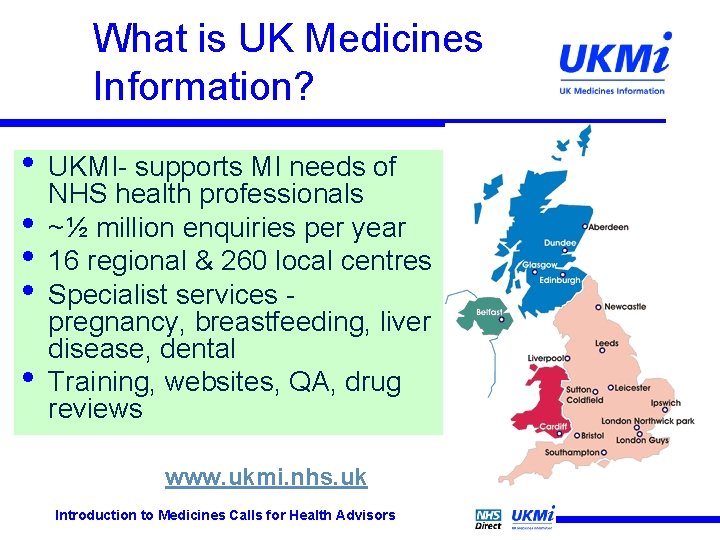
What is UK Medicines Information? • • • UKMI- supports MI needs of NHS health professionals ~½ million enquiries per year 16 regional & 260 local centres Specialist services - pregnancy, breastfeeding, liver disease, dental Training, websites, QA, drug reviews www. ukmi. nhs. uk Introduction to Medicines Calls for Health Advisors
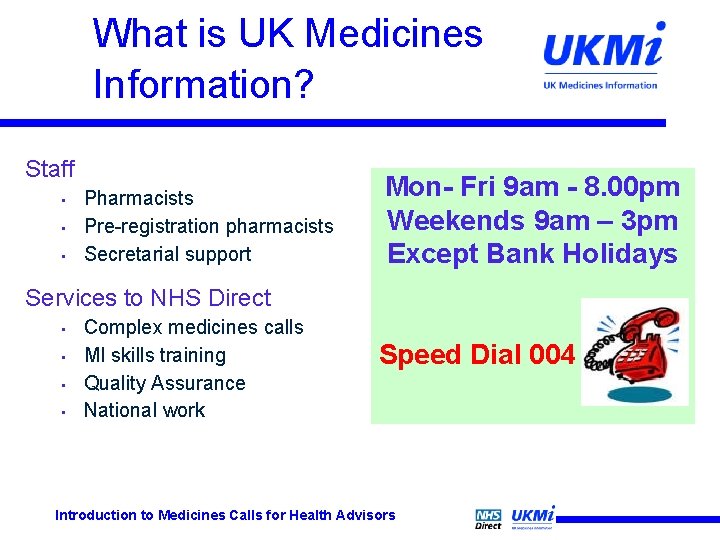
What is UK Medicines Information? Staff • • • Pharmacists Pre-registration pharmacists Secretarial support Mon- Fri 9 am - 8. 00 pm Weekends 9 am – 3 pm Except Bank Holidays Services to NHS Direct • • Complex medicines calls MI skills training Quality Assurance National work Speed Dial 004 Introduction to Medicines Calls for Health Advisors
Timetable Welcome & learning outcomes NHSD policies for medicines calls, access to medicines Role of UKMI as a support service to NHS Direct Identification and prioritisation of medicines calls Workshop 1: Annotating Medicines Calls Break The National Poisons Information Service Substances of low toxicity by ingestion Workshop 2: Use of the Low Toxicity poster What is a medicine? Overview of community pharmacy services Workshop 3: Medicines Quiz, review of learning outcomes and close Introduction to Medicines Calls for Health Advisors
NHS Direct’s Pharmacy and Medicines Services All calls to NHSD can be categorised as Injury, Illness or Information. ‘The purpose of CSPT is to get the patient to the right endpoint at the right time and thereby use NHS resources appropriately’ See Using CSPT Effectively e-learning tool and Using CSPT in the Call Handling Phase of Care Delivery workbook Introduction to Medicines Calls for Health Advisors
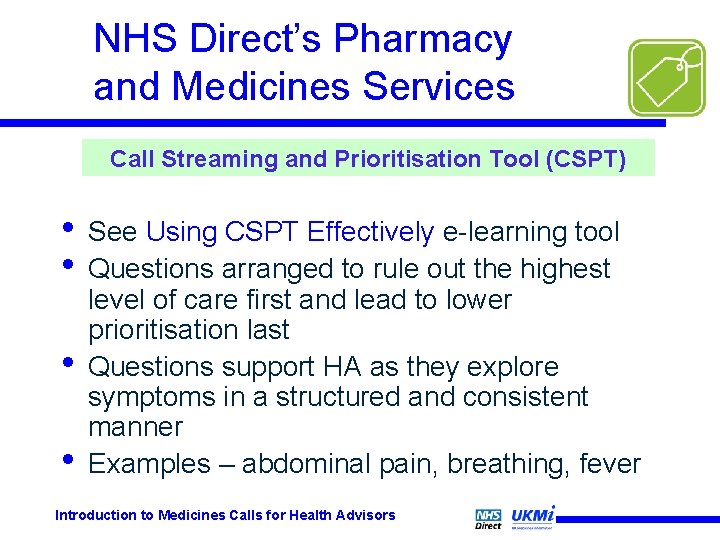
NHS Direct’s Pharmacy and Medicines Services Call Streaming and Prioritisation Tool (CSPT) • • See Using CSPT Effectively e-learning tool Questions arranged to rule out the highest level of care first and lead to lower prioritisation last Questions support HA as they explore symptoms in a structured and consistent manner Examples – abdominal pain, breathing, fever Introduction to Medicines Calls for Health Advisors
NHS Direct’s Pharmacy and Medicines Services Call Streaming and Prioritisation Tool (CSPT) ‘Are you calling for Health Information? ’ If ‘yes’ leads to drop down menu with five selections 1. Repeat prescriptions 2. Access to services 3. Medicines enquiry 4. Health Information 5. None of the above Introduction to Medicines Calls for Health Advisors
Identification and prioritisation of medicines calls The National Health Information Queue All Health Information calls assigned the same priorities nationally: P 4 for Health Information calls Introduction to Medicines Calls for Health Advisors
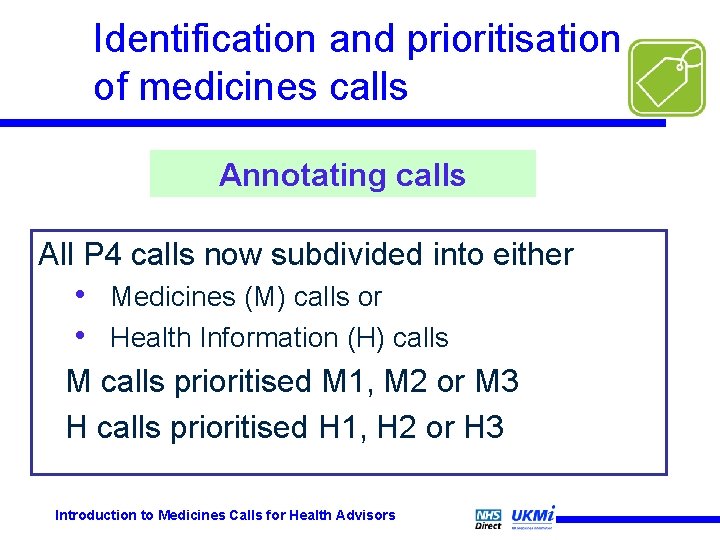
Identification and prioritisation of medicines calls Annotating calls All P 4 calls now subdivided into either • Medicines (M) calls or • Health Information (H) calls M calls prioritised M 1, M 2 or M 3 H calls prioritised H 1, H 2 or H 3 Introduction to Medicines Calls for Health Advisors
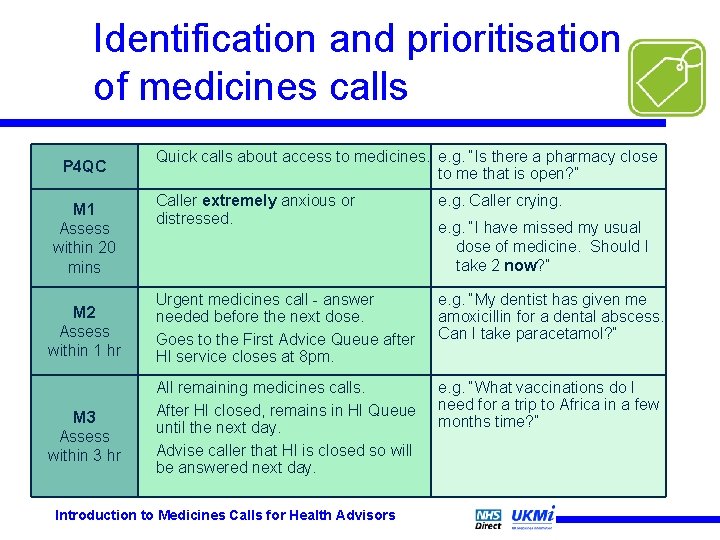
Identification and prioritisation of medicines calls P 4 QC M 1 Assess within 20 mins M 2 Assess within 1 hr M 3 Assess within 3 hr Quick calls about access to medicines. e. g. “Is there a pharmacy close to me that is open? ” Caller extremely anxious or distressed. e. g. Caller crying. Urgent medicines call - answer needed before the next dose. Goes to the First Advice Queue after HI service closes at 8 pm. e. g. “My dentist has given me amoxicillin for a dental abscess. Can I take paracetamol? ” All remaining medicines calls. After HI closed, remains in HI Queue until the next day. Advise caller that HI is closed so will be answered next day. e. g. “What vaccinations do I need for a trip to Africa in a few months time? ” Introduction to Medicines Calls for Health Advisors e. g. “I have missed my usual dose of medicine. Should I take 2 now? ”
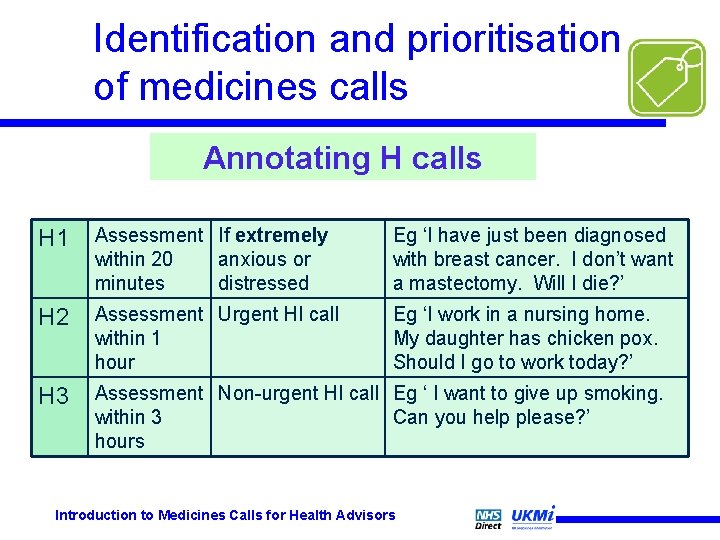
Identification and prioritisation of medicines calls Annotating H calls H 1 Assessment If extremely within 20 anxious or minutes distressed Eg ‘I have just been diagnosed with breast cancer. I don’t want a mastectomy. Will I die? ’ H 2 Assessment Urgent HI call within 1 hour Eg ‘I work in a nursing home. My daughter has chicken pox. Should I go to work today? ’ H 3 Assessment Non-urgent HI call Eg ‘ I want to give up smoking. within 3 Can you help please? ’ hours Introduction to Medicines Calls for Health Advisors
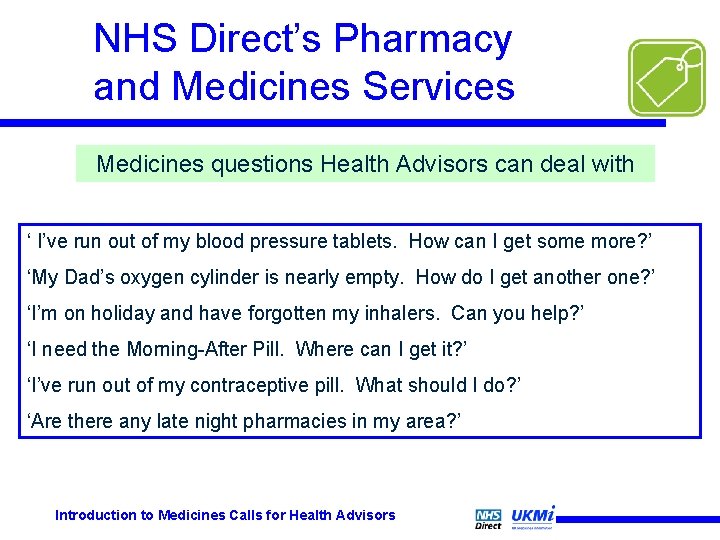
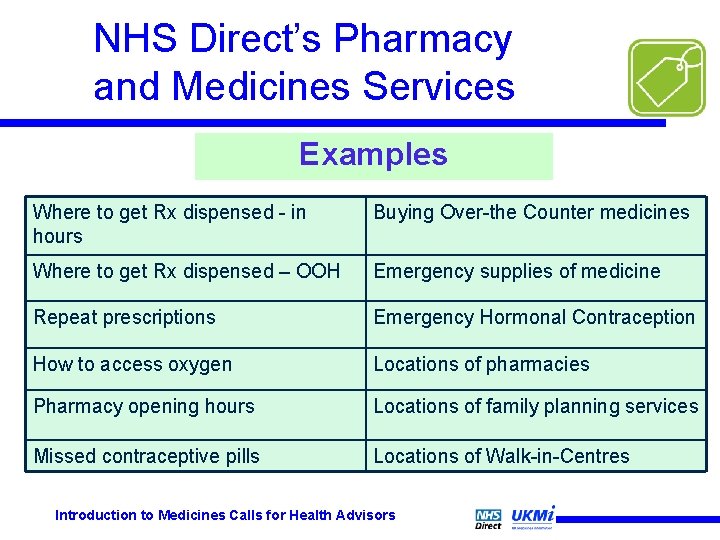
NHS Direct’s Pharmacy and Medicines Services Medicines questions Health Advisors can deal with ‘ I’ve run out of my blood pressure tablets. How can I get some more? ’ ‘My Dad’s oxygen cylinder is nearly empty. How do I get another one? ’ ‘I’m on holiday and have forgotten my inhalers. Can you help? ’ ‘I need the Morning-After Pill. Where can I get it? ’ ‘I’ve run out of my contraceptive pill. What should I do? ’ ‘Are there any late night pharmacies in my area? ’ Introduction to Medicines Calls for Health Advisors
NHS Direct’s Pharmacy and Medicines Services Examples Where to get Rx dispensed - in hours Buying Over-the Counter medicines Where to get Rx dispensed – OOH Emergency supplies of medicine Repeat prescriptions Emergency Hormonal Contraception How to access oxygen Locations of pharmacies Pharmacy opening hours Locations of family planning services Missed contraceptive pills Locations of Walk-in-Centres Introduction to Medicines Calls for Health Advisors
Timetable Welcome & learning outcomes NHSD policies for medicines calls, access to medicines Role of UKMI as a support service to NHS Direct Identification and prioritisation of medicines calls Workshop 1: Annotating Medicines Calls Break The National Poisons Information Service Substances of low toxicity by ingestion Workshop 2: Use of the Low Toxicity poster What is a medicine? Overview of community pharmacy services Workshop 3: Medicines Quiz, review of learning outcomes and close Introduction to Medicines Calls for Health Advisors
Workshop 1 Annotating Medicines Calls Introduction to Medicines Calls for Health Advisors
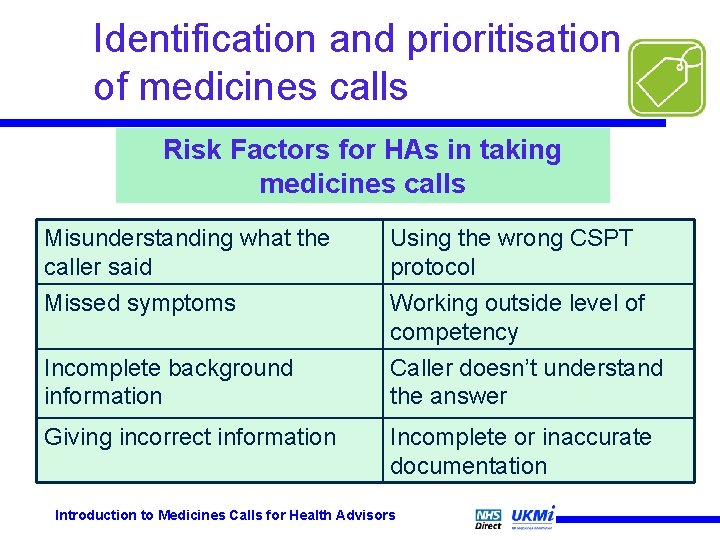
Identification and prioritisation of medicines calls Risk Factors for HAs in taking medicines calls Misunderstanding what the caller said Missed symptoms Using the wrong CSPT protocol Working outside level of competency Incomplete background information Caller doesn’t understand the answer Giving incorrect information Incomplete or inaccurate documentation Introduction to Medicines Calls for Health Advisors
Timetable Welcome & learning outcomes NHSD policies for medicines calls, access to medicines Role of UKMI as a support service to NHS Direct Identification and prioritisation of medicines calls Workshop 1: Annotating Medicines Calls Break The National Poisons Information Service Substances of low toxicity by ingestion Workshop 2: Use of the Low Toxicity poster What is a medicine? Overview of community pharmacy services Workshop 3: Medicines Quiz, review of learning outcomes and close Introduction to Medicines Calls for Health Advisors
Introduction to Medicines Calls for Health Advisors
Timetable Welcome & learning outcomes NHSD policies for medicines calls, access to medicines Role of UKMI as a support service to NHS Direct Identification and prioritisation of medicines calls Workshop 1: Annotating Medicines Calls Break The National Poisons Information Service Substances of low toxicity by ingestion Workshop 2: Use of the Low Toxicity poster What is a medicine? Overview of community pharmacy services Workshop 3: Medicines Quiz, review of learning outcomes and close Introduction to Medicines Calls for Health Advisors
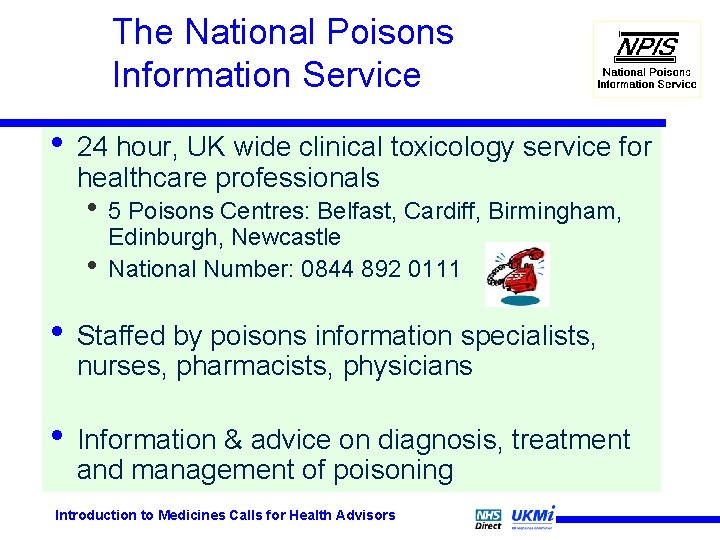
The National Poisons Information Service • 24 hour, UK wide clinical toxicology service for healthcare professionals • • 5 Poisons Centres: Belfast, Cardiff, Birmingham, Edinburgh, Newcastle National Number: 0844 892 0111 • Staffed by poisons information specialists, nurses, pharmacists, physicians • Information & advice on diagnosis, treatment and management of poisoning Introduction to Medicines Calls for Health Advisors
The National Poisons Information Service Previously • All potentially toxic ingestion calls were prioritised P 1 and handled by Nurse Advisors But • Many calls were found to be low toxicity and did not warrant the high priority eg. Sudocrem® Now • HAs can handle calls on ingestions of low toxicity substances Introduction to Medicines Calls for Health Advisors
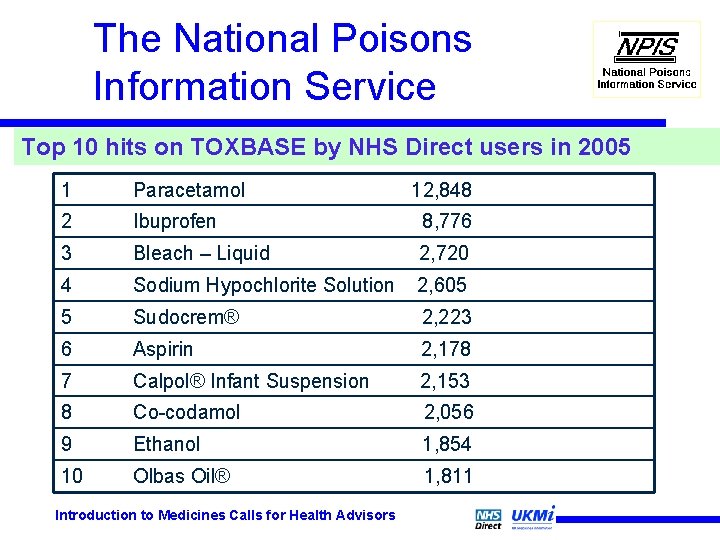
The National Poisons Information Service Top 10 hits on TOXBASE by NHS Direct users in 2005 1 Paracetamol 12, 848 2 Ibuprofen 8, 776 3 Bleach – Liquid 2, 720 4 Sodium Hypochlorite Solution 2, 605 5 Sudocrem® 2, 223 6 Aspirin 2, 178 7 Calpol® Infant Suspension 2, 153 8 Co-codamol 2, 056 9 Ethanol 1, 854 10 Olbas Oil® 1, 811 Introduction to Medicines Calls for Health Advisors
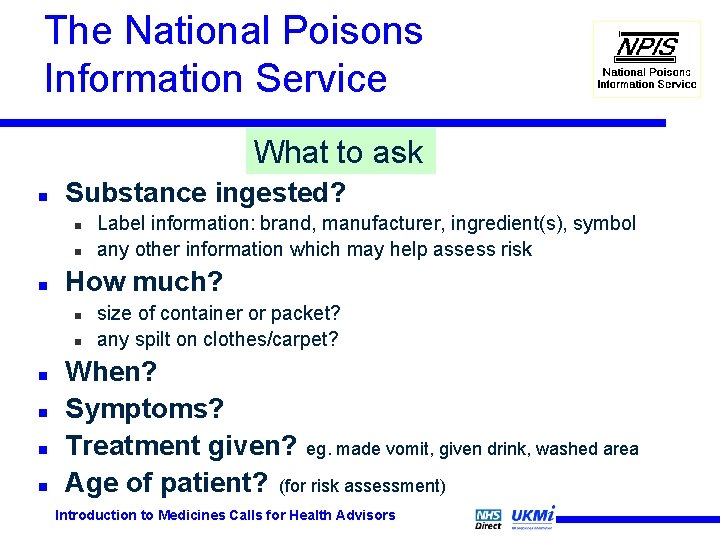
The National Poisons Information Service What to ask n Substance ingested? n n n How much? n n n Label information: brand, manufacturer, ingredient(s), symbol any other information which may help assess risk size of container or packet? any spilt on clothes/carpet? When? Symptoms? Treatment given? eg. made vomit, given drink, washed area Age of patient? (for risk assessment) Introduction to Medicines Calls for Health Advisors
Timetable Welcome & learning outcomes NHSD policies for medicines calls, access to medicines Role of UKMI as a support service to NHS Direct Identification and prioritisation of medicines calls Workshop 1: Annotating Medicines Calls Break The National Poisons Information Service Substances of low toxicity by ingestion Workshop 2: Use of the Low Toxicity poster What is a medicine? Overview of community pharmacy services Workshop 3: Medicines Quiz, review of learning outcomes and close Introduction to Medicines Calls for Health Advisors
Substances of Low Toxicity by Ingestion Substances of Low Toxicity Refers to swallowing only – not inhalation, injection or skin contact See Low Toxicity poster at all workstations at NHS Direct and link on NHSD national Intranet homepage Introduction to Medicines Calls for Health Advisors
The National Poisons Information Service Use of the Low Toxicity Poster is safe because • • Advise caller to call back if “new or worsening symptoms occur…. while waiting for nurse advisor to call” Low toxicity poster is based on those substances listed as low toxicity on Toxbase (NPIS database) Call placed in queue which is managed by clinical supervisor – will be upgraded if appropriate. Caller will get call back from a nurse advisor within P 3 timescale in all cases Introduction to Medicines Calls for Health Advisors
Timetable Welcome & learning outcomes NHSD policies for medicines calls, access to medicines Role of UKMI as a support service to NHS Direct Identification and prioritisation of medicines calls Workshop 1: Annotating Medicines Calls Break The National Poisons Information Service Substances of low toxicity by ingestion Workshop 2: Use of the Low Toxicity poster What is a medicine? Overview of community pharmacy services Workshop 3: Medicines Quiz, review of learning outcomes and close Introduction to Medicines Calls for Health Advisors
Workshop 2 – Toxic or not? Introduction to Medicines Calls for Health Advisors
Timetable Welcome & learning outcomes NHSD policies for medicines calls, access to medicines Role of UKMI as a support service to NHS Direct Identification and prioritisation of medicines calls Workshop 1: Annotating Medicines Calls Break The National Poisons Information Service Substances of low toxicity by ingestion Workshop 2: Use of the Low Toxicity poster What is a medicine? Overview of community pharmacy services Workshop 3: Medicines Quiz, review of learning outcomes and close Introduction to Medicines Calls for Health Advisors
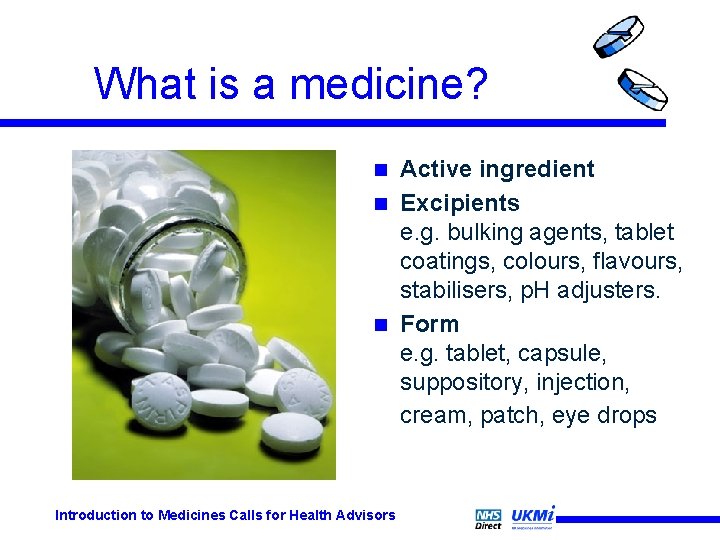
What is a medicine? Active ingredient n Excipients e. g. bulking agents, tablet coatings, colours, flavours, stabilisers, p. H adjusters. n Form e. g. tablet, capsule, suppository, injection, cream, patch, eye drops n Introduction to Medicines Calls for Health Advisors
What is a medicine? Naming medicines Generic Brand Amoxicillin Amoxil ® Salbutamol Ventolin ® Fluoxetine Prozac ® Omeprazole Losec ® Mefloquine Lariam ® Introduction to Medicines Calls for Health Advisors
What is a medicine? Legal classification of medicines General Sales List May be sold in general shops e. g. Paracetamol in packs of GSL 16 tablets Pharmacy Only May be sold in a pharmacy but not a general shop e. g. P Piriton® Prescription Only May only be supplied on prescription e. g. Amoxicillin POM Introduction to Medicines Calls for Health Advisors
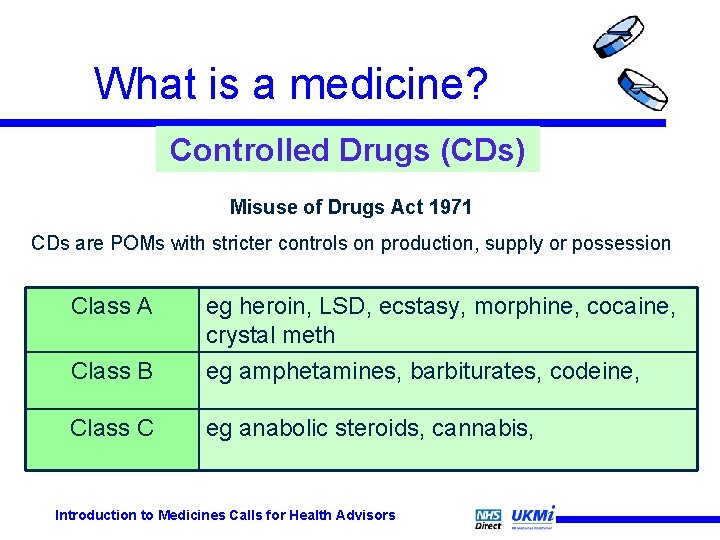
What is a medicine? Controlled Drugs (CDs) Misuse of Drugs Act 1971 CDs are POMs with stricter controls on production, supply or possession Class A eg heroin, LSD, ecstasy, morphine, cocaine, crystal meth Class B eg amphetamines, barbiturates, codeine, Class C eg anabolic steroids, cannabis, Introduction to Medicines Calls for Health Advisors
What is a medicine? Simple analgesics (pain killers) Paracetamol Ibuprofen Aspirin Co-codamol Introduction to Medicines Calls for Health Advisors
What is a medicine? Paracetamol • Reduces pain and fever • Used for mild to moderate pain eg toothache, headache • Side effects not usually a problem • Must not exceed recommended dose – dangerous in overdose 10– 15 g (20– 30 tablets) or 150 mg/kg in 24 hours can cause severe liver / renal damage and death. • Must not take with other products containing paracetamol Introduction to Medicines Calls for Health Advisors
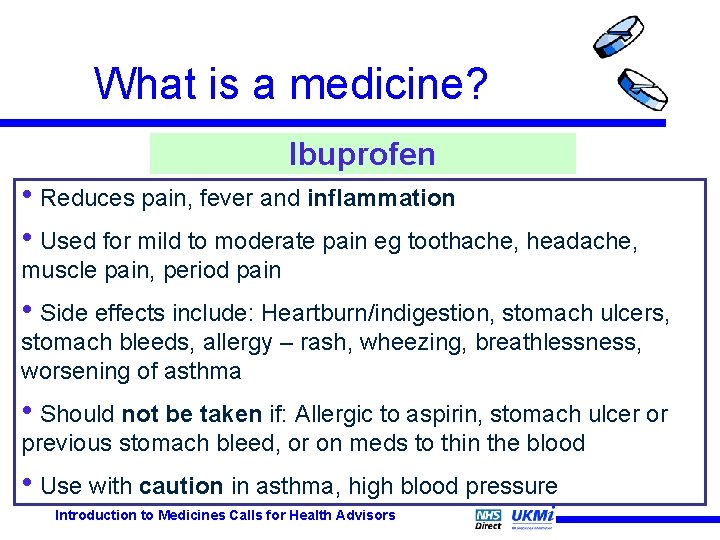
What is a medicine? Ibuprofen • Reduces pain, fever and inflammation • Used for mild to moderate pain eg toothache, headache, muscle pain, period pain • Side effects include: Heartburn/indigestion, stomach ulcers, stomach bleeds, allergy – rash, wheezing, breathlessness, worsening of asthma • Should not be taken if: Allergic to aspirin, stomach ulcer or previous stomach bleed, or on meds to thin the blood • Use with caution in asthma, high blood pressure Introduction to Medicines Calls for Health Advisors
What is a medicine? Aspirin • When used as a pain killer has similar effects and precautions as ibuprofen. • Must not be given to children under 16 years. • Also used at low doses to prevent heart attacks and strokes. Introduction to Medicines Calls for Health Advisors
What is a medicine? Co-analgesics Many painkillers contain a combination of more than one drug Often paracetamol + other(s) Examples: Co-codamol contains paracetamol and codeine Co-dydramol contains paracetamol and dihydrocodeine Co-proxamol contains paracetamol and dextropropoxyphene Co-codaprin contains aspirin and codeine Introduction to Medicines Calls for Health Advisors
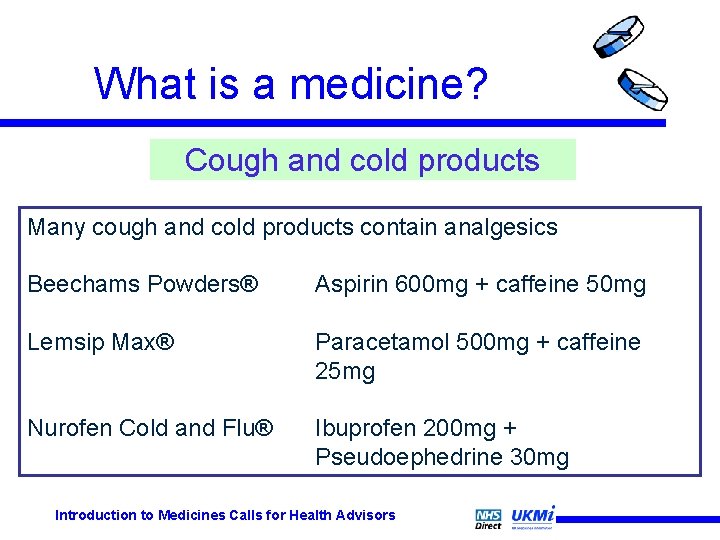
What is a medicine? Cough and cold products Many cough and cold products contain analgesics Beechams Powders® Aspirin 600 mg + caffeine 50 mg Lemsip Max® Paracetamol 500 mg + caffeine 25 mg Nurofen Cold and Flu® Ibuprofen 200 mg + Pseudoephedrine 30 mg Introduction to Medicines Calls for Health Advisors
Timetable Welcome & learning outcomes NHSD policies for medicines calls, access to medicines Role of UKMI as a support service to NHS Direct Identification and prioritisation of medicines calls Workshop 1: Annotating Medicines Calls Break The National Poisons Information Service Substances of low toxicity by ingestion Workshop 2: Use of the Low Toxicity poster What is a medicine? Overview of community pharmacy services Workshop 3: Medicines Quiz, review of learning outcomes and close Introduction to Medicines Calls for Health Advisors
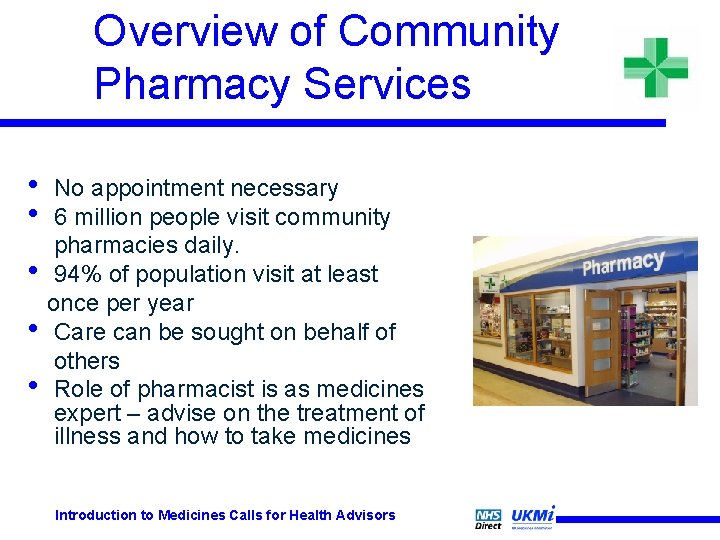
Overview of Community Pharmacy Services • • No appointment necessary 6 million people visit community pharmacies daily. • 94% of population visit at least once per year • Care can be sought on behalf of others • Role of pharmacist is as medicines expert – advise on the treatment of illness and how to take medicines Introduction to Medicines Calls for Health Advisors
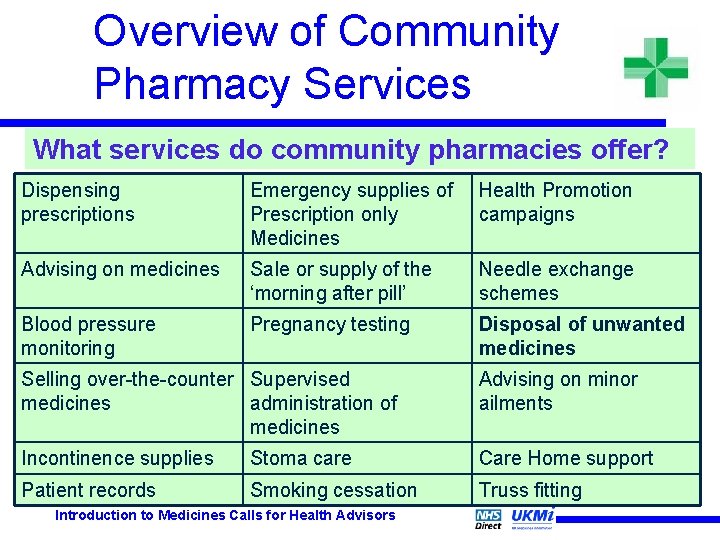
Overview of Community Pharmacy Services What services do community pharmacies offer? Dispensing prescriptions Emergency supplies of Prescription only Medicines Health Promotion campaigns Advising on medicines Sale or supply of the ‘morning after pill’ Needle exchange schemes Blood pressure monitoring Pregnancy testing Disposal of unwanted medicines Selling over-the-counter Supervised medicines administration of medicines Advising on minor ailments Incontinence supplies Stoma care Care Home support Patient records Smoking cessation Truss fitting Introduction to Medicines Calls for Health Advisors
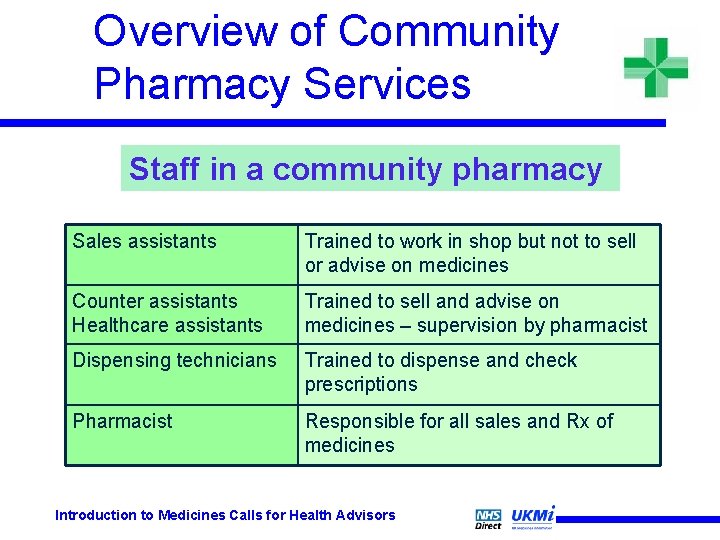
Overview of Community Pharmacy Services Staff in a community pharmacy Sales assistants Trained to work in shop but not to sell or advise on medicines Counter assistants Healthcare assistants Trained to sell and advise on medicines – supervision by pharmacist Dispensing technicians Trained to dispense and check prescriptions Pharmacist Responsible for all sales and Rx of medicines Introduction to Medicines Calls for Health Advisors
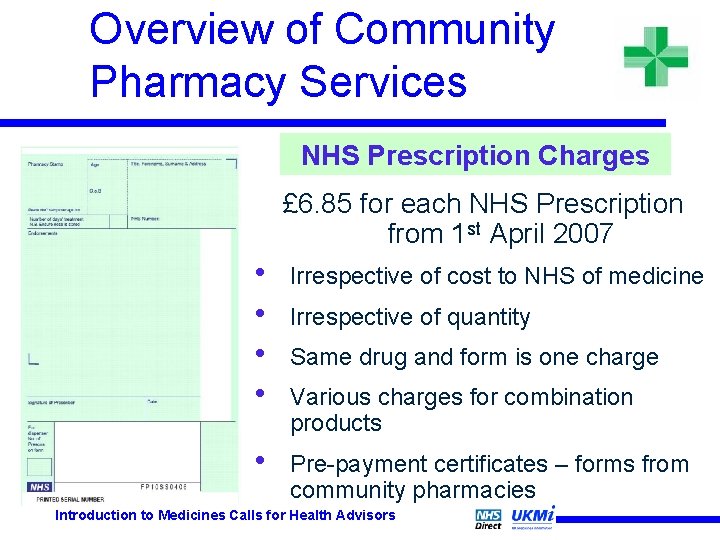
Overview of Community Pharmacy Services NHS Prescription Charges £ 6. 85 for each NHS Prescription from 1 st April 2007 • • Irrespective of cost to NHS of medicine • Pre-payment certificates – forms from community pharmacies Irrespective of quantity Same drug and form is one charge Various charges for combination products Introduction to Medicines Calls for Health Advisors
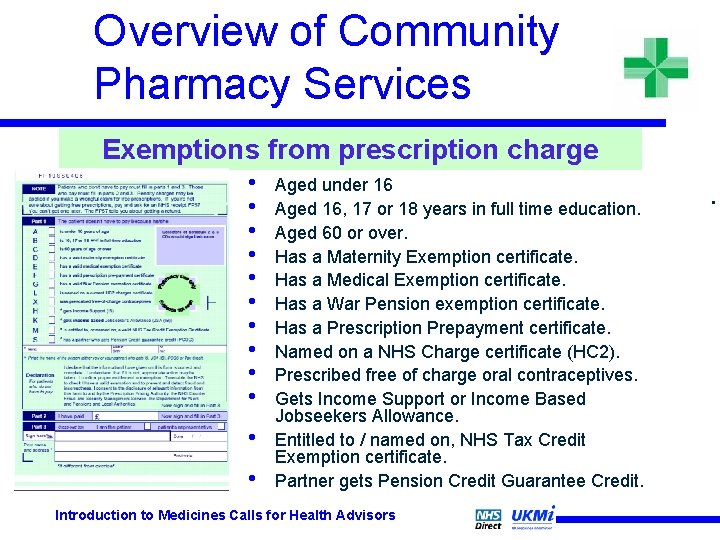
Overview of Community Pharmacy Services Exemptions from prescription charge • • • Aged under 16 Aged 16, 17 or 18 years in full time education. Aged 60 or over. Has a Maternity Exemption certificate. Has a Medical Exemption certificate. Has a War Pension exemption certificate. Has a Prescription Prepayment certificate. Named on a NHS Charge certificate (HC 2). Prescribed free of charge oral contraceptives. Gets Income Support or Income Based Jobseekers Allowance. Entitled to / named on, NHS Tax Credit Exemption certificate. Partner gets Pension Credit Guarantee Credit. Introduction to Medicines Calls for Health Advisors .
Overview of Community Pharmacy Services Emergency Supply by a pharmacist May be possible when • Inadvertently run out of medicines at a weekend or • • surgery closed On holiday and forgotten medicines Not possible to obtain prescription Pharmacist will check that not run out of through overuse eg inhaler for asthma There will be a charge to patient Introduction to Medicines Calls for Health Advisors
Overview of Community Pharmacy Services Emergency Supply by a pharmacist • Pharmacist must interview the person • Supply up to five days treatment • Controlled drugs may not be supplied Introduction to Medicines Calls for Health Advisors
Overview of Community Pharmacy Services Emergency Supply by a pharmacist • Patient must go to pharmacy in person • Take evidence of medicine eg empty box, repeat slip • Take ID The pharmacist makes a professional judgement and may decline to supply Introduction to Medicines Calls for Health Advisors
Overview of Community Pharmacy Services Emergency Hormonal Contraception (EHC) Pharmacists may • Supply EHC (free to patient) subject to pharmacist training and according to local guidelines (PGD or prescription) • Sell EHC (cost to patient) subject to certain restrictions e. g. age of patient Introduction to Medicines Calls for Health Advisors
Timetable Welcome & learning outcomes NHSD policies for medicines calls, access to medicines Role of UKMI as a support service to NHS Direct Identification and prioritisation of medicines calls Workshop 1: Annotating Medicines Calls Break The National Poisons Information Service Substances of low toxicity by ingestion Workshop 2: Use of the Low Toxicity poster What is a medicine? Overview of community pharmacy services Workshop 3: Medicines Quiz, review of learning outcomes and close Introduction to Medicines Calls for Health Advisors
Workshop 3 – Medicines Quiz Introduction to Medicines Calls for Health Advisors