Organizational Culture It refer to the system of
- Slides: 52
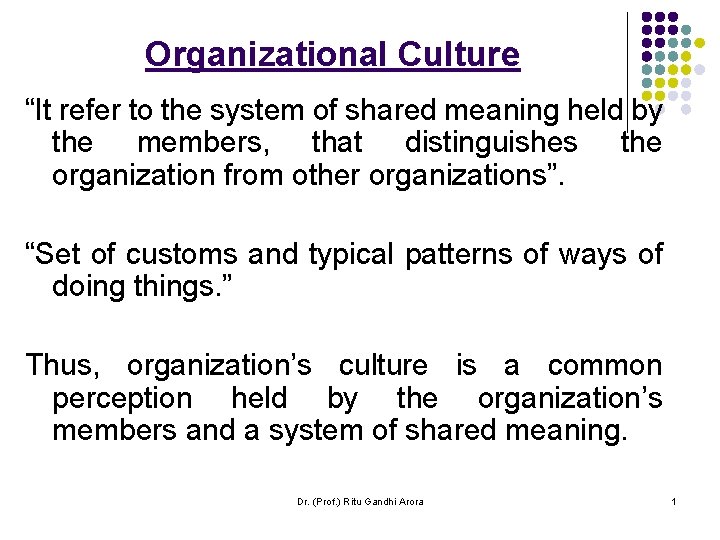
Organizational Culture “It refer to the system of shared meaning held by the members, that distinguishes the organization from other organizations”. “Set of customs and typical patterns of ways of doing things. ” Thus, organization’s culture is a common perception held by the organization’s members and a system of shared meaning. Dr. (Prof. ) Ritu Gandhi Arora 1
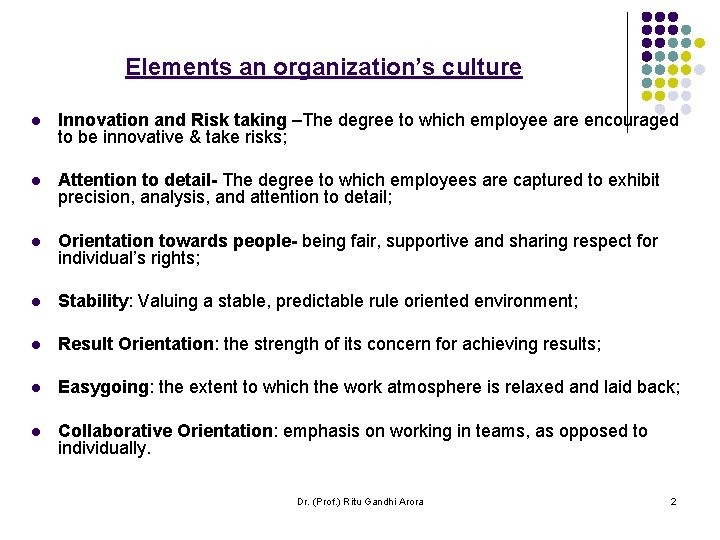
Elements an organization’s culture l Innovation and Risk taking –The degree to which employee are encouraged to be innovative & take risks; l Attention to detail- The degree to which employees are captured to exhibit precision, analysis, and attention to detail; l Orientation towards people- being fair, supportive and sharing respect for individual’s rights; l Stability: Valuing a stable, predictable rule oriented environment; l Result Orientation: the strength of its concern for achieving results; l Easygoing: the extent to which the work atmosphere is relaxed and laid back; l Collaborative Orientation: emphasis on working in teams, as opposed to individually. Dr. (Prof. ) Ritu Gandhi Arora 2
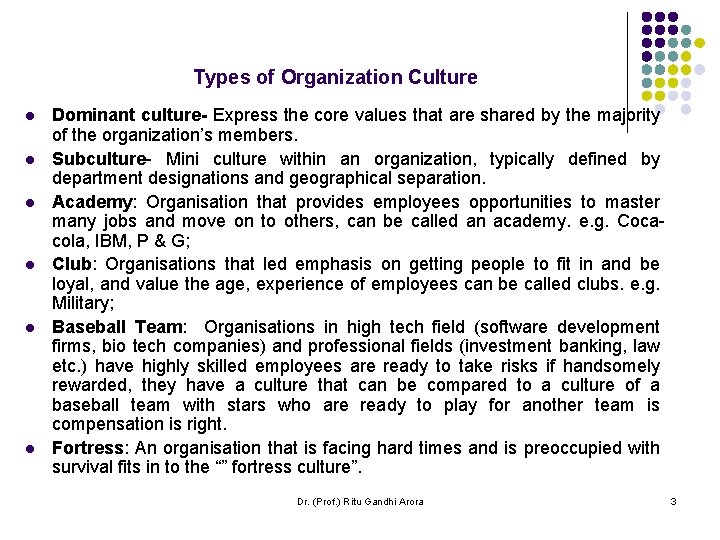
Types of Organization Culture l l l Dominant culture- Express the core values that are shared by the majority of the organization’s members. Subculture- Mini culture within an organization, typically defined by department designations and geographical separation. Academy: Organisation that provides employees opportunities to master many jobs and move on to others, can be called an academy. e. g. Cocacola, IBM, P & G; Club: Organisations that led emphasis on getting people to fit in and be loyal, and value the age, experience of employees can be called clubs. e. g. Military; Baseball Team: Organisations in high tech field (software development firms, bio tech companies) and professional fields (investment banking, law etc. ) have highly skilled employees are ready to take risks if handsomely rewarded, they have a culture that can be compared to a culture of a baseball team with stars who are ready to play for another team is compensation is right. Fortress: An organisation that is facing hard times and is preoccupied with survival fits in to the “” fortress culture”. Dr. (Prof. ) Ritu Gandhi Arora 3
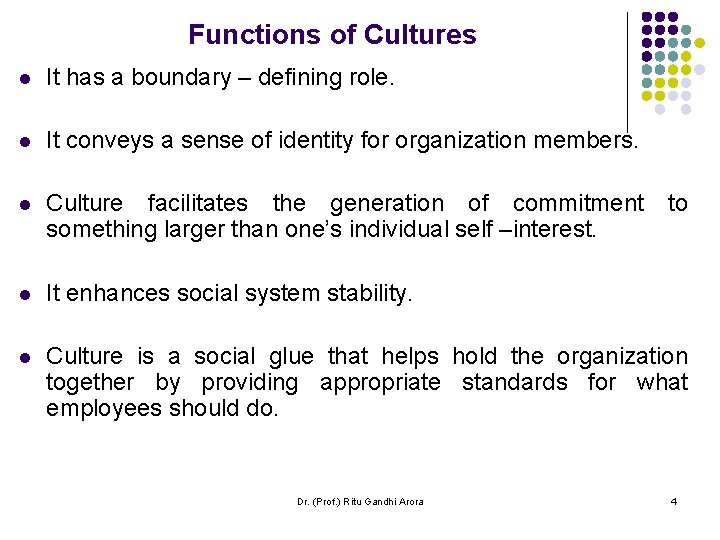
Functions of Cultures l It has a boundary – defining role. l It conveys a sense of identity for organization members. l Culture facilitates the generation of commitment something larger than one’s individual self –interest. l It enhances social system stability. l Culture is a social glue that helps hold the organization together by providing appropriate standards for what employees should do. Dr. (Prof. ) Ritu Gandhi Arora to 4
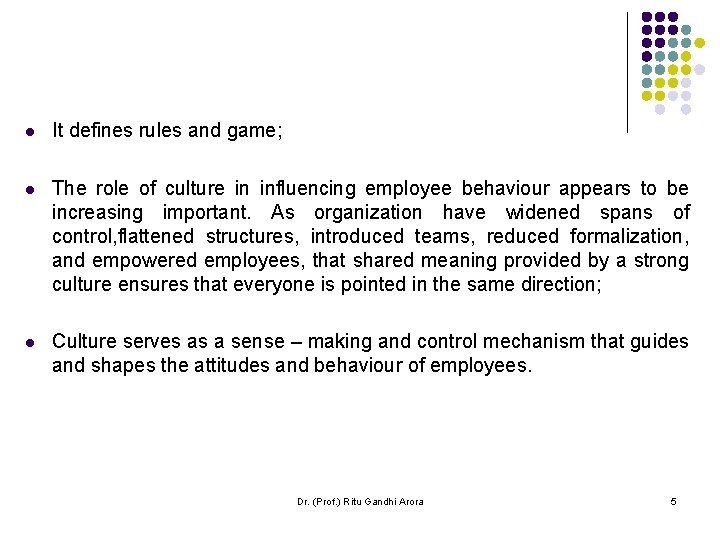
l It defines rules and game; l The role of culture in influencing employee behaviour appears to be increasing important. As organization have widened spans of control, flattened structures, introduced teams, reduced formalization, and empowered employees, that shared meaning provided by a strong culture ensures that everyone is pointed in the same direction; l Culture serves as a sense – making and control mechanism that guides and shapes the attitudes and behaviour of employees. Dr. (Prof. ) Ritu Gandhi Arora 5
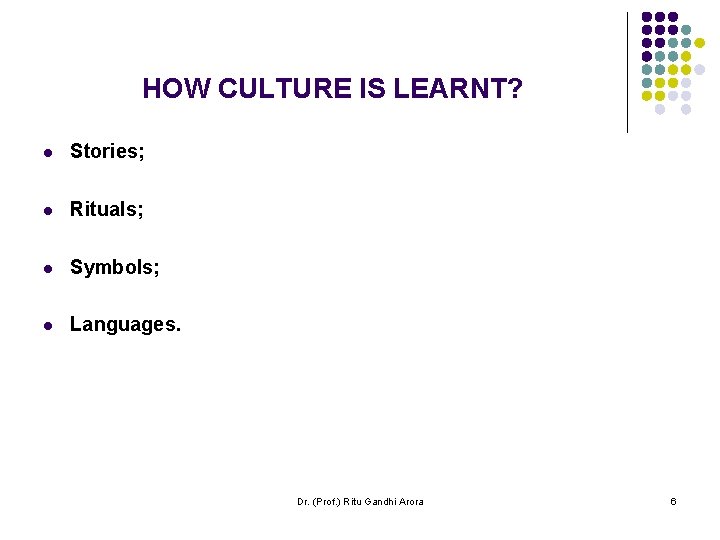
HOW CULTURE IS LEARNT? l Stories; l Rituals; l Symbols; l Languages. Dr. (Prof. ) Ritu Gandhi Arora 6
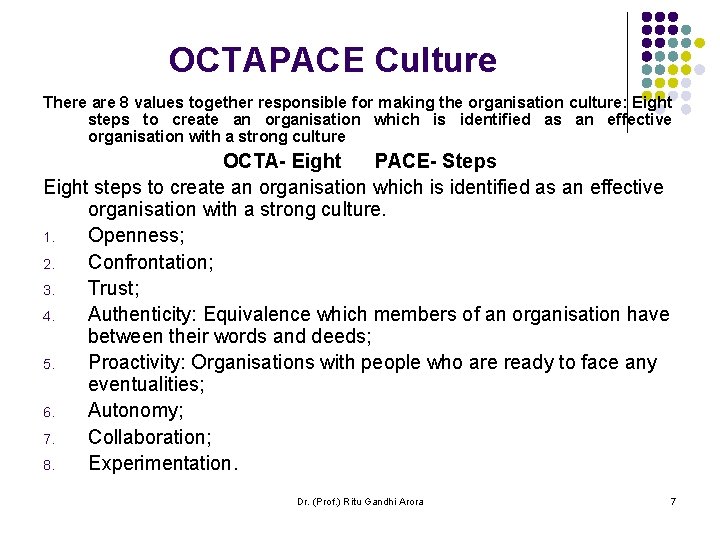
OCTAPACE Culture There are 8 values together responsible for making the organisation culture: Eight steps to create an organisation which is identified as an effective organisation with a strong culture OCTA- Eight PACE- Steps Eight steps to create an organisation which is identified as an effective organisation with a strong culture. 1. Openness; 2. Confrontation; 3. Trust; 4. Authenticity: Equivalence which members of an organisation have between their words and deeds; 5. Proactivity: Organisations with people who are ready to face any eventualities; 6. Autonomy; 7. Collaboration; 8. Experimentation. Dr. (Prof. ) Ritu Gandhi Arora 7
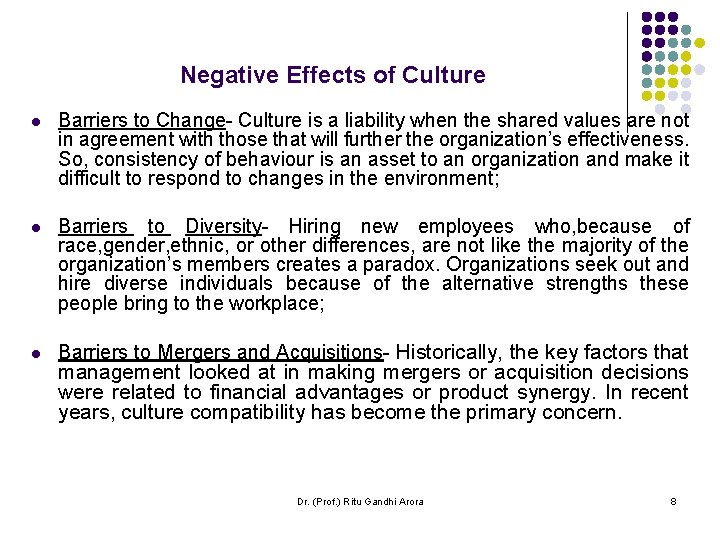
Negative Effects of Culture l Barriers to Change- Culture is a liability when the shared values are not in agreement with those that will further the organization’s effectiveness. So, consistency of behaviour is an asset to an organization and make it difficult to respond to changes in the environment; l Barriers to Diversity- Hiring new employees who, because of race, gender, ethnic, or other differences, are not like the majority of the organization’s members creates a paradox. Organizations seek out and hire diverse individuals because of the alternative strengths these people bring to the workplace; l Barriers to Mergers and Acquisitions- Historically, the key factors that management looked at in making mergers or acquisition decisions were related to financial advantages or product synergy. In recent years, culture compatibility has become the primary concern. Dr. (Prof. ) Ritu Gandhi Arora 8
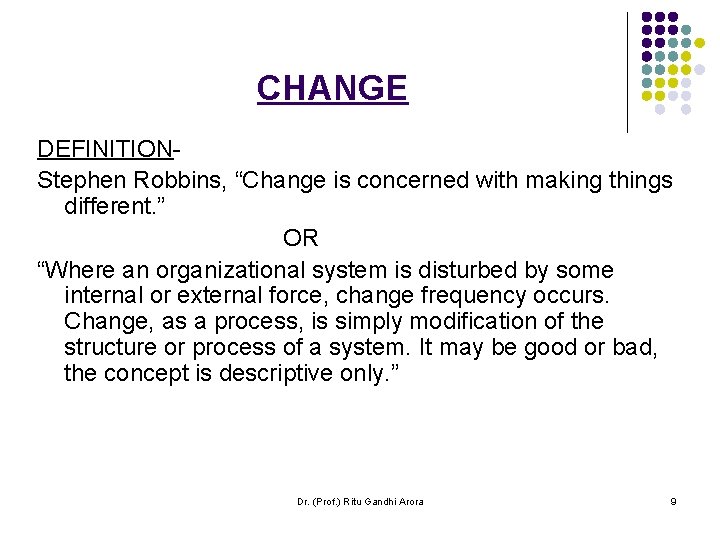
CHANGE DEFINITIONStephen Robbins, “Change is concerned with making things different. ” OR “Where an organizational system is disturbed by some internal or external force, change frequency occurs. Change, as a process, is simply modification of the structure or process of a system. It may be good or bad, the concept is descriptive only. ” Dr. (Prof. ) Ritu Gandhi Arora 9
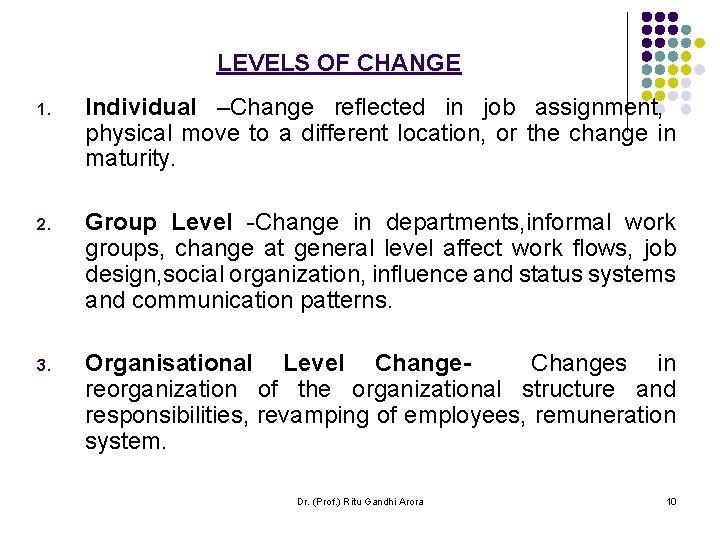
LEVELS OF CHANGE 1. Individual –Change reflected in job assignment, physical move to a different location, or the change in maturity. 2. Group Level -Change in departments, informal work groups, change at general level affect work flows, job design, social organization, influence and status systems and communication patterns. 3. Organisational Level Changes in reorganization of the organizational structure and responsibilities, revamping of employees, remuneration system. Dr. (Prof. ) Ritu Gandhi Arora 10
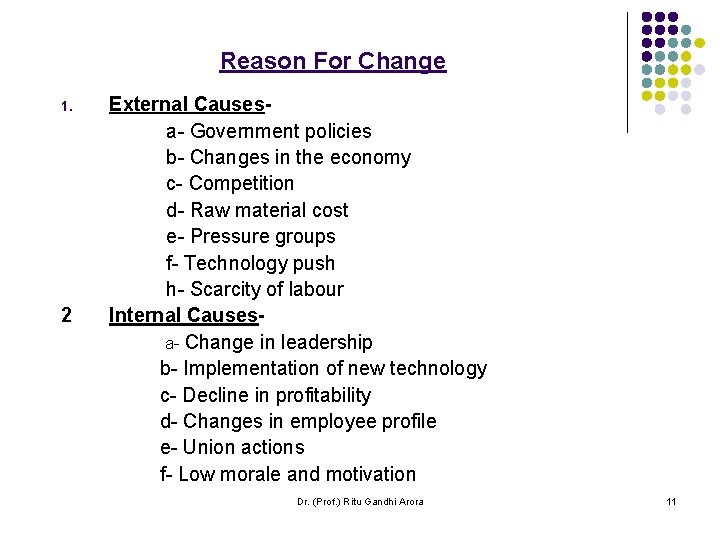
Reason For Change 1. 2 External Causesa- Government policies b- Changes in the economy c- Competition d- Raw material cost e- Pressure groups f- Technology push h- Scarcity of labour Internal Causesa- Change in leadership b- Implementation of new technology c- Decline in profitability d- Changes in employee profile e- Union actions f- Low morale and motivation Dr. (Prof. ) Ritu Gandhi Arora 11
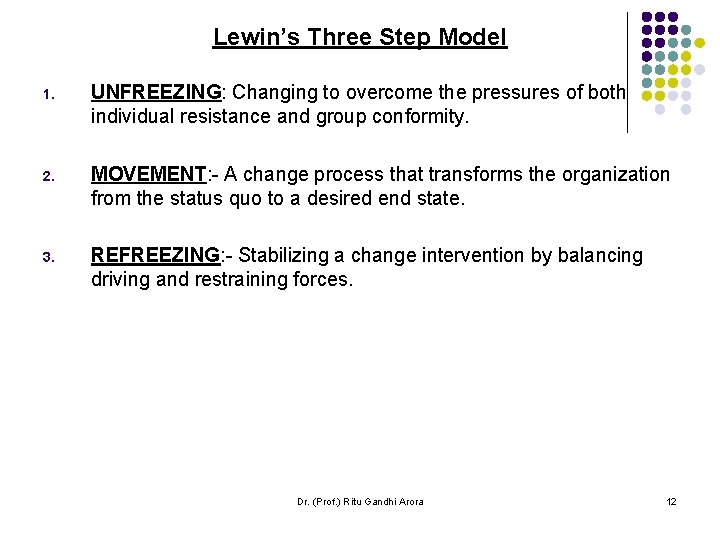
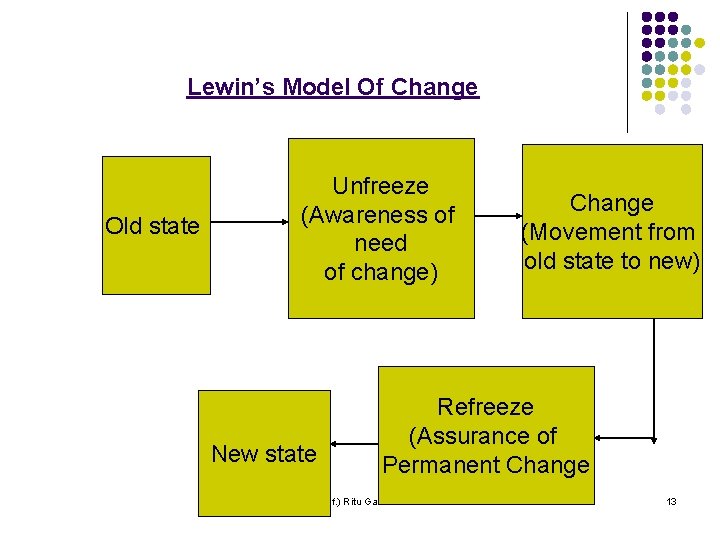
Lewin’s Three Step Model 1. UNFREEZING: Changing to overcome the pressures of both individual resistance and group conformity. 2. MOVEMENT: - A change process that transforms the organization from the status quo to a desired end state. 3. REFREEZING: - Stabilizing a change intervention by balancing driving and restraining forces. Dr. (Prof. ) Ritu Gandhi Arora 12
Lewin’s Model Of Change Old state Unfreeze (Awareness of need of change) New state Change (Movement from old state to new) Refreeze (Assurance of Permanent Change Dr. (Prof. ) Ritu Gandhi Arora 13
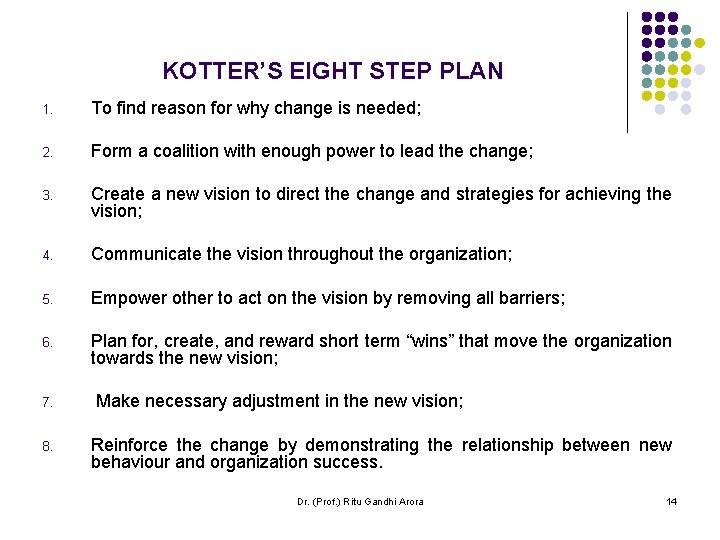
KOTTER’S EIGHT STEP PLAN 1. To find reason for why change is needed; 2. Form a coalition with enough power to lead the change; 3. Create a new vision to direct the change and strategies for achieving the vision; 4. Communicate the vision throughout the organization; 5. Empower other to act on the vision by removing all barriers; 6. Plan for, create, and reward short term “wins” that move the organization towards the new vision; 7. 8. Make necessary adjustment in the new vision; Reinforce the change by demonstrating the relationship between new behaviour and organization success. Dr. (Prof. ) Ritu Gandhi Arora 14
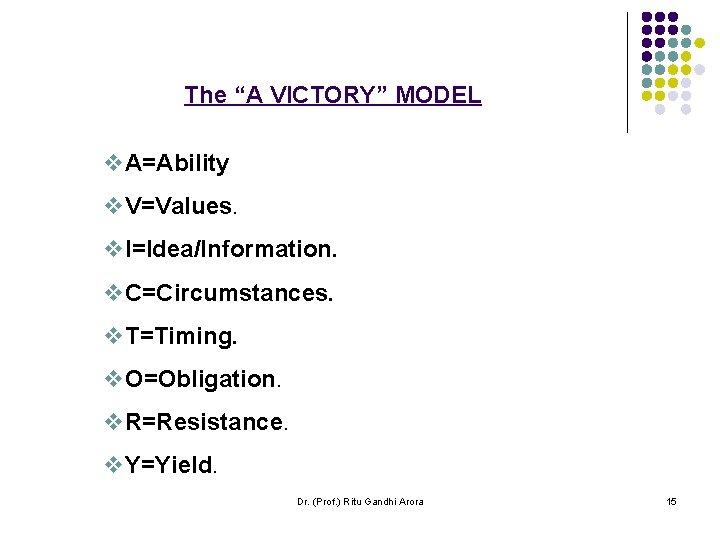
The “A VICTORY” MODEL v. A=Ability v. V=Values. v. I=Idea/Information. v. C=Circumstances. v. T=Timing. v. O=Obligation. v. R=Resistance. v. Y=Yield. Dr. (Prof. ) Ritu Gandhi Arora 15
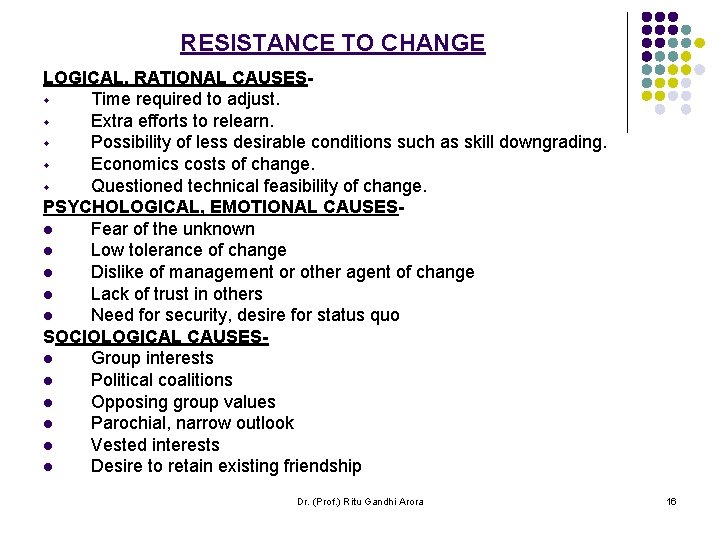
RESISTANCE TO CHANGE LOGICAL, RATIONAL CAUSESw Time required to adjust. w Extra efforts to relearn. w Possibility of less desirable conditions such as skill downgrading. w Economics costs of change. w Questioned technical feasibility of change. PSYCHOLOGICAL, EMOTIONAL CAUSESl Fear of the unknown l Low tolerance of change l Dislike of management or other agent of change l Lack of trust in others l Need for security, desire for status quo SOCIOLOGICAL CAUSESl Group interests l Political coalitions l Opposing group values l Parochial, narrow outlook l Vested interests l Desire to retain existing friendship Dr. (Prof. ) Ritu Gandhi Arora 16
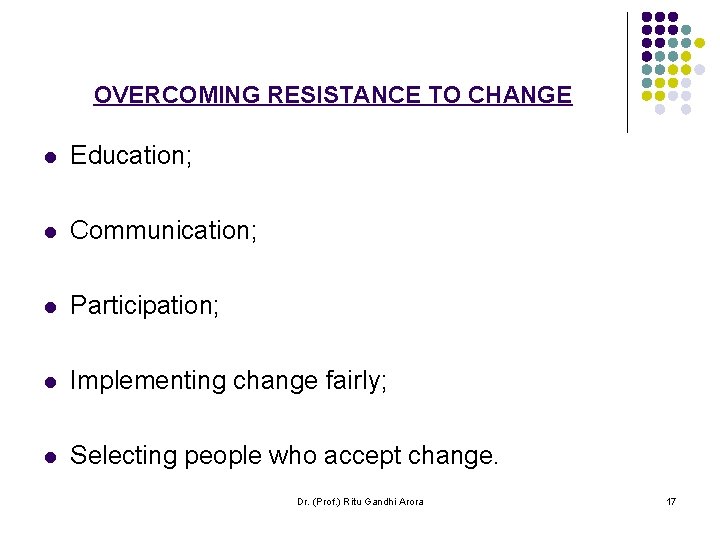
OVERCOMING RESISTANCE TO CHANGE l Education; l Communication; l Participation; l Implementing change fairly; l Selecting people who accept change. Dr. (Prof. ) Ritu Gandhi Arora 17
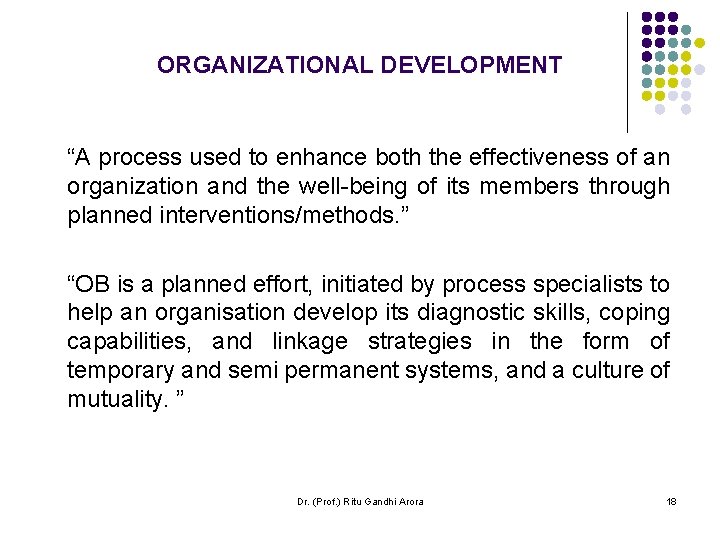
ORGANIZATIONAL DEVELOPMENT “A process used to enhance both the effectiveness of an organization and the well-being of its members through planned interventions/methods. ” “OB is a planned effort, initiated by process specialists to help an organisation develop its diagnostic skills, coping capabilities, and linkage strategies in the form of temporary and semi permanent systems, and a culture of mutuality. ” Dr. (Prof. ) Ritu Gandhi Arora 18
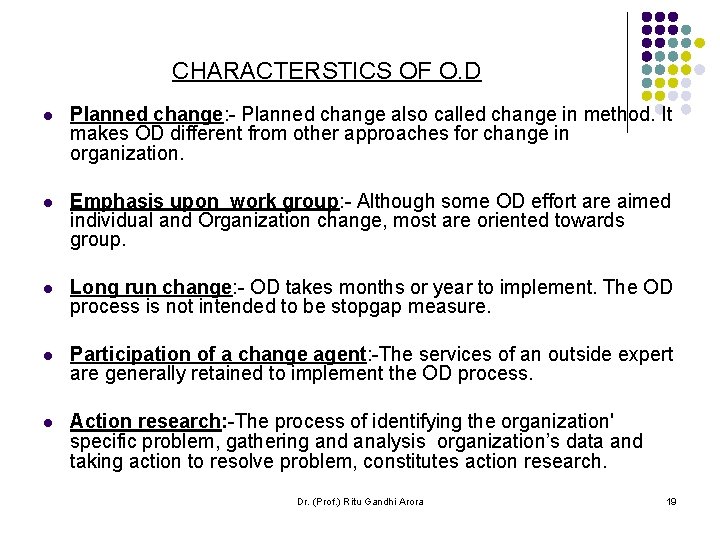
CHARACTERSTICS OF O. D l Planned change: - Planned change also called change in method. It makes OD different from other approaches for change in organization. l Emphasis upon work group: - Although some OD effort are aimed individual and Organization change, most are oriented towards group. l Long run change: - OD takes months or year to implement. The OD process is not intended to be stopgap measure. l Participation of a change agent: -The services of an outside expert are generally retained to implement the OD process. l Action research: -The process of identifying the organization' specific problem, gathering and analysis organization’s data and taking action to resolve problem, constitutes action research. Dr. (Prof. ) Ritu Gandhi Arora 19
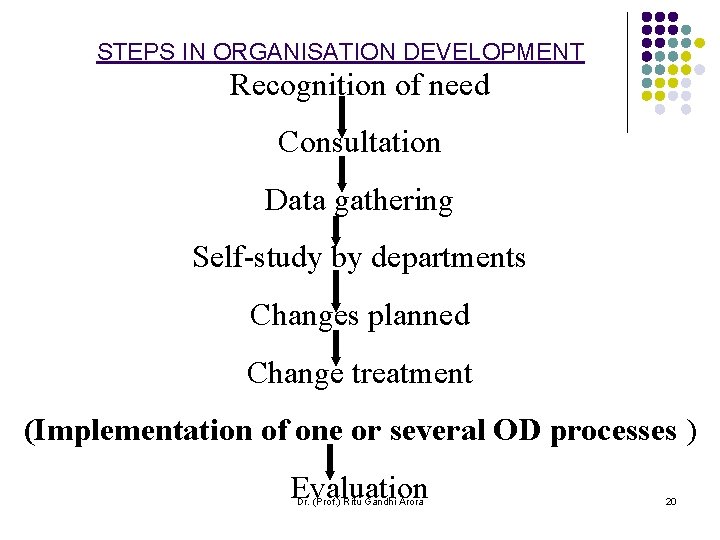
STEPS IN ORGANISATION DEVELOPMENT Recognition of need Consultation Data gathering Self-study by departments Changes planned Change treatment (Implementation of one or several OD processes ) Evaluation Dr. (Prof. ) Ritu Gandhi Arora 20
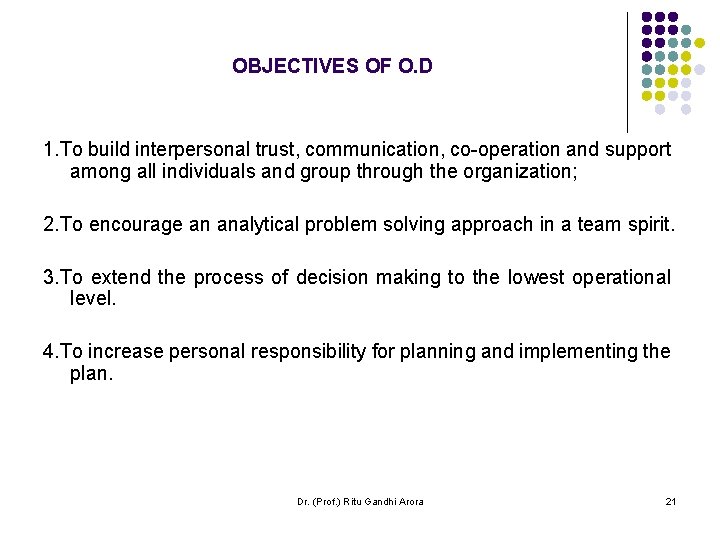
OBJECTIVES OF O. D 1. To build interpersonal trust, communication, co-operation and support among all individuals and group through the organization; 2. To encourage an analytical problem solving approach in a team spirit. 3. To extend the process of decision making to the lowest operational level. 4. To increase personal responsibility for planning and implementing the plan. Dr. (Prof. ) Ritu Gandhi Arora 21
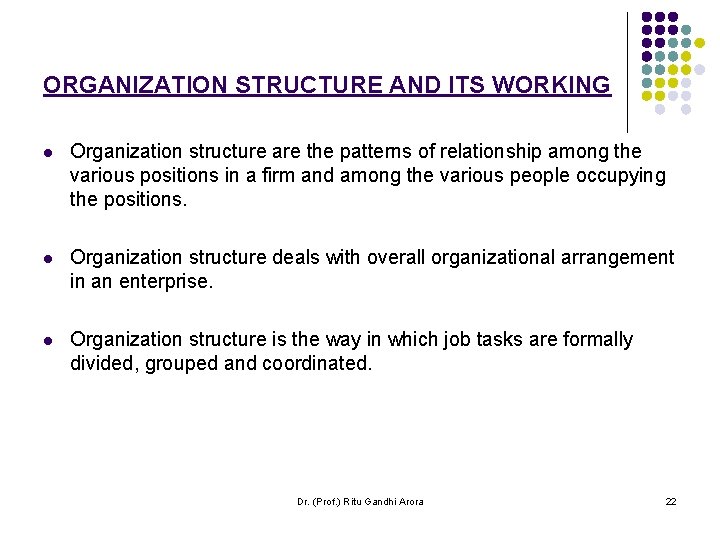
ORGANIZATION STRUCTURE AND ITS WORKING l Organization structure are the patterns of relationship among the various positions in a firm and among the various people occupying the positions. l Organization structure deals with overall organizational arrangement in an enterprise. l Organization structure is the way in which job tasks are formally divided, grouped and coordinated. Dr. (Prof. ) Ritu Gandhi Arora 22
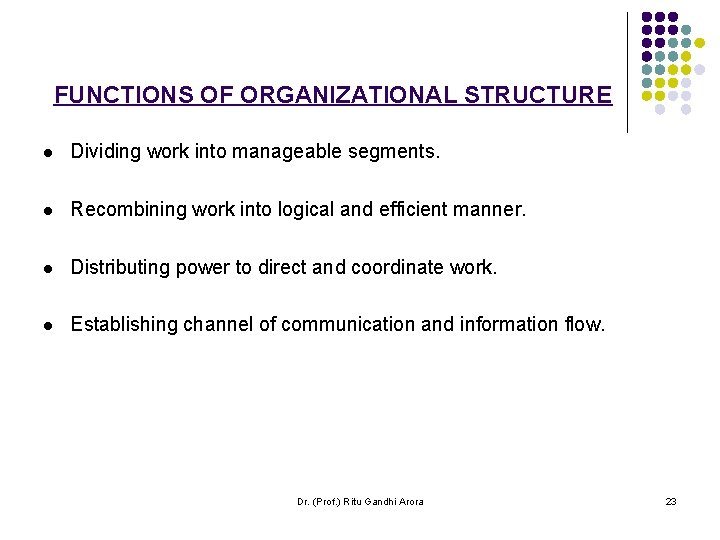
FUNCTIONS OF ORGANIZATIONAL STRUCTURE l Dividing work into manageable segments. l Recombining work into logical and efficient manner. l Distributing power to direct and coordinate work. l Establishing channel of communication and information flow. Dr. (Prof. ) Ritu Gandhi Arora 23
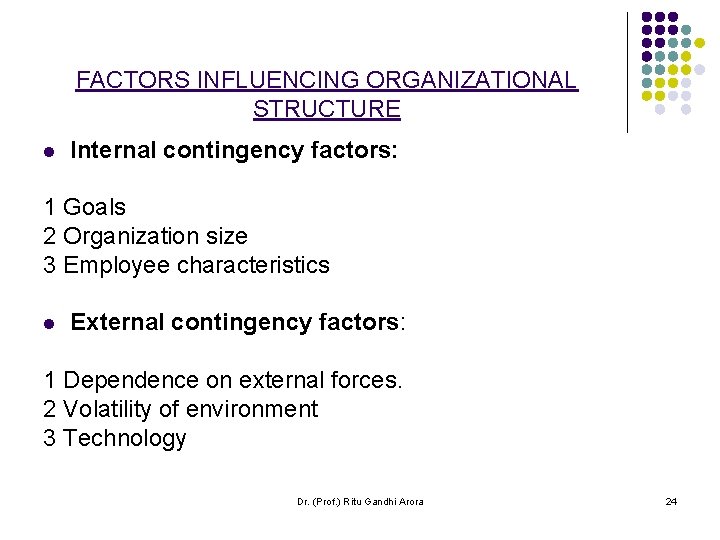
FACTORS INFLUENCING ORGANIZATIONAL STRUCTURE l Internal contingency factors: 1 Goals 2 Organization size 3 Employee characteristics l External contingency factors: 1 Dependence on external forces. 2 Volatility of environment 3 Technology Dr. (Prof. ) Ritu Gandhi Arora 24
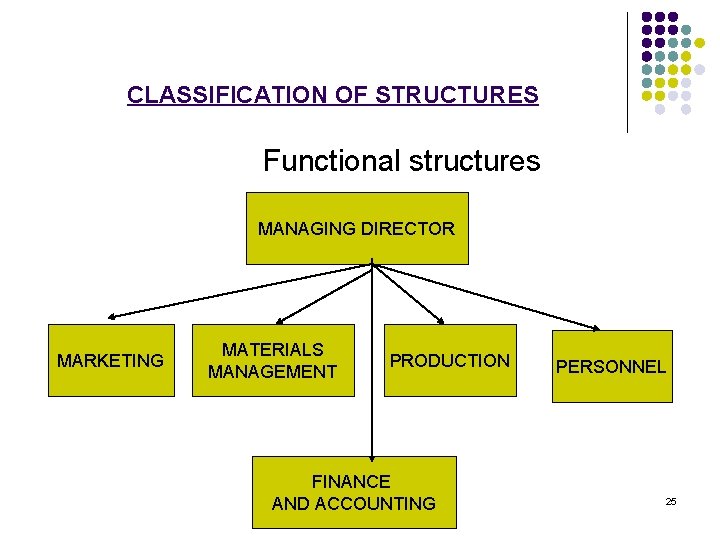
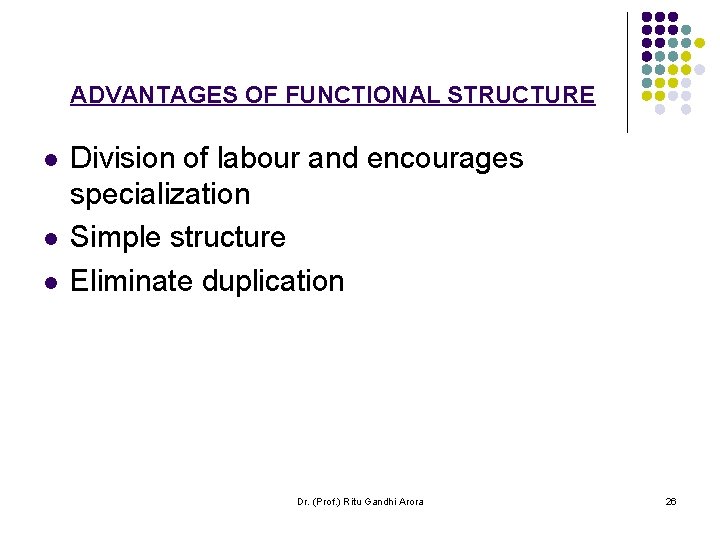
CLASSIFICATION OF STRUCTURES Functional structures MANAGING DIRECTOR MARKETING MATERIALS MANAGEMENT PRODUCTION FINANCE Dr. (Prof. ) Ritu Gandhi Arora AND ACCOUNTING PERSONNEL 25
ADVANTAGES OF FUNCTIONAL STRUCTURE l l l Division of labour and encourages specialization Simple structure Eliminate duplication Dr. (Prof. ) Ritu Gandhi Arora 26
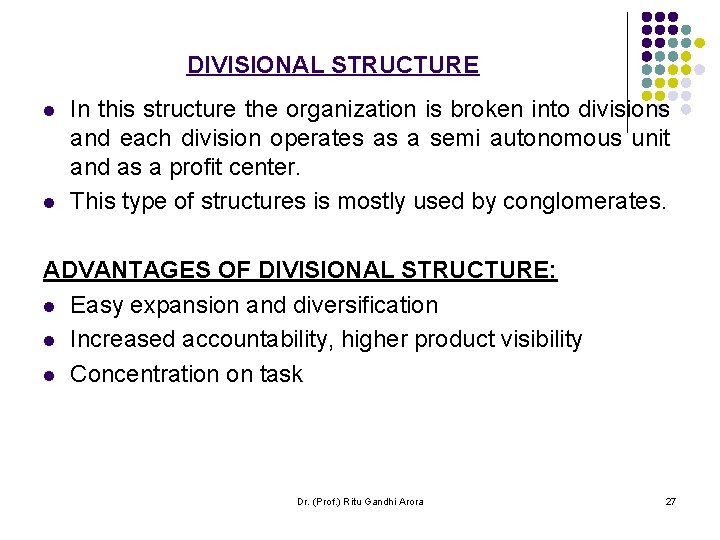
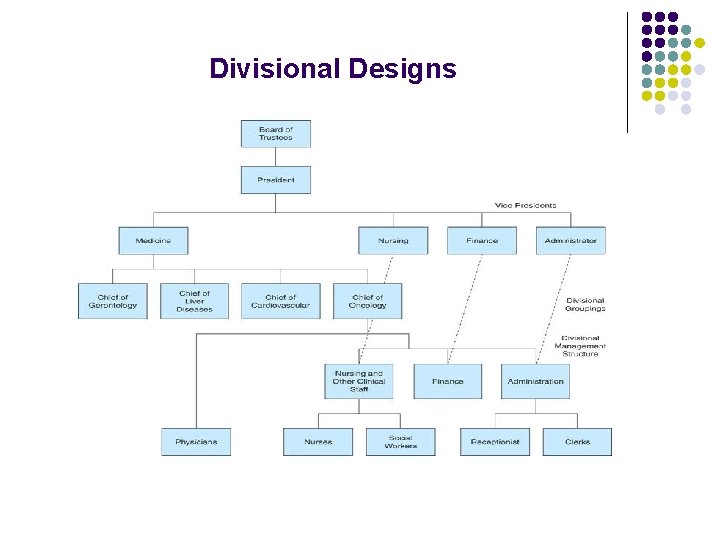
DIVISIONAL STRUCTURE l l In this structure the organization is broken into divisions and each division operates as a semi autonomous unit and as a profit center. This type of structures is mostly used by conglomerates. ADVANTAGES OF DIVISIONAL STRUCTURE: l Easy expansion and diversification l Increased accountability, higher product visibility l Concentration on task Dr. (Prof. ) Ritu Gandhi Arora 27
Organizational Design l l l Building blocks of organization are arranged to improve effectiveness and adaptive capacity i. e. a dynamic process controlling outcomes and process Authority Responsibility Accountability Information Rewards
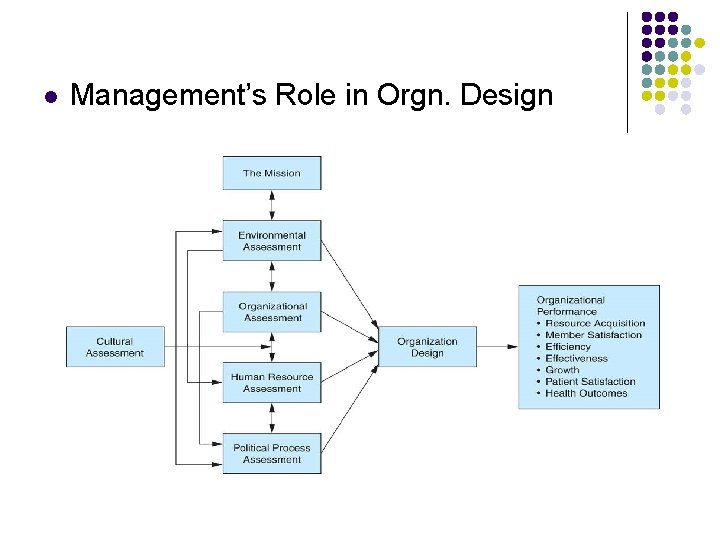
l Management’s Role in Orgn. Design
l When a design should be reconsidered l l Severe performance problems Change in environment that affects internal policies New programs or product lines Leadership change
Levels of Organization Design l Designing a Position l Identify: Major responsibilities and roles l Skills and training necessary l To whom the person and work are accountable l The relationship of other peer positions l
Levels of Organization Design l Designing a Work Group l Clarify Specific purpose of group l Time frame for completing problem solving l Boundaries of group's authority l l Appoint a leader
Levels of Organization Design l Designing a Total Organization l Enormous challenge l Extensive investment l Behavioral flexibility l Group units to maximize use of: l Knowledge and skill l Work process l Time l Commonality of clients or patients l Geographic location
Levels of Organization Design l Designing a Network l l Coordination of services and client flow Analyze interorganizational relationships Decide which organizations should have most power l Identify resource transactions l Diffusing innovations l
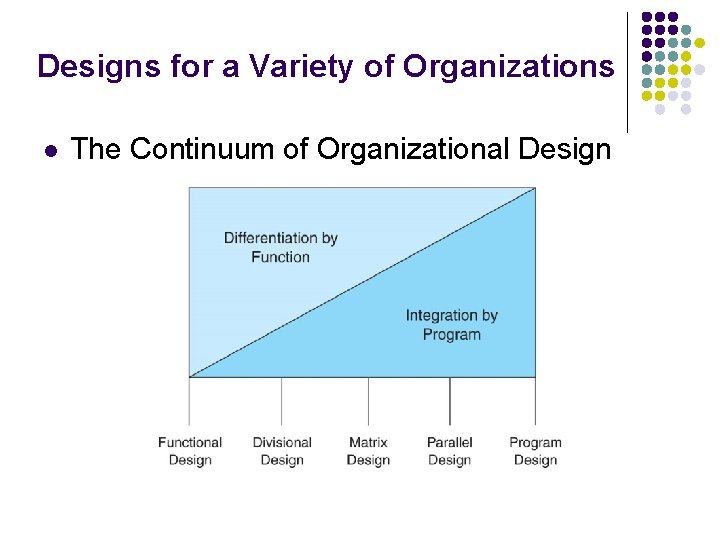
Designs for a Variety of Organizations l The Continuum of Organizational Design
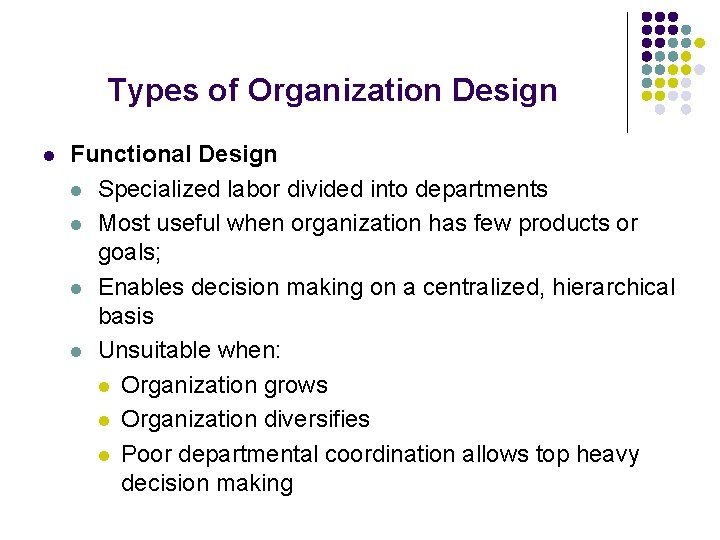
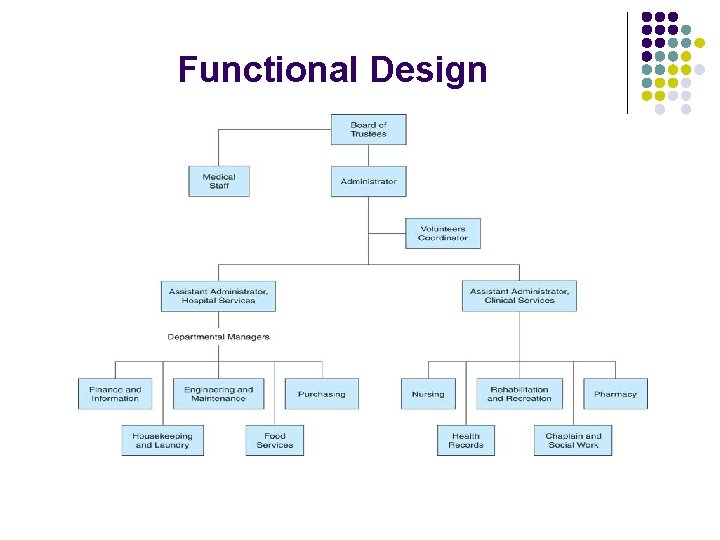
Types of Organization Design l Functional Design l Specialized labor divided into departments l Most useful when organization has few products or goals; l Enables decision making on a centralized, hierarchical basis l Unsuitable when: l Organization grows l Organization diversifies l Poor departmental coordination allows top heavy decision making
Functional Design
Divisional Design l l l Organizational divisions and semiautonomous units Decentralizes decisions to lowest level Difficulties arise when priorities are determined at higher organizational levels
Divisional Designs
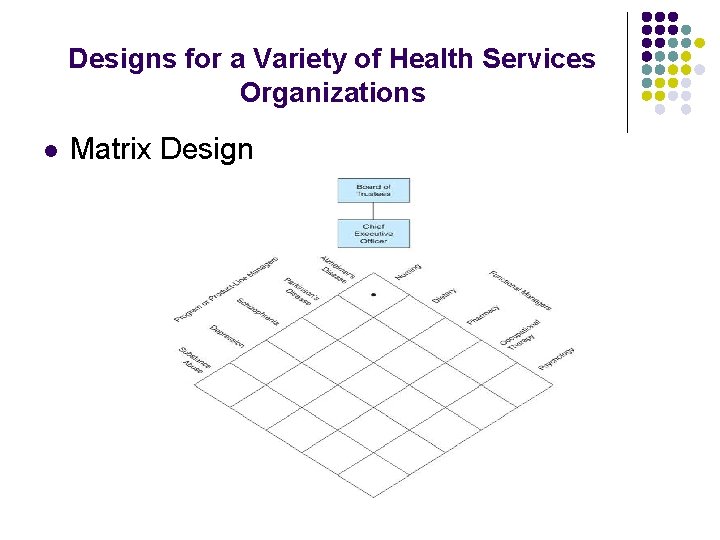
Matrix Design l l Improves coordination and communication across organization Characterized by dual authority system Reporting to managers Disadvantages due to dual authority system
Designs for a Variety of Health Services Organizations l Matrix Design
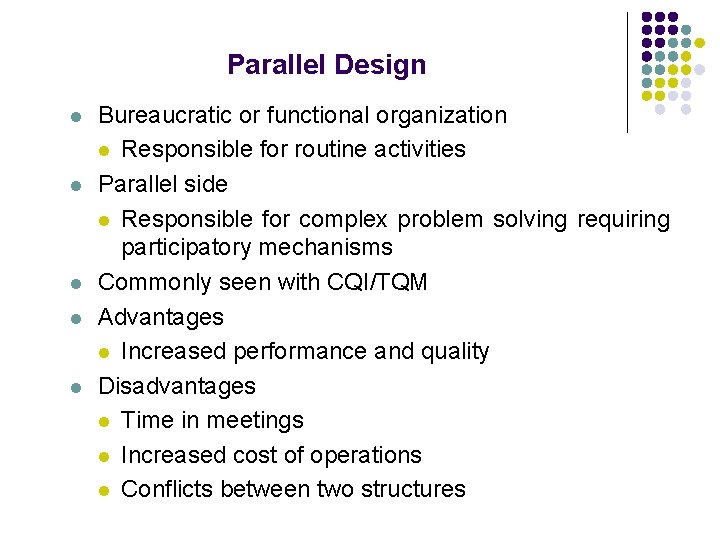
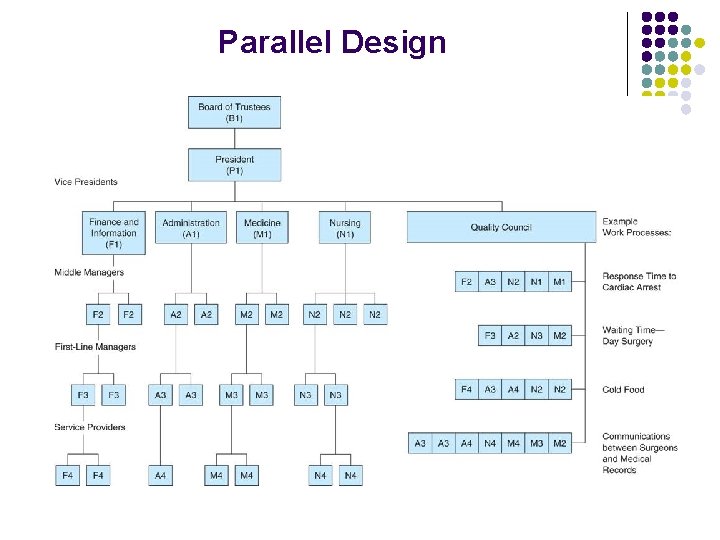
Parallel Design l l l Bureaucratic or functional organization l Responsible for routine activities Parallel side l Responsible for complex problem solving requiring participatory mechanisms Commonly seen with CQI/TQM Advantages l Increased performance and quality Disadvantages l Time in meetings l Increased cost of operations l Conflicts between two structures
Parallel Design
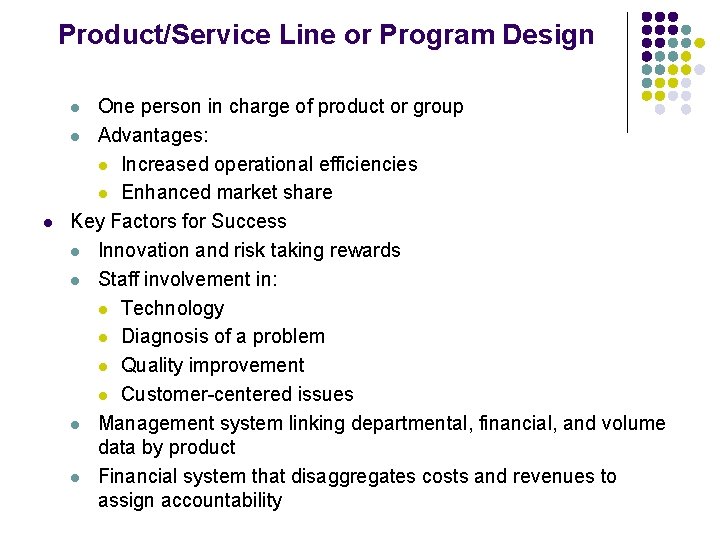
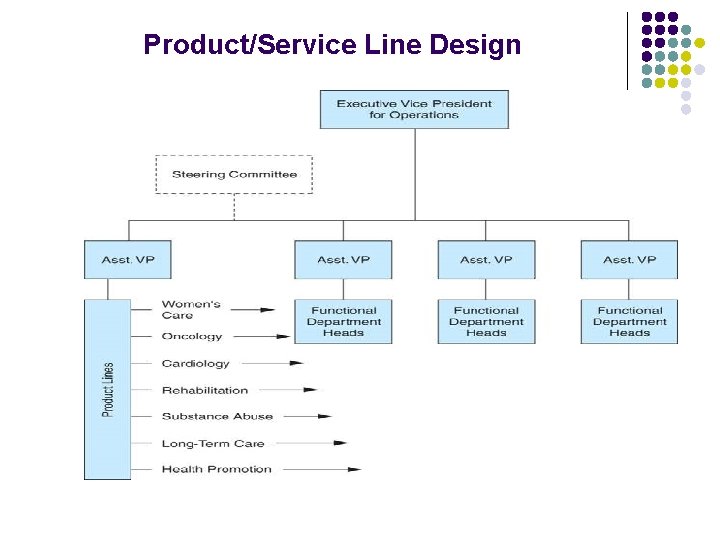
Product/Service Line or Program Design One person in charge of product or group l Advantages: l Increased operational efficiencies l Enhanced market share Key Factors for Success l Innovation and risk taking rewards l Staff involvement in: l Technology l Diagnosis of a problem l Quality improvement l Customer-centered issues l Management system linking departmental, financial, and volume data by product l Financial system that disaggregates costs and revenues to assign accountability l l
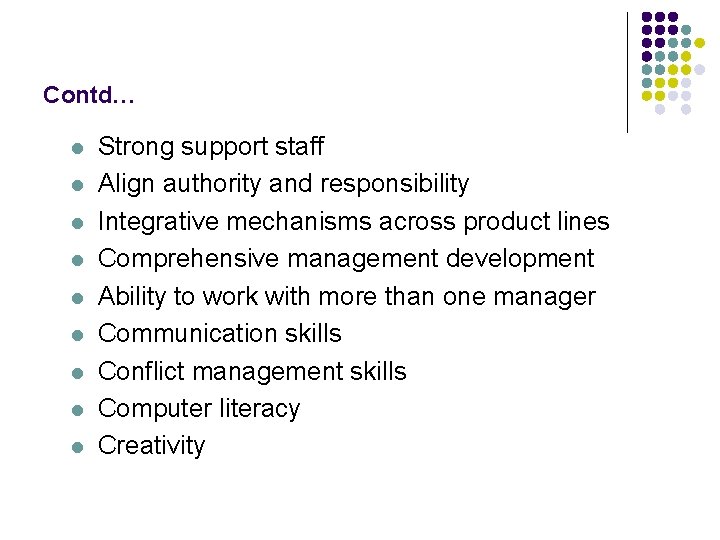
Contd… l l l l l Strong support staff Align authority and responsibility Integrative mechanisms across product lines Comprehensive management development Ability to work with more than one manager Communication skills Conflict management skills Computer literacy Creativity
Product/Service Line Design
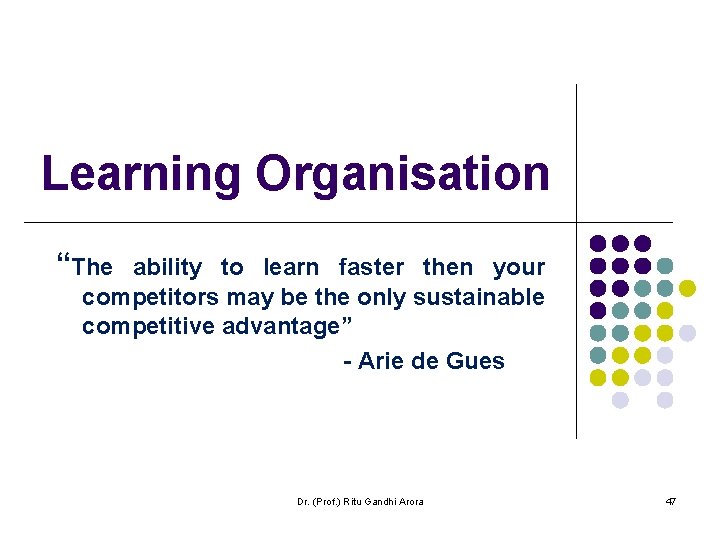
Learning Organisation “The ability to learn faster then your competitors may be the only sustainable competitive advantage” - Arie de Gues Dr. (Prof. ) Ritu Gandhi Arora 47
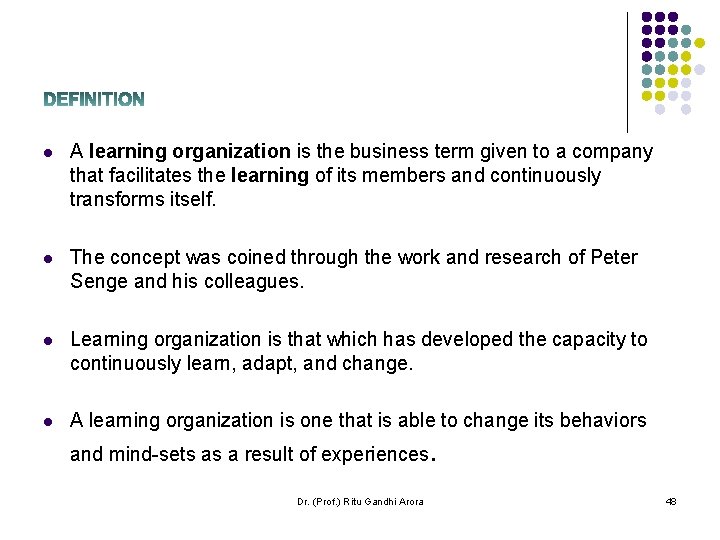
l A learning organization is the business term given to a company that facilitates the learning of its members and continuously transforms itself. l The concept was coined through the work and research of Peter Senge and his colleagues. l Learning organization is that which has developed the capacity to continuously learn, adapt, and change. l A learning organization is one that is able to change its behaviors and mind-sets as a result of experiences. Dr. (Prof. ) Ritu Gandhi Arora 48
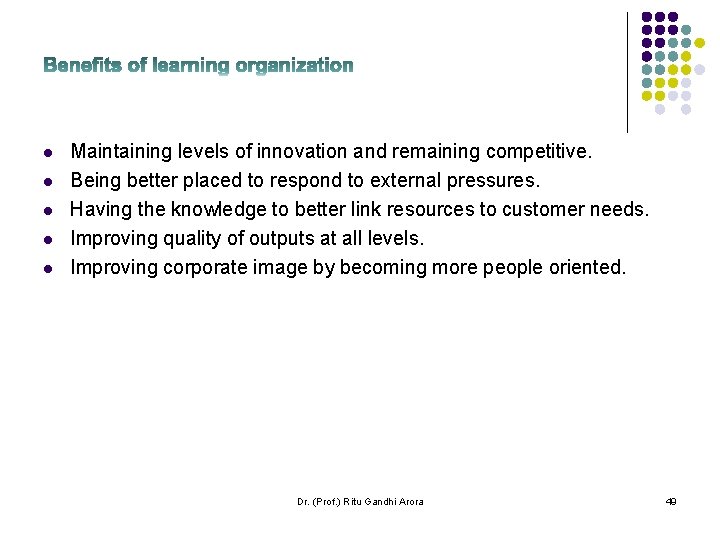
l l l Maintaining levels of innovation and remaining competitive. Being better placed to respond to external pressures. Having the knowledge to better link resources to customer needs. Improving quality of outputs at all levels. Improving corporate image by becoming more people oriented. Dr. (Prof. ) Ritu Gandhi Arora 49
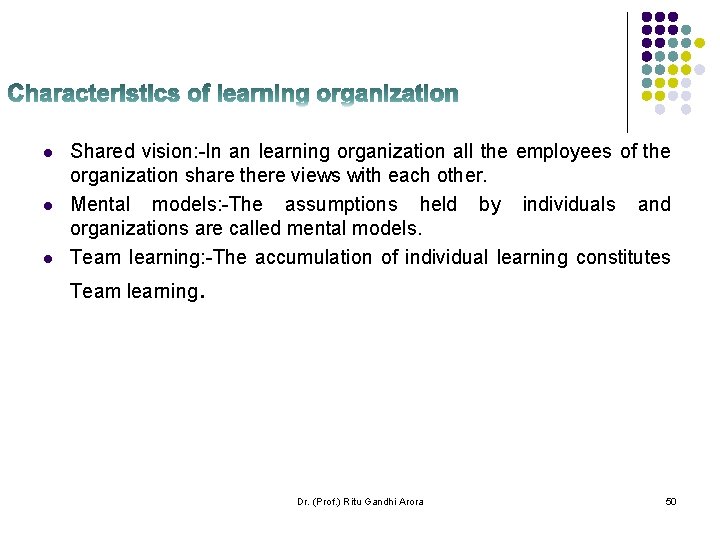
l l l Shared vision: -In an learning organization all the employees of the organization share there views with each other. Mental models: -The assumptions held by individuals and organizations are called mental models. Team learning: -The accumulation of individual learning constitutes Team learning. Dr. (Prof. ) Ritu Gandhi Arora 50
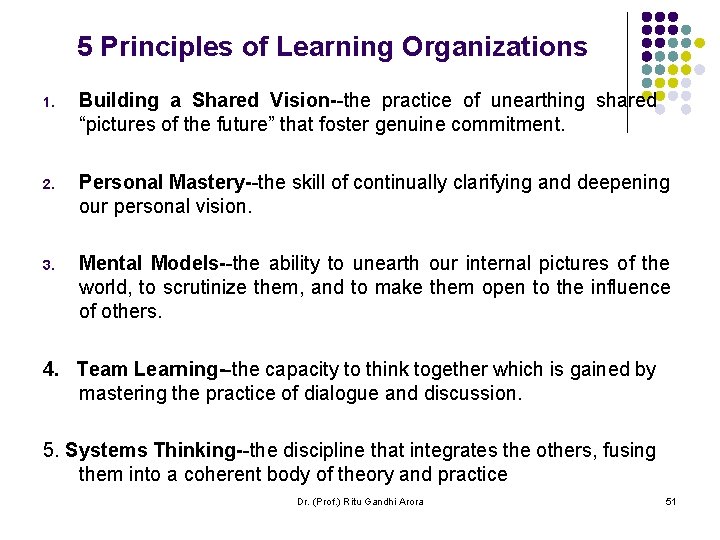
5 Principles of Learning Organizations 1. Building a Shared Vision--the practice of unearthing shared “pictures of the future” that foster genuine commitment. 2. Personal Mastery--the skill of continually clarifying and deepening our personal vision. 3. Mental Models--the ability to unearth our internal pictures of the world, to scrutinize them, and to make them open to the influence of others. 4. Team Learning--the capacity to think together which is gained by mastering the practice of dialogue and discussion. 5. Systems Thinking--the discipline that integrates the others, fusing them into a coherent body of theory and practice Dr. (Prof. ) Ritu Gandhi Arora 51
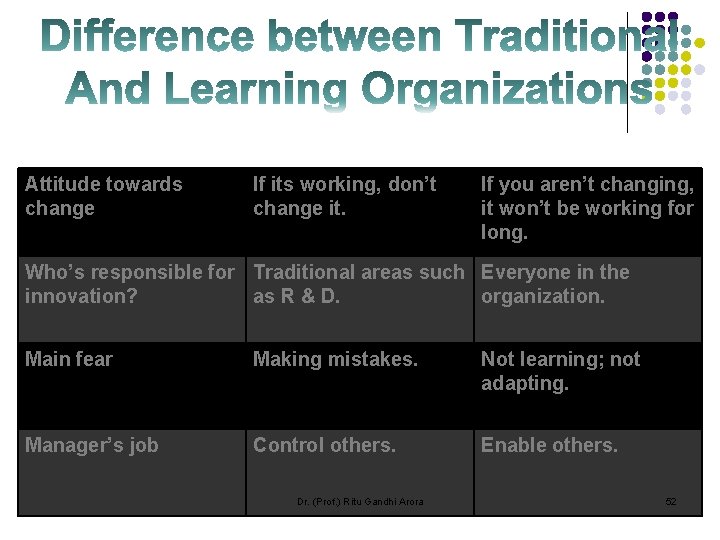
Attitude towards change If its working, don’t change it. If you aren’t changing, it won’t be working for long. Who’s responsible for Traditional areas such Everyone in the innovation? as R & D. organization. Main fear Making mistakes. Not learning; not adapting. Manager’s job Control others. Enable others. Dr. (Prof. ) Ritu Gandhi Arora 52