Organic Chemistry Second Edition David Klein Chapter 3
- Slides: 41
Organic Chemistry Second Edition David Klein Chapter 3 Acids and Bases Copyright © 2015 John Wiley & Sons, Inc. All rights reserved. Klein, Organic Chemistry 2 e
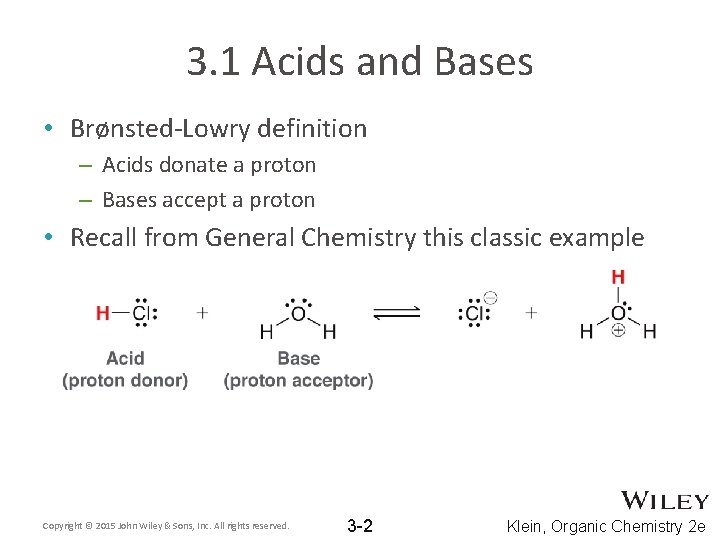
3. 1 Acids and Bases • Brønsted-Lowry definition – Acids donate a proton – Bases accept a proton • Recall from General Chemistry this classic example Copyright © 2015 John Wiley & Sons, Inc. All rights reserved. 3 -2 Klein, Organic Chemistry 2 e
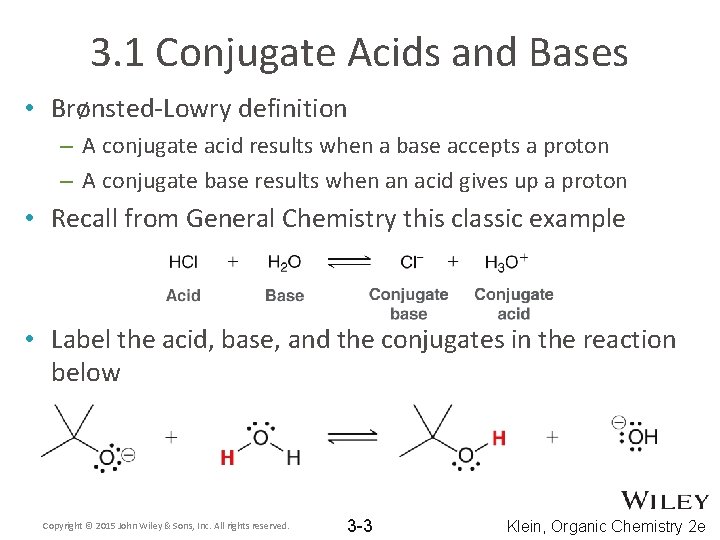
3. 1 Conjugate Acids and Bases • Brønsted-Lowry definition – A conjugate acid results when a base accepts a proton – A conjugate base results when an acid gives up a proton • Recall from General Chemistry this classic example • Label the acid, base, and the conjugates in the reaction below Copyright © 2015 John Wiley & Sons, Inc. All rights reserved. 3 -3 Klein, Organic Chemistry 2 e
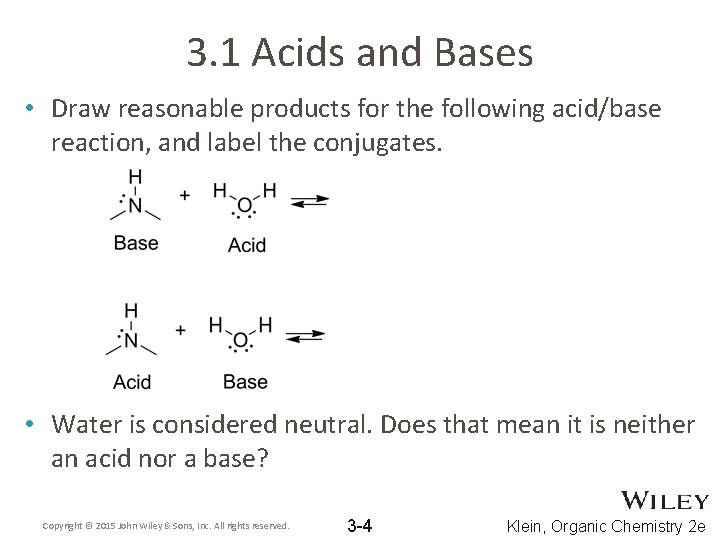
3. 1 Acids and Bases • Draw reasonable products for the following acid/base reaction, and label the conjugates. • Water is considered neutral. Does that mean it is neither an acid nor a base? Copyright © 2015 John Wiley & Sons, Inc. All rights reserved. 3 -4 Klein, Organic Chemistry 2 e
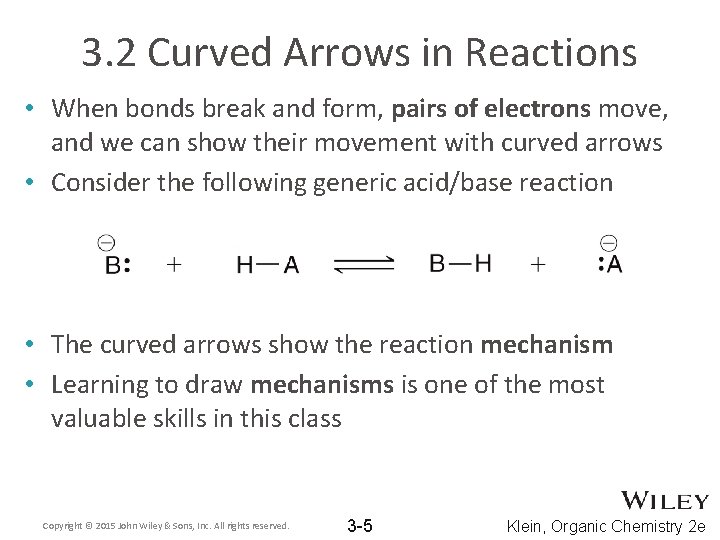
3. 2 Curved Arrows in Reactions • When bonds break and form, pairs of electrons move, and we can show their movement with curved arrows • Consider the following generic acid/base reaction • The curved arrows show the reaction mechanism • Learning to draw mechanisms is one of the most valuable skills in this class Copyright © 2015 John Wiley & Sons, Inc. All rights reserved. 3 -5 Klein, Organic Chemistry 2 e
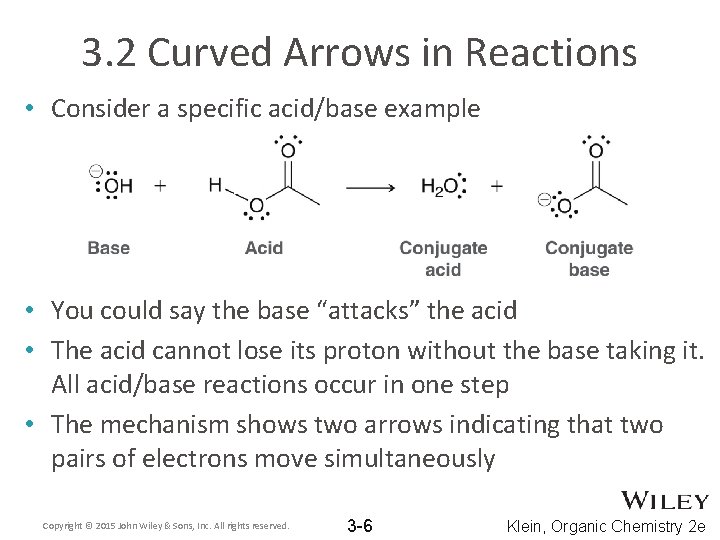
3. 2 Curved Arrows in Reactions • Consider a specific acid/base example • You could say the base “attacks” the acid • The acid cannot lose its proton without the base taking it. All acid/base reactions occur in one step • The mechanism shows two arrows indicating that two pairs of electrons move simultaneously Copyright © 2015 John Wiley & Sons, Inc. All rights reserved. 3 -6 Klein, Organic Chemistry 2 e
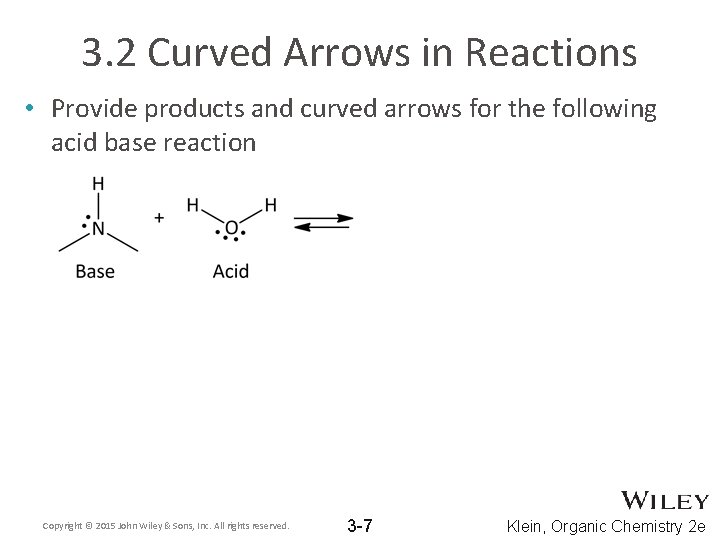
3. 2 Curved Arrows in Reactions • Provide products and curved arrows for the following acid base reaction Copyright © 2015 John Wiley & Sons, Inc. All rights reserved. 3 -7 Klein, Organic Chemistry 2 e
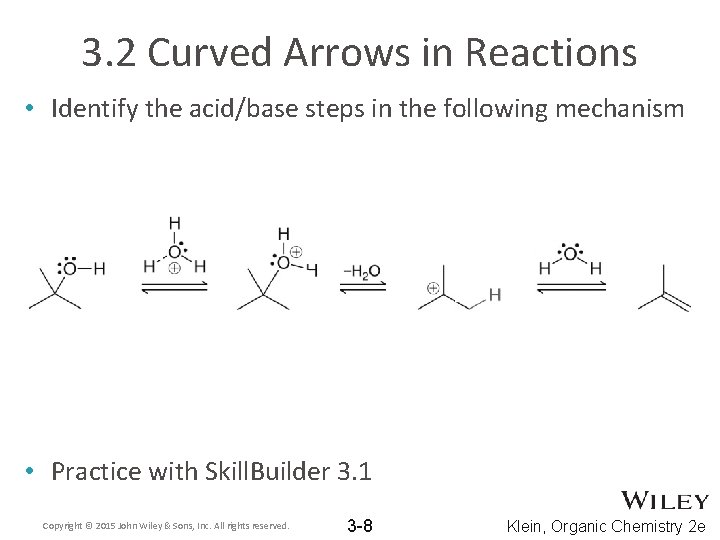
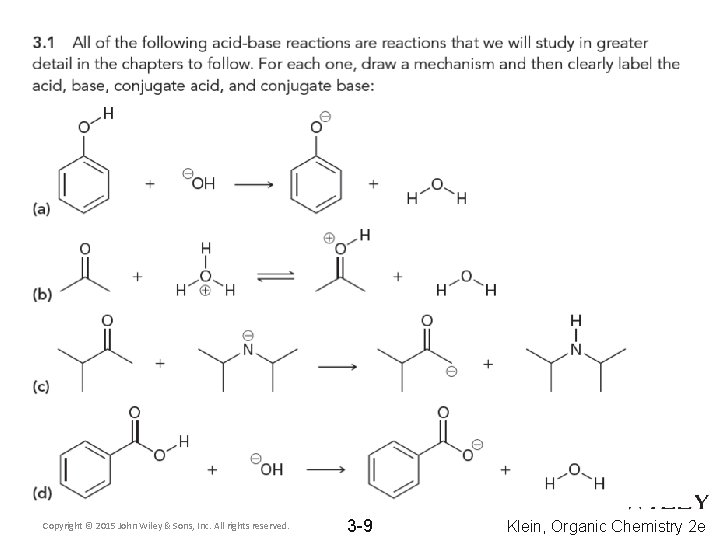
3. 2 Curved Arrows in Reactions • Identify the acid/base steps in the following mechanism • Practice with Skill. Builder 3. 1 Copyright © 2015 John Wiley & Sons, Inc. All rights reserved. 3 -8 Klein, Organic Chemistry 2 e
Copyright © 2015 John Wiley & Sons, Inc. All rights reserved. 3 -9 Klein, Organic Chemistry 2 e
Copyright © 2015 John Wiley & Sons, Inc. All rights reserved. 3 -10 Klein, Organic Chemistry 2 e
3. 3 Quantifying Acidity • Recall from General Chemistry, how do “strong” acids/bases differ from “weak” acids/bases? • The strength of an acid or base is helpful to predict how reactions will progress – We will learn to do Quantitative strength analysis – using p. Ka values to compare the strengths of acids – We will learn to do Qualitative strength analysis – comparing the general stability of structures. Copyright © 2015 John Wiley & Sons, Inc. All rights reserved. 3 -11 Klein, Organic Chemistry 2 e
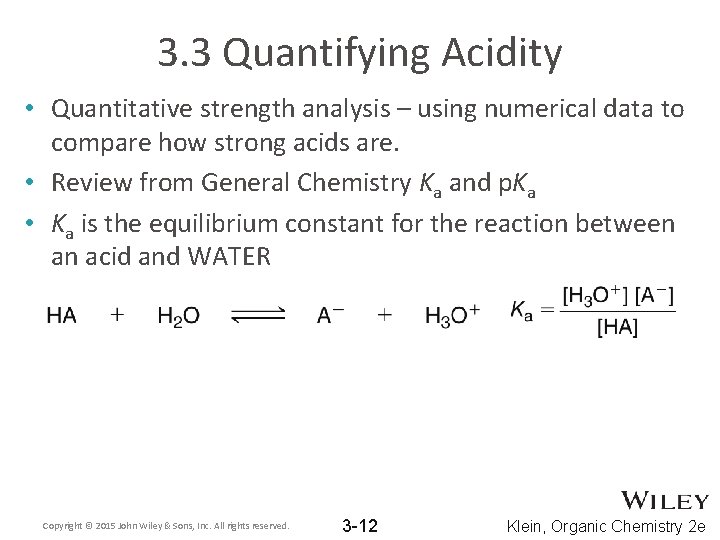
3. 3 Quantifying Acidity • Quantitative strength analysis – using numerical data to compare how strong acids are. • Review from General Chemistry Ka and p. Ka • Ka is the equilibrium constant for the reaction between an acid and WATER Copyright © 2015 John Wiley & Sons, Inc. All rights reserved. 3 -12 Klein, Organic Chemistry 2 e
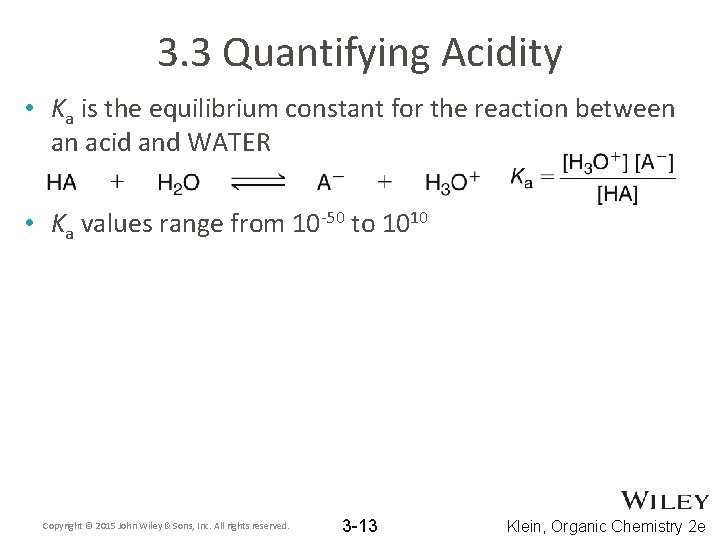
3. 3 Quantifying Acidity • Ka is the equilibrium constant for the reaction between an acid and WATER • Ka values range from 10 -50 to 1010 Copyright © 2015 John Wiley & Sons, Inc. All rights reserved. 3 -13 Klein, Organic Chemistry 2 e
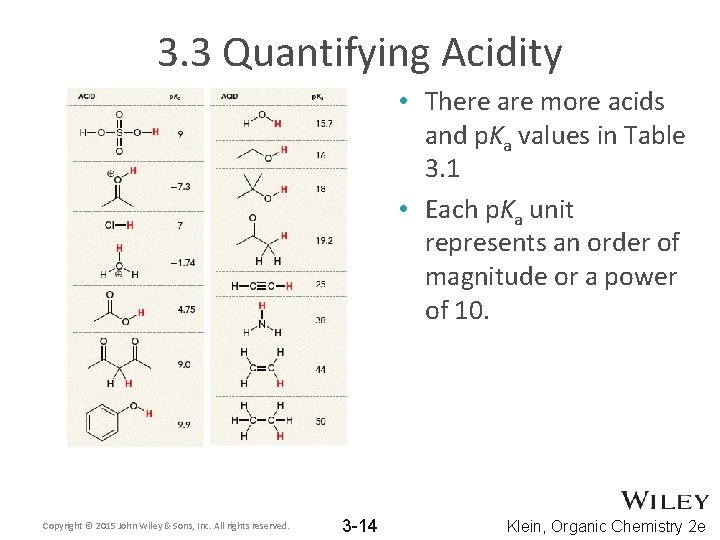
3. 3 Quantifying Acidity • There are more acids and p. Ka values in Table 3. 1 • Each p. Ka unit represents an order of magnitude or a power of 10. Copyright © 2015 John Wiley & Sons, Inc. All rights reserved. 3 -14 Klein, Organic Chemistry 2 e
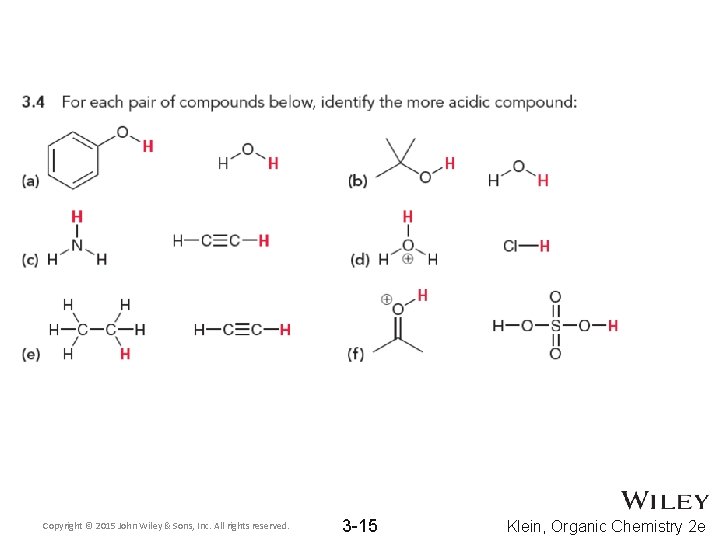
Copyright © 2015 John Wiley & Sons, Inc. All rights reserved. 3 -15 Klein, Organic Chemistry 2 e
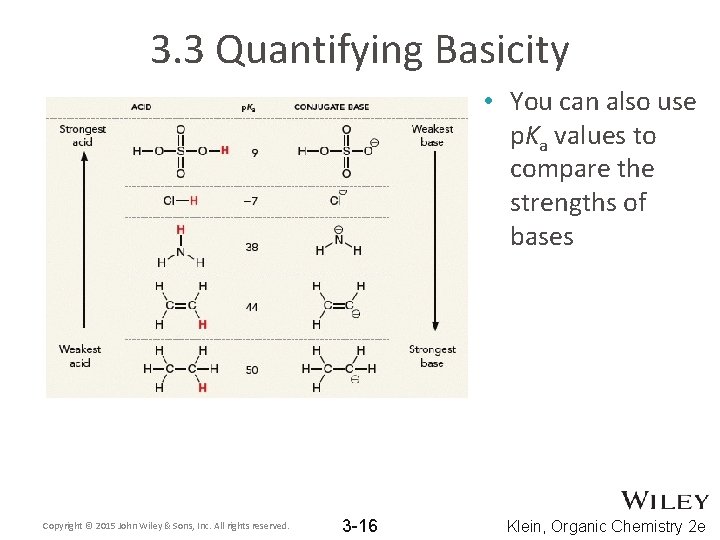
3. 3 Quantifying Basicity • You can also use p. Ka values to compare the strengths of bases Copyright © 2015 John Wiley & Sons, Inc. All rights reserved. 3 -16 Klein, Organic Chemistry 2 e
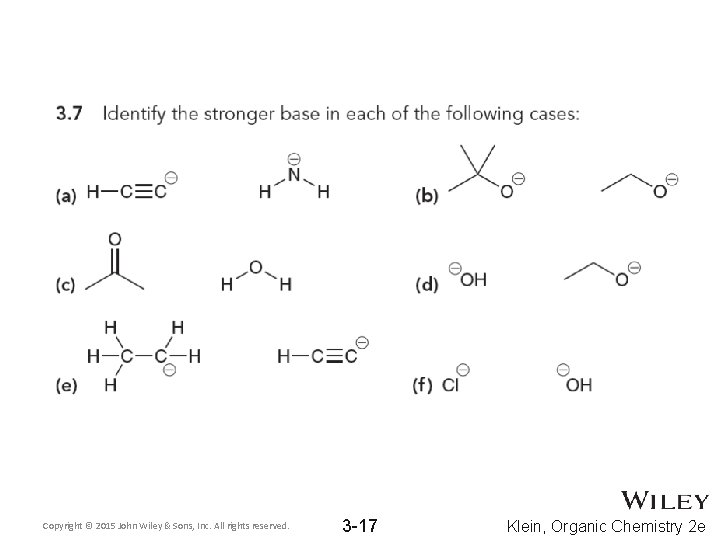
Copyright © 2015 John Wiley & Sons, Inc. All rights reserved. 3 -17 Klein, Organic Chemistry 2 e
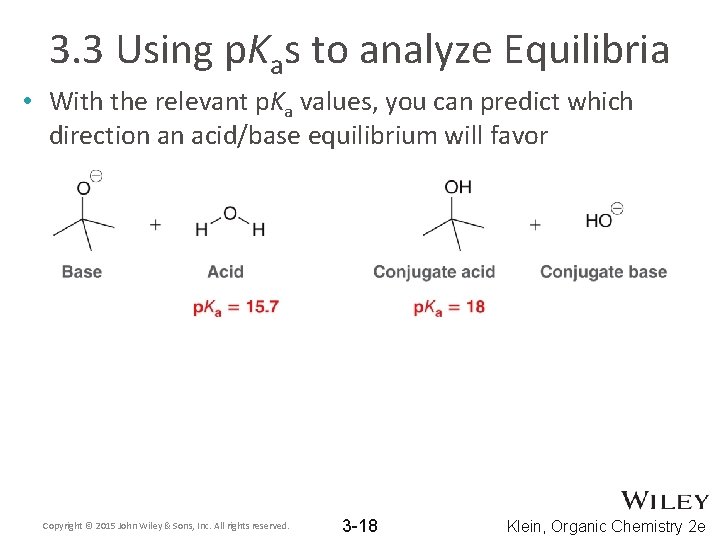
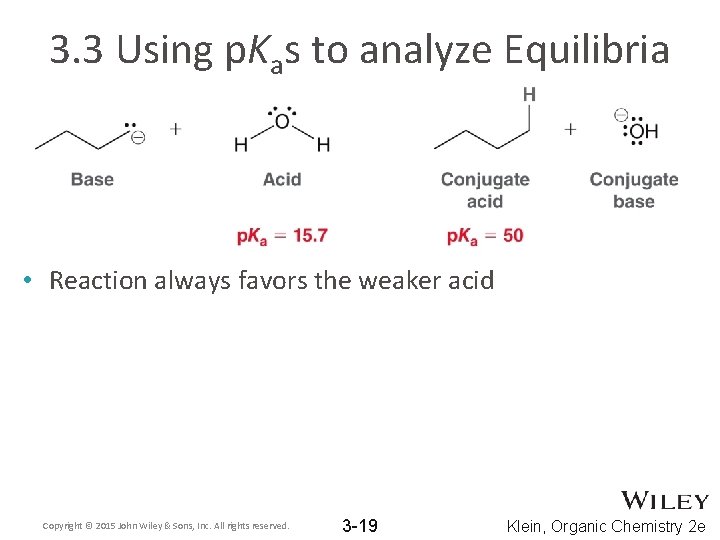
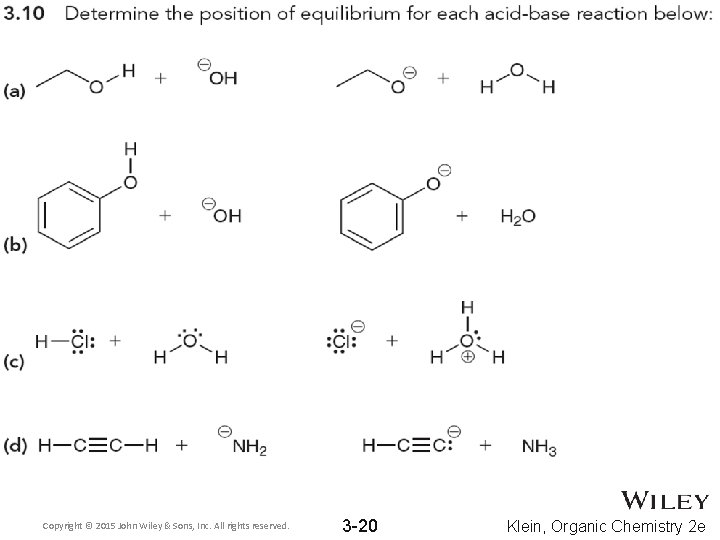
3. 3 Using p. Kas to analyze Equilibria • With the relevant p. Ka values, you can predict which direction an acid/base equilibrium will favor Copyright © 2015 John Wiley & Sons, Inc. All rights reserved. 3 -18 Klein, Organic Chemistry 2 e
3. 3 Using p. Kas to analyze Equilibria • Reaction always favors the weaker acid Copyright © 2015 John Wiley & Sons, Inc. All rights reserved. 3 -19 Klein, Organic Chemistry 2 e
Copyright © 2015 John Wiley & Sons, Inc. All rights reserved. 3 -20 Klein, Organic Chemistry 2 e
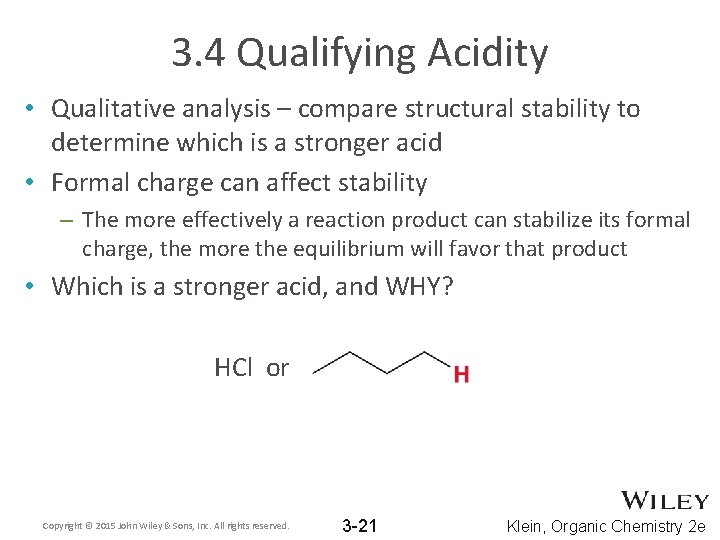
3. 4 Qualifying Acidity • Qualitative analysis – compare structural stability to determine which is a stronger acid • Formal charge can affect stability – The more effectively a reaction product can stabilize its formal charge, the more the equilibrium will favor that product • Which is a stronger acid, and WHY? HCl or Copyright © 2015 John Wiley & Sons, Inc. All rights reserved. 3 -21 Klein, Organic Chemistry 2 e
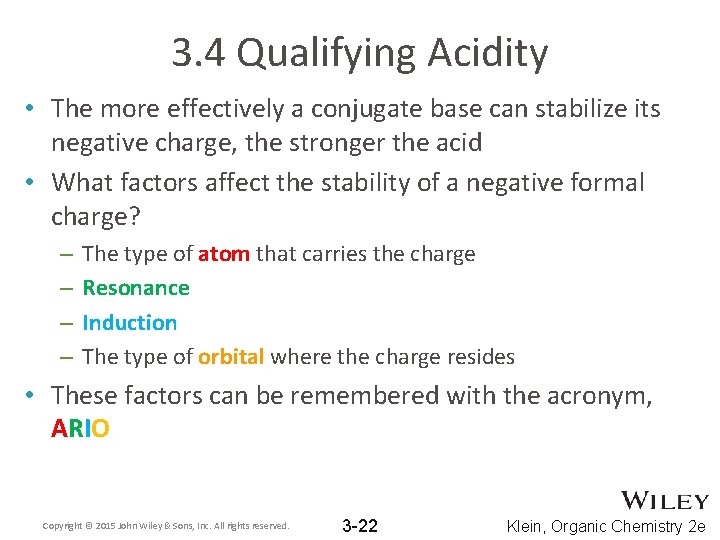
3. 4 Qualifying Acidity • The more effectively a conjugate base can stabilize its negative charge, the stronger the acid • What factors affect the stability of a negative formal charge? – – The type of atom that carries the charge Resonance Induction The type of orbital where the charge resides • These factors can be remembered with the acronym, ARIO Copyright © 2015 John Wiley & Sons, Inc. All rights reserved. 3 -22 Klein, Organic Chemistry 2 e
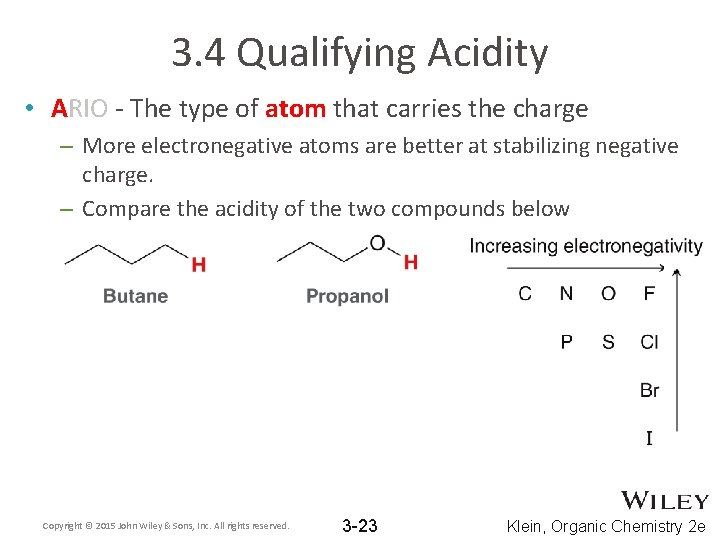
3. 4 Qualifying Acidity • ARIO - The type of atom that carries the charge – More electronegative atoms are better at stabilizing negative charge. – Compare the acidity of the two compounds below Copyright © 2015 John Wiley & Sons, Inc. All rights reserved. 3 -23 Klein, Organic Chemistry 2 e
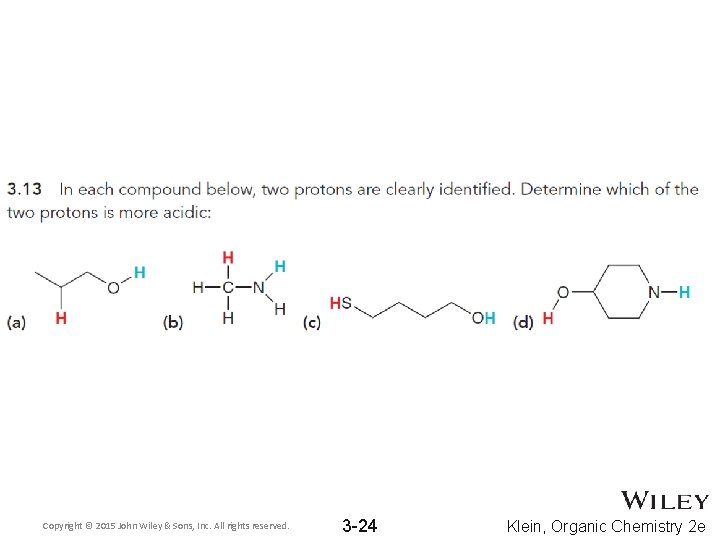
Copyright © 2015 John Wiley & Sons, Inc. All rights reserved. 3 -24 Klein, Organic Chemistry 2 e
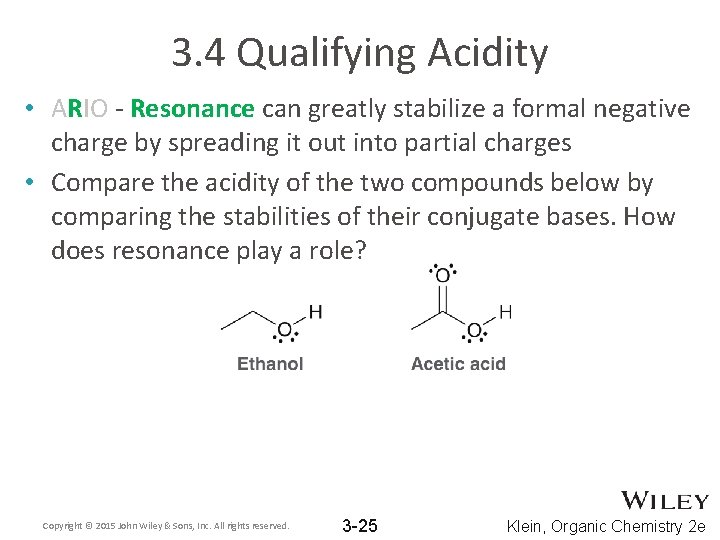
3. 4 Qualifying Acidity • ARIO - Resonance can greatly stabilize a formal negative charge by spreading it out into partial charges • Compare the acidity of the two compounds below by comparing the stabilities of their conjugate bases. How does resonance play a role? Copyright © 2015 John Wiley & Sons, Inc. All rights reserved. 3 -25 Klein, Organic Chemistry 2 e
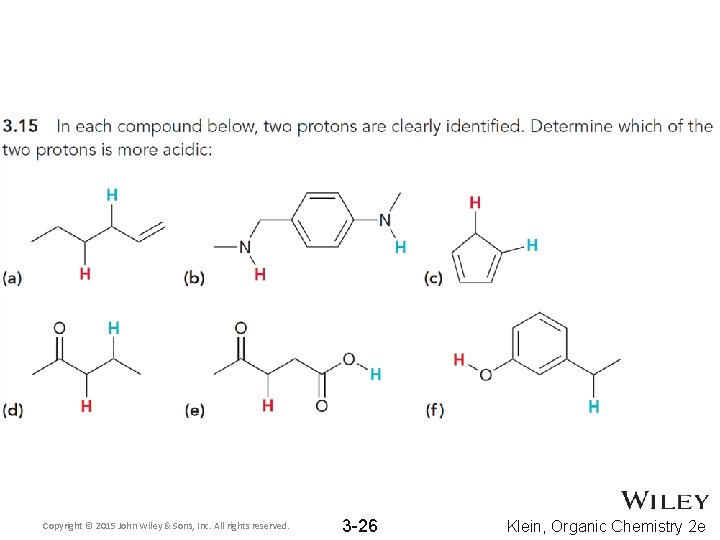
Copyright © 2015 John Wiley & Sons, Inc. All rights reserved. 3 -26 Klein, Organic Chemistry 2 e
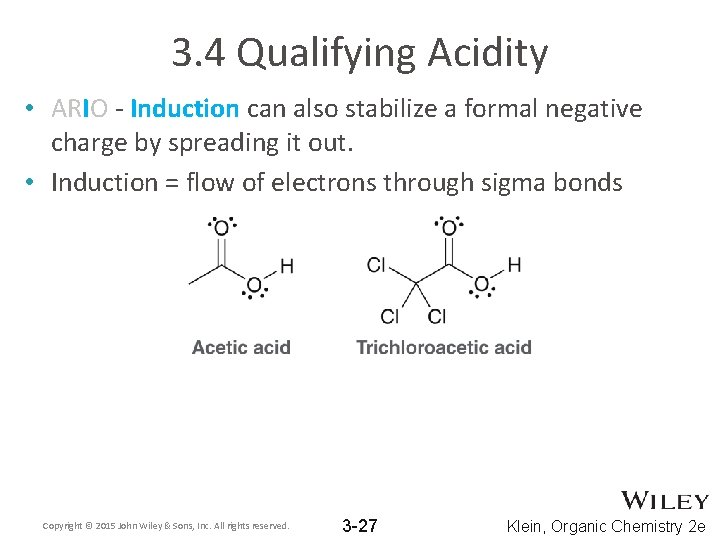
3. 4 Qualifying Acidity • ARIO - Induction can also stabilize a formal negative charge by spreading it out. • Induction = flow of electrons through sigma bonds Copyright © 2015 John Wiley & Sons, Inc. All rights reserved. 3 -27 Klein, Organic Chemistry 2 e
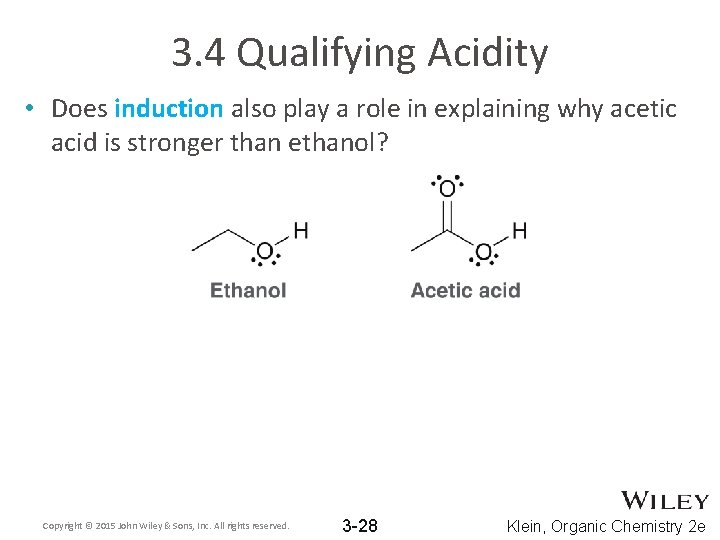
3. 4 Qualifying Acidity • Does induction also play a role in explaining why acetic acid is stronger than ethanol? Copyright © 2015 John Wiley & Sons, Inc. All rights reserved. 3 -28 Klein, Organic Chemistry 2 e
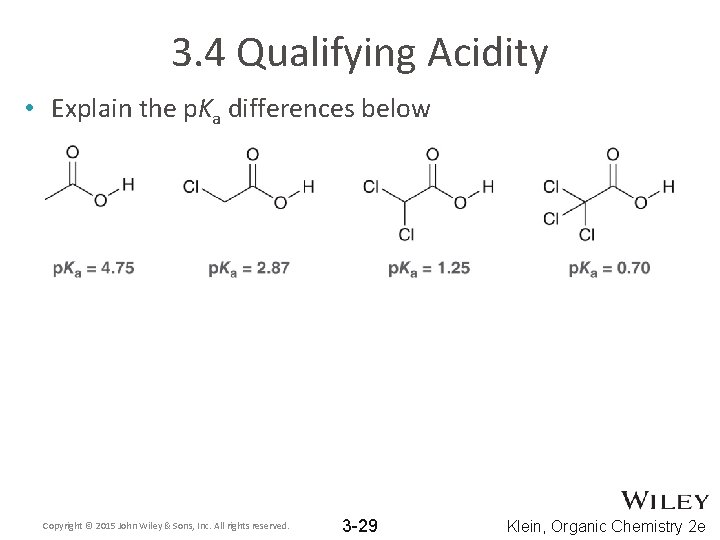
3. 4 Qualifying Acidity • Explain the p. Ka differences below Copyright © 2015 John Wiley & Sons, Inc. All rights reserved. 3 -29 Klein, Organic Chemistry 2 e
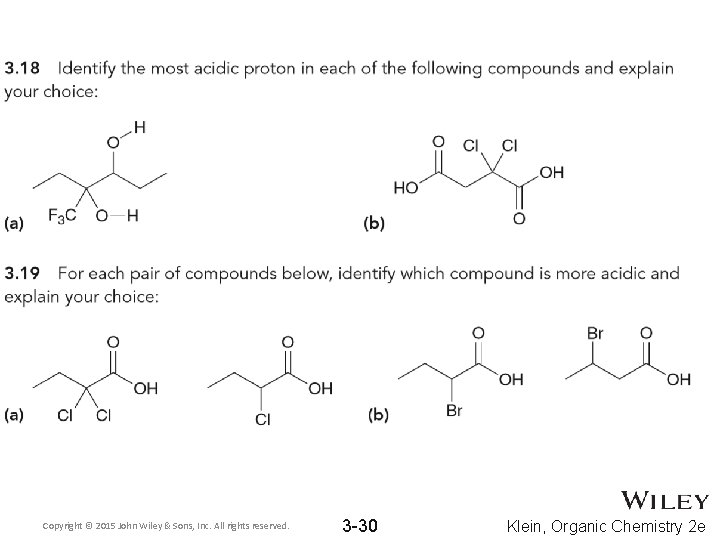
Copyright © 2015 John Wiley & Sons, Inc. All rights reserved. 3 -30 Klein, Organic Chemistry 2 e
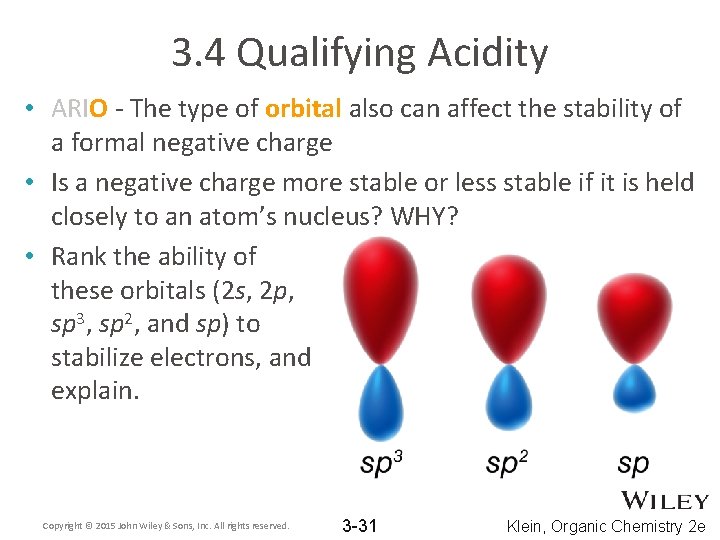
3. 4 Qualifying Acidity • ARIO - The type of orbital also can affect the stability of a formal negative charge • Is a negative charge more stable or less stable if it is held closely to an atom’s nucleus? WHY? • Rank the ability of these orbitals (2 s, 2 p, sp 3, sp 2, and sp) to stabilize electrons, and explain. Copyright © 2015 John Wiley & Sons, Inc. All rights reserved. 3 -31 Klein, Organic Chemistry 2 e
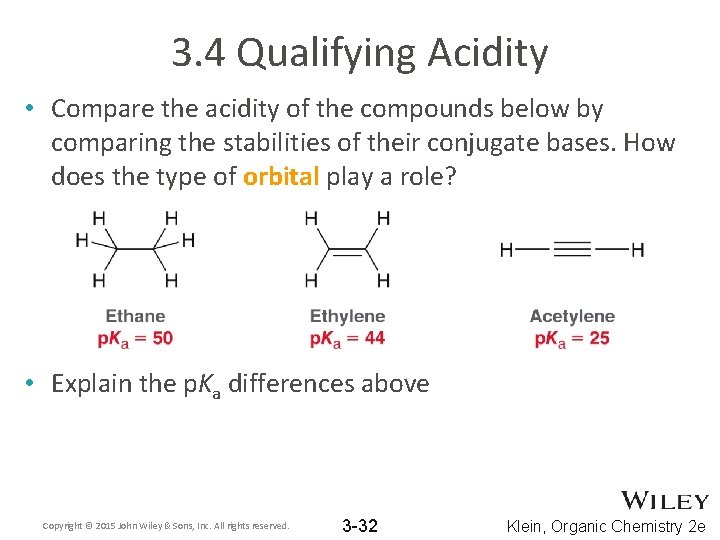
3. 4 Qualifying Acidity • Compare the acidity of the compounds below by comparing the stabilities of their conjugate bases. How does the type of orbital play a role? • Explain the p. Ka differences above Copyright © 2015 John Wiley & Sons, Inc. All rights reserved. 3 -32 Klein, Organic Chemistry 2 e
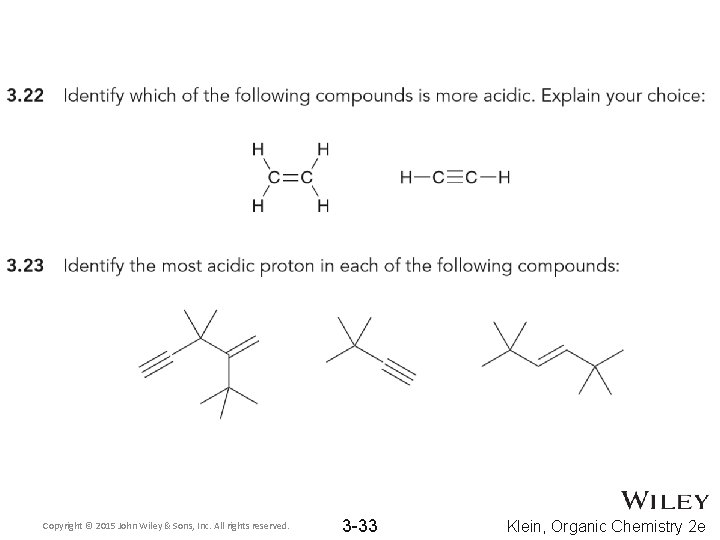
Copyright © 2015 John Wiley & Sons, Inc. All rights reserved. 3 -33 Klein, Organic Chemistry 2 e
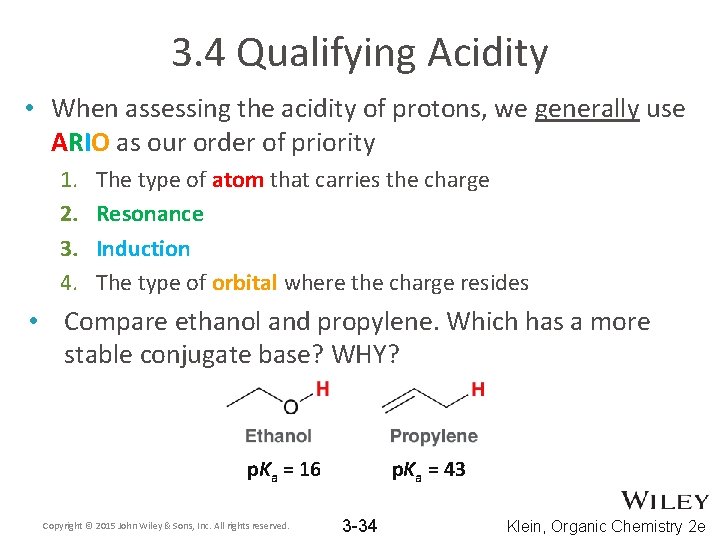
3. 4 Qualifying Acidity • When assessing the acidity of protons, we generally use ARIO as our order of priority 1. 2. 3. 4. The type of atom that carries the charge Resonance Induction The type of orbital where the charge resides • Compare ethanol and propylene. Which has a more stable conjugate base? WHY? p. Ka = 16 Copyright © 2015 John Wiley & Sons, Inc. All rights reserved. p. Ka = 43 3 -34 Klein, Organic Chemistry 2 e
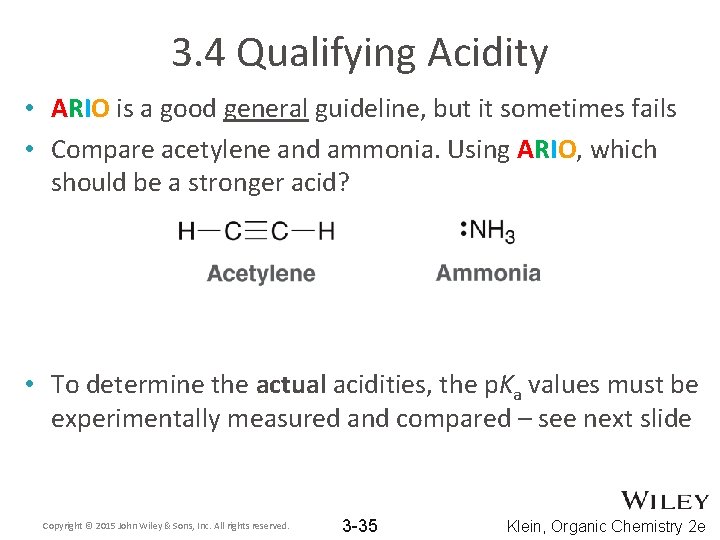
3. 4 Qualifying Acidity • ARIO is a good general guideline, but it sometimes fails • Compare acetylene and ammonia. Using ARIO, which should be a stronger acid? • To determine the actual acidities, the p. Ka values must be experimentally measured and compared – see next slide Copyright © 2015 John Wiley & Sons, Inc. All rights reserved. 3 -35 Klein, Organic Chemistry 2 e
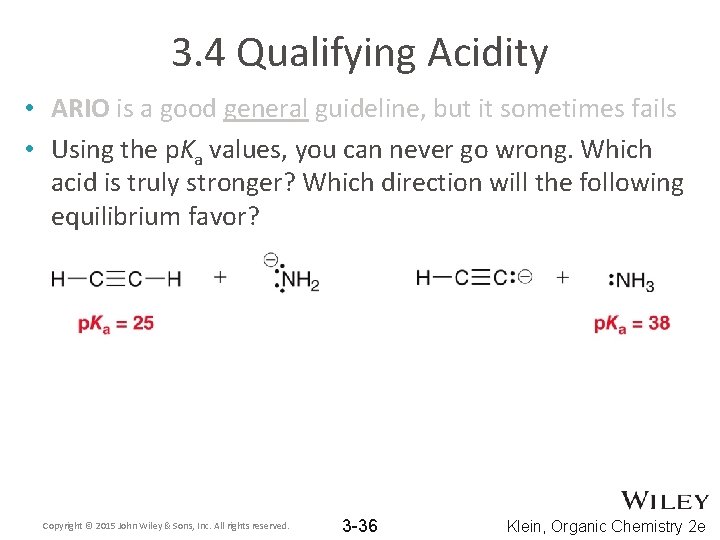
3. 4 Qualifying Acidity • ARIO is a good general guideline, but it sometimes fails • Using the p. Ka values, you can never go wrong. Which acid is truly stronger? Which direction will the following equilibrium favor? Copyright © 2015 John Wiley & Sons, Inc. All rights reserved. 3 -36 Klein, Organic Chemistry 2 e
Copyright © 2015 John Wiley & Sons, Inc. All rights reserved. 3 -37 Klein, Organic Chemistry 2 e
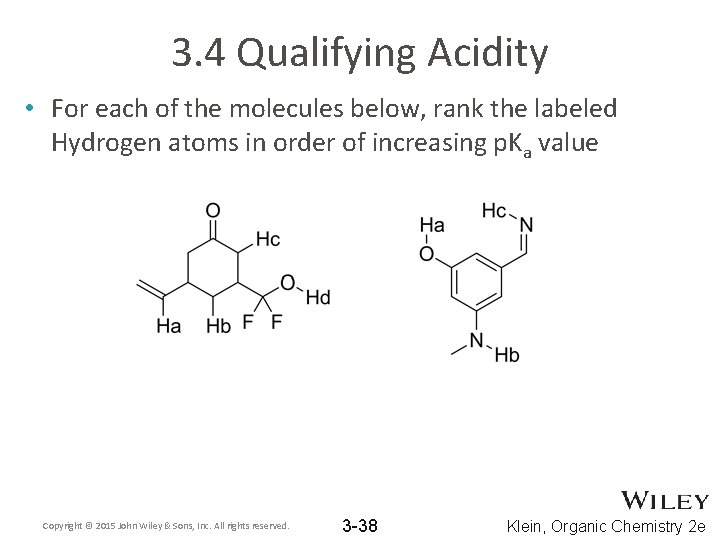
3. 4 Qualifying Acidity • For each of the molecules below, rank the labeled Hydrogen atoms in order of increasing p. Ka value Copyright © 2015 John Wiley & Sons, Inc. All rights reserved. 3 -38 Klein, Organic Chemistry 2 e
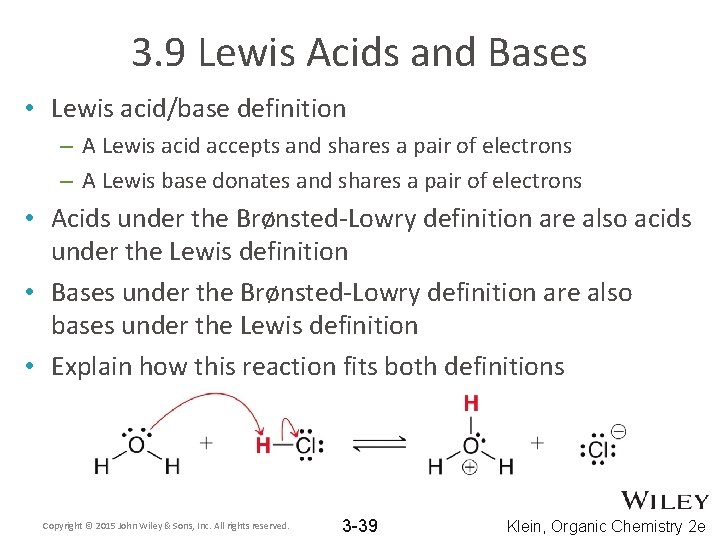
3. 9 Lewis Acids and Bases • Lewis acid/base definition – A Lewis acid accepts and shares a pair of electrons – A Lewis base donates and shares a pair of electrons • Acids under the Brønsted-Lowry definition are also acids under the Lewis definition • Bases under the Brønsted-Lowry definition are also bases under the Lewis definition • Explain how this reaction fits both definitions Copyright © 2015 John Wiley & Sons, Inc. All rights reserved. 3 -39 Klein, Organic Chemistry 2 e
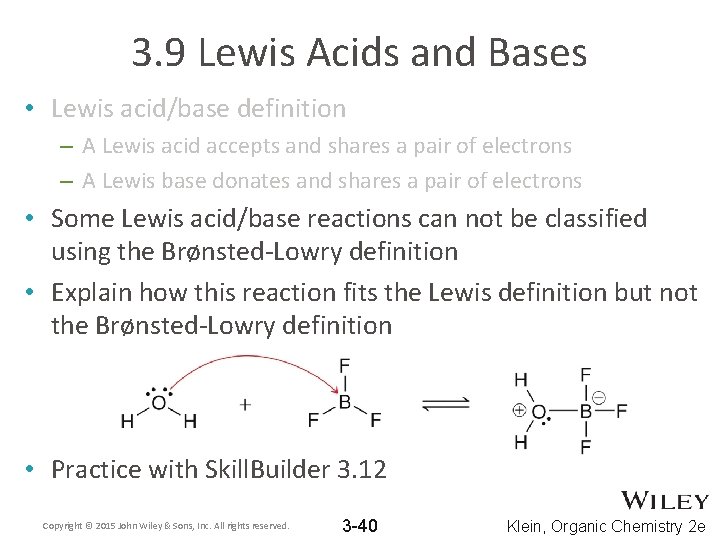
3. 9 Lewis Acids and Bases • Lewis acid/base definition – A Lewis acid accepts and shares a pair of electrons – A Lewis base donates and shares a pair of electrons • Some Lewis acid/base reactions can not be classified using the Brønsted-Lowry definition • Explain how this reaction fits the Lewis definition but not the Brønsted-Lowry definition • Practice with Skill. Builder 3. 12 Copyright © 2015 John Wiley & Sons, Inc. All rights reserved. 3 -40 Klein, Organic Chemistry 2 e
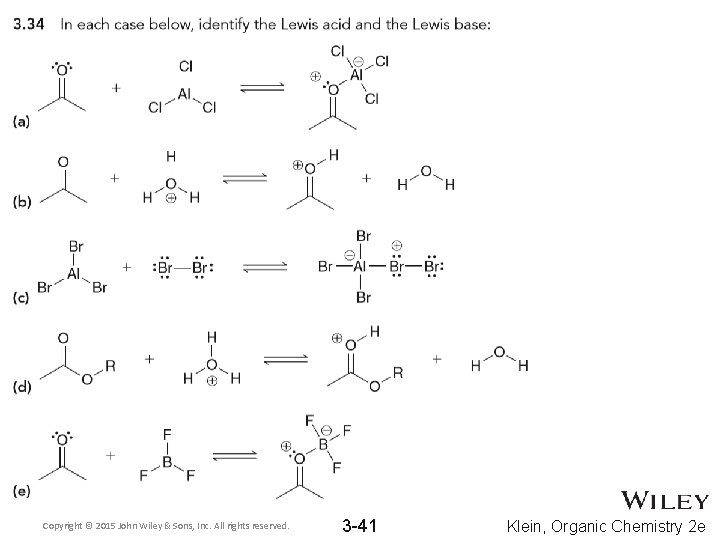
Copyright © 2015 John Wiley & Sons, Inc. All rights reserved. 3 -41 Klein, Organic Chemistry 2 e