NASHVILLEDAVIDSON COUNTY COORDINATED ENTRY SYSTEM Housing Navigator Training




- Slides: 49
NASHVILLE/DAVIDSON COUNTY COORDINATED ENTRY SYSTEM Housing Navigator Training 2018
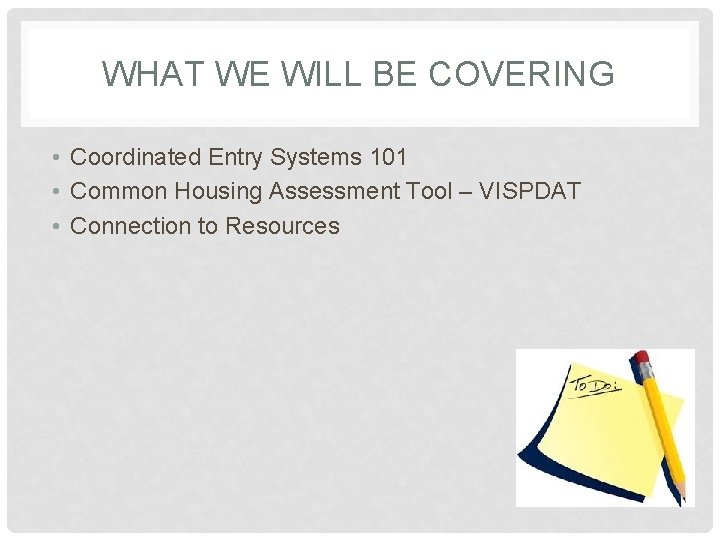
WHAT WE WILL BE COVERING • Coordinated Entry Systems 101 • Common Housing Assessment Tool – VISPDAT • Connection to Resources
NASHVILLE/DAVIDSON COUNTY COORDINATED ENTRY SYSTEM Coordinated Entry Systems 101 2018
DEFINITION OF CES • CES is a system-wide approach that serves to assess all persons experiencing a housing crisis to help identify, prioritize and connect them with the appropriate housing and support service resources as quickly as possible.
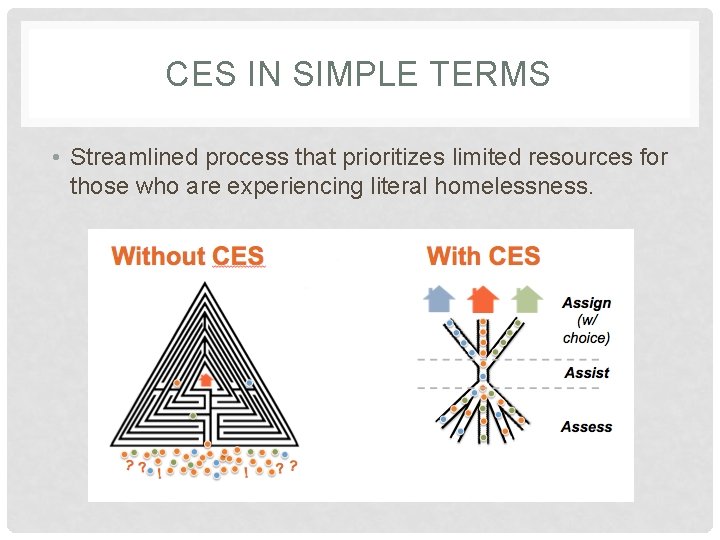
CES IN SIMPLE TERMS • Streamlined process that prioritizes limited resources for those who are experiencing literal homelessness.
WHAT CES IS NOT • A magic wand…
WHAT GOES INTO CES • • Collaboration A Community Focus Client-Centered Service Delivery Low Barrier Access/Housing First Philosophy Diversion Prevention Prioritization of Limited Resources -SYSTEM LEVEL CHANGES-
BENEFITS OF CES When CES is fully implemented the following benefits will follow: • Meets clients’ needs with appropriate interventions • Increases exits to permanent housing • Reduces the length of homelessness and returns to homelessness • Provides information to communities about housing and service gaps **Borrowed from NAEH: http: //www. flhousing. org/wp-content/uploads/2015/03/Webinar 4 -Coordinated-Entry-and-System-Change-Webinar. pdf
WHAT CES LOOKS LIKE IN NASHVILLE • • Identification Preliminary Assessment completed via HMIS Master-List/BNL VI-SPDAT/VI-F-SPDAT/TAY-VI-SPDAT Housing Navigation/Engagement Care Coordination Meetings Connection to Housing Resources Connection to Support Services Post-Housing
HOW CLIENTS GET CONNECTED? • Families with Minor Children • Metro Social Services [Through 862 -6444 or In-Person] • Individuals [In-Person] • Room In The Inn • Metro Social Services • Veterans Who Prefer Veteran Services [In-Person] • Operation Stand Down TN • VA – Mental Health Annex • Youth and Young Adults (18 -24) • Oasis Center [In-Person] • Those Fleeing Domestic Violence • Call DV Hotline – 1 -800 -334 -4628 **We are hoping to have specified office hours for individuals who are funded by the CES Grant, so that those who are in need know that they will be meeting with someone in person. **If a person is in need of a reasonable accommodation, this can be handled by one of the three CES Grant Funded positions.
CURRENT RESOURCES The below resources are to be applied for by a Housing Navigator on the behalf of their clients. • How’s Nashville Section 8 Vouchers • Urban Housing Solutions – Single Room Occupancy Units • How’s Nashville Financial Assistance for Move-In • MTA Bus Pass – Chronic or at Risk of Chronic Homelessness • Critical Time Intervention Case Management through Centerstone – Post Housing
CURRENT BARRIERS TO CES • • Limited Housing Resource Participation After Hour Support Limited Connection to Support Services Post-Housing Diversion/Prevention – not established There are efforts looking at how to move past these barriers and improve the CES not only for the community but for those who are experiencing a housing crisis
NASHVILLE/DAVIDSON COUNTY COORDINATED ENTRY SYSTEM CONDUCTING THE VI-SPDAT, F-VI-SPDAT, AND THE TAY VISPDAT 2018
WHAT IS THE VI-SPDAT The Vulnerability Index-Service Prioritization Decision Assistance Tool (VI-SPDAT) was developed by Org. Code, in collaboration with Community Solutions, as a brief survey that can quickly determine a client’s acuity and what housing intervention may be most appropriate. It also assists communities with prioritizing housing resources for the most vulnerable individuals/families.
WHAT IS THE POINT OF THE VI-SPDAT? • To help determine the person’s acuity level • Help determine the most appropriate housing intervention • To assist in prioritizing the most vulnerable people for the most appropriate housing intervention • To connect the person with appropriate support services based on the type of housing intervention
WHO DO I COMPLETE THE VI-SPDAT WITH? • A person experiencing literal homelessness (street, shelter [emergency/transitional], place not meant for human habitation) • UNLESS – If the client is a young person from the age of 18 -24 – literal homelessness is defined as not having a key of their own to a safe residence. • A person who has identified housing as a goal or a want
HOW DO I KNOW WHICH VERSION TO USE? • VI-SPDAT – Any individual, veteran, adult couple, family of adults, who are experiencing literal homelessness. • F-VI-SPDAT – Any family who have minor children in their care who are experiencing literal homelessness or a new mother in her third trimester. • TAY-VI-SPDAT – Any individual who is 18 -24 years of age who does not have a key to a safe and stable residence.
STEPS TO CONDUCTING THE VI-SPDAT • Introduction: Make sure the client knows who you are, where you work, and why you need to conduct the assessment. • Include what to expect from the assessment and that they can refuse to answer a question or stop taking the assessment at any time if it makes them feel uncomfortable. • CONSENT, DID I SAY CONSENT • Make sure the client signs a consent stating that they are okay with participating in having a VI-SPDAT completed and that it can be entered into HMIS. • The current consent used is the Homelink/HMIS Consent • Conduct the VI-SPDAT • Everything is self-report by the client – whatever they say is what you will report. • Enter it into HMIS under the CES Entry.
CONDUCTING THE VI-SPDAT • Remember the questions are to be read how they are written • However the client answers the question is how the responses should be documented • We don’t need detail, they are yes or no questions • A client has the right to refuse to answer any question on the questionnaire • Give time frames when needed to help clients give a more accurate response (ie. Instead of saying in the last six months, provide what month it was six months ago) • Once entered into HMIS, HMIS will score the VI-SPDAT automatically. **These pointers are true for all the VI-SPDAT versions.
CONDUCTING THE F-VI-SPDAT • This is for families with minor children in their care • There is space for single or dual headed households • Please include children’s information, for those children in the care of the adult • Questions change to “anyone in the household” • There will be family unit questions • Once entered into HMIS, HMIS will score the F-VISPDAT automatically
CONDUCTING THE TAY-VI-SPDAT • To be completed with young adults ages 18 -24 • The questions are very youth specific (runaway, gender identity, etc) • Be mindful of non-verbal cues in case the young person starts to feel uncomfortable or is experiencing some re-traumatization. • This is true for the other populations as well • Once entered into HMIS, HMIS will score the TAY-VISPDAT automatically
QUIZ This is an anonymous quiz to help improve our training. You have 5 minutes to complete the quiz.
CAN I RE-DO A VI-SPDAT? • There are only two reasons a VISPDAT should be recompleted • If a person was housed, exited from CES via HMIS and has fallen back into homelessness • If a person was exited from CES via HMIS due to being inactive and has resurfaced. Best way to remember – Are they currently open or closed in HMIS? If they are closed you can re-do a VISPDAT with a person.
NASHVILLE/DAVIDSON COUNTY COORDINATED ENTRY SYSTEM Connection to Resources 2018
CURRENT RESOURCES • • How’s Nashville Section 8 Vouchers UHS-SROs How’s Nashville Financial Assistance for Move-In Cost MTA Bus Passes for Chronic or At Risk of Chronic Homelessness • CTI Case Management through Centerstone – Post Housing
HOW’S NASHVILLE-SECTION 8 • A collaboration made between the Metro Homelessness Commission and MDHA • Provides up to 18 vouchers a month to person(s) identified through CES as literally homeless (HUD Category 1: Those who are sleeping on the street, in shelters, or places not meant for human habitation). • Eligibility: • Must be entered into the CES Process via HMIS • Preliminary Assessment and appropriate VI-SPDAT must be completed prior to the application being submitted • Must be LITERALLY homeless – as defined by HUD Cat. 1 • Final determination/approval by MDHA
CONT. HOW’S NASH – SECTION 8 • How to Apply: • Must complete the section 8 application - can be found on the Nashville CES Weebly Website: • http: //nashvilleces. weebly. com • Make sure to use the most RECENT application • The application is 20 pages – if a page is not applicable write N/A on it. • Anything you report on the application - must have documentation of (ie. Income, food stamps, etc. ) • Once completed you will upload into HMIS with required documents
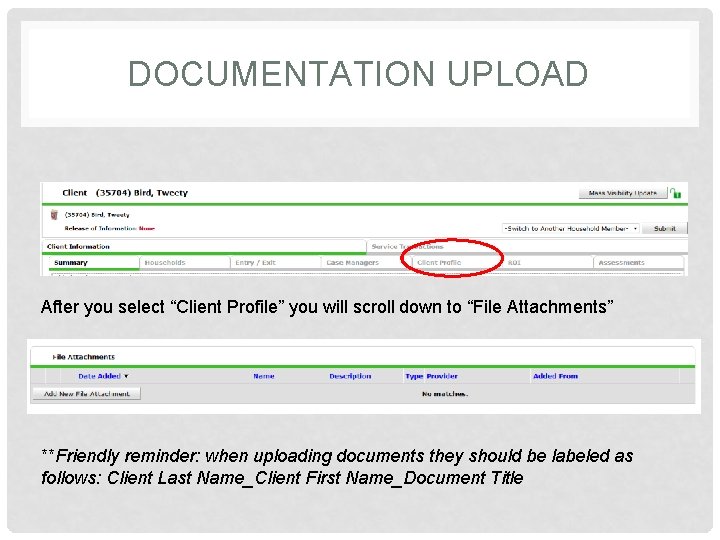
DOCUMENTATION UPLOAD After you select “Client Profile” you will scroll down to “File Attachments” **Friendly reminder: when uploading documents they should be labeled as follows: Client Last Name_Client First Name_Document Title
CONT. HOW’S NASH – SECTION 8 • Required Documents: • • Front and Back of State Identification Card – All adults Front and Back of Social Security Card – All family members Birth Certificate – All family members Proof of Income (must be within the last 90 days)– All adults – for all income sources reported • If there is an adult without income – complete the Zero Income Certification Form which is included in the Section 8 Application If there is a child with SSDI benefits the adult must report it • • Proof of Non Cash Benefits – Ex. Food Stamps (must be within the last 90 days) • Recommendation – Do NOT fill out the application until you are in possession of all documents – the applications expire after 90 days. If there any missing documents the application will be denied and everything will have to be resubmitted. • Recommendation #2 – The Housing Navigator should fill out the Section 8 Application with the person so that nothing is missed.
CONT. HOW’S NASH – SECTION 8 1. Upload all required documents to HMIS, Complete Preliminary Assessment and VI-SPDAT 2. E-Mail Jessica Ivey at Jessica. Ivey@nashville. gov to inform her the documents and application have been uploaded. Include HMIS ID# in the email. 3. Jessica will complete the referral to MDHA and inform you when that has been completed. She will also add a case note in HMIS stating this has been completed. 4. The google doc is updated about weekly by MDHA, you will need to check there for updates/missing documents. 5. As briefing dates become available each housing navigator will receive an email from the Metro Homelessness Commission with the needed information.
URBAN HOUSING SOLUTIONS –SRO • A collaboration with UHS and the Metro Homelessness Commission • All vacant UHS SROs are filled through the CES process. • Note: The person will still have to meet the eligibility criteria put forth by UHS • Eligibility: • Must be entered into the CES Process via HMIS • Preliminary Assessment and VI-SPDAT must be completed prior to the application being submitted • Must be LITERALLY homeless – as defined by HUD Cat. 1
CONT. UHS-SRO’S • How to Apply: • Must complete the UHS Pre-Match application - can be found on the Nashville CES Weebly Website: • http: //nashvilleces. weebly. com • Once completed you will upload into HMIS with required documents • Required Documents: • • Front and Back of State Identification Card – All adults Front and Back of Social Security Card – All family members Birth Certificate – All family members Proof of Income (must be within the last 90 days)– All adults – for all income sources reported • If there is an adult without income – complete the Zero Income Certification Form which is included in the Section 8 Application • Proof of Non Cash Benefits – Ex. Food Stamps (must be within the last 90 days)
CONT. UHS-SRO’S 1. Upload all required documents to HMIS, Complete Preliminary Assessment and VI-SPDAT 2. E-Mail Jessica Ivey at Jessica. Ivey@nashville. gov to inform her the documents and application have been uploaded. Include HMIS ID# in the email. 3. Jessica will verify everything has been uploaded and completed and then add the client to the waiting list (kept internally at MHCommission). 4. Adam Graham from UHS will notify Jessica when a vacancy arises. She will send a Match Letter to Adam Graham and the Housing Navigator for the person who is next on the waiting list 5. Adam Graham will schedule the person to come in for an interview and UHS will complete the process.
HN – FINANCIAL ASSISTANCE How’s Nashville is able to provide up to $1000. 00 (onetime only) per household for move-in related expenses such as: • • Security Deposit First Month’s Rent NES/Utility Deposit Arrears – If it is the ONLY barrier to a person getting into a unit they have been approved for. • Other possible move-in costs can include pet deposits, key deposit, etc. (check with Sunni Brimsy, the Housing Navigator Liaison, at the Metro Homelessness Commission if you are unsure).
CONT. HN – FINANCIAL ASSISTANCE • Eligibility: • Must be entered into the CES Process via HMIS • Preliminary Assessment and VI-SPDAT must be completed prior to the application being submitted • Must be literally homeless and moving into Permanent Housing • How to Apply: • Must complete the Financial Assistance Request- can be found on the Nashville CES Weebly Website: • http: //nashvilleces. weebly. com • The Metro Homelessness Commission will receive notification and complete the needed steps to evaluate the request.
CONT. HN – FINANCIAL ASSISTANCE • If there any questions regarding the request the Metro Homelessness Commission will contact the Housing Navigator. • On average it takes about 2 weeks after approval for a financial request to be fully completed. • All payments are made directly to landlords, utility companies, etc. • If there any questions regarding this process please contact Sunni Brimsy at Sunni. Brimsy@nashville. gov
CONT. HN-FINANCIAL ASSISTANCE Expectations: • Housing navigators are not to make assumptions or promises for payment on behalf of the payer (in this case, the Homelessness Commission). • The dedicated financial assistance provider (or his/her designee) within the Homelessness Commission follows the How’s Nashville Financial Assistance Protocol(any extraordinary circumstances require approval from the Director). Communications are between the property manager/landlord and the dedicated financial assistance provider. • The Homelessness Commission does not pay rent for monthly hotels. • The client has to sign a lease. A signed ‘contract’ is insufficient. • Requests for move-in assistance need to be submitted prior to an individual’s move-in date. The sooner the better. • Please note: financial assistance requests are checked daily and are processed by the next business day.
MTA ANNUAL BUS PASSES • The Metro Homelessness Commission in partnership with MTA was able to secure 500 Annual Bus Passes for adult persons who are experiencing literal homelessness and are identified as chronically homeless or at risk of becoming chronically homeless. • Eligibility: • Must be a chronically homeless adult or at risk of being chronically homeless. For this program: • Chronically Homeless is defined as being literally homeless for 12+ consecutive months or homeless 4 times in the last 3 years totalling 12+ months, and a self-reported disabling condition. • At Risk is defined as 5 months literally homeless with a disabling condition, that can be self-reported • Must be entered into the CES Process via HMIS • Preliminary Assessment must be completed prior to the application being submitted
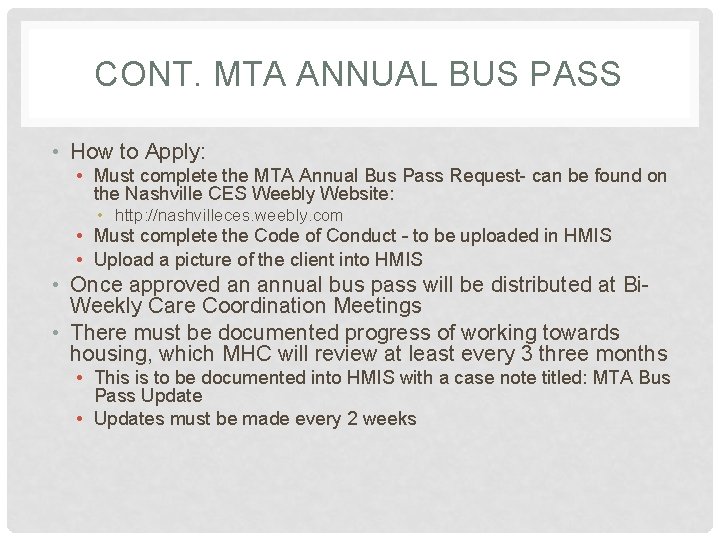
CONT. MTA ANNUAL BUS PASS • How to Apply: • Must complete the MTA Annual Bus Pass Request- can be found on the Nashville CES Weebly Website: • http: //nashvilleces. weebly. com • Must complete the Code of Conduct – to be uploaded in HMIS • Upload a picture of the client into HMIS • Once approved an annual bus pass will be distributed at Bi. Weekly Care Coordination Meetings • There must be documented progress of working towards housing, which MHC will review at least every 3 three months • This is to be documented into HMIS with a case note titled: MTA Bus Pass Update • Updates must be made every 2 weeks
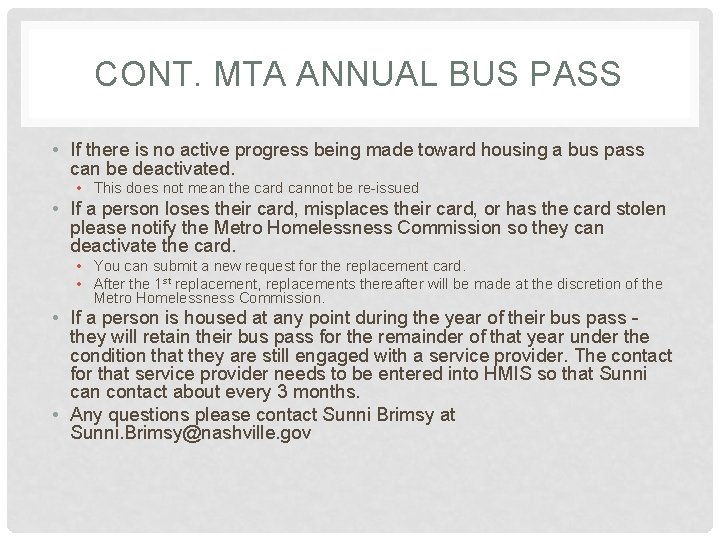
CONT. MTA ANNUAL BUS PASS • If there is no active progress being made toward housing a bus pass can be deactivated. • This does not mean the card cannot be re-issued • If a person loses their card, misplaces their card, or has the card stolen please notify the Metro Homelessness Commission so they can deactivate the card. • You can submit a new request for the replacement card. • After the 1 st replacement, replacements thereafter will be made at the discretion of the Metro Homelessness Commission. • If a person is housed at any point during the year of their bus pass – they will retain their bus pass for the remainder of that year under the condition that they are still engaged with a service provider. The contact for that service provider needs to be entered into HMIS so that Sunni can contact about every 3 months. • Any questions please contact Sunni Brimsy at Sunni. Brimsy@nashville. gov
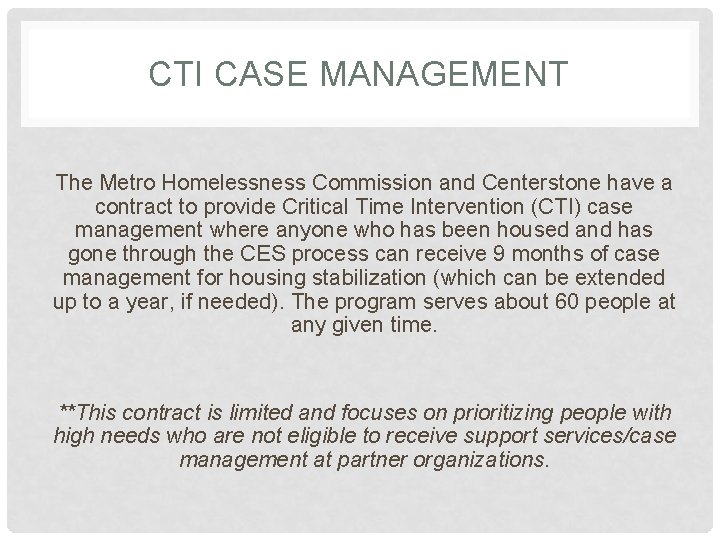
CTI CASE MANAGEMENT The Metro Homelessness Commission and Centerstone have a contract to provide Critical Time Intervention (CTI) case management where anyone who has been housed and has gone through the CES process can receive 9 months of case management for housing stabilization (which can be extended up to a year, if needed). The program serves about 60 people at any given time. **This contract is limited and focuses on prioritizing people with high needs who are not eligible to receive support services/case management at partner organizations.
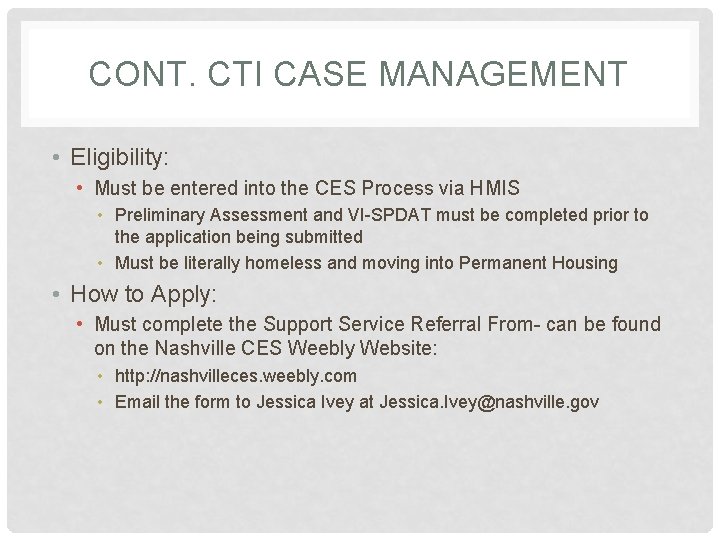
CONT. CTI CASE MANAGEMENT • Eligibility: • Must be entered into the CES Process via HMIS • Preliminary Assessment and VI-SPDAT must be completed prior to the application being submitted • Must be literally homeless and moving into Permanent Housing • How to Apply: • Must complete the Support Service Referral From- can be found on the Nashville CES Weebly Website: • http: //nashvilleces. weebly. com • Email the form to Jessica Ivey at Jessica. Ivey@nashville. gov
CONT. CTI CASE MANAGEMENT • Once the referral form is received Jessica will email the Centerstone Point of Contact with the referral form. • A CM will be assigned and will contact the Housing Navigator to schedule a warm-handoff. • Jessica will also email the Housing Navigator to let them know who the assigned CM is with their email address.
ONCE A CLIENT IS HOUSED • Please make sure to complete the CES Exit via HMIS This is imperative for our community to know how many individuals/families are exiting homelessness into permanent housing.
IN CLOSING • Everything is always a work in progress and takes time. • We are always looking at ways for improvement and growth. • Please complete Feedback Survey If there any questions please do not hesitate to reach out: Jessica Ivey, LMSW - jessica. ivey@nashville. gov - 615 -880 -2293
CONTACT INFORMATION • Anything Homelessness Commission Related • Judith Tackett, Director • Judith. Tackett@nashville. gov • Abigail Dowell • Abigail. Dowell@nashville. gov • Anything CES Related • Jessica Ivey, CES Manager • Jessica. Ivey@nashville. gov • Anything Landlord Recruitment Related • Deon Trotter • Deon. Trotter@nashville. gov • Anthything Housing Navigator Related • Sunni Brimsy • Sunni. Brimsy@nashville. gov • Anything Outreach Related • Sally Besuden - Troy Jenkins – Joseph Parker • Sally. Besuden@nashville. gov; Troy. Jenkins@nashville. gov; Joseph. Parker@nashville. gov