Chapter 11 Coordinated Product and Supply Chain Design




- Slides: 50
Chapter 11 Coordinated Product and Supply Chain Design Mc. Graw-Hill/Irwin Copyright © 2008 by The Mc. Graw-Hill Companies, Inc. All rights reserved.
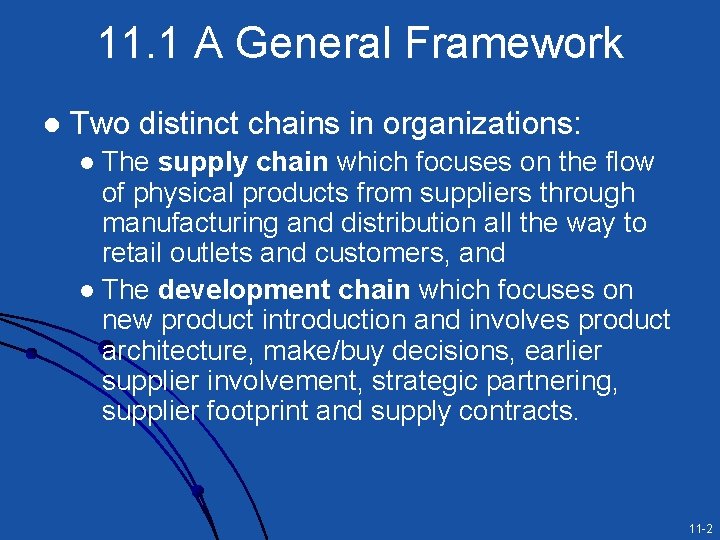
11. 1 A General Framework l Two distinct chains in organizations: The supply chain which focuses on the flow of physical products from suppliers through manufacturing and distribution all the way to retail outlets and customers, and l The development chain which focuses on new product introduction and involves product architecture, make/buy decisions, earlier supplier involvement, strategic partnering, supplier footprint and supply contracts. l 11 -2
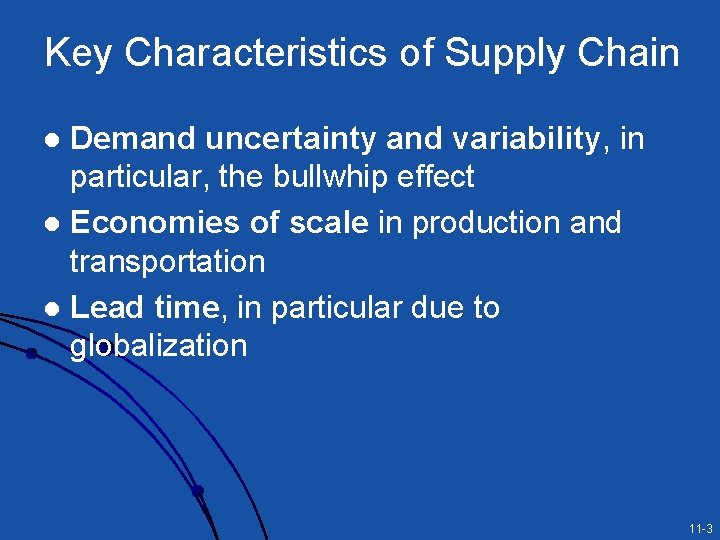
Key Characteristics of Supply Chain Demand uncertainty and variability, in particular, the bullwhip effect l Economies of scale in production and transportation l Lead time, in particular due to globalization l 11 -3
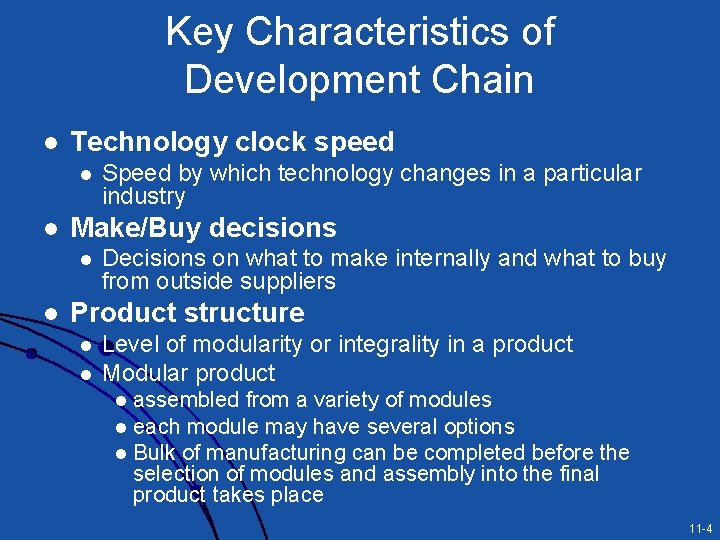
Key Characteristics of Development Chain l Technology clock speed l l Make/Buy decisions l l Speed by which technology changes in a particular industry Decisions on what to make internally and what to buy from outside suppliers Product structure l l Level of modularity or integrality in a product Modular product assembled from a variety of modules l each module may have several options l Bulk of manufacturing can be completed before the selection of modules and assembly into the final product takes place l 11 -4
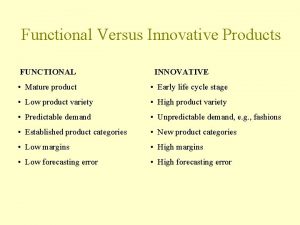
Interaction between the Two Chains l Fisher’s concept of Innovative and Functional Products l Functional products characterized by: l slow technology clock speed, low product variety, and typically low profit margins l Innovative products characterized by: l fast technology clock speed and short product life cycle, high product variety, and relatively high margins. 11 -5
What Is the Appropriate Supply Chain Strategy and Product Design Strategy for Each Product Type? Each requires a different supply chain strategy l Development chain has to deal with the differing level of demand uncertainty l 11 -6
Framework for Matching Product Design and Supply Chain Strategies FIGURE 11 -3: The impact of demand uncertainty and product introduction frequency on product design and supply chain strategy 11 -7
11. 2 Design for Logistics (DFL) l Product and process design that help to control logistics costs and increase service levels l Economic packaging and transportation l Concurrent and parallel processing l Standardization 11 -8
Economic Transportation and Storage Design products so that they can be efficiently packed and stored l Design packaging so that products can be consolidated at cross docking points l Design products to efficiently utilize retail space l 11 -9
Examples l Ikea World’s largest furniture retailer l 131 stores in 21 countries l Large stores, centralized manufacturing, compactly and efficiently packed products l l Rubbermaid l Clear Classic food containers - designed to fit 14 x 14” Wal-Mart shelves 11 -10
Final Packaging Delay until as late as possible l Repackaging at the cross-docking point is common for many products l 11 -11
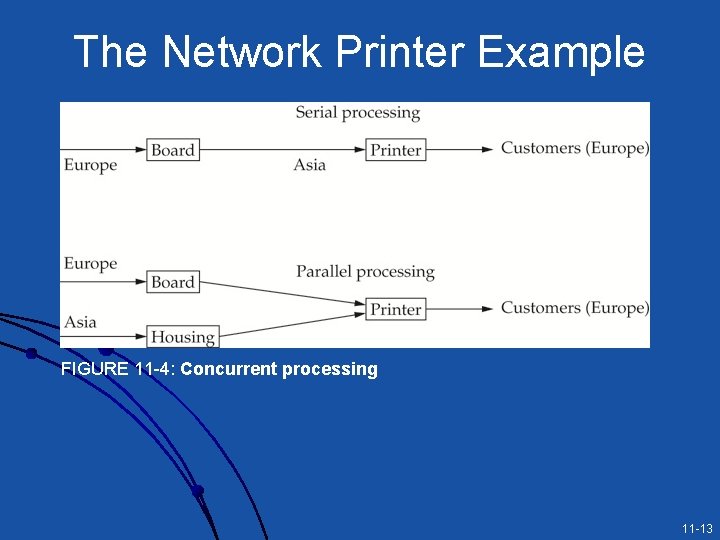
Concurrent/Parallel Processing Objective is to minimize lead times l Achieved by redesigning products so that several manufacturing steps can take place in parallel l Modularity/Decoupling is key to implementation l Enables different inventory levels for different parts l 11 -12
The Network Printer Example FIGURE 11 -4: Concurrent processing 11 -13
Traditional Manufacturing Set schedules as early as possible l Use large lot sizes to make efficient use of equipment and minimize costs l Large centralized facilities take advantage of economies of scale l 11 -14
Standardization l l Recall: aggregate demand information is more reliable We can have better forecasts for a product family (rather than a specific product or style) How to make use of aggregate data ? Designing the product and manufacturing processes so that decisions about which specific product is being manufactured (differentiation) can be delayed until after manufacturing is under way 11 -15
Modularity in Product and Process l Modular Product: l l l Can be made by appropriately combining the different modules It entails providing customers a number of options for each module Modular Process: l l Each product undergo a discrete set of operations making it possible to store inventory in semi-finished form Products differ from each other in terms of the subset of operations that are performed on them 11 -16
Modularity in Product and Process Semiconductor wafer fabrication is modular since the type of chip produced depends on the unique set of operations performed l Oil refining is not modular since it is continuous and inventory storage of semifinished product is difficult l 11 -17
Modularity in Product and Process l Modular products are not always made from modular processes l Bio-tech and pharmaceutical industries make modular products but use non-modular processes; many products are made by varying the mix of a small number of ingredients 11 -18
Swaminathan’s Four Approaches to Standardization Part standardization l Process standardization l Product standardization l Procurement standardization l 11 -19
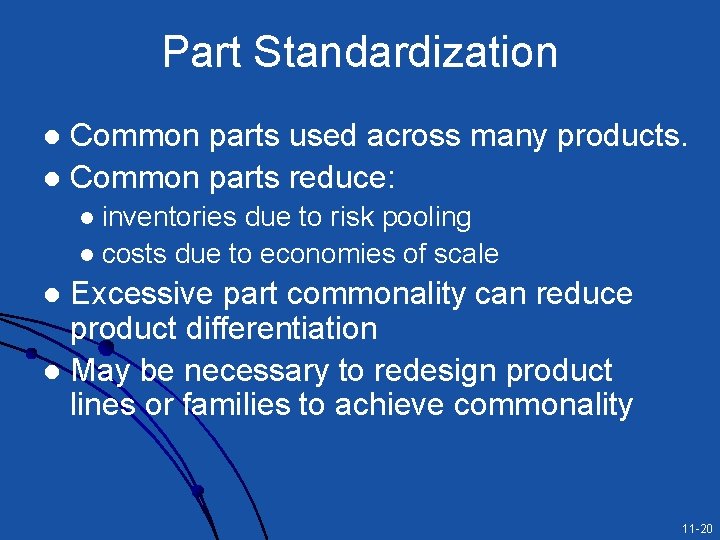
Part Standardization Common parts used across many products. l Common parts reduce: l inventories due to risk pooling l costs due to economies of scale l Excessive part commonality can reduce product differentiation l May be necessary to redesign product lines or families to achieve commonality l 11 -20
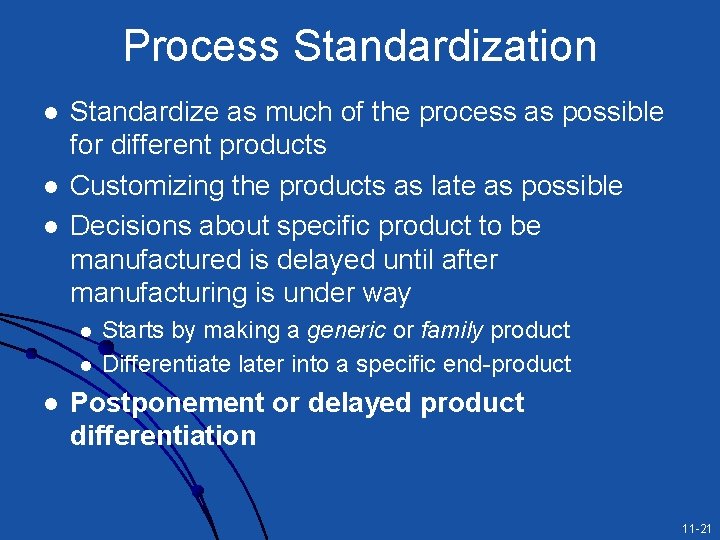
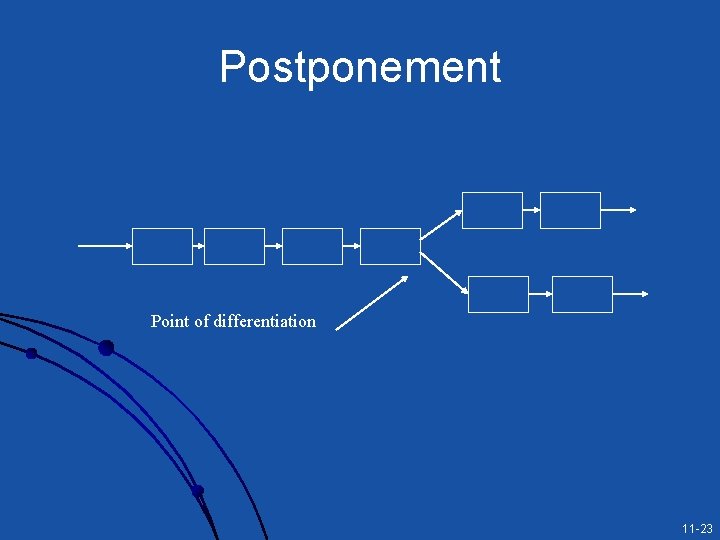
Process Standardization l l l Standardize as much of the process as possible for different products Customizing the products as late as possible Decisions about specific product to be manufactured is delayed until after manufacturing is under way l l l Starts by making a generic or family product Differentiate later into a specific end-product Postponement or delayed product differentiation 11 -21
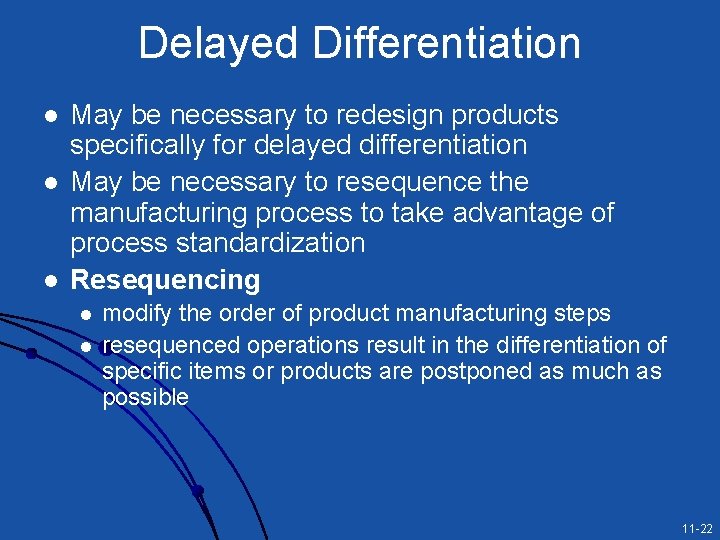
Delayed Differentiation l l l May be necessary to redesign products specifically for delayed differentiation May be necessary to resequence the manufacturing process to take advantage of process standardization Resequencing l l modify the order of product manufacturing steps resequenced operations result in the differentiation of specific items or products are postponed as much as possible 11 -22
Postponement Point of differentiation 11 -23
Benetton Background l l l A world leader in knitwear Massive volume, many stores Logistics l l Large, flexible production network Many independent subcontractors Subcontractors responsible for product movement Retailers l Many, small stores with limited storage 11 -24
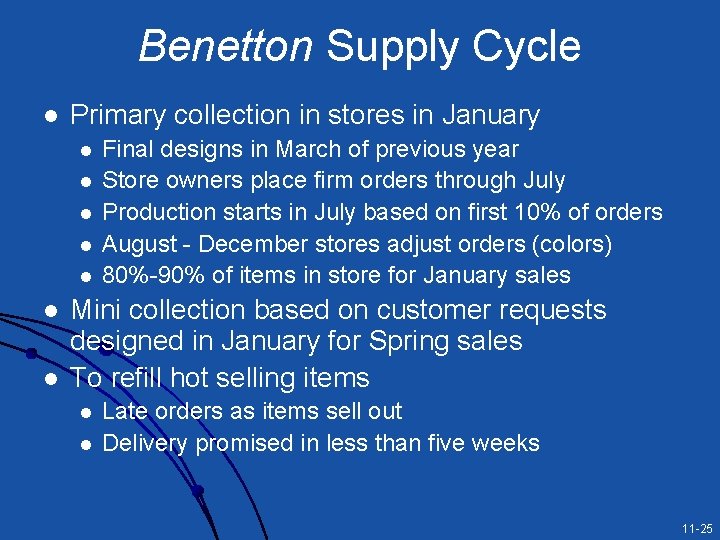
Benetton Supply Cycle l Primary collection in stores in January l l l l Final designs in March of previous year Store owners place firm orders through July Production starts in July based on first 10% of orders August - December stores adjust orders (colors) 80%-90% of items in store for January sales Mini collection based on customer requests designed in January for Spring sales To refill hot selling items l l Late orders as items sell out Delivery promised in less than five weeks 11 -25
Benetton Flexibility l Business goals l l Increase sales of fashion items Continue to expand sales network Minimize costs Flexibility important in achieving these goals l l l Hard to predict what items, colors, etc. will sell Customers make requests once items are in stores Small stores may need frequent replenishments 11 -26
It Is Hard to Be Flexible When. . . Lead times are long l Retailers are committed to purchasing early orders l Purchasing plans for raw materials are based upon extrapolating from 10% of the orders l 11 -27
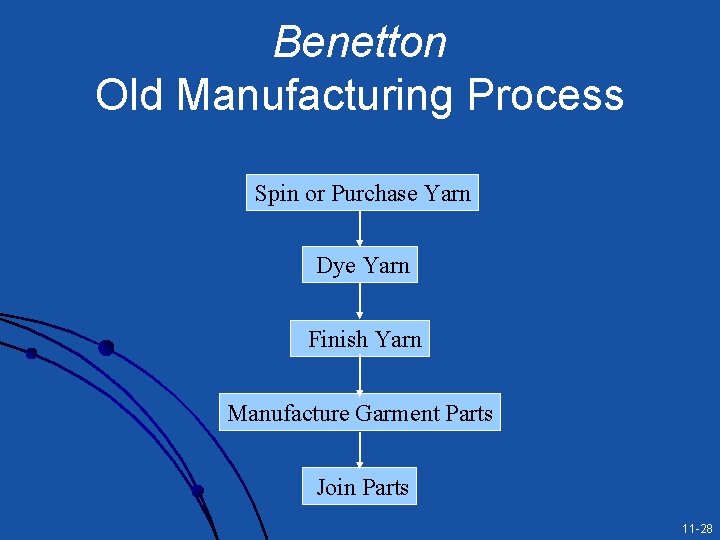
Benetton Old Manufacturing Process Spin or Purchase Yarn Dye Yarn Finish Yarn Manufacture Garment Parts Join Parts 11 -28
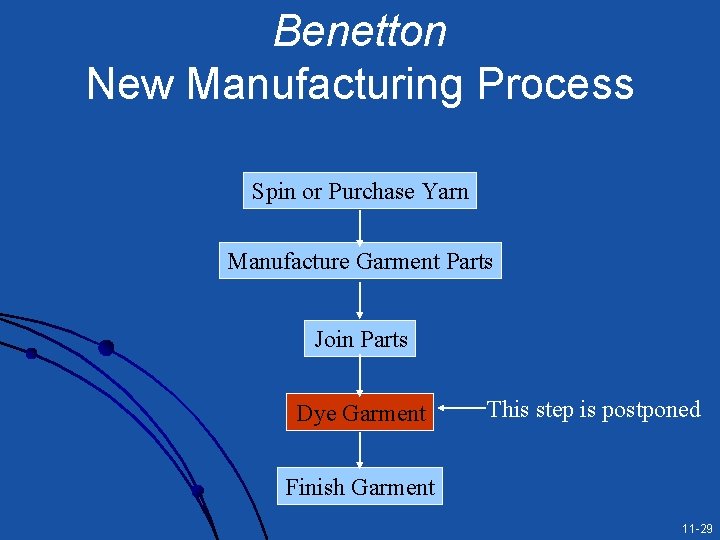
Benetton New Manufacturing Process Spin or Purchase Yarn Manufacture Garment Parts Join Parts Dye Garment This step is postponed Finish Garment 11 -29
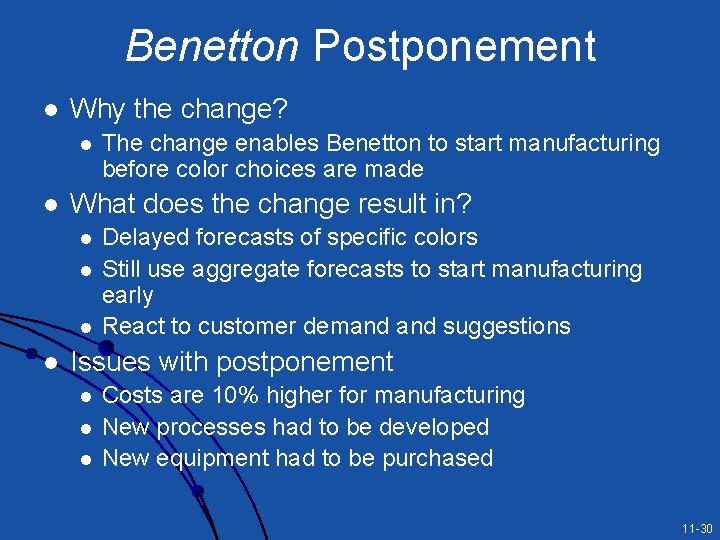
Benetton Postponement l Why the change? l l What does the change result in? l l The change enables Benetton to start manufacturing before color choices are made Delayed forecasts of specific colors Still use aggregate forecasts to start manufacturing early React to customer demand suggestions Issues with postponement l l l Costs are 10% higher for manufacturing New processes had to be developed New equipment had to be purchased 11 -30
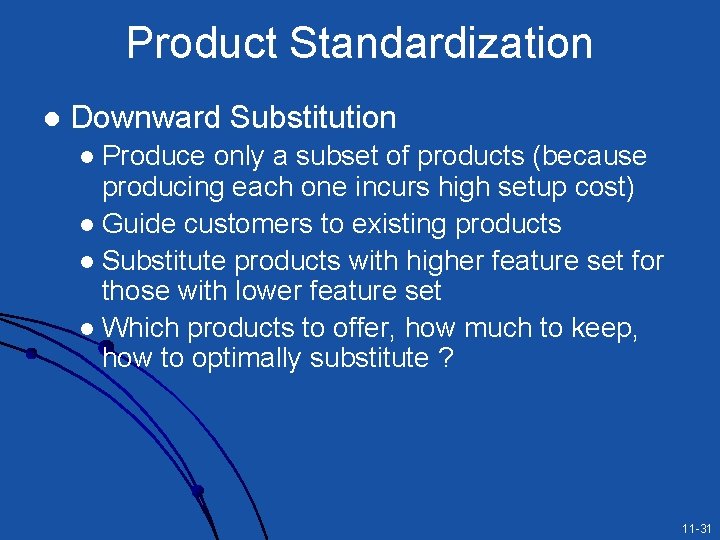
Product Standardization l Downward Substitution Produce only a subset of products (because producing each one incurs high setup cost) l Guide customers to existing products l Substitute products with higher feature set for those with lower feature set l Which products to offer, how much to keep, how to optimally substitute ? l 11 -31
Procurement Standardization l Consider a large semiconductor manufacturer l l The wafer fabrication facility produces highly customized integrated circuits Processing equipment that manufactures these wafers are very expensive with long lead time and are made to order Although there is a degree of variety at the final product level, each wafer has to undergo a common set of operations The firm reduces risk of investing in the wrong equipment by pooling demand across a variety of products 11 -32
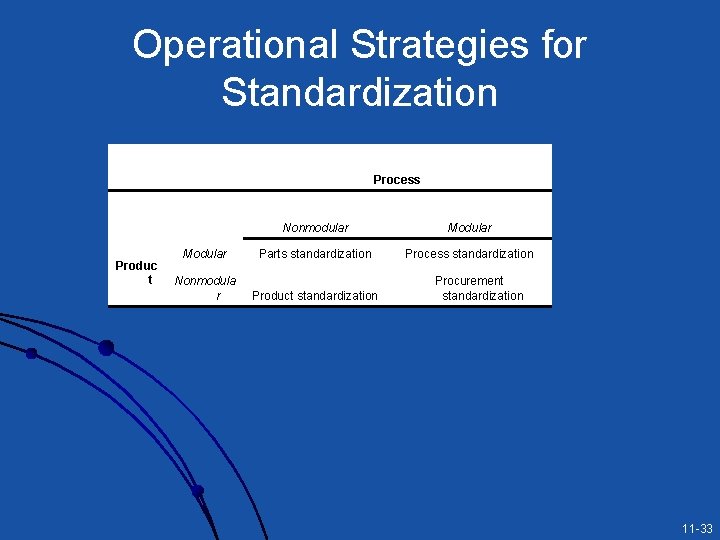
Operational Strategies for Standardization Process Produc t Nonmodular Modular Parts standardization Process standardization Nonmodula r Product standardization Procurement standardization 11 -33
Selecting the Standardization Strategy l l If process and product are modular, process standardization will help to maximize effective forecast accuracy and minimize inventory costs. If the product is modular, but the process is not, it is not possible to delay differentiation. However, part standardization is likely to be effective. If the process is modular but the product is not, procurement standardization may decrease equipment expenses. If neither the process nor the product is modular, some benefits may still result from focusing on product standardization. 11 -34
Important Considerations Strategies designed to deal with demand uncertainty and/or inaccurate forecasts l Changes suggested in the strategies may be too expensive to implement l Redesign related costs should be incurred at the beginning of the product life cycle l Benefits cannot be quantified in many cases: l l increased flexibility, more efficient customer service, decreased market response times 11 -35
Important Considerations l Resequencing causes: l level of inventory in many cases to go down per unit value of inventory being held will be higher Tariffs and duties are lower for semi-finished or non-configured goods than for final products l Completing the manufacturing process in a local distribution center may help to lower costs associated with tariffs and duties. 11 -36
Push-Pull Boundary l Pull-based systems typically lead to: l l l Not always practical to implement a pull-based system throughout the entire supply chain l l l reduction in supply chain lead times, inventory levels, and system costs making it easier to manage system resources Lead times may be too long May be necessary to have economies of scale in production or transportation. Standardization strategies can combine push and pull systems l l Portion of the supply chain prior to product differentiation is typically a push-based supply chain Portion of the supply chain starting from the time of differentiation is a pull-based supply chain. 11 -37
Back to the HP Case l l Long lead times, high inventory levels, imbalance of inventory Localization (labeling and manuals, power supply, plug) One cause of imbalance (too much inventory for printers localized for one market, too little inventory for another market) l Significant uncertainty on how to set safety stock l Too many localization options l Uncertainty in local markets Some options l Air shipment l A factory in Europe l Improve forecasting practices (how? ) 11 -38
Back to the HP Case l l HP management considered postponement as an option Ship “unlocalized” printers to European DC and localize them after observing the local demand l At 98% service level, safety stock dropped from 3. 8 weeks supply to 2. 6 weeks supply on the average l Annual savings around $800, 000 l Value of inventory in transit (and hence insurance costs) goes down l Some of the localization material can be locally sourced (cheaper) l European DC had to be modified to facilitate localization. Printer needed to be redesigned. l All Vancouver products now DC-localizable (postponement). One of the best of such practices. 11 -39
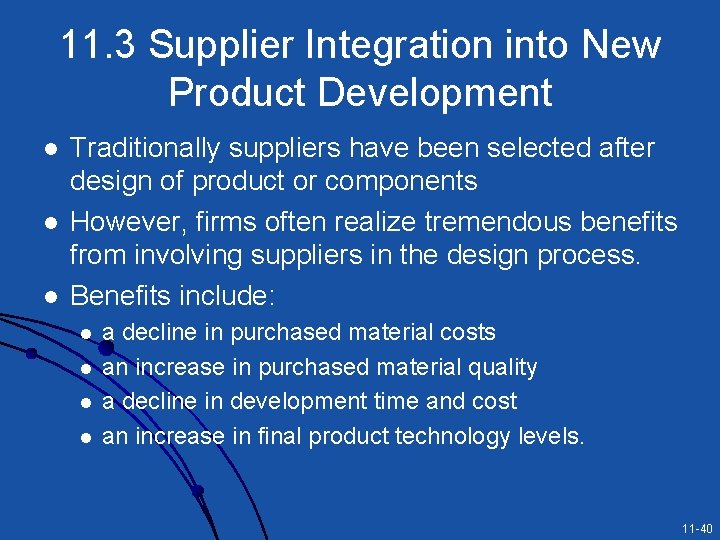
11. 3 Supplier Integration into New Product Development l l l Traditionally suppliers have been selected after design of product or components However, firms often realize tremendous benefits from involving suppliers in the design process. Benefits include: l l a decline in purchased material costs an increase in purchased material quality a decline in development time and cost an increase in final product technology levels. 11 -40
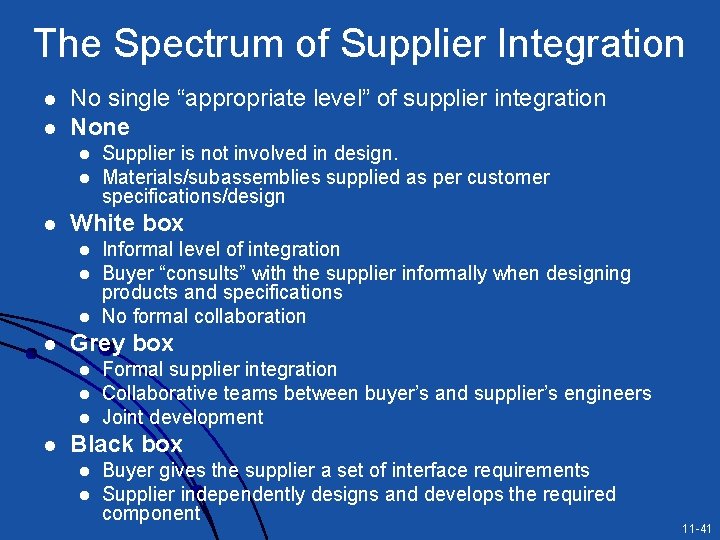
The Spectrum of Supplier Integration l l No single “appropriate level” of supplier integration None l l l White box l l Informal level of integration Buyer “consults” with the supplier informally when designing products and specifications No formal collaboration Grey box l l Supplier is not involved in design. Materials/subassemblies supplied as per customer specifications/design Formal supplier integration Collaborative teams between buyer’s and supplier’s engineers Joint development Black box l l Buyer gives the supplier a set of interface requirements Supplier independently designs and develops the required component 11 -41
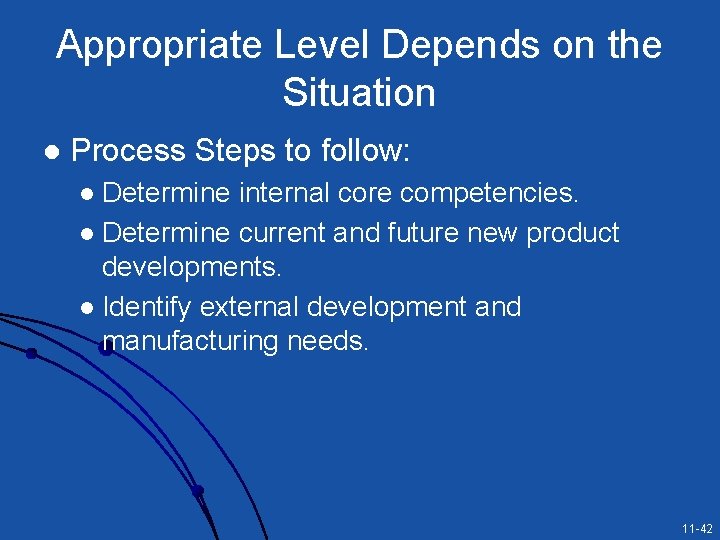
Appropriate Level Depends on the Situation l Process Steps to follow: Determine internal core competencies. l Determine current and future new product developments. l Identify external development and manufacturing needs. l 11 -42
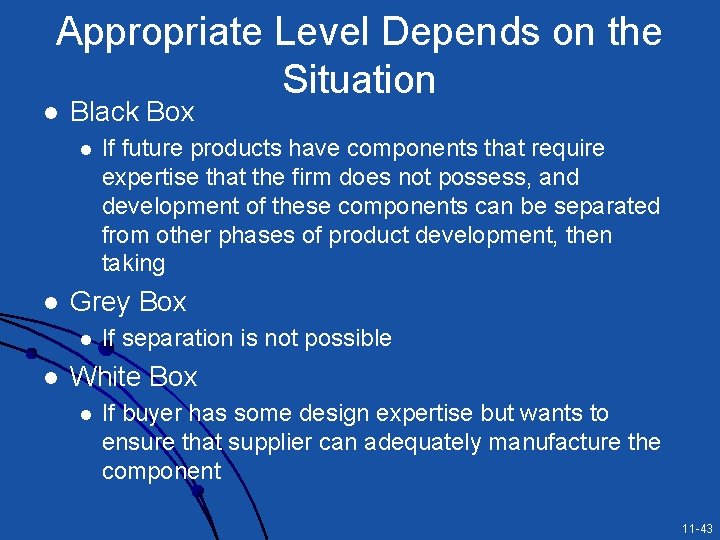
Appropriate Level Depends on the Situation l Black Box l l Grey Box l l If future products have components that require expertise that the firm does not possess, and development of these components can be separated from other phases of product development, then taking If separation is not possible White Box l If buyer has some design expertise but wants to ensure that supplier can adequately manufacture the component 11 -43
Keys to Supplier Integration l Making the relationship a success: l l l Select suppliers and build relationships with them Align objectives with selected suppliers Which suppliers can be integrated? l l l Capability to participate in the design process Willingness to participate in the design process Ability to reach agreements on intellectual property and confidentiality issues. Ability to commit sufficient personnel and time to the process. Co-locating personnel if appropriate Sufficient resources to commit to the supplier integration process. 11 -44
11. 4 Mass Customization l Evolved from the two prevailing manufacturing paradigms of the 20 th century l l Mass production l l Craft production and mass production. efficient production of a large quantity of a small variety of goods High priority on automating and measuring tasks Mechanistic organizations with rigid controls Craft production l l l involves highly skilled and flexible workers Often craftsmen Organic organizations which are flexible and changing 11 -45
Absence of Trade-Offs l Two types meant inherent trade-offs l l Low-cost, low-variety strategy may be appropriate for some products For others, a higher-cost, higher-variety, more adaptable strategy was more effective Development of mass customization implies it is not always necessary to make this trade-off Mass customization l l l delivery of a wide variety of customized goods or services quickly and efficiently at low cost captures many of the advantages of both the mass production and craft production systems not appropriate for all products gives firms important competitive advantages helps to drive new business models 11 -46
Making Mass Customization Work Highly skilled and autonomous workers, processes, and modular units l Managers can coordinate and reconfigure these modules to meet specific customer requests and demands l 11 -47
Key Attributes l Instantaneous l l l Costless l l l Linkages must add little if any cost to the processes Allows mass customization to be a low-cost alternative. Seamless l l Modules and processes must be linked together very quickly Allows rapid response to various customer demands. Linkages and individual modules should be invisible to the customer Frictionless l l Networks or collections of modules must be formed with little overhead. Communication must work instantly 11 -48
Mass Customization and SCM l l Many of the advanced SCM approaches and techniques essential if mass customization is to be successfully implemented IT critical for effective SCM is also critical for coordinating different modules Concepts like strategic partnerships and supplier integration essential for the success of mass customization. Postponement can play a key role in implementing mass customization 11 -49
SUMMARY l Design for logistics concepts Efficient packaging and storage l Certain manufacturing steps can be completed in parallel l Standardization l Integrating suppliers into the product design and development process l Advanced supply chain management facilitating mass customization l 11 -50