
Bibliographic entry Problem Subjects Procedures Results and conclusion
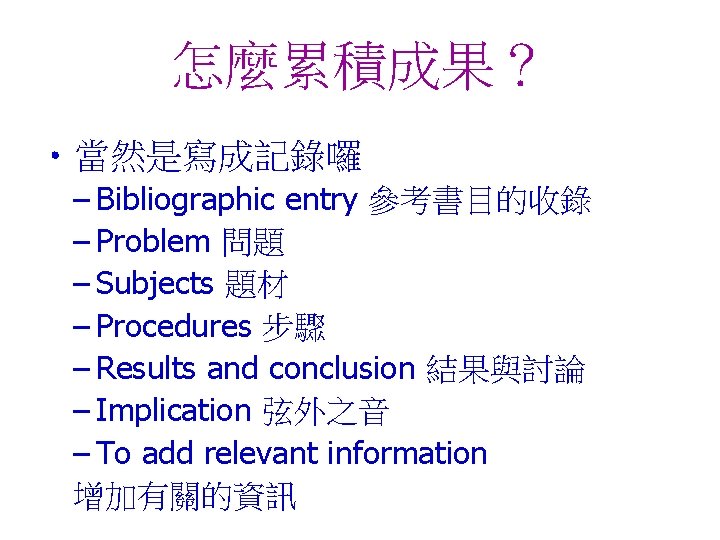
怎麼累積成果? • 當然是寫成記錄囉 – Bibliographic entry 參考書目的收錄 – Problem 問題 – Subjects 題材 – Procedures 步驟 – Results and conclusion 結果與討論 – Implication 弦外之音 – To add relevant information 增加有關的資訊
How to Write a Literature Review 如何撰寫文獻探討? MIS 583/585 Spring 2002
Literature Review 文獻探討 What is the “literature” anyway? 文獻是什麼東東呢? • The literature is “the works you consulted in order to understand investigate your research question. ” 文獻是您為了瞭解與探究研究問題所查閱 的東西。
Skills Needed for a Literature Review 文獻探討所需要的技巧 • Information Seeking: Ability to scan the literature efficiently using a library or the Internet search to identify a set of potentially useful articles or books. 收集資訊:利用圖書館或是網際網路來有效瀏覽文 獻並辨識出一組可能是有用的文章或是書籍的能力。 • Critical Appraisal: Ability to apply principles of analysis to identify those studies which are unbiased and valid. 批判評價:能運用分析的原則來加以分辨這些過去 研究是否無偏見且有效度的一種能力。 Source: http: //www. utoronto. ca/hswriting/lit-review. htm
Bad Sign! 不良文獻探討的訊號 • Every paragraph of your review begins with the names of researchers. 每一段都是由研究者的名字來開頭 • Every paragraph contains a summary of one article. 每一段都包含一篇文章的摘要 • Literature review contains a stack of paragraph without a section header. 文獻探討包含的很多段落而沒有分節或小節的標題 • There is no logical link between each paragraph. 每一段之間沒有邏輯性的連結
Good sign 良好文獻探討的訊號 • Organize your view into useful, information sections (or issues) relevant to your study’s domain 將文獻探討組織成跟您的研究領域有關聯且有用的 訊息(或議題) • Present an evolution of a concept 呈現一個概念是如何演進的 • Compare/contrast different views from previous research 比較與對照過去的研究所呈現的不同觀點。
What literature Review looks like? 文獻探討長什麼樣子? Source: http: //www. utoronto. ca/hswriting/lit-review. htm • NOT a summary of articles 不是文章的摘要 • Conceptually organized synthesis of the results of your search 將您所搜尋到的文獻探討結果以概念式組織來綜合 • MUST – Organize information and relate it to the research question 將與待答問題有關的資訊組織起來 – Synthesize results into what is and isn’t known 將文獻探討的結果依照已知或未知者組合起來 – Identify controversy when it appears in the literature 分辨出文獻中有爭議性的觀點 – Develop questions for further research 由文獻探討中發展出未來研究的問題
Value of Literature Review 文獻探討的價值 • NOT depends on “how many sources you use” 其價值不在於您收集了多少資料來源 • BUT depends on “your presentation and awareness of how different perspectives are in your study domain” 但其價值是在於您是否能呈現並察覺出該研 究領域中的不同觀點 • ALSO depends on “quality of the sources you use” 也跟您使用的資料來源的品質有關
How useful are the following sources? Source: http: //www. languages. ait. ac. th/EL 21 LIT. HTM • Journal articles (peer review): Relatively valid and reliable (based on a scientific study), relatively up-todate issues 期刊文章(有同儕評審過的):相對而言比較有效度與信度,而且也比 較跟得上時代的議題 • Books: Contains principles and theories, good for a starting point, give a big picture 書籍:包括該領域的原則與理論,是好的開始,提供該領域的大局面。 • Conferencing proceedings: latest research or work-in-progress 會議的彙編:最新的研究或進行中的研究 • Trade magazines: Not useful for research except as a starting point (e. g. , looking for a topic) or new innovations 雜誌:對於研究沒有什麼幫助,但是可以提供一個起始點,例如找題目 或是創新的改革
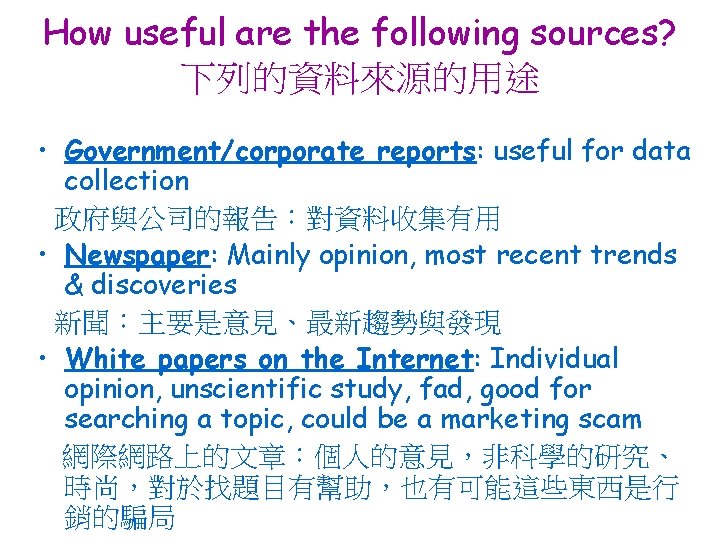
How useful are the following sources? 下列的資料來源的用途 • Government/corporate reports: useful for data collection 政府與公司的報告:對資料收集有用 • Newspaper: Mainly opinion, most recent trends & discoveries 新聞:主要是意見、最新趨勢與發現 • White papers on the Internet: Individual opinion, unscientific study, fad, good for searching a topic, could be a marketing scam 網際網路上的文章:個人的意見,非科學的研究、 時尚,對於找題目有幫助,也有可能這些東西是行 銷的騙局
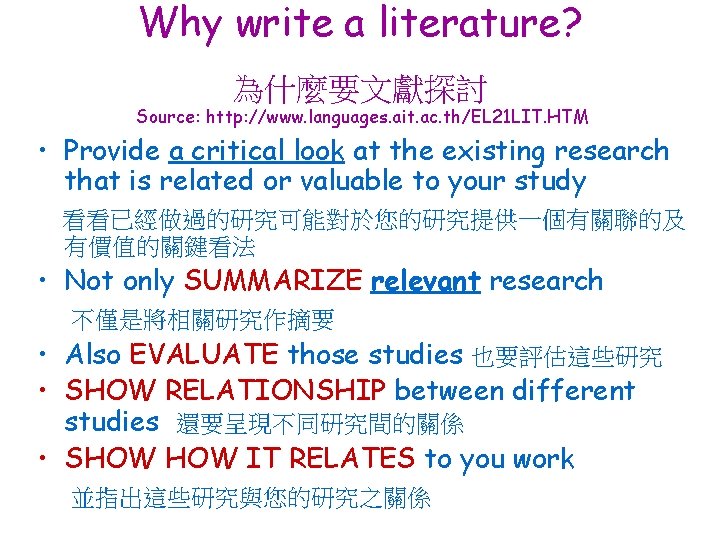
Why write a literature? 為什麼要文獻探討 Source: http: //www. languages. ait. ac. th/EL 21 LIT. HTM • Provide a critical look at the existing research that is related or valuable to your study 看看已經做過的研究可能對於您的研究提供一個有關聯的及 有價值的關鍵看法 • Not only SUMMARIZE relevant research 不僅是將相關研究作摘要 • Also EVALUATE those studies 也要評估這些研究 • SHOW RELATIONSHIP between different studies 還要呈現不同研究間的關係 • SHOW IT RELATES to you work 並指出這些研究與您的研究之關係
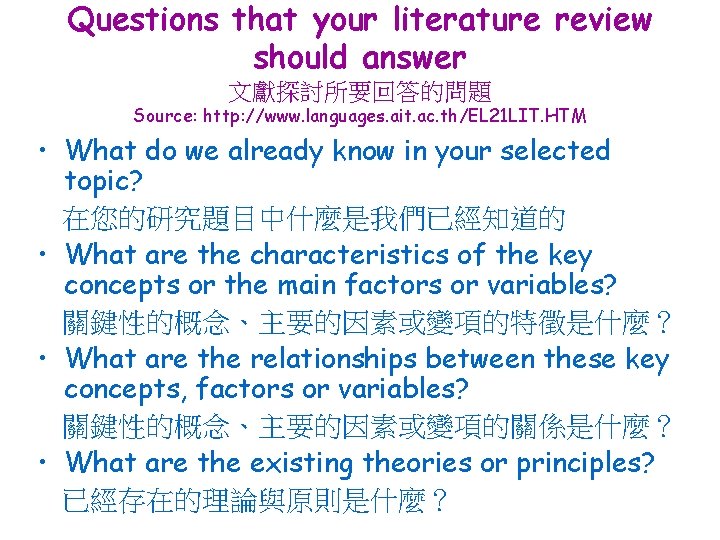
Questions that your literature review should answer 文獻探討所要回答的問題 Source: http: //www. languages. ait. ac. th/EL 21 LIT. HTM • What do we already know in your selected topic? 在您的研究題目中什麼是我們已經知道的 • What are the characteristics of the key concepts or the main factors or variables? 關鍵性的概念、主要的因素或變項的特徵是什麼? • What are the relationships between these key concepts, factors or variables? 關鍵性的概念、主要的因素或變項的關係是什麼? • What are the existing theories or principles? 已經存在的理論與原則是什麼?
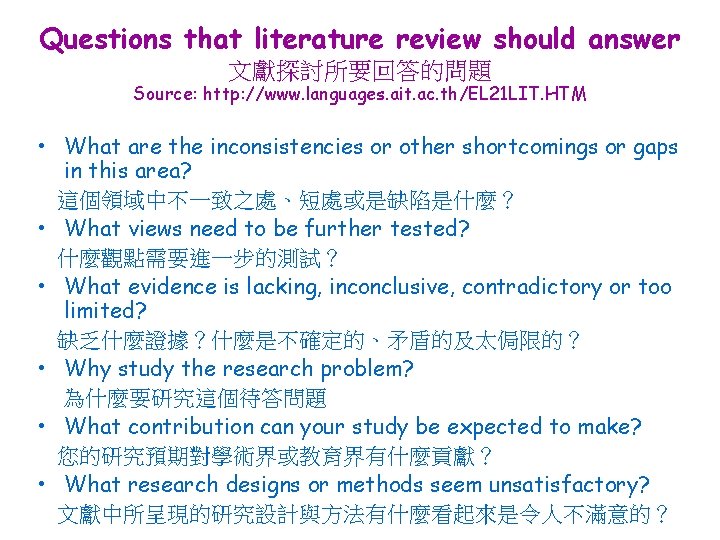
Questions that literature review should answer 文獻探討所要回答的問題 Source: http: //www. languages. ait. ac. th/EL 21 LIT. HTM • What are the inconsistencies or other shortcomings or gaps in this area? 這個領域中不一致之處、短處或是缺陷是什麼? • What views need to be further tested? 什麼觀點需要進一步的測試? • What evidence is lacking, inconclusive, contradictory or too limited? 缺乏什麼證據?什麼是不確定的、矛盾的及太侷限的? • Why study the research problem? 為什麼要研究這個待答問題 • What contribution can your study be expected to make? 您的研究預期對學術界或教育界有什麼貢獻? • What research designs or methods seem unsatisfactory? 文獻中所呈現的研究設計與方法有什麼看起來是令人不滿意的?
How can I write good literature review? 我要怎樣才能寫出一個好的文獻探討? • Remember the purpose: try to answer those questions (in the previous two slides) 記得您的文獻探討目的(參閱前兩張投影片) • Read with a purpose: Think while reading 閱讀文獻時要有目的的讀,一邊想一邊讀 • Write with a purpose: Think while writing 撰寫論文時要有目的的寫,一邊想一邊寫。 Source: http: //www. languages. ait. ac. th/EL 21 LIT. HTM
Keep in mind 存記在心 • If you don’t define your research problem or not clear about it, it might take you forever to search the literature 如果您的研究問題定義不清,您可能會花很多時間 在文獻探討上。 • A research problem can be changed as you read more. So reading can shape a problem, and defining a problem can identify what to read and what to ignore. 您閱讀文獻越多的時候,待答問題可能也會跟著改 變,對於研究問題定義越清楚越能幫助您辨識出什 麼文獻是該閱讀的,什麼是可以忽略的
Traps 陷阱 Source: http: //www. languages. ait. ac. th/EL 21 LIT. HTM • Trying to read everything 想要什麼都讀 • Reading but not writing 只讀不寫 • Not keeping bibliographic information 沒有保持參考書目有關的資訊
- Slides: 19