Major Concepts of Anatomy and Physiology Part 1
- Slides: 39
Major Concepts of Anatomy and Physiology Part 1: Organization of the Human Body
What is A&P? n Anatomy: ¨ The n study of the structure of the human body. Physiology: ¨ The study of the function of the human body.
Subdivisions of Anatomy Gross Anatomy: Studies structures visible to naked eye. n Histology: Studies structure of tissues visible through a microscope. n Neuroanatomy: Studies the structures of the human nervous system. n Embryology: Studies the development of human embryos. n Radiographic Anatomy: Studies the structures visible via x-ray. n
Subdivisions of Physiology Neurophysiology: Studies the function of the human nervous system n Cardiophysiology: Studies the human cardiovascular system. n Immunology: Studies the structure & function of the immune system. n Endocrinology: Studies the function of hormones and their effects. n Pathophysiology: Studies the changes brought on by disease and aging. n
Homeostasis n Homeostasis: ¨ The healthy internal balance of the human organism. ¨ The body will always attempt to return to homeostasis if change occurs. n Feedback Systems are used to maintain homeostasis. ¨ E. g. blood glucose, body temperature, etc. ¨ Major fluctuations may indicate a problem!
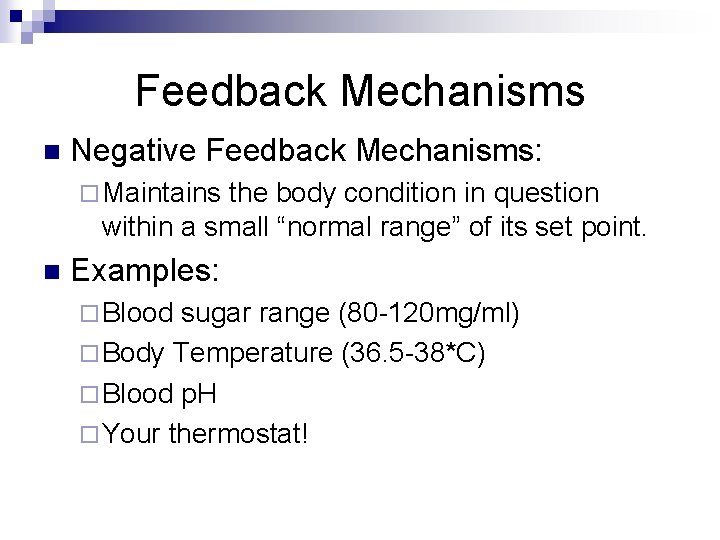
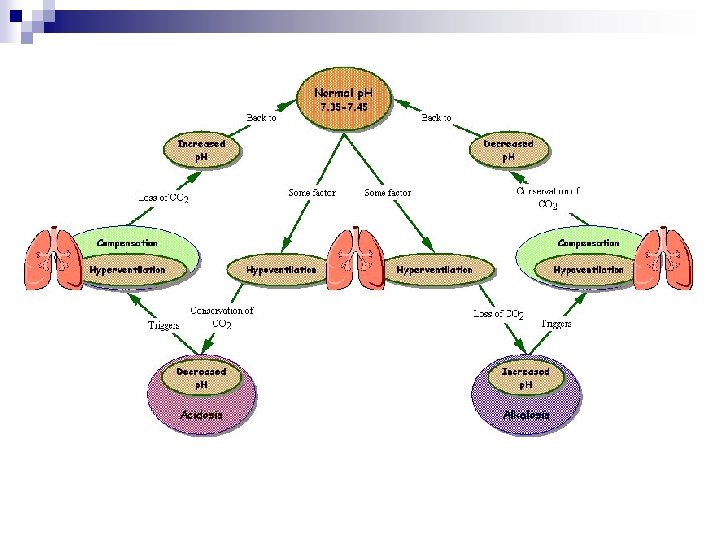
Feedback Mechanisms n Negative Feedback Mechanisms: ¨ Maintains the body condition in question within a small “normal range” of its set point. n Examples: ¨ Blood sugar range (80 -120 mg/ml) ¨ Body Temperature (36. 5 -38*C) ¨ Blood p. H ¨ Your thermostat!
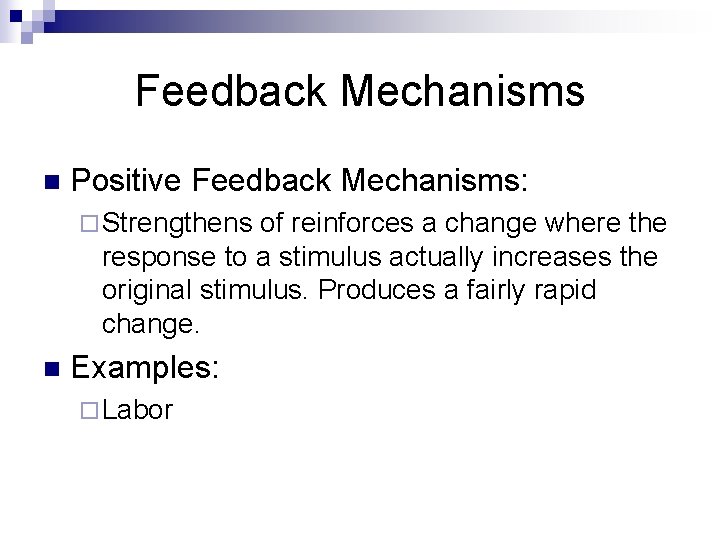
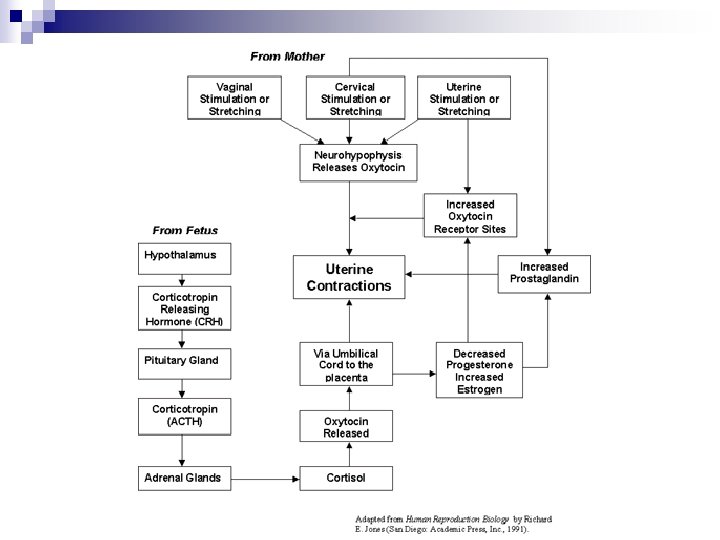
Feedback Mechanisms n Positive Feedback Mechanisms: ¨ Strengthens of reinforces a change where the response to a stimulus actually increases the original stimulus. Produces a fairly rapid change. n Examples: ¨ Labor
Hierarchy of Complexity n 6 Levels of the Hierarchy ¨ Chemical Level ¨ Cellular Level ¨ Tissue Level ¨ Organ Level ¨ System Level ¨ Organism Level n Moves from simple to complex.
Chemical Level The atoms and molecules that make up the cells of the body. n Subatomic Particles: ¨ Smaller than atoms ¨ Include protons, neutrons & electrons n Atoms: ¨ The smallest unit of the elements ¨ Formed by combinations of the subatomic particles
Chemical Level n Elements: ¨ Fundamental substances composed of atoms ¨ Chemically alike &cannot be separated into smaller substances by typical methods ¨ Include Oxygen, hydrogen, carbon, & nitrogen n Molecules: ¨ Composed of groups of atoms ¨ Includes things like Glucose & Macromolecules n Macromolecules: ¨ Composed of hundreds or thousands of molecules ¨ Includes proteins, fats, carbohydrates, DNA, RNA
Cellular Level n Organelles: ¨ Microscopic structures contained inside cells ¨ Carry out individual functions ¨ Include Mitochondria, endoplasmic reticulum, lysosomes n Cells: ¨ The basic building block of all organic organisms (living things)
Tissue Level n Tissue: ¨A mass of similar cells that perform the same specific function ¨ FOUR PRIMARY TISSUES Epithelium Tissue n Connective Tissue n Muscle Tissue n Nervous Tissue n
Organ Level n Organ: ¨ Structure composed of two or more separate tissue types working together to carry out a particular function ¨ Distinct gross anatomical boundaries ¨ Include stomach, heart, brain, etc.
System Level n Organ System: ¨A group of organs connected together to accomplish a unique collective function ¨ Example: Digestive system Separate organs include the esophagus, stomach, small & large intestines n Functions include digestion, absorption, and excretion n
Organism Level n Organism: ¨A single complete individual ¨ Composed of a number of different organ systems ¨ 11 Systems in the Human Integumentary Skeletal Muscular Cardiovascular Nervous Endocrine Respiratory Digestive Lymphatic Reproductive Urinary
Six Characteristics of Living Organisms 1. Metabolism: All chemical reaction occurring within living cells. 1. 2. 3. Anabolism: Synthesis reactions to combine small molecules to form larger ones. Requires an input of energy. Catabolism: Reactions reduce large, complex substances into simpler ones. Releases energy. Growth: An increase in size through division and/or enlargement of cells. Differentiation: The process of developing unspecialized cells into specialized cells with specific structure and function.
Six Characteristics of Living Organisms 1. 2. 3. Movement: Includes motion of a body part or materials through the body. Responsiveness: The ability to detect and respond to changes in the environment. Reproduction: The process of producing a new organism or forming new cells.
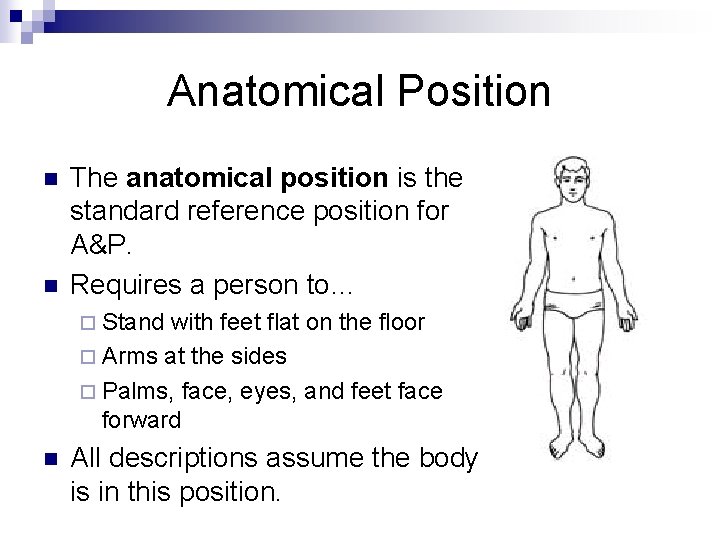
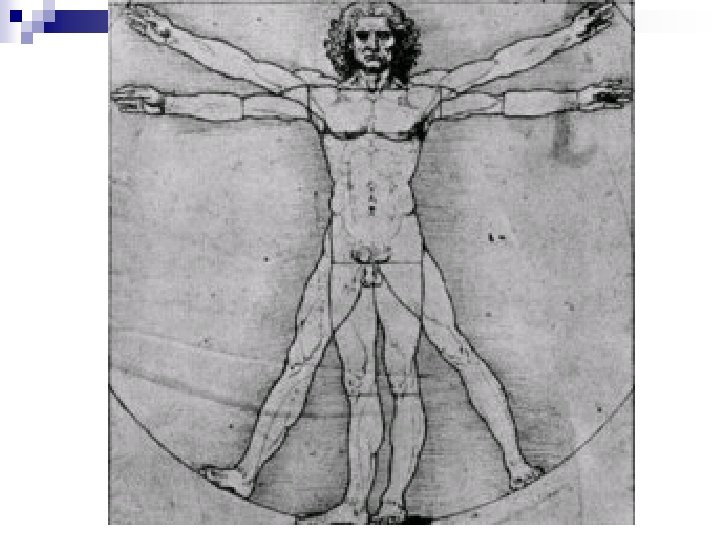
Anatomical Position n n The anatomical position is the standard reference position for A&P. Requires a person to… ¨ Stand with feet flat on the floor ¨ Arms at the sides ¨ Palms, face, eyes, and feet face forward n All descriptions assume the body is in this position.
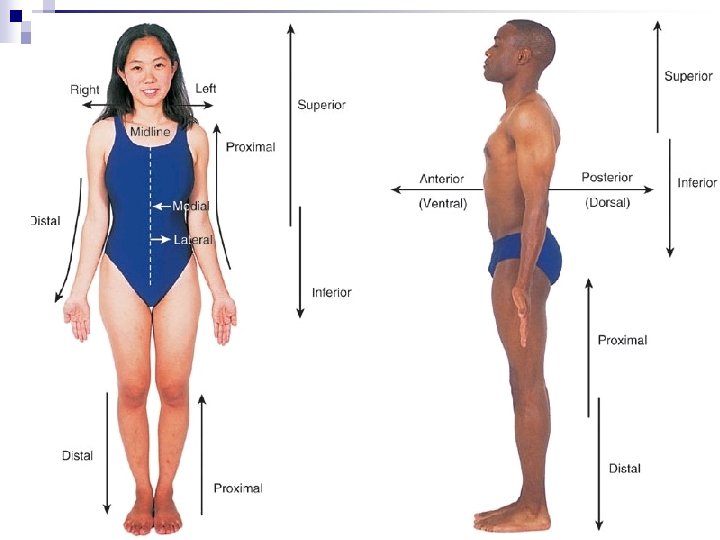
Directional Terms Superior: Toward the top of the head n Inferior: Below or toward the feet n Anterior or Ventral: Front n Posterior or Dorsal: Back n Medial: Toward the midline/midsagittal plane n Lateral: Away from the midline n Proximal: Closer to midline or the point of limb attachment n
Directional Terms Distal: Farther away from the midline or point of limb attachment n Superficial: Closer to the surface of the body n Deep: Farther from the surface of the body n
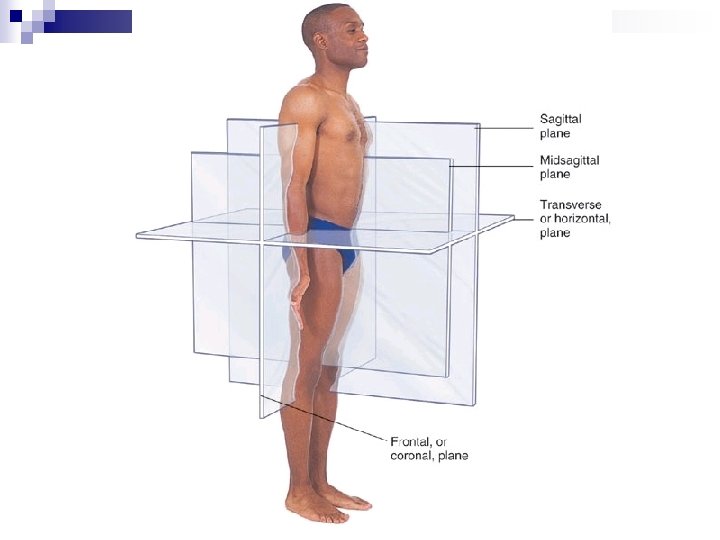
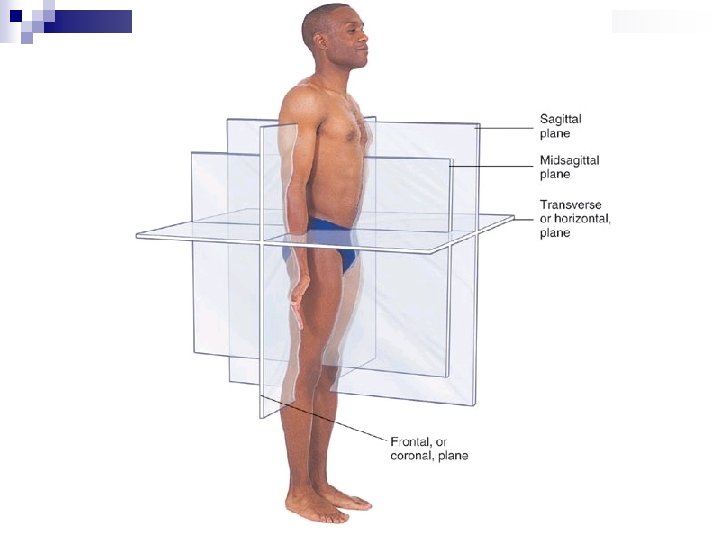
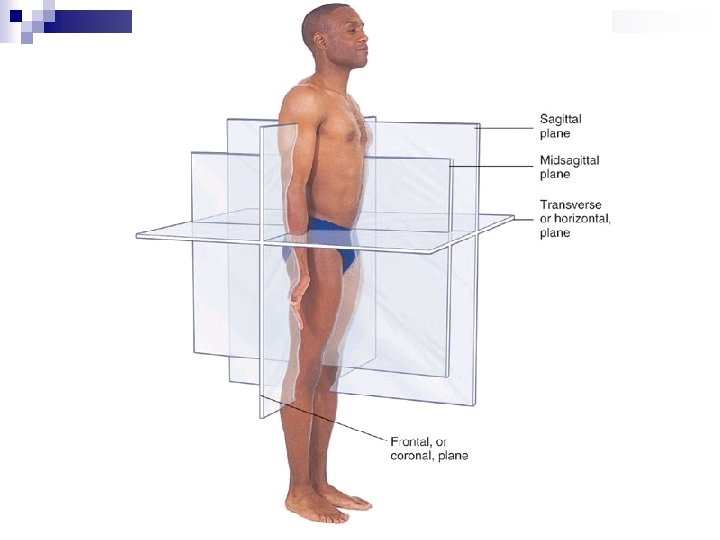
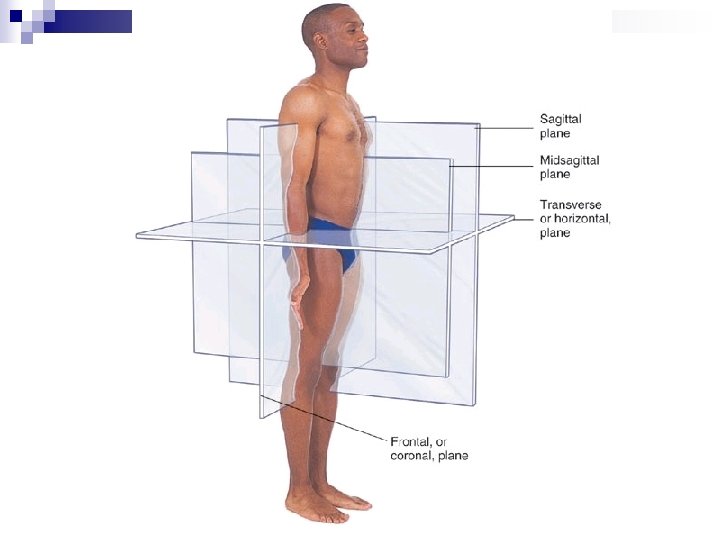
Anatomical Planes n Sagittal Plane: Extends vertically from head to toes; divides the body into left and right portions. ¨ Midsagittal Median Plane: Passes exactly through midline (middle) of the body; divides the body into equal halves. ¨ Parasagittal Plane: Any sagittal plane that passes through the body to the left or right of the midline; divides the body into unequal left & right portions.
Anatomical Planes n Frontal Coronal Plane: Vertically oriented plane ¨ At right angles perpendicular to the sagittal plane ¨ Divides the body into a front (anterior) and back (posterior) portion
Anatomical Planes n Transverse Plane: Passes through the body horizontally ¨ Perpendicular to the long axis of the body ¨ Divides the body into top (superior) and bottom (inferior) portions. ¨ Typical plane of Computerized Tomography (CT) scans
Anatomical Planes n Oblique Plane: Passes through the body at an angle ¨ Between the transverse plan and either a sagittal or frontal plane.
Surface Anatomy n Axial Region: The area of the body closest to the midline. Consists of. . ¨ head ¨ neck ¨ Trunk Thoracic region (chest above diaphragm) n Abdominopelvic region (below diaphragm) n
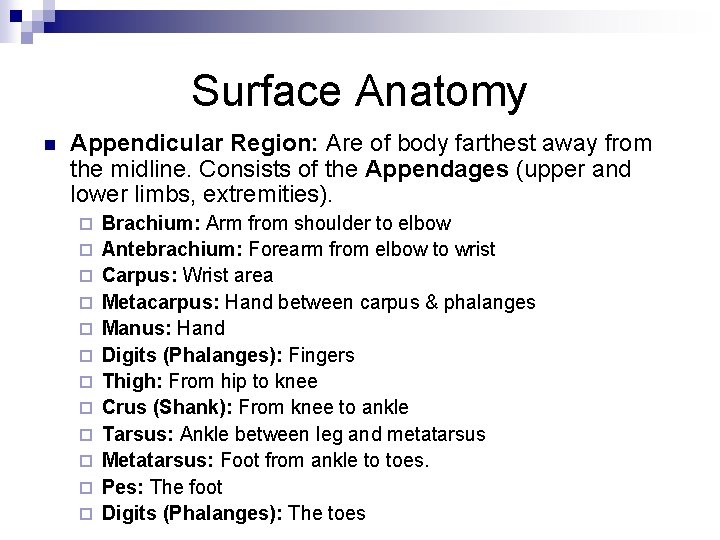
Surface Anatomy n Appendicular Region: Are of body farthest away from the midline. Consists of the Appendages (upper and lower limbs, extremities). ¨ ¨ ¨ Brachium: Arm from shoulder to elbow Antebrachium: Forearm from elbow to wrist Carpus: Wrist area Metacarpus: Hand between carpus & phalanges Manus: Hand Digits (Phalanges): Fingers Thigh: From hip to knee Crus (Shank): From knee to ankle Tarsus: Ankle between leg and metatarsus Metatarsus: Foot from ankle to toes. Pes: The foot Digits (Phalanges): The toes
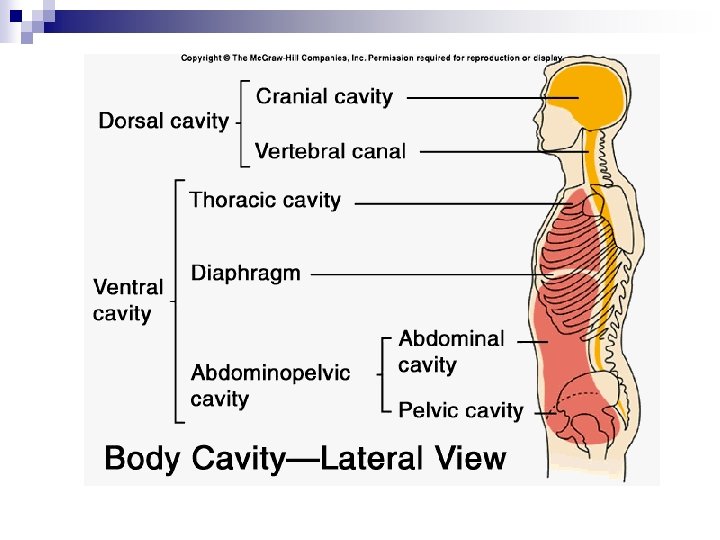
Body Cavities n Dorsal Cavity: Lined by the meninges (dura mater, arachnoid mater, and pia mater). Cranial Cavity: Contains the brain; enclosed in the skull. ¨ Vertebral or Spinal Cavity: Contains the spinal chord; enclosed in the vertebral column. ¨ n Ventral Cavity Thoracic Cavity: Contains the heart, lungs, & upper digestive system organs. ¨ Abdominopelvic Cavity: Contains the stomach, liver, gallbladder, spleen, pancreas, urinary bladder, small & large intestine. Kidneys located BEHIND abdominopelvic cavity. ¨ n Organs located in these cavities are referred to as viscera.
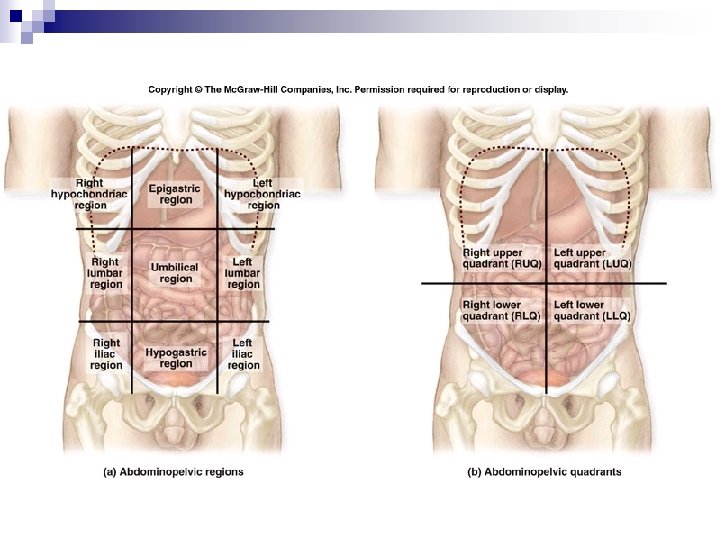
Abdominopelvic Cavity n 4 Abdominopelvic Quadrants: ¨ Right Upper Quadrant ¨ Left Lower Quadrant ¨ Right Lower Quadrant
Abdominopelvic Cavity n 9 Abdominopelvic Regions ¨ Right Hypochondriac Region: Liver, gall bladder ¨ Epigastric Region: Liver, stomach, pancreas ¨ Left Hypochondriac Region: Stomach, spleen ¨ Right Lateral or Lumbar Region: Ascending colon, gall bladder ¨ Umbilical Region: Stomach, transverse colon, small intestine, pancreas ¨ Left Lateral or Lumbar Region: Small intestine, descending colon ¨ Right Inguinal or Iliac Region: Cecum, small intestine ¨ Hypogastric Region: Small intestine, rectum, urinary bladder, reproductive organs ¨ Left Inguinal or Iliac Region: Small intestine, sigmoid colon