LINES AND ANGLES Definitions Free powerpoints at http

- Slides: 50
LINES AND ANGLES Definitions Free powerpoints at http: //www. worldofteaching. com Modified by Lisa Palen
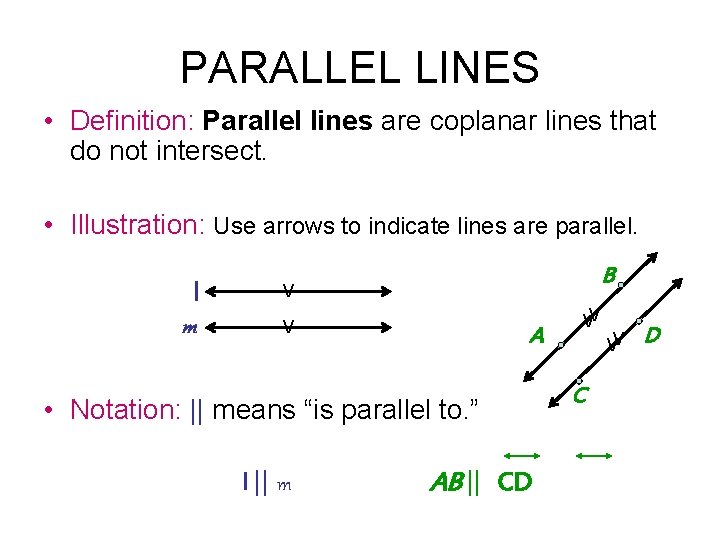
PARALLEL LINES • Definition: Parallel lines are coplanar lines that do not intersect. • Illustration: Use arrows to indicate lines are parallel. l V m V B A • Notation: || means “is parallel to. ” l || m AB || CD VV C VV D
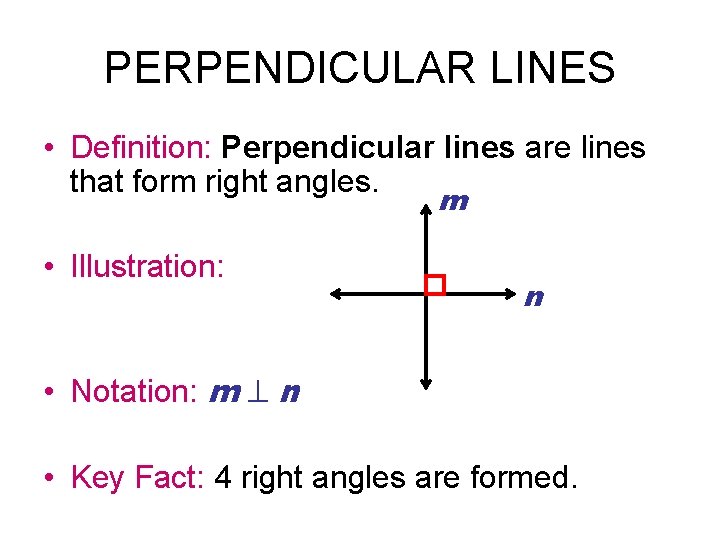
PERPENDICULAR LINES • Definition: Perpendicular lines are lines that form right angles. m • Illustration: n • Notation: m n • Key Fact: 4 right angles are formed.
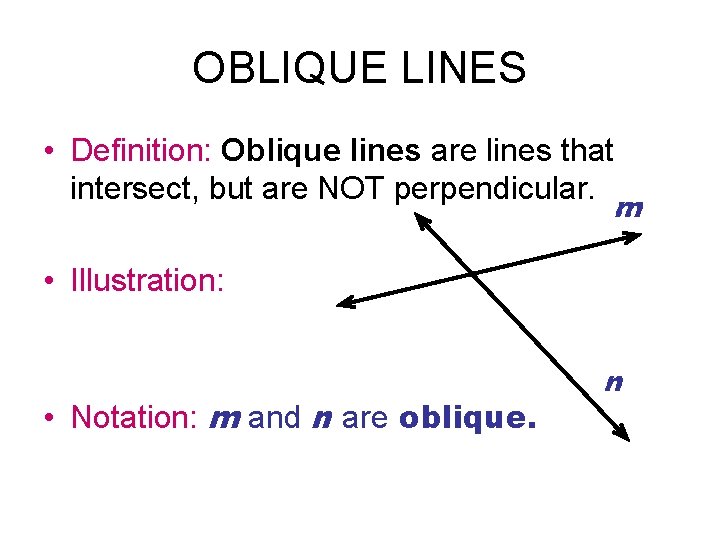
OBLIQUE LINES • Definition: Oblique lines are lines that intersect, but are NOT perpendicular. • Illustration: • Notation: m and n are oblique.
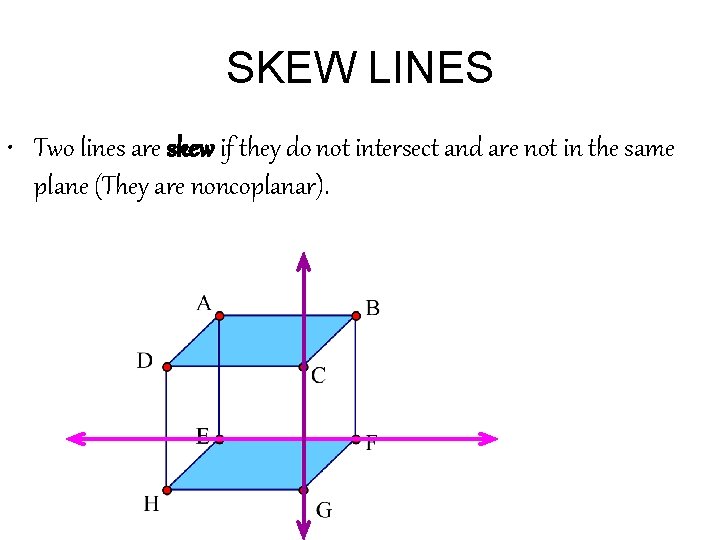
SKEW LINES • Two lines are skew if they do not intersect and are not in the same plane (They are noncoplanar).
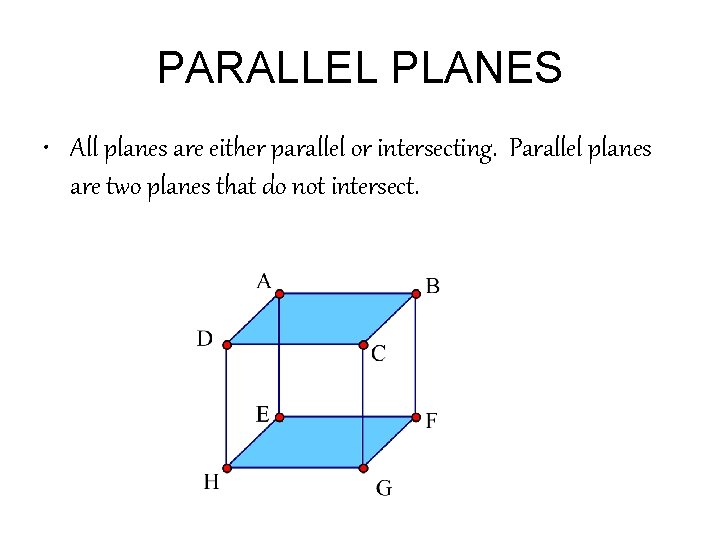
PARALLEL PLANES • All planes are either parallel or intersecting. Parallel planes are two planes that do not intersect.
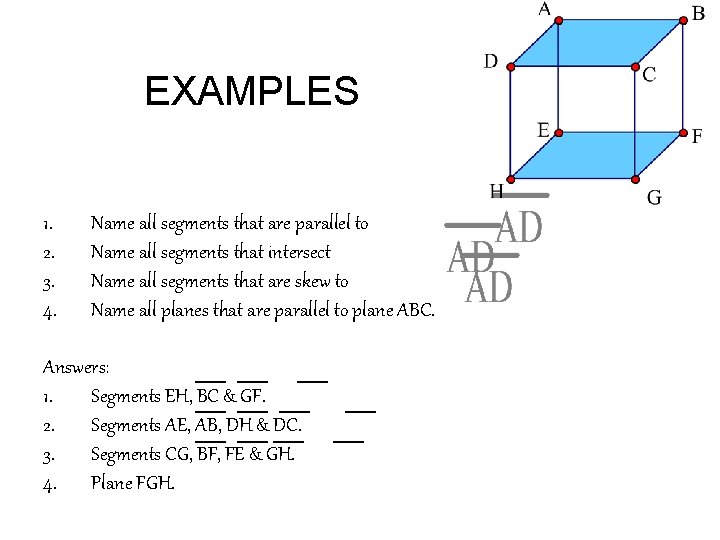
EXAMPLES 1. 2. 3. 4. Name all segments that are parallel to Name all segments that intersect Name all segments that are skew to Name all planes that are parallel to plane ABC. Answers: 1. Segments EH, BC & GF. 2. Segments AE, AB, DH & DC. 3. Segments CG, BF, FE & GH. 4. Plane FGH.
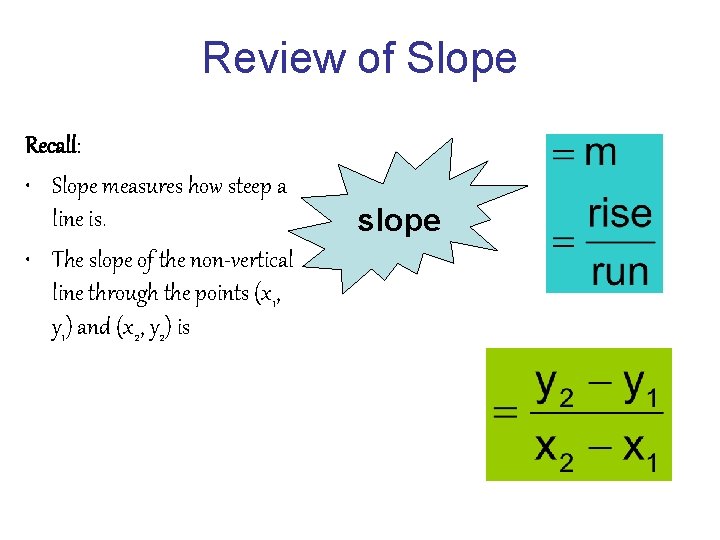
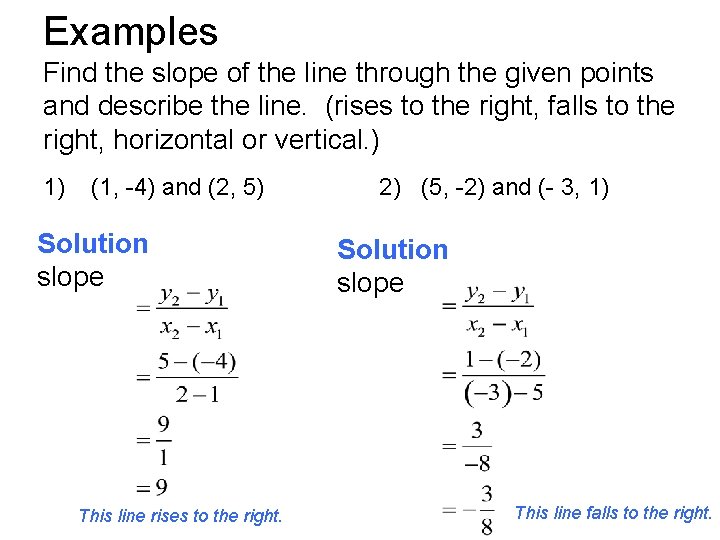
Review of Slope Recall: • Slope measures how steep a line is. • The slope of the non-vertical line through the points (x 1, y 1) and (x 2, y 2) is slope
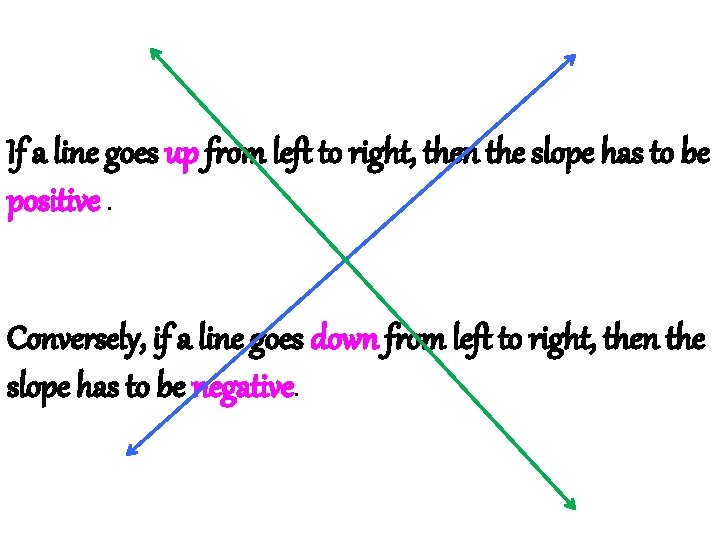
If a line goes up from left to right, then the slope has to be positive. Conversely, if a line goes down from left to right, then the slope has to be negative.
Examples Find the slope of the line through the given points and describe the line. (rises to the right, falls to the right, horizontal or vertical. ) 1) (1, -4) and (2, 5) Solution slope This line rises to the right. 2) (5, -2) and (- 3, 1) Solution slope This line falls to the right.
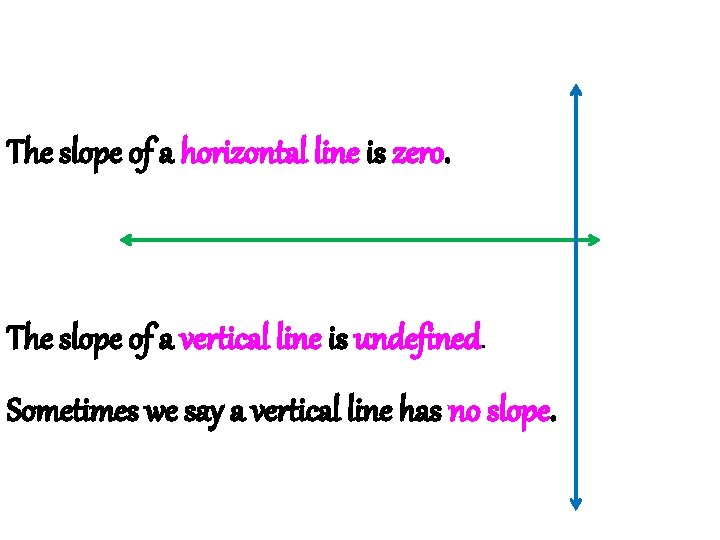
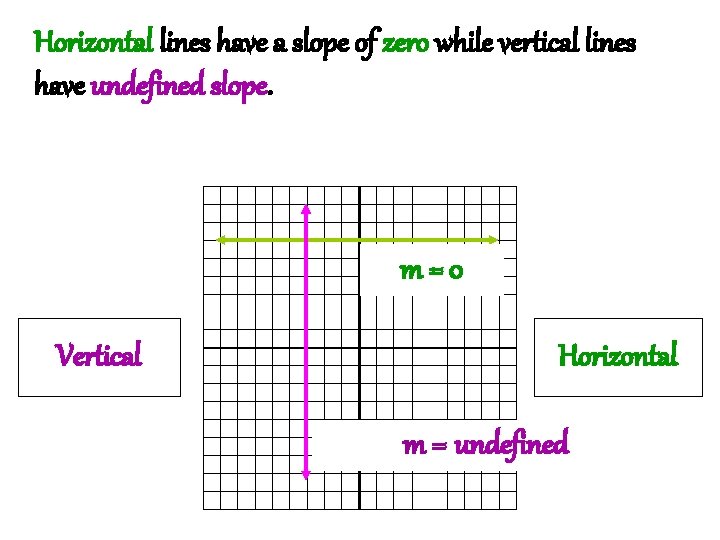
The slope of a horizontal line is zero. The slope of a vertical line is undefined. Sometimes we say a vertical line has no slope.
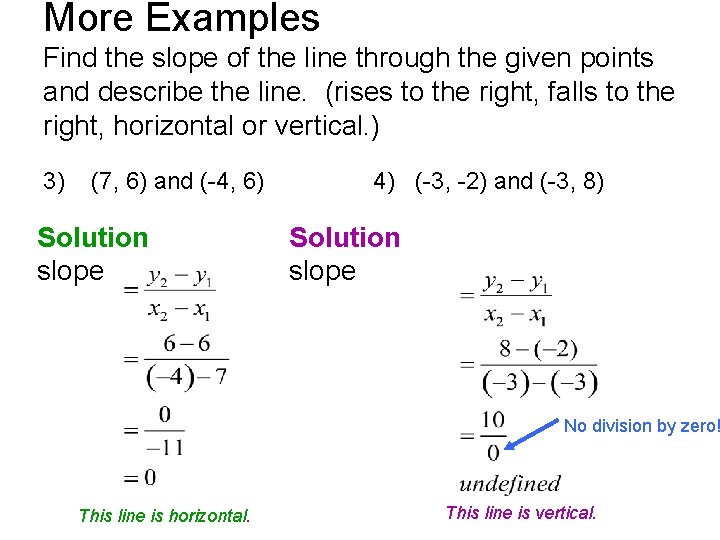
More Examples Find the slope of the line through the given points and describe the line. (rises to the right, falls to the right, horizontal or vertical. ) 3) (7, 6) and (-4, 6) Solution slope 4) (-3, -2) and (-3, 8) Solution slope No division by zero! This line is horizontal. This line is vertical.
Horizontal lines have a slope of zero while vertical lines have undefined slope. m=0 Vertical Horizontal m = undefined
Slopes of Parallel lines Postulate (Parallel lines have equal slopes. ) Two non-vertical lines are parallel if and only if they have equal slopes. Also: • All horizontal lines are parallel. • All vertical lines are parallel. • All lines with undefined slope are parallel. (They are all vertical. )
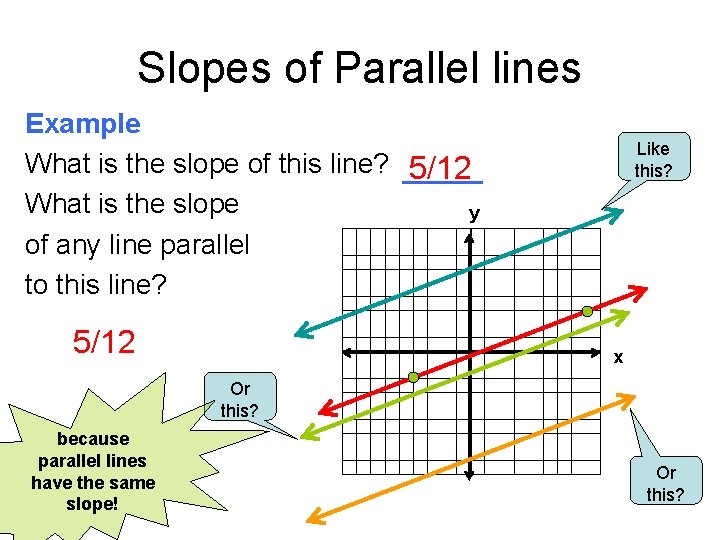
Slopes of Parallel lines Example What is the slope of this line? ____ 5/12 What is the slope y of any line parallel to this line? 5/12 Like this? x Or this? because parallel lines have the same slope! Or this?
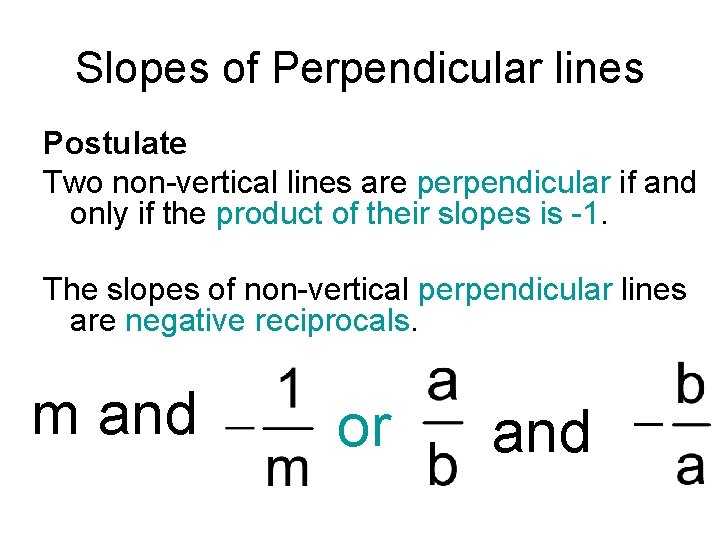
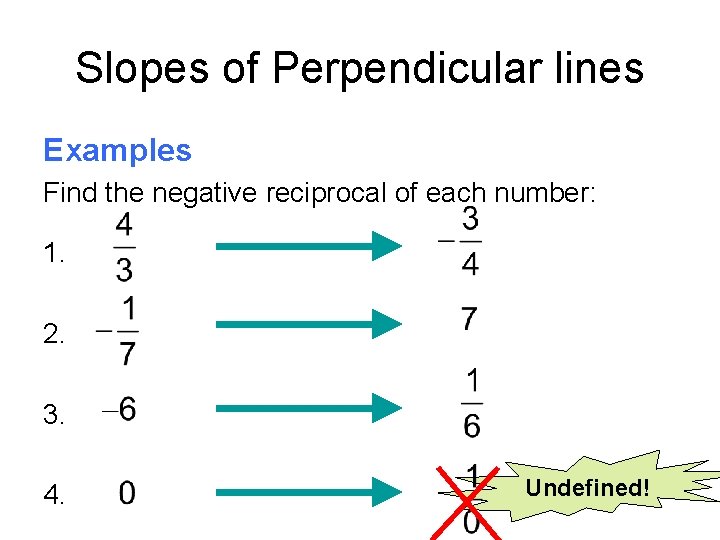
Slopes of Perpendicular lines Postulate Two non-vertical lines are perpendicular if and only if the product of their slopes is -1. The slopes of non-vertical perpendicular lines are negative reciprocals. m and or and
Slopes of Perpendicular lines Examples Find the negative reciprocal of each number: 1. 2. 3. 4. Undefined!
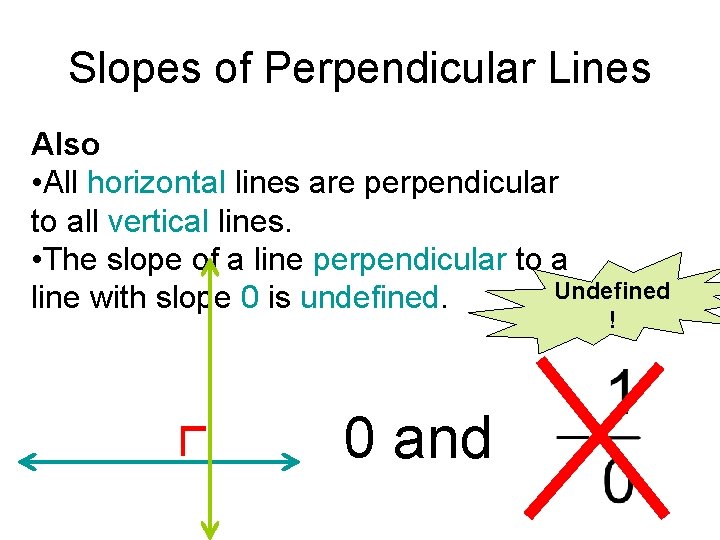
Slopes of Perpendicular Lines Also • All horizontal lines are perpendicular to all vertical lines. • The slope of a line perpendicular to a Undefined line with slope 0 is undefined. ! 0 and
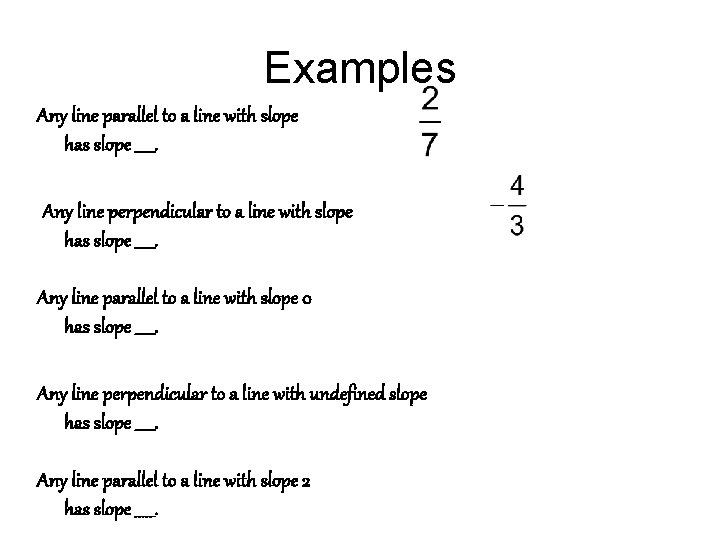
Examples Any line parallel to a line with slope has slope _____. Any line perpendicular to a line with slope has slope _____. Any line parallel to a line with slope 0 has slope _____. Any line perpendicular to a line with undefined slope has slope _____. Any line parallel to a line with slope 2 has slope _____.
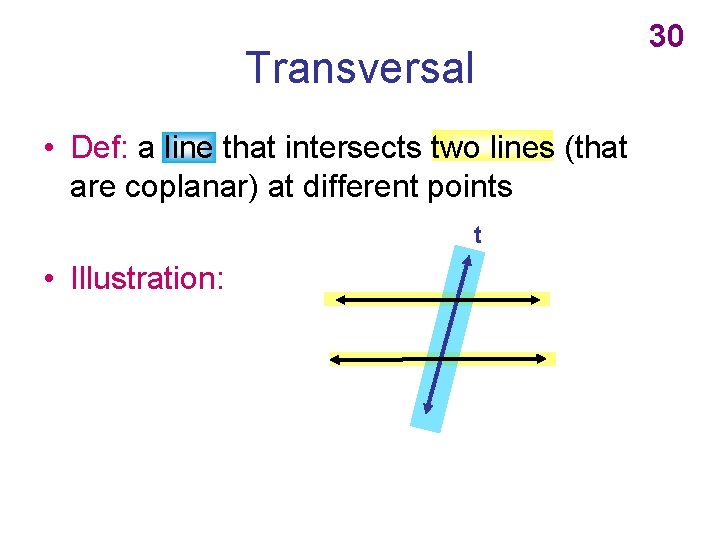
Transversal • Def: a line that intersects two lines (that are coplanar) at different points t • Illustration: 30
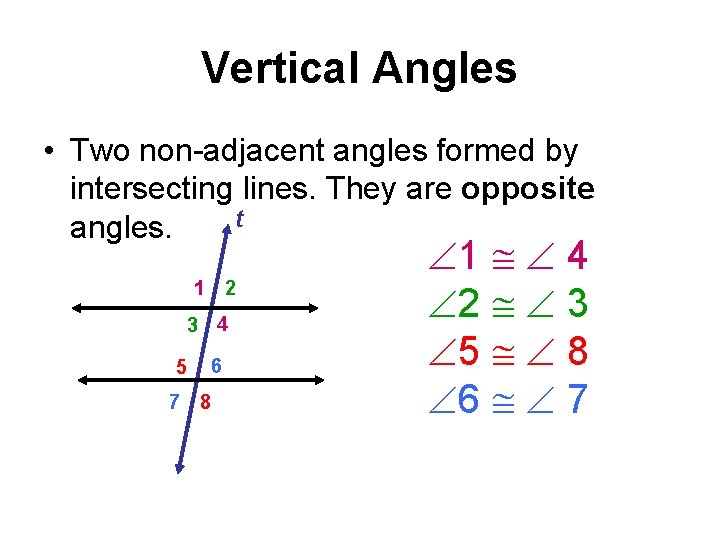
Vertical Angles • Two non-adjacent angles formed by intersecting lines. They are opposite t angles. 1 2 3 4 5 7 6 8 1 4 2 3 5 8 6 7
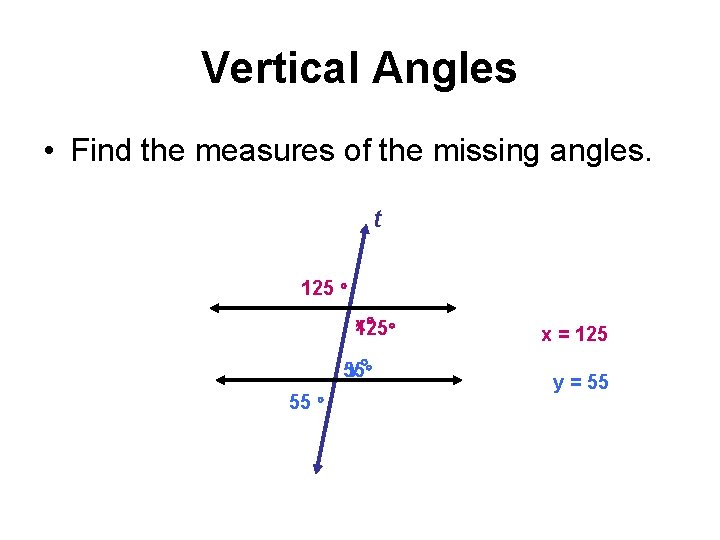
Vertical Angles • Find the measures of the missing angles. t 125 x 125 y 55 55 x = 125 y = 55
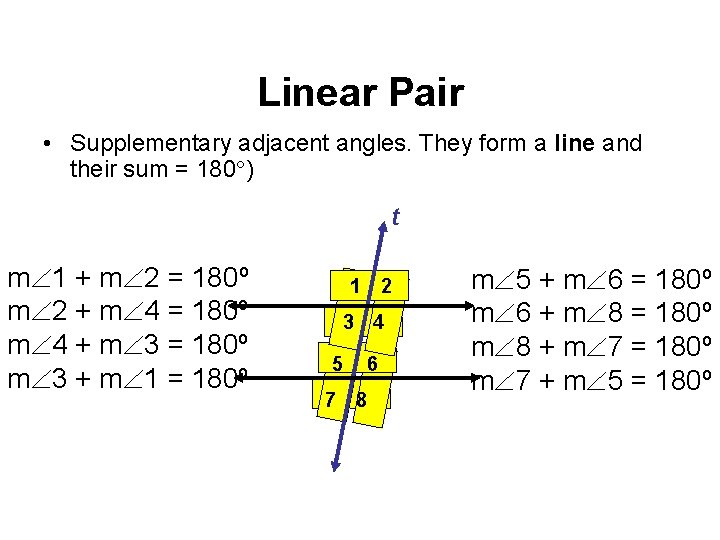
Linear Pair • Supplementary adjacent angles. They form a line and their sum = 180 ) t m 1 + m 2 = 180º m 2 + m 4 = 180º m 4 + m 3 = 180º m 3 + m 1 = 180º 1 2 3 4 5 7 6 8 m 5 + m 6 = 180º m 6 + m 8 = 180º m 8 + m 7 = 180º m 7 + m 5 = 180º
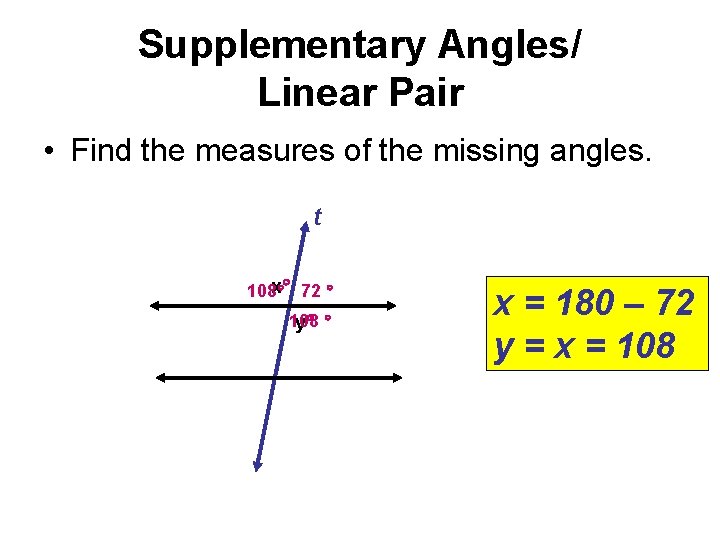
Supplementary Angles/ Linear Pair • Find the measures of the missing angles. t x 72 108 y x = 180 – 72 y = x = 108
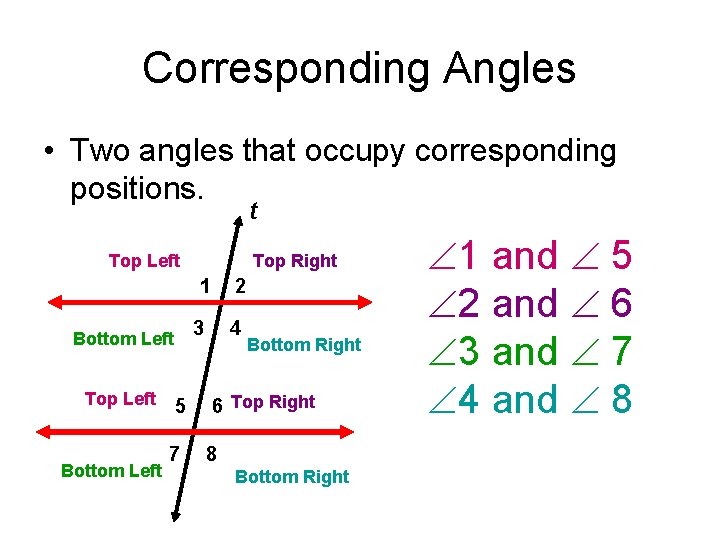
Corresponding Angles • Two angles that occupy corresponding positions. t Top Left Top Right 1 3 Bottom Left Top Left Bottom Left 2 5 7 4 Bottom Right 6 Top Right 8 Bottom Right 1 and 5 2 and 6 3 and 7 4 and 8
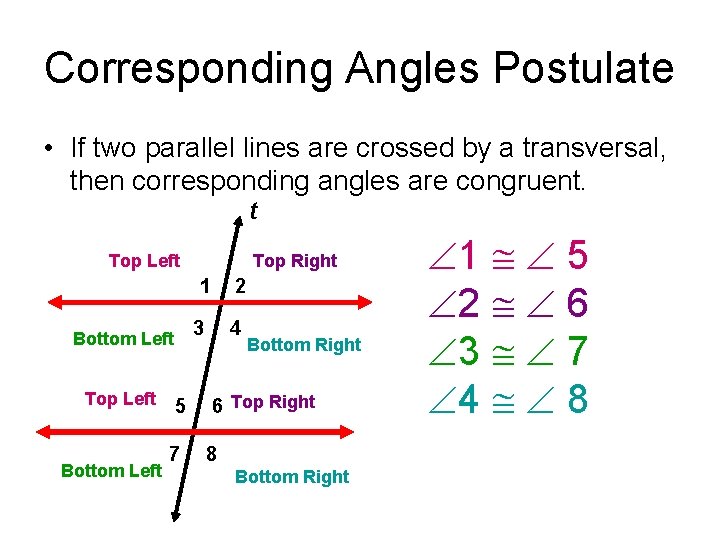
Corresponding Angles Postulate • If two parallel lines are crossed by a transversal, then corresponding angles are congruent. t Top Left Top Right 1 3 Bottom Left Top Left Bottom Left 2 5 7 4 Bottom Right 6 Top Right 8 Bottom Right 1 5 2 6 3 7 4 8
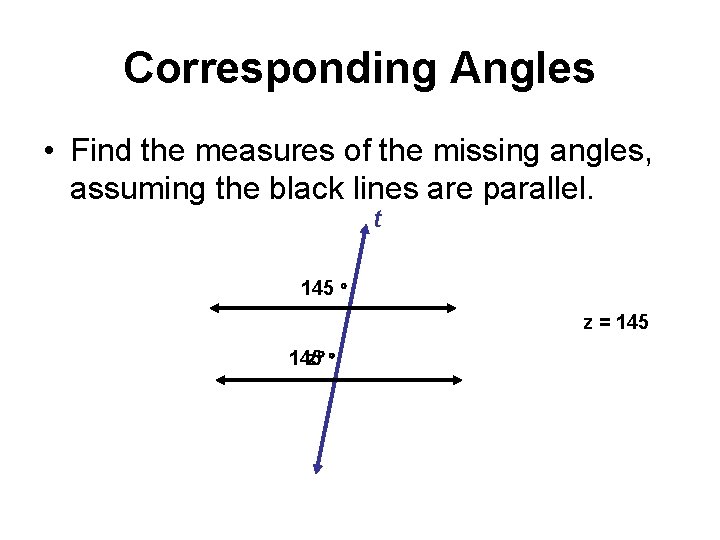
Corresponding Angles • Find the measures of the missing angles, assuming the black lines are parallel. t 145 z = 145 z
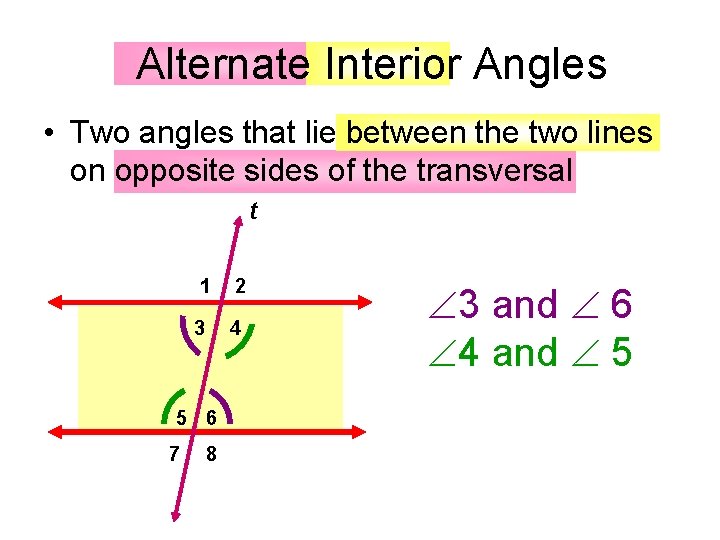
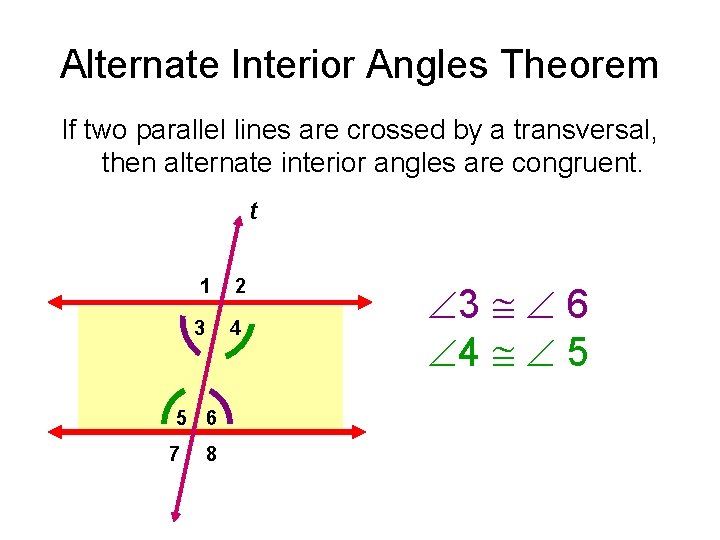
Alternate Interior Angles • Two angles that lie between the two lines on opposite sides of the transversal t 1 2 3 4 5 6 7 8 3 and 6 4 and 5
Alternate Interior Angles Theorem If two parallel lines are crossed by a transversal, then alternate interior angles are congruent. t 1 2 3 4 5 6 7 8 3 6 4 5
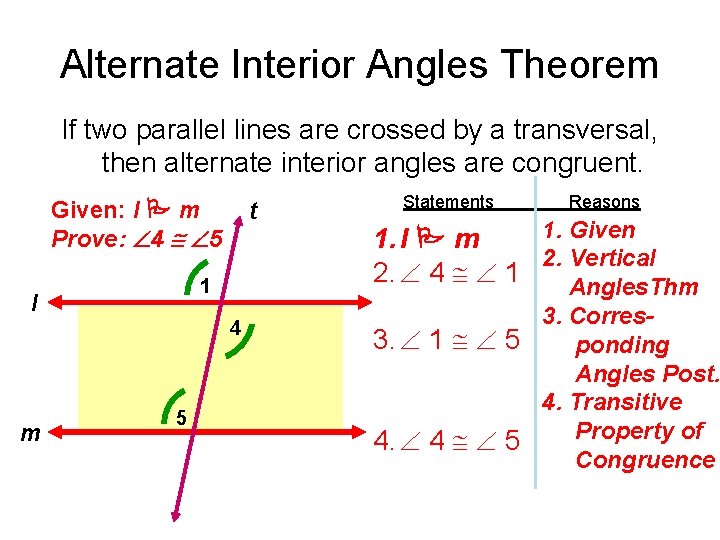
Alternate Interior Angles Theorem If two parallel lines are crossed by a transversal, then alternate interior angles are congruent. Given: l m Prove: 4 5 t 1 l 4 m 5 Statements Reasons 1. Given 1. l m 2. Vertical 2. 4 1 Angles. Thm 3. Corres 3. 1 5 ponding Angles Post. 4. Transitive Property of 4. 4 5 Congruence
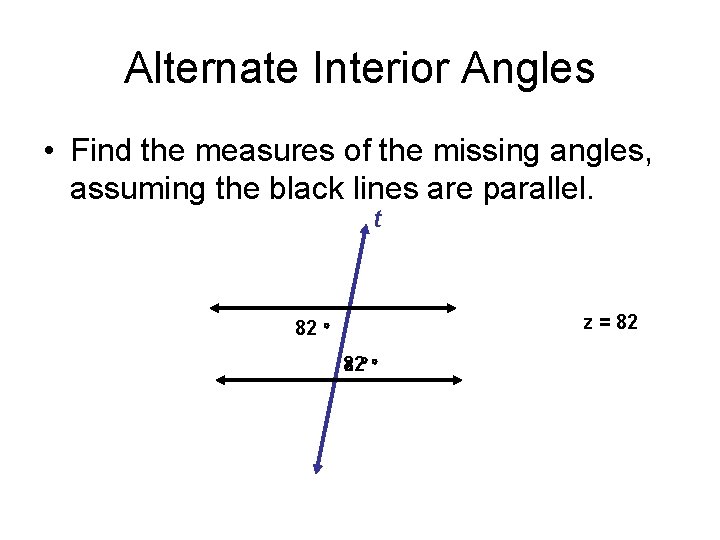
Alternate Interior Angles • Find the measures of the missing angles, assuming the black lines are parallel. t z = 82 82 z
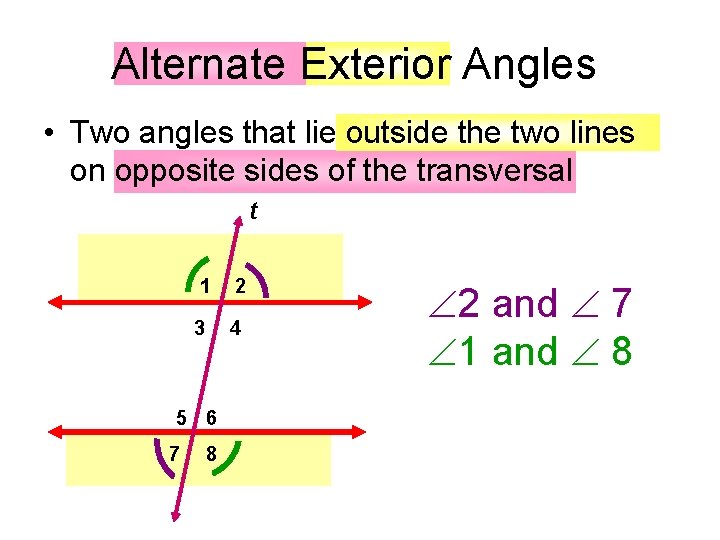
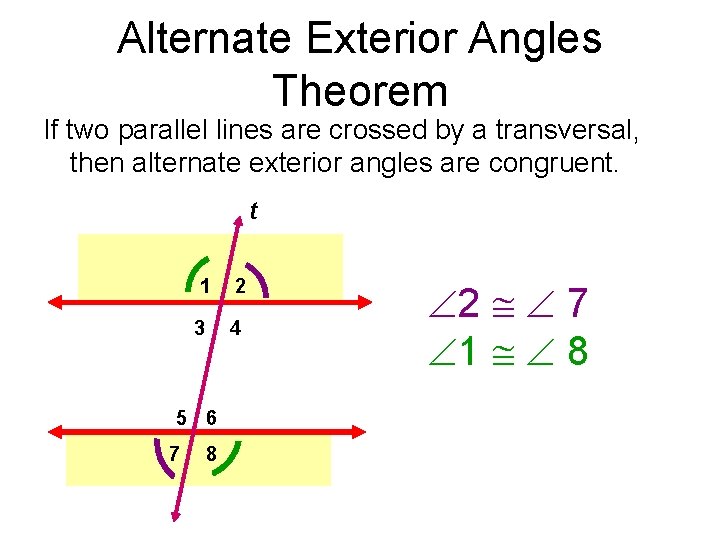
Alternate Exterior Angles • Two angles that lie outside the two lines on opposite sides of the transversal t 1 2 3 4 5 6 7 8 2 and 7 1 and 8
Alternate Exterior Angles Theorem If two parallel lines are crossed by a transversal, then alternate exterior angles are congruent. t 1 2 3 4 5 6 7 8 2 7 1 8
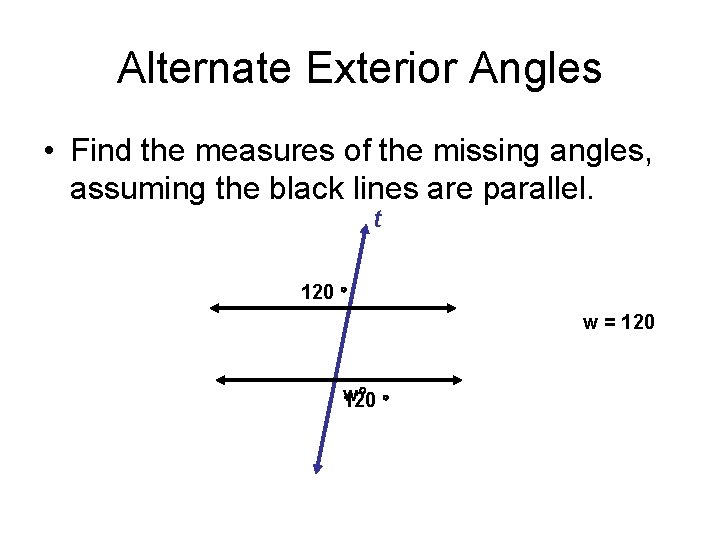
Alternate Exterior Angles • Find the measures of the missing angles, assuming the black lines are parallel. t 120 w = 120 w 120
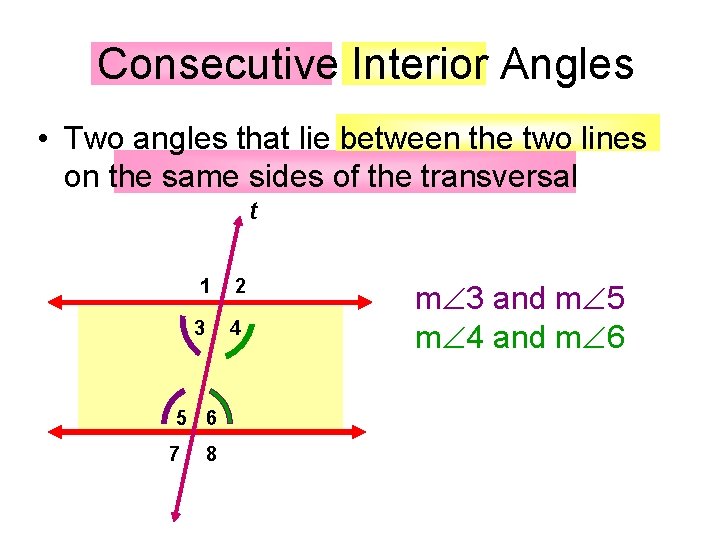
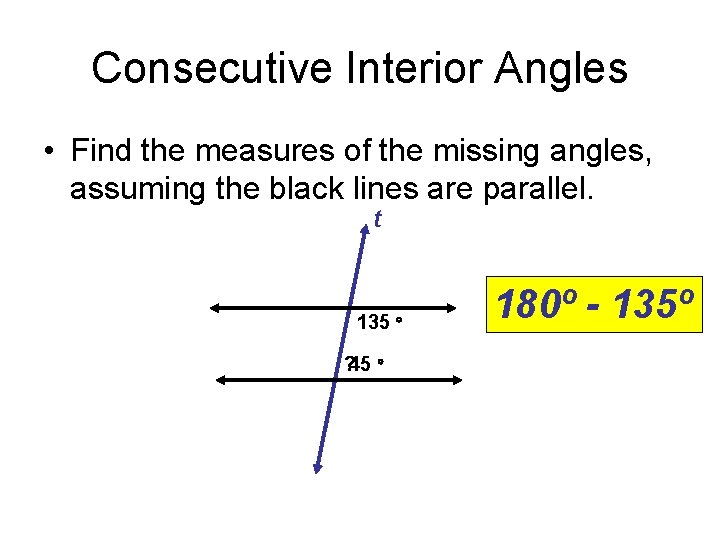
Consecutive Interior Angles • Two angles that lie between the two lines on the same sides of the transversal t 1 2 3 4 5 6 7 8 m 3 and m 5 m 4 and m 6
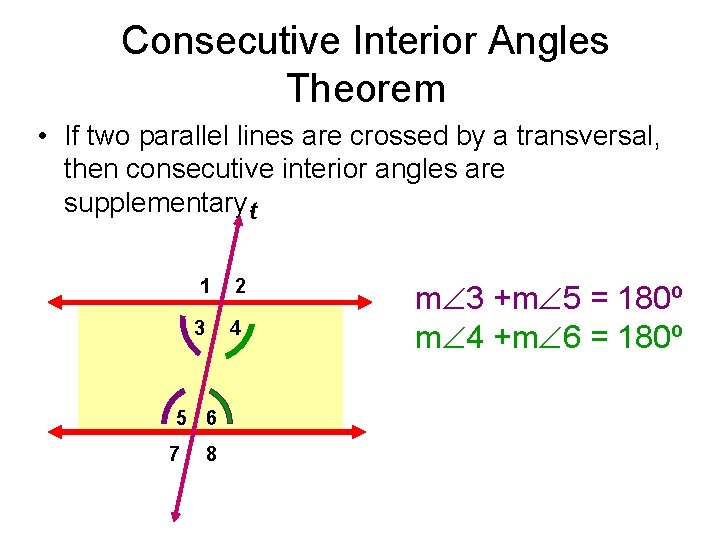
Consecutive Interior Angles Theorem • If two parallel lines are crossed by a transversal, then consecutive interior angles are supplementary. t 1 2 3 4 5 6 7 8 m 3 +m 5 = 180º m 4 +m 6 = 180º
Consecutive Interior Angles • Find the measures of the missing angles, assuming the black lines are parallel. t 135 ? 45 180º - 135º
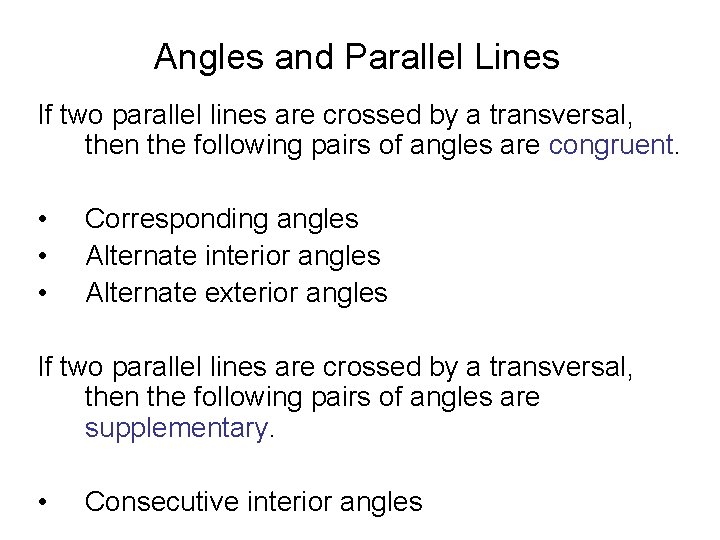
Angles and Parallel Lines If two parallel lines are crossed by a transversal, then the following pairs of angles are congruent. • • • Corresponding angles Alternate interior angles Alternate exterior angles If two parallel lines are crossed by a transversal, then the following pairs of angles are supplementary. • Consecutive interior angles
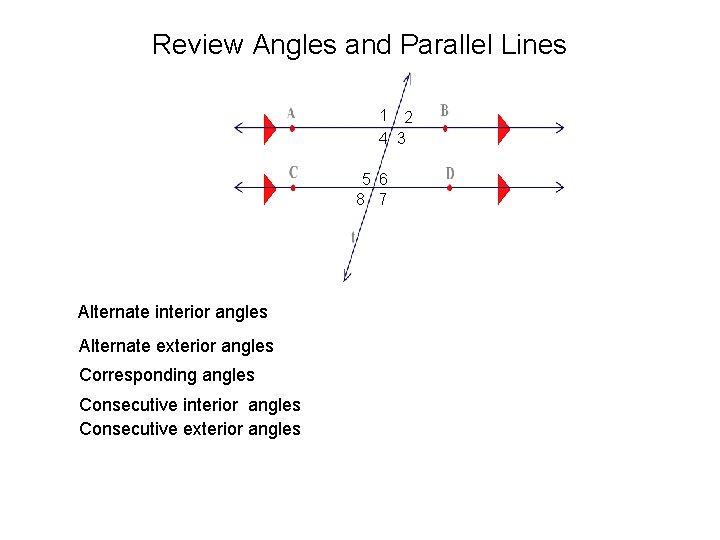
Review Angles and Parallel Lines 1 2 4 3 5 6 8 7 Alternate interior angles Alternate exterior angles Corresponding angles Consecutive interior angles Consecutive exterior angles
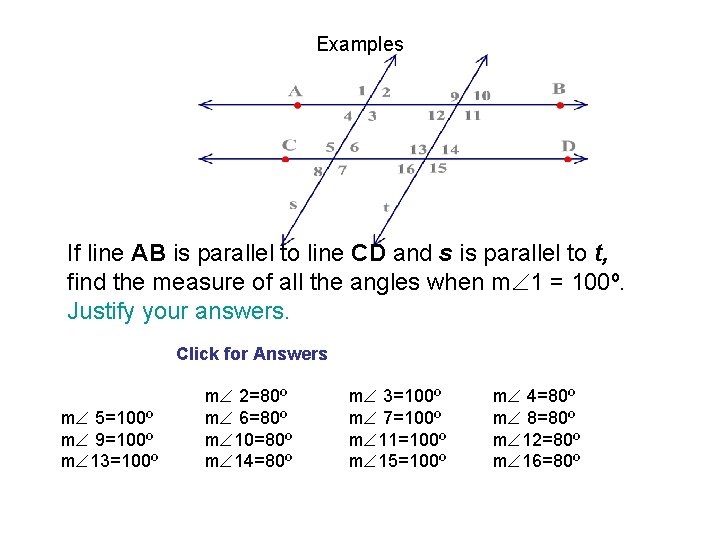
Examples If line AB is parallel to line CD and s is parallel to t, find the measure of all the angles when m 1 = 100º. Justify your answers. Click for Answers m 5=100º m 9=100º m 13=100º m 2=80º m 6=80º m 10=80º m 14=80º m 3=100º m 7=100º m 11=100º m 15=100º m 4=80º m 8=80º m 12=80º m 16=80º
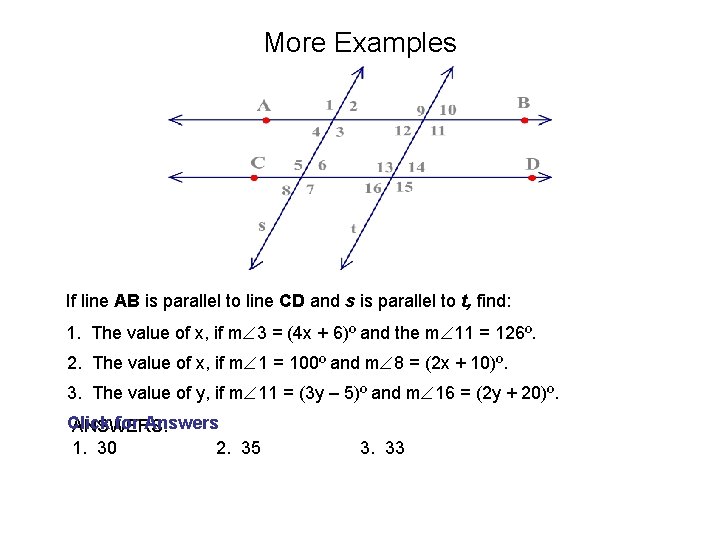
More Examples If line AB is parallel to line CD and s is parallel to t, find: 1. The value of x, if m 3 = (4 x + 6)º and the m 11 = 126º. 2. The value of x, if m 1 = 100º and m 8 = (2 x + 10)º. 3. The value of y, if m 11 = (3 y – 5)º and m 16 = (2 y + 20)º. Click for Answers ANSWERS: 1. 30 2. 35 3. 33
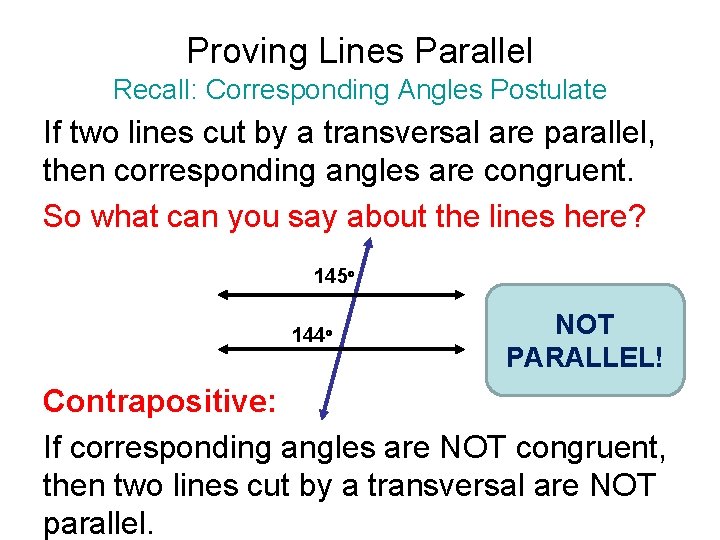
Proving Lines Parallel Recall: Corresponding Angles Postulate If two lines cut by a transversal are parallel, then corresponding angles are congruent. So what can you say about the lines here? 145 144 NOT PARALLEL! Contrapositive: If corresponding angles are NOT congruent, then two lines cut by a transversal are NOT parallel.
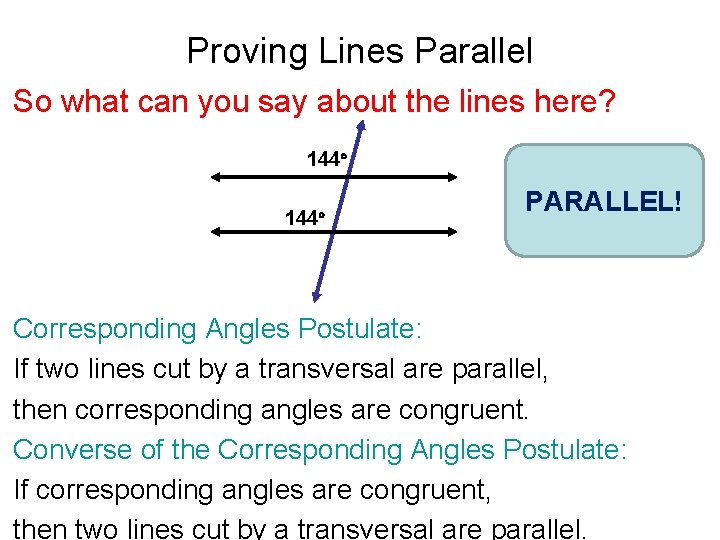
Proving Lines Parallel So what can you say about the lines here? 144 PARALLEL! Corresponding Angles Postulate: If two lines cut by a transversal are parallel, then corresponding angles are congruent. Converse of the Corresponding Angles Postulate: If corresponding angles are congruent, then two lines cut by a transversal are parallel.
Proving Lines Parallel Converse of the Corresponding Angles Postulate If corresponding angles are congruent, then two lines cut by a transversal are parallel
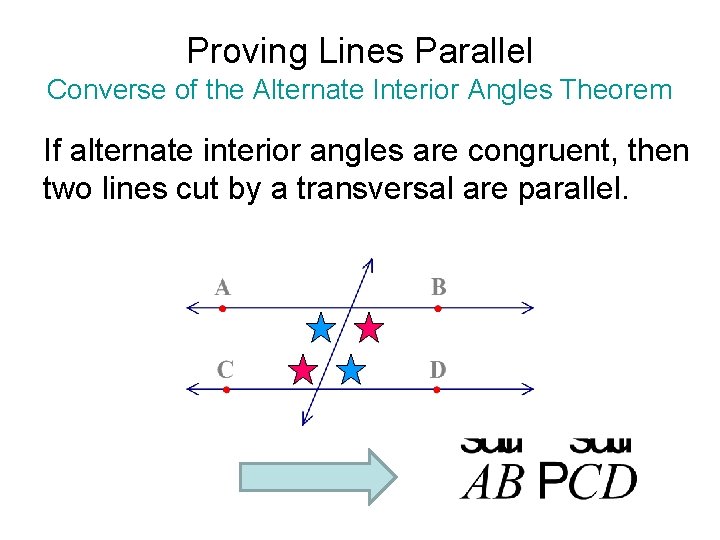
Proving Lines Parallel Converse of the Alternate Interior Angles Theorem If alternate interior angles are congruent, then two lines cut by a transversal are parallel.
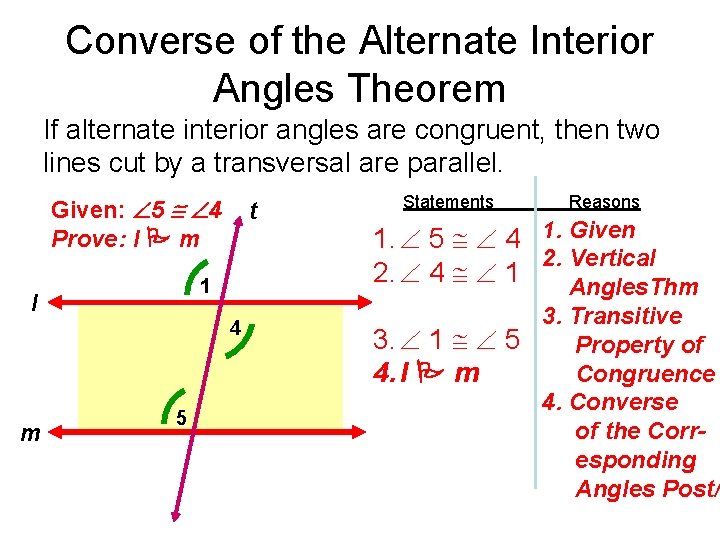
Converse of the Alternate Interior Angles Theorem If alternate interior angles are congruent, then two lines cut by a transversal are parallel. Given: 5 4 Prove: l m t 1 l 4 m 5 Statements Reasons 1. 5 4 1. Given 2. Vertical 2. 4 1 Angles. Thm 3. Transitive 3. 1 5 Property of Congruence 4. l m 4. Converse of the Corresponding Angles Post/
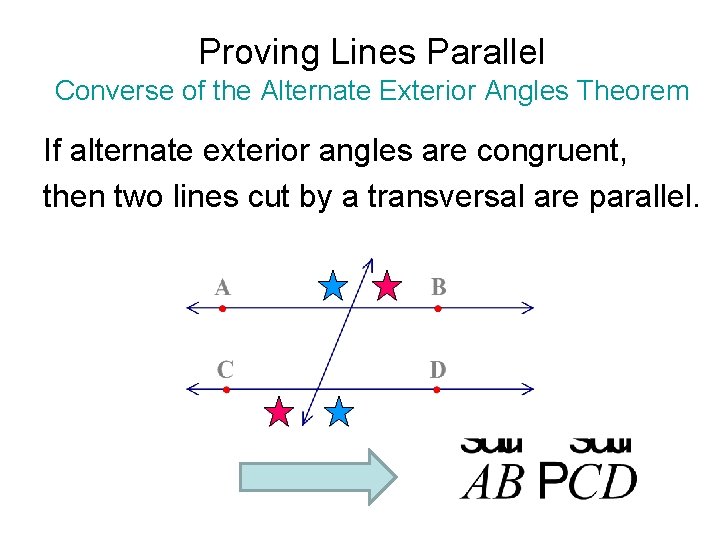
Proving Lines Parallel Converse of the Alternate Exterior Angles Theorem If alternate exterior angles are congruent, then two lines cut by a transversal are parallel.
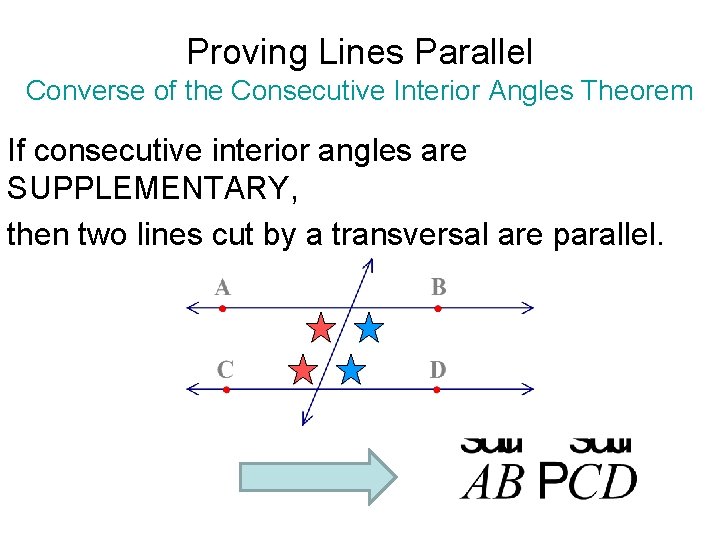
Proving Lines Parallel Converse of the Consecutive Interior Angles Theorem If consecutive interior angles are SUPPLEMENTARY, then two lines cut by a transversal are parallel.
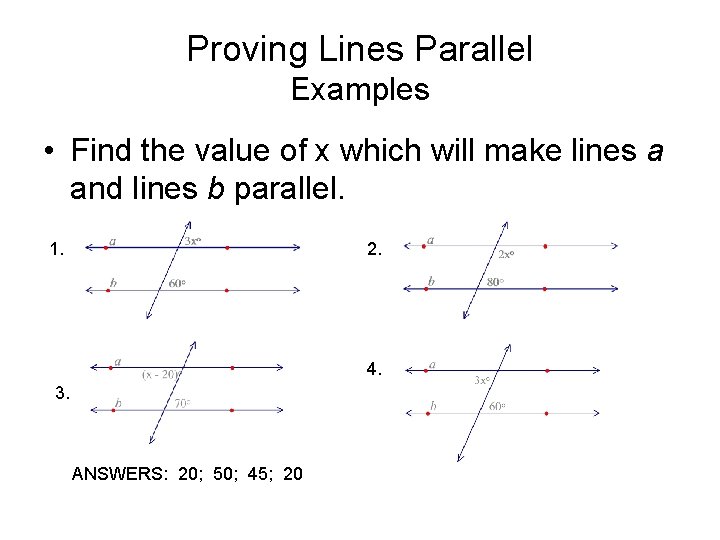
Proving Lines Parallel Examples • Find the value of x which will make lines a and lines b parallel. 1. 2. 4. 3. ANSWERS: 20; 50; 45; 20
Ways to Prove Two Lines Parallel • Show that corresponding angles are congruent. • Show that alternative interior angles are congruent. • Show that alternate exterior angles are congruent. • Show that consecutive interior angles are supplementary. • In a plane, show that the lines are perpendicular to the same line.