LARS A LocationAware Recommender System Justin Levandoski Mohamed






- Slides: 41
LARS A Location-Aware Recommender System Justin Levandoski Mohamed Sarwat Ahmed Eldawy Mohamed F. Mokbel
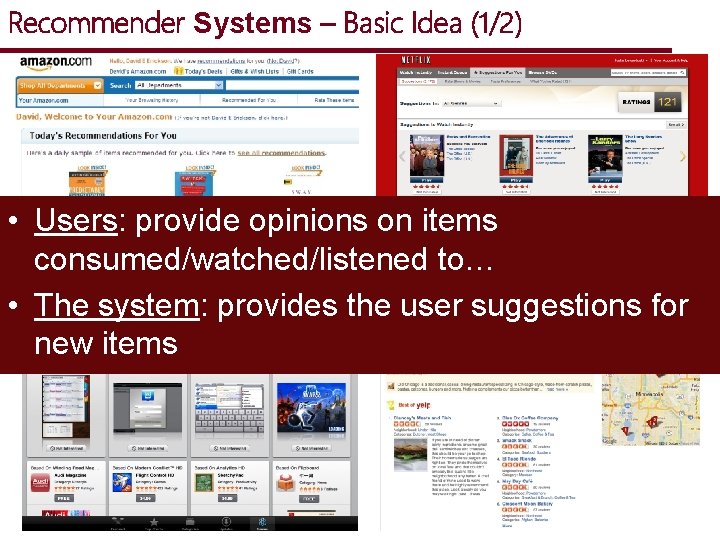
Recommender Systems – Basic Idea (1/2) • Users: provide opinions on items consumed/watched/listened to… • The system: provides the user suggestions for new items 2 2
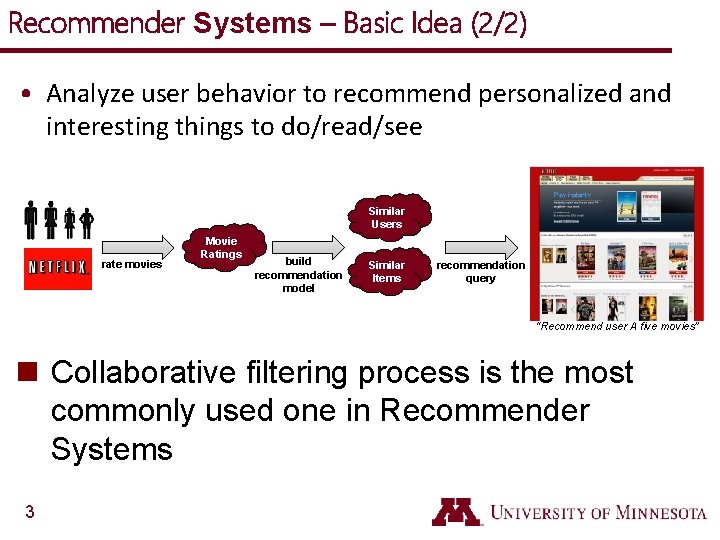
Recommender Systems – Basic Idea (2/2) • Analyze user behavior to recommend personalized and interesting things to do/read/see Similar Users rate movies Movie Ratings build recommendation model Similar Items recommendation query “Recommend user A five movies” n Collaborative filtering process is the most commonly used one in Recommender Systems 3
Location Matters !
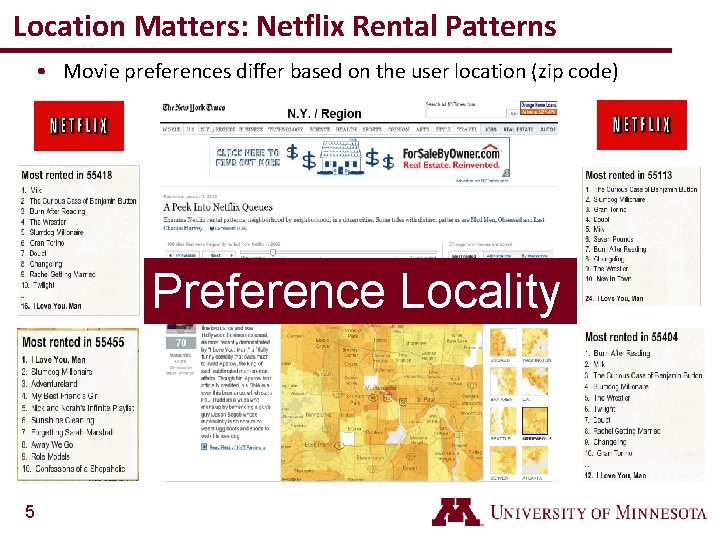
Location Matters: Netflix Rental Patterns • Movie preferences differ based on the user location (zip code) Preference Locality 5
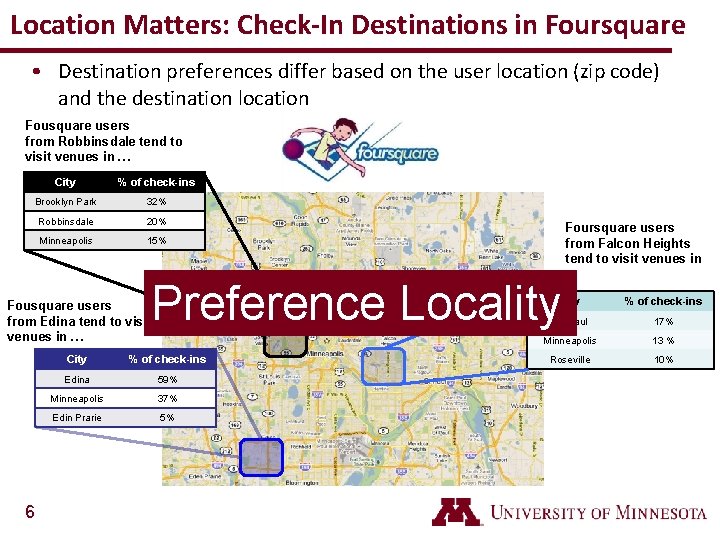
Location Matters: Check-In Destinations in Foursquare • Destination preferences differ based on the user location (zip code) and the destination location Fousquare users from Robbinsdale tend to visit venues in … City % of check-ins Brooklyn Park 32% Robbinsdale 20% Minneapolis 15% Preference Locality Fousquare users from Edina tend to visit venues in … City % of check-ins Edina 59% Minneapolis 37% Edin Prarie 5% 6 Foursquare users from Falcon Heights tend to visit venues in … City % of check-ins St. Paul 17% Minneapolis 13 % Roseville 10%
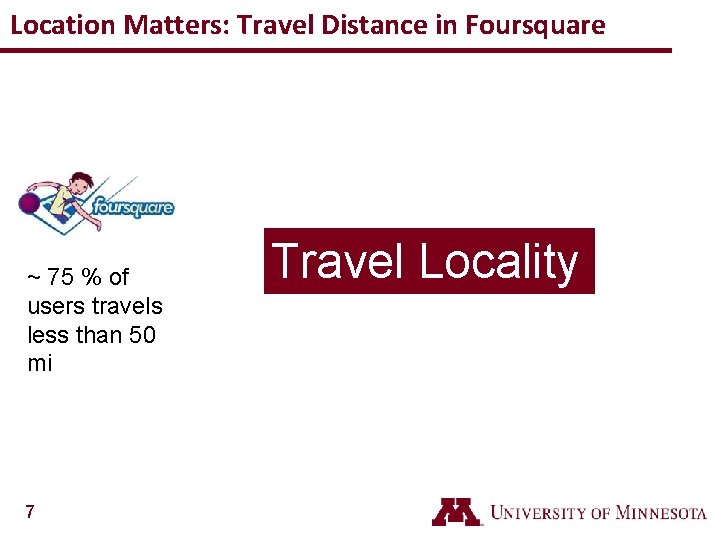
Location Matters: Travel Distance in Foursquare ~ 75 % of users travels less than 50 mi 7 Travel Locality
LARS Main Idea LARS takes into account Preference Locality and Travel Locality when recommending items to users 8
Talk Outline • Location-based Ratings • LARS solution • Experimental Evaluation • Conclusion 9
Talk Outline • Location-based Ratings • LARS solution • Experimental Evaluation • Conclusion 10
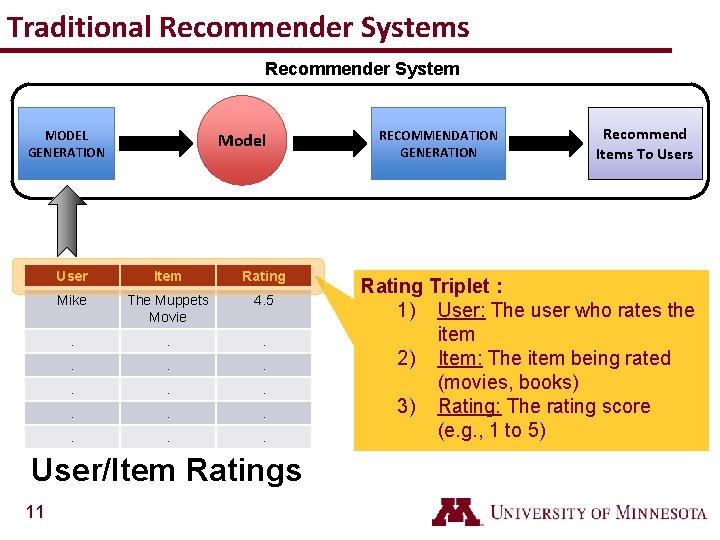
Traditional Recommender Systems Recommender System MODEL GENERATION Model User Item Rating Mike The Muppets Movie 4. 5 . . . . User/Item Ratings 11 RECOMMENDATION GENERATION Recommend Items To Users Rating Triplet : 1) User: The user who rates the item 2) Item: The item being rated (movies, books) 3) Rating: The rating score (e. g. , 1 to 5)
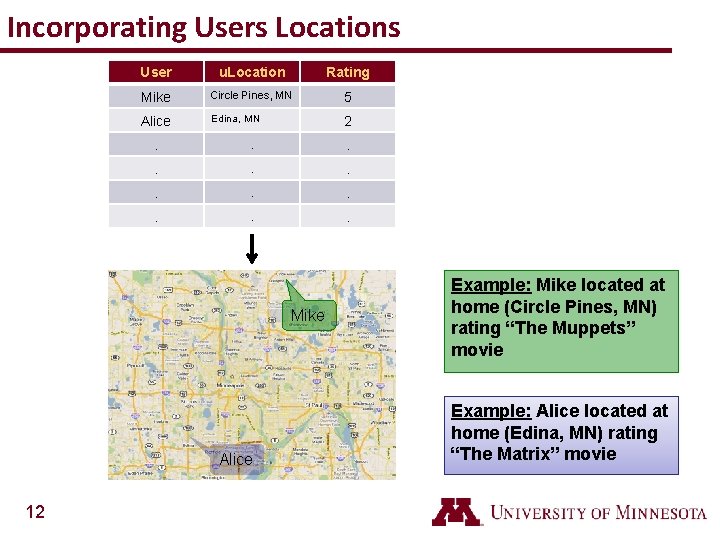
Incorporating Users Locations User Item u. Location Rating Mike Circle Pines, MN The Muppets 5 Alice Edina, The MN Matrix 2 . . . Mike Alice 12 Example: Mike located at home (Circle Pines, MN) rating “The Muppets” movie Example: Alice located at home (Edina, MN) rating “The Matrix” movie
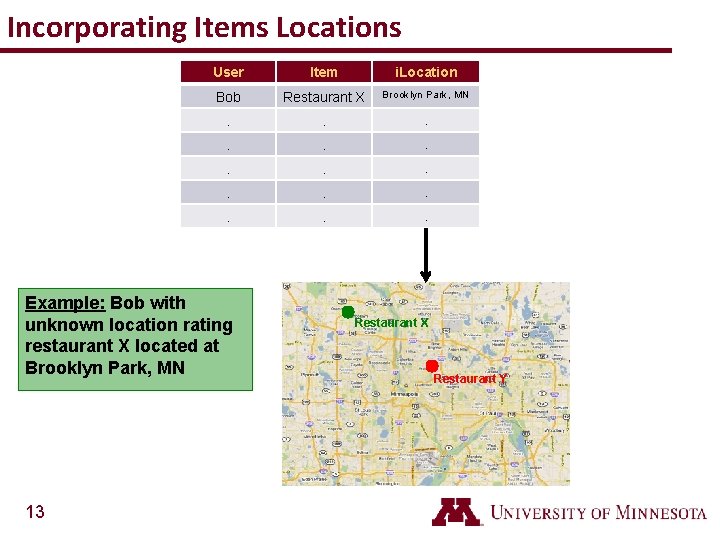
Incorporating Items Locations User Item Rating i. Location Bob Restaurant X Brooklyn. 4. 5 Park, MN . . Example: Bob with unknown location rating restaurant X located at Brooklyn Park, MN 13 Restaurant X Restaurant Y
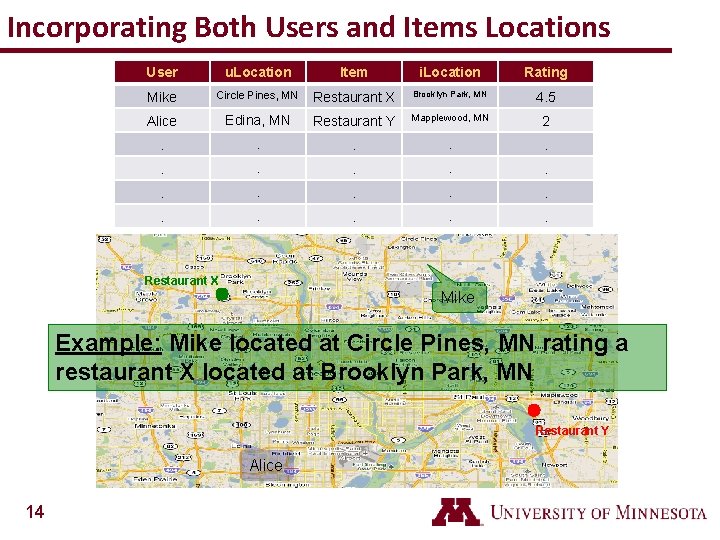
Incorporating Both Users and Items Locations User u. Location Item i. Location Rating Mike Circle Pines, MN Restaurant X Brooklyn Park, MN 4. 5 Alice Edina, MN Restaurant Y Mapplewood, MN 2 . . Restaurant X Mike Example: Mike located at Circle Pines, MN rating a restaurant X located at Brooklyn Park, MN Restaurant Y Alice 14
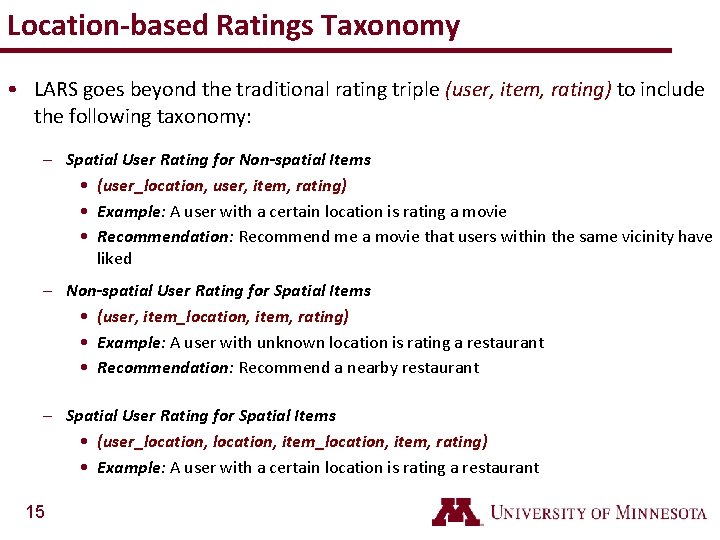
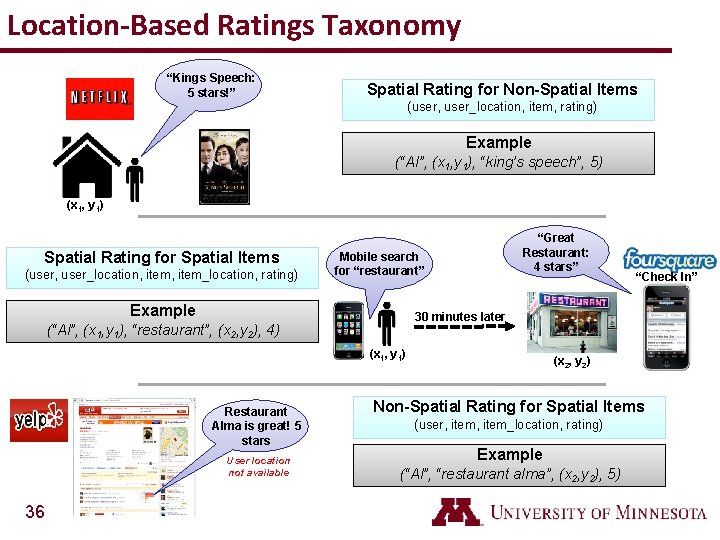
Location-based Ratings Taxonomy • LARS goes beyond the traditional rating triple (user, item, rating) to include the following taxonomy: – Spatial User Rating for Non-spatial Items • (user_location, user, item, rating) • Example: A user with a certain location is rating a movie • Recommendation: Recommend me a movie that users within the same vicinity have liked – Non-spatial User Rating for Spatial Items • (user, item_location, item, rating) • Example: A user with unknown location is rating a restaurant • Recommendation: Recommend a nearby restaurant – Spatial User Rating for Spatial Items • (user_location, item_location, item, rating) • Example: A user with a certain location is rating a restaurant 15
Talk Outline • Location-based Ratings • LARS solution – Spatial User Ratings for Non-Spatial Items – Non-Spatial User Ratings for Spatial Items – Spatial User Ratings for Spatial Items • Experimental Evaluation • Conclusion 16
Talk Outline • Location-based Ratings • LARS solution – Spatial User Ratings for Non-Spatial Items – Non-Spatial User Ratings for Spatial Items – Spatial User Ratings for Spatial Items • Experimental Evaluation • Conclusion 17
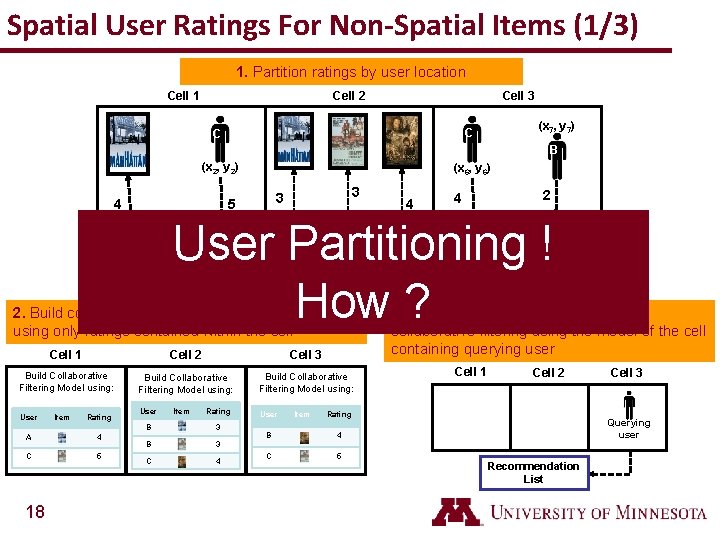
Spatial User Ratings For Non-Spatial Items (1/3) 1. Partition ratings by user location Cell 1 Cell 2 Cell 3 (x 7, y 7) C C B (x 2, y 2) 4 (x 6, y 6) 3 3 5 (x 1, y 1) (x 3, y 3) C (x 4, y 4) Cell 2 Cell 3 Build Collaborative Filtering Model using: User Rating A 4 C 5 18 Item Rating B 3 C 4 Item (x 5, y 5) 3. Generate recommendations using collaborative filtering using the model of the cell containing querying user Cell 1 Item 2 User Partitioning ! How ? 2. Build collaborative filtering model for each cell using only ratings contained within the cell User 4 B B A 4 Cell 1 Cell 2 Rating B 4 C 5 Cell 3 Querying user Recommendation List
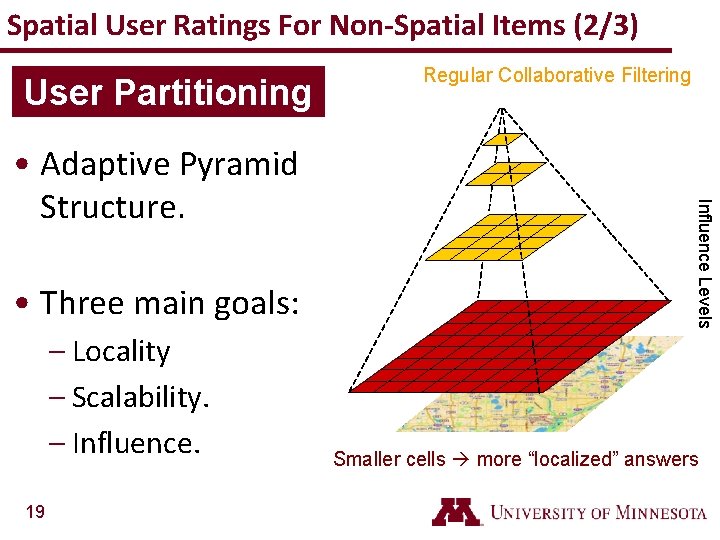
Spatial User Ratings For Non-Spatial Items (2/3) User Partitioning • Three main goals: – Locality – Scalability. – Influence. 19 Influence Levels • Adaptive Pyramid Structure. Regular Collaborative Filtering Smaller cells more “localized” answers
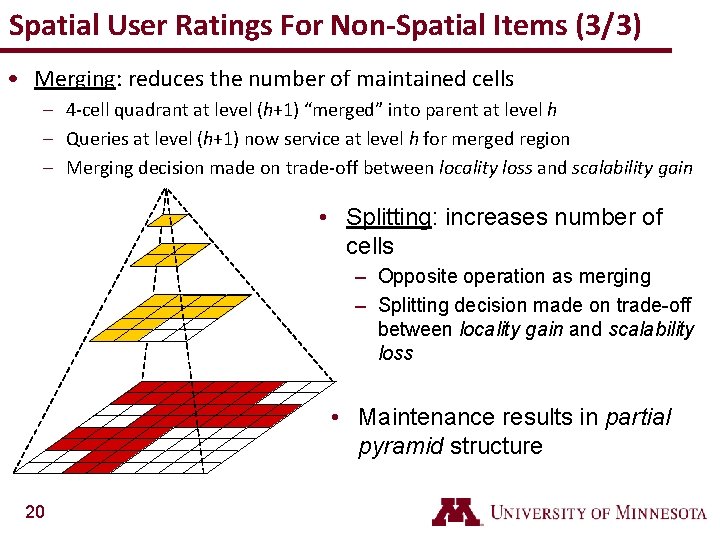
Spatial User Ratings For Non-Spatial Items (3/3) • Merging: reduces the number of maintained cells – 4 -cell quadrant at level (h+1) “merged” into parent at level h – Queries at level (h+1) now service at level h for merged region – Merging decision made on trade-off between locality loss and scalability gain • Splitting: increases number of cells – Opposite operation as merging – Splitting decision made on trade-off between locality gain and scalability loss • Maintenance results in partial pyramid structure 20
Talk Outline • Location-based Ratings • LARS solution – Spatial User Ratings for Non-Spatial Items – Non-Spatial User Rating for Spatial Items – Spatial User Ratings for Spatial Items • Experimental Evaluation • Conclusion 21
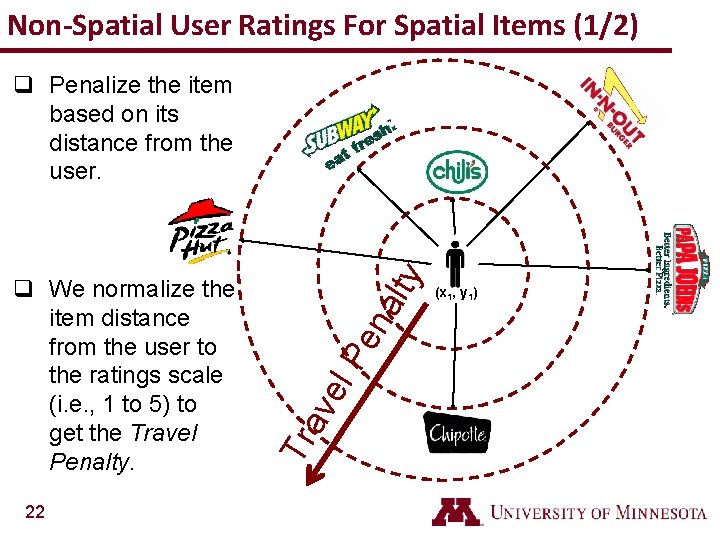
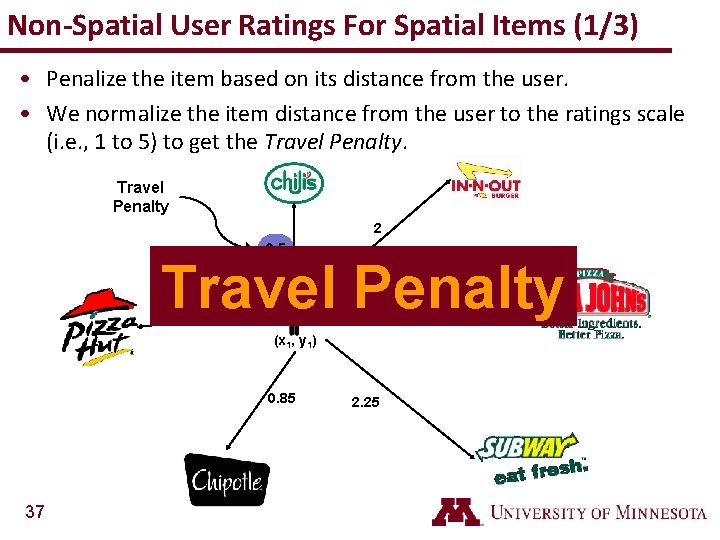
Non-Spatial User Ratings For Spatial Items (1/2) 22 na Pe el av Tr q We normalize the item distance from the user to the ratings scale (i. e. , 1 to 5) to get the Travel Penalty. lty q Penalize the item based on its distance from the user. (x 1, y 1)
Non-Spatial User Ratings For Spatial Items (2/2) • Penalize each item, with a travel penalty, based on its distance from the user. • Use a ranking function that combines the recommendation score and travel penalty • Incrementally, retrieve items based on travel penalty, and calculate the ranking score on an ad-hoc basis • Employ an early stopping condition to minimize the list of accessed items to get the K recommended items 23
Talk Outline • Location-based Ratings • LARS solution – Spatial User Ratings for Non-Spatial Items – Non-Spatial User Ratings for Spatial Items – Spatial User Ratings for Spatial Items • Experimental Evaluation • Conclusion 24
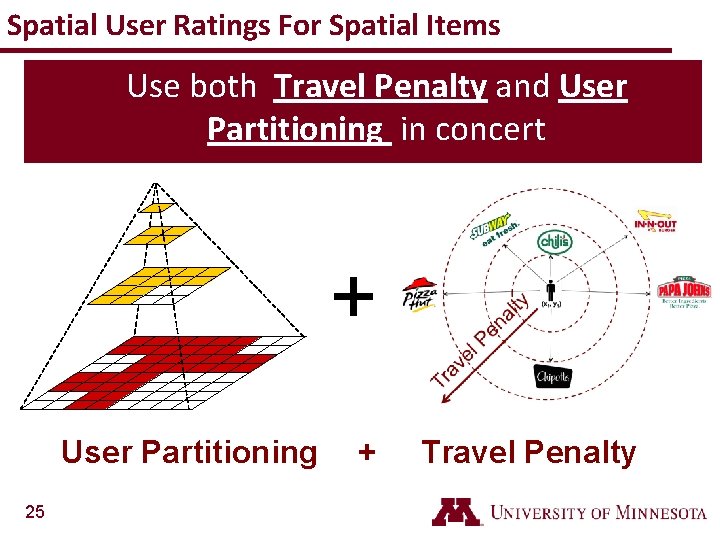
Spatial User Ratings For Spatial Items • Use both Travel Penalty and User Partitioning in concert + User Partitioning 25 + Travel Penalty
Talk Outline • Location-based Ratings • LARS solution – Spatial User Ratings for Non-Spatial Items – Non-Spatial User Ratings for Spatial Items – Spatial User Ratings for Spatial Items • Experimental Evaluation • Conclusion 26
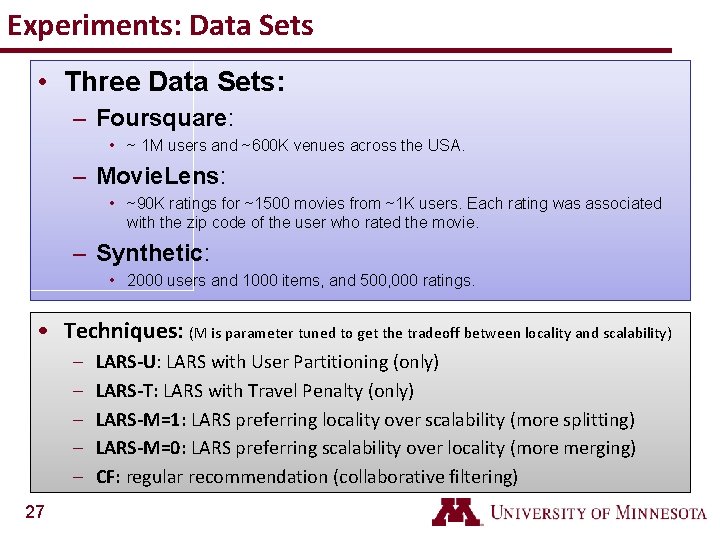
Experiments: Data Sets • Three Data Sets: – Foursquare: • ~ 1 M users and ~600 K venues across the USA. – Movie. Lens: • ~90 K ratings for ~1500 movies from ~1 K users. Each rating was associated with the zip code of the user who rated the movie. – Synthetic: • 2000 users and 1000 items, and 500, 000 ratings. • Techniques: (M is parameter tuned to get the tradeoff between locality and scalability) – – – 27 LARS-U: LARS with User Partitioning (only) LARS-T: LARS with Travel Penalty (only) LARS-M=1: LARS preferring locality over scalability (more splitting) LARS-M=0: LARS preferring scalability over locality (more merging) CF: regular recommendation (collaborative filtering)
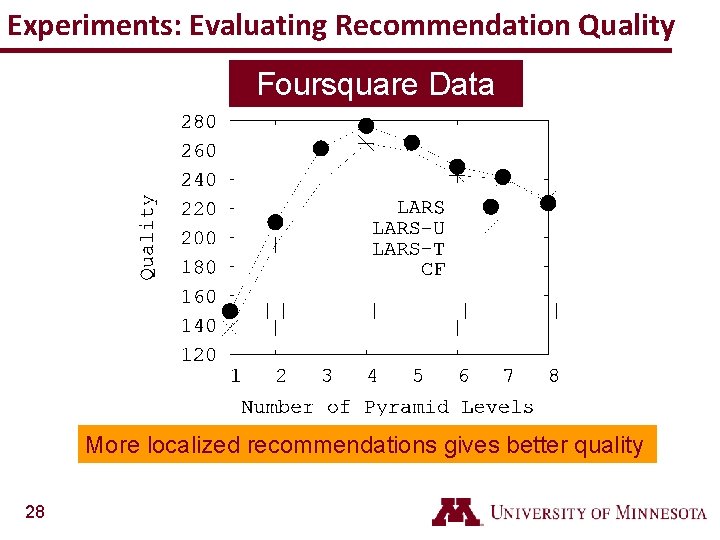
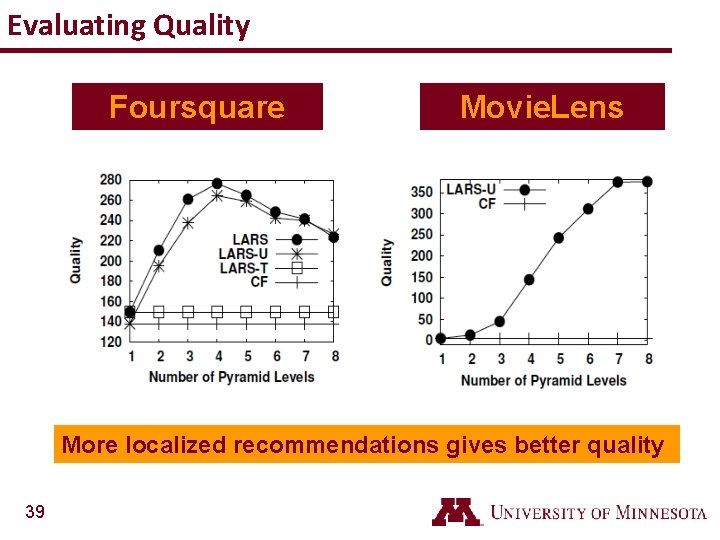
Experiments: Evaluating Recommendation Quality Foursquare Data More localized recommendations gives better quality 28
Experiments: Evaluating Scalability Synthetic Data Set Storage and Maintenance increases exponentially 29
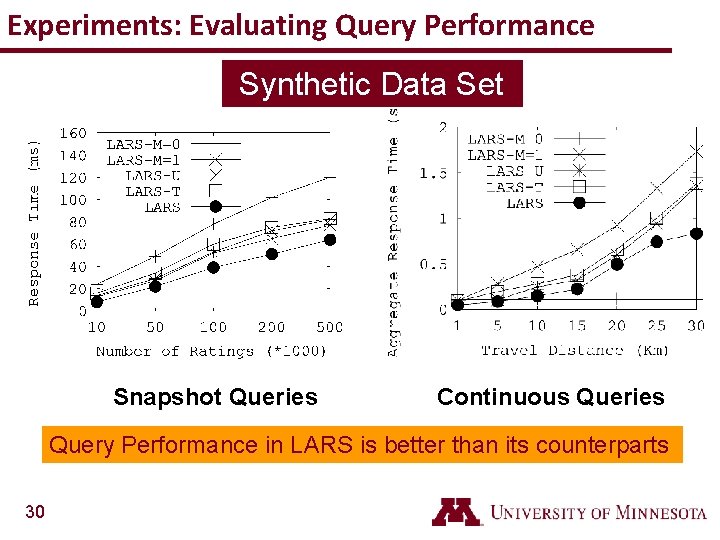
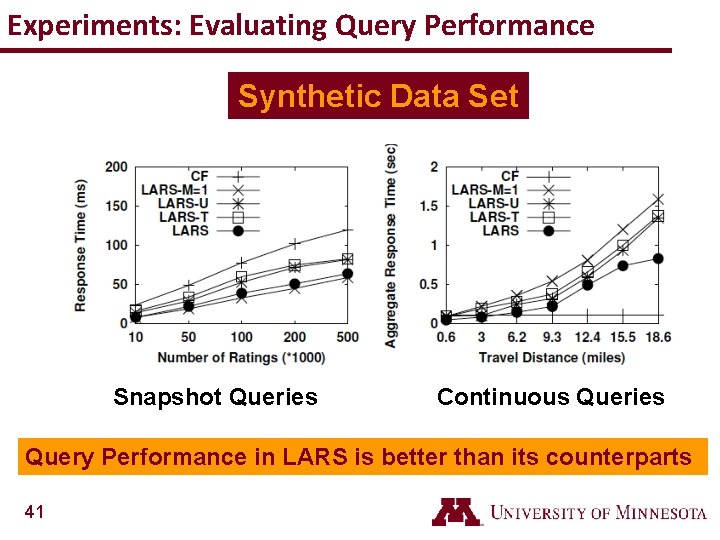
Experiments: Evaluating Query Performance Synthetic Data Set Snapshot Queries Continuous Queries Query Performance in LARS is better than its counterparts 30
Talk Outline • Location-based Ratings • LARS solution – Spatial User Ratings for Non-Spatial Items – Non-Spatial User Ratings for Spatial Items – Spatial User Ratings for Spatial Items • Experimental Evaluation • Conclusion 31
Take-Away Message • LARS promotes Location as a first class citizen in traditional recommender systems. • LARS presents a neat taxonomy for location-based ratings in recommender system. • LARS employs a user partitioning and travel penalty techniques which can be applied separately or in concert to support the various types of location-based ratings. 32
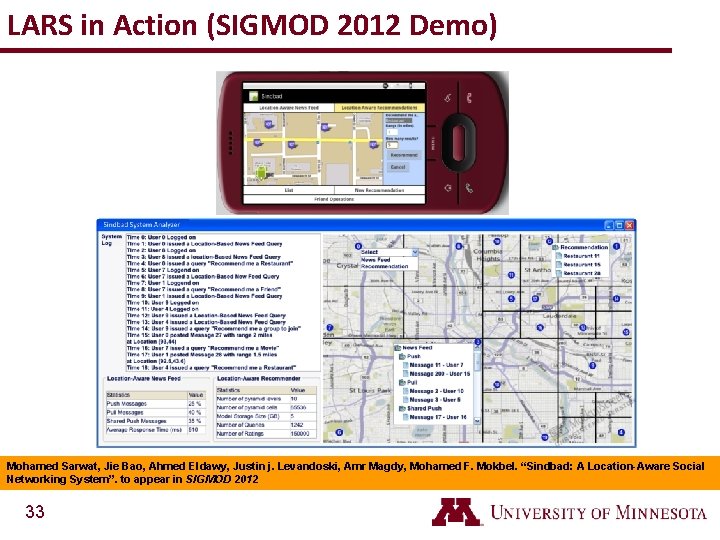
LARS in Action (SIGMOD 2012 Demo) Mohamed Sarwat, Jie Bao, Ahmed Eldawy, Justin j. Levandoski, Amr Magdy, Mohamed F. Mokbel. “Sindbad: A Location-Aware Social Networking System”. to appear in SIGMOD 2012 33
Questions
Thank You
Location-Based Ratings Taxonomy “Kings Speech: 5 stars!” Spatial Rating for Non-Spatial Items (user, user_location, item, rating) Example (“Al”, (x 1, y 1), “king’s speech”, 5) (x 1, y 1) Spatial Rating for Spatial Items (user, user_location, item_location, rating) “Great Restaurant: 4 stars” Mobile search for “restaurant” Example 30 minutes later (“Al”, (x 1, y 1), “restaurant”, (x 2, y 2), 4) (x 1, y 1) Restaurant Alma is great! 5 stars User location not available 36 “Check In” (x 2, y 2) Non-Spatial Rating for Spatial Items (user, item_location, rating) Example (“Al”, “restaurant alma”, (x 2, y 2), 5)
Non-Spatial User Ratings For Spatial Items (1/3) • Penalize the item based on its distance from the user. • We normalize the item distance from the user to the ratings scale (i. e. , 1 to 5) to get the Travel Penalty 2 0. 5 Travel Penalty 2. 5 1 (x 1, y 1) 0. 85 37 2. 25
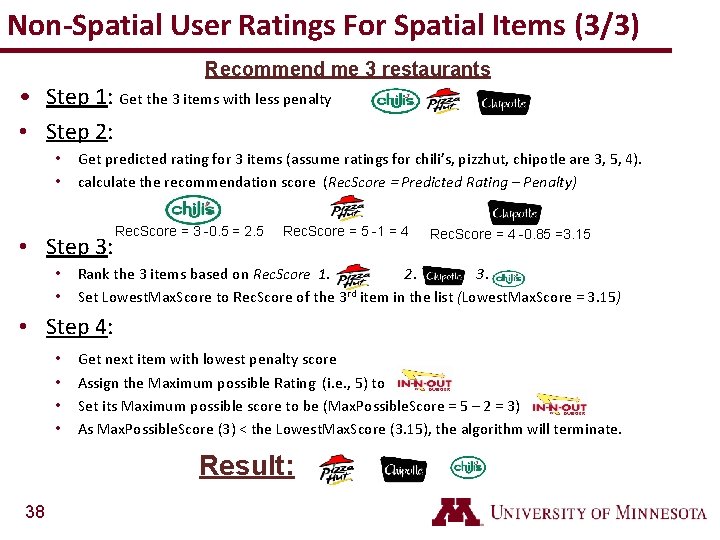
Non-Spatial User Ratings For Spatial Items (3/3) Recommend me 3 restaurants • Step 1: Get the 3 items with less penalty • Step 2: • • Get predicted rating for 3 items (assume ratings for chili’s, pizzhut, chipotle are 3, 5, 4). calculate the recommendation score (Rec. Score = Predicted Rating – Penalty) • Step 3: • • Rec. Score = 3 -0. 5 = 2. 5 Rec. Score = 5 -1 = 4 Rec. Score = 4 -0. 85 =3. 15 Rank the 3 items based on Rec. Score 1. 2. 3. Set Lowest. Max. Score to Rec. Score of the 3 rd item in the list (Lowest. Max. Score = 3. 15) • Step 4: • • Get next item with lowest penalty score Assign the Maximum possible Rating (i. e. , 5) to Set its Maximum possible score to be (Max. Possible. Score = 5 – 2 = 3) As Max. Possible. Score (3) < the Lowest. Max. Score (3. 15), the algorithm will terminate. Result: 38
Evaluating Quality Foursquare Movie. Lens More localized recommendations gives better quality 39
Experiments: Evaluating Scalability Synthetic Data Set Storage Maintenance Storage and Maintenance increases exponentially 40
Experiments: Evaluating Query Performance Synthetic Data Set Snapshot Queries Continuous Queries Query Performance in LARS is better than its counterparts 41