Recommender Systems Introduction A recommender system also known


- Slides: 19
Recommender Systems
Introduction A recommender system, also known as a recommendation engine, is an information filtering system whose purpose is to recommend or suggest items or actions to a user The recommendation may consist of: ● Offering articles to online readers, based on a prediction of reader interests. ● Offering customers an suggestion about what they might like to buy, based on their past history and/or product searches compared with the habits of similar users. It can be said that, Recommendation engines are nothing but an automated form of “shop counter guy”. You ask him for a product. Not only will he show that product, but also the related ones which you could buy.
Why use Recommendation Systems ● We are in an information society. The quantity of information increases day by day and it goes over our limited processing capabilities ● For example, Netflix, It has an enormous collection of content. Because of so much information people had a hard time selecting the items they actually want to see. For this reason, they need something able to recommend or suggest us and this is where recommendation system kicks in. Therefore Recommendation System is used to ● Make search space smaller. ● Increase trust and customer loyalty. ● Increase sales. ● Better understand each customer ● Discover new things.
Part 1 A Model for Recommendation Systems Content-Based Systems
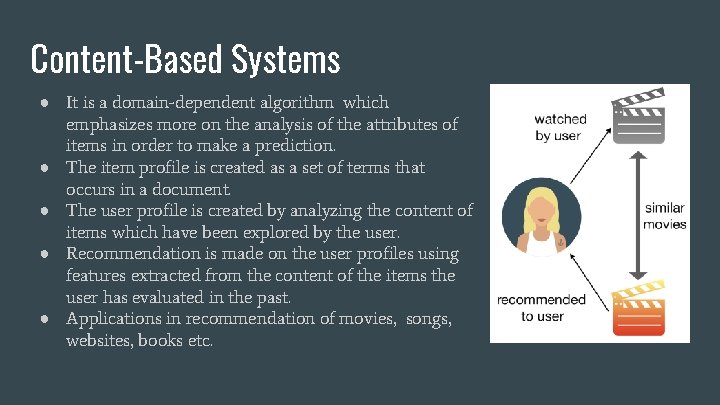
Content-Based Systems ● It is a domain-dependent algorithm which emphasizes more on the analysis of the attributes of items in order to make a prediction. ● The item profile is created as a set of terms that occurs in a document. ● The user profile is created by analyzing the content of items which have been explored by the user. ● Recommendation is made on the user profiles using features extracted from the content of the items the user has evaluated in the past. ● Applications in recommendation of movies, songs, websites, books etc.
Item Profiles ● Content based systems maintain important characteristics of an item in an item profile ● Each profile is a vector of features ● Item profile of a book will look like: Book: title, author, year of publication, genre ● TF-IDF (Term frequency * Inverse Doc Frequency) index can be used to extract these important features of the items. ● The features with highest TF-IDF scores are selected
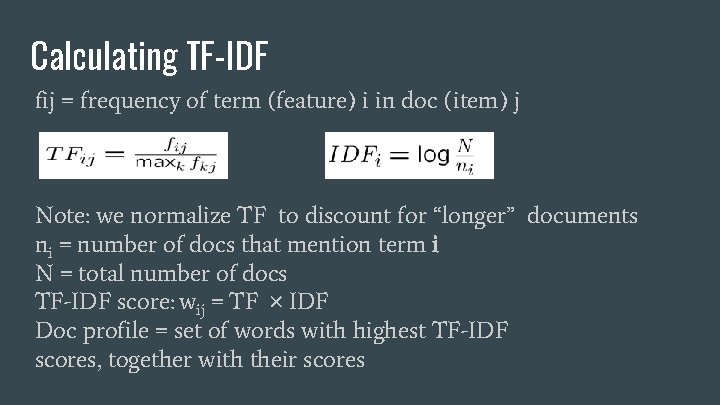
Calculating TF-IDF fij = frequency of term (feature) i in doc (item) j Note: we normalize TF to discount for “longer” documents ni = number of docs that mention term i N = total number of docs TF-IDF score: wij = TF × IDF Doc profile = set of words with highest TF-IDF scores, together with their scores
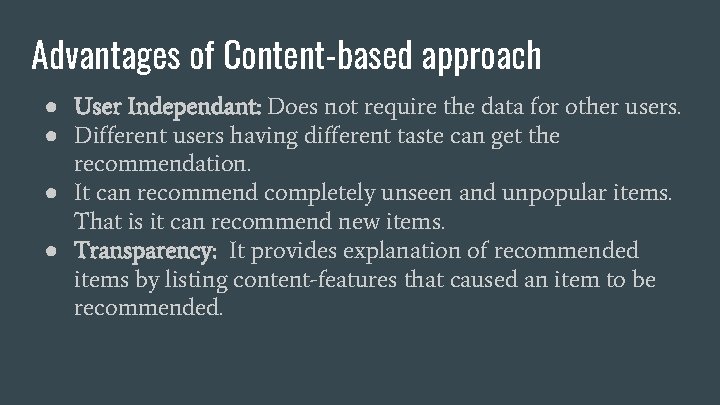
Advantages of Content-based approach ● User Independant: Does not require the data for other users. ● Different users having different taste can get the recommendation. ● It can recommend completely unseen and unpopular items. That is it can recommend new items. ● Transparency: It provides explanation of recommended items by listing content-features that caused an item to be recommended.
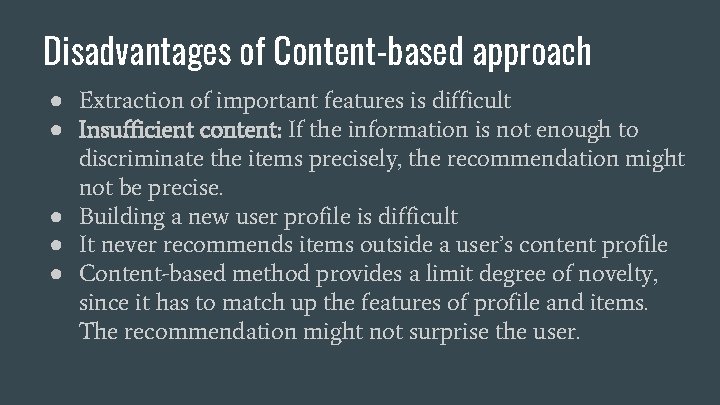
Disadvantages of Content-based approach ● Extraction of important features is difficult ● Insufficient content: If the information is not enough to discriminate the items precisely, the recommendation might not be precise. ● Building a new user profile is difficult ● It never recommends items outside a user’s content profile ● Content-based method provides a limit degree of novelty, since it has to match up the features of profile and items. The recommendation might not surprise the user.
Which score can be used to evaluate how important a word is to a document?
TF-IDF Score
Part 2 Collaborative Filtering Dimensionality Reduction
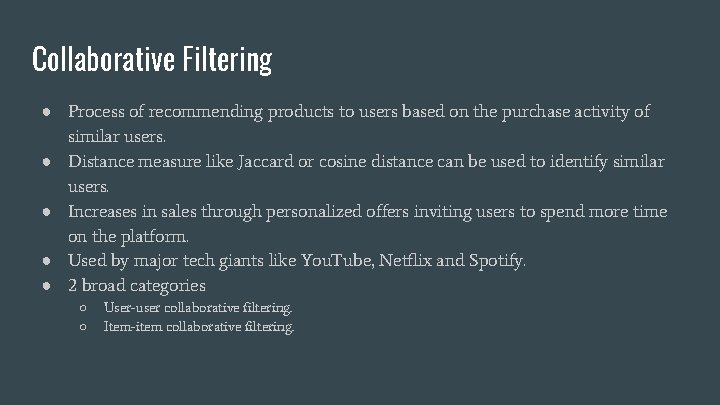
Collaborative Filtering ● Process of recommending products to users based on the purchase activity of similar users. ● Distance measure like Jaccard or cosine distance can be used to identify similar users. ● Increases in sales through personalized offers inviting users to spend more time on the platform. ● Used by major tech giants like You. Tube, Netflix and Spotify. ● 2 broad categories ○ ○ User-user collaborative filtering. Item-item collaborative filtering.
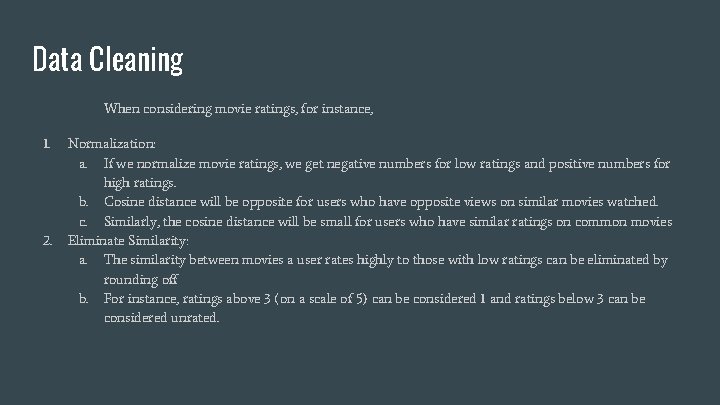
Data Cleaning When considering movie ratings, for instance, 1. 2. Normalization: a. If we normalize movie ratings, we get negative numbers for low ratings and positive numbers for high ratings. b. Cosine distance will be opposite for users who have opposite views on similar movies watched. c. Similarly, the cosine distance will be small for users who have similar ratings on common movies Eliminate Similarity: a. The similarity between movies a user rates highly to those with low ratings can be eliminated by rounding off b. For instance, ratings above 3 (on a scale of 5) can be considered 1 and ratings below 3 can be considered unrated.
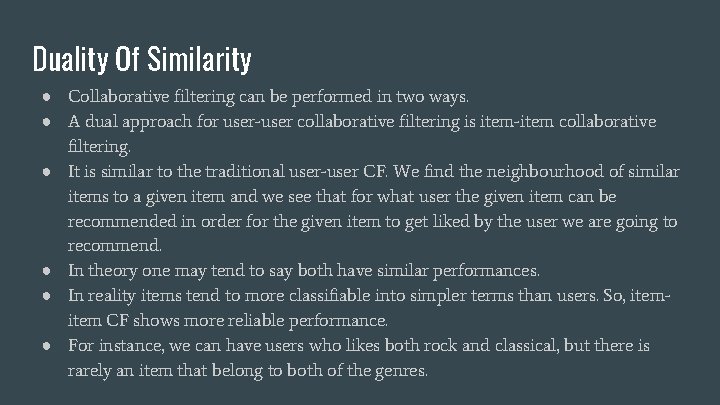
Duality Of Similarity ● Collaborative filtering can be performed in two ways. ● A dual approach for user-user collaborative filtering is item-item collaborative filtering. ● It is similar to the traditional user-user CF. We find the neighbourhood of similar items to a given item and we see that for what user the given item can be recommended in order for the given item to get liked by the user we are going to recommend. ● In theory one may tend to say both have similar performances. ● In reality items tend to more classifiable into simpler terms than users. So, item CF shows more reliable performance. ● For instance, we can have users who likes both rock and classical, but there is rarely an item that belong to both of the genres.
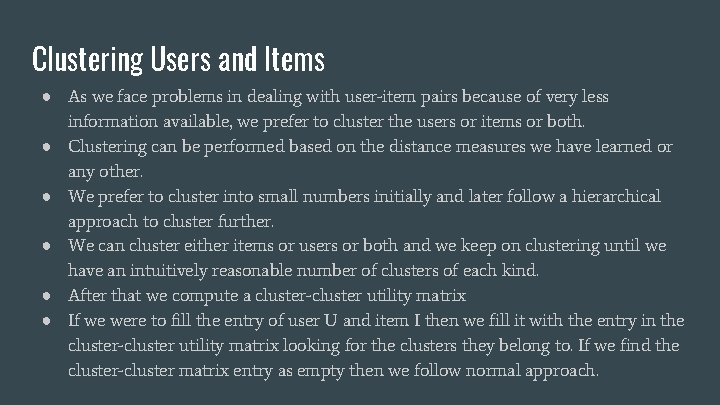
Clustering Users and Items ● As we face problems in dealing with user-item pairs because of very less information available, we prefer to cluster the users or items or both. ● Clustering can be performed based on the distance measures we have learned or any other. ● We prefer to cluster into small numbers initially and later follow a hierarchical approach to cluster further. ● We can cluster either items or users or both and we keep on clustering until we have an intuitively reasonable number of clusters of each kind. ● After that we compute a cluster-cluster utility matrix ● If we were to fill the entry of user U and item I then we fill it with the entry in the cluster-cluster utility matrix looking for the clusters they belong to. If we find the cluster-cluster matrix entry as empty then we follow normal approach.
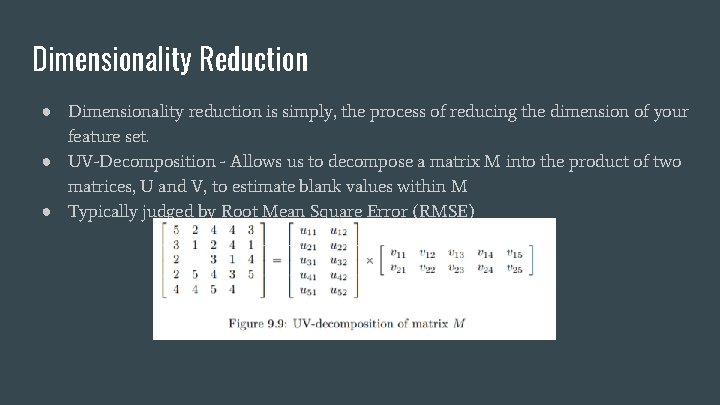
Dimensionality Reduction ● Dimensionality reduction is simply, the process of reducing the dimension of your feature set. ● UV-Decomposition - Allows us to decompose a matrix M into the product of two matrices, U and V, to estimate blank values within M ● Typically judged by Root Mean Square Error (RMSE)
Which method could be used to group users and items into categories to make recommendation easier?
Clustering