
Deuteronomy Transaction Support for Cloud Data Justin Levandoski
- Slides: 20
Deuteronomy: Transaction Support for Cloud Data Justin Levandoski* University of Minnesota David Lomet Microsoft Research Mohamed Mokbel* University of Minnesota Kevin Zhao* University of California San Diego *work done while at Microsoft Research
Motivation �Want ACID transactions for data anywhere in cloud �Currently, cloud providers support: �Transactions for data guaranteed to exist on the same node �Eventual consistency �Currently no support for transactions “across the cloud” 2
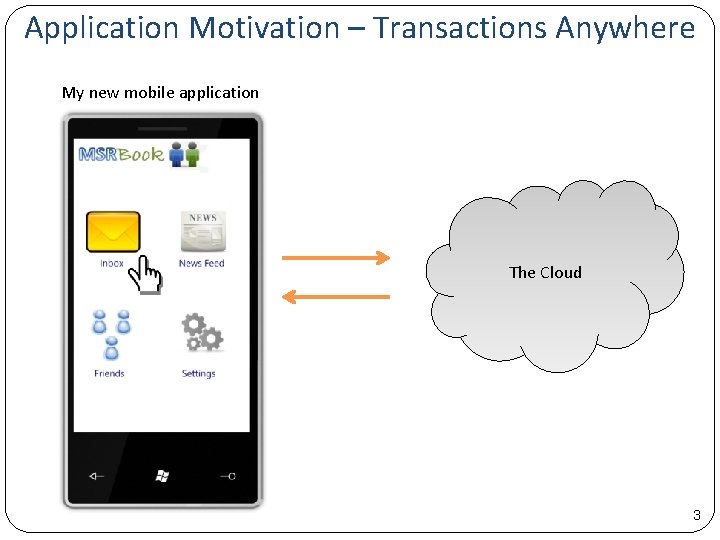
Application Motivation – Transactions Anywhere My new mobile application The Cloud 3
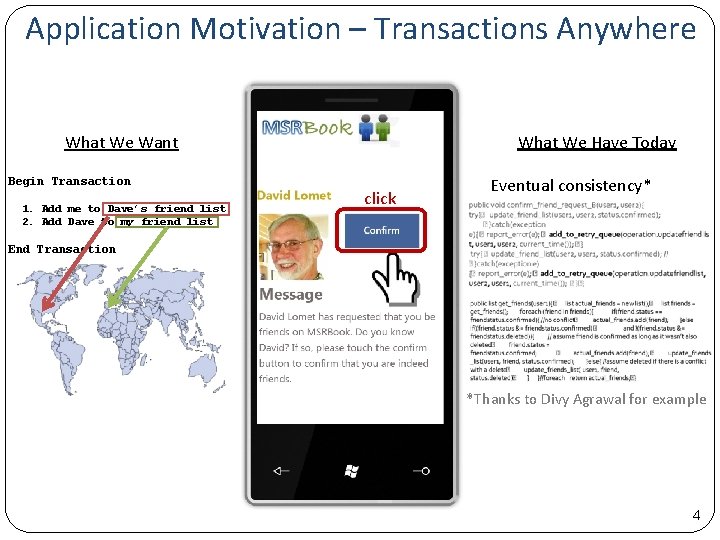
Application Motivation – Transactions Anywhere What We Have Today What We Want Begin Transaction 1. Add me to Dave’s friend list 2. Add Dave to my friend list click Eventual consistency* End Transaction *Thanks to Divy Agrawal for example 4
Talk Outline �Application Motivation �Technical Motivation �Deuteronomy Architecture �Transaction Component Implementation �Performance �Wrap Up 5
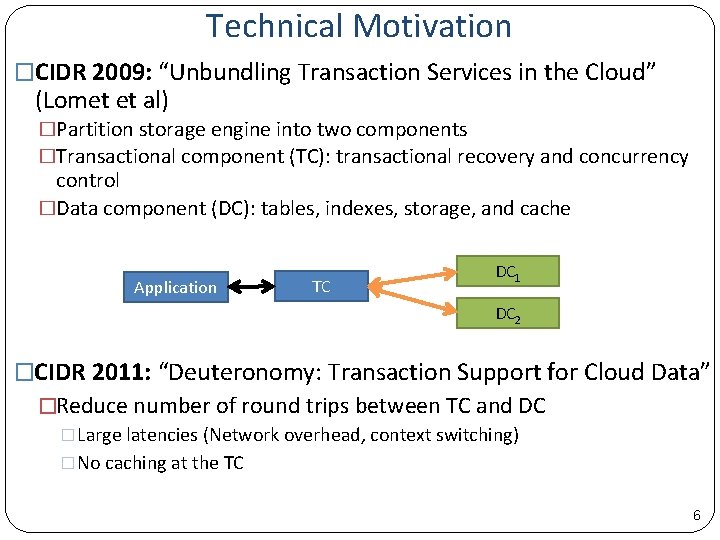
Technical Motivation �CIDR 2009: “Unbundling Transaction Services in the Cloud” (Lomet et al) �Partition storage engine into two components �Transactional component (TC): transactional recovery and concurrency control �Data component (DC): tables, indexes, storage, and cache Application TC DC 1 DC 2 �CIDR 2011: “Deuteronomy: Transaction Support for Cloud Data” �Reduce number of round trips between TC and DC �Large latencies (Network overhead, context switching) �No caching at the TC 6
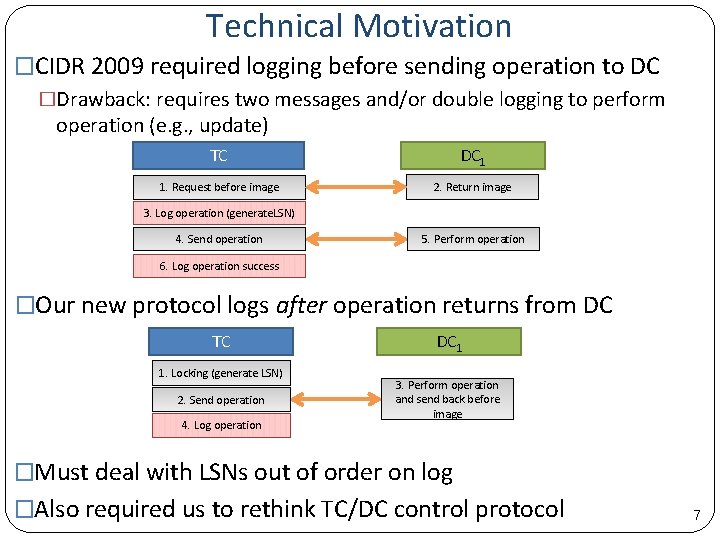
Technical Motivation �CIDR 2009 required logging before sending operation to DC �Drawback: requires two messages and/or double logging to perform operation (e. g. , update) TC DC 1 1. Request before image 2. Return image 3. Log operation (generate. LSN) 4. Send operation 5. Perform operation 6. Log operation success �Our new protocol logs after operation returns from DC TC 1. Locking (generate LSN) 2. Send operation 4. Log operation DC 1 3. Perform operation and send back before image �Must deal with LSNs out of order on log �Also required us to rethink TC/DC control protocol 7
Talk Outline �Application Motivation �Technical Motivation �Deuteronomy Architecture �Transaction Component Implementation �Performance �Wrap Up 8
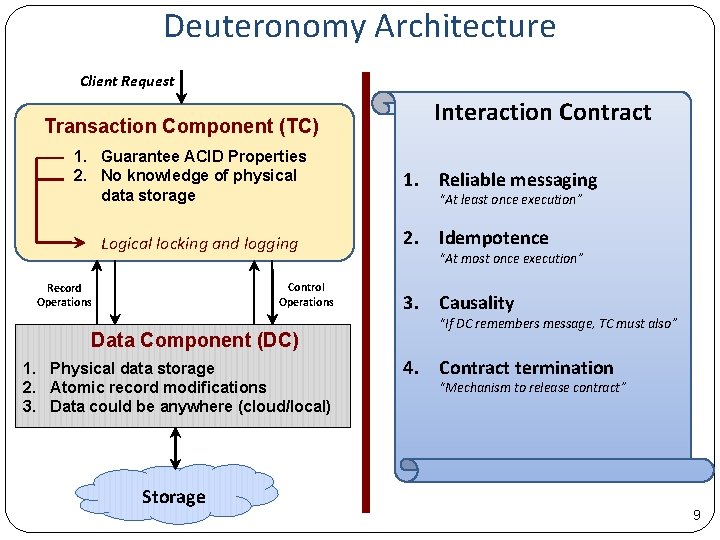
Deuteronomy Architecture Client Request Transaction Component (TC) 1. Guarantee ACID Properties 2. No knowledge of physical data storage Logical locking and logging Control Operations Record Operations Data Component (DC) 1. Physical data storage 2. Atomic record modifications 3. Data could be anywhere (cloud/local) Storage Interaction Contract 1. Reliable messaging “At least once execution” 2. Idempotence “At most once execution” 3. Causality “If DC remembers message, TC must also” 4. Contract termination “Mechanism to release contract” 9
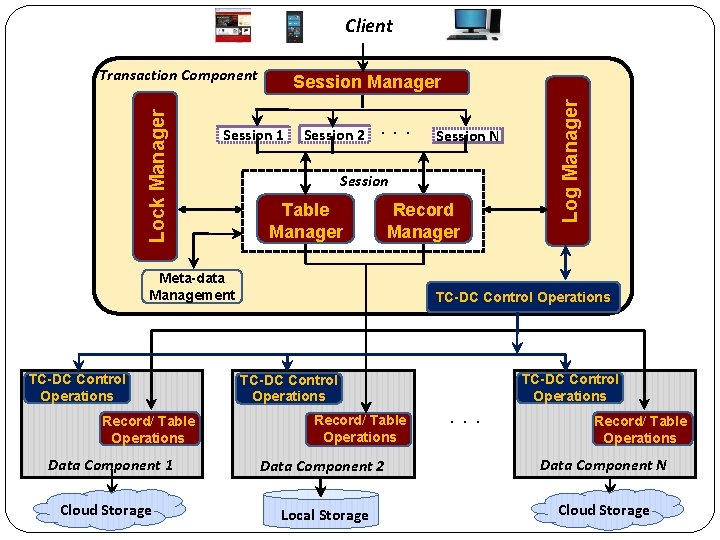
Client Session Manager Session 1 Session 2. . . Session Table Manager Record Manager Meta-data Management TC-DC Control Operations Record/ Table Operations Session N Log Manager Lock Manager Transaction Component TC-DC Control Operations Record/ Table Operations . . . Record/ Table Operations Data Component 1 Data Component 2 Data Component N Cloud Storage Local Storage Cloud Storage
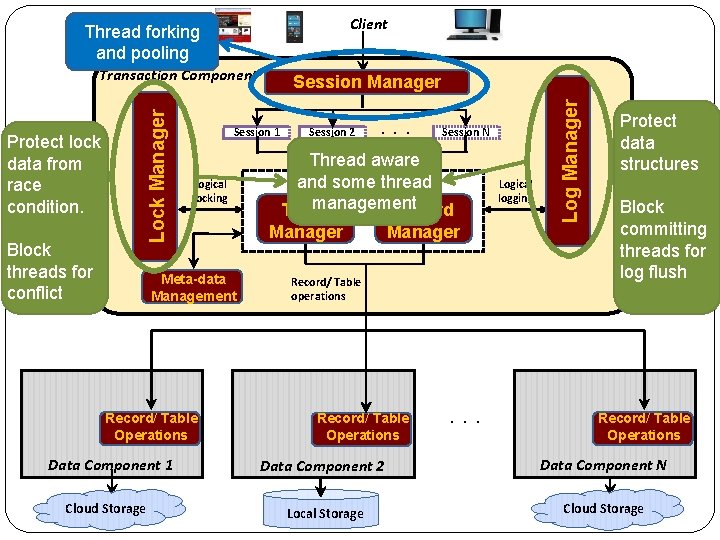
Client Thread forking and pooling Block threads for conflict Session 1 Logical locking Meta-data Management Record/ Table Operations Data Component 1 Cloud Storage Session Manager Session 2 . . . Session N Thread aware Sessionthread and some management Table Record Manager Record/ Table operations Record/ Table Operations . . . Logical logging Log Manager Protect lock data from race condition. Lock Manager Transaction Component Protect data structures Block committing threads for log flush Record/ Table Operations Data Component 2 Data Component N Local Storage Cloud Storage
Talk Outline �Application Motivation �Technical Motivation �Deuteronomy Architecture �Transaction Component Implementation �Performance �Wrap Up 12
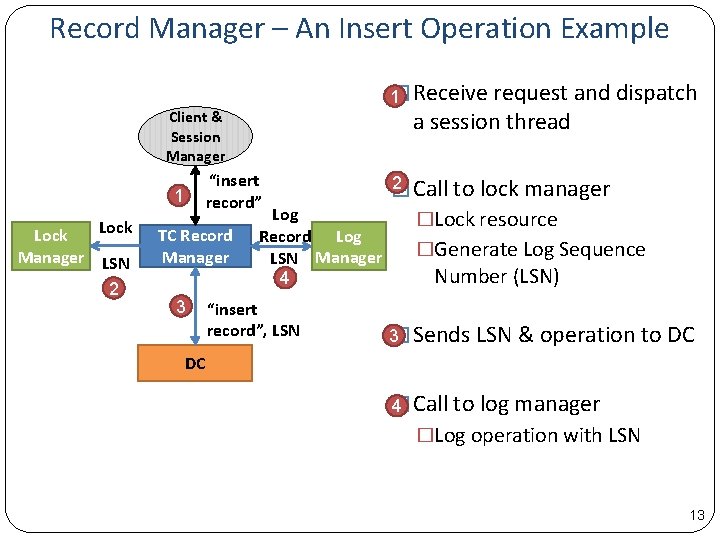
Record Manager – An Insert Operation Example 1� Receive request and dispatch a session thread Client & Session Manager “insert record” 1 Lock Manager LSN 2 TC Record Manager 3 Log Record Log LSN Manager 4 “insert record”, LSN 2 Call to lock manager � �Lock resource �Generate Log Sequence Number (LSN) 3� Sends LSN & operation to DC DC � 4 Call to log manager �Log operation with LSN 13
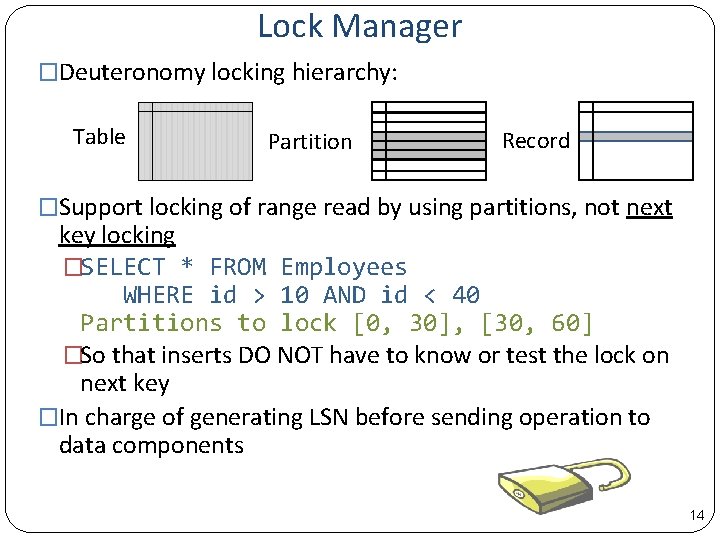
Lock Manager �Deuteronomy locking hierarchy: Table Partition Record �Support locking of range read by using partitions, not next key locking �SELECT * FROM Employees WHERE id > 10 AND id < 40 Partitions to lock [0, 30], [30, 60] �So that inserts DO NOT have to know or test the lock on next key �In charge of generating LSN before sending operation to data components 14
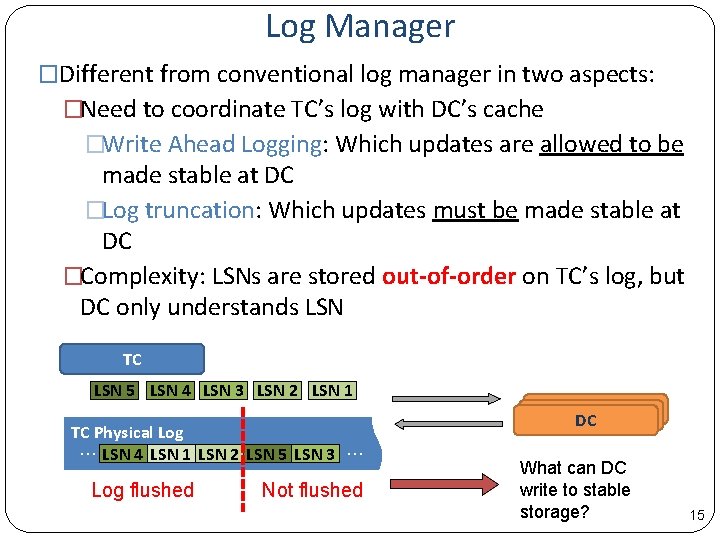
Log Manager �Different from conventional log manager in two aspects: �Need to coordinate TC’s log with DC’s cache �Write Ahead Logging: Which updates are allowed to be made stable at DC �Log truncation: Which updates must be made stable at DC �Complexity: LSNs are stored out-of-order on TC’s log, but DC only understands LSN TC LSN 5 LSN 4 LSN 3 LSN 2 LSN 1 TC Physical Log … LSN 4 LSN 1 LSN 2 LSN 5 LSN 3 … Log flushed Not flushed DC DC DC What can DC write to stable storage? 15
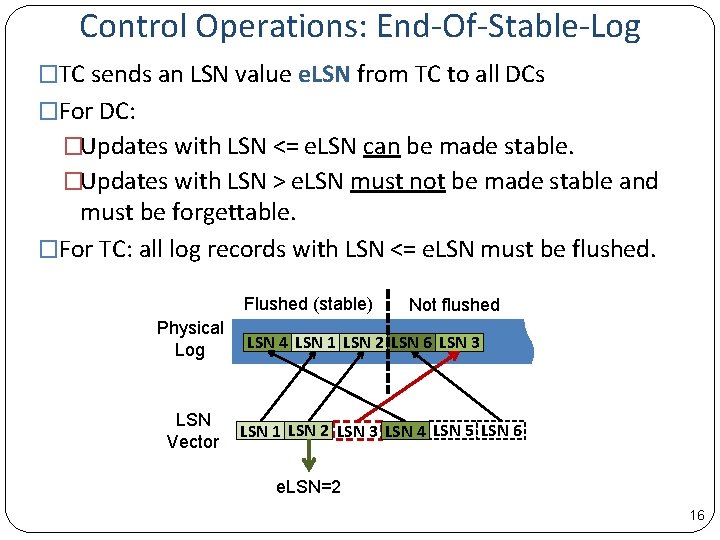
Control Operations: End-Of-Stable-Log �TC sends an LSN value e. LSN from TC to all DCs �For DC: �Updates with LSN <= e. LSN can be made stable. �Updates with LSN > e. LSN must not be made stable and must be forgettable. �For TC: all log records with LSN <= e. LSN must be flushed. Flushed (stable) Physical Log LSN Vector Not flushed LSN 4 LSN 1 LSN 2 LSN 6 LSN 3 LSN 1 LSN 2 LSN 3 LSN 4 LSN 5 LSN 6 e. LSN=2 16
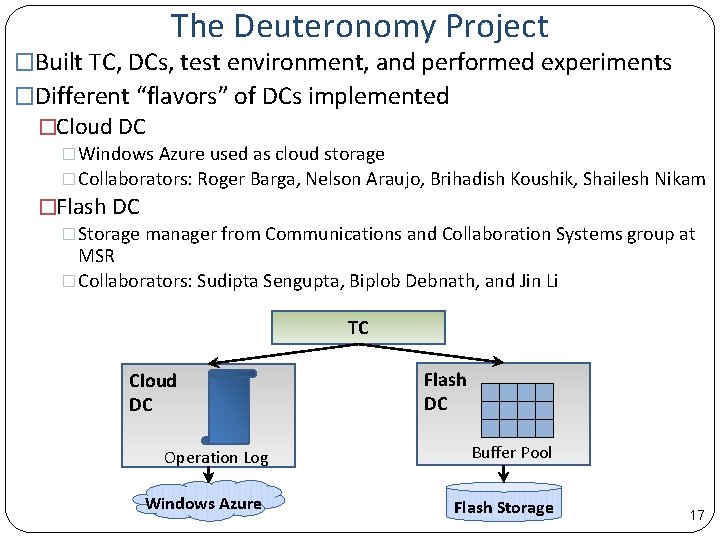
The Deuteronomy Project �Built TC, DCs, test environment, and performed experiments �Different “flavors” of DCs implemented �Cloud DC �Windows Azure used as cloud storage �Collaborators: Roger Barga, Nelson Araujo, Brihadish Koushik, Shailesh Nikam �Flash DC �Storage manager from Communications and Collaboration Systems group at MSR �Collaborators: Sudipta Sengupta, Biplob Debnath, and Jin Li TC Cloud DC Operation Log Windows Azure Flash DC Buffer Pool Flash Storage 17
Talk Outline �Application Motivation �Technical Motivation �Deuteronomy Architecture �Transaction Component Implementation �Performance �Wrap Up 18
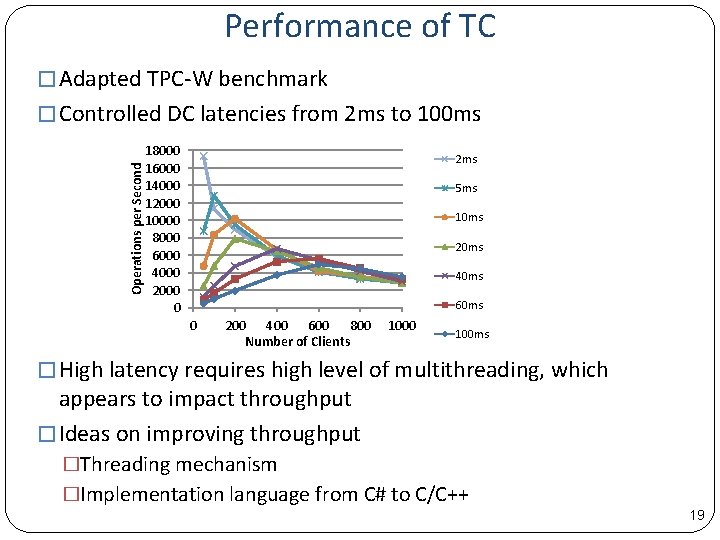
Performance of TC � Adapted TPC-W benchmark Operations per Second � Controlled DC latencies from 2 ms to 100 ms 18000 16000 14000 12000 10000 8000 6000 4000 2000 0 2 ms 5 ms 10 ms 20 ms 40 ms 60 ms 0 200 400 600 800 Number of Clients 1000 100 ms � High latency requires high level of multithreading, which appears to impact throughput � Ideas on improving throughput �Threading mechanism �Implementation language from C# to C/C++ 19
Conclusion �Application & Technical Motivations �Overview of project, teams, and development �Architecture of our multithreaded TC �A new TC: DC interface protocol to suit the cloud scenario �Experiments that show good performance and the impact of cloud latency on performance 20