KtV of peritoneal dialysis 2011 16 definition of


- Slides: 32
Kt/V of peritoneal dialysis 2011. 16 신장내과 이은빈
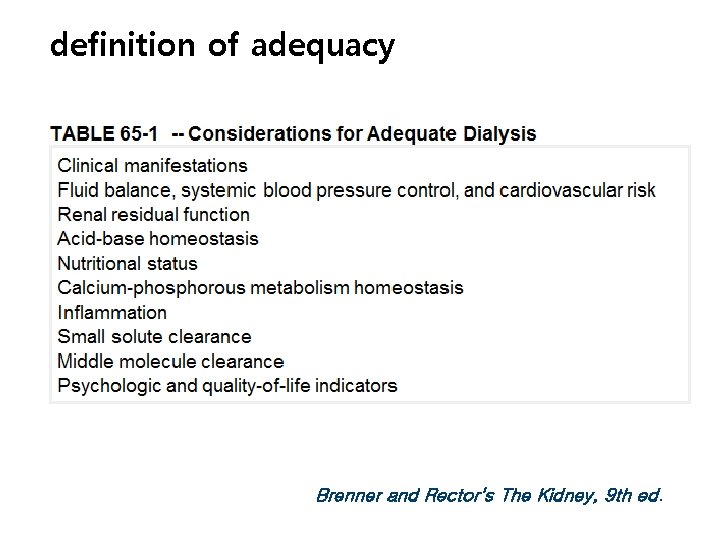
definition of adequacy Brenner and Rector's The Kidney, 9 th ed.
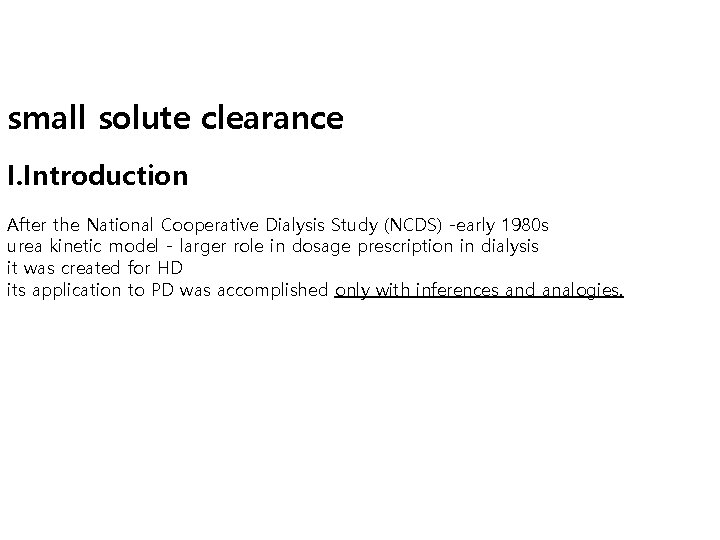
small solute clearance I. Introduction After the National Cooperative Dialysis Study (NCDS) -early 1980 s urea kinetic model - larger role in dosage prescription in dialysis it was created for HD its application to PD was accomplished only with inferences and analogies.
II. Calculations for Kt/Vurea and Cr. Cl Fractional Urea Clearance (Kt/Vurea) Weekly total Kt/V urea = 7 ⅹ Daily total Kt/Vurea = Daily peritoneal Kt/Vurea + Daily renal Kt/Vurea Daily peritoneal Kt/Vurea =24 hr urea D/P ⅹ 24 hr EV/V Daily renal Kt/Vurea =(Uurea/Purea) ⅹ 24 hr UV/V Weekly total Kt/Vurea = 7 ⅹ [(24 hr urea D/P ⅹ 24 hr EV)+ (Uurea/Purea) ⅹ 24 hr UV)] /V
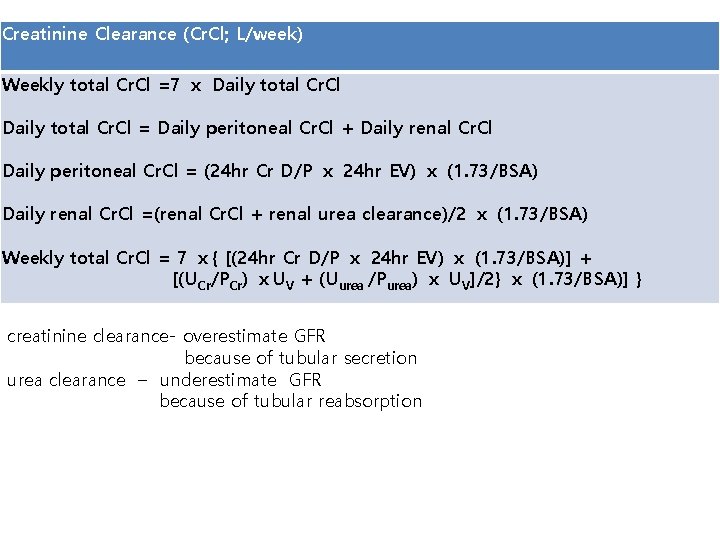
Creatinine Clearance (Cr. Cl; L/week) Weekly total Cr. Cl =7 ⅹ Daily total Cr. Cl = Daily peritoneal Cr. Cl + Daily renal Cr. Cl Daily peritoneal Cr. Cl = (24 hr Cr D/P ⅹ 24 hr EV) ⅹ (1. 73/BSA) Daily renal Cr. Cl =(renal Cr. Cl + renal urea clearance)/2 ⅹ (1. 73/BSA) Weekly total Cr. Cl = 7 ⅹ{ [(24 hr Cr D/P ⅹ 24 hr EV) ⅹ (1. 73/BSA)] + [(UCr/PCr) ⅹUV + (Uurea /Purea) ⅹ UV]/2} ⅹ (1. 73/BSA)] } creatinine clearance- overestimate GFR because of tubular secretion urea clearance – underestimate GFR because of tubular reabsorption
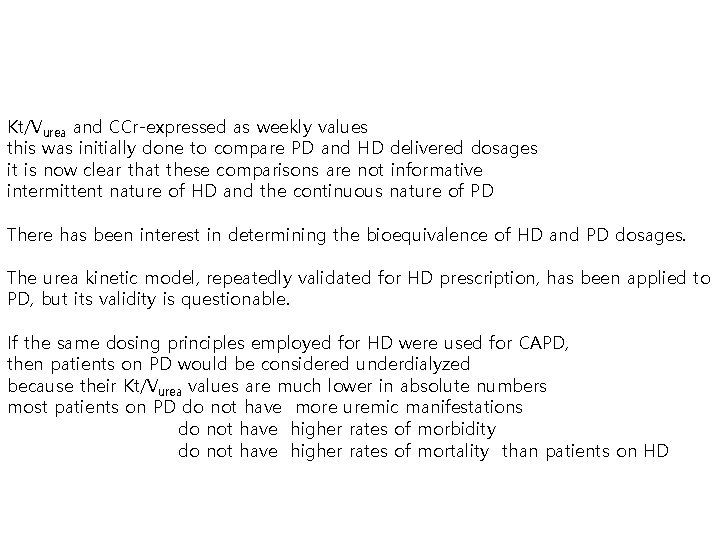
Kt/Vurea and CCr-expressed as weekly values this was initially done to compare PD and HD delivered dosages it is now clear that these comparisons are not informative intermittent nature of HD and the continuous nature of PD There has been interest in determining the bioequivalence of HD and PD dosages. The urea kinetic model, repeatedly validated for HD prescription, has been applied to PD, but its validity is questionable. If the same dosing principles employed for HD were used for CAPD, then patients on PD would be considered underdialyzed because their Kt/Vurea values are much lower in absolute numbers most patients on PD do not have more uremic manifestations do not have higher rates of morbidity do not have higher rates of mortality than patients on HD
III. Optimal Clearance Target
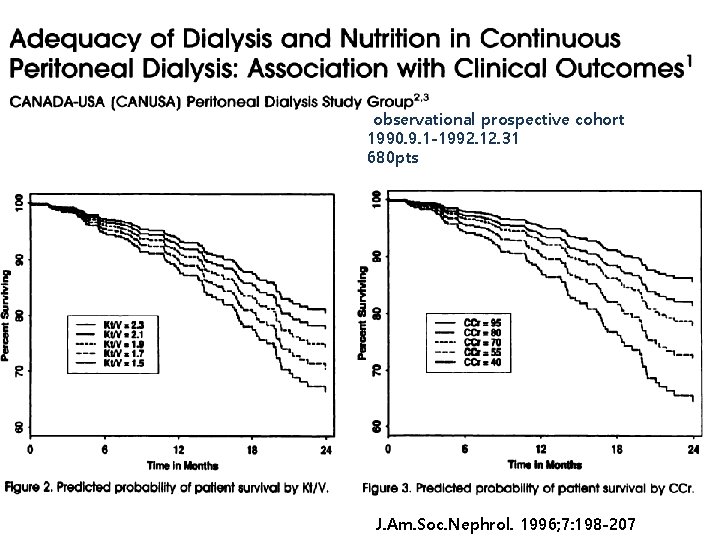
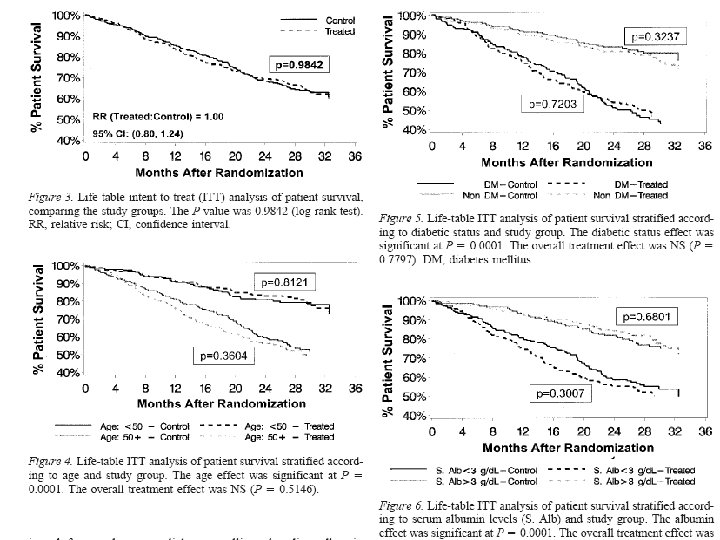
observational prospective cohort 1990. 9. 1 -1992. 12. 31 680 pts J. Am. Soc. Nephrol. 1996; 7: 198 -207
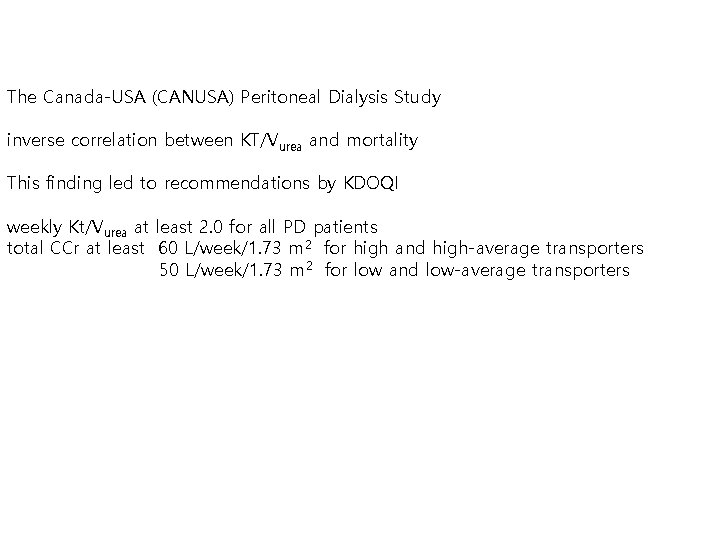
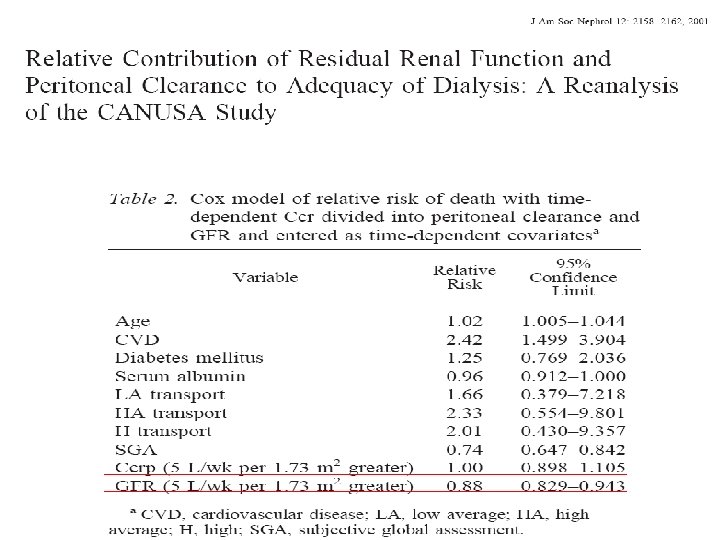
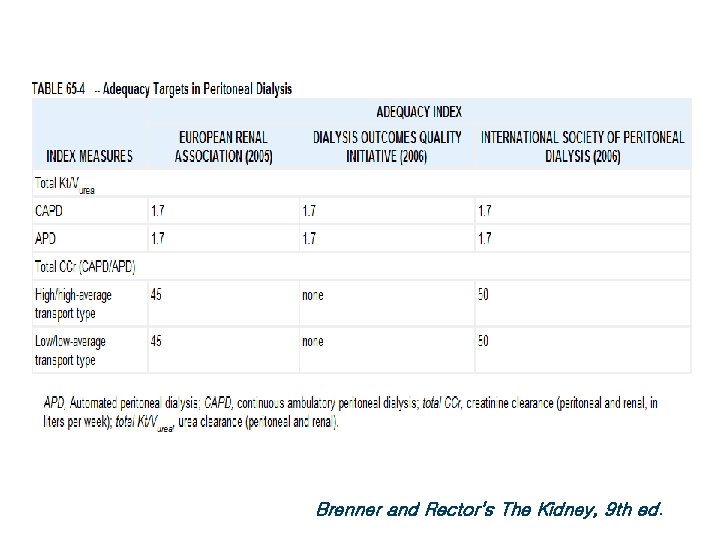
The Canada-USA (CANUSA) Peritoneal Dialysis Study inverse correlation between KT/Vurea and mortality This finding led to recommendations by KDOQI weekly Kt/Vurea at least 2. 0 for all PD patients total CCr at least 60 L/week/1. 73 m 2 for high and high-average transporters 50 L/week/1. 73 m 2 for low and low-average transporters
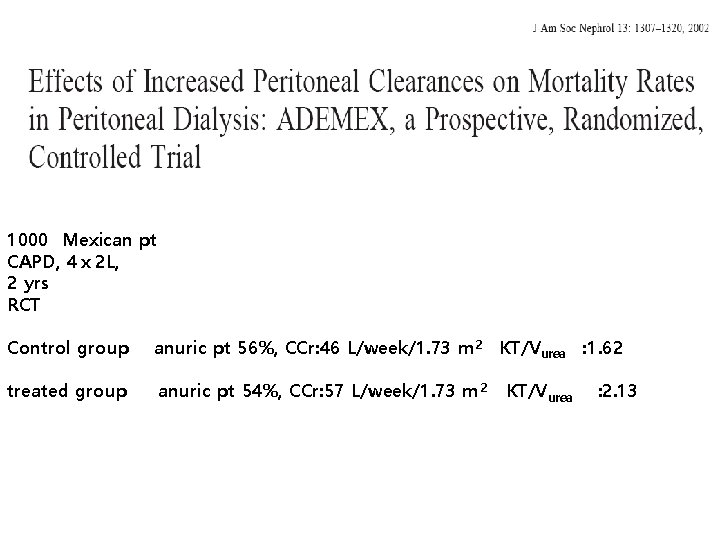
1000 Mexican pt CAPD, 4ⅹ 2 L, 2 yrs RCT Control group anuric pt 56%, CCr: 46 L/week/1. 73 m 2 KT/Vurea : 1. 62 treated group anuric pt 54%, CCr: 57 L/week/1. 73 m 2 KT/Vurea : 2. 13
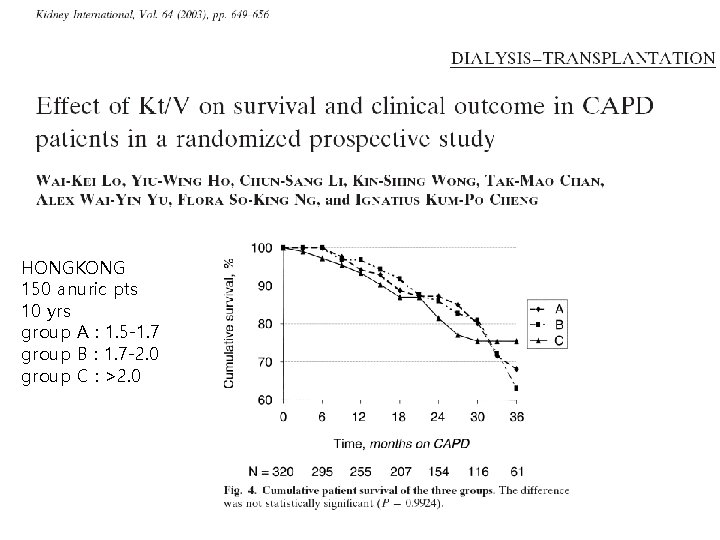
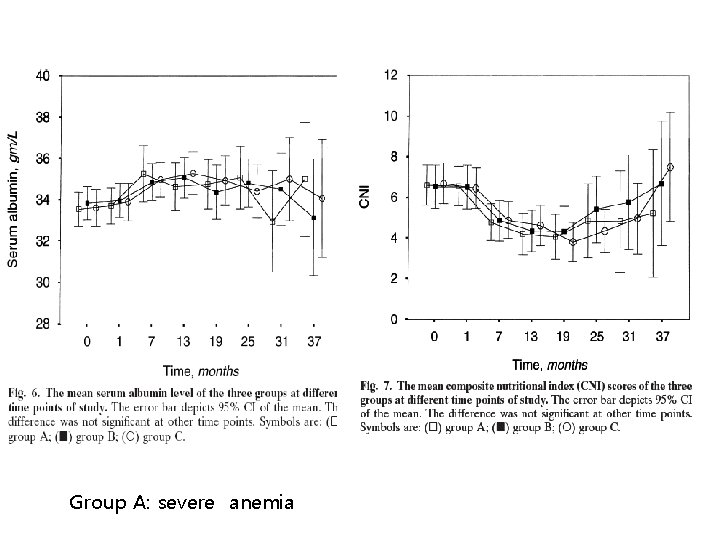
HONGKONG 150 anuric pts 10 yrs group A : 1. 5 -1. 7 group B : 1. 7 -2. 0 group C : >2. 0
Group A: severe anemia
Brenner and Rector's The Kidney, 9 th ed.
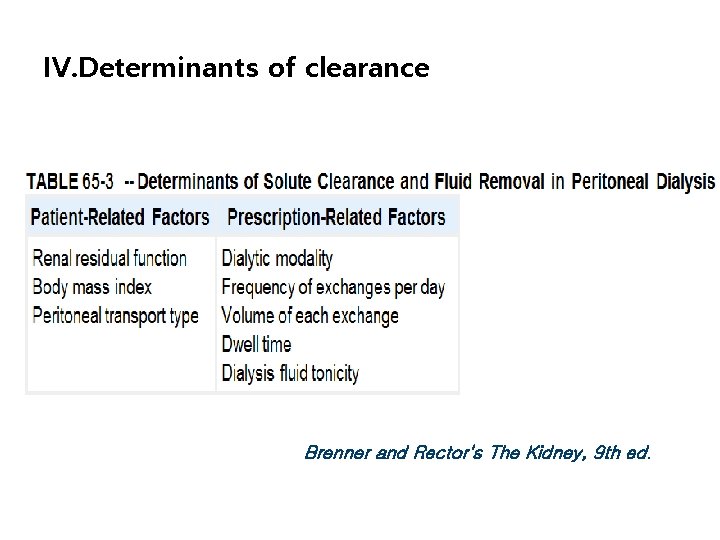
IV. Determinants of clearance Brenner and Rector's The Kidney, 9 th ed.
A. Patient related factors -nonprescription factors 1. RKF contributes significantly to fluid removal and variably to solute clearance. 1 ml/min of CCr ≒ 10 L/week/1. 73 m 2 of clearance. 1 ml/min of urea clearance ≒ additional 0. 25 to the total weekly Kt/Vurea. RKF tends to diminish over time should be evaluated periodically dialysis prescription should be modified to compensate
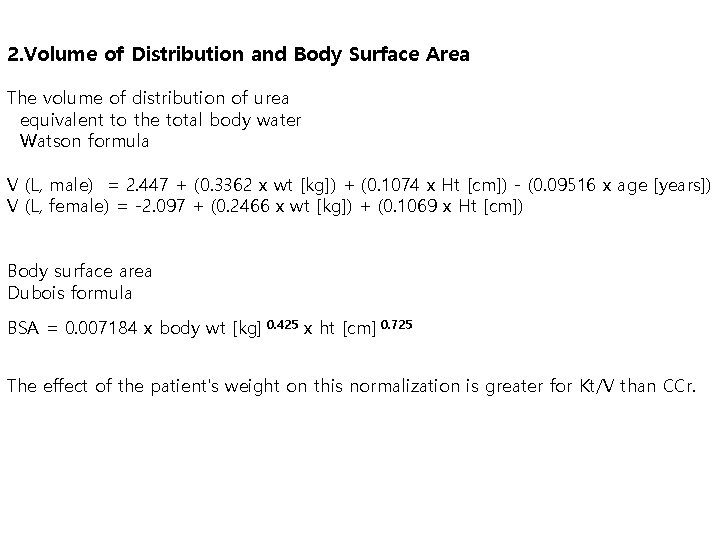
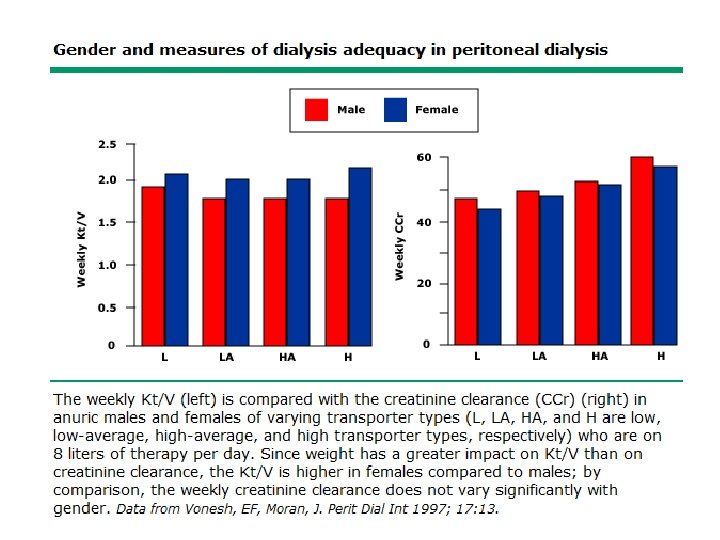
2. Volume of Distribution and Body Surface Area The volume of distribution of urea equivalent to the total body water Watson formula V (L, male) = 2. 447 + (0. 3362 x wt [kg]) + (0. 1074 x Ht [cm]) - (0. 09516 x age [years]) V (L, female) = -2. 097 + (0. 2466 x wt [kg]) + (0. 1069 x Ht [cm]) Body surface area Dubois formula BSA = 0. 007184 x body wt [kg] 0. 425 x ht [cm] 0. 725 The effect of the patient's weight on this normalization is greater for Kt/V than CCr.
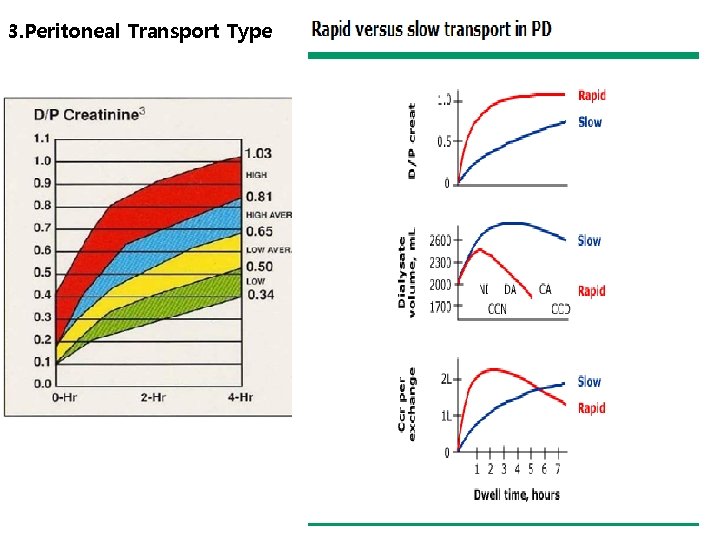
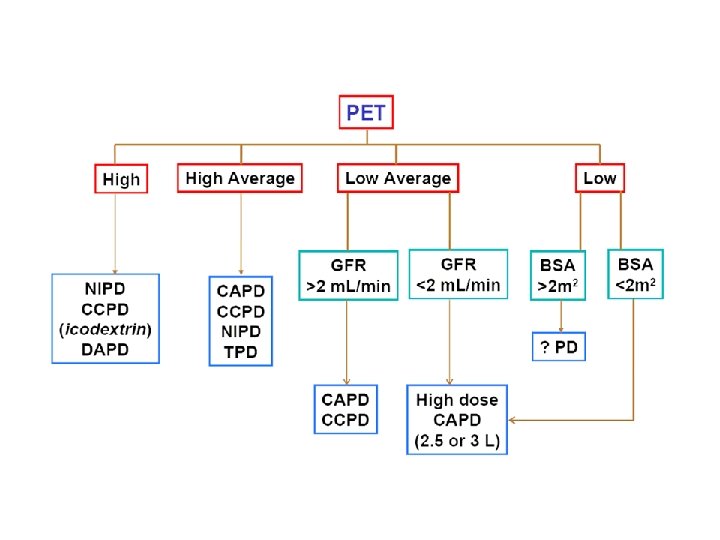
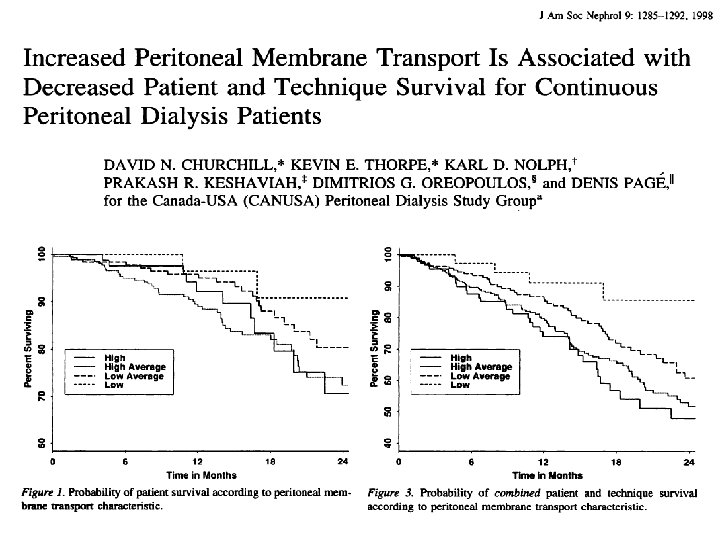
3. Peritoneal Transport Type
3. Peritoneal Transport Type
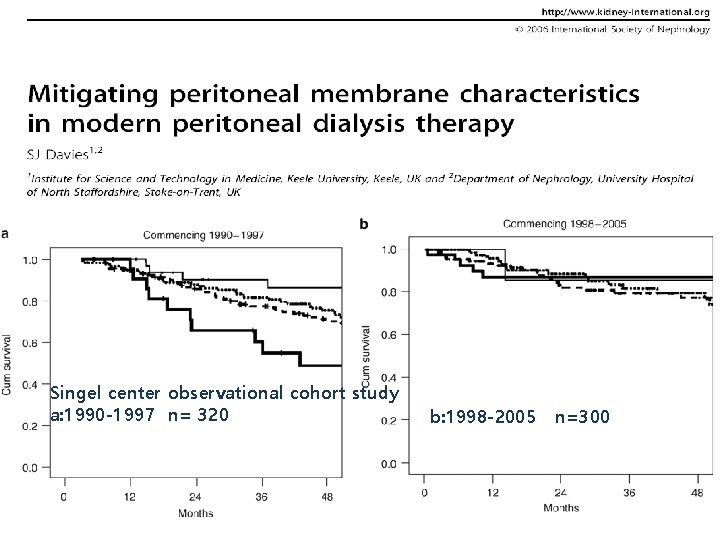
Singel center observational cohort study a: 1990 -1997 n= 320 b: 1998 -2005 n=300
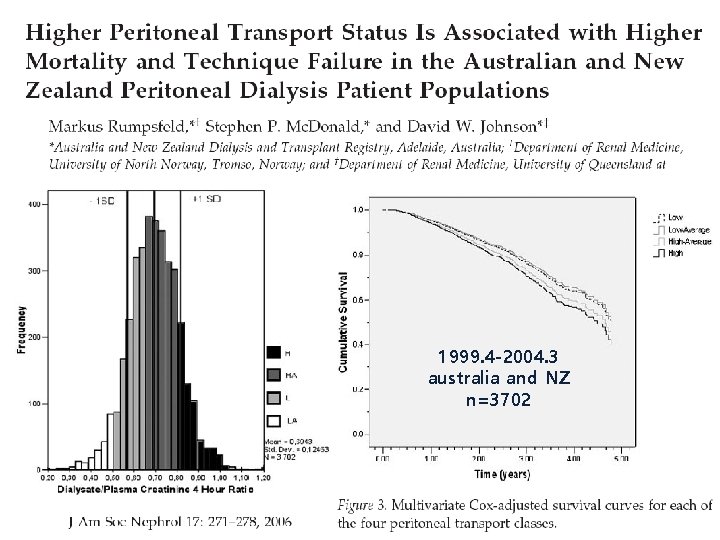
1999. 4 -2004. 3 australia and NZ n=3702
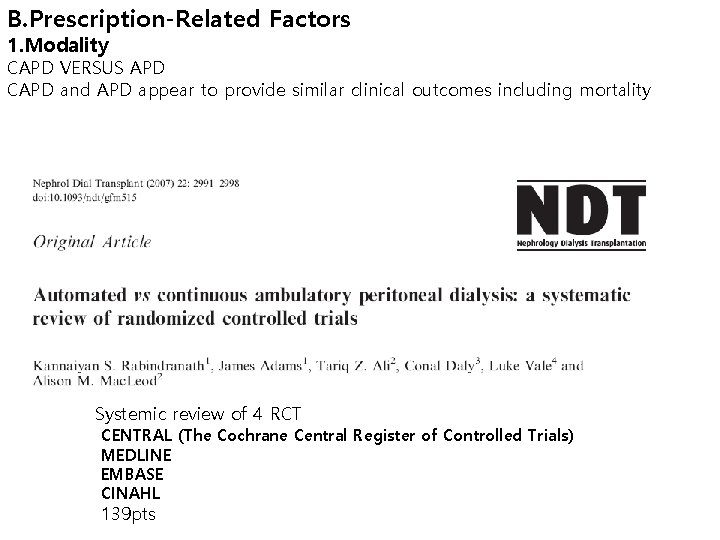
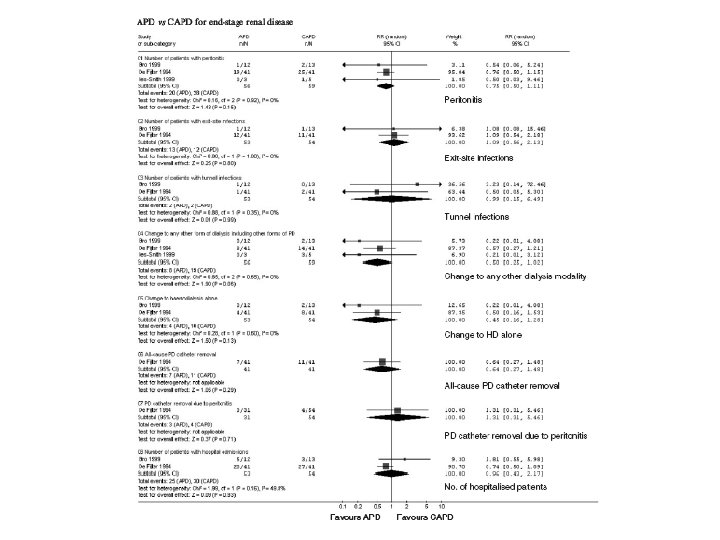
B. Prescription-Related Factors 1. Modality CAPD VERSUS APD CAPD and APD appear to provide similar clinical outcomes including mortality Systemic review of 4 RCT CENTRAL (The Cochrane Central Register of Controlled Trials) MEDLINE EMBASE CINAHL 139 pts
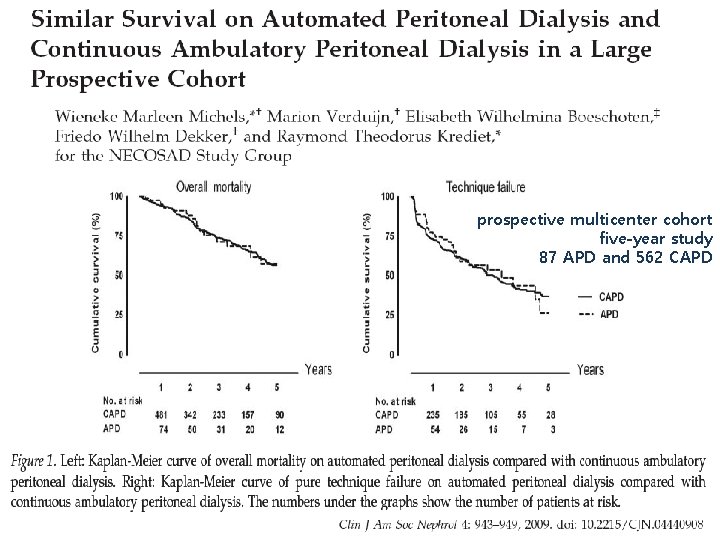
prospective multicenter cohort five-year study 87 APD and 562 CAPD
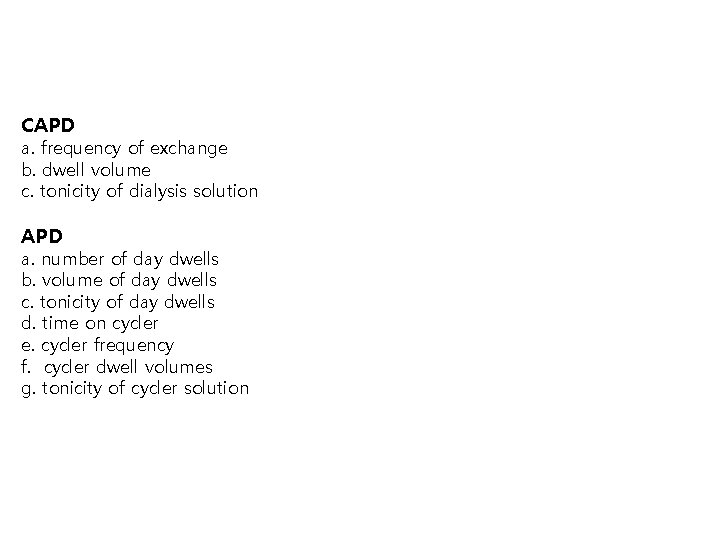
CAPD a. frequency of exchange b. dwell volume c. tonicity of dialysis solution APD a. number of day dwells b. volume of day dwells c. tonicity of day dwells d. time on cycler e. cycler frequency f. cycler dwell volumes g. tonicity of cycler solution
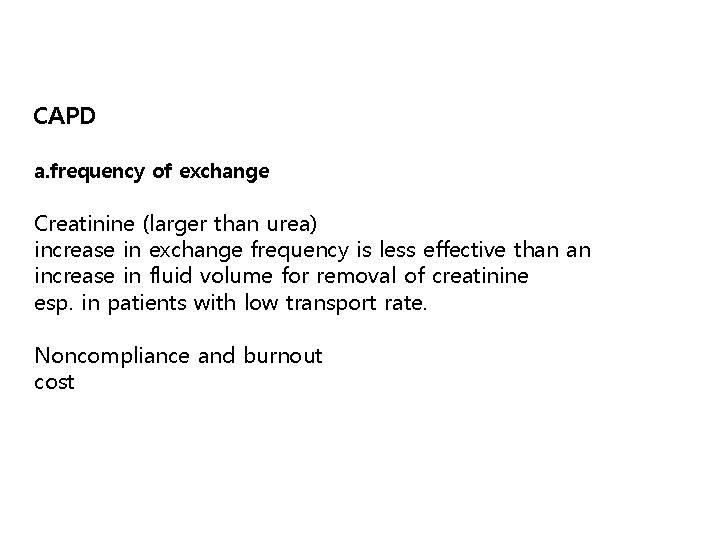
CAPD a. frequency of exchange Creatinine (larger than urea) increase in exchange frequency is less effective than an increase in fluid volume for removal of creatinine esp. in patients with low transport rate. Noncompliance and burnout cost
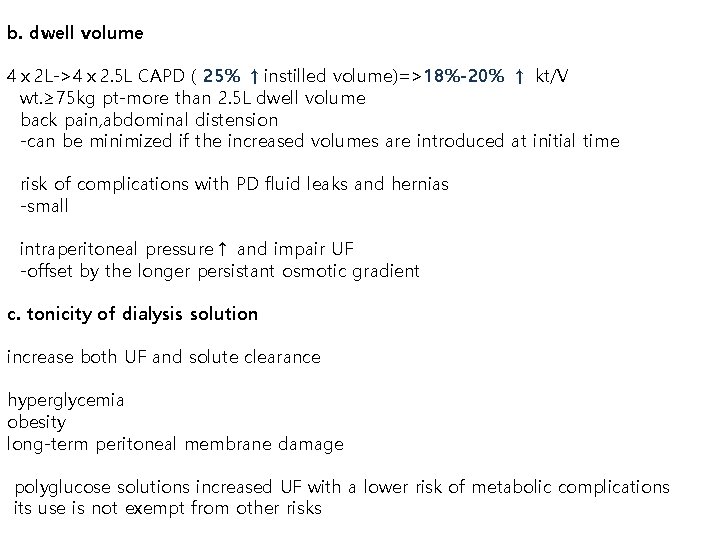
b. dwell volume 4ⅹ 2 L->4ⅹ 2. 5 L CAPD ( 25% ↑instilled volume)=>18%-20% ↑ kt/V wt. ≥ 75 kg pt-more than 2. 5 L dwell volume back pain, abdominal distension -can be minimized if the increased volumes are introduced at initial time risk of complications with PD fluid leaks and hernias -small intraperitoneal pressure↑ and impair UF -offset by the longer persistant osmotic gradient c. tonicity of dialysis solution increase both UF and solute clearance hyperglycemia obesity long-term peritoneal membrane damage polyglucose solutions increased UF with a lower risk of metabolic complications its use is not exempt from other risks
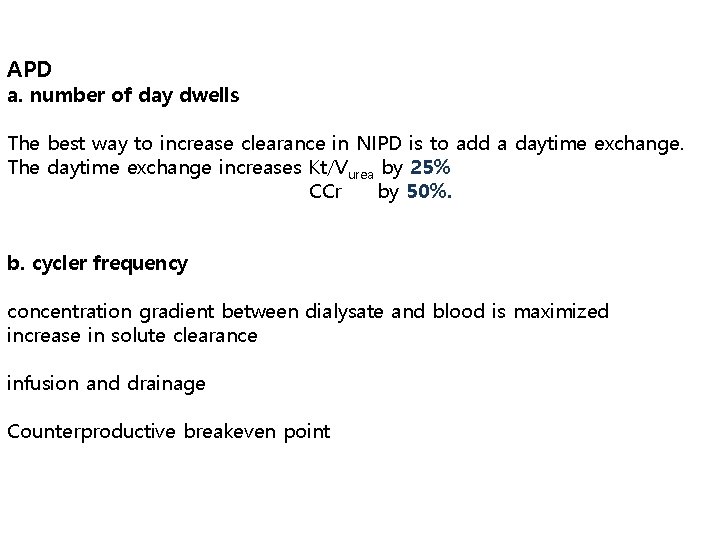
APD a. number of day dwells The best way to increase clearance in NIPD is to add a daytime exchange. The daytime exchange increases Kt/Vurea by 25% CCr by 50%. b. cycler frequency concentration gradient between dialysate and blood is maximized increase in solute clearance infusion and drainage Counterproductive breakeven point