Jacek Matulewski Institute of Physics NCU ICNT UMK











- Slides: 52
Jacek Matulewski Institute of Physics, NCU ICNT, UMK WWW: http: //www. fizyka. umk. pl/~jacek E-mail: jacek@phys. uni. torun. pl Visual Perception and Eyetracking: Eye Movement and its Analysis TAPS, 22 -08 -2018
Senses Humans receptors Vision Olfaction (smell) Haptics, pain Taste Hearing 250 000 photoreceptor cells 40 000 chemoreceptors 2 500 000 mechanoreceptors 1 000 chemoreceptors 25 000 mechanoreceptors Receptors are in whole body 80% inform. about envir. – vision, 10% cerebral cortex Source: http: //www. if. pwr. wroc. pl/~wozniak/kolorymetria_pliki/
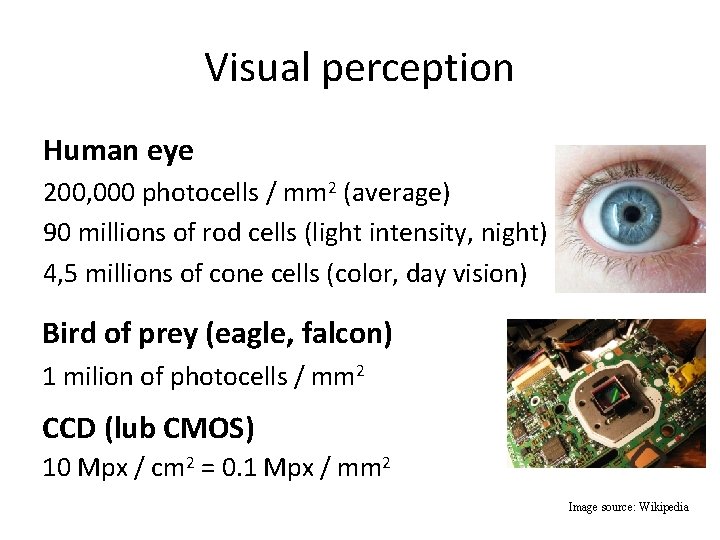
Visual perception Human eye 200, 000 photocells / mm 2 (average) 90 millions of rod cells (light intensity, night) 4, 5 millions of cone cells (color, day vision) Bird of prey (eagle, falcon) 1 milion of photocells / mm 2 CCD (lub CMOS) 10 Mpx / cm 2 = 0. 1 Mpx / mm 2 Image source: Wikipedia
Visual perception How many degrees of freedom does the human eye have? Source: Holmqvist i in. Eye Tracking. A Comprehensive Guide to Methods and Measures
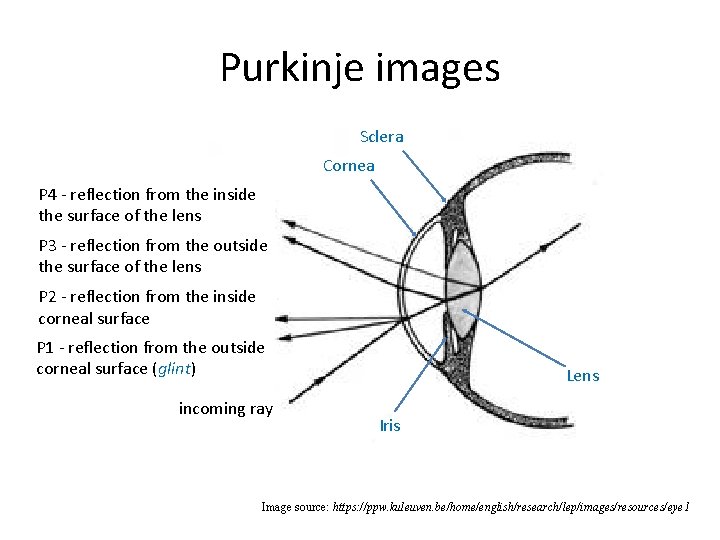
Purkinje images Sclera Cornea P 4 - reflection from the inside the surface of the lens P 3 - reflection from the outside the surface of the lens P 2 - reflection from the inside corneal surface P 1 - reflection from the outside corneal surface (glint) incoming ray Lens Iris Image source: https: //ppw. kuleuven. be/home/english/research/lep/images/resources/eye 1
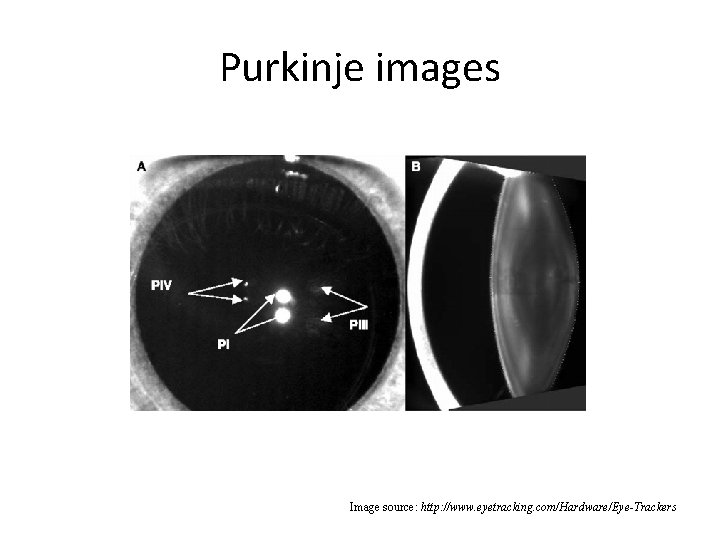
Purkinje images Image source: http: //www. eyetracking. com/Hardware/Eye-Trackers
Eyetracker – hardware Mirametrix SMI Remote and head-mounted eye trackers Eye. Link Kamil Pleskot Image source: http: //www. eyetracking. com/Hardware/Eye-Trackers
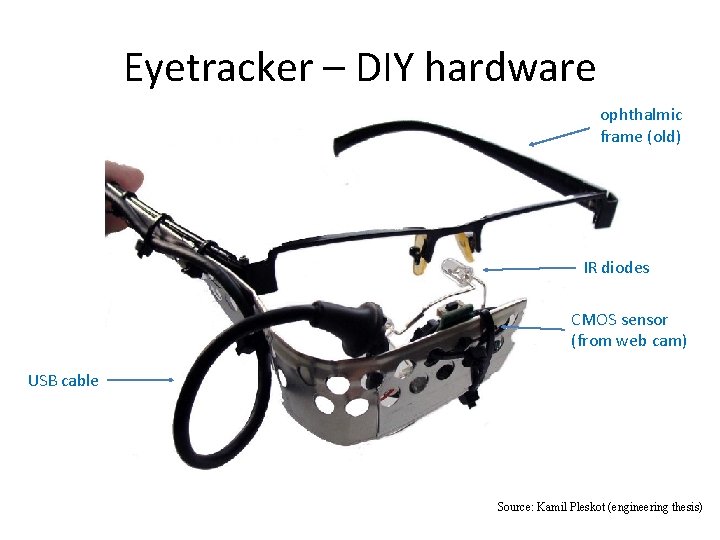
Eyetracker – DIY hardware ophthalmic frame (old) IR diodes CMOS sensor (from web cam) USB cable Source: Kamil Pleskot (engineering thesis)
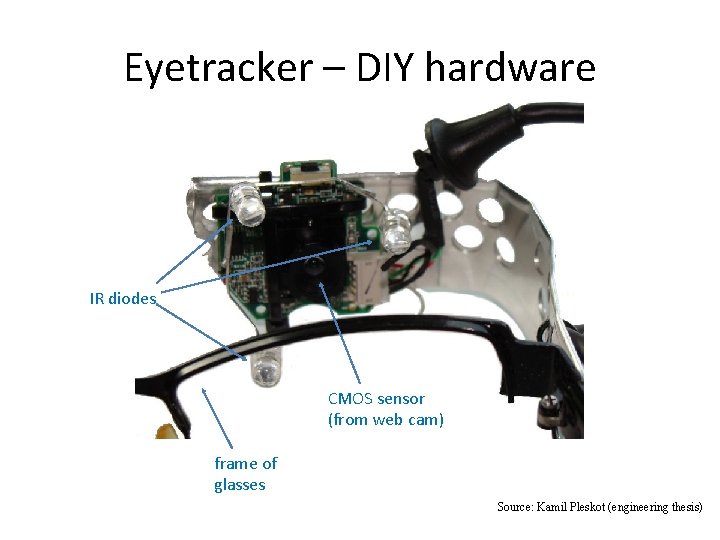
Eyetracker – DIY hardware IR diodes CMOS sensor (from web cam) frame of glasses Source: Kamil Pleskot (engineering thesis)
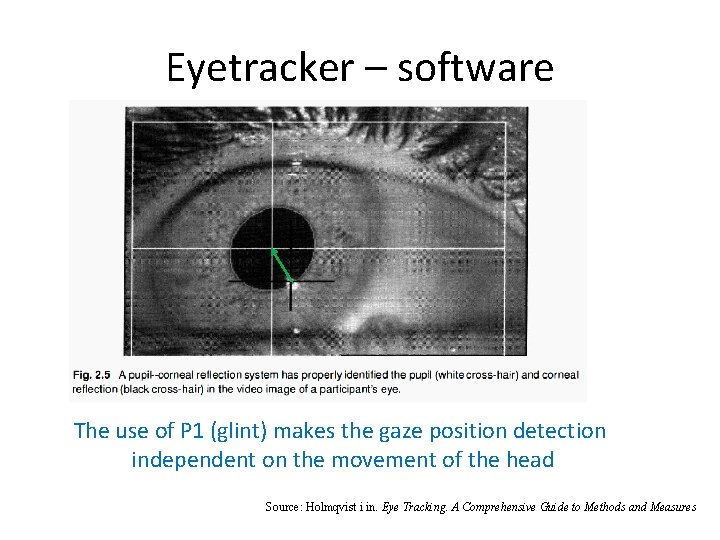
Eyetracker – software The use of P 1 (glint) makes the gaze position detection independent on the movement of the head Source: Holmqvist i in. Eye Tracking. A Comprehensive Guide to Methods and Measures
Eyetracker – software Glasses make the glint recognition harder Source: Kamil Pleskot
Eye movement Eyes never stop moving. La saccadé (fr. jolt, jerk, rapid movement) During wake time – 200, 000 saccades. During sleep, the eye movement changes (REM - rapid eye movements). The small part of the eye movements is controlled consciously (like breathing) Most of the movements (including the microsaccades) are not controlled and we are not aware of them. Otherwise the image would be constantly shaking. Even during fixation on the subject the eye is not still! Microsaccades - movements of the eye with a smaller amplitude "within" the fixation object. The microsaccades are responsible for "refreshing" the image (stimulating the eye rods and cons). Without it we would see only moving objects (like some animals). Erasmus Darwin (Charles’ grandfather, 1794): staring at a very small piece of silk on paper - the color gradually fades and disappears! Susanna Martinez-Conde http: //static. trogu. com/documents/articles/palgrave/references/martinez-conde%20 vision%20 saccades. pdf
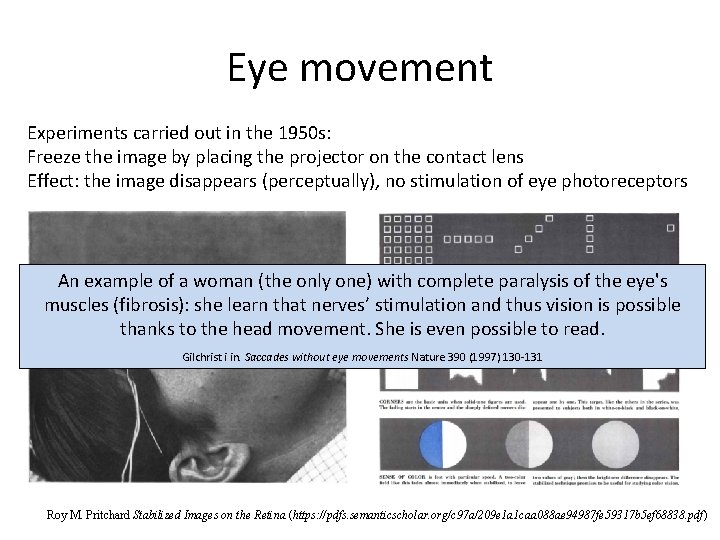
Eye movement Experiments carried out in the 1950 s: Freeze the image by placing the projector on the contact lens Effect: the image disappears (perceptually), no stimulation of eye photoreceptors An example of a woman (the only one) with complete paralysis of the eye's muscles (fibrosis): she learn that nerves’ stimulation and thus vision is possible thanks to the head movement. She is even possible to read. Gilchrist i in. Saccades without eye movements Nature 390 (1997) 130 -131 Roy M. Pritchard Stabilized Images on the Retina (https: //pdfs. semanticscholar. org/c 97 a/209 e 1 a 1 caa 088 ae 94987 fe 59317 b 5 ef 68838. pdf)
Eye movement Experiment of Johna K. Stevensa: JKS is object/observer. Injection of a neuromuscular-blocking drug (succinylcholine) and curare A tourniquet on the right hand prevents its paralysis (communication) Breathing support (respirator) Mirror and screen (stimulus) The total immobilization of the eye Conclusion: the perception of space is not Image fading becomes a problem simple function of info. from senses, Conscious attempts of sakad (effort) but also of planned eye movements caused the world to move? (despite (sensory processing / integration) the lack of changes in the image!) John K. Stevens i in. Paralysis Of The Awake Human: Visual Perceptions Vision Research 16 (1976) https: //pdfs. semanticscholar. org/8567/8 b 73 e 4 f 918 f 05244 b 66 ca 2 a 9 f 65 ef 89 ed 3 d 9. pdf
Eye movement - Events fixation microsaccade glisade drift saccade fixation The schema does not retain the scale of the real eye movement
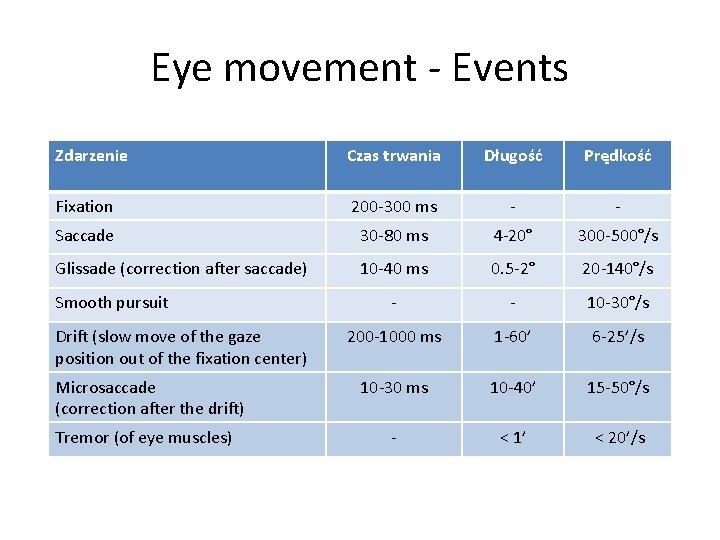
Eye movement - Events Zdarzenie Czas trwania Długość Prędkość Fixation 200 -300 ms - - Saccade 30 -80 ms 4 -20° 300 -500°/s Glissade (correction after saccade) 10 -40 ms 0. 5 -2° 20 -140°/s - - 10 -30°/s 200 -1000 ms 1 -60’ 6 -25’/s 10 -30 ms 10 -40’ 15 -50°/s - < 1’ < 20’/s Smooth pursuit Drift (slow move of the gaze position out of the fixation center) Microsaccade (correction after the drift) Tremor (of eye muscles)
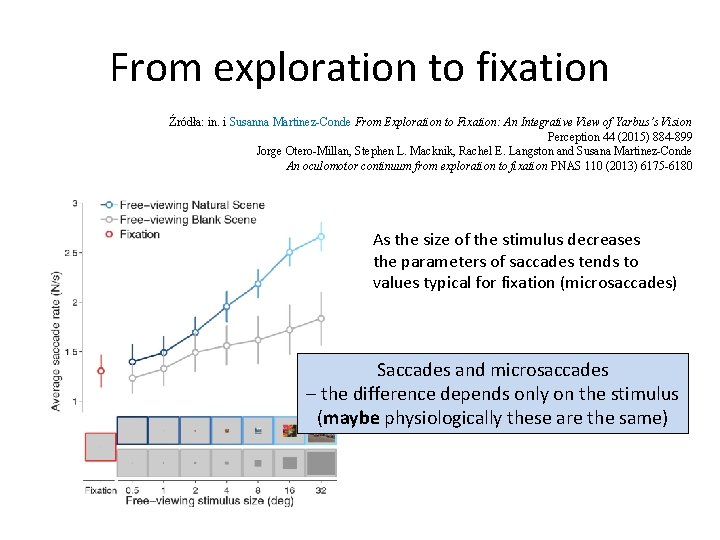
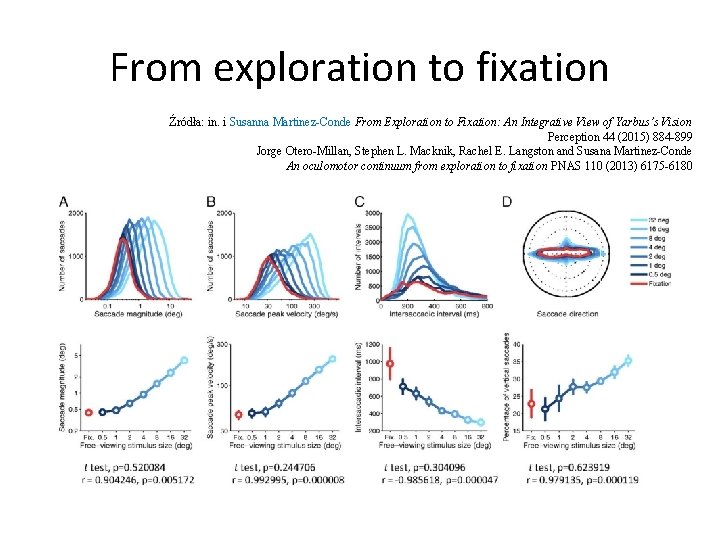
From exploration to fixation Źródła: in. i Susanna Martinez-Conde From Exploration to Fixation: An Integrative View of Yarbus’s Vision Perception 44 (2015) 884 -899 Jorge Otero-Millan, Stephen L. Macknik, Rachel E. Langston and Susana Martinez-Conde An oculomotor continuum from exploration to fixation PNAS 110 (2013) 6175 -6180 As the size of the stimulus decreases the parameters of saccades tends to values typical for fixation (microsaccades) Saccades and microsaccades – the difference depends only on the stimulus (maybe physiologically these are the same)
From exploration to fixation Źródła: in. i Susanna Martinez-Conde From Exploration to Fixation: An Integrative View of Yarbus’s Vision Perception 44 (2015) 884 -899 Jorge Otero-Millan, Stephen L. Macknik, Rachel E. Langston and Susana Martinez-Conde An oculomotor continuum from exploration to fixation PNAS 110 (2013) 6175 -6180
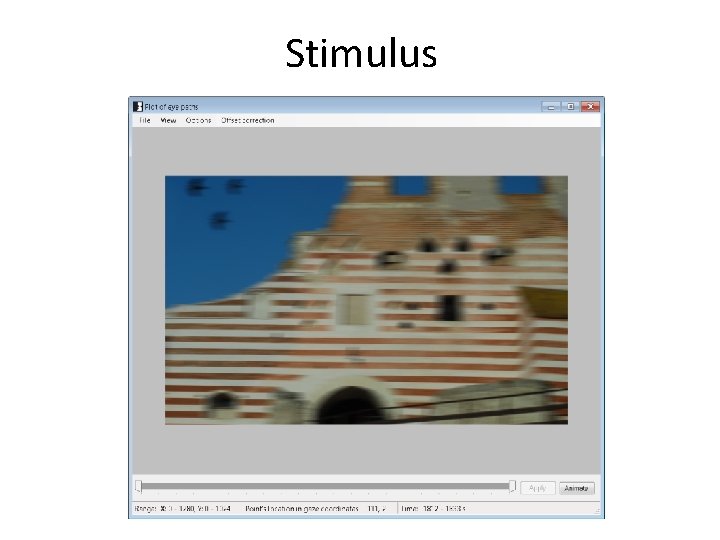
Stimulus
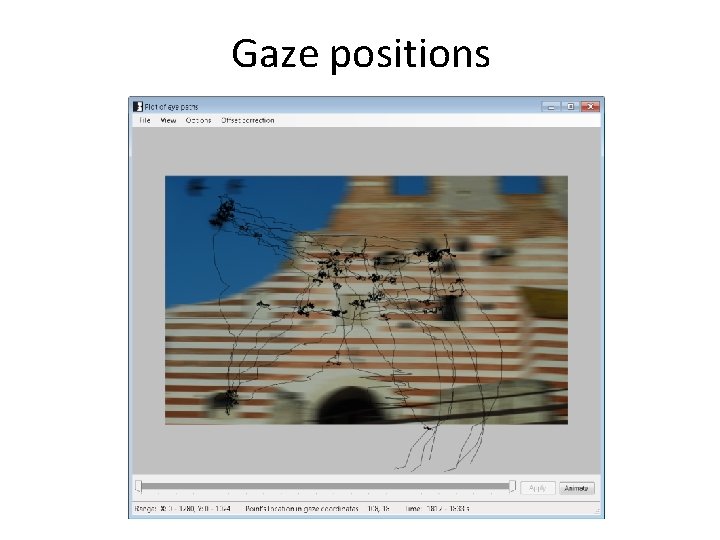
Gaze positions
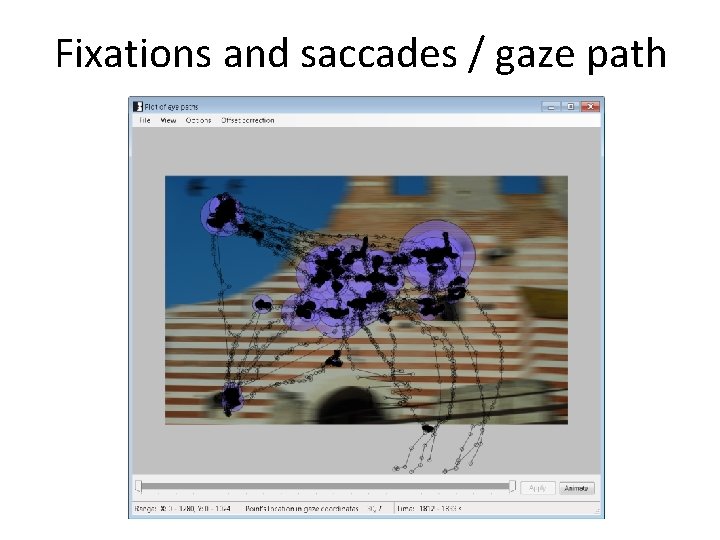
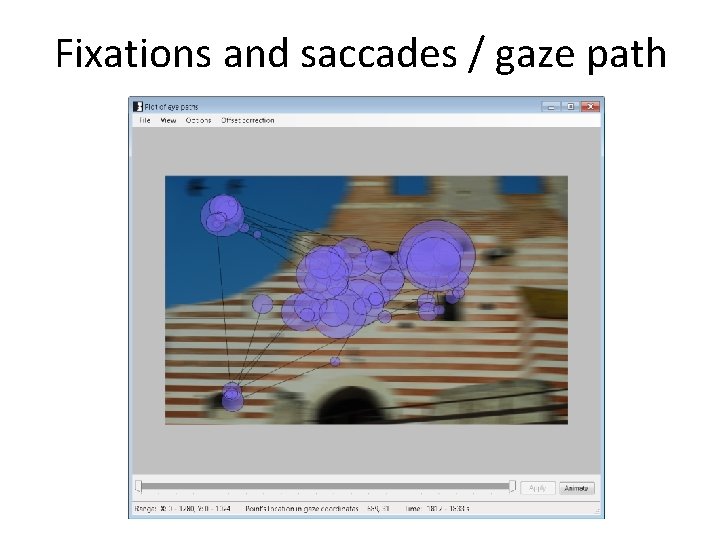
Fixations and saccades / gaze path
Fixations and saccades / gaze path
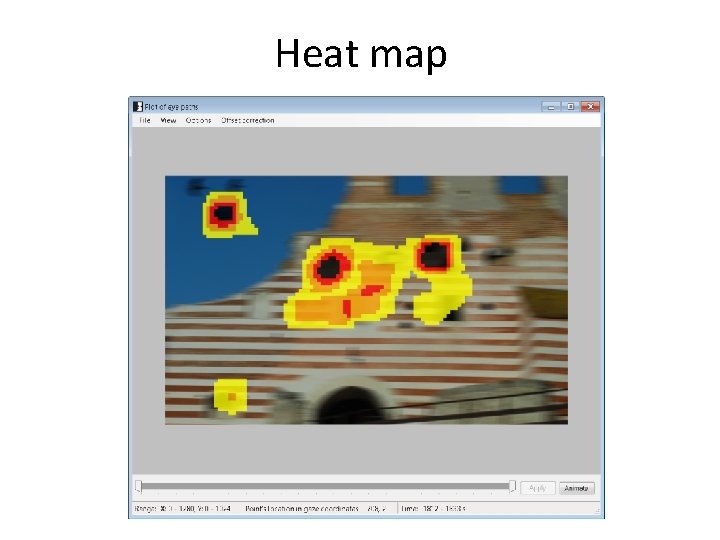
Heat map
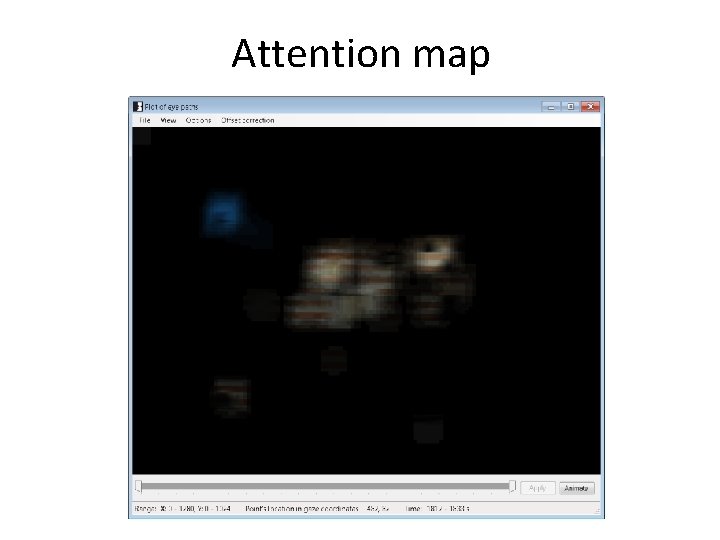
Attention map
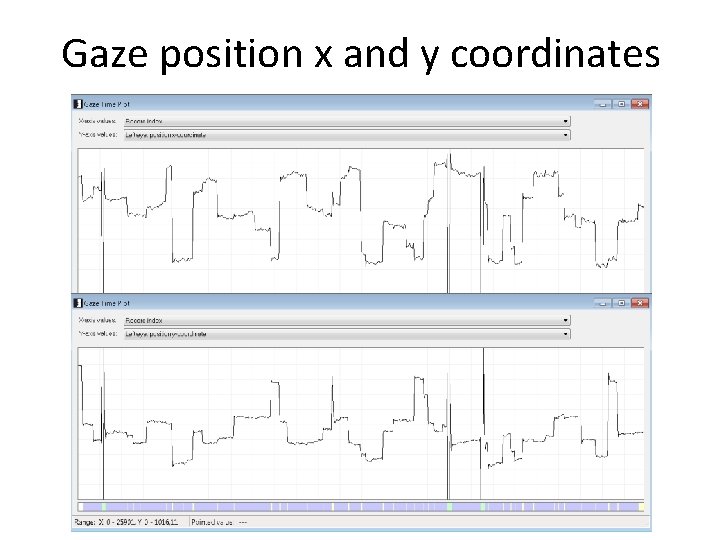
Gaze position x and y coordinates
Speed of gaze Euler’s algorithm (simplest)
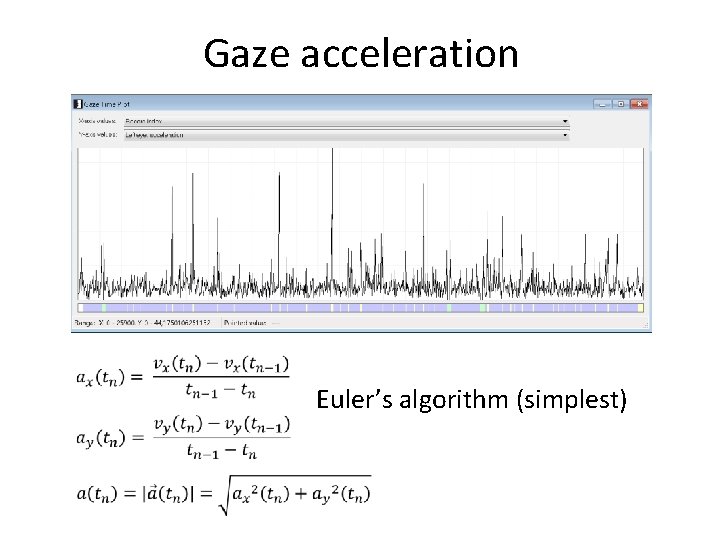
Gaze acceleration Euler’s algorithm (simplest)
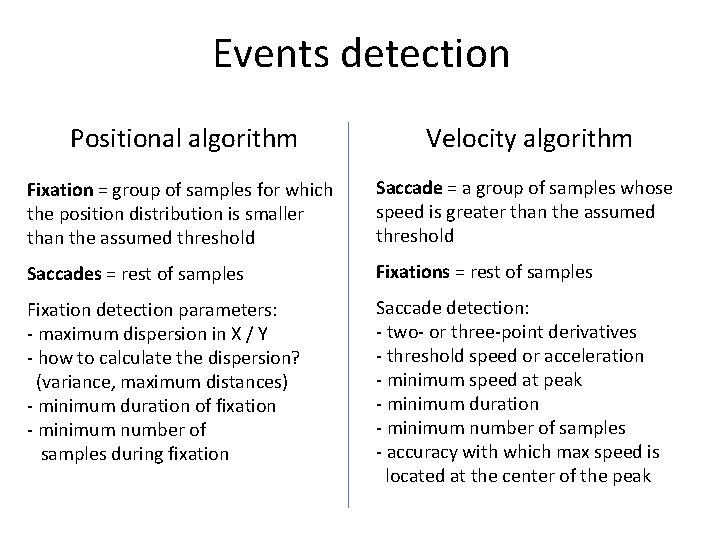
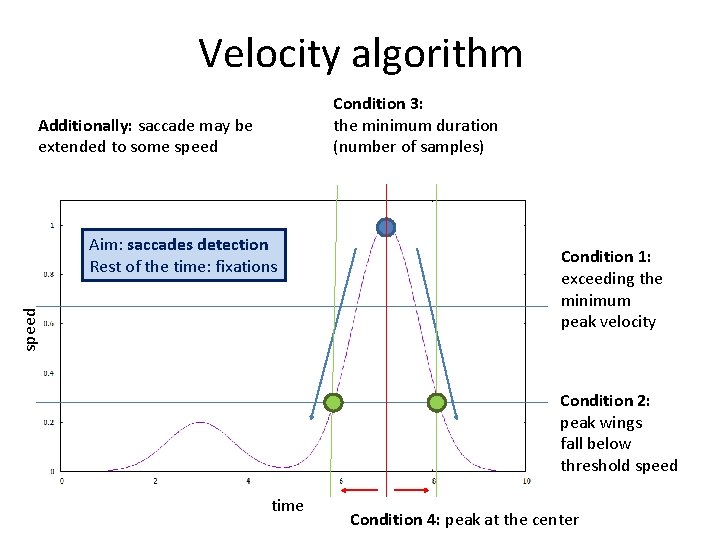
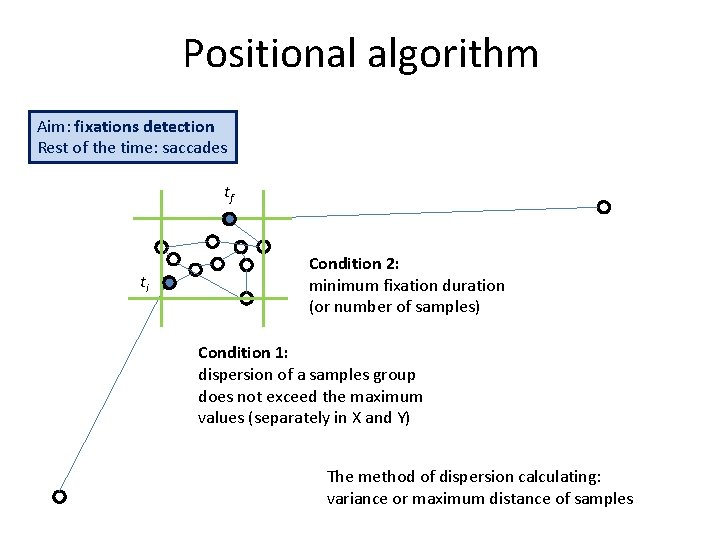
Events detection Positional algorithm Velocity algorithm Fixation = group of samples for which the position distribution is smaller than the assumed threshold Saccade = a group of samples whose speed is greater than the assumed threshold Saccades = rest of samples Fixation detection parameters: - maximum dispersion in X / Y - how to calculate the dispersion? (variance, maximum distances) - minimum duration of fixation - minimum number of samples during fixation Saccade detection: - two- or three-point derivatives - threshold speed or acceleration - minimum speed at peak - minimum duration - minimum number of samples - accuracy with which max speed is located at the center of the peak
Velocity algorithm Condition 3: the minimum duration (number of samples) Additionally: saccade may be extended to some speed Aim: saccades detection Rest of the time: fixations Condition 1: exceeding the minimum peak velocity Condition 2: peak wings fall below threshold speed time Condition 4: peak at the center
Positional algorithm Aim: fixations detection Rest of the time: saccades tf ti Condition 2: minimum fixation duration (or number of samples) Condition 1: dispersion of a samples group does not exceed the maximum values (separately in X and Y) The method of dispersion calculating: variance or maximum distance of samples
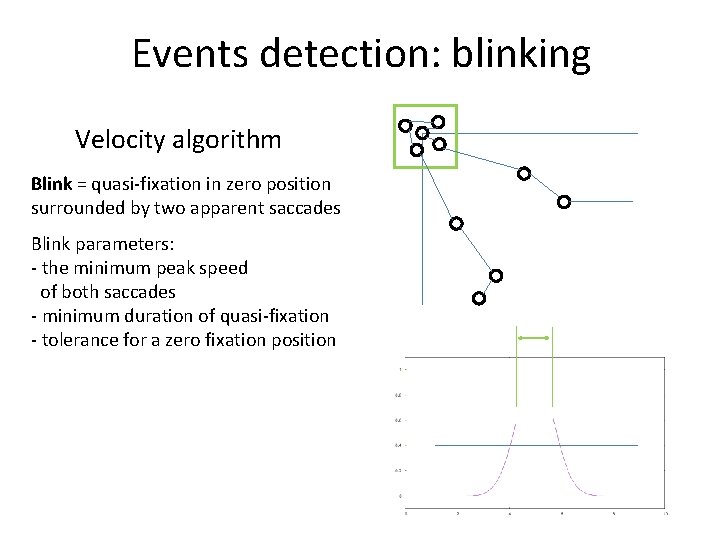
Events detection: blinking Velocity algorithm Blink = quasi-fixation in zero position surrounded by two apparent saccades Blink parameters: - the minimum peak speed of both saccades - minimum duration of quasi-fixation - tolerance for a zero fixation position
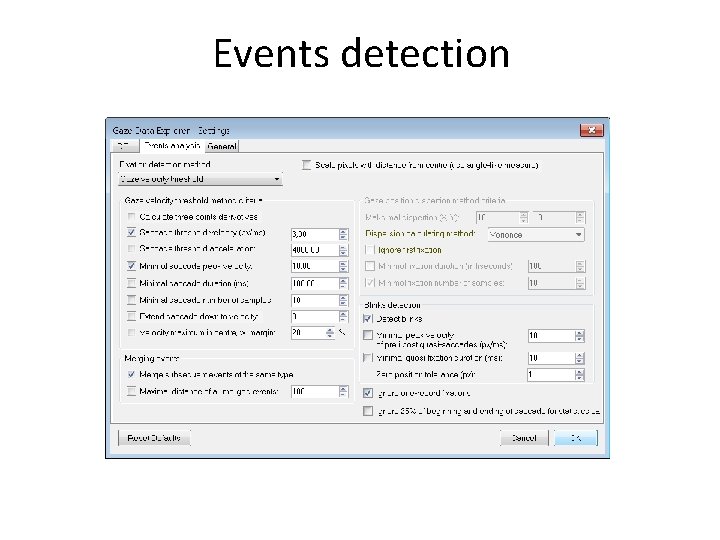
Events detection
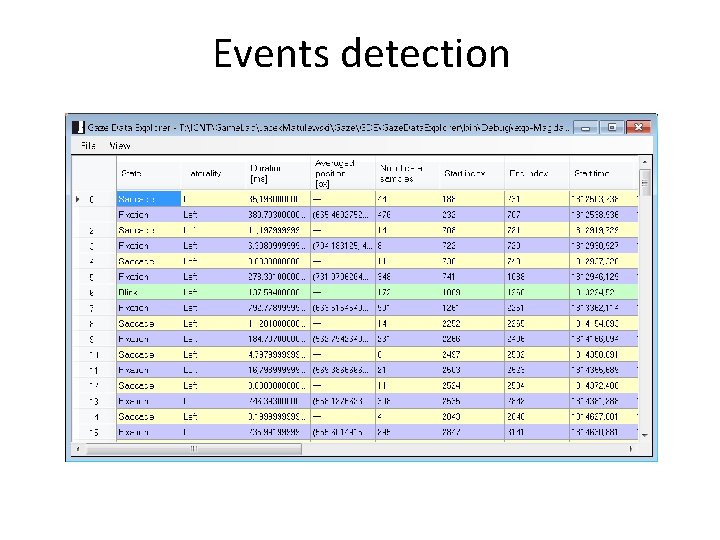
Events detection
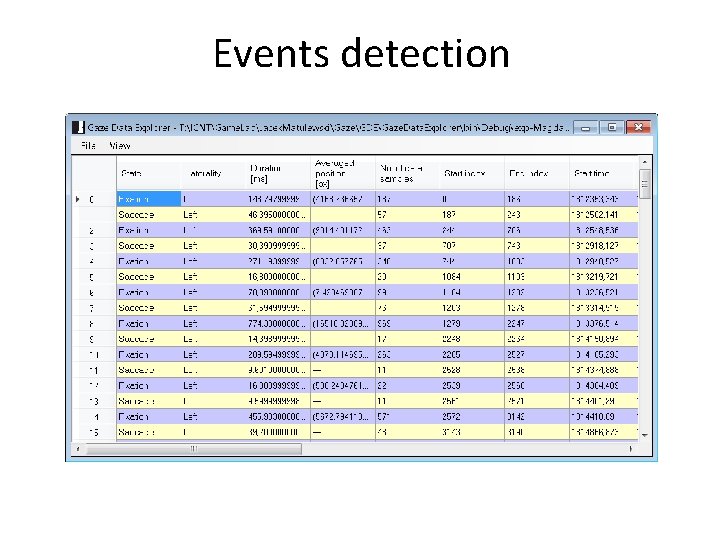
Events detection
Events detection: smooth pursuit Smooth pursuit – „fixation on a moving object” • changing the gaze position in order to follow the object • usually impossible without the object (series of saccased) • speed lower than in case of saccades If object is moving too fast (> 30°/s) smooth pursuit changes into a sequence of catch-up saccades Smooth pursuit is physiologically different from the vestibular-ocular reflex (the eye movement compensating the head movement during fixation). • Some people can start smooth running just imagining the moving object • Smooth is easier for objects moving horizontally than vertically (different brain areas are responsible) • Requires feedback with object (but continues while the object is for a moment covered). The first 100 ms - ballistic.
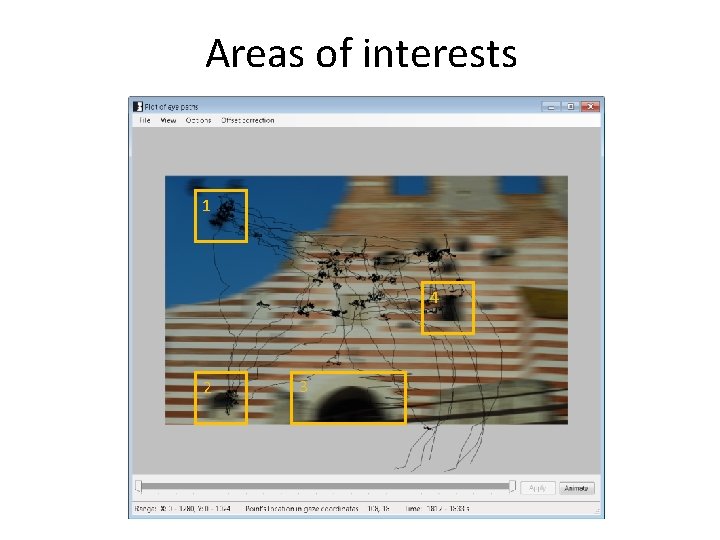
Areas of interests 1 4 2 3
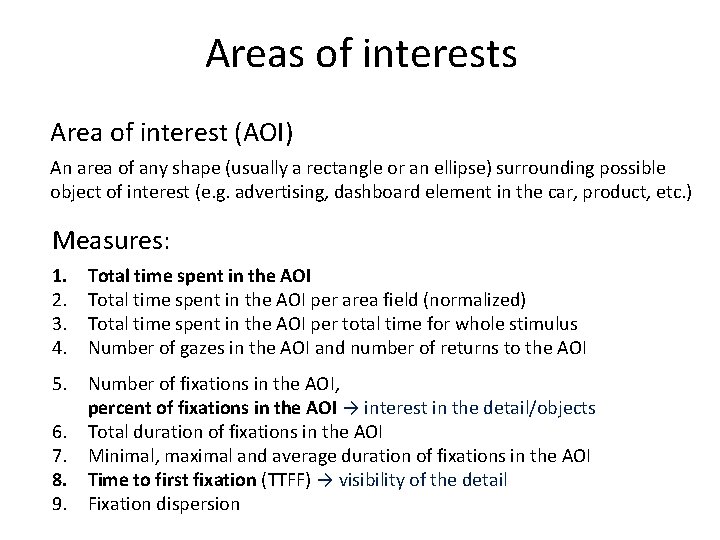
Areas of interests Area of interest (AOI) An area of any shape (usually a rectangle or an ellipse) surrounding possible object of interest (e. g. advertising, dashboard element in the car, product, etc. ) Measures: 1. 2. 3. 4. Total time spent in the AOI per area field (normalized) Total time spent in the AOI per total time for whole stimulus Number of gazes in the AOI and number of returns to the AOI 5. Number of fixations in the AOI, percent of fixations in the AOI → interest in the detail/objects 6. Total duration of fixations in the AOI 7. Minimal, maximal and average duration of fixations in the AOI 8. Time to first fixation (TTFF) → visibility of the detail 9. Fixation dispersion
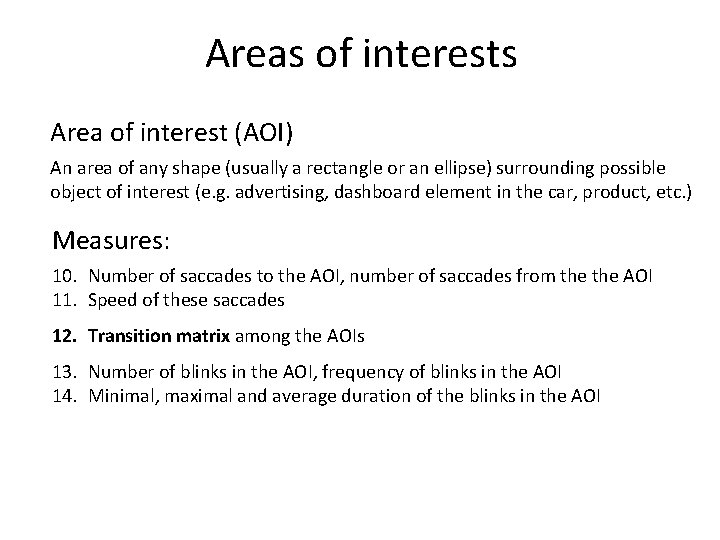
Areas of interests Area of interest (AOI) An area of any shape (usually a rectangle or an ellipse) surrounding possible object of interest (e. g. advertising, dashboard element in the car, product, etc. ) Measures: 10. Number of saccades to the AOI, number of saccades from the AOI 11. Speed of these saccades 12. Transition matrix among the AOIs 13. Number of blinks in the AOI, frequency of blinks in the AOI 14. Minimal, maximal and average duration of the blinks in the AOI
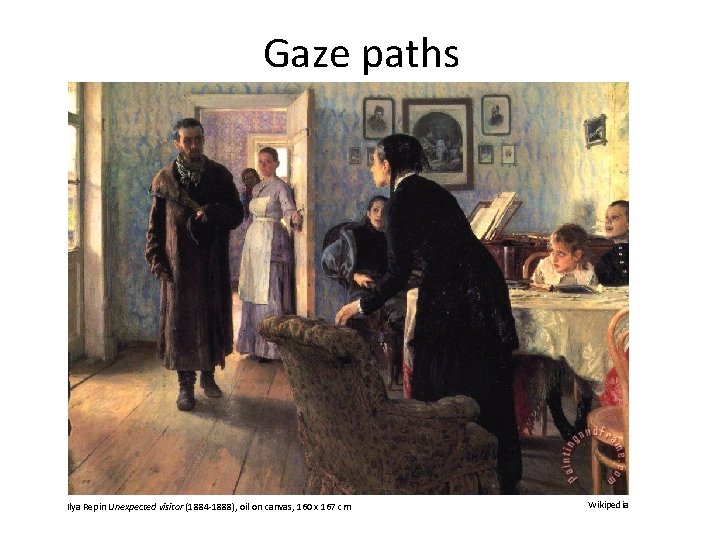
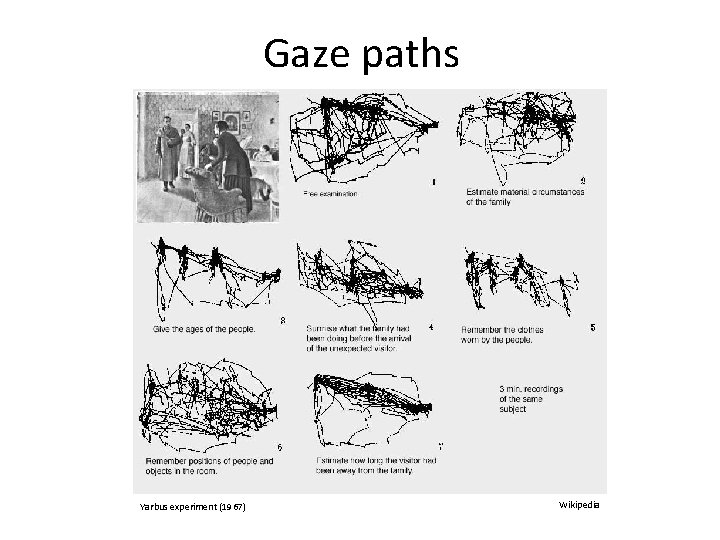
Gaze paths Ilya Repin Unexpected visitor (1884 -1888), oil on canvas, 160 x 167 cm Wikipedia
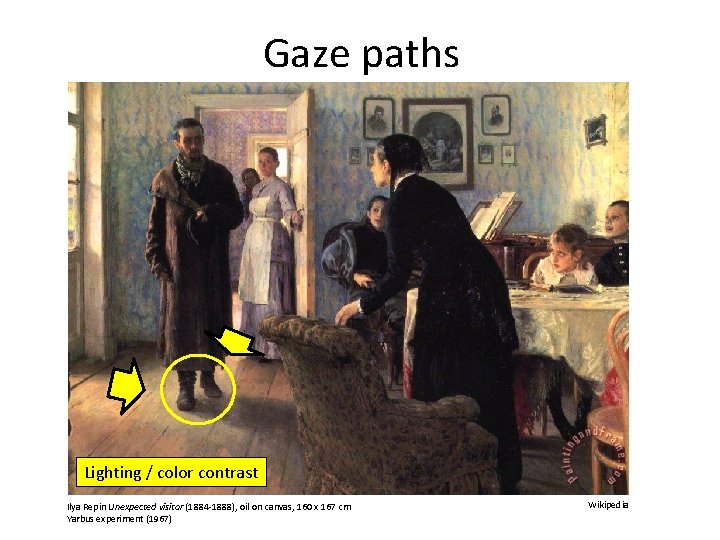
Gaze paths Lighting / color contrast Ilya Repin Unexpected visitor (1884 -1888), oil on canvas, 160 x 167 cm Yarbus experiment (1967) Wikipedia
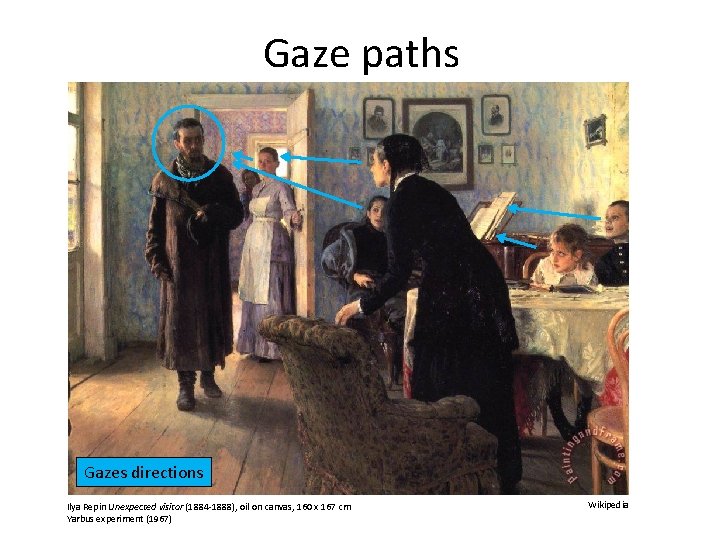
Gaze paths Gazes directions Ilya Repin Unexpected visitor (1884 -1888), oil on canvas, 160 x 167 cm Yarbus experiment (1967) Wikipedia
Gaze paths Gaze directions / relations / emotions Ilya Repin Unexpected visitor (1884 -1888), oil on canvas, 160 x 167 cm Yarbus experiment (1967) Wikipedia
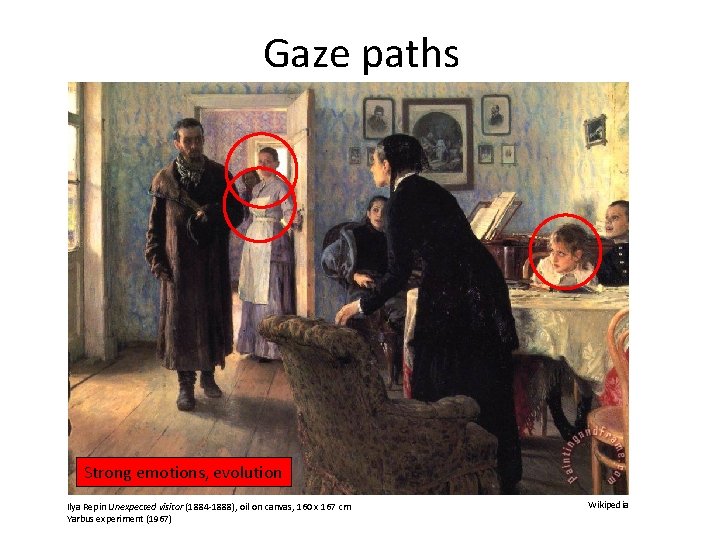
Gaze paths Strong emotions, evolution Ilya Repin Unexpected visitor (1884 -1888), oil on canvas, 160 x 167 cm Yarbus experiment (1967) Wikipedia
Gaze paths Ilya Repin Unexpected visitor (1884 -1888), oil on canvas, 160 x 167 cm Yarbus experiment (1967) Wikipedia
Gaze paths Yarbus experiment (1967) Wikipedia
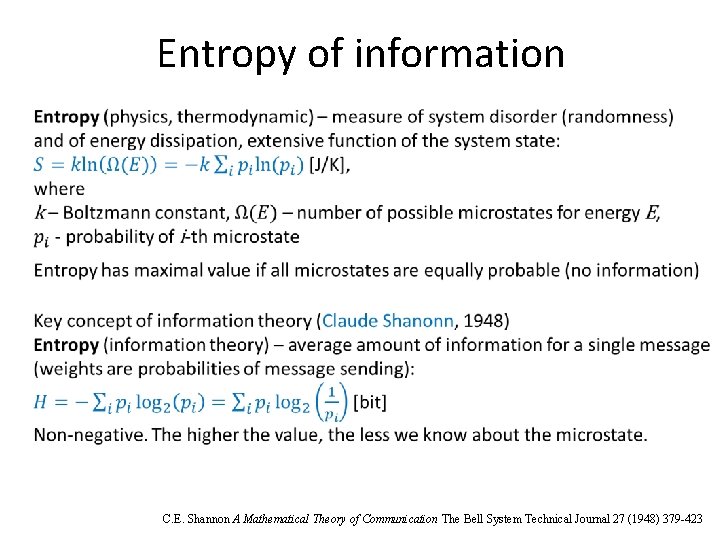
Entropy of information C. E. Shannon A Mathematical Theory of Communication The Bell System Technical Journal 27 (1948) 379 -423
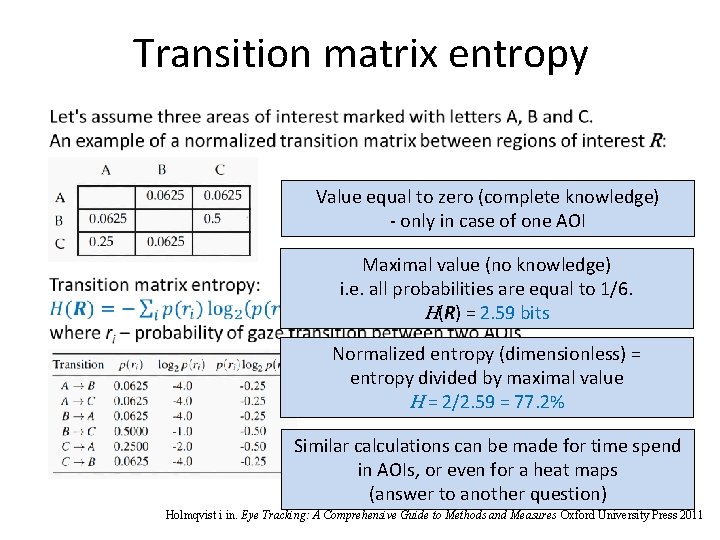
Transition matrix entropy Value equal to zero (complete knowledge) - only in case of one AOI Maximal value (no knowledge) i. e. all probabilities are equal to 1/6. H(R) = 2. 59 bits Normalized entropy (dimensionless) = entropy divided by maximal value H = 2/2. 59 = 77. 2% Similar calculations can be made for time spend in AOIs, or even for a heat maps (answer to another question) Holmqvist i in. Eye Tracking: A Comprehensive Guide to Methods and Measures Oxford University Press 2011
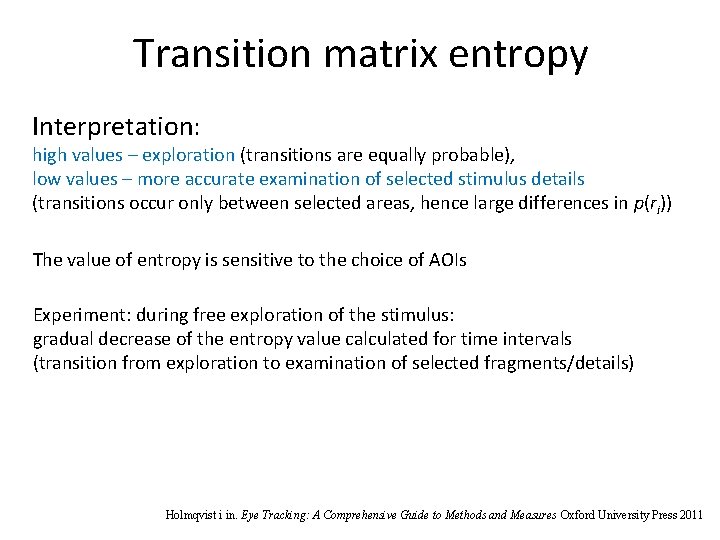
Transition matrix entropy Interpretation: high values – exploration (transitions are equally probable), low values – more accurate examination of selected stimulus details (transitions occur only between selected areas, hence large differences in p(ri)) The value of entropy is sensitive to the choice of AOIs Experiment: during free exploration of the stimulus: gradual decrease of the entropy value calculated for time intervals (transition from exploration to examination of selected fragments/details) Holmqvist i in. Eye Tracking: A Comprehensive Guide to Methods and Measures Oxford University Press 2011
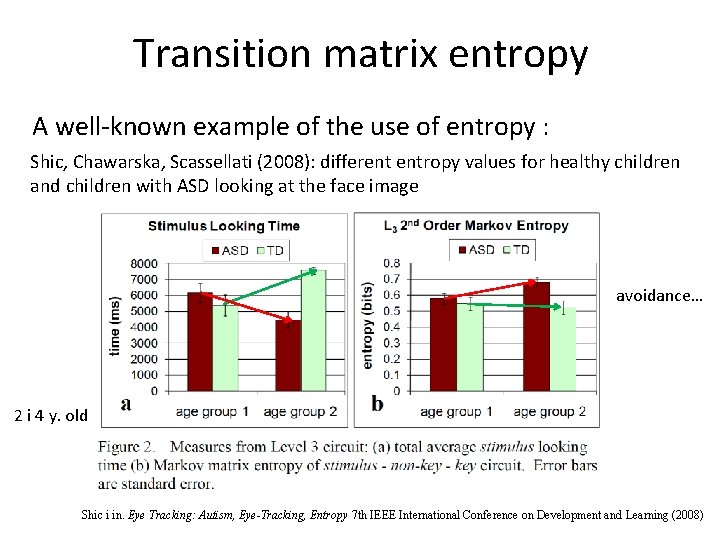
Transition matrix entropy A well-known example of the use of entropy : Shic, Chawarska, Scassellati (2008): different entropy values for healthy children and children with ASD looking at the face image avoidance… 2 i 4 y. old Shic i in. Eye Tracking: Autism, Eye-Tracking, Entropy 7 th IEEE International Conference on Development and Learning (2008)
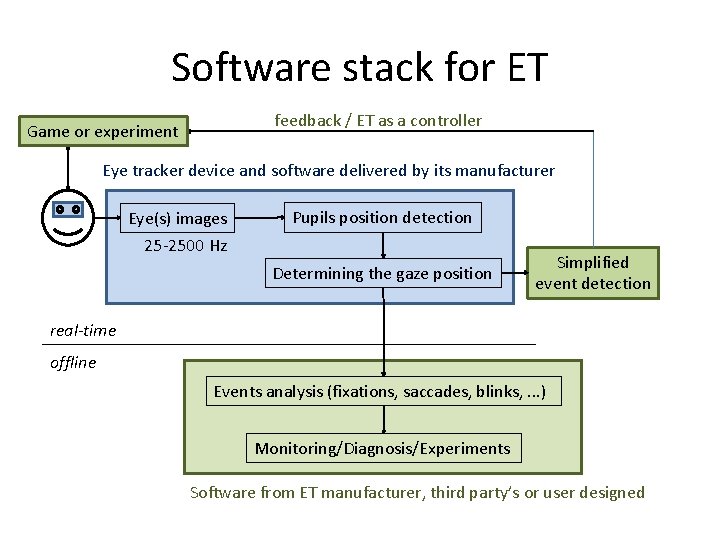
Software stack for ET feedback / ET as a controller Game or experiment Eye tracker device and software delivered by its manufacturer Eye(s) images Pupils position detection 25 -2500 Hz Determining the gaze position Simplified event detection real-time offline Events analysis (fixations, saccades, blinks, . . . ) Monitoring/Diagnosis/Experiments Software from ET manufacturer, third party’s or user designed
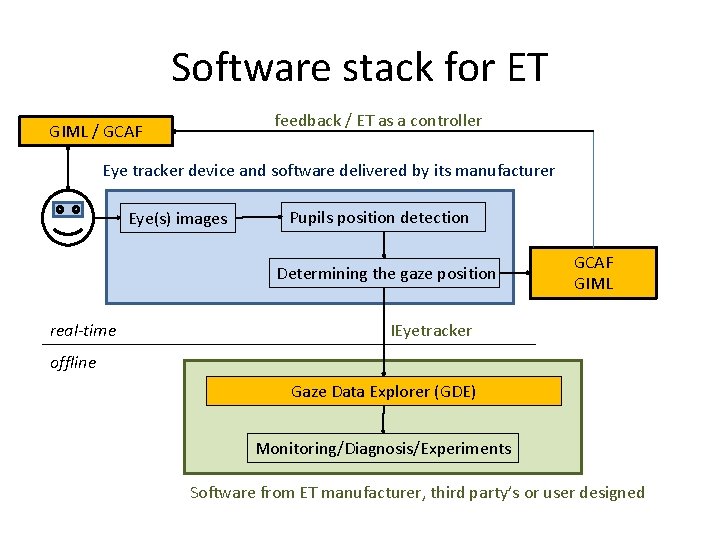
Software stack for ET feedback / ET as a controller GIML / GCAF Eye tracker device and software delivered by its manufacturer Eye(s) images Pupils position detection Determining the gaze position real-time GCAF GIML IEyetracker offline Gaze Data Explorer (GDE) Monitoring/Diagnosis/Experiments Software from ET manufacturer, third party’s or user designed
Software stack for ET feedback / ET as a controller GIML / GCAF Eye tracker device and software delivered by its manufacturer Eye(s) images Pupils position detection Determining the gaze position real-time GCAF GIML IEyetracker offline Gaze Data Explorer (GDE) Monitoring/Diagnosis/Experiments Software from ET manufacturer, third party’s or user designed