
NUCLEAR STRUCTURE AND RARE ISOTOPES Jacek Dobaczewski Warsaw
NUCLEAR STRUCTURE AND RARE ISOTOPES Jacek Dobaczewski Warsaw University/University of Tennessee/ORNL Third RIA Summer School on Exotic Beam Physics August 8 -14, 2004 ATLAS Facility Argonne National Laboratory Argonne, Illinois U. S. A. Jacek Dobaczewski
Nuclear Landscape 126 stable nuclei 82 o r protons known nuclei terra incognita 50 ss e c p 28 r o r -p 20 2 8 Jacek Dobaczewski 82 50 8 28 s s e c neutrons neutron stars
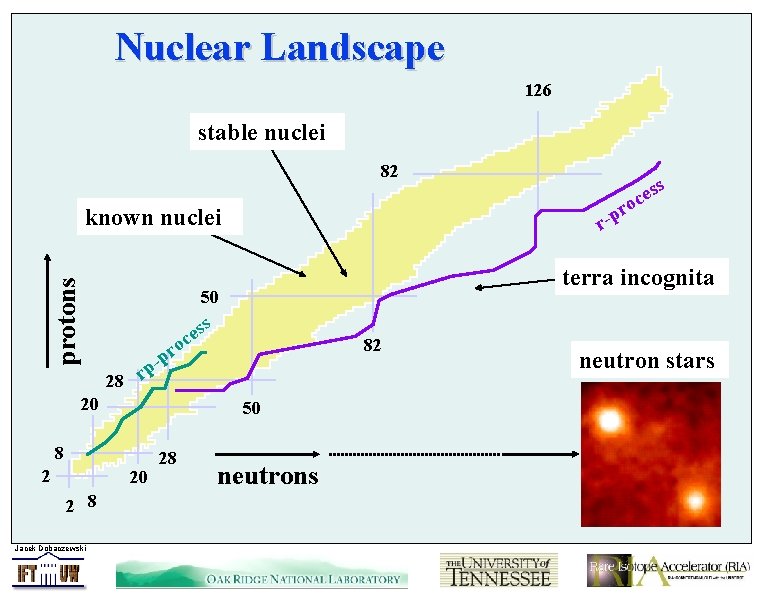
Nuclear Landscape There are only less than 300 stable nuclides in nature (black squares), while already about 3000 other ones have been synthesized and studied in nuclear structure laboratories (yellow zone). However, the nuclear landscape extends further away into uncharted territories (green zone), where probably double of that await discovery. Properties of these exotic systems cannot be at present reliably derived from theoretical models, because our knowledge of basic ingredients thereof is still quite rudimentary. Derivations form first principles allow us already now to recognize general features of nuclear forces, energy-density functionals, or shell-model interactions, however, plenty of these features require careful adjustment to precise nuclear data (RIA!). Such adjustments, especially when performed for exotic, extreme systems, provide invaluable information, and then in turn allow for more reliable extrapolations. Jacek Dobaczewski
Astrophysics Nuclear-Physics connections Atomic Physics Hadron Structure Nuclear Physics Hypernuclei Nuclear Reactions Hot & Dense Medium QCD & Chiral Symmetry Many-Body Systems Jacek Dobaczewski Particle Physics
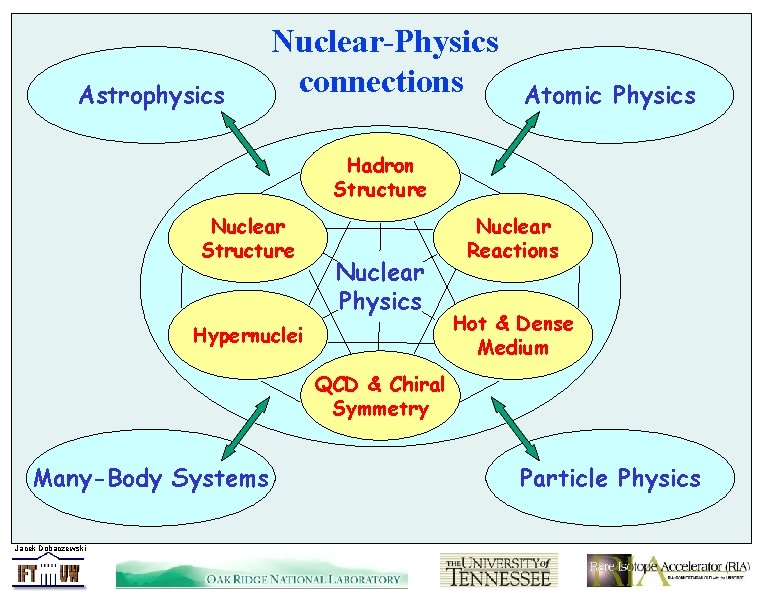
Nuclear-Physics connections The present-day nuclear physics contains not only the traditional subdomains, such as the nuclear structure, nuclear reactions, and physics of hypernuclei, but also those that not-so-long-ago where part and parcel of the particle physics, like the hadron structure, hot and dense nuclear matter, and low-energy aspects of the QCD. Nuclear physics not only has very strong ties to astrophysics (stars are born and die via nuclear processes) and particle physics (weak interactions and neutrinos), but also to atomic physics (tests of fundamental interactions through the electron-nucleus interaction), and to the general physics of many-body systems (condensed matter and solid state physics). Jacek Dobaczewski
Jacek Dobaczewski 3) 2) 1) Lecture I: Quarks, gluons, mesons, nucleons, and nuclei • QCD fundamentals • Composite particles • NN interactions Lecture II: Spontaneous symmetry breaking • Parity – NH 3 molecule • Chiral – pion condensate • Rotational – deuteron & nuclei Lecture III: Physics of exotic nuclei • Matter distributions • Shell structure • Pairing Erich Ormand: 2002 RIA Summer School http: //www. orau. org/ria 02/notes/ormand. ppt Stuart Pittel: 2003 RIA Summer School http: //www. orau. org/ria 03/lecturenotes/pittel. pdf Jacek Dobaczewski: 2002 Ecole Internationale Joliot-Curie: http: //arxiv. org/abs/nucl-th/0301069 Outline
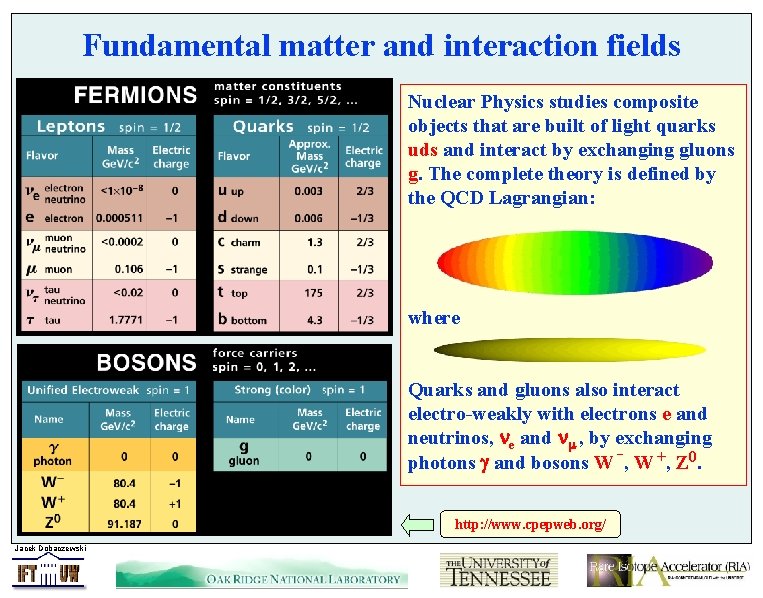
Fundamental matter and interaction fields Nuclear Physics studies composite objects that are built of light quarks uds and interact by exchanging gluons g. The complete theory is defined by the QCD Lagrangian: where Quarks and gluons also interact electro-weakly with electrons e and neutrinos, ne and nm , by exchanging photons g and bosons W -, W +, Z 0. http: //www. cpepweb. org/ Jacek Dobaczewski
Derek B. Leinweber The QCD vacuum http: //hermes. physics. adelaide. edu. au/theory/staff/leinweber/Visual. QCD/QCDvacuum/welcome. html Jacek Dobaczewski
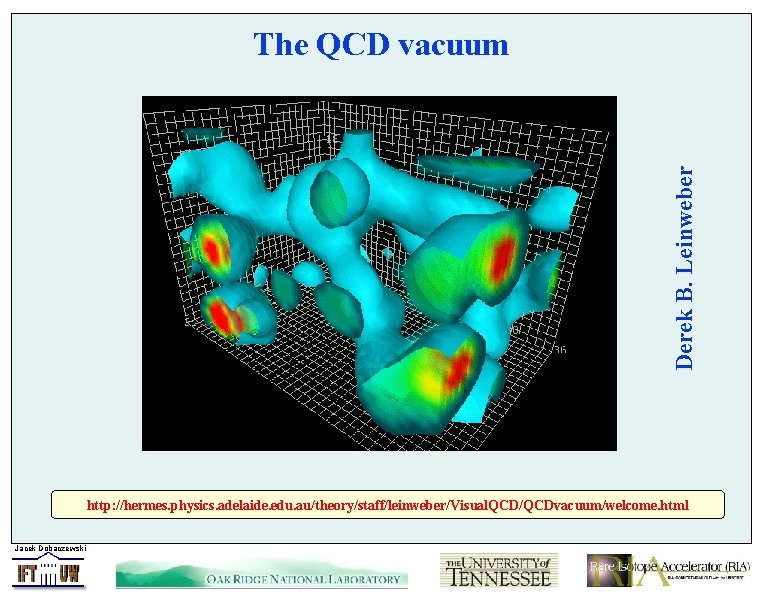
The QCD vacuum The empty space is not empty at all! The vacuum is one of the solutions of the field equations which minimizes the energy for a state with baryon and lepton numbers equal to zero. Such a state may contain arbitrary numbers of particle-antiparticle pairs that can spontaneously appear in the empty space. On the average, there can be non-zero numbers of these pairs at any time and point in space. Therefore, the vacuum can be an enormously complicated state with a non-zero energy density. This is a well-known and experimentally verified effect in QED (quantum electrodynamics) called the Casimir effect, whereupon two conducting parallel plates attract each other when put in otherwise completely empty space. The attraction is caused by electron-positron pairs that spontaneously appear in the empty space between the plates (the so-called vacuum polarization effect). Jacek Dobaczewski
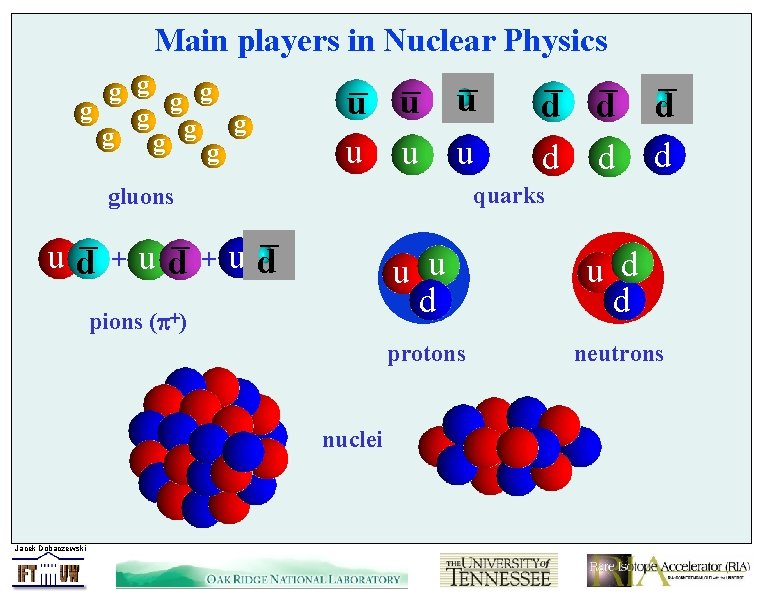
Main players in Nuclear Physics g g g _ ud gluons + _ ud + _ _ _ u u u quarks _ ud pions (p+) nuclei Jacek Dobaczewski _ _ _ d d d u u d d protons neutrons
Main players in Nuclear Physics Quarks and gluons are fundamental fields that appear in the QCD Lagrangian. All other elementary hadrons are composite objects that are solutions of the QCD for specific baryon numbers. Quarks and gluons belong to three and eight dimensional representations of the color SU(3) group; whereupon quarks are traditionally referred by the red, green, and blue (RGB) basic colors, while antiquarks by cyan, magenta, and yellow (CMY) complementary colors. Only color-SU(3) scalars (white composite particles) can propagate as free particles; all colored fields are confined within white objects and cannot be separated. White combinations of the quark-antiquark pairs are called mesons. Nucleons are white three-quark composite particles. Composite particles are known from experiment and cannot yet be fully calculated within the QCD. Nuclei are composite particles built of nucleons, of which the quark constituents are unresolved. Jacek Dobaczewski
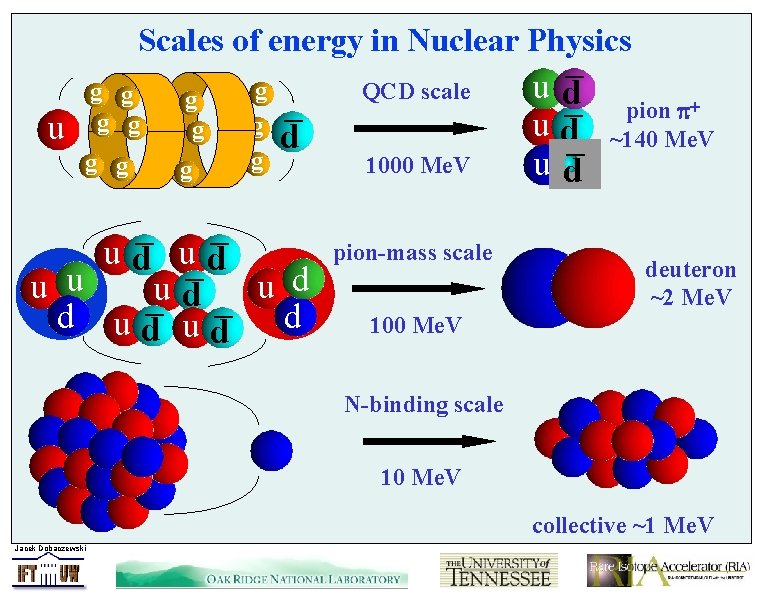
Scales of energy in Nuclear Physics g g g g g u g g g _ d _ _ u d u_ d d u u _ d_ d ud ud d QCD scale 1000 Me. V pion-mass scale _ u d_ ud pion p+ ~140 Me. V deuteron ~2 Me. V 100 Me. V N-binding scale 10 Me. V collective ~1 Me. V Jacek Dobaczewski
Scales of energy in Nuclear Physics 1000 Me. V QCD scale: When two valence quarks are separated, they are connected by a tube of gluons and quark-antiquark pairs (the flux tube) that provides an interaction “potential” linearly growing with the distance. The same gluon-quark-antiquark soup binds the valence quarks into white composite particles and provides most of their mass. 100 Me. V pion-mass scale: When two nucleons are separated, they interact by exchanging one-, two-, ore several pions. Nuclei are bound as a result of pion exchanges within the background of the so-called chiral condensate. 10 Me. V N-binding scale: When a nucleon is separated from the nucleus, it interacts with the average field of all the remaining nucleons; its binding energy is a result of strong cancellation between the kinetic and interaction energies. 1 Me. V collective scale: When the collective excitation of a nucleus is created, its energy is a coherent sum of small excitation energies of all or many constituent nucleons. Jacek Dobaczewski
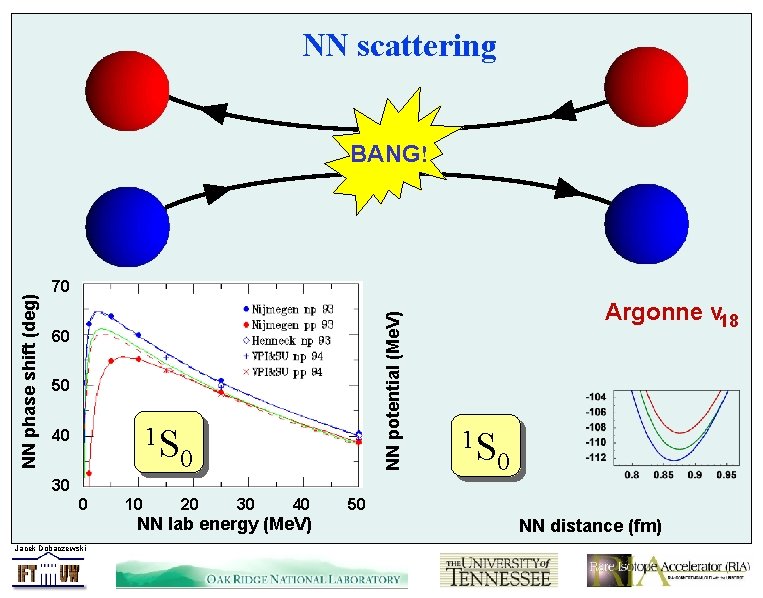
NN scattering 70 NN potential (Me. V) NN phase shift (deg) BANG! 60 50 1 S 40 0 Argonne v 18 1 S 0 30 0 10 20 30 40 NN lab energy (Me. V) Jacek Dobaczewski 50 NN distance (fm)
NN scattering At low energies below 300 Me. V, the quark structures of nucleons are not resolved and interactions between the nucleons can be approximated by potentials that have long attractive tails and strong repulsive cores. These potentials are best adjusted to the NN scattering data (phase shifts) in specific channels defined by L, S, and J, described by the spectroscopic notation of 2 S+1 LJ. The Pauli principle requires that the isospin of each channel be confined to T=0 for odd J and T=1 for even J. Interactions are very weakly depending on the isospin – mostly, but not uniquely, through the Coulomb force. Channels of J>0 mix two values of L=J± 1, and therefore potentials in these channels are 2´ 2 matrices. Therefore, e. g. , the deuteron wave function is a mixture of the L=0 (S) and L=2 (D) components. Jacek Dobaczewski
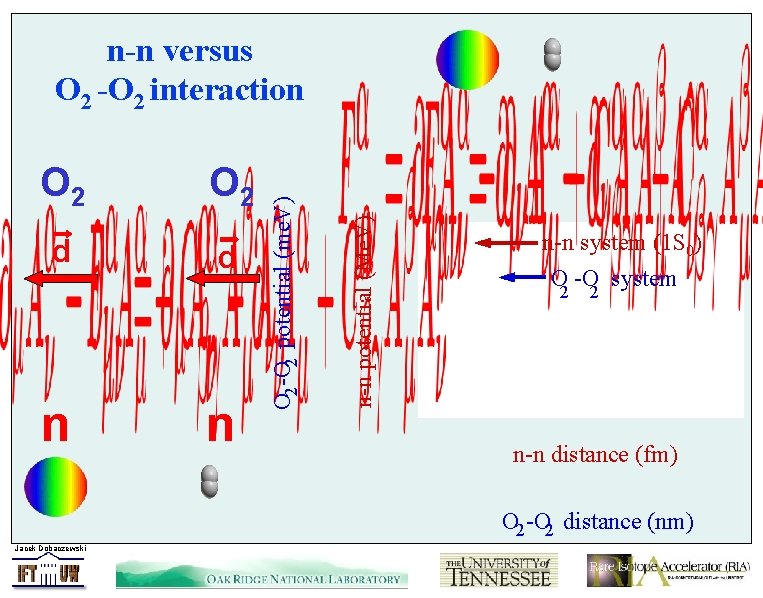
O 2 d d n n n-n potential (Me. V) O 2 -O 2 potential (me. V) n-n versus O 2 -O 2 interaction n-n system (1 S 0) O 2 -O 2 system n-n distance (fm) O 2 -O 2 distance (nm) Jacek Dobaczewski
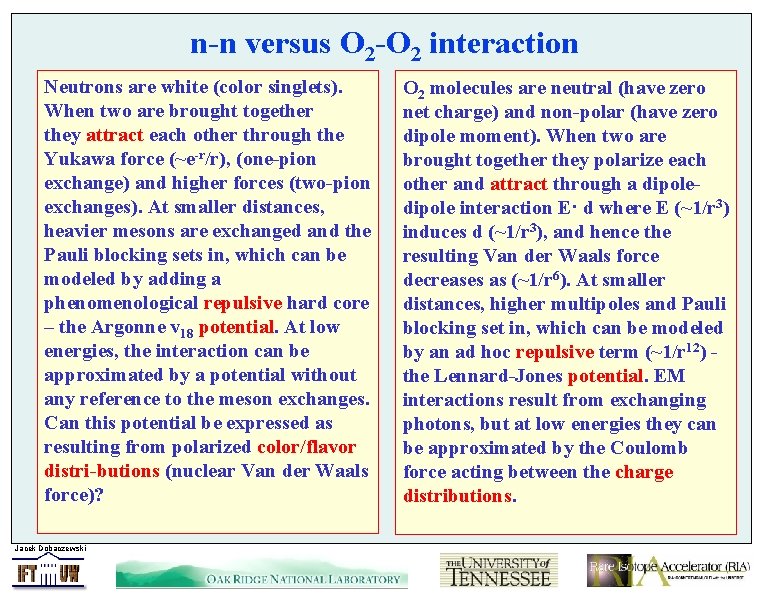
n-n versus O 2 -O 2 interaction Neutrons are white (color singlets). When two are brought together they attract each other through the Yukawa force (~e-r/r), (one-pion exchange) and higher forces (two-pion exchanges). At smaller distances, heavier mesons are exchanged and the Pauli blocking sets in, which can be modeled by adding a phenomenological repulsive hard core – the Argonne v 18 potential. At low energies, the interaction can be approximated by a potential without any reference to the meson exchanges. Can this potential be expressed as resulting from polarized color/flavor distri-butions (nuclear Van der Waals force)? Jacek Dobaczewski O 2 molecules are neutral (have zero net charge) and non-polar (have zero dipole moment). When two are brought together they polarize each other and attract through a dipole interaction E· d where E (~1/r 3) induces d (~1/r 3), and hence the resulting Van der Waals force decreases as (~1/r 6). At smaller distances, higher multipoles and Pauli blocking set in, which can be modeled by an ad hoc repulsive term (~1/r 12) the Lennard-Jones potential. EM interactions result from exchanging photons, but at low energies they can be approximated by the Coulomb force acting between the charge distributions.
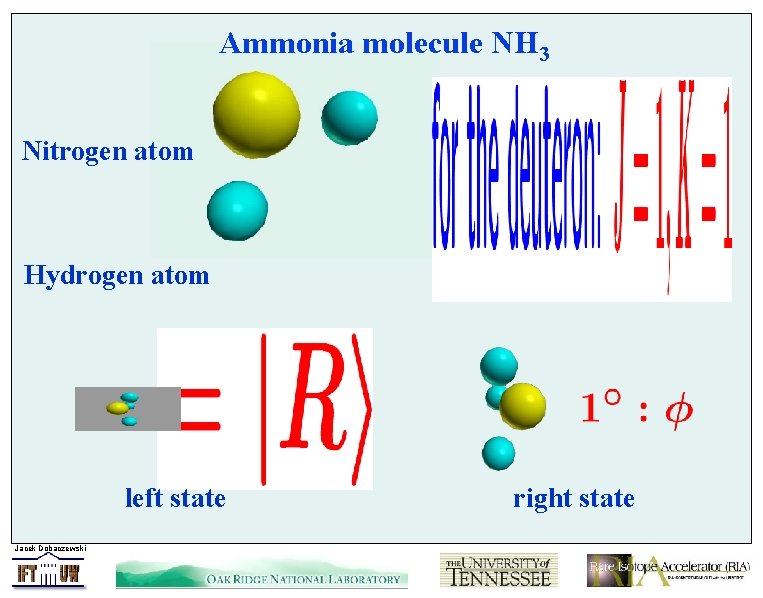
Ammonia molecule NH 3 Nitrogen atom Hydrogen atom left state Jacek Dobaczewski right state
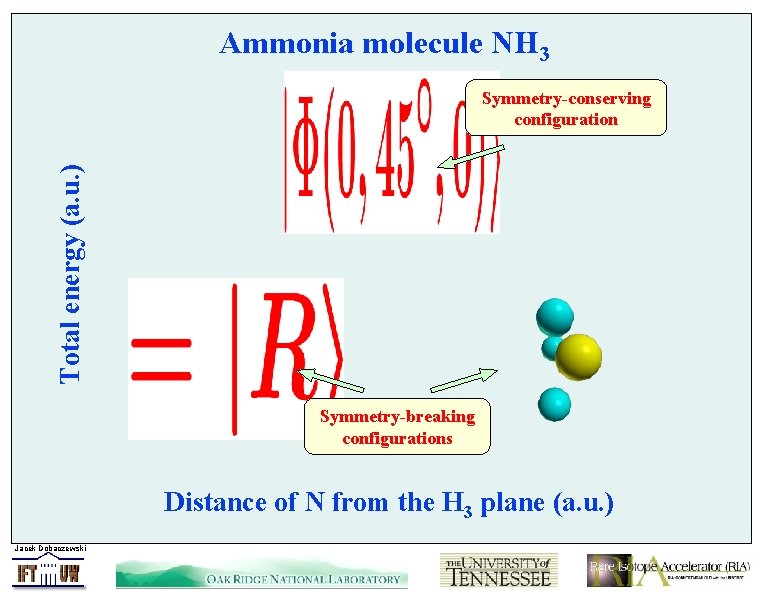
Ammonia molecule NH 3 Total energy (a. u. ) Symmetry-conserving configuration Symmetry-breaking configurations Distance of N from the H 3 plane (a. u. ) Jacek Dobaczewski
Jacek Dobaczewski
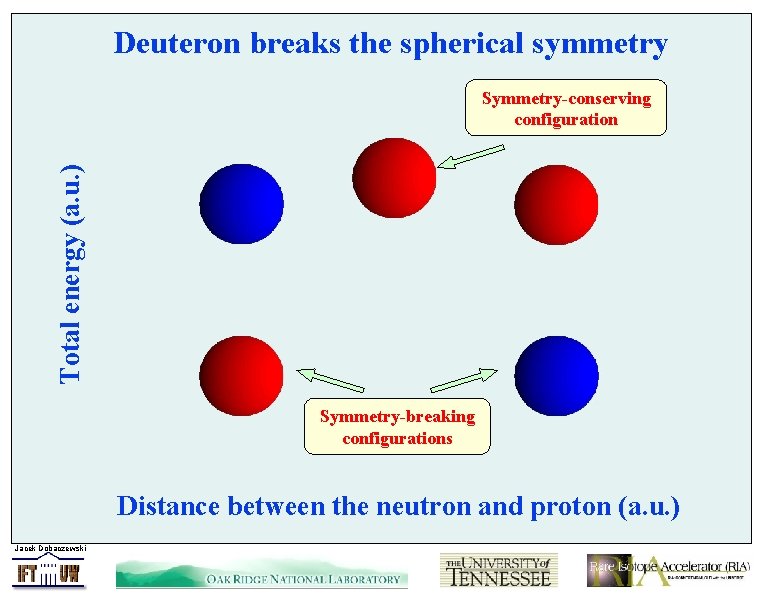
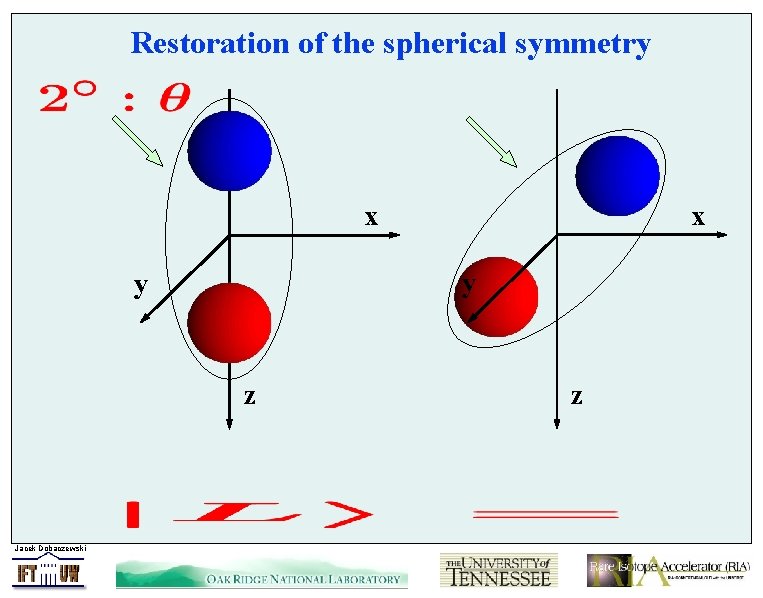
Spontaneous symmetry breaking gives a description of the system in terms of wave packets instead of eigenstates. The wave packets corresponds to given configurations of constituents. If the configuration interaction energy is very small, the wave packets live a very long time and behave like classical objects. If configurations are orthogonal and degenerate, the wave packets are also eigenstates (infinite systems). Symmetry restoration amounts to projecting states with good quantum numbers from the symmetry-breaking states. If the configuration interaction energy is very small, the energies of projected states are very close to those of the symmetry-breaking states. Symmetry restoration can be essential for calculating average values of symmetry-conserving observables other than the Hamiltonian. After the symmetry restoration, the symmetrybreaking solutions do not break symmetry! Jacek Dobaczewski
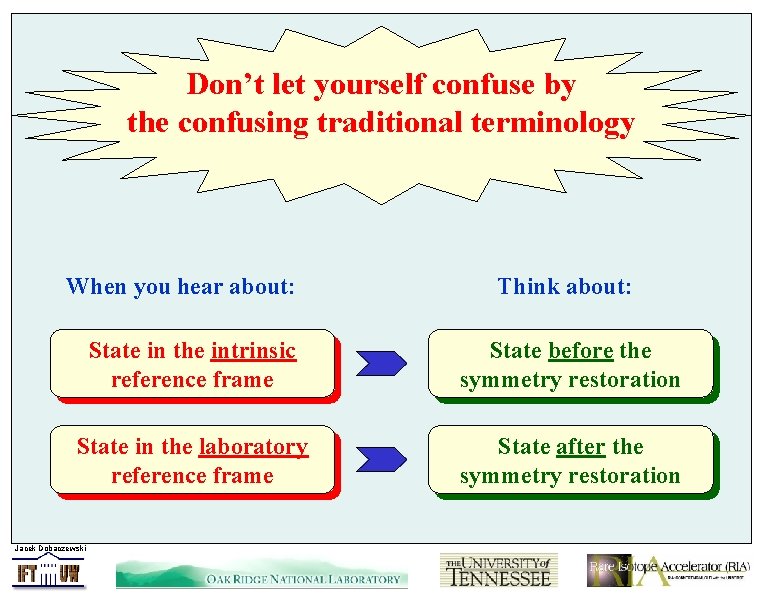
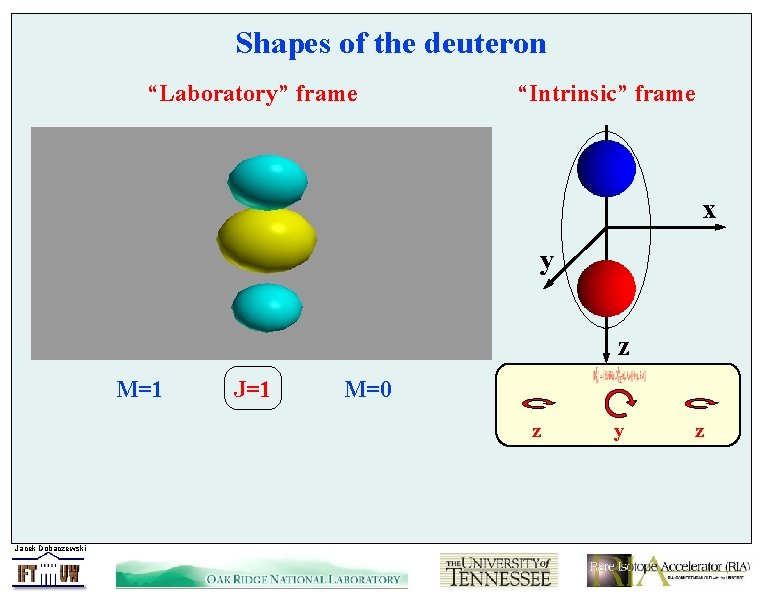
Don’t let yourself confuse by the confusing traditional terminology When you hear about: Think about: State in the intrinsic reference frame State before the symmetry restoration State in the laboratory reference frame State after the symmetry restoration Jacek Dobaczewski
Chiral symmetry and isospin Jacek Dobaczewski
Chiral symmetry breaking Jacek Dobaczewski
Linear s model Jacek Dobaczewski
Mexican-hat potential Jacek Dobaczewski
Non-linear s model Jacek Dobaczewski
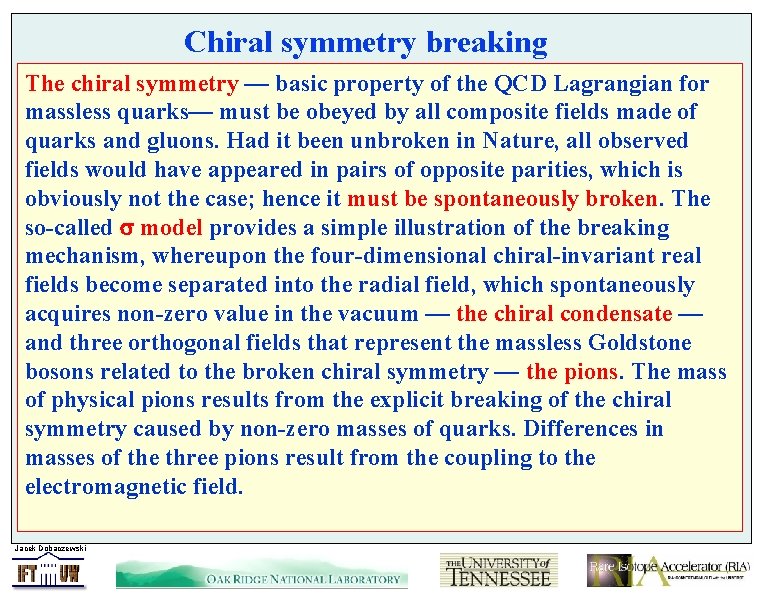
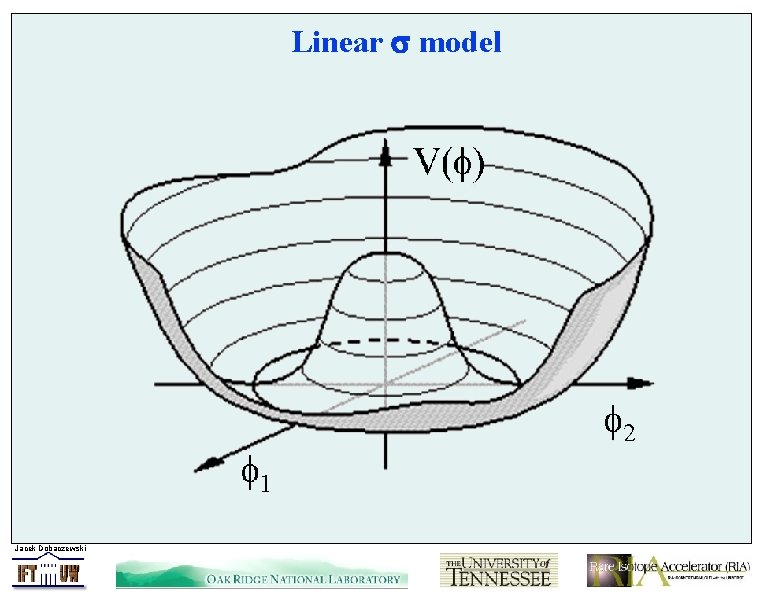
Chiral symmetry breaking The chiral symmetry — basic property of the QCD Lagrangian for massless quarks— must be obeyed by all composite fields made of quarks and gluons. Had it been unbroken in Nature, all observed fields would have appeared in pairs of opposite parities, which is obviously not the case; hence it must be spontaneously broken. The so-called s model provides a simple illustration of the breaking mechanism, whereupon the four-dimensional chiral-invariant real fields become separated into the radial field, which spontaneously acquires non-zero value in the vacuum — the chiral condensate — and three orthogonal fields that represent the massless Goldstone bosons related to the broken chiral symmetry — the pions. The mass of physical pions results from the explicit breaking of the chiral symmetry caused by non-zero masses of quarks. Differences in masses of the three pions result from the coupling to the electromagnetic field. Jacek Dobaczewski
Structure of the deuteron M=1 J=1 M=0 http: //www. phy. anl. gov/theory/movie-run. html Jacek Dobaczewski
Deuteron breaks the spherical symmetry Total energy (a. u. ) Symmetry-conserving configuration Symmetry-breaking configurations Distance between the neutron and proton (a. u. ) Jacek Dobaczewski
Restoration of the spherical symmetry x x y y z Jacek Dobaczewski z
Shapes of the deuteron “Laboratory” frame “Intrinsic” frame x y z M=1 J=1 M=0 z Jacek Dobaczewski y z
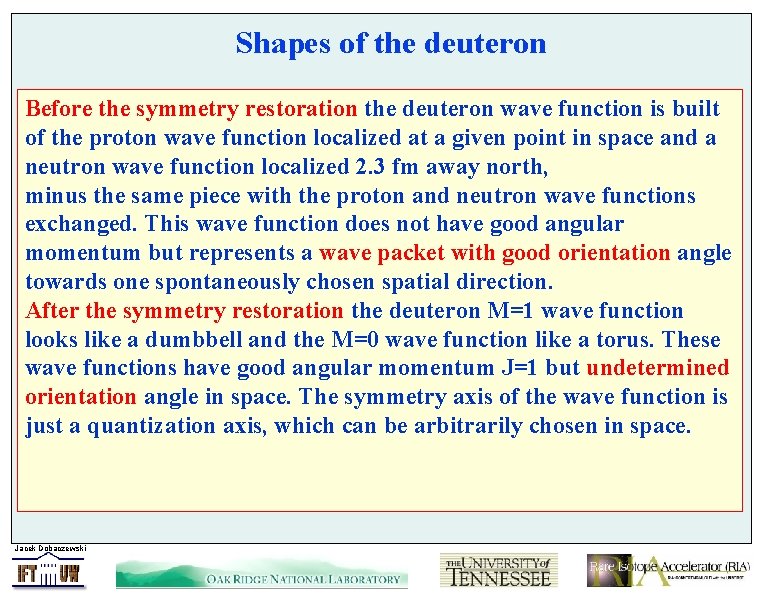
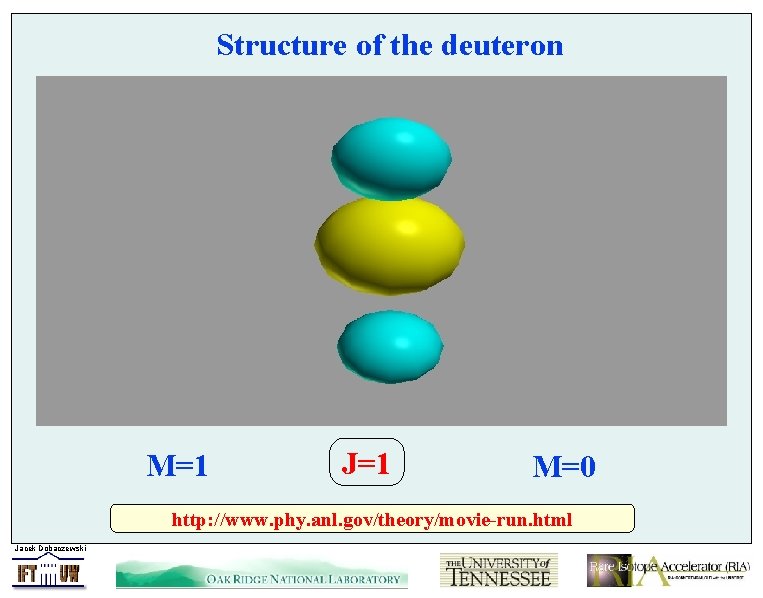
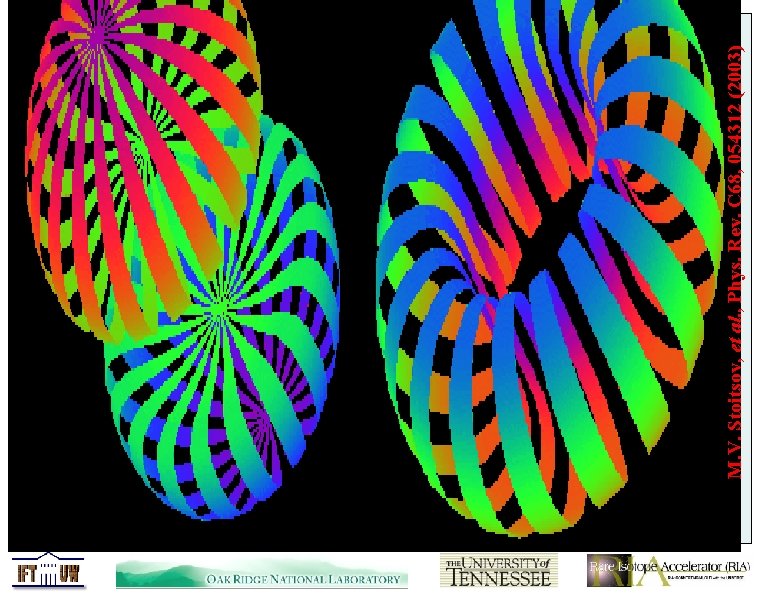
Shapes of the deuteron Before the symmetry restoration the deuteron wave function is built of the proton wave function localized at a given point in space and a neutron wave function localized 2. 3 fm away north, minus the same piece with the proton and neutron wave functions exchanged. This wave function does not have good angular momentum but represents a wave packet with good orientation angle towards one spontaneously chosen spatial direction. After the symmetry restoration the deuteron M=1 wave function looks like a dumbbell and the M=0 wave function like a torus. These wave functions have good angular momentum J=1 but undetermined orientation angle in space. The symmetry axis of the wave function is just a quantization axis, which can be arbitrarily chosen in space. Jacek Dobaczewski
Nuclear deformation Total energy (a. u. ) Symmetry-conserving configuration Symmetry-breaking configurations Elongation (a. u. ) Jacek Dobaczewski
Single-particle energy (a. u. ) Origins of nuclear deformation Open-shell system: 8 particles on 8 doubly degenrate levels Elongation (a. u. ) Jacek Dobaczewski
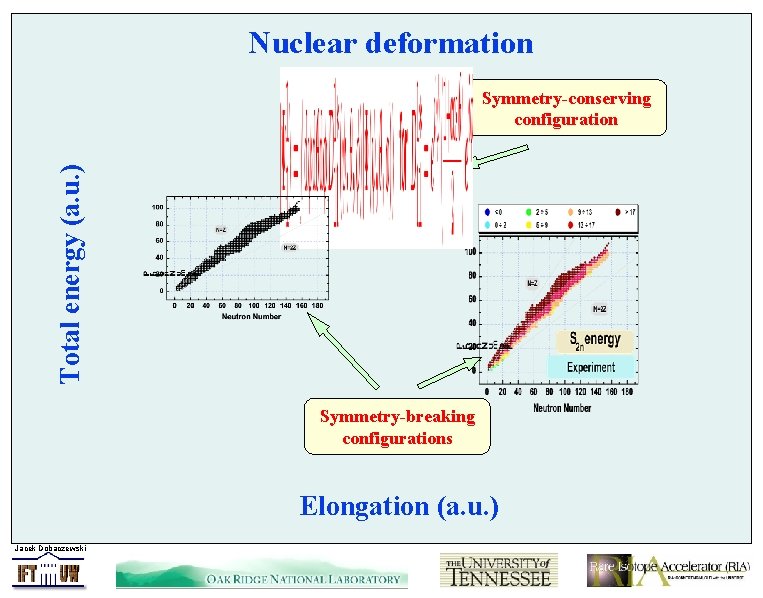
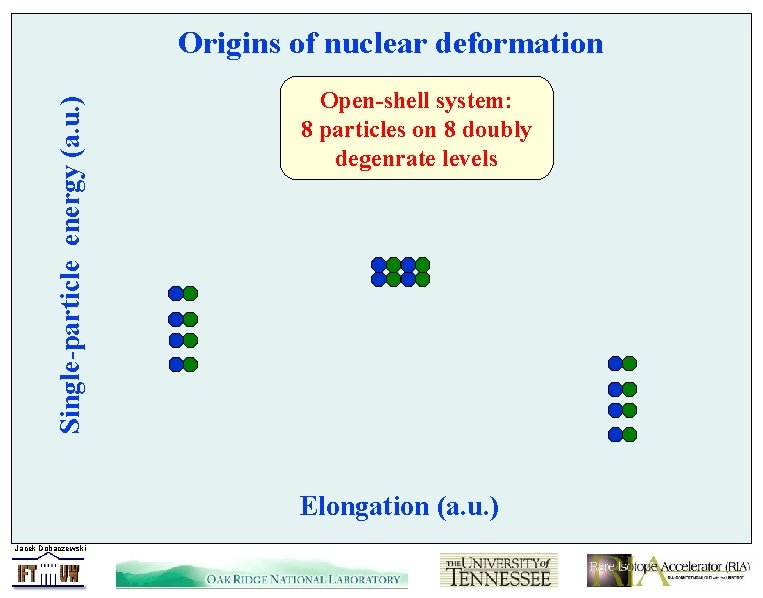
Nuclear deformation results form residual two-body interactions between valence nucleons that favor configurations in which nucleons occupy single-particle orbitals in a deformed mean field. Prolate deformations are preferred at the beginning of large shells (almost empty shells) and oblate deformations at the and of large shells (almost full shells), although for detailed and realistic situations the prolate ones appear more often in Nature. Deformed wave functions do not have good angular momenta and represent wave packets of very large widths (very many angular-momentum components). The average angular momentum squared is always large, while the average angular momentum can be zero (non-rotating wave packets) or non-zero (rotating wave packets). In the cranking approximation a rotating wave packet is stationary in the rotating reference frame. Jacek Dobaczewski
Jacek Dobaczewski M. V. Stoitsov, et al. , Phys. Rev. C 68, 054312 (2003)
Nuclear densities as composite fields Modern Mean-Field Theory º Energy Density Functional r, t, Hohenberg-Kohn-Sham Negele-Vautherin Landau-Migdal Nilsson-Strutinsky Jacek Dobaczewski « J, ® j, ® T, ® s, ® F, mean field Þ one-body densities zero range Þ local densities finite range Þ non-local densities
Nuclear densities as composite fields Jacek Dobaczewski
Local energy density: (no isospin, no pairing) Jacek Dobaczewski
Complete local energy density Mean field Jacek Dobaczewski Pairing
Mean-field equations Jacek Dobaczewski
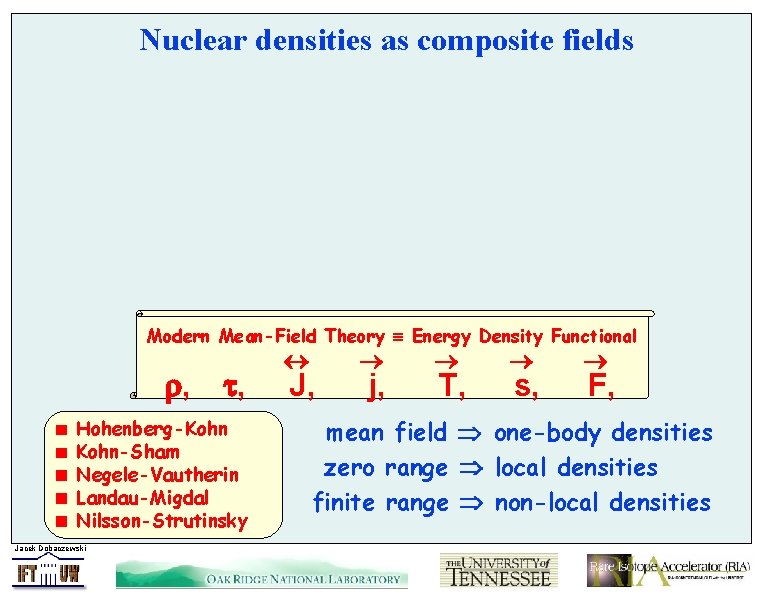
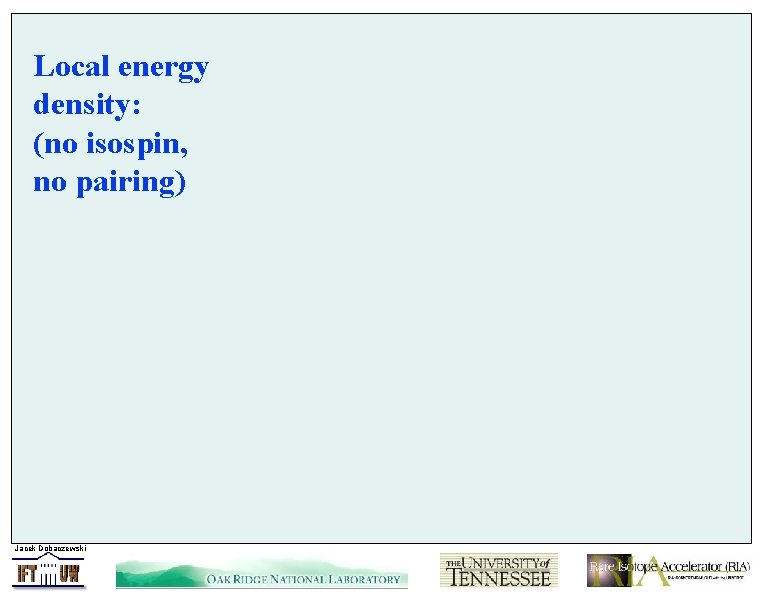
Nuclear densities as composite fields Density distributions of matter, spin, and current in a nucleus can be used as fields defining new degrees of freedom that describe nucleus as a composite particle. In terms of these fields, the most general energy density functional can be constructed by using symmetry arguments. The functional depends on a number of coupling constants, which have to be either adjusted to the experimental data or determined from a higher-level theory. In the spirit of the Effective Field Theory, the energy density can be supplemented by higherorder contact terms, which amount to a density dependence of the coupling constants. These terms take into account high-energy phenomena that are not resolved when one looks at nuclear phenomena within the scale of the nucleon binding (~10 Me. V). On the other hand, all effects within the low-energy scale of collective excitations (~1 Me. V) have to be treated explicitly (deformations, zeropoint motion, pairing corrections, symmetry restoration, etc. ). Jacek Dobaczewski

Jacek Dobaczewski A. H. Wapstra, et al. , Nucl. Phys. A 729, 129 (2003)

Jacek Dobaczewski M. V. Stoitsov, et al. , Phys. Rev. C 68, 054312 (2003)
S 2 n (Me. V) Jacek Dobaczewski 16 12 8 4 1. 2 56 24 20 50 1. 5 N /Z 44 N=80 N=82 N=84 N=86 0 1. 8 2. 1 2. 4 J. Dobaczewski and W. Nazarewicz Phil. Trans. R. Soc. Lond. A 356, 2007 (1998) 62 neutron drip line proton drip line 68 Proton Number 38
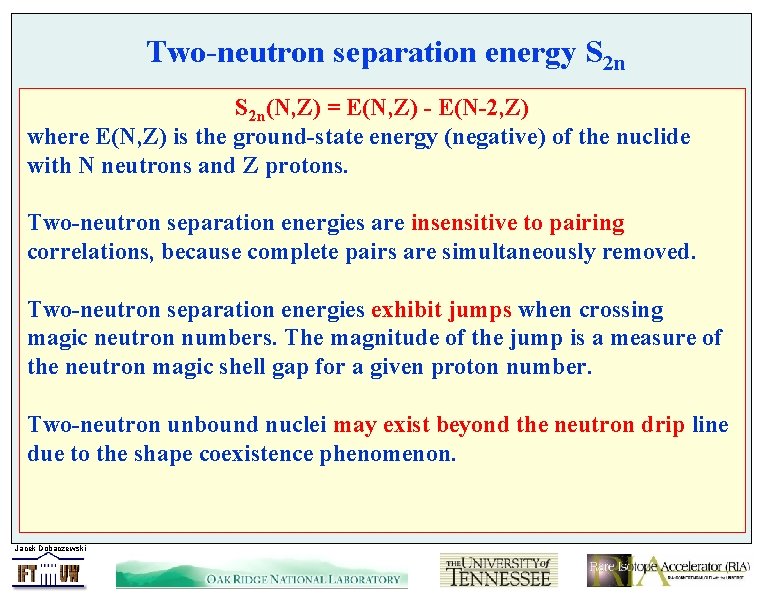
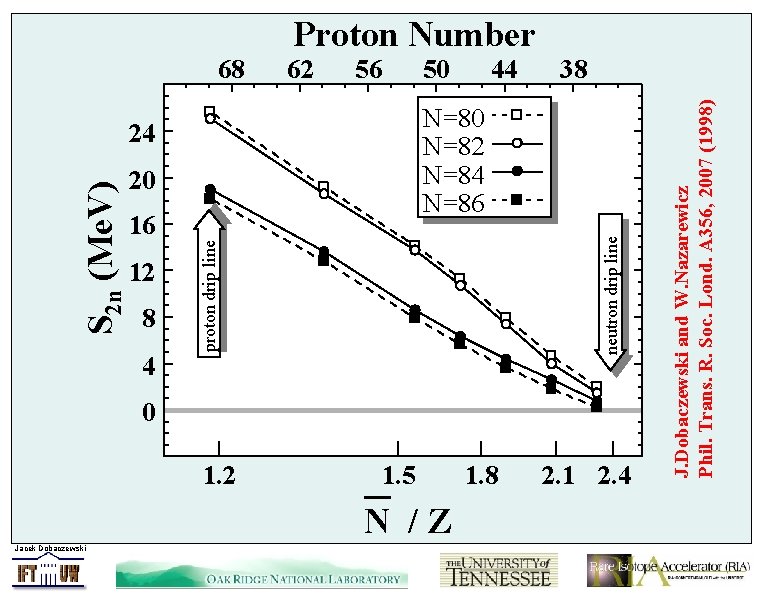
Two-neutron separation energy S 2 n(N, Z) = E(N, Z) - E(N-2, Z) where E(N, Z) is the ground-state energy (negative) of the nuclide with N neutrons and Z protons. Two-neutron separation energies are insensitive to pairing correlations, because complete pairs are simultaneously removed. Two-neutron separation energies exhibit jumps when crossing magic neutron numbers. The magnitude of the jump is a measure of the neutron magic shell gap for a given proton number. Two-neutron unbound nuclei may exist beyond the neutron drip line due to the shape coexistence phenomenon. Jacek Dobaczewski
Neutron & proton density distributions (n) Diffuseness (n) 150 Sn (p) Jacek Dobaczewski Skin (p) Halo
The Helm model S. Mizutori, et al. , Phys. Rev. C 61, 044326 (2000) Jacek Dobaczewski
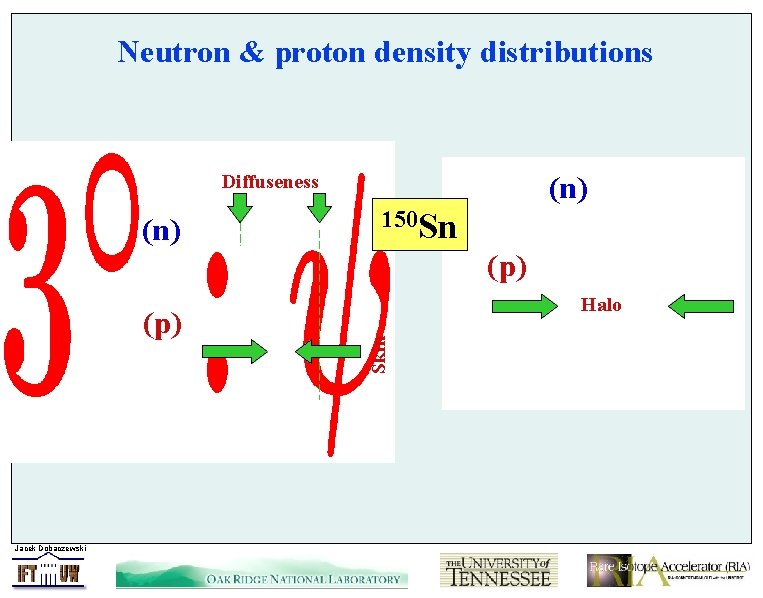
Neutron & proton density distributions Diffuseness of the density distribution is equal to the difference of radii where the density has values of 10% and 90% of the average central density. Better quantitative measure of the diffuseness can be formulated within the Helm model (step-like distribution folded with a Gaussian). Neutron skin size is equal to the difference of radii where the neutron and proton densities have values of 50% of their respective average central densities Better quantitative measure of the skin can be formulated within the Helm model as the difference of neutron and proton diffraction radii. Neutron halo size is the difference between the neutron root-meansquared and diffraction radii. Properties of the neutron halo are governed by the asymptotic features of tails of quantal wave functions. Jacek Dobaczewski
Asymptotic properties of mean-field single-particle wave functions Jacek Dobaczewski
Asymptotic properties of paired quasiparticle wave functions Jacek Dobaczewski
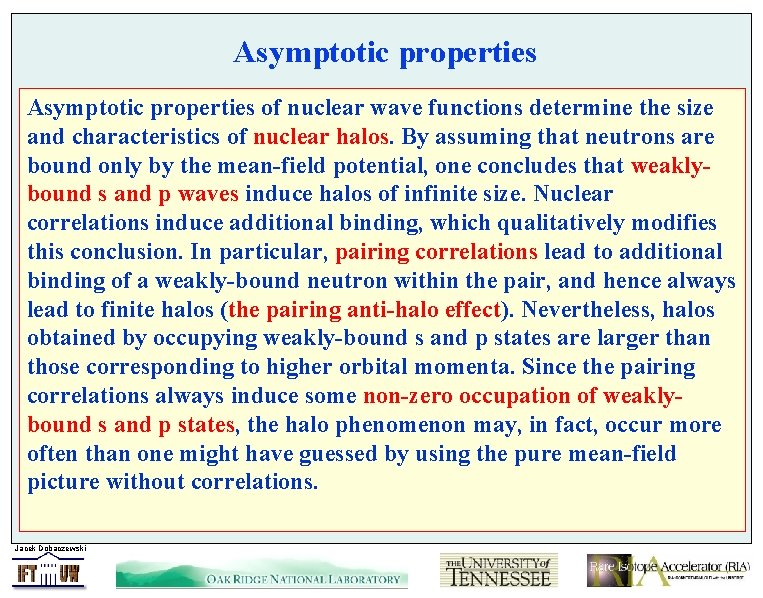
Asymptotic properties of nuclear wave functions determine the size and characteristics of nuclear halos. By assuming that neutrons are bound only by the mean-field potential, one concludes that weaklybound s and p waves induce halos of infinite size. Nuclear correlations induce additional binding, which qualitatively modifies this conclusion. In particular, pairing correlations lead to additional binding of a weakly-bound neutron within the pair, and hence always lead to finite halos (the pairing anti-halo effect). Nevertheless, halos obtained by occupying weakly-bound s and p states are larger than those corresponding to higher orbital momenta. Since the pairing correlations always induce some non-zero occupation of weaklybound s and p states, the halo phenomenon may, in fact, occur more often than one might have guessed by using the pure mean-field picture without correlations. Jacek Dobaczewski
- Slides: 53