
Web Services Choreography Description Language WSCDL Jacek Kopeck
Web Services Choreography Description Language (WS-CDL) Jacek Kopecký June 2004 Jacek Kopecký, jacek. kopecky@deri. org
What is WS-CDL? • Web Services Choreography Description Language • Early draft by W 3 C WS-Chor Working Group • No support from IBM, MS • Apparently initially from Oracle • Wild guess at Last Call sometime in 2005 • Main editor working on formalization June 2004 Jacek Kopecký, jacek. kopecky@deri. org 2
WS-CDL Overview • Global view of the observable behavior of a set of Web Services • Modeling as documentation • Central, top-down approach • Not executable process • Local choreographies can be generated from WS-CDL • Also skeletons for orchestration June 2004 Jacek Kopecký, jacek. kopecky@deri. org 3
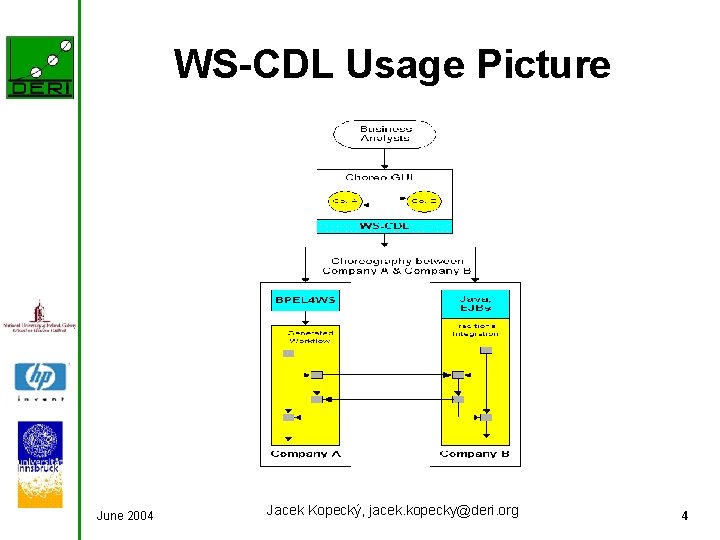
WS-CDL Usage Picture June 2004 Jacek Kopecký, jacek. kopecky@deri. org 4
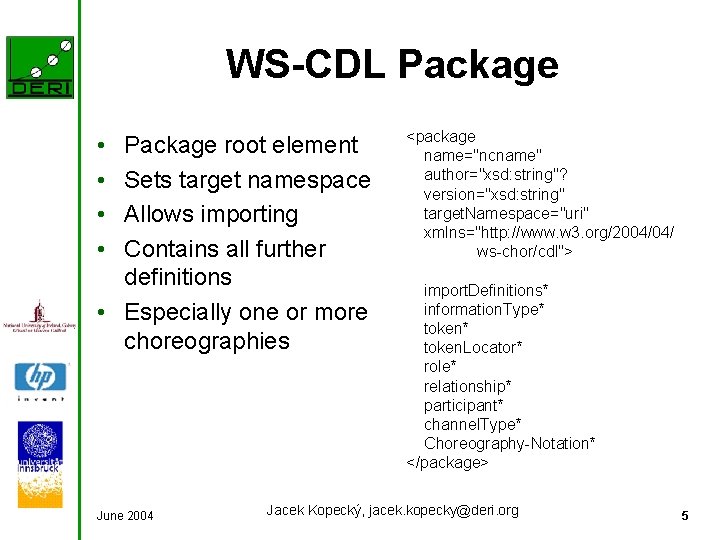
WS-CDL Package • • Package root element Sets target namespace Allows importing Contains all further definitions • Especially one or more choreographies June 2004 <package name="ncname" author="xsd: string"? version="xsd: string" target. Namespace="uri" xmlns="http: //www. w 3. org/2004/04/ ws-chor/cdl"> import. Definitions* information. Type* token. Locator* role* relationship* participant* channel. Type* Choreography-Notation* </package> Jacek Kopecký, jacek. kopecky@deri. org 5
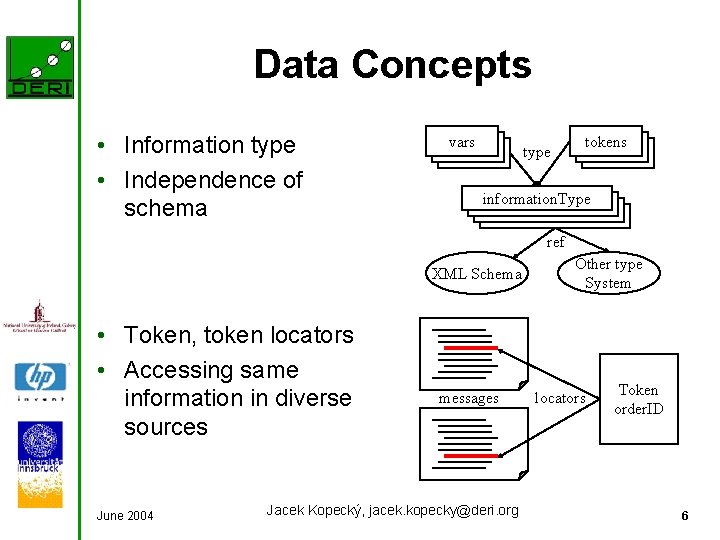
Data Concepts • Information type • Independence of schema vars type tokens information. Type ref XML Schema • Token, token locators • Accessing same information in diverse sources June 2004 messages Jacek Kopecký, jacek. kopecky@deri. org Other type System locators Token order. ID 6
Data Concepts (2) • Channel • For communication with a participant • Dynamic, actual endpoint in data • Can be passed around • Variables • Information exchange, state, channel variables • Reside in Roles June 2004 Jacek Kopecký, jacek. kopecky@deri. org 7
Participants & Roles • Enumerate behaviors, optionally linked to WSDL interfaces • Participants • Play one or more roles • Apparently not used in WS-CDL • Relationships • Associate specific behaviors of two roles “for a purpose” • Complex relationships broken down to pairs June 2004 Jacek Kopecký, jacek. kopecky@deri. org 8
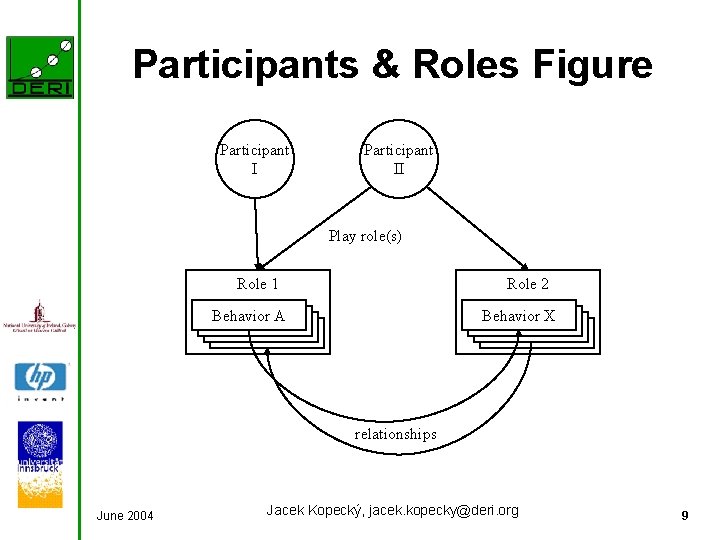
Participants & Roles Figure Participant II Play role(s) Role 1 Role 2 Behavior A Behavior X relationships June 2004 Jacek Kopecký, jacek. kopecky@deri. org 9
Choreography • The main thing WS-CDL defines • Scoping variables, exception handling and finalization • Finalization unclear • Contains a single activity • Initiated by a message June 2004 Jacek Kopecký, jacek. kopecky@deri. org 10
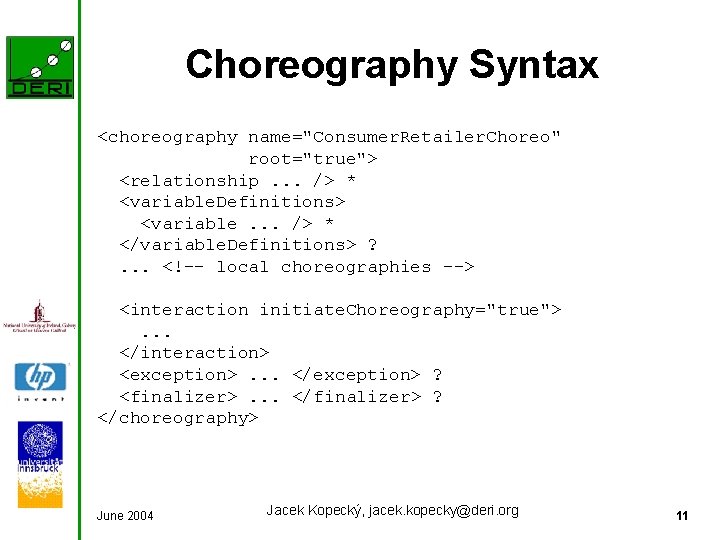
Choreography Syntax <choreography name="Consumer. Retailer. Choreo" root="true"> <relationship. . . /> * <variable. Definitions> <variable. . . /> * </variable. Definitions> ? . . . <!–- local choreographies --> <interaction initiate. Choreography="true">. . . </interaction> <exception>. . . </exception> ? <finalizer>. . . </finalizer> ? </choreography> June 2004 Jacek Kopecký, jacek. kopecky@deri. org 11
Activities • Perform actual work • Ordering structures (complex activities) • Sequence, parallel • Choice – implicit selection by incoming message • Work. Units (guarded activities) • Condition and repetition for activity • Optionally blocking on data availability • Example on next slide • Variable assignment • Create or update a variable in a role • No. Action • non-observable effects June 2004 Jacek Kopecký, jacek. kopecky@deri. org 12
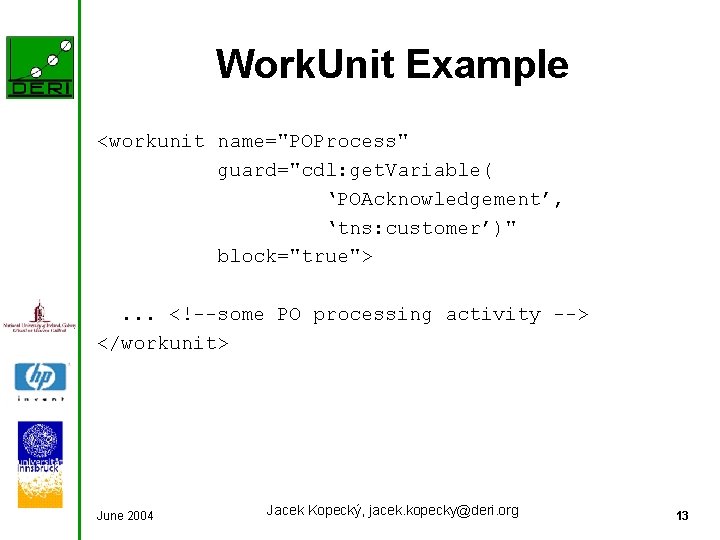
Work. Unit Example <workunit name="POProcess" guard="cdl: get. Variable( ‘POAcknowledgement’, ‘tns: customer’)" block="true">. . . <!--some PO processing activity --> </workunit> June 2004 Jacek Kopecký, jacek. kopecky@deri. org 13
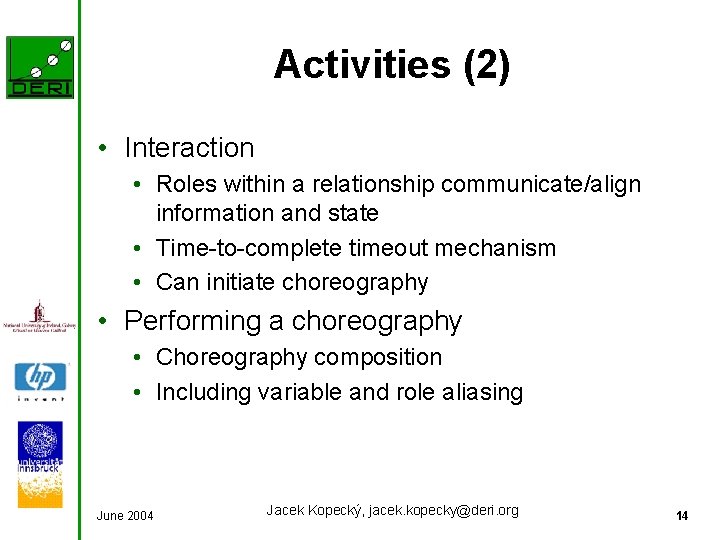
Activities (2) • Interaction • Roles within a relationship communicate/align information and state • Time-to-complete timeout mechanism • Can initiate choreography • Performing a choreography • Choreography composition • Including variable and role aliasing June 2004 Jacek Kopecký, jacek. kopecky@deri. org 14
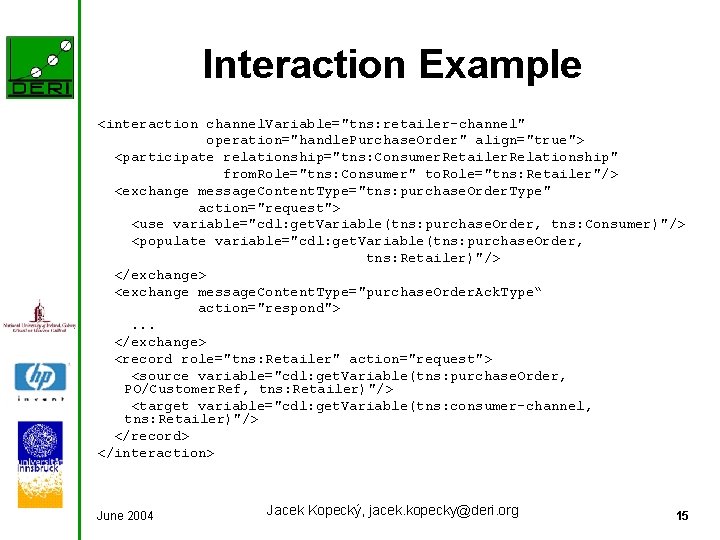
Interaction Example <interaction channel. Variable="tns: retailer-channel" operation="handle. Purchase. Order" align="true"> <participate relationship="tns: Consumer. Retailer. Relationship" from. Role="tns: Consumer" to. Role="tns: Retailer"/> <exchange message. Content. Type="tns: purchase. Order. Type" action="request"> <use variable="cdl: get. Variable(tns: purchase. Order, tns: Consumer)"/> <populate variable="cdl: get. Variable(tns: purchase. Order, tns: Retailer)"/> </exchange> <exchange message. Content. Type="purchase. Order. Ack. Type“ action="respond">. . . </exchange> <record role="tns: Retailer" action="request"> <source variable="cdl: get. Variable(tns: purchase. Order, PO/Customer. Ref, tns: Retailer)"/> <target variable="cdl: get. Variable(tns: consumer-channel, tns: Retailer)"/> </record> </interaction> June 2004 Jacek Kopecký, jacek. kopecky@deri. org 15
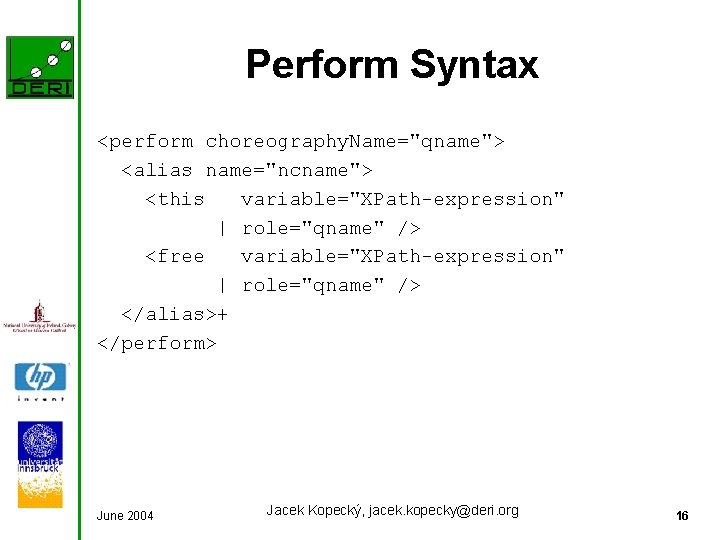
Perform Syntax <perform choreography. Name="qname"> <alias name="ncname"> <this variable="XPath-expression" | role="qname" /> <free variable="XPath-expression" | role="qname" /> </alias>+ </perform> June 2004 Jacek Kopecký, jacek. kopecky@deri. org 16
Q&A • Questions, answers • Thanks for your attention June 2004 Jacek Kopecký, jacek. kopecky@deri. org 17
- Slides: 17