ISPS 11 Security Training HZS ISPS 2006 2007

- Slides: 46
ISPS 11. Security Training HZS ISPS 2006 -2007 1
Security Training I. Training requirements HZS ISPS 2006 -2007 2
Don’t Be Kept In The Dark! HZS ISPS 2006 -2007 3
Before ISPS • Training requirements concerning security were very poor and generic • The only training requirement could be found within the STCW – Masters and chief officers on board of ships > 500 GT should be trained to maintain safety and security of ship’s crew and passengers. • The training on board was totally focused on safety; fire and boat drills, onboard emergency procedures, maintenance of safety systems etc. • No security matters were covered HZS ISPS 2006 -2007 4
After ISPS • • All of a sudden security training was there and in a very prominent way. The ISPS code reveals training requirements at 3 fundamental levels. 1. Security awareness 2. Provision of security 3. Management of security HZS ISPS 2006 -2007 5
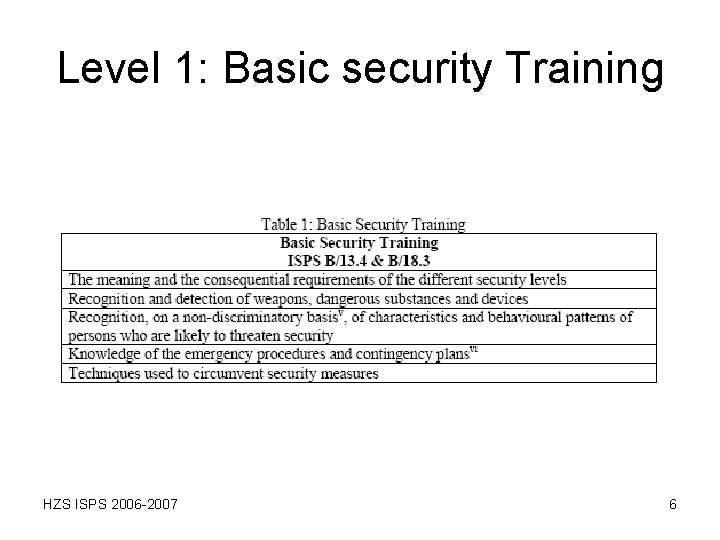
Level 1: Basic security Training HZS ISPS 2006 -2007 6
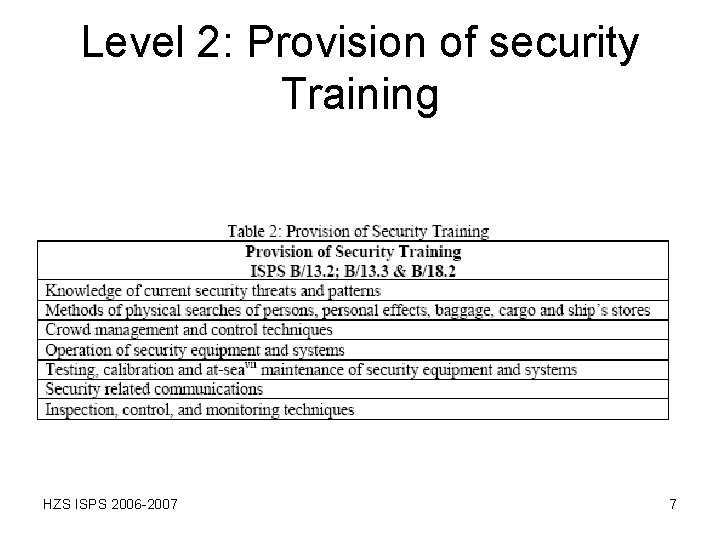
Level 2: Provision of security Training HZS ISPS 2006 -2007 7
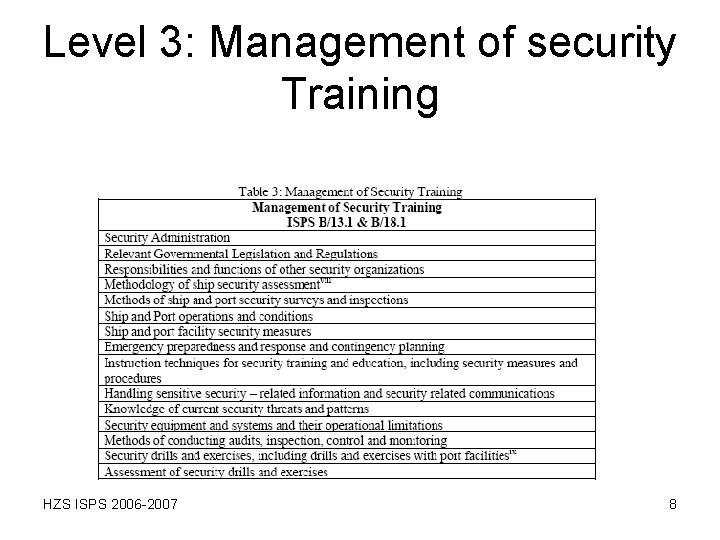
Level 3: Management of security Training HZS ISPS 2006 -2007 8
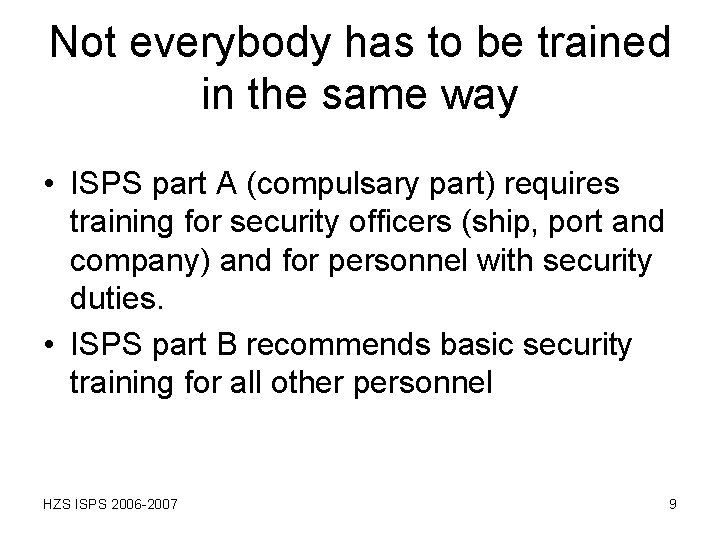
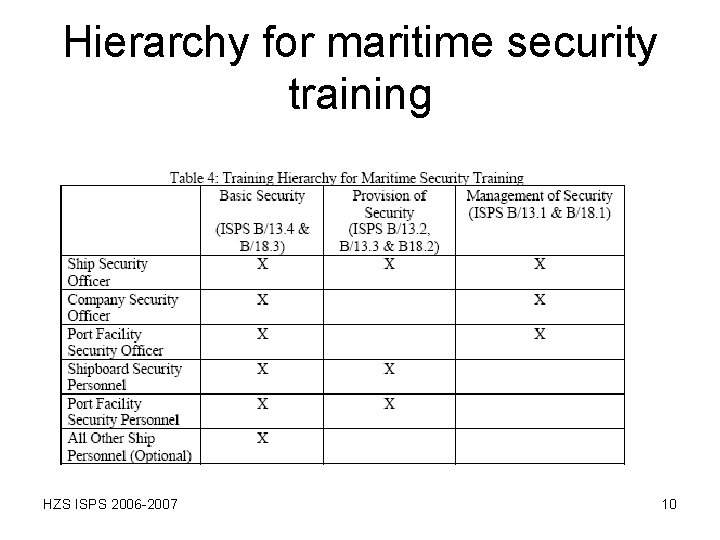
Not everybody has to be trained in the same way • ISPS part A (compulsary part) requires training for security officers (ship, port and company) and for personnel with security duties. • ISPS part B recommends basic security training for all other personnel HZS ISPS 2006 -2007 9
Hierarchy for maritime security training HZS ISPS 2006 -2007 10
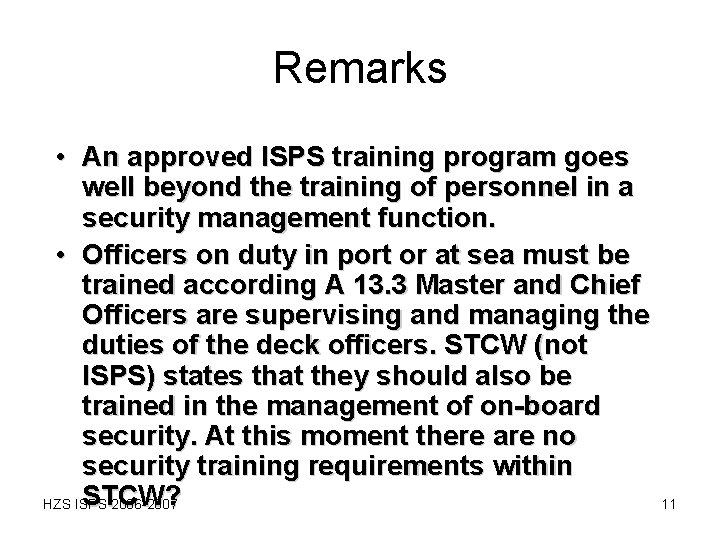
Remarks • An approved ISPS training program goes well beyond the training of personnel in a security management function. • Officers on duty in port or at sea must be trained according A 13. 3 Master and Chief Officers are supervising and managing the duties of the deck officers. STCW (not ISPS) states that they should also be trained in the management of on-board security. At this moment there are no security training requirements within STCW? HZS ISPS 2006 -2007 11
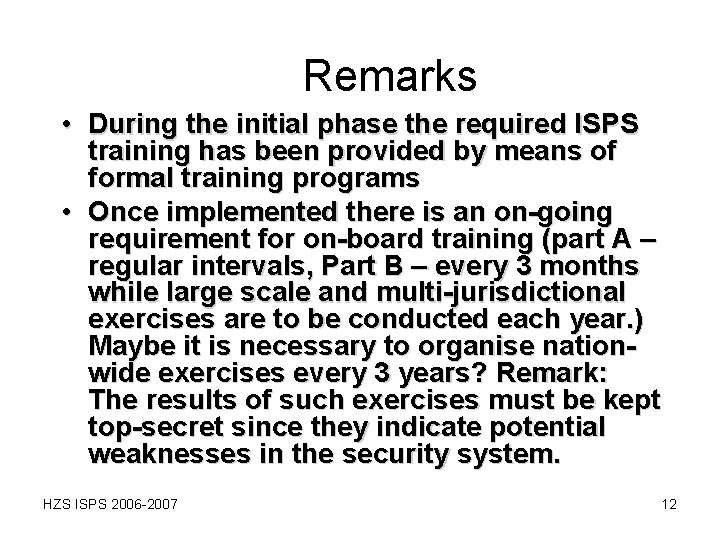
Remarks • During the initial phase the required ISPS training has been provided by means of formal training programs • Once implemented there is an on-going requirement for on-board training (part A – regular intervals, Part B – every 3 months while large scale and multi-jurisdictional exercises are to be conducted each year. ) Maybe it is necessary to organise nationwide exercises every 3 years? Remark: The results of such exercises must be kept top-secret since they indicate potential weaknesses in the security system. HZS ISPS 2006 -2007 12
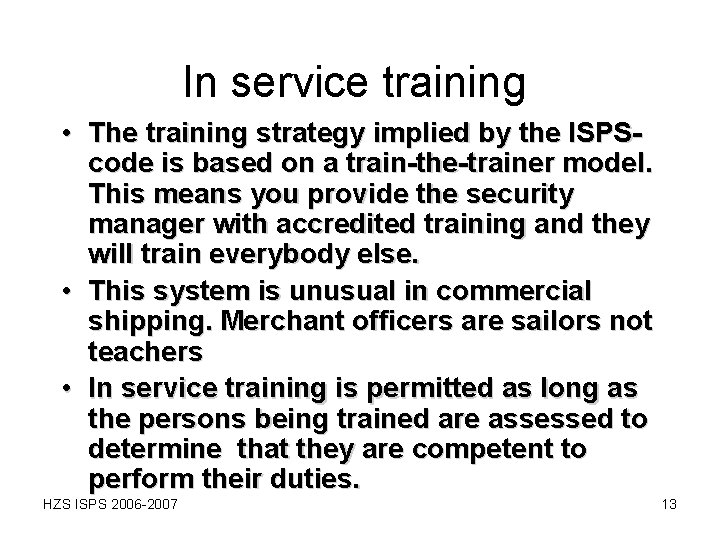
In service training • The training strategy implied by the ISPScode is based on a train-the-trainer model. This means you provide the security manager with accredited training and they will train everybody else. • This system is unusual in commercial shipping. Merchant officers are sailors not teachers • In service training is permitted as long as the persons being trained are assessed to determine that they are competent to perform their duties. HZS ISPS 2006 -2007 13
In service training • The role of the security officers is vital • Under the STCW-context it is required that the training is covered by a quality assurance program. (ISM-procedures) • Another possibility is to seek training providers that have developed modules that can be used by the ship Security Officers or by training providers during on board training sessions – Module covering basic security requirement – Module covering provisions and security elements • This way of working makes approval by the competent authorities easier HZS ISPS 2006 -2007 14
Course Content • A problem when it comes to national legislations • ISPS has been implemented at a speed never seen before. The national legislations have to follow but this does not happen at the same speed => gap between the flagstate obligations and the international legislation HZS ISPS 2006 -2007 15
Crisis management Training • The training requirements described in the ISPS Code seem to presume that the security officers have some basic understanding of crisis management. While this assumption is true for military/coast guard personnel (whose operations are exempted from the ISPS Code), and may be true for security officers in the oil and gas and passenger vessel industries, it is not necessarily true for merchant mariners trained to STCW standards. • BRM only helps when it comes to internal issues related to a crisis • BRM training is still not compulsary. • Making BRM compulsary would make ISPS HZS ISPS 2006 -2007 more effective 16 training
Crisis management Training • Coordinating security efforts with other organisations require the installation of a standard structure such as ICS = Incident command system • A critical feature of ICS is that everyone adapts a common vocabulary, utilize standardized forms, and receive basic training on how ICS works. HZS ISPS 2006 -2007 17
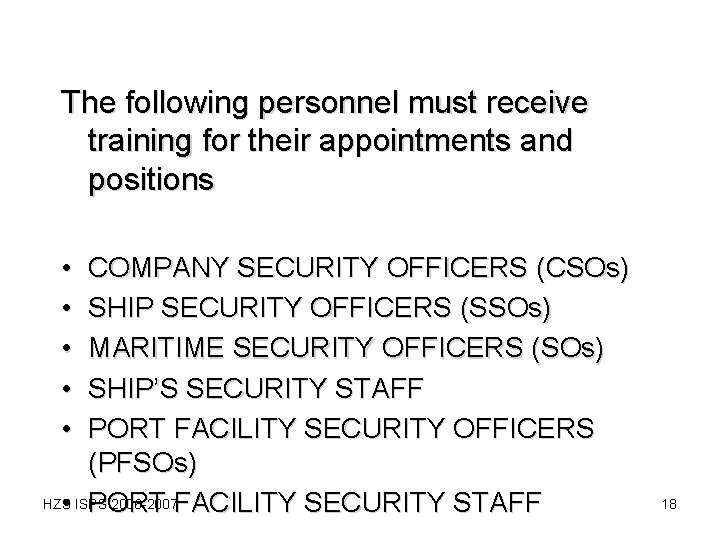
The following personnel must receive training for their appointments and positions • • • COMPANY SECURITY OFFICERS (CSOs) SHIP SECURITY OFFICERS (SSOs) MARITIME SECURITY OFFICERS (SOs) SHIP’S SECURITY STAFF PORT FACILITY SECURITY OFFICERS (PFSOs) HZS 2006 -2007 FACILITY SECURITY STAFF • ISPS PORT 18
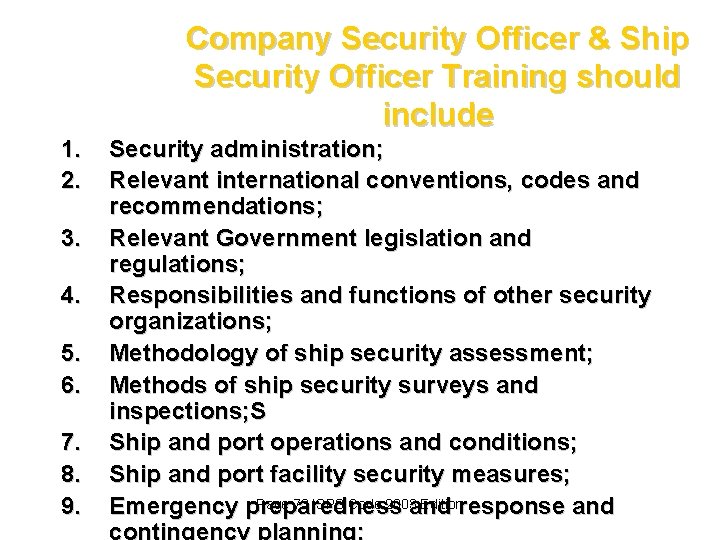
Company Security Officer & Ship Security Officer Training should include 1. 2. 3. 4. 5. 6. 7. 8. 9. Security administration; Relevant international conventions, codes and recommendations; Relevant Government legislation and regulations; Responsibilities and functions of other security organizations; Methodology of ship security assessment; Methods of ship security surveys and inspections; S Ship and port operations and conditions; Ship and port facility security measures; Page 73 ISPS Code 2003 Editionresponse and Emergency preparedness and contingency planning;
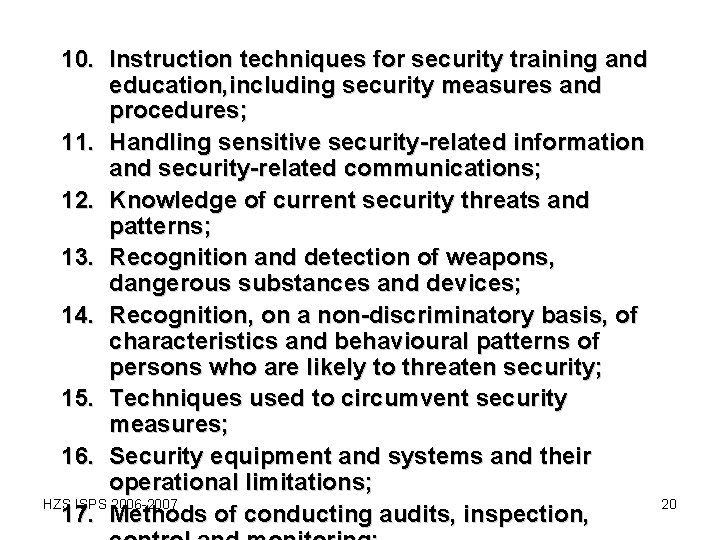
10. Instruction techniques for security training and education, including security measures and procedures; 11. Handling sensitive security-related information and security-related communications; 12. Knowledge of current security threats and patterns; 13. Recognition and detection of weapons, dangerous substances and devices; 14. Recognition, on a non-discriminatory basis, of characteristics and behavioural patterns of persons who are likely to threaten security; 15. Techniques used to circumvent security measures; 16. Security equipment and systems and their operational limitations; HZS ISPS 2006 -2007 17. Methods of conducting audits, inspection, 20
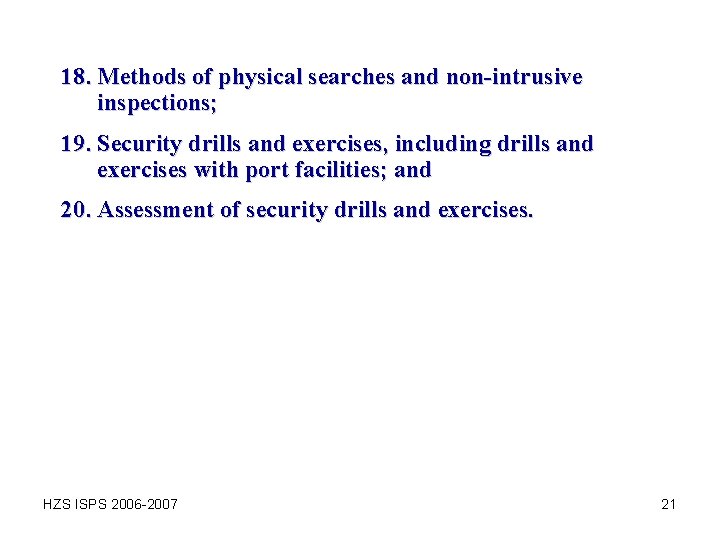
18. Methods of physical searches and non-intrusive inspections; 19. Security drills and exercises, including drills and exercises with port facilities; and 20. Assessment of security drills and exercises. HZS ISPS 2006 -2007 21
1. 2. 3. 4. In addition, the Ship Security Officer should have adequate knowledge of, and receive training in, some or all of the following, as appropriate The layout of the ship; The ship security plan (SSP) and related procedures (including scenario-based training on how to respond); Crowd management and control techniques; Operations of security equipment and systems; and Testing, calibration and at-sea maintenance of security equipment and systems. Page 73 ISPS Code 2003 Edition
Shipboard personnel having specific security duties should have sufficient knowledge and ability to perform their assigned duties including, 1. Knowledge of current security threats and patterns; 2. Recognition and detection of weapons, dangerous substances and devices; 3. Recognition of characteristics and behavioural patterns of persons who are likely to threaten security; 4. Techniques used to circumvent security measures; ISPS 2006 -2007 5. HZS Crowd management and control techniques; 23
7. knowledge of the emergency procedures and contingency plans; 8. Operations of security equipment and systems; 9. Testing, calibration and at-sea maintenance of security equipment and systems; 10. Inspection, control, and monitoring techniques; and 11. Methods of physical searches of persons, personal effects, baggage, cargo, and ship's stores. HZS ISPS 2006 -2007 24
All other shipboard personnel should have sufficient knowledge of and be familiar with relevant provisions of the SSP, including: 1. The meaning and the consequential requirements of the different security levels; 2. Knowledge of the emergency procedures and contingency plans; 3. Recognition and detection of weapons, dangerous substances and devices; 4. Recognition, on a non-discriminatory basis, of characteristics and behavioural patterns of persons who are likely to threaten security; and 5. Techniques used to circumvent security HZSmeasures. ISPS 2006 -2007 25
Drills and exercises • Organsation of these drills and exercises is one of the main responsabilities of the SSO • The SSP is a living document that should be updated ceaseless • The SSP should be in line with most probable and realistic threats (changing) • Drills and exercises are the proper method to maintain and improve the SSP HZS ISPS 2006 -2007 26
Drills and exercises • The objective of drills and exercises is to ensure that shipboard personnel are proficient in all assigned security duties at all security levels and the identification of any security-related deficiencies which need to be addressed. HZS ISPS 2006 -2007 27
• To ensure the effective implementation of the provisions of the ship security plan, drills should be conducted at least once every three months. In addition, in cases where more than 25% of the ship's personnel has been changed, at any one time, with personnel that has not previously participated in any drill on that ship within the last 3 months, a drill should be conducted within one week of the change. HZS ISPS 2006 -2007 28
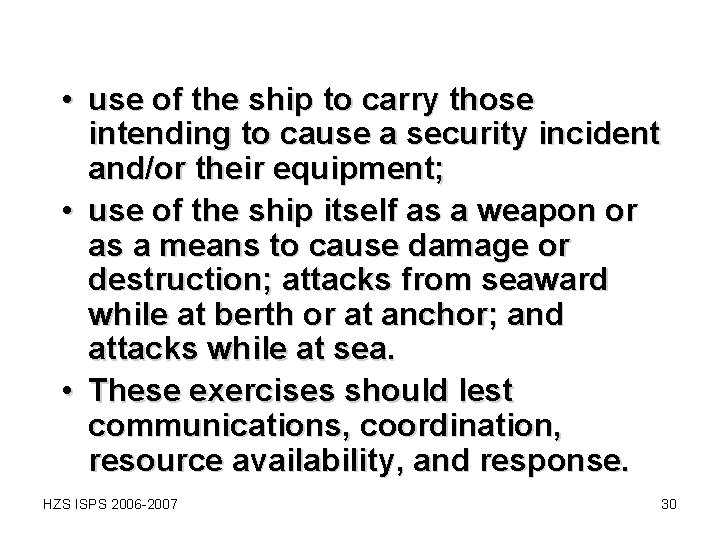
Drills should test individual elements of SSP such as: • Damage to, or destruction of, the ship or of a port facility, e. g. by explosive devices, arson, sabotage or vandalism; • Hi-jacking or seizure of the ship or of persons on board; • Tampering with cargo, essential ship equipment or systems or ship's stores; • unauthorized access or use, including presence of stowaways; • Smuggling weapons or equipment, including weapons of mass destruction; HZS ISPS 2006 -2007 29
• use of the ship to carry those intending to cause a security incident and/or their equipment; • use of the ship itself as a weapon or as a means to cause damage or destruction; attacks from seaward while at berth or at anchor; and attacks while at sea. • These exercises should lest communications, coordination, resource availability, and response. HZS ISPS 2006 -2007 30
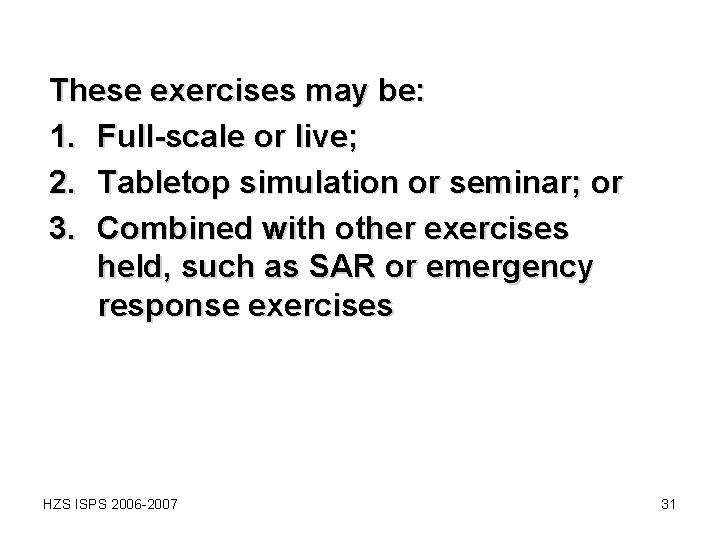
These exercises may be: 1. Full-scale or live; 2. Tabletop simulation or seminar; or 3. Combined with other exercises held, such as SAR or emergency response exercises HZS ISPS 2006 -2007 31
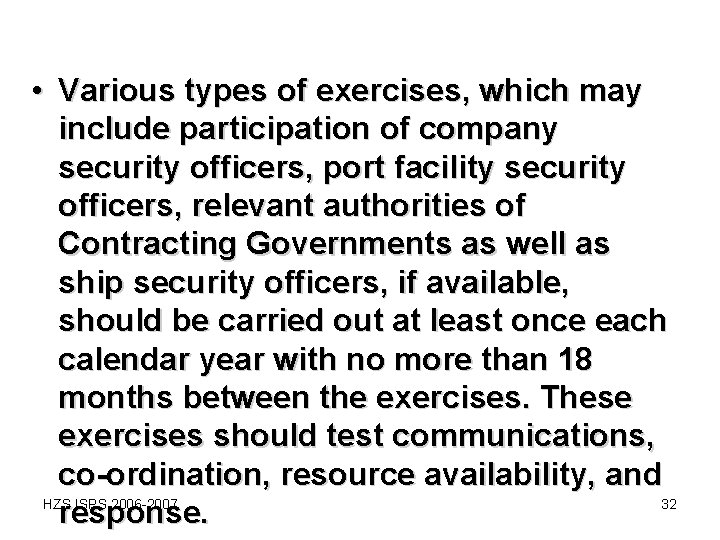
• Various types of exercises, which may include participation of company security officers, port facility security officers, relevant authorities of Contracting Governments as well as ship security officers, if available, should be carried out at least once each calendar year with no more than 18 months between the exercises. These exercises should test communications, co-ordination, resource availability, and HZS ISPS 2006 -2007 32 response.
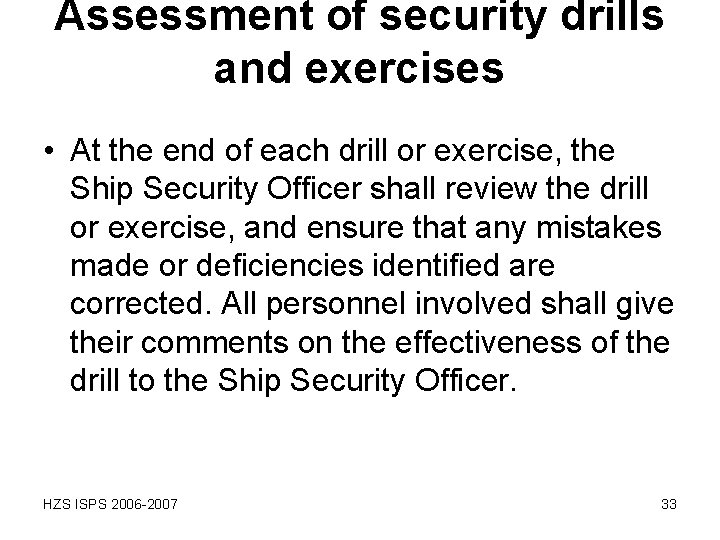
Assessment of security drills and exercises • At the end of each drill or exercise, the Ship Security Officer shall review the drill or exercise, and ensure that any mistakes made or deficiencies identified are corrected. All personnel involved shall give their comments on the effectiveness of the drill to the Ship Security Officer. HZS ISPS 2006 -2007 33
The following slides can be used as hand-out or aide mémoire when composing the security training program for officers and crew on board HZS ISPS 2006 -2007 34
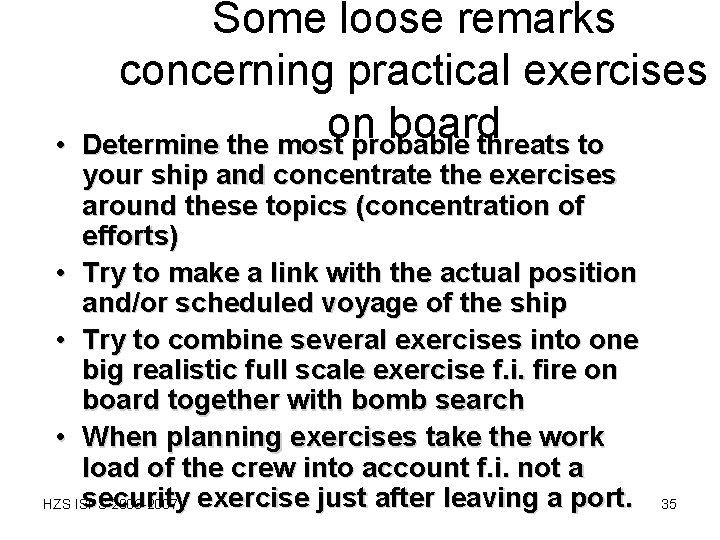
• Some loose remarks concerning practical exercises on board Determine the most probable threats to your ship and concentrate the exercises around these topics (concentration of efforts) • Try to make a link with the actual position and/or scheduled voyage of the ship • Try to combine several exercises into one big realistic full scale exercise f. i. fire on board together with bomb search • When planning exercises take the work load of the crew into account f. i. not a security HZS ISPS 2006 -2007 exercise just after leaving a port. 35
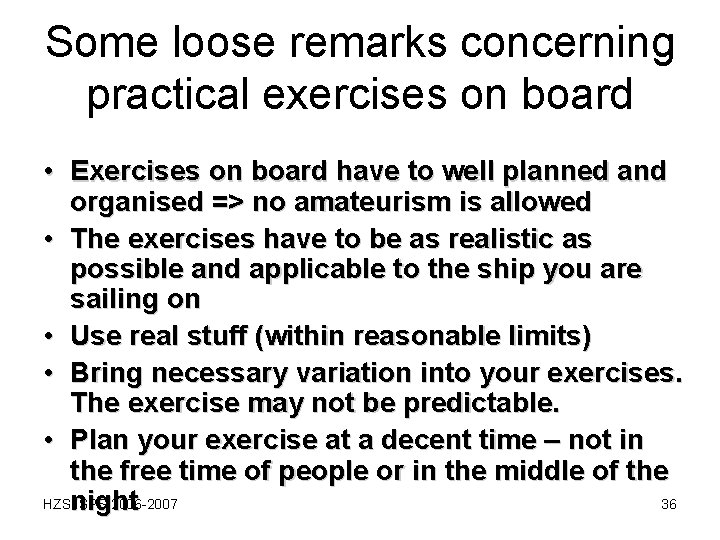
Some loose remarks concerning practical exercises on board • Exercises on board have to well planned and organised => no amateurism is allowed • The exercises have to be as realistic as possible and applicable to the ship you are sailing on • Use real stuff (within reasonable limits) • Bring necessary variation into your exercises. The exercise may not be predictable. • Plan your exercise at a decent time – not in the free time of people or in the middle of the HZSnight ISPS 2006 -2007 36
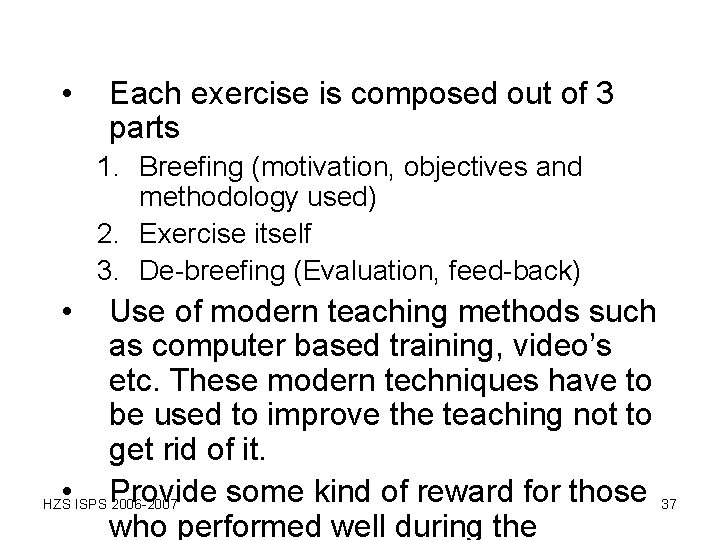
• Each exercise is composed out of 3 parts 1. Breefing (motivation, objectives and methodology used) 2. Exercise itself 3. De-breefing (Evaluation, feed-back) • Use of modern teaching methods such as computer based training, video’s etc. These modern techniques have to be used to improve the teaching not to get rid of it. • ISPS Provide some kind of reward for those 37 HZS 2006 -2007 who performed well during the
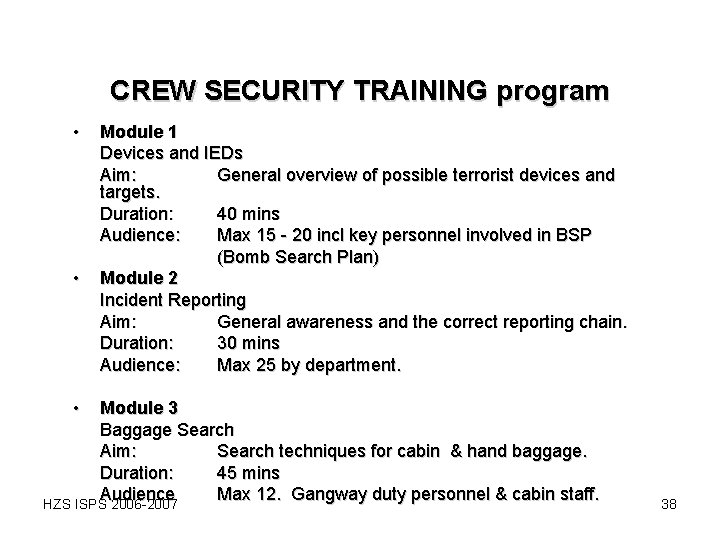
CREW SECURITY TRAINING program • • Module 1 Devices and IEDs Aim: General overview of possible terrorist devices and targets. Duration: 40 mins Audience: Max 15 - 20 incl key personnel involved in BSP (Bomb Search Plan) Module 2 Incident Reporting Aim: General awareness and the correct reporting chain. Duration: 30 mins Audience: Max 25 by department. • Module 3 Baggage Search Aim: Search techniques for cabin & hand baggage. Duration: 45 mins Audience Max 12. Gangway duty personnel & cabin staff. HZS ISPS 2006 -2007 38
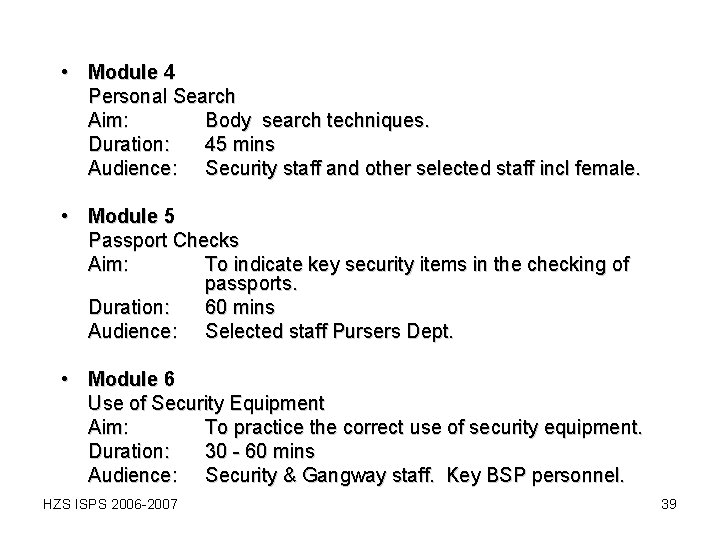
• Module 4 Personal Search Aim: Body search techniques. Duration: 45 mins Audience: Security staff and other selected staff incl female. • Module 5 Passport Checks Aim: To indicate key security items in the checking of passports. Duration: 60 mins Audience: Selected staff Pursers Dept. • Module 6 Use of Security Equipment Aim: To practice the correct use of security equipment. Duration: 30 - 60 mins Audience: Security & Gangway staff. Key BSP personnel. HZS ISPS 2006 -2007 39
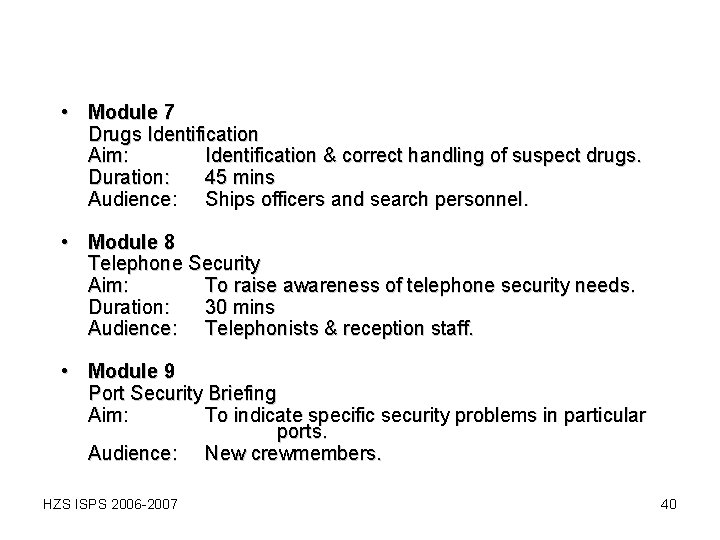
• Module 7 Drugs Identification Aim: Identification & correct handling of suspect drugs. Duration: 45 mins Audience: Ships officers and search personnel. • Module 8 Telephone Security Aim: To raise awareness of telephone security needs. Duration: 30 mins Audience: Telephonists & reception staff. • Module 9 Port Security Briefing Aim: To indicate specific security problems in particular ports. Audience: New crewmembers. HZS ISPS 2006 -2007 40
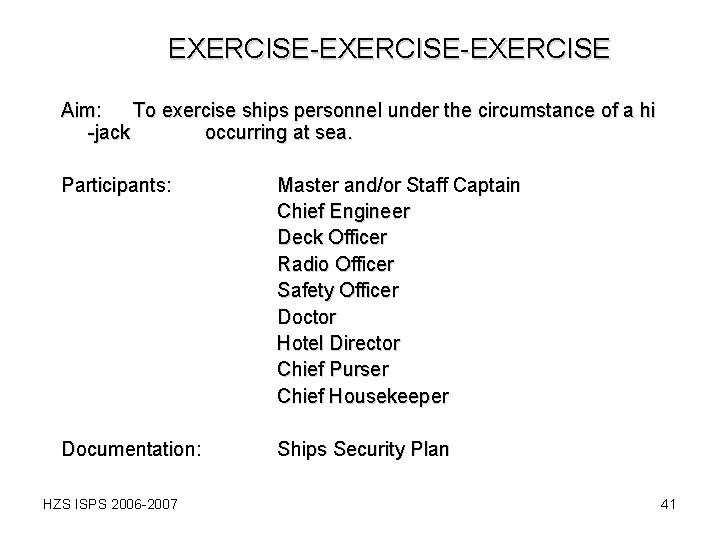
EXERCISE-EXERCISE Aim: To exercise ships personnel under the circumstance of a hi -jack occurring at sea. Participants: Master and/or Staff Captain Chief Engineer Deck Officer Radio Officer Safety Officer Doctor Hotel Director Chief Purser Chief Housekeeper Documentation: Ships Security Plan HZS ISPS 2006 -2007 41
Method: Serials given below represent a series of events. The requirement is to consider what actions, if any, could or should be taken by key individuals to minimise the risk to life and property and to protect Company interest. Serial 1 3 Hrs after leaving embarkation port. Three UK males appear on bridge with weapons (pistols). Watch Officer threatened and asked whereabouts of Master (Day Cabin). Two males escort Watch Officer to cabin and return with Master approx. 4 mins later. 2 One male Hi-jacker? Leaves the bridge and returns after 4 mins with 2 other persons also armed. (Possible grenades, 1 x automatic sub machine gun and a suitcase (poss parcel bomb). 3 One male (leader) uses hand held radio. (Not ships equipment). Watch Officer told to secure Bridge main and Wing doors. After 5 mins Master informed on Bridge telephone by Staff Engr that 1 x armed male is in Engine Room and by Duty Receptionist that 1 x armed female in Chief Pursers Office. 4. Master told to summon Radio Officer to Bridge and instruct Company Operations that ship has been seized by Chechnya Liberation Army and to standby for urgent demands to FRG Government concerning the 42 HZS ISPS 2006 -2007 release of Chechnian patriots held in Frankfurt as Political Prisoners.
5. Master instructed to use PA system to request all passengers to return to their cabins. 6. Three hi-jackers leave Bridge with satchel (bomb? ). 7. Master instructed to use PA system to assemble all crew in Muster Stn A. 8. Receptionist uses Ships Radio to report reception phone jammed by pax calls requesting info. 9. Reported on Bridge phone - 1 x crewman injured (poss gsw to leg) lift lobby Promenaden. 10. Master informed by one hi-jacker (leader? ) that a bomb has been placed in a key location and will be detonated by radio if any resistance encountered. 11. Radio Officer instructed to despatch lengthy text document of ‘demands’ to Coy. 12. Radio Officer informs Master he has been instructed to downpower all Satellite Comms. 13. Hotel Director reports passengers leaving their cabins in order to find out what is happening. 14. Hi-jack leader demands food is taken to Bridge, Engine Room, Reception HZS ISPS 2006 -2007 and cabin 6. 43
15. Master told to bring all passenger Passports to Bridge and to identify all passengers who are FRG employees. 16. Doctor reports injured crewman needs urgent attention on shore. 17. Master instructed to have all passenger and crew mobile phones collected on aft mooring deck. 18. Hi-jack leader instruct Radio Officer to take one man to the TV Centre for a ship announcement. 19. A lady passenger arrives at main Bridge door and says she thinks her husband is suffering a heart attack. 20. Sole hi-jacker left on Bridge asks location of toilet and leaves the bridge. EXERCISE - EXERCISE HZS ISPS 2006 -2007 44
HZS ISPS 2006 -2007 45
!! Good Luck !! HZS ISPS 2006 -2007 46