Introduction to Information Retrieval LINK ANALYSIS 1 Introduction



- Slides: 84
Introduction to Information Retrieval LINK ANALYSIS 1
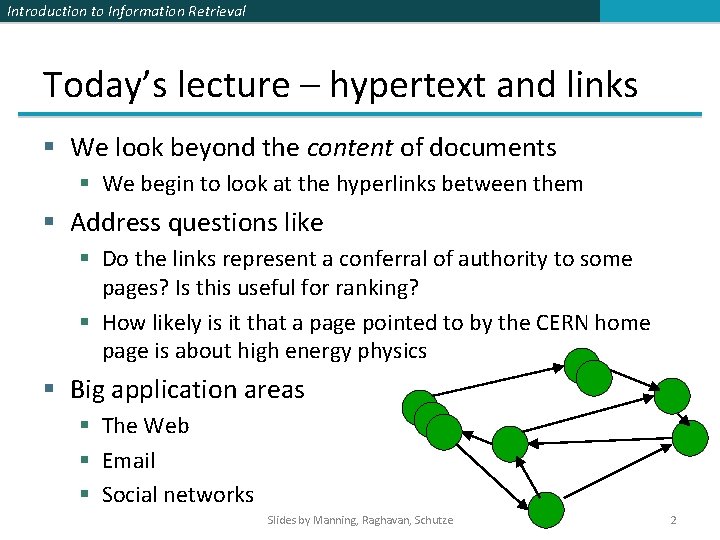
Introduction to Information Retrieval Today’s lecture – hypertext and links § We look beyond the content of documents § We begin to look at the hyperlinks between them § Address questions like § Do the links represent a conferral of authority to some pages? Is this useful for ranking? § How likely is it that a page pointed to by the CERN home page is about high energy physics § Big application areas § The Web § Email § Social networks Slides by Manning, Raghavan, Schutze 2
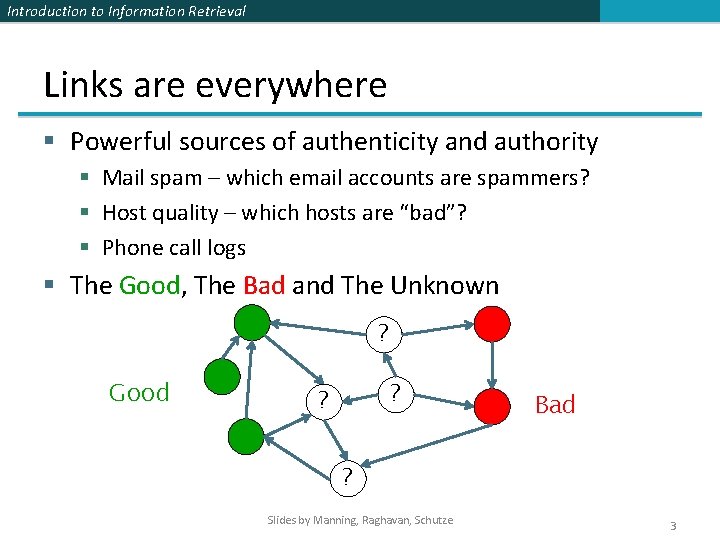
Introduction to Information Retrieval Links are everywhere § Powerful sources of authenticity and authority § Mail spam – which email accounts are spammers? § Host quality – which hosts are “bad”? § Phone call logs § The Good, The Bad and The Unknown ? Good ? ? Bad ? Slides by Manning, Raghavan, Schutze 3
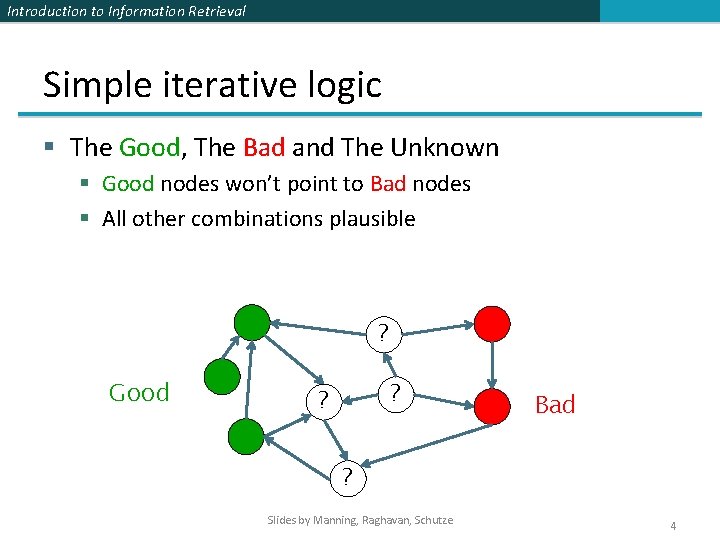
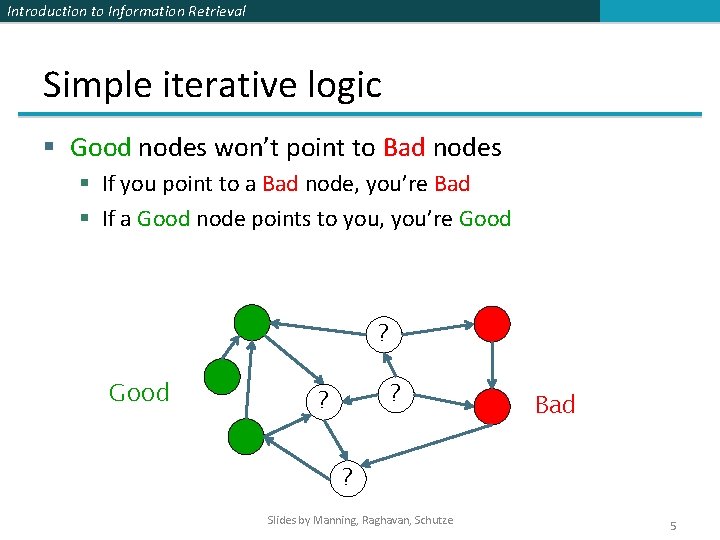
Introduction to Information Retrieval Simple iterative logic § The Good, The Bad and The Unknown § Good nodes won’t point to Bad nodes § All other combinations plausible ? Good ? ? Bad ? Slides by Manning, Raghavan, Schutze 4
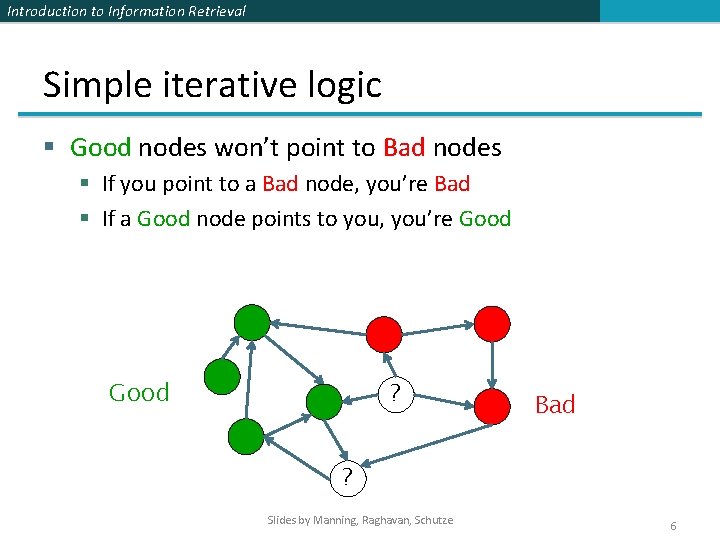
Introduction to Information Retrieval Simple iterative logic § Good nodes won’t point to Bad nodes § If you point to a Bad node, you’re Bad § If a Good node points to you, you’re Good ? ? Bad ? Slides by Manning, Raghavan, Schutze 5
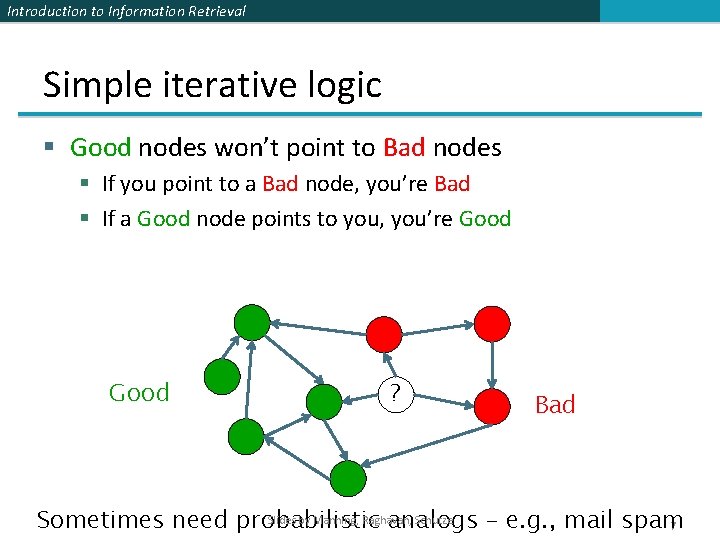
Introduction to Information Retrieval Simple iterative logic § Good nodes won’t point to Bad nodes § If you point to a Bad node, you’re Bad § If a Good node points to you, you’re Good ? Good Bad ? Slides by Manning, Raghavan, Schutze 6
Introduction to Information Retrieval Simple iterative logic § Good nodes won’t point to Bad nodes § If you point to a Bad node, you’re Bad § If a Good node points to you, you’re Good ? Bad Slides by Manning, Raghavan, Schutze Sometimes need probabilistic analogs – e. g. , mail spam 7
Introduction to Information Retrieval Many other examples of link analysis § Social networks are a rich source of grouping behavior § E. g. , Shoppers’ affinity – Goel+Goldstein 2010 § Consumers whose friends spend a lot, spend a lot themselves § http: //www. cs. cornell. edu/home/kleinber/networks-book/ Slides by Manning, Raghavan, Schutze 8
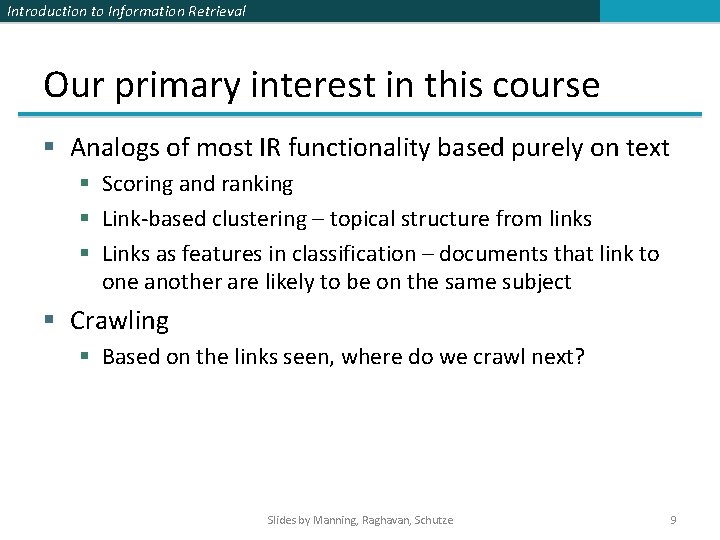
Introduction to Information Retrieval Our primary interest in this course § Analogs of most IR functionality based purely on text § Scoring and ranking § Link-based clustering – topical structure from links § Links as features in classification – documents that link to one another are likely to be on the same subject § Crawling § Based on the links seen, where do we crawl next? Slides by Manning, Raghavan, Schutze 9
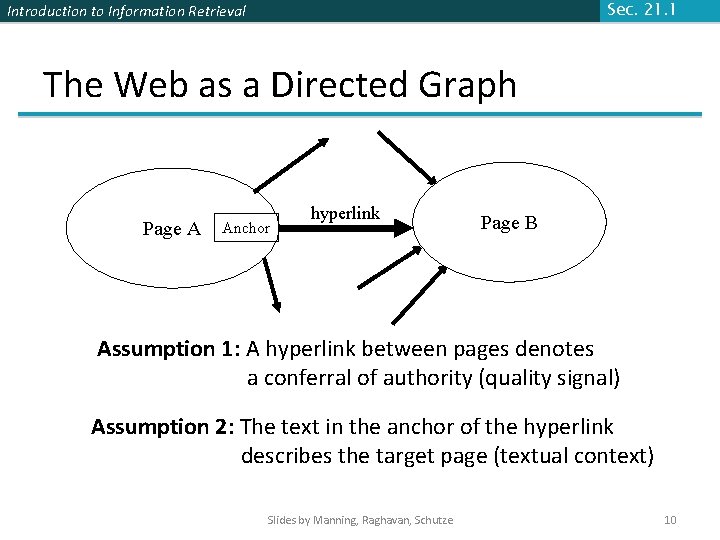
Introduction to Information Retrieval Sec. 21. 1 The Web as a Directed Graph Page A Anchor hyperlink Page B Assumption 1: A hyperlink between pages denotes a conferral of authority (quality signal) Assumption 2: The text in the anchor of the hyperlink describes the target page (textual context) Slides by Manning, Raghavan, Schutze 10
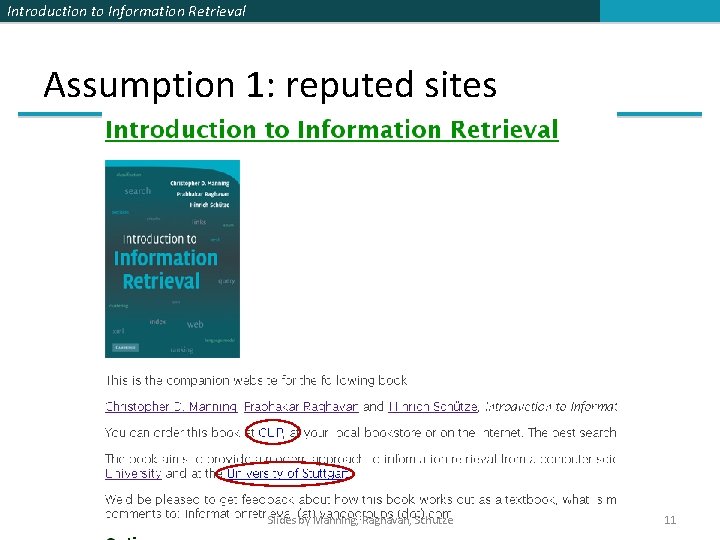
Introduction to Information Retrieval Assumption 1: reputed sites Slides by Manning, Raghavan, Schutze 11
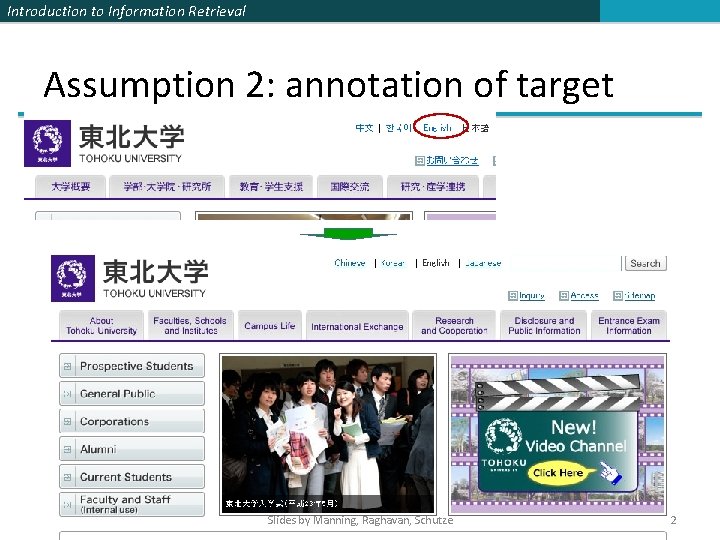
Introduction to Information Retrieval Assumption 2: annotation of target Slides by Manning, Raghavan, Schutze 12
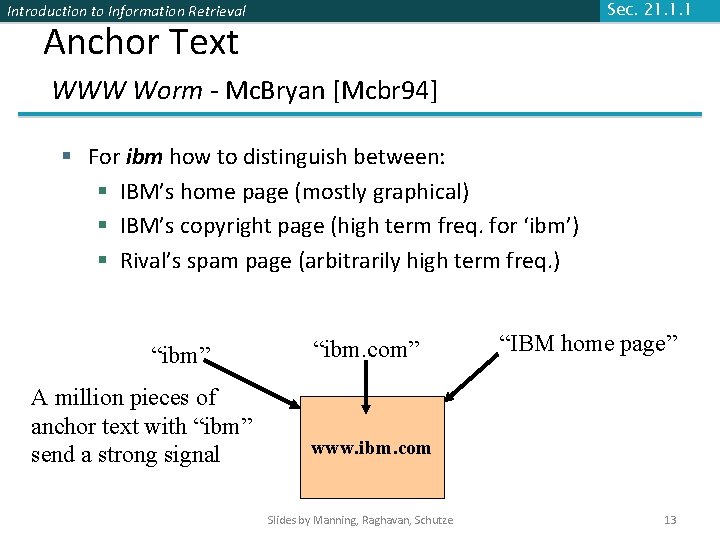
Introduction to Information Retrieval Anchor Text Sec. 21. 1. 1 WWW Worm - Mc. Bryan [Mcbr 94] § For ibm how to distinguish between: § IBM’s home page (mostly graphical) § IBM’s copyright page (high term freq. for ‘ibm’) § Rival’s spam page (arbitrarily high term freq. ) “ibm” A million pieces of anchor text with “ibm” send a strong signal “ibm. com” “IBM home page” www. ibm. com Slides by Manning, Raghavan, Schutze 13
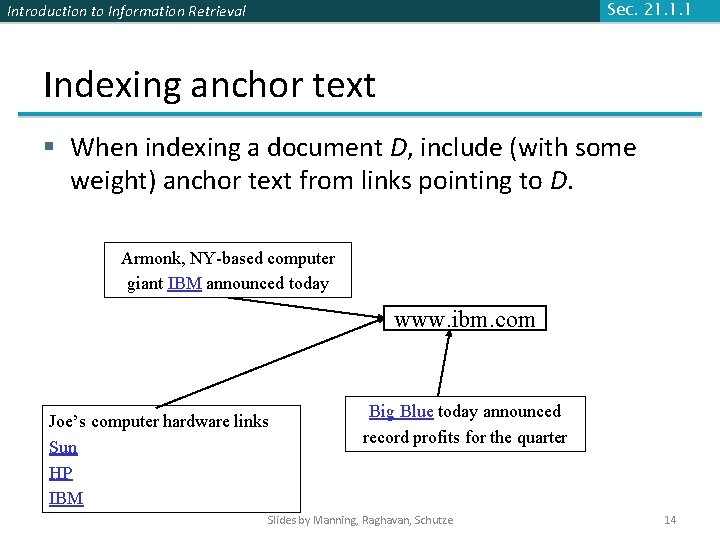
Introduction to Information Retrieval Sec. 21. 1. 1 Indexing anchor text § When indexing a document D, include (with some weight) anchor text from links pointing to D. Armonk, NY-based computer giant IBM announced today www. ibm. com Joe’s computer hardware links Sun HP IBM Big Blue today announced record profits for the quarter Slides by Manning, Raghavan, Schutze 14
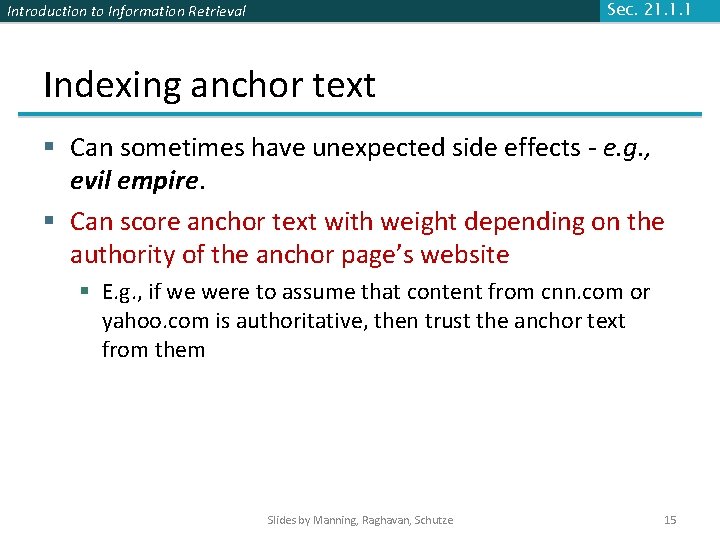
Introduction to Information Retrieval Sec. 21. 1. 1 Indexing anchor text § Can sometimes have unexpected side effects - e. g. , evil empire. § Can score anchor text with weight depending on the authority of the anchor page’s website § E. g. , if we were to assume that content from cnn. com or yahoo. com is authoritative, then trust the anchor text from them Slides by Manning, Raghavan, Schutze 15
Introduction to Information Retrieval Sec. 21. 1. 1 Anchor Text § Other applications § Weighting/filtering links in the graph § Generating page descriptions from anchor text Slides by Manning, Raghavan, Schutze 16
Introduction to Information Retrieval Citation Analysis § Citation frequency § Bibliographic coupling frequency § Articles that co-cite the same articles are related § Citation indexing § Who is this author cited by? (Garfield 1972) § Pagerank preview: Pinsker and Narin ’ 60 s Slides by Manning, Raghavan, Schutze 17
Introduction to Information Retrieval The web isn’t scholarly citation § Millions of participants, each with self interests § Spamming is widespread § Once search engines began to use links for ranking (roughly 1998), link spam grew § You can join a group of websites that heavily link to one another Slides by Manning, Raghavan, Schutze 18
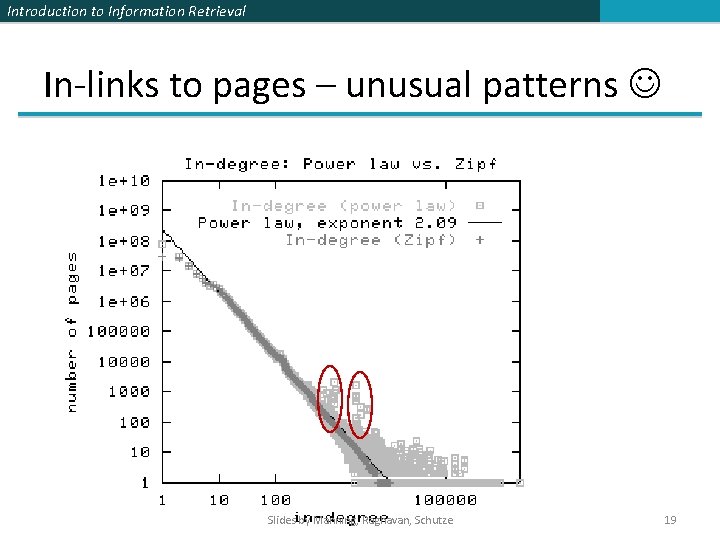
Introduction to Information Retrieval In-links to pages – unusual patterns Slides by Manning, Raghavan, Schutze 19
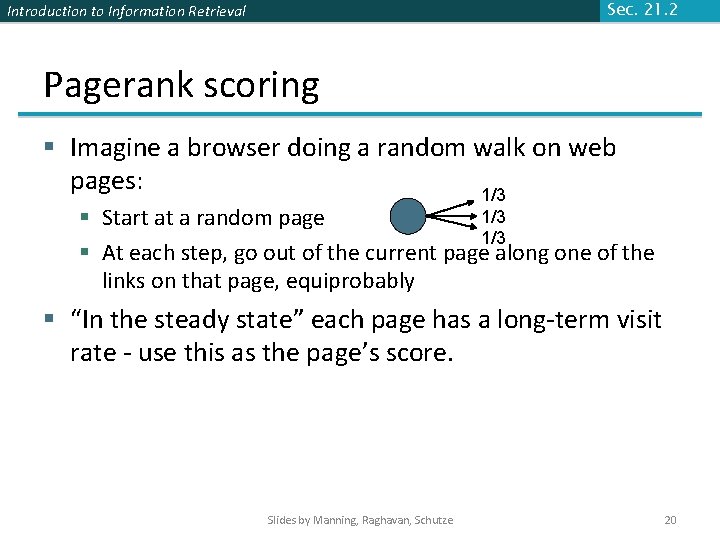
Introduction to Information Retrieval Sec. 21. 2 Pagerank scoring § Imagine a browser doing a random walk on web pages: 1/3 § Start at a random page 1/3 § At each step, go out of the current page along one of the links on that page, equiprobably § “In the steady state” each page has a long-term visit rate - use this as the page’s score. Slides by Manning, Raghavan, Schutze 20
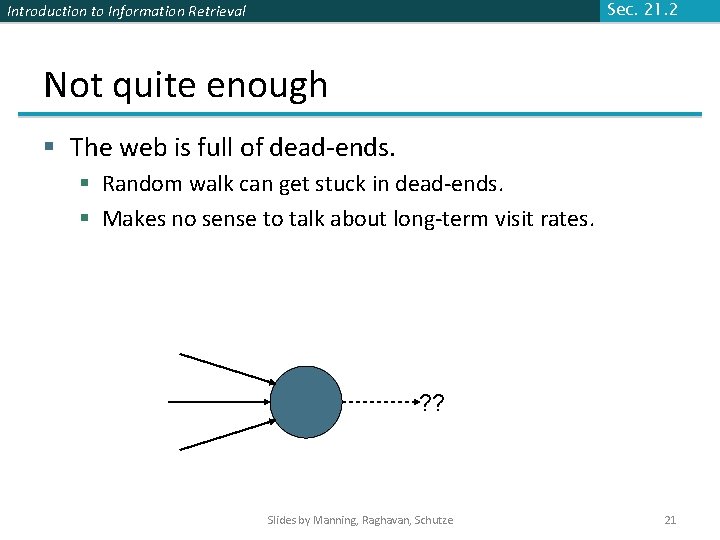
Introduction to Information Retrieval Sec. 21. 2 Not quite enough § The web is full of dead-ends. § Random walk can get stuck in dead-ends. § Makes no sense to talk about long-term visit rates. ? ? Slides by Manning, Raghavan, Schutze 21
Introduction to Information Retrieval Sec. 21. 2 Teleporting § At a dead end, jump to a random web page. § At any non-dead end, with probability 10%, jump to a random web page. § With remaining probability (90%), go out on a random link. § 10% - a parameter. Slides by Manning, Raghavan, Schutze 22
Introduction to Information Retrieval Sec. 21. 2 Result of teleporting § Now cannot get stuck locally. § There is a long-term rate at which any page is visited (not obvious, will show this). § How do we compute this visit rate? Slides by Manning, Raghavan, Schutze 23
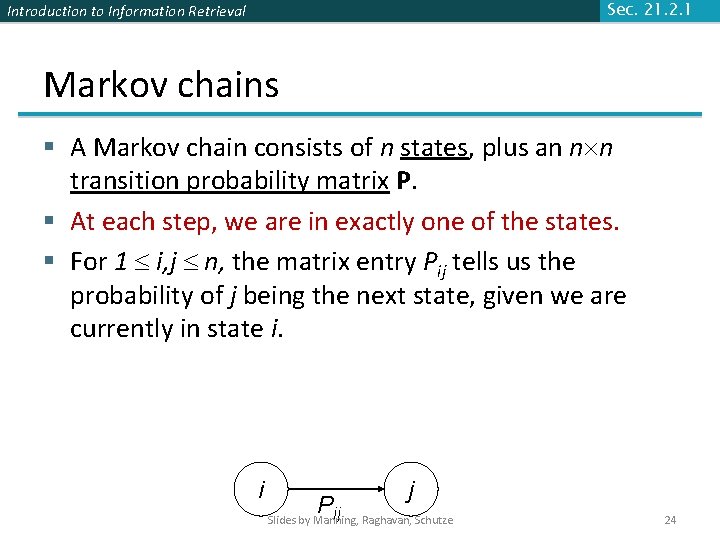
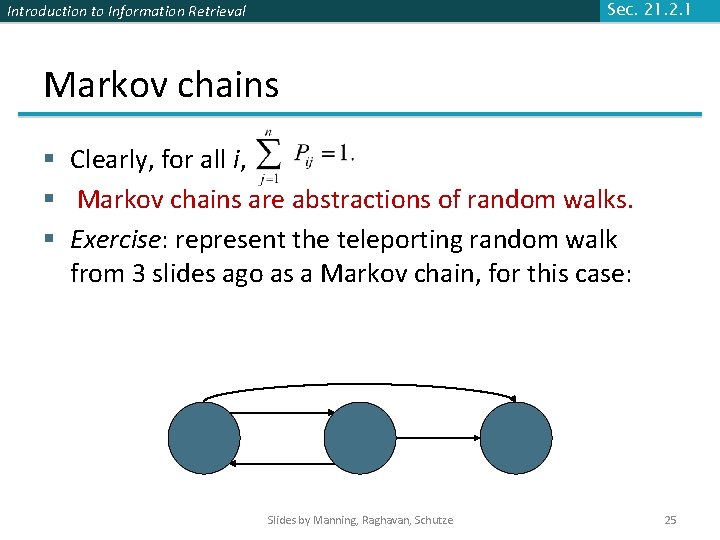
Introduction to Information Retrieval Sec. 21. 2. 1 Markov chains § A Markov chain consists of n states, plus an n n transition probability matrix P. § At each step, we are in exactly one of the states. § For 1 i, j n, the matrix entry Pij tells us the probability of j being the next state, given we are currently in state i. i P j ij Slides by Manning, Raghavan, Schutze 24
Introduction to Information Retrieval Sec. 21. 2. 1 Markov chains § Clearly, for all i, § Markov chains are abstractions of random walks. § Exercise: represent the teleporting random walk from 3 slides ago as a Markov chain, for this case: Slides by Manning, Raghavan, Schutze 25
Introduction to Information Retrieval Sec. 21. 2. 1 Ergodic Markov chains § For any (ergodic) Markov chain, there is a unique long-term visit rate for each state. § Steady-state probability distribution. § Over a long time-period, we visit each state in proportion to this rate. § It doesn’t matter where we start. Slides by Manning, Raghavan, Schutze 26
Introduction to Information Retrieval Theory of Markov chains § Fact: For any start vector, the power method applied to a Markov transition matrix P will converge to a unique positive stationary vector as long as P is stochastic, irreducible and aperiodic. Slides by Jure Leskovec: Mining Massive Datasets 27
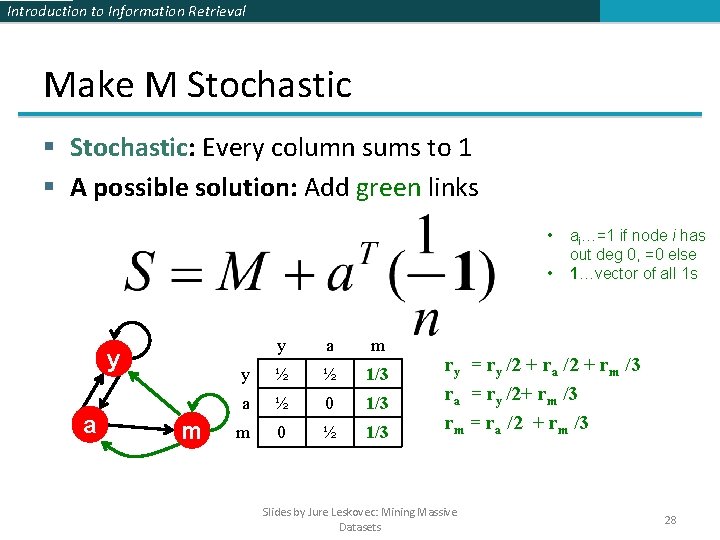
Introduction to Information Retrieval Make M Stochastic § Stochastic: Every column sums to 1 § A possible solution: Add green links • • y a m y ½ ½ 1/3 a ½ 0 1/3 m 0 ½ 1/3 ai…=1 if node i has out deg 0, =0 else 1…vector of all 1 s ry = ry /2 + ra /2 + rm /3 ra = ry /2+ rm /3 rm = ra /2 + rm /3 Slides by Jure Leskovec: Mining Massive Datasets 28
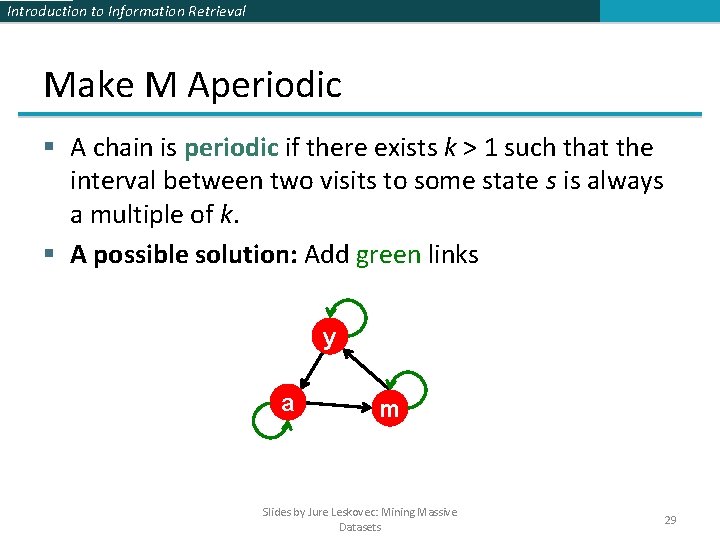
Introduction to Information Retrieval Make M Aperiodic § A chain is periodic if there exists k > 1 such that the interval between two visits to some state s is always a multiple of k. § A possible solution: Add green links y a m Slides by Jure Leskovec: Mining Massive Datasets 29
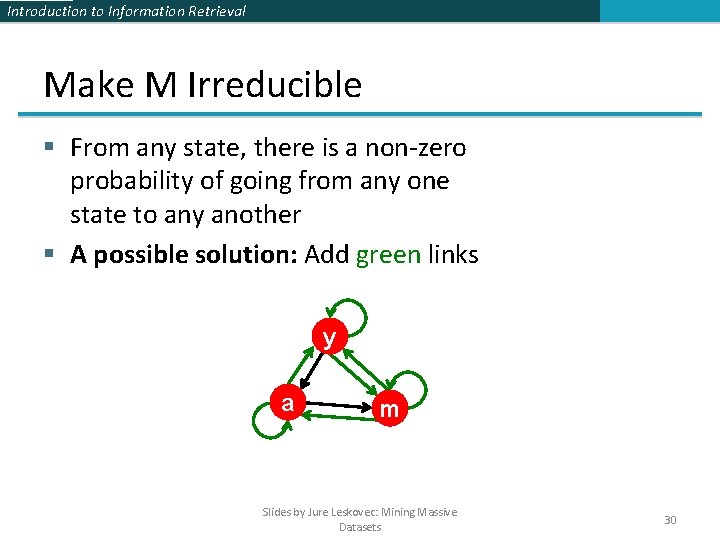
Introduction to Information Retrieval Make M Irreducible § From any state, there is a non-zero probability of going from any one state to any another § A possible solution: Add green links y a m Slides by Jure Leskovec: Mining Massive Datasets 30
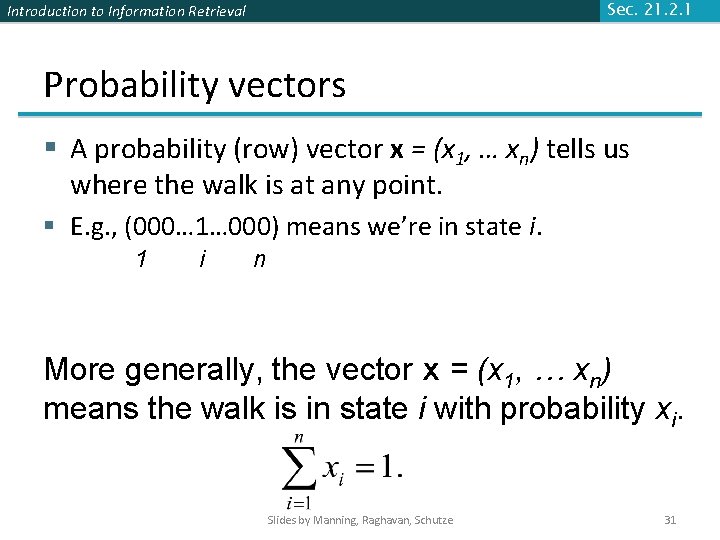
Introduction to Information Retrieval Sec. 21. 2. 1 Probability vectors § A probability (row) vector x = (x 1, … xn) tells us where the walk is at any point. § E. g. , (000… 1… 000) means we’re in state i. 1 i n More generally, the vector x = (x 1, … xn) means the walk is in state i with probability xi. Slides by Manning, Raghavan, Schutze 31
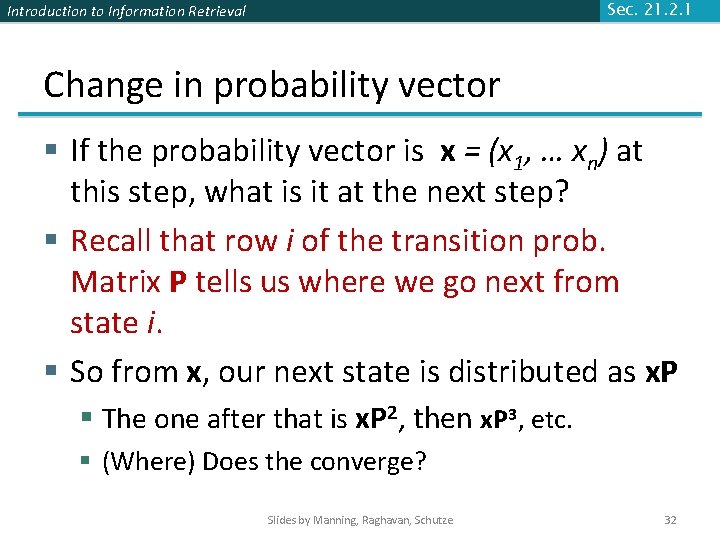
Introduction to Information Retrieval Sec. 21. 2. 1 Change in probability vector § If the probability vector is x = (x 1, … xn) at this step, what is it at the next step? § Recall that row i of the transition prob. Matrix P tells us where we go next from state i. § So from x, our next state is distributed as x. P § The one after that is x. P 2, then x. P 3, etc. § (Where) Does the converge? Slides by Manning, Raghavan, Schutze 32
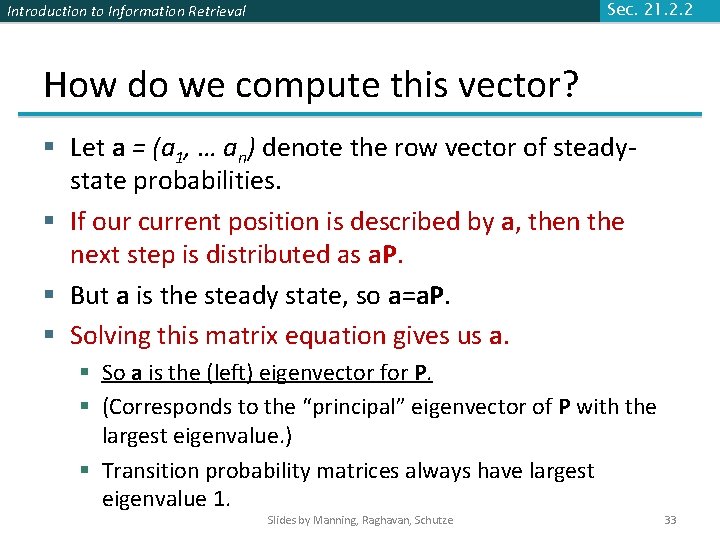
Introduction to Information Retrieval Sec. 21. 2. 2 How do we compute this vector? § Let a = (a 1, … an) denote the row vector of steadystate probabilities. § If our current position is described by a, then the next step is distributed as a. P. § But a is the steady state, so a=a. P. § Solving this matrix equation gives us a. § So a is the (left) eigenvector for P. § (Corresponds to the “principal” eigenvector of P with the largest eigenvalue. ) § Transition probability matrices always have largest eigenvalue 1. Slides by Manning, Raghavan, Schutze 33
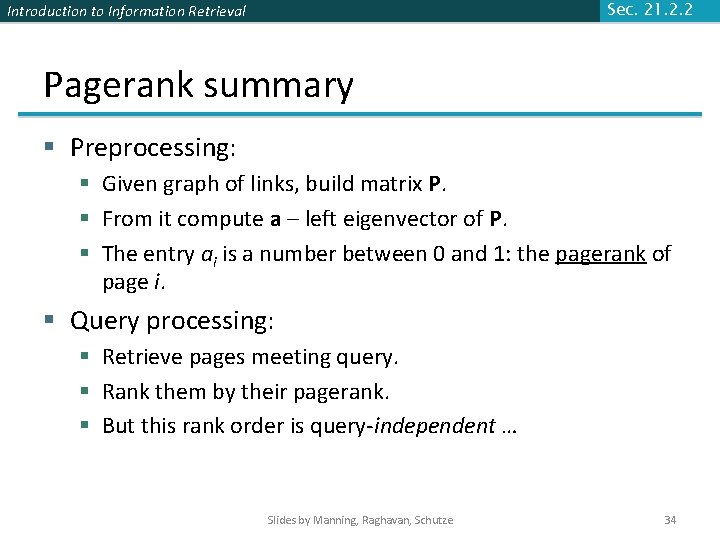
Introduction to Information Retrieval Sec. 21. 2. 2 Pagerank summary § Preprocessing: § Given graph of links, build matrix P. § From it compute a – left eigenvector of P. § The entry ai is a number between 0 and 1: the pagerank of page i. § Query processing: § Retrieve pages meeting query. § Rank them by their pagerank. § But this rank order is query-independent … Slides by Manning, Raghavan, Schutze 34
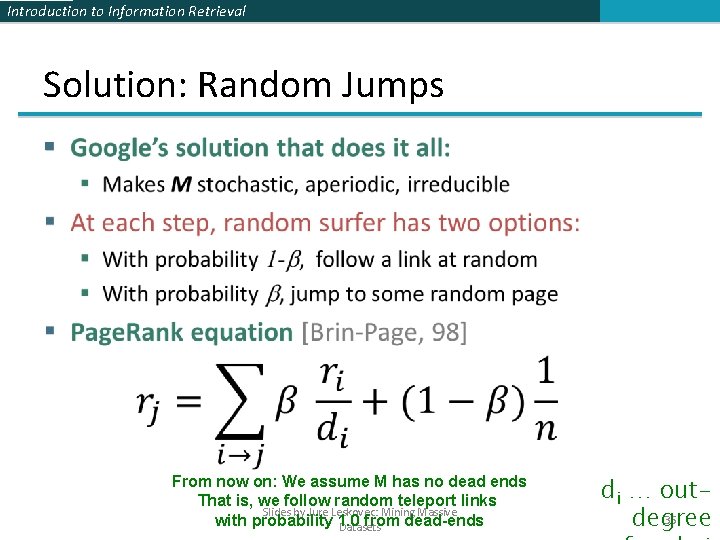
Introduction to Information Retrieval Solution: Random Jumps § From now on: We assume M has no dead ends That is, we follow random teleport links Slides by Jure Leskovec: Mining Massive with probability 1. 0 from dead-ends Datasets di … out 35 degree
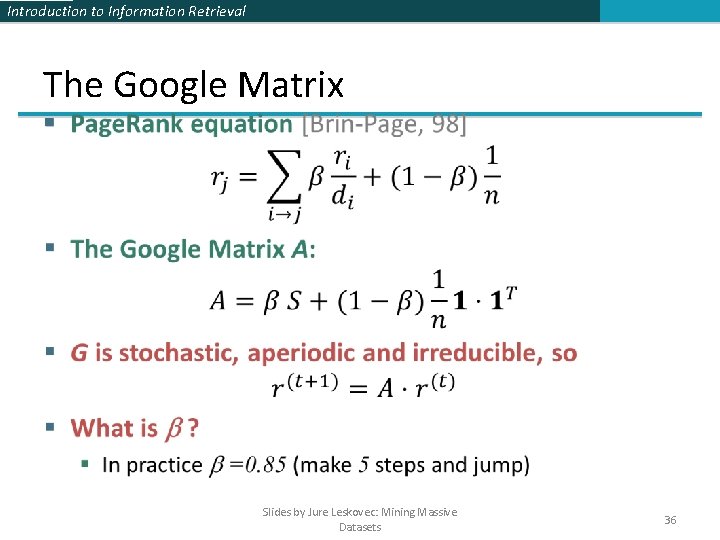
Introduction to Information Retrieval The Google Matrix § Slides by Jure Leskovec: Mining Massive Datasets 36
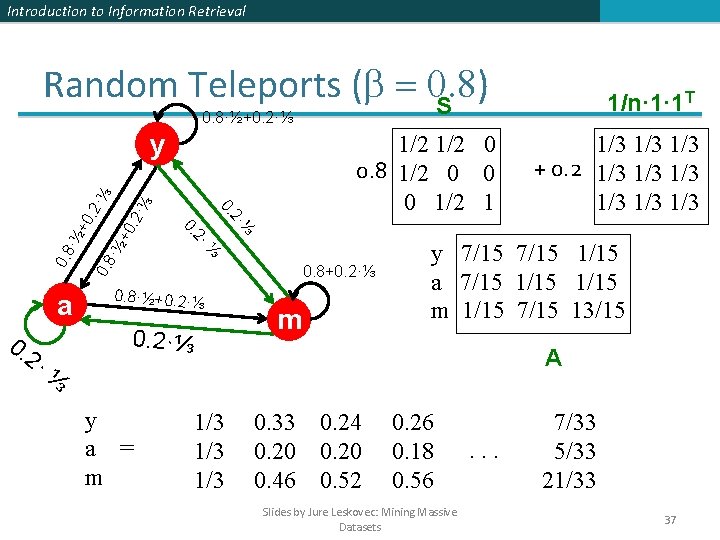
Introduction to Information Retrieval Random Teleports ( = 0. 8) S 1/n· 1· 1 T 0. 8·½+0. 2·⅓ ·½ +0 . 2· 0. 8 ·½ +0 0. 8 ⅓ 0. 8+0. 2·⅓ 0. 8·½+0. 2·⅓ y a = m 1/3 1/3 + 0. 2 1/3 1/3 1/3 2· ⅓ 2· 0. 2· ⅓ 0. a 1/2 0 0. 8 1/2 0 0 0 1/2 1 0. ⅓ ⅓ y m y 7/15 1/15 a 7/15 1/15 m 1/15 7/15 13/15 A 1/3 1/3 0. 33 0. 20 0. 46 0. 24 0. 20 0. 52 0. 26 0. 18 0. 56 Slides by Jure Leskovec: Mining Massive Datasets . . . 7/33 5/33 21/33 37
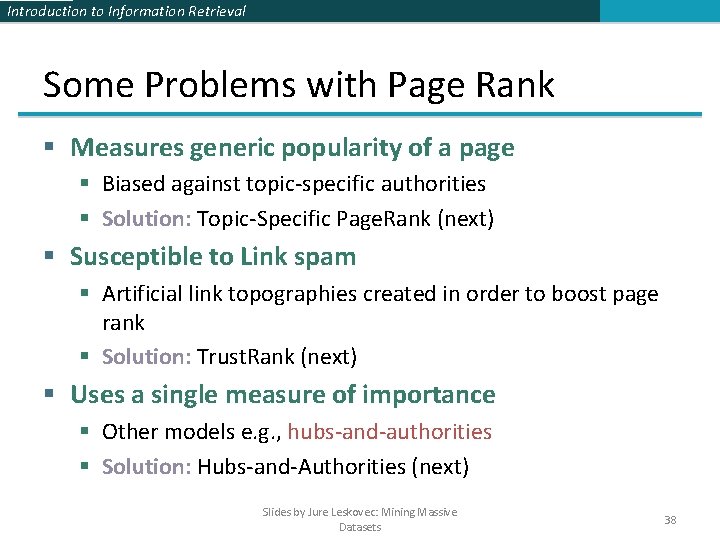
Introduction to Information Retrieval Some Problems with Page Rank § Measures generic popularity of a page § Biased against topic-specific authorities § Solution: Topic-Specific Page. Rank (next) § Susceptible to Link spam § Artificial link topographies created in order to boost page rank § Solution: Trust. Rank (next) § Uses a single measure of importance § Other models e. g. , hubs-and-authorities § Solution: Hubs-and-Authorities (next) Slides by Jure Leskovec: Mining Massive Datasets 38
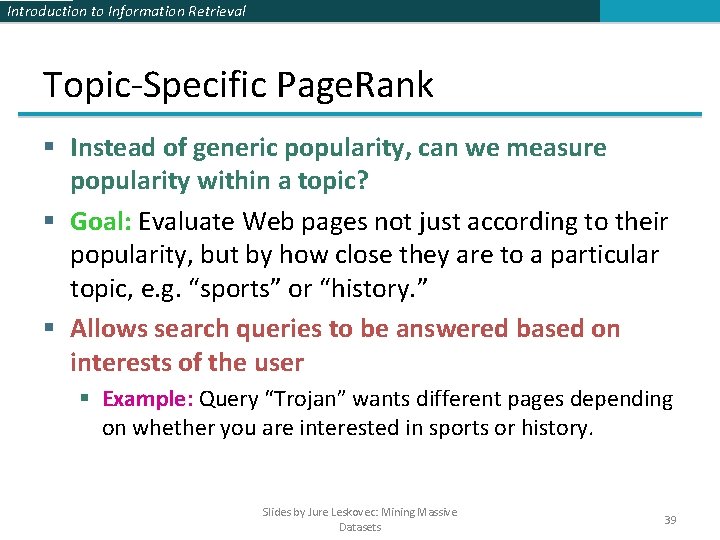
Introduction to Information Retrieval Topic-Specific Page. Rank § Instead of generic popularity, can we measure popularity within a topic? § Goal: Evaluate Web pages not just according to their popularity, but by how close they are to a particular topic, e. g. “sports” or “history. ” § Allows search queries to be answered based on interests of the user § Example: Query “Trojan” wants different pages depending on whether you are interested in sports or history. Slides by Jure Leskovec: Mining Massive Datasets 39
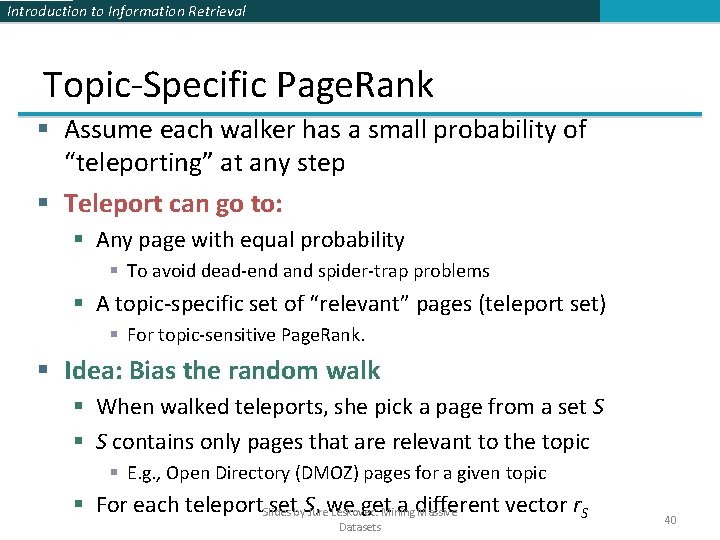
Introduction to Information Retrieval Topic-Specific Page. Rank § Assume each walker has a small probability of “teleporting” at any step § Teleport can go to: § Any page with equal probability § To avoid dead-end and spider-trap problems § A topic-specific set of “relevant” pages (teleport set) § For topic-sensitive Page. Rank. § Idea: Bias the random walk § When walked teleports, she pick a page from a set S § S contains only pages that are relevant to the topic § E. g. , Open Directory (DMOZ) pages for a given topic § For each teleport set S, we get a different vector r Slides by Jure Leskovec: Mining Massive S Datasets 40
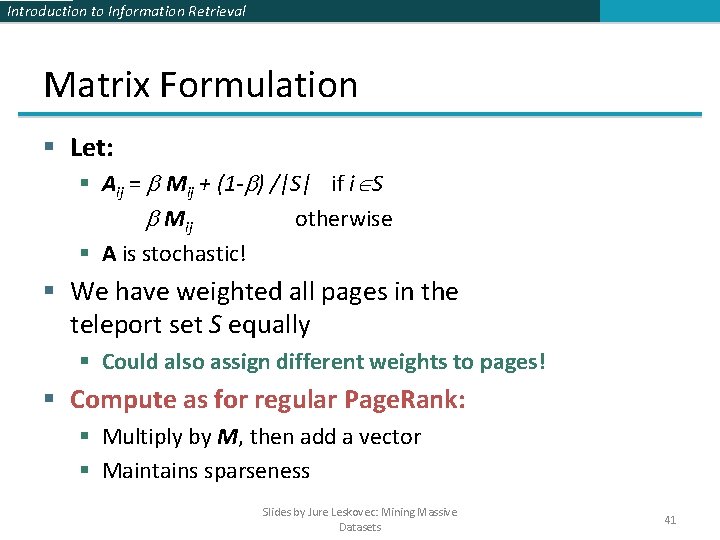
Introduction to Information Retrieval Matrix Formulation § Let: § Aij = Mij + (1 - ) /|S| if i S Mij otherwise § A is stochastic! § We have weighted all pages in the teleport set S equally § Could also assign different weights to pages! § Compute as for regular Page. Rank: § Multiply by M, then add a vector § Maintains sparseness Slides by Jure Leskovec: Mining Massive Datasets 41
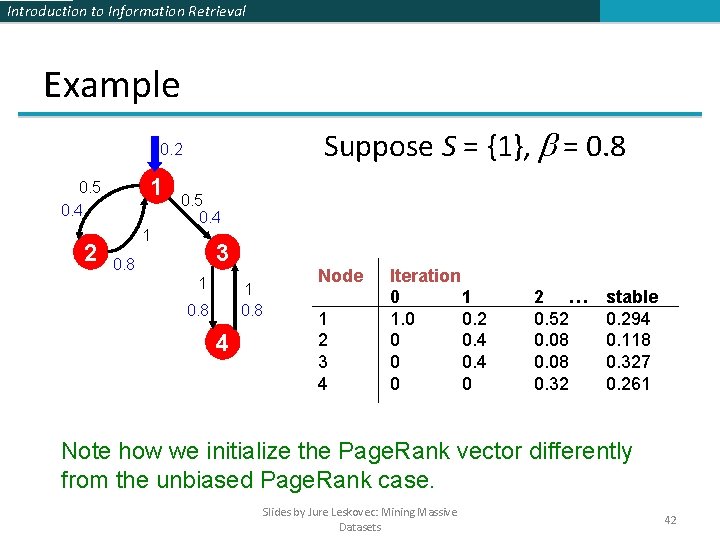
Introduction to Information Retrieval Example Suppose S = {1}, = 0. 8 0. 2 1 0. 5 0. 4 2 0. 5 0. 4 1 3 0. 8 1 1 0. 8 4 Node 1 2 3 4 Iteration 0 1 1. 0 0. 2 0 0. 4 0 0 2 … 0. 52 0. 08 0. 32 stable 0. 294 0. 118 0. 327 0. 261 Note how we initialize the Page. Rank vector differently from the unbiased Page. Rank case. Slides by Jure Leskovec: Mining Massive Datasets 42
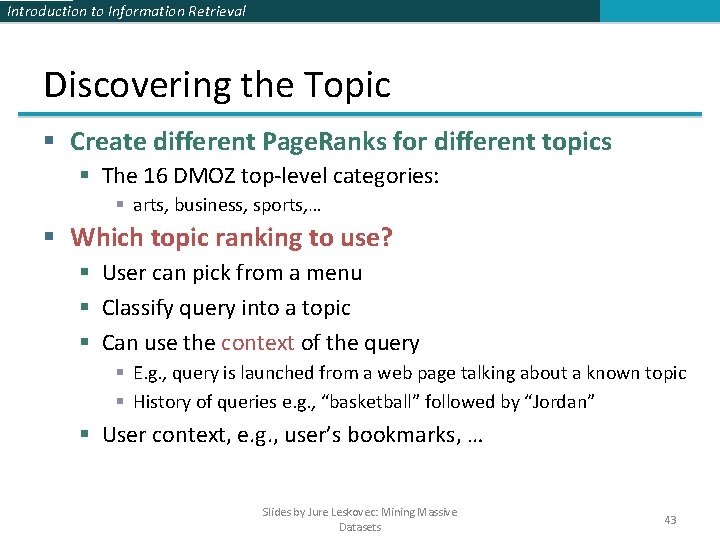
Introduction to Information Retrieval Discovering the Topic § Create different Page. Ranks for different topics § The 16 DMOZ top-level categories: § arts, business, sports, … § Which topic ranking to use? § User can pick from a menu § Classify query into a topic § Can use the context of the query § E. g. , query is launched from a web page talking about a known topic § History of queries e. g. , “basketball” followed by “Jordan” § User context, e. g. , user’s bookmarks, … Slides by Jure Leskovec: Mining Massive Datasets 43
Web Spam
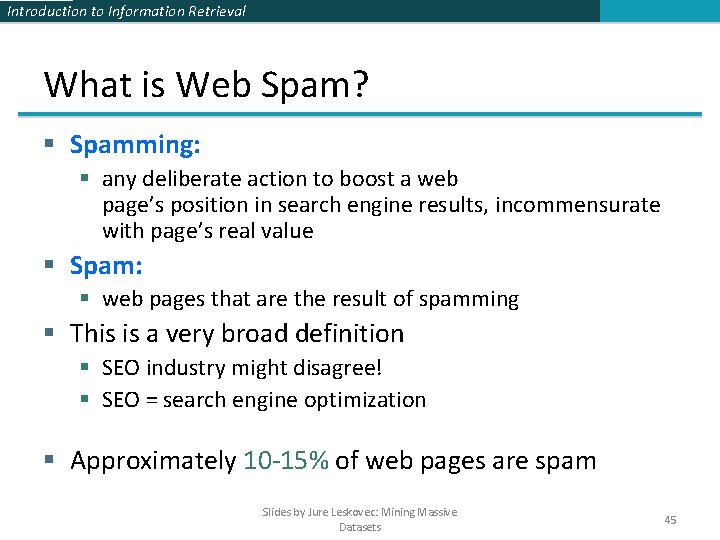
Introduction to Information Retrieval What is Web Spam? § Spamming: § any deliberate action to boost a web page’s position in search engine results, incommensurate with page’s real value § Spam: § web pages that are the result of spamming § This is a very broad definition § SEO industry might disagree! § SEO = search engine optimization § Approximately 10 -15% of web pages are spam Slides by Jure Leskovec: Mining Massive Datasets 45
Introduction to Information Retrieval Web Search § Early search engines: § Crawl the Web § Index pages by the words they contained § Respond to search queries (lists of words) with the pages containing those words § Early page ranking: § Attempt to order pages matching a search query by “importance” § First search engines considered: § 1) Number of times query words appeared. § 2) Prominence of word position, e. g. title, header. Slides by Jure Leskovec: Mining Massive Datasets 46
Introduction to Information Retrieval First Spammers § As people began to use search engines to find things on the Web, those with commercial interests tried to exploit search engines to bring people to their own site – whether they wanted to be there or not. § Example: § Shirt-seller might pretend to be about “movies. ” § Techniques for achieving high relevance/importance for a web page Slides by Jure Leskovec: Mining Massive Datasets 47
Introduction to Information Retrieval First Spammers: Term Spam § How do you make your page appear to be about movies? § 1) Add the word movie 1000 times to your page § Set text color to the background color, so only search engines would see it § 2) Or, run the query “movie” on your target search engine § See what page came first in the listings § Copy it into your page, make it “invisible” § These and similar techniques are term spam Slides by Jure Leskovec: Mining Massive Datasets 48
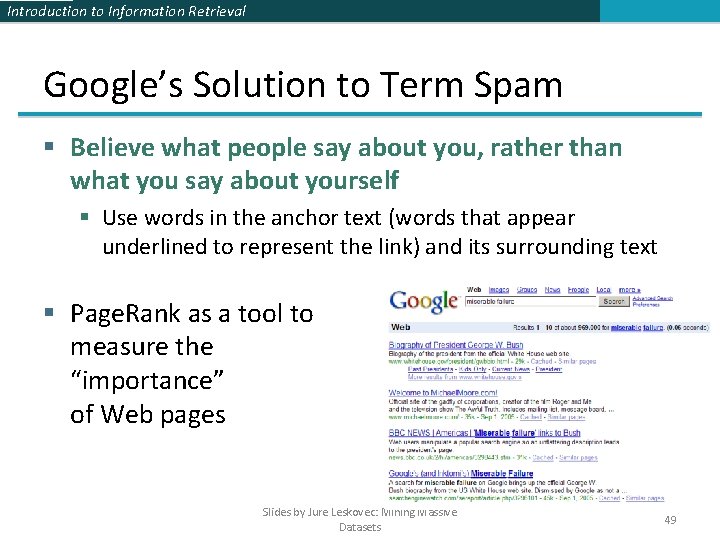
Introduction to Information Retrieval Google’s Solution to Term Spam § Believe what people say about you, rather than what you say about yourself § Use words in the anchor text (words that appear underlined to represent the link) and its surrounding text § Page. Rank as a tool to measure the “importance” of Web pages Slides by Jure Leskovec: Mining Massive Datasets 49
Introduction to Information Retrieval Why It Works? § Our hypothetical shirt-seller loses § Saying he is about movies doesn’t help, because others don’t say he is about movies § His page isn’t very important, so it won’t be ranked high for shirts or movies § Example: § Shirt-seller creates 1000 pages, each links to his with “movie” in the anchor text § These pages have no links in, so they get little Page. Rank § So the shirt-seller can’t beat truly important movie pages like IMDB Slides by Jure Leskovec: Mining Massive Datasets 50
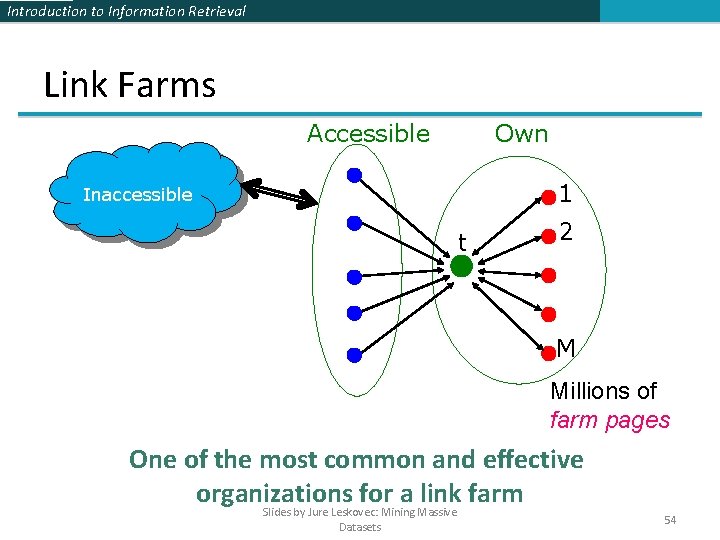
Introduction to Information Retrieval Google vs. Spammers: Round 2 § Once Google became the dominant search engine, spammers began to work out ways to fool Google § Spam farms were developed to concentrate Page. Rank on a single page § Link spam: § Creating link structures that boost Page. Rank of a particular page Slides by Jure Leskovec: Mining Massive Datasets 51
Introduction to Information Retrieval Link Spamming § Three kinds of web pages from a spammer’s point of view: § Inaccessible pages § Accessible pages: § e. g. , blog comments pages § spammer can post links to his pages § Own pages: § Completely controlled by spammer § May span multiple domain names Slides by Jure Leskovec: Mining Massive Datasets 52
Introduction to Information Retrieval Link Farms § Spammer’s goal: § Maximize the Page. Rank of target page t § Technique: § Get as many links from accessible pages as possible to target page t § Construct “link farm” to get Page. Rank multiplier effect Slides by Jure Leskovec: Mining Massive Datasets 53
Introduction to Information Retrieval Link Farms Accessible Own 1 Inaccessible t 2 M Millions of farm pages One of the most common and effective organizations for a link farm Slides by Jure Leskovec: Mining Massive Datasets 54
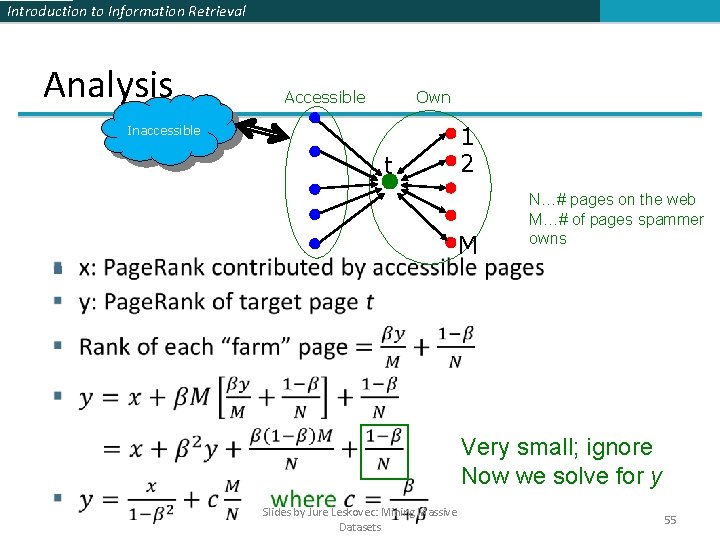
Introduction to Information Retrieval Analysis Accessible Own 1 2 Inaccessible t § M N…# pages on the web M…# of pages spammer owns Very small; ignore Now we solve for y Slides by Jure Leskovec: Mining Massive Datasets 55
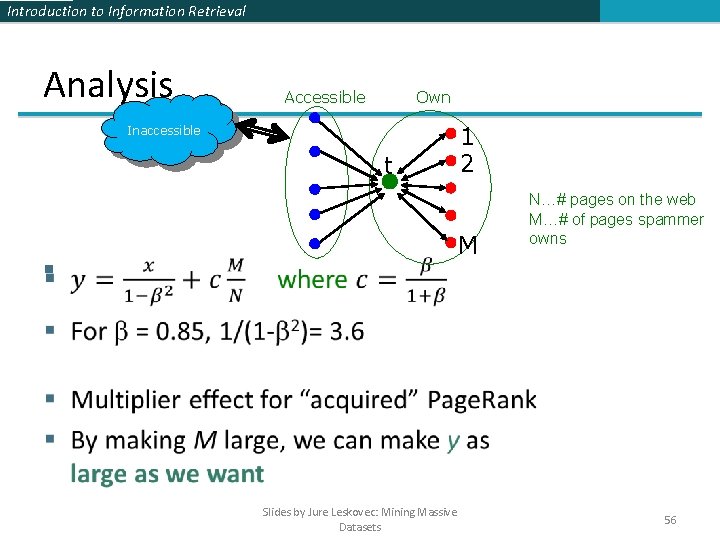
Introduction to Information Retrieval Analysis Accessible Own 1 2 Inaccessible t § M Slides by Jure Leskovec: Mining Massive Datasets N…# pages on the web M…# of pages spammer owns 56
Combating Web Spam
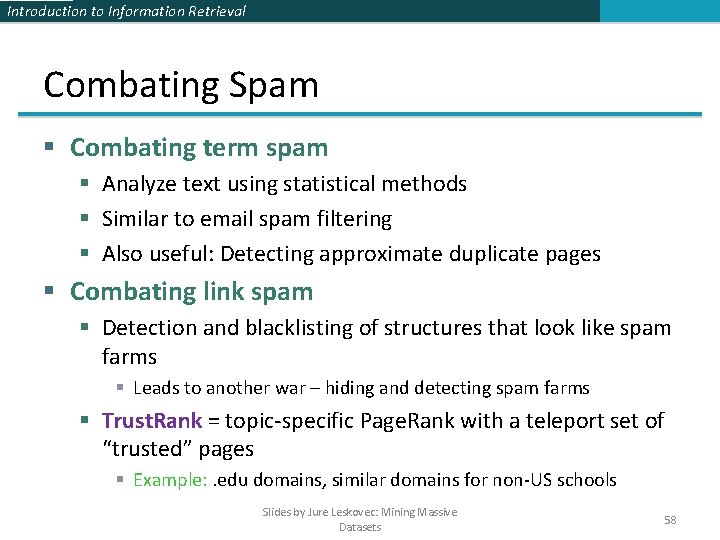
Introduction to Information Retrieval Combating Spam § Combating term spam § Analyze text using statistical methods § Similar to email spam filtering § Also useful: Detecting approximate duplicate pages § Combating link spam § Detection and blacklisting of structures that look like spam farms § Leads to another war – hiding and detecting spam farms § Trust. Rank = topic-specific Page. Rank with a teleport set of “trusted” pages § Example: . edu domains, similar domains for non-US schools Slides by Jure Leskovec: Mining Massive Datasets 58
Introduction to Information Retrieval Trust. Rank: Idea § Basic principle: Approximate isolation § It is rare for a “good” page to point to a “bad” (spam) page § Sample a set of “seed pages” from the web § Have an oracle (human) identify the good pages and the spam pages in the seed set § Expensive task, so we must make seed set as small as possible Slides by Jure Leskovec: Mining Massive Datasets 59
Introduction to Information Retrieval Trust Propagation § Call the subset of seed pages that are identified as “good” the “trusted pages” § Perform a topic-sensitive Page. Rank with teleport set = trusted pages. § Propagate trust through links: § Each page gets a trust value between 0 and 1 § Use a threshold value and mark all pages below the trust threshold as spam Slides by Jure Leskovec: Mining Massive Datasets 60
Introduction to Information Retrieval Why is it a good idea? § Trust attenuation: § The degree of trust conferred by a trusted page decreases with distance § Trust splitting: § The larger the number of out-links from a page, the less scrutiny the page author gives each out-link § Trust is “split” across out-links Slides by Jure Leskovec: Mining Massive Datasets 61
Introduction to Information Retrieval Picking the Seed Set § Two conflicting considerations: § Human has to inspect each seed page, so seed set must be as small as possible § Must ensure every “good page” gets adequate trust rank, so need make all good pages reachable from seed set by short paths Slides by Jure Leskovec: Mining Massive Datasets 62
Introduction to Information Retrieval Approaches to Picking Seed Set § Suppose we want to pick a seed set of k pages § Page. Rank: § Pick the top k pages by Page. Rank § Theory is that you can’t get a bad page’s rank really high § Use domains whose membership is controlled, like . edu, . mil, . gov Slides by Jure Leskovec: Mining Massive Datasets 63
Introduction to Information Retrieval Spam Mass § In the Trust. Rank model, we start with good pages and propagate trust § Complementary view: What fraction of a page’s Page. Rank comes from “spam” pages? § In practice, we don’t know all the spam pages, so we need to estimate Slides by Jure Leskovec: Mining Massive Datasets 64
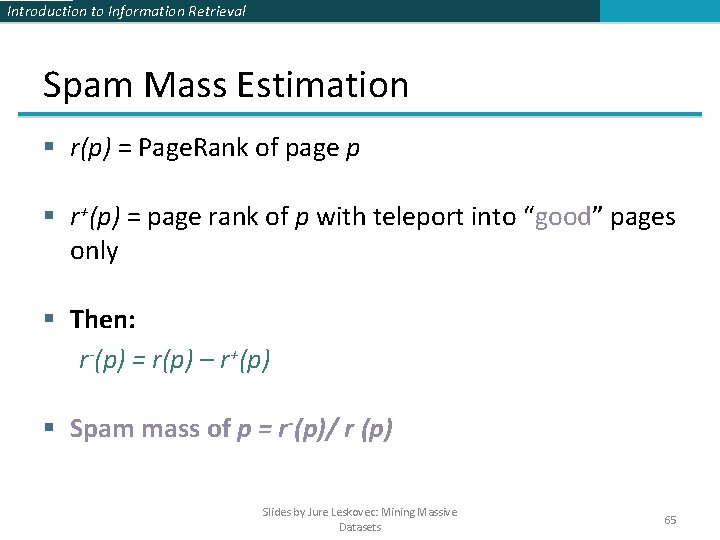
Introduction to Information Retrieval Spam Mass Estimation § r(p) = Page. Rank of page p § r+(p) = page rank of p with teleport into “good” pages only § Then: r-(p) = r(p) – r+(p) § Spam mass of p = r-(p)/ r (p) Slides by Jure Leskovec: Mining Massive Datasets 65
Introduction to Information Retrieval The reality § Pagerank is used in google and other engines, but is hardly the full story of ranking § Many sophisticated features are used § Some address specific query classes § Machine learned ranking (Lecture 19) heavily used § Pagerank still very useful for things like crawl policy Slides by Manning, Raghavan, Schutze 66
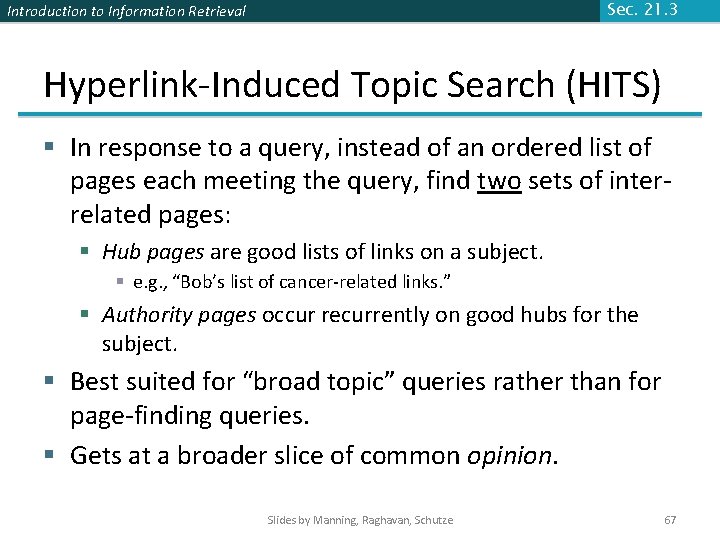
Introduction to Information Retrieval Sec. 21. 3 Hyperlink-Induced Topic Search (HITS) § In response to a query, instead of an ordered list of pages each meeting the query, find two sets of interrelated pages: § Hub pages are good lists of links on a subject. § e. g. , “Bob’s list of cancer-related links. ” § Authority pages occur recurrently on good hubs for the subject. § Best suited for “broad topic” queries rather than for page-finding queries. § Gets at a broader slice of common opinion. Slides by Manning, Raghavan, Schutze 67
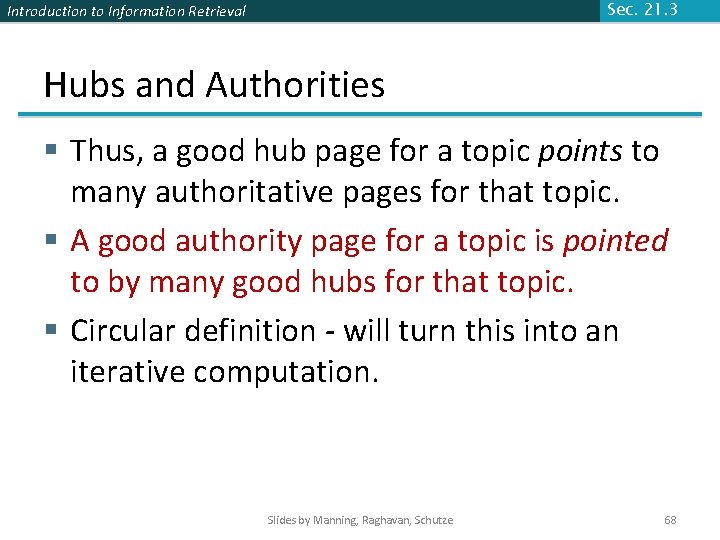
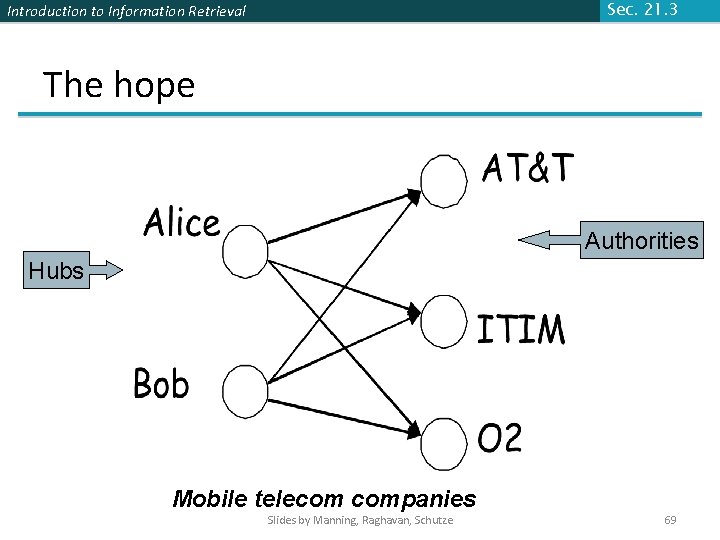
Introduction to Information Retrieval Sec. 21. 3 Hubs and Authorities § Thus, a good hub page for a topic points to many authoritative pages for that topic. § A good authority page for a topic is pointed to by many good hubs for that topic. § Circular definition - will turn this into an iterative computation. Slides by Manning, Raghavan, Schutze 68
Introduction to Information Retrieval Sec. 21. 3 The hope Authorities Hubs Mobile telecom companies Slides by Manning, Raghavan, Schutze 69
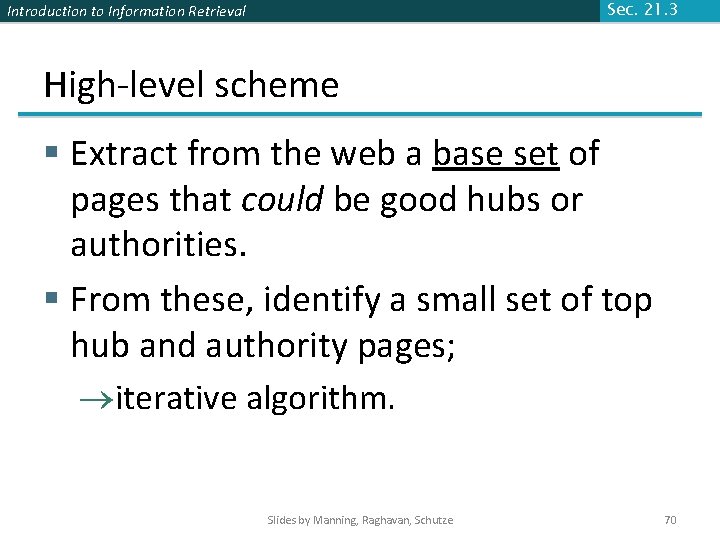
Introduction to Information Retrieval Sec. 21. 3 High-level scheme § Extract from the web a base set of pages that could be good hubs or authorities. § From these, identify a small set of top hub and authority pages; ®iterative algorithm. Slides by Manning, Raghavan, Schutze 70
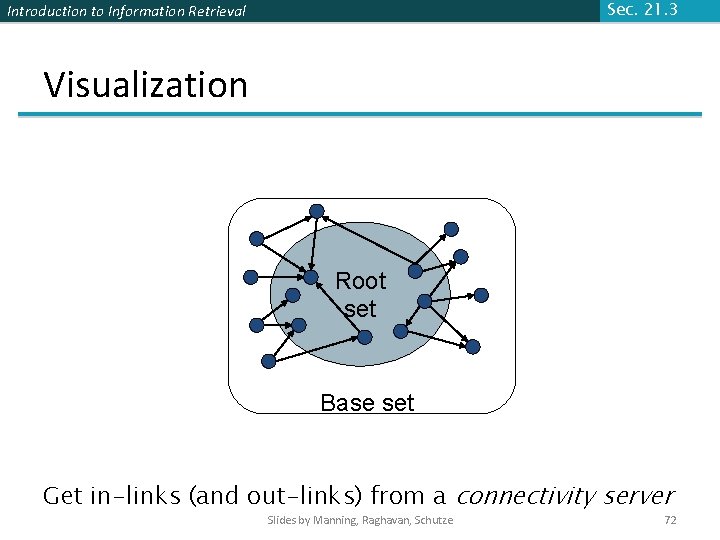
Introduction to Information Retrieval Sec. 21. 3 Base set § Given text query (say browser), use a text index to get all pages containing browser. § Call this the root set of pages. § Add in any page that either § points to a page in the root set, or § is pointed to by a page in the root set. § Call this the base set. Slides by Manning, Raghavan, Schutze 71
Introduction to Information Retrieval Sec. 21. 3 Visualization Root set Base set Get in-links (and out-links) from a connectivity server Slides by Manning, Raghavan, Schutze 72
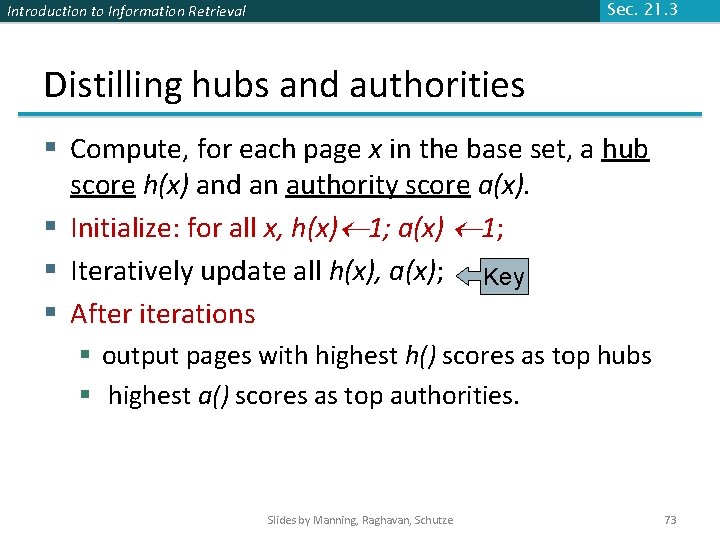
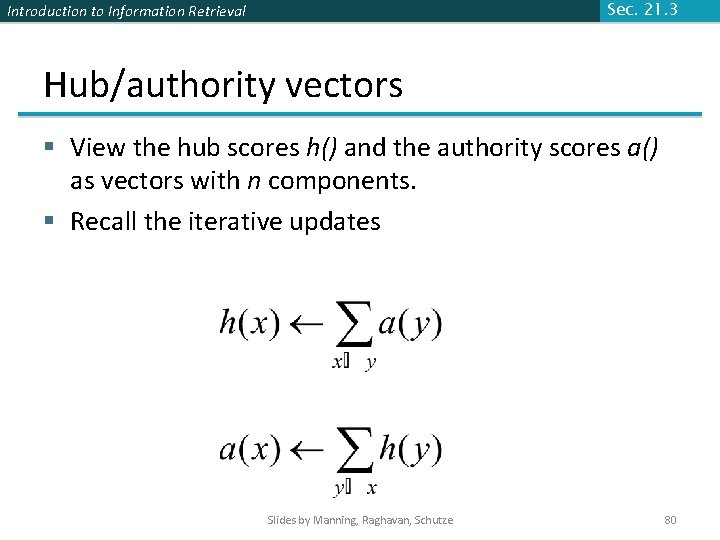
Introduction to Information Retrieval Sec. 21. 3 Distilling hubs and authorities § Compute, for each page x in the base set, a hub score h(x) and an authority score a(x). § Initialize: for all x, h(x) 1; a(x) 1; § Iteratively update all h(x), a(x); Key § After iterations § output pages with highest h() scores as top hubs § highest a() scores as top authorities. Slides by Manning, Raghavan, Schutze 73
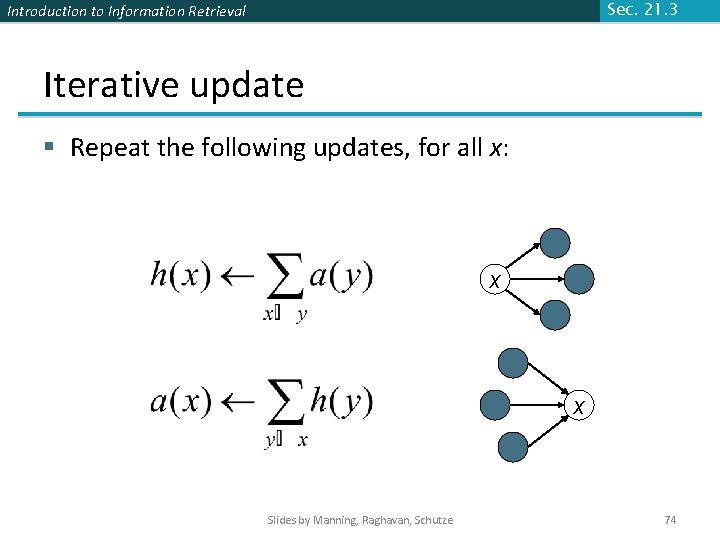
Introduction to Information Retrieval Sec. 21. 3 Iterative update § Repeat the following updates, for all x: x x Slides by Manning, Raghavan, Schutze 74
Introduction to Information Retrieval Sec. 21. 3 Scaling § To prevent the h() and a() values from getting too big, can scale down after each iteration. § Scaling factor doesn’t really matter: § we only care about the relative values of the scores. Slides by Manning, Raghavan, Schutze 75
Introduction to Information Retrieval Sec. 21. 3 How many iterations? § Claim: relative values of scores will converge after a few iterations: § in fact, suitably scaled, h() and a() scores settle into a steady state! § proof of this comes later. § In practice, ~5 iterations get you close to stability. Slides by Manning, Raghavan, Schutze 76
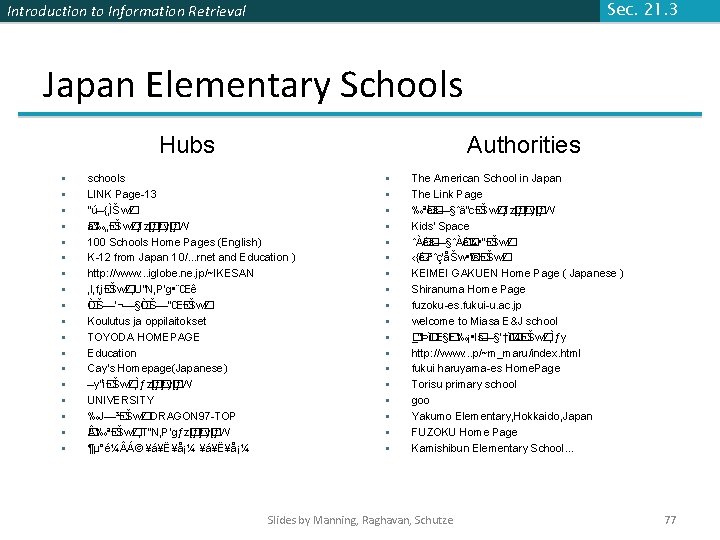
Introduction to Information Retrieval Sec. 21. 3 Japan Elementary Schools Hubs § § § § § Authorities schools LINK Page-13 “ú–{‚ÌŠw� Z a‰„� � ¬Šw� Zƒz� [ƒ� ƒy� [ƒW 100 Schools Home Pages (English) K-12 from Japan 10/. . . rnet and Education ) http: //www. . . iglobe. ne. jp/~IKESAN ‚l‚f‚j� ¬Šw� Z‚U”N‚P‘g • ¨Œê ÒŠ—’¬—§� � ÒŠ—“Œ� ¬Šw� Z Koulutus ja oppilaitokset TOYODA HOMEPAGE Education Cay's Homepage(Japanese) –y“ì� ¬Šw� Z‚̃z� [ƒ� ƒy� [ƒW UNIVERSITY ‰J—³� ¬Šw� Z DRAGON 97 -TOP ‰ª� � ¬Šw� Z‚T”N‚P‘gƒz� [ƒ� ƒy� [ƒW ¶µ°é¼ Á© ¥á¥Ë¥å¡¼ § § § § § The American School in Japan The Link Page ‰ª� è� s—§ˆä“c� ¬Šw� Zƒz� [ƒ� ƒy� [ƒW Kids' Space ˆÀ� é� s—§ˆÀ� é� ¼ • ”� ¬Šw� Z ‹{� 鋳ˆç‘åŠw • � ‘®� ¬Šw� Z KEIMEI GAKUEN Home Page ( Japanese ) Shiranuma Home Page fuzoku-es. fukui-u. ac. jp welcome to Miasa E&J school _“Þ� � 쌧� E‰¡ • l� s—§’†� ì� ¼� ¬Šw� Z‚̃y http: //www. . . p/~m_maru/index. html fukui haruyama-es Home. Page Torisu primary school goo Yakumo Elementary, Hokkaido, Japan FUZOKU Home Page Kamishibun Elementary School. . . Slides by Manning, Raghavan, Schutze 77
Introduction to Information Retrieval Sec. 21. 3 Things to note § Pulled together good pages regardless of language of page content. § Use only link analysis after base set assembled § iterative scoring is query-independent. § Iterative computation after text index retrieval - significant overhead. Slides by Manning, Raghavan, Schutze 78
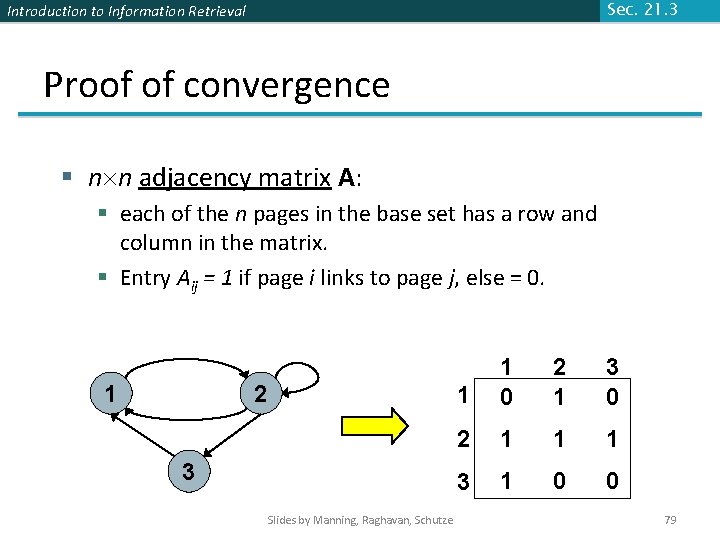
Introduction to Information Retrieval Sec. 21. 3 Proof of convergence § n n adjacency matrix A: § each of the n pages in the base set has a row and column in the matrix. § Entry Aij = 1 if page i links to page j, else = 0. 1 2 3 Slides by Manning, Raghavan, Schutze 1 1 0 2 1 3 0 2 1 1 1 3 1 0 0 79
Introduction to Information Retrieval Sec. 21. 3 Hub/authority vectors § View the hub scores h() and the authority scores a() as vectors with n components. § Recall the iterative updates Slides by Manning, Raghavan, Schutze 80
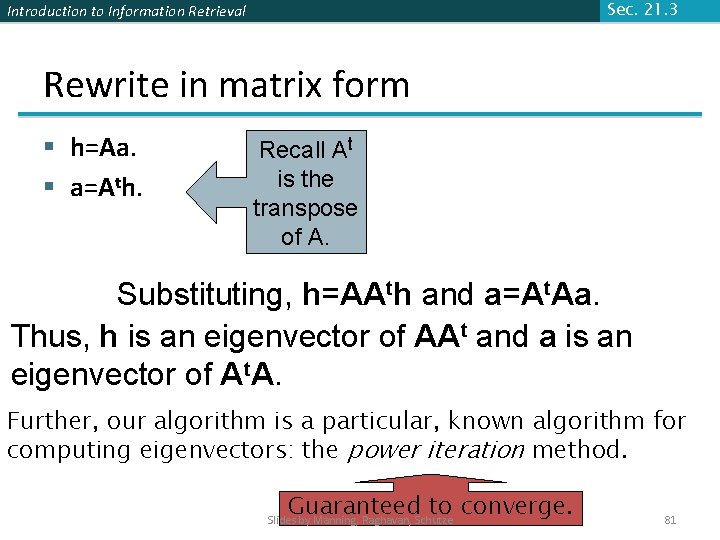
Introduction to Information Retrieval Sec. 21. 3 Rewrite in matrix form § h=Aa. § a=Ath. Recall At is the transpose of A. Substituting, h=AAth and a=At. Aa. Thus, h is an eigenvector of AAt and a is an eigenvector of At. A. Further, our algorithm is a particular, known algorithm for computing eigenvectors: the power iteration method. Guaranteed to converge. Slides by Manning, Raghavan, Schutze 81
Introduction to Information Retrieval Sec. 21. 3 Issues § Topic Drift § Off-topic pages can cause off-topic “authorities” to be returned § E. g. , the neighborhood graph can be about a “super topic” § Mutually Reinforcing Affiliates § Affiliated pages/sites can boost each others’ scores § Linkage between affiliated pages is not a useful signal Slides by Manning, Raghavan, Schutze 82
Introduction to Information Retrieval Page. Rank and HITS § Page. Rank and HITS are two solutions to the same problem: § What is the value of an in-link from u to v? § In the Page. Rank model, the value of the link depends on the links into u § In the HITS model, it depends on the value of the other links out of u § The destinies of Page. Rank and HITS post-1998 were very different Slides by Jure Leskovec: Mining Massive Datasets 83
Introduction to Information Retrieval Resources § IIR Chap 21 § Chapter 5, Mining Massive Datasets, by Anand Rajaraman and Jeff Ullman, Cambridge University Press, 2011 Slides by Manning, Raghavan, Schutze 84