
Introduction Information Retrieval Fatemeh Azimzadeh Books Manning et

Introduction Information Retrieval Fatemeh Azimzadeh
Books (Manning et al. , 2008) ü Christopher D. Manning, Prabhakar Raghavan, and Hinrich Schütze. Introduction to Information Retrieval. Cambridge University Press, 2008. (Belew, 2000) ü Richard K. Belew. Finding Out About: A Cognitive Perspective on Search Engine Technology and the WWW. Cambridge University Press, 2000. (Baeza-Yates and Ribeiro-Neto, 1999) ü Ricardo Baeza-Yates and Berthier Ribeiro-Neto. Modern Information Retrieval. Addison-Wesley, 1999. (van Rijsbergen, 1979) ü Cornelis Joost van Rijsbergen. Information Retrieval. Butterworths, second edition, 1979.
What is IR? Information retrieval (IR): ü An area of study that is related to search and retrieval of documents from the Internet or database archived [38]. ü Enormous type of data in digital form has necessitated serious interest in methods for assisting the user in locating data of interest.
What is IR? Zhu and Guach [33] classified information retrieval into two broad categories namely the centralized and distributed information retrieval systems. In a centralized information retrieval system, all the documents are kept at a single site as a local site which also answers to all the queries. In a distributed information retrieval systems, users are allowed to access documents where collections are distributed across multiple remote site system.

What is IR? IR: Part of computer science which studies the retrieval of information (not data) from a collection of written documents. The retrieved documents aim at satisfying a user information need usually expressed in natural language.

Information Retrieval vs Data Retrieval
What is IR? Narrow-sense: ü IR= Search Engine Technologies (IR=Google, library info system) ü IR= Text matching/classification Broad-sense: ü IR = Text Information Management: ü General problem: how to manage text information? How to find useful information? (retrieval) Example: Google How to organize information? (text classification) Example: Automatically assign emails to different folders How to discover knowledge from text? (text mining) Example: Discover correlation of events
Web Search Very similar to information retrieval • Main differences: ü Links between Web pages can be exploited ü Collecting, storing, and updating documents is more difficult ü Usually, the number of users is very large ü Spam is a problem
Search Engine Due to the massive growth of the WWW, “search engines” applications have been created as fast and efficient systems in finding electronic information. Search engines are designed for general or special purposes. A web search engine typically consists of two fundamental components: ü Web crawlers: which serve to download and parse content in the WWW. ü Data miners: that extract keywords from pages, rank document importance, and answer the user queries [40].
crawler A web crawler (also known as a web spider or web robot) is a program or automated script that browses the Internet seeking web pages to process. Crawlers are given a starting set of web pages (seed pages) as their input to extract outgoing links appearing in the seed pages. Crawlers determine what links to visit next based on certain set criteria. Web pages pointed by these links are downloaded and those satisfying certain relevance criteria are stored in a central repository. The crawler will periodically return to the sites to check for any information that has changed.

Web Crawling
Web Crawling Issues Coverage ü Google, the biggest search engine, covers only 70% of web content ü We must focus on high quality pages Freshness ü Keep the copy in synchronize with the source pages Politeness ü Do it without disrupting the web and obeying the webmasters constrains
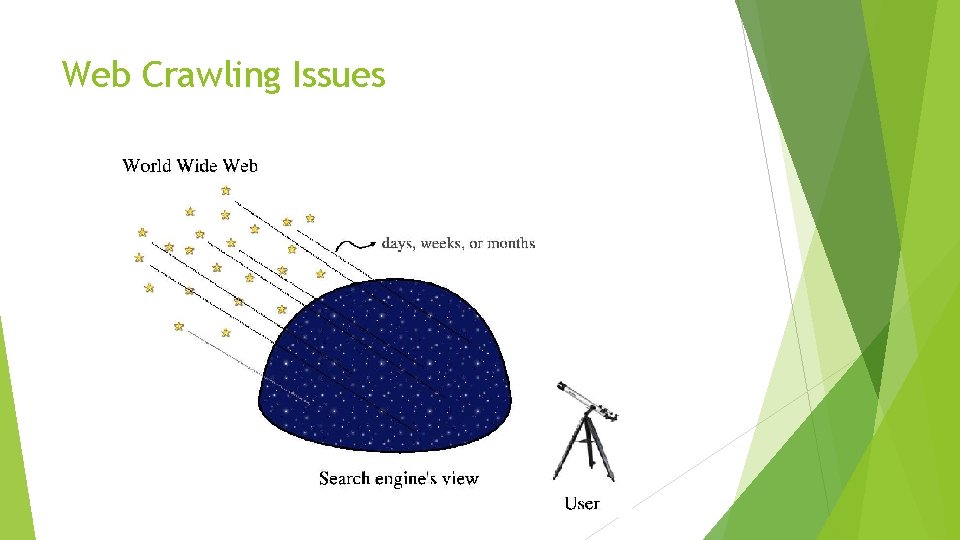
Web Crawling Issues
Data miners A data miner in a web search engine typically consists of a document indexer, a document ranker, and results presentation interface. The indexers analyze the information contained within corpus documents into a format which is amenable to quick access by the query processor. Typically, this involves extracting document features by breaking-down the documents into their constituent terms, extracting statistics relating to term presence within the documents, and calculating any query-independent evidence.
Indexing Text Operations forms index words (tokens). ü Stopword removal ü Stemming Indexing constructs an inverted index of word to document pointers.
Indexing The indexers analyze the information contained within corpus documents into a format which is amenable to quick access by the query processor. Typically, this involves extracting document features by breaking-down the documents into their constituent terms. Extracting statistics relating to term presence within the documents, and calculating any query independent evidence.
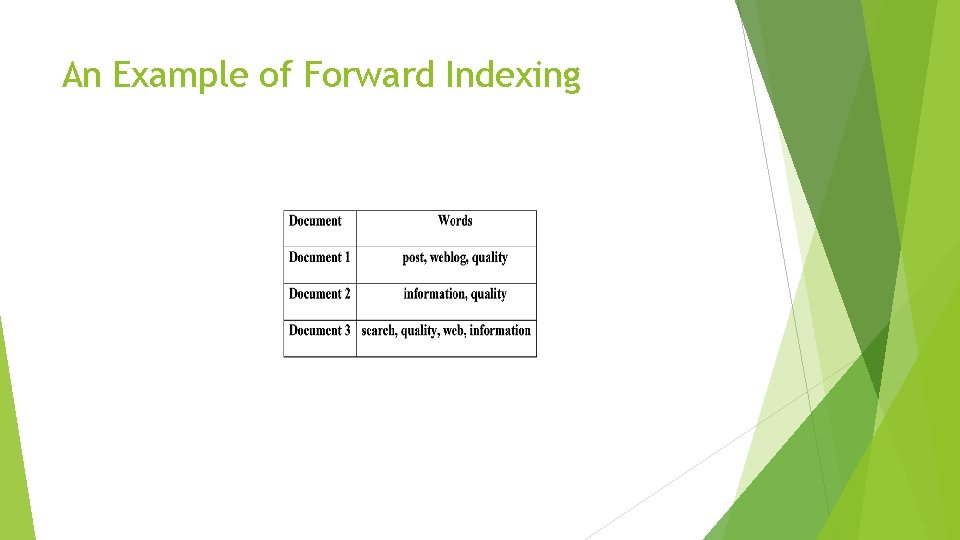
An Example of Forward Indexing
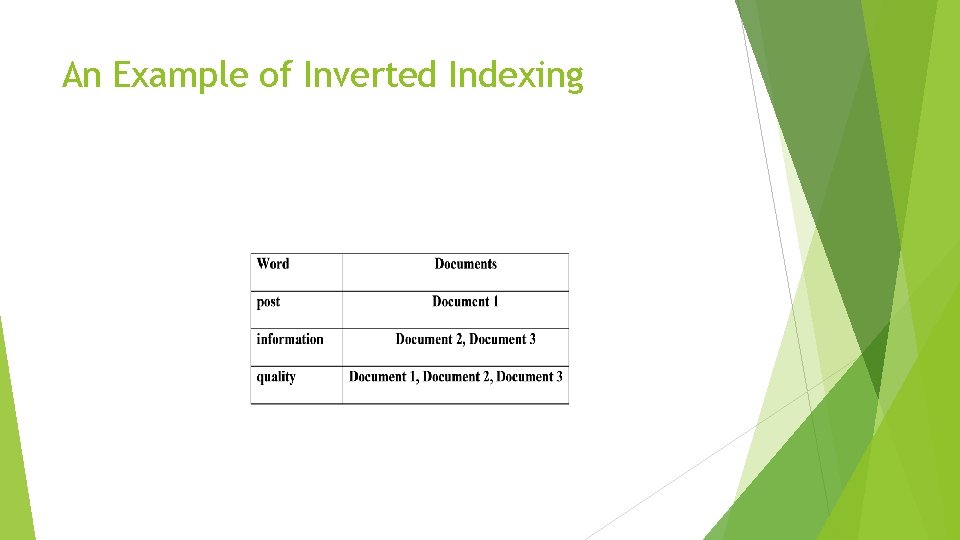
An Example of Inverted Indexing
Ranking is the process which estimates the quality of a set of results retrieved by a search engine Ranking is the most important part of a search engine
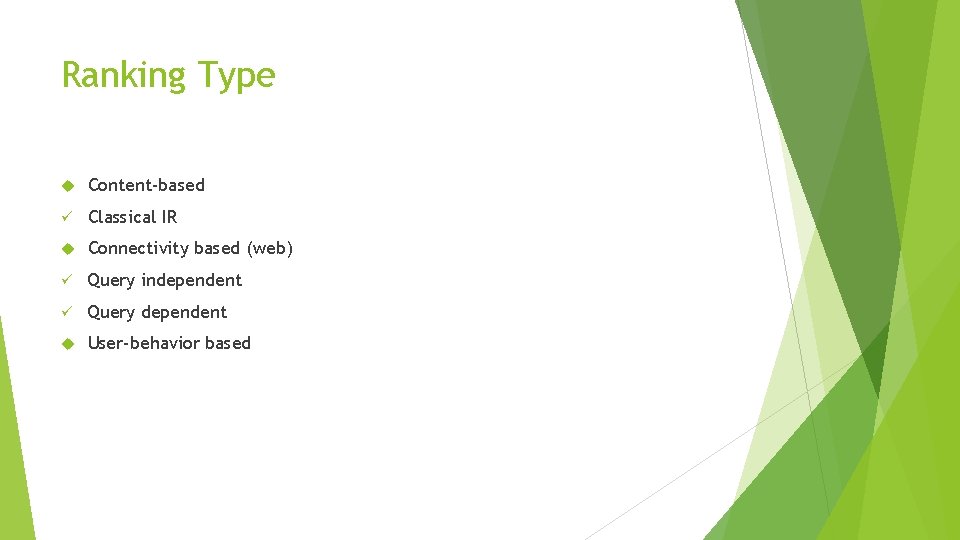
Ranking Type Content-based ü Classical IR Connectivity based (web) ü Query independent ü Query dependent User-behavior based
Publications/societies ü ü ACM’s SIGIR Special Interest Group on Information Retrieval Annual conferences, beginning in 1978 ü Gerald Salton award, first honoree: Gerald Salton (1983) TREC ü Annual Text Retrieval Conference, beginning in 1992 ü Sponsored by the U. S. National Institute of Standards and ü Technology as well as the U. S. Department of Defense ü Today: many different tracks, e. g. , blogs, genomics, spam ü Provides data sets and test problems
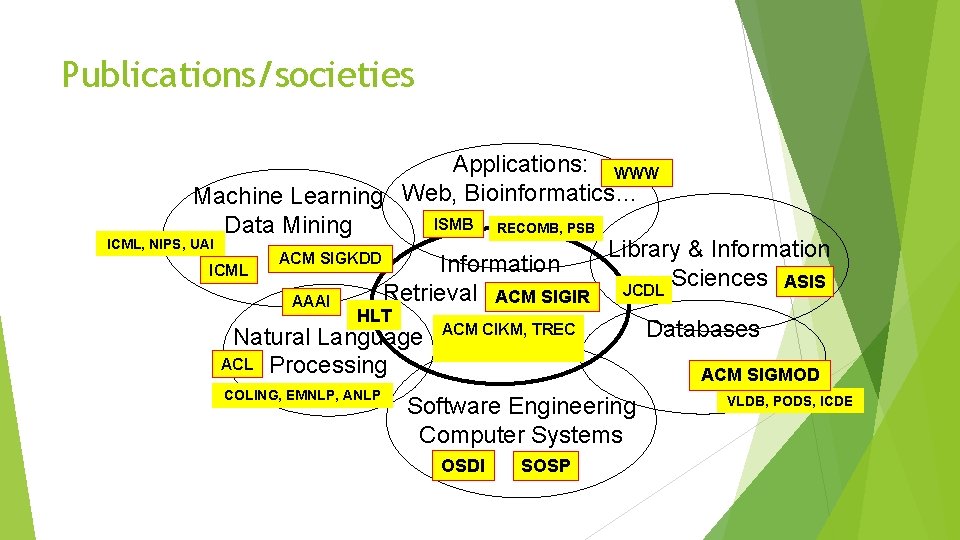
Publications/societies Applications: WWW Machine Learning Web, Bioinformatics… ISMB RECOMB, PSB Data Mining ICML, NIPS, UAI Library & Information ACM SIGKDD Information ICML Sciences ASIS JCDL Retrieval ACM SIGIR AAAI HLT Natural Language ACL Processing COLING, EMNLP, ANLP ACM CIKM, TREC Databases ACM SIGMOD Software Engineering Computer Systems OSDI SOSP VLDB, PODS, ICDE
- Slides: 22