Intergenerational Communication Improving the Efficiency and Effectiveness of

- Slides: 37
Intergenerational Communication: Improving the Efficiency and Effectiveness of Multigenerational Teams Saiqa Anne Qureshi, Ph. D MBA UCSF- University of California San Francisco 2019
Section One § Introduction • Agenda • Learning Outcomes • Why This Training • Vocabulary 2 11/27/2020
Agenda § Vocabulary and Intersection § Identifying the Generations § Demographic changes in the Workforce § A changing workforce § Advice and Examples across Generations
Learning Outcomes § Understand the generations that are present in the workforce § Identify difference in those cohorts and their expectations § Support you to tailor interaction with different groups § Support you to work across those generations to harness the strengths of a multigenerational team
Why this training? • Miscommunication is the number one cause of adverse events in surgical settings. • The place of the employee within the hierarchy is known to cause communication problems, and a focus on improving communication can reduce accidents. • Complicating communication are the intersection of gender, race, cultural background, work role, and age or generation. • This training will support clinicians to better understand the perspective of different generations in the work place, and how to communicate more effectively with each group. This should support better overall communication within the patient facing team. 5 11/27/2020
Vocabulary § Generation- individuals living contemporaneously who have common knowledge and experiences that affect their attitudes, thought process, values, beliefs and behaviors. § Cusper- people living on the edge of one generation or another § Generational Myopia- when you see an entire group as one monolithic existence, all pained with one brush
Intersection § Birth year within a generational cohort is only one factor. • Gender • Sexual Orientation • Nation of Origin • Immigration history • Cultural background • Socioeconomic Status • Race • Religiosity • Marital Status • Other factors in the lived experience (negative ones include stress, violence ))
Section Two § Identifying Generations • Silent/ Traditionalist/ Veterans • Boomers • Generation X • Generation Y (Millennials) • Generation Z 8
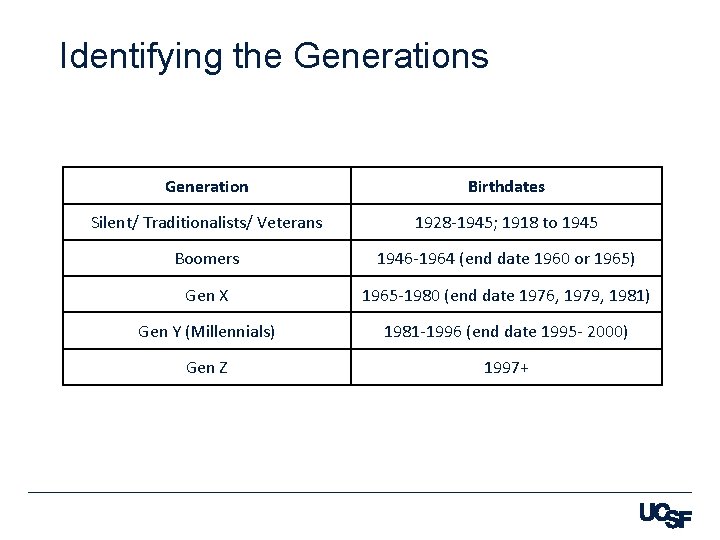
Identifying the Generations Generation Birthdates Silent/ Traditionalists/ Veterans 1928 -1945; 1918 to 1945 Boomers 1946 -1964 (end date 1960 or 1965) Gen X 1965 -1980 (end date 1976, 1979, 1981) Gen Y (Millennials) 1981 -1996 (end date 1995 - 2000) Gen Z 1997+
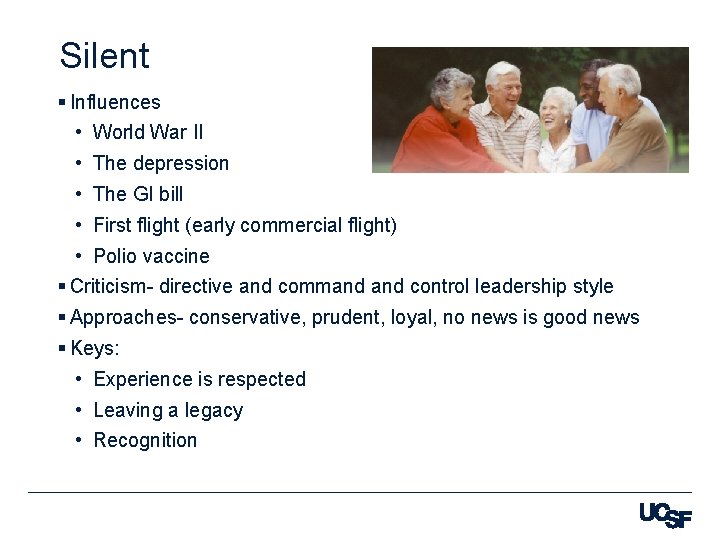
Silent § Influences • World War II • The depression • The GI bill • First flight (early commercial flight) • Polio vaccine § Criticism- directive and command control leadership style § Approaches- conservative, prudent, loyal, no news is good news § Keys: • Experience is respected • Leaving a legacy • Recognition
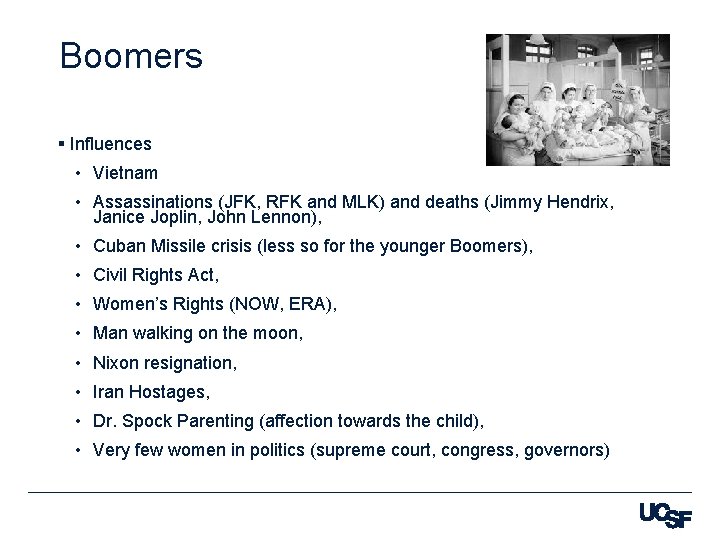
Boomers § Influences • Vietnam • Assassinations (JFK, RFK and MLK) and deaths (Jimmy Hendrix, Janice Joplin, John Lennon), • Cuban Missile crisis (less so for the younger Boomers), • Civil Rights Act, • Women’s Rights (NOW, ERA), • Man walking on the moon, • Nixon resignation, • Iran Hostages, • Dr. Spock Parenting (affection towards the child), • Very few women in politics (supreme court, congress, governors)
Boomers § Key • Prize fairness and individual rights • Personal growth and freedom of expression • Motivated internally when they can have ownership, receive recognition and feel needed. • Very sensitive to feedback and uncomfortable with conflict. • Less need for feedback, recognition via money and title. “Two Reasons to hire Boomers: They don’t expect to be complimented for breathing and they’re unlikely to take a week off because someone broke their heart. ” Cindy Cooke, Director of Boomerz
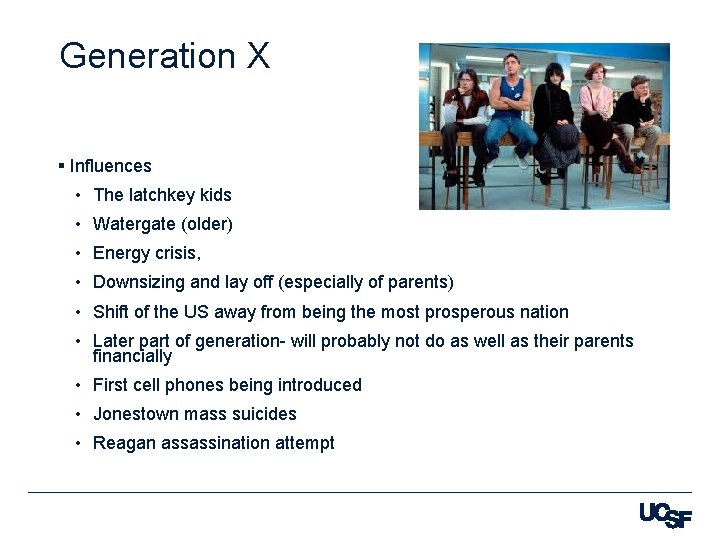
Generation X § Influences • The latchkey kids • Watergate (older) • Energy crisis, • Downsizing and lay off (especially of parents) • Shift of the US away from being the most prosperous nation • Later part of generation- will probably not do as well as their parents financially • First cell phones being introduced • Jonestown mass suicides • Reagan assassination attempt
Generation X § Criticism • Distrustful of those who don’t “pay their dues” the way they did • Nuts and bolts tech savvy • Skeptical • Least prepared for retirement (only 33% have the recommended amount saved) and will probably have to push out planned retirement dates. § Approaches • Efficiency • “Kumbaya”- the team getting along • Seniority is less important (normally don’t think work is below them) • Building family (evidence of delay marriage and kids, but larger families)
Cusper Group: Xenial § Subgroup (Xenial or Oregon Trail or Catalano (My So Called Life)1977 to 1985 (really in the early 1980’s) • Different- in the workforce when the recession hit, hit hardest by the recession due to lack of job/job losses and high student loan debt (later millennials started work with work available) • No social media in teen years (normally my space and facebook in college or just after) • Impact of 9/11 was different- in teens and 20’s, later millennials were shaken younger by the experience • No cell phone in school, had to use pay phone, landlines and speak to friend’s parents • Less helicopter parents • Not as optimistic as millennials • First group to grow up with household computers and internet access
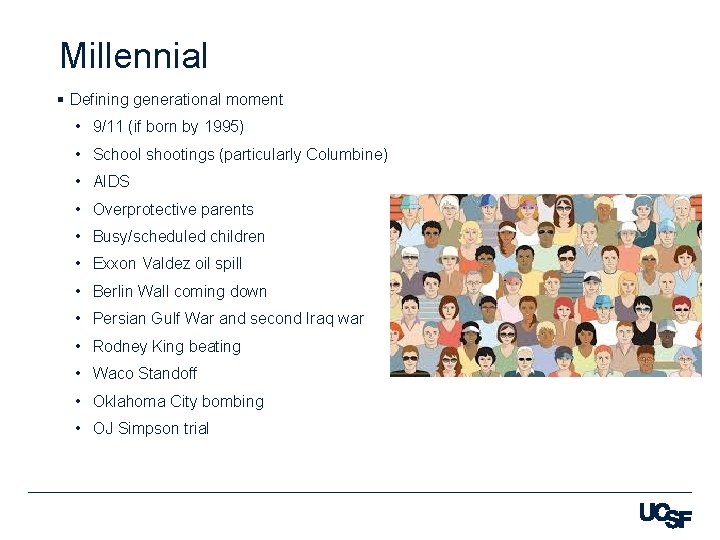
Millennial § Defining generational moment • 9/11 (if born by 1995) • School shootings (particularly Columbine) • AIDS • Overprotective parents • Busy/scheduled children • Exxon Valdez oil spill • Berlin Wall coming down • Persian Gulf War and second Iraq war • Rodney King beating • Waco Standoff • Oklahoma City bombing • OJ Simpson trial
Millennial § Keys • Used to constant communication, transparency and information about the big picture, flexibility, provide more feedback and coaching. • They possess self-efficacy and a belief in their abilities to handle whatever comes their way. • Motivated by challenge, action, unconditional acceptance, and change. • Not averse to the status quo, but they want more input on the rationale behind “sticking with it”. • Millennials appreciate being involved in decision-making and want the opportunity to give their two cents. • Driven by meaningful work, working with other bright creative people, push button access (information), resume building and collaboration. • “The numbers are telling: when asked which benefits are most important to them, work flexibility ranked first, at 19. 1%, followed by healthcare coverage at 16. 9%. ”
Section Three § Demographic Change in the Workforce § A Changing Workforce § Multigenerational Teams § Examples Across Generations 18 11/27/2020
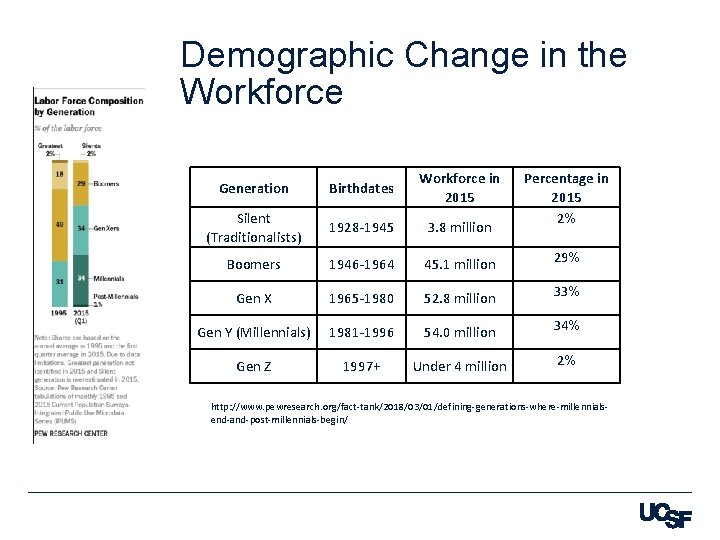
Demographic Change in the Workforce Generation Birthdates Workforce in 2015 Percentage in 2015 2% Silent (Traditionalists) 1928 -1945 3. 8 million Boomers 1946 -1964 45. 1 million 29% Gen X 1965 -1980 52. 8 million 33% Gen Y (Millennials) 1981 -1996 54. 0 million 34% Gen Z 1997+ Under 4 million 2% http: //www. pewresearch. org/fact-tank/2018/03/01/defining-generations-where-millennialsend-and-post-millennials-begin/
Demographic Change in the Workforce § UNC’s Kenan-Flagler Business School and the YEC, millennials or Gen-Y (those born between 1976 and 2001) were 36% of the workforce in 2014 and are predicted to be 46% by 2020. § By 2026 Millennials will be the majority of the workforce. (Pew) § 55+ will be 24% of the workforce by 2020, as older workers are delaying retirement. § Traditionalist are working longer, however most are retired, and more Baby Boomers are retiring earlier, leaving a gap in the higher management ranks (Boston College Center on Aging) § This change means that there is a gap in higher management that Generation X is filling, perhaps earlier than expected, but Millennials are the majority of the workforce with some Baby Boomers still in the workforce.
A Changing Workforce § We cannot hire, not respect and not factor in the needs of a younger work force. § We have to find a way to bring together 4 -5 generations in the workplace and support all for success. § We must avoid Generational Myopia, when an entire group is seen as one monolithic existence, all pained with one brush, to avoid stereotypes and harness strengths
Strengths in Multigenerational Teams § Economic Cycles and how to function through this with long term planning § Knowing the ropes at a company- connecting younger workers to contacts via networks (intra company and also within field) § Age provides diversity of perspective § Risk taking (different profiles bring different tolerances into the workplace) § Moving jobs- having a changing work force does have upsides (new skills into team)
Communication across Generations § Change in the level of formality • Less formal now • Set communication norms- ok to “text talk” on chat- not on email • how to use “to” and “cc” on email § Change in technology • Shift to “chat” so less formal complete messages are sent out § Change in communication model call vs email/chat • Still needs to be seen as establishing networks at work
Examples Across Generations § Team meeting at 9 am on a Friday for 1. 5 hours (in person) • Previously- great, will be there; don’t ask to not attend • Currently- Why? What is on the agenda? Do we need 1. 5 hours? Can we do this on email? § Where people sit • Previously- Sit where you are told, set assigned seat, moved at will, moved as a punishment (command control style) • Currently- Why? Can we hot desk? Can we move to sit with different team? Can we locate at different locations as needed? Do we need a desk phone or can you pay for a cell phone?
Section Four § Advice Across Generations 25 11/27/2020
Advice Across Generations § Filing systems • Paper (going digital) • Short cut links vs understanding the filing of folder system • Physically finding vs optimized search bar • Nomenclature and naming conventions § How putting in effort is defined • Boomers- face time and laying ground work ‒ 60 minute meeting • Millennial- short bursts of communication ‒ 60, 1 minute meetings
Advice Across Generations § Start with respect- don’t assume based on age, all generations still want to build relationships (normally face to face). § Diversify the methods you use to engage your employees and boost morale. While younger workers might appreciate informal time to bond outside the office and older workers could gravitate toward a structured brainstorming session around a specific task, encourage everybody to attend both types of events § Use multiple communication avenues (memo, email, newsletter, chat messenger). § Don’t jump the gun on overusing technology; members of all generations still see the value in more personal contact. While you may want your organization to be on the cutting edge, employees who aren’t yet trained on new applications might feel left out while others could miss the personal touch of an inperson conversation
Advice Across Generations § Body language and tone of voice comprise 93% of our communication. Misinterpretation of tone of voice is the source of many conflicts. As things move away from face to face communication, and there is an increase in chat, email and telecommuting, strategies must to put in place to manage conflict that can arise from miscommunication. § Common Ground- meaning in the work, mission driven, what brings everyone together. • Focus on common Goals § Involve everyone • Diverse groups give more viewpoints and encourages creativity • Include a range of age ranges in leadership, at least in a consultative way • Keep older workers engage (remember to tell them they are valued)
Advice Across Generations § Emphasize Uniqueness • What does each person value, want and need • What do they need to be productive • Make sure everyone knows what each person brings to the team ‒ Please note- this is far more time consuming in terms of management, and to do this effectively you must be aware of how many staff members each manager can effectively manage. § Platinum Rule • Do unto others as they want to be done unto. • Variety is key in terms of rewards, allowing people to choose what is right for them.
Advice Across Generations § Support training to overcome resistance to change • Confront Negative Behavior ‒ Describe Problem ‒ Explain your concerns ‒ Listen and acknowledge issues ‒ Ask for agreement to change ‒ Clarify what has been agreed ‒ Express confidence and confidently expect change
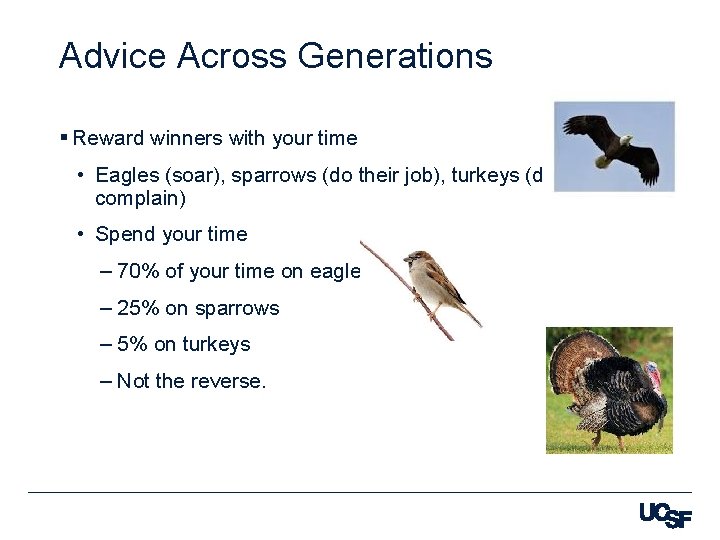
Advice Across Generations § Reward winners with your time • Eagles (soar), sparrows (do their job), turkeys (do little and complain) • Spend your time ‒ 70% of your time on eagles ‒ 25% on sparrows ‒ 5% on turkeys ‒ Not the reverse.
Advice Across Generations § Praise • Specific and significant • Sincere • Immediate • In public or in writing • Often • Connect to impact on organization § Criticism • Coaching not punishment • Specific • Private • Descriptive and specific • Prescriptive
Advice Across Generations: Management § Leadership team made up of Baby Boomers and Gen X, majority of workforce is Millennial (non-leadership). § The perception is that there is a lack of transparency because Gen X and Baby Boomers thinks that younger people should “wait their turn” to get into leadership and then make decisions (and have privileged information). § This doesn’t garner “buy in” from the younger work force around vision and direction of the business and disengagement occurs. § Information as a right vs. a privilege
Advice Across Generations: Management § Everyone is different- ask what they want, ask what is best for them, practice the platinum rule § Try to meet others how they want to be communicated withwhat is your preferred style, are you ok with being interrupted § Think about a team meeting plus chat during the day § Connect both hard work (completion of tasks) with mission and cause (a larger driver for younger workers) § Realize the need for praise/recognition § There is no “truth”- there is not just one way to do things, there is rarely one right answer § Mutual reciprocity- you get what you give, and if you give people what they need they tend to give you what you need.
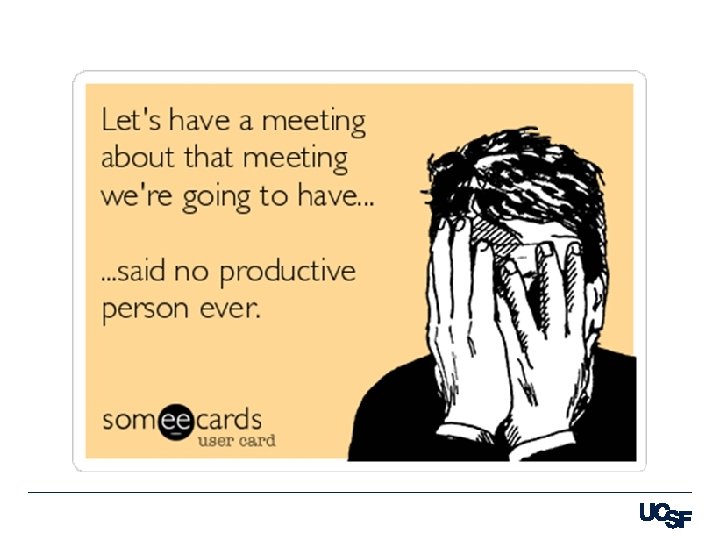
Advice Across Generations: Meetings § Determine the purpose (for example meetings) § Consider alternatives to meetings § Always have an agenda § Start on time § End on time § Stick to the agenda § Assign responsibilities § Take notes and clearly assign responsibilities
Thank You