i NSOMNIA ElSayed Saleh M D Ass Prof

- Slides: 51
i. NSOMNIA El-Sayed Saleh, M. D. Ass. Prof. of Psychiatry
Definitions Sleep is a state of unconsciousness in which the brain is relatively more responsive to internal than to external stimuli Mechanisms within the brainstem and hypothalamus regulate sleep through GABA and acetylcholine
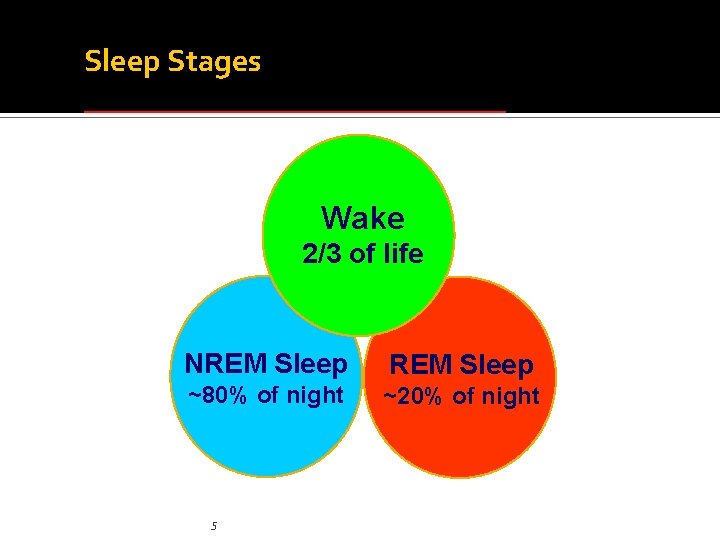
Sleep Stages ______________ Wake 2/3 of life NREM Sleep ~80% of night ~20% of night 5
Stages of sleep ______________ 1. NREM Sleep A. Stage 1 B. Stage 2 C. Stage 3 D. Stage 4 2. REM Sleep 6
Sleep Requirements Average - 7 1/2 to 8 1/2 hrs/night Range (for adults) - 5 -9 hrs/night Steadily decreases from birth to old age newborns sleep 14 -16 hours/24 hours Elderly spend less time sleeping per night, but increase in sleep latency and more frequent arousals make their requirement in bed longer.
Initiation of Sleep = Time to fall asleep Standard - less than 30 minutes Sleep Efficiency = Time sleeping/ Time in bed Standard - Greater than 85% May be caused by awakening frequently during the night with subsequent difficulty in re-initiating sleep, or awakening too early without being able to go back to sleep at all
Philagrypnia Ability to stay alert with very little sleep
Sleep disorders (ICSD 2) 1. 2. 3. 4. 5. 6. Insomnia. Sleep Related Breathing Disorders. Hypersomnia. Cicadian Rhythm Sleep Disorder. Parasomnia. Sleep related Movement Disorder. 10
Important facts Sleep disorders are common Sleep disorders are serious Sleep disorders are treatable Sleep disorders are under diagnosed 11
i. NSOMNIA
Insomnia – definition Insomnia is defined as difficulty with the initiation, maintenance of sleep that results in the impairment of daytime functioning, despite adequate opportunity and circumstances for sleep. Patient’s subjective dissatisfaction with the sleep quality and quantity The normal requirement for sleep ranges between 4 and 10 hours Insomnia is a symptom, not a disorder by itself
Poor Sleep Maintenance Waking after sleep has been initiated, but before desired waking time
Types of insomnia Transient insomnia < 4 weeks triggered by excitement or stress, occurs when away from home Short-term 4 wks to 6 months , ongoing stress at home or work, medical problems, psychiatric illness Chronic Poor sleep every night or most nights for > 6 months, psychological factors (prevalence 9%)
Some patients may not meet any of the above conditions, but awake feeling poorly rested.
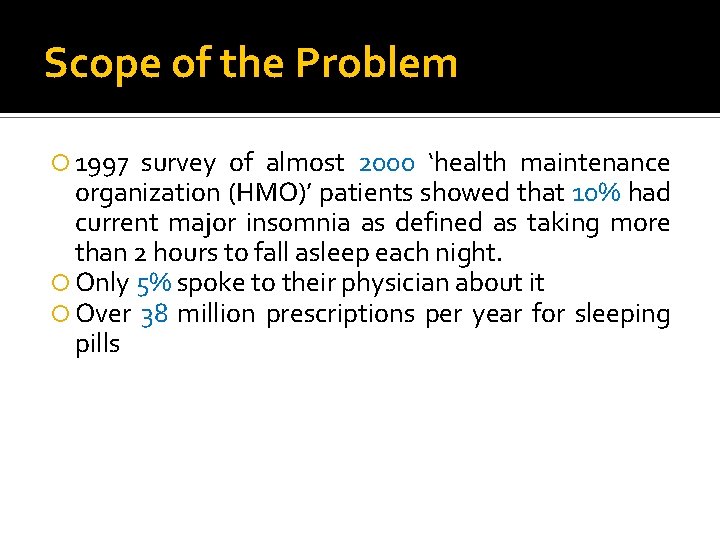
Scope of the Problem 1997 survey of almost 2000 ‘health maintenance organization (HMO)’ patients showed that 10% had current major insomnia as defined as taking more than 2 hours to fall asleep each night. Only 5% spoke to their physician about it Over 38 million prescriptions per year for sleeping pills
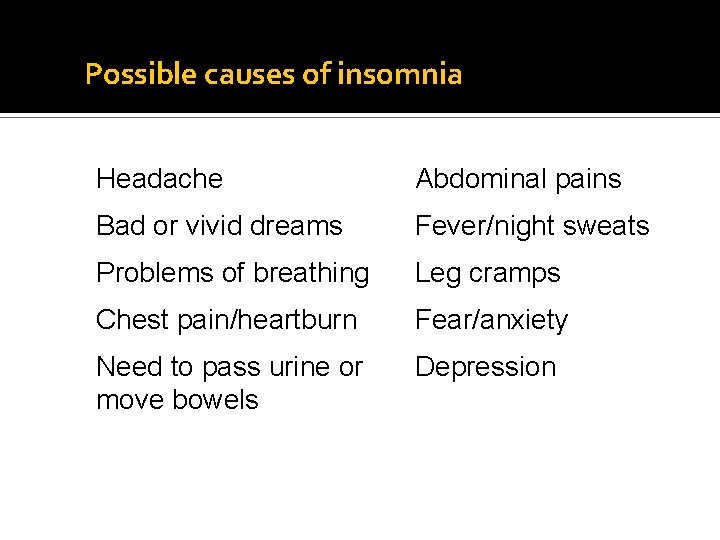
Possible causes of insomnia Headache Abdominal pains Bad or vivid dreams Fever/night sweats Problems of breathing Leg cramps Chest pain/heartburn Fear/anxiety Need to pass urine or move bowels Depression
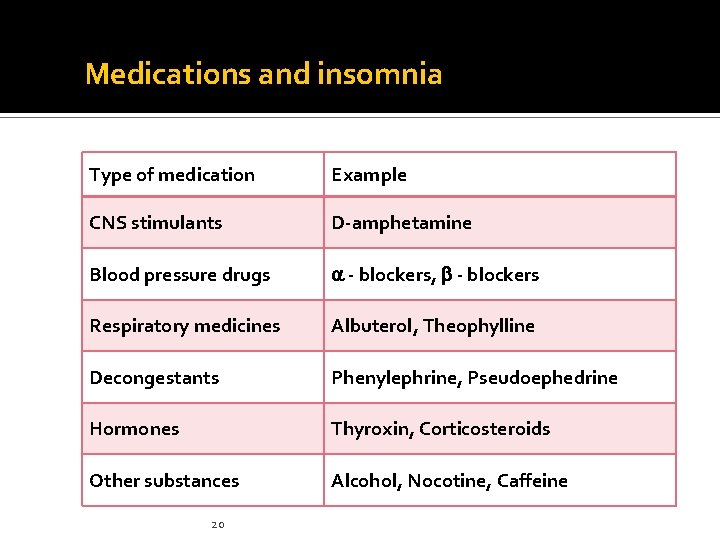
Medications and insomnia Type of medication Example CNS stimulants D-amphetamine Blood pressure drugs - blockers, - blockers Respiratory medicines Albuterol, Theophylline Decongestants Phenylephrine, Pseudoephedrine Hormones Thyroxin, Corticosteroids Other substances Alcohol, Nocotine, Caffeine 20
Insomnia – associated features At least one (or more) of the following Fatigue or malaise Attention, concentration impairment Social/ vocational dysfunction/ poor work Mood disturbance or irritability Daytime sleepiness 21
Insomnia – resultant problems Reduction in motivation, energy or initiative Proneness for errors or accidents at work or while driving Tension, headaches or gastrointestinal symptoms in response to sleep loss Concerns or worries about sleep Secondary psychiatric problems 22
Consequences Mood Disturbance Depression and/or Anxiety Poor memory Difficulty concentrating Motor vehicle and other accidents
Insomnia – assessment Determine the pattern of sleep problem (frequency, associated events, how long it takes to go to sleep, and how long the patient can stay asleep) Include a full history of alcohol and caffeine intake and other factors that might affect sleep Review current medications that patient is taking to eliminate these as possible causes Take a history to rule out physical cause and/or psychosocial cause
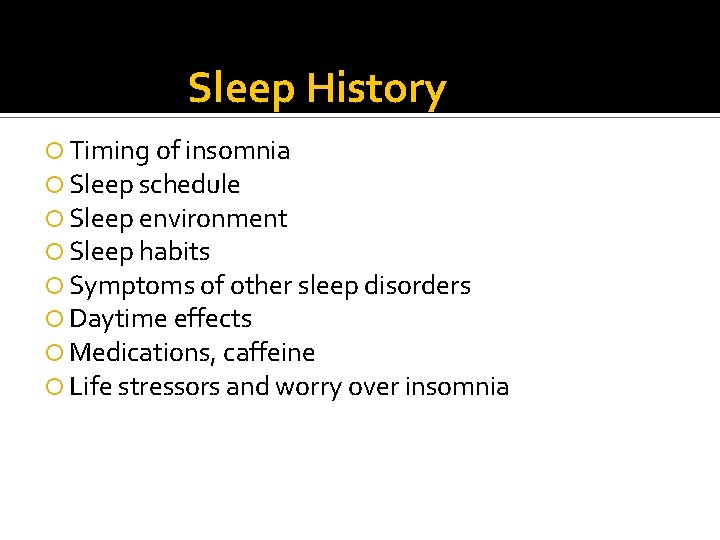
Sleep History Timing of insomnia Sleep schedule Sleep environment Sleep habits Symptoms of other sleep disorders Daytime effects Medications, caffeine Life stressors and worry over insomnia
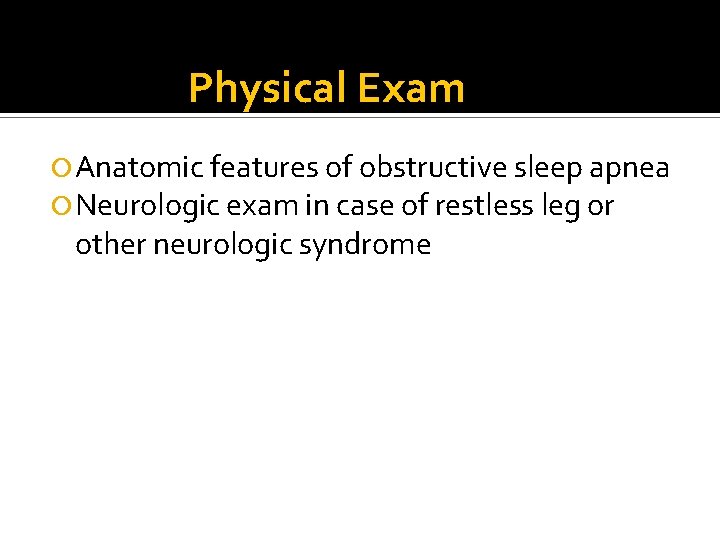
Physical Exam Anatomic features of obstructive sleep apnea Neurologic exam in case of restless leg or other neurologic syndrome
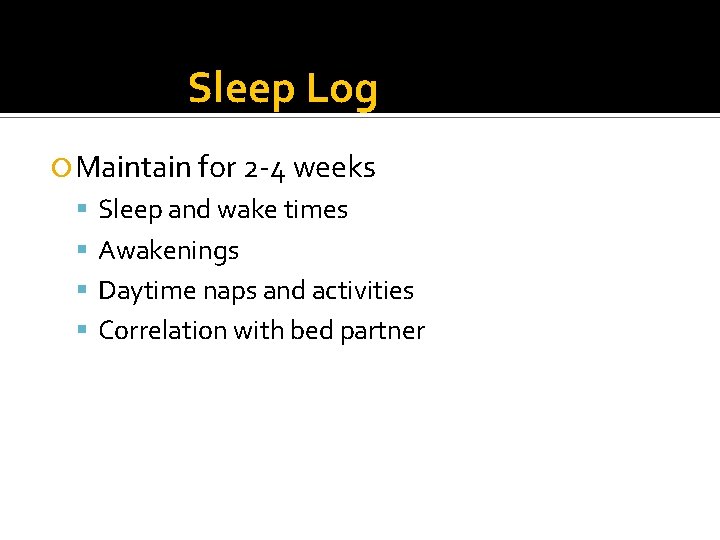
Sleep Log Maintain for 2 -4 weeks Sleep and wake times Awakenings Daytime naps and activities Correlation with bed partner
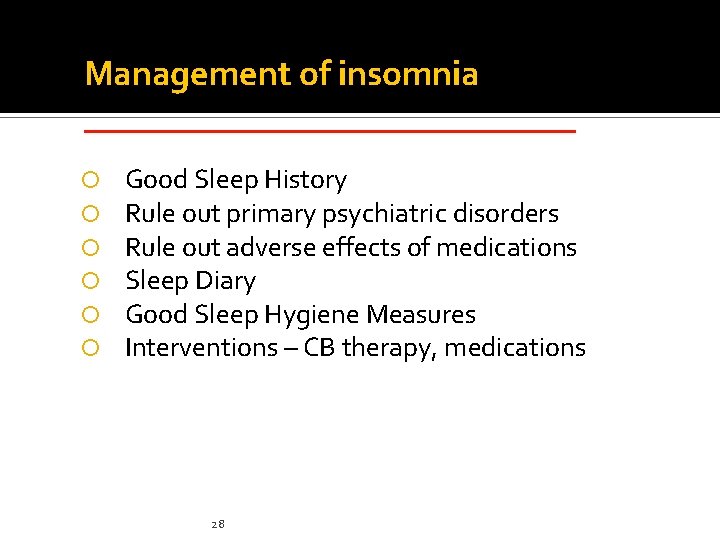
Management of insomnia ______________ Good Sleep History Rule out primary psychiatric disorders Rule out adverse effects of medications Sleep Diary Good Sleep Hygiene Measures Interventions – CB therapy, medications 28
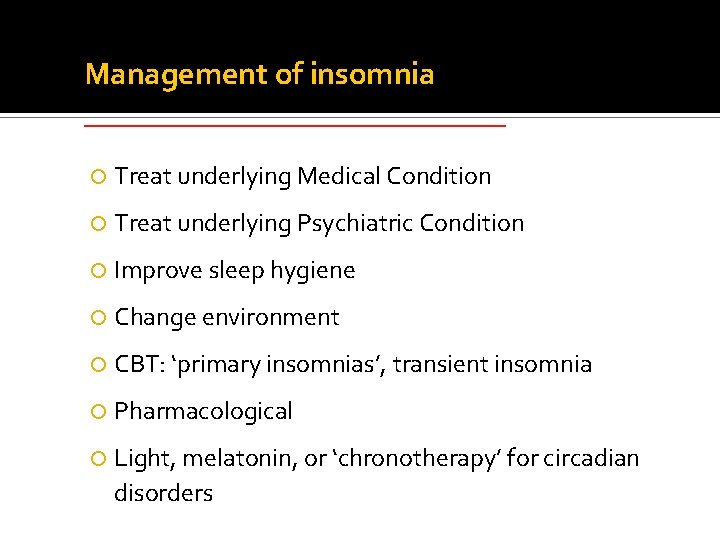
Management of insomnia ______________ Treat underlying Medical Condition Treat underlying Psychiatric Condition Improve sleep hygiene Change environment CBT: ‘primary insomnias’, transient insomnia Pharmacological Light, melatonin, or ‘chronotherapy’ for circadian disorders
Nonpharmacalogic Therapy Cognitive Behavioral Therapy Individual counseling- 6 sessions Effective in 50% of patients
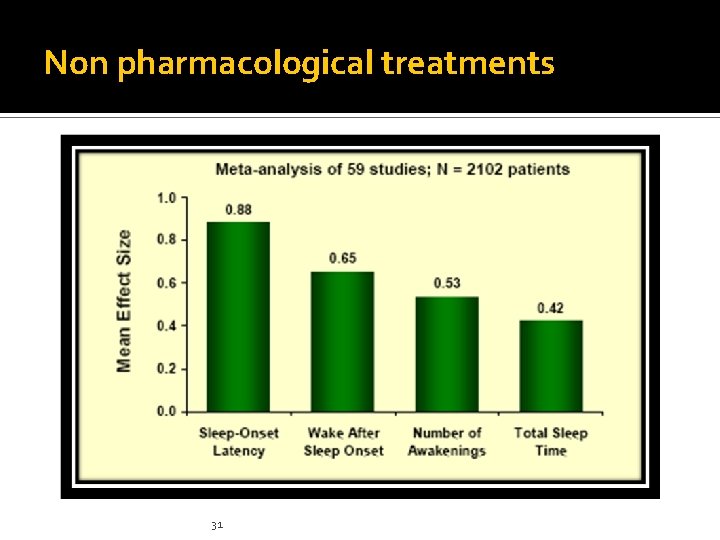
Non pharmacological treatments 31
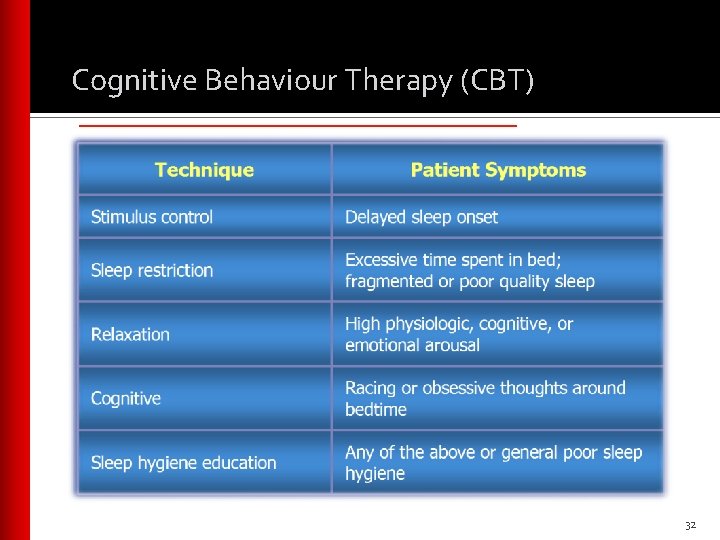
Cognitive Behaviour Therapy (CBT) ______________ 32
Bed room _____________ Temperature Fresh air S&S Comfortable bed 33
Stimulus control _____________ Go to bed when sleepy Only S & S in bedroom Get up the same time every morning Get up when sleep onset does not occur in 20 min, and go to another room No daytime napping 34
Sleep hygiene _____________ Behaviours that interfere with sleep Caffeine Alcohol Nicotine Daytime napping Exercise < 4 hrs before bed 35
Relaxation training _____________ Progressive muscle relaxation Diaphragmatic breathing Biofeedback Meditation, Yoga Hypnosis to ↓ anxiety & tension at bedtime 36
Thought stopping _____________ Interrupt unwanted pre-sleep cognitive activity by instructing patient to repeat sub-vocally ‘the’ every 3 sec (articulatory suppression) To yell sub-vocally “stop” 37 (thought stopping)
Behavioural therapies _____________ Explicit instruction to stay awake when they go to bed; Aim is to reduce anxiety associated with trying to fall asleep – Paradoxical intention Alter irrational beliefs about sleep, provide accurate information that counteracts false beliefs – Cognitive restructuring Patient imagines 6 common objects (candle, kite, fruit, hourglass, blackboard, light bulb) emphasis on imagining shape, colour, texture – Imagery training 38
Benzodiazepine receptor agonists _____________ Benzodiazepines Non Benzodiazepines Lorazepam Zolpidem Clonezepam Zolpidem CR Temazepam Zeleplon Flurazepam Eszopiclone Quazepam Alprazolam Triazolam Estazolam 39 Both these classes act on the GABAA receptors (Bz. RA) in PCN
Other classes of medications _____________ Antidepressants Melatonin Receptor Agonists Trazadone Melatonin Mirtazapine Ramelteon Doxepin Amitryptyline Antipsychotics Miscellaneous Valerian Diphenhydramine Olanzapine Cyclobenzaprine Quitiepine Hydroxyzine Alcohol 40
Bz. RAs – side effects and safety _____________ Anterograde amnesia Residual sedation – longer acting Bz. RAs Rebound Insomnia? Abuse and dependence? Mostly used short term (2 weeks) When used as a sleeping aid dose escalation rare No physical dependence with night time use Low psychological dependence with night time use Increased fall risk, cognitive effects in the elderly
Benzodiazepines ______________ Benzodiazepines (GABA receptor agonist) Transient insomnia, (max 2 wks, ideally 2 -3/wk) Long ½ life - Medium ½ life - temazepam Short ½ life - diazepam Poor functional day time status, cognitive impairment, daytime sleepiness, falls and accidents, depression Acute withdrawal, confusion, psychosis, fits - may occur up to 3/52 from stopping 42 nitrazepam
Benzodiazepine use ______________ Benzodiazepines are the drugs of choice for the treatment of insomnia. Flurazepam can be used for up to one month with little tolerance. Temazepam can be used for up to three months with little tolerance. Intermittent use recommended (every three days). Use for no longer than 3 – 6 months.
Benzodiazepine use ______________ Half-life is an important factor Benzodiazepines with long half lives (e. g. , flurazepam) produce sustained sleep, but increased risk of daytime somnolence Benzodiazepines with short half lives may be best for patients with difficulty falling asleep, but can produce rebound insomnia Development of tolerance can produce rebound insomnia in compounds with short half lives
Benzodiazepine abuse ______________ Benzodiazepines have relatively low abuse potential. Prolonged use can lead to withdrawal symptoms: headache, irritability, dizziness, abnormal sleep Rebound insomnia - triazolam
Benzodiazepine toxicity ______________ Low toxicity when taken alone In combination can be fatal Flumanzenil is a benzodiazepine antagonist that can be used to block adverse effects of benzodiazepines Stomach pump, charcoal, hemodialysis
Non benzodiazepines ______________ Act at the benzodiazepine receptor Less risk of dependence • Zaleplon short ½ life • Zolipidem, Zopiclone slightly longer ½ life • No difference in effectiveness & safety • More expensive • Only to be used if adverse effects to BZP 47
Zolpidem ______________ Short half life Does not produce rebound insomnia Low abuse potential Less likely to produce withdrawal symptoms Rebound insomnia after first night of withdrawal, but soon resolves
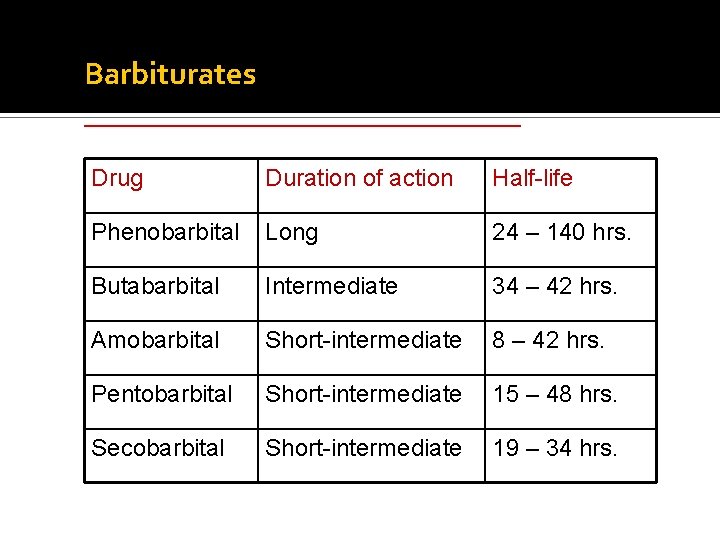
Barbiturates ______________ Drug Duration of action Half-life Phenobarbital Long 24 – 140 hrs. Butabarbital Intermediate 34 – 42 hrs. Amobarbital Short-intermediate 8 – 42 hrs. Pentobarbital Short-intermediate 15 – 48 hrs. Secobarbital Short-intermediate 19 – 34 hrs.
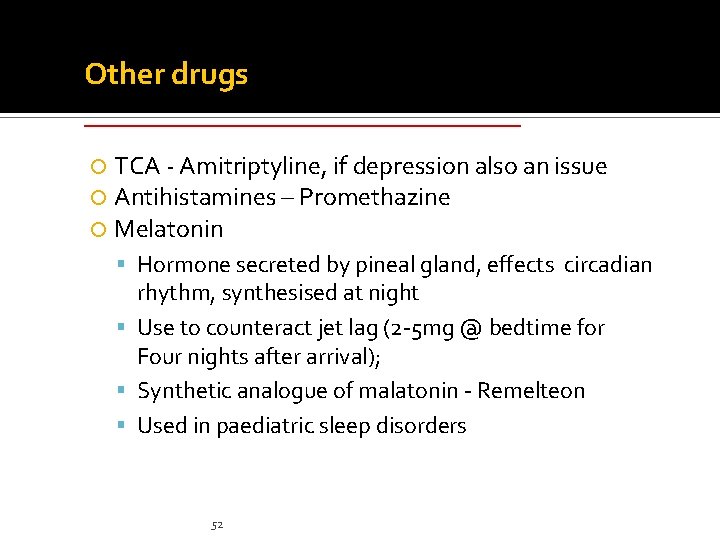
Other drugs ______________ TCA - Amitriptyline, if depression also an issue Antihistamines – Promethazine Melatonin Hormone secreted by pineal gland, effects circadian rhythm, synthesised at night Use to counteract jet lag (2 -5 mg @ bedtime for Four nights after arrival); Synthetic analogue of malatonin - Remelteon Used in paediatric sleep disorders 52
Thank You All Have Good Dreams