HECAT Health Education Curriculum Analysis Tool Lessons for






- Slides: 30
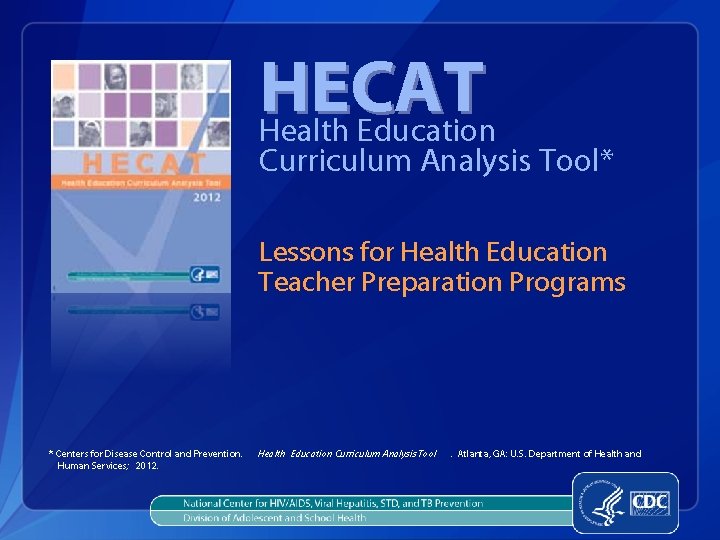
HECAT Health Education Curriculum Analysis Tool* Lessons for Health Education Teacher Preparation Programs * Centers for Disease Control and Prevention. Human Services; 2012. Health Education Curriculum Analysis Tool . Atlanta, GA: U. S. Department of Health and
Introduction to CDC’s HECAT Health Education Curriculum Analysis Tool* Lesson 1: Development, Application, and Organization of the HECAT * Centers for Disease Control and Prevention. Health and Human Services; 2012. Health Education Curriculum Analysis Tool . Atlanta, GA: U. S. Department of
Lesson 1: Objectives After completing this lesson, students will be able to: 1. Summarize the elements of a health education curriculum. 2. Summarize the purpose of the HECAT. 3. Explain a variety of ways the HECAT can be used.
What is a Health Education Curriculum? • The primary organizing framework for the delivery of health education. • The focus on what is important to address in health education. • The guide for measuring success of student learning and teacher instruction.
What is a Health Education Curriculum? Planned teaching strategies and learning experiences to provide students with opportunities to acquire the attitudes, knowledge, and skills necessary for • making health-promoting decisions. • achieving health literacy. • adopting health-enhancing behaviors. • promoting the health of others.
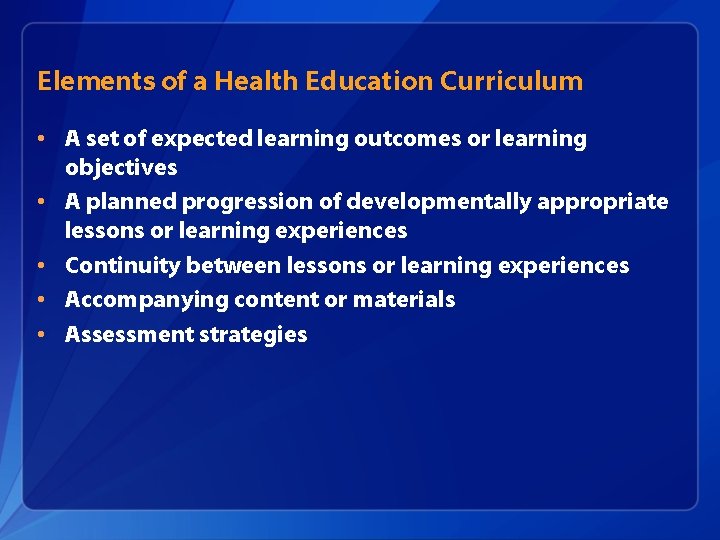
Elements of a Health Education Curriculum • A set of expected learning outcomes or learning objectives • A planned progression of developmentally appropriate lessons or learning experiences • Continuity between lessons or learning experiences • Accompanying content or materials • Assessment strategies
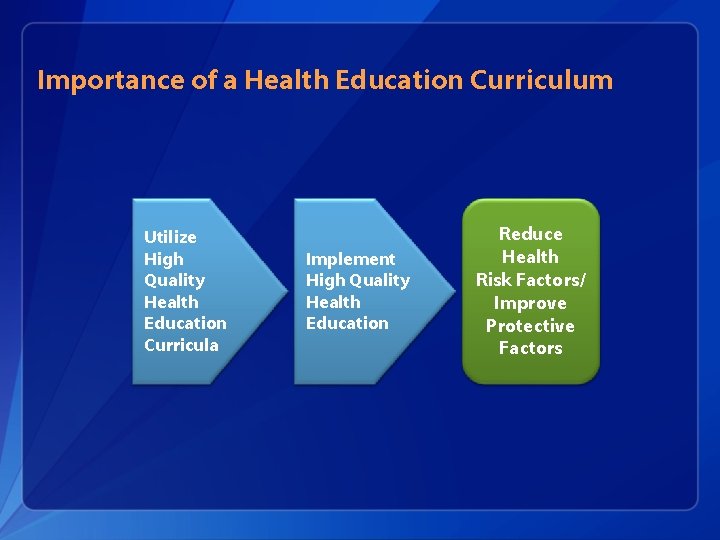
Importance of a Health Education Curriculum Utilize High Quality Health Education Curricula Implement High Quality Health Education Reduce Health Risk Factors/ Improve Protective Factors
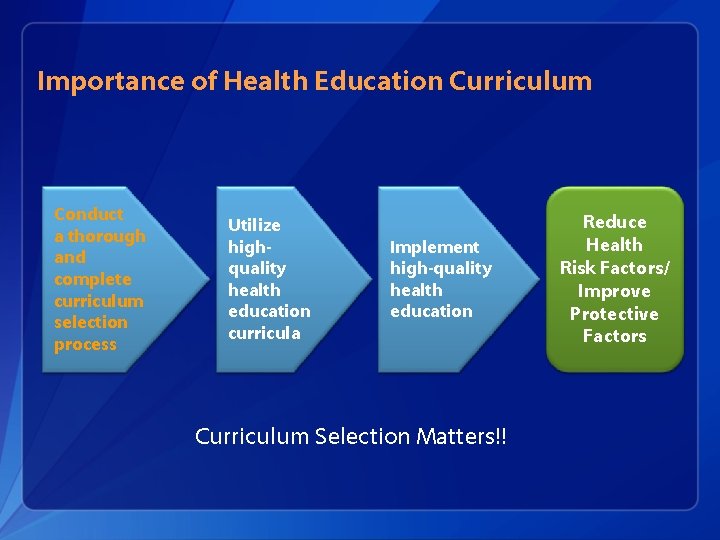
Importance of Health Education Curriculum Conduct a thorough and complete curriculum selection process Utilize highquality health education curricula Implement high-quality health education Curriculum Selection Matters!! Reduce Health Risk Factors/ Improve Protective Factors
Health Education Curriculum Analysis Tool (HECAT) HECAT Contains guidance, tools, and resources for a school district to carry out a • clear • complete • consistent analysis of health education curricula
The HECAT Gives analysis results that a school district can use to • improve an existing curriculum • select a commercially- packaged curriculum • develop or revise a locally-developed curriculum
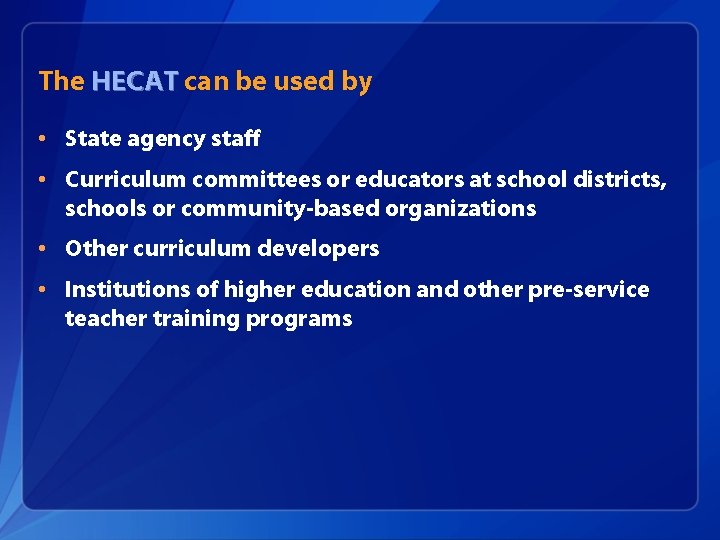
The HECAT can be used by • State agency staff • Curriculum committees or educators at school districts, schools or community-based organizations • Other curriculum developers • Institutions of higher education and other pre-service teacher training programs
HECAT Development • Reflects current research and up-to-date health education professional practice. • Guided by advisory panel of experts in: § school health education § public and school health education practice § health education standards and assessment § school curriculum design and classroom instruction § health risk behavioral research and practice
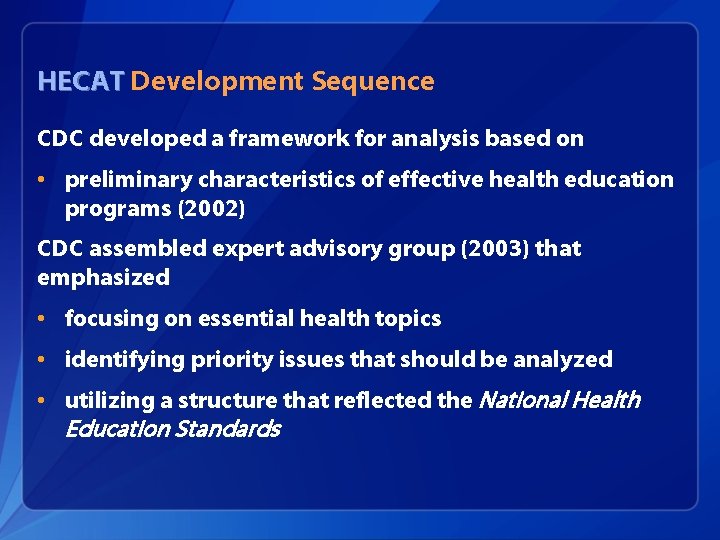
HECAT Development Sequence CDC developed a framework for analysis based on • preliminary characteristics of effective health education programs (2002) CDC assembled expert advisory group (2003) that emphasized • focusing on essential health topics • identifying priority issues that should be analyzed • utilizing a structure that reflected the National Health Education Standards
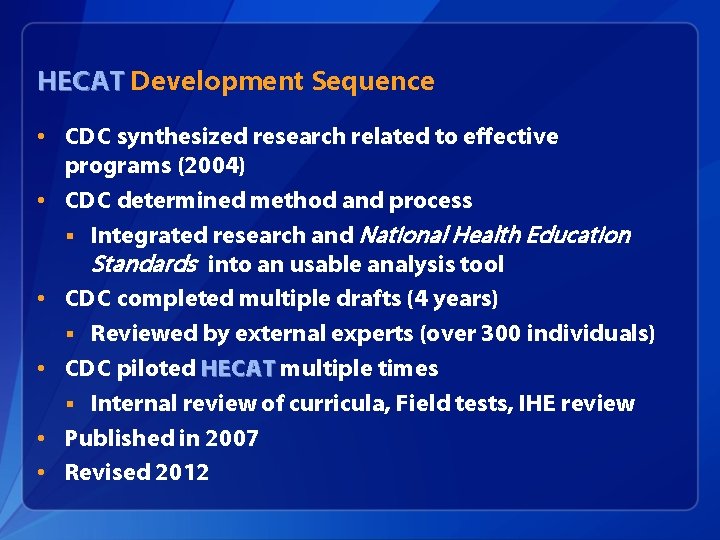
HECAT Development Sequence • CDC synthesized research related to effective programs (2004) • CDC determined method and process § Integrated research and National Health Education Standards into an usable analysis tool • CDC completed multiple drafts (4 years) § Reviewed by external experts (over 300 individuals) • CDC piloted HECAT multiple times § Internal review of curricula, Field tests, IHE review • Published in 2007 • Revised 2012
HECAT Guiding Principles • Uses science to improve practice • Addresses priority health risk behaviors and health concerns for youth • Encourages parent and community involvement in curriculum selection • Respects local authority for curriculum decisions
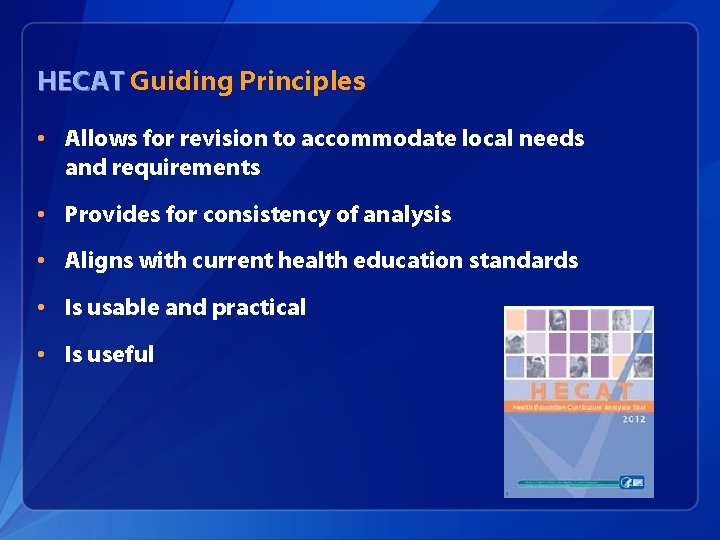
HECAT Guiding Principles • Allows for revision to accommodate local needs and requirements • Provides for consistency of analysis • Aligns with current health education standards • Is usable and practical • Is useful
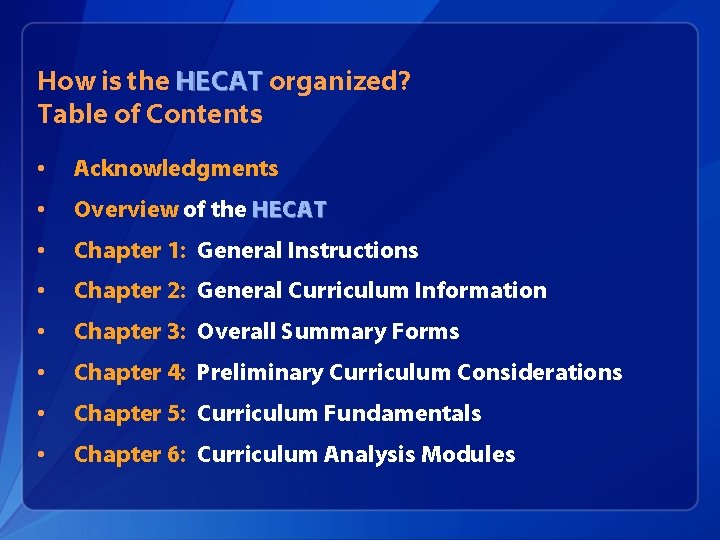
How is the HECAT organized? Table of Contents • Acknowledgments • Overview of the HECAT • Chapter 1: General Instructions • Chapter 2: General Curriculum Information • Chapter 3: Overall Summary Forms • Chapter 4: Preliminary Curriculum Considerations • Chapter 5: Curriculum Fundamentals • Chapter 6: Curriculum Analysis Modules
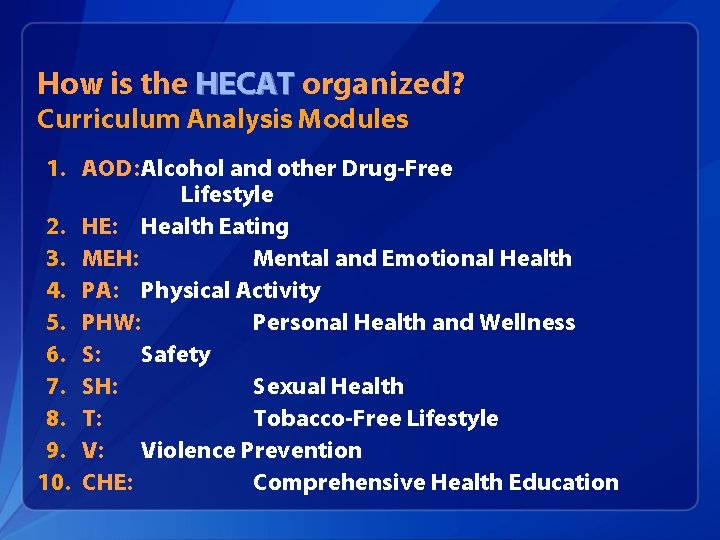
How is the HECAT organized? Curriculum Analysis Modules 1. AOD: Alcohol and other Drug-Free Lifestyle 2. HE: Health Eating 3. MEH: Mental and Emotional Health 4. PA: Physical Activity 5. PHW: Personal Health and Wellness 6. S: Safety 7. SH: Sexual Health 8. T: Tobacco-Free Lifestyle 9. V: Violence Prevention 10. CHE: Comprehensive Health Education
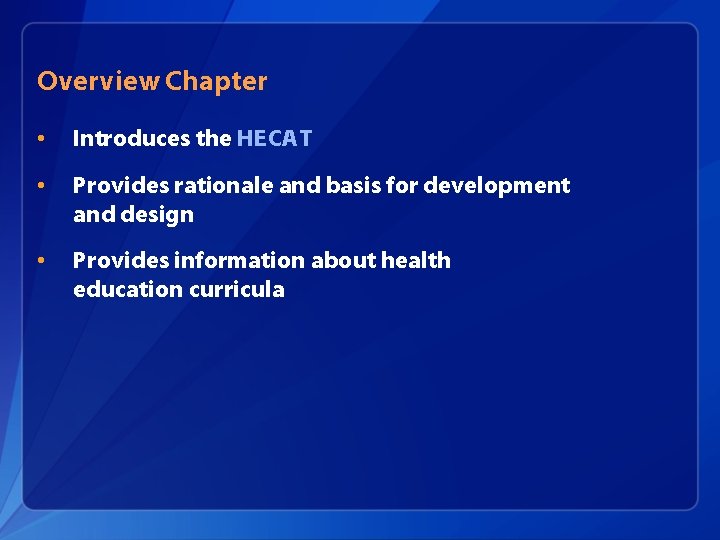
Overview Chapter • Introduces the HECAT • Provides rationale and basis for development and design • Provides information about health education curricula
Chapter 1: General Instructions • Provides steps for: • starting a review process • reviewing and analyzing curricula • using HECAT results to inform decisions
Getting Started Using the HECAT Before Starting. . . 1. Identify a HECAT coordinator 2. Form a HECAT committee and identify the roles and responsibilities of each member 3. Obtain curriculum for review and assessment 4. Determine the HECAT items that are essential for analyzing the health education curriculum
Getting Started Using the HECAT 5. Finalize curriculum analysis tool for use by the reviewers 6. Provide orientation and direction for team members 7. Determine curriculum review assignments for team members 8. Develop a timeline for the review process
Chapter 2: General Curriculum Information • • Captures general descriptive information that is needed to understand review any health education curriculum. Activity: ü After reviewing Chapter 2, answer the questions on HECAT pages 2 -1; 2 -2; 2 -3; and 2 -4. ü Be prepared to discuss your results.
Chapter 2: Discussion Questions • How is this information useful in selecting a curriculum? • What have you already found to be informative about your curriculum that gives you a sense of its quality? • What questions were you not able to answer about the curriculum? • Where else might you find the answers to these questions?
Chapter 3: Overall Summary Forms Contains three forms: • Individual Curriculum Summary Scores – consolidates scores for a single curriculum (HECAT page 3 -2) • Multiple Curriculum Comparison Scores – compares scores across multiple curricula or grade groups (HECAT page 3 -3) • Notes – captures critical comments from the review process (HECAT page 3 -4)
Chapter 4: Preliminary Curriculum Considerations Contains tools to help analyze and score important characteristics of any health education curriculum including: • Accuracy (HECAT pages 4 -2 – 4 -4) • Acceptability (HECAT pages 4 -5 – 4 -8) • Feasibility (HECAT page 4 -9) • Affordability (HECAT pages 4 -10 – 4 -14)
Chapter 5: Curriculum Fundamentals Contains tools to help analyze and score curriculum fundamentals including: • Objectives (HECAT page 5 -2) • Teacher materials (HECAT page 5 -3) • Curriculum design (HECAT page 5 -4) • Instructional strategies and materials (HECAT page 5 -5) • Promotion of norms that value positive health behaviors (HECAT page 5 -6)
Chapter 6: Overview of Modules • Contains modules to address separate health topic curricula • Uses the National Health Education Standards as framework • This framework helps determine the extent to which a curriculum is likely to enable students’ mastery of knowledge and skills that promote healthy behavior
Exit Ticket 1. Summarize the elements of a health education curriculum 2. Summarize the purpose of the HECAT 3. Explain a variety of ways the HECAT can be used
Any questions? For more information please contact Centers for Disease Control and Prevention 1600 Clifton Road NE, Atlanta, GA 30333 Telephone, 1 -800 -CDC-INFO (232 -4636)/TTY: 1 -888 -232 -6348 E-mail: cdcinfo@cdc. gov Web: www. cdc. gov The findings and conclusions in this report are those of the authors and do not necessarily represent the official position of the Centers for Disease Control and Prevention.