HECAT Health Education Curriculum Analysis Tool Lessons for



- Slides: 17
HECAT Health Education Curriculum Analysis Tool* Lessons for Health Education Teacher Preparation Programs * Centers for Disease Control and Prevention. Health Education Curriculum Analysis Tool. Atlanta, GA: U. S. Department of Health and Human Services; 2012.
Introduction to CDC’s HECAT Health Education Curriculum Analysis Tool * Lesson 4: Using the National Health Education Standards to Analyze a Health Education Curriculum * Centers for Disease Control and Prevention. Health Education Curriculum Analysis Tool. Atlanta, GA: U. S. Department of Health and Human Services; 2011.
Lesson 4: Objectives After completing this lesson, students will be able to: 1. Summarize the relationship of the. HECAT and the National Health Education Standards. 2. Apply the HECAT scoring rubrics to the review of a health education curriculum. 3. Complete an analysis of a single subject curriculum (e. g. , tobacco prevention), using the. HECAT. 4. Summarize the content and skill focus of an effective health education curriculum.
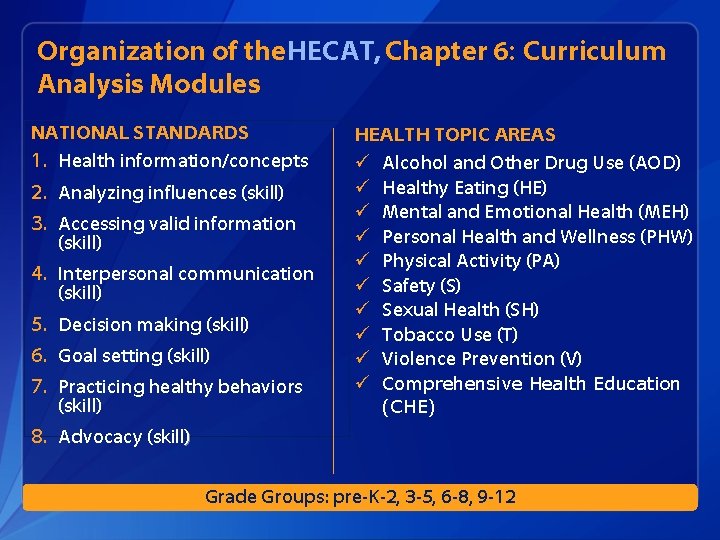
Organization of the HECAT, Chapter 6: Curriculum Analysis Modules NATIONAL STANDARDS 1. Health information/concepts 2. Analyzing influences (skill) 3. Accessing valid information (skill) 4. Interpersonal communication (skill) 5. Decision making (skill) 6. Goal setting (skill) 7. Practicing healthy behaviors (skill) HEALTH TOPIC AREAS ü Alcohol and Other Drug Use (AOD) ü Healthy Eating (HE) ü Mental and Emotional Health (MEH) ü Personal Health and Wellness (PHW) ü Physical Activity (PA) ü Safety (S) ü Sexual Health (SH) ü Tobacco Use (T) ü Violence Prevention (V) ü Comprehensive Health Education (CHE) 8. Advocacy (skill) Grade Groups: pre-K-2, 3 -5, 6 -8, 9 -12
National Health Education Standards * Reflect. . . • What students should know (essential knowledge) • What students should be able to do (essential skills) * The Joint Committee on National Health Education Standards: Achieving Excellence (2 Edition). Atlanta: American Cancer Society; 2007. nd
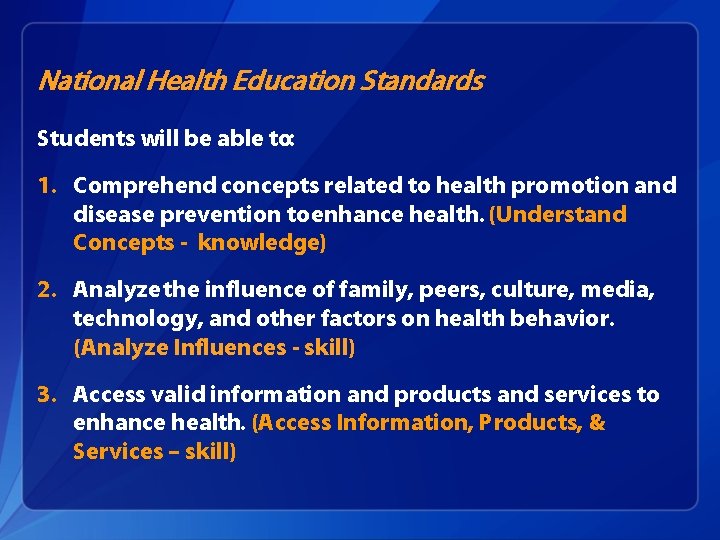
National Health Education Standards Students will be able to: 1. Comprehend concepts related to health promotion and disease prevention to enhance health. (Understand Concepts - knowledge) 2. Analyze the influence of family, peers, culture, media, technology, and other factors on health behavior. (Analyze Influences - skill) 3. Access valid information and products and services to enhance health. (Access Information, Products, & Services – skill)
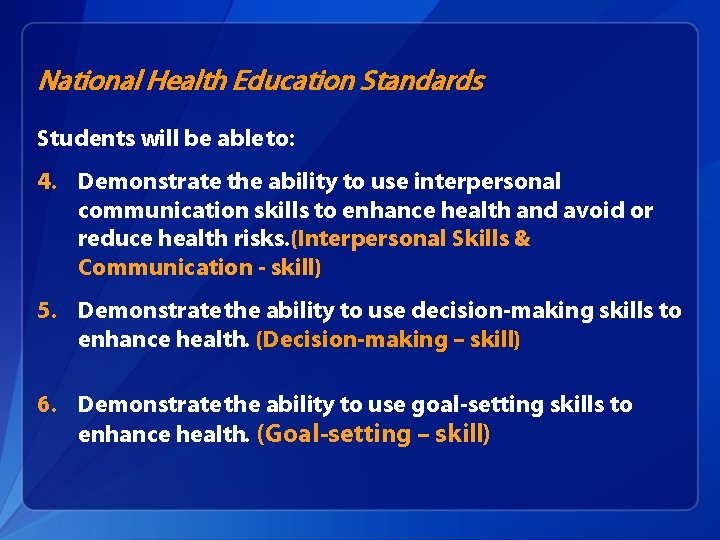
National Health Education Standards Students will be able to: 4. Demonstrate the ability to use interpersonal communication skills to enhance health and avoid or reduce health risks. (Interpersonal Skills & Communication - skill) 5. Demonstrate the ability to use decision-making skills to enhance health. (Decision-making – skill) 6. Demonstrate the ability to use goal-setting skills to enhance health. (Goal-setting – skill)
National Health Education Standards Students will be able to: 7. Demonstrate the ability to practice health-enhancing behaviors and avoid or reduce health risks. (Practice Healthy Behaviors – skill) 8. Demonstrate the ability to advocate for personal, family, and community health. (Advocate – skill)
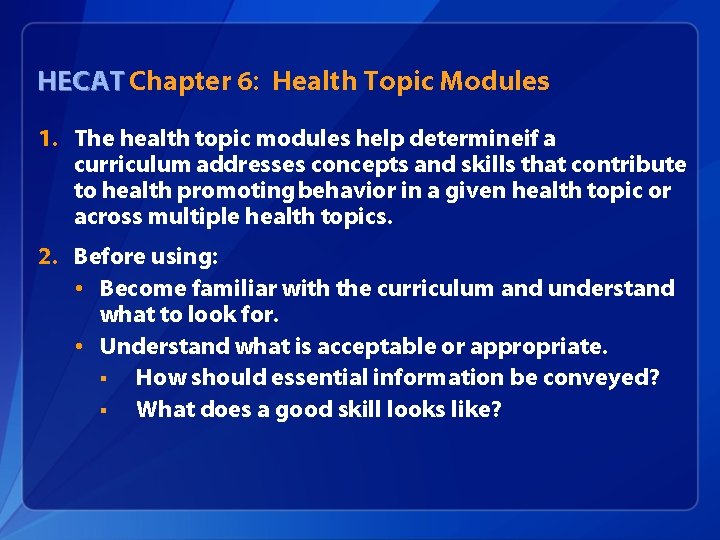
HECAT Chapter 6: Health Topic Modules 1. The health topic modules help determineif a curriculum addresses concepts and skills that contribute to health promoting behavior in a given health topic or across multiple health topics. 2. Before using: • Become familiar with the curriculum and understand what to look for. • Understand what is acceptable or appropriate. § How should essential information be conveyed? § What does a good skill looks like?
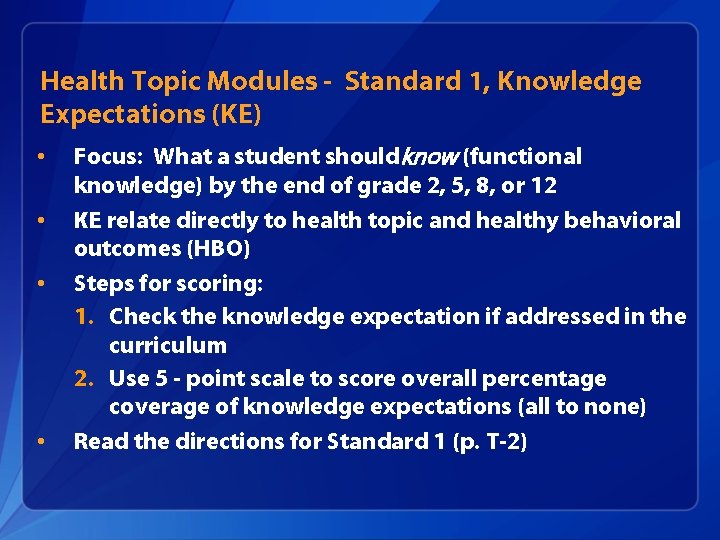
Health Topic Modules - Standard 1, Knowledge Expectations (KE) • • Focus: What a student shouldknow (functional knowledge) by the end of grade 2, 5, 8, or 12 KE relate directly to health topic and healthy behavioral outcomes (HBO) Steps for scoring: 1. Check the knowledge expectation if addressed in the curriculum 2. Use 5 - point scale to score overall percentage coverage of knowledge expectations (all to none) Read the directions for Standard 1 (p. T-2)
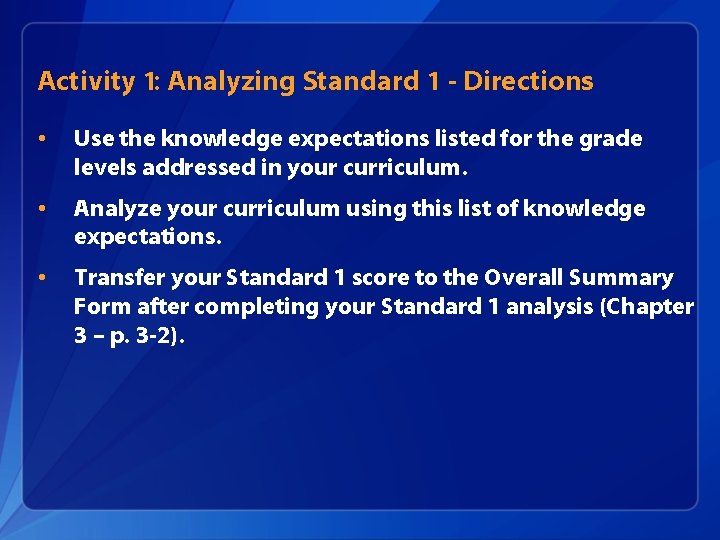
Activity 1: Analyzing Standard 1 - Directions • Use the knowledge expectations listed for the grade levels addressed in your curriculum. • Analyze your curriculum using this list of knowledge expectations. • Transfer your Standard 1 score to the Overall Summary Form after completing your Standard 1 analysis (Chapter 3 – p. 3 -2).
Health Topic Modules - Standards 2 -8 Skill Expectations (SE) • The skill standard statementand skill expectations describe skills to be addressed in a curriculum. • Focus: What a student should be able todo (essential skills) by the end of grades 2, 5, 8, or 12. • SE link directly to a health topic and reinforce healthy behavioral outcomes (HBO). • Scoring for Standards 2 -8 is more complex than scoring for Standard 1 (knowledge expectations). • Includes 2 scores for each standard: • Skill Expectation Coverage Score • Student Skill Practice Score
Health Topic Modules - Standards 2 -8 Skill Expectation Coverage Score • Module’s skill expectations are based on general skill expectations (Appendix 3). • Steps for scoring: 1. Check if the skill expectation is addressed in the curriculum. 2. Use 5 - point scale to score overallpercentage coverage of skill expectations (all to none). • Remember: 1. 2. Skill expectations may not be appropriate at some grade levels and for some topics (e. g. , T-8). It’s critical to analyze the extent to which the skill is adequately addressed in order to check the skill expectation box.
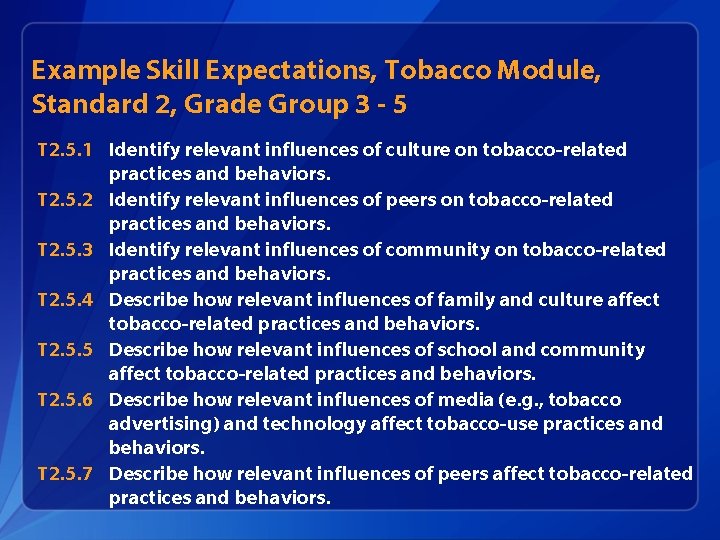
Example Skill Expectations, Tobacco Module, Standard 2, Grade Group 3 - 5 T 2. 5. 1 Identify relevant influences of culture on tobacco-related practices and behaviors. T 2. 5. 2 Identify relevant influences of peers on tobacco-related practices and behaviors. T 2. 5. 3 Identify relevant influences of community on tobacco-related practices and behaviors. T 2. 5. 4 Describe how relevant influences of family and culture affect tobacco-related practices and behaviors. T 2. 5. 5 Describe how relevant influences of school and community affect tobacco-related practices and behaviors. T 2. 5. 6 Describe how relevant influences of media (e. g. , tobacco advertising) and technology affect tobacco-use practices and behaviors. T 2. 5. 7 Describe how relevant influences of peers affect tobacco-related practices and behaviors.
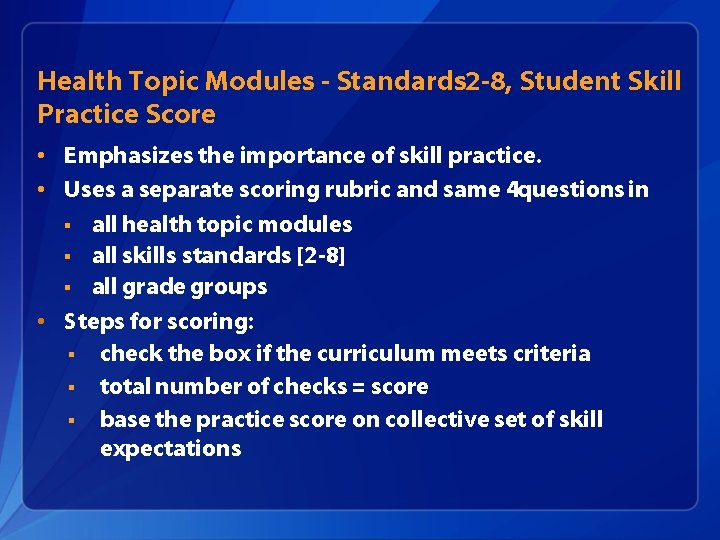
Health Topic Modules - Standards 2 -8, Student Skill Practice Score • Emphasizes the importance of skill practice. • Uses a separate scoring rubric and same 4 questions in § all health topic modules § all skills standards [2 -8] § all grade groups • Steps for scoring: § check the box if the curriculum meets criteria § total number of checks = score § base the practice score on collective set of skill expectations
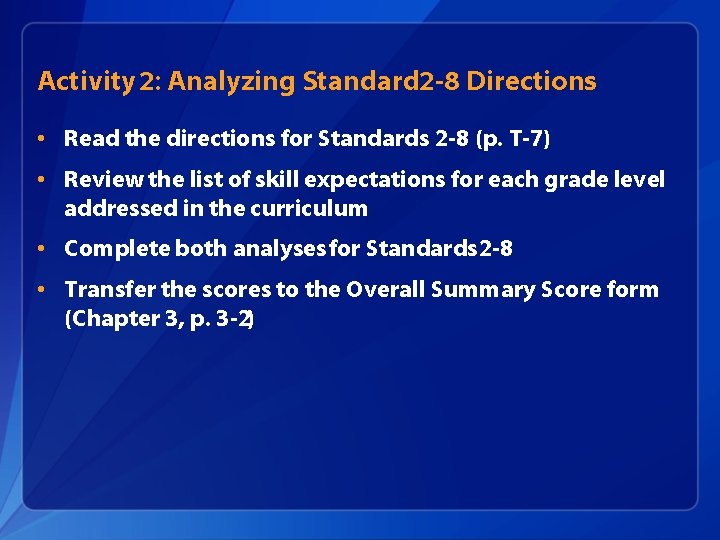
Activity 2: Analyzing Standard 2 -8 Directions • Read the directions for Standards 2 -8 (p. T-7) • Review the list of skill expectations for each grade level addressed in the curriculum • Complete both analyses for Standards 2 -8 • Transfer the scores to the Overall Summary Score form (Chapter 3, p. 3 -2)
Any questions? For more information please contact Centers for Disease Control and Prevention 1600 Clifton Road NE, Atlanta, GA 30333 Telephone, 1 -800 -CDC-INFO (232 -4636)/TTY: 1 -888 -232 -6348 E-mail: cdcinfo@cdc. gov Web: www. cdc. gov The findings and conclusions in this report are those of the authors and do not necessarily represent the official position of the Centers for Disease Control and Prevention.