
HECAT Health Education Curriculum Analysis Tool Lessons for

- Slides: 42
HECAT Health Education Curriculum Analysis Tool* Lessons for Health Education Teacher Preparation Programs * Centers for Disease Control and Prevention. Health Education Curriculum Analysis Tool. Atlanta, GA: U. S. Department of Health and Human Services; 2012.
Introduction to CDC’s HECAT Health Education Curriculum Analysis Tool Lesson 6: Using the HECAT to Develop Effective Health Education Unit Plans
Lesson 6: Objective After completing this lesson, students will be able to: • Use the HECAT to develop an effective health education unit plan.
What is the Goal of Health Education? To help students adopt and maintain healthy behaviors.
How can health education teachers help students adopt and maintain healthybehaviors? • Create unit and lesson plans that support the Characteristics of an Effective Health Education Curriculum*. • Use Healthy Behavior Outcomes (HBO), identified in the HECAT, as the starting point for creating a unit plan. • Use the knowledge and skill expectations in the. HECAT (Chapter 6) to guide the development of unit and lesson plans. * Centers for Disease Control and Prevention. Health Education Curriculum Analysis Tool. Atlanta, GA: U. S. Department of Health and Human Services; 2012; Overview, pgs. 4 -7.
What is a unit plan? • A unit plan is developed by the teacher and serves as a long-range plan. • It contains multiple lessons that areconnected, sequenced, and related.
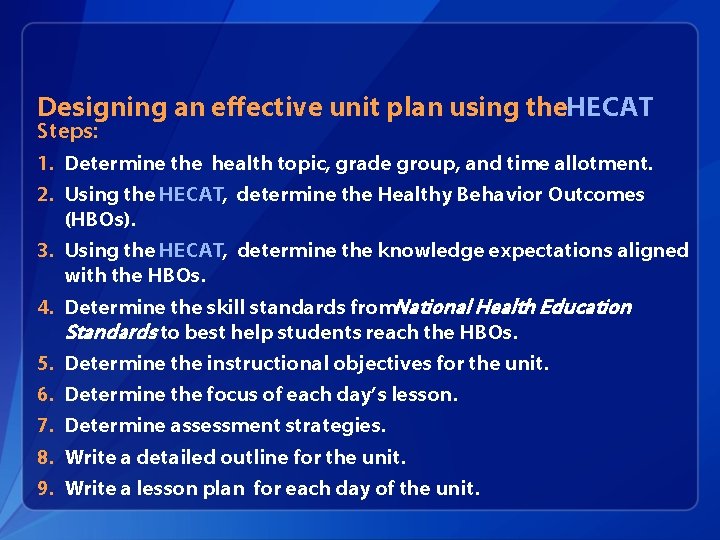
Designing an effective unit plan using the. HECAT Steps: 1. Determine the health topic, grade group, and time allotment. 2. Using the HECAT, determine the Healthy Behavior Outcomes (HBOs). 3. Using the HECAT, determine the knowledge expectations aligned with the HBOs. 4. Determine the skill standards from. National Health Education Standards to best help students reach the HBOs. 5. Determine the instructional objectives for the unit. 6. Determine the focus of each day’s lesson. 7. Determine assessment strategies. 8. Write a detailed outline for the unit. 9. Write a lesson plan for each day of the unit.
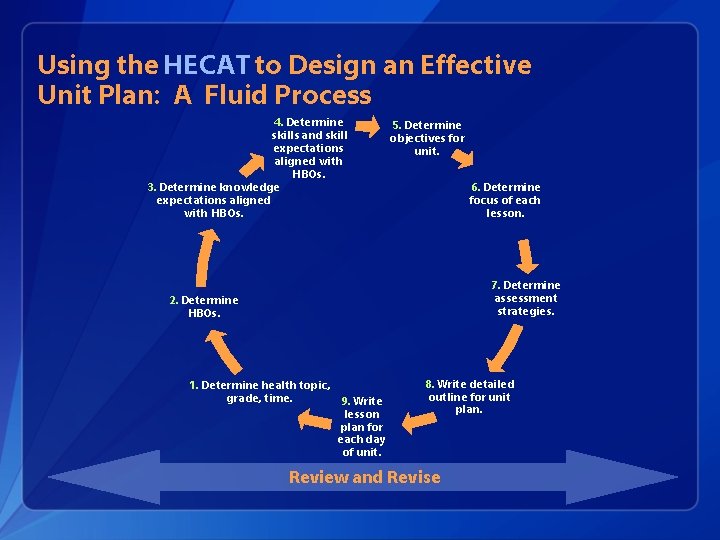
Using the HECAT to Design an Effective Unit Plan: A Fluid Process 4. Determine 5. Determine skills and skill expectations aligned with HBOs. 3. Determine knowledge expectations aligned with HBOs. objectives for unit. 6. Determine focus of each lesson. 7. Determine assessment strategies. 2. Determine HBOs. 1. Determine health topic, grade, time. 9. Write lesson plan for each day of unit. 8. Write detailed outline for unit plan. Review and Revise
Step 1: Determine the health topic, grade group and time allotment for the unit. Example • Unit topic: Tobacco-Use Prevention • Grade group: Middle school (grades 6 – 8) • Time allotment: 6 classes/lessons, 45 minutes per lesson
Step 2: Determine the Healthy Behavior Outcomes (HBOs) for the unit. • Write the Healthy Behavior Outcomes* for the topic. § § Example: Tobacco-Use Prevention Curriculum A pre-K– 12 tobacco-free curriculum should enable students to: HBO 1 - Avoid using (or experimenting with) any form of tobacco. HBO 2 - Avoid second-hand smoke. HBO 3 - Support a tobacco-free environment. HBO 4 - Support others to be tobacco-free. HBO 5 - Quit using tobacco, if already using. * See individual health topic modules at http: //www. cdc. gov/Healthy. Youth/hecat.
Step 2: Determine the Healthy Behavior Outcomes (HBOs) for the unit. (continued) • Select HBOs that are aligned with the school district’s curriculum or plan of study. • Select HBOs that are developmentally appropriate for students. (E. g. , 8 th grade). • Be realistic about how much time is available to teach the unit. (E. g. , 6 class periods, 45 minutes each. ) • Determine what HBO(s) can be adequately addressed in the time available.
Step 2: Determine the Healthy Behavior Outcomes (HBOs) for the unit. Example • HBO 1 - Avoid using (or experimenting with) any form of tobacco.
Step 3: Determine the knowledge expectations aligned with HBOs for each topic/unit. • Use the HECAT to determine the knowledge expectations aligned with the HBOs. § Turn to the knowledge expectations listed in the. HECAT (E. g. , Chapter 6, Tobacco Module, page T-5) § Record the knowledge expectations aligned with the HBOs of interest (E. g. , HBO 1 - Avoid using [or experimenting with] any form of tobacco. )
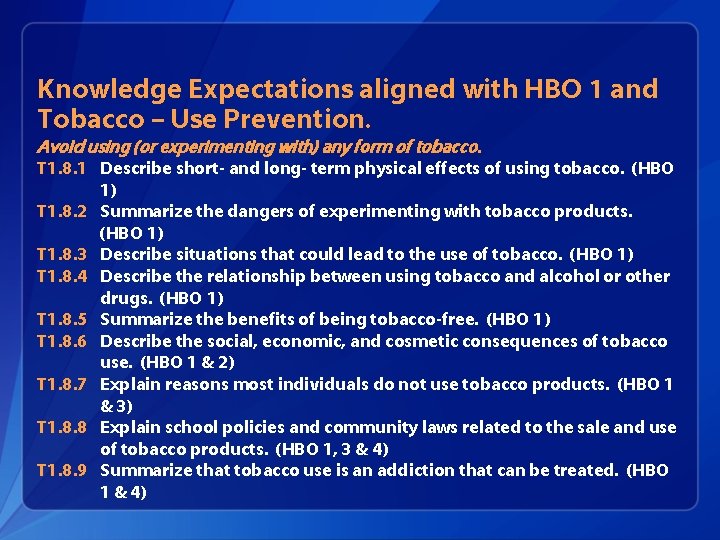
Knowledge Expectations aligned with HBO 1 and Tobacco – Use Prevention. Avoid using (or experimenting with) any form of tobacco. T 1. 8. 1 Describe short- and long- term physical effects of using tobacco. (HBO 1) T 1. 8. 2 Summarize the dangers of experimenting with tobacco products. (HBO 1) T 1. 8. 3 Describe situations that could lead to the use of tobacco. (HBO 1) T 1. 8. 4 Describe the relationship between using tobacco and alcohol or other drugs. (HBO 1) T 1. 8. 5 Summarize the benefits of being tobacco-free. (HBO 1) T 1. 8. 6 Describe the social, economic, and cosmetic consequences of tobacco use. (HBO 1 & 2) T 1. 8. 7 Explain reasons most individuals do not use tobacco products. (HBO 1 & 3) T 1. 8. 8 Explain school policies and community laws related to the sale and use of tobacco products. (HBO 1, 3 & 4) T 1. 8. 9 Summarize that tobacco use is an addiction that can be treated. (HBO 1 & 4)
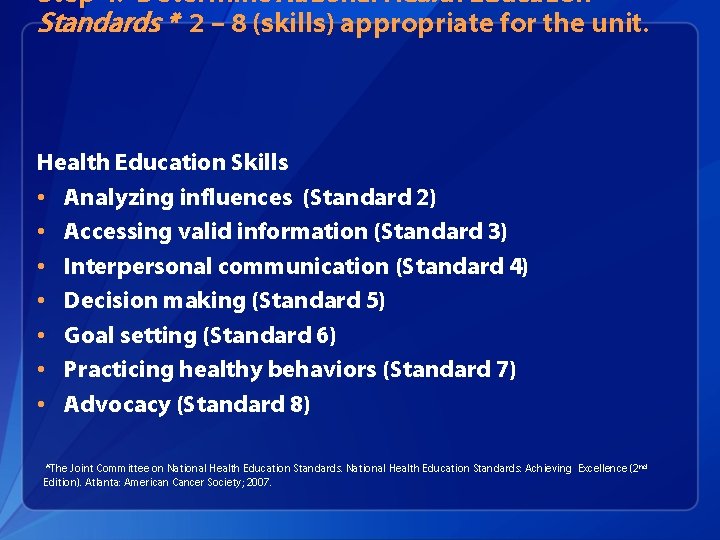
Step 4: Determine National Health Education Standards * 2 – 8 (skills) appropriate for the unit. Health Education Skills • Analyzing influences (Standard 2) • Accessing valid information (Standard 3) • Interpersonal communication (Standard 4) • Decision making (Standard 5) • Goal setting (Standard 6) • Practicing healthy behaviors (Standard 7) • Advocacy (Standard 8) *The Joint Committee on National Health Education Standards: Achieving Excellence (2 nd Edition). Atlanta: American Cancer Society; 2007.
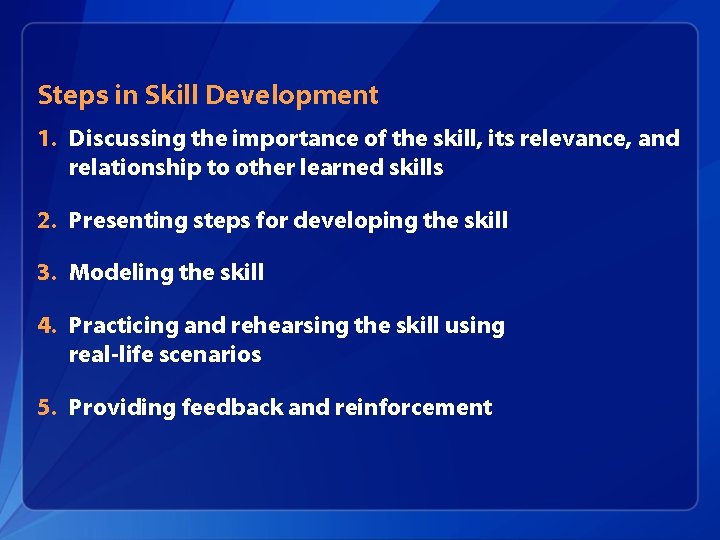
Steps in Skill Development 1. Discussing the importance of the skill, its relevance, and relationship to other learned skills 2. Presenting steps for developing the skill 3. Modeling the skill 4. Practicing and rehearsing the skill using real-life scenarios 5. Providing feedback and reinforcement
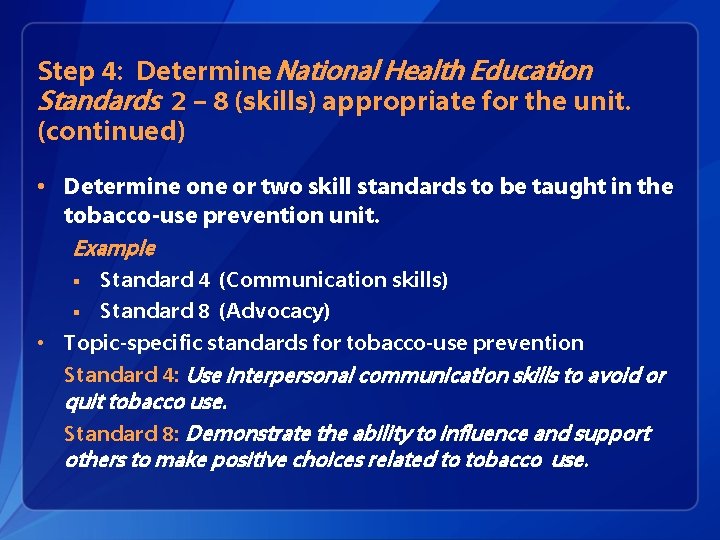
Step 4: Determine National Health Education Standards 2 – 8 (skills) appropriate for the unit. (continued) • Determine or two skill standards to be taught in the tobacco-use prevention unit. Example Standard 4 (Communication skills) § Standard 8 (Advocacy) • Topic-specific standards for tobacco-use prevention Standard 4: Use interpersonal communication skills to avoid or § quit tobacco use. Standard 8: Demonstrate the ability to influence and support others to make positive choices related to tobacco use.
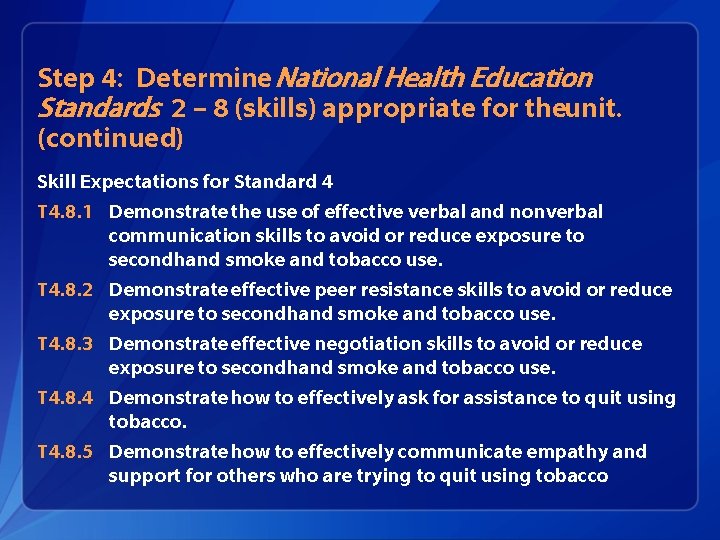
Step 4: Determine National Health Education Standards 2 – 8 (skills) appropriate for theunit. (continued) Skill Expectations for Standard 4 T 4. 8. 1 Demonstrate the use of effective verbal and nonverbal communication skills to avoid or reduce exposure to secondhand smoke and tobacco use. T 4. 8. 2 Demonstrate effective peer resistance skills to avoid or reduce exposure to secondhand smoke and tobacco use. T 4. 8. 3 Demonstrate effective negotiation skills to avoid or reduce exposure to secondhand smoke and tobacco use. T 4. 8. 4 Demonstrate how to effectively ask for assistance to quit using tobacco. T 4. 8. 5 Demonstrate how to effectively communicate empathy and support for others who are trying to quit using tobacco.
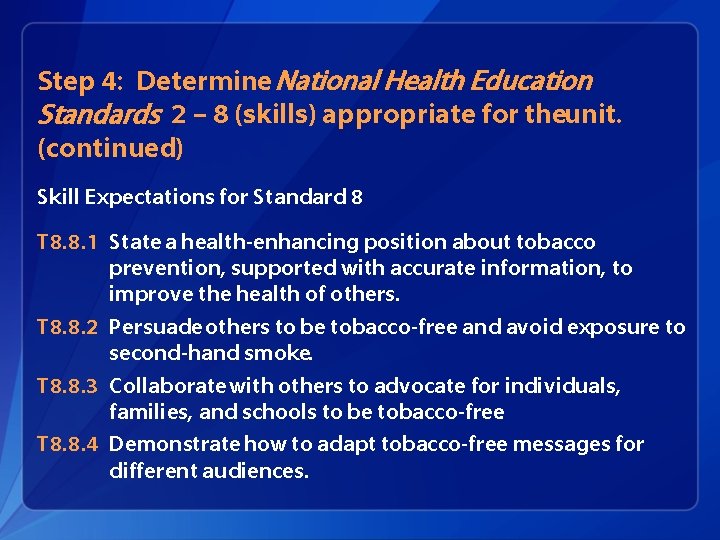
Step 4: Determine National Health Education Standards 2 – 8 (skills) appropriate for theunit. (continued) Skill Expectations for Standard 8 T 8. 8. 1 State a health-enhancing position about tobacco prevention, supported with accurate information, to improve the health of others. T 8. 8. 2 Persuade others to be tobacco-free and avoid exposure to second-hand smoke. T 8. 8. 3 Collaborate with others to advocate for individuals, families, and schools to be tobacco-free. T 8. 8. 4 Demonstrate how to adapt tobacco-free messages for different audiences.
Step 5: Determine the instructional objectives for the unit. • The knowledge and skill expectations that support the HBO(s) can be the foundation for the instructional objectives for the lesson. • Not all knowledge and skill expectationsidentified can be met. It depends on how much time is available to teach the unit.
Step 5: Determine the instructional objectives for the unit. (continued) SMART -- Criteria for writing effective objectives. • Specific • Measurable • Appropriate • Realistic • Time-phased
Step 5: Determine the instructional objectives for the unit. (continued) Examples • Knowledge Expectation (KE) T 1. 8. 1 Describe short- and long- term physical effects of using tobacco. (HBO 1) • Instructional objectives* aligned with KE By the end of the lesson, students will be able to… • describe 4 negative short-term physical effects of using tobacco. • describe 3 negative long-term physical effects of using tobacco. * meet SMART criteria
Step 5: Determine the instructional objectives for the unit. (continued) Examples • Skill Expectation (SE) T 4. 8. 2 Demonstrate effective peer resistance skills to avoid or reduce exposure to secondhand smoke and tobacco use. • Instructional objective* aligned with SE: By the end of the lesson, students will be able to… § demonstrate 3 effective peer resistance skills to avoid tobacco use. * meets SMART criteria
Step 5: Determine the instructional objectives for the unit. (continued) Practice Write your answers to the tasks below on the. Using the HECAT to Design a Health Education Unit handout (Step 5). • Choose: Two knowledge expectations aligned with HBO 1 from the tobacco-use prevention module. • Write: At least one SMART objective for each knowledge expectation. • Choose: Two skill expectations from Standards 4 or 8 from the tobacco-use prevention module. • Write: At least one SMART objective for each skill expectation.
Step 6: Determine the Focus for Each Day’s Lesson of the Unit. • Decide on the sequencing of the objectives • Make sure to consider an appropriate sequence for flow and building on previous content/skills
Step 7: Determine assessment strategies that can be used to assess the instructional objectives. • Assessment measures students’ achievement of knowledge and skills. • Assessment is the process of gathering, describing, or quantifying information about students’ performance and level of achievement based on established standards.
Step 7: Determine assessment strategies that can be used to assess the instructionalobjectives. (continued) Purpose of Assessment 1. 2. 3. 4. 5. 6. To diagnose students’ strengths and weaknesses To monitor students’ progress To provide feedback to students To assign grades to students To determine if students have met the desired objectives To determine if changes need to be made in the way the lesson/unit was taught 7. To determine teacher performance
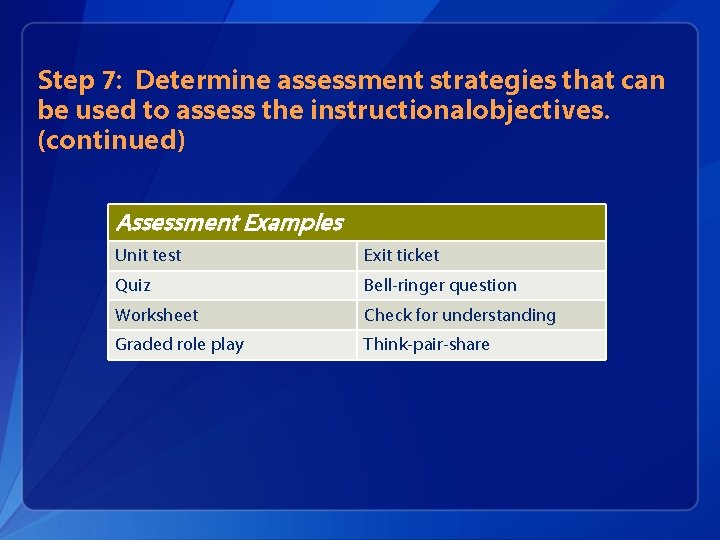
Step 7: Determine assessment strategies that can be used to assess the instructionalobjectives. (continued) Assessment Examples Unit test Exit ticket Quiz Bell-ringer question Worksheet Check for understanding Graded role play Think-pair-share
Assessment Strategies Tests, quizzes, exit tickets, worksheets are usually composed of: • Selected response items § yes-no § true-false § multiple choice items § matching items § completion items • Extended response items/Performance events: § Ask question or provide statement to assess thinking skills. § Use a variety of written formats: essay, short answer, journal entry.
Assessment Strategies Performance Tasks are: • Curriculum-embedded projects that students complete outside of class over an extended period of time.
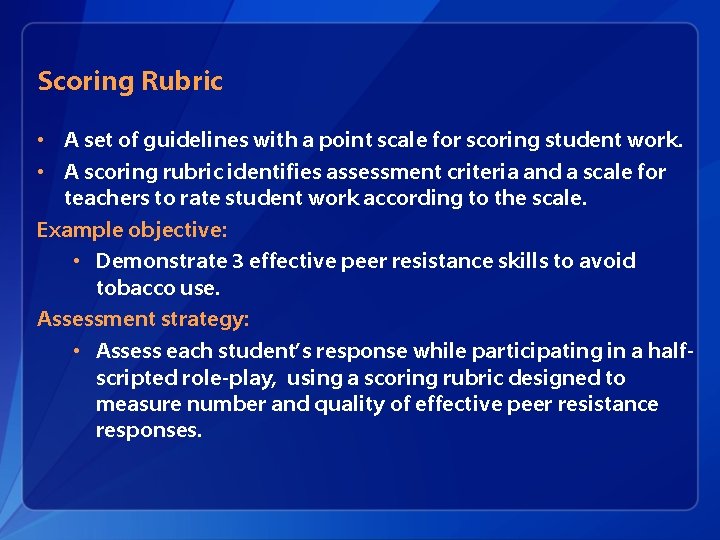
Scoring Rubric • A set of guidelines with a point scale for scoring student work. • A scoring rubric identifies assessment criteria and a scale for teachers to rate student work according to the scale. Example objective: • Demonstrate 3 effective peer resistance skills to avoid tobacco use. Assessment strategy: • Assess each student’s response while participating in a halfscripted role-play, using a scoring rubric designed to measure number and quality of effective peer resistance responses.
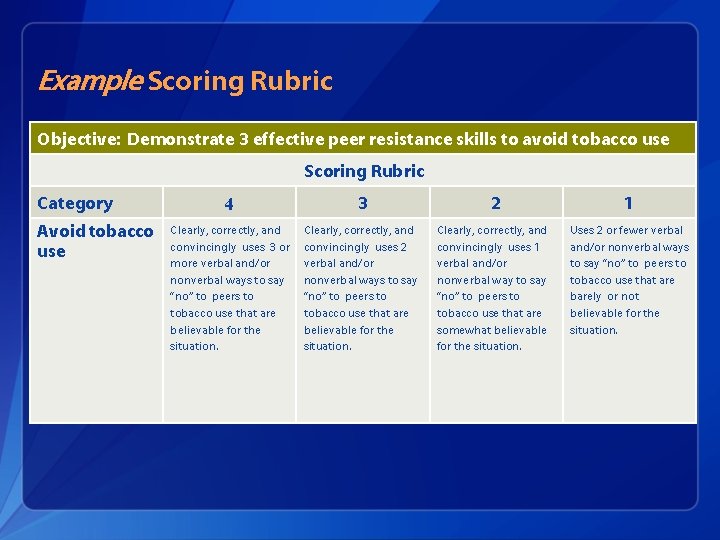
Example Scoring Rubric Objective: Demonstrate 3 effective peer resistance skills to avoid tobacco use Scoring Rubric Category Avoid tobacco use 4 3 Clearly, correctly, and convincingly uses 3 or more verbal and/or nonverbal ways to say “no” to peers to tobacco use that are believable for the situation. Clearly, correctly, and convincingly uses 2 verbal and/or nonverbal ways to say “no” to peers to tobacco use that are believable for the situation. 2 Clearly, correctly, and convincingly uses 1 verbal and/or nonverbal way to say “no” to peers to tobacco use that are somewhat believable for the situation. 1 Uses 2 or fewer verbal and/or nonverbal ways to say “no” to peers to tobacco use that are barely or not believable for the situation.
Step 7: Determine assessment strategies that can be used to assess the instructionalobjectives. (continued) • Determine how these objectives could be assessed By the end of the lesson, students will be able to… 1. describe 4 negative short term physical effects of using tobacco. (Standard 1) 2. present a convincing tobacco-use prevention message for peers. (Standard 8)
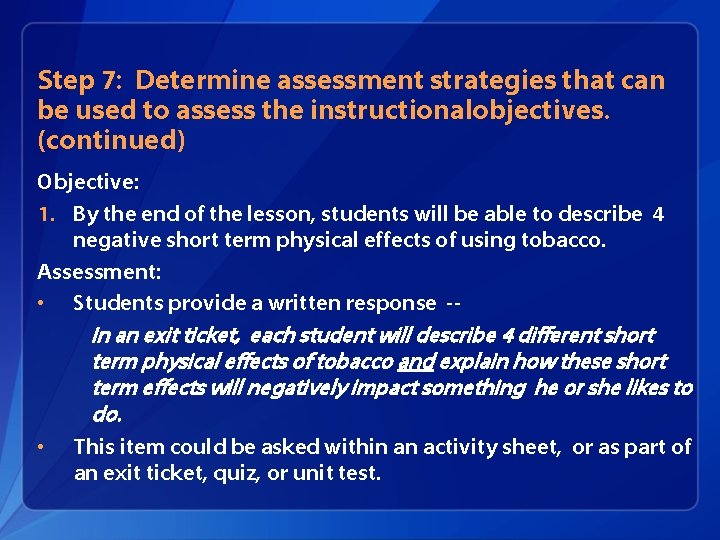
Step 7: Determine assessment strategies that can be used to assess the instructionalobjectives. (continued) Objective: 1. By the end of the lesson, students will be able to describe 4 negative short term physical effects of using tobacco. Assessment: • Students provide a written response -- In an exit ticket, each student will describe 4 different short term physical effects of tobacco and explain how these short term effects will negatively impact something he or she likes to do. • This item could be asked within an activity sheet, or as part of an exit ticket, quiz, or unit test.
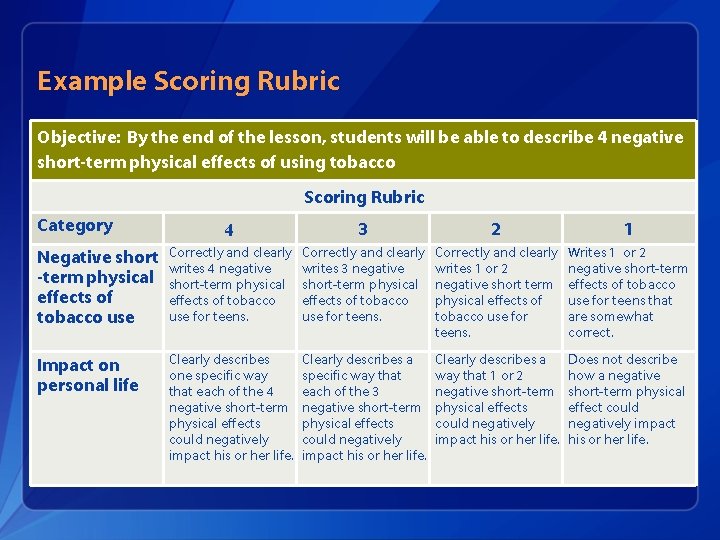
Example Scoring Rubric Objective: By the end of the lesson, students will be able to describe 4 negative short-term physical effects of using tobacco Scoring Rubric Category 4 3 2 1 Negative short -term physical effects of tobacco use Correctly and clearly writes 4 negative short-term physical effects of tobacco use for teens. Correctly and clearly writes 3 negative short-term physical effects of tobacco use for teens. Correctly and clearly writes 1 or 2 negative short term physical effects of tobacco use for teens. Writes 1 or 2 negative short-term effects of tobacco use for teens that are somewhat correct. Impact on personal life Clearly describes one specific way that each of the 4 negative short-term physical effects could negatively impact his or her life. Clearly describes a specific way that each of the 3 negative short-term physical effects could negatively impact his or her life. Clearly describes a way that 1 or 2 negative short-term physical effects could negatively impact his or her life. Does not describe how a negative short-term physical effect could negatively impact his or her life.
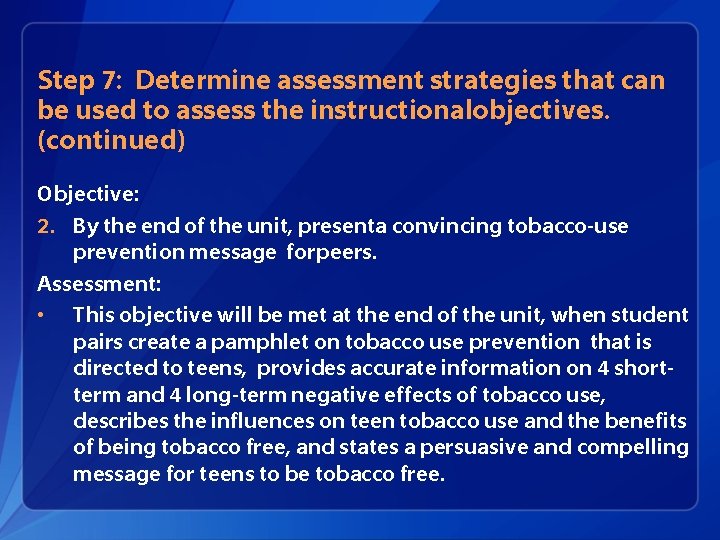
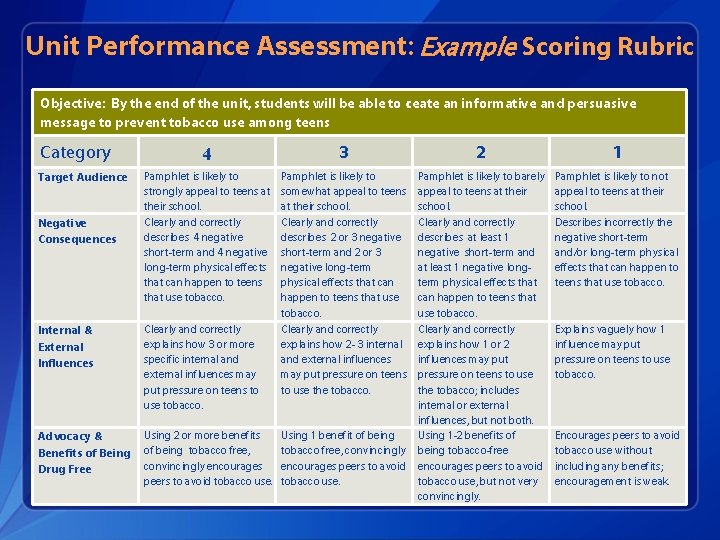
Step 7: Determine assessment strategies that can be used to assess the instructionalobjectives. (continued) Objective: 2. By the end of the unit, presenta convincing tobacco-use prevention message forpeers. Assessment: • This objective will be met at the end of the unit, when student pairs create a pamphlet on tobacco use prevention that is directed to teens, provides accurate information on 4 shortterm and 4 long-term negative effects of tobacco use, describes the influences on teen tobacco use and the benefits of being tobacco free, and states a persuasive and compelling message for teens to be tobacco free.
Unit Performance Assessment: Example Scoring Rubric Objective: By the end of the unit, students will be able to create an informative and persuasive message to prevent tobacco use among teens Category Target Audience Negative Consequences 4 3 2 1 Pamphlet is likely to strongly appeal to teens at their school. Clearly and correctly describes 4 negative short-term and 4 negative long-term physical effects that can happen to teens that use tobacco. Pamphlet is likely to somewhat appeal to teens at their school. Clearly and correctly describes 2 or 3 negative short-term and 2 or 3 negative long-term physical effects that can happen to teens that use tobacco. Clearly and correctly explains how 2 - 3 internal and external influences may put pressure on teens to use the tobacco. Pamphlet is likely to barely appeal to teens at their school. Clearly and correctly describes at least 1 negative short-term and at least 1 negative longterm physical effects that can happen to teens that use tobacco. Clearly and correctly explains how 1 or 2 influences may put pressure on teens to use the tobacco; includes internal or external influences, but not both. Using 1 -2 benefits of being tobacco-free encourages peers to avoid tobacco use, but not very convincingly. Pamphlet is likely to not appeal to teens at their school. Describes incorrectly the negative short-term and/or long-term physical effects that can happen to teens that use tobacco. Internal & External Influences Clearly and correctly explains how 3 or more specific internal and external influences may put pressure on teens to use tobacco. Advocacy & Benefits of Being Drug Free Using 2 or more benefits of being tobacco free, convincingly encourages peers to avoid tobacco use. Using 1 benefit of being tobacco free, convincingly encourages peers to avoid tobacco use. Explains vaguely how 1 influence may put pressure on teens to use tobacco. Encourages peers to avoid tobacco use without including any benefits; encouragement is weak.
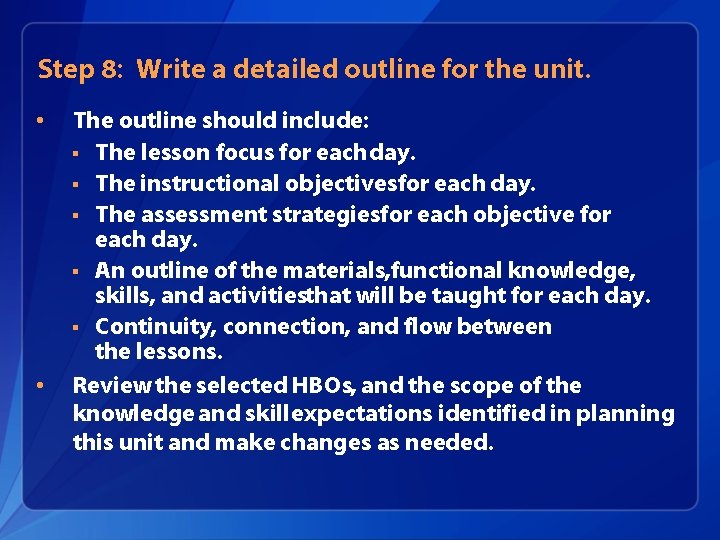
Step 8: Write a detailed outline for the unit. • • The outline should include: § The lesson focus for each day. § The instructional objectivesfor each day. § The assessment strategiesfor each objective for each day. § An outline of the materials, functional knowledge, skills, and activitiesthat will be taught for each day. § Continuity, connection, and flow between the lessons. Review the selected HBOs, and the scope of the knowledge and skill expectations identified in planning this unit and make changes as needed.
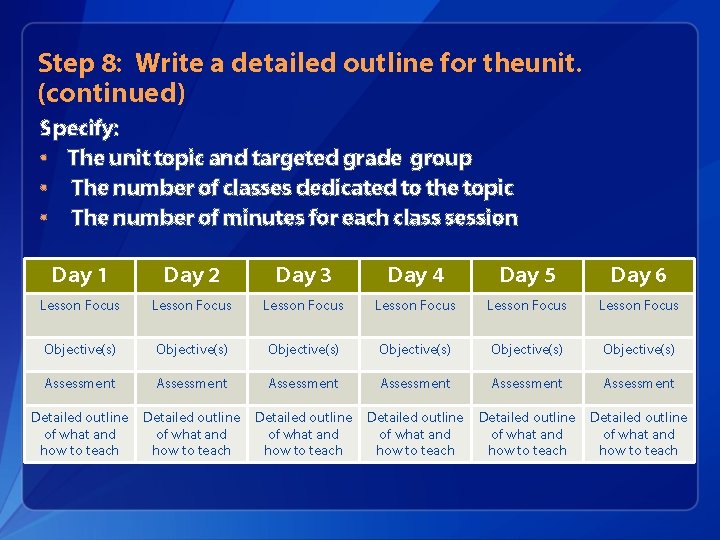
Step 8: Write a detailed outline for theunit. (continued) Specify: • The unit topic and targeted grade group • The number of classes dedicated to the topic • The number of minutes for each class session Day 1 Day 2 Day 3 Day 4 Day 5 Day 6 Lesson Focus Lesson Focus Objective(s) Objective(s) Assessment Assessment Detailed outline of what and how to teach Detailed outline of what and how to teach
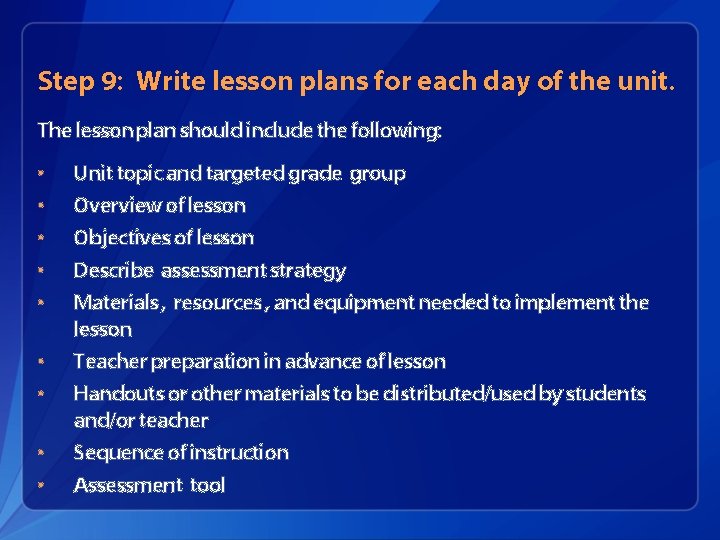
Step 9: Write lesson plans for each day of the unit. The lesson plan should include the following: • • • Unit topic and targeted grade group Overview of lesson Objectives of lesson Describe assessment strategy Materials , resources , and equipment needed to implement the lesson Teacher preparation in advance of lesson Handouts or other materials to be distributed/used by students and/or teacher Sequence of instruction Assessment tool
Using the HECAT to Design an Effective Unit Plan: A Fluid Process 4. Determine skills and skill expectations aligned with HBOs. 3. Determine knowledge expectations aligned with HBOs. 5. Determine objectives for unit. 6. Determine focus of each lesson. 7. Determine assessment strategies. 2. Determine HBOs. 1. Determine health topic, grade, time. 9. Write lesson plan for each day of unit. 8. Write detailed outline for unit plan. Review and Revise
Any questions? For more information please contact Centers for Disease Control and Prevention 1600 Clifton Road NE, Atlanta, GA 30333 Telephone, 1 -800 -CDC-INFO (232 -4636)/TTY: 1 -888 -232 -6348 E-mail: cdcinfo@cdc. gov Web: www. cdc. gov The findings and conclusions in this report are those of the authors and do not necessarily represent the official position of the Centers for Disease Control and Prevention.