Harmonic electric power quality concepts for the electrified
- Slides: 49
Harmonic electric power quality concepts for the electrified ships (AES) J. M. Prousalidis, I. K. Hatzilau, S. Perros Harmonic electric power quality concepts for the electrified ships (AES) J. Prousalidis, Lecturer, School of Naval and Marine Engineering, National Technical University of Athens (NTUA), Greece I. K. Hatzilau, Prof. Dr. -Ing, Hellenic Naval Academy (HNA) Cdr S. Perros, MSc Electrical Eng. , Hellenic Navy (HN) 1
Harmonic electric power quality concepts for the electrified ships (AES) J. M. Prousalidis, I. K. Hatzilau, S. Perros Paper Scope All Electric Ship concept comprises electrification of all systems onboard via the extensive usage of power electronic devices. Therefore, power supply quality problems are expected to be extremely important and special interest must be focused on them. presented by I. K. Hatzilau 2
Harmonic electric power quality concepts for the electrified ships (AES) Paper Scope J. M. Prousalidis, I. K. Hatzilau, S. Perros The purpose of this paper is : A. To inform on Harmonic Power Quality problem B. To present and compare standards on Harmonic Power Quality and point some applicability problems (especially for ships) C. To present authors’ ideas towards overcoming these difficulties D. To present some indicative case studies of Power Quality standards comparisons based on field measurements on Hellenic Navy MEKO-type frigates. presented by I. K. Hatzilau 3
Harmonic electric power quality concepts for the electrified ships (AES) J. M. Prousalidis, I. K. Hatzilau, S. Perros A. HARMONIC POWER QUALITY PROBLEM A. 1 Problems caused by harmonics • Extra heating losses in electric machinery and cable wiring (leading to either premature aging and de-rating of the equipment due to overheating or to extra cooling requirements). • Decrements in accuracy of measuring equipment, which are not designed for non-sinusoidal electric quantity measurements • Excitation of resonance phenomena resulting to significant overvoltages and/or overcurrents (as the harmonic frequencies flowing in the electric system could much the natural frequencies of series or parallel combinations of stray capacitances and inductances of electric equipment). • False tripping of protective switchgear (e. g. fuse blowing, or incorrect thermal relays actuation). • Failure of equipment sensitive to harmonics. • Electromagnetic Interference (EMI) with sensitive electronic equipment (navigation, communication control and automation) • erection of mechanical oscillations, vibrations, mechanical stresses and noise due to harmonic torque ripples produced. presented by I. K. Hatzilau 4
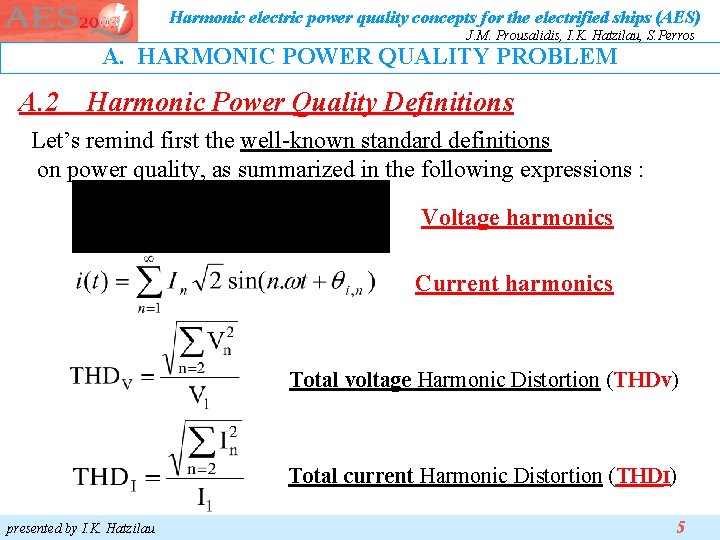
Harmonic electric power quality concepts for the electrified ships (AES) J. M. Prousalidis, I. K. Hatzilau, S. Perros A. HARMONIC POWER QUALITY PROBLEM A. 2 Harmonic Power Quality Definitions Let’s remind first the well-known standard definitions on power quality, as summarized in the following expressions : Voltage harmonics Current harmonics Total voltage Harmonic Distortion (THDv) Total current Harmonic Distortion (THDI) J. M. Prousalidis, I. K. Hatzilau, S. Perros presented by I. K. Hatzilau 55
Harmonic electric power quality concepts for the electrified ships (AES) A. J. M. Prousalidis, I. K. Hatzilau, S. Perros HARMONIC POWER QUALITY PROBLEM A. 2 Harmonic Power Quality Definitions The Total Demand Distortion (TDD) According to THD definition, both the fundamental component and the high order harmonics should be measured simultaneously. However, if the fundamental equals an average quantity over a specific time interval, then the index is called Total Demand Distortion (TDD) J. M. Prousalidis, I. K. Hatzilau, S. Perros presented by I. K. Hatzilau 66
Harmonic electric power quality concepts for the electrified ships (AES) J. M. Prousalidis, I. K. Hatzilau, S. Perros A. HARMONIC POWER QUALITY PROBLEM A. 2 Harmonic Power Quality Definitions Points of Harmonic Measurements are usually performed • At generator output terminals • At load input terminals A point of measurements often met in standards is the Point of Common Coupling (PCC) : the border point between electric system and each individual load. J. M. Prousalidis, I. K. Hatzilau, S. Perros presented by I. K. Hatzilau 77
Harmonic electric power quality concepts for the electrified ships (AES) J. M. Prousalidis, I. K. Hatzilau, S. Perros STANDARDS ON HARMONIC POWER QUALITY B. 1 Standards on Ship-Electric-Installations Evidently having a good power quality on the electric energy system of an AES should be the ultimate objective, considering its impact on all electrified and electronic subsystems, including automation and control ones. The electric system of an AES can be regarded as a non-interconnected one, comprising a reduced number of generators and an increased number of non-linear loads. presented by I. K. Hatzilau 88
Harmonic electric power quality concepts for the electrified ships (AES) J. M. Prousalidis, I. K. Hatzilau, S. Perros B. STANDARDS ON HARMONIC POWER QUALITY B. 1 Standards on Ship-Electric-Installations Due to similarities to continental grids, it can be argued, that the standards issued for ordinary electric systems can be applied to ships and AES in particular, too. On the other hand, specific standards have been released, covering the electric installations on shipboard, taking into account their particularities. J. M. Prousalidis, I. K. Hatzilau, S. Perros presented by I. K. Hatzilau 99
Harmonic electric power quality concepts for the electrified ships (AES) J. M. Prousalidis, I. K. Hatzilau, S. Perros B. STANDARDS ON HARMONIC POWER QUALITY B. 2 Standards on Power Quality studied In this paper, a comparative analysis of the most widely recognized standards for Power Quality is made. The Standards studied are : • STANAG 1008 (Edition 8 + Edition 9 under ratification): ‘Characteristics of Shipboard Electrical Power Systems in Warships of the North Atlantic Treaty Navies’ Ed 8: 21 Febr. 1994 • IEEE-519 -1992: ‘IEEE Recommended Practice and Requirements for Harmonics Control in Electrical Power Systems’, IEEE, New York, 12 April 1993 • Germanischer Lloyds (GL) : ‘General Requirements and Instructions’, I-Part 1, Chapter 3, Section 1, 2002 • Lloyds Register of Shipping (LRS) : ’Rules and Regulations for the Classification of Naval Ships – Electrical Engineering’, Vol. 2, Part 10, Chapter 1, January 2001 • IEC 60092 : ‘Electrical installation in Ships - Definitions and General Requirements’, Vol. 101, 1994 J. M. Prousalidis, I. K. Hatzilau, S. Perros presented by I. K. Hatzilau 10 10
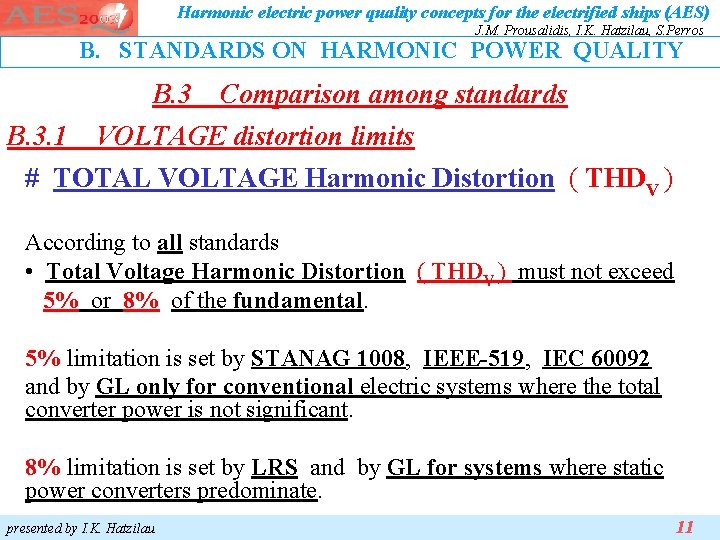
Harmonic electric power quality concepts for the electrified ships (AES) J. M. Prousalidis, I. K. Hatzilau, S. Perros B. STANDARDS ON HARMONIC POWER QUALITY B. 3 Comparison among standards B. 3. 1 VOLTAGE distortion limits # TOTAL VOLTAGE Harmonic Distortion ( THDV ) According to all standards • Total Voltage Harmonic Distortion ( THDV ) must not exceed 5% or 8% of the fundamental. 5% limitation is set by STANAG 1008, IEEE-519, IEC 60092 and by GL only for conventional electric systems where the total converter power is not significant. 8% limitation is set by LRS and by GL for systems where static power converters predominate. presented by I. K. Hatzilau 11
Harmonic electric power quality concepts for the electrified ships (AES) J. M. Prousalidis, I. K. Hatzilau, S. Perros B. STANDARDS ON HARMONIC POWER QUALITY B. 3 Comparison among standards B. 3. 1 VOLTAGE distortion limits (continued) # Total Voltage Harmonic Distortion (THDV) Furthermore, according to LRS , should the system is to be of class “ES 1”, then standards of STANAG 1008 should be applied instead, while it is underlined that : “ if any weapons or other combat systems may degrade the quality of power supplies, relevant details are to be advised to LR and to the prime contractor, in order that the consequences may be established ”. presented by I. K. Hatzilau 12
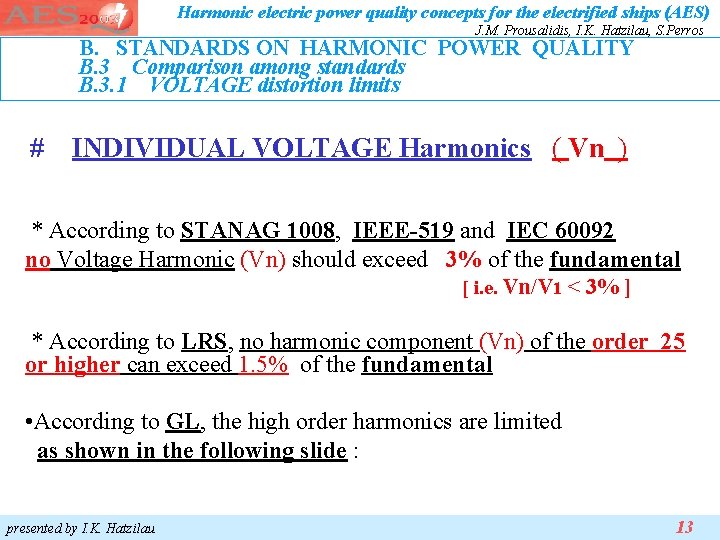
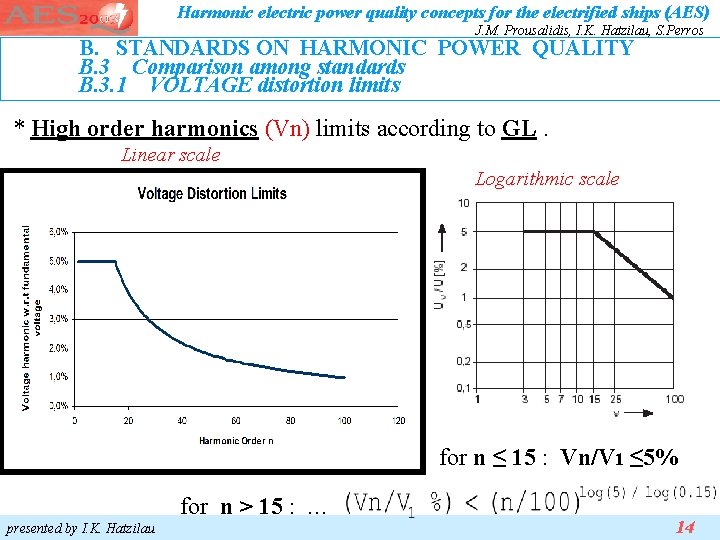
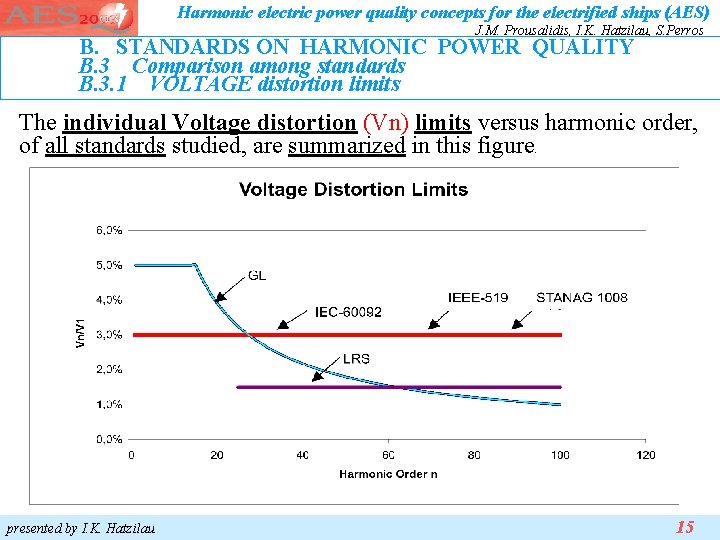
Harmonic electric power quality concepts for the electrified ships (AES) J. M. Prousalidis, I. K. Hatzilau, S. Perros B. STANDARDS ON HARMONIC POWER QUALITY B. 3 Comparison among standards B. 3. 1 VOLTAGE distortion limits # INDIVIDUAL VOLTAGE Harmonics ( Vn ) * According to STANAG 1008, IEEE-519 and IEC 60092 no Voltage Harmonic (Vn) should exceed 3% of the fundamental [ i. e. Vn/V 1 < 3% ] * According to LRS, no harmonic component (Vn) of the order 25 or higher can exceed 1. 5% of the fundamental • According to GL, the high order harmonics are limited as shown in the following slide : presented by I. K. Hatzilau 13
Harmonic electric power quality concepts for the electrified ships (AES) J. M. Prousalidis, I. K. Hatzilau, S. Perros B. STANDARDS ON HARMONIC POWER QUALITY B. 3 Comparison among standards B. 3. 1 VOLTAGE distortion limits * High order harmonics (Vn) limits according to GL. Linear scale Logarithmic scale for n > 15 : … presented by I. K. Hatzilau for n ≤ 15 : Vn/V 1 ≤ 5% 14
Harmonic electric power quality concepts for the electrified ships (AES) J. M. Prousalidis, I. K. Hatzilau, S. Perros B. STANDARDS ON HARMONIC POWER QUALITY B. 3 Comparison among standards B. 3. 1 VOLTAGE distortion limits The individual Voltage distortion (Vn) limits versus harmonic order, of all standards studied, are summarized in this figure. presented by I. K. Hatzilau 15
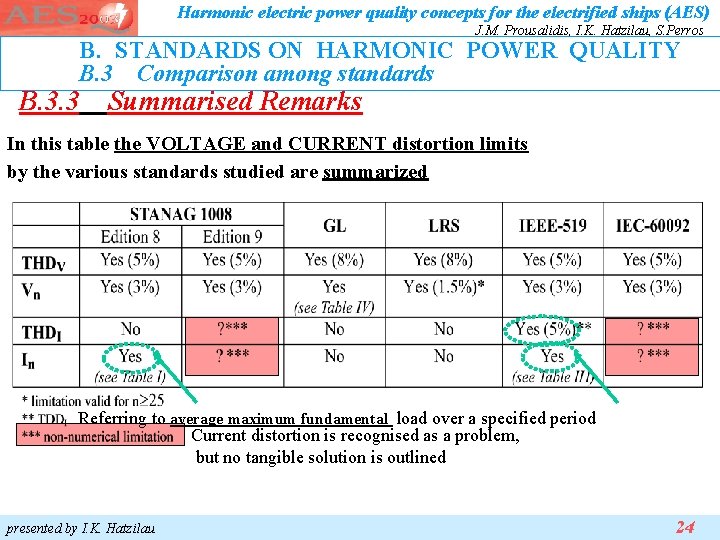
Harmonic electric power quality concepts for the electrified ships (AES) J. M. Prousalidis, I. K. Hatzilau, S. Perros B. STANDARDS ON HARMONIC POWER QUALITY B. 3 Comparison among standards B. 3. 2 CURRENT distortion limits # TOTAL CURRENT Harmonic Distortion ( THDI / TDDI) * Only IEEE-519 sets limits for TDDI , but no limit for THDI The Total Current Demand Distortion ( TDDI ) on Point of Common Coupling (PCC) must not exceed 5 % of the average maximum fundamental load Current I 1, avf. L as this is measured in a specific time interval e. g. 12 months. * by GL, LRS, STANAG 1008 and IEC 60092: no numerical limit is set for either THDI or TDDI presented by I. K. Hatzilau 16
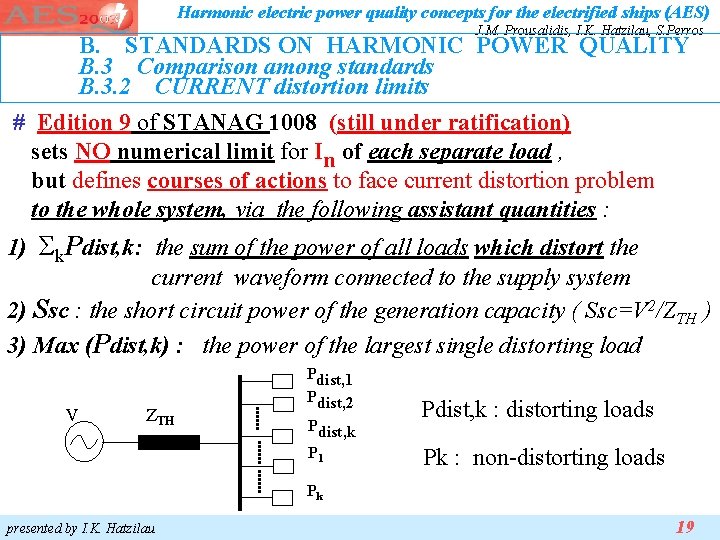
Harmonic electric power quality concepts for the electrified ships (AES) J. M. Prousalidis, I. K. Hatzilau, S. Perros B. STANDARDS ON HARMONIC POWER QUALITY B. 3 Comparison among standards B. 3. 2 CURRENT distortion limits # INDIVIDUAL CURRENT Harmonics ( In ) GL, LRS and IEC 60092 set no numerical limit , but they offer some comments on possible effects of current harmonic distortion. IEEE-519 and Ed. 8 of STANAG 1008 set numerical limits for In Ed. 9 of STANAG 1008 sets no numerical limit for In, but defines courses of actions to face current distortion problem. presented by I. K. Hatzilau 17
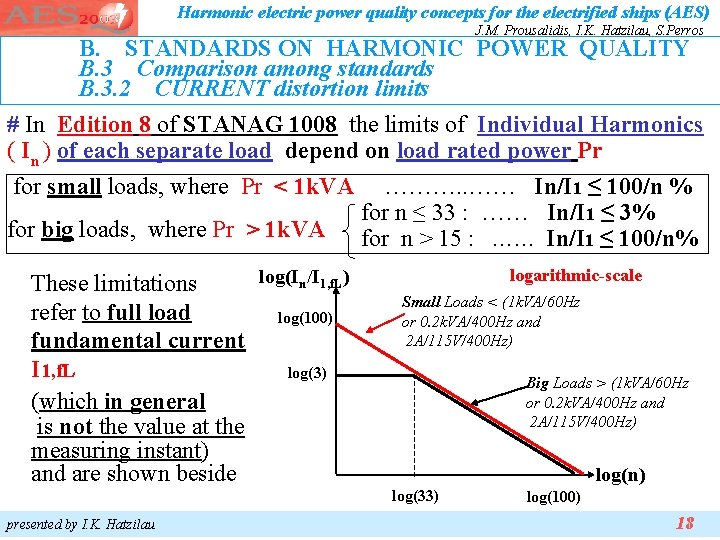
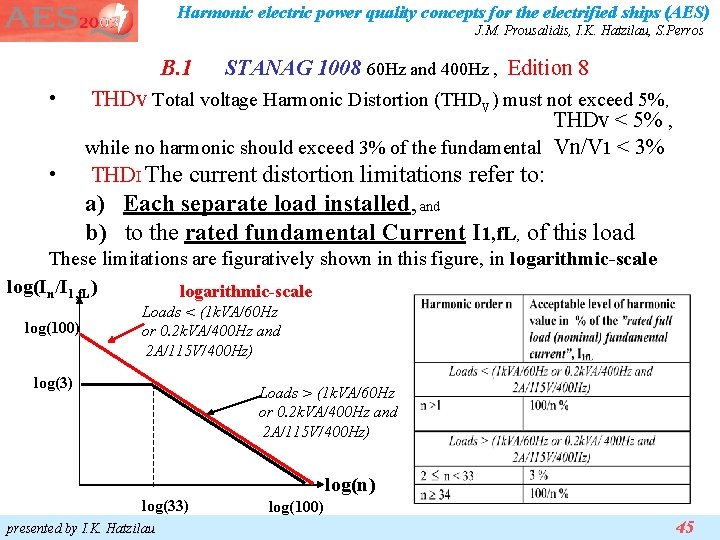
Harmonic electric power quality concepts for the electrified ships (AES) J. M. Prousalidis, I. K. Hatzilau, S. Perros B. STANDARDS ON HARMONIC POWER QUALITY B. 3 Comparison among standards B. 3. 2 CURRENT distortion limits # In Edition 8 of STANAG 1008 the limits of Individual Harmonics ( In ) of each separate load depend on load rated power Pr for small loads, where Pr < 1 k. VA ………. . …… In/I 1 ≤ 100/n % for n ≤ 33 : …… In/I 1 ≤ 3% for big loads, where Pr > 1 k. VA for n > 15 : …… In/I 1 ≤ 100/n% log(In/I 1, f. L) These limitations refer to full load log(100) fundamental current I 1, f. L log(3) (which in general is not the value at the measuring instant) and are shown beside logarithmic-scale Small Loads < (1 k. VA/60 Hz or 0. 2 k. VA/400 Hz and 2 A/115 V/400 Hz) Big Loads > (1 k. VA/60 Hz or 0. 2 k. VA/400 Hz and 2 A/115 V/400 Hz) log(n) log(33) presented by I. K. Hatzilau log(100) 18
Harmonic electric power quality concepts for the electrified ships (AES) J. M. Prousalidis, I. K. Hatzilau, S. Perros B. STANDARDS ON HARMONIC POWER QUALITY B. 3 Comparison among standards B. 3. 2 CURRENT distortion limits # Edition 9 of STANAG 1008 (still under ratification) sets NO numerical limit for In of each separate load , but defines courses of actions to face current distortion problem to the whole system, via the following assistant quantities : 1) Σk. Pdist, k: the sum of the power of all loads which distort the current waveform connected to the supply system 2) Ssc : the short circuit power of the generation capacity ( Ssc=V 2/ZTH ) 3) Max (Pdist, k) : the power of the largest single distorting load V ZTH Pdist, 1 Pdist, 2 Pdist, k P 1 Pdist, k : distorting loads Pk : non-distorting loads Pk presented by I. K. Hatzilau 19
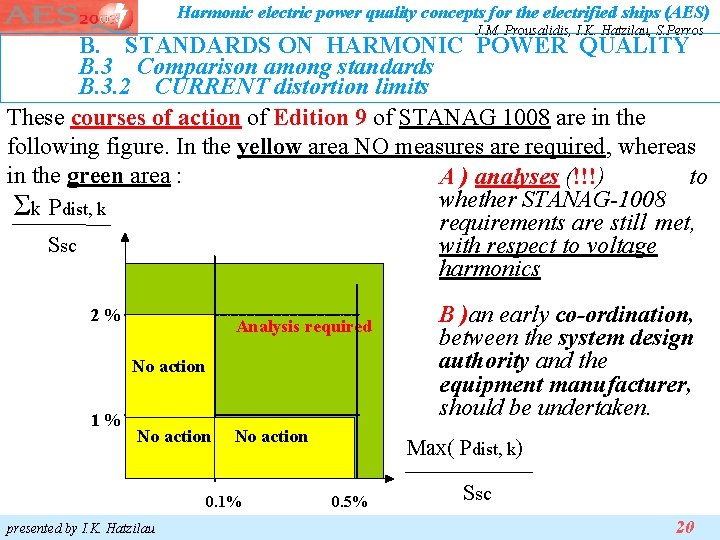
Harmonic electric power quality concepts for the electrified ships (AES) J. M. Prousalidis, I. K. Hatzilau, S. Perros B. STANDARDS ON HARMONIC POWER QUALITY B. 3 Comparison among standards B. 3. 2 CURRENT distortion limits These courses of action of Edition 9 of STANAG 1008 are in the following figure. In the yellow area NO measures are required, whereas in the green area : A ) analyses (!!!) to whether STANAG-1008 Σk Pdist, k requirements are still met, Ssc with respect to voltage harmonics 2% Analysis required No action 1% No action 0. 1% presented by I. K. Hatzilau B )an early co-ordination, between the system design authority and the equipment manufacturer, should be undertaken. Max( Pdist, k) 0. 5% Ssc 20
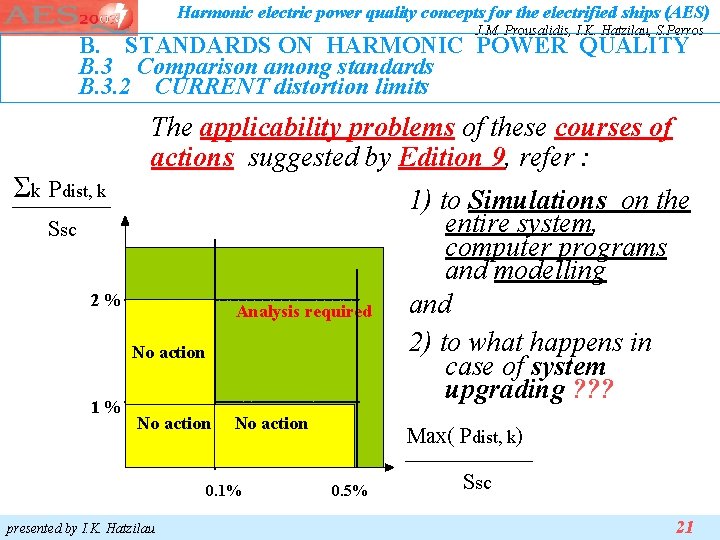
Harmonic electric power quality concepts for the electrified ships (AES) J. M. Prousalidis, I. K. Hatzilau, S. Perros B. STANDARDS ON HARMONIC POWER QUALITY B. 3 Comparison among standards B. 3. 2 CURRENT distortion limits The applicability problems of these courses of actions suggested by Edition 9, refer : Σk Pdist, k Ssc 2% Analysis required No action 1% No action 0. 1% presented by I. K. Hatzilau 1) to Simulations on the entire system, computer programs and modelling and 2) to what happens in case of system upgrading ? ? ? Max( Pdist, k) 0. 5% Ssc 21
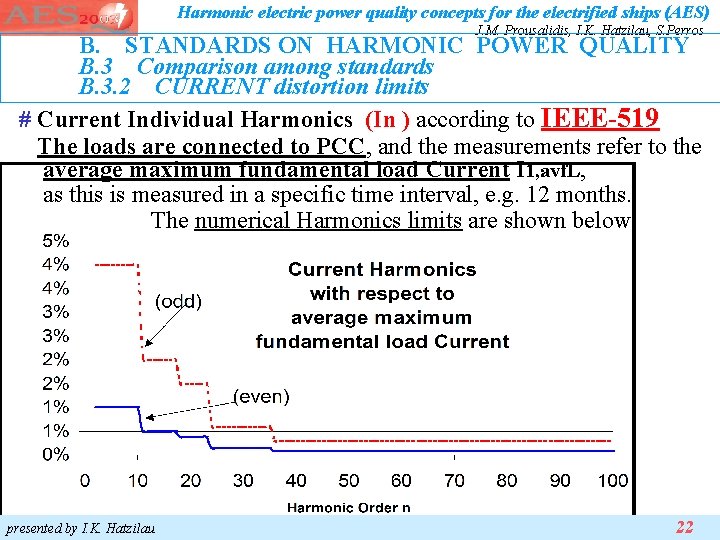
Harmonic electric power quality concepts for the electrified ships (AES) J. M. Prousalidis, I. K. Hatzilau, S. Perros B. STANDARDS ON HARMONIC POWER QUALITY B. 3 Comparison among standards B. 3. 2 CURRENT distortion limits # Current Individual Harmonics (In ) according to IEEE-519 The loads are connected to PCC, and the measurements refer to the average maximum fundamental load Current I 1, avf. L, as this is measured in a specific time interval, e. g. 12 months. The numerical Harmonics limits are shown below. presented by I. K. Hatzilau 22
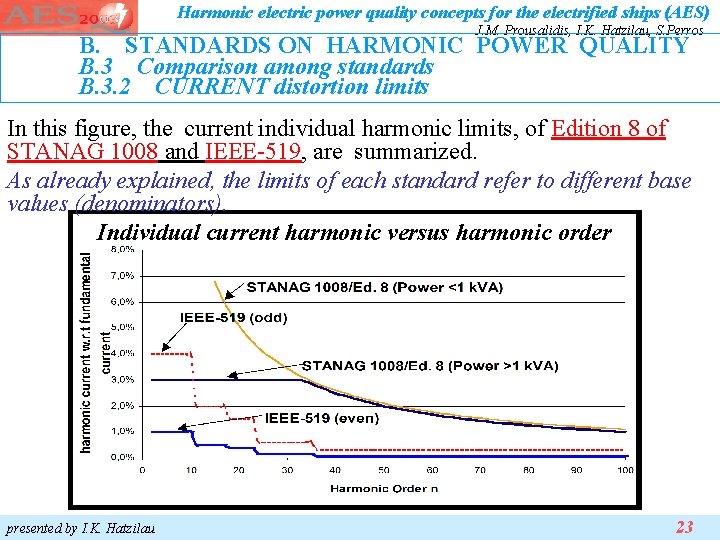
Harmonic electric power quality concepts for the electrified ships (AES) J. M. Prousalidis, I. K. Hatzilau, S. Perros B. STANDARDS ON HARMONIC POWER QUALITY B. 3 Comparison among standards B. 3. 2 CURRENT distortion limits In this figure, the current individual harmonic limits, of Edition 8 of STANAG 1008 and IEEE-519, are summarized. As already explained, the limits of each standard refer to different base values (denominators). Individual current harmonic versus harmonic order presented by I. K. Hatzilau 23
Harmonic electric power quality concepts for the electrified ships (AES) J. M. Prousalidis, I. K. Hatzilau, S. Perros B. STANDARDS ON HARMONIC POWER QUALITY B. 3 Comparison among standards B. 3. 3 Summarised Remarks In this table the VOLTAGE and CURRENT distortion limits by the various standards studied are summarized Referring to average maximum fundamental load over a specified period Current distortion is recognised as a problem, but no tangible solution is outlined presented by I. K. Hatzilau 24
Harmonic electric power quality concepts for the electrified ships (AES) J. M. Prousalidis, I. K. Hatzilau, S. Perros B. STANDARDS ON HARMONIC POWER QUALITY B. 3 Comparison among standards B. 3. 3 Summarised Remarks The main conclusions drawn from this comparison are the following: Concerning VOLTAGE distortion : • all standards confine THDV below 5% or 8% with GL and LRS being the less strict ones, • while in most cases all high order individual harmonics are restricted by an upper limit of 3%. • Furthermore, there seems to be no clear way of estimating voltage distortion, by investigating the current distortion caused by each separate load. presented by I. K. Hatzilau 25
Harmonic electric power quality concepts for the electrified ships (AES) J. M. Prousalidis, I. K. Hatzilau, S. Perros B. STANDARDS ON HARMONIC POWER QUALITY B. 3 Comparison among standards B. 3. 3 Summarised Remarks • Finally, it is underlined that no particular limitation is set for the interharmonics, the non-integer multiples of the fundamental. • Concerning CURRENT distortion : • Current Harmonic limits are clearly set only by STANAG 1008/Edition 8 and IEEE-519. Moreover, IEEE-519 restricts also the entire high order spectrum expressed by TDDI. • In addition, the limits of high order current harmonics set by the two standards refer, in general, to different values. presented by I. K. Hatzilau 26
Harmonic electric power quality concepts for the electrified ships (AES) J. M. Prousalidis, I. K. Hatzilau, S. Perros C. AUTHORs’ PROPOSITION for the application of IEEE-519 CURRENT DISTORTION LIMITS on SHIPBOARD After the author’s proposition, at an initial approximation, IEEE 519 harmonic current limits, can be applied considering that for each separate load : • its corresponding PCC is the system power outlet, where it is connected, • its average maximum load can be estimated by the operation service load factors fs , which are extensively used at the electric balance of the ship power plant. presented by I. K. Hatzilau 27
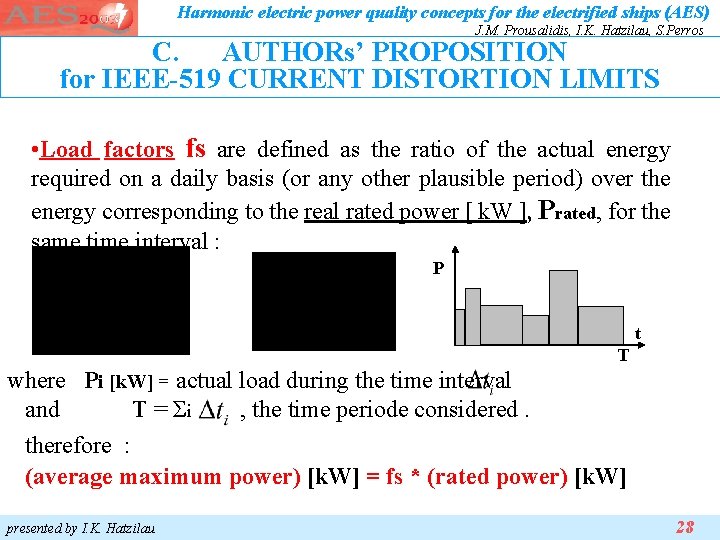
Harmonic electric power quality concepts for the electrified ships (AES) J. M. Prousalidis, I. K. Hatzilau, S. Perros C. AUTHORs’ PROPOSITION for IEEE-519 CURRENT DISTORTION LIMITS • Load factors fs are defined as the ratio of the actual energy required on a daily basis (or any other plausible period) over the energy corresponding to the real rated power [ k. W ], Prated, for the same time interval : P t T where Pi [k. W] = actual load during the time interval and T = Σi , the time periode considered. therefore : (average maximum power) [k. W] = fs * (rated power) [k. W] presented by I. K. Hatzilau 28
Harmonic electric power quality concepts for the electrified ships (AES) J. M. Prousalidis, I. K. Hatzilau, S. Perros C. AUTHORs’ PROPOSITION for IEEE-519 CURRENT DISTORTION LIMITS The values of fs, which are often readily available as a result of accumulated experience are often checked and updated. In case of diversified fs values for several operation profiles, the worst case can be considered. Thus, average maximum power can be estimated. However, average fundamental current, which is needed, can still not be estimated, in those cases where the current harmonic spectrum varies with the operating power. All the points discussed so far will be shown figuratively through representative study cases as follows. presented by I. K. Hatzilau 29
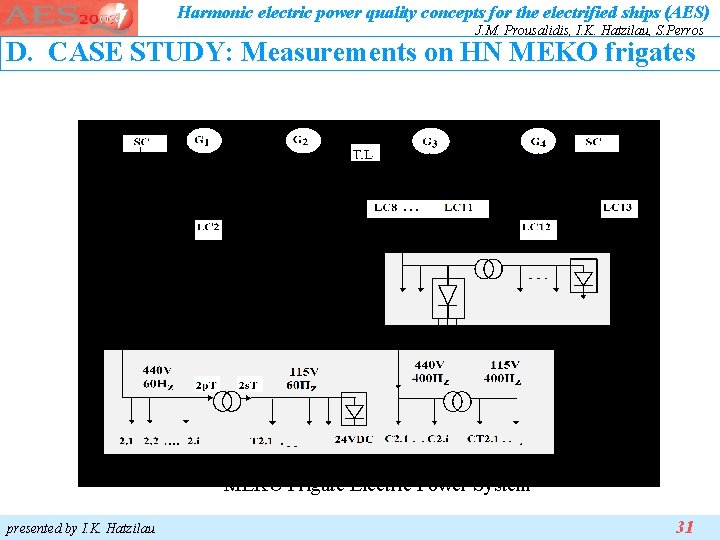
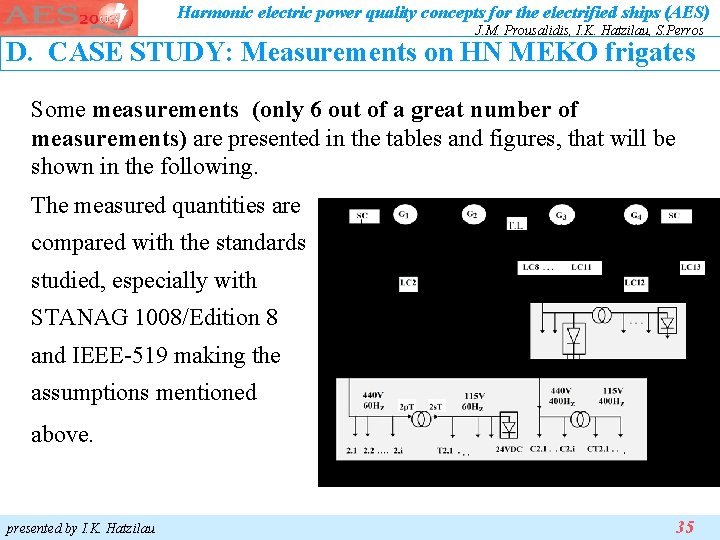
Harmonic electric power quality concepts for the electrified ships (AES) J. M. Prousalidis, I. K. Hatzilau, S. Perros D. CASE STUDY: Measurements on HN MEKO frigates During a research project investigating electric power quality in Hellenic Navy ships, several measurements on voltage and current harmonics have been conducted onboard HN MEKO frigates , while the validity of load factors fs often used has been verified. The electric plant in these ships is served by four generators (775 KVA, 450 V/60 Hz, 3 -phase), laid in two separate engine-rooms. The generators feed two main switchboards supplying thirteen Load Centers (LCi, i = 1, . . . , 13) which in turn feed all separate loads. presented by I. K. Hatzilau 30
Harmonic electric power quality concepts for the electrified ships (AES) J. M. Prousalidis, I. K. Hatzilau, S. Perros D. CASE STUDY: Measurements on HN MEKO frigates Figure 3 MEKO Frigate Electric Power System presented by I. K. Hatzilau 31
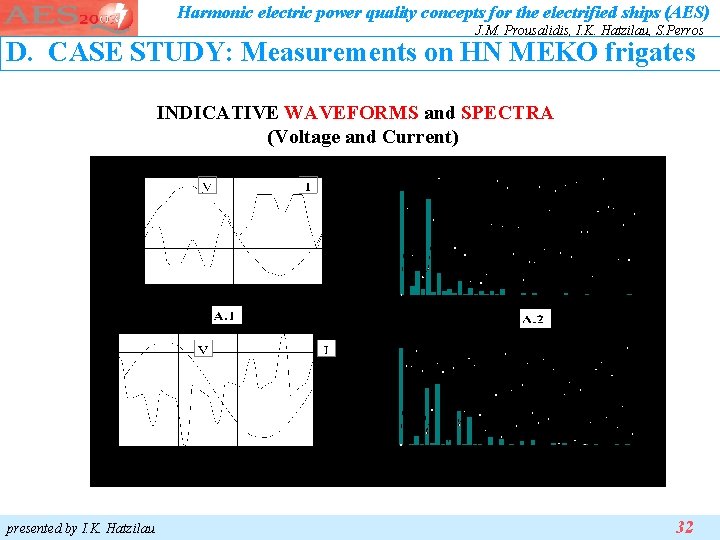
Harmonic electric power quality concepts for the electrified ships (AES) J. M. Prousalidis, I. K. Hatzilau, S. Perros D. CASE STUDY: Measurements on HN MEKO frigates INDICATIVE WAVEFORMS and SPECTRA (Voltage and Current) presented by I. K. Hatzilau 32
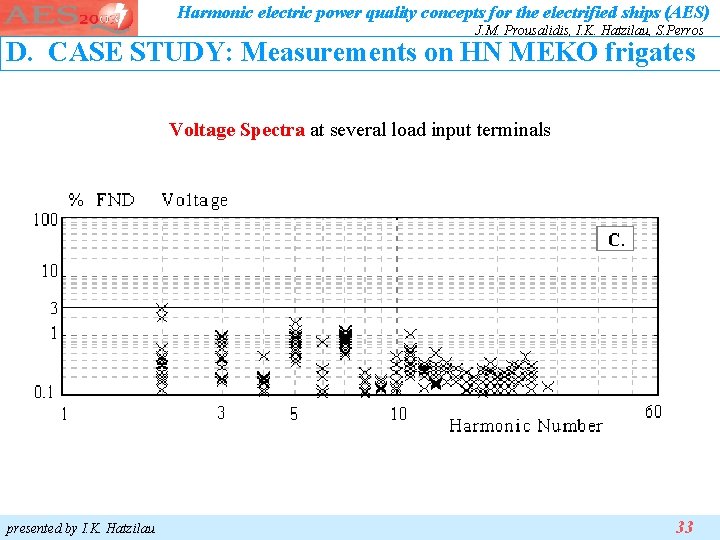
Harmonic electric power quality concepts for the electrified ships (AES) J. M. Prousalidis, I. K. Hatzilau, S. Perros D. CASE STUDY: Measurements on HN MEKO frigates Voltage Spectra at several load input terminals presented by I. K. Hatzilau 33
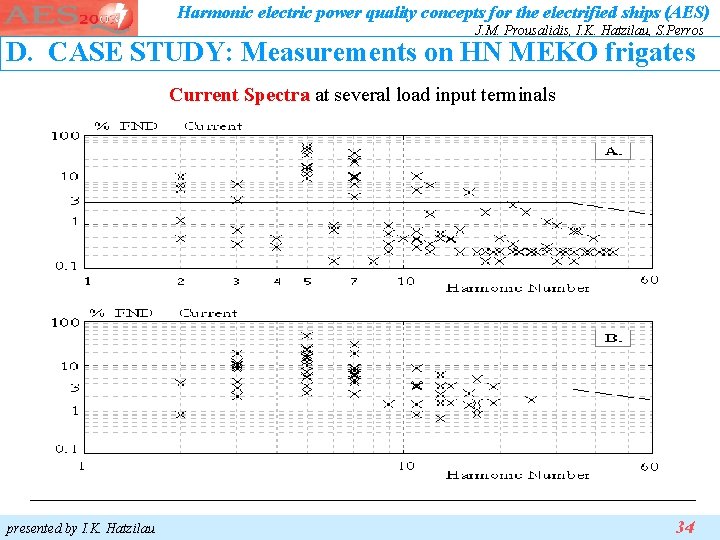
Harmonic electric power quality concepts for the electrified ships (AES) J. M. Prousalidis, I. K. Hatzilau, S. Perros D. CASE STUDY: Measurements on HN MEKO frigates Current Spectra at several load input terminals presented by I. K. Hatzilau 34
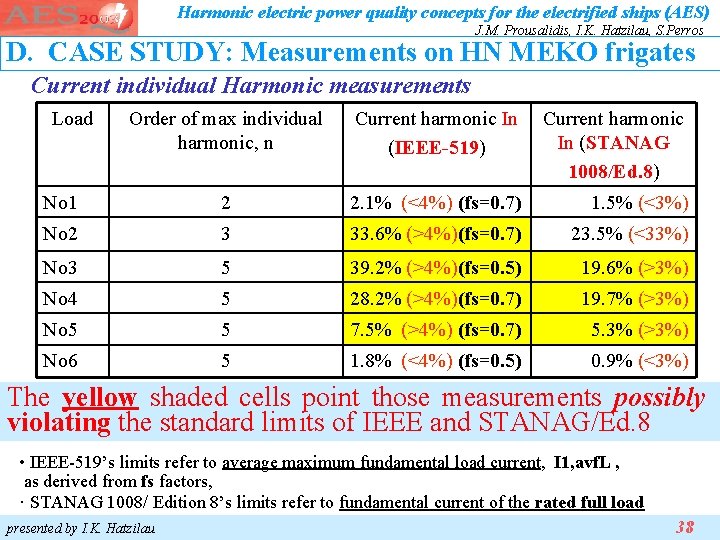
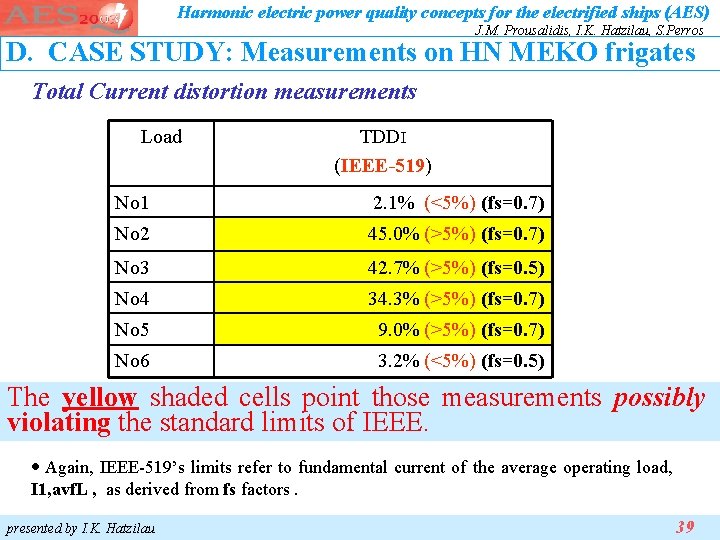
Harmonic electric power quality concepts for the electrified ships (AES) J. M. Prousalidis, I. K. Hatzilau, S. Perros D. CASE STUDY: Measurements on HN MEKO frigates Some measurements (only 6 out of a great number of measurements) are presented in the tables and figures, that will be shown in the following. The measured quantities are compared with the standards studied, especially with STANAG 1008/Edition 8 and IEEE-519 making the assumptions mentioned above. presented by I. K. Hatzilau 35
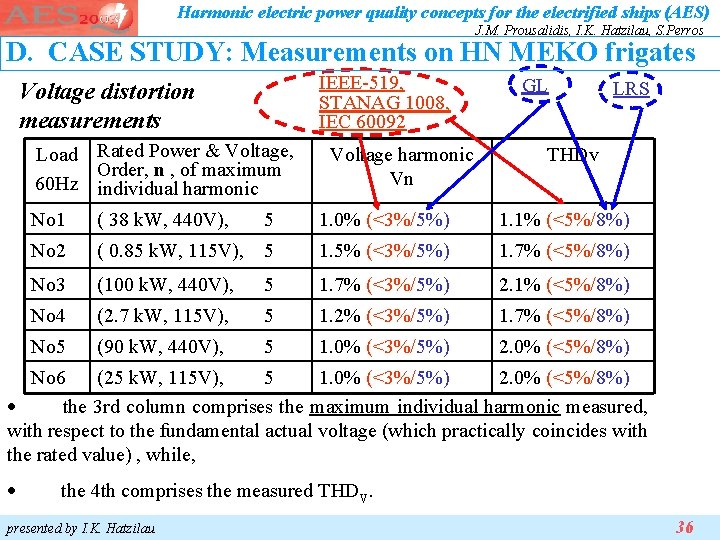
Harmonic electric power quality concepts for the electrified ships (AES) J. M. Prousalidis, I. K. Hatzilau, S. Perros D. CASE STUDY: Measurements on HN MEKO frigates Voltage distortion measurements Load Rated Power & Voltage, Order, n , of maximum 60 Hz individual harmonic IEEE-519, STANAG 1008, IEC 60092 Voltage harmonic Vn GL LRS THDv No 1 ( 38 k. W, 440 V), 5 1. 0% (<3%/5%) 1. 1% (<5%/8%) No 2 ( 0. 85 k. W, 115 V), 5 1. 5% (<3%/5%) 1. 7% (<5%/8%) No 3 (100 k. W, 440 V), 5 1. 7% (<3%/5%) 2. 1% (<5%/8%) No 4 (2. 7 k. W, 115 V), 5 1. 2% (<3%/5%) 1. 7% (<5%/8%) No 5 (90 k. W, 440 V), 5 1. 0% (<3%/5%) 2. 0% (<5%/8%) No 6 (25 k. W, 115 V), 5 1. 0% (<3%/5%) 2. 0% (<5%/8%) · the 3 rd column comprises the maximum individual harmonic measured, with respect to the fundamental actual voltage (which practically coincides with the rated value) , while, · the 4 th comprises the measured THDV. presented by I. K. Hatzilau 36
Harmonic electric power quality concepts for the electrified ships (AES) J. M. Prousalidis, I. K. Hatzilau, S. Perros D. CASE STUDY: Measurements on HN MEKO frigates Voltage distortion measurements Measurements performed on a series of various types of loads have shown no violation of any voltage harmonic constraints set by any of the standards studied presented by I. K. Hatzilau 37
Harmonic electric power quality concepts for the electrified ships (AES) J. M. Prousalidis, I. K. Hatzilau, S. Perros D. CASE STUDY: Measurements on HN MEKO frigates Current individual Harmonic measurements Load Order of max individual harmonic, n Current harmonic In (STANAG (IEEE-519) 1008/Ed. 8) No 1 2 2. 1% (<4%) (fs=0. 7) 1. 5% (<3%) No 2 3 33. 6% (>4%)(fs=0. 7) 23. 5% (<33%) No 3 5 39. 2% (>4%)(fs=0. 5) 19. 6% (>3%) No 4 5 28. 2% (>4%)(fs=0. 7) 19. 7% (>3%) No 5 5 7. 5% (>4%) (fs=0. 7) 5. 3% (>3%) No 6 5 1. 8% (<4%) (fs=0. 5) 0. 9% (<3%) The yellow shaded cells point those measurements possibly violating the standard limits of IEEE and STANAG/Ed. 8 • IEEE-519’s limits refer to average maximum fundamental load current, I 1, avf. L , as derived from fs factors, · STANAG 1008/ Edition 8’s limits refer to fundamental current of the rated full load presented by I. K. Hatzilau 38
Harmonic electric power quality concepts for the electrified ships (AES) J. M. Prousalidis, I. K. Hatzilau, S. Perros D. CASE STUDY: Measurements on HN MEKO frigates Total Current distortion measurements Load TDDI (IEEE-519) No 1 2. 1% (<5%) (fs=0. 7) No 2 45. 0% (>5%) (fs=0. 7) No 3 42. 7% (>5%) (fs=0. 5) No 4 34. 3% (>5%) (fs=0. 7) No 5 9. 0% (>5%) (fs=0. 7) No 6 3. 2% (<5%) (fs=0. 5) The yellow shaded cells point those measurements possibly violating the standard limits of IEEE. · Again, IEEE-519’s limits refer to fundamental current of the average operating load, I 1, avf. L , as derived from fs factors. presented by I. K. Hatzilau 39
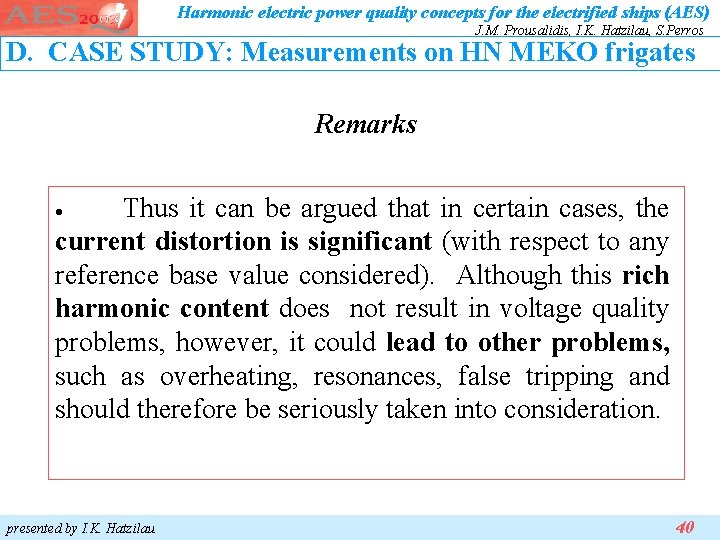
Harmonic electric power quality concepts for the electrified ships (AES) J. M. Prousalidis, I. K. Hatzilau, S. Perros D. CASE STUDY: Measurements on HN MEKO frigates Remarks · Thus it can be argued that in certain cases, the current distortion is significant (with respect to any reference base value considered). Although this rich harmonic content does not result in voltage quality problems, however, it could lead to other problems, such as overheating, resonances, false tripping and should therefore be seriously taken into consideration. presented by I. K. Hatzilau 40
Harmonic electric power quality concepts for the electrified ships (AES) J. M. Prousalidis, I. K. Hatzilau, S. Perros E. CONCLUSIONS • presented by I. K. Hatzilau 41
Harmonic electric power quality concepts for the electrified ships (AES) J. M. Prousalidis, I. K. Hatzilau, S. Perros E. CONCLUSIONS · current distortion is not limited by many standards, while where restricted, i. e. in STANAG 1008/Edition 8 and IEEE-519 the defined current distortion limitations can not be easily applied. However, the possibly violated limits of current harmonics should be a warning to be acknowledged especially in future buildings as current distortion could not only affect voltage distortion, but also provoke other adverse phenomena. · The novel proposition of this work to exploit the wellknown load factors fs and to consider Point of Common Coupling (PCC) at the load power outlet, could facilitate the evaluation of current distortion on shipboard installations according to IEEE-519. This can be done, provided there is a clear way of estimating the average maximum fundamental load current from the corresponding power value, the average power factor and the corresponding harmonic spectrum could be estimated, too. presented by I. K. Hatzilau 42
Harmonic electric power quality concepts for the electrified ships (AES) J. M. Prousalidis, I. K. Hatzilau, S. Perros F. REFERENCES presented by I. K. Hatzilau 43
Harmonic electric power quality concepts for the electrified ships (AES) J. M. Prousalidis, I. K. Hatzilau, S. Perros F. REFERENCES J. M. Prousalidis, I. K. Hatzilau, S. Perros presented by I. K. Hatzilau 44 44
Harmonic electric power quality concepts for the electrified ships (AES) J. M. Prousalidis, I. K. Hatzilau, S. Perros B. 1 • • STANAG 1008 60 Hz and 400 Hz , Edition 8 THDv Total voltage Harmonic Distortion (THDV) must not exceed 5%, THDv < 5% , while no harmonic should exceed 3% of the fundamental Vn/V 1 < 3% THDI The current distortion limitations refer to: a) Each separate load installed, and b) to the rated fundamental Current I 1, f. L, of this load These limitations are figuratively shown in this figure, in logarithmic-scale log(In/I 1, f. L) logarithmic-scale log(100) Loads < (1 k. VA/60 Hz or 0. 2 k. VA/400 Hz and 2 A/115 V/400 Hz) log(3) Loads > (1 k. VA/60 Hz or 0. 2 k. VA/400 Hz and 2 A/115 V/400 Hz) log(n) log(33) presented by I. K. Hatzilau log(100) 45
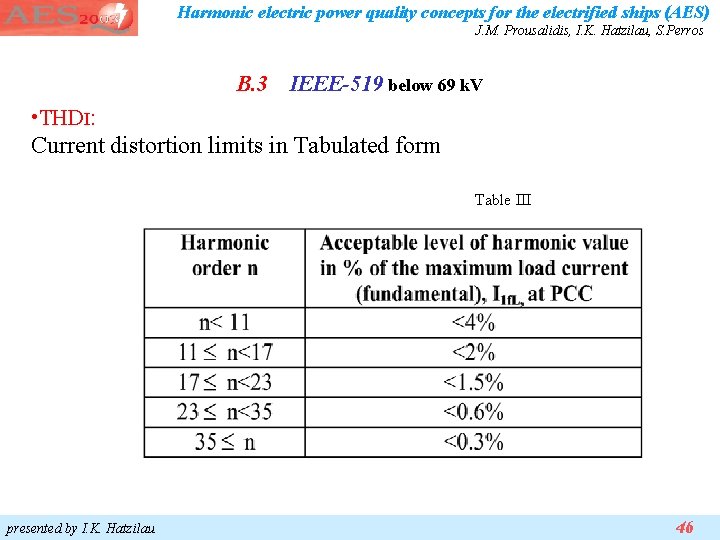
Harmonic electric power quality concepts for the electrified ships (AES) J. M. Prousalidis, I. K. Hatzilau, S. Perros B. 3 IEEE-519 below 69 k. V • THDI: Current distortion limits in Tabulated form Table III presented by I. K. Hatzilau 46
Harmonic electric power quality concepts for the electrified ships (AES) J. M. Prousalidis, I. K. Hatzilau, S. Perros D. CASE STUDY: Measurements on HN MEKO frigates Current distortion measurements • Neither of the standard reference values are readily available or can be estimated without knowing the power factor and the harmonic spectrum at the average and rated full load respectively. • However, in order to enable some commenting on the measurements performed, the assumption that the harmonic spectrum is equal to the measured one is made. • Similarly the power factor is considered equal to 0. 75. • On the grounds of these assumptions, the average operating load currents (via fs), I 1, avf. L, and rated full load currents, I 1, f. L, are estimated. presented by I. K. Hatzilau 47
Harmonic electric power quality concepts for the electrified ships (AES) J. M. Prousalidis, I. K. Hatzilau, S. Perros D. CASE STUDY: Measurements on HN MEKO frigates Remarks From the measurements performed, the following remarks are made: Voltage distortion · In any case, the measured voltage distortion caused by the loads - referring to either the THDV or the individual harmonics where the 5 th component dominates - is lower than the imposed marginal values of all standards. It is also underlined, that there is no rated voltage reference problem as the operating voltage normally coincides its rated value. presented by I. K. Hatzilau 48
Harmonic electric power quality concepts for the electrified ships (AES) J. M. Prousalidis, I. K. Hatzilau, S. Perros D. CASE STUDY: Measurements on HN MEKO frigates Remarks From the measurements performed, the following remarks are made: Current distortion · The highest harmonics of current are in the order 2, 3 and 5 with their values being fairly large with respect to the simultaneous fundamental current. In certain cases (shaded cells in Table VIII), restrictions appear to be violated, referring to either the individual harmonic or the total current distortion. However it can not be safely argued that the measured values exceed the limits of both IEEE-519 and STANAG 1008/Edition 8 as their reference values can not but roughly estimated. presented by I. K. Hatzilau 49