GLUSTER CAN DO THAT Architecting and Performance Tuning














- Slides: 47
GLUSTER CAN DO THAT! Architecting and Performance Tuning Efficient Gluster Storage Pools Dustin Black Senior Architect, Software-Defined Storage @dustinlblack 2017 -05 -02 Ben Turner Principal Quality Engineer @bennyturns
GLUSTER 101 IN 5 SECONDS
NOT SURE IF YOU GOT IT? https: //people. redhat. com/dblack/summit 2017
GLUSTER CAN DO THAT!* *If you build it right
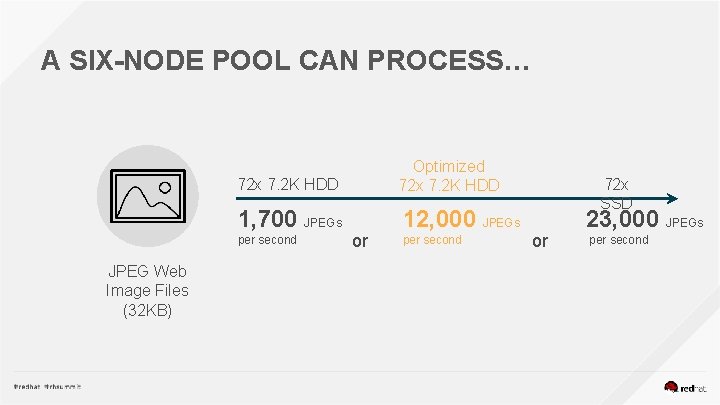
A SIX-NODE POOL CAN PROCESS… 72 x 7. 2 K HDD Optimized 72 x 7. 2 K HDD 1, 700 JPEGs 12, 000 JPEGs per second JPEG Web Image Files (32 KB) or per second 72 x SSD or 23, 000 JPEGs per second
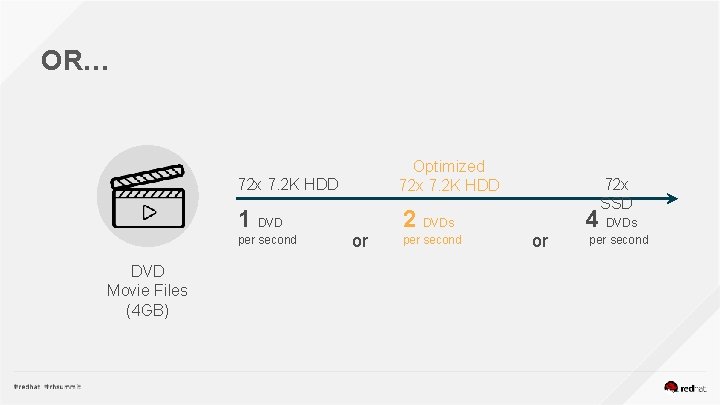
OR… 72 x 7. 2 K HDD Optimized 72 x 7. 2 K HDD 1 DVD 2 DVDs per second DVD Movie Files (4 GB) or per second 72 x SSD or 4 DVDs per second
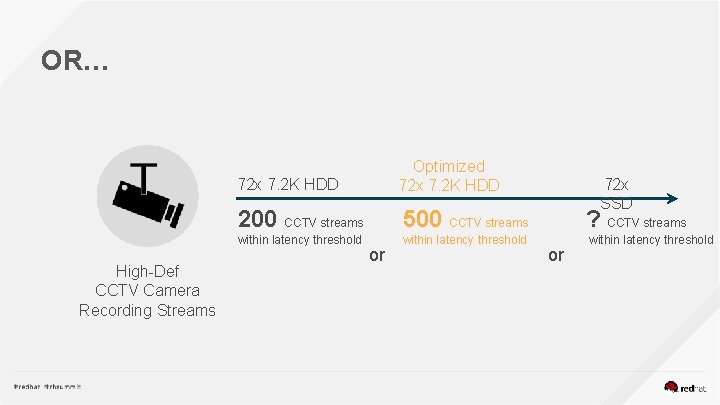
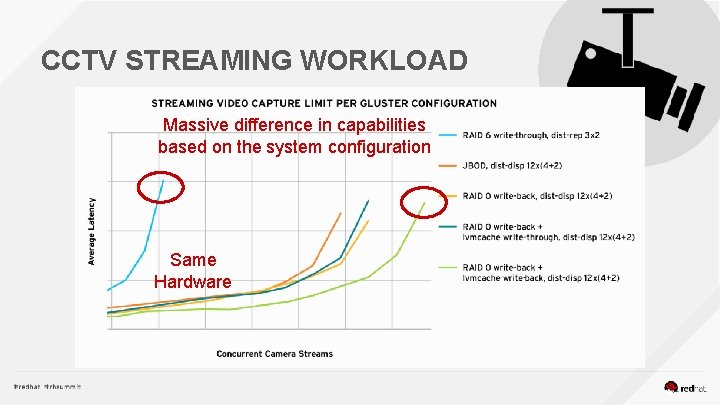
OR… High-Def CCTV Camera Recording Streams 72 x 7. 2 K HDD Optimized 72 x 7. 2 K HDD 200 CCTV streams 500 CCTV streams ? CCTV streams within latency threshold or 72 x SSD or
EE P T IMPLE, TUPID
SWTWD
WITH THE WORKLOA D, DUMMY
WHY DO YOU ASK THE WRONG QUESTIONS?
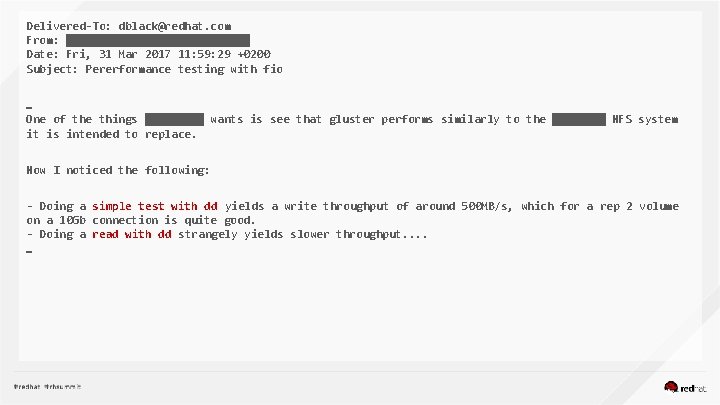
Delivered-To: dblack@redhat. com From: ██████████████ Date: Fri, 31 Mar 2017 11: 59: 29 +0200 Subject: Pererformance testing with fio … One of the things █████ wants is see that gluster performs similarly to the ████ NFS system it is intended to replace. Now I noticed the following: - Doing a simple test with dd yields a write throughput of around 500 MB/s, which for a rep 2 volume on a 10 Gb connection is quite good. - Doing a read with dd strangely yields slower throughput. . …
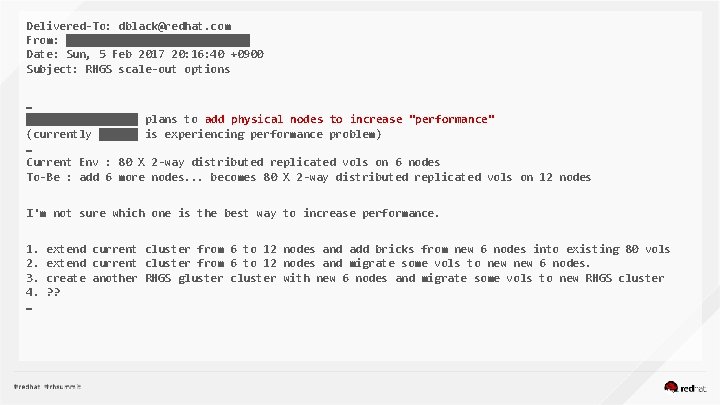
Delivered-To: dblack@redhat. com From: ██████████████ Date: Sun, 5 Feb 2017 20: 16: 40 +0900 Subject: RHGS scale-out options … █████████ plans to add physical nodes to increase "performance" (currently ██████ is experiencing performance problem) … Current Env : 80 X 2 -way distributed replicated vols on 6 nodes To-Be : add 6 more nodes. . . becomes 80 X 2 -way distributed replicated vols on 12 nodes I'm not sure which one is the best way to increase performance. 1. 2. 3. 4. … extend current cluster from 6 to 12 nodes and add bricks from new 6 nodes into existing 80 vols extend current cluster from 6 to 12 nodes and migrate some vols to new 6 nodes. create another RHGS gluster cluster with new 6 nodes and migrate some vols to new RHGS cluster ? ?
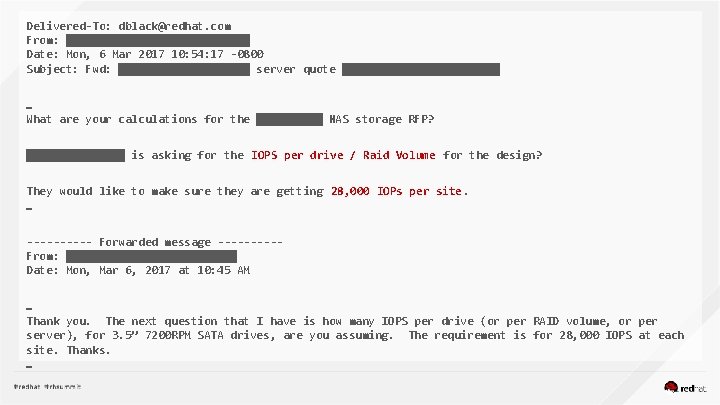
Delivered-To: dblack@redhat. com From: ██████████████ Date: Mon, 6 Mar 2017 10: 54: 17 -0800 Subject: Fwd: ██████████ server quote ████████████ … What are your calculations for the █████ NAS storage RFP? ████████ is asking for the IOPS per drive / Raid Volume for the design? They would like to make sure they are getting 28, 000 IOPs per site. … ----- Forwarded message -----From: █████████████ Date: Mon, Mar 6, 2017 at 10: 45 AM … Thank you. The next question that I have is how many IOPS per drive (or per RAID volume, or per server), for 3. 5” 7200 RPM SATA drives, are you assuming. The requirement is for 28, 000 IOPS at each site. Thanks. …
THE WORKLOAD IS COMING
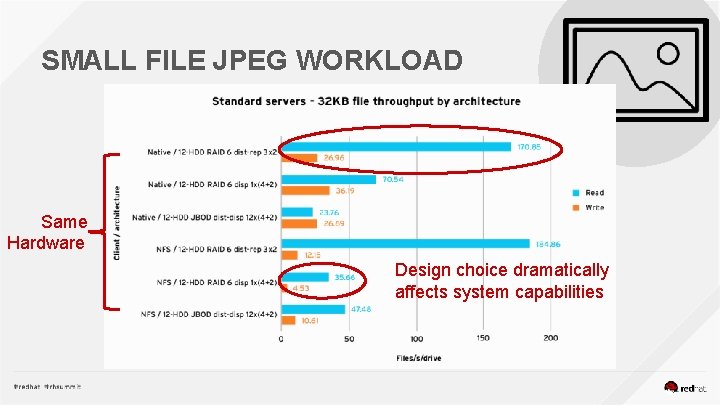
SMALL FILE JPEG WORKLOAD Same Hardware Design choice dramatically affects system capabilities
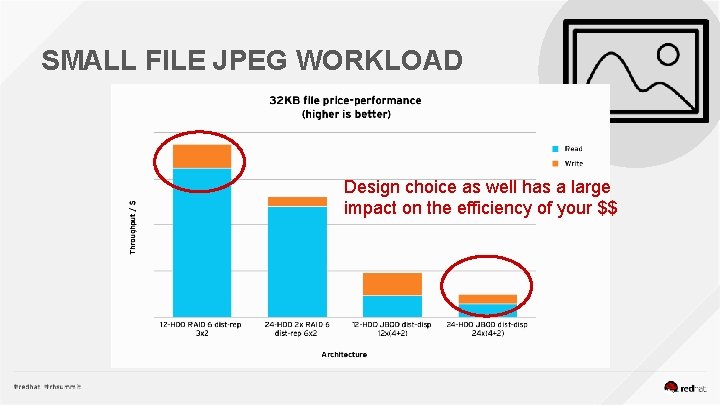
SMALL FILE JPEG WORKLOAD Design choice as well has a large impact on the efficiency of your $$
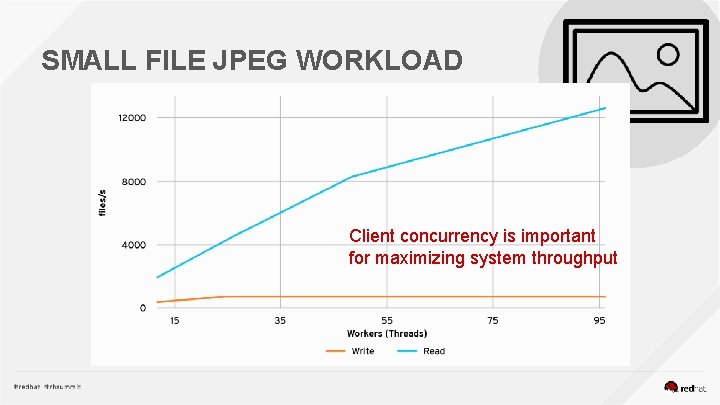
SMALL FILE JPEG WORKLOAD Client concurrency is important for maximizing system throughput
SMALL FILE JPEG WORKLOAD
SMALL FILE JPEG WORKLOAD
IF A FILE IS VERY SMALL IS IT STILL A FILE?
IT'S LIKE A SERIES OF TUBES
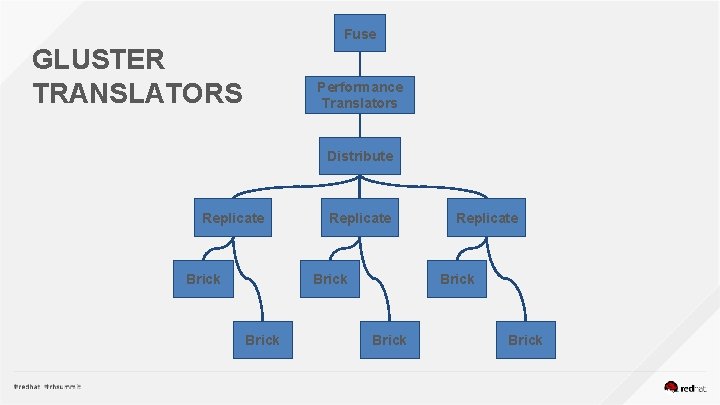
Fuse GLUSTER TRANSLATORS Performance Translators Distribute Replicate Brick Brick
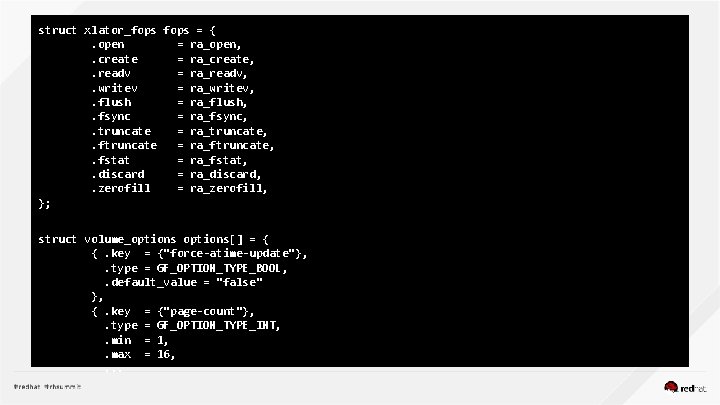
struct xlator_fops = {. open = ra_open, . create = ra_create, . readv = ra_readv, . writev = ra_writev, . flush = ra_flush, . fsync = ra_fsync, . truncate = ra_truncate, . ftruncate = ra_ftruncate, . fstat = ra_fstat, . discard = ra_discard, . zerofill = ra_zerofill, }; struct volume_options[] = { {. key = {"force-atime-update"}, . type = GF_OPTION_TYPE_BOOL, . default_value = "false" }, {. key = {"page-count"}, . type = GF_OPTION_TYPE_INT, . min = 1, . max = 16, . . .
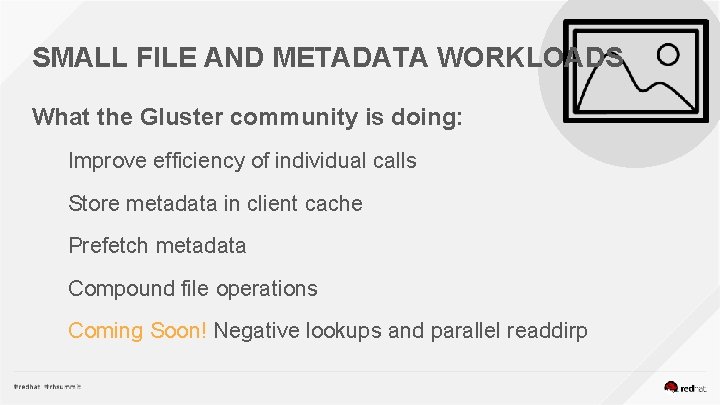
SMALL FILE AND METADATA WORKLOADS What the Gluster community is doing: Improve efficiency of individual calls Store metadata in client cache Prefetch metadata Compound file operations Coming Soon! Negative lookups and parallel readdirp
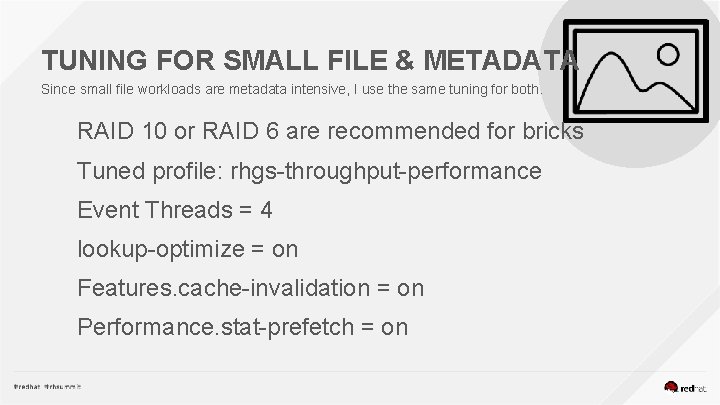
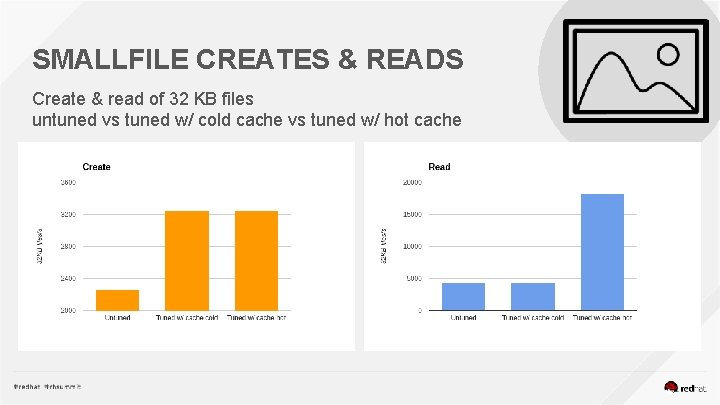
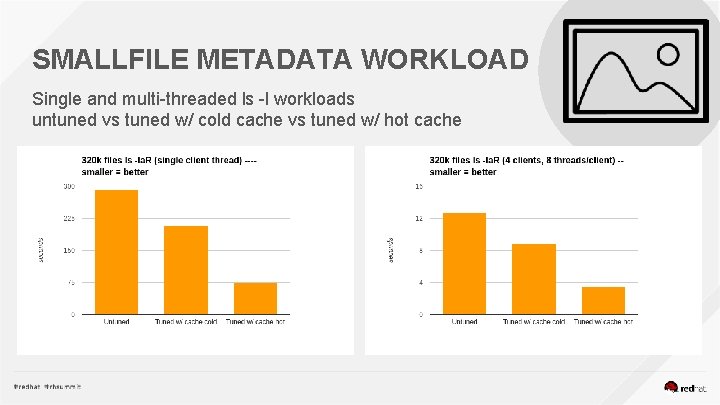
TUNING FOR SMALL FILE & METADATA Since small file workloads are metadata intensive, I use the same tuning for both. RAID 10 or RAID 6 are recommended for bricks Tuned profile: rhgs-throughput-performance Event Threads = 4 lookup-optimize = on Features. cache-invalidation = on Performance. stat-prefetch = on
SMALLFILE CREATES & READS Create & read of 32 KB files untuned vs tuned w/ cold cache vs tuned w/ hot cache
SMALLFILE METADATA WORKLOAD Single and multi-threaded ls -l workloads untuned vs tuned w/ cold cache vs tuned w/ hot cache
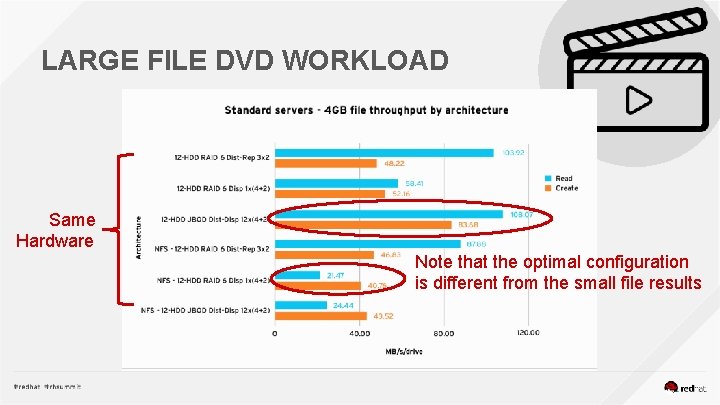
LARGE FILE DVD WORKLOAD Same Hardware Note that the optimal configuration is different from the small file results
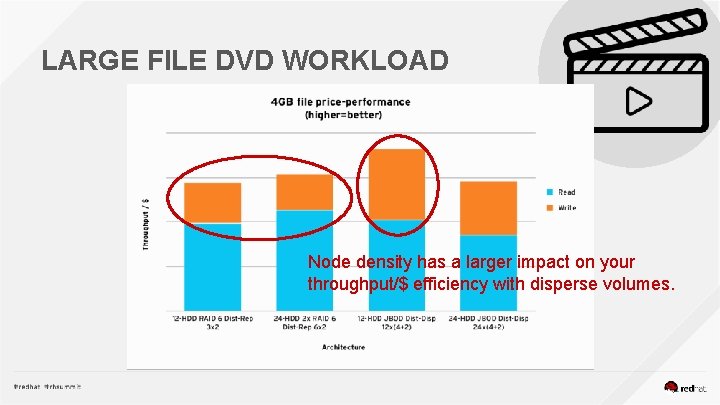
LARGE FILE DVD WORKLOAD Node density has a larger impact on your throughput/$ efficiency with disperse volumes.
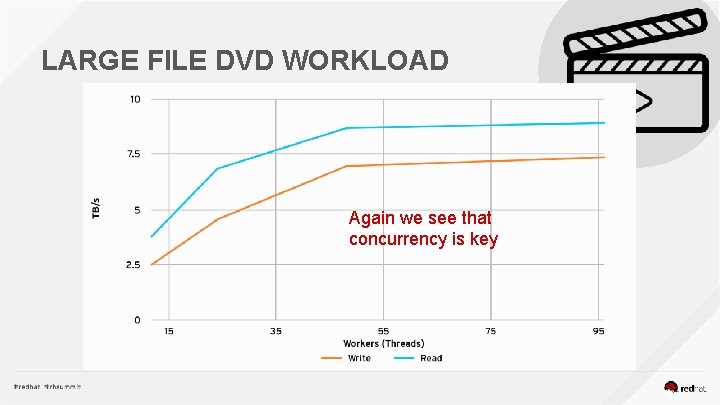
LARGE FILE DVD WORKLOAD Again we see that concurrency is key
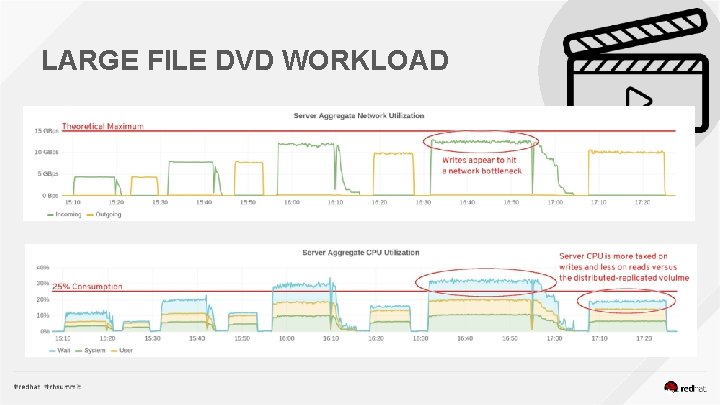
LARGE FILE DVD WORKLOAD
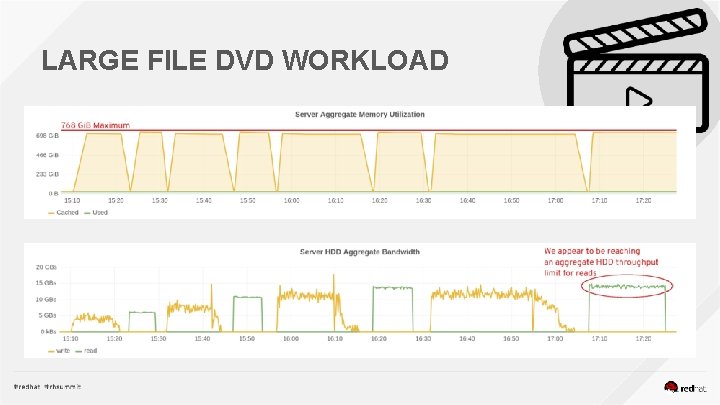
LARGE FILE DVD WORKLOAD
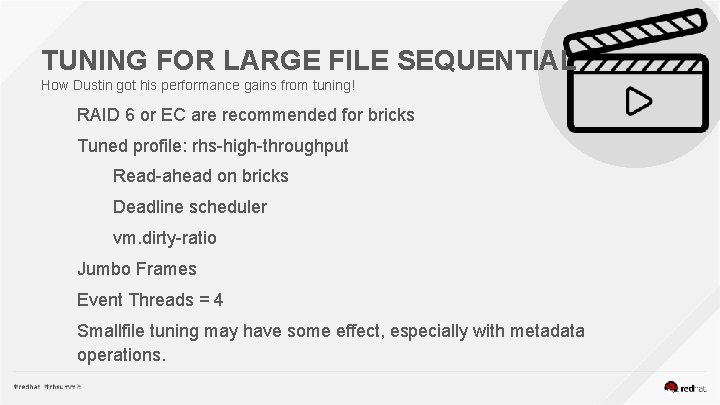
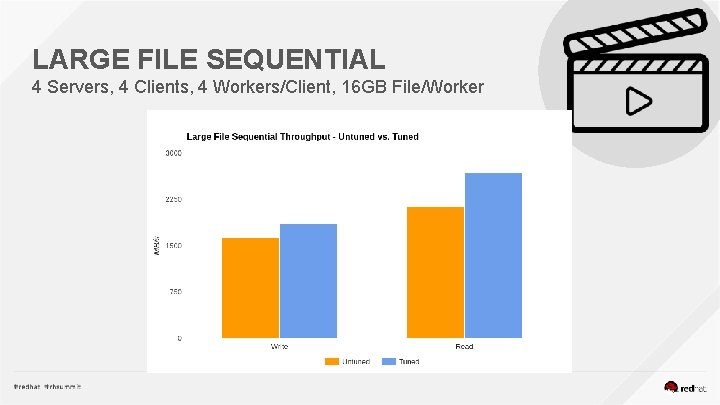
TUNING FOR LARGE FILE SEQUENTIAL How Dustin got his performance gains from tuning! RAID 6 or EC are recommended for bricks Tuned profile: rhs-high-throughput Read-ahead on bricks Deadline scheduler vm. dirty-ratio Jumbo Frames Event Threads = 4 Smallfile tuning may have some effect, especially with metadata operations.
LARGE FILE SEQUENTIAL 4 Servers, 4 Clients, 4 Workers/Client, 16 GB File/Worker
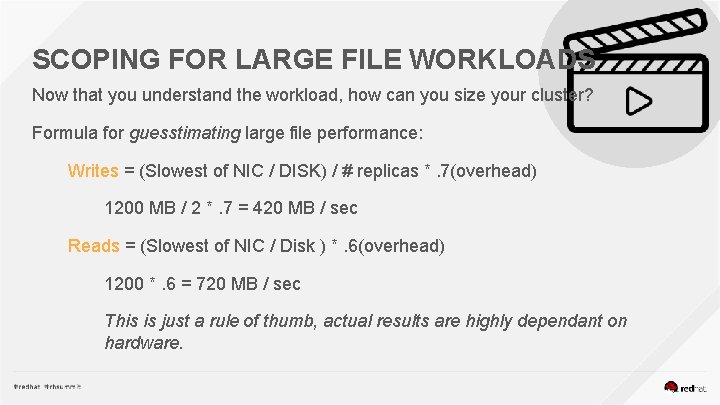
SCOPING FOR LARGE FILE WORKLOADS Now that you understand the workload, how can you size your cluster? Formula for guesstimating large file performance: Writes = (Slowest of NIC / DISK) / # replicas *. 7(overhead) 1200 MB / 2 *. 7 = 420 MB / sec Reads = (Slowest of NIC / Disk ) *. 6(overhead) 1200 *. 6 = 720 MB / sec This is just a rule of thumb, actual results are highly dependant on hardware.
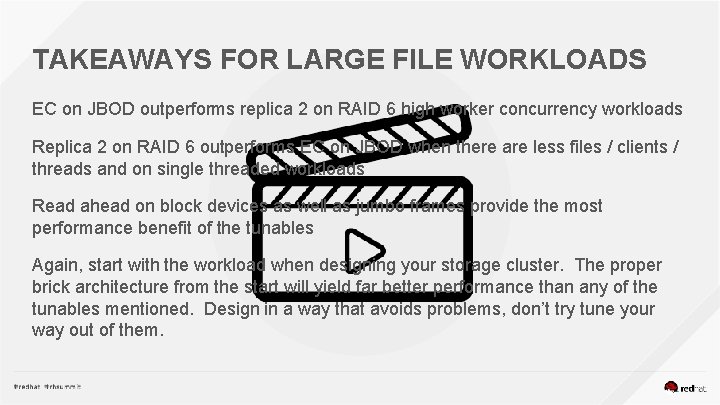
TAKEAWAYS FOR LARGE FILE WORKLOADS EC on JBOD outperforms replica 2 on RAID 6 high worker concurrency workloads Replica 2 on RAID 6 outperforms EC on JBOD when there are less files / clients / threads and on single threaded workloads Read ahead on block devices as well as jumbo frames provide the most performance benefit of the tunables Again, start with the workload when designing your storage cluster. The proper brick architecture from the start will yield far better performance than any of the tunables mentioned. Design in a way that avoids problems, don’t try tune your way out of them.
YOUR WORKLOAD CAN'T BE SLOW IF YOU NEVER RUN IT
CCTV STREAMING WORKLOAD Massive difference in capabilities based on the system configuration Same Hardware
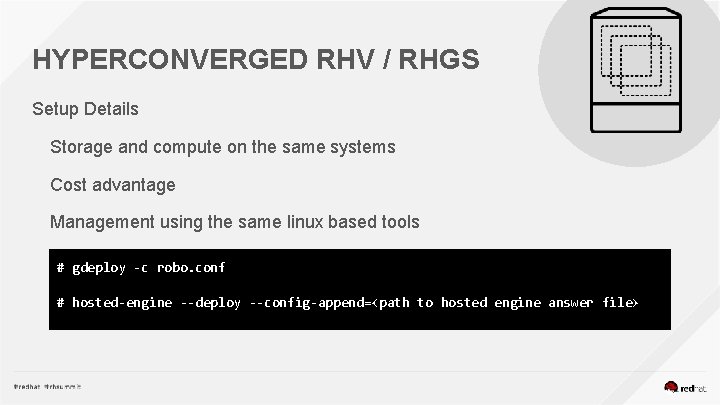
HYPERCONVERGED RHV / RHGS Setup Details Storage and compute on the same systems Cost advantage Management using the same linux based tools Full HCI environment # gdeploy -c robo. confcreated from 2 commands(with answer files): # hosted-engine --deploy --config-append=<path to hosted engine answer file>
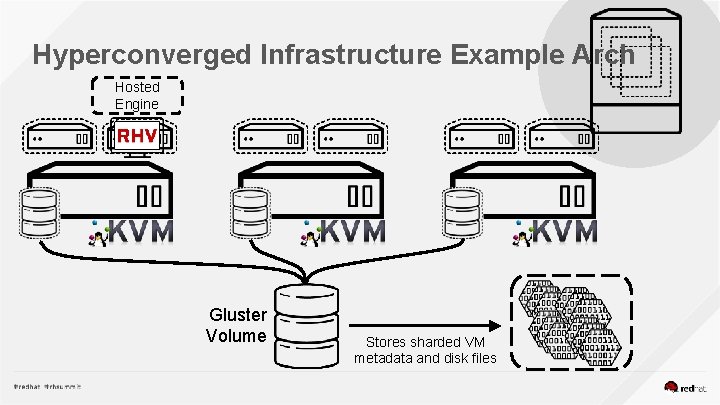
Hyperconverged Infrastructure Example Arch Hosted Engine Gluster Volume Stores sharded VM metadata and disk files
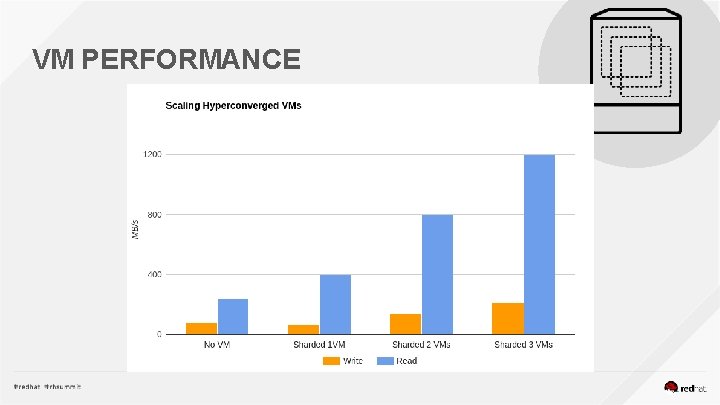
VM PERFORMANCE
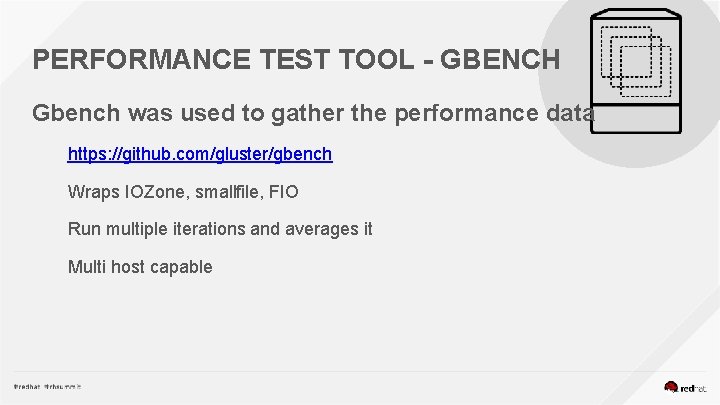
PERFORMANCE TEST TOOL - GBENCH Gbench was used to gather the performance data https: //github. com/gluster/gbench Wraps IOZone, smallfile, FIO Run multiple iterations and averages it Multi host capable
THANK YOU plus. google. com/+Red. Hat facebook. com/redhatinc linkedin. com/company/red-hat twitter. com/Red. Hat. News youtube. com/user/Red. Hat. Videos Dustin Black @dustinlblack Ben Turner @bennyturns
Install The Summit Mobile App PLEASE https: //install. events/reraa 17 Help us out by reviewing our session