Giulia Mugellini Transcrime University Milan DEVELOPMENT OF MONITORING
- Slides: 65
Giulia Mugellini – Transcrime, University Milan DEVELOPMENT OF MONITORING INSTRUMENTS FOR JUDICIAL AND LAW ENFORCEMENT INSTITUTIONS IN THE WESTERN BALKANS PHASE 3 – POLICE TRAINING Sarajevo, 30 September – 1 st October 2010 With funding from the European Union DEVELOPMENT OF MONITORING INSTRUMENTS FOR JUDICIAL AND LAW ENFORCEMENT INSTITUTIONS IN THE WESTERN BALKANS 2009 -2011
SESSION 1 • Introductions • Programme Guidelines Recommendations • How the sessions are organised
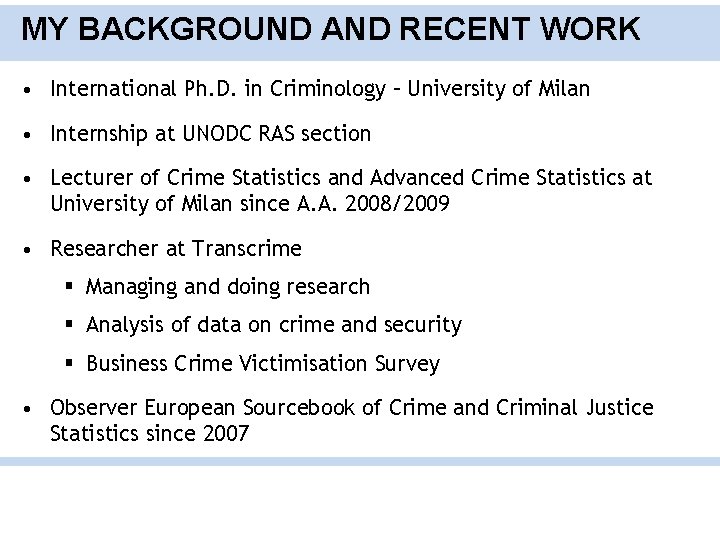
MY BACKGROUND AND RECENT WORK • International Ph. D. in Criminology – University of Milan • Internship at UNODC RAS section • Lecturer of Crime Statistics and Advanced Crime Statistics at University of Milan since A. A. 2008/2009 • Researcher at Transcrime § Managing and doing research § Analysis of data on crime and security § Business Crime Victimisation Survey • Observer European Sourcebook of Crime and Criminal Justice Statistics since 2007
INTRODUCTIONS FROM PARTICIPANTS
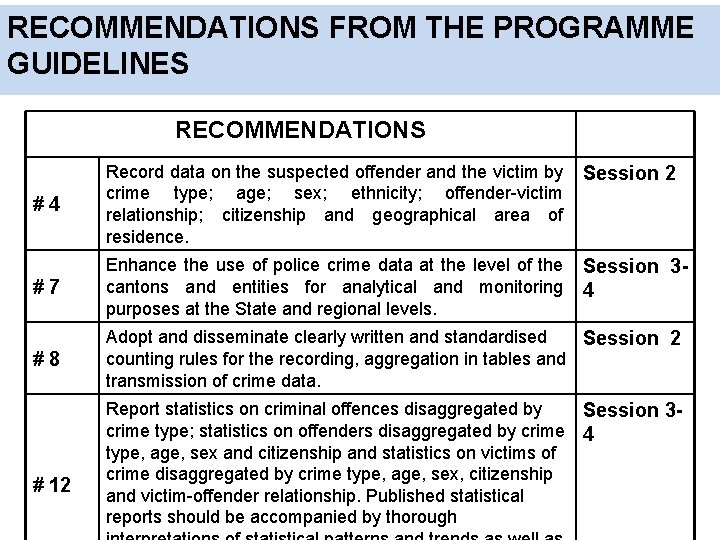
RECOMMENDATIONS FROM THE PROGRAMME GUIDELINES RECOMMENDATIONS Session 2 #4 Record data on the suspected offender and the victim by crime type; age; sex; ethnicity; offender-victim relationship; citizenship and geographical area of residence. #7 Enhance the use of police crime data at the level of the cantons and entities for analytical and monitoring purposes at the State and regional levels. Session 34 #8 Adopt and disseminate clearly written and standardised Session 2 counting rules for the recording, aggregation in tables and transmission of crime data. # 12 Report statistics on criminal offences disaggregated by Session 3 crime type; statistics on offenders disaggregated by crime 4 type, age, sex and citizenship and statistics on victims of crime disaggregated by crime type, age, sex, citizenship and victim-offender relationship. Published statistical reports should be accompanied by thorough
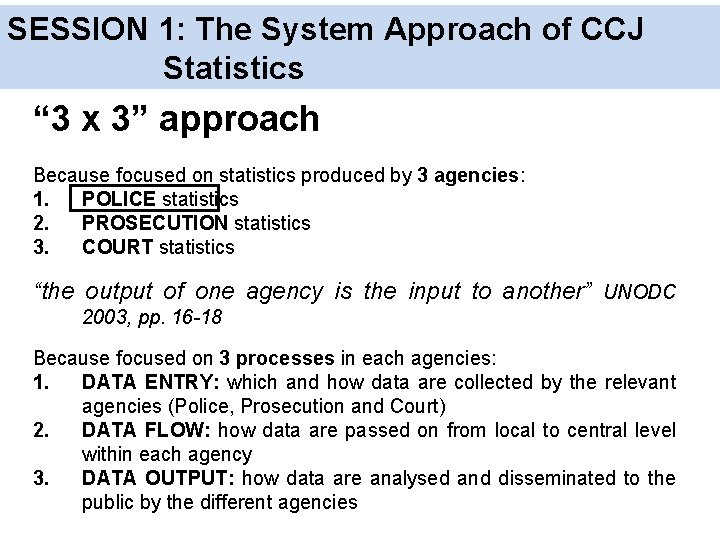
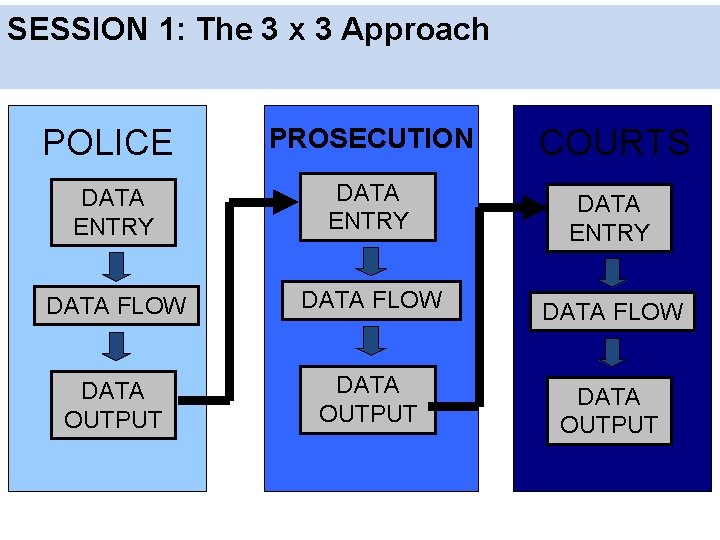
SESSION 1: The System Approach of CCJ Statistics “ 3 x 3” approach Because focused on statistics produced by 3 agencies: 1. POLICE statistics 2. PROSECUTION statistics 3. COURT statistics “the output of one agency is the input to another” UNODC 2003, pp. 16 -18 Because focused on 3 processes in each agencies: 1. DATA ENTRY: which and how data are collected by the relevant agencies (Police, Prosecution and Court) 2. DATA FLOW: how data are passed on from local to central level within each agency 3. DATA OUTPUT: how data are analysed and disseminated to the public by the different agencies
SESSION 1: The 3 x 3 Approach POLICE PROSECUTION COURTS DATA ENTRY DATA FLOW DATA OUTPUT
SESSION 1: THE NEED FOR VALID STATISTICS • For knowledge-based crime policy. . You need to know ‘the facts’ • To interpret your knowledge. . You need to compare across years, and across countries • To compare. . Your data need to be comparable within your own jurisdiction over time, and – ideally – with other jurisdictions • To be comparable. . Means that common standards have been applied – within the jurisdiction, and over time, and – ideally – the same as other jurisdictions Based on Kauko Aromaa (HEUNI)
SESSION 1: CENTRALIZED VS DECENTRALIZED CCJ SYSTEM “One of the major characteristics distinguishing different types of criminal justice statistics is the degree of centralization of data collection and processing, which is typically a reflection of the degree of administrative centralization of the criminal justice system itself”. UN Manual , 2006, p. 6
SESSION 2: WRITTEN RULES FOR RECORDING AND COUNTING CRIMES AND SUSPECTS • What are the main counting rules? • The existence of written counting rules regulating the way in which data are recorded in police crime statistics; . - Across countries in Europe - Across Western Balkans - In Bi. H • What is the present consistency in recording (without written rules)? • Resource and training implications
COUNTING RULES IN POLICE STATISTICS “…. the rules applied in each country to count offences included in crime statistics. Such rules vary … hence introducing differences in recorded crime rates that do not reflect actual differences in the levels of crime”. Aebi 2003, p. 1. What we know is that there are NO CONSISTENT counting rules across the Western Balkans, or across other countries See Handout #10 However, there is some ‘best practice’ guidance
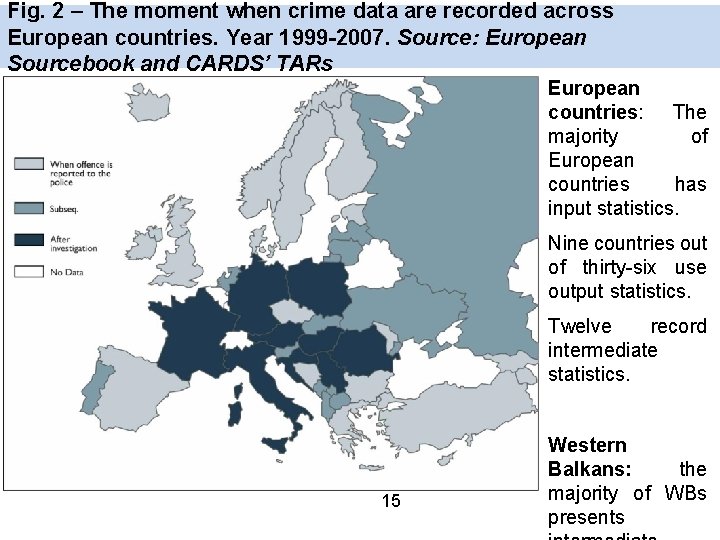
WHAT ARE THE MAIN COUNTING RULES? • The moment when data are collected in crime statistics (Input statistics: data are included in statistics when the crime incident is reported to police/ Intermediate statistics: some point in time between the input and the output/Output statistics: data are recorded in statistics when the police have completed the investigation); • The application of the principal offence rule; • The recording of multiple offences; • The recording of offences committed by more than one person
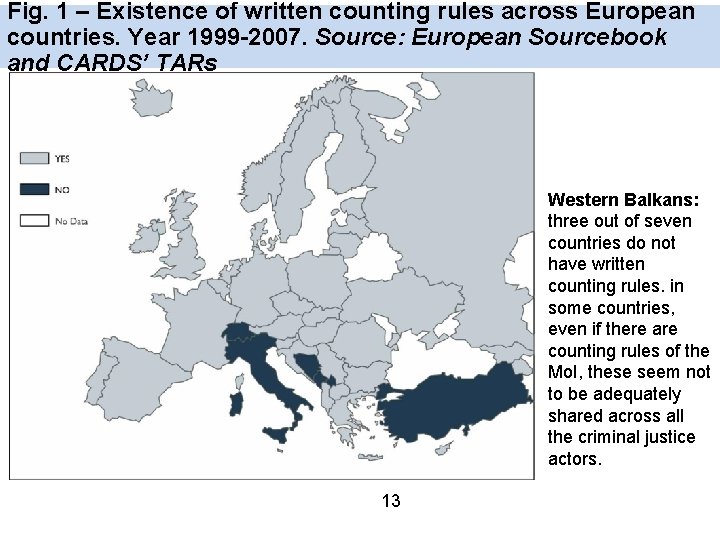
Fig. 1 – Existence of written counting rules across European countries. Year 1999 -2007. Source: European Sourcebook and CARDS’ TARs Western Balkans: three out of seven countries do not have written counting rules. in some countries, even if there are counting rules of the Mo. I, these seem not to be adequately shared across all the criminal justice actors. 13
EXISTENCE OF WRITTEN COUNTING RULES IN Bi. H There are no uniform counting rules issued by a central institution and applied uniformly in all of Bi. H. • In FBi. H and in RS there are “written instructions to the police stations to fill in the standard statistical forms”. • BDBi. H has not written instruction for statistical data collection at the level of police. • These rules are not shared by all authorities at the state level. 14
Fig. 2 – The moment when crime data are recorded across European countries. Year 1999 -2007. Source: European Sourcebook and CARDS’ TARs European countries: The majority of European countries has input statistics. Nine countries out of thirty-six use output statistics. Twelve record intermediate statistics. 15 Western Balkans: the majority of WBs presents
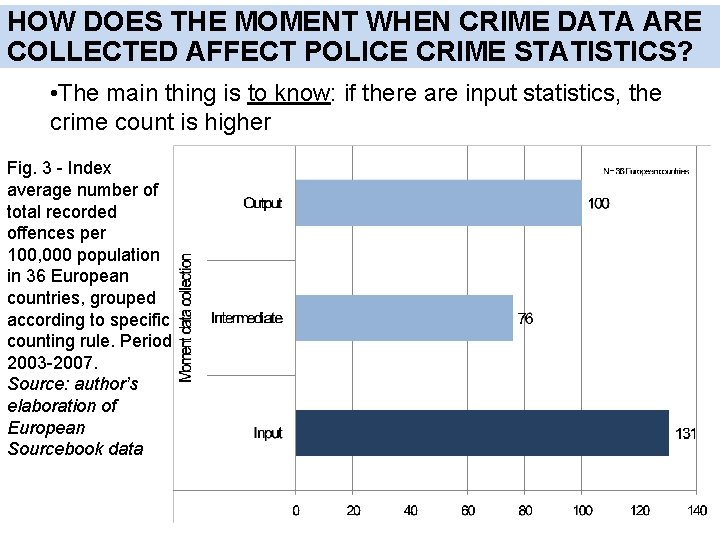
HOW DOES THE MOMENT WHEN CRIME DATA ARE COLLECTED AFFECT POLICE CRIME STATISTICS? • The main thing is to know: if there are input statistics, the crime count is higher Fig. 3 - Index average number of total recorded offences per 100, 000 population in 36 European countries, grouped according to specific counting rule. Period 2003 -2007. Source: author’s elaboration of European Sourcebook data 16
THE MOMENT WHEN CRIME DATA ARE RECORDED IN CRIME STATISTICS IN Bi. H • Clear information on the moment when crime data are collected for inclusion in statistics was collected for Republika Srpska: “when the incident has been classified as a crime by the police (input statistics)” TAR Bi. H, p. 11. • Information on this counting rule applied in the other entities of Bi. H? 17
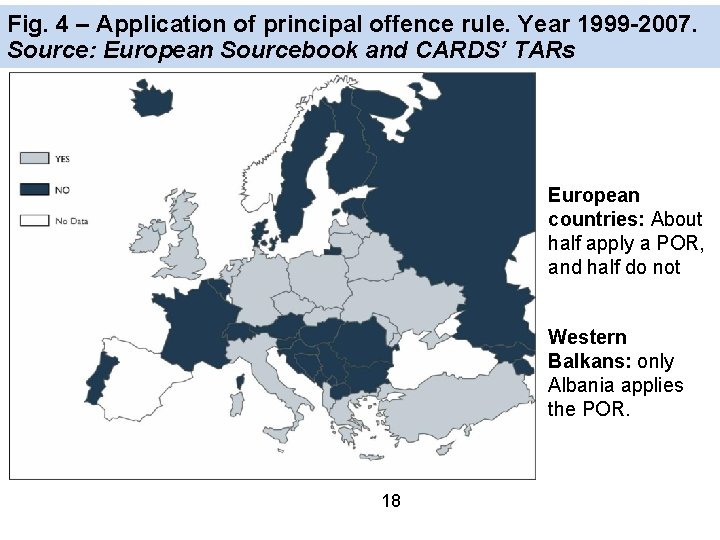
Fig. 4 – Application of principal offence rule. Year 1999 -2007. Source: European Sourcebook and CARDS’ TARs European countries: About half apply a POR, and half do not Western Balkans: only Albania applies the POR. 18
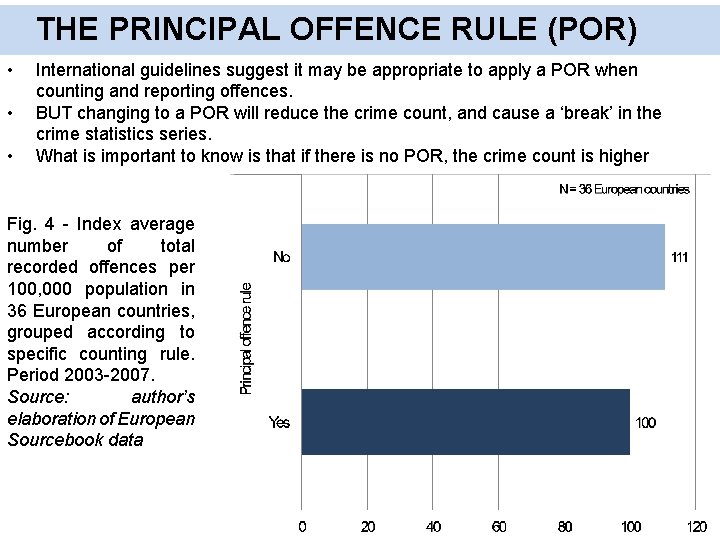
THE PRINCIPAL OFFENCE RULE (POR) • • • International guidelines suggest it may be appropriate to apply a POR when counting and reporting offences. BUT changing to a POR will reduce the crime count, and cause a ‘break’ in the crime statistics series. What is important to know is that if there is no POR, the crime count is higher Fig. 4 - Index average number of total recorded offences per 100, 000 population in 36 European countries, grouped according to specific counting rule. Period 2003 -2007. Source: author’s elaboration of European Sourcebook data
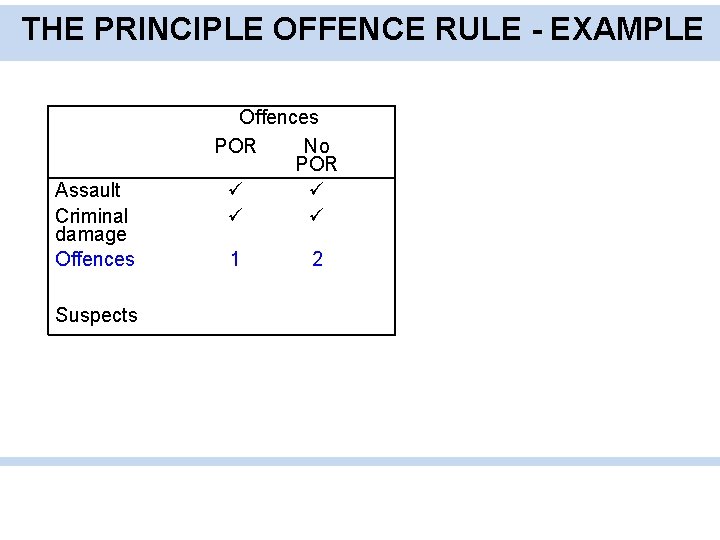
THE PRINCIPLE OFFENCE RULE - EXAMPLE Assault Criminal damage Offences Suspects Offences POR No POR 1 2
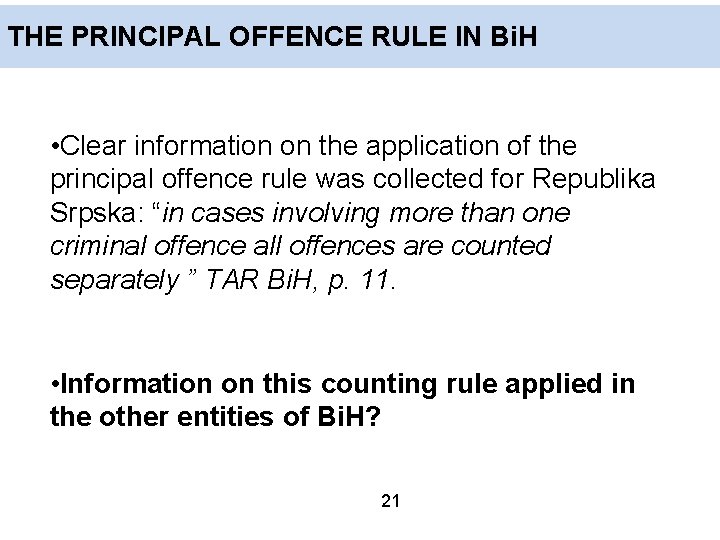
THE PRINCIPAL OFFENCE RULE IN Bi. H • Clear information on the application of the principal offence rule was collected for Republika Srpska: “in cases involving more than one criminal offence all offences are counted separately ” TAR Bi. H, p. 11. • Information on this counting rule applied in the other entities of Bi. H? 21
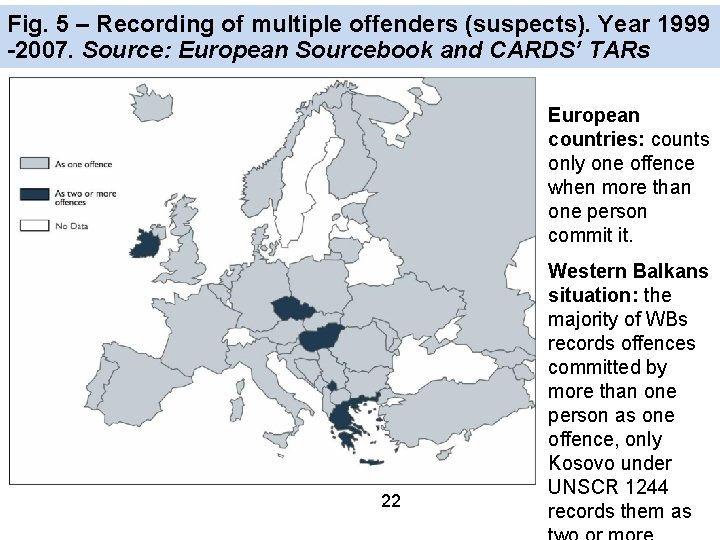
Fig. 5 – Recording of multiple offenders (suspects). Year 1999 -2007. Source: European Sourcebook and CARDS’ TARs European countries: counts only one offence when more than one person commit it. 22 Western Balkans situation: the majority of WBs records offences committed by more than one person as one offence, only Kosovo under UNSCR 1244 records them as
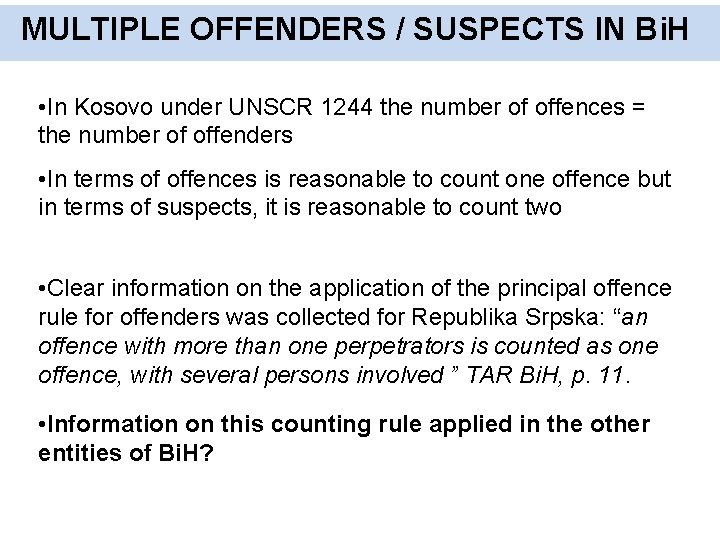
MULTIPLE OFFENDERS / SUSPECTS IN Bi. H • In Kosovo under UNSCR 1244 the number of offences = the number of offenders • In terms of offences is reasonable to count one offence but in terms of suspects, it is reasonable to count two • Clear information on the application of the principal offence rule for offenders was collected for Republika Srpska: “an offence with more than one perpetrators is counted as one offence, with several persons involved ” TAR Bi. H, p. 11. • Information on this counting rule applied in the other entities of Bi. H?
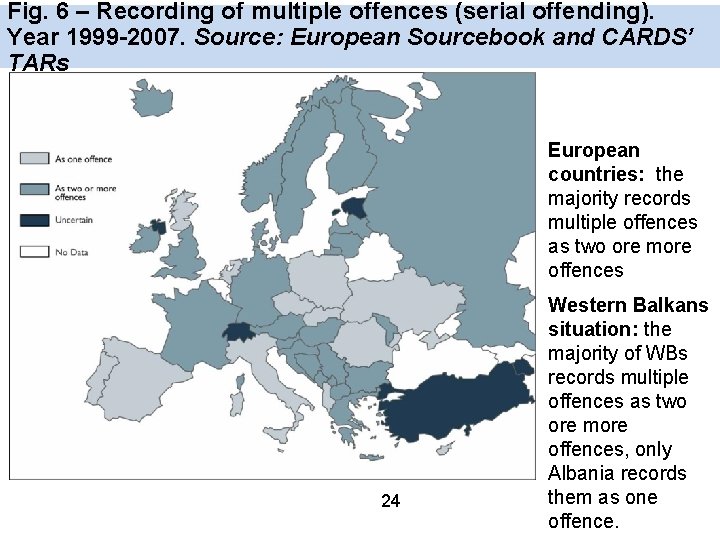
Fig. 6 – Recording of multiple offences (serial offending). Year 1999 -2007. Source: European Sourcebook and CARDS’ TARs European countries: the majority records multiple offences as two ore more offences 24 Western Balkans situation: the majority of WBs records multiple offences as two ore more offences, only Albania records them as one offence.
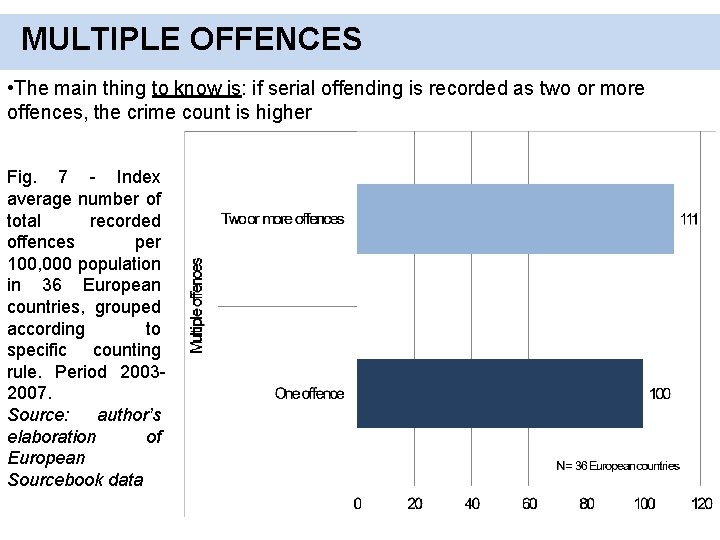
MULTIPLE OFFENCES • The main thing to know is: if serial offending is recorded as two or more offences, the crime count is higher Fig. 7 - Index average number of total recorded offences per 100, 000 population in 36 European countries, grouped according to specific counting rule. Period 20032007. Source: author’s elaboration of European Sourcebook data
MULTIPLE OFFENCES IN Bi. H • Clear information on the counting of multiple offences was collected for Republika Srpska: “serial offending is typically counted as only one case and as one offence” TAR Bi. H, p. 11. • Information on this counting rule applied in the other entities of Bi. H?
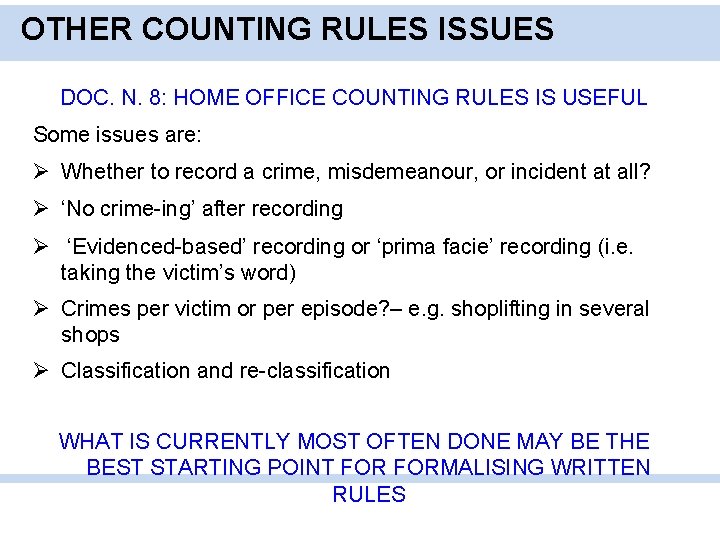
OTHER COUNTING RULES ISSUES DOC. N. 8: HOME OFFICE COUNTING RULES IS USEFUL Some issues are: Ø Whether to record a crime, misdemeanour, or incident at all? Ø ‘No crime-ing’ after recording Ø ‘Evidenced-based’ recording or ‘prima facie’ recording (i. e. taking the victim’s word) Ø Crimes per victim or per episode? – e. g. shoplifting in several shops Ø Classification and re-classification WHAT IS CURRENTLY MOST OFTEN DONE MAY BE THE BEST STARTING POINT FORMALISING WRITTEN RULES
PRESENT CONSISTENCY IN COUNTING RULES IN Bi. H DISCUSSION
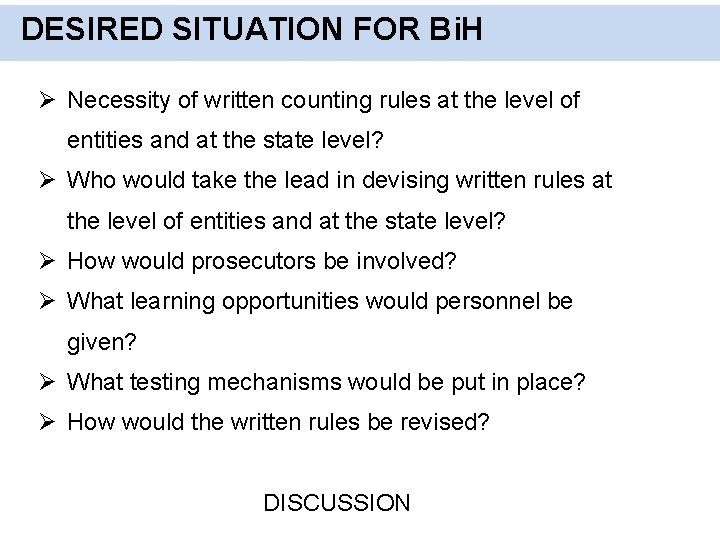
DESIRED SITUATION FOR Bi. H Ø Necessity of written counting rules at the level of entities and at the state level? Ø Who would take the lead in devising written rules at the level of entities and at the state level? Ø How would prosecutors be involved? Ø What learning opportunities would personnel be given? Ø What testing mechanisms would be put in place? Ø How would the written rules be revised? DISCUSSION
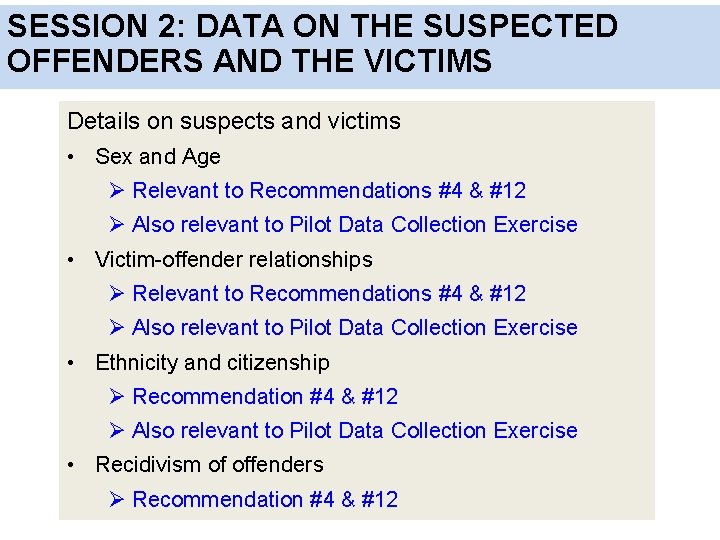
SESSION 2: DATA ON THE SUSPECTED OFFENDERS AND THE VICTIMS Details on suspects and victims • Sex and Age Ø Relevant to Recommendations #4 & #12 Ø Also relevant to Pilot Data Collection Exercise • Victim-offender relationships Ø Relevant to Recommendations #4 & #12 Ø Also relevant to Pilot Data Collection Exercise • Ethnicity and citizenship Ø Recommendation #4 & #12 Ø Also relevant to Pilot Data Collection Exercise • Recidivism of offenders Ø Recommendation #4 & #12
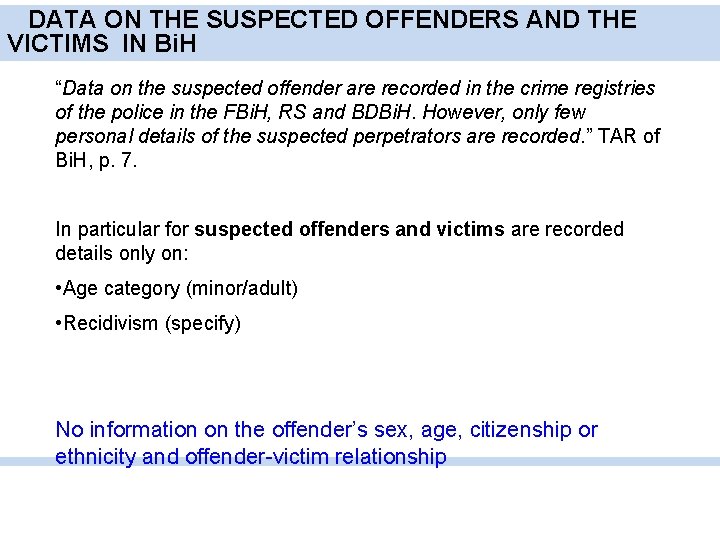
DATA ON THE SUSPECTED OFFENDERS AND THE VICTIMS IN Bi. H “Data on the suspected offender are recorded in the crime registries of the police in the FBi. H, RS and BDBi. H. However, only few personal details of the suspected perpetrators are recorded. ” TAR of Bi. H, p. 7. In particular for suspected offenders and victims are recorded details only on: • Age category (minor/adult) • Recidivism (specify) No information on the offender’s sex, age, citizenship or ethnicity and offender-victim relationship
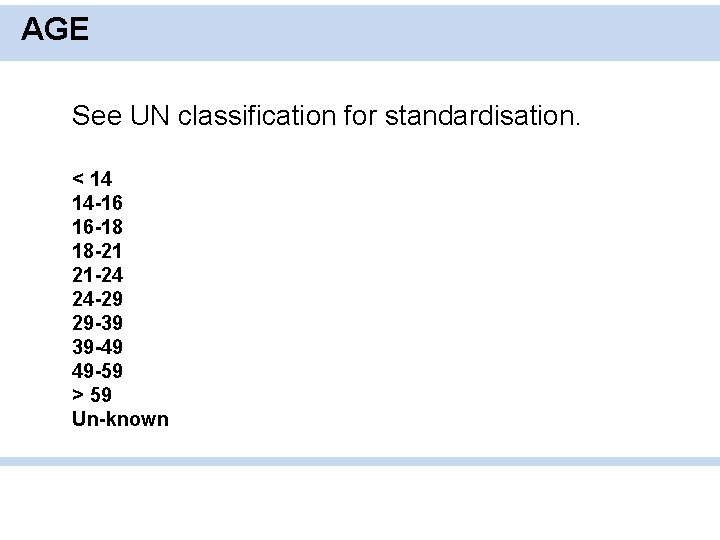
AGE See UN classification for standardisation. < 14 14 -16 16 -18 18 -21 21 -24 24 -29 29 -39 39 -49 49 -59 > 59 Un-known
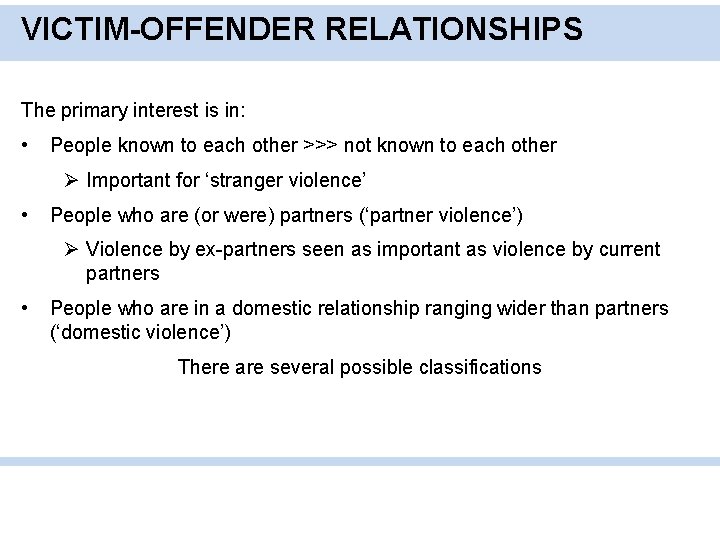
VICTIM-OFFENDER RELATIONSHIPS The primary interest is in: • People known to each other >>> not known to each other Ø Important for ‘stranger violence’ • People who are (or were) partners (‘partner violence’) Ø Violence by ex-partners seen as important as violence by current partners • People who are in a domestic relationship ranging wider than partners (‘domestic violence’) There are several possible classifications
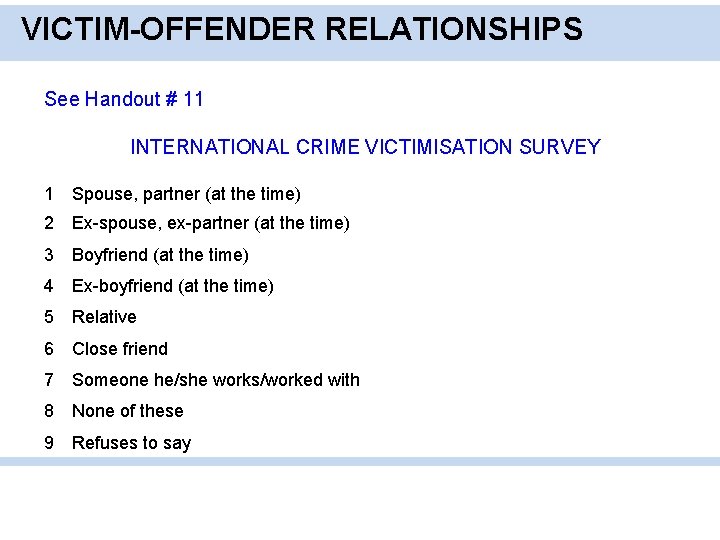
VICTIM-OFFENDER RELATIONSHIPS See Handout # 11 INTERNATIONAL CRIME VICTIMISATION SURVEY 1 Spouse, partner (at the time) 2 Ex-spouse, ex-partner (at the time) 3 Boyfriend (at the time) 4 Ex-boyfriend (at the time) 5 Relative 6 Close friend 7 Someone he/she works/worked with 8 None of these 9 Refuses to say
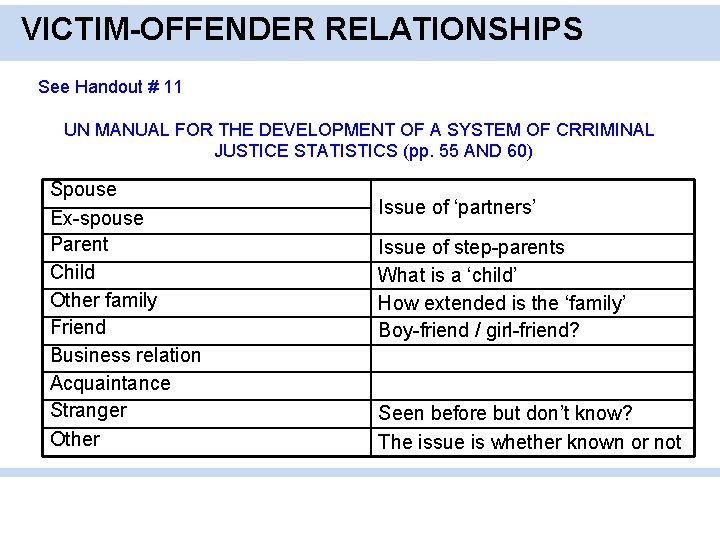
VICTIM-OFFENDER RELATIONSHIPS See Handout # 11 UN MANUAL FOR THE DEVELOPMENT OF A SYSTEM OF CRRIMINAL JUSTICE STATISTICS (pp. 55 AND 60) Spouse Ex-spouse Parent Child Other family Friend Business relation Acquaintance Stranger Other Issue of ‘partners’ Issue of step-parents What is a ‘child’ How extended is the ‘family’ Boy-friend / girl-friend? Seen before but don’t know? The issue is whether known or not
ETHNICITY AND CITIZENSHIP See Handout # 12 • Example of ethnicity classification from other countries • What about citizenship? DISCUSSION
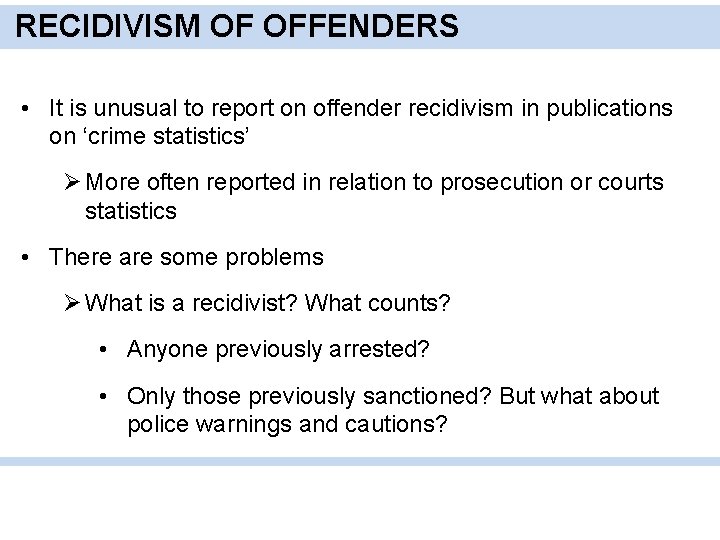
RECIDIVISM OF OFFENDERS • It is unusual to report on offender recidivism in publications on ‘crime statistics’ Ø More often reported in relation to prosecution or courts statistics • There are some problems Ø What is a recidivist? What counts? • Anyone previously arrested? • Only those previously sanctioned? But what about police warnings and cautions?
DESIRED SITUATION FOR Bi. H Ø Necessity of collecting information on these details for suspects and victims? Ø How could it be implemented? Necessity to change the incident form to register crime? Necessity to add fields in the tables used to transmit the data? DISCUSSION
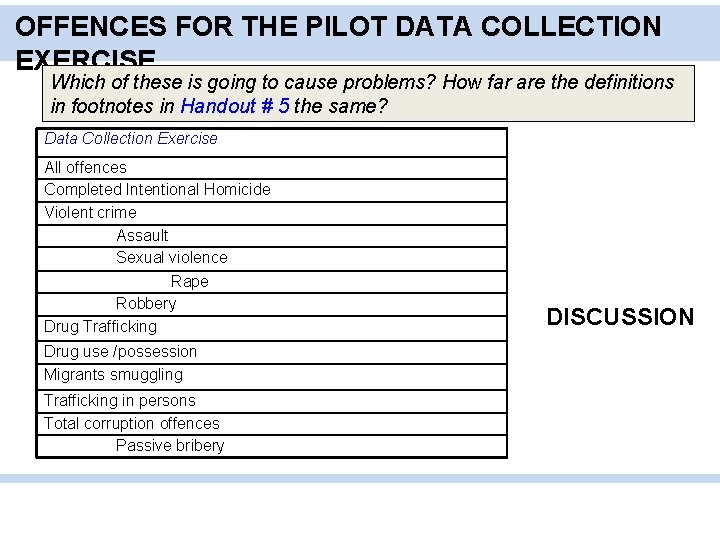
OFFENCES FOR THE PILOT DATA COLLECTION EXERCISE Which of these is going to cause problems? How far are the definitions in footnotes in Handout # 5 the same? Data Collection Exercise All offences Completed Intentional Homicide Violent crime Assault Sexual violence Rape Robbery Drug Trafficking Drug use /possession Migrants smuggling Trafficking in persons Total corruption offences Passive bribery DISCUSSION
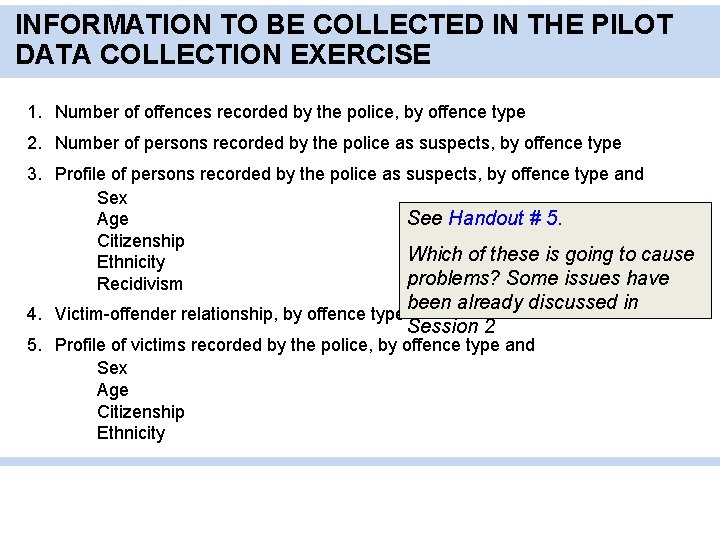
INFORMATION TO BE COLLECTED IN THE PILOT DATA COLLECTION EXERCISE 1. Number of offences recorded by the police, by offence type 2. Number of persons recorded by the police as suspects, by offence type 3. Profile of persons recorded by the police as suspects, by offence type and Sex See Handout # 5. Age Citizenship Which of these is going to cause Ethnicity problems? Some issues have Recidivism 4. Victim-offender relationship, by offence type been already discussed in Session 2 5. Profile of victims recorded by the police, by offence type and Sex Age Citizenship Ethnicity
SESSION 3: DATA OUTPUT - OVERVIEW OF REPORTS OF POLICE DATA AT INTERNATIONAL & NATIONAL LEVEL • The need for valid data and common standards • Main international compilations of police figures • Two examples of national reports ØEngland & Wales ØNew Zealand
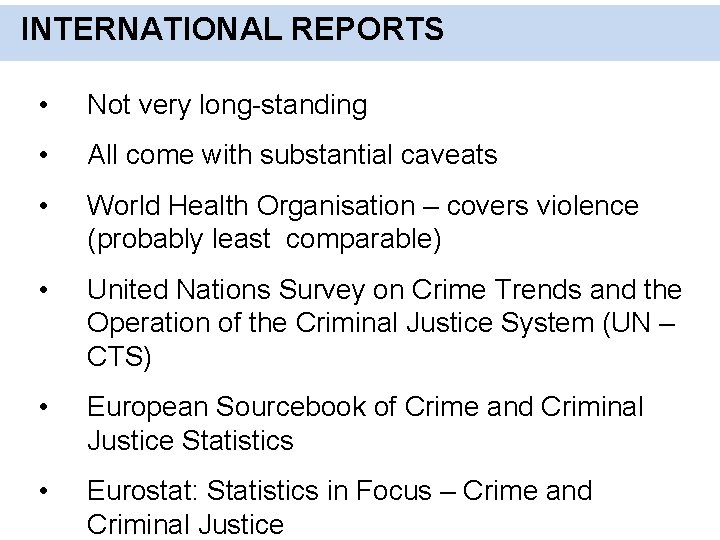
INTERNATIONAL REPORTS • Not very long-standing • All come with substantial caveats • World Health Organisation – covers violence (probably least comparable) • United Nations Survey on Crime Trends and the Operation of the Criminal Justice System (UN – CTS) • European Sourcebook of Crime and Criminal Justice Statistics • Eurostat: Statistics in Focus – Crime and Criminal Justice
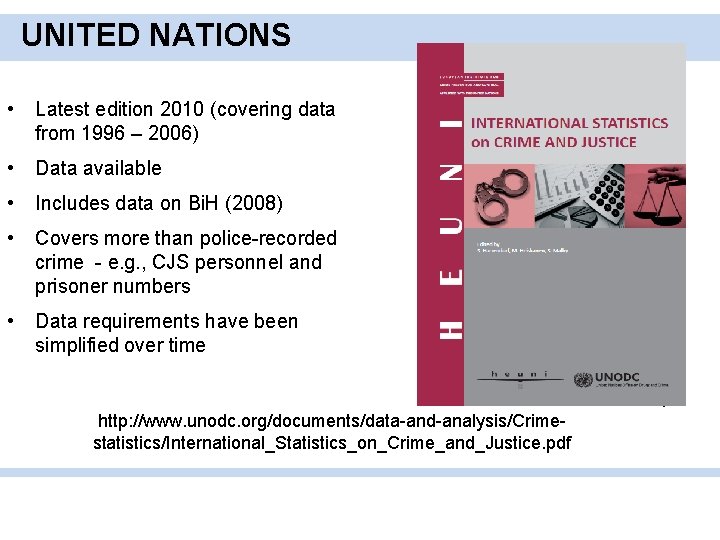
UNITED NATIONS • Latest edition 2010 (covering data from 1996 – 2006) • Data available • Includes data on Bi. H (2008) • Covers more than police-recorded crime - e. g. , CJS personnel and prisoner numbers • Data requirements have been simplified over time http: //www. unodc. org/documents/data-and-analysis/Crimestatistics/International_Statistics_on_Crime_and_Justice. pdf
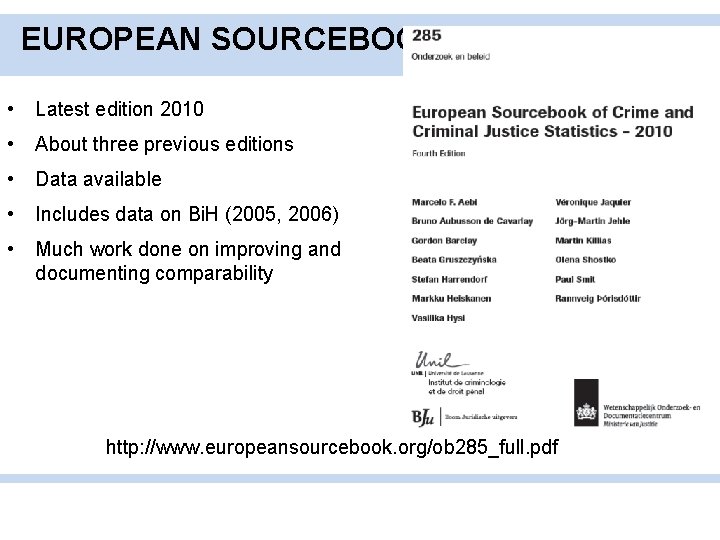
EUROPEAN SOURCEBOOK • Latest edition 2010 • About three previous editions • Data available • Includes data on Bi. H (2005, 2006) • Much work done on improving and documenting comparability http: //www. europeansourcebook. org/ob 285_full. pdf
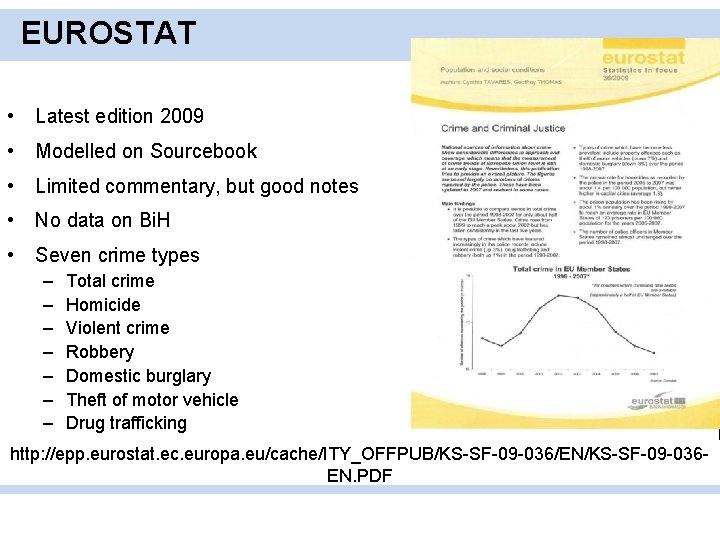
EUROSTAT • Latest edition 2009 • Modelled on Sourcebook • Limited commentary, but good notes • No data on Bi. H • Seven crime types – – – – Total crime Homicide Violent crime Robbery Domestic burglary Theft of motor vehicle Drug trafficking http: //epp. eurostat. ec. europa. eu/cache/ITY_OFFPUB/KS-SF-09 -036/EN/KS-SF-09 -036 EN. PDF
NATIONAL REPORTS • Massive variety of styles • Usually annual • Sometimes with other criminal justice system information; sometimes not • Sometimes with special topics; sometimes not • USA – ‘Index’ crimes only • Nearly all publically available • Now also usually available on the web • Data sometimes downloadable
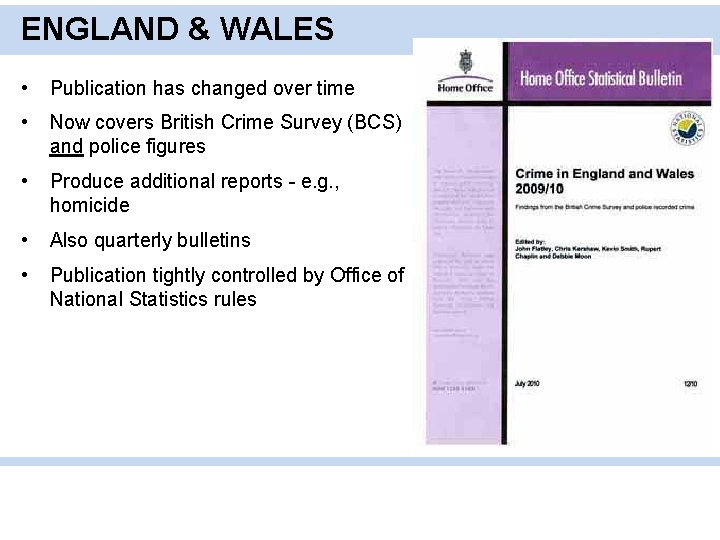
ENGLAND & WALES • Publication has changed over time • Now covers British Crime Survey (BCS) and police figures • Produce additional reports - e. g. , homicide • Also quarterly bulletins • Publication tightly controlled by Office of National Statistics rules
ENGLAND & WALES (2) Latest publication covers: Ø Extent of and trends in crime Ø Ø Ø Violent and sexual crimes Acquisitive and other property crime Publications perceptions Detection of crime Geographic patterns of crime Most chapters draw on police figures and British Crime Survey.
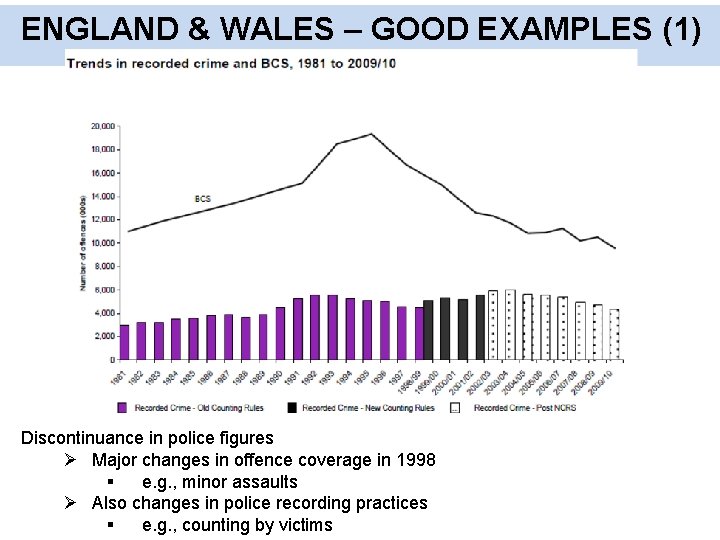
ENGLAND & WALES – GOOD EXAMPLES (1) Discontinuance in police figures Ø Major changes in offence coverage in 1998 § e. g. , minor assaults Ø Also changes in police recording practices § e. g. , counting by victims
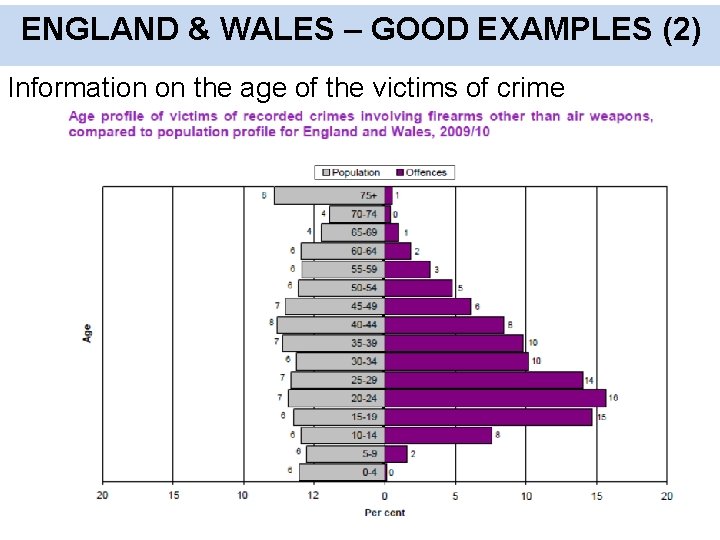
ENGLAND & WALES – GOOD EXAMPLES (2) Information on the age of the victims of crime
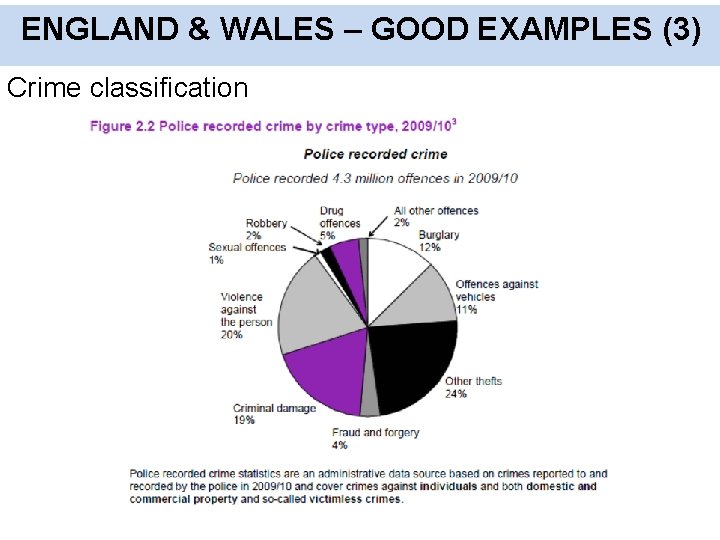
ENGLAND & WALES – GOOD EXAMPLES (3) Crime classification
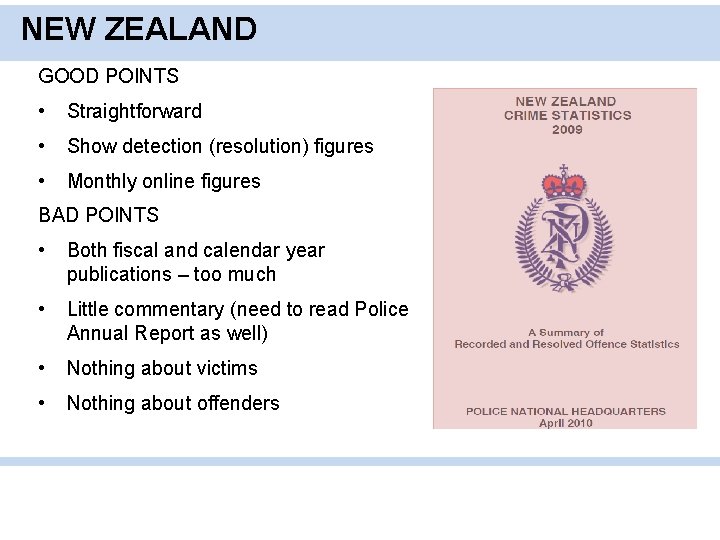
NEW ZEALAND GOOD POINTS • Straightforward • Show detection (resolution) figures • Monthly online figures BAD POINTS • Both fiscal and calendar year publications – too much • Little commentary (need to read Police Annual Report as well) • Nothing about victims • Nothing about offenders
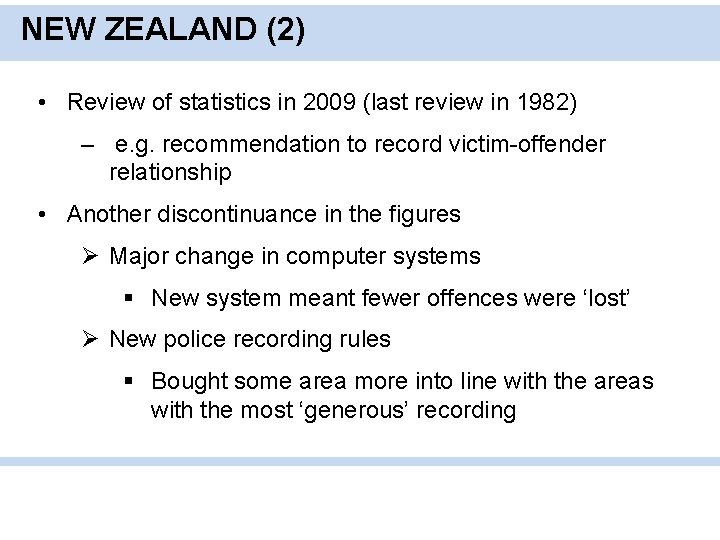
NEW ZEALAND (2) • Review of statistics in 2009 (last review in 1982) – e. g. recommendation to record victim-offender relationship • Another discontinuance in the figures Ø Major change in computer systems § New system meant fewer offences were ‘lost’ Ø New police recording rules § Bought some area more into line with the areas with the most ‘generous’ recording
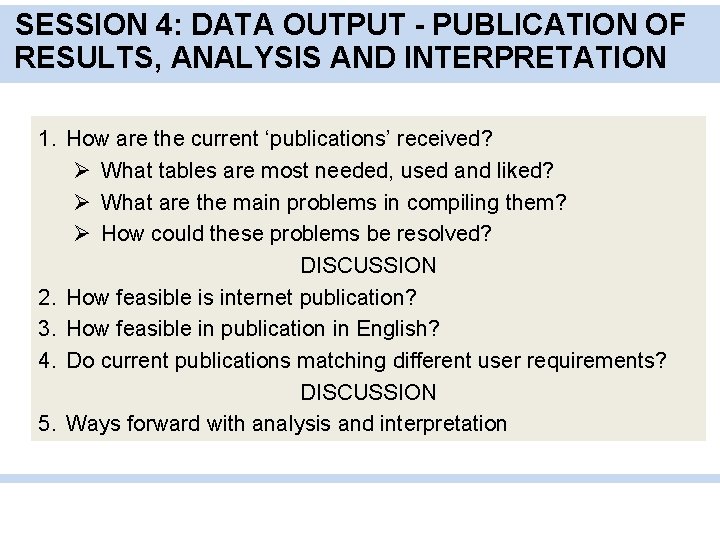
SESSION 4: DATA OUTPUT - PUBLICATION OF RESULTS, ANALYSIS AND INTERPRETATION 1. How are the current ‘publications’ received? Ø What tables are most needed, used and liked? Ø What are the main problems in compiling them? Ø How could these problems be resolved? DISCUSSION 2. How feasible is internet publication? 3. How feasible in publication in English? 4. Do current publications matching different user requirements? DISCUSSION 5. Ways forward with analysis and interpretation
THE CURRENT PUBLICATIONS: GOOD AND BAD How are the current ‘publications’ received? Ø What tables are most needed, used and liked? Ø What are the main problems in compiling them? Ø How could these problems be resolved? DISCUSSION
INTERNET PUBLICATION? ENGLISH PUBLICATION? USER REQUIREMENTS? How feasible is internet publication? How feasible in publication in English? Do current publications matching different user requirements? DISCUSSION
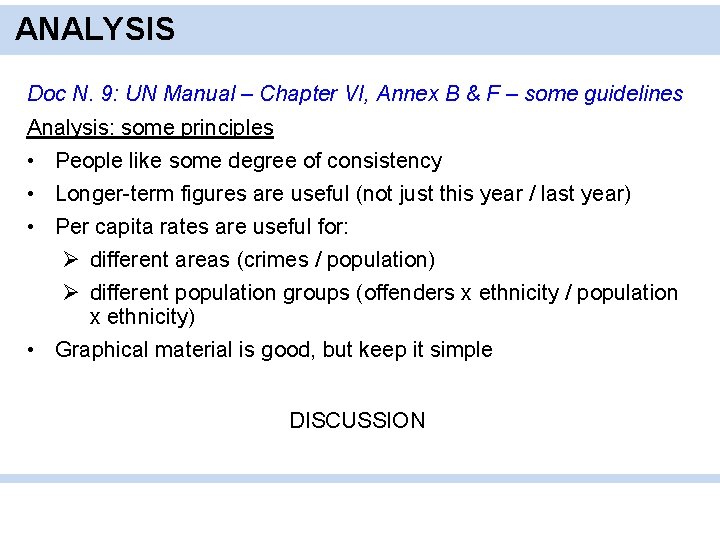
ANALYSIS Doc N. 9: UN Manual – Chapter VI, Annex B & F – some guidelines Analysis: some principles • People like some degree of consistency • Longer-term figures are useful (not just this year / last year) • Per capita rates are useful for: Ø different areas (crimes / population) Ø different population groups (offenders x ethnicity / population x ethnicity) • Graphical material is good, but keep it simple DISCUSSION
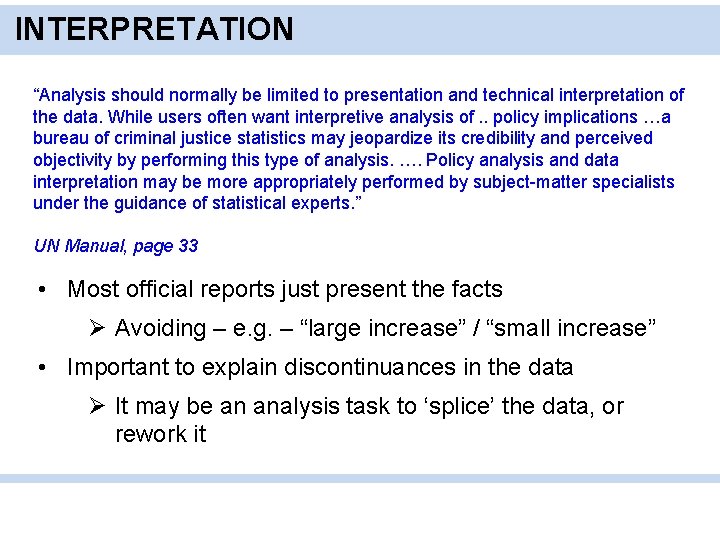
INTERPRETATION “Analysis should normally be limited to presentation and technical interpretation of the data. While users often want interpretive analysis of. . policy implications …a bureau of criminal justice statistics may jeopardize its credibility and perceived objectivity by performing this type of analysis. …. Policy analysis and data interpretation may be more appropriately performed by subject-matter specialists under the guidance of statistical experts. ” UN Manual, page 33 • Most official reports just present the facts Ø Avoiding – e. g. – “large increase” / “small increase” • Important to explain discontinuances in the data Ø It may be an analysis task to ‘splice’ the data, or rework it
SESSION 5: ROUND–UP AND FUTURE PLANS Summary of previous sessions – completed during training Future plans
WHAT NEEDS MORE ATTENTION [Points from previous sessions] DISCUSSION
SHORT-TERM AND LONG-TERM GOALS What are the goals Which are longer-term? Which are shorter-term?
SHORT-TERM GOALS – STEPS AND DEADLINES DISCUSSION AND DECISIONS
LONGER-TERM GOALS – STEPS AND DEADLINES DISCUSSION AND DECISIONS
THANK YOU FOR YOUR KIND ATTENTION
Giulia Mugellini – Transcrime, University Milan DEVELOPMENT OF MONITORING INSTRUMENTS FOR JUDICIAL AND LAW ENFORCEMENT INSTITUTIONS IN THE WESTERN BALKANS PHASE 3 – POLICE TRAINING Sarajevo, 30 September – 1 st October 2010 With funding from the European Union DEVELOPMENT OF MONITORING INSTRUMENTS FOR JUDICIAL AND LAW ENFORCEMENT INSTITUTIONS IN THE WESTERN BALKANS 2009 -2011