Fundamentals of Organic Chemistry CHEM 109 For Students



- Slides: 32
Fundamentals of Organic Chemistry CHEM 109 For Students of Health Colleges Credit hrs. : (2+1) King Saud University College of Science, Chemistry Department CHAPTER 1: Introduction 1
Bonding, Structural Formulas, and Molecular Shapes 2
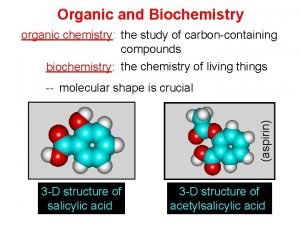
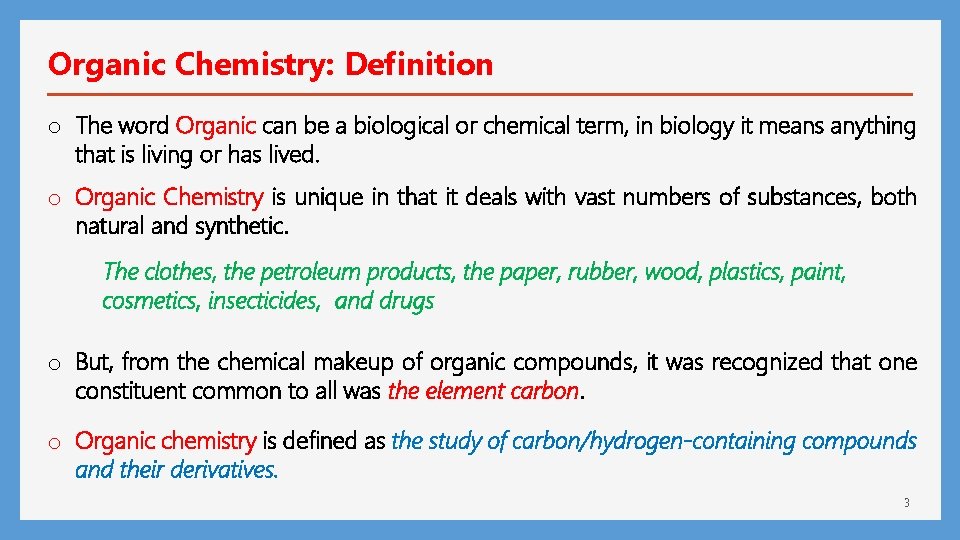
Organic Chemistry: Definition o The word Organic can be a biological or chemical term, in biology it means anything that is living or has lived. o Organic Chemistry is unique in that it deals with vast numbers of substances, both natural and synthetic. The clothes, the petroleum products, the paper, rubber, wood, plastics, paint, cosmetics, insecticides, and drugs o But, from the chemical makeup of organic compounds, it was recognized that one constituent common to all was the element carbon. o Organic chemistry is defined as the study of carbon/hydrogen-containing compounds and their derivatives. 3
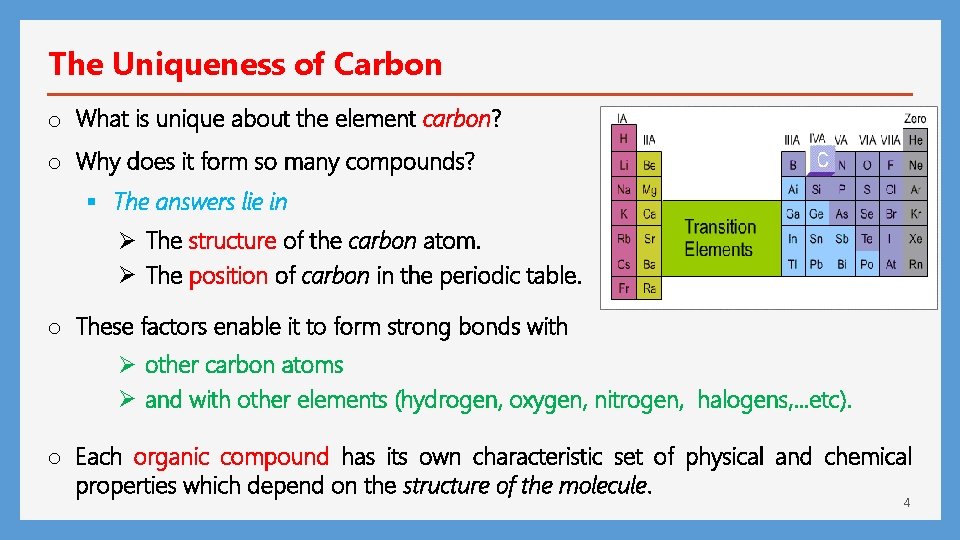
The Uniqueness of Carbon o What is unique about the element carbon? o Why does it form so many compounds? § The answers lie in Ø The structure of the carbon atom. Ø The position of carbon in the periodic table. o These factors enable it to form strong bonds with Ø other carbon atoms Ø and with other elements (hydrogen, oxygen, nitrogen, halogens, …etc). o Each organic compound has its own characteristic set of physical and chemical properties which depend on the structure of the molecule. 4
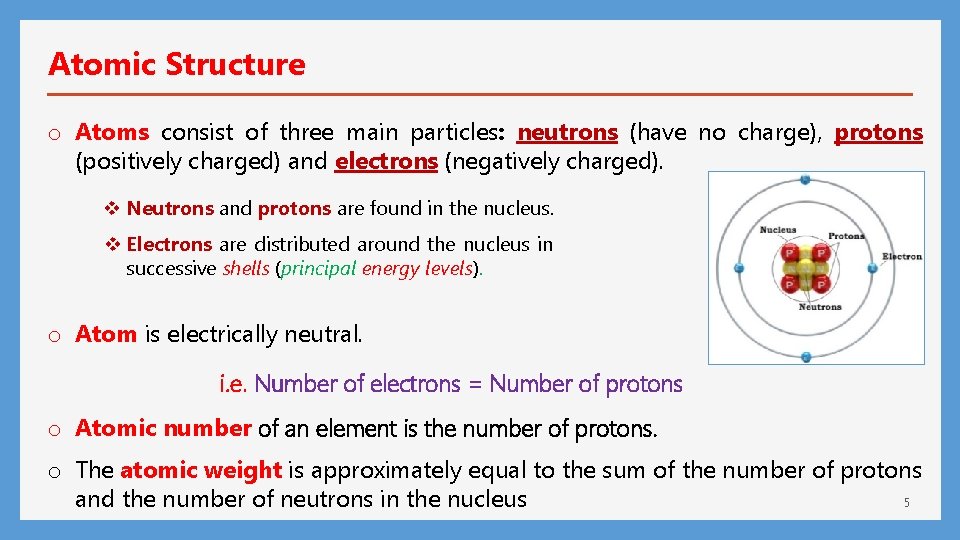
Atomic Structure o Atoms consist of three main particles: neutrons (have no charge), protons (positively charged) and electrons (negatively charged). v Neutrons and protons are found in the nucleus. v Electrons are distributed around the nucleus in successive shells (principal energy levels). o Atom is electrically neutral. i. e. Number of electrons = Number of protons o Atomic number of an element is the number of protons. o The atomic weight is approximately equal to the sum of the number of protons and the number of neutrons in the nucleus 5
Atomic Structure o The energy levels are designated by capital letters (K, L, M, N, . . ). o The maximum capacity of a shell = 2 n 2 electrons. n = number of the energy level. o For example, the element carbon (atomic number 6) 6 electrons are distributed about the nucleus as Shell Number of electrons K 2 L 4 M 0 N 0 6
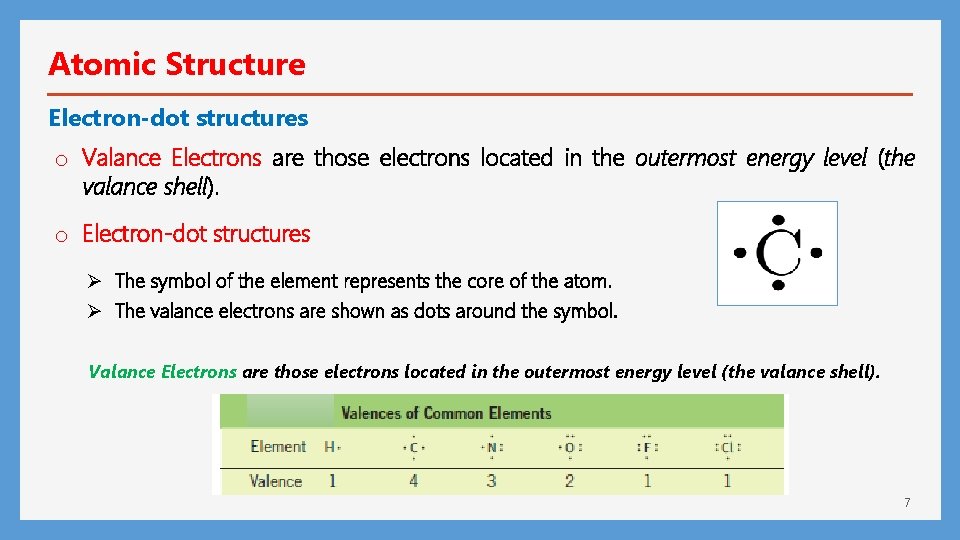
Atomic Structure Electron-dot structures o Valance Electrons are those electrons located in the outermost energy level (the valance shell). o Electron-dot structures Ø The symbol of the element represents the core of the atom. Ø The valance electrons are shown as dots around the symbol. Valance Electrons are those electrons located in the outermost energy level (the valance shell). 7
Chemical Bonding o In 1916 G. N. Lewis pointed out that: The noble gases were stable elements and he ascribed their lack of reactivity to their having their valence shells filled with electrons. Ø 2 electrons in case of helium. Ø 8 electrons for the other noble gases. o According to Lewis, in interacting with one another atoms can achieve a greater degree of stability by rearrangement of the valence electrons to acquire the outer-shell structure of the closest noble gas in the periodic table. 8
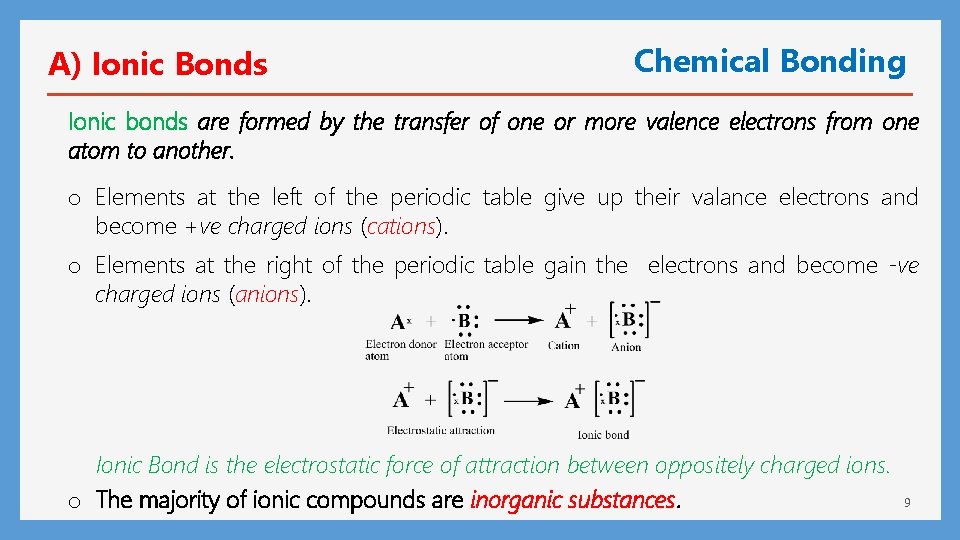
A) Ionic Bonds Chemical Bonding Ionic bonds are formed by the transfer of one or more valence electrons from one atom to another. o Elements at the left of the periodic table give up their valance electrons and become +ve charged ions (cations). o Elements at the right of the periodic table gain the electrons and become -ve charged ions (anions). Ionic Bond is the electrostatic force of attraction between oppositely charged ions. o The majority of ionic compounds are inorganic substances. 9
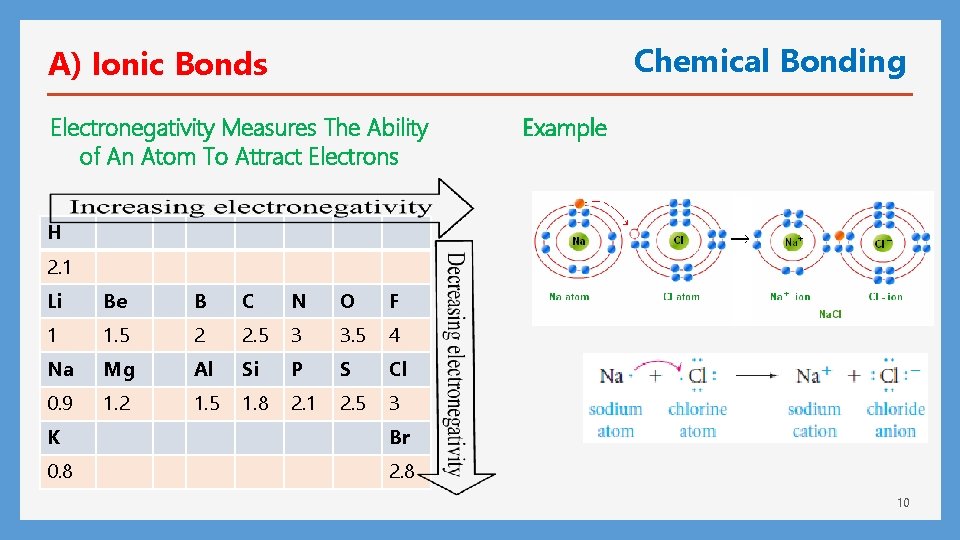
Chemical Bonding A) Ionic Bonds Electronegativity Measures The Ability of An Atom To Attract Electrons Example H 2. 1 Li Be B C N O F 1 1. 5 2 2. 5 3 3. 5 4 Na Mg Al Si P S Cl 0. 9 1. 2 1. 5 1. 8 2. 1 2. 5 3 K Br 0. 8 2. 8 10
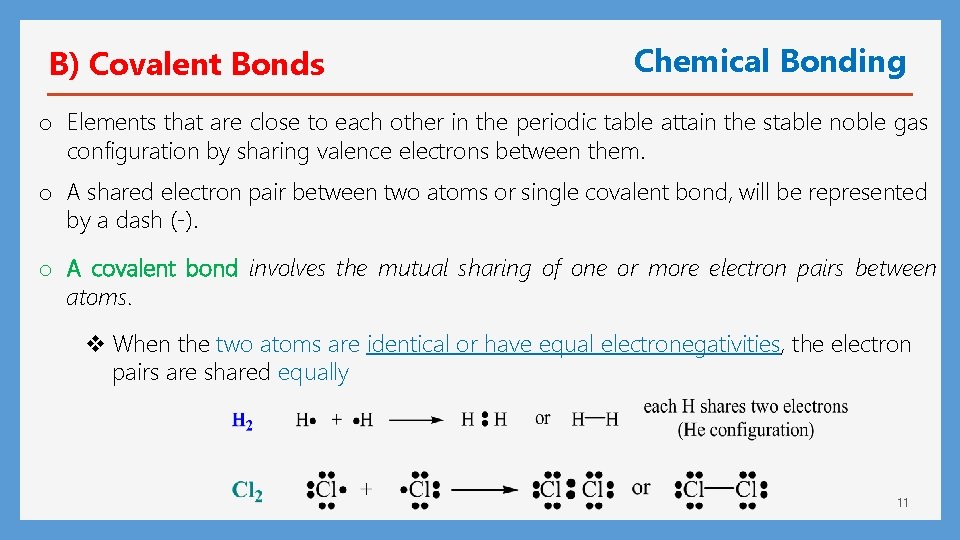
B) Covalent Bonds Chemical Bonding o Elements that are close to each other in the periodic table attain the stable noble gas configuration by sharing valence electrons between them. o A shared electron pair between two atoms or single covalent bond, will be represented by a dash (-). o A covalent bond involves the mutual sharing of one or more electron pairs between atoms. v When the two atoms are identical or have equal electronegativities, the electron pairs are shared equally 11
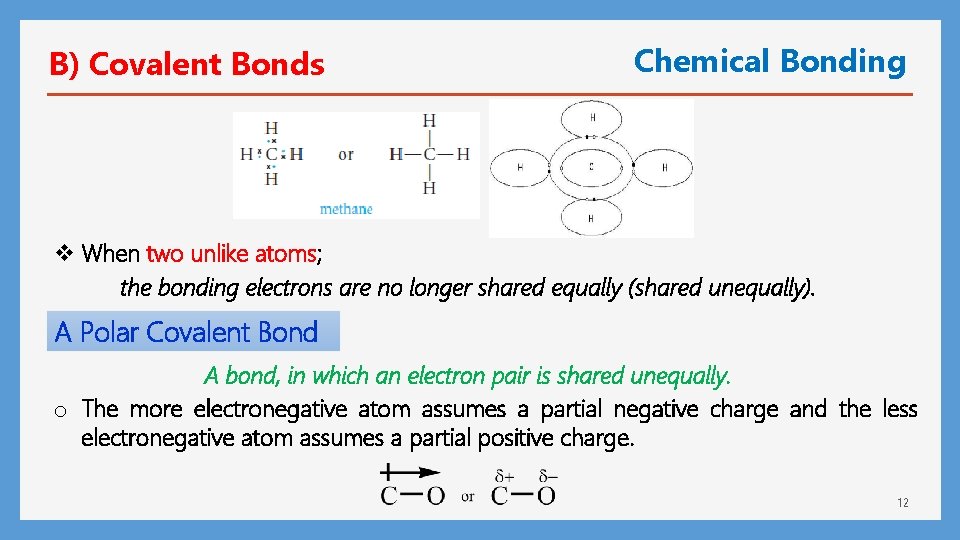
B) Covalent Bonds Chemical Bonding v When two unlike atoms; the bonding electrons are no longer shared equally (shared unequally). A Polar Covalent Bond A bond, in which an electron pair is shared unequally. o The more electronegative atom assumes a partial negative charge and the less electronegative atom assumes a partial positive charge. 12
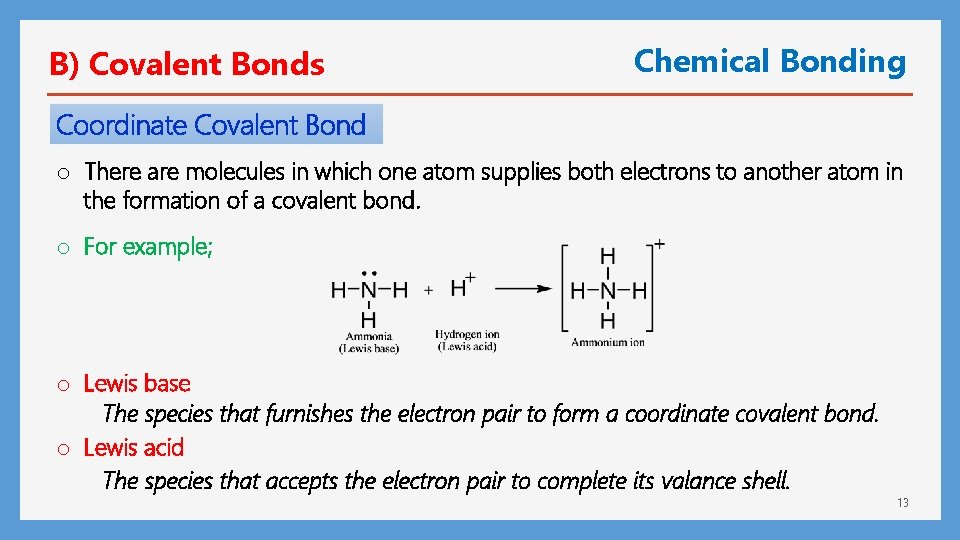
B) Covalent Bonds Chemical Bonding Coordinate Covalent Bond o There are molecules in which one atom supplies both electrons to another atom in the formation of a covalent bond. o For example; o Lewis base The species that furnishes the electron pair to form a coordinate covalent bond. o Lewis acid The species that accepts the electron pair to complete its valance shell. 13
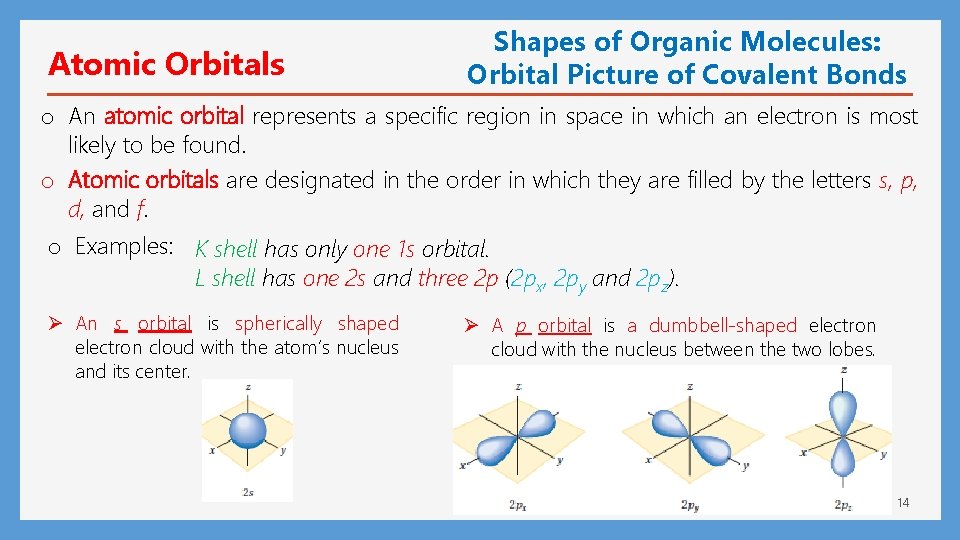
Atomic Orbitals Shapes of Organic Molecules: Orbital Picture of Covalent Bonds o An atomic orbital represents a specific region in space in which an electron is most likely to be found. o Atomic orbitals are designated in the order in which they are filled by the letters s, p, d, and f. o Examples: K shell has only one 1 s orbital. L shell has one 2 s and three 2 p (2 px, 2 py and 2 pz). Ø An s orbital is spherically shaped electron cloud with the atom’s nucleus and its center. Ø A p orbital is a dumbbell-shaped electron cloud with the nucleus between the two lobes. 14
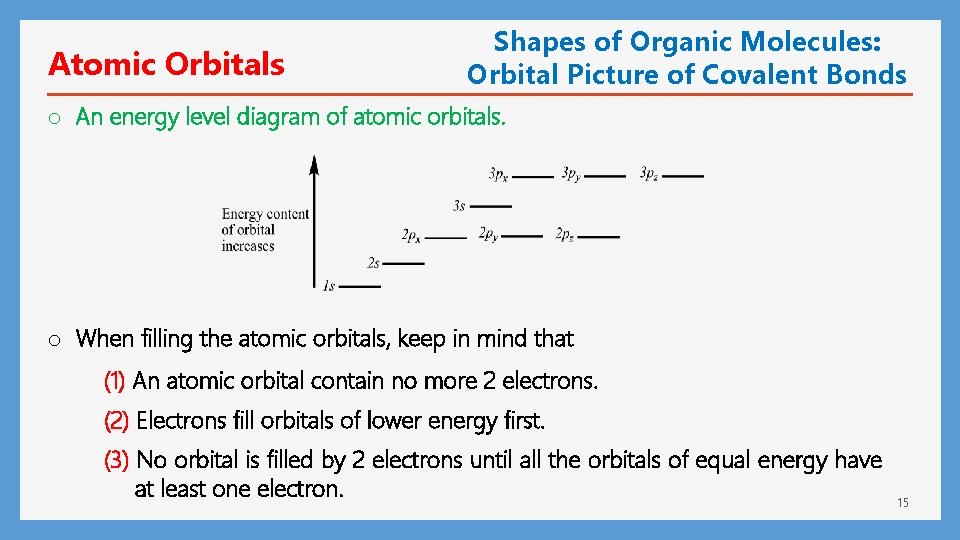
Atomic Orbitals Shapes of Organic Molecules: Orbital Picture of Covalent Bonds o An energy level diagram of atomic orbitals. o When filling the atomic orbitals, keep in mind that (1) An atomic orbital contain no more 2 electrons. (2) Electrons fill orbitals of lower energy first. (3) No orbital is filled by 2 electrons until all the orbitals of equal energy have at least one electron. 15
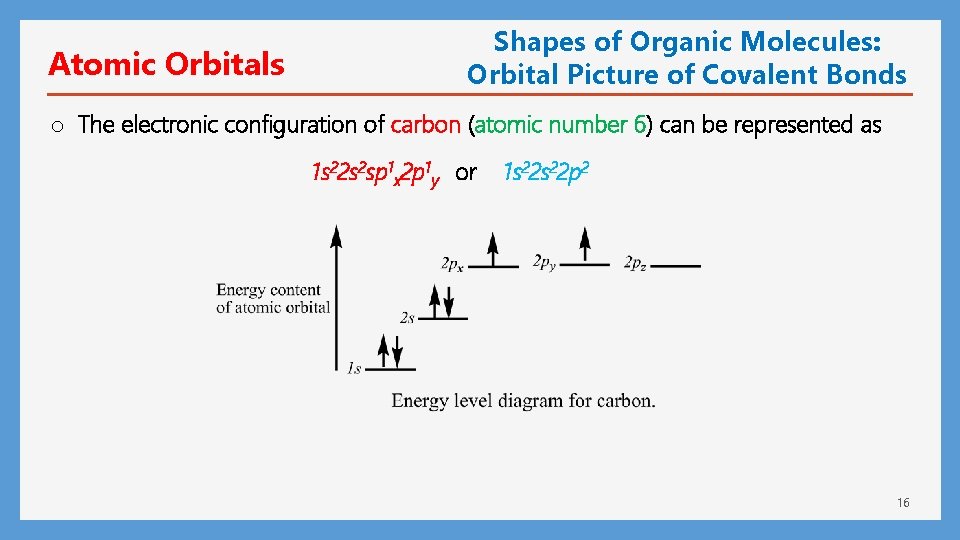
Atomic Orbitals Shapes of Organic Molecules: Orbital Picture of Covalent Bonds o The electronic configuration of carbon (atomic number 6) can be represented as 1 s 22 s 2 sp 1 x 2 p 1 y or 1 s 22 p 2 16
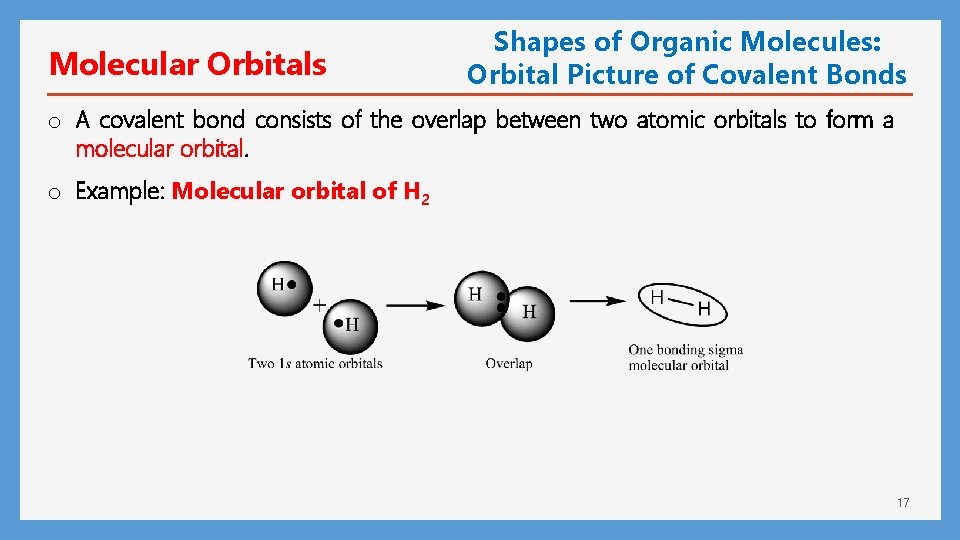
Molecular Orbitals Shapes of Organic Molecules: Orbital Picture of Covalent Bonds o A covalent bond consists of the overlap between two atomic orbitals to form a molecular orbital. o Example: Molecular orbital of H 2 17
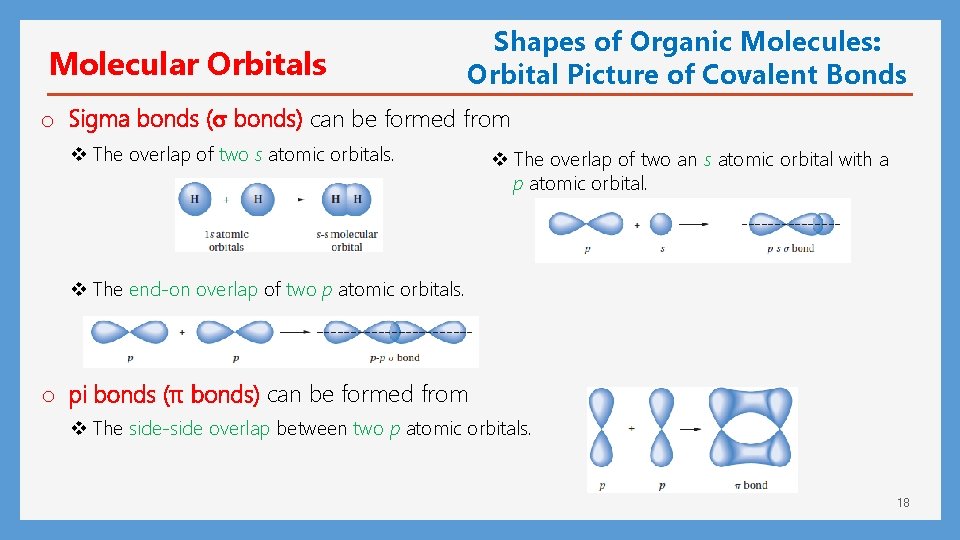
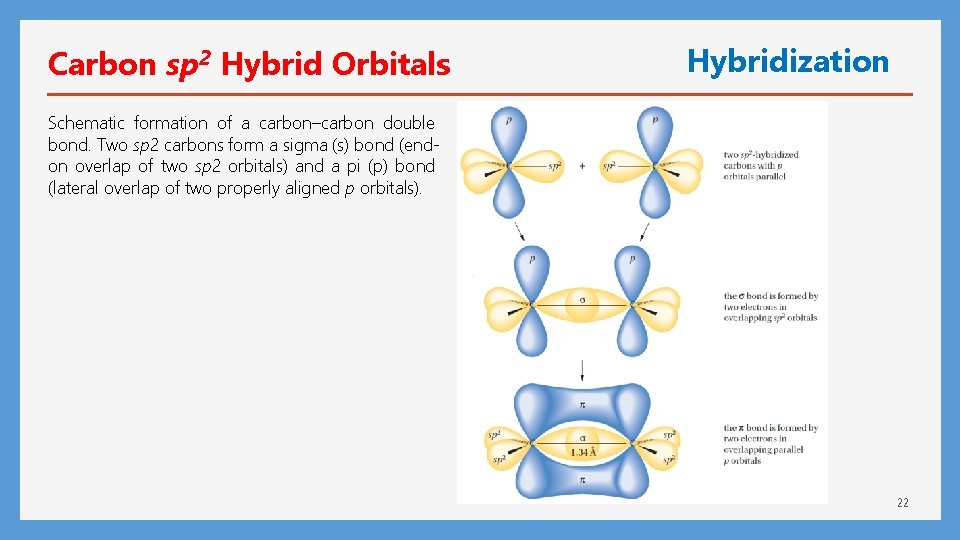
Molecular Orbitals Shapes of Organic Molecules: Orbital Picture of Covalent Bonds o Sigma bonds ( bonds) can be formed from v The overlap of two s atomic orbitals. v The overlap of two an s atomic orbital with a p atomic orbital. v The end-on overlap of two p atomic orbitals. o pi bonds (π bonds) can be formed from v The side-side overlap between two p atomic orbitals. 18
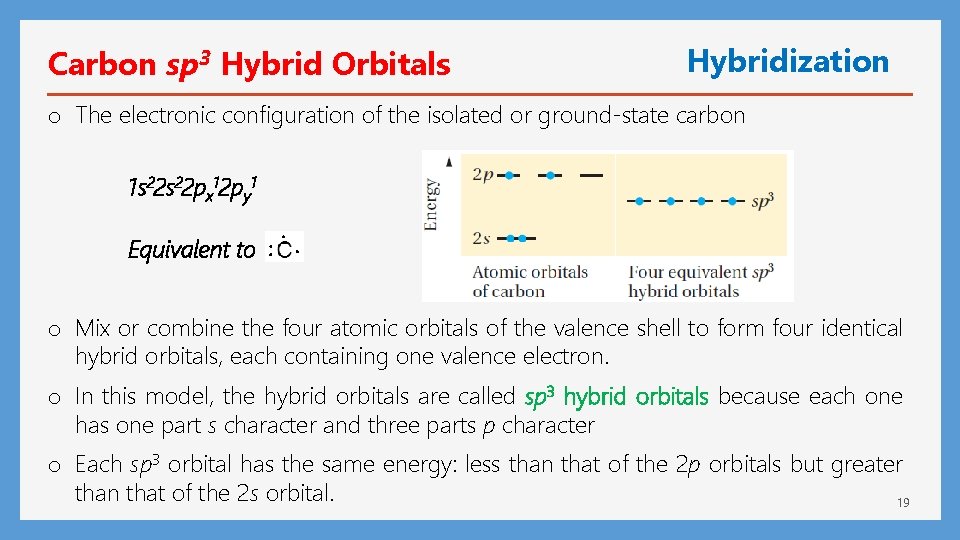
Carbon sp 3 Hybrid Orbitals Hybridization o The electronic configuration of the isolated or ground-state carbon 1 s 22 px 12 py 1 Equivalent to o Mix or combine the four atomic orbitals of the valence shell to form four identical hybrid orbitals, each containing one valence electron. o In this model, the hybrid orbitals are called sp 3 hybrid orbitals because each one has one part s character and three parts p character o Each sp 3 orbital has the same energy: less than that of the 2 p orbitals but greater than that of the 2 s orbital. 19
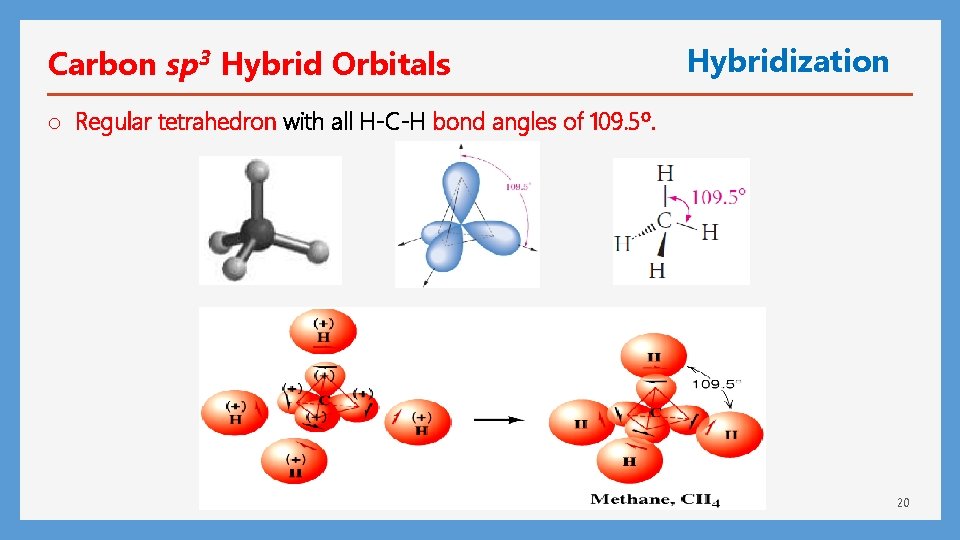
Carbon sp 3 Hybrid Orbitals Hybridization o Regular tetrahedron with all H-C-H bond angles of 109. 5º. 20
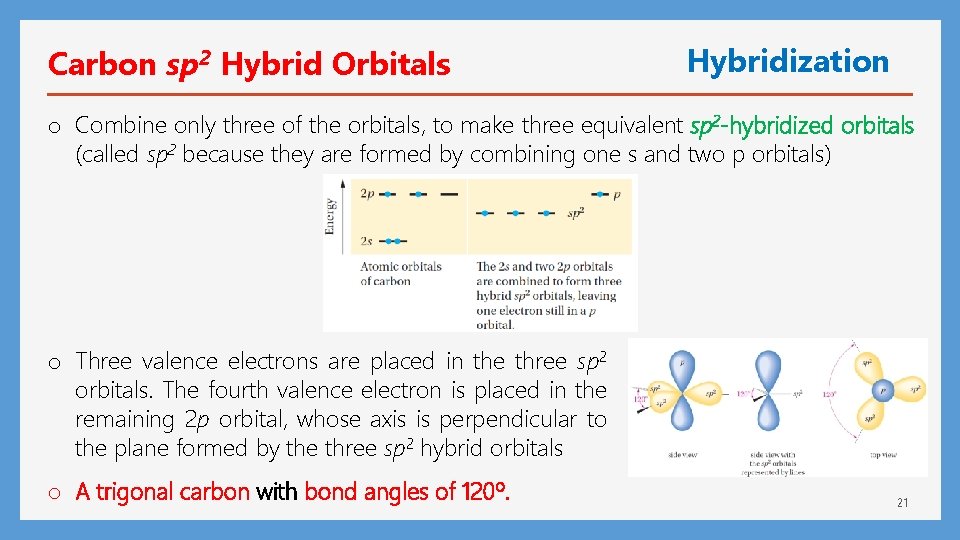
Carbon sp 2 Hybrid Orbitals Hybridization o Combine only three of the orbitals, to make three equivalent sp 2 -hybridized orbitals (called sp 2 because they are formed by combining one s and two p orbitals) o Three valence electrons are placed in the three sp 2 orbitals. The fourth valence electron is placed in the remaining 2 p orbital, whose axis is perpendicular to the plane formed by the three sp 2 hybrid orbitals o A trigonal carbon with bond angles of 120º. 21
Carbon sp 2 Hybrid Orbitals Hybridization Schematic formation of a carbon–carbon double bond. Two sp 2 carbons form a sigma (s) bond (endon overlap of two sp 2 orbitals) and a pi (p) bond (lateral overlap of two properly aligned p orbitals). 22
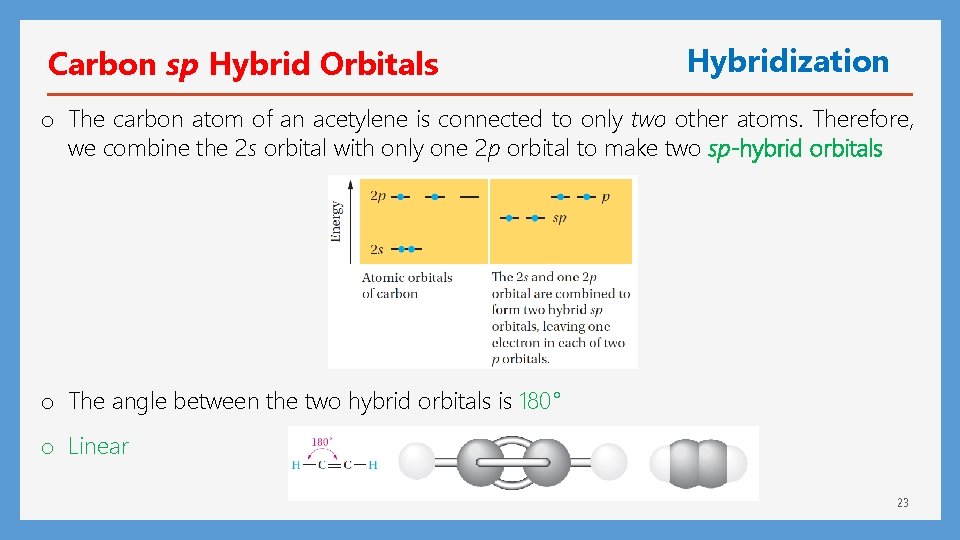
Carbon sp Hybrid Orbitals Hybridization o The carbon atom of an acetylene is connected to only two other atoms. Therefore, we combine the 2 s orbital with only one 2 p orbital to make two sp-hybrid orbitals o The angle between the two hybrid orbitals is 180° o Linear 23
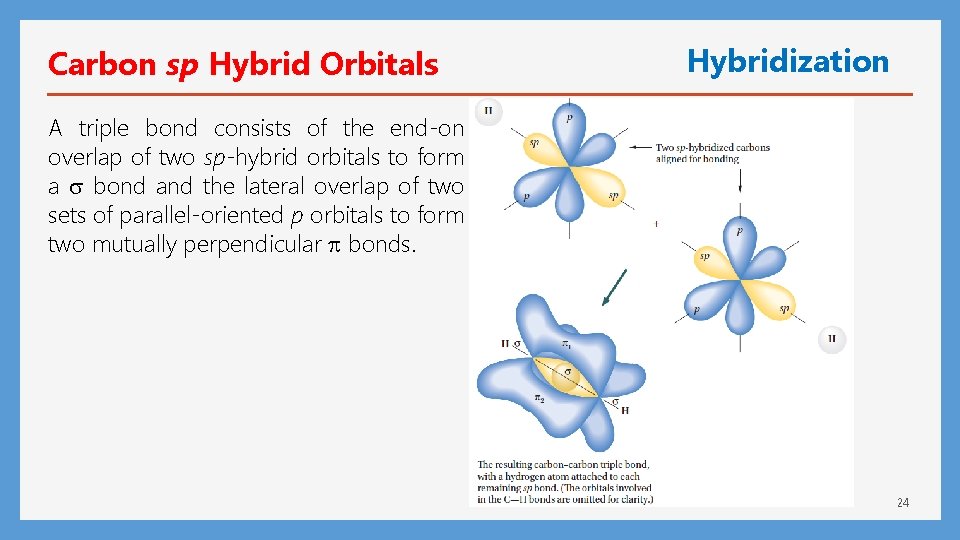
Carbon sp Hybrid Orbitals Hybridization A triple bond consists of the end-on overlap of two sp-hybrid orbitals to form a bond and the lateral overlap of two sets of parallel-oriented p orbitals to form two mutually perpendicular bonds. 24
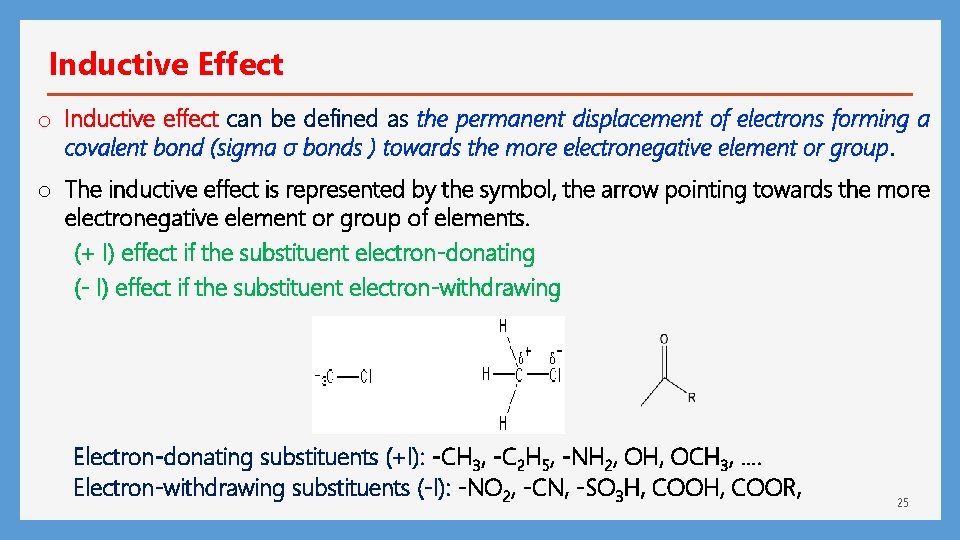
Inductive Effect o Inductive effect can be defined as the permanent displacement of electrons forming a covalent bond (sigma σ bonds ) towards the more electronegative element or group. o The inductive effect is represented by the symbol, the arrow pointing towards the more electronegative element or group of elements. (+ I) effect if the substituent electron-donating (- I) effect if the substituent electron-withdrawing Electron-donating substituents (+I): -CH 3, -C 2 H 5, -NH 2, OH, OCH 3, …. Electron-withdrawing substituents (-I): -NO 2, -CN, -SO 3 H, COOR, 25
Bond Polarity and Dipole Moment (µ) o Dipole moment (depends on the inductive effect). o A bond with the electrons shared equally between two atoms is called a nonpolar bond like in Cl-Cl and C-C bond in ethane. o A bond with the electrons shared unequally between two different elements is called a polar bond. o The bond polarity is measured by its dipole moment (µ). o Dipole moment (µ) defined to be the amount of charge separation ( +δ and –δ ) multiplied by the bond length. 26
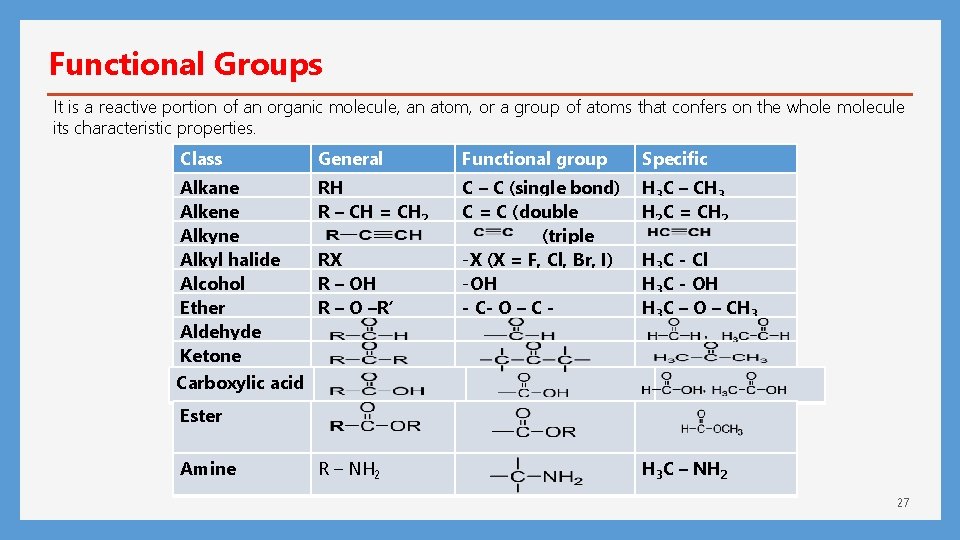
Functional Groups It is a reactive portion of an organic molecule, an atom, or a group of atoms that confers on the whole molecule its characteristic properties. Class Alkane Alkene Alkyl halide Alcohol Ether Aldehyde Ketone Carboxylic acid General formula RH R – CH = CH 2 RX R – OH R – O –R’ Functional group Specific C – C (single bond) C = C (double bond) (triple bond) -X (X = F, Cl, Br, I) -OH - C- O – C - H 3 C – CH 3 H 2 C = CH 2 H 3 C - Cl H 3 C - OH H 3 C – O – CH 3 Ester Amine R – NH 2 H 3 C – NH 2 27
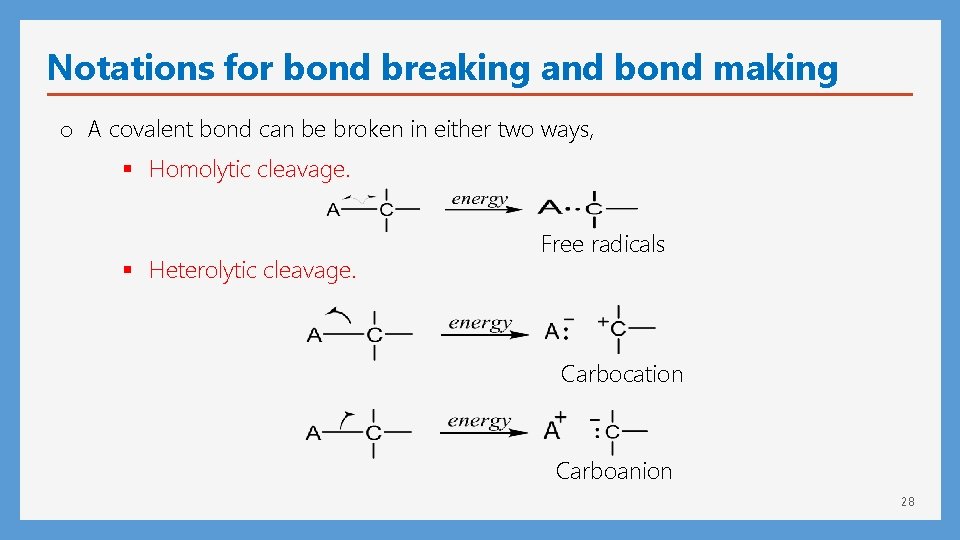
Notations for bond breaking and bond making o A covalent bond can be broken in either two ways, § Homolytic cleavage. § Heterolytic cleavage. Free radicals Carbocation Carboanion 28
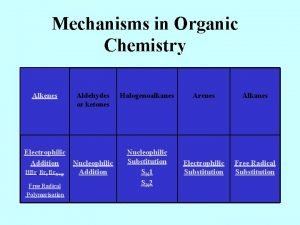
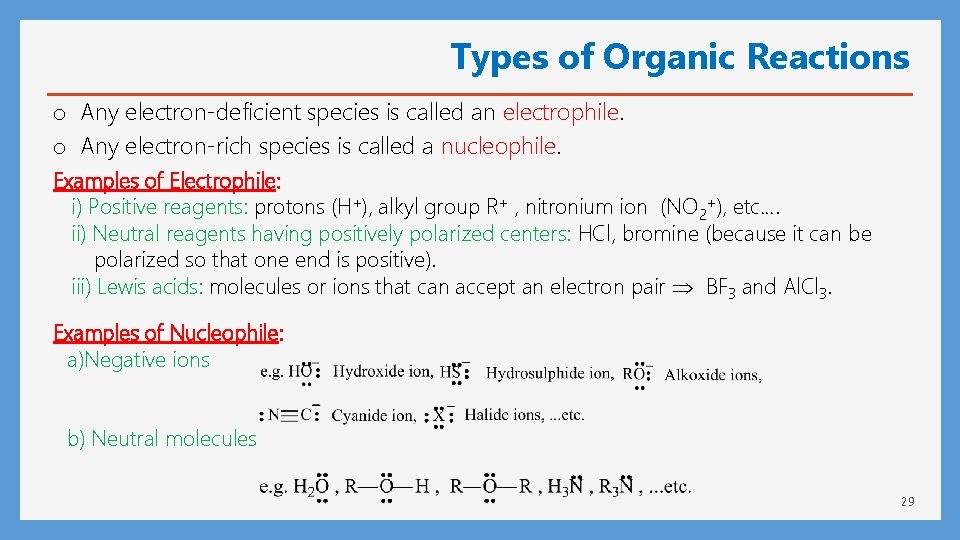
Types of Organic Reactions o Any electron-deficient species is called an electrophile. o Any electron-rich species is called a nucleophile. Examples of Electrophile: i) Positive reagents: protons (H+), alkyl group R+ , nitronium ion (NO 2+), etc…. ii) Neutral reagents having positively polarized centers: HCl, bromine (because it can be polarized so that one end is positive). iii) Lewis acids: molecules or ions that can accept an electron pair BF 3 and Al. Cl 3. Examples of Nucleophile: a)Negative ions b) Neutral molecules 29
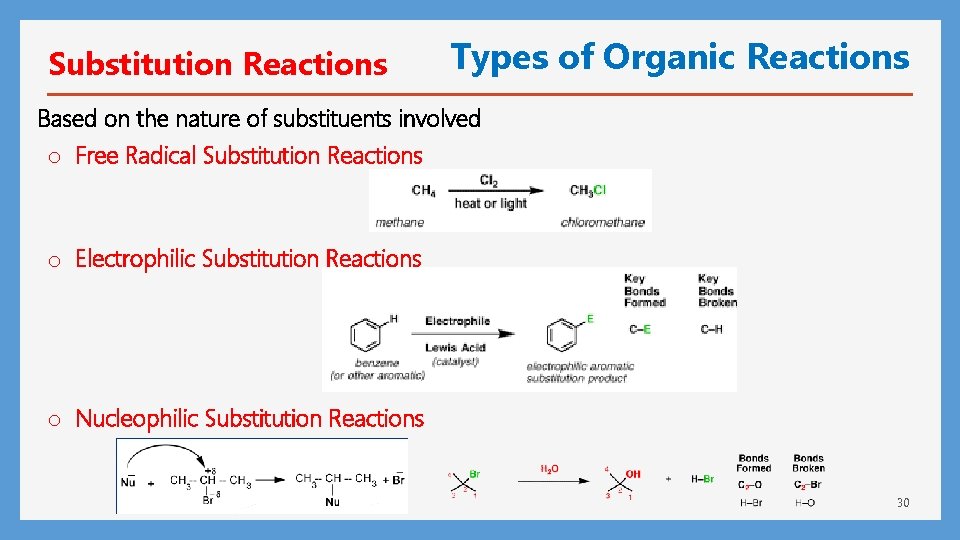
Substitution Reactions Types of Organic Reactions Based on the nature of substituents involved o Free Radical Substitution Reactions o Electrophilic Substitution Reactions o Nucleophilic Substitution Reactions 30
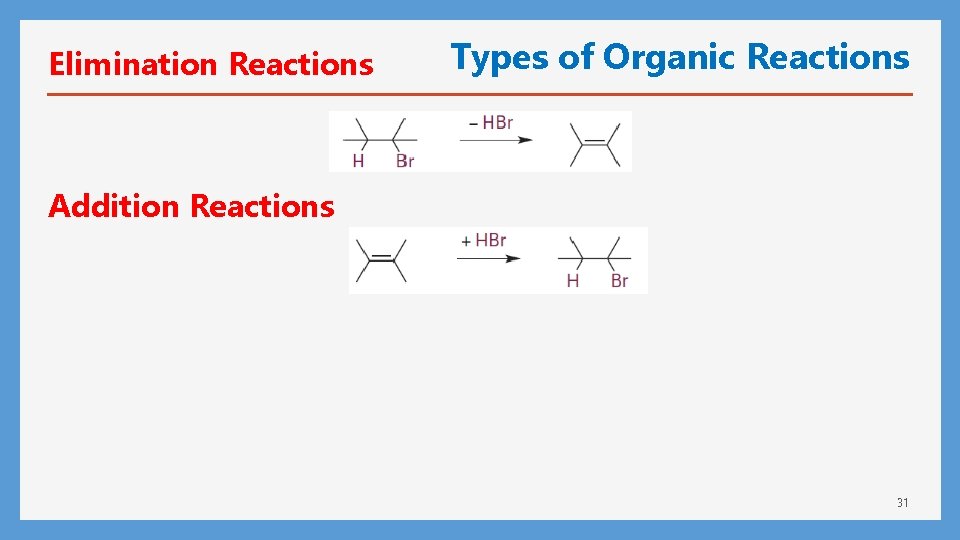
Elimination Reactions Types of Organic Reactions Addition Reactions 31
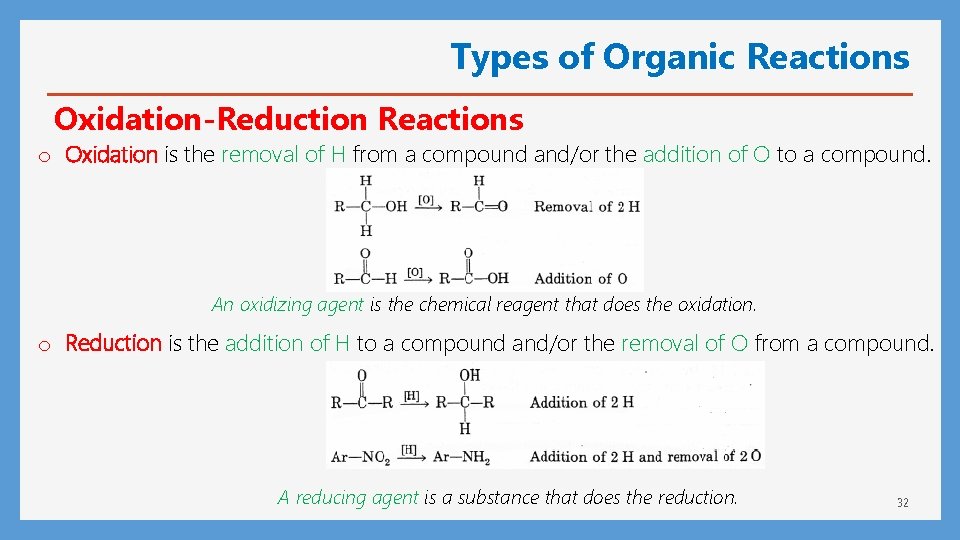
Types of Organic Reactions Oxidation-Reduction Reactions o Oxidation is the removal of H from a compound and/or the addition of O to a compound. An oxidizing agent is the chemical reagent that does the oxidation. o Reduction is the addition of H to a compound and/or the removal of O from a compound. A reducing agent is a substance that does the reduction. 32