Financial Reporting Framework for Small and MediumSized Entities





- Slides: 64
Financial Reporting Framework for Small- and Medium-Sized Entities FRF for SMEs™ Accounting Framework Name of presenter Audience Date © 2014 American Institute of CPAs
Our discussion today What is FRF for SMEs? FRF for SMEs in Action What Does the Market Say? Key Principles Comparison: FRF for SMEs to U. S. GAAP Reporting by CPAs Extracts from Illustrative Financial Statements FRF for SMEs Toolkits © 2014 American Institute of CPAs
What is FRF for SMEs? © 2014 American Institute of CPAs
An additional non-GAAP framework © 2014 American Institute of CPAs
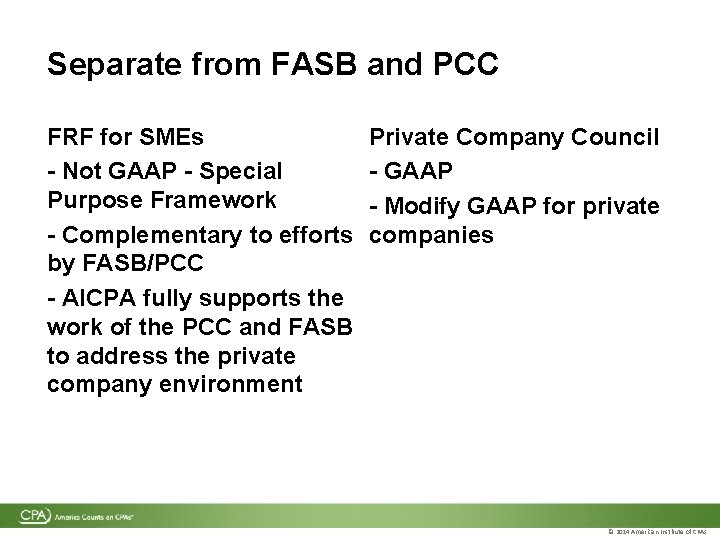
Separate from FASB and PCC FRF for SMEs - Not GAAP - Special Purpose Framework - Complementary to efforts by FASB/PCC - AICPA fully supports the work of the PCC and FASB to address the private company environment Private Company Council - GAAP - Modify GAAP for private companies © 2014 American Institute of CPAs
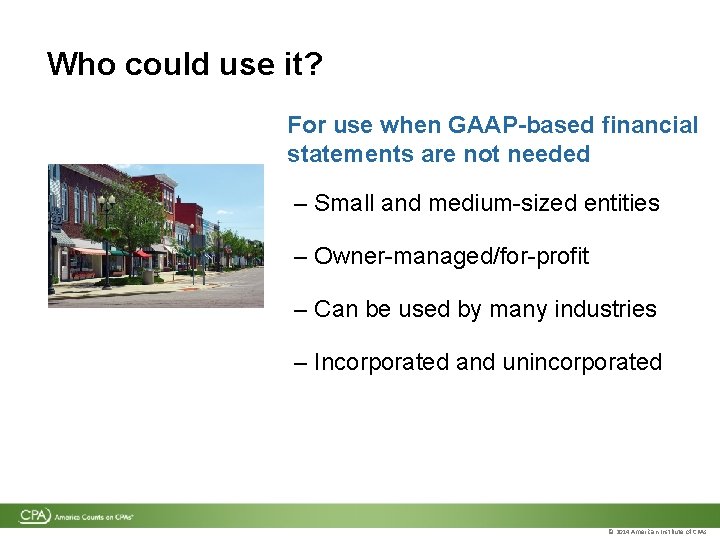
Who could use it? For use when GAAP-based financial statements are not needed – Small and medium-sized entities – Owner-managed/for-profit – Can be used by many industries – Incorporated and unincorporated © 2014 American Institute of CPAs
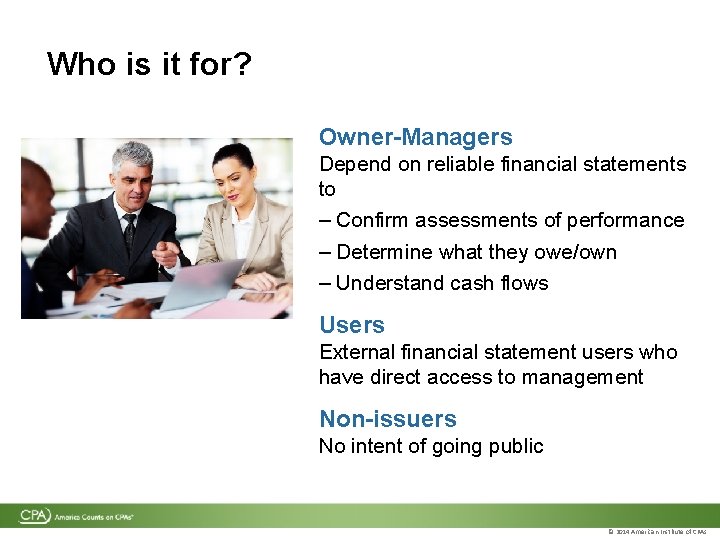
Who is it for? Owner-Managers Depend on reliable financial statements to – Confirm assessments of performance – Determine what they owe/own – Understand cash flows Users External financial statement users who have direct access to management Non-issuers No intent of going public © 2014 American Institute of CPAs
Characteristics of typical entities – Entity does not operate in an industry that has highly specialized accounting guidance – such as financial institutions and investment companies – Entity does not engage in overly complicated transactions – Entity does not have significant foreign operations – Financial statement users may have greater interest in cash flows, liquidity, statement of financial position strength and interest coverage © 2014 American Institute of CPAs
Features – Standalone framework – Concise – Suitable criteria for general-use financial statements – Accrual based – Blend of traditional accounting and accrual income tax methods – Fewer adjustments from book to tax © 2014 American Institute of CPAs
Features – Excess narrative avoided – Eschews prescriptive rules – Use of professional judgment – Intuitive and understandable – Stable yet nimble © 2014 American Institute of CPAs
Framework in Action © 2014 American Institute of CPAs
CPAs are putting FRF for SMEs to use… Firms assessing client base Using tools and discussing with clients and bankers Holding seminars for local bankers Taking steps to implement, and actually converting clients Ø Otherwise risk losing business or missing opportunities © 2014 American Institute of CPAs
…And finding success CPA in WI demonstrated before-and-after financial statements to large regional and local banks. Banks received positively. Has had success converting compilation clients. CPA in FL influenced local Bof. A branch to accept FRF for SMEs on behalf of a client. © 2014 American Institute of CPAs
CPAs’ experiences with bankers CPAs introducing FRF for SMEs and educating state bank organizations FRF for SMEs treated as OCBOA Mostly positive responses Bankers want to see what they are getting Use tools – sample financial statements and comparison charts © 2014 American Institute of CPAs
CPAs’ experiences with clients CPA in Ohio says one converted client saves a lot on disclosures; financials are more relevant. CPA in AK met with client starting new construction company; bonding agency agreed to use FRF for SMEs. © 2014 American Institute of CPAs
Banking regulators/acceptance – Discussed FRF for SMEs with regulators/exam chiefs – Bankers accept OCBOA today/Flexible with smaller businesses – Exam chiefs will treat FRF for SMEs as another OCBOA © 2014 American Institute of CPAs
What Does the Market Say? © 2014 American Institute of CPAs
CPAs in the Field Say “We met with 18 banks… They appreciated the framework’s comprehensiveness and relevant disclosures. ” ‒CPA from WA “For many of my clients, I use the FRF for SMEs because it makes the financial statements more understandable from their perspective. ” ‒CPA from WI “We quickly put in place a strategy to offer FRF for SMEsbased financial statement preparation to our clients. ” ‒ CPA from CO © 2014 American Institute of CPAs
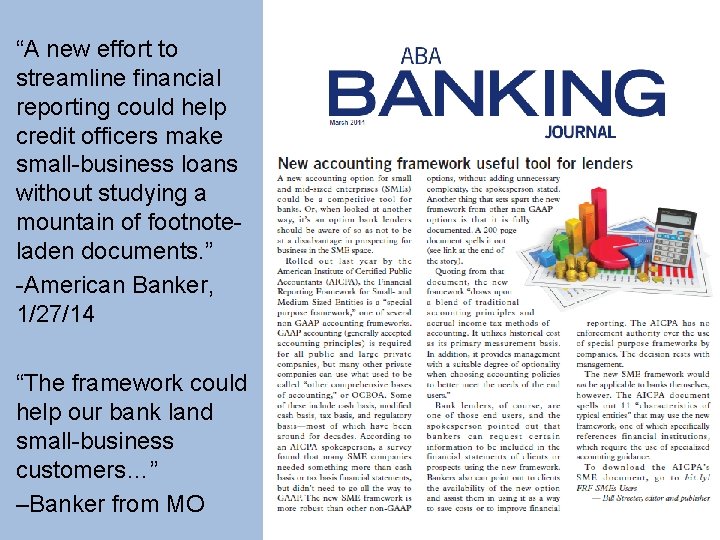
“A new effort to streamline financial reporting could help credit officers make small-business loans without studying a mountain of footnoteladen documents. ” -American Banker, 1/27/14 “The framework could help our bank land small-business customers…” ‒Banker from MO
Key Principles © 2014 American Institute of CPAs
Historical cost Framework primarily uses historical cost basis, steering away from complicated fair value measurements Most relevant and reliable measurement basis for small business financial reporting needs Well-suited as a metric for evaluating an entity’s cash flow Objective, verifiable, straight-forward © 2014 American Institute of CPAs
Historical cost Directly relates to the past experience and past decisions of an entity Sound basis for financial forecasts Best measurement basis to help evaluate the performance of a small business. Stands the test of time © 2014 American Institute of CPAs
Optionality in certain accounting policies Answers the varying informational needs of different financial statement users Financial reporting that is truly representative of the underlying economics of a small business Optionality nothing new to accountants – make choices today © 2014 American Institute of CPAs
Primary accounting policy options Income tax accounting − taxes payable method or deferred income taxes method Subsidiary accounting − consolidate or equity method Long-term contracts − percentage of completion method or the completed contract method © 2014 American Institute of CPAs
Targeted disclosures Only targeted disclosures in the financial statements Stakeholders receive the pertinent, understandable information they need Avoid excess narrative or irrelevant “noise” in the financial reports © 2014 American Institute of CPAs
Comparison: FRF for SMEs to U. S. GAAP © 2014 American Institute of CPAs
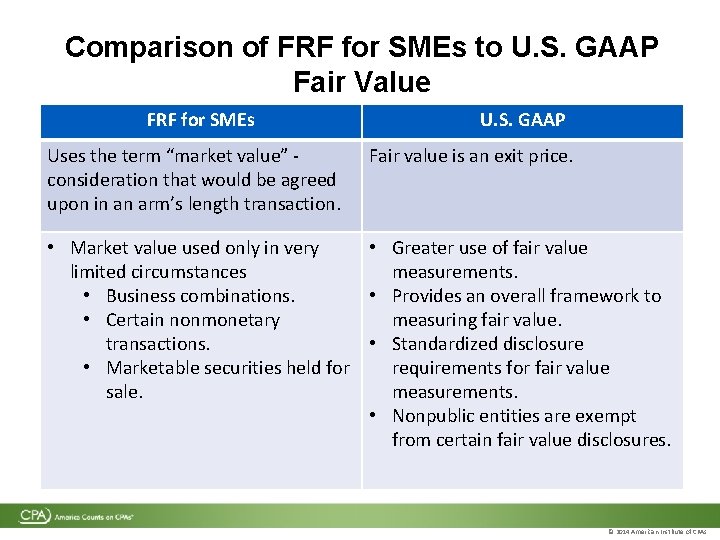
Comparison of FRF for SMEs to U. S. GAAP Fair Value FRF for SMEs Uses the term “market value” consideration that would be agreed upon in an arm’s length transaction. U. S. GAAP Fair value is an exit price. • Market value used only in very • Greater use of fair value limited circumstances measurements. • Business combinations. • Provides an overall framework to • Certain nonmonetary measuring fair value. transactions. • Standardized disclosure • Marketable securities held for requirements for fair value sale. measurements. • Nonpublic entities are exempt from certain fair value disclosures. © 2014 American Institute of CPAs
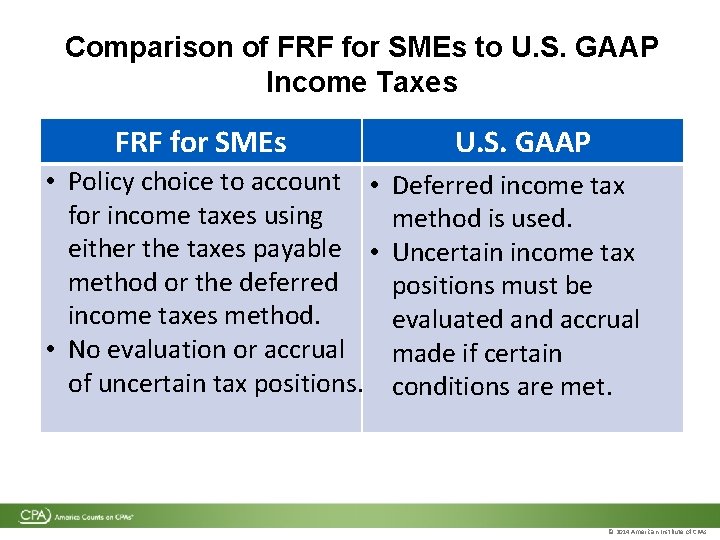
Comparison of FRF for SMEs to U. S. GAAP Income Taxes FRF for SMEs • Policy choice to account • for income taxes using either the taxes payable • method or the deferred income taxes method. • No evaluation or accrual of uncertain tax positions. U. S. GAAP Deferred income tax method is used. Uncertain income tax positions must be evaluated and accrual made if certain conditions are met. © 2014 American Institute of CPAs
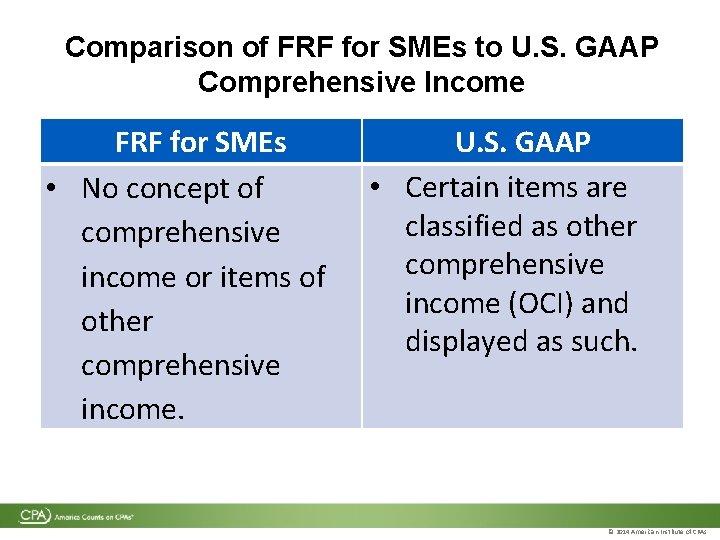
Comparison of FRF for SMEs to U. S. GAAP Comprehensive Income FRF for SMEs • No concept of comprehensive income or items of other comprehensive income. U. S. GAAP • Certain items are classified as other comprehensive income (OCI) and displayed as such. © 2014 American Institute of CPAs
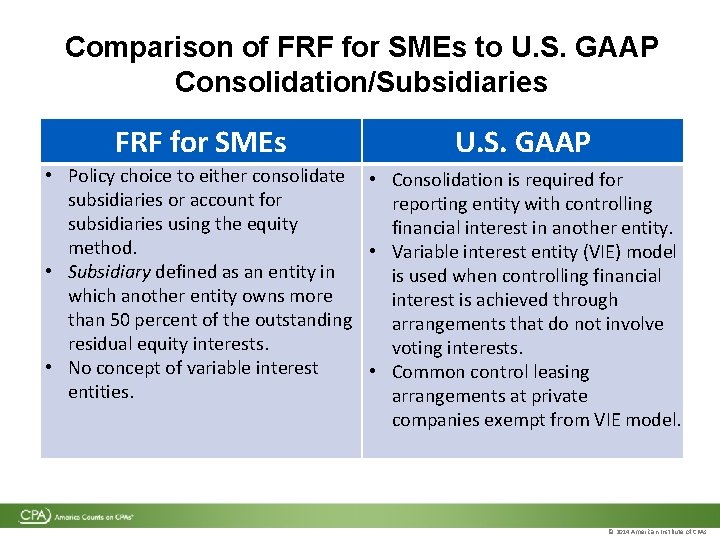
Comparison of FRF for SMEs to U. S. GAAP Consolidation/Subsidiaries FRF for SMEs U. S. GAAP • Policy choice to either consolidate • Consolidation is required for subsidiaries or account for reporting entity with controlling subsidiaries using the equity financial interest in another entity. method. • Variable interest entity (VIE) model • Subsidiary defined as an entity in is used when controlling financial which another entity owns more interest is achieved through than 50 percent of the outstanding arrangements that do not involve residual equity interests. voting interests. • No concept of variable interest • Common control leasing entities. arrangements at private companies exempt from VIE model. © 2014 American Institute of CPAs
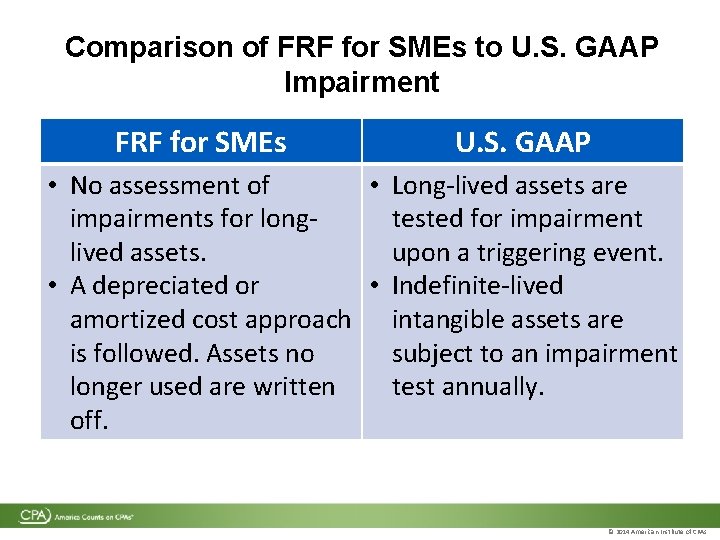
Comparison of FRF for SMEs to U. S. GAAP Impairment FRF for SMEs U. S. GAAP • No assessment of • Long-lived assets are impairments for longtested for impairment lived assets. upon a triggering event. • A depreciated or • Indefinite-lived amortized cost approach intangible assets are is followed. Assets no subject to an impairment longer used are written test annually. off. © 2014 American Institute of CPAs
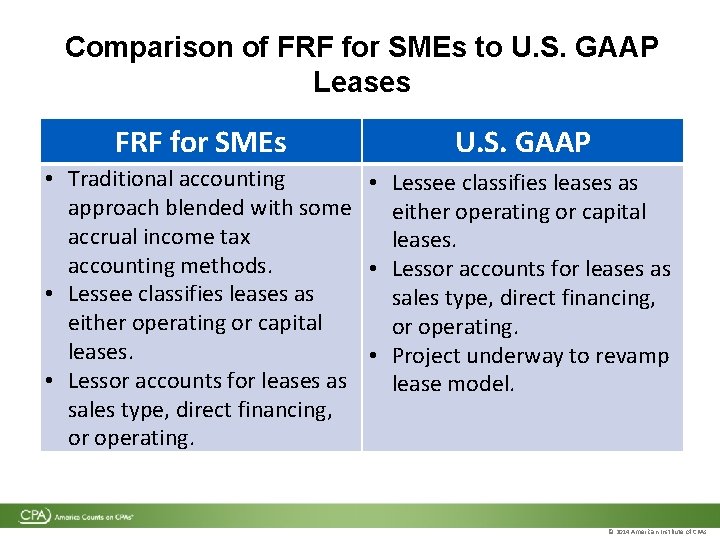
Comparison of FRF for SMEs to U. S. GAAP Leases FRF for SMEs U. S. GAAP • Traditional accounting • Lessee classifies leases as approach blended with some either operating or capital accrual income tax leases. accounting methods. • Lessor accounts for leases as • Lessee classifies leases as sales type, direct financing, either operating or capital or operating. leases. • Project underway to revamp • Lessor accounts for leases as lease model. sales type, direct financing, or operating. © 2014 American Institute of CPAs
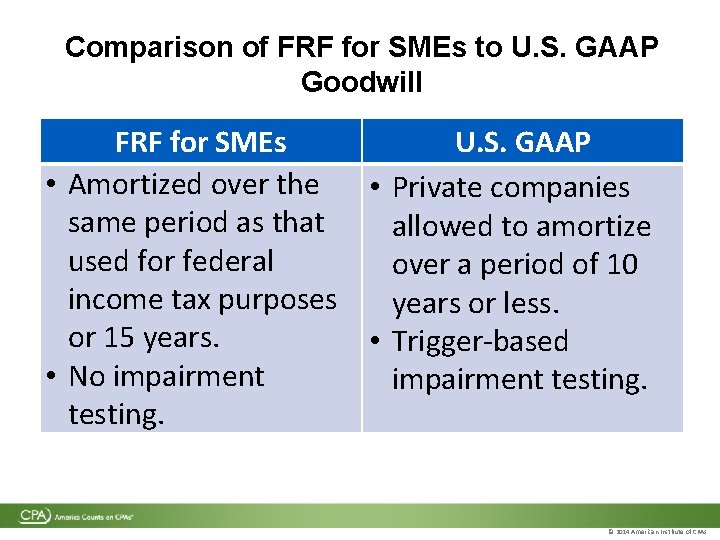
Comparison of FRF for SMEs to U. S. GAAP Goodwill FRF for SMEs U. S. GAAP • Amortized over the • Private companies same period as that allowed to amortize used for federal over a period of 10 income tax purposes years or less. or 15 years. • Trigger-based • No impairment testing. © 2014 American Institute of CPAs
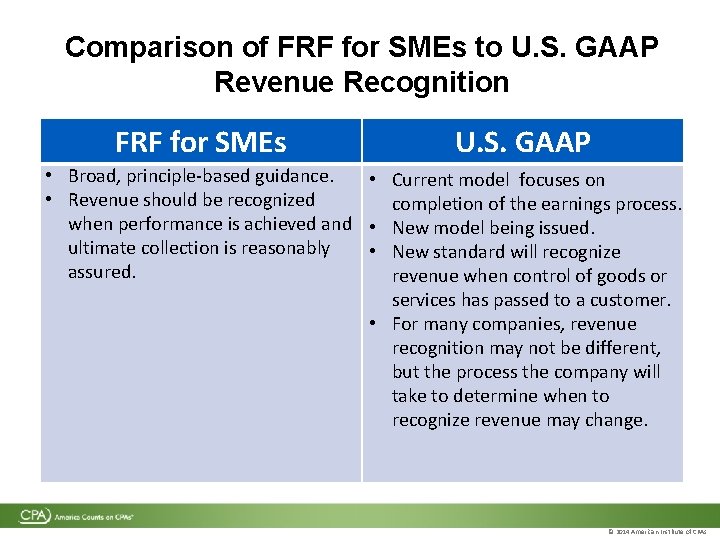
Comparison of FRF for SMEs to U. S. GAAP Revenue Recognition FRF for SMEs U. S. GAAP • Broad, principle-based guidance. • Current model focuses on • Revenue should be recognized completion of the earnings process. when performance is achieved and • New model being issued. ultimate collection is reasonably • New standard will recognize assured. revenue when control of goods or services has passed to a customer. • For many companies, revenue recognition may not be different, but the process the company will take to determine when to recognize revenue may change. © 2014 American Institute of CPAs
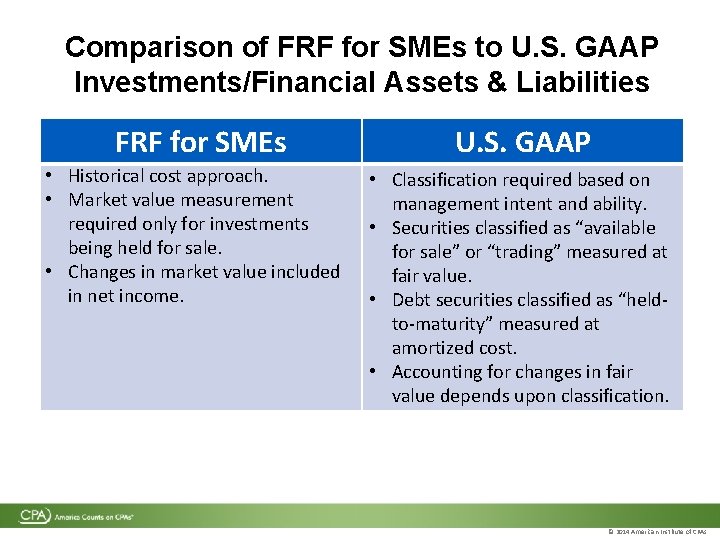
Comparison of FRF for SMEs to U. S. GAAP Investments/Financial Assets & Liabilities FRF for SMEs • Historical cost approach. • Market value measurement required only for investments being held for sale. • Changes in market value included in net income. U. S. GAAP • Classification required based on management intent and ability. • Securities classified as “available for sale” or “trading” measured at fair value. • Debt securities classified as “heldto-maturity” measured at amortized cost. • Accounting for changes in fair value depends upon classification. © 2014 American Institute of CPAs
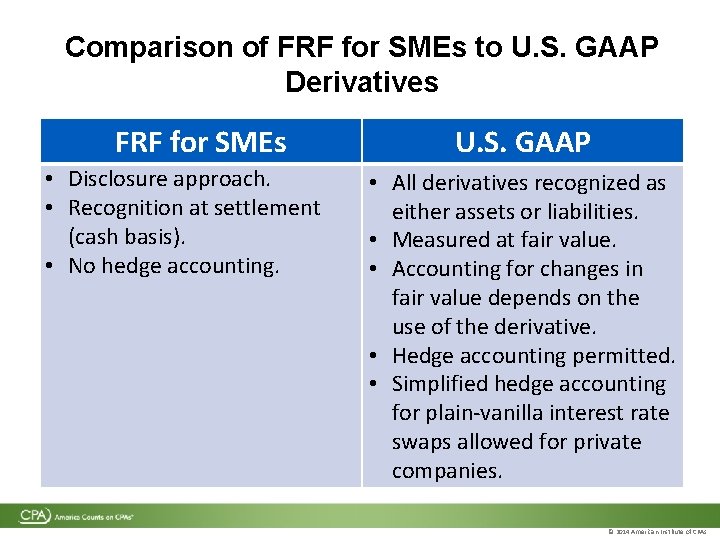
Comparison of FRF for SMEs to U. S. GAAP Derivatives FRF for SMEs • Disclosure approach. • Recognition at settlement (cash basis). • No hedge accounting. U. S. GAAP • All derivatives recognized as either assets or liabilities. • Measured at fair value. • Accounting for changes in fair value depends on the use of the derivative. • Hedge accounting permitted. • Simplified hedge accounting for plain-vanilla interest rate swaps allowed for private companies. © 2014 American Institute of CPAs
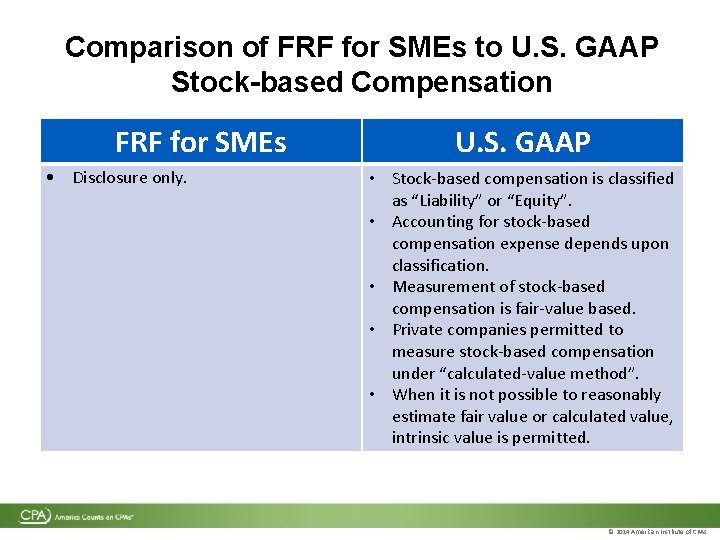
Comparison of FRF for SMEs to U. S. GAAP Stock-based Compensation FRF for SMEs • Disclosure only. U. S. GAAP • Stock-based compensation is classified as “Liability” or “Equity”. • Accounting for stock-based compensation expense depends upon classification. • Measurement of stock-based compensation is fair-value based. • Private companies permitted to measure stock-based compensation under “calculated-value method”. • When it is not possible to reasonably estimate fair value or calculated value, intrinsic value is permitted. © 2014 American Institute of CPAs
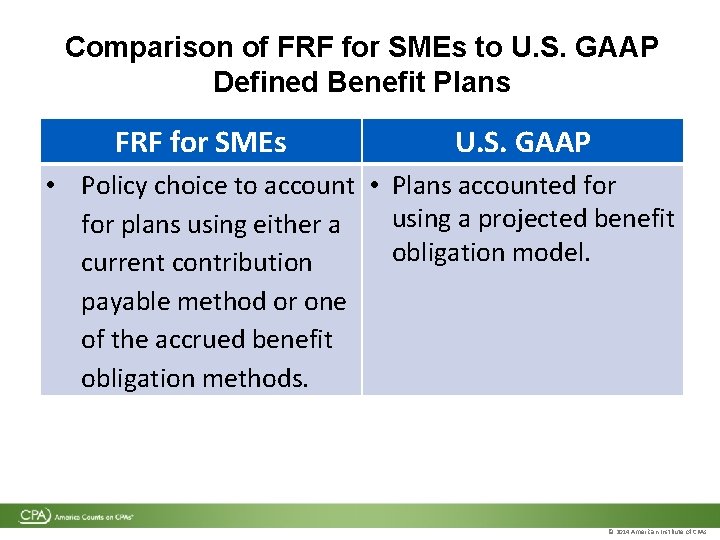
Comparison of FRF for SMEs to U. S. GAAP Defined Benefit Plans FRF for SMEs U. S. GAAP • Policy choice to account • Plans accounted for using a projected benefit for plans using either a obligation model. current contribution payable method or one of the accrued benefit obligation methods. © 2014 American Institute of CPAs
Reporting by CPAs © 2014 American Institute of CPAs
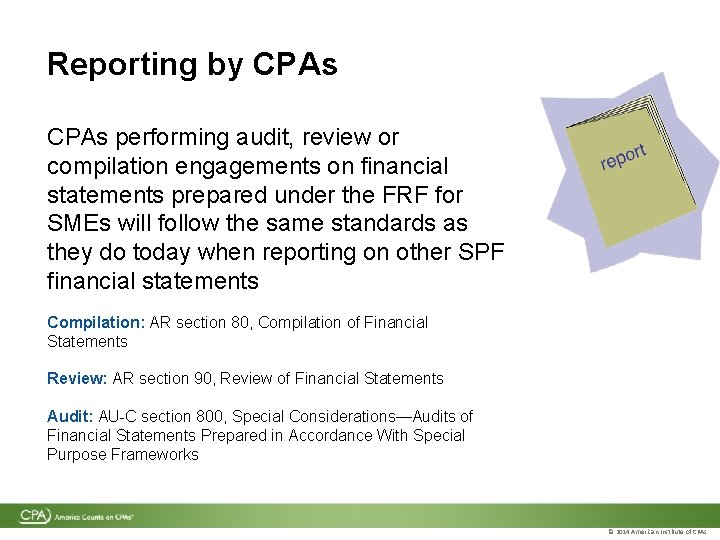
Reporting by CPAs performing audit, review or compilation engagements on financial statements prepared under the FRF for SMEs will follow the same standards as they do today when reporting on other SPF financial statements Compilation: AR section 80, Compilation of Financial Statements Review: AR section 90, Review of Financial Statements Audit: AU-C section 800, Special Considerations—Audits of Financial Statements Prepared in Accordance With Special Purpose Frameworks © 2014 American Institute of CPAs
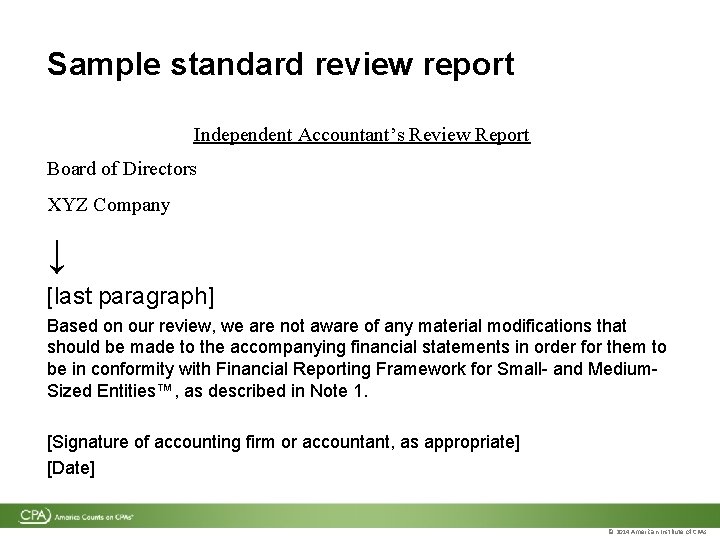
Sample standard review report Independent Accountant’s Review Report Board of Directors XYZ Company ↓ [last paragraph] Based on our review, we are not aware of any material modifications that should be made to the accompanying financial statements in order for them to be in conformity with Financial Reporting Framework for Small- and Medium. Sized Entities™, as described in Note 1. [Signature of accounting firm or accountant, as appropriate] [Date] © 2014 American Institute of CPAs
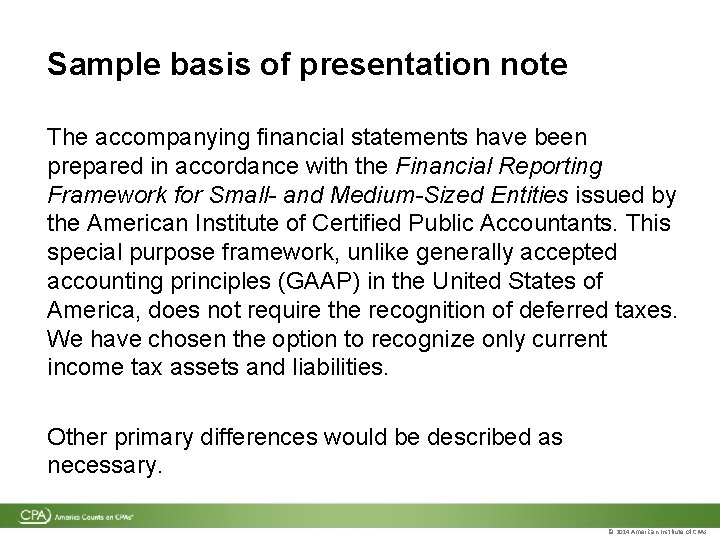
Sample basis of presentation note The accompanying financial statements have been prepared in accordance with the Financial Reporting Framework for Small- and Medium-Sized Entities issued by the American Institute of Certified Public Accountants. This special purpose framework, unlike generally accepted accounting principles (GAAP) in the United States of America, does not require the recognition of deferred taxes. We have chosen the option to recognize only current income tax assets and liabilities. Other primary differences would be described as necessary. © 2014 American Institute of CPAs
Extracts from Illustrative Financial Statements © 2014 American Institute of CPAs
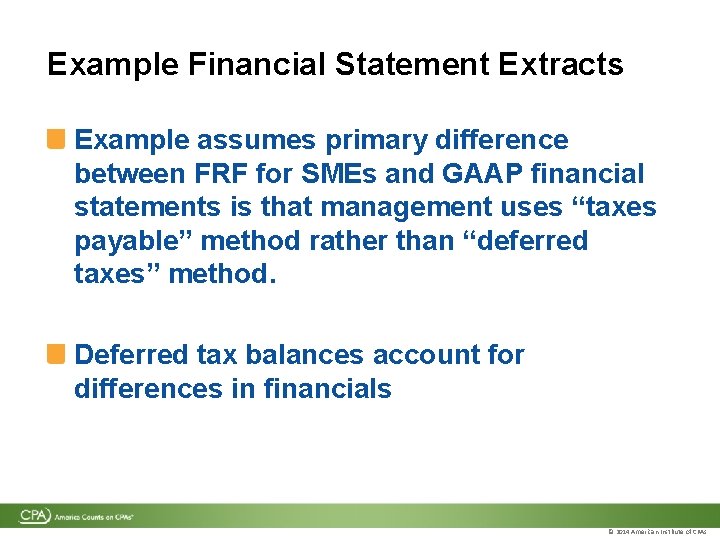
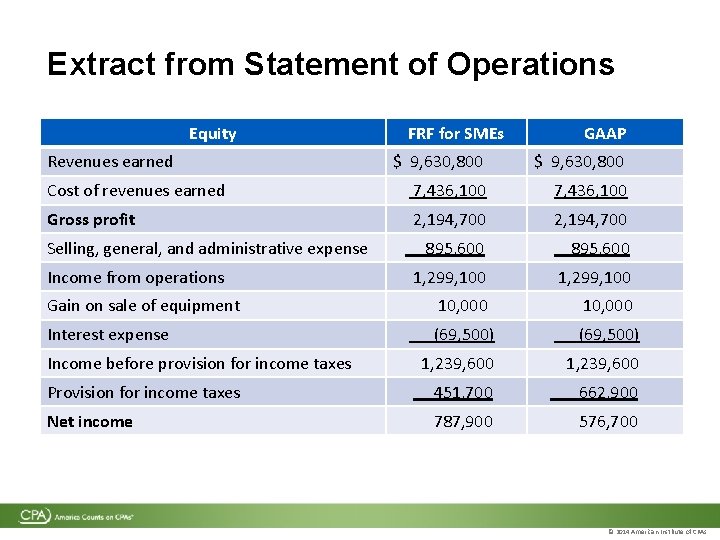
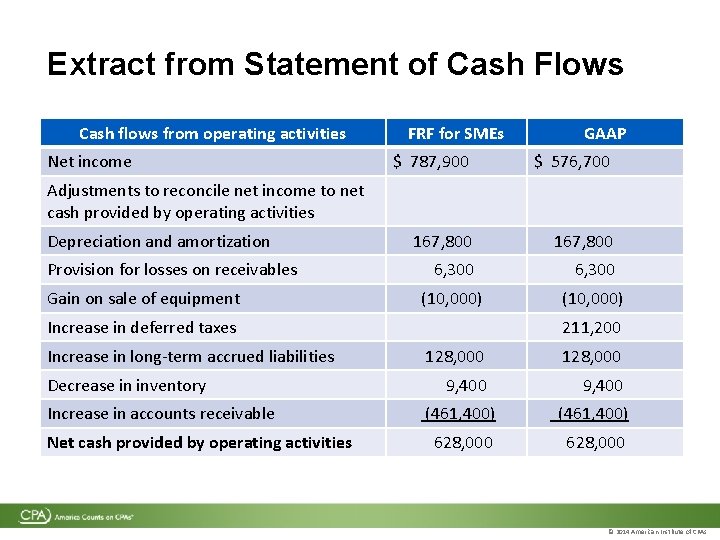
Example Financial Statement Extracts Example assumes primary difference between FRF for SMEs and GAAP financial statements is that management uses “taxes payable” method rather than “deferred taxes” method. Deferred tax balances account for differences in financials © 2014 American Institute of CPAs
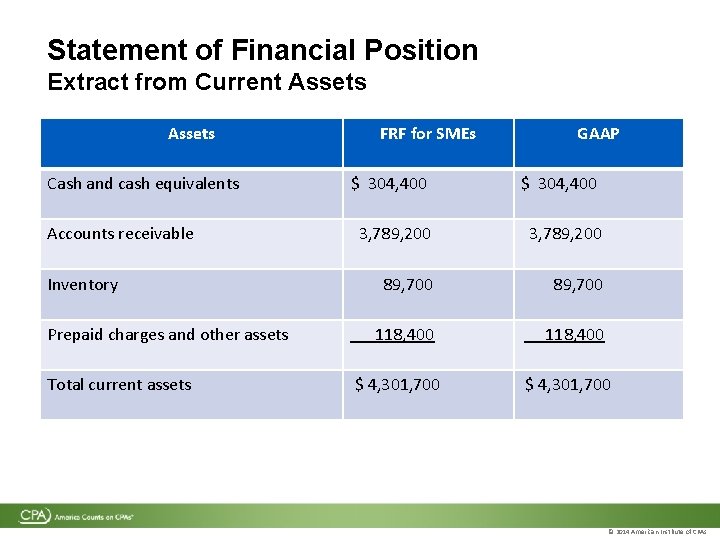
Statement of Financial Position Extract from Current Assets Cash and cash equivalents Accounts receivable Inventory Prepaid charges and other assets Total current assets FRF for SMEs GAAP $ 304, 400 3, 789, 200 89, 700 118, 400 $ 4, 301, 700 © 2014 American Institute of CPAs
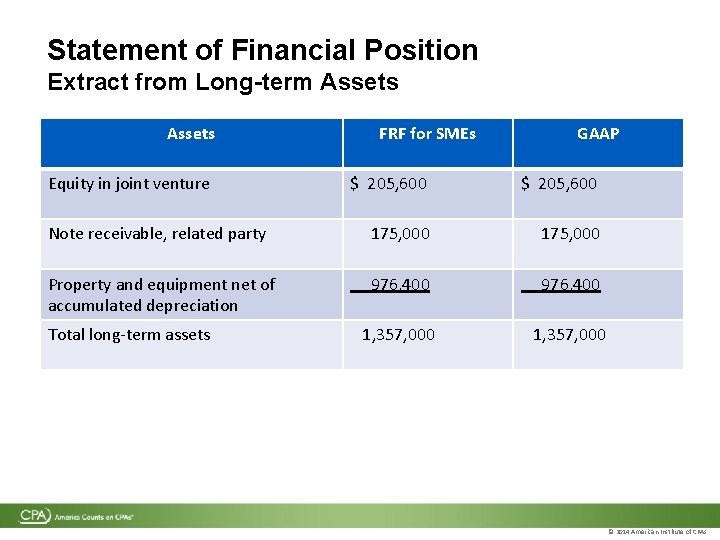
Statement of Financial Position Extract from Long-term Assets Equity in joint venture FRF for SMEs GAAP $ 205, 600 Note receivable, related party 175, 000 Property and equipment net of accumulated depreciation 976, 400 1, 357, 000 Total long-term assets © 2014 American Institute of CPAs
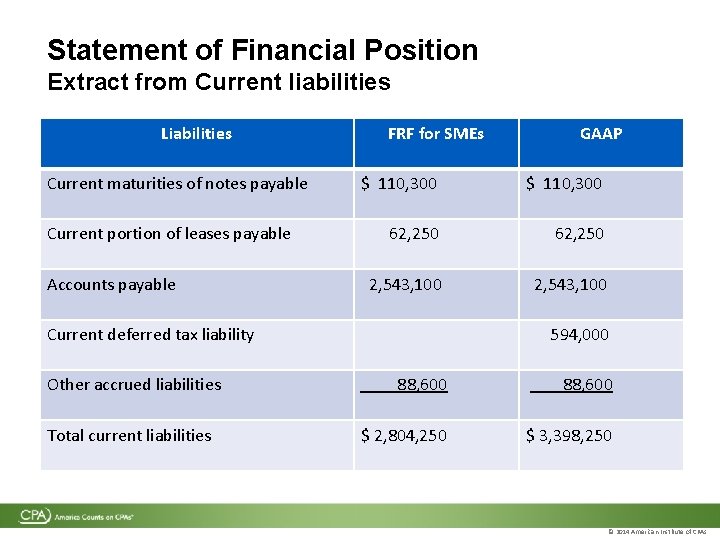
Statement of Financial Position Extract from Current liabilities Liabilities Current maturities of notes payable Current portion of leases payable Accounts payable FRF for SMEs $ 110, 300 62, 250 2, 543, 100 Current deferred tax liability Other accrued liabilities Total current liabilities GAAP 594, 000 88, 600 $ 2, 804, 250 $ 3, 398, 250 © 2014 American Institute of CPAs
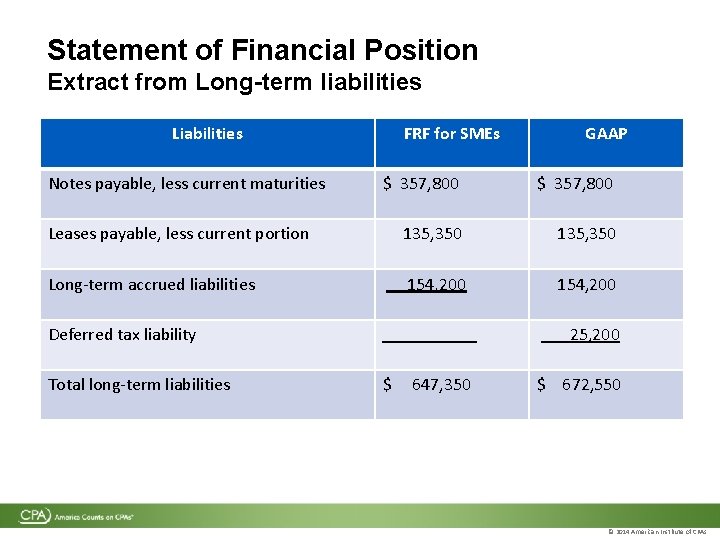
Statement of Financial Position Extract from Long-term liabilities Liabilities Notes payable, less current maturities FRF for SMEs GAAP $ 357, 800 Leases payable, less current portion 135, 350 Long-term accrued liabilities 154, 200 Deferred tax liability Total long-term liabilities 25, 200 $ 647, 350 $ 672, 550 © 2014 American Institute of CPAs
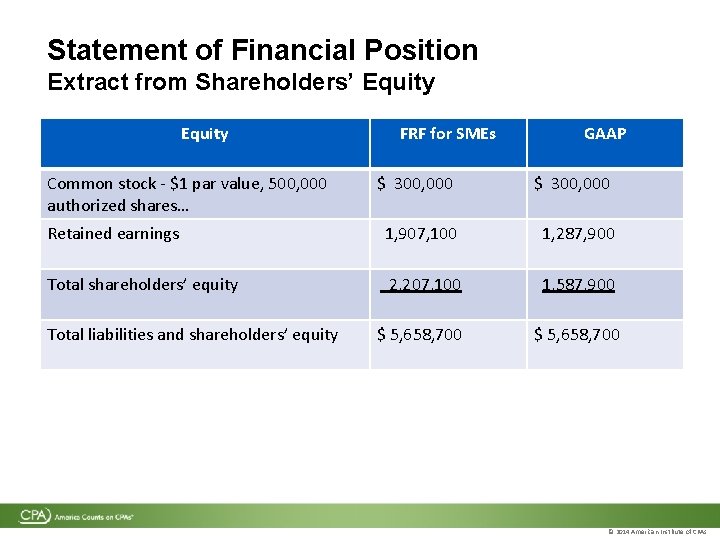
Statement of Financial Position Extract from Shareholders’ Equity Common stock - $1 par value, 500, 000 authorized shares… FRF for SMEs GAAP $ 300, 000 Retained earnings 1, 907, 100 1, 287, 900 Total shareholders’ equity 2, 207, 100 1, 587, 900 $ 5, 658, 700 Total liabilities and shareholders’ equity © 2014 American Institute of CPAs
Extract from Statement of Operations Equity Revenues earned FRF for SMEs GAAP $ 9, 630, 800 Cost of revenues earned 7, 436, 100 Gross profit 2, 194, 700 895, 600 1, 299, 100 Gain on sale of equipment 10, 000 Interest expense (69, 500) 1, 239, 600 Provision for income taxes 451, 700 662, 900 Net income 787, 900 576, 700 Selling, general, and administrative expense Income from operations Income before provision for income taxes © 2014 American Institute of CPAs
Extract from Statement of Cash Flows Cash flows from operating activities Net income FRF for SMEs GAAP $ 787, 900 $ 576, 700 167, 800 6, 300 (10, 000) Adjustments to reconcile net income to net cash provided by operating activities Depreciation and amortization Provision for losses on receivables Gain on sale of equipment Increase in deferred taxes Increase in long-term accrued liabilities Decrease in inventory Increase in accounts receivable Net cash provided by operating activities 211, 200 128, 000 9, 400 (461, 400) 628, 000 © 2014 American Institute of CPAs
FRF for SMEs Toolkits © 2014 American Institute of CPAs
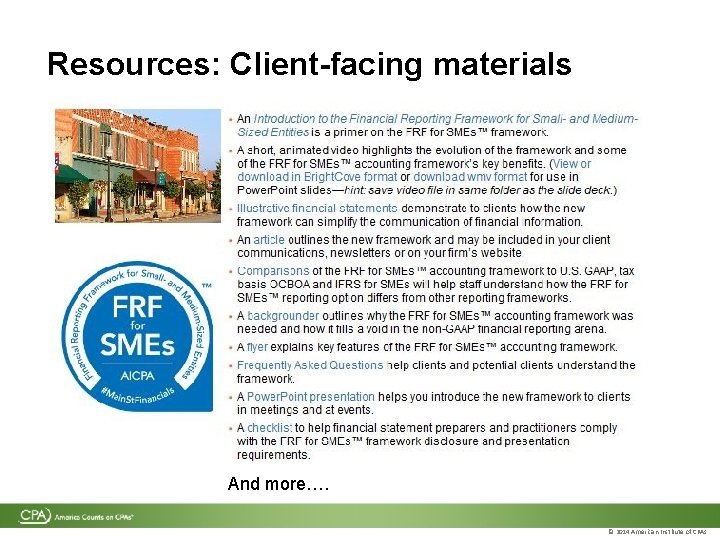
Resources: Client-facing materials And more…. © 2014 American Institute of CPAs
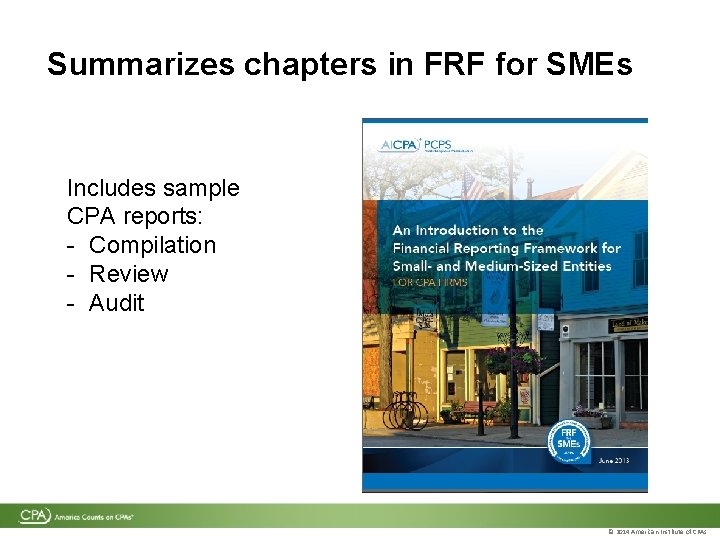
Summarizes chapters in FRF for SMEs Includes sample CPA reports: - Compilation - Review - Audit © 2014 American Institute of CPAs
Illustrative financial statements © 2014 American Institute of CPAs
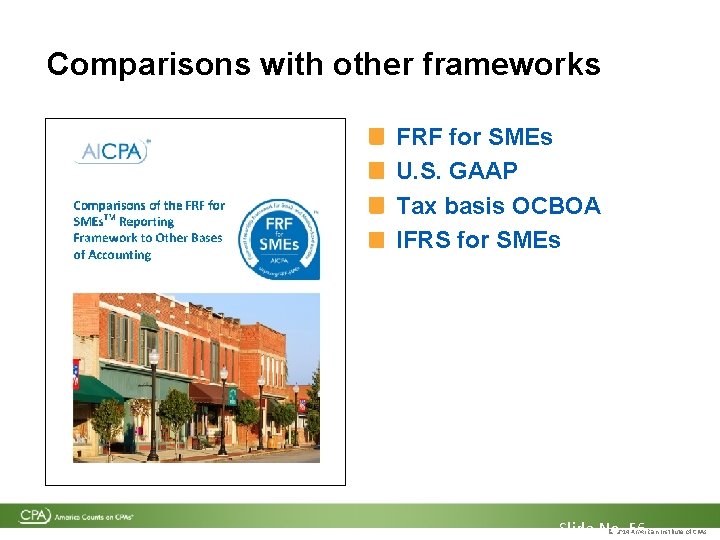
Comparisons with other frameworks FRF for SMEs U. S. GAAP Tax basis OCBOA IFRS for SMEs Slide No. 56 © 2014 American Institute of CPAs
Power. Point for use with clients/users Brand with firm name/information Slide No. 57 © 2014 American Institute of CPAs
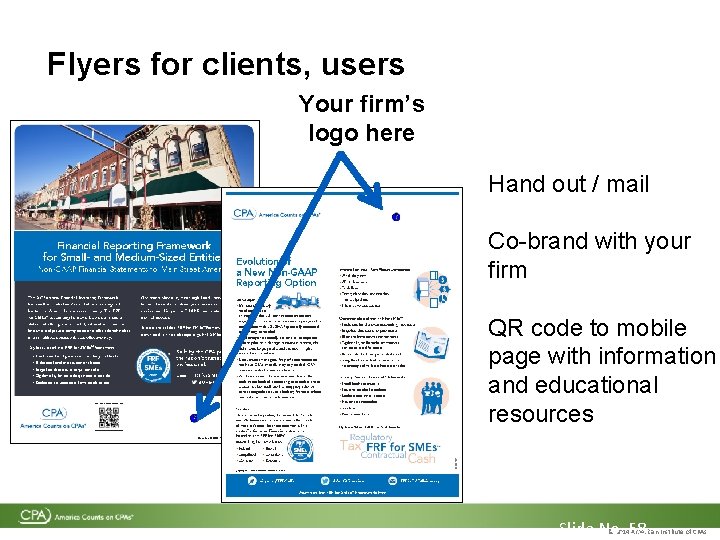
Flyers for clients, users Your firm’s logo here Hand out / mail Co-brand with your firm QR code to mobile page with information and educational resources Slide No. 58 © 2014 American Institute of CPAs
Disclosure checklist Slide No. 59 © 2014 American Institute of CPAs
Additional resources Social media support (Linked. In, Facebook, Tweets, Foursquare) #Main. St. Financials – ongoing conversation Article for website and/or newsletter/mailer Short video – social media, meetings, presentations © 2014 American Institute of CPAs
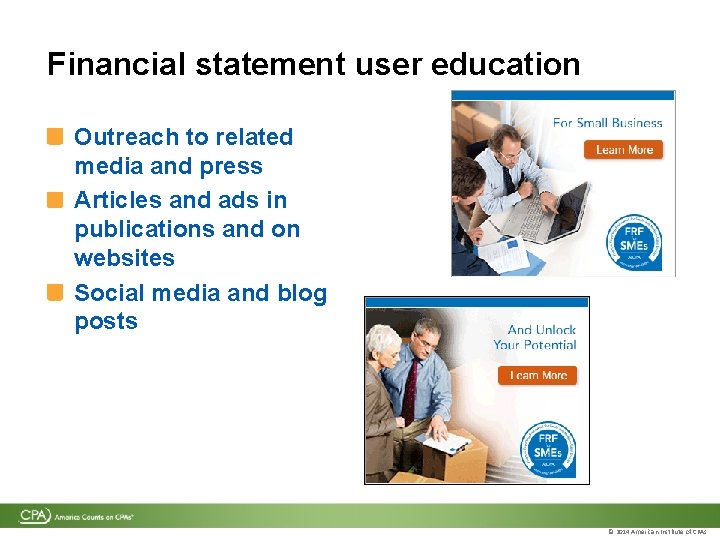
Financial statement user education Outreach to related media and press Articles and ads in publications and on websites Social media and blog posts © 2014 American Institute of CPAs
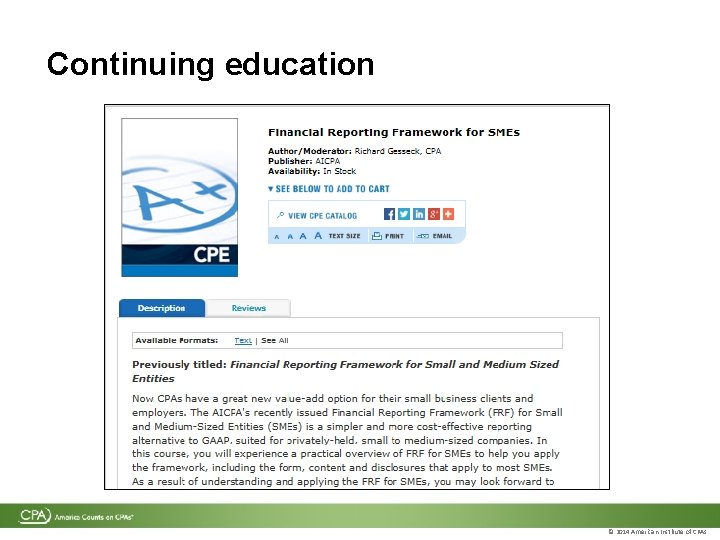
Continuing education © 2014 American Institute of CPAs
Questions? © 2014 American Institute of CPAs
Financial Reporting Framework for Small- and Medium-Sized Entities FRF for SMEs™ Accounting Framework Name of presenter Audience Date © 2014 American Institute of CPAs