Fewshot learning State of the Art Joseph Shtok

- Slides: 21
Few-shot learning State of the Art Joseph Shtok IBM Research AI The presentation is available at http: //www. research. ibm. com/haifa/dept/imt/ist_dm. shtml
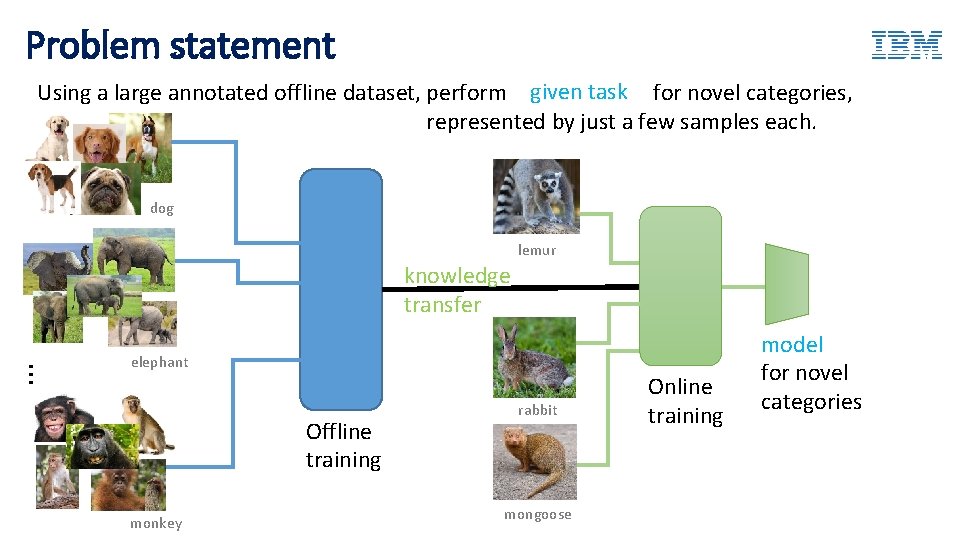
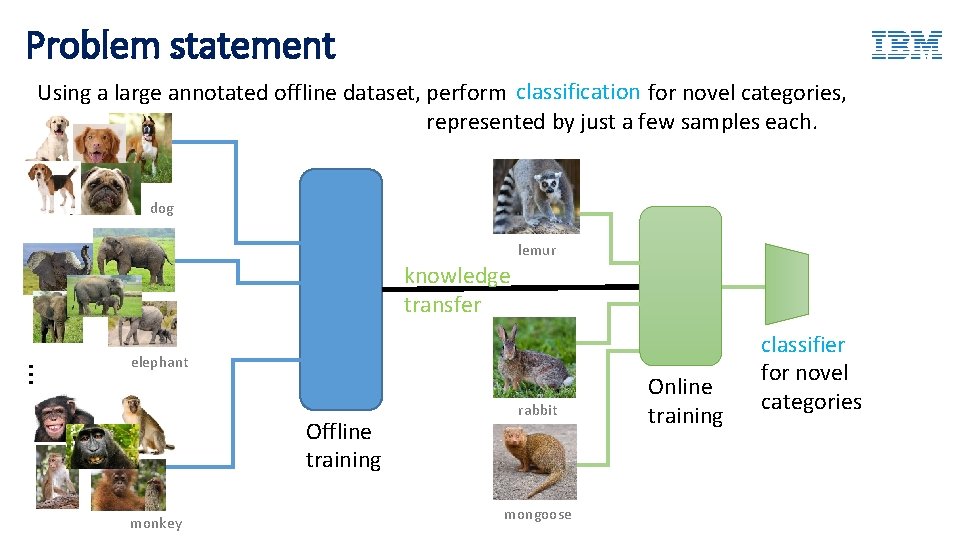
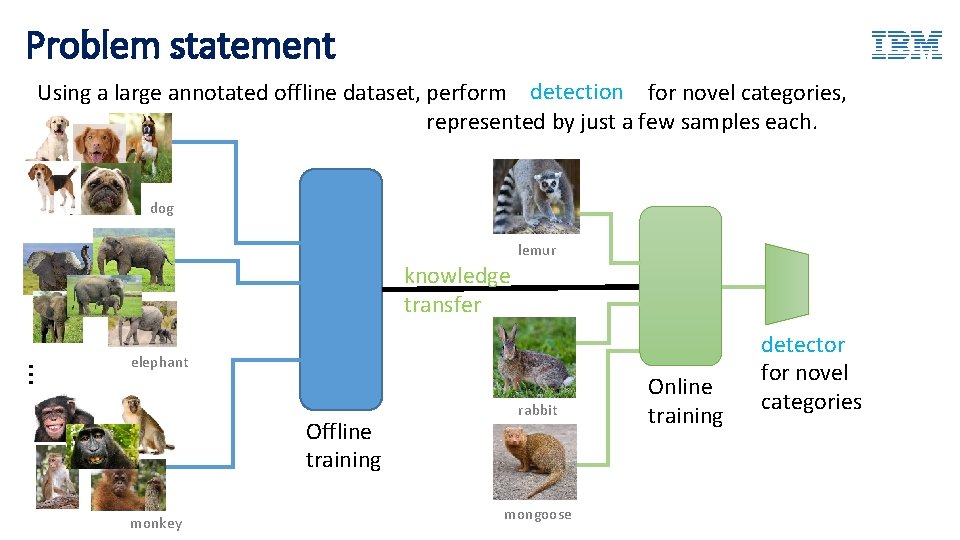
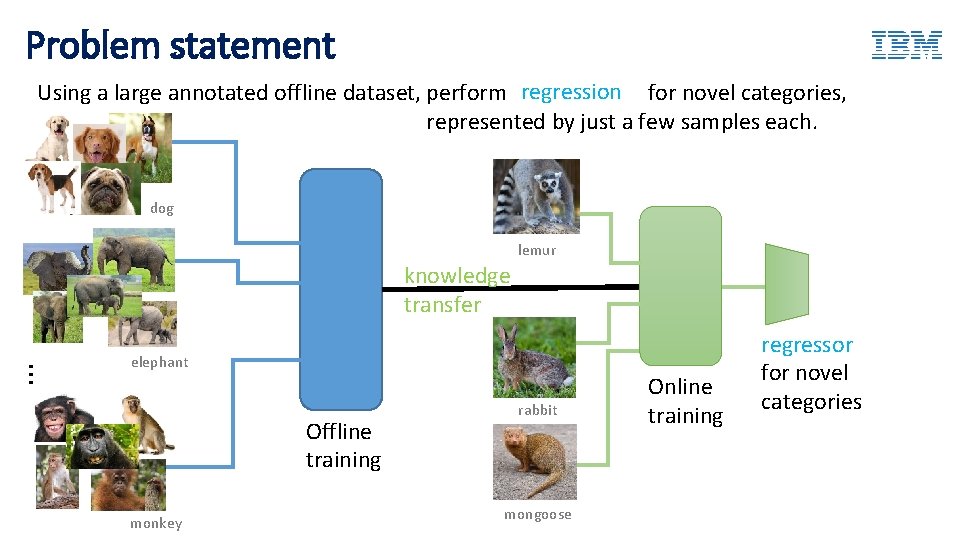
Problem statement given task Using a large annotated offline dataset, perform for novel categories, represented by just a few samples each. dog lemur knowledge transfer … elephant Offline training monkey rabbit mongoose Online training model for novel categories
Problem statement classification Using a large annotated offline dataset, perform for novel categories, represented by just a few samples each. dog lemur knowledge transfer … elephant Offline training monkey rabbit mongoose Online training classifier for novel categories
Problem statement detection Using a large annotated offline dataset, perform for novel categories, represented by just a few samples each. dog lemur knowledge transfer … elephant Offline training monkey rabbit mongoose Online training detector for novel categories
Problem statement regression Using a large annotated offline dataset, perform for novel categories, represented by just a few samples each. dog lemur knowledge transfer … elephant Offline training monkey rabbit mongoose Online training regressor for novel categories
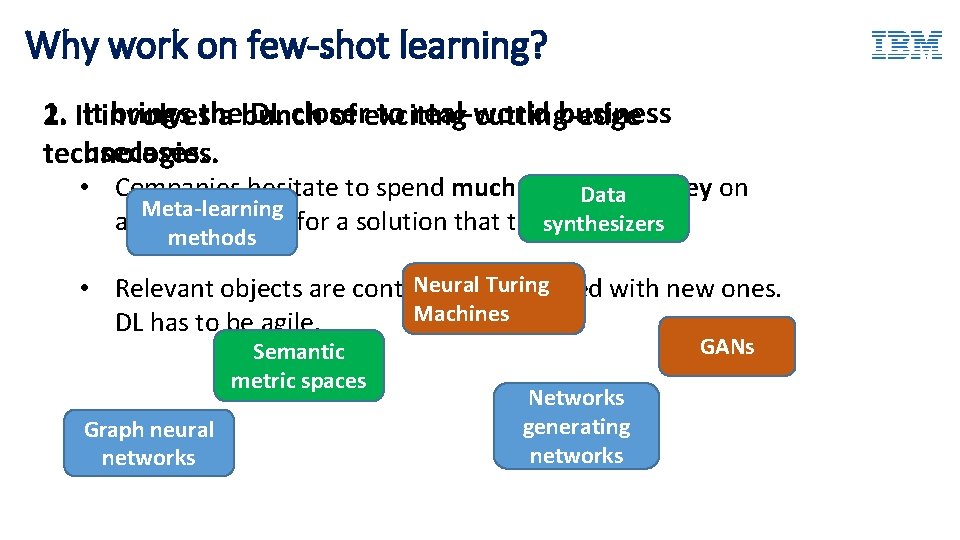
Why work on few-shot learning? 1. brings the DL closer to real-world business 2. Itinvolves a bunch of exciting cutting-edge usecases. technologies. • Companies hesitate to spend much time Data and money on Meta-learning annotated data for a solution that they may profit. synthesizers methods Neural Turing • Relevant objects are continuously replaced with new ones. Machines DL has to be agile. Semantic metric spaces Graph neural networks GANs Networks generating networks
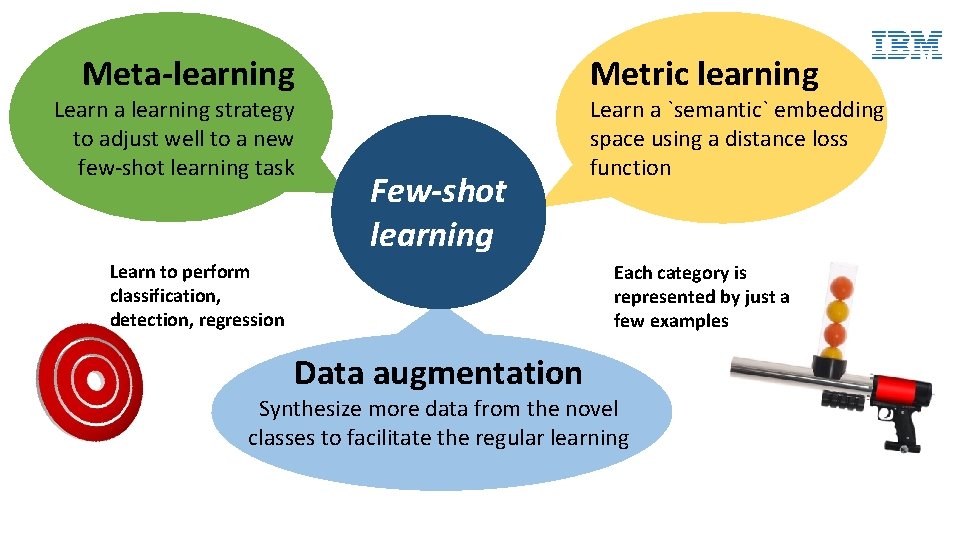
Metric learning Meta-learning Learn a learning strategy to adjust well to a new few-shot learning task Few-shot learning Learn to perform classification, detection, regression Learn a `semantic` embedding space using a distance loss function Each category is represented by just a few examples Data augmentation Synthesize more data from the novel classes to facilitate the regular learning
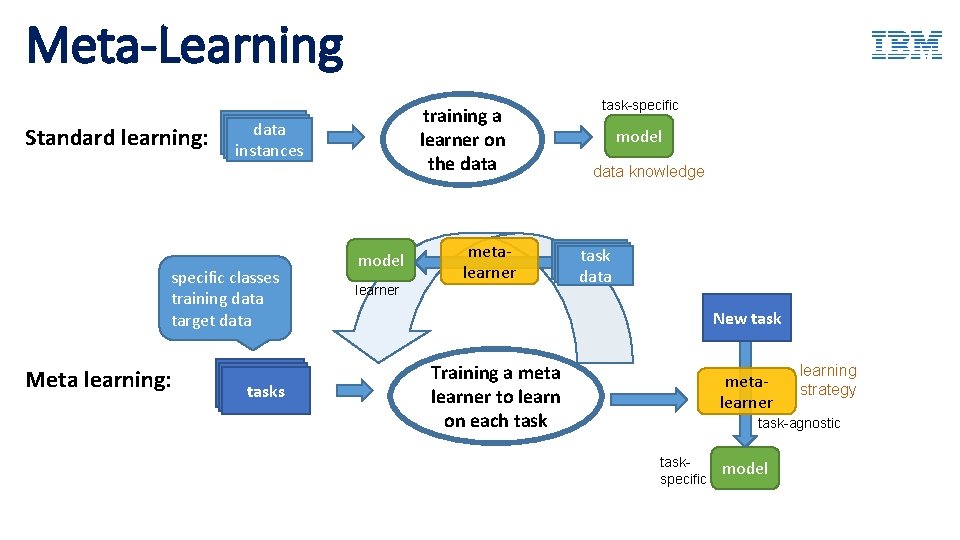
Meta-Learning Standard learning: data instances specific classes training data target data Meta learning: training a learner on the data tasks model learner metalearner task-specific model data knowledge task data New task Training a meta learner to learn on each task metalearner learning strategy task-agnostic taskspecific model
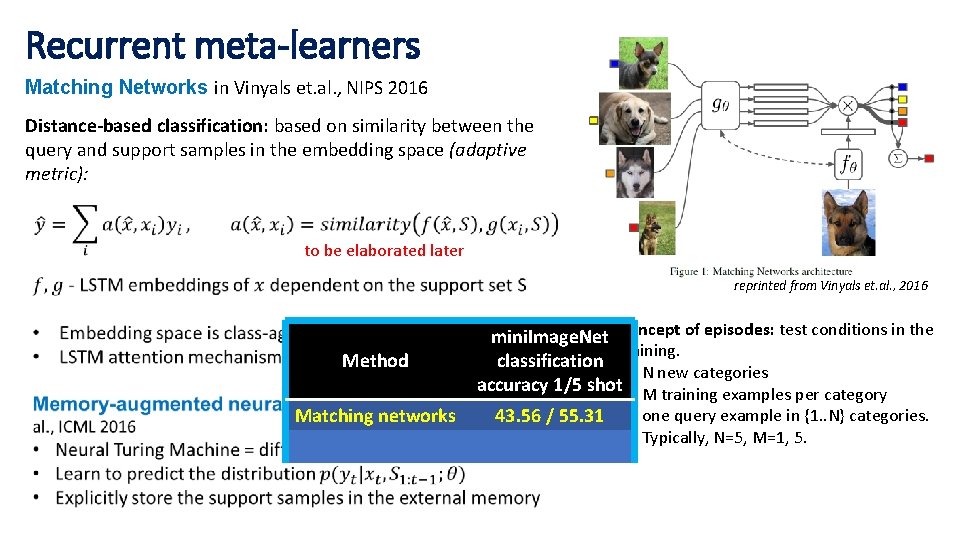
Recurrent meta-learners Matching Networks in Vinyals et. al. , NIPS 2016 Distance-based classification: based on similarity between the query and support samples in the embedding space (adaptive metric): to be elaborated later reprinted from Vinyals et. al. , 2016 Method Matching networks mini. Image. Net Concept of episodes: test conditions in the training. classification • N new categories accuracy 1/5 shot • M training examples per category 43. 56 / 55. 31 • one query example in {1. . N} categories. • Typically, N=5, M=1, 5.
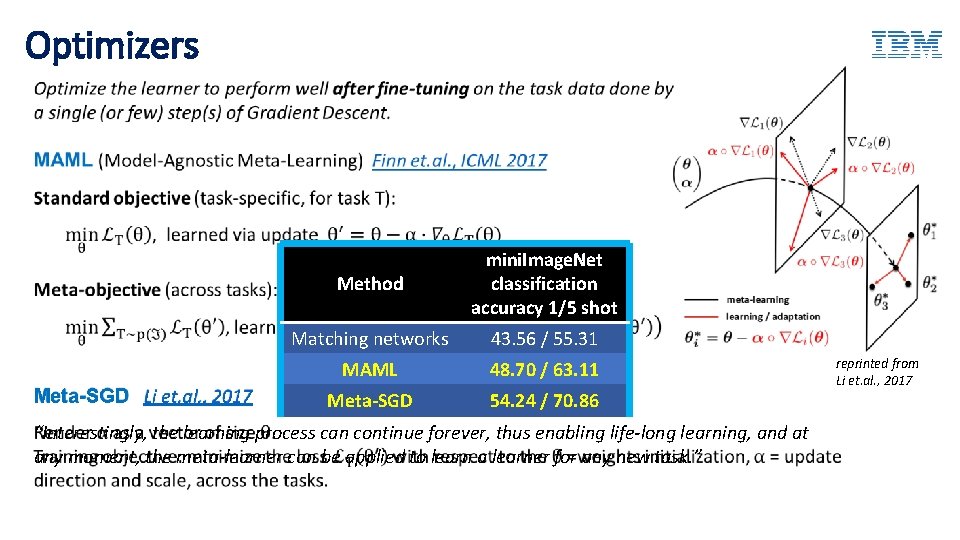
Optimizers Meta-SGD Li et. al. , 2017 Method mini. Image. Net classification accuracy 1/5 shot Matching networks 43. 56 / 55. 31 MAML 48. 70 / 63. 11 Meta-SGD 54. 24 / 70. 86 “Interestingly, the learning process can continue forever, thus enabling life-long learning, and at any moment, the meta-learner can be applied to learn a learner for any new task. ” reprinted from Li et. al. , 2017
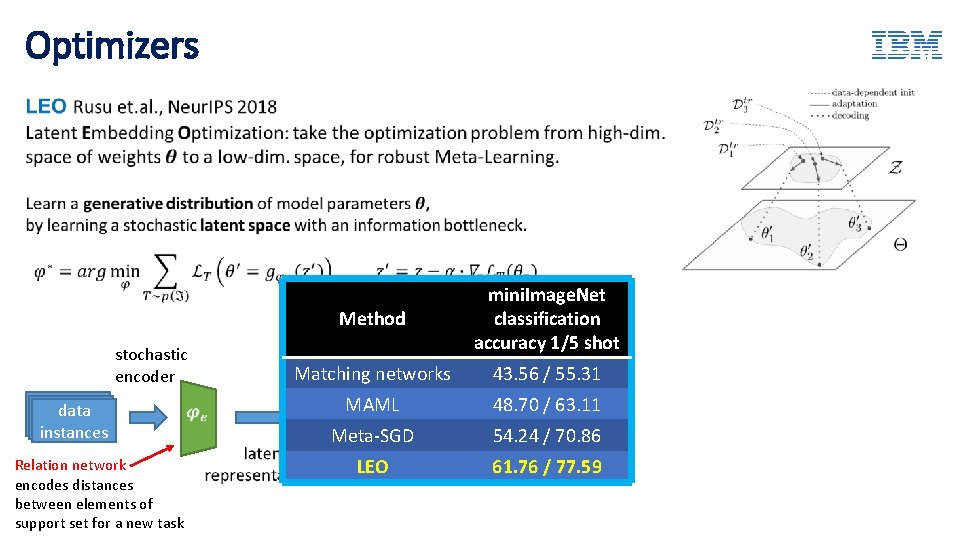
Optimizers mini. Image. Net classification accuracy 1/5 shot Method stochastic encoder data instances parameter Matching networks generator Relation network encodes distances between elements of support set for a new task MAML 43. 56 / 55. 31 48. 70 / 63. 11 Meta-SGD 54. 24 / 70. 86 LEO 61. 76 / 77. 59
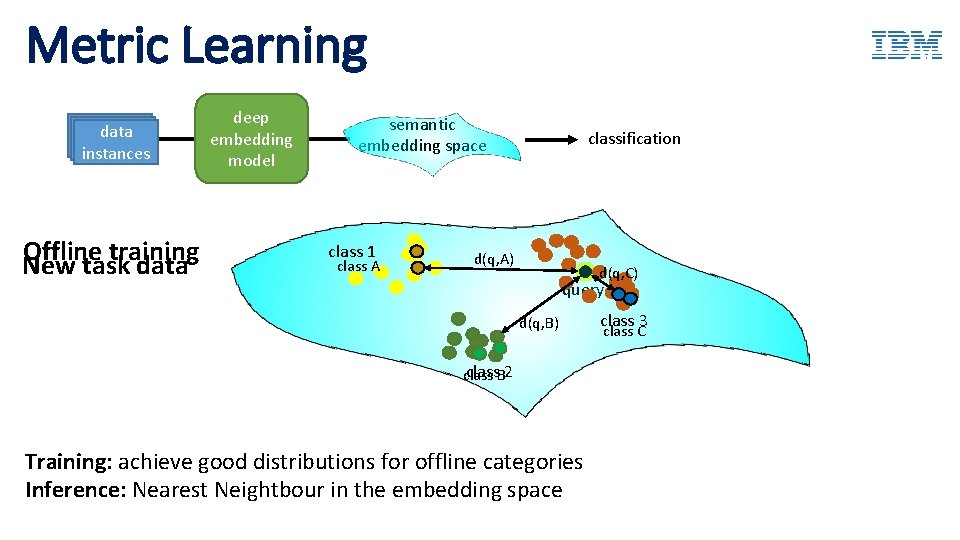
Metric Learning data instances Offline training New task data deep embedding model semantic embedding space class 1 class A classification d(q, A) d(q, C) query d(q, B) class 2 class B Training: achieve good distributions for offline categories Inference: Nearest Neightbour in the embedding space class 3 class C
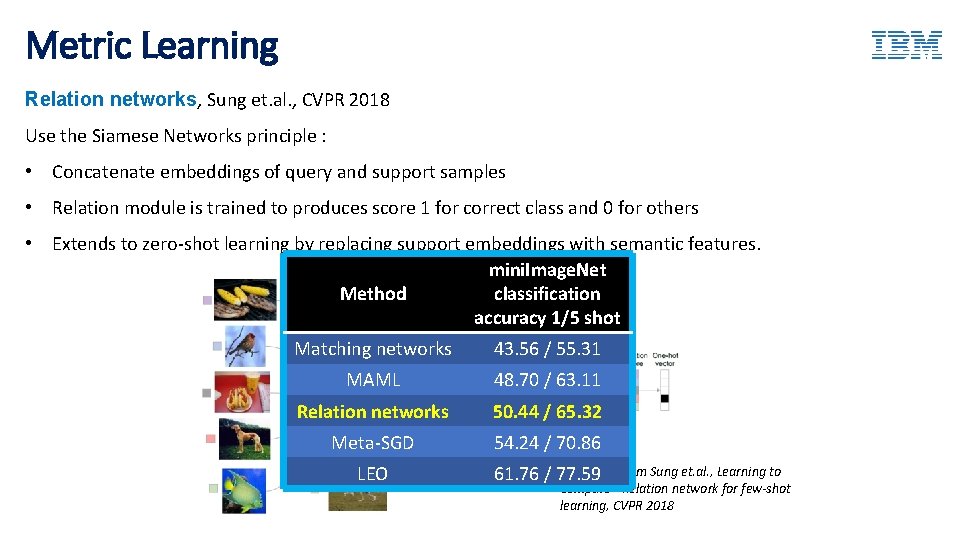
Metric Learning Relation networks, Sung et. al. , CVPR 2018 Use the Siamese Networks principle : • Concatenate embeddings of query and support samples • Relation module is trained to produces score 1 for correct class and 0 for others • Extends to zero-shot learning by replacing support embeddings with semantic features. mini. Image. Net Method classification accuracy 1/5 shot Matching networks 43. 56 / 55. 31 MAML 48. 70 / 63. 11 Relation networks 50. 44 / 65. 32 Meta-SGD 54. 24 / 70. 86 LEO replicated from Sung et. al. , Learning to 61. 76 / 77. 59 Compare - Relation network for few-shot learning, CVPR 2018
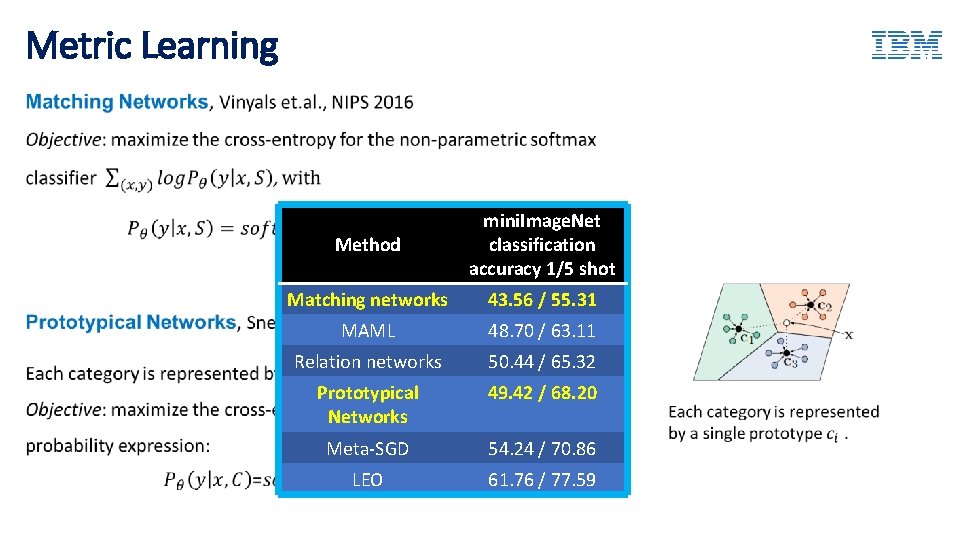
Metric Learning Method mini. Image. Net classification accuracy 1/5 shot Matching networks 43. 56 / 55. 31 MAML 48. 70 / 63. 11 Relation networks 50. 44 / 65. 32 Prototypical Networks 49. 42 / 68. 20 Meta-SGD 54. 24 / 70. 86 LEO 61. 76 / 77. 59
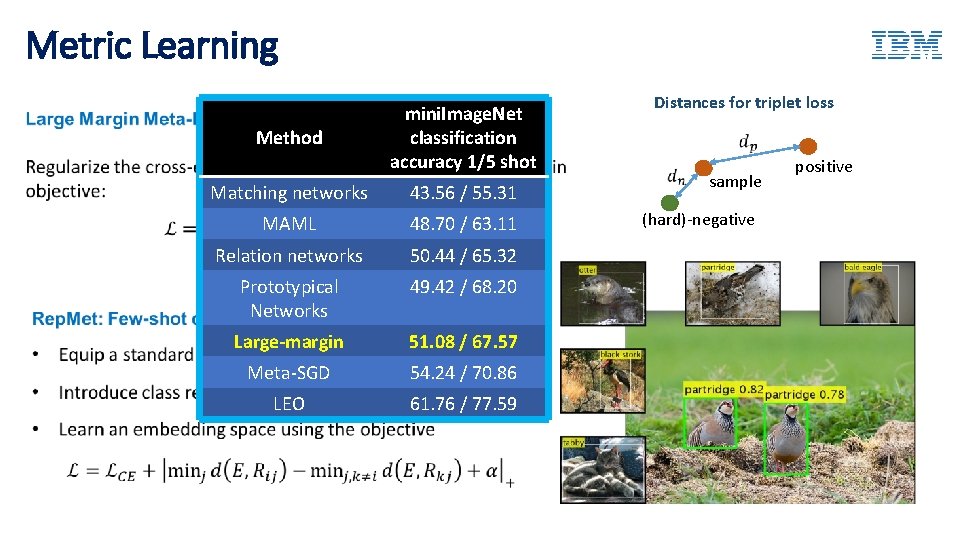
Metric Learning Method mini. Image. Net classification accuracy 1/5 shot Matching networks 43. 56 / 55. 31 MAML 48. 70 / 63. 11 Relation networks 50. 44 / 65. 32 Prototypical Networks 49. 42 / 68. 20 Large-margin 51. 08 / 67. 57 Meta-SGD 54. 24 / 70. 86 LEO 61. 76 / 77. 59 Distances for triplet loss sample (hard)-negative positive
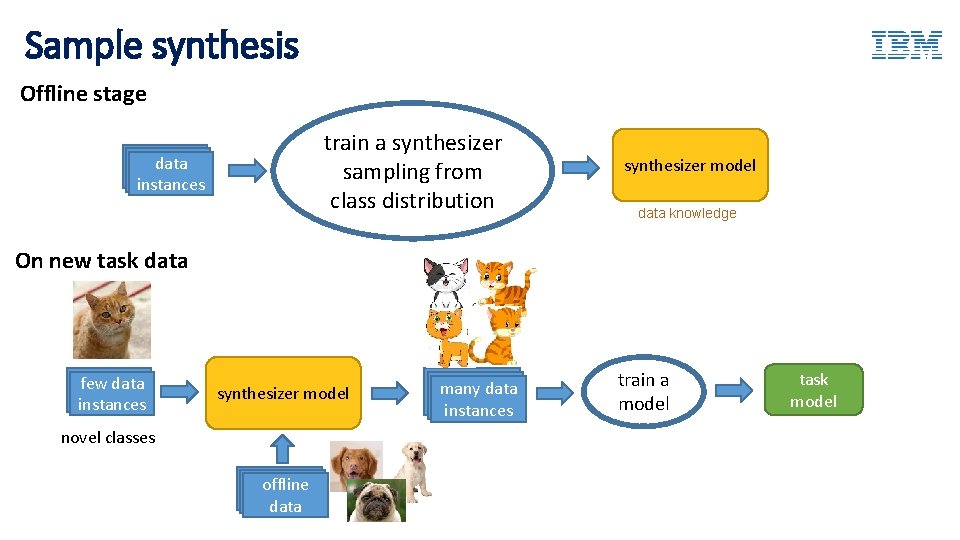
Sample synthesis Offline stage train a synthesizer sampling from class distribution data instances synthesizer model data knowledge On new task data few data instances synthesizer model novel classes offline data many data instances train a model task model
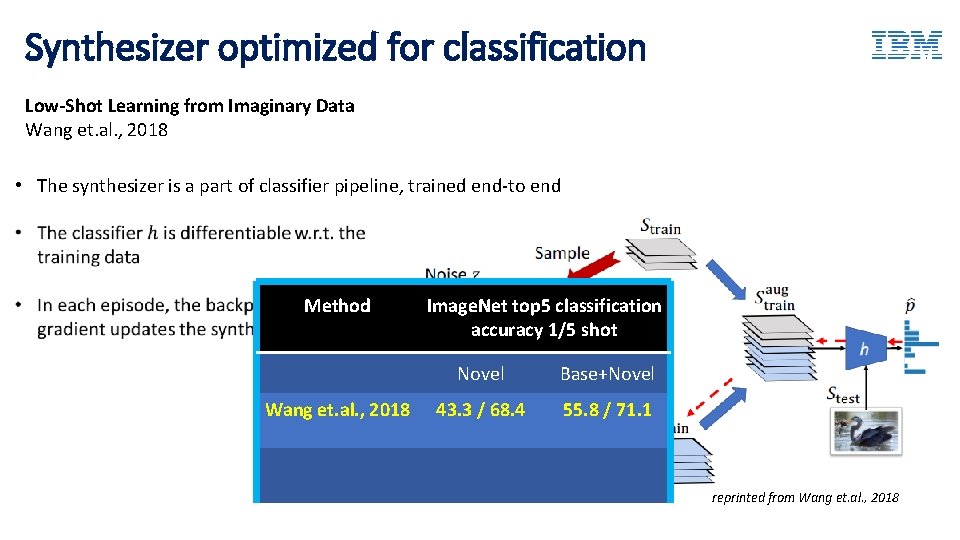
Synthesizer optimized for classification Low-Shot Learning from Imaginary Data Wang et. al. , 2018 • The synthesizer is a part of classifier pipeline, trained end-to end Method Wang et. al. , 2018 Image. Net top 5 classification accuracy 1/5 shot Novel Base+Novel 43. 3 / 68. 4 55. 8 / 71. 1 reprinted from Wang et. al. , 2018
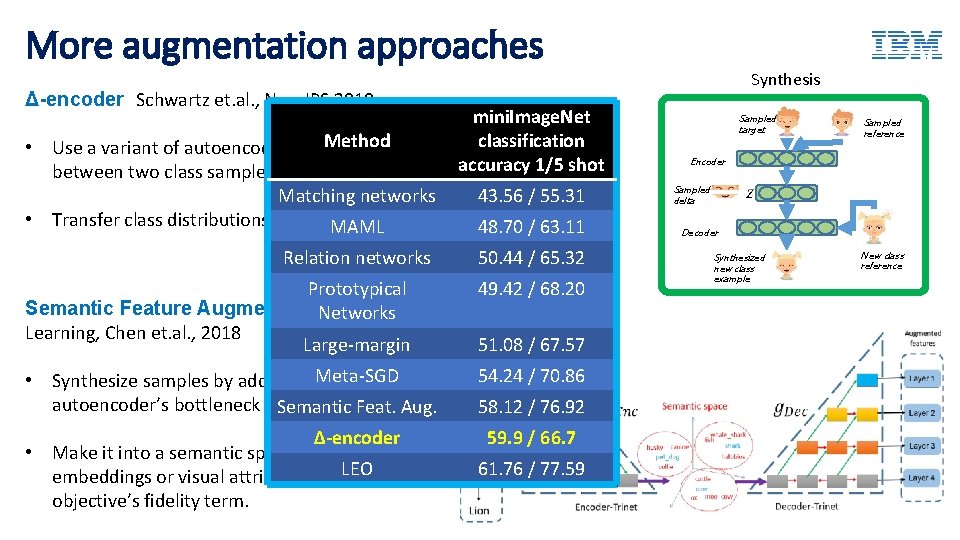
More augmentation approaches Synthesis Δ-encoder Schwartz et. al. , Neur. IPS 2018 mini. Image. Net Method classification • Use a variant of autoencoder to capture the intra-class difference between two class samples in the latent space. accuracy 1/5 shot Sampled target Encoder Matching networks 43. 56 / 55. 31 • Transfer class distributions from training to novel classes. MAML 48. 70 / 63. 11 Relation networks 50. 44 / 65. 32 Prototypical Semantic Feature Augmentation in Few-shot Networks Learning, Chen et. al. , 2018 Large-margin 49. 42 / 68. 20 Meta-SGD • Synthesize samples by adding noise in the autoencoder’s bottleneck space. Semantic Feat. Aug. 54. 24 / 70. 86 Δ-encoder • Make it into a semantic space, using word LEO embeddings or visual attributes for the objective’s fidelity term. Sampled reference Sampled delta Decoder New class reference Synthesized new class example 51. 08 / 67. 57 58. 12 / 76. 92 59. 9 / 66. 7 61. 76 / 77. 59
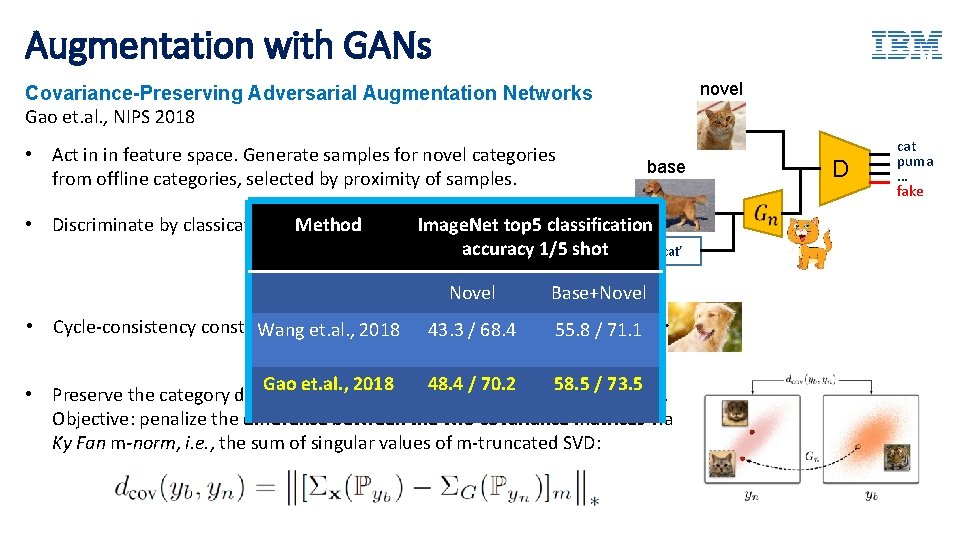
Augmentation with GANs novel Covariance-Preserving Adversarial Augmentation Networks Gao et. al. , NIPS 2018 • Act in in feature space. Generate samples for novel categories from offline categories, selected by proximity of samples. correct class • Discriminate by classication: real image Method Image. Net top 5 classification synthetic image ‘fake’ accuracy 1/5 shot ‘cat’ Novel • Cycle-consistency constraint: Wang et. al. , 2018 43. 3 / 68. 4 D base Base+Novel 55. 8 / 71. 1 Gao et. al. , 2018 48. 4 / 70. 2 58. 5 / 73. 5 • Preserve the category distribution during transfer of base novel category. Objective: penalize the difference between the two covariance matrices via Ky Fan m-norm, i. e. , the sum of singular values of m-truncated SVD: cat puma … fake
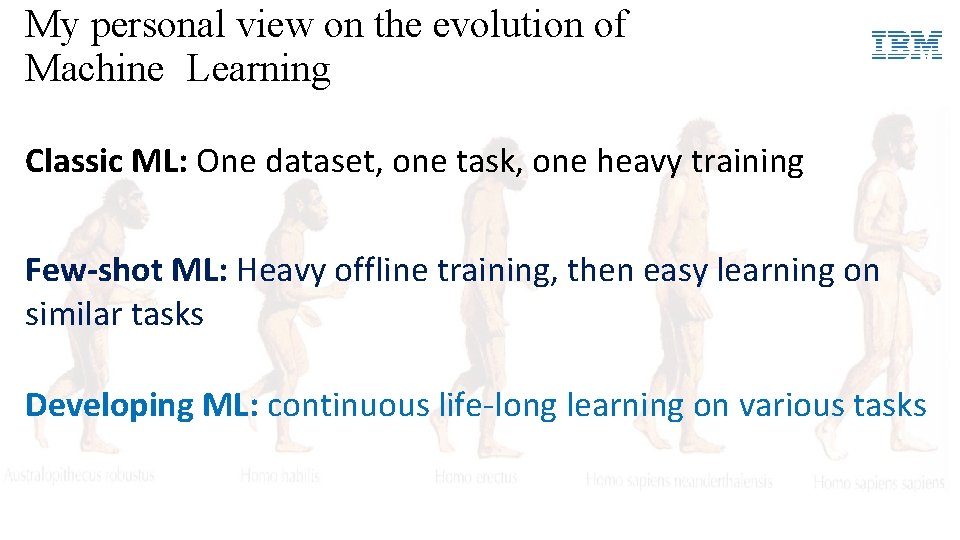
My personal view on the evolution of Machine Learning Classic ML: One dataset, one task, one heavy training Few-shot ML: Heavy offline training, then easy learning on similar tasks Developing ML: continuous life-long learning on various tasks
Thank you The presentation is available at http: //www. research. ibm. com/haifa/dept/imt/ist_dm. shtml