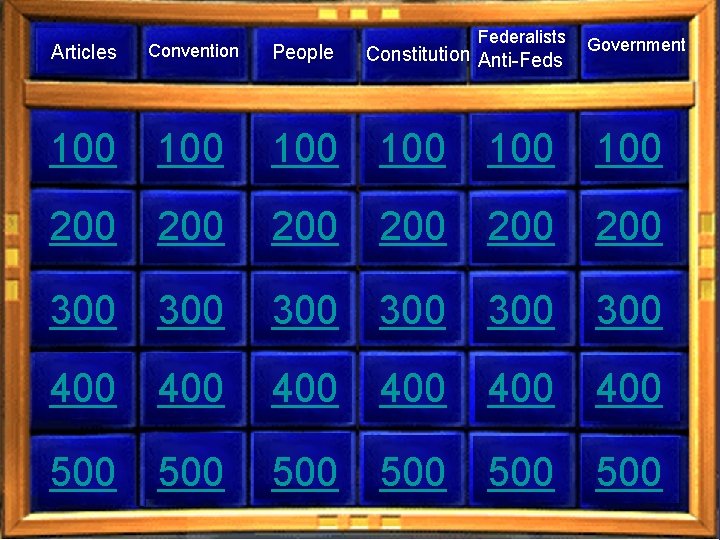
Federalists Government Articles Convention People 100 100 100

- Slides: 64
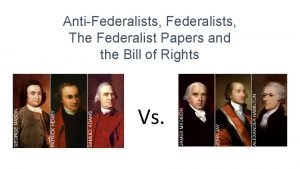
Federalists Government Articles Convention People 100 100 100 200 200 200 300 300 300 400 400 400 500 500 500 Constitution Anti-Feds
Question A 100 Articles of Confederation put most of the power with the (state or federal) government.
Answer A 100 State A 100
Question B 100 Constitutional Convention was a meeting to ________.
Answer B 100 Improve the Articles of Confederation B 100
Question C 100 Massachusetts farmer who led a rebellion against the government
Answer C 100 Daniel Shays C 100
Question D 100 The preamble sets the purpose for the document. The phrase, “in order to form a more perfect union, ” means that they wanted to ___________.
Answer D 100 Create a better government Than the Articles of Confederation D 100
Question E 100 People who supported a strong central government and the new Constitution
Answer E 100 Federalists E 100
Question F 100 The 3 branches of government are:
Answer F 100 Legislative, Executive, & Judicial F 100
Question A 200 Under the Articles, the federal government could raise an army, but could not _______.
Answer A 200 Force anyone to join A 200
Question B 200 Plan that favored the states with larger populations. 2 Houses both with representation proportional to population.
Answer B 200 Virginia Plan B 200
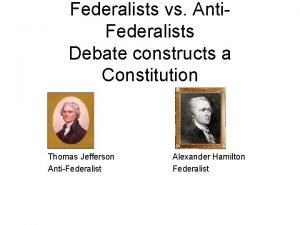
Question C 200 Anti-Federalist who believed people should stand up to their government. “A little rebellion now and again, is a good thing. ”
Answer C 200 Thomas Jefferson C 200
Question D 200 The constitution includes separation of powers and checks and balances to avoid __________.
Answer D 200 An all powerful central government (they had just fought to get rid of one) D 200
Question E 200 Thomas Jefferson authored essays defending states rights and a smaller central government. He was a(n) ___________
Answer E 200 Anti-federalist E 200
Question F 200 The office of the President carries out the laws and is called the ________ branch.
Answer F 200 Executive F 200
Question A 300 Under the Articles, the federal government could coin (print) money, but they could not _______.
Answer A 300 Raise (levy) taxes A 300
Question B 300 Plan that smaller states likes based on equal representation in 1 house legislature.
Answer B 300 New Jersey Plan B 300
Question C 300 Federalist Papers author who believed that the wealthy and educated should rule.
Answer C 300 Alexander Hamilton C 300
Question D 300 Line in the preamble that addresses the need for the government to provide services to it citizens to ensure their health and wellness.
Answer D 300 Promote the General Welfare D 300
Question E 300 Federalist Papers were written by: _________________
Answer E 300 John Jay James Madison Alexander Hamilton E 300
Question F 300 The branch that makes the laws.
Answer F 300 Legislative F 300
Question A 400 The Northwest ordinance was the first attempt to control ______.
Answer A 400 Slavery A 400
Question B 400 Compromises that solved issues over representation _______________________
Answer B 400 Great Compromise –Wm. Sherman 3/5 Compromise B 400
Question C 400 Would not sign the Constitution without a Bill of Rights
Answer C 400 George Mason C 400
Question D 400 The body of the constitution is divided into 7 _______, or sections.
Answer D 400 Articles D 400
Question E 400 One argument of anti-federalists was that the government would be led by a small group of wealthy and elite, and would become _______.
Answer E 400 Oppressive E 400
Question F 400 This branch settles disputes about and interprets the laws.
Answer F 400 Judicial F 400
Question A 500 Actual problems that the Articles were too weak to address _______________
Answer A 500 • Trade issues with Spain and Britain • Post war depression • Rebellions like Shay’s • Disagreements over slavery A 500
Question B 500 Needed 9 states to ratify (approve) the Constitution. Some states held out for the promise of ________
Answer B 500 A Bill of Rights B 500
Question C 500 Father of the Constitution and author of Federalist Papers
Answer C 500 James Madison C 500
Question D 500 First 10 amendments to the constitution, ensuring all citizens basic rights in the federal government.
Answer D 500 Bill of Rights D 500
Question E 500 In the end, the federalists agree to _________ in order to get the Constitution ratified.
Answer E 500 Bill of Rights E 500
Question F 500 System where each branch has power to limit another branch. Ex: President can veto a law, congress can override the veto, and the Supreme Court can declare a law unconstitutional.
Answer F 500 Checks and Balances F 500