
The Constitution Breakdown The Annapolis Meeting Attempt to
The Constitution Breakdown
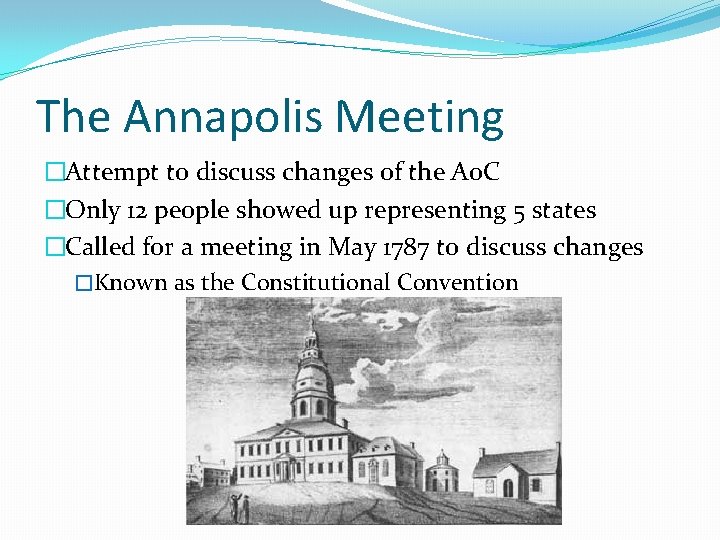
The Annapolis Meeting �Attempt to discuss changes of the Ao. C �Only 12 people showed up representing 5 states �Called for a meeting in May 1787 to discuss changes �Known as the Constitutional Convention
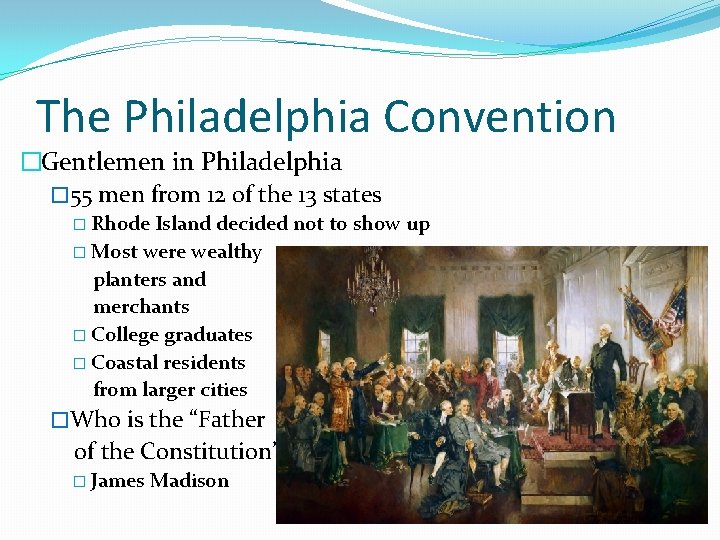
The Philadelphia Convention �Gentlemen in Philadelphia � 55 men from 12 of the 13 states � Rhode Island decided not to show up � Most were wealthy planters and merchants � College graduates � Coastal residents from larger cities �Who is the “Father of the Constitution”? � James Madison
Five Principles of Government �Popular Sovereignty �Rule of the people provides legitimacy for the gov’t �Limited Government �Gov’t that is bound to certain principles by a constitution �Federalism �System that allows states to share power with the nat’l gov’t �Each level has their own responsibilities �Separation of Powers �Providing different branches of gov’t with different but equal powers �Checks and Balances �Each gov’t branch balancing the others to ensure no one becomes too powerful
Article I – Legislative Branch �House �Senate �Elected every 2 years � 2 senators from each state � 25 years old and inhabitant �Elected every 6 years of the state �Chosen by population �Choose Speaker of the House and other officers �Sole power of impeachment � 30 years old and 9 year US citizen and must live in the state elected from �Choose officers: � Pro Tempe – presides when VP not there �Power to try impeachments
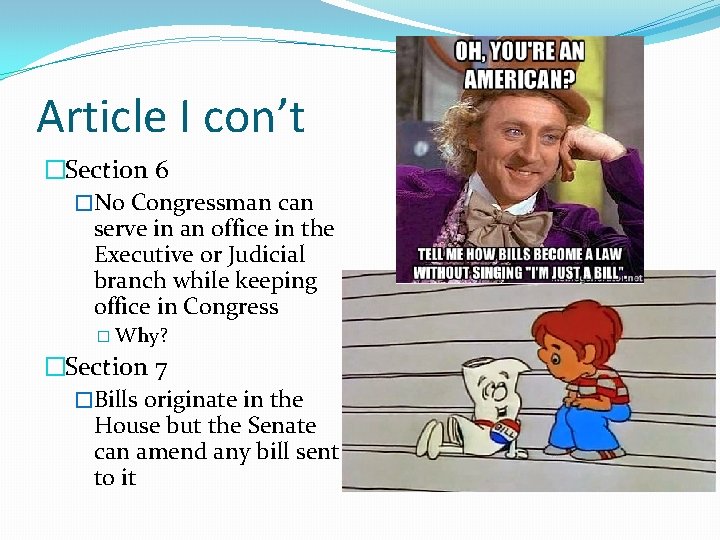
Article I con’t �Section 6 �No Congressman can serve in an office in the Executive or Judicial branch while keeping office in Congress � Why? �Section 7 �Bills originate in the House but the Senate can amend any bill sent to it
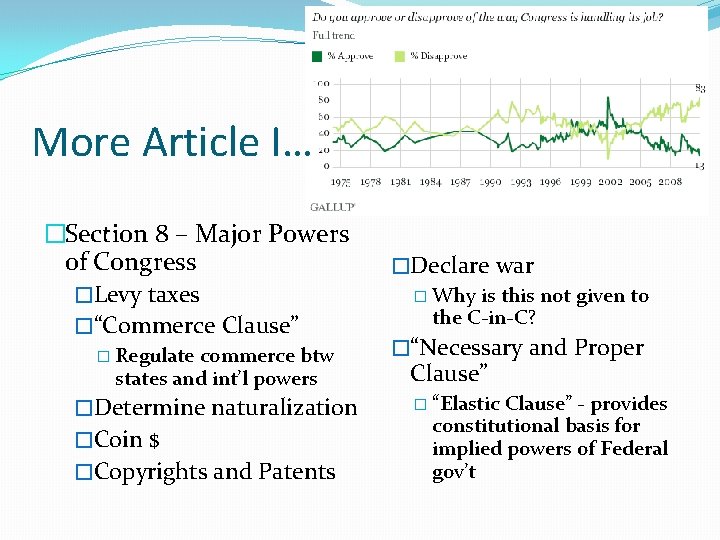
More Article I… �Section 8 – Major Powers of Congress �Levy taxes �“Commerce Clause” � Regulate commerce btw states and int’l powers �Determine naturalization �Coin $ �Copyrights and Patents �Declare war � Why is this not given to the C-in-C? �“Necessary and Proper Clause” � “Elastic Clause” - provides constitutional basis for implied powers of Federal gov’t
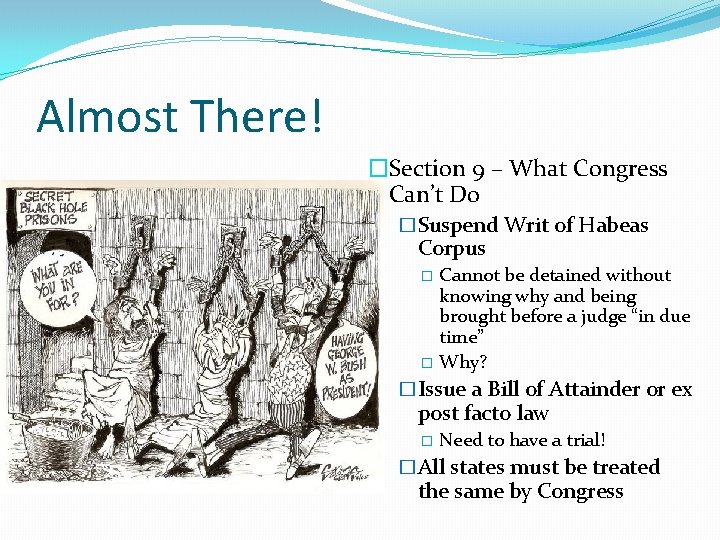
Almost There! �Section 9 – What Congress Can’t Do �Suspend Writ of Habeas Corpus Cannot be detained without knowing why and being brought before a judge “in due time” � Why? � �Issue a Bill of Attainder or ex post facto law � Need to have a trial! �All states must be treated the same by Congress
Article II – Executive Branch �Establishes president title �Serve 4 years �Naturalized citizen � 35 years old �Electoral College �Each state appoints “electors” equal to their number of Senators and Representatives �No sitting Congressman could be chosen � Why?
Article II – It doesn’t end there… �Powers and Duties �Veto and approval powers for legislation (1. 7. ii) �Commander-in-Chief �Make treaties, appoint ambassadors, justices, With the consent of who? � Senate � How many must say yes? � Simple majority � �Impeachment �Must be for treason, bribery, or other high crimes
Article III – Judicial Branch �Vested in the Supreme Court (high court) �Congress may from time to time establish other courts �Justices hold office until they die or retire �Have authority over a case depending on the subject matter or who’s involved �Appellate Jurisdiction – court’s power to hear a case on appeal from a lower court �Original Jurisdiction – hear the case in the first instance, not on an appeal �SC has both – but its normally on appeals
Article III - Treason �Definition (only defined crime in the Constitution) �Only in times of war �Only done by a citizen or resident alien �Must have two credible witnesses �Punishment �Congress declares punishment �Cannot punish descendants or family of the convicted
Article IV – How the States Get Along �Key – Each state must recognize the validity of the laws and decisions of other states �Fleeing the law �If you are caught in one state after committing a crime in another, you must be sent back to the state where you committed the first crime �Only new states can be admitted to the Union �US gov’t will ensure all states will be protected from foreign and domestic invasion �Why?
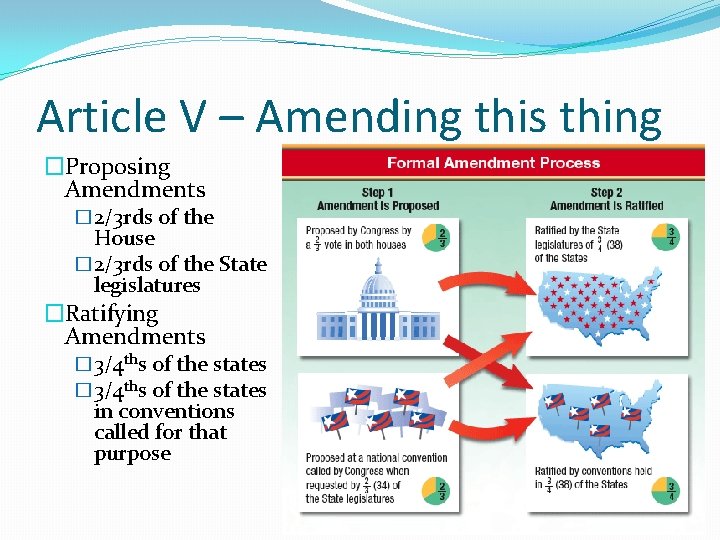
Article V – Amending this thing �Proposing Amendments � 2/3 rds of the House � 2/3 rds of the State legislatures �Ratifying Amendments � 3/4 ths of the states in conventions called for that purpose
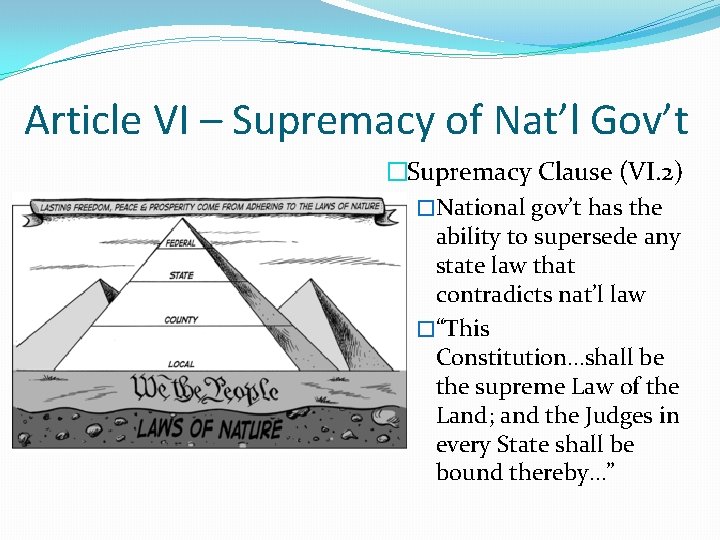
Article VI – Supremacy of Nat’l Gov’t �Supremacy Clause (VI. 2) �National gov’t has the ability to supersede any state law that contradicts nat’l law �“This Constitution…shall be the supreme Law of the Land; and the Judges in every State shall be bound thereby…”
Article VII Ratification �Required 9 of then 13 states �Why? �Signed by the majority of the framers on 17 September 1787 �Only 39 actually signed � 3 because they did not believe in the document Eldbridge Gerry (MA) � Edmund Randolph (VA) � George Mason (VA) �
- Slides: 16