
Chapter 2 THE REVOLUTION AND THE CONSTITUTION Institutional
- Slides: 13
Chapter 2 THE REVOLUTION AND THE CONSTITUTION Institutional Focus: The Constitutional Debate © 2011 Taylor & Francis
The Federalist/Anti-Federalist Debate • The proper size and scope of the federal government • The debate of the Constitutional Convention (1787) © 2011 Taylor & Francis
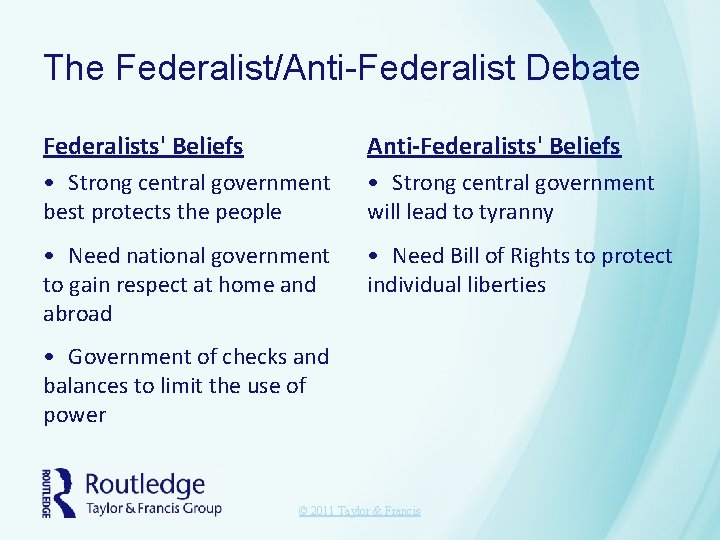
The Federalist/Anti-Federalist Debate Federalists' Beliefs Anti-Federalists' Beliefs • Strong central government best protects the people • Strong central government will lead to tyranny • Need national government to gain respect at home and abroad • Need Bill of Rights to protect individual liberties • Government of checks and balances to limit the use of power © 2011 Taylor & Francis
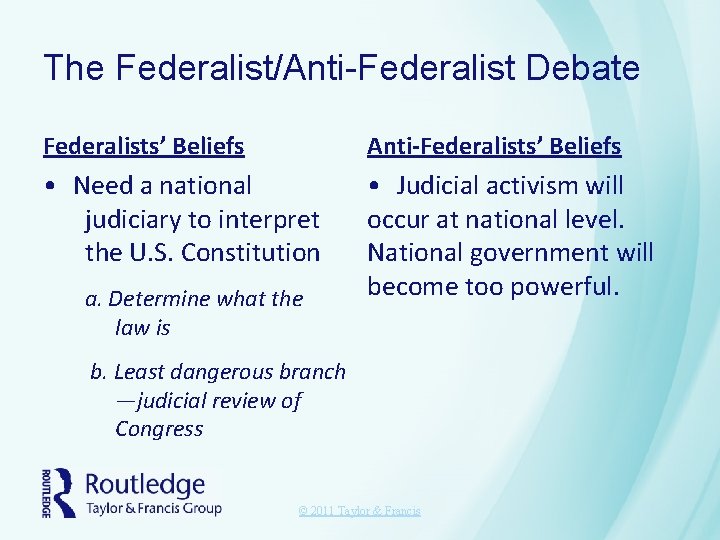
The Federalist/Anti-Federalist Debate Federalists’ Beliefs Anti-Federalists’ Beliefs • Need a national judiciary to interpret the U. S. Constitution • Judicial activism will occur at national level. National government will become too powerful. a. Determine what the law is b. Least dangerous branch —judicial review of Congress © 2011 Taylor & Francis
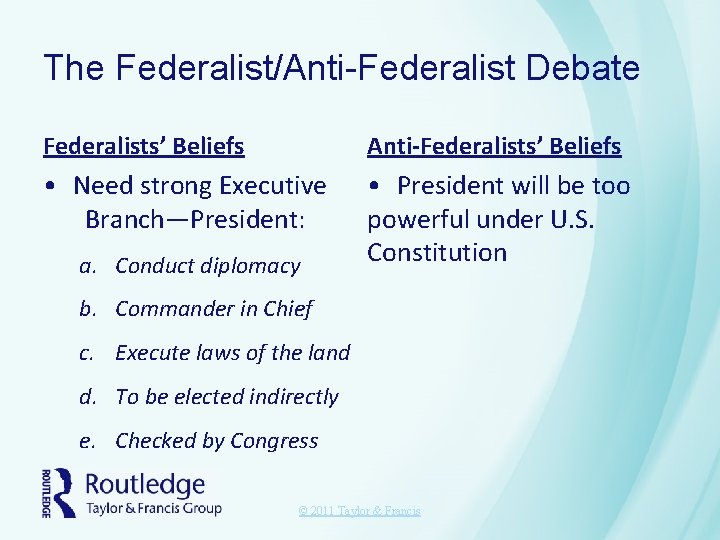
The Federalist/Anti-Federalist Debate Federalists’ Beliefs Anti-Federalists’ Beliefs • Need strong Executive Branch—President: • President will be too powerful under U. S. Constitution a. Conduct diplomacy b. Commander in Chief c. Execute laws of the land d. To be elected indirectly e. Checked by Congress © 2011 Taylor & Francis
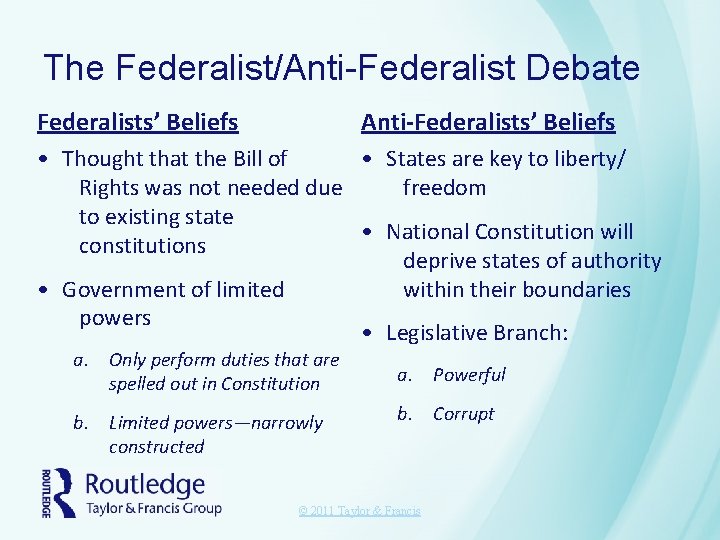
The Federalist/Anti-Federalist Debate Federalists’ Beliefs Anti-Federalists’ Beliefs • Thought that the Bill of • States are key to liberty/ Rights was not needed due freedom to existing state • National Constitution will constitutions deprive states of authority • Government of limited within their boundaries powers • Legislative Branch: a. Only perform duties that are spelled out in Constitution b. Limited powers—narrowly constructed a. Powerful b. Corrupt © 2011 Taylor & Francis
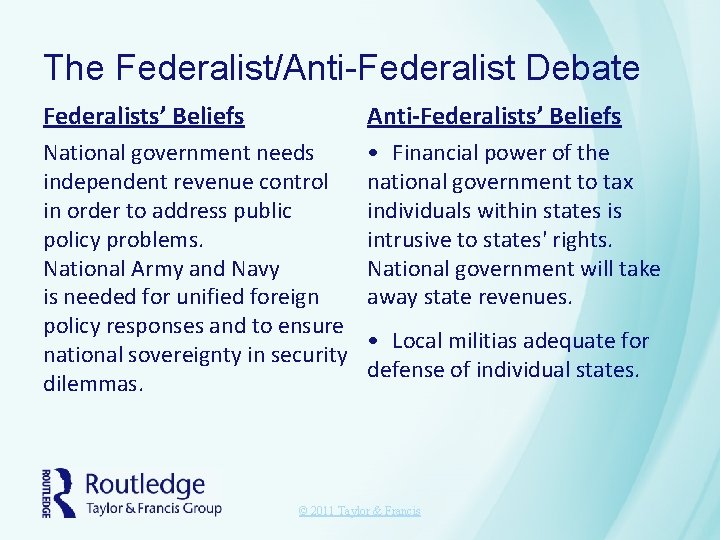
The Federalist/Anti-Federalist Debate Federalists’ Beliefs Anti-Federalists’ Beliefs National government needs independent revenue control in order to address public policy problems. National Army and Navy is needed for unified foreign policy responses and to ensure national sovereignty in security dilemmas. • Financial power of the national government to tax individuals within states is intrusive to states' rights. National government will take away state revenues. • Local militias adequate for defense of individual states. © 2011 Taylor & Francis
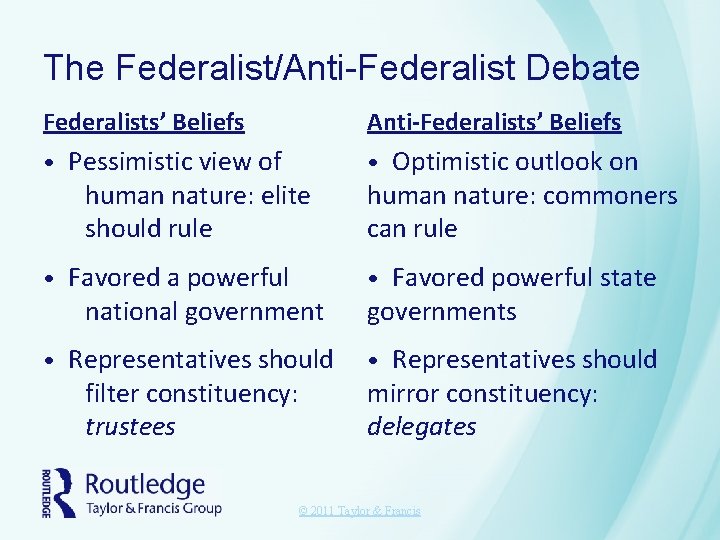
The Federalist/Anti-Federalist Debate Federalists’ Beliefs Anti-Federalists’ Beliefs • Pessimistic view of • Optimistic outlook on • Favored a powerful • Favored powerful state • Representatives should human nature: elite should rule national government filter constituency: trustees human nature: commoners can rule governments mirror constituency: delegates © 2011 Taylor & Francis
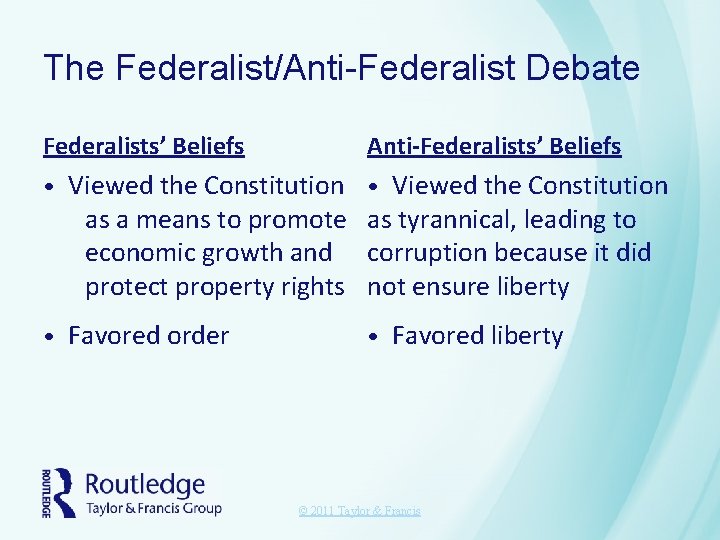
The Federalist/Anti-Federalist Debate Federalists’ Beliefs Anti-Federalists’ Beliefs • Viewed the Constitution as a means to promote as tyrannical, leading to economic growth and corruption because it did protect property rights not ensure liberty • Favored order • Favored liberty © 2011 Taylor & Francis
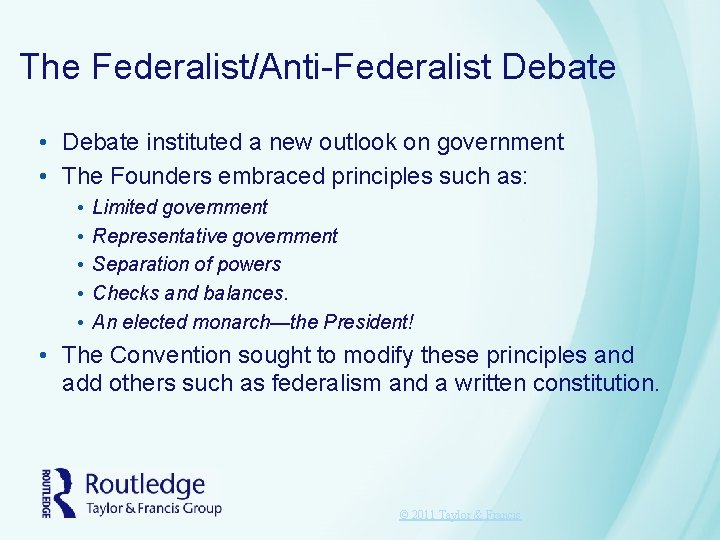
The Federalist/Anti-Federalist Debate • Debate instituted a new outlook on government • The Founders embraced principles such as: • • • Limited government Representative government Separation of powers Checks and balances. An elected monarch—the President! • The Convention sought to modify these principles and add others such as federalism and a written constitution. © 2011 Taylor & Francis
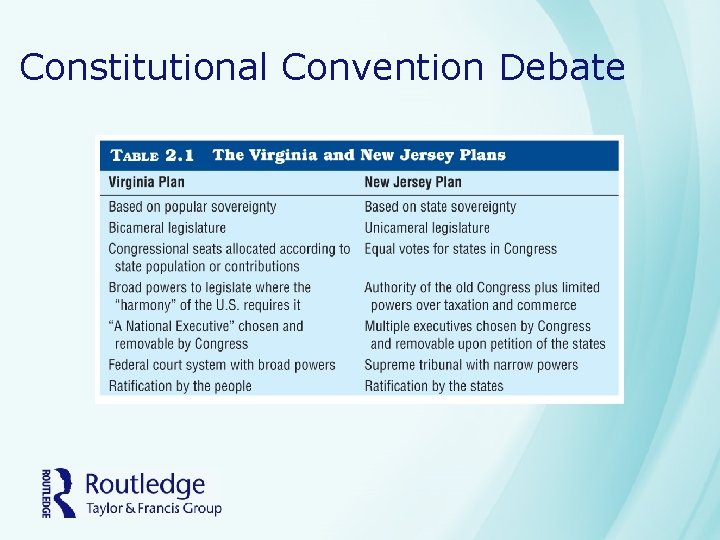
Constitutional Convention Debate
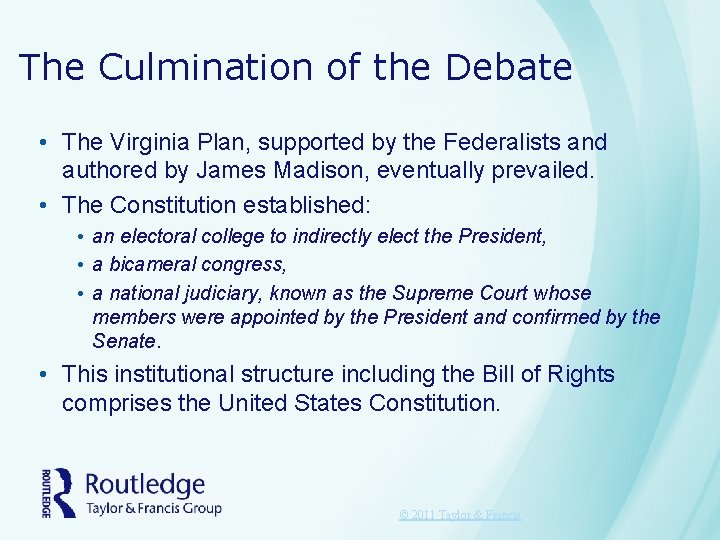
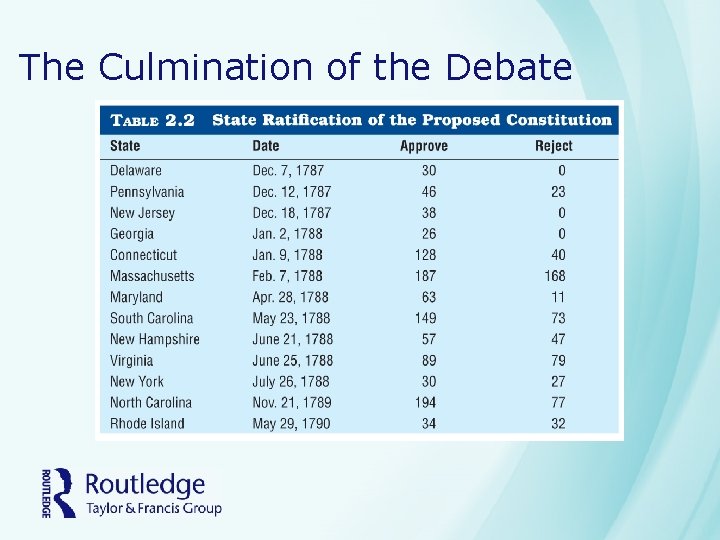
The Culmination of the Debate • The Virginia Plan, supported by the Federalists and authored by James Madison, eventually prevailed. • The Constitution established: • an electoral college to indirectly elect the President, • a bicameral congress, • a national judiciary, known as the Supreme Court whose members were appointed by the President and confirmed by the Senate. • This institutional structure including the Bill of Rights comprises the United States Constitution. © 2011 Taylor & Francis
The Culmination of the Debate