
The Hague Convention of 23 November 2007 on
The Hague Convention of 23 November 2007 on the International Recovery of Child Support and Other Forms of Family Maintenance and its Protocol On The Law Applicable To Maintenance Obligations “INTERNATIONAL FAMILY LAW, LEGAL CO-OPERATION AND COMMERCE: PROMOTING HUMAN RIGHTS AND CROSS-BORDER TRADE IN THE CARIBBEAN THROUGH THE HAGUE CONFERENCE CONVENTIONS” Georgetown, Guyana Juan José Obando Peralta Central American and Caribbean Academy of Private International Law
Central American and Caribbean Academy OF PRIVATE INTERNATIONAL LAW https: //www. face book. com/groups /acecadip/ Also! www. asadip. org
Recovery of maintenance in context Domestic rules and private international law cases - A strong territorial perspective of the Rule of Law in different countries has affected the effective access to child support and maintenance for people in cases with international elements (private international law). -It is common to observe in our region, how most countries disregard the existence of foreign proceedings or issue complex and lengthy procedures in order to recognize a foreign decision. -Procedural problems: Exorbitant territorial jurisdiction, the rejection of international lis pendens and the misconception of the public policy notion. -Application of foreign law even when more strongly connected to the subject matter is rare in many countries. Slide 3
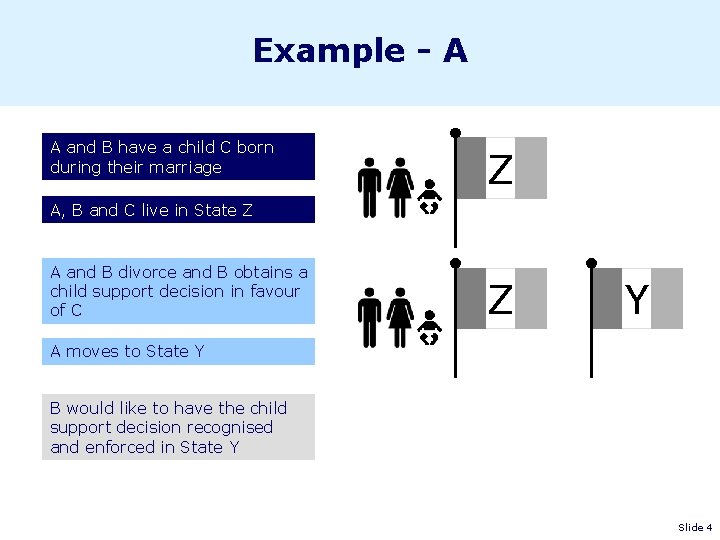
Example - A A and B have a child C born during their marriage Z A, B and C live in State Z A and B divorce and B obtains a child support decision in favour of C Z Y A moves to State Y B would like to have the child support decision recognised and enforced in State Y Slide 4
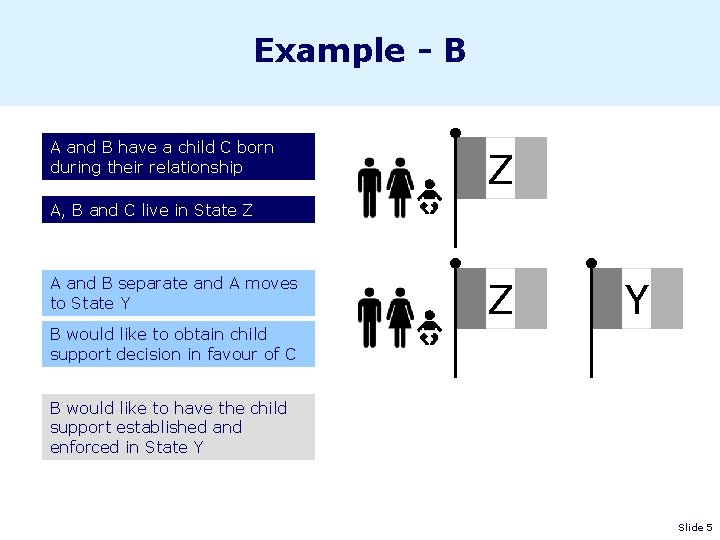
Example - B A and B have a child C born during their relationship Z A, B and C live in State Z A and B separate and A moves to State Y Z Y B would like to obtain child support decision in favour of C B would like to have the child support established and enforced in State Y Slide 5
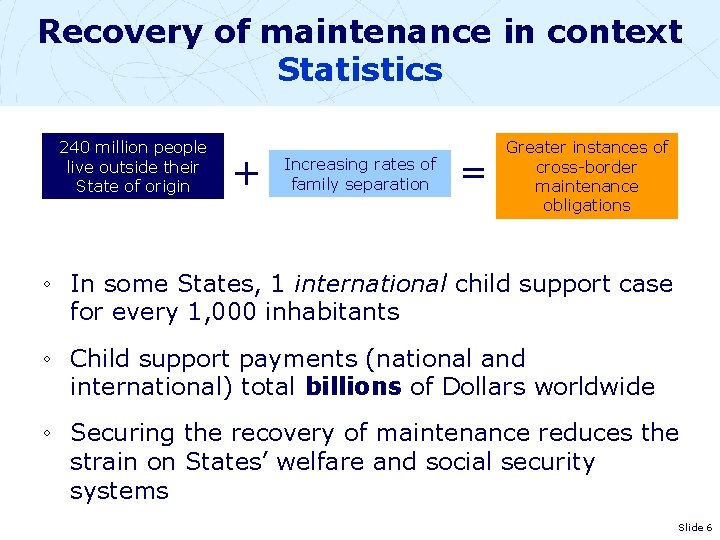
Recovery of maintenance in context Statistics 240 million people live outside their State of origin + Increasing rates of family separation = Greater instances of cross-border maintenance obligations ◦ In some States, 1 international child support case for every 1, 000 inhabitants ◦ Child support payments (national and international) total billions of Dollars worldwide ◦ Securing the recovery of maintenance reduces the strain on States’ welfare and social security systems Slide 6
Recovery of maintenance in context Convention on the Rights of the Child Signatories : 140. Parties : 196 https: //treaties. un. org Slide 7
Recovery of maintenance in context UN Rights of the Child Convention Article 27 1. States Parties recognize the right of every child to a standard of living adequate for the child's physical, mental, spiritual, moral and social development. 2. The parent(s) or others responsible for the child have the primary responsibility to secure, within their abilities and financial capacities, the conditions of living necessary for the child's development. Slide 8
Recovery of maintenance in context UN Rights of the Child Convention Article 27 3. States Parties, in accordance with national conditions and within their means, shall take appropriate measures to assist parents and others responsible for the child to implement this right and shall in case of need provide material assistance and support programmes, particularly with regard to nutrition, clothing and housing. Slide 9
Recovery of maintenance in context UN Rights of the Child Convention Article 27 4. States Parties shall take all appropriate measures to secure the recovery of maintenance for the child from the parents or other persons having financial responsibility for the child, both within the State Party and from abroad. In particular, where the person having financial responsibility for the child lives in a State different from that of the child, States Parties shall promote the accession to international agreements or the conclusion of such agreements, as well as the making of other appropriate arrangements. Slide 10
Recovery of maintenance in context UN Rights of the Child Convention Article 4 States Parties shall undertake all appropriate legislative, administrative, and other measures for the implementation of the rights recognized in the present Convention. With regard to economic, social and cultural rights, States Parties shall undertake such measures to the maximum extent of their available resources and, where needed, within the framework of international co-operation. Slide 11
Recovery of maintenance in context AMERICAN CONVENTION ON HUMAN RIGHTS "PACT OF SAN JOSE, COSTA RICA" Article 19. Rights of the Child Every minor child has the right to the measures of protection required by his condition as a minor on the part of his family, society, and the state. Slide 12
Recovery of maintenance in context ARE THESE RULES, MERE PROGRAMMATIC DECLARATIONS OR NEGATIVE (CONCRETE) RIGHTS? -A programmatic declaration only guides the legislature, directing it to pass legislation that promotes the right. They provide no mechanism for citizens to seek judicial relief if the government fails to provide or enforce the right. - A concrete right enables a citizen to sue if the State denies him or her that right. Slide 13
Recovery of maintenance in context Case of the “Street Children” (Villagran-Morales et al v. Guatemala (19/9/99) Decision on the merits 194. Both the American Convention and the Convention on the Rights of the Child form part of a very comprehensive international corpus juris for the protection of the child that should help this Court establish the content and scope of the general provision established in Article 19 of the American Convention. 53 Slide 14
Recovery of maintenance in context Case of the “Street Children” (Villagran-Morales et al v. Guatemala (19/9/99) Concurring Opinion of Judges A. A. CANÇADO TRINDADE AND A. ABREU-BURELLI 2. The right to life implies not only the negative obligation not to deprive anyone of life arbitrarily, but also the positive obligation to take all necessary measures to secure that basic right is not violated. Such interpretation of the right to life, so as to comprise positive measures of protection on the part of the State, finds support nowadays in international caselaw as well as doctrine. There can no longer be any doubt that the fundamental right to life belongs to the domain of jus cogens. 53 Slide 15
Recovery of maintenance in context International Covenant on Economic, Social and Cultural Rights (164 State parties) Article 10 -The States Parties to the present Covenant recognize that: -1. The widest possible protection and assistance should be accorded to the family, which is the natural and fundamental group unit of society, particularly for its establishment and while it is responsible for the care and education of dependent children. Marriage must be entered into with the free consent of the intending spouses. -2. Special protection should be accorded to mothers during a reasonable period before and after childbirth. During such period working mothers should be accorded paid leave or leave with adequate social security benefits. -3. Special measures of protection and assistance should be taken on behalf of all children and young persons without any discrimination for reasons of parentage or other conditions. Children and young persons should be protected from economic and social exploitation. Their employment in work harmful to their morals or health or dangerous to life or likely to hamper their normal development should be punishable by law. States should also set age limits below which the paid employment of child labour should be prohibited and punishable by law. Slide 16
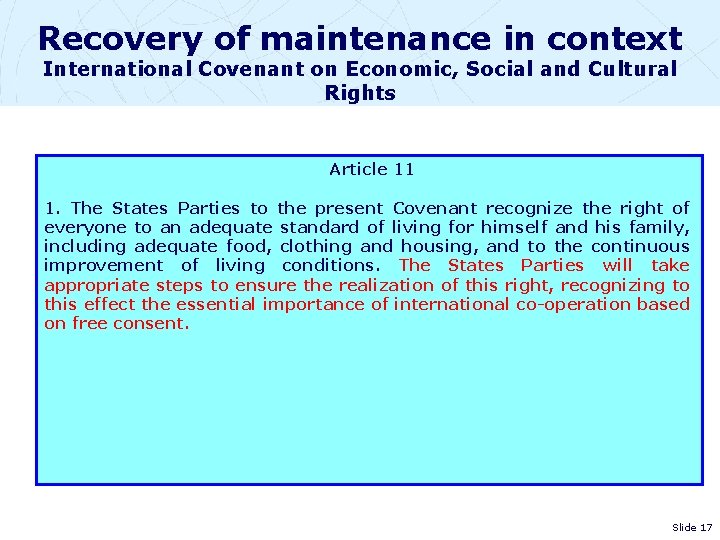
Recovery of maintenance in context International Covenant on Economic, Social and Cultural Rights Article 11 1. The States Parties to the present Covenant recognize the right of everyone to an adequate standard of living for himself and his family, including adequate food, clothing and housing, and to the continuous improvement of living conditions. The States Parties will take appropriate steps to ensure the realization of this right, recognizing to this effect the essential importance of international co-operation based on free consent. Slide 17
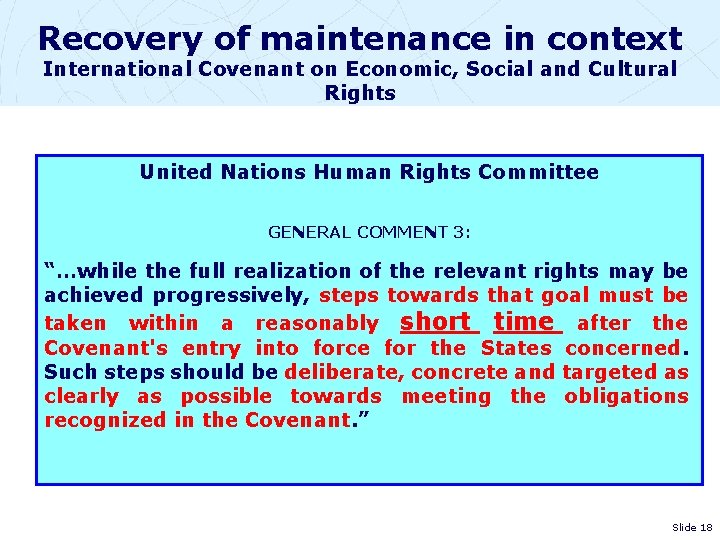
Recovery of maintenance in context International Covenant on Economic, Social and Cultural Rights United Nations Human Rights Committee GENERAL COMMENT 3: “…while the full realization of the relevant rights may be achieved progressively, steps towards that goal must be taken within a reasonably short time after the Covenant's entry into force for the States concerned. Such steps should be deliberate, concrete and targeted as clearly as possible towards meeting the obligations recognized in the Covenant. ” Slide 18

Recovery of maintenance in context Multiple ineffective treaties ◦ New York Convention of 20 June 1956 on the Recovery Abroad of Maintenance (64 State parties). ◦ Hague Convention of 24 October 1956 on the law applicable to maintenance obligations towards children (14 State parties) ◦ Hague Convention of 15 April 1958 concerning the recognition and enforcement of decisions relating to maintenance obligations towards children (20 State parties). ◦ Hague Convention of 2 October 1973 on the Recognition and Enforcement of Decisions relating to Maintenance Obligations (24 State parties). ◦ Hague Convention of 2 October 1973 on the Law Applicable to Maintenance Obligations (15 State parties). Slide 19
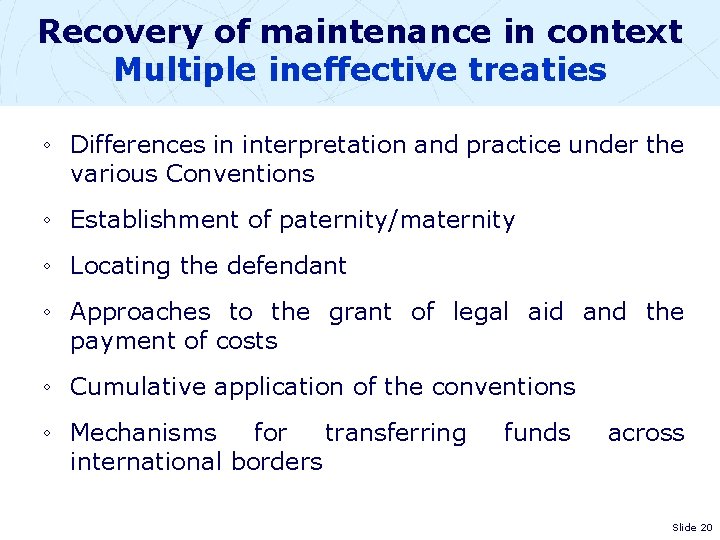
Recovery of maintenance in context Multiple ineffective treaties ◦ Differences in interpretation and practice under the various Conventions ◦ Establishment of paternity/maternity ◦ Locating the defendant ◦ Approaches to the grant of legal aid and the payment of costs ◦ Cumulative application of the conventions ◦ Mechanisms for transferring international borders funds across Slide 20
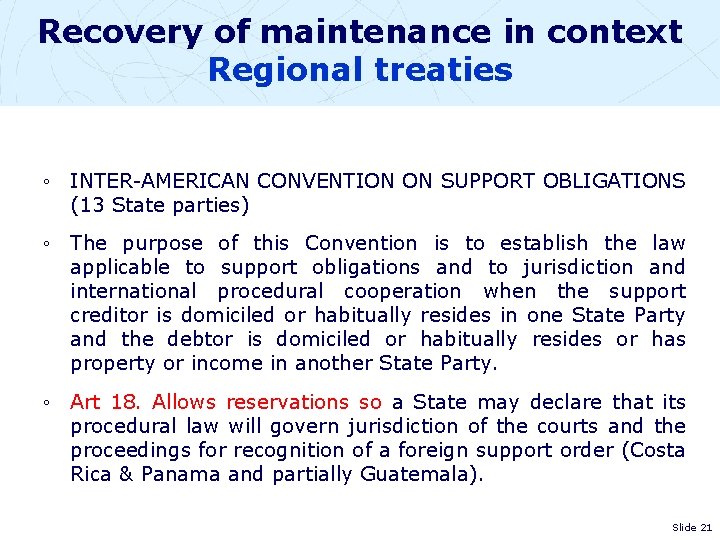
Recovery of maintenance in context Regional treaties ◦ INTER-AMERICAN CONVENTION ON SUPPORT OBLIGATIONS (13 State parties) ◦ The purpose of this Convention is to establish the law applicable to support obligations and to jurisdiction and international procedural cooperation when the support creditor is domiciled or habitually resides in one State Party and the debtor is domiciled or habitually resides or has property or income in another State Party. ◦ Art 18. Allows reservations so a State may declare that its procedural law will govern jurisdiction of the courts and the proceedings for recognition of a foreign support order (Costa Rica & Panama and partially Guatemala). Slide 21
Recovery of maintenance in context 1956 UN Maintenance Convention ◦ 2007 Hague Convention replaces the 1956 UN Maintenance Convention between Contracting States ◦ 64 States Parties: Examples in the region: Barbados, Brazil, Colombia, Dominican Republic, Ecuador, Haiti, Suriname; ◦ States Parties to the 1956 UN Maintenance Convention are working on the implementation of the 2007 Convention Slide 22
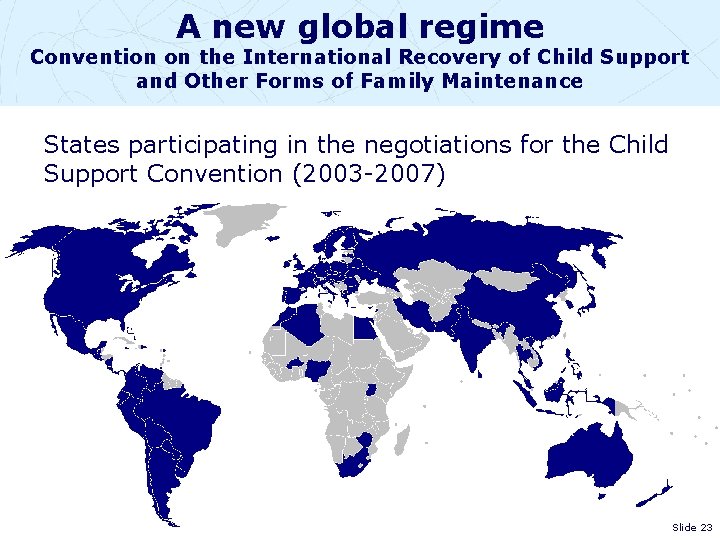
A new global regime Convention on the International Recovery of Child Support and Other Forms of Family Maintenance States participating in the negotiations for the Child Support Convention (2003 -2007) Slide 23
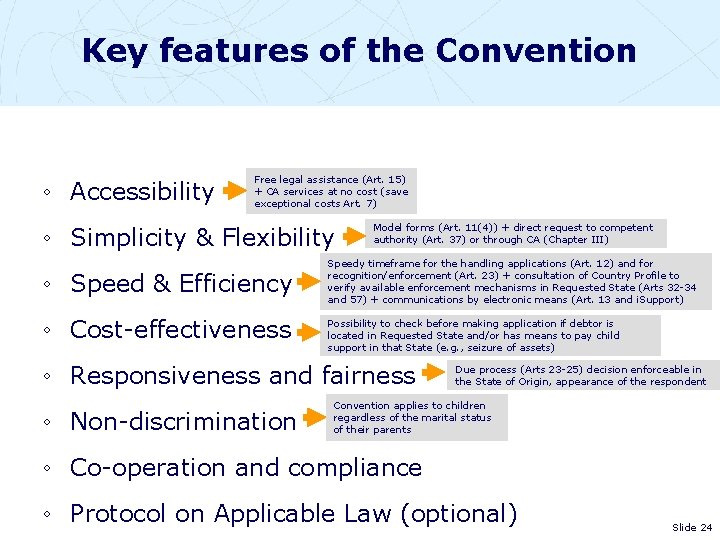
Key features of the Convention ◦ Accessibility Free legal assistance (Art. 15) + CA services at no cost (save exceptional costs Art. 7) ◦ Simplicity & Flexibility ◦ Speed & Efficiency ◦ Cost-effectiveness Model forms (Art. 11(4)) + direct request to competent authority (Art. 37) or through CA (Chapter III) Speedy timeframe for the handling applications (Art. 12) and for recognition/enforcement (Art. 23) + consultation of Country Profile to verify available enforcement mechanisms in Requested State (Arts 32 -34 and 57) + communications by electronic means (Art. 13 and i. Support) Possibility to check before making application if debtor is located in Requested State and/or has means to pay child support in that State (e. g. , seizure of assets) ◦ Responsiveness and fairness ◦ Non-discrimination Due process (Arts 23 -25) decision enforceable in the State of Origin, appearance of the respondent Convention applies to children regardless of the marital status of their parents ◦ Co-operation and compliance ◦ Protocol on Applicable Law (optional) Slide 24
Principal components and objectives ◦ System of administrative co-operation (efficient, responsive, flexible, accessible) ◦ Provides procedures for applications seeking: • • • establishment of decision (incl. paternity); recognition or recognition and enforcement of decisions (procedures to maximise recognition); and modification of decisions ◦ Effective access to procedures ◦ Swift and effective enforcement ◦ Allows for direct requests to competent authorities Slide 25
Flexible scope ◦ Entire Convention applies on a mandatory basis to child support cases of persons under the age of 21 (reservation for persons under 18) and to spousal support combined with child support (Art. 10(1) a) & b)) ◦ Convention also covers spousal support but its provision on administrative co-operation will apply to spousal support only where States have made a declaration (art. 2(3)) ◦ Application of any part of the Convention could be extended by way of declaration (with reciprocal effect) to other maintenance obligations arising from a family relationship, parentage, marriage or affinity, including vulnerable adults ◦ Convention applies to children regardless of the marital status of the parents Slide 26
Role of Central Authorities ◦ Administrative co-operation under the Convention is implemented using Central Authorities (CAs) ◦ Central Authorities are responsible for: • • transmitting and receiving applications; and initiating or facilitating proceedings in respect of such applications ◦ Central Authorities are also responsible for taking a range of related measures, including: • • providing or facilitating the provision of legal assistance; and helping to locate debtor/creditor or to obtain information about financial circumstances Slide 27
Recognition and enforcement of decisions ◦ The bases for recognizing and enforcing maintenance decisions of other Contracting States under the Convention are broad. ◦ The habitual residence of either the respondent or the creditor in the State of origin when proceedings were initiated, are likely to be the principal bases in practice (art 18). A reservation in respect of creditor’s jurisdiction is possible, but any State making such a reservation will in return be obliged to recognise foreign decisions made in factual circumstances which confer or would have conferred jurisdiction on its own authorities to award maintenance. Slide 28
Recognition and enforcement of decisions ◦ Bases for recognition and enforcement ◦ (1) A decision made in one Contracting State ("the State of origin") shall be recognized and enforced in other Contracting States if ◦ a) the respondent was habitually resident in the State of origin at the time proceedings were instituted; ◦ b) the respondent has submitted to the jurisdiction either expressly or by defending on the merits of the case without objecting to the jurisdiction at the first available opportunity; ◦ c) the creditor was habitually resident in the State of origin at the time proceedings were instituted; Slide 29
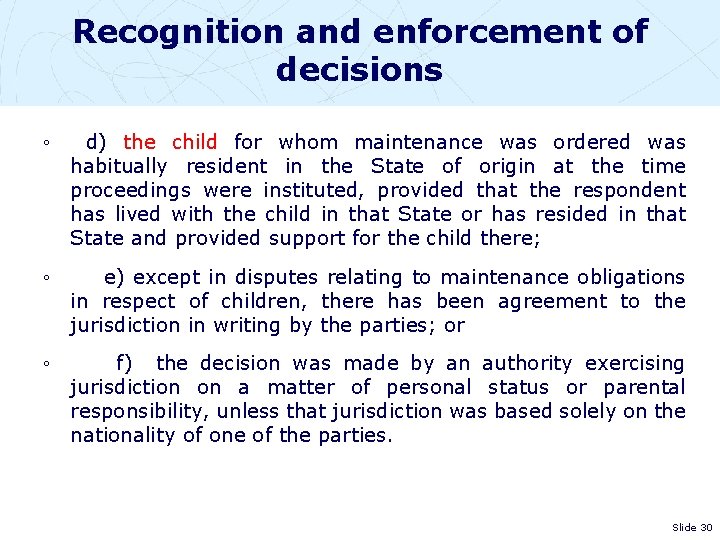
Recognition and enforcement of decisions ◦ d) the child for whom maintenance was ordered was habitually resident in the State of origin at the time proceedings were instituted, provided that the respondent has lived with the child in that State or has resided in that State and provided support for the child there; ◦ e) except in disputes relating to maintenance obligations in respect of children, there has been agreement to the jurisdiction in writing by the parties; or ◦ f) the decision was made by an authority exercising jurisdiction on a matter of personal status or parental responsibility, unless that jurisdiction was based solely on the nationality of one of the parties. Slide 30
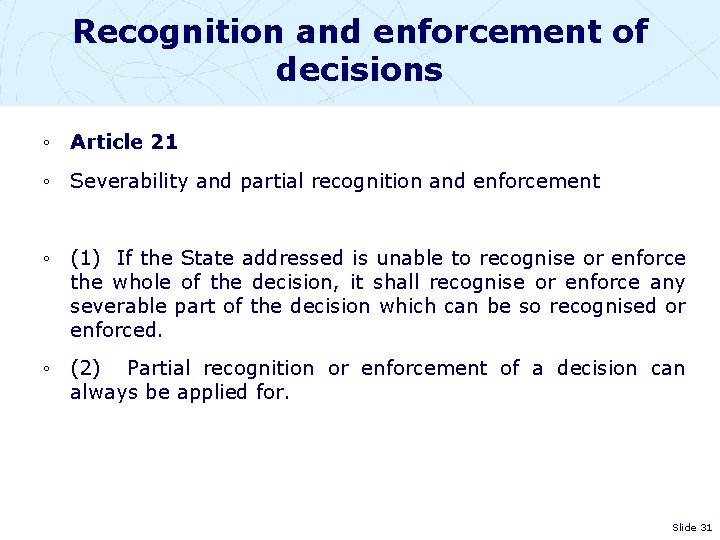
Recognition and enforcement of decisions ◦ Article 21 ◦ Severability and partial recognition and enforcement ◦ (1) If the State addressed is unable to recognise or enforce the whole of the decision, it shall recognise or enforce any severable part of the decision which can be so recognised or enforced. ◦ (2) Partial recognition or enforcement of a decision can always be applied for. Slide 31
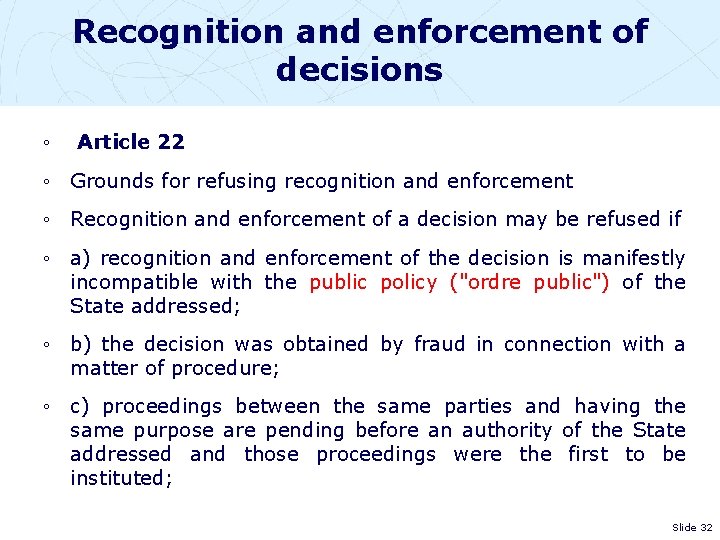
Recognition and enforcement of decisions ◦ Article 22 ◦ Grounds for refusing recognition and enforcement ◦ Recognition and enforcement of a decision may be refused if ◦ a) recognition and enforcement of the decision is manifestly incompatible with the public policy ("ordre public") of the State addressed; ◦ b) the decision was obtained by fraud in connection with a matter of procedure; ◦ c) proceedings between the same parties and having the same purpose are pending before an authority of the State addressed and those proceedings were the first to be instituted; Slide 32
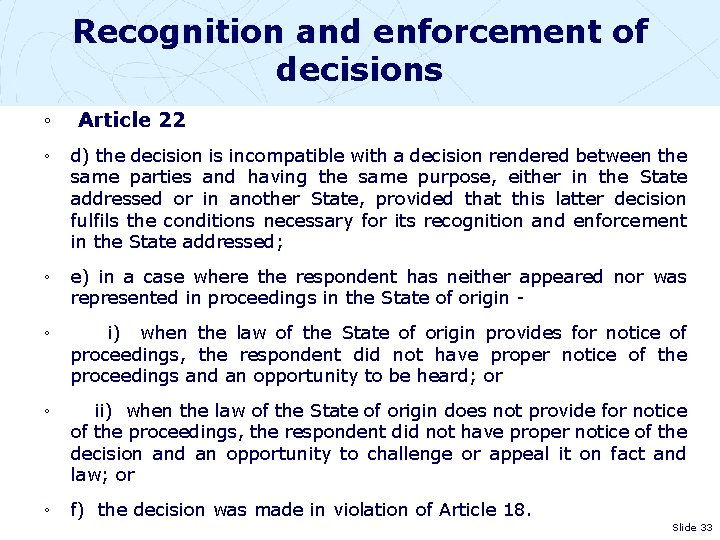
Recognition and enforcement of decisions ◦ Article 22 ◦ d) the decision is incompatible with a decision rendered between the same parties and having the same purpose, either in the State addressed or in another State, provided that this latter decision fulfils the conditions necessary for its recognition and enforcement in the State addressed; ◦ e) in a case where the respondent has neither appeared nor was represented in proceedings in the State of origin - ◦ i) when the law of the State of origin provides for notice of proceedings, the respondent did not have proper notice of the proceedings and an opportunity to be heard; or ◦ ii) when the law of the State of origin does not provide for notice of the proceedings, the respondent did not have proper notice of the decision and an opportunity to challenge or appeal it on fact and law; or ◦ f) the decision was made in violation of Article 18. Slide 33
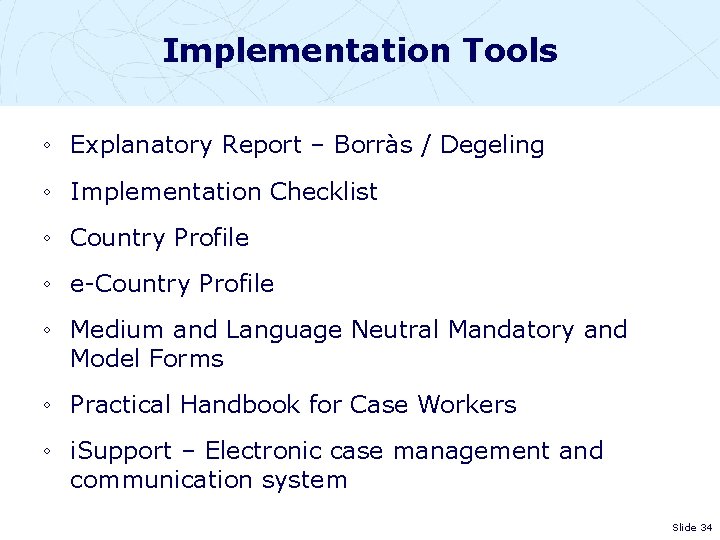
Implementation Tools ◦ Explanatory Report – Borràs / Degeling ◦ Implementation Checklist ◦ Country Profile ◦ e-Country Profile ◦ Medium and Language Neutral Mandatory and Model Forms ◦ Practical Handbook for Case Workers ◦ i. Support – Electronic case management and communication system Slide 34
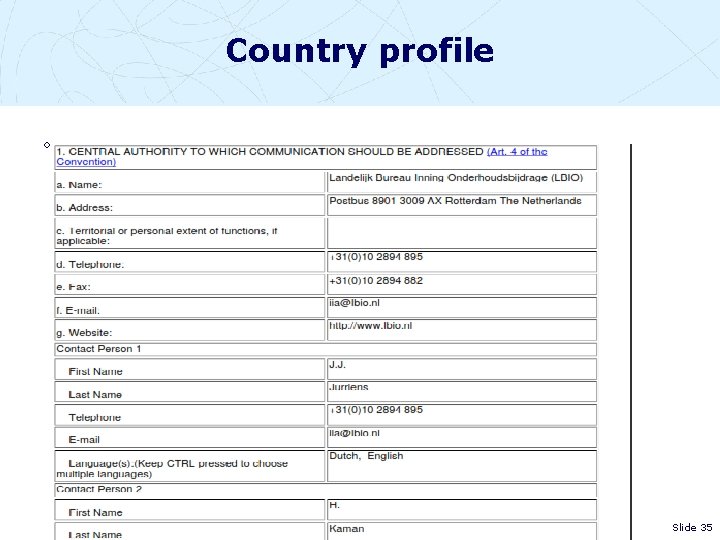
Country profile ◦ Slide 35
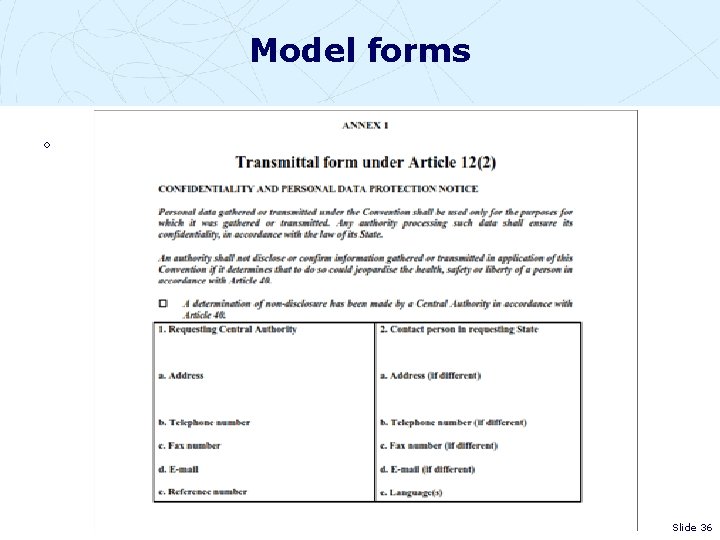
Model forms ◦ Slide 36
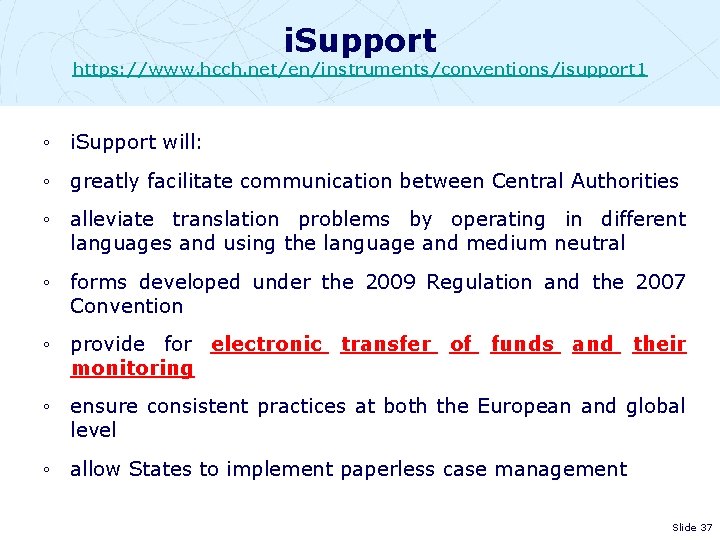
i. Support https: //www. hcch. net/en/instruments/conventions/isupport 1 ◦ i. Support will: ◦ greatly facilitate communication between Central Authorities ◦ alleviate translation problems by operating in different languages and using the language and medium neutral ◦ forms developed under the 2009 Regulation and the 2007 Convention ◦ provide for electronic transfer of funds and their monitoring ◦ ensure consistent practices at both the European and global level ◦ allow States to implement paperless case management Slide 37
Current status Hague Convention ◦ The Convention entered into force on 1 January 2013 and currently has 33 Contracting States/Regional Economic Integration Organizations (including the EU) ◦ The United States of America signed Convention (up-coming ratifications) the ◦ Other States will join soon (e. g. , Belarus, Brazil, Canada, Kazakhstan) Slide 38
Protocol of 23 November 2007 on the Law Applicable to Maintenance Obligations ◦ The Protocol entered into force on 1 August 2013 and currently has 28 Contracting States/Regional Economic Integration Organizations (including the EU) Slide 39
Protocol of 23 November 2007 on the Law Applicable to Maintenance Obligations ◦ The Protocol determines the law applicable to maintenance obligations arising from a family relationship, parentage, marriage or affinity, including a maintenance obligation in respect of a child regardless of the marital status of the parents. Slide 40
Protocol of 23 November 2007 on the Law Applicable to Maintenance Obligations ◦ Replaces the 1956 and 1973 Hague Conventions on law applicable to maintenance obligations. ◦ 3 main innovations: ◦ - Maintains habitual residence of the creditor as main connecting factor and extends it to maintenance obligations between spouses and exspouses ◦ - Reinforces the role of the lex fori for claims by privileged classes of creditors ◦ - Escape clause based on the idea of close connection for obligations between spouses Slide 41
Protocol of 23 November 2007 on the Law Applicable to Maintenance Obligations ◦ Party autonomy in family law relationships? Why not? Bustamante did it in 1928! ◦ Possibility of procedural agreements enabling the parties, with respect to any maintenance obligation, to select the law of the forum for the purposes of a specific proceeding. ◦ Applicable law that may be exercised at any time, subject to certain conditions and restrictions. Slide 42
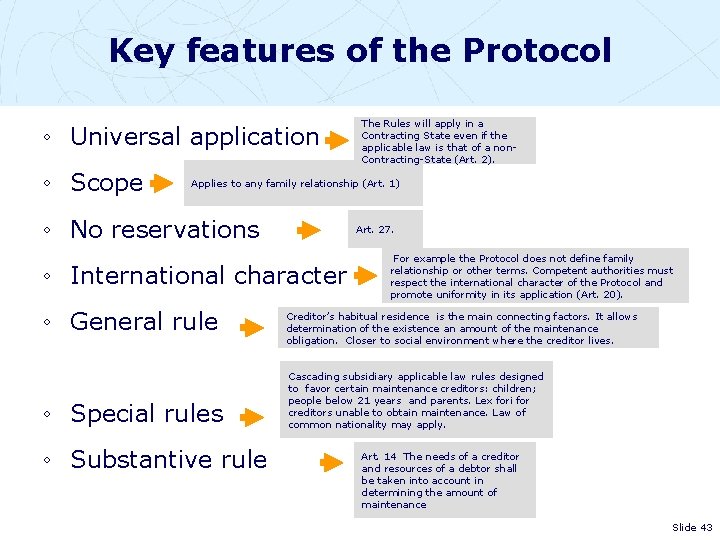
Key features of the Protocol ◦ Universal application ◦ Scope The Rules will apply in a Contracting State even if the applicable law is that of a non. Contracting-State (Art. 2). Applies to any family relationship (Art. 1) ◦ No reservations Art. 27. ◦ International character ◦ General rule ◦ Special rules ◦ Substantive rule For example the Protocol does not define family relationship or other terms. Competent authorities must respect the international character of the Protocol and promote uniformity in its application (Art. 20). Creditor’s habitual residence is the main connecting factors. It allows determination of the existence an amount of the maintenance obligation. Closer to social environment where the creditor lives. Cascading subsidiary applicable law rules designed to favor certain maintenance creditors: children; people below 21 years and parents. Lex fori for creditors unable to obtain maintenance. Law of common nationality may apply. Art. 14 The needs of a creditor and resources of a debtor shall be taken into account in determining the amount of maintenance Slide 43

Thank you Juan José Obando juanjose@oprlegal. com
- Slides: 44