f MRI data preprocessing Realigning and unwarping JOAQUN

- Slides: 34
f. MRI data pre-processing Realigning and unwarping JOAQUÍN NAVAJAS SARAH BUCK 2014 Methods for Dummies
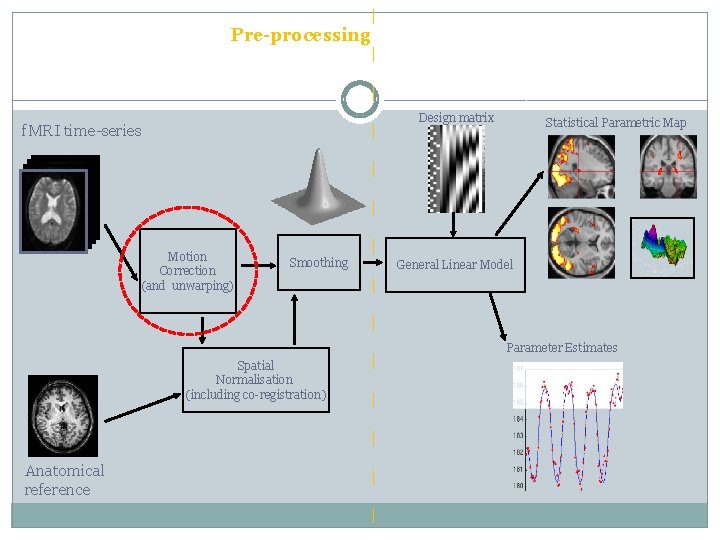
| Pre-processing | | f. MRI time-series | Design matrix Statistical Parametric Map | | Motion Correction (and unwarping) | Smoothing General Linear Model | | Spatial Normalisation (including co-registration) | | | Anatomical reference | | Parameter Estimates
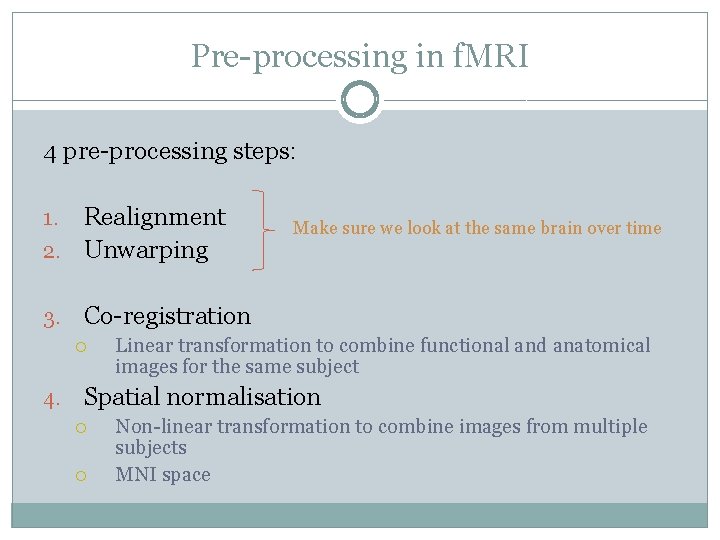
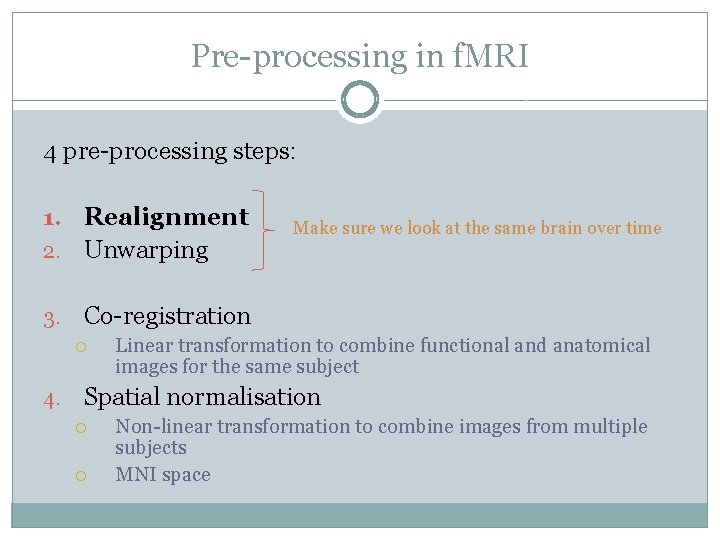
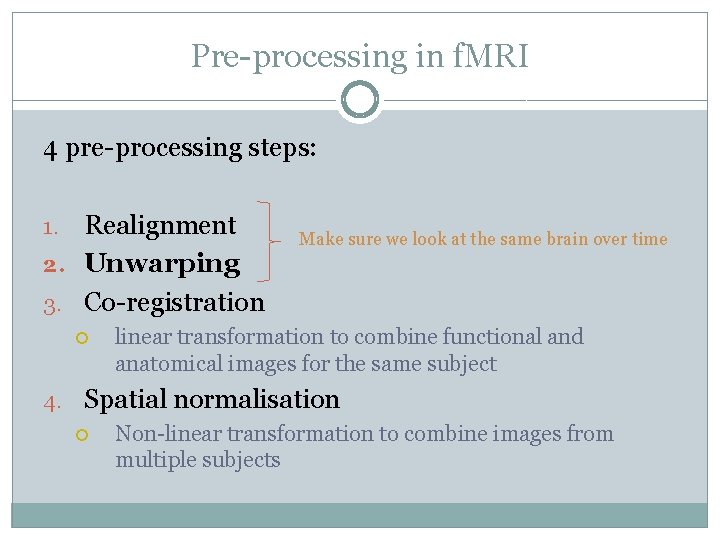
Pre-processing in f. MRI 4 pre-processing steps: Realignment 2. Unwarping 1. 3. Co-registration 4. Make sure we look at the same brain over time Linear transformation to combine functional and anatomical images for the same subject Spatial normalisation Non-linear transformation to combine images from multiple subjects MNI space
Pre-processing in f. MRI 4 pre-processing steps: Realignment 2. Unwarping 1. 3. Co-registration 4. Make sure we look at the same brain over time Linear transformation to combine functional and anatomical images for the same subject Spatial normalisation Non-linear transformation to combine images from multiple subjects MNI space
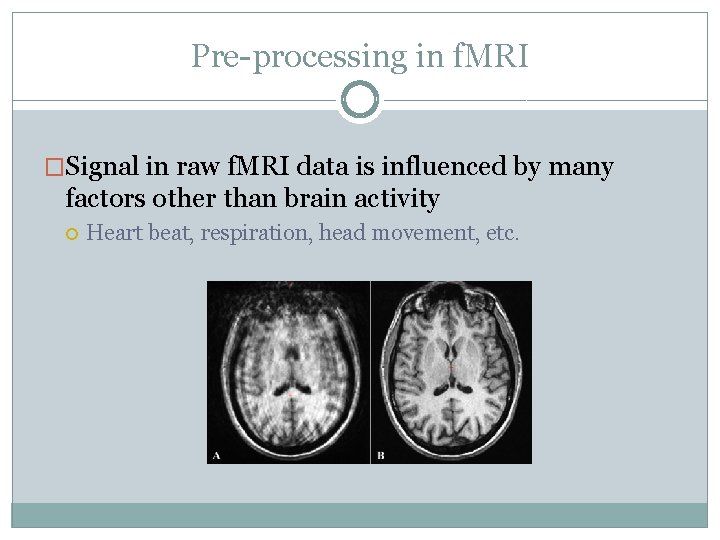
Pre-processing in f. MRI �Signal in raw f. MRI data is influenced by many factors other than brain activity Heart beat, respiration, head movement, etc.
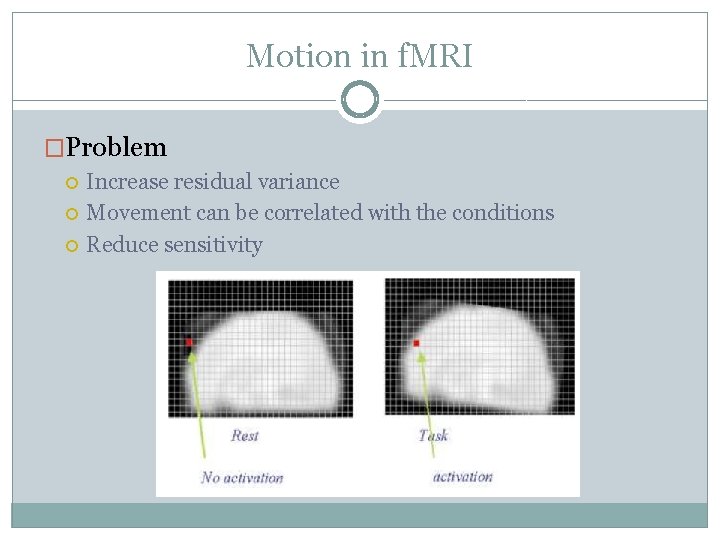
Motion in f. MRI �Problem Increase residual variance Movement can be correlated with the conditions Reduce sensitivity
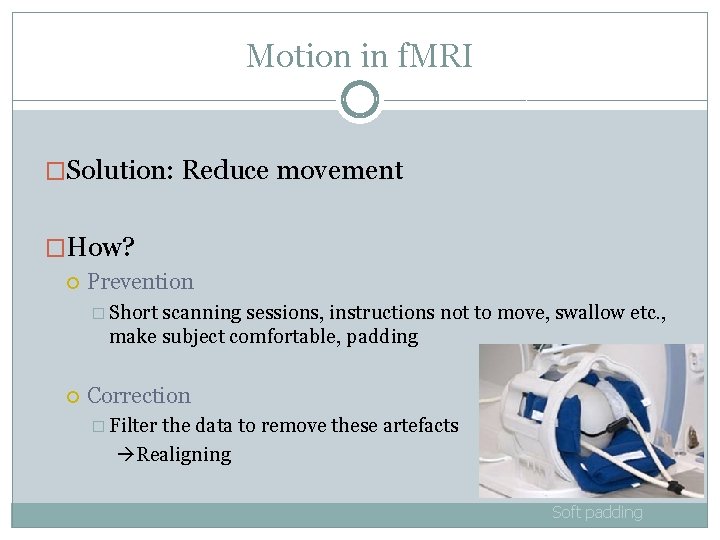
Motion in f. MRI �Solution: Reduce movement �How? Prevention � Short scanning sessions, instructions not to move, swallow etc. , make subject comfortable, padding Correction � Filter the data to remove these artefacts Realigning Soft padding
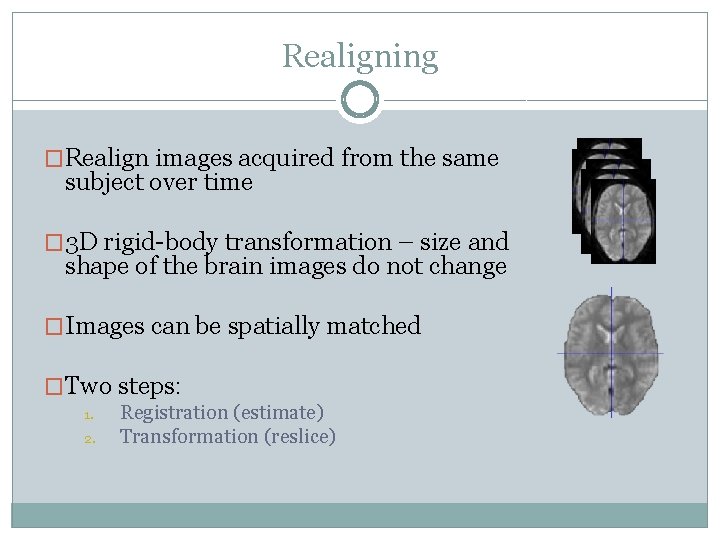
Realigning �Realign images acquired from the same subject over time � 3 D rigid-body transformation – size and shape of the brain images do not change �Images can be spatially matched �Two steps: 1. 2. Registration (estimate) Transformation (reslice)
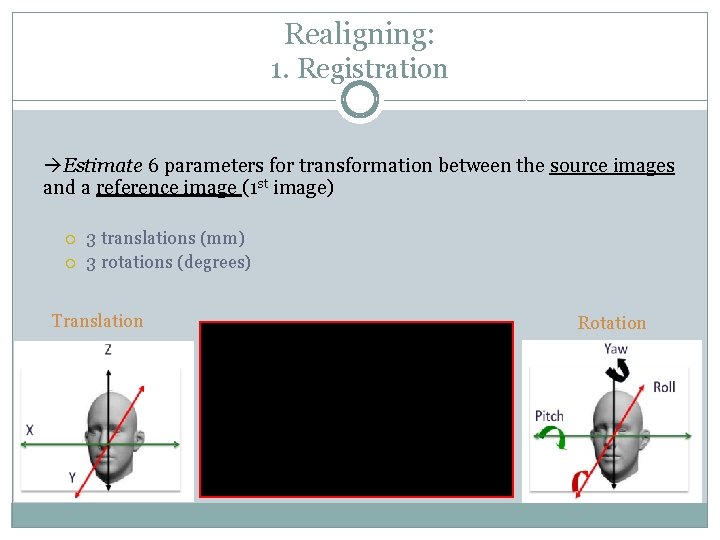
Realigning: 1. Registration Estimate 6 parameters for transformation between the source images and a reference image (1 st image) 3 translations (mm) 3 rotations (degrees) Translation Rotation
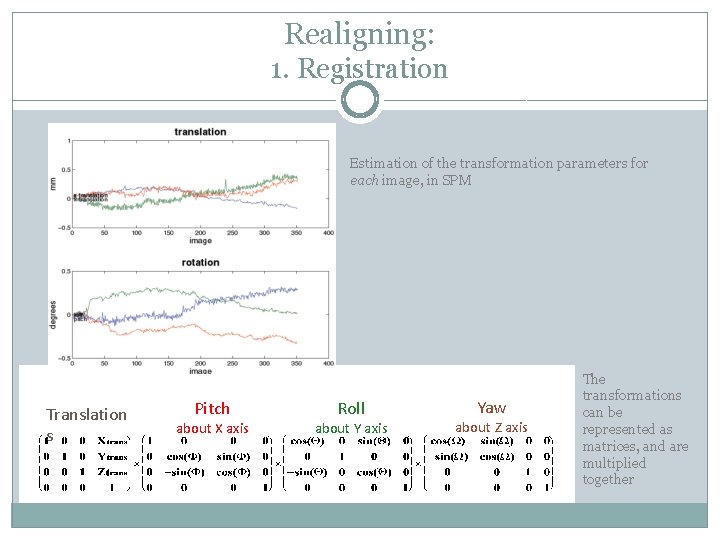
Realigning: 1. Registration Estimation of the transformation parameters for each image, in SPM Translation s Pitch about X axis Roll about Y axis Yaw about Z axis The transformations can be represented as matrices, and are multiplied together
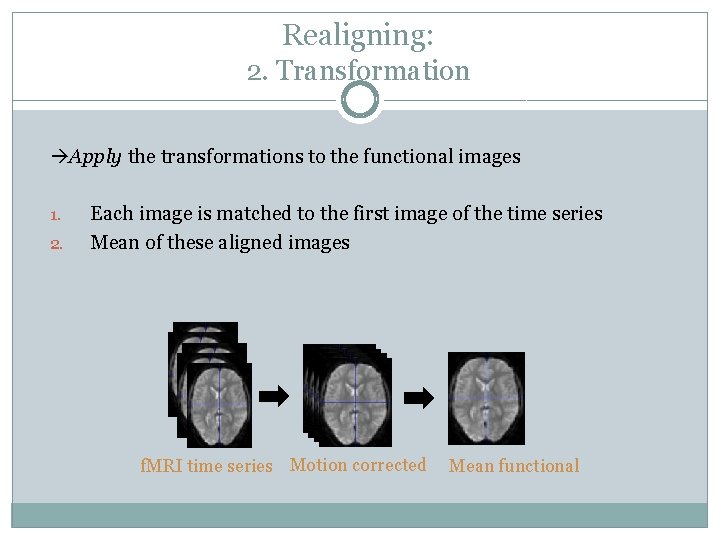
Realigning: 2. Transformation Apply the transformations to the functional images 1. 2. Each image is matched to the first image of the time series Mean of these aligned images f. MRI time series Motion corrected Mean functional
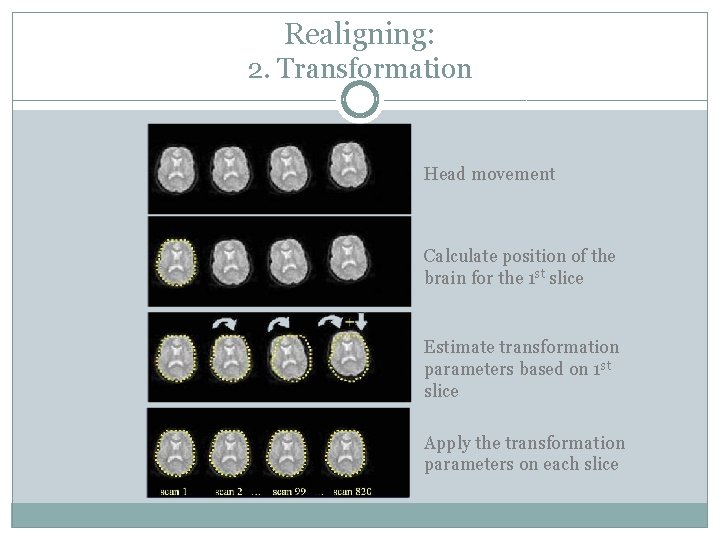
Realigning: 2. Transformation Head movement Calculate position of the brain for the 1 st slice Estimate transformation parameters based on 1 st slice Apply the transformation parameters on each slice
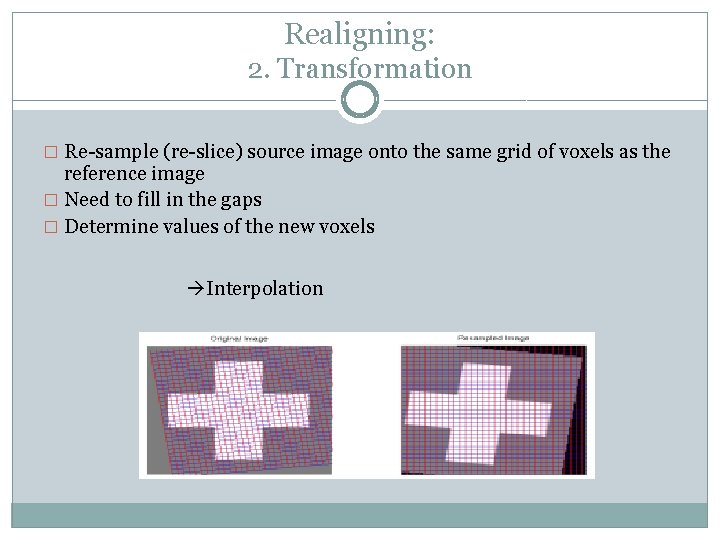
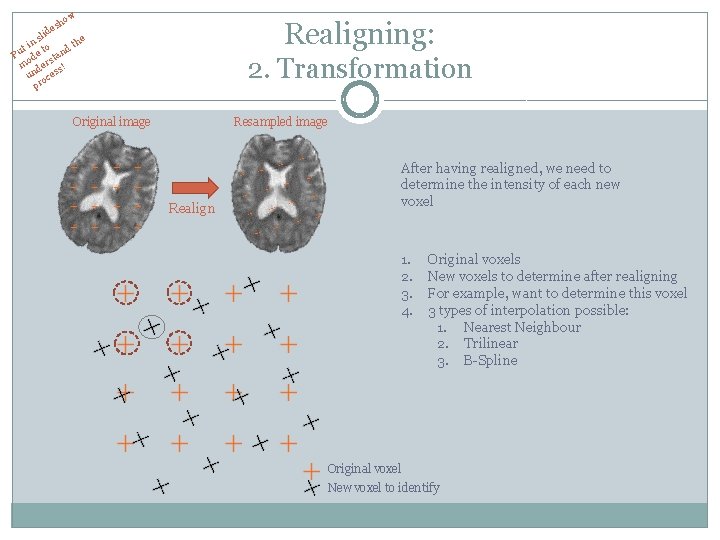
Realigning: 2. Transformation � Re-sample (re-slice) source image onto the same grid of voxels as the reference image � Need to fill in the gaps � Determine values of the new voxels Interpolation
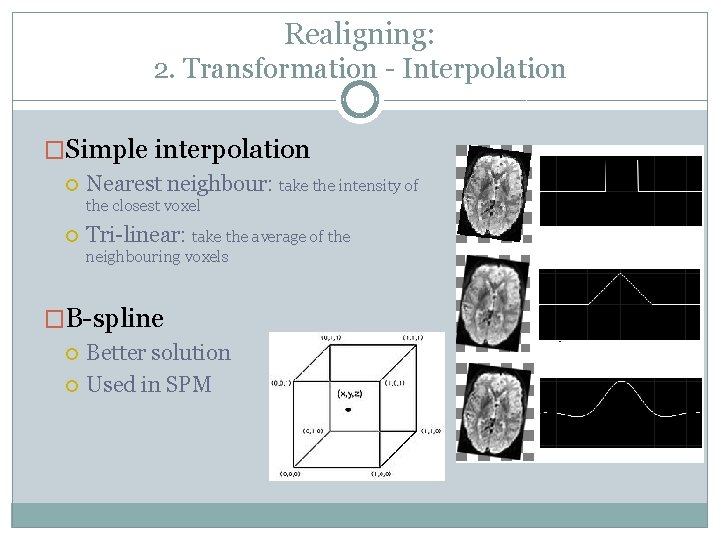
Realigning: 2. Transformation - Interpolation �Simple interpolation Nearest neighbour: take the intensity of the closest voxel Tri-linear: take the average of the neighbouring voxels �B-spline Better solution Used in SPM
w ho s e Realigning: d sli he n t i to nd t u P ode sta m der s! un oces pr 2. Transformation Original image Resampled image Realign After having realigned, we need to determine the intensity of each new voxel 1. 2. 3. 4. Original voxels New voxels to determine after realigning For example, want to determine this voxel 3 types of interpolation possible: 1. Nearest Neighbour 2. Trilinear 3. B-Spline Original voxel New voxel to identify
Pre-processing in f. MRI 4 pre-processing steps: Realignment 2. Unwarping 3. Co-registration 1. Make sure we look at the same brain over time linear transformation to combine functional and anatomical images for the same subject 4. Spatial normalisation Non-linear transformation to combine images from multiple subjects
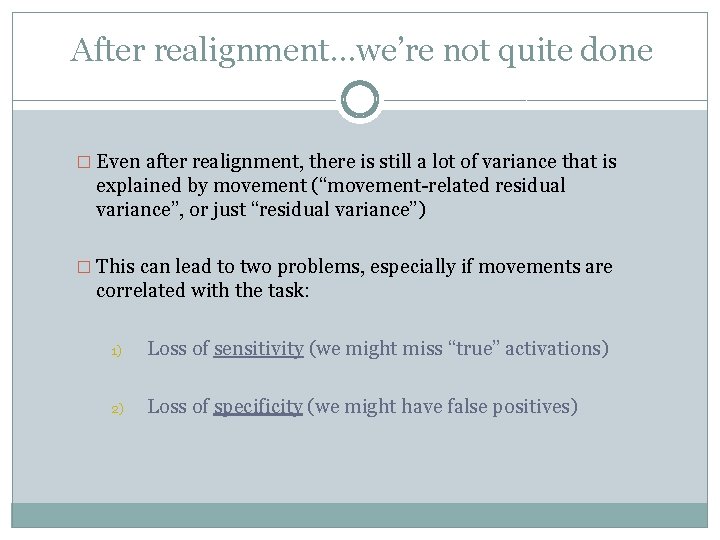
After realignment…we’re not quite done � Even after realignment, there is still a lot of variance that is explained by movement (“movement-related residual variance”, or just “residual variance”) � This can lead to two problems, especially if movements are correlated with the task: 1) Loss of sensitivity (we might miss “true” activations) 2) Loss of specificity (we might have false positives)
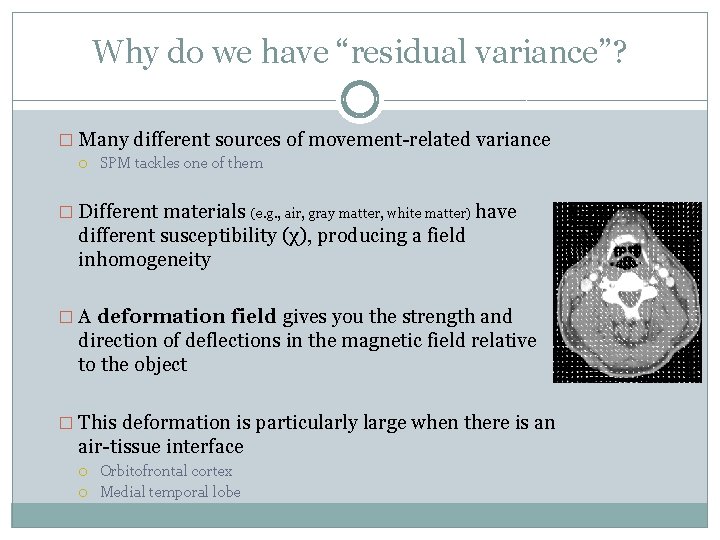
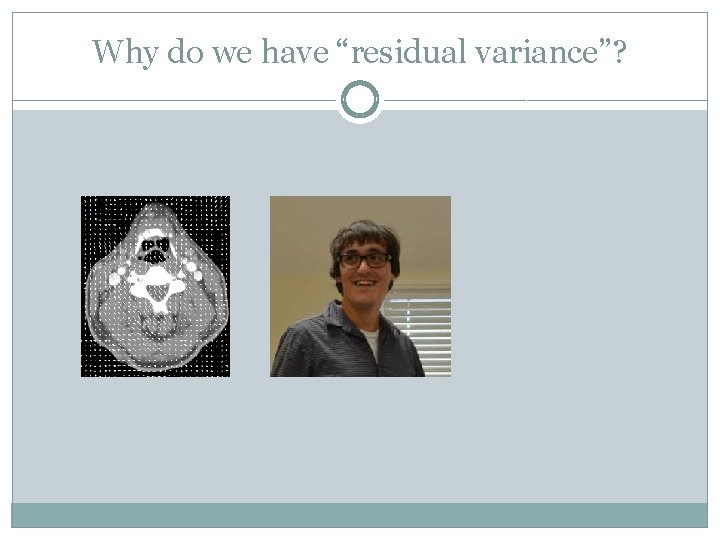
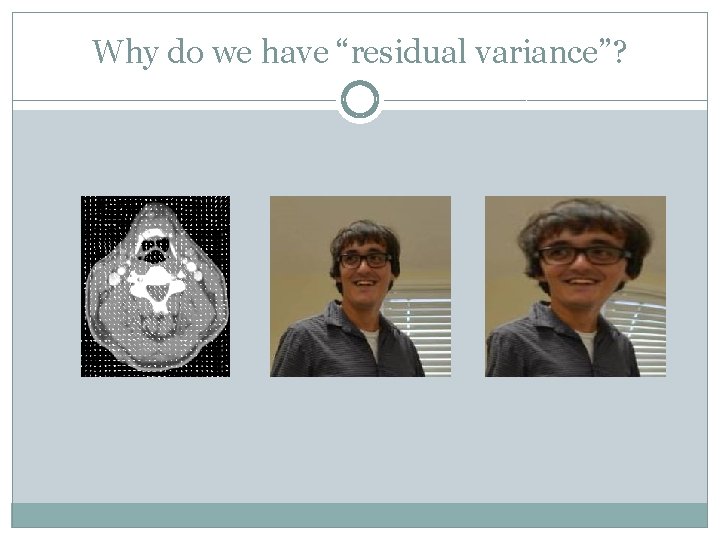
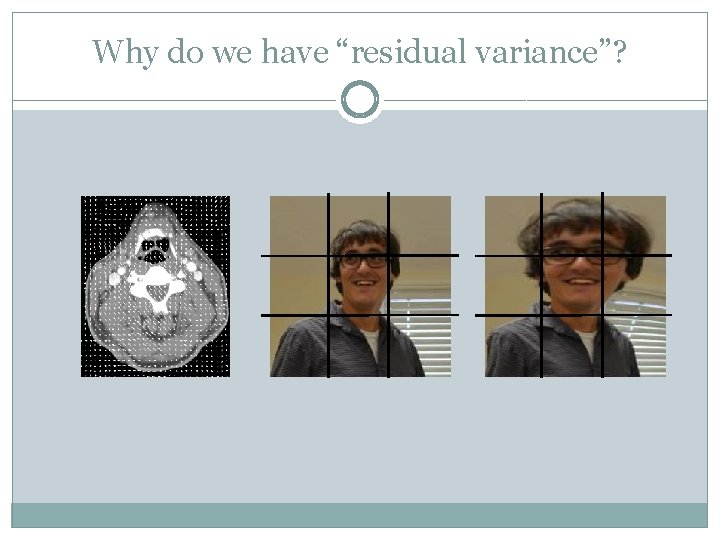
Why do we have “residual variance”? � Many different sources of movement-related variance SPM tackles one of them � Different materials (e. g. , air, gray matter, white matter) have different susceptibility (χ), producing a field inhomogeneity � A deformation field gives you the strength and direction of deflections in the magnetic field relative to the object � This deformation is particularly large when there is an air-tissue interface Orbitofrontal cortex Medial temporal lobe
Why do we have “residual variance”?
Why do we have “residual variance”?
Why do we have “residual variance”?
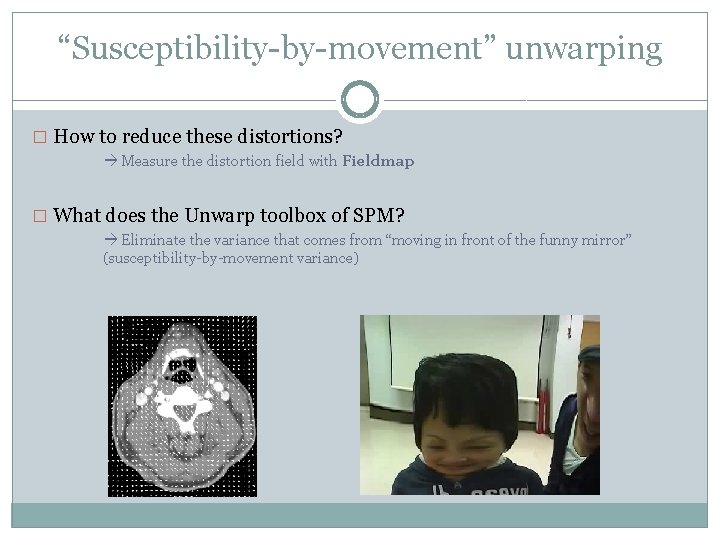
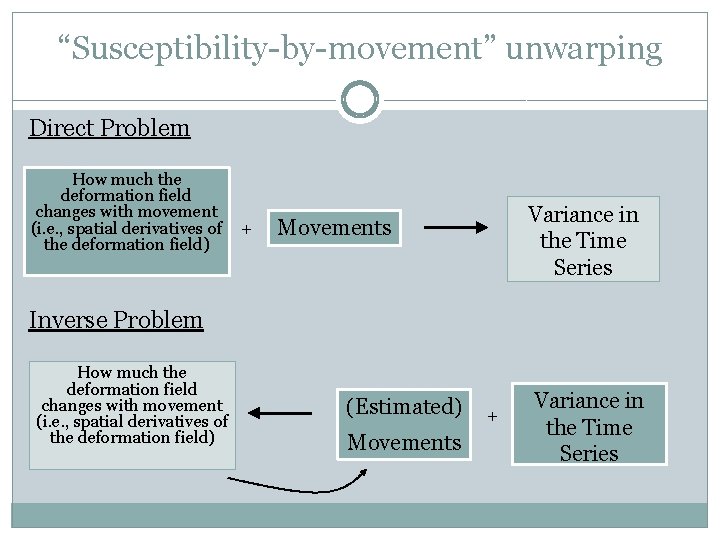
“Susceptibility-by-movement” unwarping � How to reduce these distortions? Measure the distortion field with Fieldmap � What does the Unwarp toolbox of SPM? Eliminate the variance that comes from “moving in front of the funny mirror” (susceptibility-by-movement variance)
“Susceptibility-by-movement” unwarping Direct Problem How much the deformation field changes with movement (i. e. , spatial derivatives of the deformation field) + Variance in the Time Series Movements Inverse Problem How much the deformation field changes with movement (i. e. , spatial derivatives of the deformation field) (Estimated) Movements + Variance in the Time Series
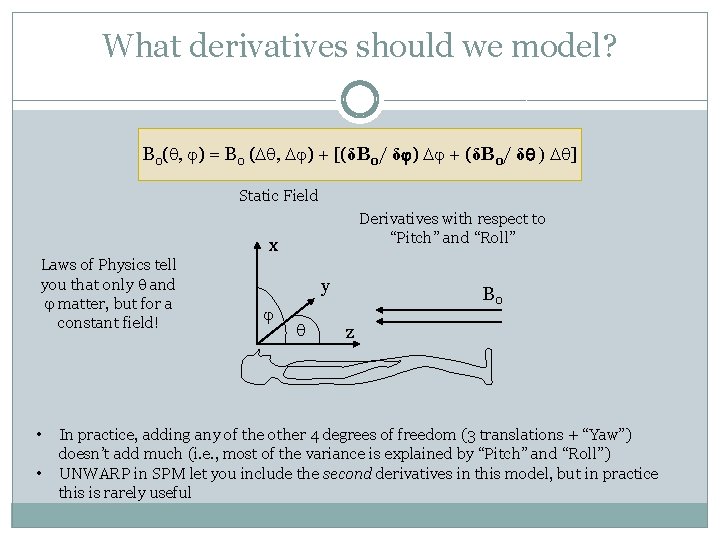
What derivatives should we model? B 0( , ) = B 0 ( , ) + [(δB 0/ δ ) + (δB 0/ δ ) ] Static Field Derivatives with respect to “Pitch” and “Roll” x Laws of Physics tell you that only and matter, but for a constant field! • • y B 0 z In practice, adding any of the other 4 degrees of freedom (3 translations + “Yaw”) doesn’t add much (i. e. , most of the variance is explained by “Pitch” and “Roll”) UNWARP in SPM let you include the second derivatives in this model, but in practice this is rarely useful
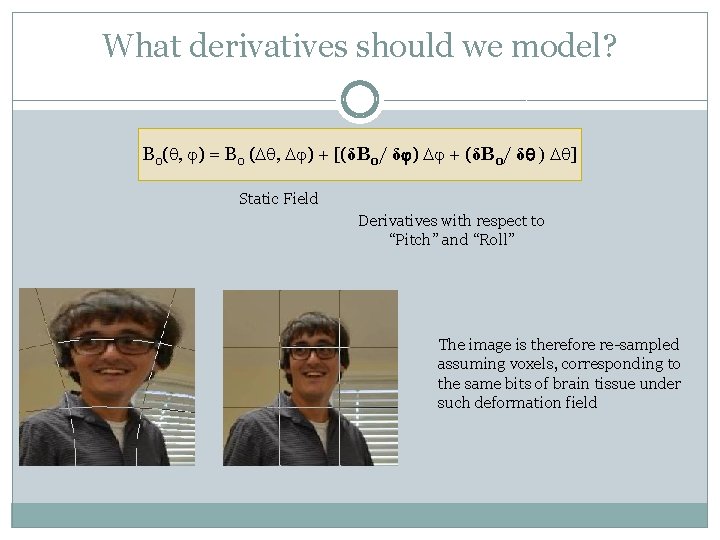
What derivatives should we model? B 0( , ) = B 0 ( , ) + [(δB 0/ δ ) + (δB 0/ δ ) ] Static Field Derivatives with respect to “Pitch” and “Roll” The image is therefore re-sampled assuming voxels, corresponding to the same bits of brain tissue under such deformation field
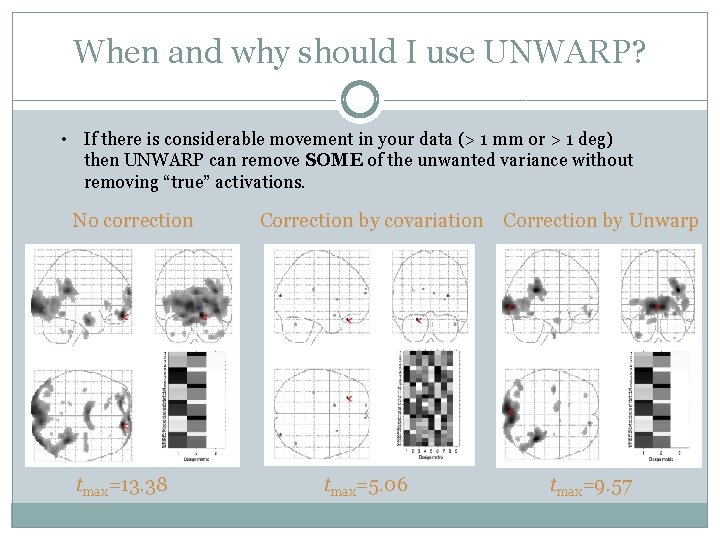
When and why should I use UNWARP? • If there is considerable movement in your data (> 1 mm or > 1 deg) then UNWARP can remove SOME of the unwanted variance without removing “true” activations. No correction tmax=13. 38 Correction by covariation Correction by Unwarp tmax=5. 06 tmax=9. 57
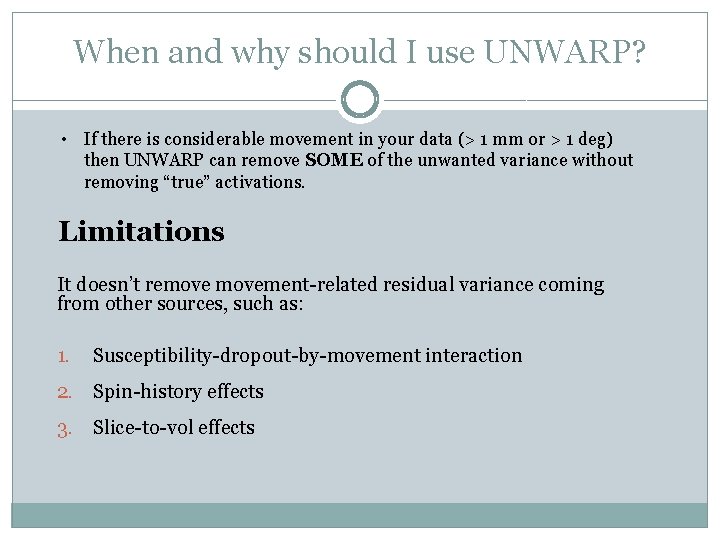
When and why should I use UNWARP? • If there is considerable movement in your data (> 1 mm or > 1 deg) then UNWARP can remove SOME of the unwanted variance without removing “true” activations. Limitations It doesn’t removement-related residual variance coming from other sources, such as: 1. Susceptibility-dropout-by-movement interaction 2. Spin-history effects 3. Slice-to-vol effects
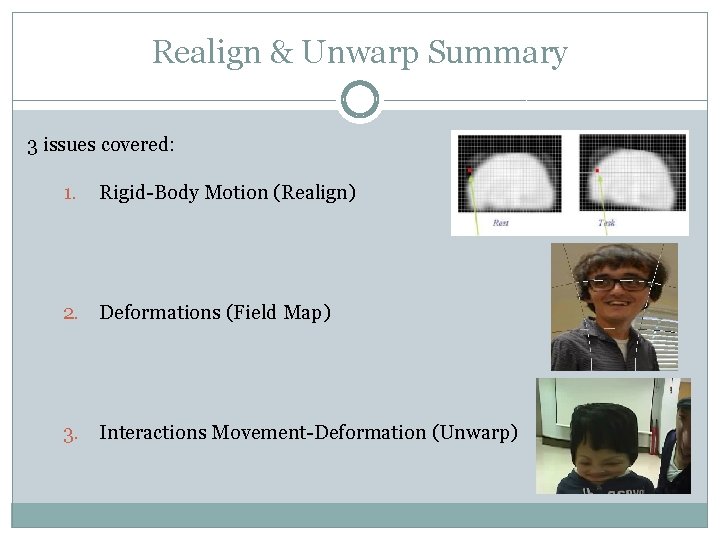
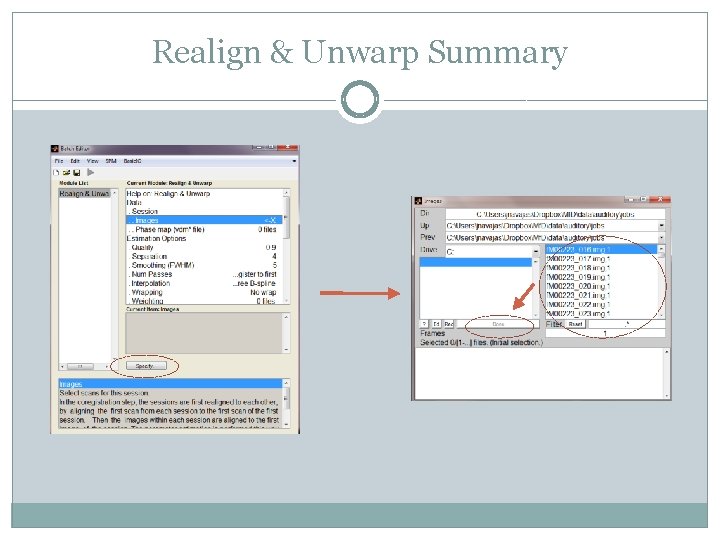
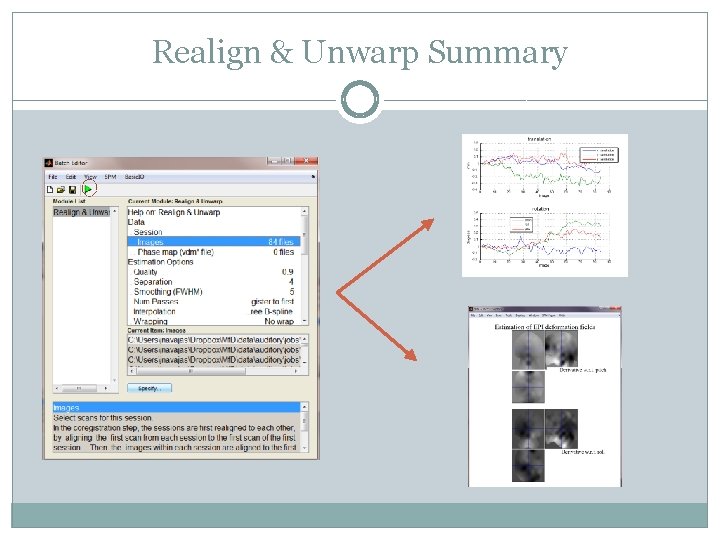
Realign & Unwarp Summary 3 issues covered: 1. Rigid-Body Motion (Realign) 2. Deformations (Field Map) 3. Interactions Movement-Deformation (Unwarp)
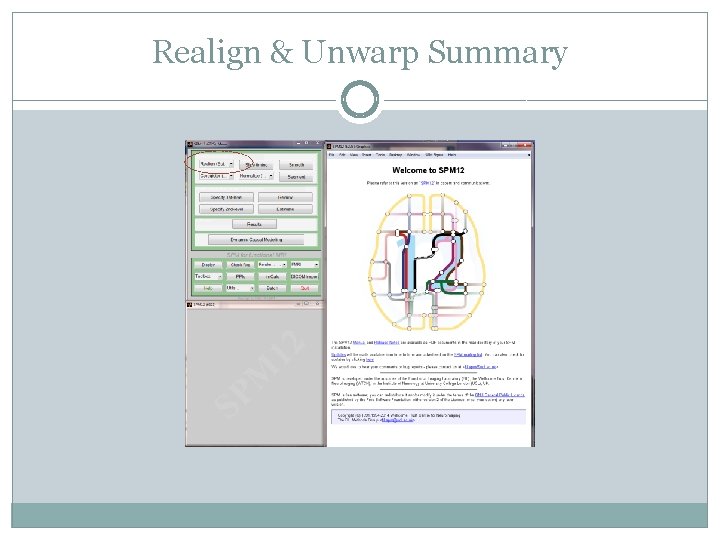
Realign & Unwarp Summary
Realign & Unwarp Summary
Realign & Unwarp Summary
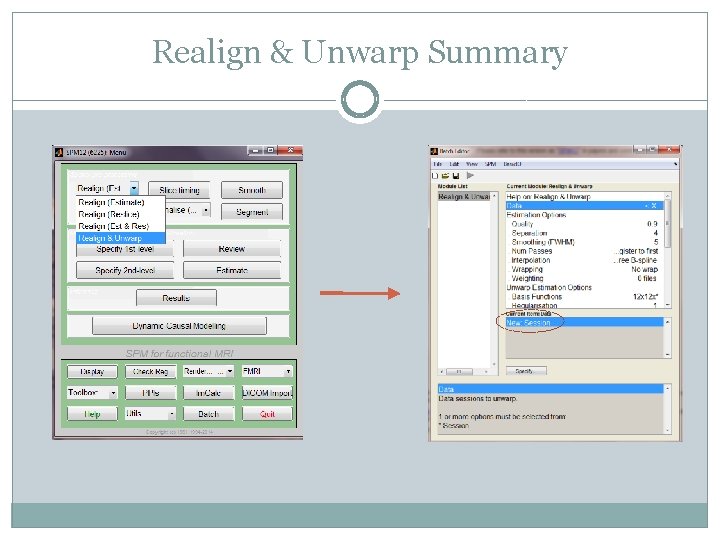
Realign & Unwarp Summary
References - Realigning � Ashburner & Friston. Rigid Body Registration. Chapter. � Previous years’ Md. F presentations � Ged Ridgway (2010). UBC SPM Course 2010. http: //www. pet. ubc. ca/sites/default/files/01_Spatial_Preprocessing. p df � Guillaume Flandin (2012). f. MRI Preprocessing http: //info. vtc. vt. edu/spmclass/01_Preprocessing. pdf � Andrew Jahn. Andy’s Brain Blog http: //andysbrainblogspot. co. uk/2012/10/fmri-motion-correction -afnis-3 dvolreg. html � Matthijs Vink (2007). Preprocessing and Analysis of Functional MRI data. Rudolf Magnus Institute of Neuroscience.
References - Unwarping � SPM toolbox tutorial: http: //www. fil. ion. ucl. ac. uk/spm/toolbox/unwarp/ � Paper presenting the method behind UNWARP: � Andersson JLR, Hutton C, Ashburner J, Turner R, Friston K (2001). Modelling geometric deformations in EPI time series. Neuro. Image 13: 90 -919 � Previous years’ Mf. D slides � General about movement-relates issues: � Friston KJ, Williams SR, Howard R, Frackowiak RSJ and Turner R (1995). Movement-related effect in f. MRI time-series. Magn Reson Med 35: 346 -355