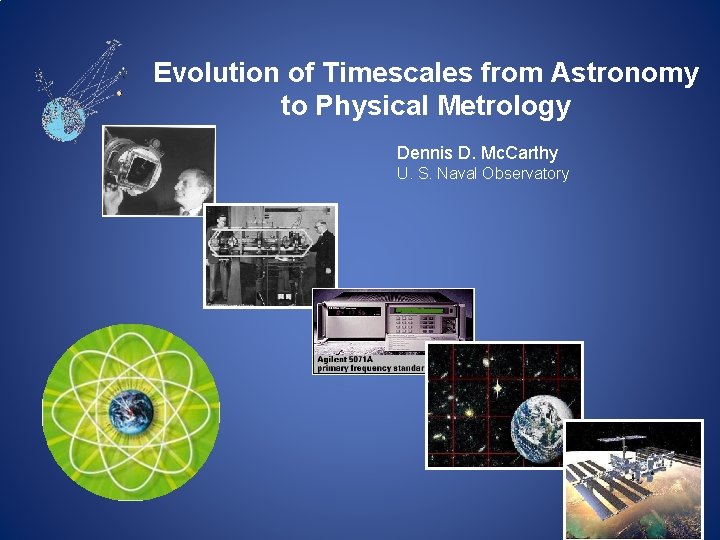
Evolution of Timescales from Astronomy to Physical Metrology
- Slides: 47
Evolution of Timescales from Astronomy to Physical Metrology Dennis D. Mc. Carthy U. S. Naval Observatory
TIMEKEEPING BASICS • Repeatable Phenomenon – Length between repetitions – Beginning of the repetition – Names for the successive repetitions • Timescales driven by timekeeping technology
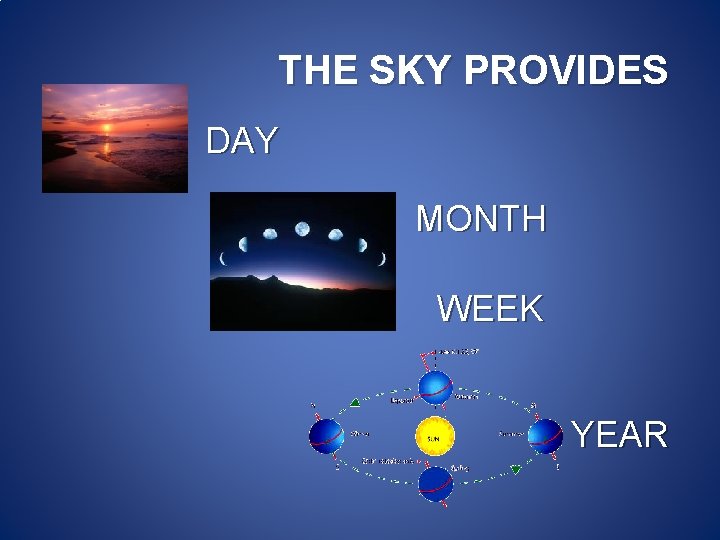
THE SKY PROVIDES DAY MONTH WEEK YEAR
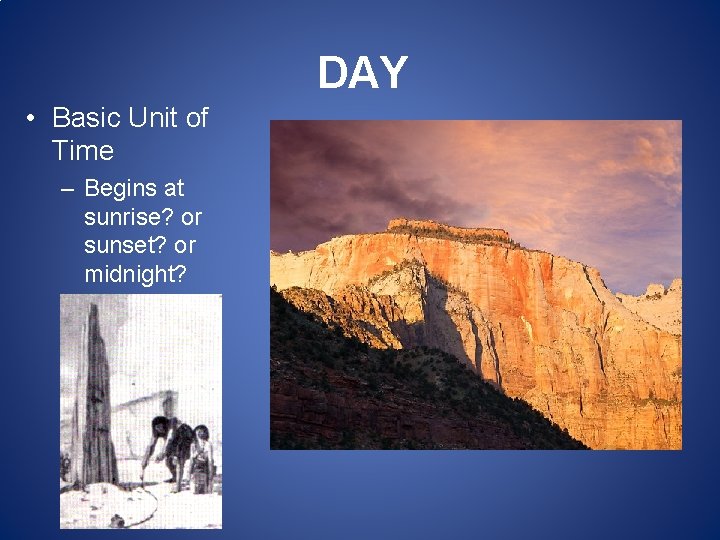
DAY • Basic Unit of Time – Begins at sunrise? or sunset? or midnight?
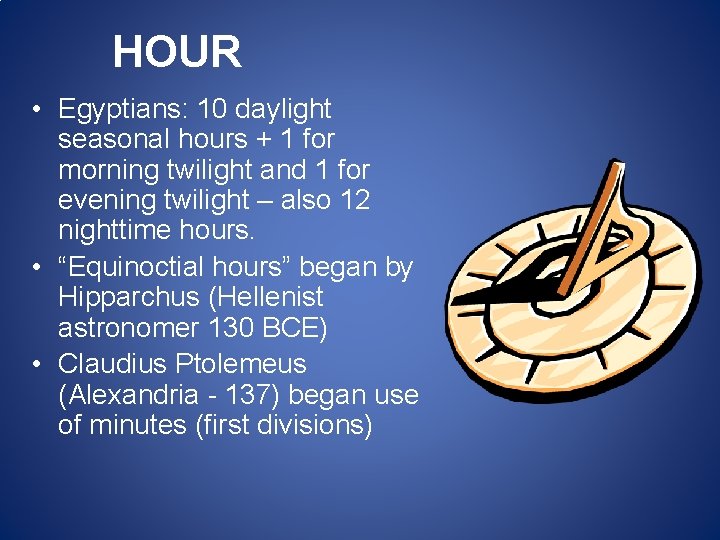
HOUR • Egyptians: 10 daylight seasonal hours + 1 for morning twilight and 1 for evening twilight – also 12 nighttime hours. • “Equinoctial hours” began by Hipparchus (Hellenist astronomer 130 BCE) • Claudius Ptolemeus (Alexandria - 137) began use of minutes (first divisions)
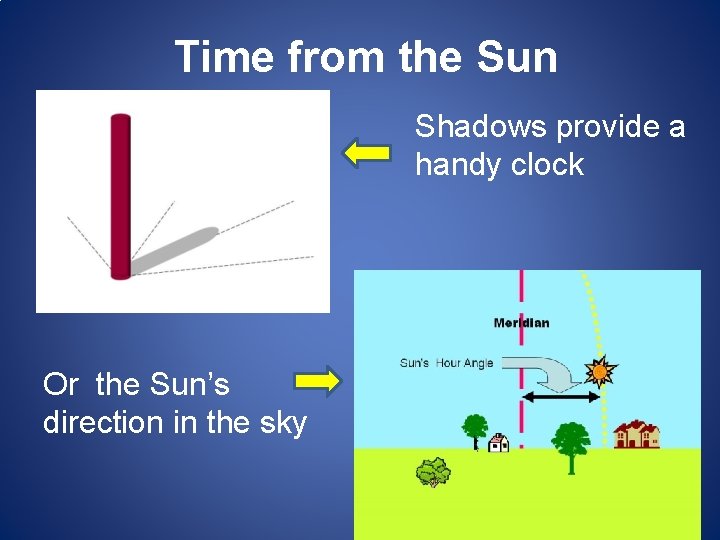
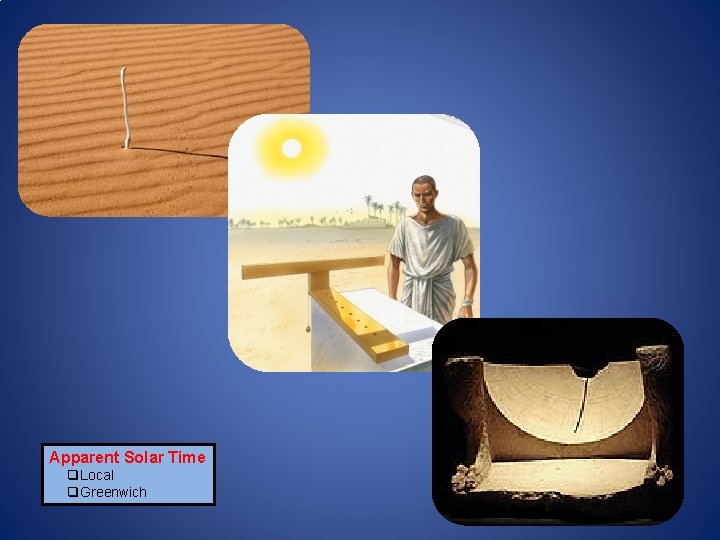
Time from the Sun Shadows provide a handy clock Or the Sun’s direction in the sky
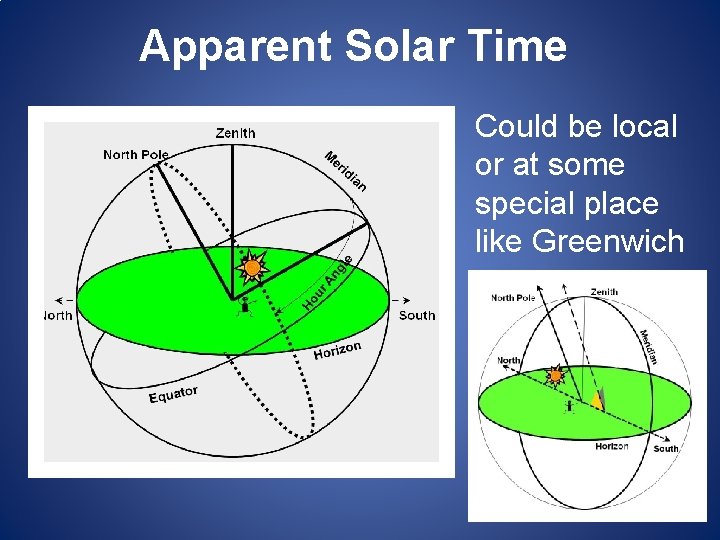
Apparent Solar Time Could be local or at some special place like Greenwich
Apparent Solar Time q. Local q. Greenwich
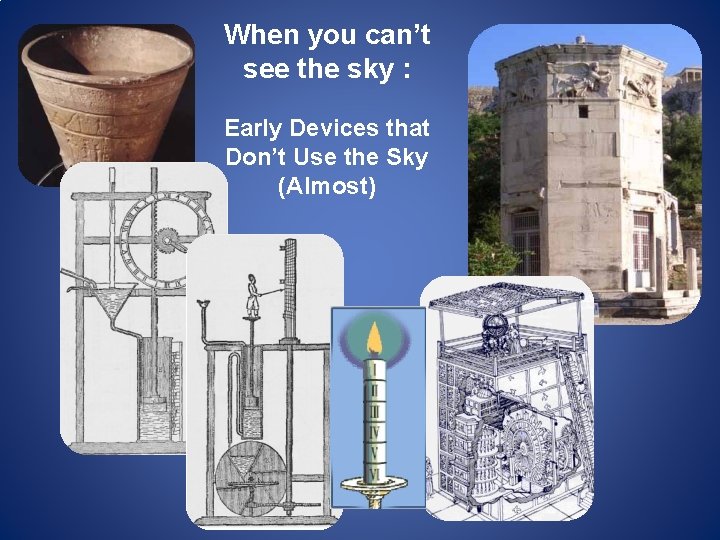
When you can’t see the sky : Early Devices that Don’t Use the Sky (Almost)
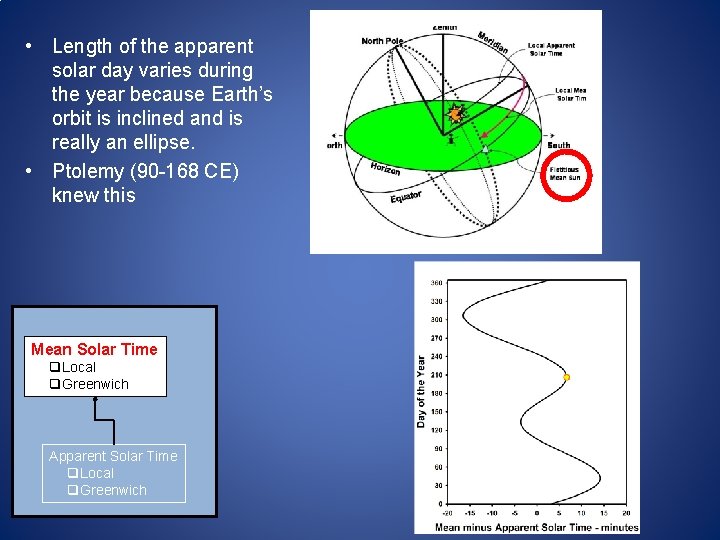
• Length of the apparent solar day varies during the year because Earth’s orbit is inclined and is really an ellipse. • Ptolemy (90 -168 CE) knew this Mean Solar Time q. Local q. Greenwich Apparent Solar Time q. Local q. Greenwich
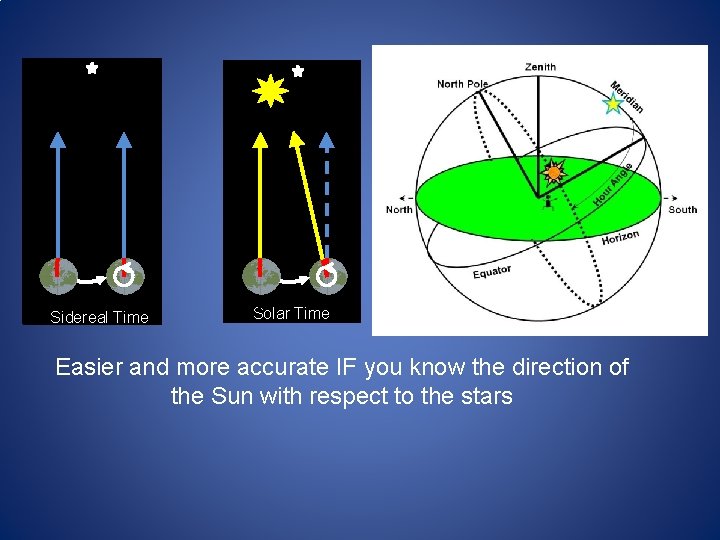
Sidereal Time Solar Time Easier and more accurate IF you know the direction of the Sun with respect to the stars
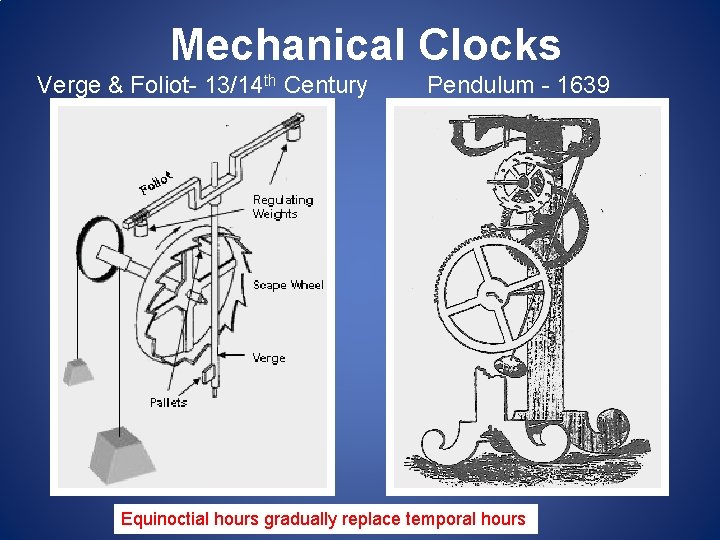
Mechanical Clocks Verge & Foliot- 13/14 th Century Pendulum - 1639 Equinoctial hours gradually replace temporal hours
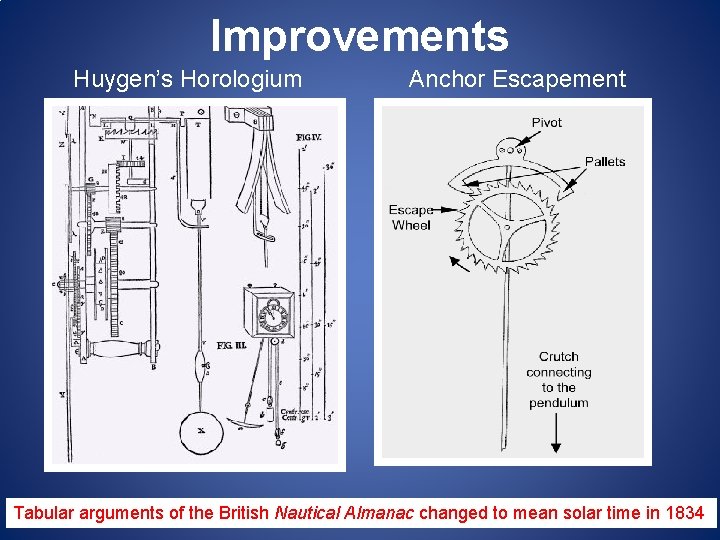
Improvements Huygen’s Horologium Anchor Escapement Tabular arguments of the British Nautical Almanac changed to mean solar time in 1834
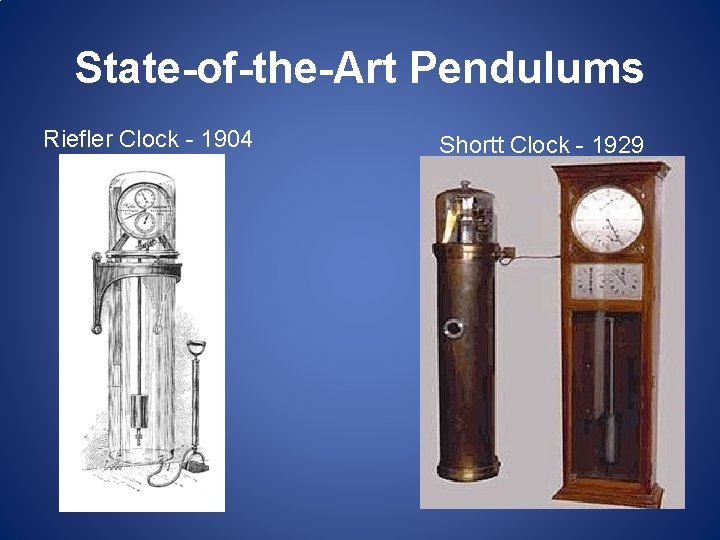
State-of-the-Art Pendulums Riefler Clock - 1904 Shortt Clock - 1929
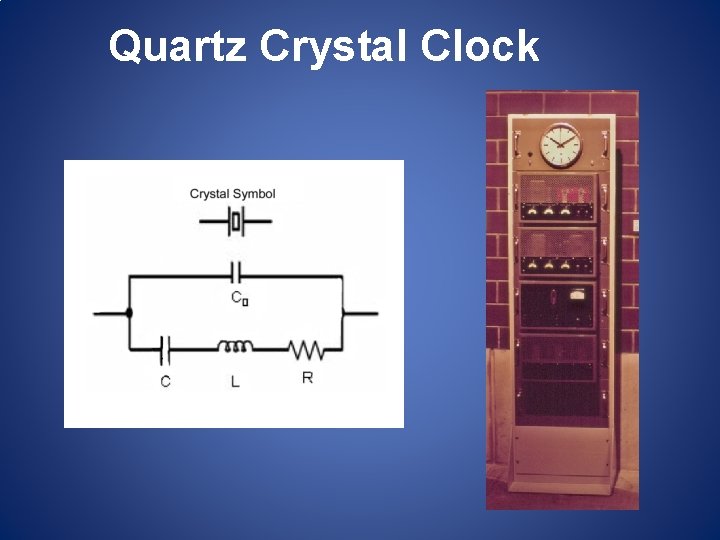
Quartz Crystal Clock
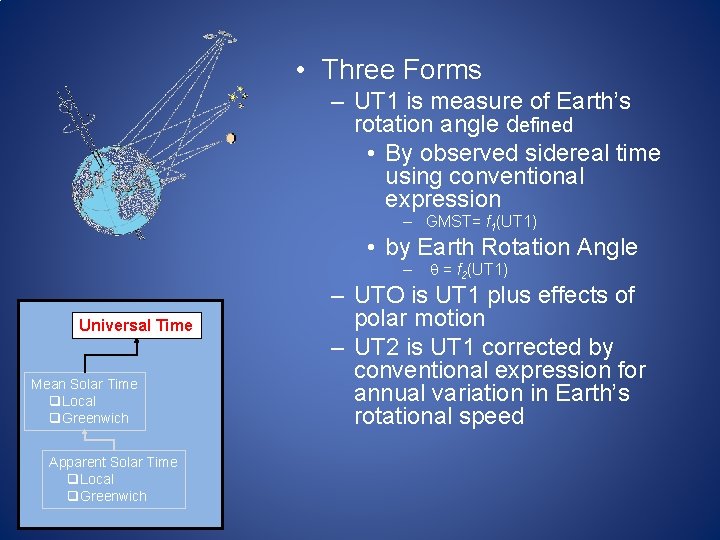
• Three Forms – UT 1 is measure of Earth’s rotation angle defined • By observed sidereal time using conventional expression – GMST= f 1(UT 1) • by Earth Rotation Angle – Universal Time Mean Solar Time q. Local q. Greenwich Apparent Solar Time q. Local q. Greenwich q = f 2(UT 1) – UTO is UT 1 plus effects of polar motion – UT 2 is UT 1 corrected by conventional expression for annual variation in Earth’s rotational speed
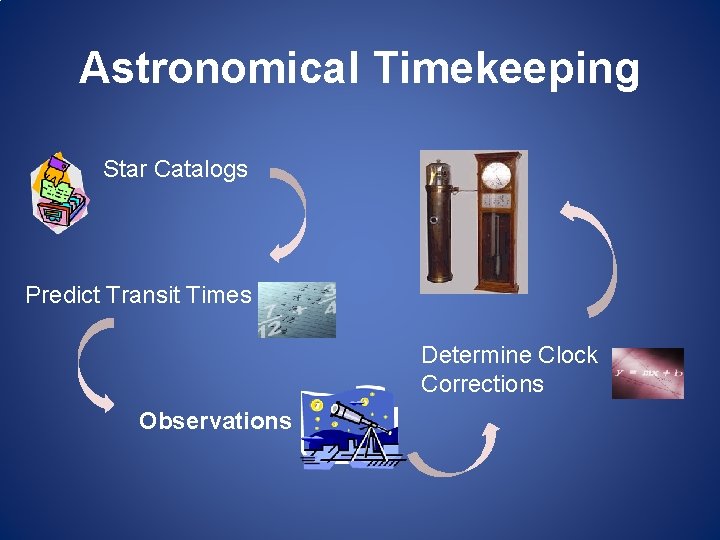
Astronomical Timekeeping Star Catalogs Predict Transit Times Determine Clock Corrections Observations
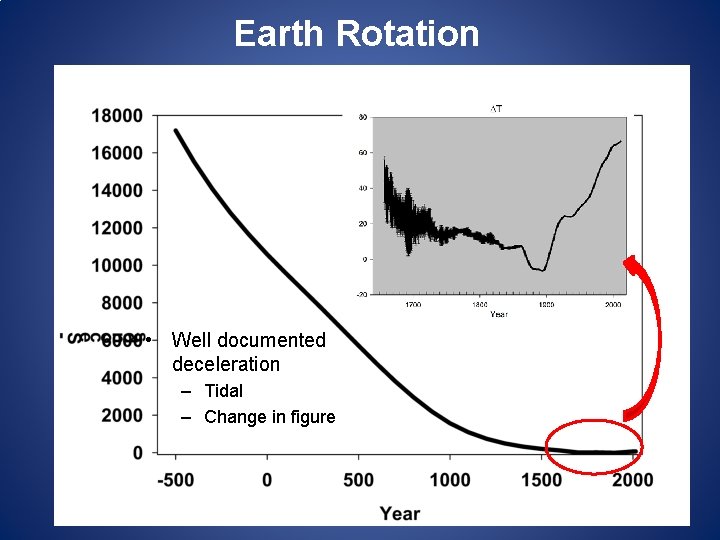
Earth Rotation • Well documented deceleration – Tidal – Change in figure
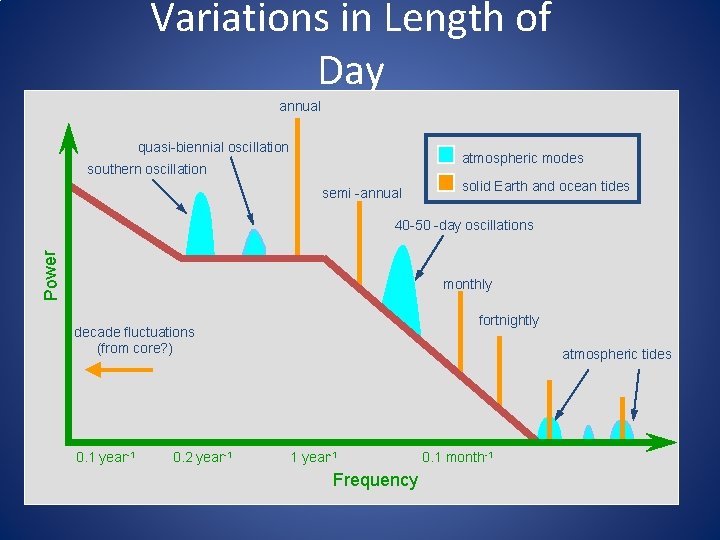
Variations in Length of Day annual quasi-biennial oscillation atmospheric modes southern oscillation semi -annual solid Earth and ocean tides Power 40 -50 -day oscillations monthly fortnightly decade fluctuations (from core? ) 0. 1 year-1 0. 2 year-1 atmospheric tides 1 year-1 Frequency 0. 1 month-1
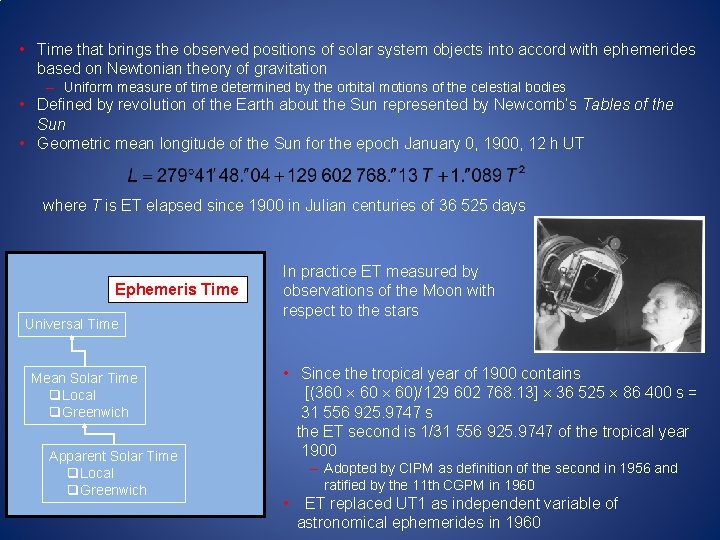
• Time that brings the observed positions of solar system objects into accord with ephemerides based on Newtonian theory of gravitation – Uniform measure of time determined by the orbital motions of the celestial bodies • Defined by revolution of the Earth about the Sun represented by Newcomb’s Tables of the Sun • Geometric mean longitude of the Sun for the epoch January 0, 1900, 12 h UT where T is ET elapsed since 1900 in Julian centuries of 36 525 days Ephemeris Time Universal Time Mean Solar Time q. Local q. Greenwich Apparent Solar Time q. Local q. Greenwich In practice ET measured by observations of the Moon with respect to the stars • Since the tropical year of 1900 contains [(360 60)/129 602 768. 13] 36 525 86 400 s = 31 556 925. 9747 s the ET second is 1/31 556 925. 9747 of the tropical year 1900 – Adopted by CIPM as definition of the second in 1956 and ratified by the 11 th CGPM in 1960 • ET replaced UT 1 as independent variable of astronomical ephemerides in 1960
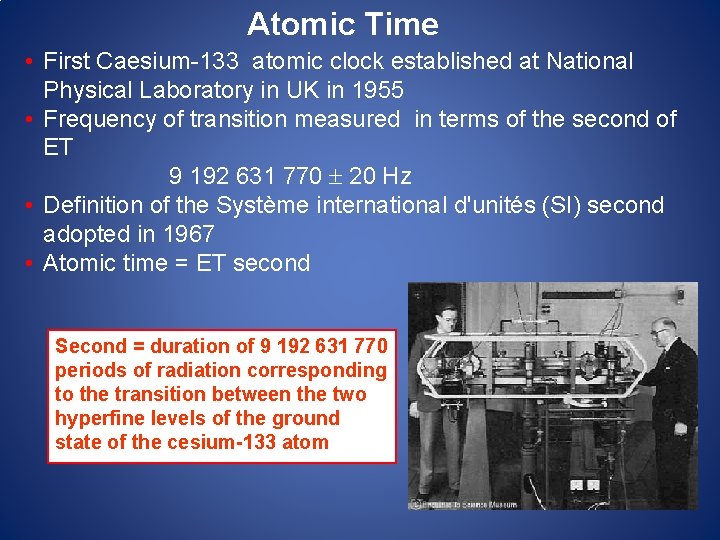
Atomic Time • First Caesium-133 atomic clock established at National Physical Laboratory in UK in 1955 • Frequency of transition measured in terms of the second of ET 9 192 631 770 20 Hz • Definition of the Système international d'unités (SI) second adopted in 1967 • Atomic time = ET second Second = duration of 9 192 631 770 periods of radiation corresponding to the transition between the two hyperfine levels of the ground state of the cesium-133 atom
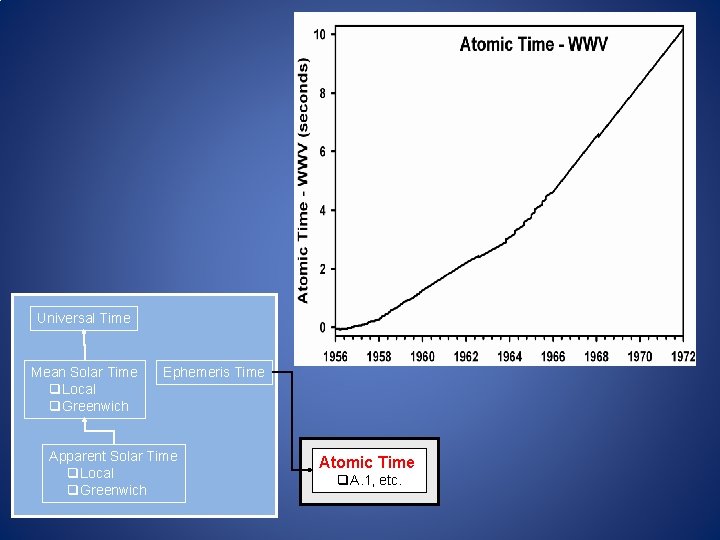
Universal Time Mean Solar Time q. Local q. Greenwich Ephemeris Time Apparent Solar Time q. Local q. Greenwich Atomic Time q A. 1, etc.
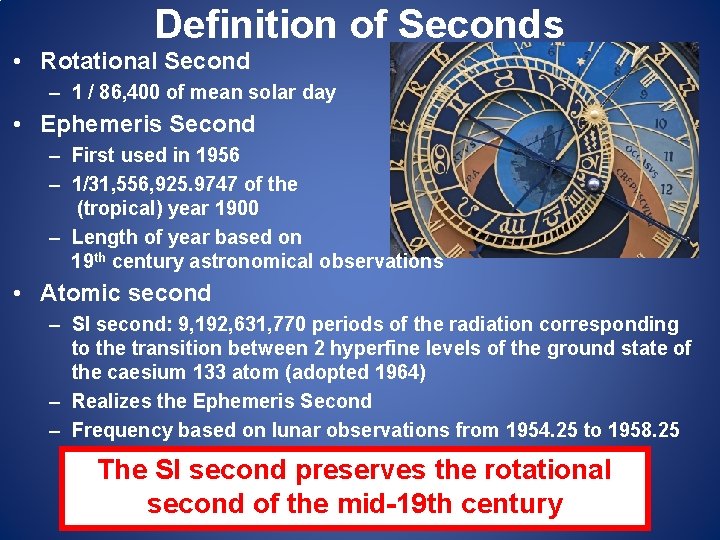
Definition of Seconds • Rotational Second – 1 / 86, 400 of mean solar day • Ephemeris Second – First used in 1956 – 1/31, 556, 925. 9747 of the (tropical) year 1900 – Length of year based on 19 th century astronomical observations • Atomic second – SI second: 9, 192, 631, 770 periods of the radiation corresponding to the transition between 2 hyperfine levels of the ground state of the caesium 133 atom (adopted 1964) – Realizes the Ephemeris Second – Frequency based on lunar observations from 1954. 25 to 1958. 25 The SI second preserves the rotational second of the mid-19 th century
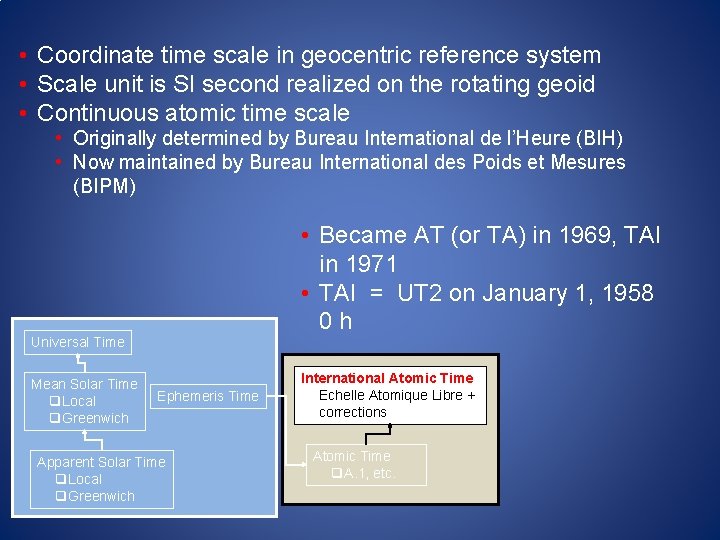
• Coordinate time scale in geocentric reference system • Scale unit is SI second realized on the rotating geoid • Continuous atomic time scale • Originally determined by Bureau International de l’Heure (BIH) • Now maintained by Bureau International des Poids et Mesures (BIPM) • Became AT (or TA) in 1969, TAI in 1971 • TAI = UT 2 on January 1, 1958 0 h Universal Time Mean Solar Time q. Local q. Greenwich Ephemeris Time Apparent Solar Time q. Local q. Greenwich International Atomic Time Echelle Atomique Libre + corrections Atomic Time q A. 1, etc.
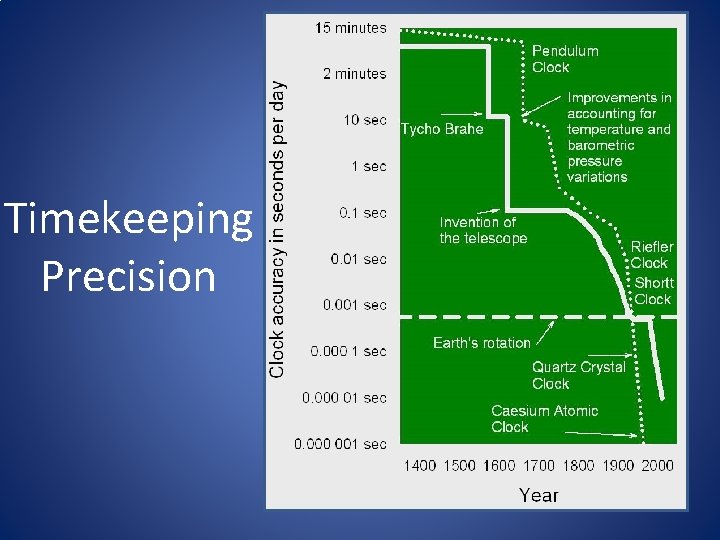
Timekeeping Precision
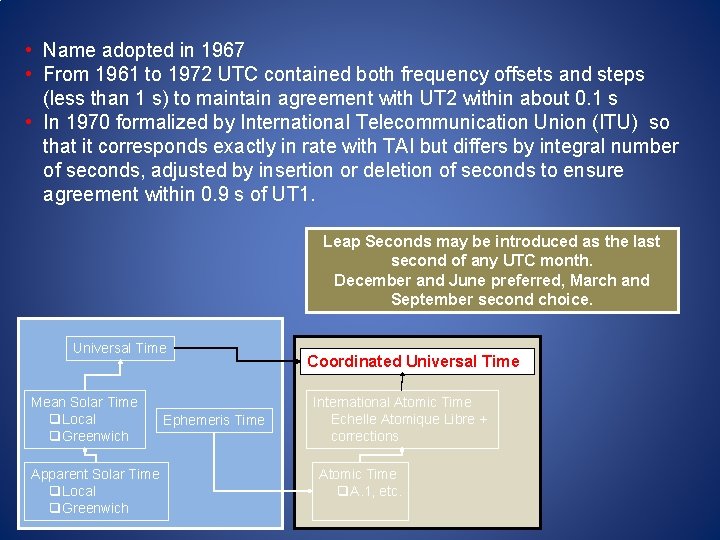
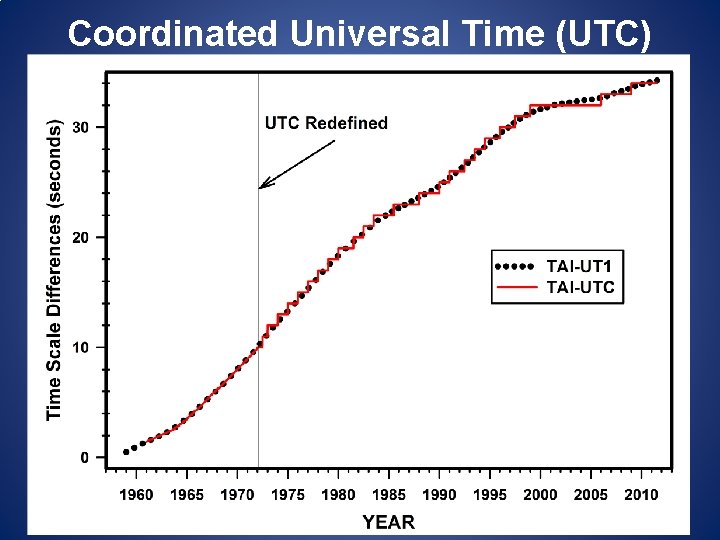
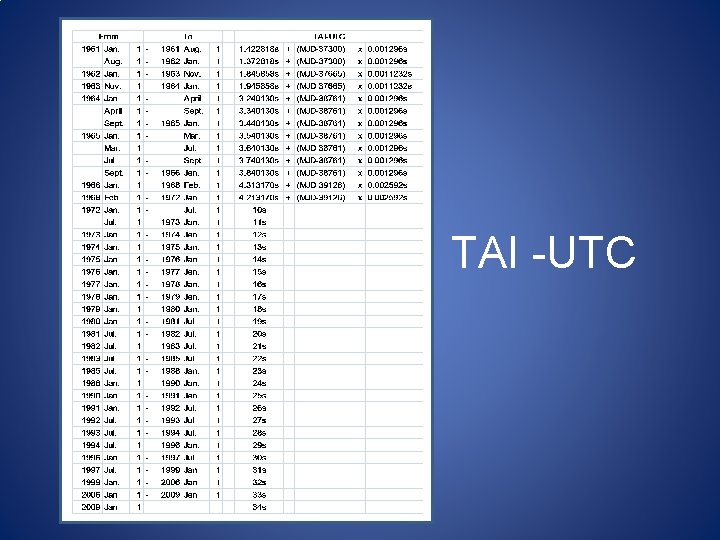
• Name adopted in 1967 • From 1961 to 1972 UTC contained both frequency offsets and steps (less than 1 s) to maintain agreement with UT 2 within about 0. 1 s • In 1970 formalized by International Telecommunication Union (ITU) so that it corresponds exactly in rate with TAI but differs by integral number of seconds, adjusted by insertion or deletion of seconds to ensure agreement within 0. 9 s of UT 1. Leap Seconds may be introduced as the last second of any UTC month. December and June preferred, March and September second choice. Universal Time Mean Solar Time q. Local q. Greenwich Apparent Solar Time q. Local q. Greenwich Ephemeris Time Coordinated Universal Time International Atomic Time Echelle Atomique Libre + corrections Atomic Time q A. 1, etc.
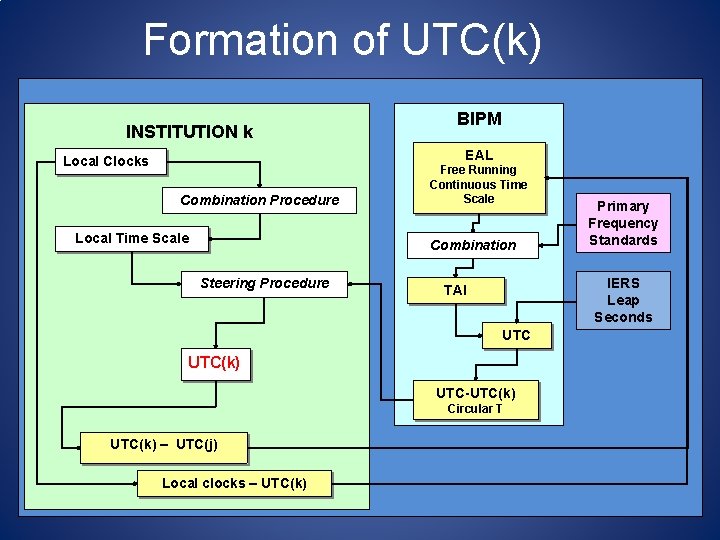
Formation of UTC(k) INSTITUTION k BIPM EAL Local Clocks Combination Procedure Local Time Scale Free Running Continuous Time Scale Combination Steering Procedure IERS Leap Seconds TAI UTC(k) UTC-UTC(k) Circular T UTC(k) – UTC(j) Local clocks – UTC(k) Primary Frequency Standards
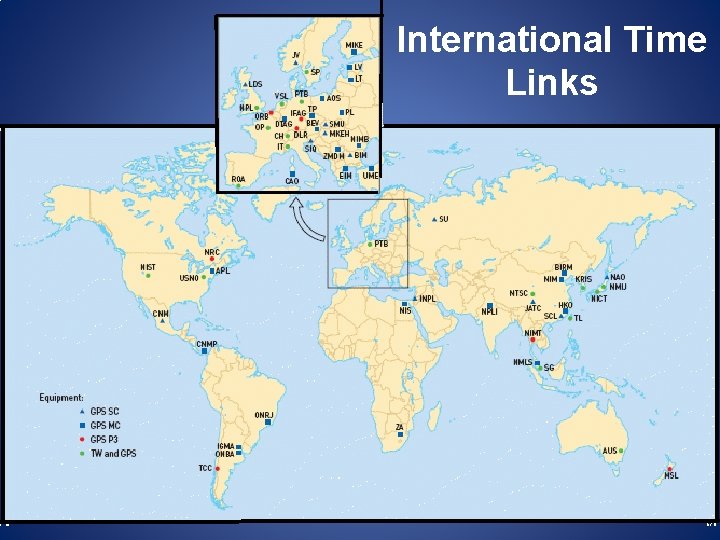
International Time Links
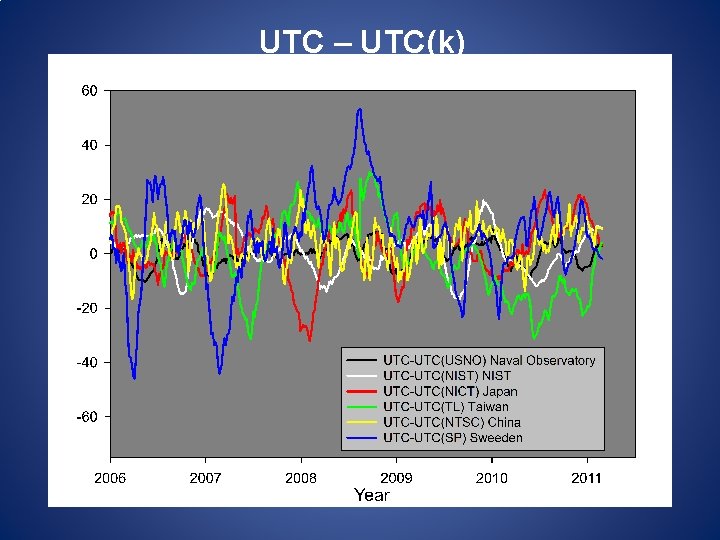
UTC – UTC(k)
Coordinated Universal Time (UTC)
TAI -UTC
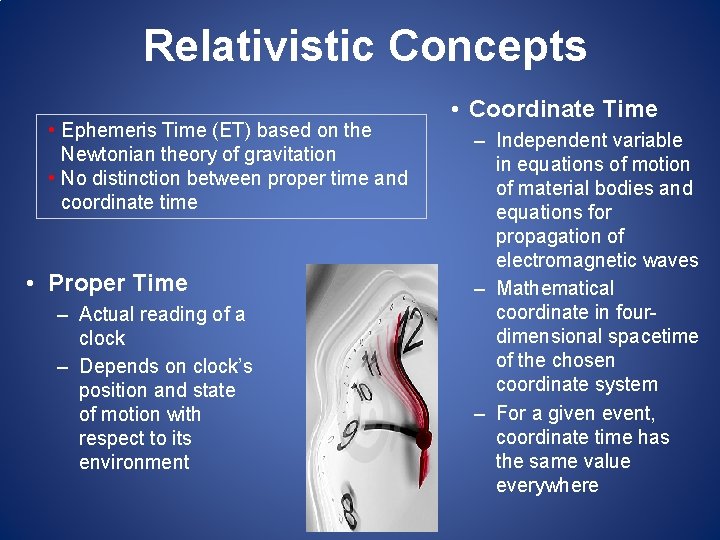
Relativistic Concepts • Ephemeris Time (ET) based on the Newtonian theory of gravitation • No distinction between proper time and coordinate time • Proper Time – Actual reading of a clock – Depends on clock’s position and state of motion with respect to its environment • Coordinate Time – Independent variable in equations of motion of material bodies and equations for propagation of electromagnetic waves – Mathematical coordinate in fourdimensional spacetime of the chosen coordinate system – For a given event, coordinate time has the same value everywhere
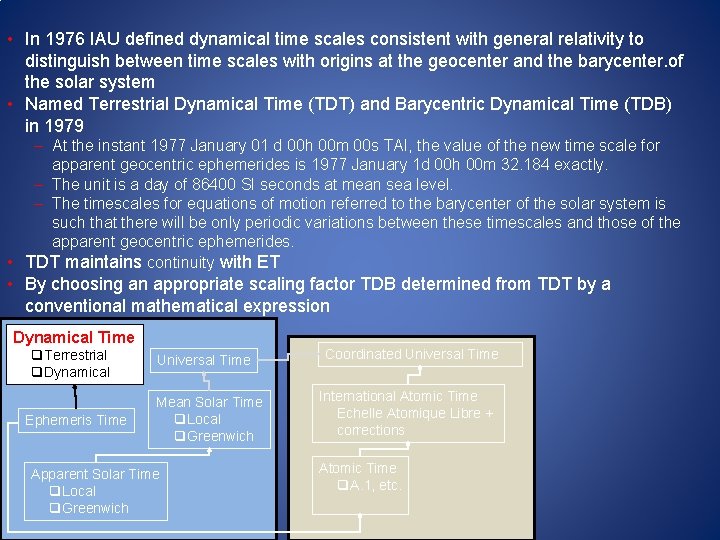
• In 1976 IAU defined dynamical time scales consistent with general relativity to distinguish between time scales with origins at the geocenter and the barycenter. of the solar system • Named Terrestrial Dynamical Time (TDT) and Barycentric Dynamical Time (TDB) in 1979 – At the instant 1977 January 01 d 00 h 00 m 00 s TAI, the value of the new time scale for apparent geocentric ephemerides is 1977 January 1 d 00 h 00 m 32. 184 exactly. – The unit is a day of 86400 SI seconds at mean sea level. – The timescales for equations of motion referred to the barycenter of the solar system is such that there will be only periodic variations between these timescales and those of the apparent geocentric ephemerides. • TDT maintains continuity with ET • By choosing an appropriate scaling factor TDB determined from TDT by a conventional mathematical expression Dynamical Time q. Terrestrial q Dynamical Ephemeris Time Universal Time Mean Solar Time q. Local q. Greenwich Apparent Solar Time q. Local q. Greenwich Coordinated Universal Time International Atomic Time Echelle Atomique Libre + corrections Atomic Time q A. 1, etc.
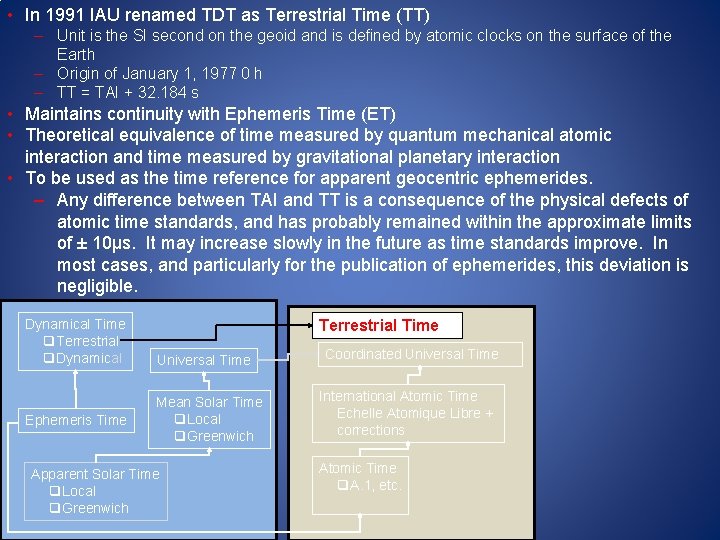
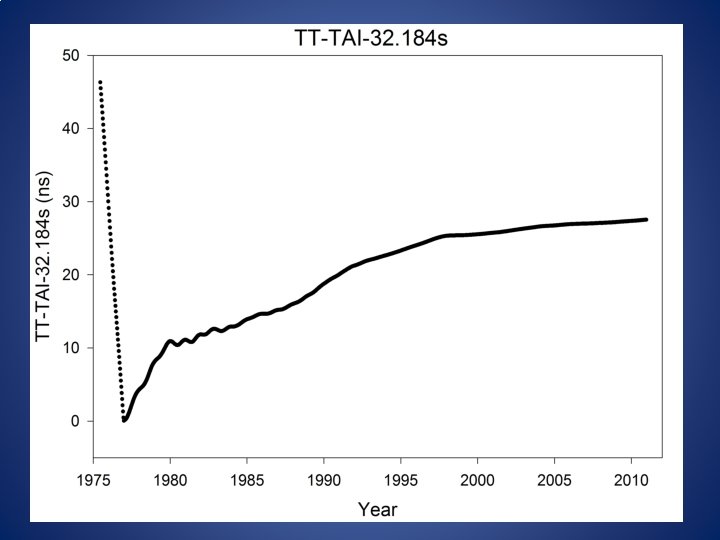
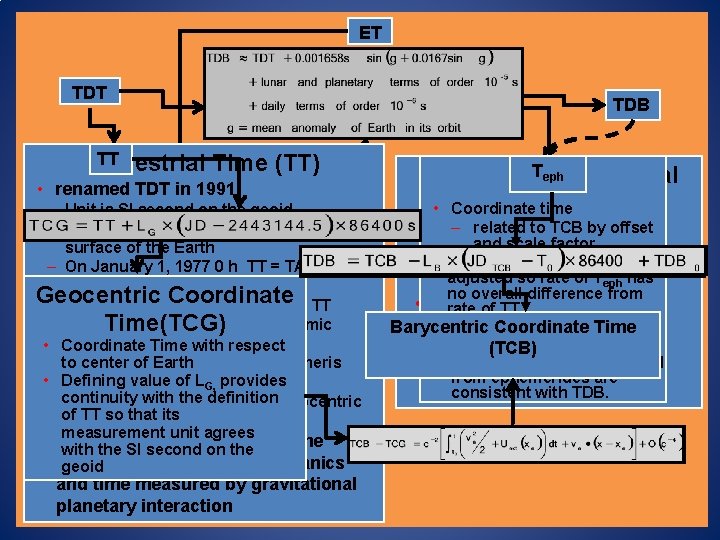
• In 1991 IAU renamed TDT as Terrestrial Time (TT) – Unit is the SI second on the geoid and is defined by atomic clocks on the surface of the Earth – Origin of January 1, 1977 0 h – TT = TAI + 32. 184 s • Maintains continuity with Ephemeris Time (ET) • Theoretical equivalence of time measured by quantum mechanical atomic interaction and time measured by gravitational planetary interaction • To be used as the time reference for apparent geocentric ephemerides. – Any difference between TAI and TT is a consequence of the physical defects of atomic time standards, and has probably remained within the approximate limits of ± 10µs. It may increase slowly in the future as time standards improve. In most cases, and particularly for the publication of ephemerides, this deviation is negligible. Dynamical Time q. Terrestrial q Dynamical Ephemeris Time Terrestrial Time Universal Time Mean Solar Time q. Local q. Greenwich Apparent Solar Time q. Local q. Greenwich Coordinated Universal Time International Atomic Time Echelle Atomique Libre + corrections Atomic Time q A. 1, etc.
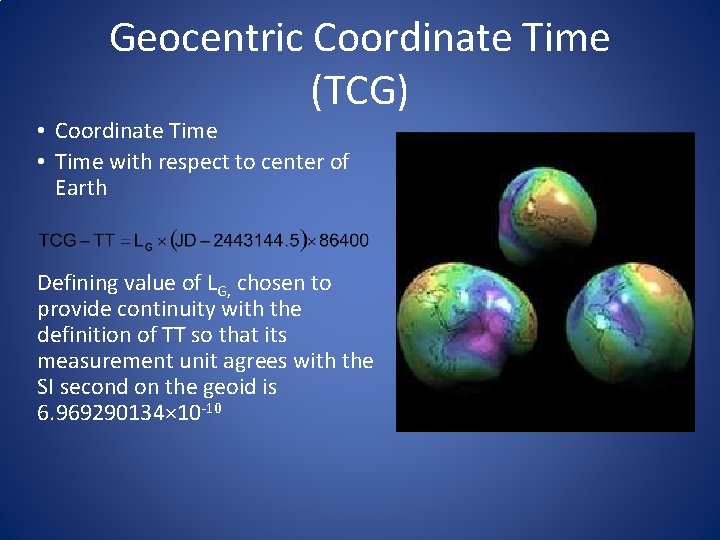
Geocentric Coordinate Time (TCG) • Coordinate Time • Time with respect to center of Earth Defining value of LG, chosen to provide continuity with the definition of TT so that its measurement unit agrees with the SI second on the geoid is 6. 969290134× 10 -10
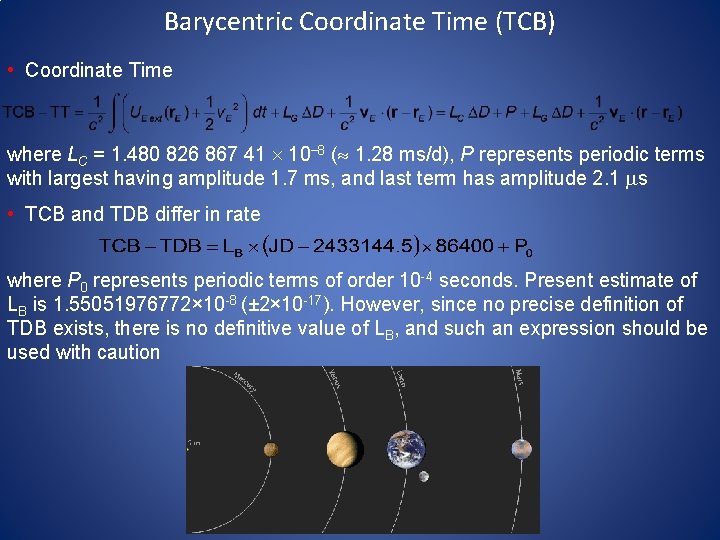
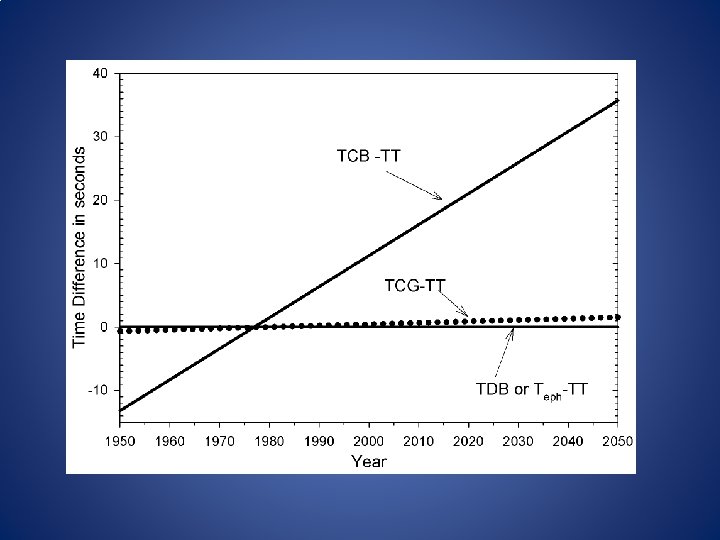
Barycentric Coordinate Time (TCB) • Coordinate Time where LC = 1. 480 826 867 41 10− 8 ( 1. 28 ms/d), P represents periodic terms with largest having amplitude 1. 7 ms, and last term has amplitude 2. 1 s • TCB and TDB differ in rate where P 0 represents periodic terms of order 10 -4 seconds. Present estimate of LB is 1. 55051976772× 10 -8 (± 2× 10 -17). However, since no precise definition of TDB exists, there is no definitive value of LB, and such an expression should be used with caution
Teph • Time argument used in the JPL solar system ephemerides since the mid-1960’s • True relativistic coordinate time, rigorously equivalent to TCB • TCB differs from Teph only by a rate and an offset • differs from TT by periodic terms with an amplitude < 2 ms of time
ET TDT TT Terrestrial Time (TT) Terrestrial Dynamical • renamed TDT in 1991 (TDT) – Unit is Time SI second on the geoid – • Defined by atomic Defined in 1976 clocks on the surface of the Earth • SI second – On January 1, 1977 0 h TT = TAI + • Origin at the geocenter 32. 184 s Geocentric Named in Coordinate 1979 – • Any difference between TAI and TT of physicalwith defects • result Continuous ETof atomic Time(TCG) time • • Coordinate Time with respect On standards 1 January 1984 – to Maintains with Ephemeris center ofcontinuity Earth replaced Ephemeris Time • Defining Time (ET)value of LG, provides in national with ephemerides the – continuity Time reference for definition apparent geocentric of TT so that its ephemerides. measurement unit agrees • Theoretical equivalence with the SI second on the of time measured by quantum mechanics geoid and time measured by gravitational planetary interaction TDB eph. Dynamical Barycentric TTeph Time time (TDB) • Coordinate – related to TCB by offset • Defined in 1976 and scale factor • Origin at the based solaron Teph • Ephemerides adjustedbarycenter so rate of Teph has system no overall difference from • Named in 1979 rate of TT Barycentric – So. Coordinate nodifference. Time from • Periodic the rate of TDB (TCB) between TDB and TDT • Space coordinates obtained from ephemerides are • Theory dependent consistent with TDB.
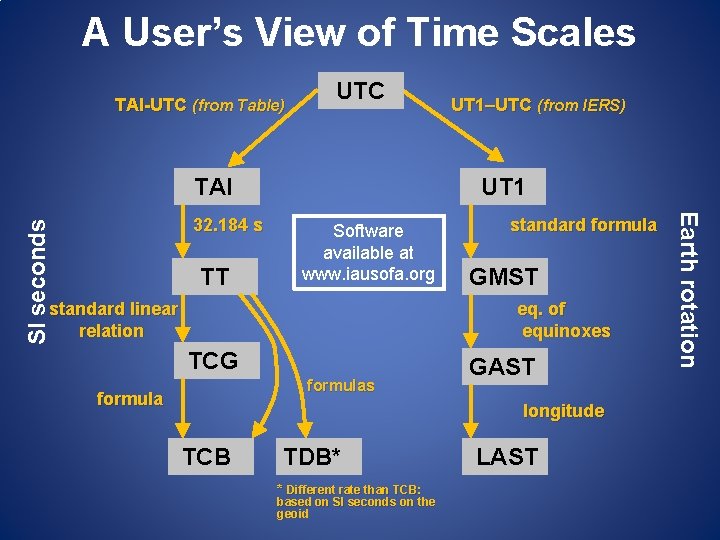
A User’s View of Time Scales TAI-UTC (from Table) UTC TAI SI seconds TT UT 1 Software available at www. iausofa. org standard linear relation standard formula GMST eq. of equinoxes TCG formulas formula GAST longitude TCB TDB* * Different rate than TCB: based on SI seconds on the geoid LAST Earth rotation 32. 184 s UT 1–UTC (from IERS)
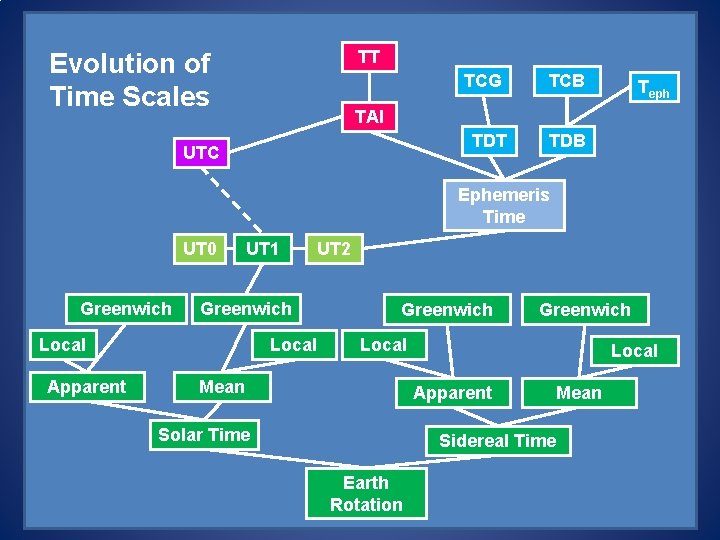
TT Evolution of Time Scales TCG TCB TDT TDB Teph TAI UTC Ephemeris Time UT 0 Greenwich UT 1 Greenwich Local Apparent UT 2 Local Greenwich Local Mean Local Apparent Solar Time Mean Sidereal Time Earth Rotation
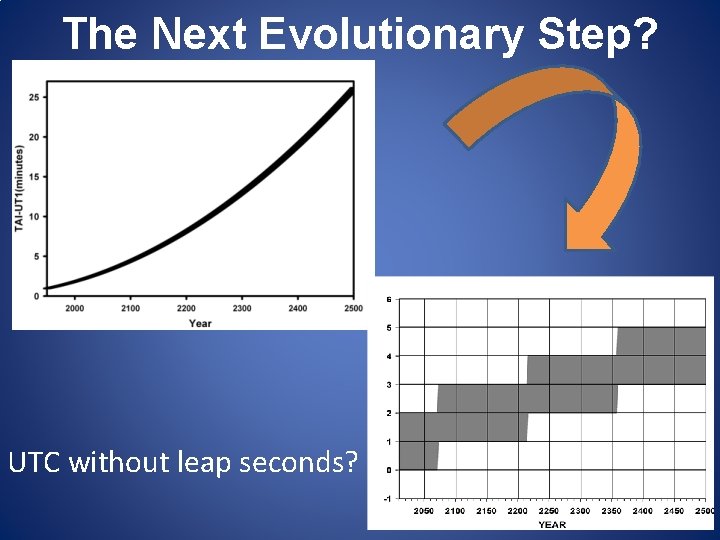
The Next Evolutionary Step? UTC without leap seconds?
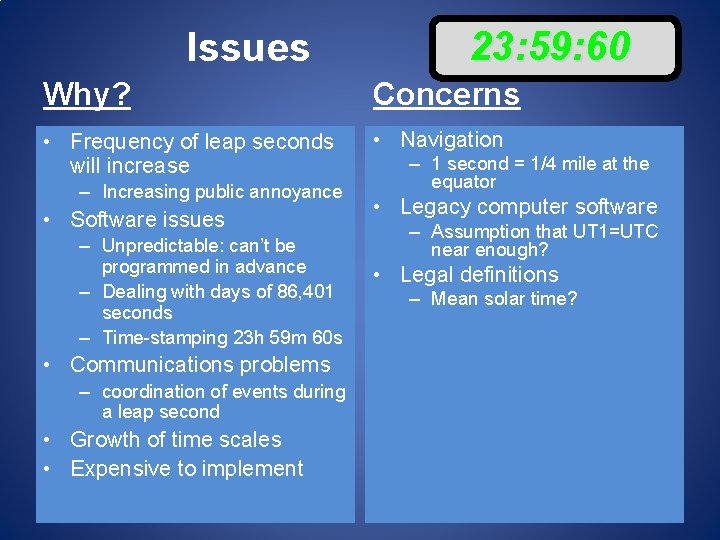
Issues 23: 59: 60 Why? Concerns • Frequency of leap seconds will increase • Navigation – Increasing public annoyance • Software issues – Unpredictable: can’t be programmed in advance – Dealing with days of 86, 401 seconds – Time-stamping 23 h 59 m 60 s • Communications problems – coordination of events during a leap second • Growth of time scales • Expensive to implement – 1 second = 1/4 mile at the equator • Legacy computer software – Assumption that UT 1=UTC near enough? • Legal definitions – Mean solar time?
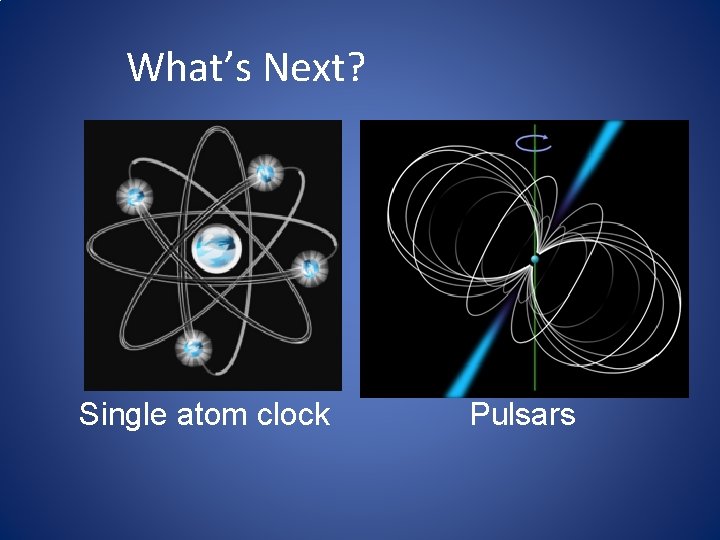
What’s Next? Single atom clock Pulsars
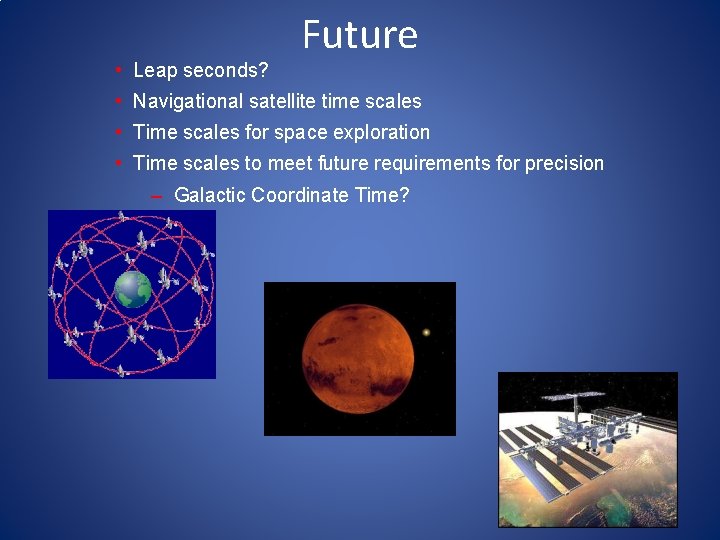
• Leap seconds? Future • Navigational satellite time scales • Time scales for space exploration • Time scales to meet future requirements for precision – Galactic Coordinate Time?
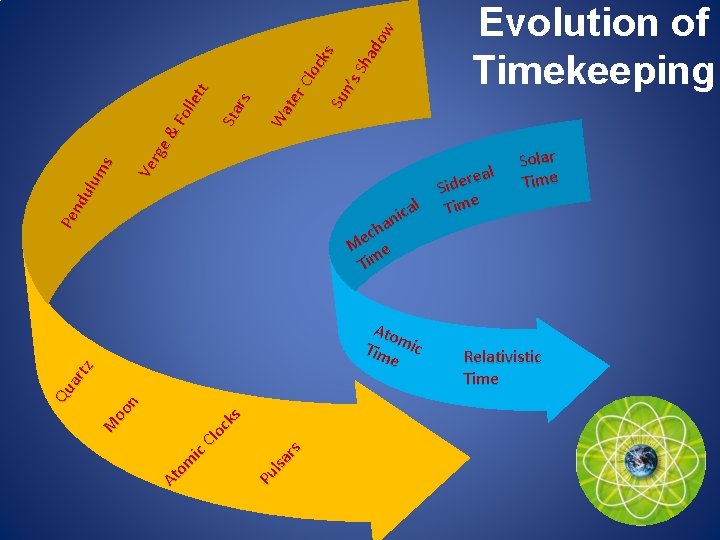
W ate r. C l oc ks Su n’s Sh ad ow Fo lle tt S ta rs Ve rge & Ato m Tim i c e Pu lsa rs At om ic Cl oc ks M oo n Qu ar tz Pe nd ulu ms al c i an h c Me e Tim Evolution of Timekeeping real e d i S Time Solar Time Relativistic Time