
Quantum metrology and the geometry of quantum channels
- Slides: 21
Quantum metrology and the geometry of quantum channels the illusion of the Heisenberg scaling R. Demkowicz-Dobrzański 1, J. Kołodyński 1, M. Guta 2 1 Faculty of Physics, Warsaw University, Poland 2 School of Mathematical Sciences, University of Nottingham, United Kingdom
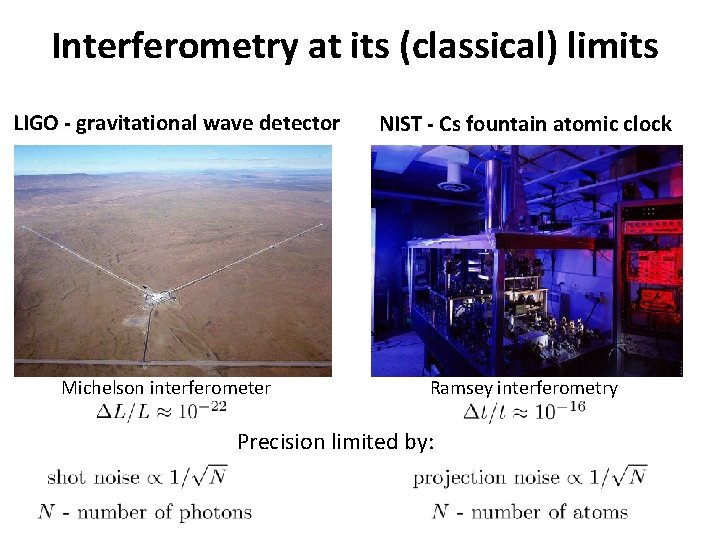
Interferometry at its (classical) limits LIGO - gravitational wave detector Michelson interferometer NIST - Cs fountain atomic clock Ramsey interferometry Precision limited by:
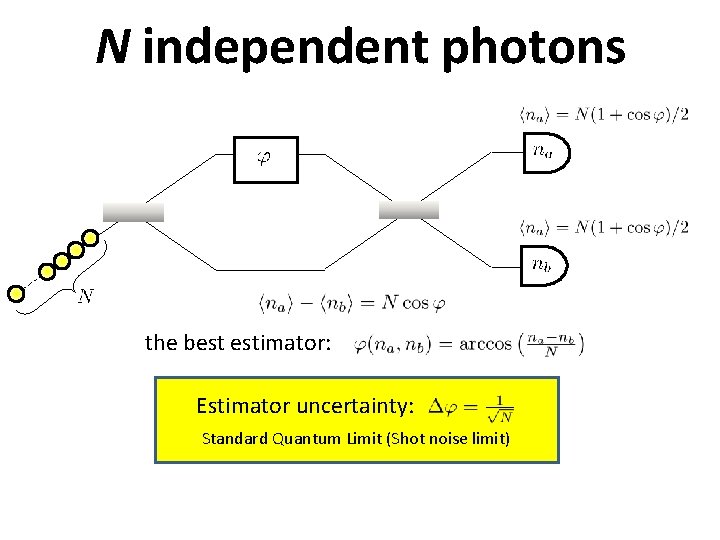
N independent photons the best estimator: Estimator uncertainty: Standard Quantum Limit (Shot noise limit)
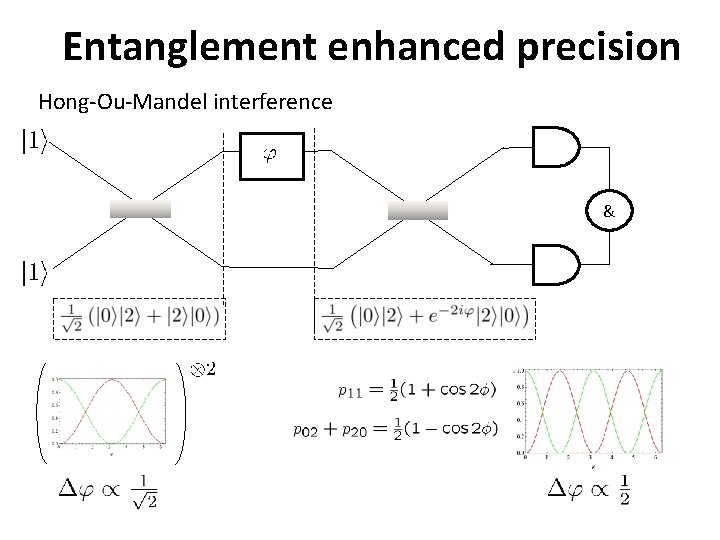
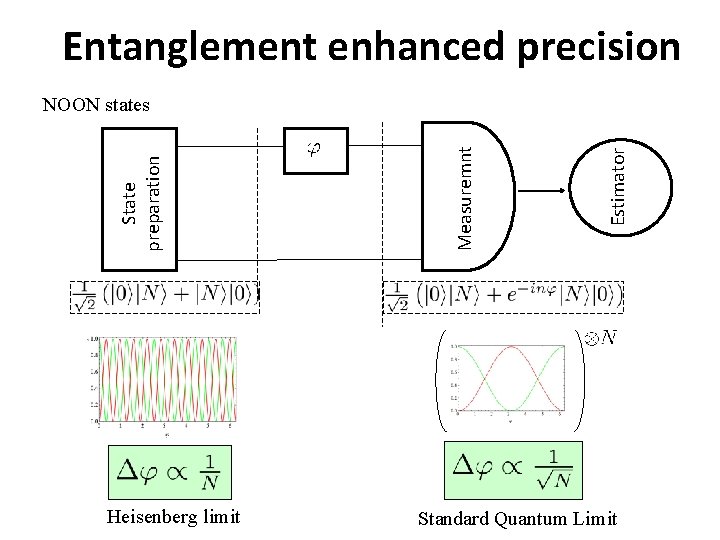
Entanglement enhanced precision Hong-Ou-Mandel interference &
Entanglement enhanced precision Heisenberg limit Estimator Measuremnt State preparation NOON states Standard Quantum Limit
What are the fundamental bounds in presence of decoherence?
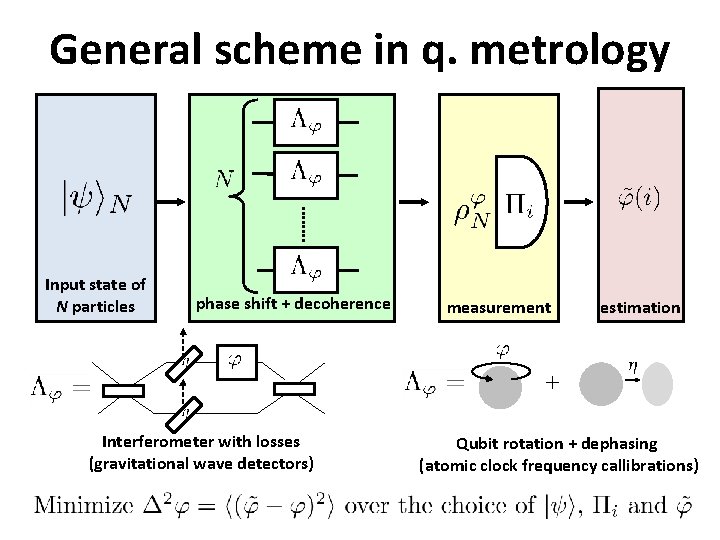
General scheme in q. metrology Input state of N particles phase shift + decoherence Interferometer with losses (gravitational wave detectors) measurement estimation Qubit rotation + dephasing (atomic clock frequency callibrations)
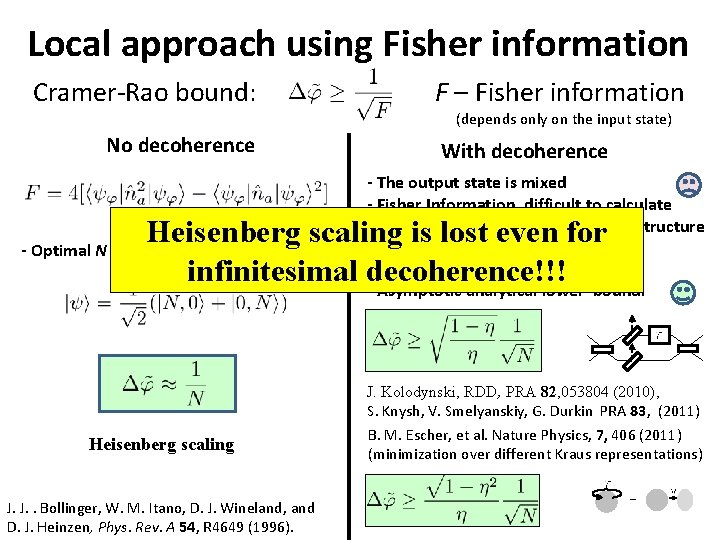
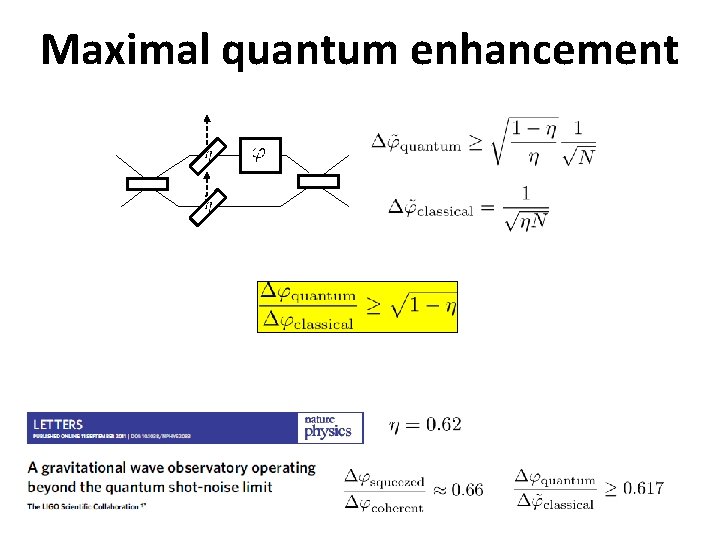
Local approach using Fisher information Cramer-Rao bound: F – Fisher information (depends only on the input state) No decoherence With decoherence - The output state is mixed - Fisher Information, difficult to calculate - Optimal states do not have simple structure Heisenberg scaling is lost even for RDD, et al. PRA 80, 013825 (2009), - Optimal N photon state (maximal F=N ): U. Dorner, et al. , PRL. 102, 040403 (2009) infinitesimal decoherence!!! - Asymptotic analytical lower bound: 2 J. Kolodynski, RDD, PRA 82, 053804 (2010), S. Knysh, V. Smelyanskiy, G. Durkin PRA 83, (2011) Heisenberg scaling J. J. . Bollinger, W. M. Itano, D. J. Wineland, and D. J. Heinzen, Phys. Rev. A 54, R 4649 (1996). B. M. Escher, et al. Nature Physics, 7, 406 (2011) (minimization over different Kraus representations)
Maximal quantum enhancement
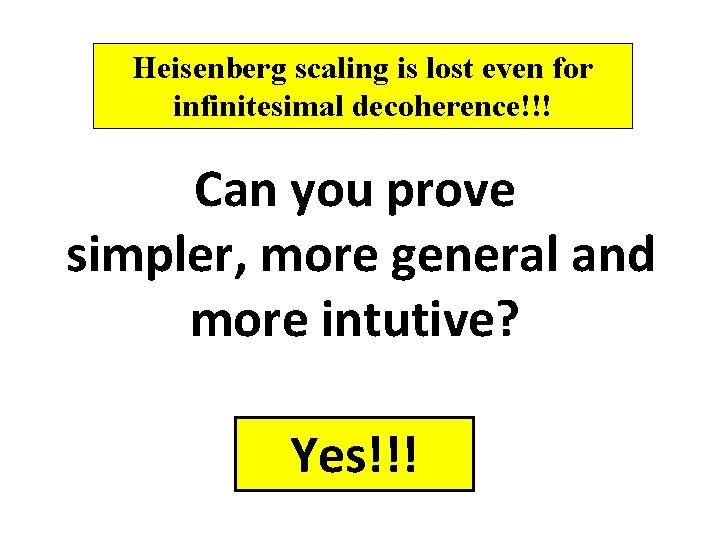
Heisenberg scaling is lost even for infinitesimal decoherence!!! Can you prove simpler, more general and more intutive? Yes!!!
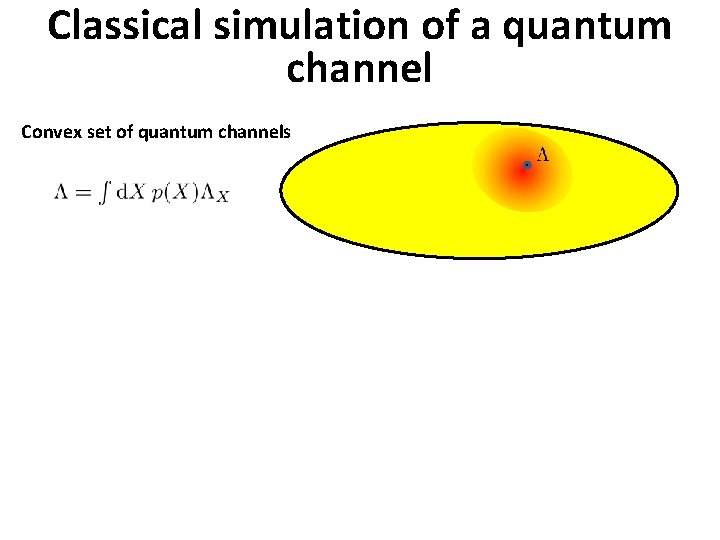
Classical simulation of a quantum channel Convex set of quantum channels
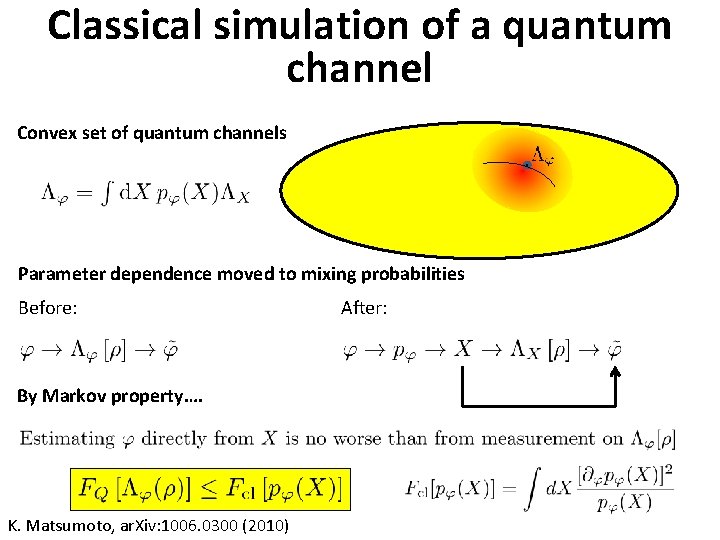
Classical simulation of a quantum channel Convex set of quantum channels Parameter dependence moved to mixing probabilities Before: By Markov property…. K. Matsumoto, ar. Xiv: 1006. 0300 (2010) After:
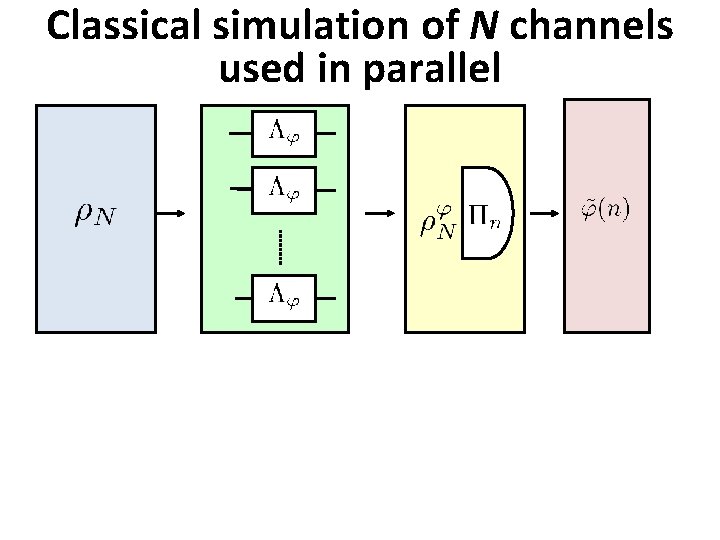
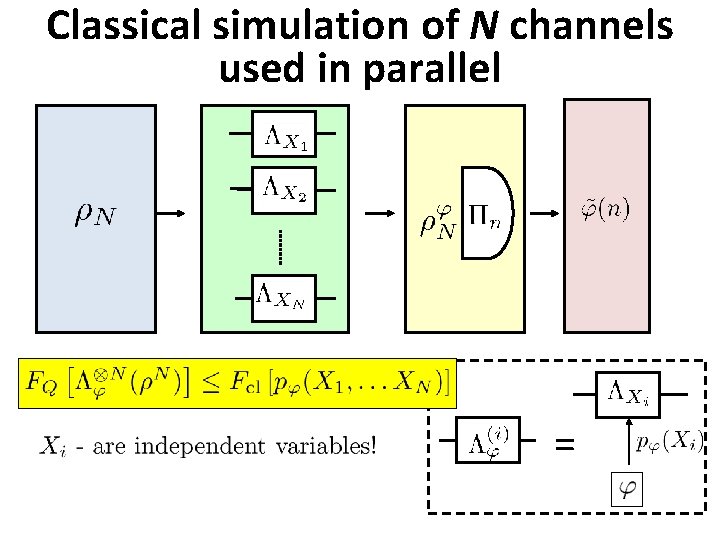
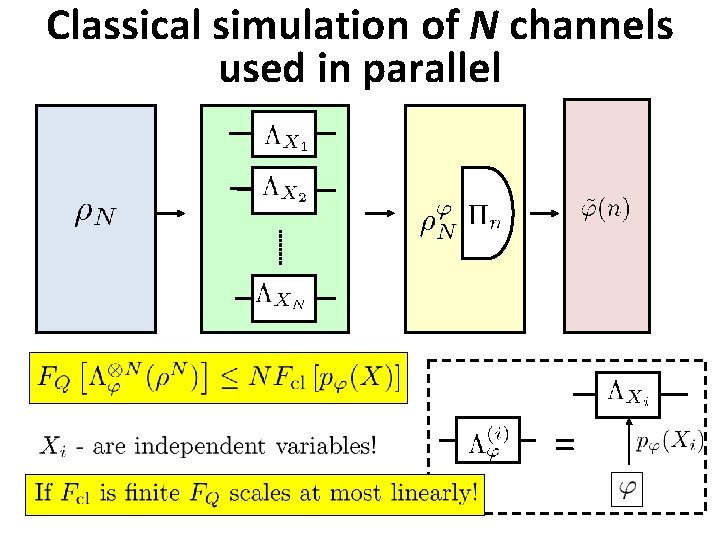
Classical simulation of N channels used in parallel
Classical simulation of N channels used in parallel =
Classical simulation of N channels used in parallel =
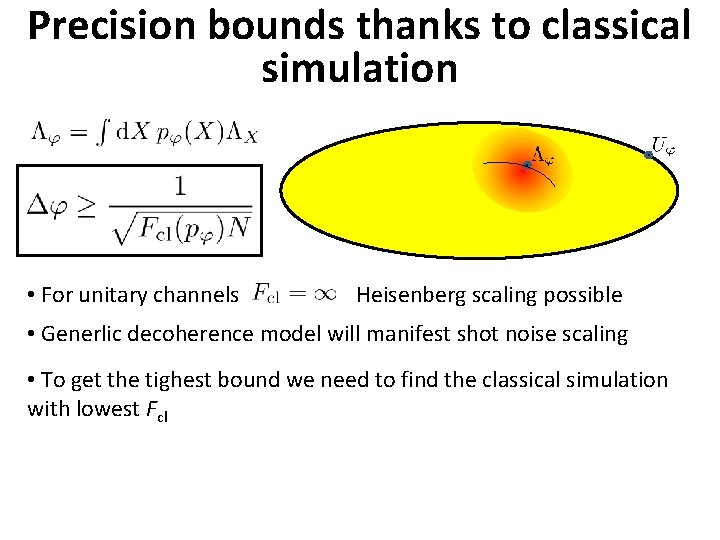
Precision bounds thanks to classical simulation • For unitary channels Heisenberg scaling possible • Generlic decoherence model will manifest shot noise scaling • To get the tighest bound we need to find the classical simulation with lowest Fcl
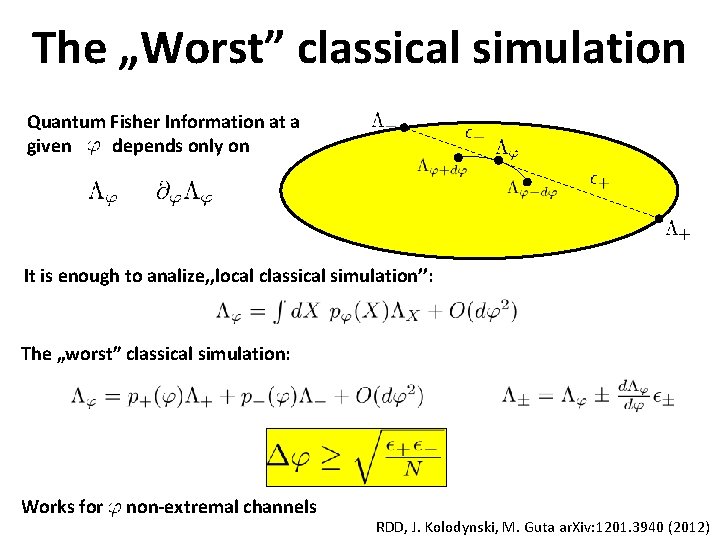
The „Worst” classical simulation Quantum Fisher Information at a given depends only on It is enough to analize, , local classical simulation’’: The „worst” classical simulation: Works for non-extremal channels RDD, J. Kolodynski, M. Guta ar. Xiv: 1201. 3940 (2012)
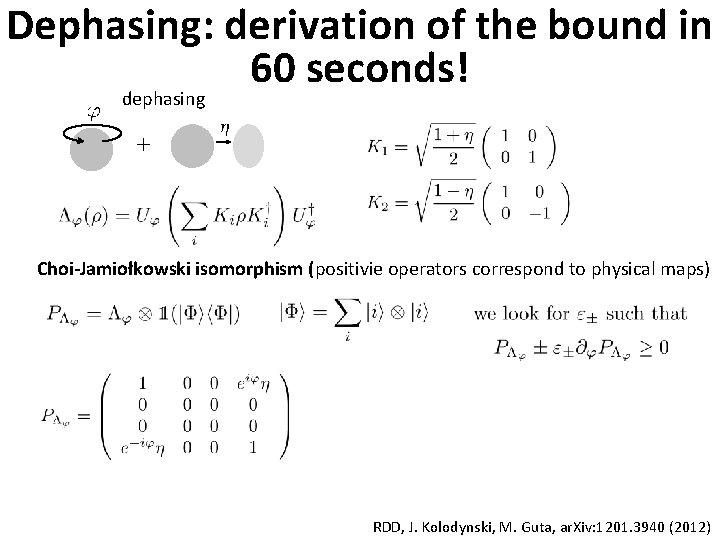
Dephasing: derivation of the bound in 60 seconds! dephasing Choi-Jamiołkowski isomorphism (positivie operators correspond to physical maps) RDD, J. Kolodynski, M. Guta, ar. Xiv: 1201. 3940 (2012)
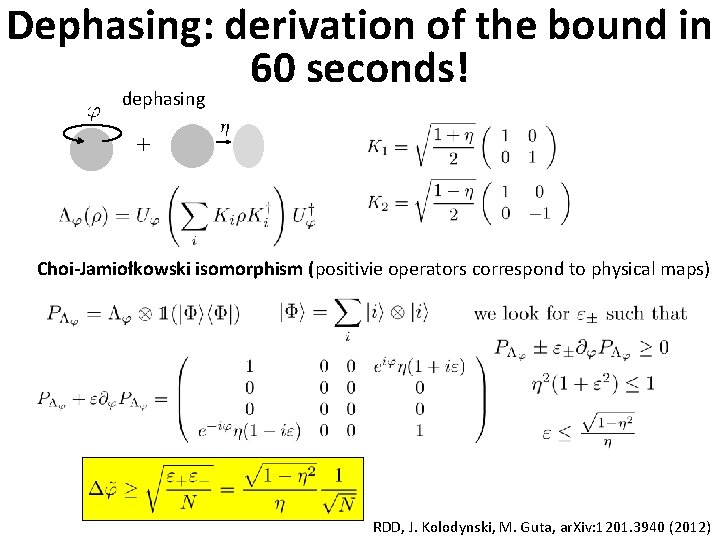
Dephasing: derivation of the bound in 60 seconds! dephasing Choi-Jamiołkowski isomorphism (positivie operators correspond to physical maps) RDD, J. Kolodynski, M. Guta, ar. Xiv: 1201. 3940 (2012)
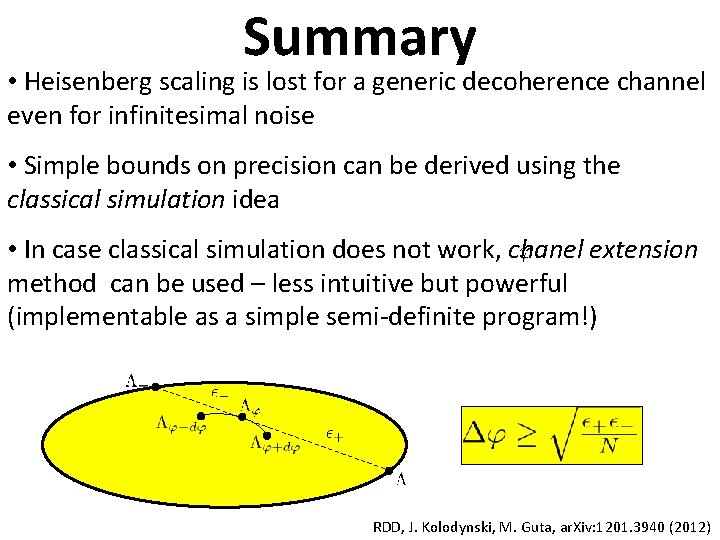
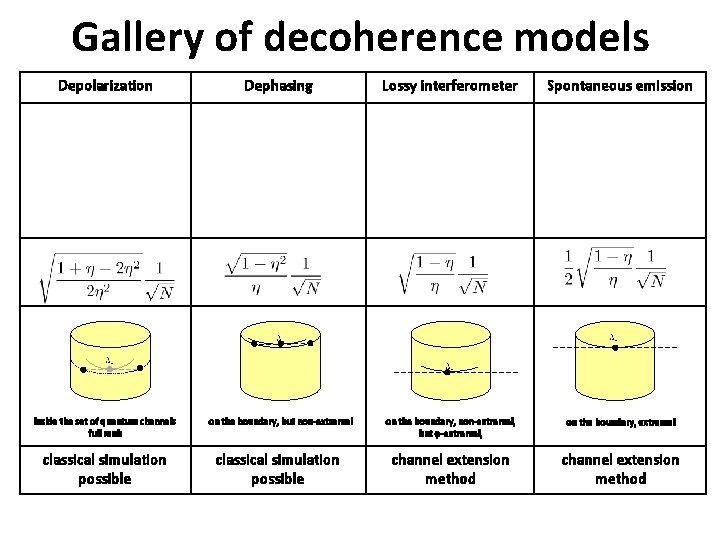
Summary • Heisenberg scaling is lost for a generic decoherence channel even for infinitesimal noise • Simple bounds on precision can be derived using the classical simulation idea • In case classical simulation does not work, chanel extension method can be used – less intuitive but powerful (implementable as a simple semi-definite program!) RDD, J. Kolodynski, M. Guta, ar. Xiv: 1201. 3940 (2012)
Gallery of decoherence models Depolarization Dephasing Lossy interferometer Spontaneous emission inside the set of quantum channels full rank on the boundary, but non-extremal on the boundary, non-extremal, but -extremal, on the boundary, extremal classical simulation possible channel extension method