Towards a Compton Telescope for Gamma Ray Astronomy
- Slides: 11
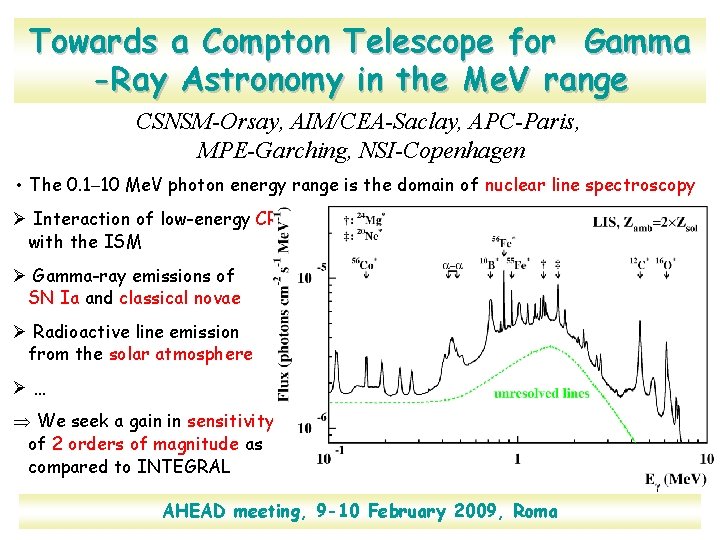
Towards a Compton Telescope for Gamma -Ray Astronomy in the Me. V range CSNSM-Orsay, AIM/CEA-Saclay, APC-Paris, MPE-Garching, NSI-Copenhagen • The 0. 1 10 Me. V photon energy range is the domain of nuclear line spectroscopy Ø Interaction of low-energy CRs with the ISM Ø Gamma-ray emissions of SN Ia and classical novae Ø Radioactive line emission from the solar atmosphere Ø… We seek a gain in sensitivity of 2 orders of magnitude as compared to INTEGRAL AHEAD meeting, 9 -10 February 2009, Roma
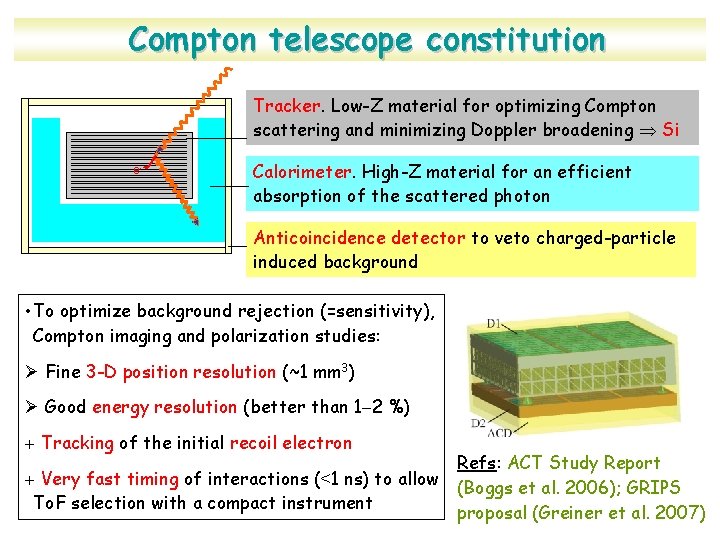
Compton telescope constitution Tracker. Low-Z material for optimizing Compton scattering and minimizing Doppler broadening Si e- Calorimeter. High-Z material for an efficient absorption of the scattered photon Anticoincidence detector to veto charged-particle induced background • To optimize background rejection (=sensitivity), Compton imaging and polarization studies: Ø Fine 3 -D position resolution (~1 mm 3) Ø Good energy resolution (better than 1 2 %) Tracking of the initial recoil electron Very fast timing of interactions (<1 ns) to allow To. F selection with a compact instrument Refs: ACT Study Report (Boggs et al. 2006); GRIPS proposal (Greiner et al. 2007)
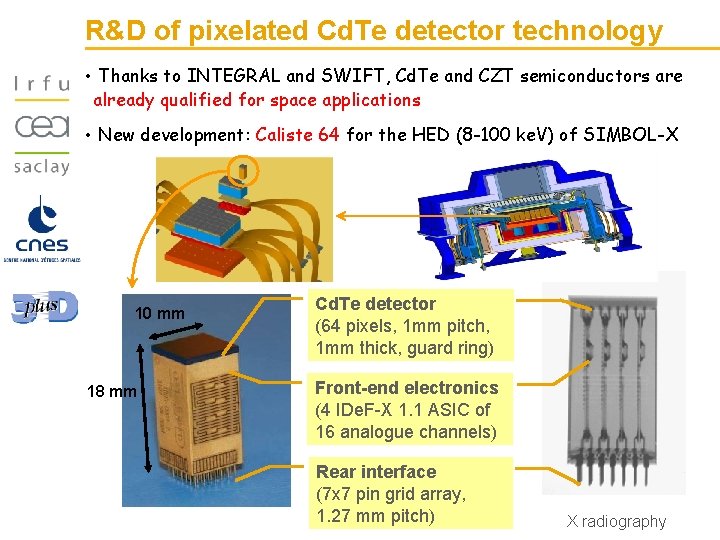
R&D of pixelated Cd. Te detector technology • Thanks to INTEGRAL and SWIFT, Cd. Te and CZT semiconductors are already qualified for space applications • New development: Caliste 64 for the HED (8 -100 ke. V) of SIMBOL-X 10 mm 18 mm Cd. Te detector (64 pixels, 1 mm pitch, 1 mm thick, guard ring) Front-end electronics (4 IDe. F-X 1. 1 ASIC of 16 analogue channels) Rear interface (7 x 7 pin grid array, 1. 27 mm pitch) X radiography
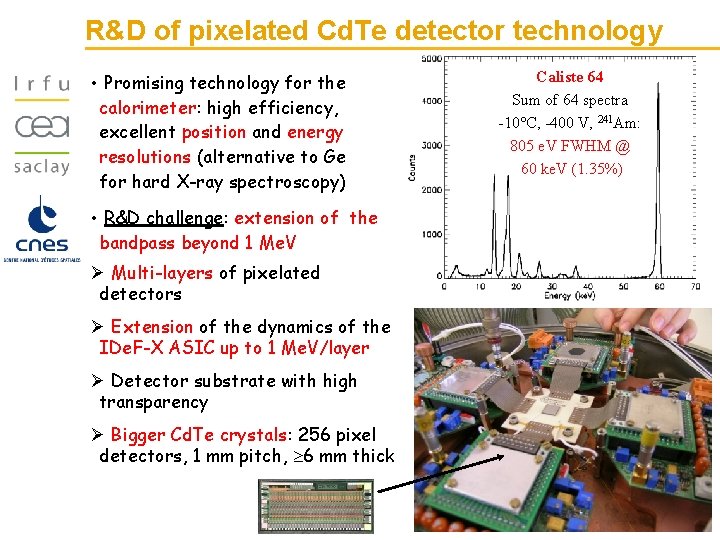
R&D of pixelated Cd. Te detector technology • Promising technology for the calorimeter: high efficiency, excellent position and energy resolutions (alternative to Ge for hard X-ray spectroscopy) • R&D challenge: extension of the bandpass beyond 1 Me. V Ø Multi-layers of pixelated detectors Ø Extension of the dynamics of the IDe. F-X ASIC up to 1 Me. V/layer Ø Detector substrate with high transparency Ø Bigger Cd. Te crystals: 256 pixel detectors, 1 mm pitch, 6 mm thick Caliste 64 Sum of 64 spectra -10°C, -400 V, 241 Am: 805 e. V FWHM @ 60 ke. V (1. 35%)
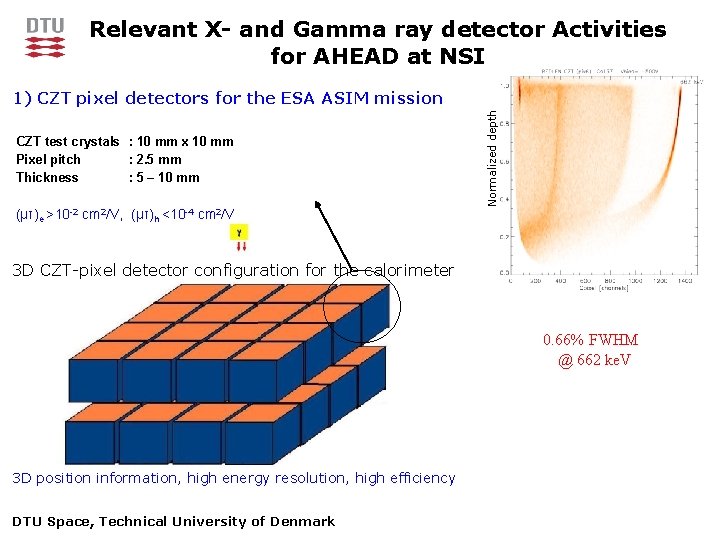
Relevant X- and Gamma ray detector Activities for AHEAD at NSI CZT test crystals : 10 mm x 10 mm Pixel pitch : 2. 5 mm Thickness : 5 – 10 mm (μτ)e >10 -2 cm 2/V, (μτ)h <10 -4 cm 2/V Normalized depth 1) CZT pixel detectors for the ESA ASIM mission 3 D CZT-pixel detector configuration for the calorimeter 0. 66% FWHM @ 662 ke. V 3 D position information, high energy resolution, high efficiency DTU Space, Technical University of Denmark
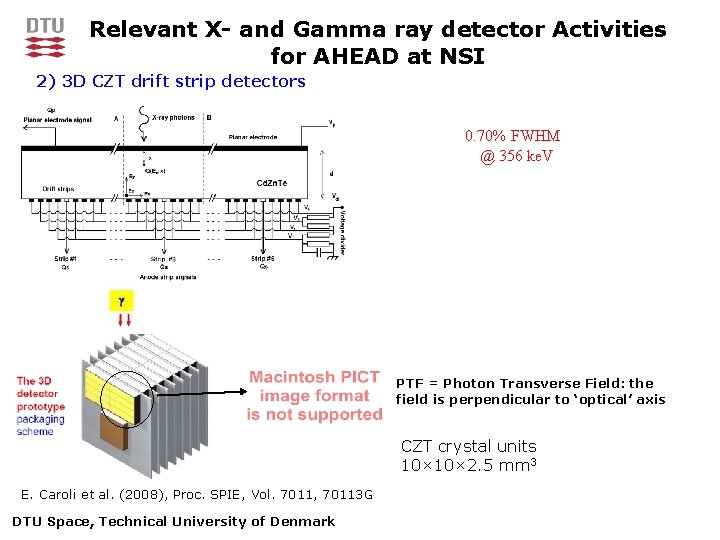
Relevant X- and Gamma ray detector Activities for AHEAD at NSI 2) 3 D CZT drift strip detectors 0. 70% FWHM @ 356 ke. V PTF = Photon Transverse Field: the field is perpendicular to ‘optical’ axis CZT crystal units 10× 2. 5 mm 3 E. Caroli et al. (2008), Proc. SPIE, Vol. 7011, 70113 G DTU Space, Technical University of Denmark
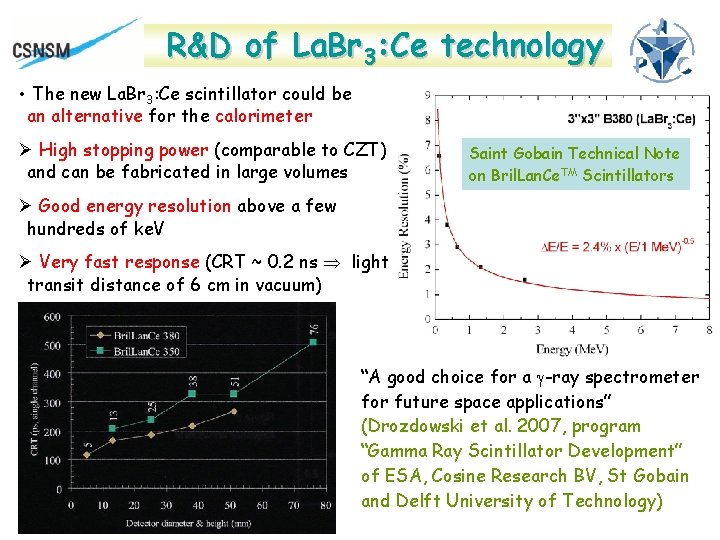
R&D of La. Br 3: Ce technology • The new La. Br 3: Ce scintillator could be an alternative for the calorimeter Ø High stopping power (comparable to CZT) and can be fabricated in large volumes Saint Gobain Technical Note on Bril. Lan. Ce. TM Scintillators Ø Good energy resolution above a few hundreds of ke. V Ø Very fast response (CRT ~ 0. 2 ns light transit distance of 6 cm in vacuum) “A good choice for a -ray spectrometer for future space applications” (Drozdowski et al. 2007, program “Gamma Ray Scintillator Development” of ESA, Cosine Research BV, St Gobain and Delft University of Technology)
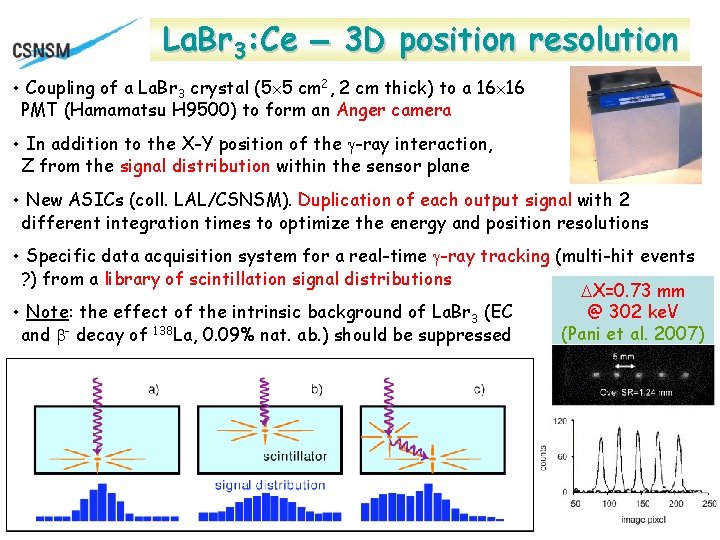
La. Br 3: Ce 3 D position resolution • Coupling of a La. Br 3 crystal (5 5 cm 2, 2 cm thick) to a 16 16 PMT (Hamamatsu H 9500) to form an Anger camera • In addition to the X-Y position of the -ray interaction, Z from the signal distribution within the sensor plane multianode depth • New ASICs (coll. LAL/CSNSM). Duplication of each output signal with 2 different integration times to optimize the energy and position resolutions • Specific data acquisition system for a real-time -ray tracking (multi-hit events ? ) from a library of scintillation signal distributions X=0. 73 mm • Note: the effect of the intrinsic background of La. Br 3 (EC @ 302 ke. V (Pani et al. 2007) and - decay of 138 La, 0. 09% nat. ab. ) should be suppressed
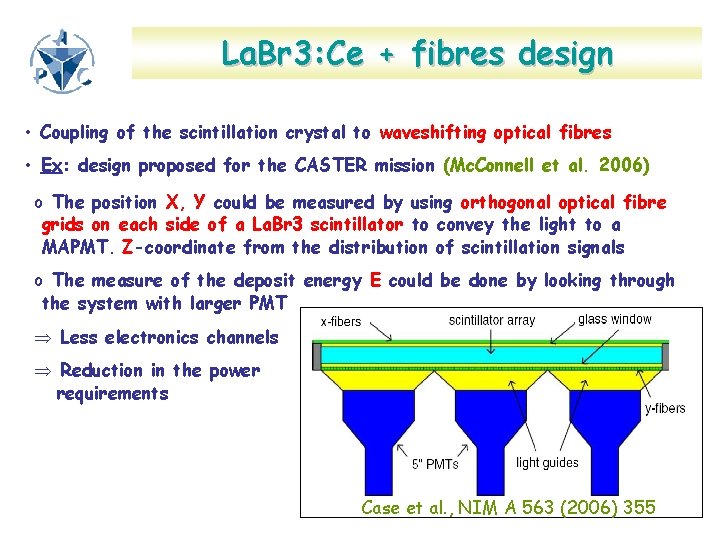
La. Br 3: Ce + fibres design • Coupling of the scintillation crystal to waveshifting optical fibres • Ex: design proposed for the CASTER mission (Mc. Connell et al. 2006) o The position X, Y could be measured by using orthogonal optical fibre grids on each side of a La. Br 3 scintillator to convey the light to a MAPMT. Z-coordinate from the distribution of scintillation signals o The measure of the deposit energy E could be done by looking through the system with larger PMT Less electronics channels Reduction in the power requirements Case et al. , NIM A 563 (2006) 355
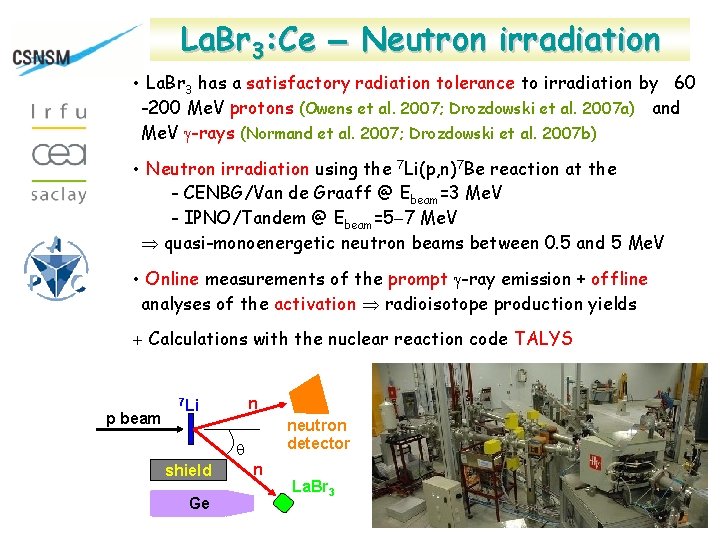
La. Br 3: Ce Neutron irradiation • La. Br 3 has a satisfactory radiation tolerance to irradiation by 60 -200 Me. V protons (Owens et al. 2007; Drozdowski et al. 2007 a) and Me. V -rays (Normand et al. 2007; Drozdowski et al. 2007 b) • Neutron irradiation using the 7 Li(p, n)7 Be reaction at the - CENBG/Van de Graaff @ Ebeam=3 Me. V - IPNO/Tandem @ Ebeam=5 7 Me. V quasi-monoenergetic neutron beams between 0. 5 and 5 Me. V • Online measurements of the prompt -ray emission + offline analyses of the activation radioisotope production yields Calculations with the nuclear reaction code TALYS p beam n 7 Li neutron detector shield Ge n La. Br 3
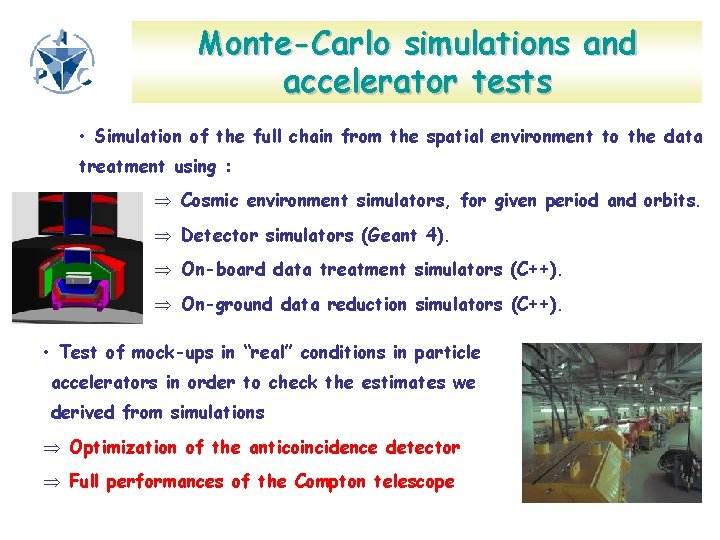
Monte-Carlo simulations and accelerator tests • Simulation of the full chain from the spatial environment to the data treatment using : Cosmic environment simulators, for given period and orbits. Detector simulators (Geant 4). On-board data treatment simulators (C++). On-ground data reduction simulators (C++). • Test of mock-ups in “real” conditions in particle accelerators in order to check the estimates we derived from simulations Optimization of the anticoincidence detector Full performances of the Compton telescope