
The Swift Gamma Ray Burst Explorer Paolo DAvanzo
The Swift Gamma. Ray Burst Explorer Paolo D’Avanzo INAF-Osservatorio Astronomico Di Brera (MISTICI team) Universita` degli studi dell’Insubria Multiwavelength Italian Swift Team with International Co-Investigators 1
The Swift Mission • Successfully launched on the 20 th of November 2004 • 267 days in orbit • All instruments operating to spec • BAT First Light: 3 December 2004 • XRT First Light: 11 December 2004 • First BAT Burst: 17 December 2004 • First XRT Afterglow: 23 December 2004 • UVOT First Light: 12 January 2005 • First UVOT Afterglow 15 March 2005 • Calibration phase ended on Apr 5 2
OUTLINE • • • GRB: theory and open matters Swift & REM: instruments, performances & science GRB: results Observationals procedures: BA & DS Secondary science: X-Ray Binaries Conclusions & Future 3
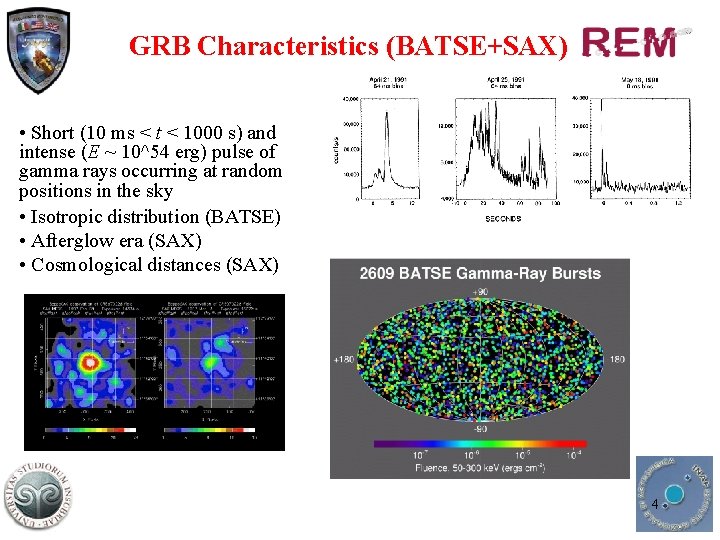
GRB Characteristics (BATSE+SAX) • Short (10 ms < t < 1000 s) and intense (E ~ 10^54 erg) pulse of gamma rays occurring at random positions in the sky • Isotropic distribution (BATSE) • Afterglow era (SAX) • Cosmological distances (SAX) 4
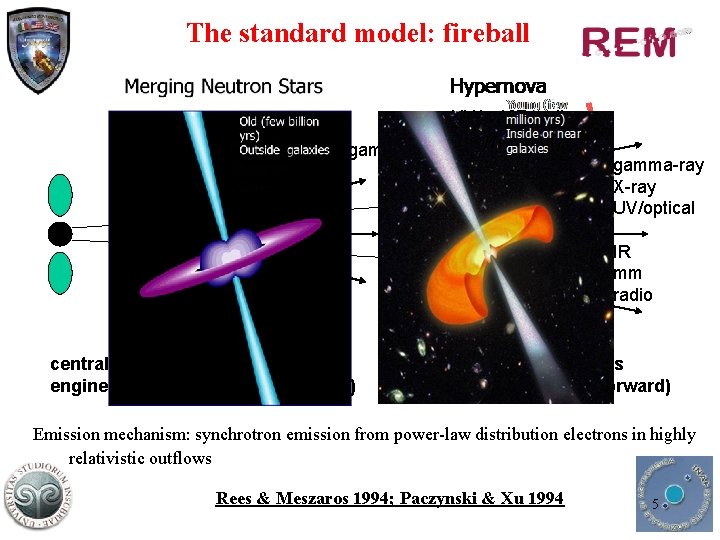
The standard model: fireball UV/opt/IR/radio gamma-ray X-ray UV/optical IR mm radio central engine photosphere internal (shocks) external shocks (reverse) (forward) Emission mechanism: synchrotron emission from power-law distribution electrons in highly relativistic outflows Rees & Meszaros 1994; Paczynski & Xu 1994 5
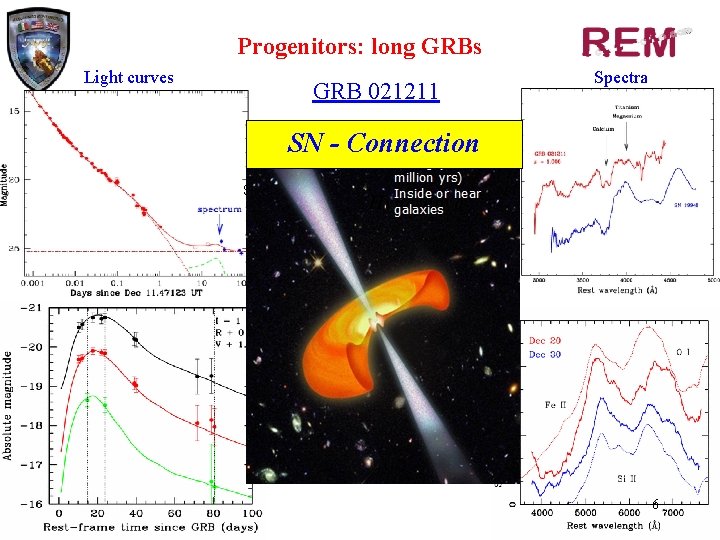
Progenitors: long GRBs Light curves GRB 021211 Spectra (Massimo Della Valle, Daniele Malesani, Stefano Benetti, Vincenzo Testa, Mario Hamuy, L. Angelo Antonelli, Guido Chincarini, Gabriele Cocozza, Stefano Covino, Paolo D'Avanzo & 7 coautori A&A 406, L 33 -L 37 (2003)) SN - Connection GRB 980425 (Galama et al. , 1998) First GRB – SN association GRB 031203 (Daniele Malesani, Gianpiero Tagliaferri Guido Chincarini, Stefano Covino, Massimo Della Valle, Dino Fugazza, Paolo Mazzali, Filippo M. Zerbi, Paolo D'Avanzo & 17 coautori Ap. J 609, L 5 -L 8 (2004)) 6
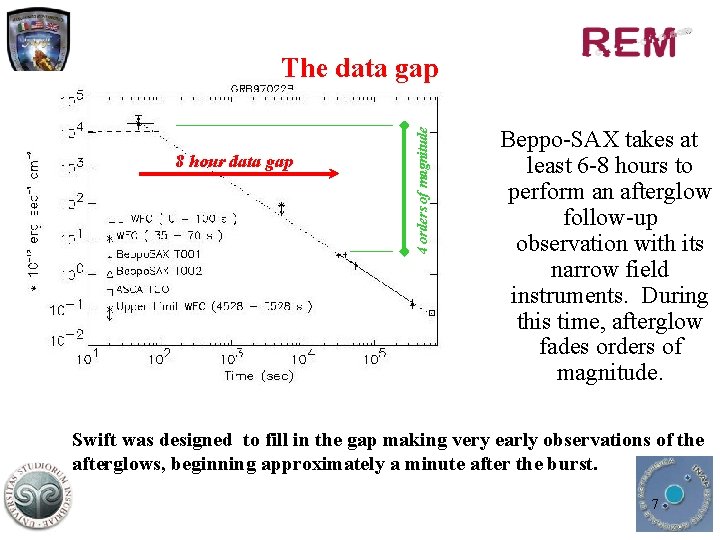
8 hour data gap 4 orders of magnitude The data gap Beppo-SAX takes at least 6 -8 hours to perform an afterglow follow-up observation with its narrow field instruments. During this time, afterglow fades orders of magnitude. Swift was designed to fill in the gap making very early observations of the afterglows, beginning approximately a minute after the burst. 7
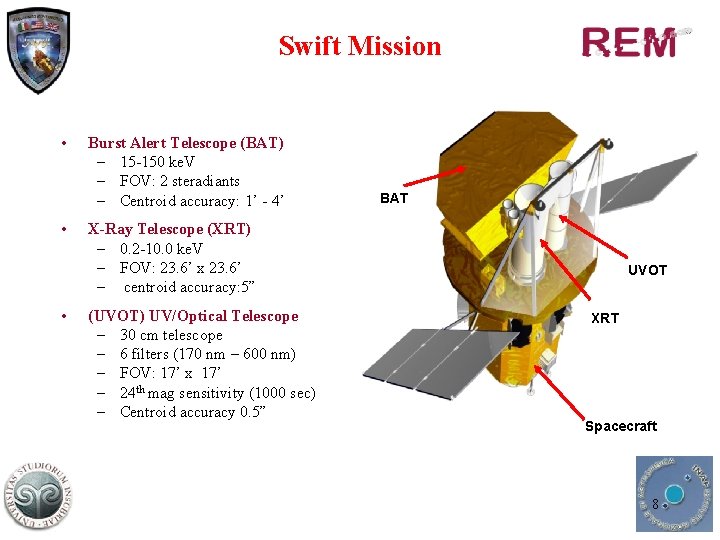
Swift Mission • • • Burst Alert Telescope (BAT) – 15 -150 ke. V – FOV: 2 steradiants – Centroid accuracy: 1’ - 4’ X-Ray Telescope (XRT) – 0. 2 -10. 0 ke. V – FOV: 23. 6’ x 23. 6’ – centroid accuracy: 5” (UVOT) UV/Optical Telescope – 30 cm telescope – 6 filters (170 nm – 600 nm) – FOV: 17’ x 17’ – 24 th mag sensitivity (1000 sec) – Centroid accuracy 0. 5” UVOT BAT XRT UVOT XRT Spacecraft 8
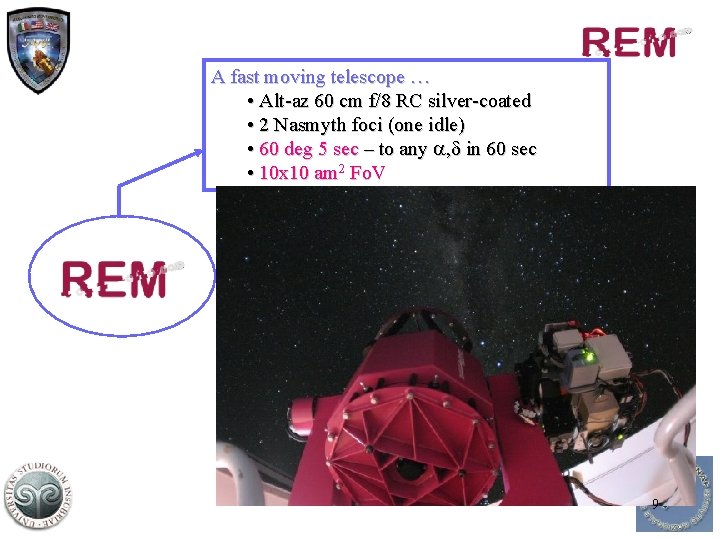
A fast moving telescope … • Alt-az 60 cm f/8 RC silver-coated • 2 Nasmyth foci (one idle) • 60 deg 5 sec – to any , in 60 sec • 10 x 10 am 2 Fo. V … with a high throughput NIR Camera… • 10 x 10 am 2 Fo. V • 1. 2 as pixel scale (diff. limited) • 0. 9 -2. 3 microns (Z’, J, H, Ks) • 512 x 512 Hg. Cd. Te chip @77 Kelvin • Wobbling plate for dithering 9
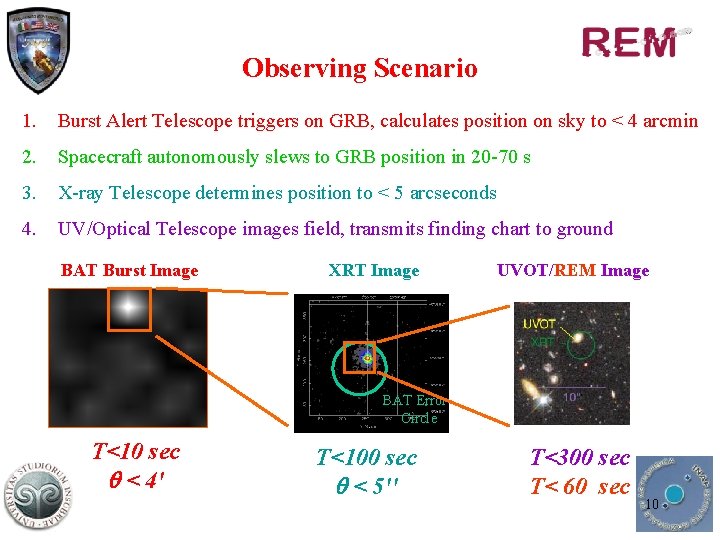
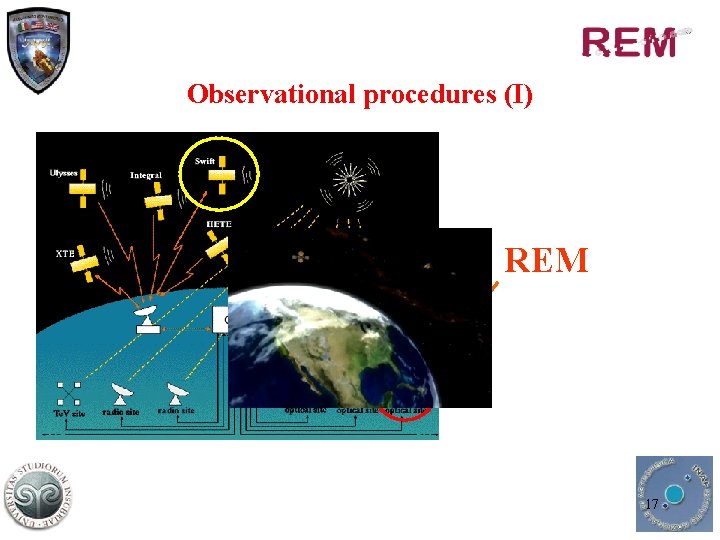
Observing Scenario 1. Burst Alert Telescope triggers on GRB, calculates position on sky to < 4 arcmin 2. Spacecraft autonomously slews to GRB position in 20 -70 s 3. X-ray Telescope determines position to < 5 arcseconds 4. UV/Optical Telescope images field, transmits finding chart to ground BAT Burst Image XRT Image UVOT/REM Image BAT Error Circle T<10 sec < 4' T<100 sec < 5'' T<300 sec T< 60 sec 10
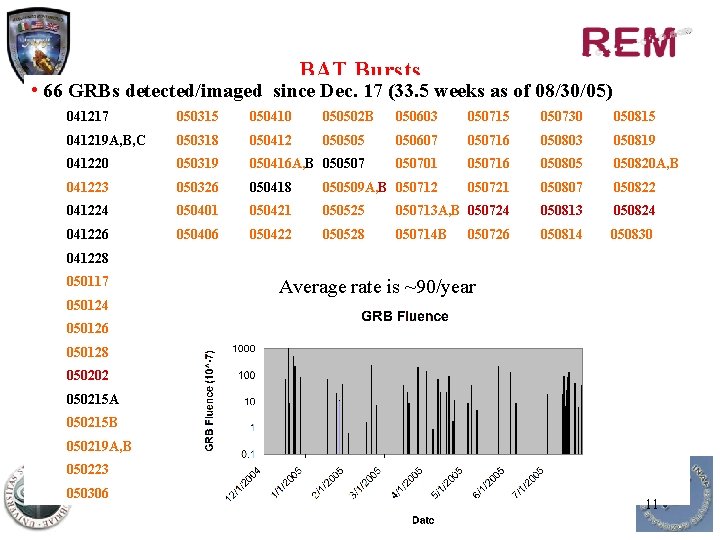
BAT Bursts • 66 GRBs detected/imaged since Dec. 17 (33. 5 weeks as of 08/30/05) 041217 050315 050410 050502 B 050603 050715 050730 050815 041219 A, B, C 050318 050412 050505 050607 050716 050803 050819 041220 050319 050416 A, B 05050701 050716 050805 050820 A, B 041223 050326 050418 050509 A, B 050712 050721 050807 050822 041224 050401 050421 050525 050713 A, B 050724 050813 050824 041226 050406 050422 050528 050714 B 050814 050830 050726 041228 050117 050124 Average rate is ~90/year 050126 050128 050202 050215 A 050215 B 050219 A, B 050223 050306 11
Short GRB XRF XRF XRF Short GRB 12

RESULTS 13
Progenitors: short GRBs (I) GRB 050509 B: first detection of the X-ray afterglow of a short GRB (N. Gehrels et al. , 2005 Nature) GRB 050709: first detection of the optical afterglow of a short GRB (S. Covino, D. Malesani, G. L. Israel, P. D’Avanzo & 29 coauthors, 2005 A&AL, submitted) GRB 050724: again a detection of the optical afterglow of a short GRB (S. D. Barthelmy, G. Chincarini, D. N Burrows, N. Geherels, S. Covino, A. Moretti, P. Romano, P. T. O’Brien, C. L. Sarazin, C. Kouvelotou, M. Goad, S. Vaughan, G. Tagliaferri, B. Zhang, A. Antonelli, S. Campana, P. D’Avanzo & 12 coauthors, 2005 Nature, submitted) Host Galaxies 14
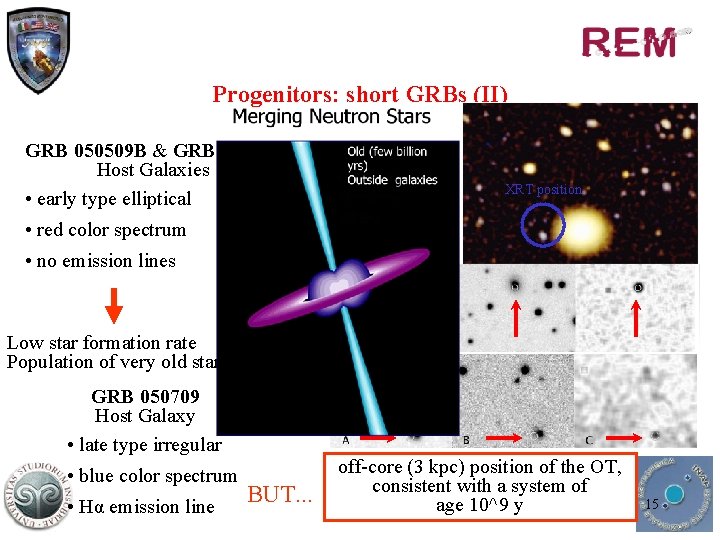
Progenitors: short GRBs (II) GRB 050509 B & GRB 050724 Host Galaxies • early type elliptical of • red color spectrum long GRB • no emission lines vs. XRT position Low star formation rate Population of very old stars GRB 050709 Host Galaxy • late type irregular • blue color spectrum • Hα emission line BUT. . . off-core (3 kpc) position of the OT, consistent with a system of age 10^9 y 15
The fartest GRB ever observed z = 6. 3! ESO press release 12 Sep 2005 16
Observational procedures (I) REM 17
Observational procedures (II) • Burst Advocate • Rem Duty Scientist 18
Science with Swift & REM GRB! GRBs observed rate now is about 2 burst per week but also latitude/longitude constraints have to be taken into account. This is leaving free Swift & REM observing time that is largely used for: Any program requesting fast multi-frequency observations 1. 2. 3. 4. Multifrequency monitoring of AGNs X-Ray Binaries Flare Stars Others. . . 19
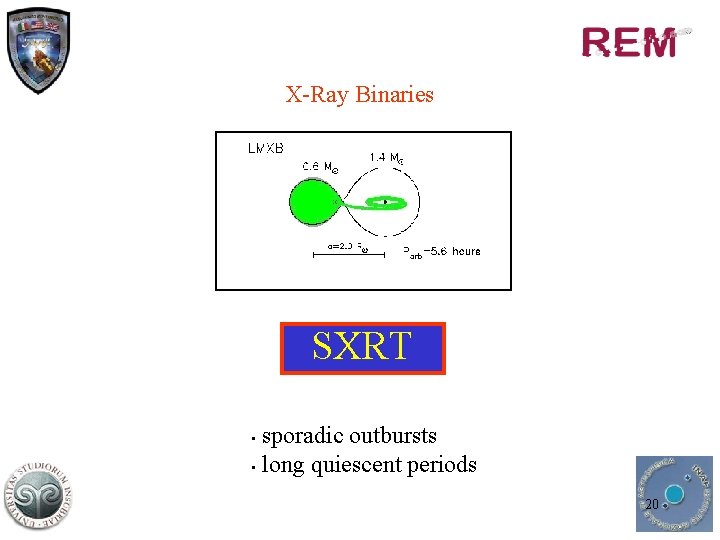
X-Ray Binaries SXRT sporadic outbursts • long quiescent periods • 20
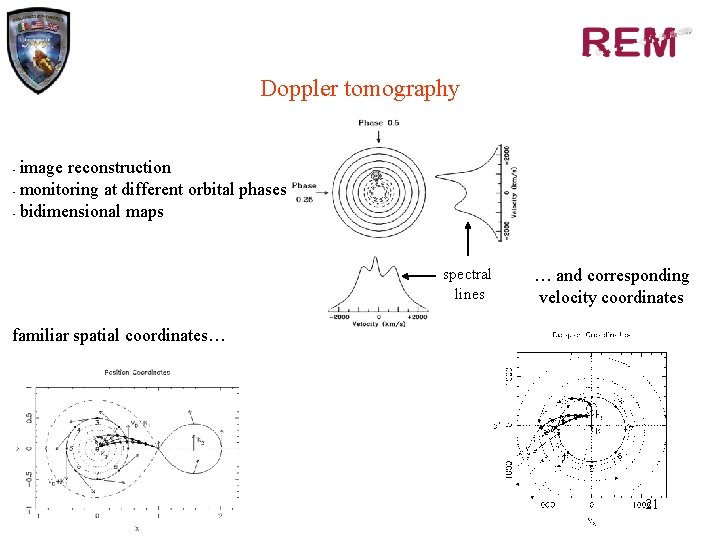
Doppler tomography image reconstruction • monitoring at different orbital phases • bidimensional maps • spectral lines … and corresponding velocity coordinates familiar spatial coordinates… 21
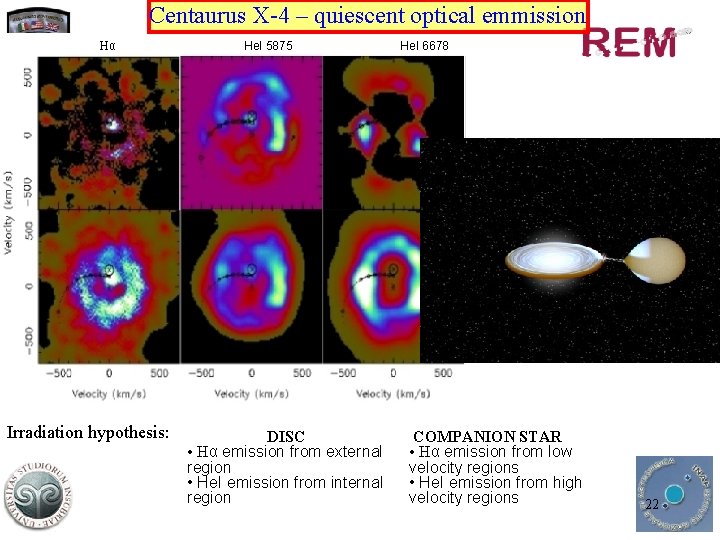
Centaurus X-4 – quiescent optical emmission Hα He. I 5875 He. I 6678 • circular ring-like structure in emission • emission from the companion • visible “hot spot” Irradiation hypothesis: DISC • Hα emission from external region • He. I emission from internal region COMPANION STAR • Hα emission from low velocity regions • He. I emission from high velocity regions 22
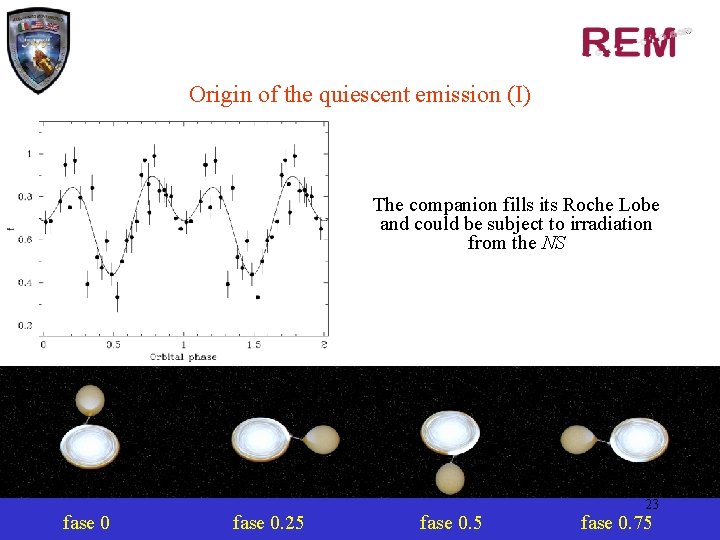
Origin of the quiescent emission (I) The companion fills its Roche Lobe and could be subject to irradiation from the NS fase 0. 25 fase 0. 5 23 fase 0. 75
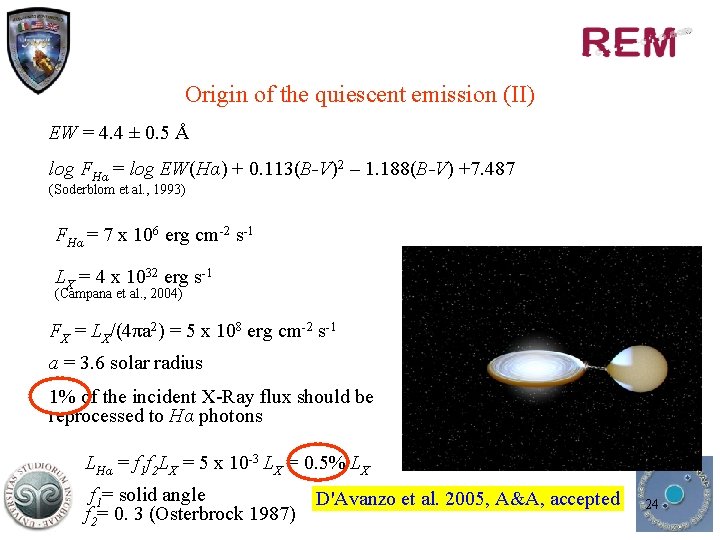
Origin of the quiescent emission (II) EW = 4. 4 ± 0. 5 Å log FHα = log EW(Hα) + 0. 113(B-V)2 – 1. 188(B-V) +7. 487 (Soderblom et al. , 1993) FHα = 7 x 10⁶ erg cm-2 s-1 LX = 4 x 1032 erg s-1 (Campana et al. , 2004) FX = LX/(4πa 2) = 5 x 10⁸ erg cm-2 s-1 a = 3. 6 solar radius 1% of the incident X-Ray flux should be reprocessed to Hα photons LHα = f 1 f 2 LX = 5 x 10 -3 LX = 0. 5% LX f 1= solid angle f 2= 0. 3 (Osterbrock 1987) D'Avanzo et al. 2005, A&A, accepted 24
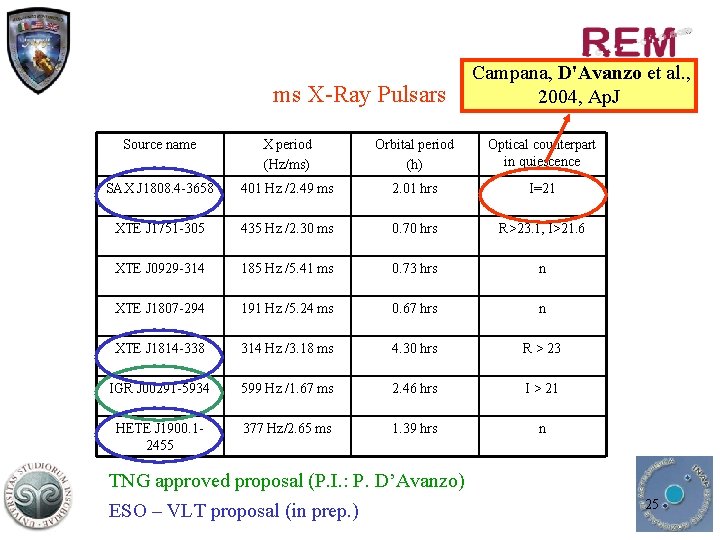
ms X-Ray Pulsars Campana, D'Avanzo et al. , 2004, Ap. J Source name X period (Hz/ms) Orbital period (h) Optical counterpart in quiescence SAX J 1808. 4 -3658 401 Hz /2. 49 ms 2. 01 hrs I=21 XTE J 1751 -305 435 Hz /2. 30 ms 0. 70 hrs R>23. 1, I>21. 6 XTE J 0929 -314 185 Hz /5. 41 ms 0. 73 hrs n XTE J 1807 -294 191 Hz /5. 24 ms 0. 67 hrs n XTE J 1814 -338 314 Hz /3. 18 ms 4. 30 hrs R > 23 IGR J 00291 -5934 599 Hz /1. 67 ms 2. 46 hrs I > 21 HETE J 1900. 12455 377 Hz/2. 65 ms 1. 39 hrs n TNG approved proposal (P. I. : P. D’Avanzo) ESO – VLT proposal (in prep. ) 25
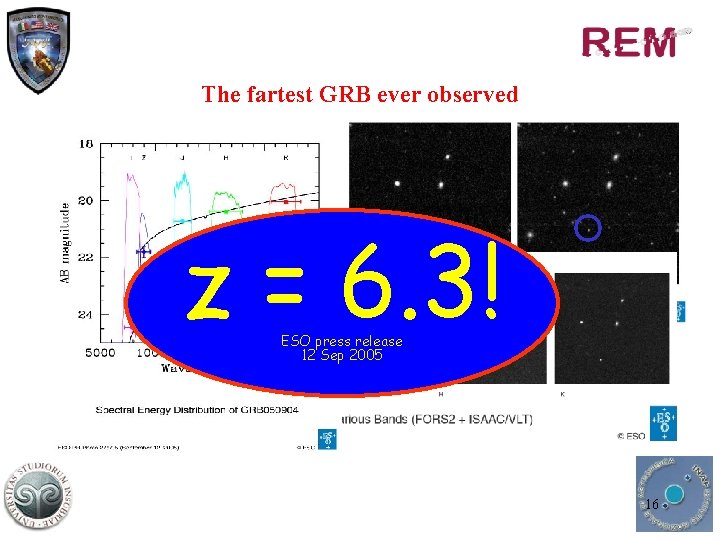
Conclusions (I) • Exciting Swift results on: – GRB progenitors – Host Galaxy morfology – High z GRB • New light on quiescent optical emission of SXRTs • Opportunity to investigate the link between ms X-Ray Pulsars and ms Radio Pulsars 26
Conclusions (II) • Our results on GRB led to: – – 42 GCN circulars 3 published papers 3 submitted papers 2 papers in preparation • Our results on SXRT led to: – 1 paper published – 1 approved TNG proposal – 3 ESO proposals in preparation 27
- Slides: 27