EE 379 KEE 394 V Smart Grids Ancillary
- Slides: 57
EE 379 K/EE 394 V Smart Grids: Ancillary Services Julia Matevosyan, ERCOT, Inc. Spring 2019 Copyright © 2019 Ross Baldick, Department of Electrical and Computer Engineering 1
From David Maggio’s presentation: Real-Time Operations n Monitoring the system between SCED dispatch intervals n Responses to SCED instructions n Frequency and area control error n Reserves n n Forced outage detection n n Ancillary Services, Physical Responsive Capability, capacity available for economic dispatch, etc. Current status of equipment vs. planned state State of applications (i. e. , last run time) Copyright © 2019 2
Outline n n n n AS Definition and Need Frequency control, ACE, AGC ERCOT’s Ancillary Services Changes to ERCOT’s Resource Mix Changes to ERCOT’s AS Requirements and Situational Awareness Tools Key Takeaways Homework Assignment Copyright © 2019 3
What is Ancillary Service? n n n In ERCOT Protocols: Ancillary Service – A service necessary to support the transmission of energy to load while maintaining reliable operation of the system… Ancillary Services in ERCOT include all reserves (Responsive, Regulation, Non-Spin) In other areas, the term AS may also include voltage support, emergency reserves and black start service. Copyright © 2019 4
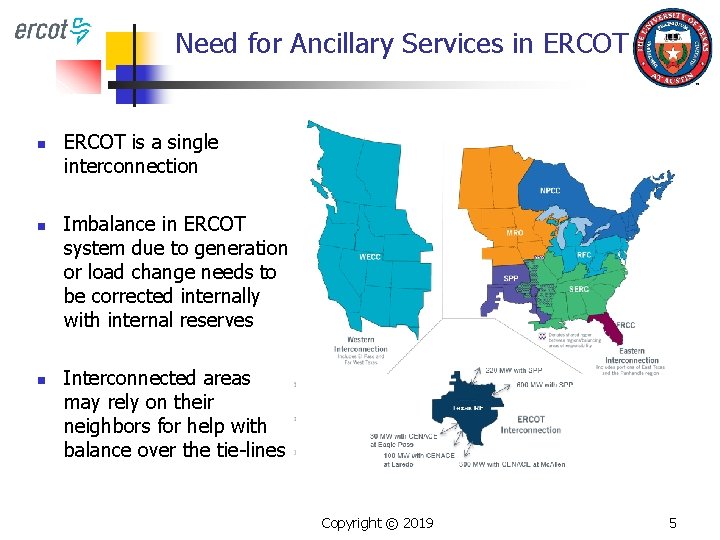
Need for Ancillary Services in ERCOT n n n ERCOT is a single interconnection Imbalance in ERCOT system due to generation or load change needs to be corrected internally with internal reserves Interconnected areas may rely on their neighbors for help with balance over the tie-lines Copyright © 2019 5
Outline n n n n AS Definition and Need Frequency Control, ACE, AGC ERCOT’s Ancillary Services Changes to ERCOT’s Resource Mix Changes to ERCOT’s AS Requirements and Situational Awareness Tools Key Takeaways Homework Assignment Copyright © 2019 6
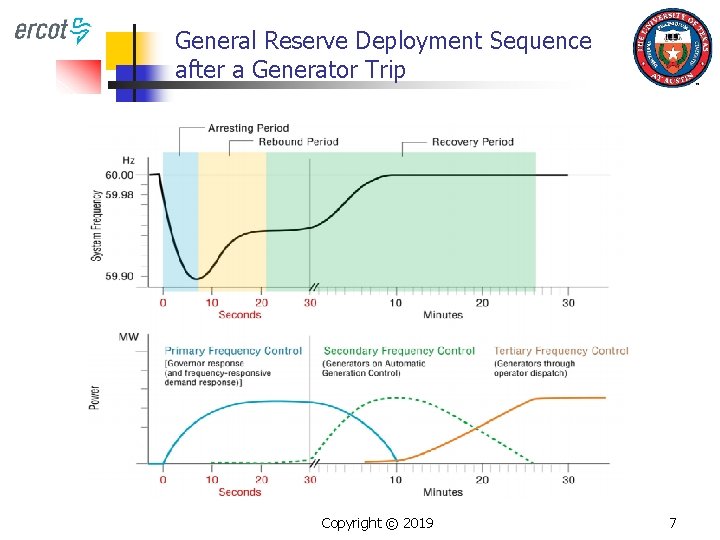
General Reserve Deployment Sequence after a Generator Trip Copyright © 2019 7
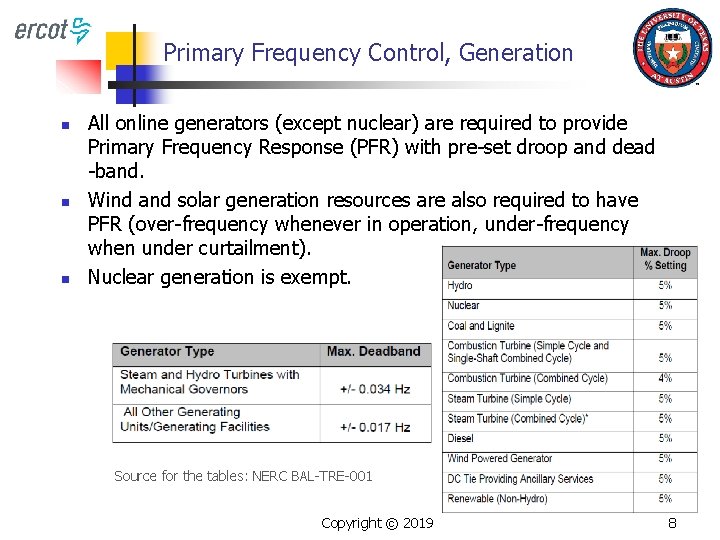
Primary Frequency Control, Generation n All online generators (except nuclear) are required to provide Primary Frequency Response (PFR) with pre-set droop and dead -band. Wind and solar generation resources are also required to have PFR (over-frequency whenever in operation, under-frequency when under curtailment). Nuclear generation is exempt. Source for the tables: NERC BAL-TRE-001 Copyright © 2019 8
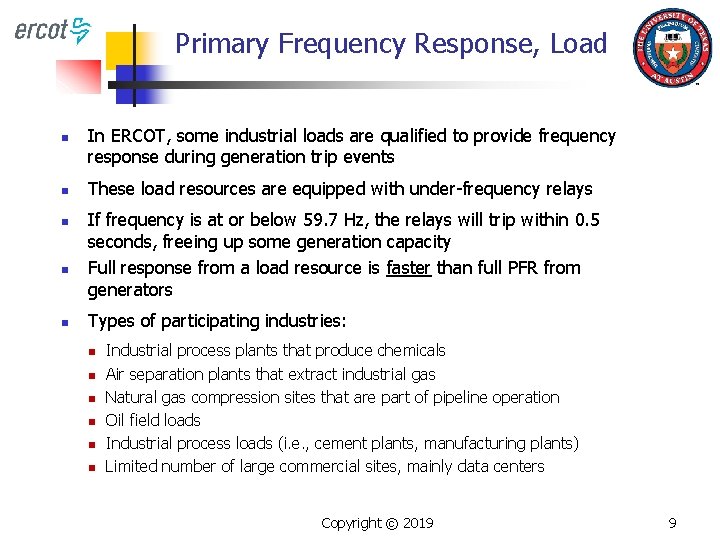
Primary Frequency Response, Load n n n In ERCOT, some industrial loads are qualified to provide frequency response during generation trip events These load resources are equipped with under-frequency relays If frequency is at or below 59. 7 Hz, the relays will trip within 0. 5 seconds, freeing up some generation capacity Full response from a load resource is faster than full PFR from generators Types of participating industries: n n n Industrial process plants that produce chemicals Air separation plants that extract industrial gas Natural gas compression sites that are part of pipeline operation Oil field loads Industrial process loads (i. e. , cement plants, manufacturing plants) Limited number of large commercial sites, mainly data centers Copyright © 2019 9
Physical Responsive Capacity Monitoring n n ERCOT monitors all capacity available for Primary Frequency Response, called Physical Responsive Capacity (PRC). For each online generator, the capacity that counts toward PRC is the available “headroom” or 20% of installed capacity, whichever is less: n n Headroom is max capacity minus generation. For loads, all load resources equipped with underfrequency relays count toward PRC. Copyright © 2019 10
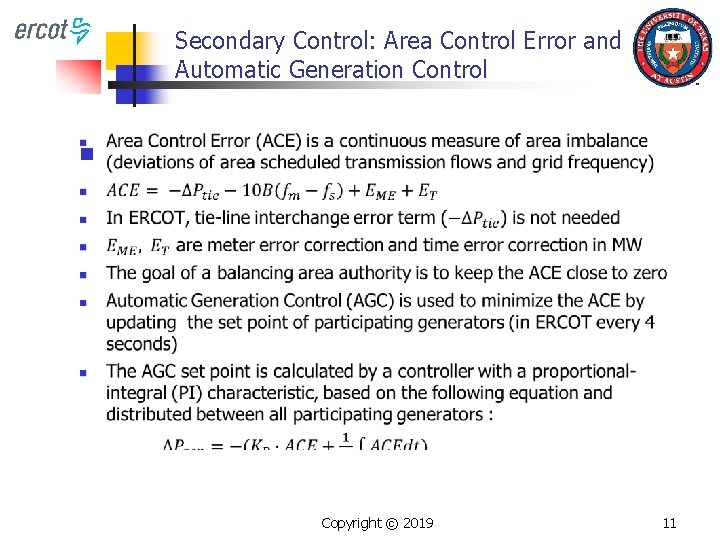
Secondary Control: Area Control Error and Automatic Generation Control n Copyright © 2019 11
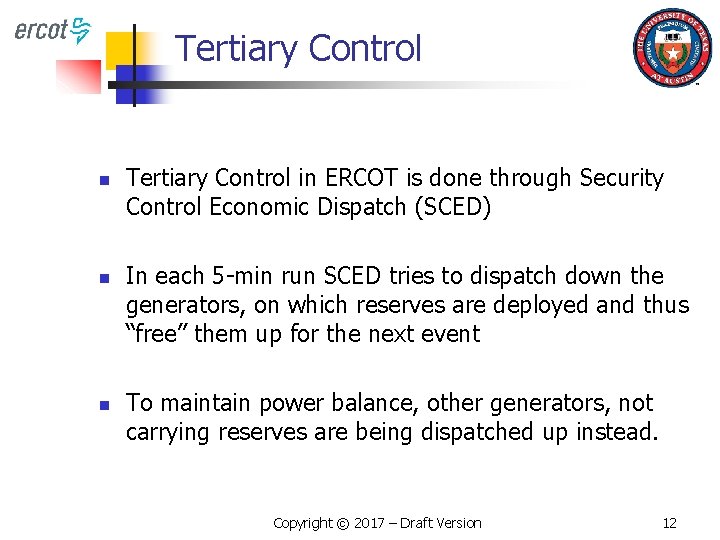
Tertiary Control n n n Tertiary Control in ERCOT is done through Security Control Economic Dispatch (SCED) In each 5 -min run SCED tries to dispatch down the generators, on which reserves are deployed and thus “free” them up for the next event To maintain power balance, other generators, not carrying reserves are being dispatched up instead. Copyright © 2017 – Draft Version 12
Outline n n n n AS Definition and Need Frequency Control, ACE, AGC ERCOT’s Ancillary Services Changes to ERCOT’s Resource Mix Changes to ERCOT’s AS Requirements and Situational Awareness Tools Key Takeaways Homework Assignment Copyright © 2019 13
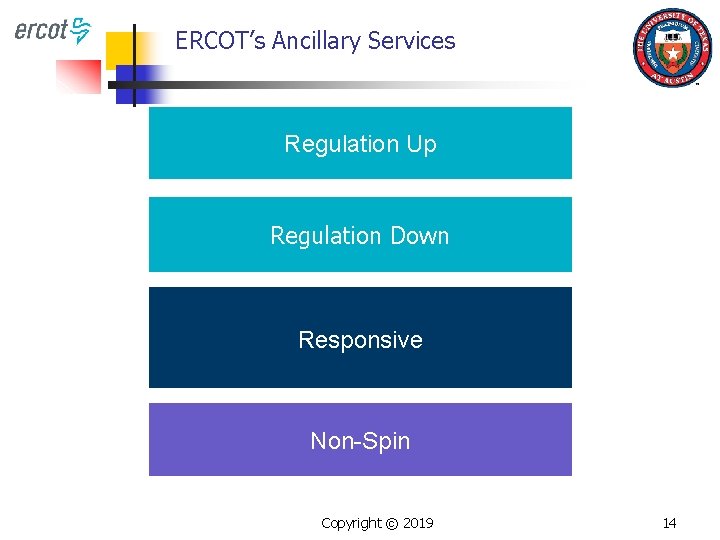
ERCOT’s Ancillary Services Regulation Up Regulation Down Responsive Non-Spin Copyright © 2019 14
Responsive Reserve Service RRS provides operating reserves intended to: n n n Arrest frequency decay within the first few seconds of a significant frequency deviation on the ERCOT grid (deployment as PFR) After the first few seconds of a significant frequency deviation, to help restore used-up reserves (release of capacity to SCED and dispatch as needed) Provide energy during emergency situations Copyright © 2019 15
Resources providing RRS may be provided by: n n Unloaded, online generation resource capacity, through PFR (Governor Response) Load resources controlled by high-set, under-frequency relays (0. 5 second response time, 59. 7 Hz trigger) Controllable load resources through PFR Hydro generation resources in synchronous condenser mode Copyright © 2019 16
Regulation Reserve Service n n n Deployed to balance net load variability between 5 -minute SCED intervals Reg-Up is used during negative imbalance between generation and load (i. e. , shortage) Reg-Down is used during positive imbalance between generation and load (i. e. , surplus) Deployed by ERCOT through AGC that proportionally divides Regulation needed between all participating generators and issues deployment signals every 4 seconds Regulation can be provided by generators, storage and controllable loads. Copyright © 2019 17
Non-Spinning Reserve Service Non-Spin may be deployed to: n n Replace loss of generating capacity Compensate for load, wind, solar forecast uncertainty Address the risk of net load ramps Assist when there is a limited amount of capacity available to SCED Historically, the need for Non-Spin has occurred during: n n Unexpected hot weather (in shoulder seasons) Cold weather, early morning load ramp outpacing the ability of generation to follow Summer afternoons when high loads and unit outages outstrip generating capability Following large unit trips to replenish reserves Copyright © 2019 18
Resources providing Non-Spin Service is provided by using: n n n Generation resources (online or offline) that are capable of being synchronized and ramped to a specified output level within 30 minutes, and are available to run at a specified output level for at least one hour Controllable load resources that qualify for SCED dispatch and are capable of ramping to a specific consumption level within 30 minutes, and are able to consume at this level for an hour Most of the Non-spin is provided by 10 -minute quick start units Copyright © 2019 19
Outline n n n n AS Definition and Need Frequency Control, ACE, AGC ERCOT’s Ancillary Services Changes to ERCOT’s Resource Mix Changes to ERCOT’s AS Requirements and Situational Awareness Tools Key Takeaways Homework Assignment Copyright © 2019 20
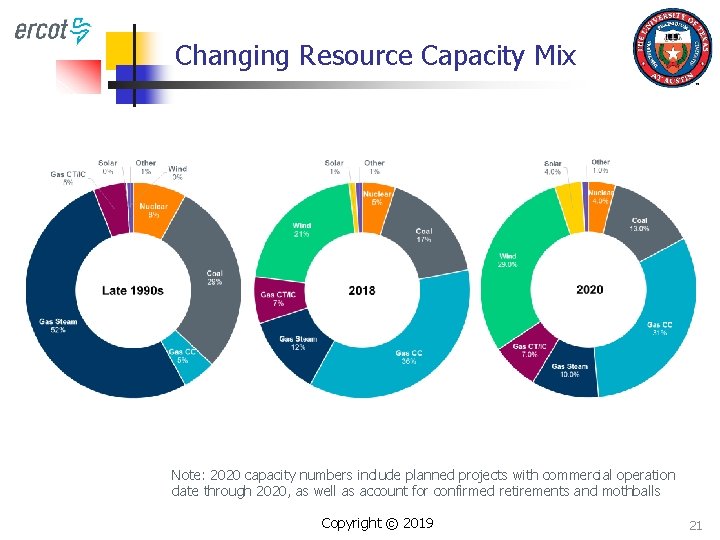
Changing Resource Capacity Mix Note: 2020 capacity numbers include planned projects with commercial operation date through 2020, as well as account for confirmed retirements and mothballs Copyright © 2019 21
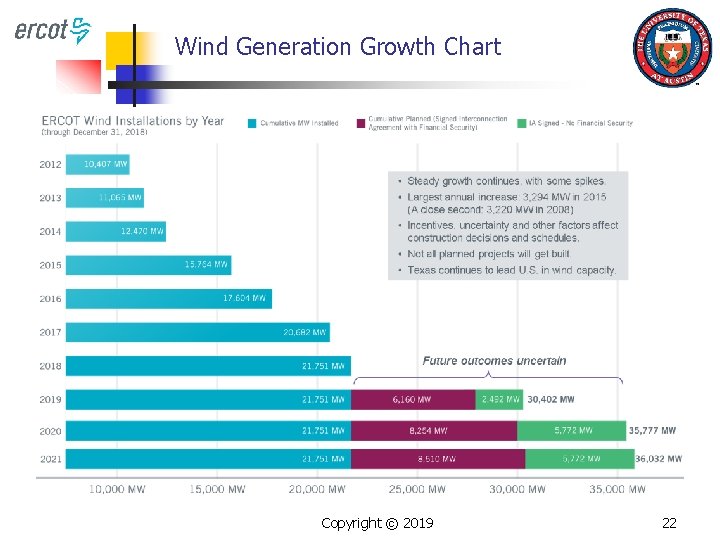
Wind Generation Growth Chart Copyright © 2019 22
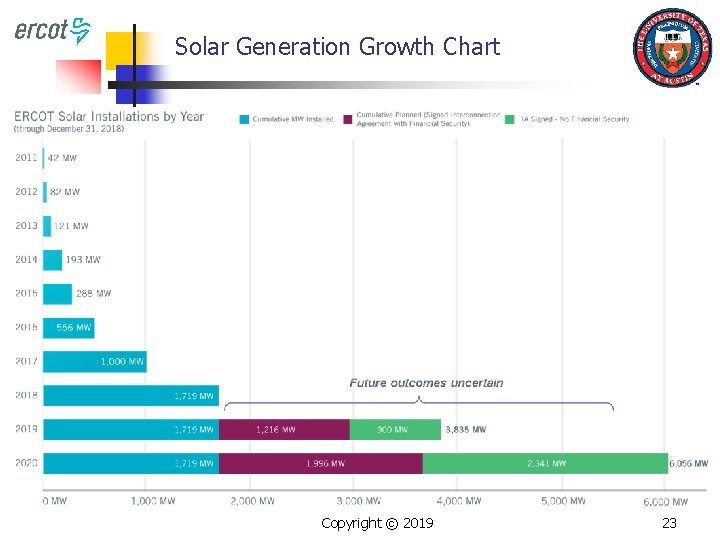
Solar Generation Growth Chart Copyright © 2019 23
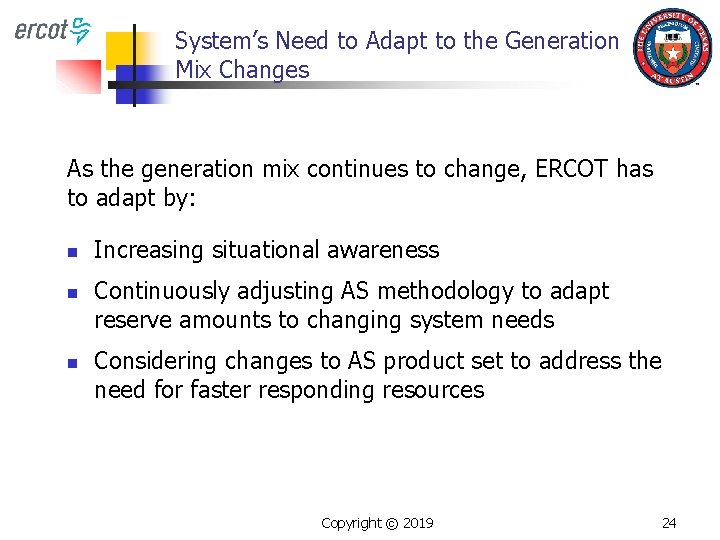
System’s Need to Adapt to the Generation Mix Changes As the generation mix continues to change, ERCOT has to adapt by: n n n Increasing situational awareness Continuously adjusting AS methodology to adapt reserve amounts to changing system needs Considering changes to AS product set to address the need for faster responding resources Copyright © 2019 24
Outline n n n n AS definition and Need Frequency Control, ACE, AGC ERCOT’s Ancillary Services Changes to ERCOT’s Resource Mix Changes to ERCOT’s AS Requirements and Situational Awareness Tools Key Takeaways Homework Assignment Copyright © 2019 25
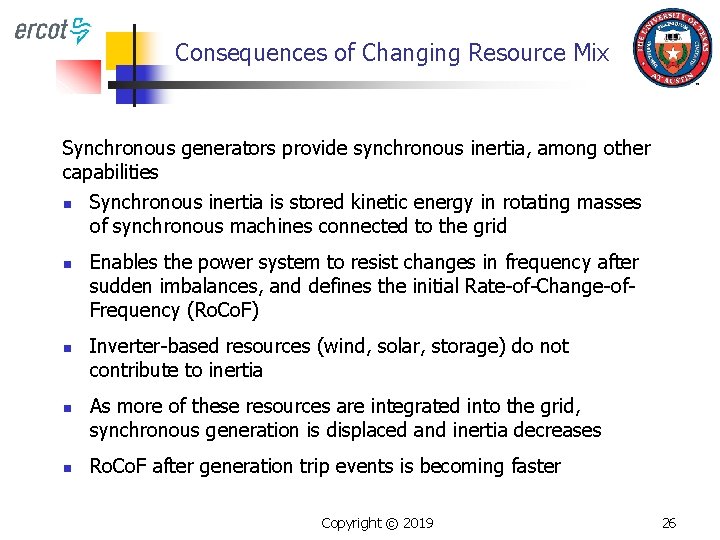
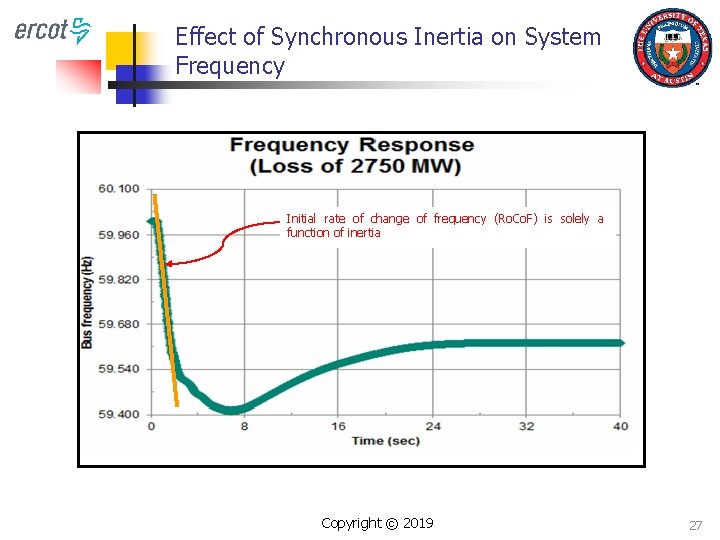
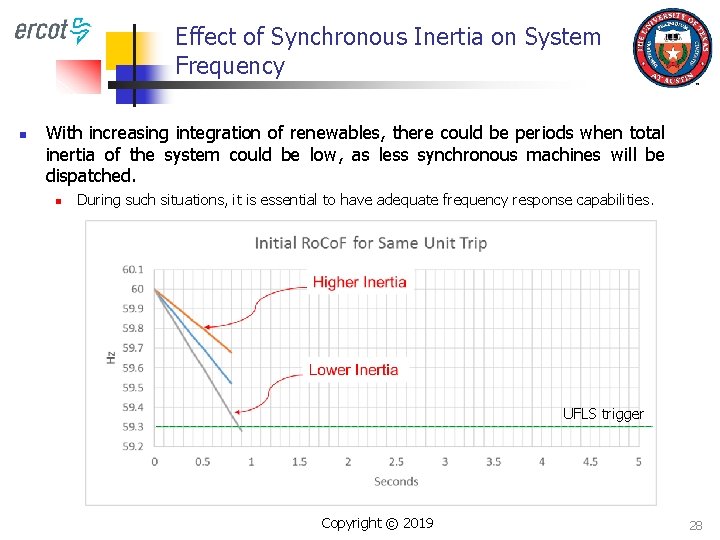
Consequences of Changing Resource Mix Synchronous generators provide synchronous inertia, among other capabilities n Synchronous inertia is stored kinetic energy in rotating masses of synchronous machines connected to the grid n n Enables the power system to resist changes in frequency after sudden imbalances, and defines the initial Rate-of-Change-of. Frequency (Ro. Co. F) Inverter-based resources (wind, solar, storage) do not contribute to inertia As more of these resources are integrated into the grid, synchronous generation is displaced and inertia decreases Ro. Co. F after generation trip events is becoming faster Copyright © 2019 26
Effect of Synchronous Inertia on System Frequency Initial rate of change of frequency (Ro. Co. F) is solely a function of inertia Copyright © 2019 27
Effect of Synchronous Inertia on System Frequency n With increasing integration of renewables, there could be periods when total inertia of the system could be low, as less synchronous machines will be dispatched. n During such situations, it is essential to have adequate frequency response capabilities. UFLS trigger Copyright © 2019 28
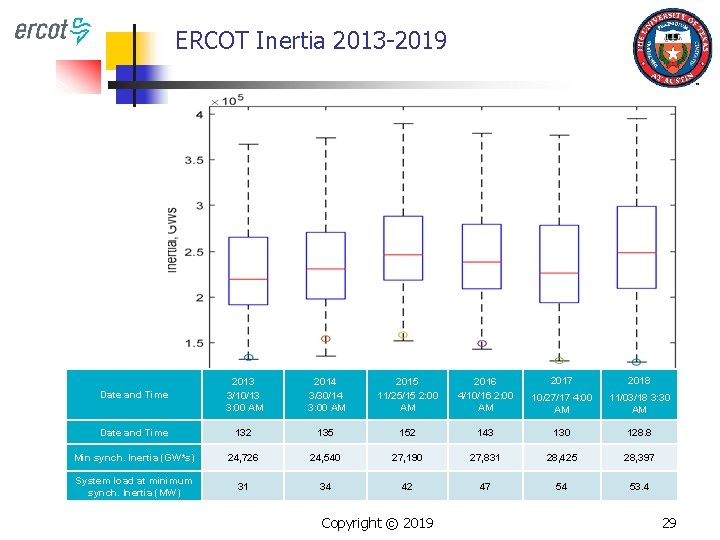
ERCOT Inertia 2013 -2019 2014 3/30/14 3: 00 AM 2015 11/25/15 2: 00 AM 2016 4/10/16 2: 00 AM 2017 2018 Date and Time 2013 3/10/13 3: 00 AM 10/27/17 4: 00 AM 11/03/18 3: 30 AM Date and Time 132 135 152 143 130 128. 8 Min synch. Inertia (GW*s) 24, 726 24, 540 27, 190 27, 831 28, 425 28, 397 System load at minimum synch. Inertia (MW) 31 34 42 47 54 53. 4 Copyright © 2019 29
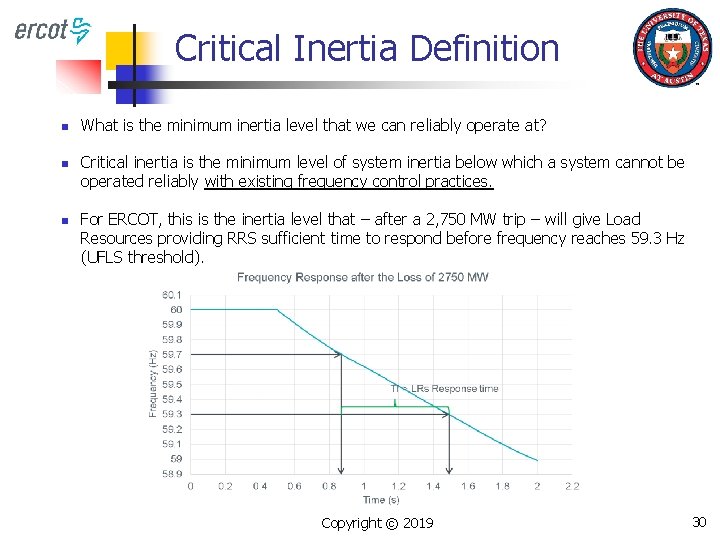
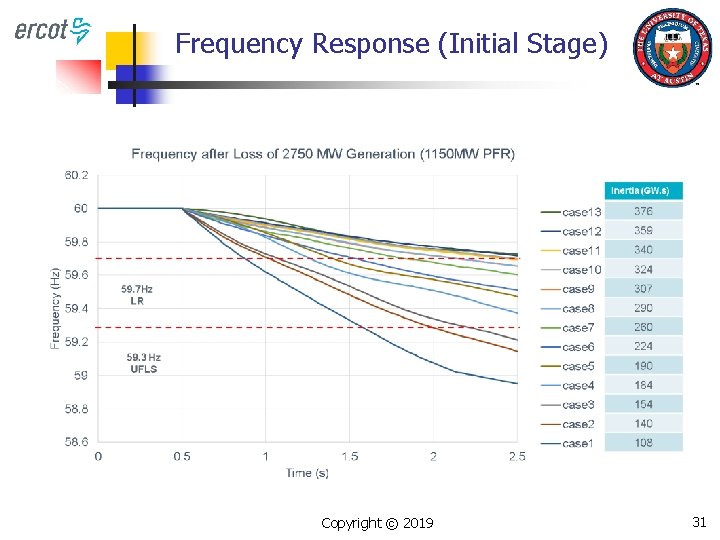
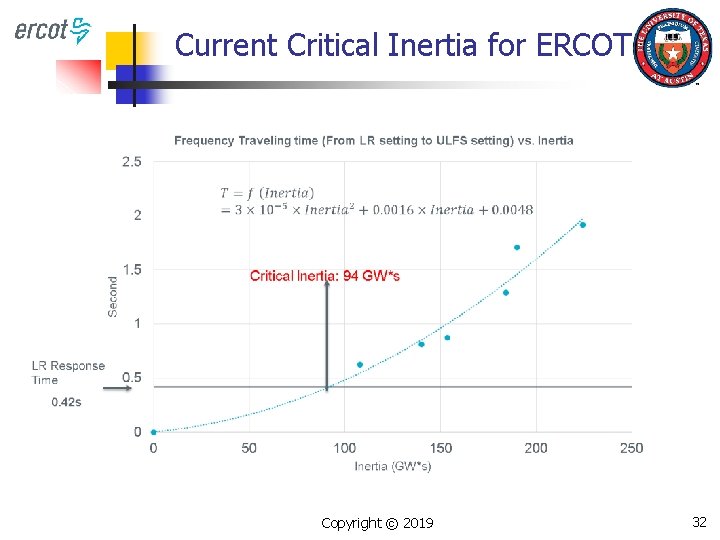
Critical Inertia Definition n What is the minimum inertia level that we can reliably operate at? Critical inertia is the minimum level of system inertia below which a system cannot be operated reliably with existing frequency control practices. For ERCOT, this is the inertia level that – after a 2, 750 MW trip – will give Load Resources providing RRS sufficient time to respond before frequency reaches 59. 3 Hz (UFLS threshold). Copyright © 2019 30
Frequency Response (Initial Stage) Copyright © 2019 31
Current Critical Inertia for ERCOT Copyright © 2019 32
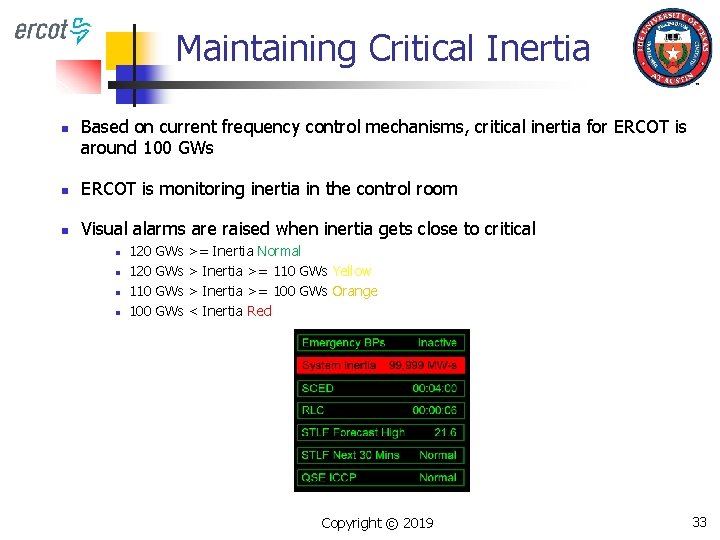
Maintaining Critical Inertia n Based on current frequency control mechanisms, critical inertia for ERCOT is around 100 GWs n ERCOT is monitoring inertia in the control room n Visual alarms are raised when inertia gets close to critical n n 120 GWs >= Inertia Normal 120 GWs > Inertia >= 110 GWs Yellow 110 GWs > Inertia >= 100 GWs Orange 100 GWs < Inertia Red Copyright © 2019 33
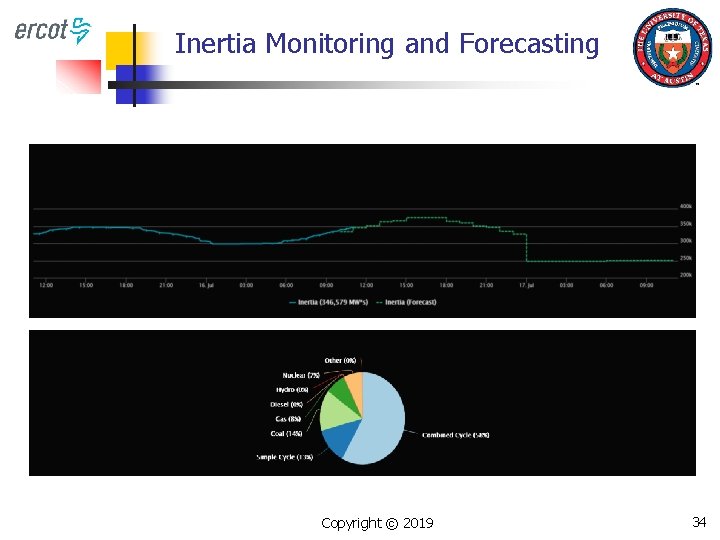
Inertia Monitoring and Forecasting Copyright © 2019 34
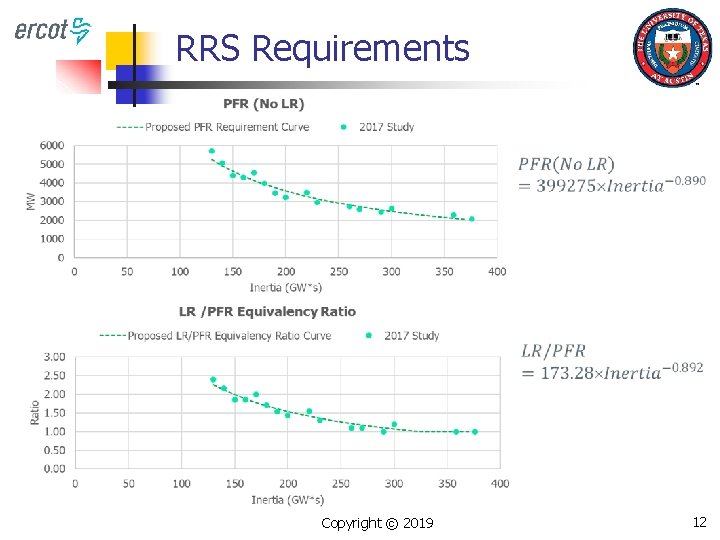
Change to RRS requirements n n n ERCOT used to procure 2, 800 MW of RRS for every hour of the year. How much RRS is needed for different inertia conditions? A series of studies were conducted based on recent historical real-time cases in 2016 and 2017 for different levels of inertia varying between 130 GWs through 376 GWs. Same criteria used for critical inertia (at each inertia level, must have sufficient amount of RRS to avoid trigger of UFLS after 2, 750 MW trip). The goal of the studies was to find out how much RRS is needed overall and determine the equivalency ratio between load resources and generation resources providing RRS. Copyright © 2019 35
RRS Requirements Copyright © 2019 12
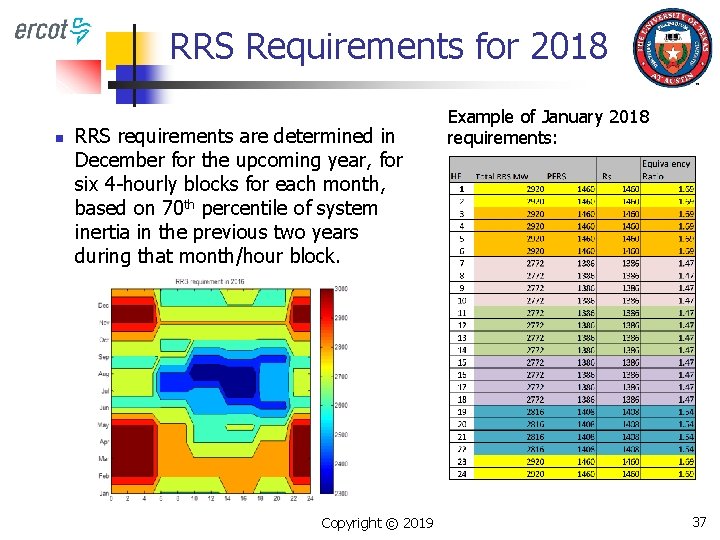
RRS Requirements for 2018 n RRS requirements are determined in December for the upcoming year, for six 4 -hourly blocks for each month, based on 70 th percentile of system inertia in the previous two years during that month/hour block. Copyright © 2019 Example of January 2018 requirements: 37
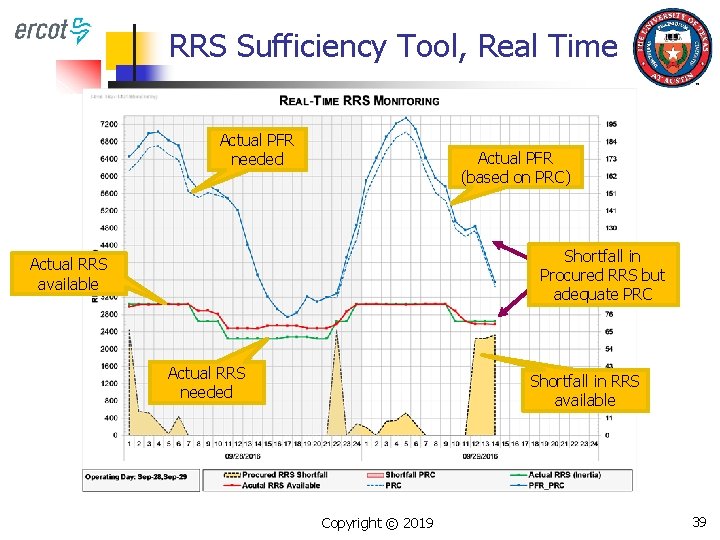
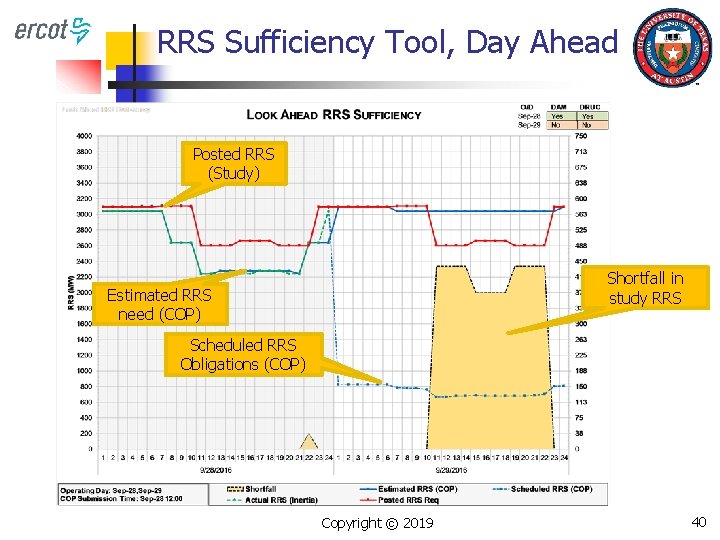
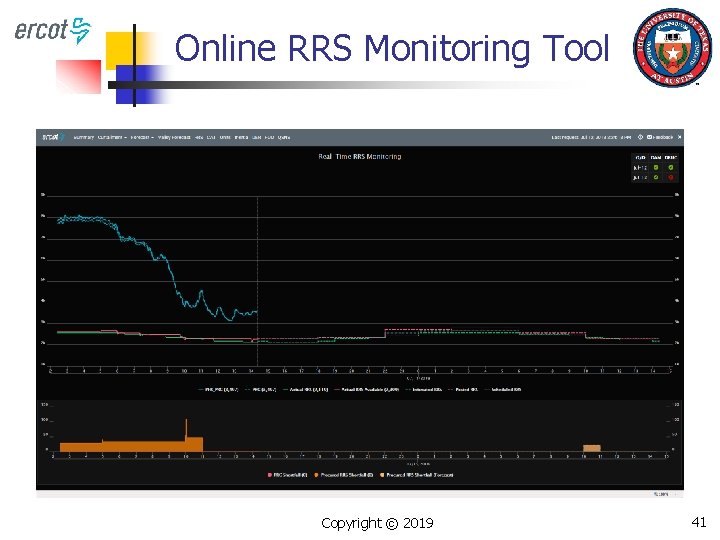
RRS Sufficiency n n n RRS requirements are determined before the operating year, for the whole year. ERCOT determines actual RRS needs based on expected inertia conditions in the DA and closer to RT, and monitors RRS sufficiency. If RRS is insufficient, ERCOT can rely on other available frequency-responsive capacity or open the Supplemental Ancillary Services Market (SASM) to procure additional RRS. Copyright © 2019 38
RRS Sufficiency Tool, Real Time Actual PFR needed Actual PFR (based on PRC) Shortfall in Procured RRS but adequate PRC Actual RRS available Actual RRS needed Shortfall in RRS available Copyright © 2019 39
RRS Sufficiency Tool, Day Ahead Posted RRS (Study) Shortfall in study RRS Estimated RRS need (COP) Scheduled RRS Obligations (COP) Copyright © 2019 40
Online RRS Monitoring Tool Copyright © 2019 41
Reliability Risk Desk ERCOT added a new desk in the control room to monitor: n System inertia n Resulting RRS requirements and RRS sufficiency n n Sufficiency of AS to cover forecast error risk and net load ramps Renewable forecasts versus actual output Copyright © 2019 42
Changes for Load Resources providing RRS n n n Historically, load resources were limited to 50% of total RRS requirement, to allow more diversity of RRS resources and to avoid frequency overshoot. With wind and solar resources providing PFR, overshoot is no longer an issue. In November 2017, the limit was increased to 60%. Copyright © 2019 43
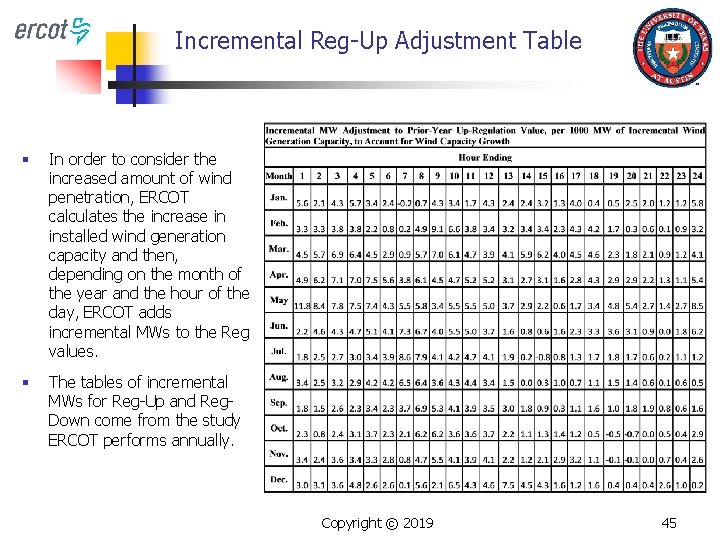
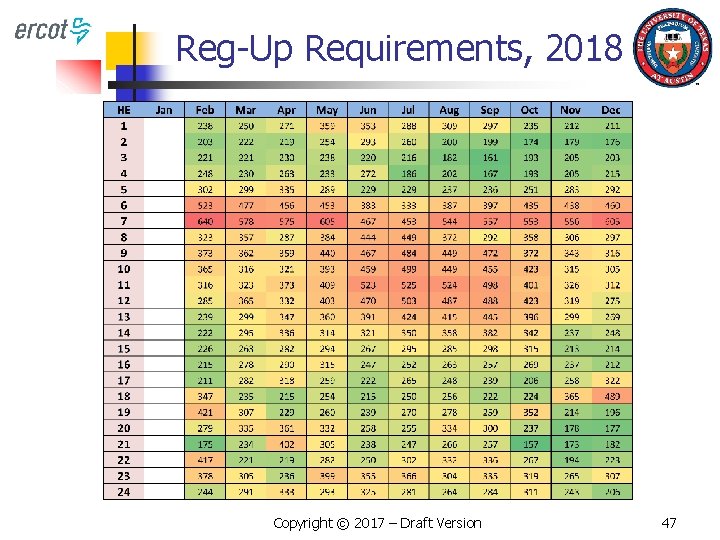
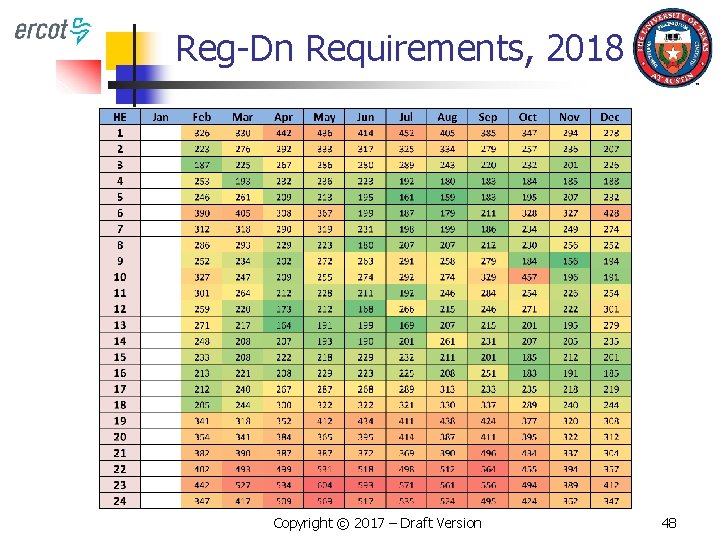
Regulation Requirements Regulation requirements are based on historic wind and solar power production and load variability, as well as historic Reg deployments. For determining the base Reg-Up requirements for a particular hour, ERCOT calculates: n n 95 th percentile of non-zero Reg-Up deployments (5 -minute averages) for the same month, same hour of the previous two years, and 95 th percentile of the positive net load (load – wind – solar) changes over each 5 -minute interval for the same month, same hour of the previous two years Maximum of these two values sets the Reg-Up requirement for the hour in this month next year + the adjustment for new capacity (see slide 45) Similar process is followed to determine Reg-Down requirements Copyright © 2019 44
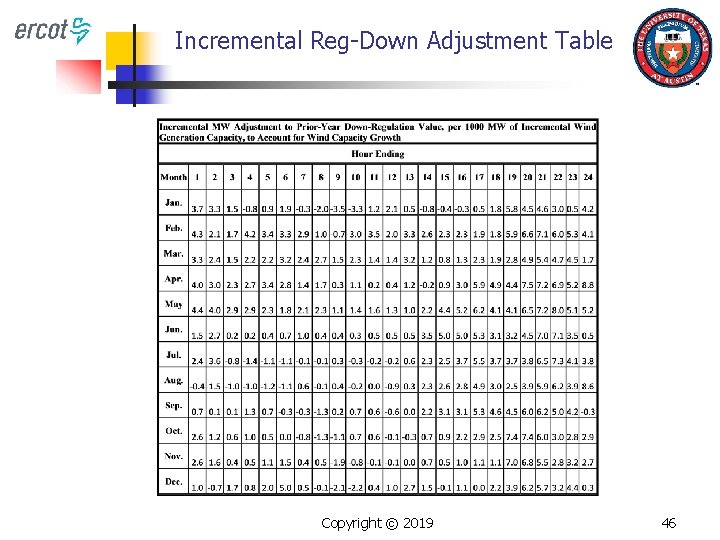
Incremental Reg-Up Adjustment Table § In order to consider the increased amount of wind penetration, ERCOT calculates the increase in installed wind generation capacity and then, depending on the month of the year and the hour of the day, ERCOT adds incremental MWs to the Reg values. § The tables of incremental MWs for Reg-Up and Reg. Down come from the study ERCOT performs annually. Copyright © 2019 45
Incremental Reg-Down Adjustment Table Copyright © 2019 46
Reg-Up Requirements, 2018 Copyright © 2017 – Draft Version 47
Reg-Dn Requirements, 2018 Copyright © 2017 – Draft Version 48
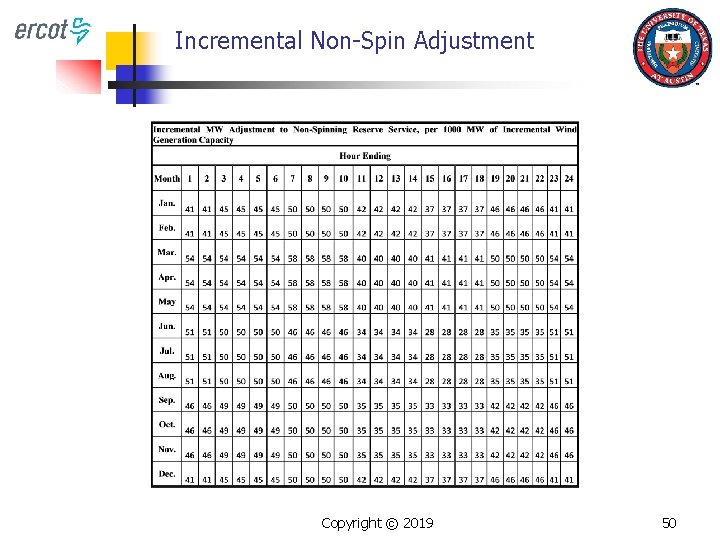
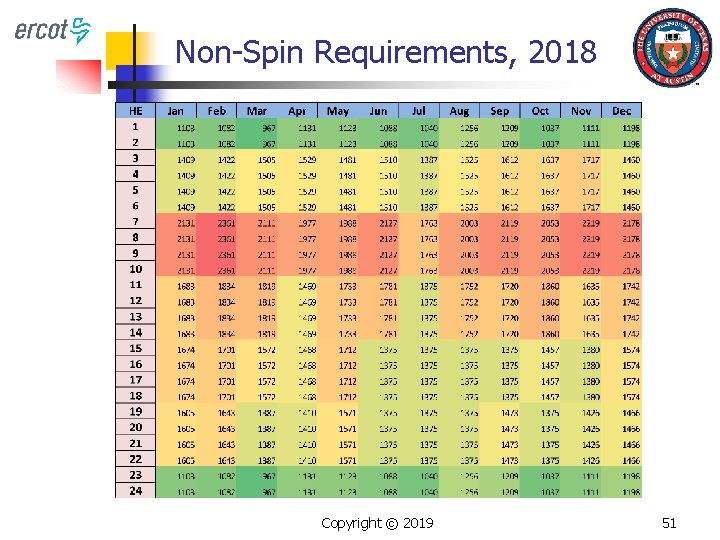
Non-Spinning Requirement Non-Spin requirements are based on the historic net load forecast error, determined for every month, 6 four-hourly blocks. For determining the Non-Spin requirements for a particular hour: n ERCOT will determine the Non-Spin requirement using the 70 th to 95 th percentile of hourly net load forecast uncertainty from the same month and same four-hourly block of the previous three years. n n Periods where the risk of net load ramp is highest will use 95 th percentile compared to 70 th percentile for periods with lowest risks. Similarly to Reg requirements, calculation and adjustment for newly installed wind capacity is made. Copyright © 2019 49
Incremental Non-Spin Adjustment Copyright © 2019 50
Non-Spin Requirements, 2018 Copyright © 2019 51
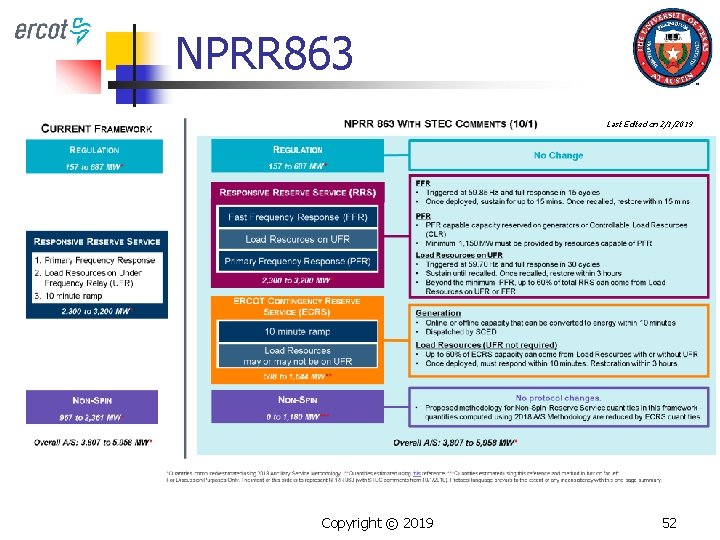
NPRR 863 Last Edited on 2/1/2019 Copyright © 2019 52
Outline n n n n AS Definition and Need Frequency Control, ACE, AGC ERCOT’s Ancillary Services Changes to ERCOT’s Resource Mix Changes to ERCOT’s AS Requirements and Situational Awareness Tools Key Takeaways Homework Assignment Copyright © 2019 53
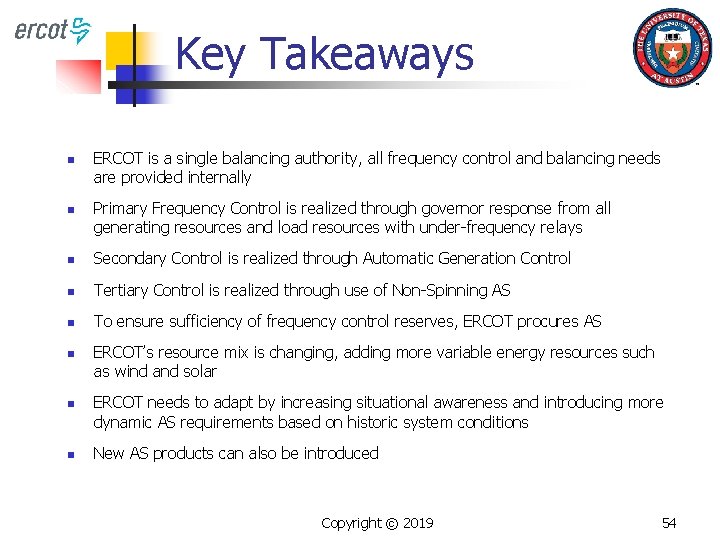
Key Takeaways n n ERCOT is a single balancing authority, all frequency control and balancing needs are provided internally Primary Frequency Control is realized through governor response from all generating resources and load resources with under-frequency relays n Secondary Control is realized through Automatic Generation Control n Tertiary Control is realized through use of Non-Spinning AS n To ensure sufficiency of frequency control reserves, ERCOT procures AS n n n ERCOT’s resource mix is changing, adding more variable energy resources such as wind and solar ERCOT needs to adapt by increasing situational awareness and introducing more dynamic AS requirements based on historic system conditions New AS products can also be introduced Copyright © 2019 54
Outline n n n n AS Definition and Need Frequency Control, ACE, AGC ERCOT’s Ancillary Services Changes to ERCOT’s Resource Mix Changes to ERCOT’s AS Requirements and Situational Awareness Key Takeaways Homework Assignment Copyright © 2019 55
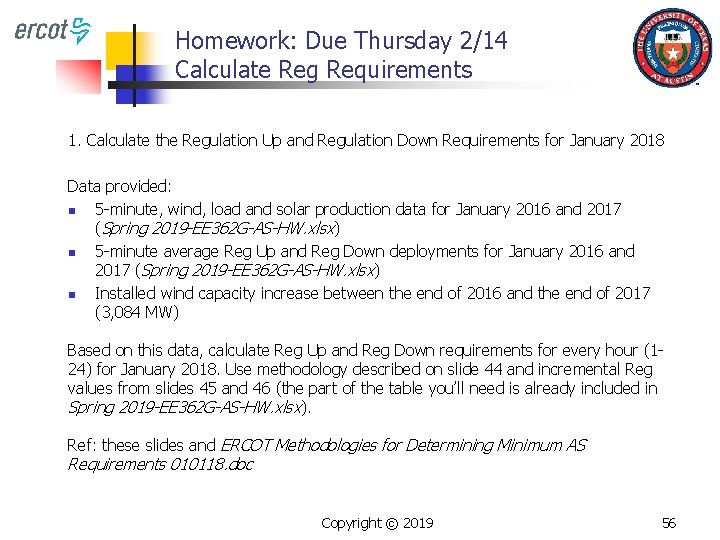
Homework: Due Thursday 2/14 Calculate Reg Requirements 1. Calculate the Regulation Up and Regulation Down Requirements for January 2018 Data provided: n 5 -minute, wind, load and solar production data for January 2016 and 2017 (Spring 2019 -EE 362 G-AS-HW. xlsx) n 5 -minute average Reg Up and Reg Down deployments for January 2016 and 2017 (Spring 2019 -EE 362 G-AS-HW. xlsx) n Installed wind capacity increase between the end of 2016 and the end of 2017 (3, 084 MW) Based on this data, calculate Reg Up and Reg Down requirements for every hour (124) for January 2018. Use methodology described on slide 44 and incremental Reg values from slides 45 and 46 (the part of the table you’ll need is already included in Spring 2019 -EE 362 G-AS-HW. xlsx). Ref: these slides and ERCOT Methodologies for Determining Minimum AS Requirements 010118. doc Copyright © 2019 56
Homework: Calculate Reg Requirements In ERCOT Methodologies for Determining Minimum AS Requirements 010118. doc, you may see that additional adjustments may be made to the Regulation requirements in case of historic violations of the CPS 1 score and/or exhaustion of Regulation Reserve. You do not need to include these in your calculation. Copyright © 2019 57