CS 6410 ADVANCED SYSTEMS PROF HAKIM WEATHERSPOON Fall
- Slides: 43
CS 6410: ADVANCED SYSTEMS PROF. HAKIM WEATHERSPOON Fall 2018 Principled Computer System Design
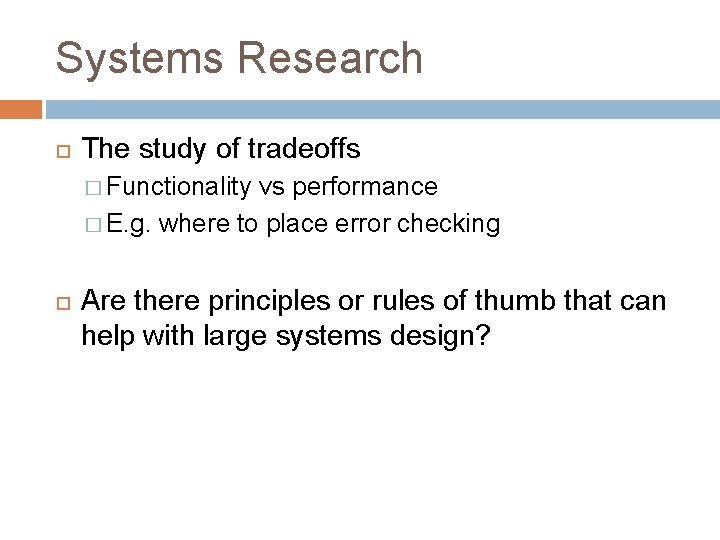
Systems Research The study of tradeoffs � Functionality vs performance � E. g. where to place error checking Are there principles or rules of thumb that can help with large systems design?
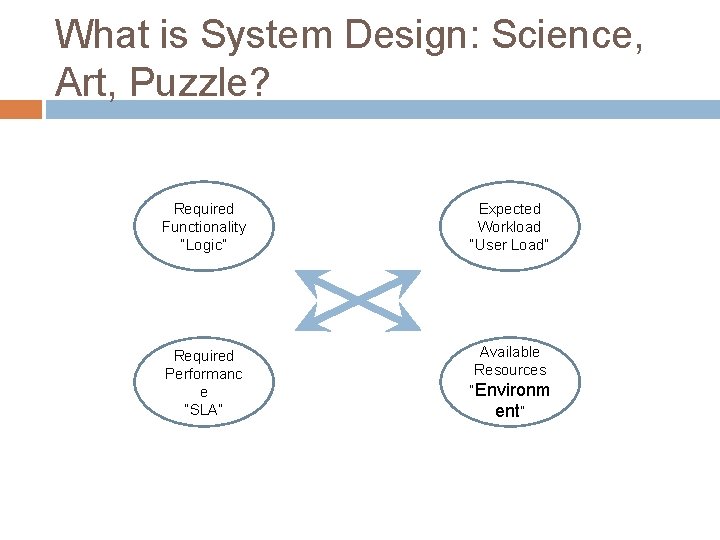
What is System Design: Science, Art, Puzzle? Required Functionality “Logic” Expected Workload “User Load” Required Performanc e “SLA” Available Resources “Environm ent”
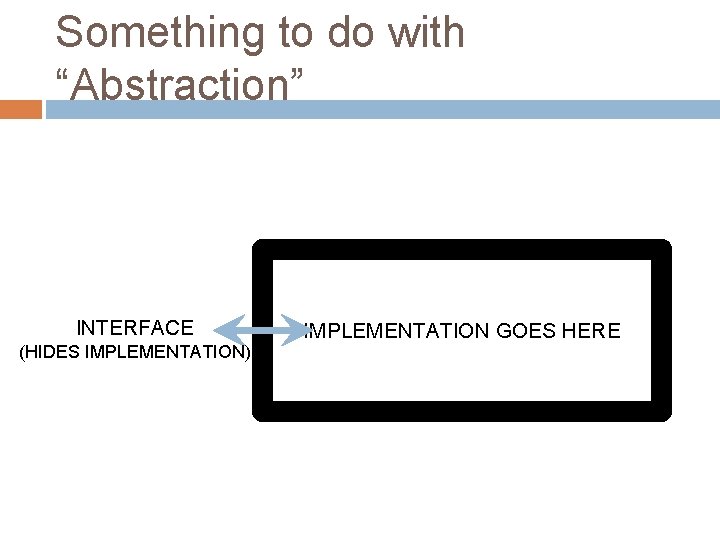
Something to do with “Abstraction” INTERFACE (HIDES IMPLEMENTATION) IMPLEMENTATION GOES HERE
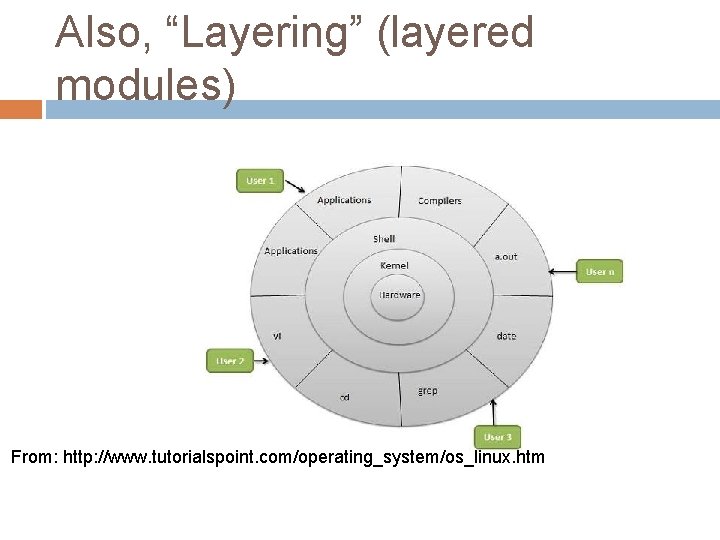
Also, “Layering” (layered modules) From: http: //www. tutorialspoint. com/operating_system/os_linux. htm
Any problem in computer science can be solved with another level of indirection Attributed to David Wheeler (by Butler Lampson)
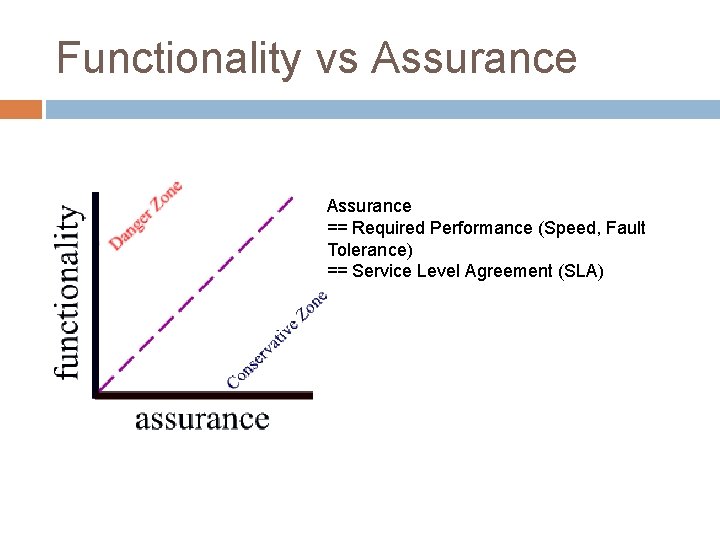
Functionality vs Assurance == Required Performance (Speed, Fault Tolerance) == Service Level Agreement (SLA)
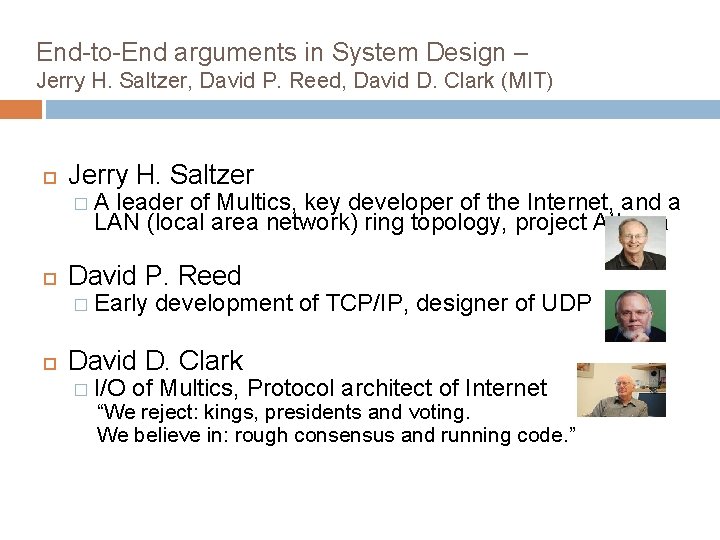
End-to-End arguments in System Design – Jerry H. Saltzer, David P. Reed, David D. Clark (MIT) Jerry H. Saltzer �A leader of Multics, key developer of the Internet, and a LAN (local area network) ring topology, project Athena David P. Reed � Early development of TCP/IP, designer of UDP David D. Clark � I/O of Multics, Protocol architect of Internet “We reject: kings, presidents and voting. We believe in: rough consensus and running code. ”
End-to-End argument Helps guide function placement among modules of a distributed system Argument � implement the functionality in the lower layer only if a large number of higher layers / applications use this functionality and implementing it at the lower layer improves the performance of many of them, AND does not hurt the remaining applications
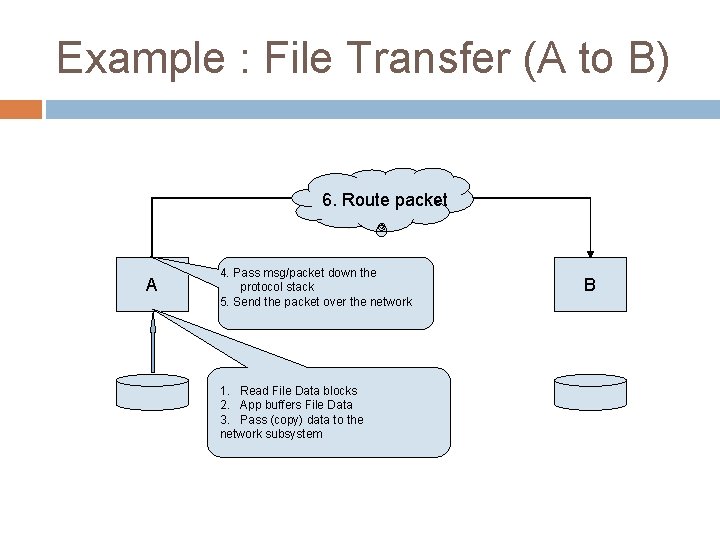
Example : File Transfer (A to B) 6. Route packet A 4. Pass msg/packet down the protocol stack 5. Send the packet over the network 1. Read File Data blocks 2. App buffers File Data 3. Pass (copy) data to the network subsystem B
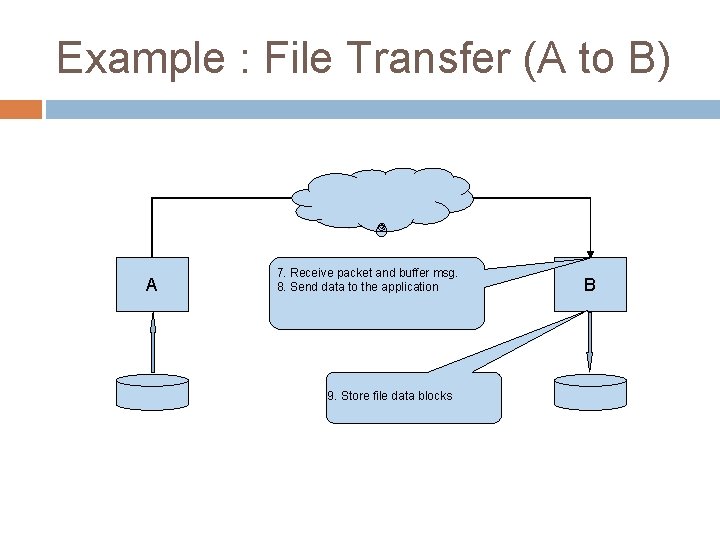
Example : File Transfer (A to B) A 7. Receive packet and buffer msg. 8. Send data to the application 9. Store file data blocks B
Possible failures Reading and writing to disk Transient errors in the memory chip while buffering and copying network might drop packets, modify bits, deliver duplicates OS buffer overflow at the sender or the receiver Either of the hosts may crash
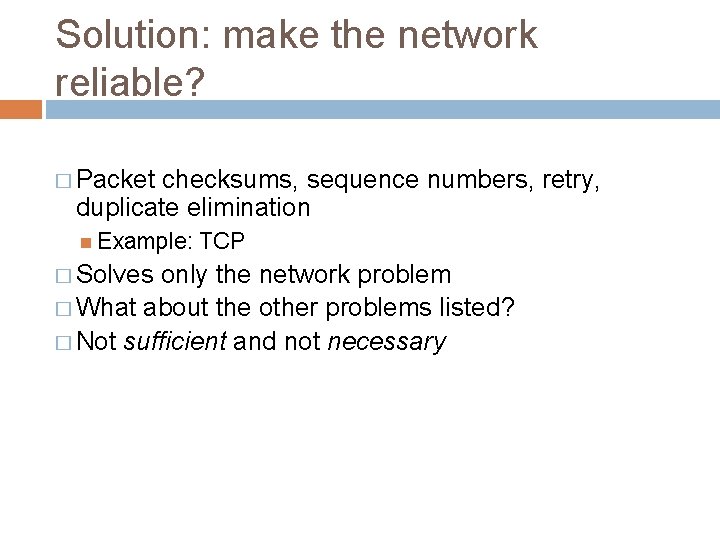
Solution: make the network reliable? � Packet checksums, sequence numbers, retry, duplicate elimination Example: � Solves TCP only the network problem � What about the other problems listed? � Not sufficient and not necessary
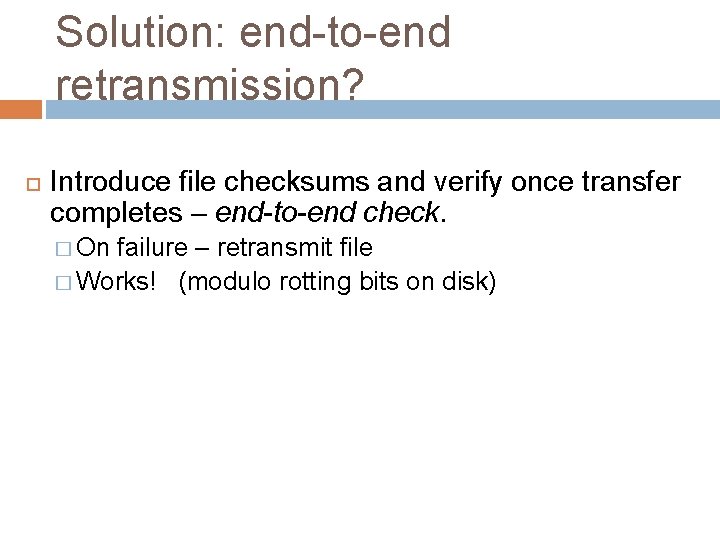
Solution: end-to-end retransmission? Introduce file checksums and verify once transfer completes – end-to-end check. � On failure – retransmit file � Works! (modulo rotting bits on disk)
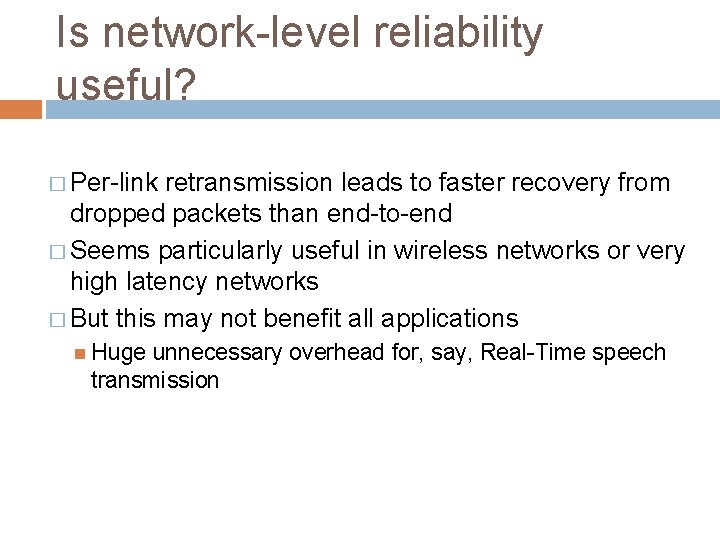
Is network-level reliability useful? � Per-link retransmission leads to faster recovery from dropped packets than end-to-end � Seems particularly useful in wireless networks or very high latency networks � But this may not benefit all applications Huge unnecessary overhead for, say, Real-Time speech transmission
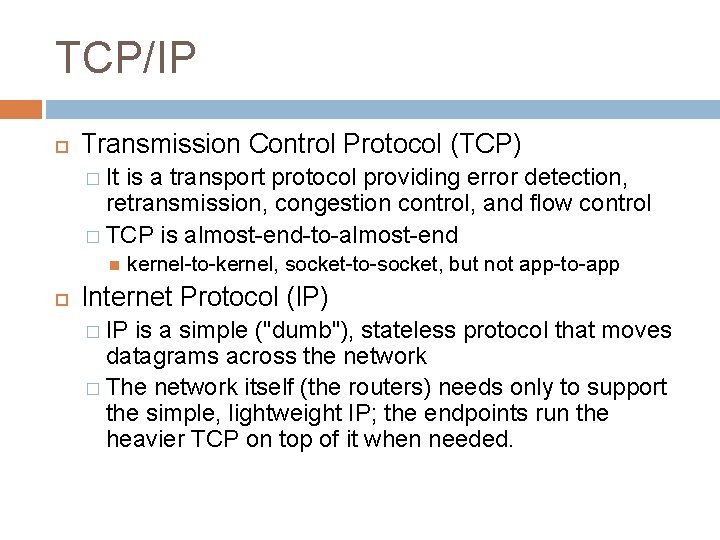
TCP/IP Transmission Control Protocol (TCP) � It is a transport protocol providing error detection, retransmission, congestion control, and flow control � TCP is almost-end-to-almost-end kernel-to-kernel, socket-to-socket, but not app-to-app Internet Protocol (IP) � IP is a simple ("dumb"), stateless protocol that moves datagrams across the network � The network itself (the routers) needs only to support the simple, lightweight IP; the endpoints run the heavier TCP on top of it when needed.
Other end-to-end examples End-to-end authentication � TLS, SSL Duplicate msg suppression
Is argument complete? E. g. congestion control � TCP leaves it to the ends Should the network trust the ends? In a wireless setting RED packet loss != congestion performance problems may appear in end-end systems under heavy load Performance enhancing Proxies
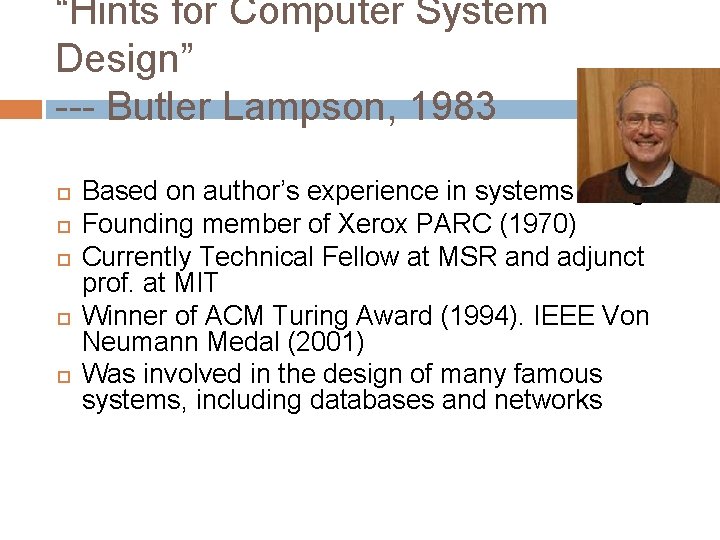
“Hints for Computer System Design” --- Butler Lampson, 1983 Based on author’s experience in systems design Founding member of Xerox PARC (1970) Currently Technical Fellow at MSR and adjunct prof. at MIT Winner of ACM Turing Award (1994). IEEE Von Neumann Medal (2001) Was involved in the design of many famous systems, including databases and networks
Some Projects & Collaborators Charles Simonyi - Bravo: WYSIWYG editor (MS Office) Bob Sproull - Alto operating system, Dover: laser printer, Interpress: page description language (VP Sun/Oracle) Mel Pirtle - 940 project, Berkeley Computer Corp. Peter Deutsch - 940 operating system, QSPL: system programming language (founder of Ghostscript) Chuck Geschke, Jim Mitchell, Ed Satterthwaite - Mesa: system programming language
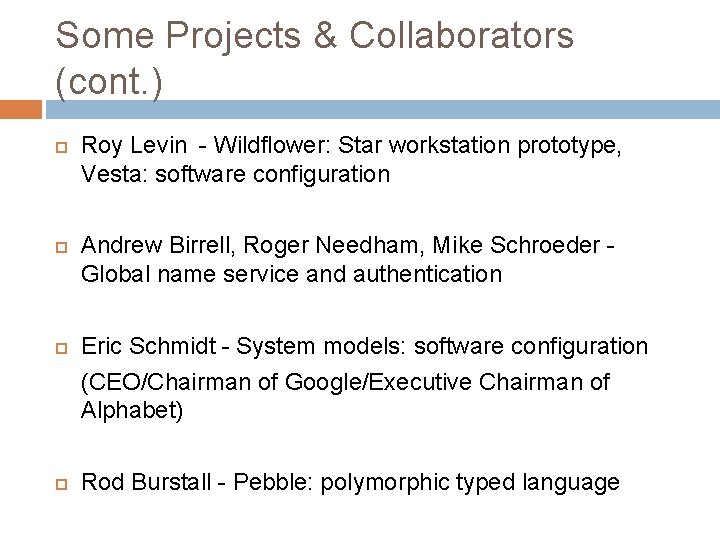
Some Projects & Collaborators (cont. ) Roy Levin - Wildflower: Star workstation prototype, Vesta: software configuration Andrew Birrell, Roger Needham, Mike Schroeder Global name service and authentication Eric Schmidt - System models: software configuration (CEO/Chairman of Google/Executive Chairman of Alphabet) Rod Burstall - Pebble: polymorphic typed language
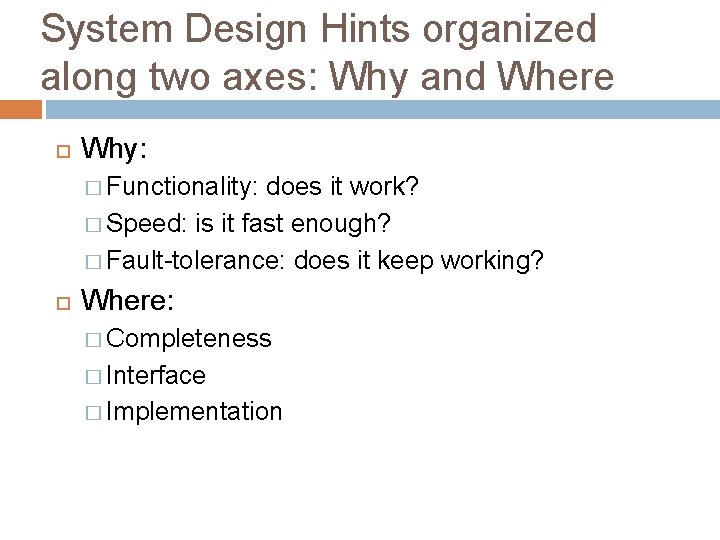
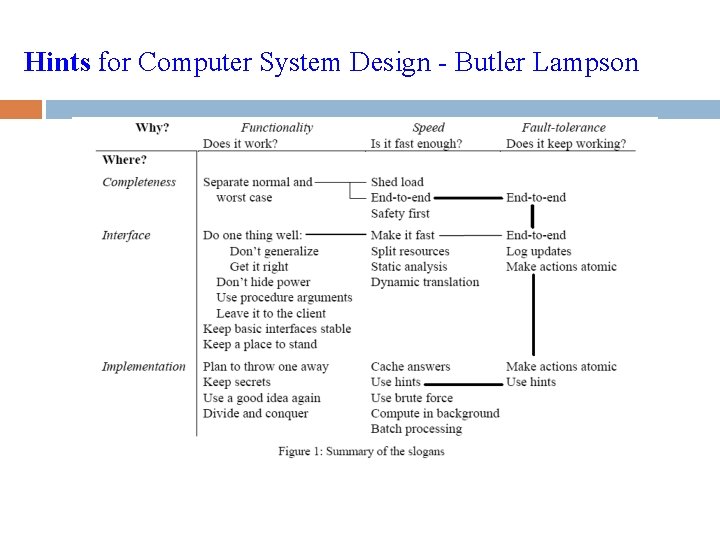
System Design Hints organized along two axes: Why and Where Why: � Functionality: does it work? � Speed: is it fast enough? � Fault-tolerance: does it keep working? Where: � Completeness � Interface � Implementation
Hints for Computer System Design - Butler Lampson
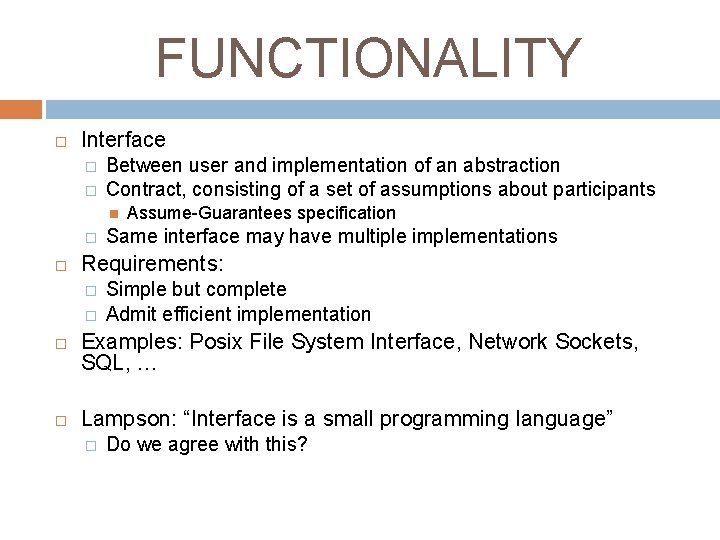
FUNCTIONALITY Interface � � Between user and implementation of an abstraction Contract, consisting of a set of assumptions about participants � � Same interface may have multiple implementations Requirements: � Assume-Guarantees specification Simple but complete Admit efficient implementation Examples: Posix File System Interface, Network Sockets, SQL, … Lampson: “Interface is a small programming language” � Do we agree with this?
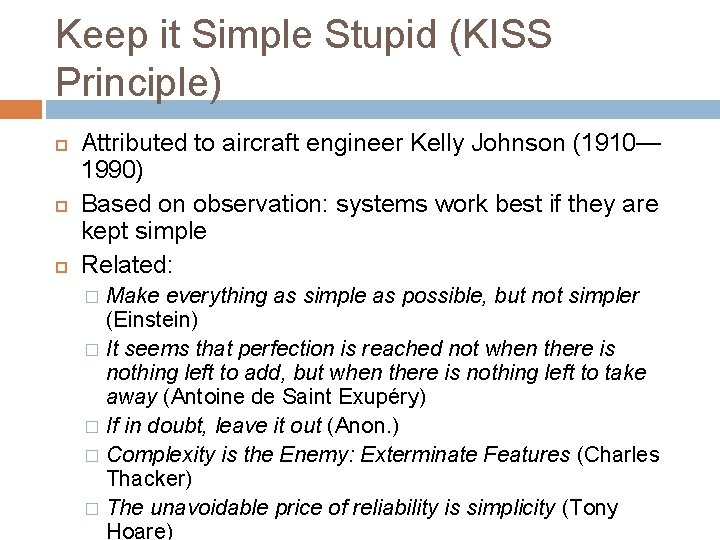
Keep it Simple Stupid (KISS Principle) Attributed to aircraft engineer Kelly Johnson (1910— 1990) Based on observation: systems work best if they are kept simple Related: Make everything as simple as possible, but not simpler (Einstein) � It seems that perfection is reached not when there is nothing left to add, but when there is nothing left to take away (Antoine de Saint Exupéry) � If in doubt, leave it out (Anon. ) � Complexity is the Enemy: Exterminate Features (Charles Thacker) � The unavoidable price of reliability is simplicity (Tony Hoare) �
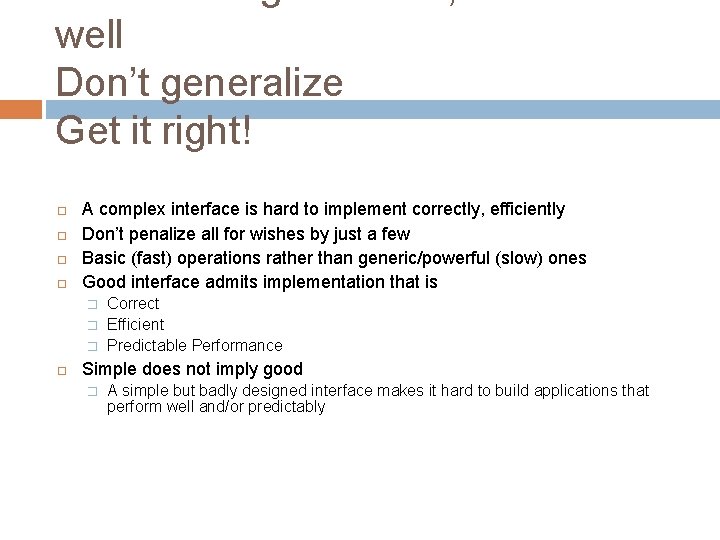
well Don’t generalize Get it right! A complex interface is hard to implement correctly, efficiently Don’t penalize all for wishes by just a few Basic (fast) operations rather than generic/powerful (slow) ones Good interface admits implementation that is � � � Correct Efficient Predictable Performance Simple does not imply good � A simple but badly designed interface makes it hard to build applications that perform well and/or predictably
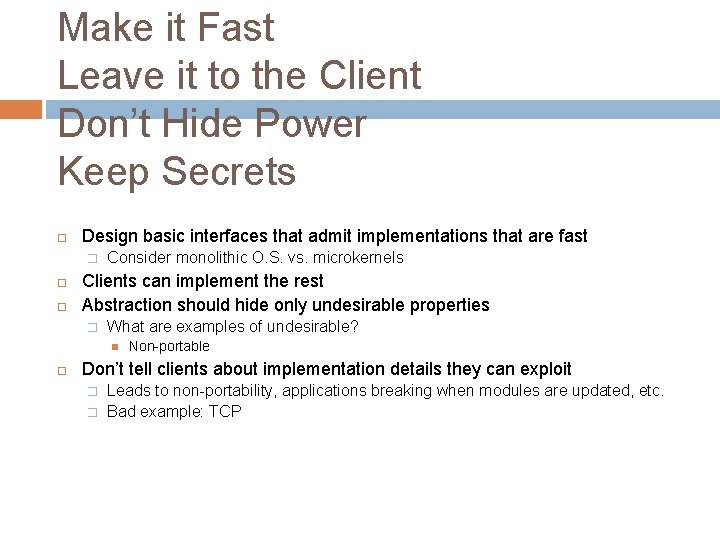
Make it Fast Leave it to the Client Don’t Hide Power Keep Secrets Design basic interfaces that admit implementations that are fast � Consider monolithic O. S. vs. microkernels Clients can implement the rest Abstraction should hide only undesirable properties � What are examples of undesirable? Non-portable Don’t tell clients about implementation details they can exploit � � Leads to non-portability, applications breaking when modules are updated, etc. Bad example: TCP
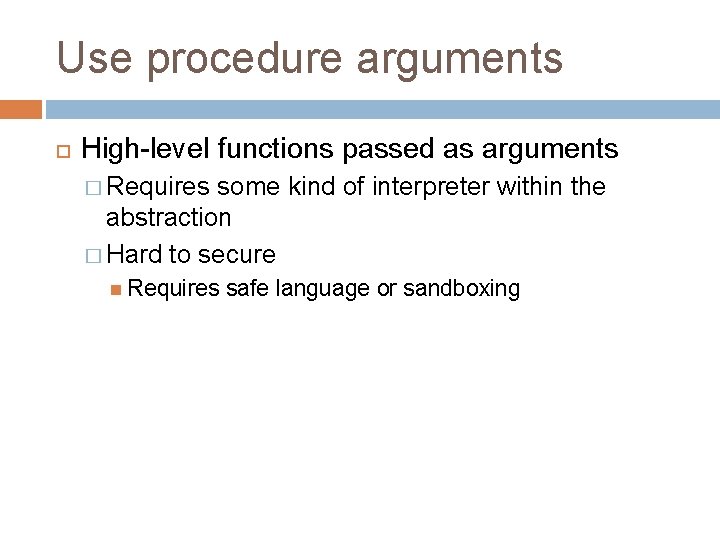
Use procedure arguments High-level functions passed as arguments � Requires some kind of interpreter within the abstraction � Hard to secure Requires safe language or sandboxing
Keep basic interfaces stable Keep a place to stand Ideally do not change interfaces � Extensions are ok If you have to change the interface, provide a backward compatibility option � Good example: Microsoft Windows
Plan to throw one away Use a good idea again Prototyping is often a good strategy in system design You end up building a series of prototypes The same good idea may be usable in multiple contexts Example: Unix developed this way, leading to Linux, Mac OS X, and several others
Divide and Conquer Several forms: � Recursion � Stepwise Refinement � Modularization Lampson only talks about recursion Stepwise refinement is a useful technique to contain complexity of systems Modules contain complexity � Principle Dijkstra) of “Separation of Concerns” (Edsger
Handle normal and worst case separately Use a highly optimized code path for normal case Just try to implement handling the worst case correctly Sometimes optimizing normal case hurts worst case performance! � And sometimes good worst case performance is more important than optimal normal case performance Example: normal case in TCP/IP highly optimized
SPEED Lampson talks mostly about making systems fast Other, perhaps more subtle considerations include � Predictable performance � Meeting service-level objectives � Cheap to run in terms of resources
Split resources Safety first Partitioning may result in better performance than sharing � but not always. . for example: a shared cache would result in better overall utilization typically than a partitioned cache but a partitioned cache may give more predictable performance to any particular user � most low-level resources these days tend to be shared… Prioritize safety over optimality
Static analysis Dynamic translation No, this is not a PL course If you know something about the workload, exploit it! � For example, workload might exhibit locality, periodicity, etc. � Related to “normal case” handling Prefetching allows I/O and compute to overlap Examples: paging and scheduling algorithms
Cache answers Use hints Caching answers to expensive computations trades storage for other resources (CPU, network, etc. ) � What does “expensive” mean in this context? “Hints” are typically caches of potentially wrong information � Example: DNS uses this extensively to provide scalability � Should be easy to check if hint works, and correct for it if not
When in doubt, use brute force Related idea: don’t optimize blindly 1. 2. 3. 4. build the system “stupidly” identify bottlenecks through profiling eliminate bottlenecks go back to Step 2 if necessary If the system is modular, such “adjustments” are typically easy to make � If not, difficult refactoring might be necessary � Related: building series of prototypes
Compute in background Use batch processing Shed load “Compute in background” essentially means to do I/O and compute in parallel � � Batching multiple small jobs into a larger one can significantly improve throughput � � examples: paging, GC, … in this day and age, we do everything in parallel… although often at the expense of latency example: TCP Avoid overload by admission control � example: TCP
Fault Tolerance We expect 24 x 7 x 365. 25 reliability these days In spite of what Lampson says, it’s pretty hard…
Log updates Make actions atomic or restartable Cheap: many storage devices optimal or optimized for append-only Useful: after a crash, state can be restored by replaying log � helps if updates are “idempotent” or restartable � example: ARIES “WAL” (Write-Ahead Log) Atomic (trans-)actions simplify reliable system design � group of low-level operations that either complete as a unit or have no effect Isolation and Durability are also very useful properties!
Concrete conclusions? Lessons Learned � Pose your problem in a clean way � Next decompose into large-scale components � Think about the common case that will determine performance: the critical path or the bottleneck points � Look for elegant ways to simultaneously offer structural clarity and yet still offer fantastic performance This can guide you towards very high-impact success
Next Time Read and write review: � The UNIX time-sharing system, Dennis M. Ritchie and Ken Thompson. Communications of the ACM Volume 17, Issue 7, July 1974, pages 365 – 375 http: //dl. acm. org/citation. cfm? id=361011. 361061 � The structure of the "THE"-multiprogramming system, E. W. Dijkstra. Communications of the ACM Volume 11, Issue 5, May 1968, pages 341— 346 http: //dl. acm. org/citation. cfm? id=363143 Need to be on campus, or use VPN to access some papers. Or, change ". acm. org/" to ". acm. org. proxy. library. cornell. edu/" in the URL Check website for updated schedule
Before Next time Rank-order papers to present Read first papers below and write review � The UNIX time-sharing system, Dennis M. Ritchie and Ken Thompson. Communications of the ACM Volume 17, Issue 7 (July 1974), pages 365 --375. � The structure of the "THE"-multiprogramming system, E. W. Dijkstra. Communications of the ACM Volume 11, Issue 5 (May 1968), pages 341 --346. Miniproject 0 � Using Amazon’s EC 2/S 3 infrastructure Check website for updated schedule