
By Mazen AlHakim M D SEIZURE MIMICS Seizure

By: Mazen Al-Hakim, M. D. SEIZURE MIMICS
Seizure Mimics * A-clinical: -Syncope -“Pseudo-seizures” -Sleep disturbances -Hyperventilation -Metabolic * B. EEG Misreading
Syncope 1 - Convulsive Syncope 2 - Eyes rolled back 3 - Staring 4 - Incontinence
Prodrome of Syncope Light-headed, blurred vision, pallor, sweating, nausea…
Seizure Prodrome Aura=Focal seizure �Usually temporal: déjà vu Jamais vu, rising sensation in abdomen, abnormal smell or taste
Landmark Study of Syncope by Lempert et al, 1994 -Myoclonus is common -Head turning, automatism, hallucinations
• Postictal is the most important • Syncope: No post-ictal encephalopathy low blood pressure • Seizure: Amnesia, confusion, lethargy, agitation High blood pressure, tongue biting
EEG in convulsive syncope Slow, then flat line No seizure
Pseudo seizures 30% of referral to video monitor for “intractable seizures”
Combination of Seizure and Pseudo seizure is uncommon Underlying psychopathology and emotional trauma including sexual abuse
Clinical signs Stop and go activity Out of phase Head turning right and left Nonclonic shaking Pelvic thrusting Opisthotonic posturing Vocalization: stuttering, weeping Preserved awareness during bilateral motor activity Ictal eye closure Pseudosyncope Postictal whispering No postictal encephalopathy
Another 30% patient referred for intractable epilepsy had EEG misread as epileptic
The most common pattern is: Nonspecific fluctuations of background in the temporal regions
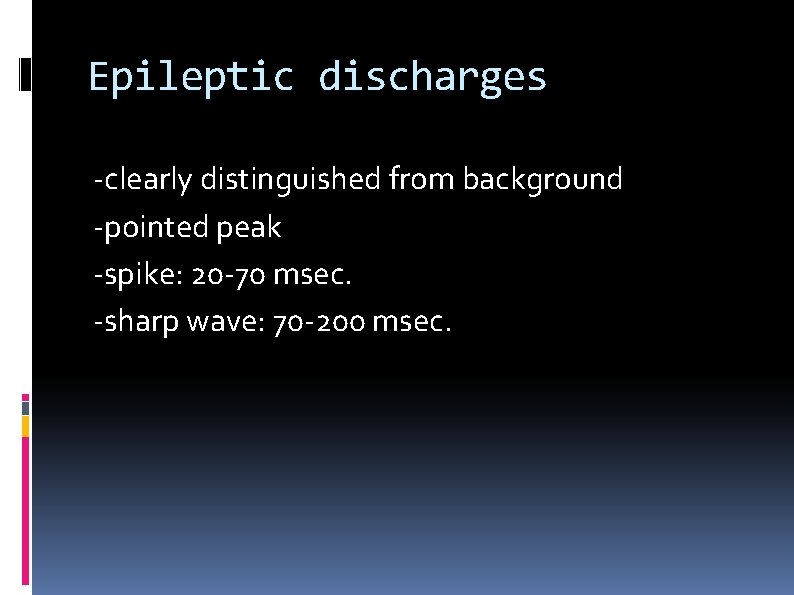
Epileptic discharges -clearly distinguished from background -pointed peak -spike: 20 -70 msec. -sharp wave: 70 -200 msec.
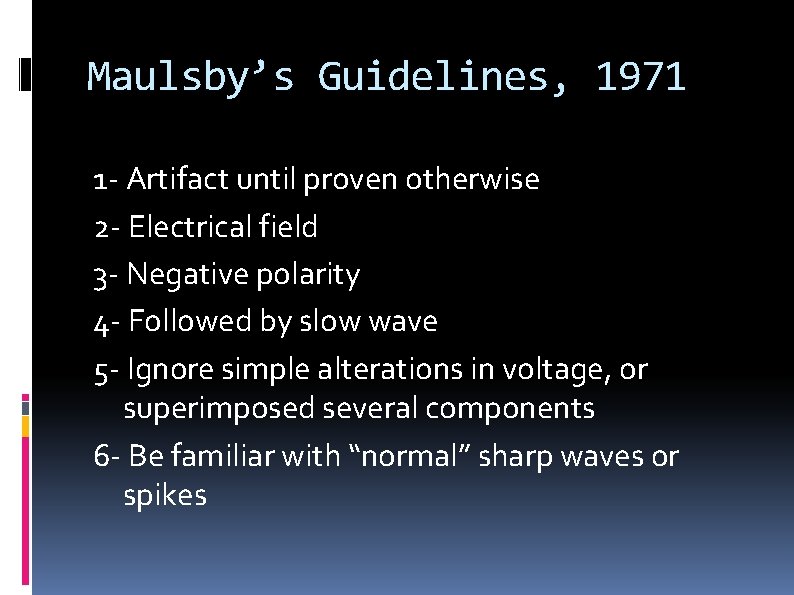
Maulsby’s Guidelines, 1971 1 - Artifact until proven otherwise 2 - Electrical field 3 - Negative polarity 4 - Followed by slow wave 5 - Ignore simple alterations in voltage, or superimposed several components 6 - Be familiar with “normal” sharp waves or spikes
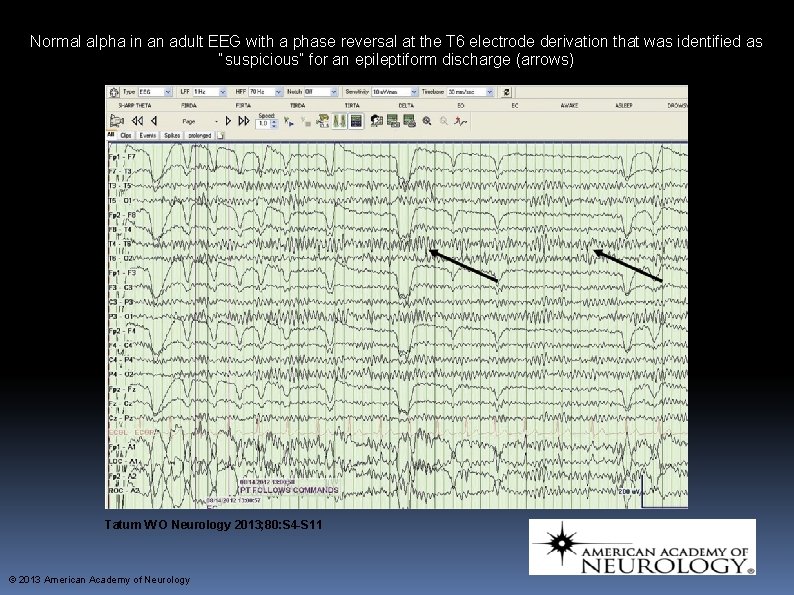
Normal alpha in an adult EEG with a phase reversal at the T 6 electrode derivation that was identified as “suspicious” for an epileptiform discharge (arrows). Tatum W O Neurology 2013; 80: S 4 -S 11 © 2013 American Academy of Neurology
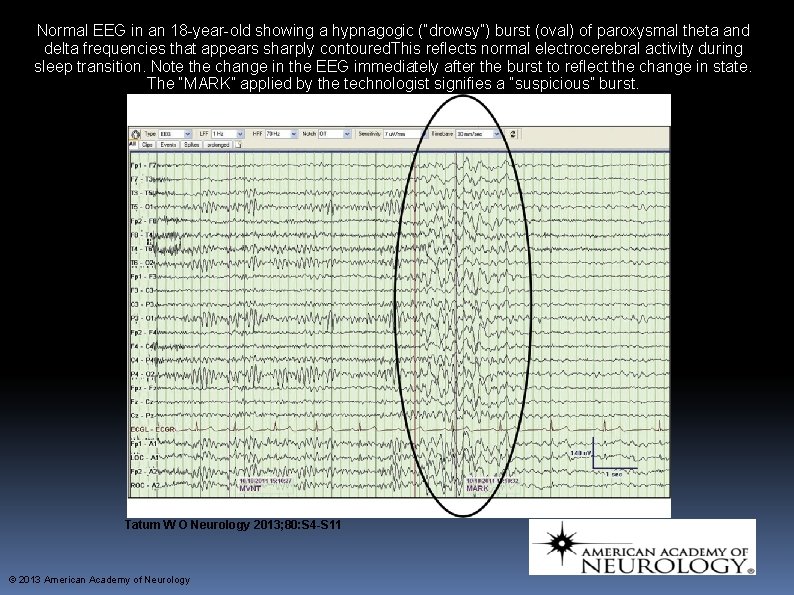
Normal EEG in an 18 -year-old showing a hypnagogic (“drowsy”) burst (oval) of paroxysmal theta and delta frequencies that appears sharply contoured. This reflects normal electrocerebral activity during sleep transition. Note the change in the EEG immediately after the burst to reflect the change in state. The “MARK” applied by the technologist signifies a “suspicious” burst. ars sleep transition. Tatum W O Neurology 2013; 80: S 4 -S 11 © 2013 American Academy of Neurology
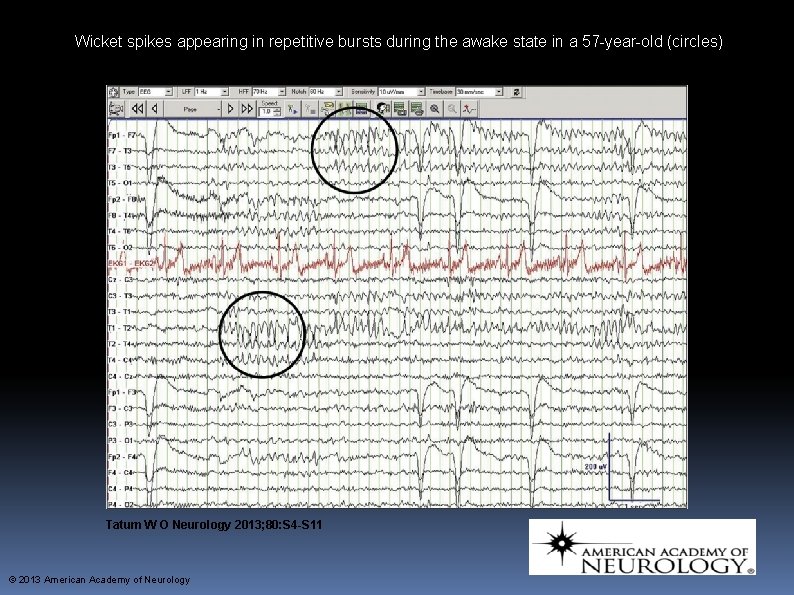
Wicket spikes appearing in repetitive bursts during the awake state in a 57 -year-old (circles). Tatum W O Neurology 2013; 80: S 4 -S 11 © 2013 American Academy of Neurology
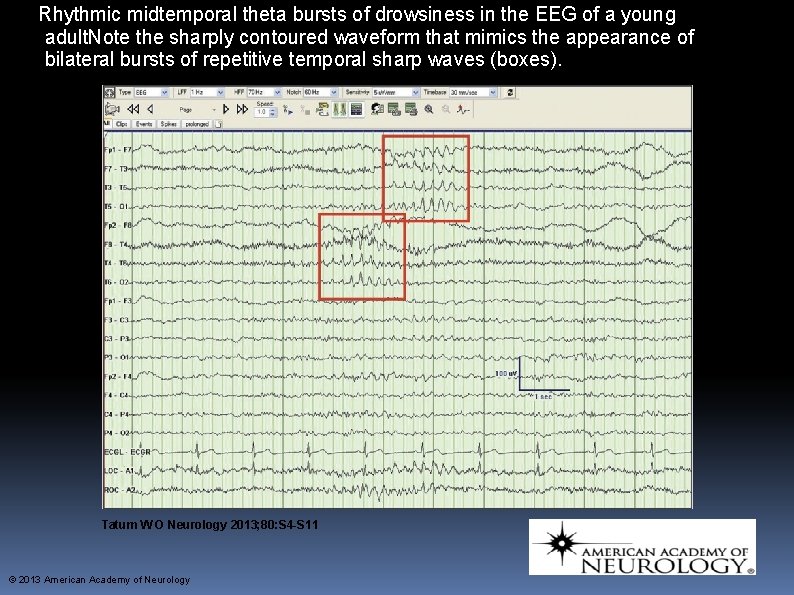
Rhythmic midtemporal theta bursts of drowsiness in the EEG of a young adult. Note the sharply contoured waveform that mimics the appearance of bilateral bursts of repetitive temporal sharp waves (boxes). Tatum W O Neurology 2013; 80: S 4 -S 11 © 2013 American Academy of Neurology
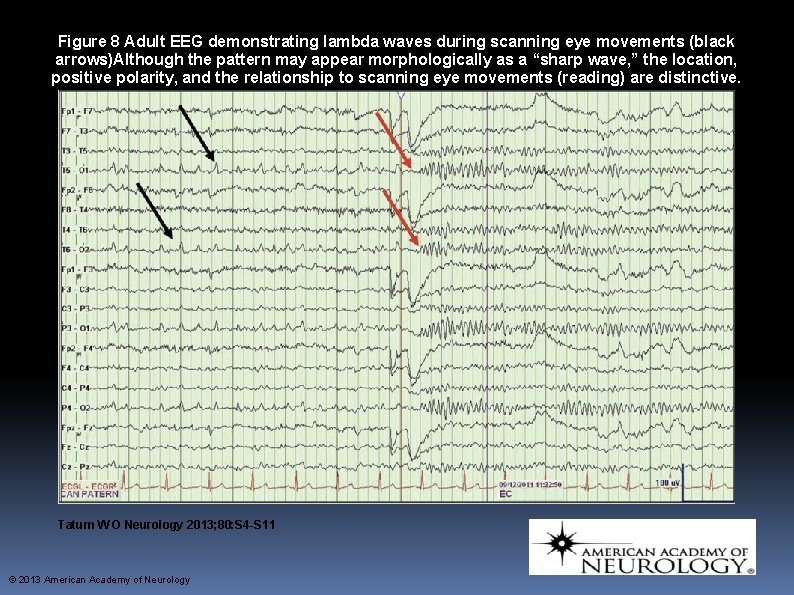
Figure 8 Adult EEG demonstrating lambda waves during scanning eye movements (black arrows)Although the pattern may appear morphologically as a “sharp wave, ” the location, positive polarity, and the relationship to scanning eye movements (reading) are distinctive. Tatum W O Neurology 2013; 80: S 4 -S 11 © 2013 American Academy of Neurology
- Slides: 20