CS 3410 Computer System Organization and Programming Hakim
- Slides: 45
CS 3410: Computer System Organization and Programming Hakim Weatherspoon Spring 2012 Computer Science Cornell University
Computer System Organization • The most amazing and likely to be most long-lived invention of the 1800’s was… © Hakim Weatherspoon, Computer Science, Cornell University
Computer Organization • The most amazing and likely to be most long-lived invention of the 1800’s was… – (a) The steam engine? – (b) The lightning rod? – (c) The carbonated beverage? – (d) All of the above – (e) None © Hakim Weatherspoon, Computer Science, Cornell University
Computer Organization • The most amazing and likely to be most long-lived invention of the 1800’s was… THE ELECTRIC SWITCH © Hakim Weatherspoon, Computer Science, Cornell University
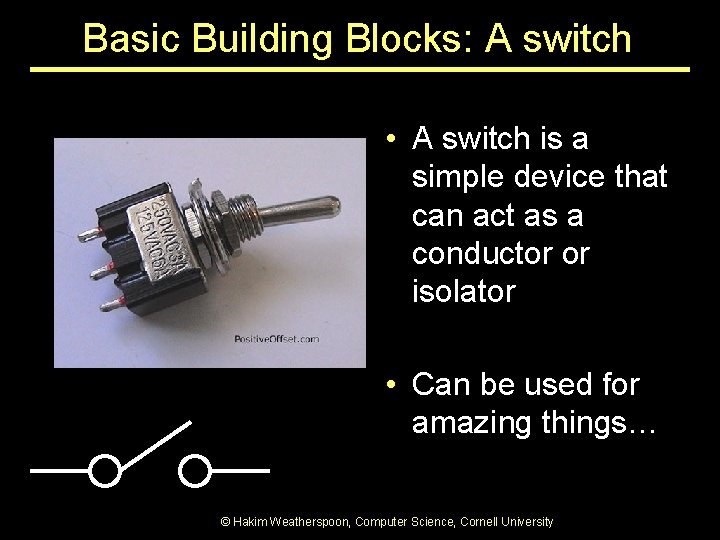
Basic Building Blocks: A switch • A switch is a simple device that can act as a conductor or isolator • Can be used for amazing things… © Hakim Weatherspoon, Computer Science, Cornell University
In what language do computers think? • • • (a) Java (b) C/C++ (c) Matlab (c) Python (d) Binary Digits © Hakim Weatherspoon, Computer Science, Cornell University
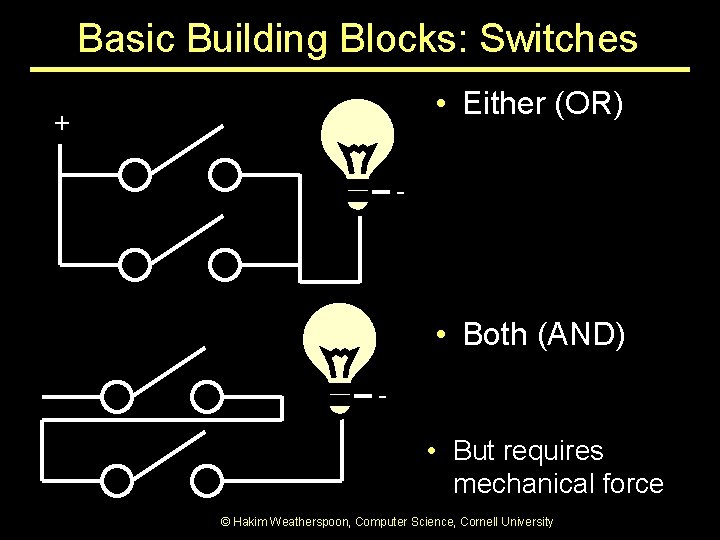
Basic Building Blocks: Switches • Either (OR) + - • Both (AND) - • But requires mechanical force © Hakim Weatherspoon, Computer Science, Cornell University
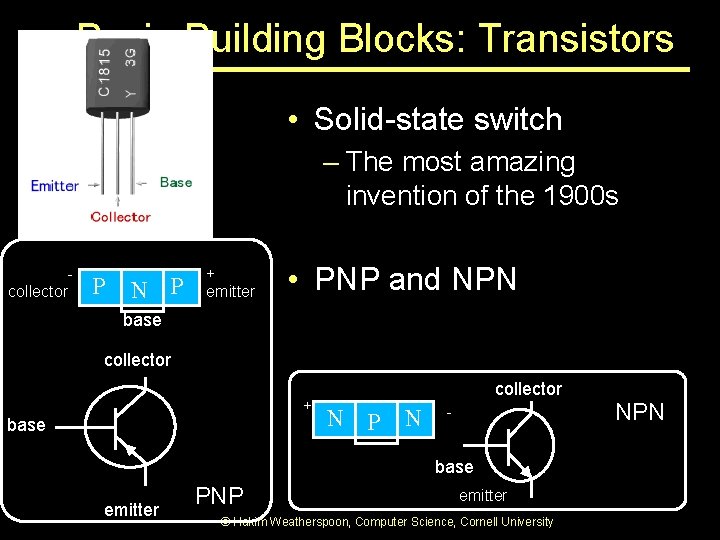
Basic Building Blocks: Transistors • Solid-state switch – The most amazing invention of the 1900 s collector P N P + emitter • PNP and NPN base collector + base collector N P N - base emitter PNP emitter © Hakim Weatherspoon, Computer Science, Cornell University NPN
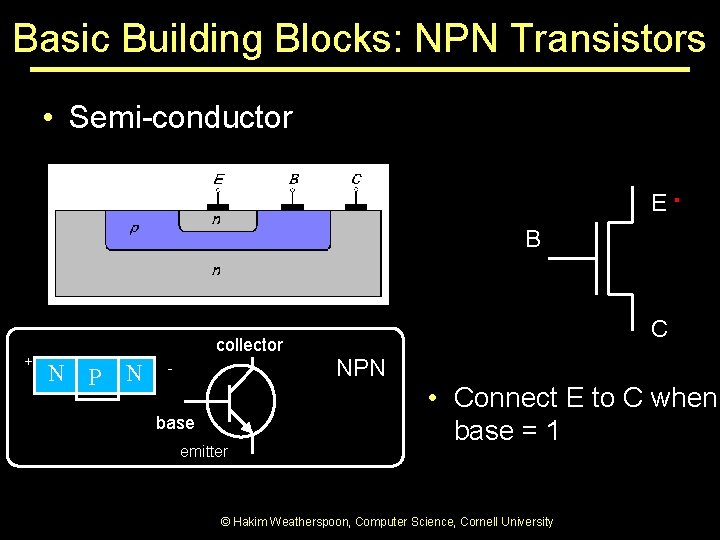
Basic Building Blocks: NPN Transistors • Semi-conductor E B + collector N P N - base emitter C NPN • Connect E to C when base = 1 © Hakim Weatherspoon, Computer Science, Cornell University
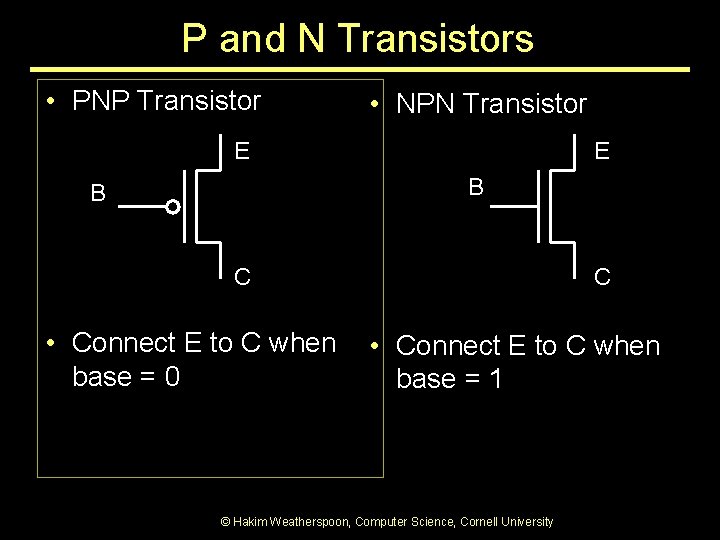
P and N Transistors • PNP Transistor • NPN Transistor E E B B C • Connect E to C when base = 0 C • Connect E to C when base = 1 © Hakim Weatherspoon, Computer Science, Cornell University
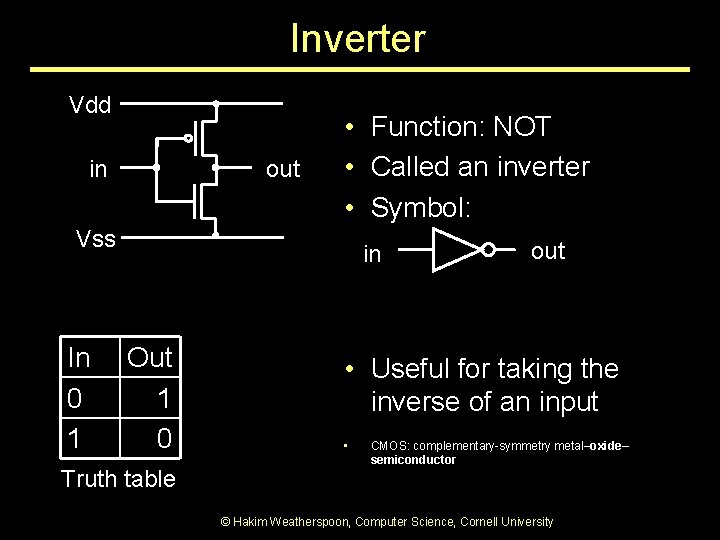
Inverter Vdd in out • Function: NOT • Called an inverter • Symbol: Vss In 0 1 in Out 1 0 Truth table out • Useful for taking the inverse of an input • CMOS: complementary-symmetry metal–oxide– semiconductor © Hakim Weatherspoon, Computer Science, Cornell University
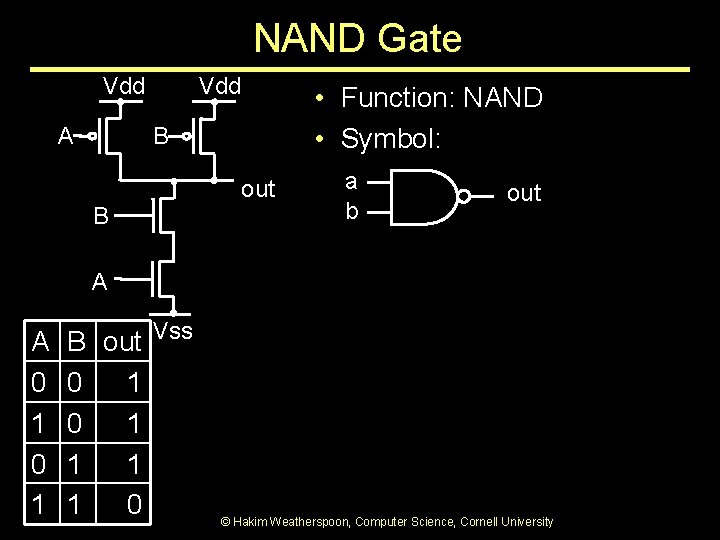
NAND Gate Vdd A Vdd B out B • Function: NAND • Symbol: a b out A A 0 1 B out Vss 0 1 1 1 1 0 © Hakim Weatherspoon, Computer Science, Cornell University
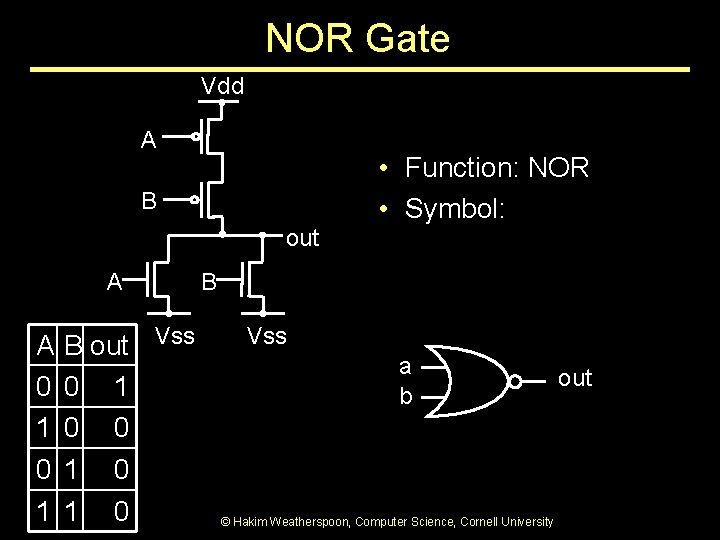
NOR Gate Vdd A • Function: NOR • Symbol: B out A A 0 1 B out Vss 0 1 0 1 0 B Vss a b © Hakim Weatherspoon, Computer Science, Cornell University out
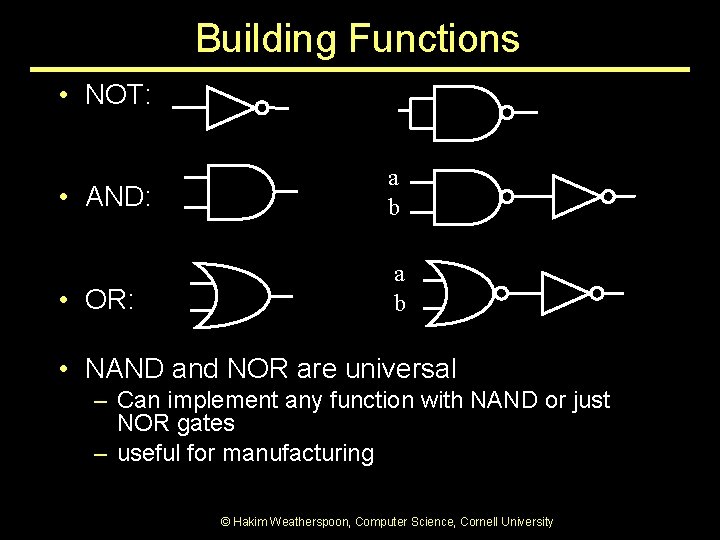
Building Functions • NOT: • AND: a b • OR: a b • NAND and NOR are universal – Can implement any function with NAND or just NOR gates – useful for manufacturing © Hakim Weatherspoon, Computer Science, Cornell University
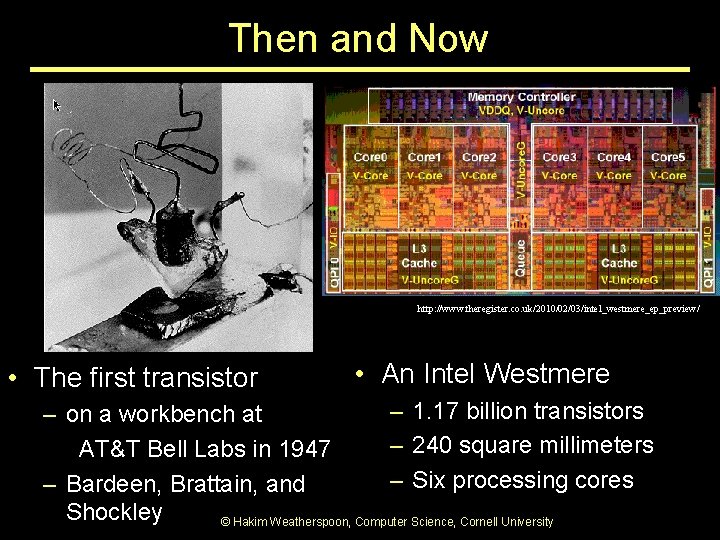
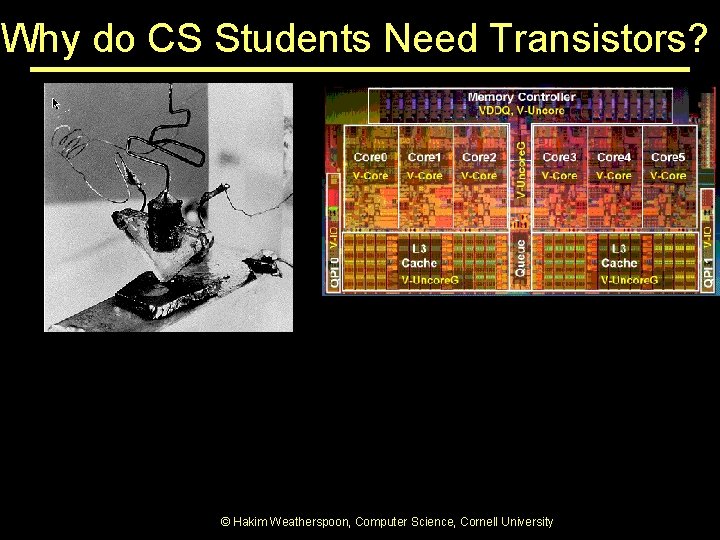
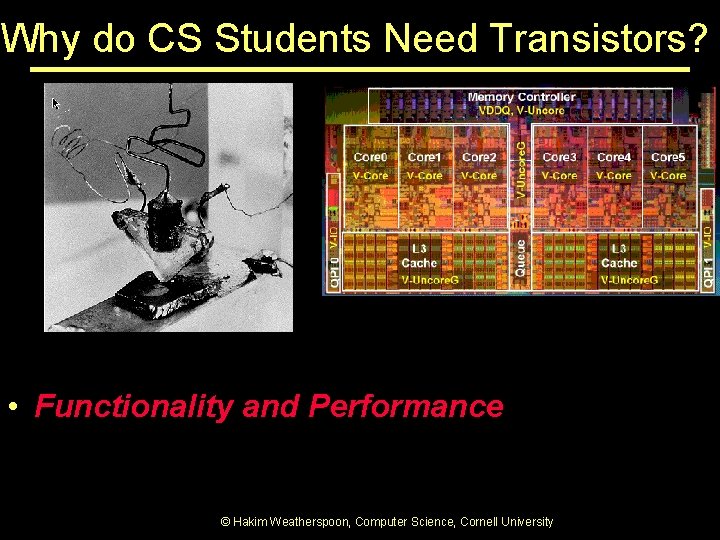
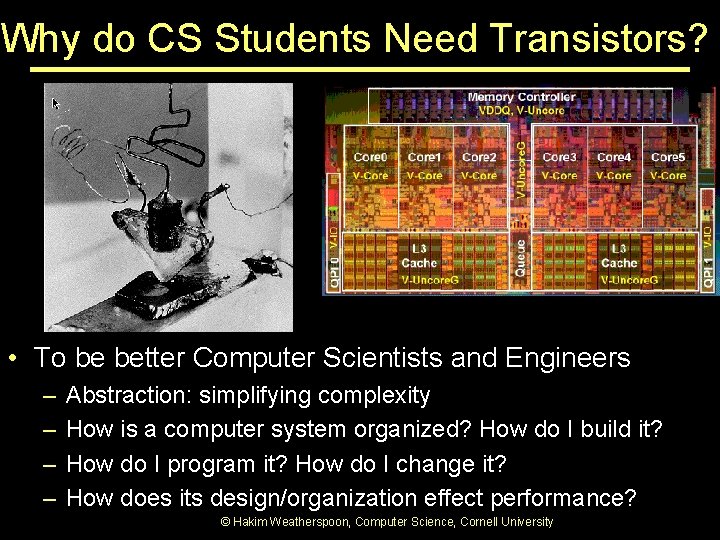
Then and Now http: //www. theregister. co. uk/2010/02/03/intel_westmere_ep_preview/ • The first transistor • An Intel Westmere – 1. 17 billion transistors – on a workbench at – 240 square millimeters AT&T Bell Labs in 1947 – Six processing cores – Bardeen, Brattain, and Shockley © Hakim Weatherspoon, Computer Science, Cornell University
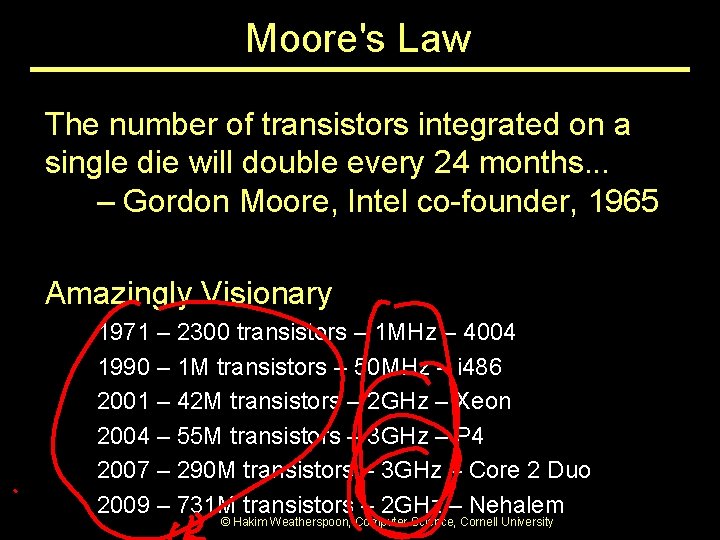
Moore's Law The number of transistors integrated on a single die will double every 24 months. . . – Gordon Moore, Intel co-founder, 1965 Amazingly Visionary 1971 – 2300 transistors – 1 MHz – 4004 1990 – 1 M transistors – 50 MHz – i 486 2001 – 42 M transistors – 2 GHz – Xeon 2004 – 55 M transistors – 3 GHz – P 4 2007 – 290 M transistors – 3 GHz – Core 2 Duo 2009 – 731 M transistors – 2 GHz – Nehalem © Hakim Weatherspoon, Computer Science, Cornell University
Course Objective • Bridge the gap between hardware and software – How a processor works – How a computer is organized • Establish a foundation for building higherlevel applications – How to understand program performance – How to understand where the world is going © Hakim Weatherspoon, Computer Science, Cornell University
Announcements: How class organized • Instructor: Hakim Weatherspoon (hweather@cs. cornell. edu) • Lecture: – Tu/Th 1: 25 -2: 40 – Hollister B 14 • Lab Sections: – Carpenter 235 (Red Room) © Hakim Weatherspoon, Computer Science, Cornell University
Who am I? • Prof. Hakim Weatherspoon – (Hakim means Doctor, wise, or prof. in Arabic) – Background in Education § Undergraduate University of Washington • Played Varsity Football – Some teammates collectively make $100’s of millions – I teach!!! § Graduate University of California, Berkeley • Some class mates collectively make $100’s of millions • I teach!!! – Background in Operating Systems § Peer-to-Peer Storage • Antiquity project - Secure wide-area distributed system • Ocean. Store project – Store your data for 1000 years § Network overlays • Bamboo and Tapestry – Find your data around globe § Tiny OS • Early adopter in 1999, but ultimately chose P 2 P direction © Hakim Weatherspoon, Computer Science, Cornell University
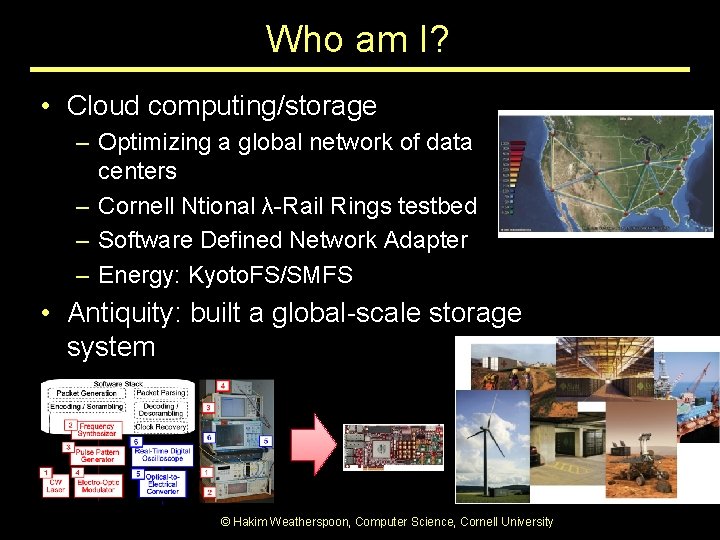
Who am I? • Cloud computing/storage – Optimizing a global network of data centers – Cornell Ntional λ-Rail Rings testbed – Software Defined Network Adapter – Energy: Kyoto. FS/SMFS • Antiquity: built a global-scale storage system © Hakim Weatherspoon, Computer Science, Cornell University
Course Staff • cs 3410 -staff-l@cs. cornell. edu • Lecture/Homwork TA’s – Colin Ponce – Anish Ghulati – Ming Pan • Lab TAs – Han Wang – Zhefu Jiang (cponce@cs. cornell. edu) (ag 795@cornell. edu) (mp 492@cornell. edu) (lead) (hwang@cs. cornell. edu) (zj 46@cs. cornell. edu) (lead) • Lab Undergraduate consultants – – – Doo San Baik (db 478@cornell. edu) Erluo Li (el 378@cornell. edu) Jason Zhao (jlz 27@cornell. edu) Peter Tseng (pht 24@cornell. edu) Roman Averbukh (raa 89@cornell. edu) Scott Franklin (sdf 47@cornell. edu) (lead) Administrative Assistant: – Randy Hess (rbhess@cs. cornell. edu) © Hakim Weatherspoon, Computer Science, Cornell University
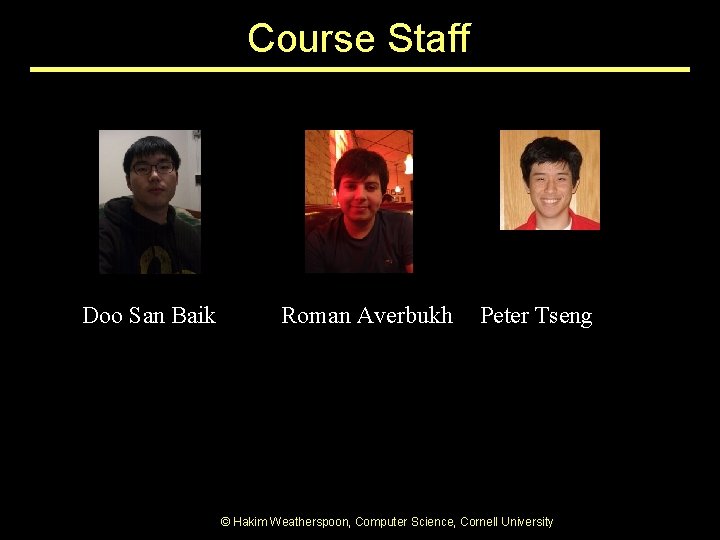
Course Staff Doo San Baik Roman Averbukh Peter Tseng © Hakim Weatherspoon, Computer Science, Cornell University
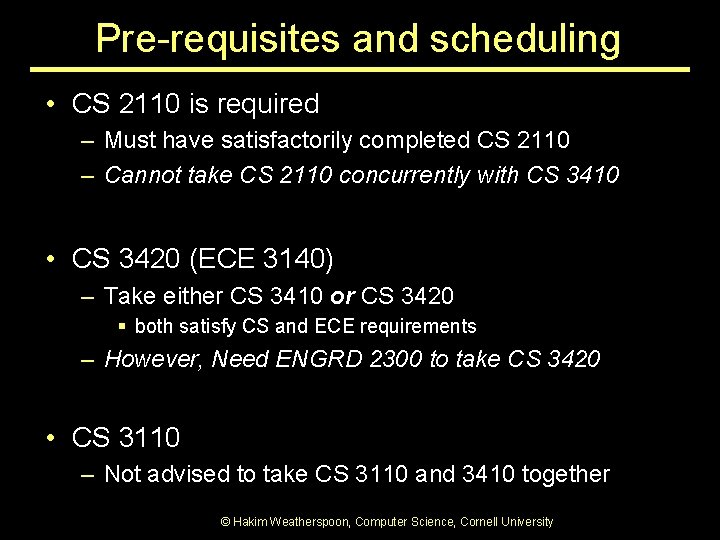
Pre-requisites and scheduling • CS 2110 is required – Must have satisfactorily completed CS 2110 – Cannot take CS 2110 concurrently with CS 3410 • CS 3420 (ECE 3140) – Take either CS 3410 or CS 3420 § both satisfy CS and ECE requirements – However, Need ENGRD 2300 to take CS 3420 • CS 3110 – Not advised to take CS 3110 and 3410 together © Hakim Weatherspoon, Computer Science, Cornell University
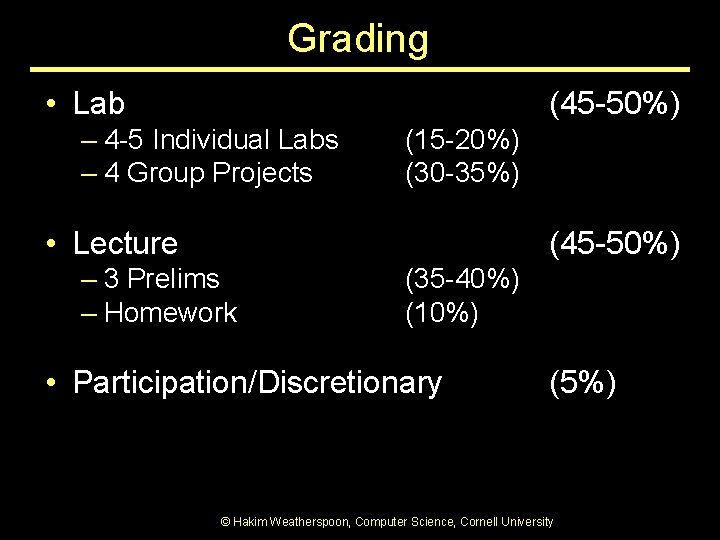
Grading • Lab (45 -50%) – 4 -5 Individual Labs – 4 Group Projects (15 -20%) (30 -35%) • Lecture (45 -50%) – 3 Prelims – Homework (35 -40%) (10%) • Participation/Discretionary (5%) © Hakim Weatherspoon, Computer Science, Cornell University
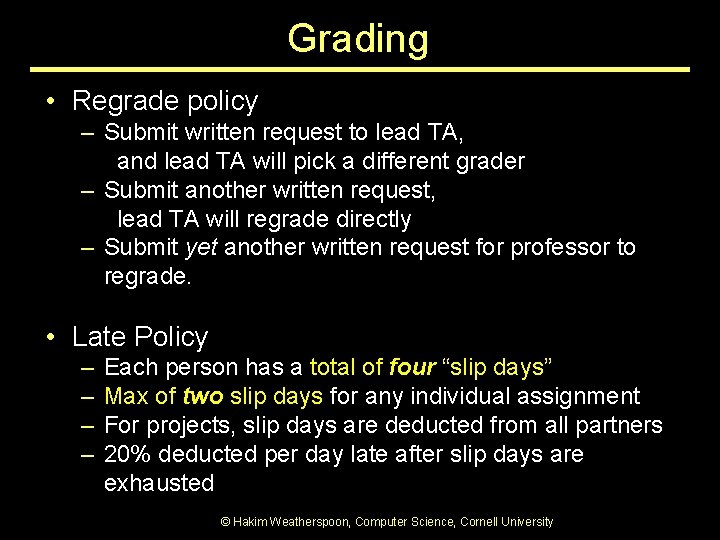
Grading • Regrade policy – Submit written request to lead TA, and lead TA will pick a different grader – Submit another written request, lead TA will regrade directly – Submit yet another written request for professor to regrade. • Late Policy – – Each person has a total of four “slip days” Max of two slip days for any individual assignment For projects, slip days are deducted from all partners 20% deducted per day late after slip days are exhausted © Hakim Weatherspoon, Computer Science, Cornell University
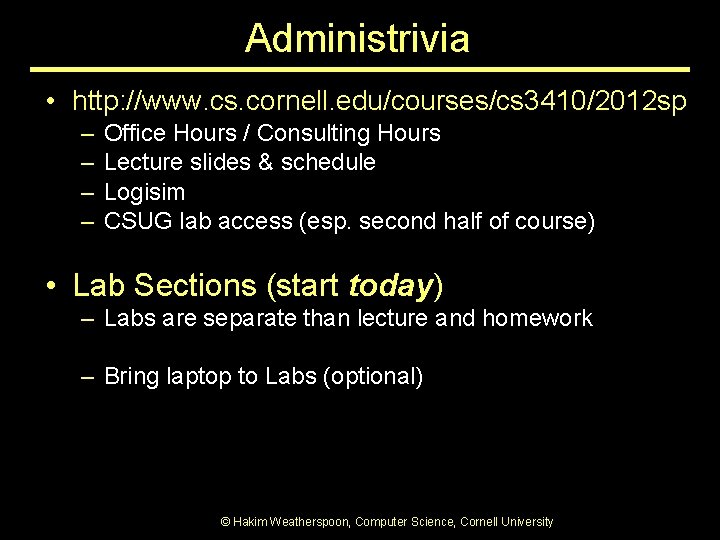
Administrivia • http: //www. cs. cornell. edu/courses/cs 3410/2012 sp – – Office Hours / Consulting Hours Lecture slides & schedule Logisim CSUG lab access (esp. second half of course) • Lab Sections (start today) – Labs are separate than lecture and homework – Bring laptop to Labs (optional) © Hakim Weatherspoon, Computer Science, Cornell University
Communication • Email – cs 3410 -staff-l@cs. cornell. edu – The email alias goes to me and the TAs, not to whole class • Assignments – CMS: http: //cms. csuglab. cornell. edu • Newsgroup – http: //www. piazza. com/cornell/spring 2012/cs 3410 – For students • i. Clicker – http: //atcsupport. cit. cornell. edu/pollsrvc/ © Hakim Weatherspoon, Computer Science, Cornell University
Lab Sections & Projects • Lab Sections start this week – Intro to logisim and building an adder • Labs Assignments – Individual – One week to finish (usually Monday to Monday) • Projects – two-person teams – Find partner in same section © Hakim Weatherspoon, Computer Science, Cornell University
Academic Integrity • All submitted work must be your own – OK to study together, but do not share soln’s – Cite your sources • Project groups submit joint work – Same rules apply to projects at the group level – Cannot use of someone else’s soln • Closed-book exams, no calculators • Stressed? Tempted? Lost? • Come see me before due date! Plagiarism in any form will not be tolerated © Hakim Weatherspoon, Computer Science, Cornell University
Why do CS Students Need Transistors? © Hakim Weatherspoon, Computer Science, Cornell University
Why do CS Students Need Transistors? • Functionality and Performance © Hakim Weatherspoon, Computer Science, Cornell University
Why do CS Students Need Transistors? • To be better Computer Scientists and Engineers – – Abstraction: simplifying complexity How is a computer system organized? How do I build it? How do I program it? How do I change it? How does its design/organization effect performance? © Hakim Weatherspoon, Computer Science, Cornell University
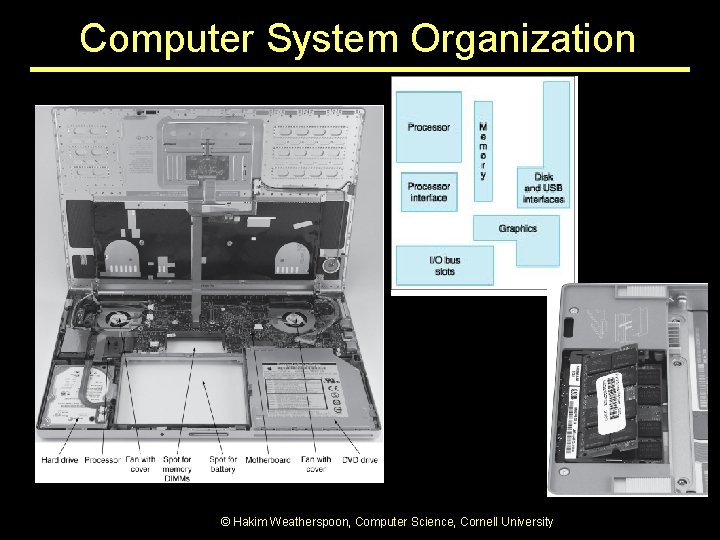
Computer System Organization © Hakim Weatherspoon, Computer Science, Cornell University
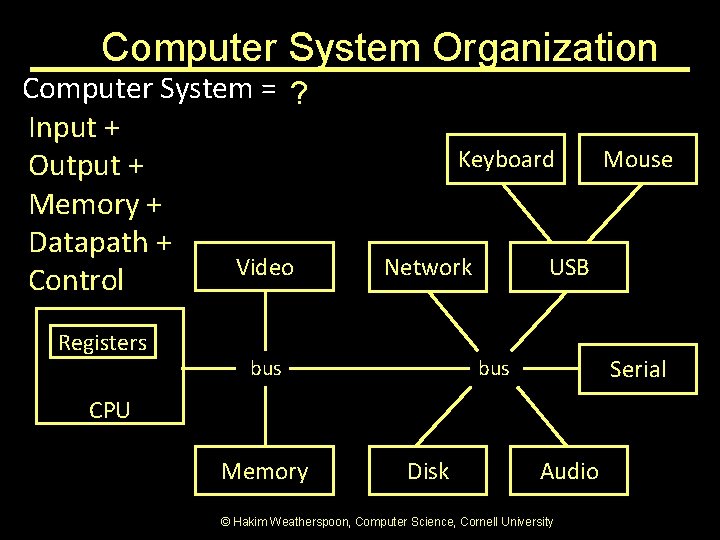
Computer System Organization Computer System = ? Input + Output + Memory + Datapath + Video Control Registers Keyboard Network bus USB Serial bus CPU Memory Disk Mouse Audio © Hakim Weatherspoon, Computer Science, Cornell University
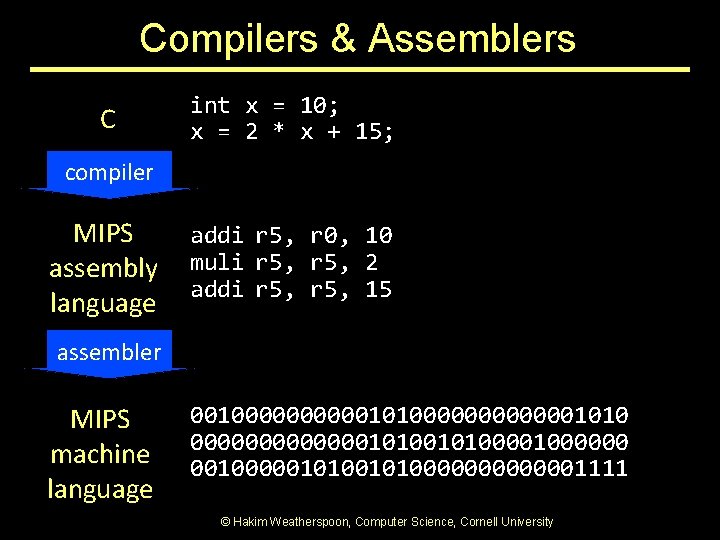
Compilers & Assemblers C int x = 10; x = 2 * x + 15; compiler MIPS assembly language addi r 5, r 0, 10 muli r 5, 2 addi r 5, 15 assembler MIPS machine language 001000001010000001010 000000010100001000000 001000001010000001111 © Hakim Weatherspoon, Computer Science, Cornell University
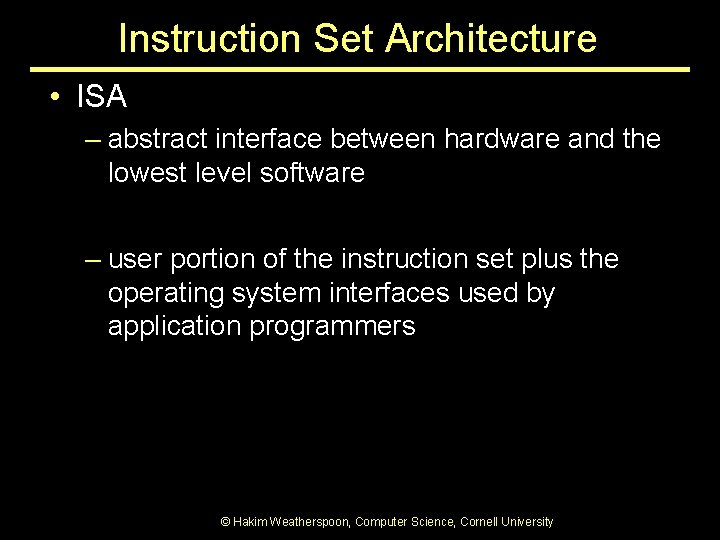
Instruction Set Architecture • ISA – abstract interface between hardware and the lowest level software – user portion of the instruction set plus the operating system interfaces used by application programmers © Hakim Weatherspoon, Computer Science, Cornell University
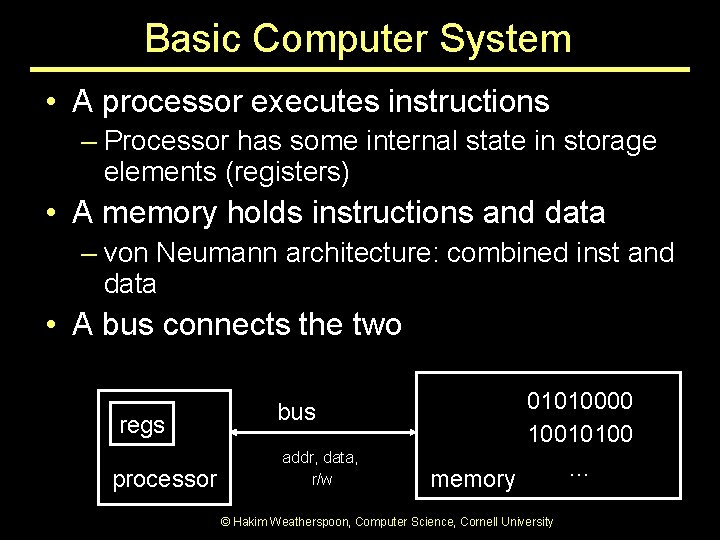
Basic Computer System • A processor executes instructions – Processor has some internal state in storage elements (registers) • A memory holds instructions and data – von Neumann architecture: combined inst and data • A bus connects the two regs processor bus addr, data, r/w 01010000 10010100 … memory © Hakim Weatherspoon, Computer Science, Cornell University
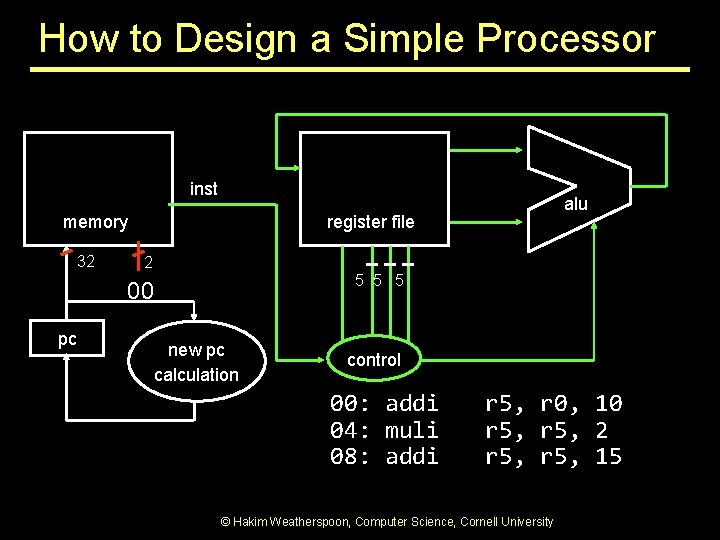
How to Design a Simple Processor inst memory 32 register file 2 5 5 5 00 pc alu new pc calculation control 00: addi 04: muli 08: addi r 5, r 0, 10 r 5, 2 r 5, 15 © Hakim Weatherspoon, Computer Science, Cornell University
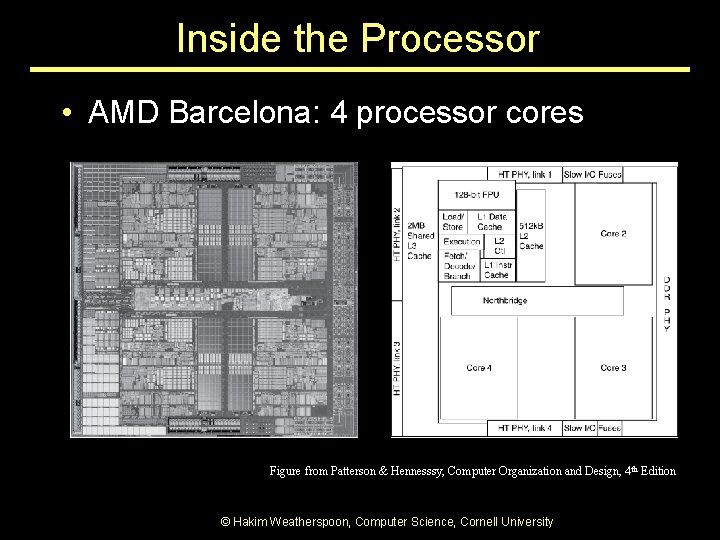
Inside the Processor • AMD Barcelona: 4 processor cores Figure from Patterson & Hennesssy, Computer Organization and Design, 4 th Edition © Hakim Weatherspoon, Computer Science, Cornell University
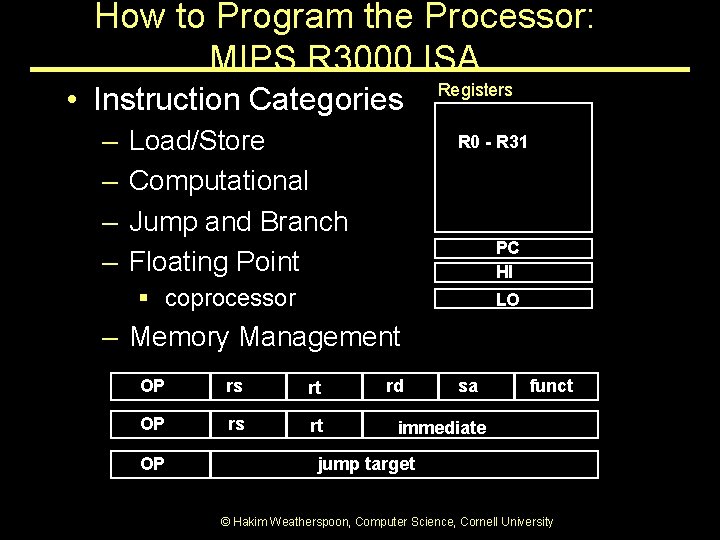
How to Program the Processor: MIPS R 3000 ISA • Instruction Categories – – Load/Store Computational Jump and Branch Floating Point Registers R 0 - R 31 PC HI § coprocessor LO – Memory Management OP rs rt OP rd sa funct immediate jump target © Hakim Weatherspoon, Computer Science, Cornell University
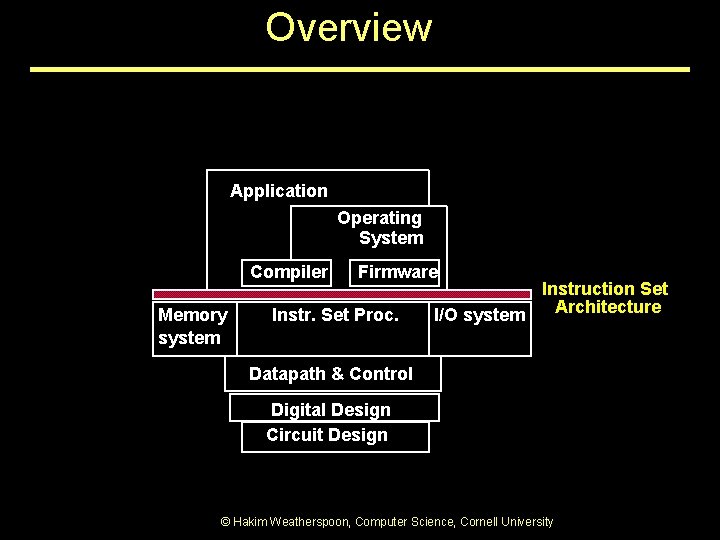
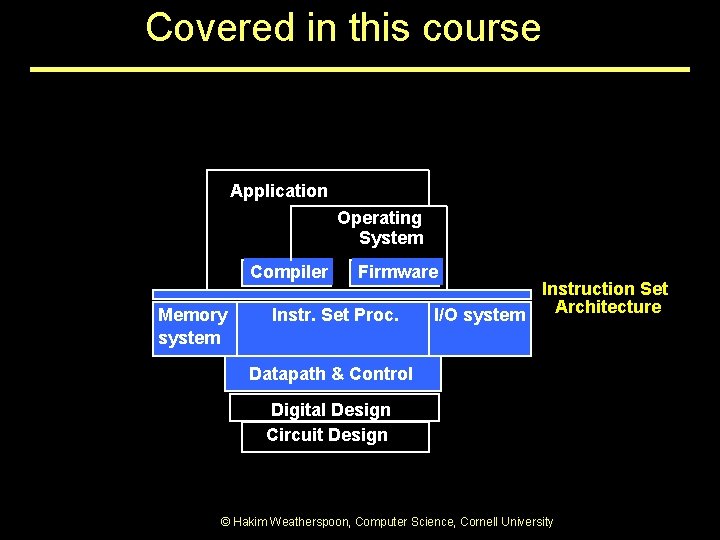
Overview Application Operating System Compiler Memory system Firmware Instr. Set Proc. Instruction Set Architecture I/O system Datapath & Control Digital Design Circuit Design © Hakim Weatherspoon, Computer Science, Cornell University
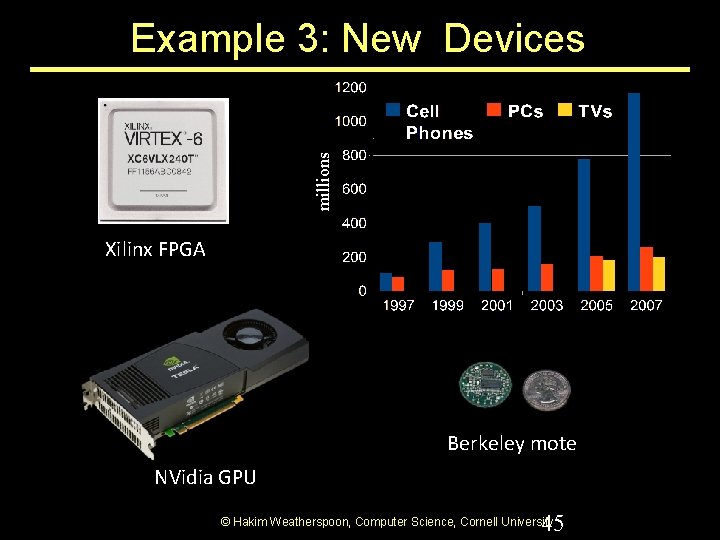
Applications • Everything these days! – Phones, cars, televisions, games, computers, … © Hakim Weatherspoon, Computer Science, Cornell University
millions Example 3: New Devices Xilinx FPGA Berkeley mote NVidia GPU 45 © Hakim Weatherspoon, Computer Science, Cornell University
Covered in this course Application Operating System Compiler Memory system Firmware Instr. Set Proc. Instruction Set Architecture I/O system Datapath & Control Digital Design Circuit Design © Hakim Weatherspoon, Computer Science, Cornell University
Reflect Why take this course? Basic knowledge needed for all other areas of CS: operating systems, compilers, . . . Levels are not independent hardware design ↔ software design ↔ performance Crossing boundaries is hard but important device drivers Good design techniques abstraction, layering, pipelining, parallel vs. serial, . . . Understand where the world is going © Hakim Weatherspoon, Computer Science, Cornell University