CS 295 Info Quality Entity Resolution University of
- Slides: 43
CS 295: Info Quality & Entity Resolution University of California, Irvine Fall 2010 Course introduction slides Instructor: Dmitri V. Kalashnikov Copyright © Dmitri V. Kalashnikov, 2010
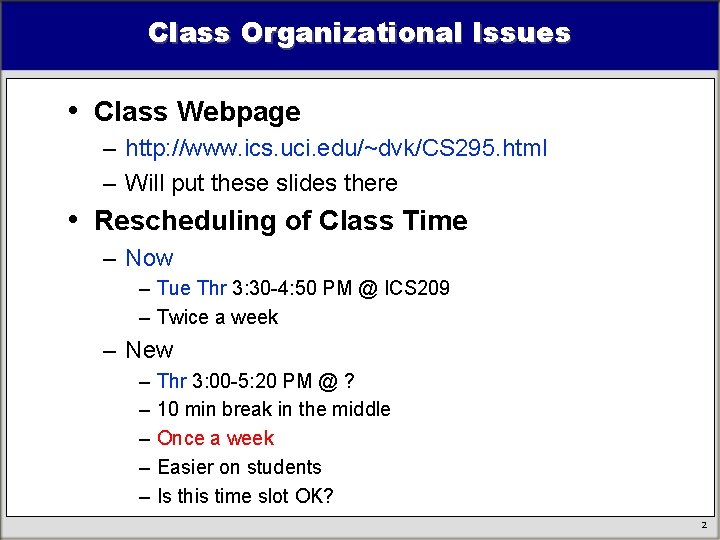
Class Organizational Issues • Class Webpage – http: //www. ics. uci. edu/~dvk/CS 295. html – Will put these slides there • Rescheduling of Class Time – Now – Tue Thr 3: 30 -4: 50 PM @ ICS 209 – Twice a week – New – – – Thr 3: 00 -5: 20 PM @ ? 10 min break in the middle Once a week Easier on students Is this time slot OK? 2
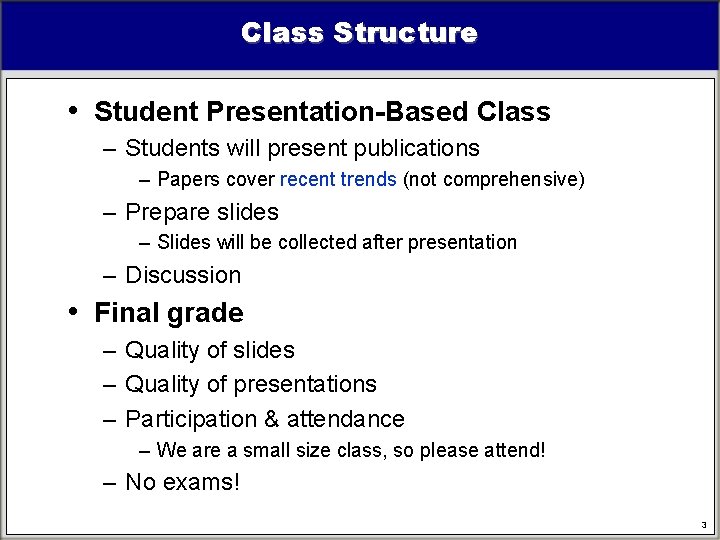
Class Structure • Student Presentation-Based Class – Students will present publications – Papers cover recent trends (not comprehensive) – Prepare slides – Slides will be collected after presentation – Discussion • Final grade – Quality of slides – Quality of presentations – Participation & attendance – We are a small size class, so please attend! – No exams! 3
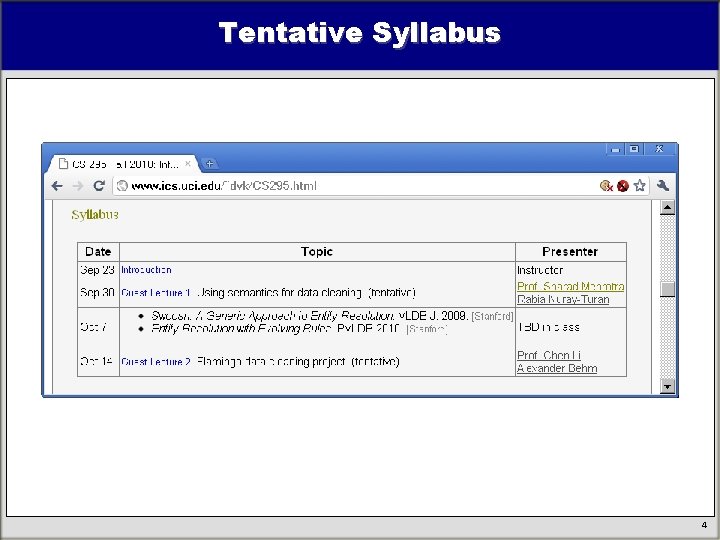
Tentative Syllabus 4
Presentation • Topics – All papers are split into “topics” – Covering a topic on a day • Student Presentations – Each student will choose a day/topic to present – A student presents only during 1 day in quarter! – If it is possible – To reduce workload – A student will present 2(? ) papers on that day – Please start preparing early! 5
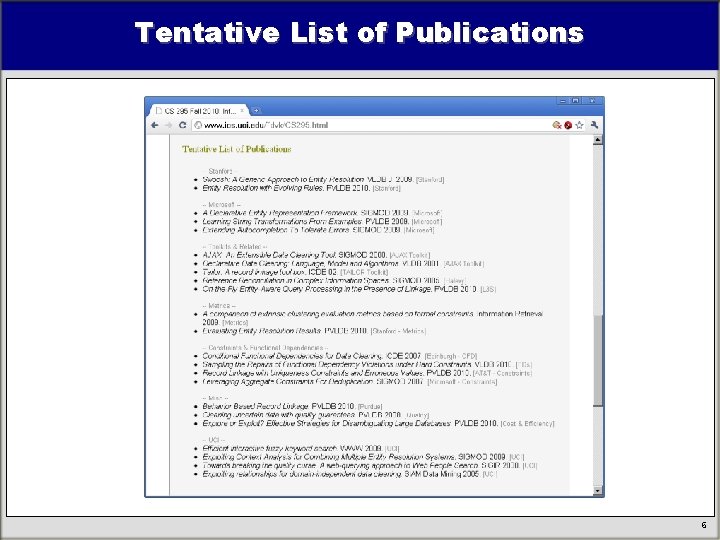
Tentative List of Publications 6
How to present a paper • Present “high-level” idea – Main idea of the paper [should be clear] • Present technical depth of techniques 1) Cover techniques in detail 2) Try to analyze the paper [if you can] – Discuss what you like about the paper – Criticize the technique – Do you see flaws/weaknesses in the proposed methodology? – Do you think the techniques can be improved? – Do you think authors should have included additional info/algo? • Present experiments – Explain datasets/setup/graphs (analyze results) – Criticize experiments [if you can] – Large enough data? More experiments needed? Unexplained trends? etc 7
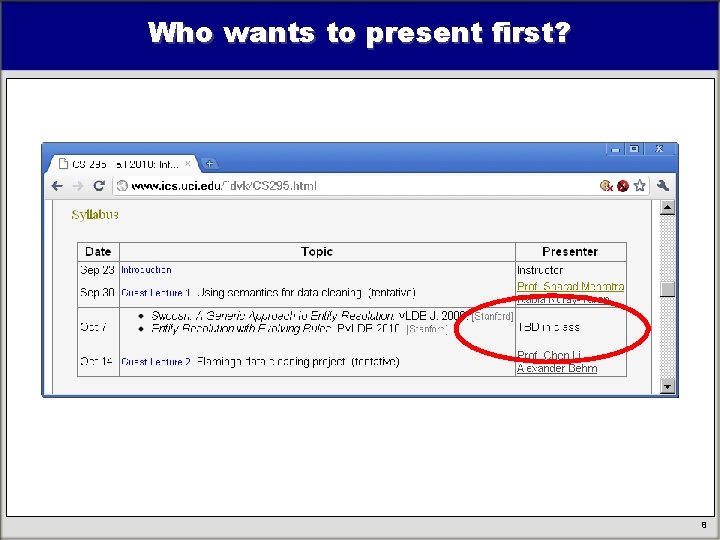
Who wants to present first? 8
Talk Overview • Class Organizational issues ØIntro to Data Quality & Entity Resolution 9
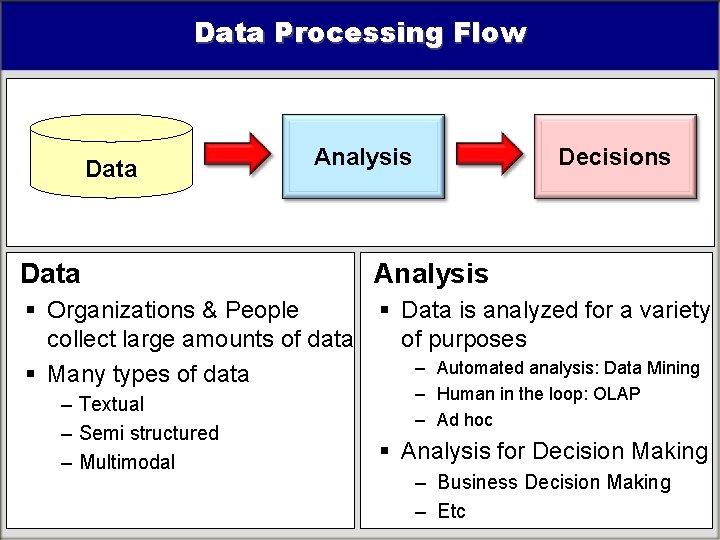
Data Processing Flow Data Analysis Decisions Data Analysis § Organizations & People collect large amounts of data § Many types of data § Data is analyzed for a variety of purposes – Textual – Semi structured – Multimodal – Automated analysis: Data Mining – Human in the loop: OLAP – Ad hoc § Analysis for Decision Making – Business Decision Making – Etc 10
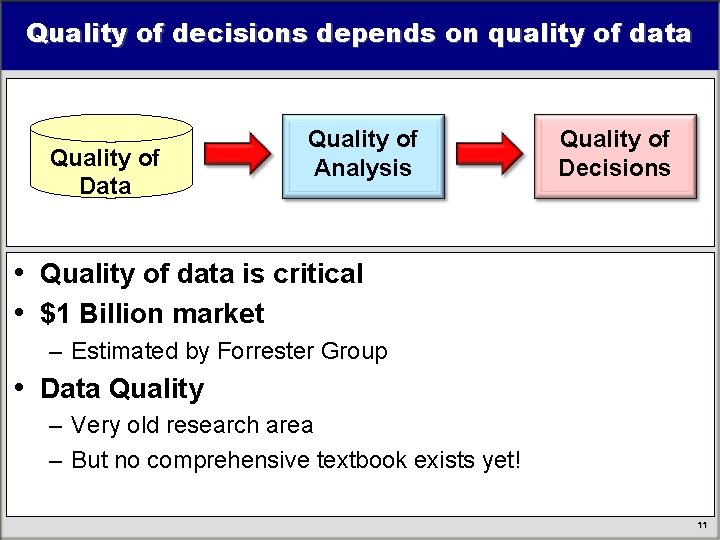
Quality of decisions depends on quality of data Quality of Data Quality of Analysis Quality of Decisions • Quality of data is critical • $1 Billion market – Estimated by Forrester Group • Data Quality – Very old research area – But no comprehensive textbook exists yet! 11
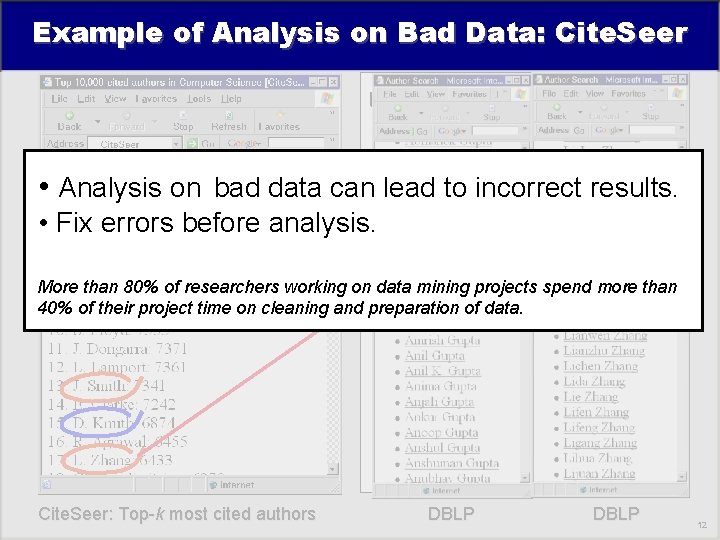
Example of Analysis on Bad Data: Cite. Seer Unexpected Entries – Lets check two people in DBLP • Analysis on bad data can – “A. Gupta” – “L. to Zhang” lead incorrect results. • Fix errors before analysis. More than 80% of researchers working on data mining projects spend more than 40% of their project time on cleaning and preparation of data. Cite. Seer: Top-k most cited authors DBLP 12
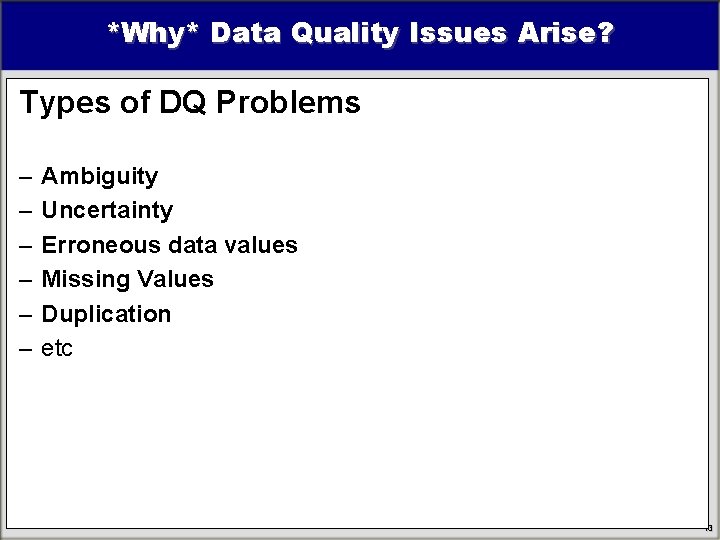
*Why* Data Quality Issues Arise? Types of DQ Problems – – – Ambiguity Uncertainty Erroneous data values Missing Values Duplication etc 13
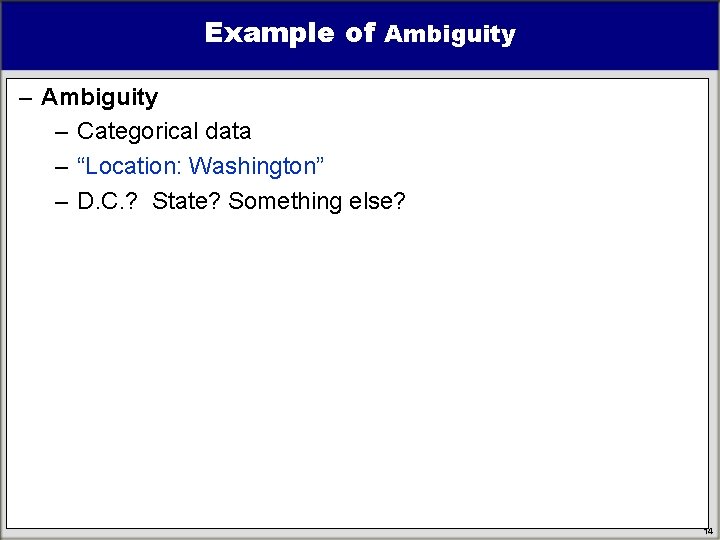
Example of Ambiguity – Categorical data – “Location: Washington” – D. C. ? State? Something else? 14
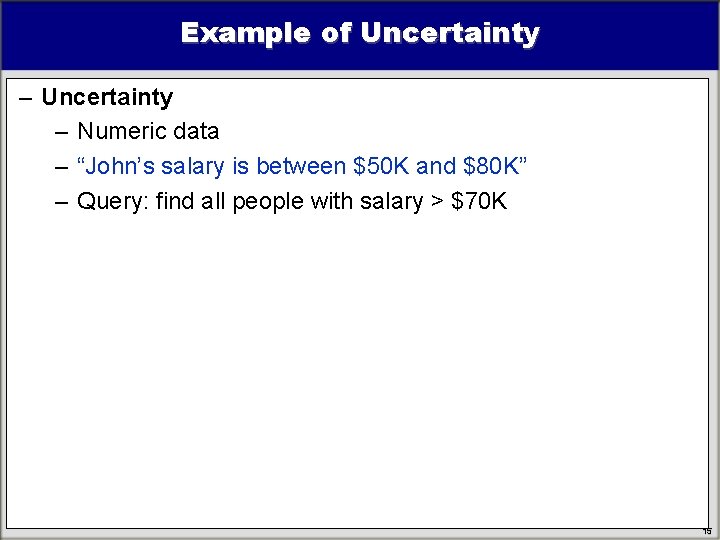
Example of Uncertainty – Numeric data – “John’s salary is between $50 K and $80 K” – Query: find all people with salary > $70 K 15
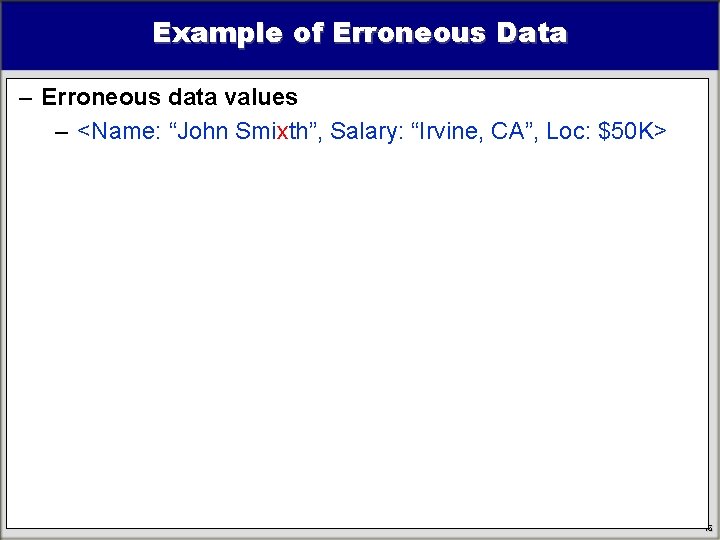
Example of Erroneous Data – Erroneous data values – <Name: “John Smixth”, Salary: “Irvine, CA”, Loc: $50 K> 16
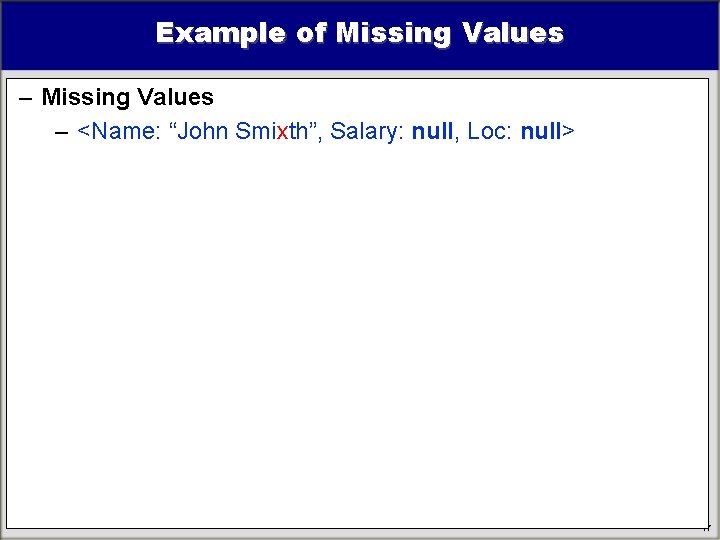
Example of Missing Values – <Name: “John Smixth”, Salary: null, Loc: null> 17
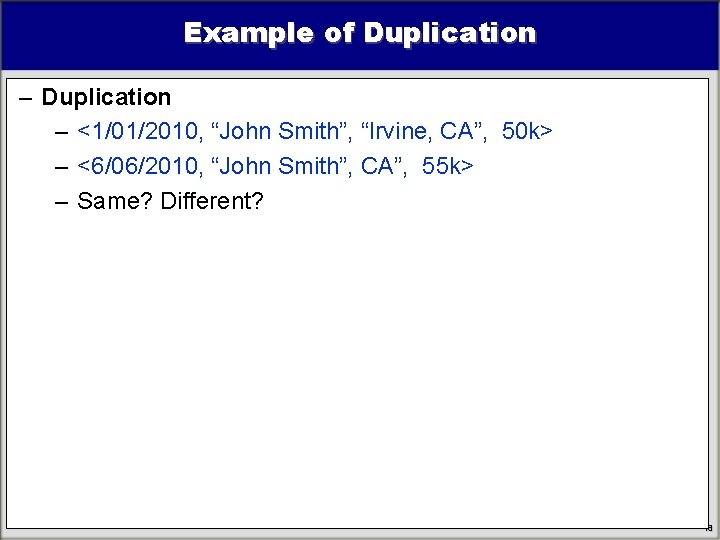
Example of Duplication – <1/01/2010, “John Smith”, “Irvine, CA”, 50 k> – <6/06/2010, “John Smith”, CA”, 55 k> – Same? Different? 18
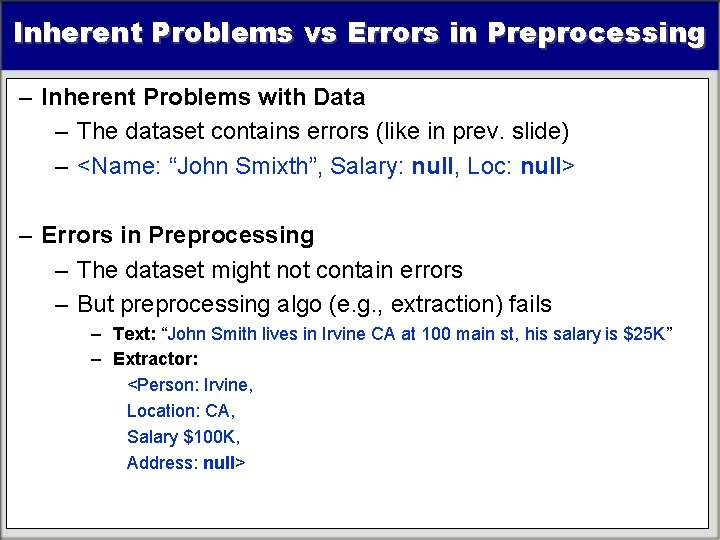
Inherent Problems vs Errors in Preprocessing – Inherent Problems with Data – The dataset contains errors (like in prev. slide) – <Name: “John Smixth”, Salary: null, Loc: null> – Errors in Preprocessing – The dataset might not contain errors – But preprocessing algo (e. g. , extraction) fails – Text: “John Smith lives in Irvine CA at 100 main st, his salary is $25 K” – Extractor: <Person: Irvine, Location: CA, Salary $100 K, Address: null>
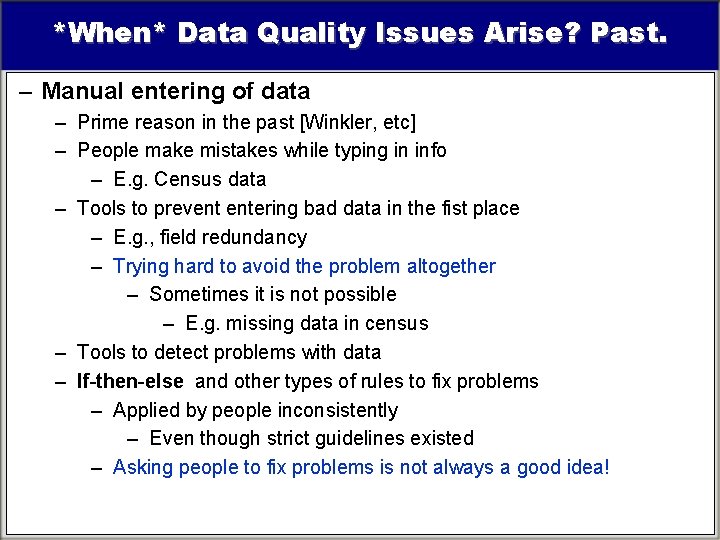
*When* Data Quality Issues Arise? Past. – Manual entering of data – Prime reason in the past [Winkler, etc] – People make mistakes while typing in info – E. g. Census data – Tools to prevent entering bad data in the fist place – E. g. , field redundancy – Trying hard to avoid the problem altogether – Sometimes it is not possible – E. g. missing data in census – Tools to detect problems with data – If-then-else and other types of rules to fix problems – Applied by people inconsistently – Even though strict guidelines existed – Asking people to fix problems is not always a good idea! 20
*When* DQ Issues Arise? Present. – Automated generation of DB content – Prime reason for DQ issues nowadays – Analyzing unstructured or semi-structured raw data – Text / Web – Extraction – Merging DBs or Data sources – Duplicate information – Inconsistent information – Missing data – Inherent problems with well structured data – As in the shown examples 21
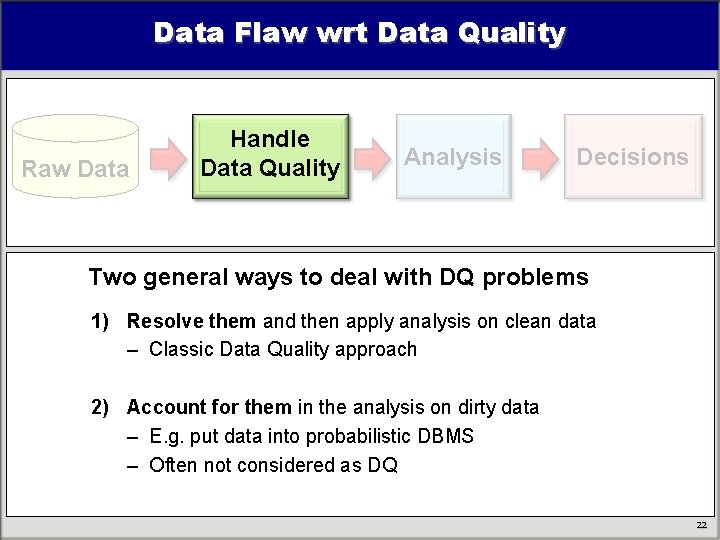
Data Flaw wrt Data Quality Raw Data Handle Data Quality Analysis Decisions Two general ways to deal with DQ problems 1) Resolve them and then apply analysis on clean data – Classic Data Quality approach 2) Account for them in the analysis on dirty data – E. g. put data into probabilistic DBMS – Often not considered as DQ 22
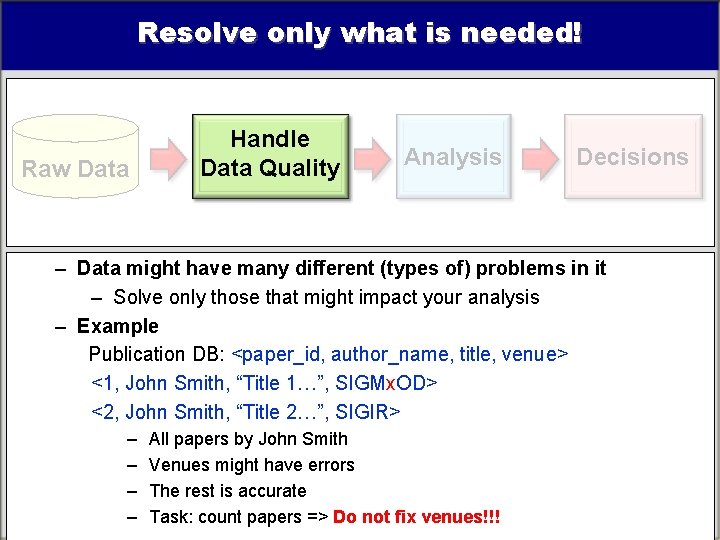
Resolve only what is needed! Raw Data Handle Data Quality Analysis Decisions – Data might have many different (types of) problems in it – Solve only those that might impact your analysis – Example Publication DB: <paper_id, author_name, title, venue> <1, John Smith, “Title 1…”, SIGMx. OD> <2, John Smith, “Title 2…”, SIGIR> – – All papers by John Smith Venues might have errors The rest is accurate Task: count papers => Do not fix venues!!! 23
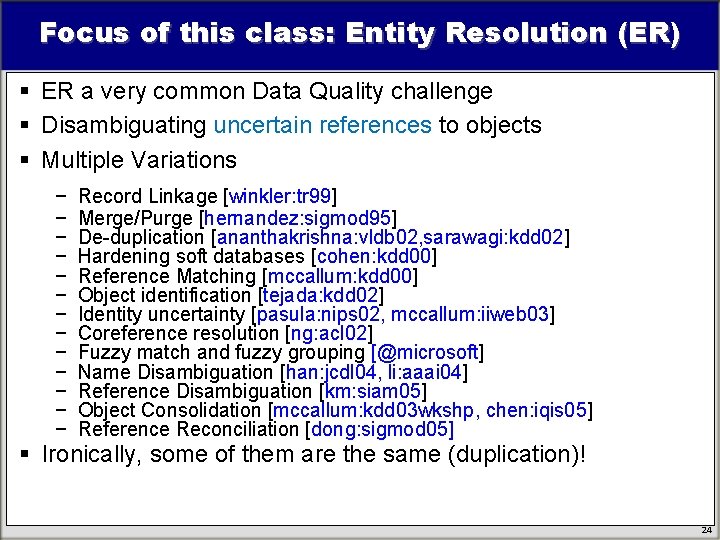
Focus of this class: Entity Resolution (ER) § ER a very common Data Quality challenge § Disambiguating uncertain references to objects § Multiple Variations − − − − Record Linkage [winkler: tr 99] Merge/Purge [hernandez: sigmod 95] De-duplication [ananthakrishna: vldb 02, sarawagi: kdd 02] Hardening soft databases [cohen: kdd 00] Reference Matching [mccallum: kdd 00] Object identification [tejada: kdd 02] Identity uncertainty [pasula: nips 02, mccallum: iiweb 03] Coreference resolution [ng: acl 02] Fuzzy match and fuzzy grouping [@microsoft] Name Disambiguation [han: jcdl 04, li: aaai 04] Reference Disambiguation [km: siam 05] Object Consolidation [mccallum: kdd 03 wkshp, chen: iqis 05] Reference Reconciliation [dong: sigmod 05] § Ironically, some of them are the same (duplication)! 24
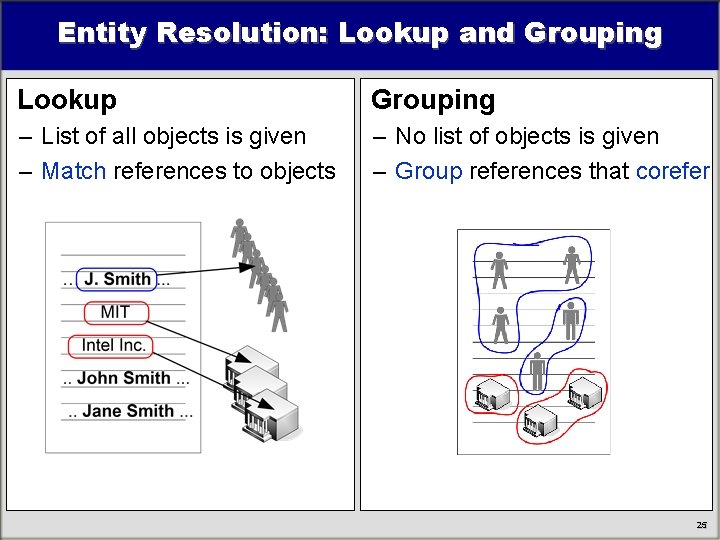
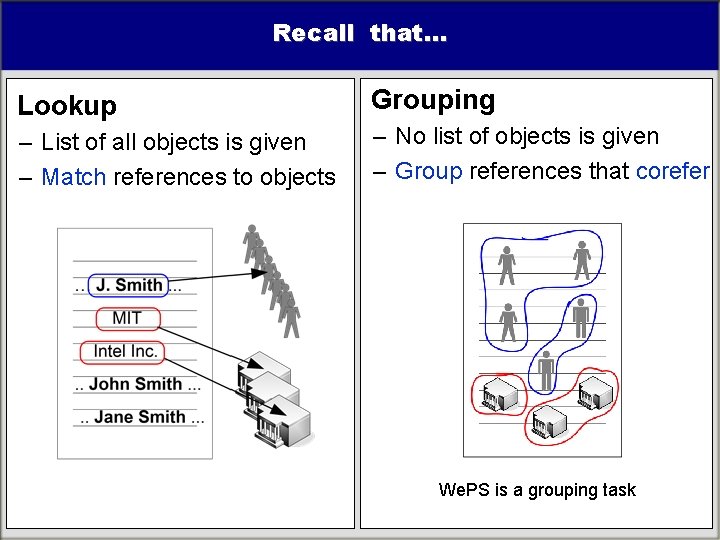
Entity Resolution: Lookup and Grouping Lookup Grouping – List of all objects is given – Match references to objects – No list of objects is given – Group references that corefer 25
When ER challenge arises? § Merging multiple data sources (even structured) – “J. Smith” in Data. Base 1 – “John Smith” in Data. Base 2 – Do they co-refer? § References to people/objects/organization in raw data – Who is “J. Smith” mentioned as an author of a publication? § Location ambiguity – “Washington” (D. C. ? WA? Other? ) § Automated extraction from text – “He’s got his Ph. D/BS from UCSD and UCLA respectively. ” – Ph. D: UCSD or UCLA? § Natural Language Processing (NLP) − “John met Jim and then he went to school” − “he”: John or Jim? 26 26
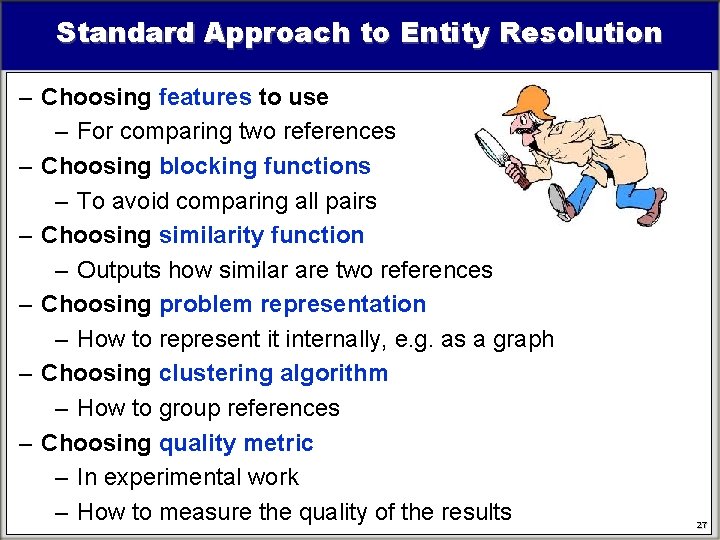
Standard Approach to Entity Resolution – Choosing features to use – For comparing two references – Choosing blocking functions – To avoid comparing all pairs – Choosing similarity function – Outputs how similar are two references – Choosing problem representation – How to represent it internally, e. g. as a graph – Choosing clustering algorithm – How to group references – Choosing quality metric – In experimental work – How to measure the quality of the results 27
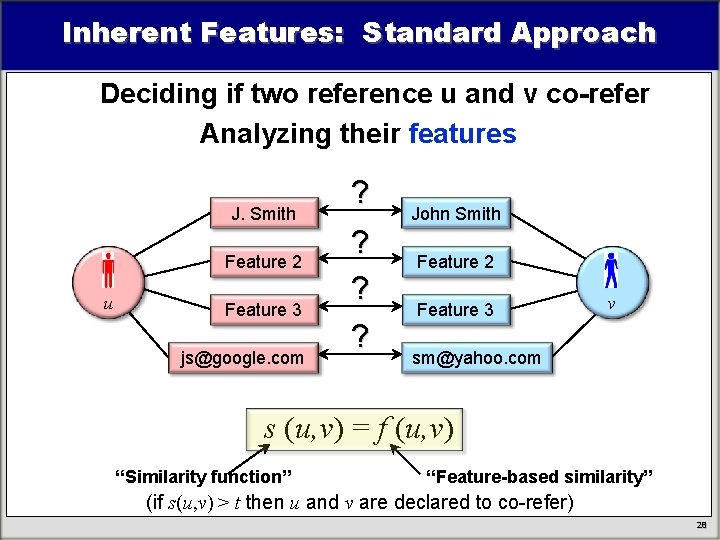
Inherent Features: Standard Approach Deciding if two reference u and v co-refer Analyzing their features J. Smith Feature 2 u Feature 3 js@google. com ? ? John Smith Feature 2 Feature 3 v sm@yahoo. com s (u, v) = f (u, v) “Similarity function” “Feature-based similarity” (if s(u, v) > t then u and v are declared to co-refer) 28
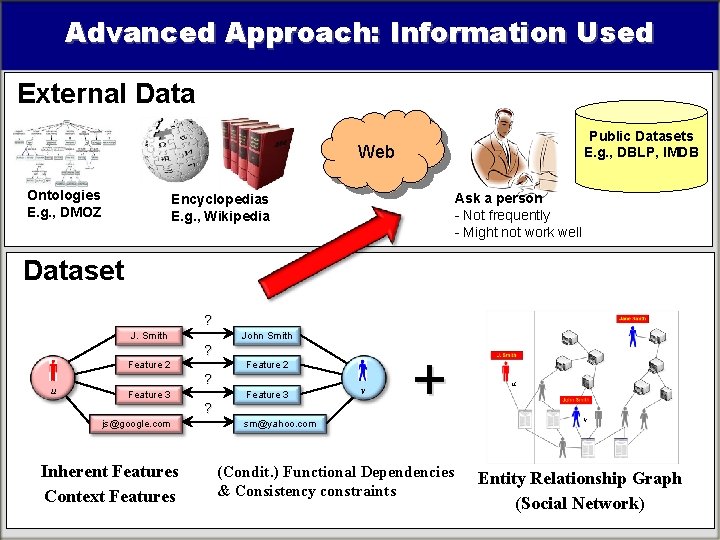
Advanced Approach: Information Used External Data Public Datasets E. g. , DBLP, IMDB Web Ontologies E. g. , DMOZ Ask a person - Not frequently - Might not work well Encyclopedias E. g. , Wikipedia Dataset ? J. Smith John Smith ? Feature 2 u Feature 2 ? Feature 3 ? js@google. com Inherent Features Context Features v + sm@yahoo. com (Condit. ) Functional Dependencies & Consistency constraints u v Entity Relationship Graph (Social Network)
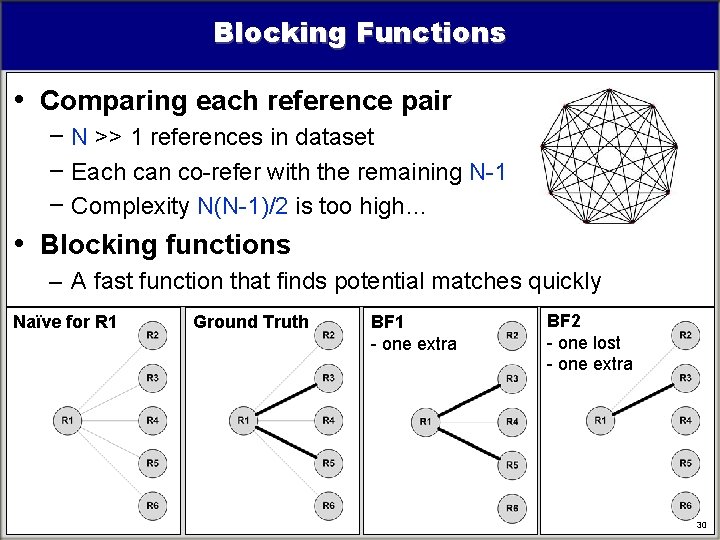
Blocking Functions • Comparing each reference pair • − N >> 1 references in dataset − Each can co-refer with the remaining N-1 − Complexity N(N-1)/2 is too high… Blocking functions – A fast function that finds potential matches quickly Naïve for R 1 Ground Truth BF 1 - one extra BF 2 - one lost - one extra 30
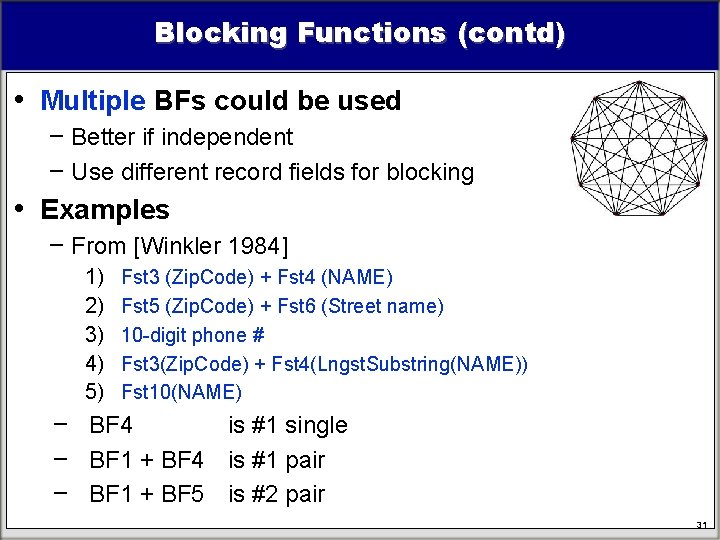
Blocking Functions (contd) • Multiple BFs could be used − Better if independent − Use different record fields for blocking • Examples − From [Winkler 1984] 1) 2) 3) 4) 5) Fst 3 (Zip. Code) + Fst 4 (NAME) Fst 5 (Zip. Code) + Fst 6 (Street name) 10 -digit phone # Fst 3(Zip. Code) + Fst 4(Lngst. Substring(NAME)) Fst 10(NAME) − BF 4 is #1 single − BF 1 + BF 4 is #1 pair − BF 1 + BF 5 is #2 pair 31
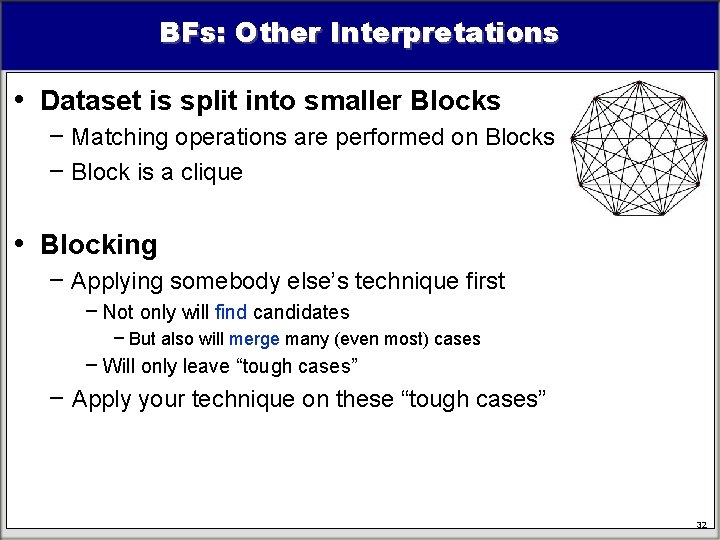
BFs: Other Interpretations • Dataset is split into smaller Blocks − Matching operations are performed on Blocks − Block is a clique • Blocking − Applying somebody else’s technique first − Not only will find candidates − But also will merge many (even most) cases − Will only leave “tough cases” − Apply your technique on these “tough cases” 32
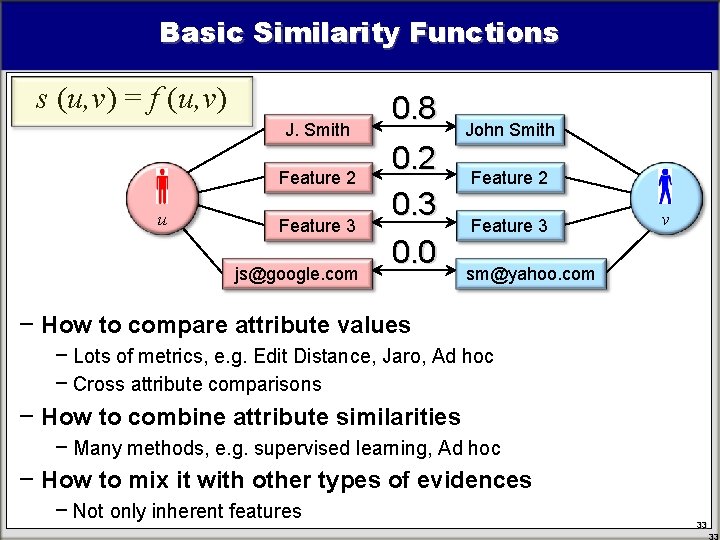
Basic Similarity Functions s (u, v) = f (u, v) J. Smith Feature 2 u Feature 3 js@google. com 0. 8 0. 2 0. 3 0. 0 John Smith Feature 2 Feature 3 v sm@yahoo. com − How to compare attribute values − Lots of metrics, e. g. Edit Distance, Jaro, Ad hoc − Cross attribute comparisons − How to combine attribute similarities − Many methods, e. g. supervised learning, Ad hoc − How to mix it with other types of evidences − Not only inherent features 33
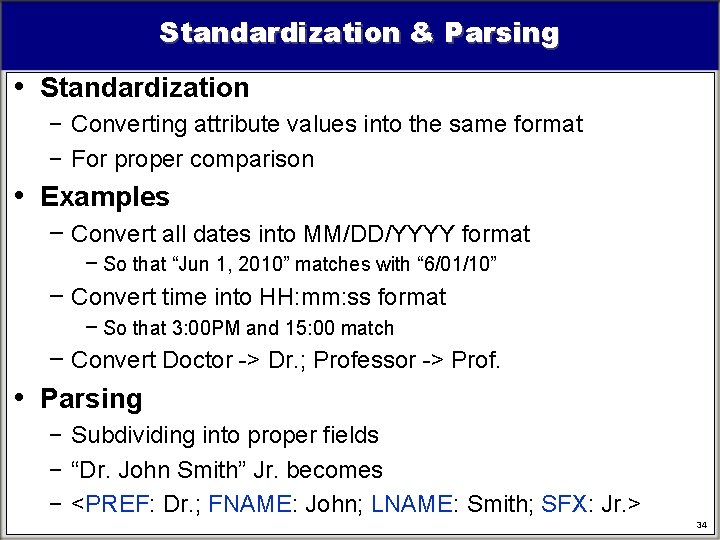
Standardization & Parsing • Standardization − Converting attribute values into the same format − For proper comparison • Examples − Convert all dates into MM/DD/YYYY format − So that “Jun 1, 2010” matches with “ 6/01/10” − Convert time into HH: mm: ss format − So that 3: 00 PM and 15: 00 match • − Convert Doctor -> Dr. ; Professor -> Prof. Parsing − Subdividing into proper fields − “Dr. John Smith” Jr. becomes − <PREF: Dr. ; FNAME: John; LNAME: Smith; SFX: Jr. > 34
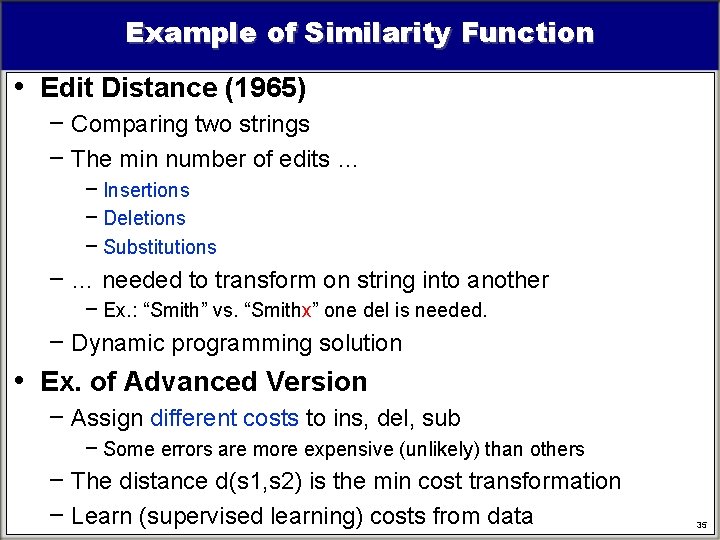
Example of Similarity Function • Edit Distance (1965) − Comparing two strings − The min number of edits … − Insertions − Deletions − Substitutions − … needed to transform on string into another − Ex. : “Smith” vs. “Smithx” one del is needed. − Dynamic programming solution • Ex. of Advanced Version − Assign different costs to ins, del, sub − Some errors are more expensive (unlikely) than others − The distance d(s 1, s 2) is the min cost transformation − Learn (supervised learning) costs from data 35
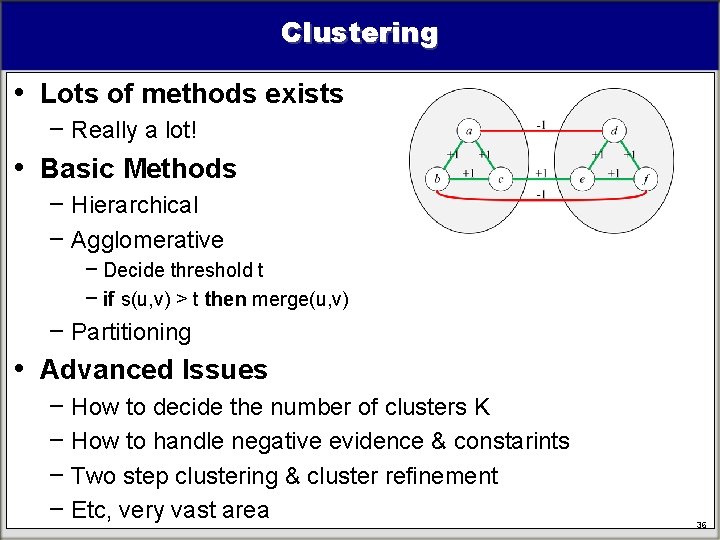
Clustering • Lots of methods exists − Really a lot! • Basic Methods − Hierarchical − Agglomerative − Decide threshold t − if s(u, v) > t then merge(u, v) − Partitioning • Advanced Issues − How to decide the number of clusters K − How to handle negative evidence & constarints − Two step clustering & cluster refinement − Etc, very vast area 36
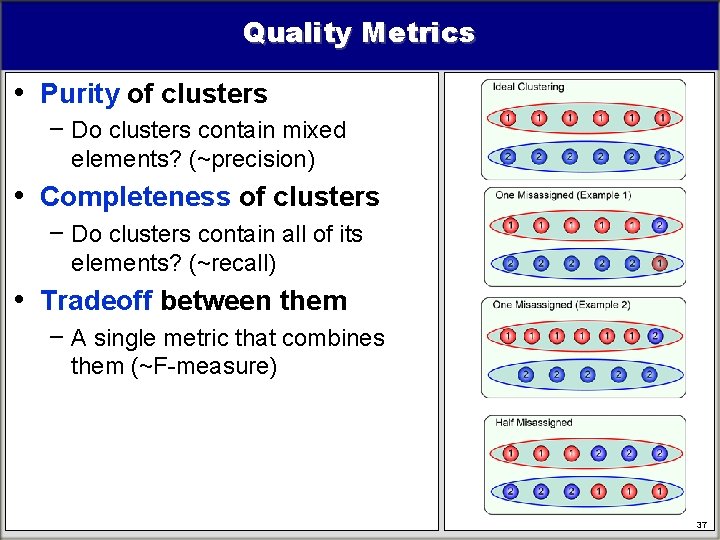
Quality Metrics • Purity of clusters − Do clusters contain mixed elements? (~precision) • Completeness of clusters − Do clusters contain all of its elements? (~recall) • Tradeoff between them − A single metric that combines them (~F-measure) 37
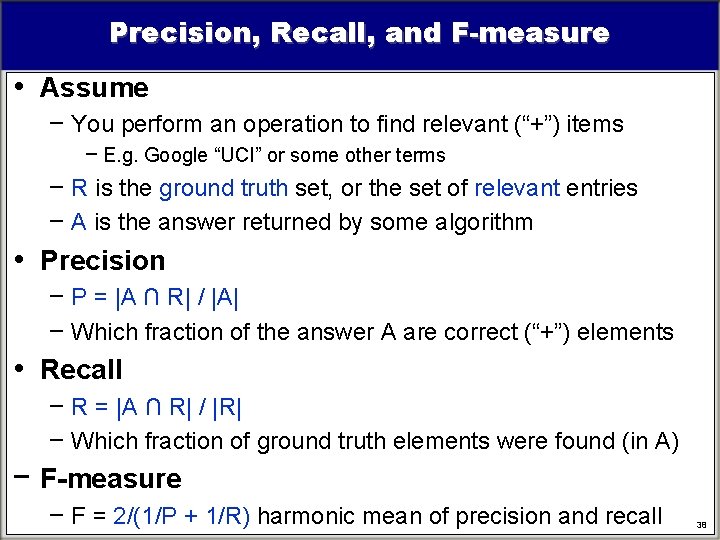
Precision, Recall, and F-measure • Assume − You perform an operation to find relevant (“+”) items − E. g. Google “UCI” or some other terms − R is the ground truth set, or the set of relevant entries − A is the answer returned by some algorithm • Precision − P = |A ∩ R| / |A| − Which fraction of the answer A are correct (“+”) elements • Recall − R = |A ∩ R| / |R| − Which fraction of ground truth elements were found (in A) − F-measure − F = 2/(1/P + 1/R) harmonic mean of precision and recall 38
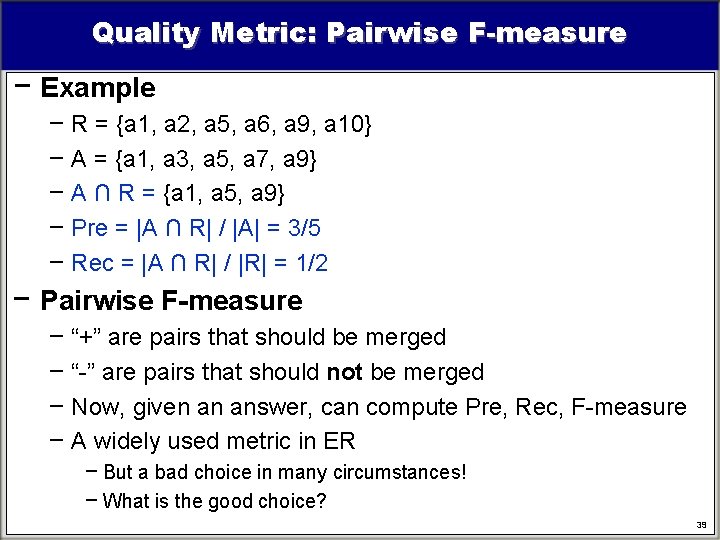
Quality Metric: Pairwise F-measure − Example − R = {a 1, a 2, a 5, a 6, a 9, a 10} − A = {a 1, a 3, a 5, a 7, a 9} − A ∩ R = {a 1, a 5, a 9} − Pre = |A ∩ R| / |A| = 3/5 − Rec = |A ∩ R| / |R| = 1/2 − Pairwise F-measure − “+” are pairs that should be merged − “-” are pairs that should not be merged − Now, given an answer, can compute Pre, Rec, F-measure − A widely used metric in ER − But a bad choice in many circumstances! − What is the good choice? 39
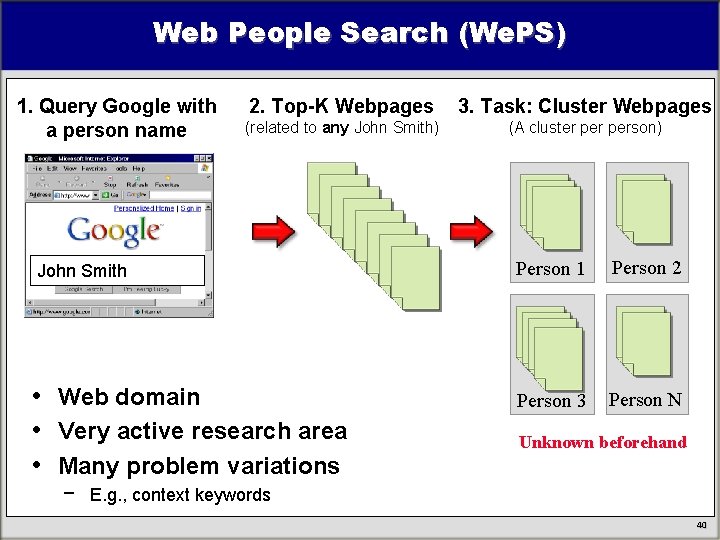
Web People Search (We. PS) 1. Query Google with a person name 2. Top-K Webpages 3. Task: Cluster Webpages (related to any John Smith) (A cluster person) John Smith • Web domain • Very active research area • Many problem variations Person 1 Person 2 Person 3 Person N Unknown beforehand − E. g. , context keywords 40
Recall that… Lookup Grouping – List of all objects is given – Match references to objects – No list of objects is given – Group references that corefer We. PS is a grouping task
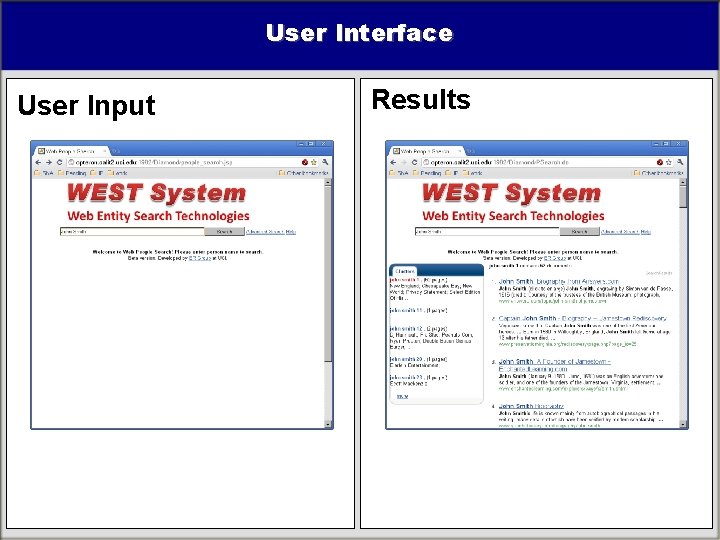
User Interface User Input Results
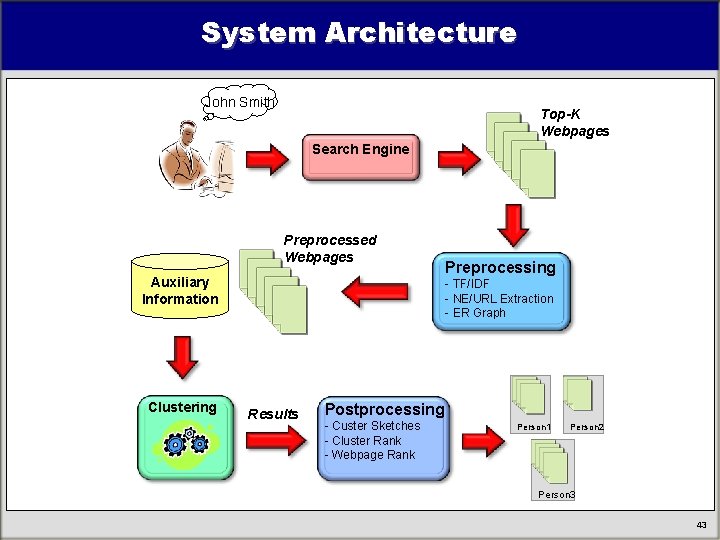
System Architecture John Smith Top-K Webpages Search Engine Preprocessed Webpages Auxiliary Information Clustering Preprocessing - TF/IDF - NE/URL Extraction - ER Graph Results Postprocessing - Custer Sketches - Cluster Rank - Webpage Rank Person 1 Person 2 Person 3 43