
L 25 Combinational Logic Digital Logic Combinational CMPT
L 25: Combinational Logic Digital Logic - Combinational CMPT 295
L 25: Combinational Logic CMPT 295 Agenda • Combinational Logic – Combinational Logic Gates – Truth Tables – Boolean Algebra – Circuit Simplification 2
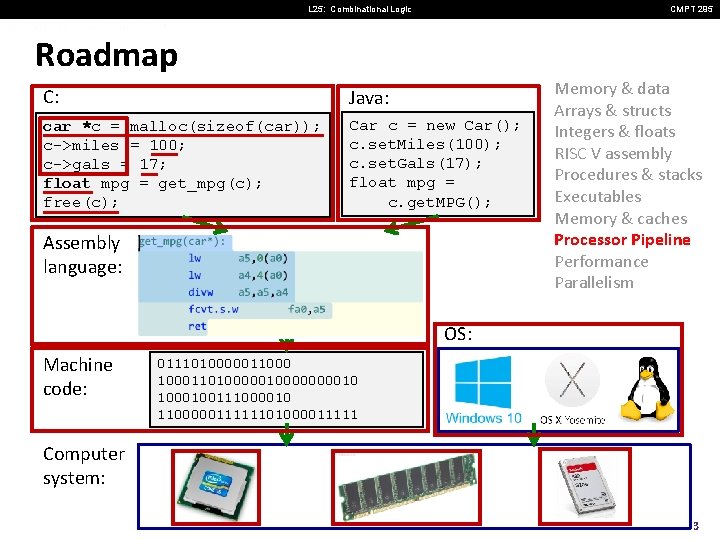
L 25: Combinational Logic CMPT 295 Roadmap C: Java: car *c = malloc(sizeof(car)); c->miles = 100; c->gals = 17; float mpg = get_mpg(c); free(c); Car c = new Car(); c. set. Miles(100); c. set. Gals(17); float mpg = c. get. MPG(); Assembly language: Memory & data Arrays & structs Integers & floats RISC V assembly Procedures & stacks Executables Memory & caches Processor Pipeline Performance Parallelism OS: Machine code: 011101000001100011010000000010 1000100111000010 110000011111101000011111 Computer system: 3
L 25: Combinational Logic CMPT 295 Why is this important? • Why study hardware design? – Background for other more in-depth classes – Only course in CMPT that deals with hardware – We need some digital systems knowledge to build our own processor 4

L 25: Combinational Logic CMPT 295 Why is this important? • We need some digital systems knowledge to build our own processor • Why build our own processor? – Because we believe computer scientists should have an answer to the question “How does a computer work? ” – So you can understand how code is actually executed on a computer 5
L 25: Combinational Logic CMPT 295 Why is this important? • So you can understand how code is actually executed on a computer • Why do we care about how code executes? – Reliability – Performance – Security 6
L 25: Combinational Logic CMPT 295 Hardware Design Why study hardware design and processors and computers if you only care about high-level software? Example of the power of layered abstractions – – – – Transistors -> Combinational Logic -> Sequential Logic -> Processors -> Machine Language -> Assembly -> High-level Programming Languages -> Word, Minecraft, Twitter At each step we can “abstract away” the lower steps and (mostly) forget they exist 7
L 25: Combinational Logic CMPT 295 Synchronous Digital Systems (SDS) Hardware of a processor, such as a RISC-V processor, is an example of a Synchronous Digital System Synchronous: • All operations coordinated by a central clock ‒ “Heartbeat” of the system! (processor frequency) Digital: • Represent all values with two discrete values • Electrical signals are treated as 1’s and 0’s ‒ 1 and 0 are complements of each other • High/Low voltage for True/False, 1/0 8

L 25: Combinational Logic CMPT 295 9

L 25: Combinational Logic CMPT 295 Historical Trend: • Hardware gets more powerful every year. – (Really due to hard work of thousands of engineers) Therefore: • Software gets more resources and faster compute! – (And has to keep up with ever-changing hardware) 10
L 25: Combinational Logic CMPT 295 Agenda • Combinational Logic – Combinational Logic Gates – Truth Tables – Boolean Algebra – Circuit Simplification 11
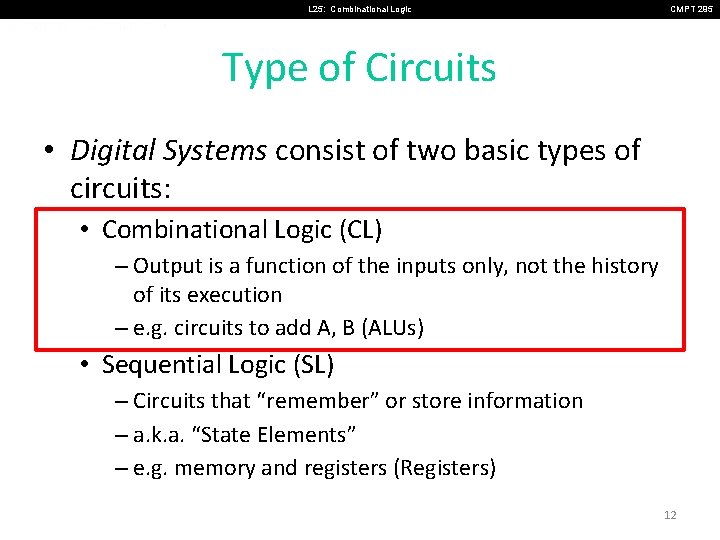
L 25: Combinational Logic CMPT 295 Type of Circuits • Digital Systems consist of two basic types of circuits: • Combinational Logic (CL) – Output is a function of the inputs only, not the history of its execution – e. g. circuits to add A, B (ALUs) • Sequential Logic (SL) – Circuits that “remember” or store information – a. k. a. “State Elements” – e. g. memory and registers (Registers) 12
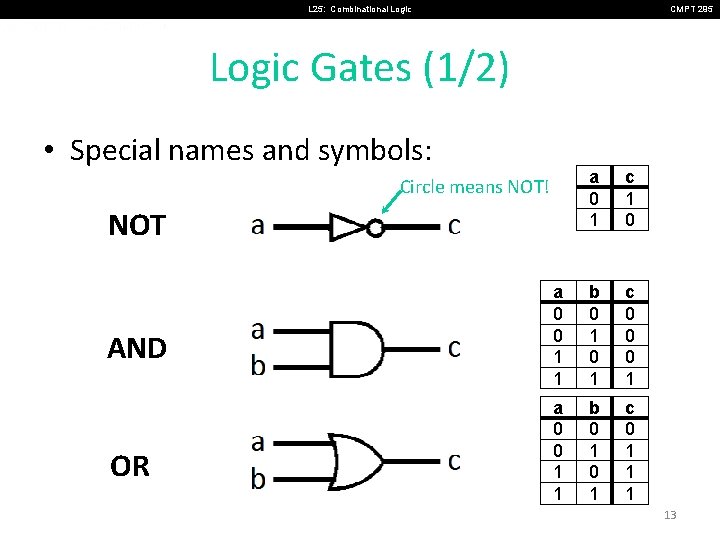
L 25: Combinational Logic CMPT 295 Logic Gates (1/2) • Special names and symbols: a 0 1 c 1 0 a 0 0 1 1 b 0 1 c 0 0 0 1 a 0 0 1 1 b 0 1 c 0 1 1 1 Circle means NOT! NOT AND OR 13
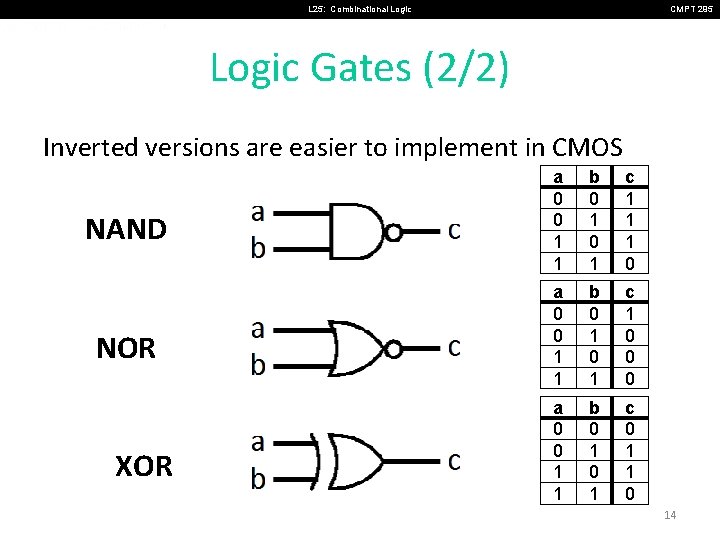
L 25: Combinational Logic CMPT 295 Logic Gates (2/2) Inverted versions are easier to implement in CMOS NAND NOR XOR a 0 0 1 1 b 0 1 c 1 1 1 0 a 0 0 1 1 b 0 1 c 1 0 0 0 a 0 0 1 1 b 0 1 c 0 1 1 0 14
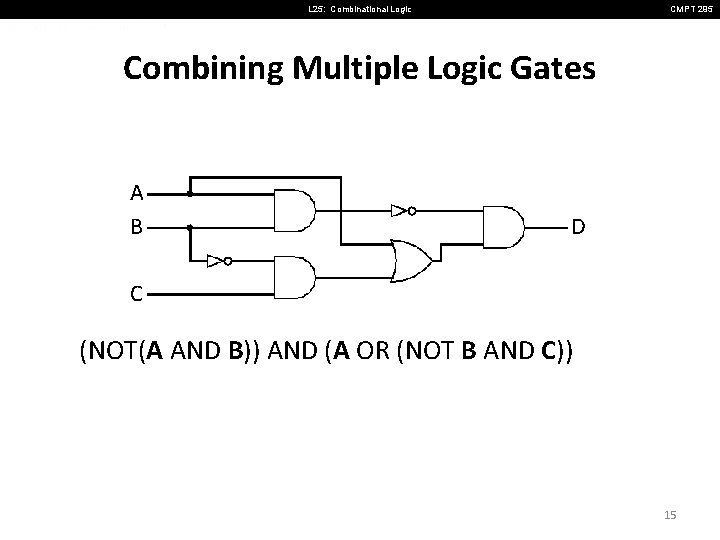
L 25: Combinational Logic CMPT 295 Combining Multiple Logic Gates A B D C (NOT(A AND B)) AND (A OR (NOT B AND C)) 15
L 25: Combinational Logic CMPT 295 Agenda • Combinational Logic – Combinational Logic Gates – Truth Tables – Boolean Algebra – Circuit Simplification 16
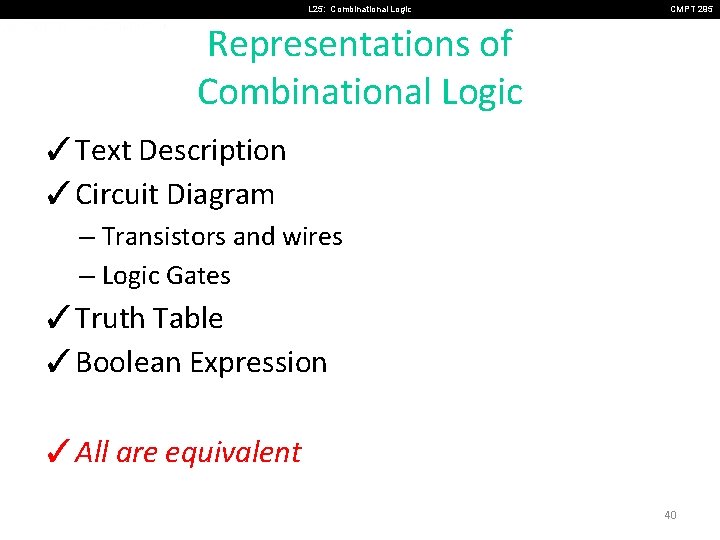
L 25: Combinational Logic CMPT 295 Representations of Combinational Logic ✓Text Description ✓Circuit Diagram – Transistors and wires – Logic Gates ✓Truth Table ✓Boolean Expression ✓All are equivalent 17
L 25: Combinational Logic CMPT 295 Truth Tables • Table that relates the inputs to a combinational logic circuit to its output – Output only depends on current inputs – Use abstraction of 0/1 instead of high/low V – Shows output for every possible combination of inputs • How big? – 0 or 1 for each of N inputs, so 2 N rows 18
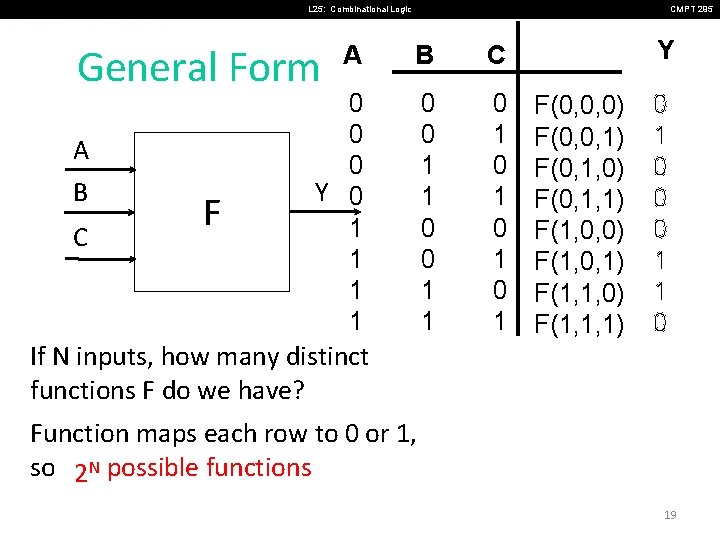
L 25: Combinational Logic General Form A B C F CMPT 295 A B C 0 0 0 Y 0 1 1 0 1 0 1 Y F(0, 0, 0) F(0, 0, 1) F(0, 1, 0) F(0, 1, 1) F(1, 0, 0) F(1, 0, 1) F(1, 1, 0) F(1, 1, 1) 0 1 0 0 0 1 1 0 If N inputs, how many distinct functions F do we have? Function maps each row to 0 or 1, so 2 N possible functions 19
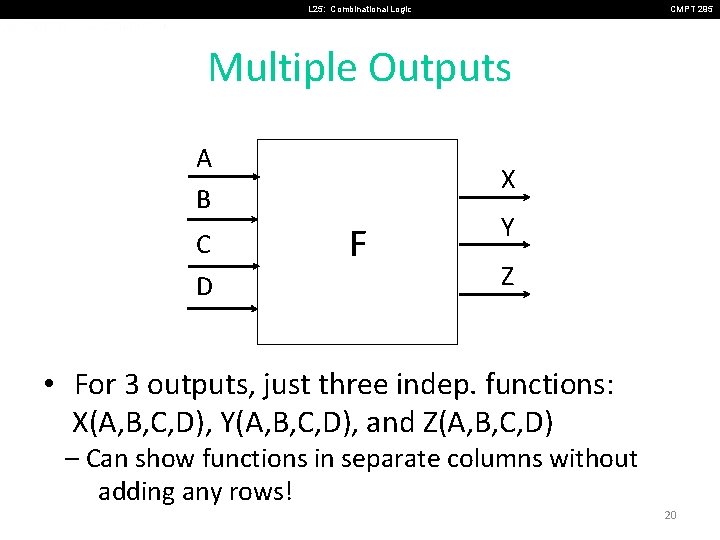
L 25: Combinational Logic CMPT 295 Multiple Outputs A B C D X F Y Z • For 3 outputs, just three indep. functions: X(A, B, C, D), Y(A, B, C, D), and Z(A, B, C, D) – Can show functions in separate columns without adding any rows! 20
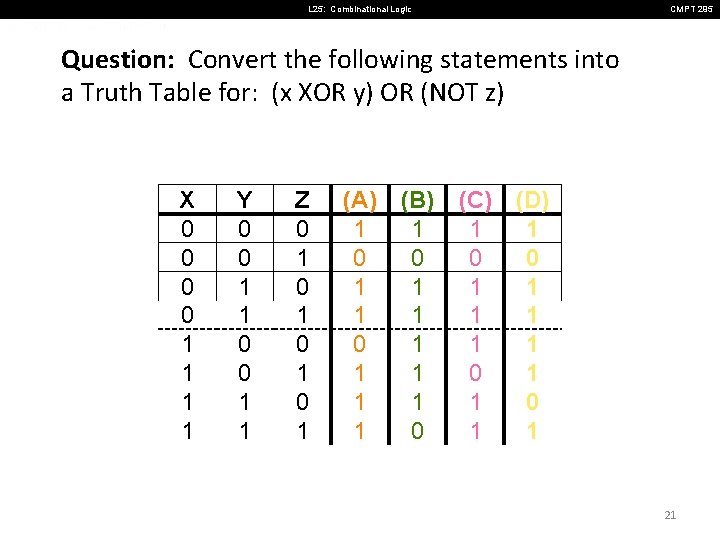
L 25: Combinational Logic CMPT 295 Question: Convert the following statements into a Truth Table for: (x XOR y) OR (NOT z) X 0 0 1 1 Y 0 0 1 1 Z 0 1 0 1 (A) 1 0 1 1 1 (B) 1 0 1 1 1 0 (C) 1 0 1 1 (D) 1 0 1 21
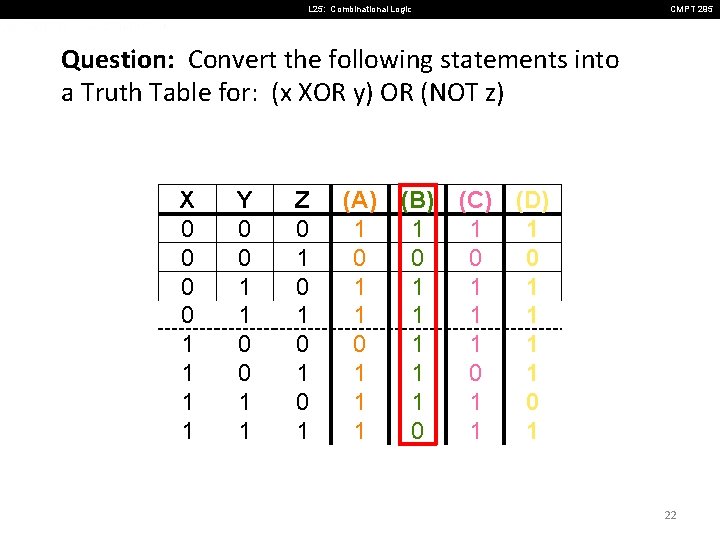
L 25: Combinational Logic CMPT 295 Question: Convert the following statements into a Truth Table for: (x XOR y) OR (NOT z) X 0 0 1 1 Y 0 0 1 1 Z 0 1 0 1 (A) 1 0 1 1 1 (B) 1 0 1 1 1 0 (C) 1 0 1 1 (D) 1 0 1 22
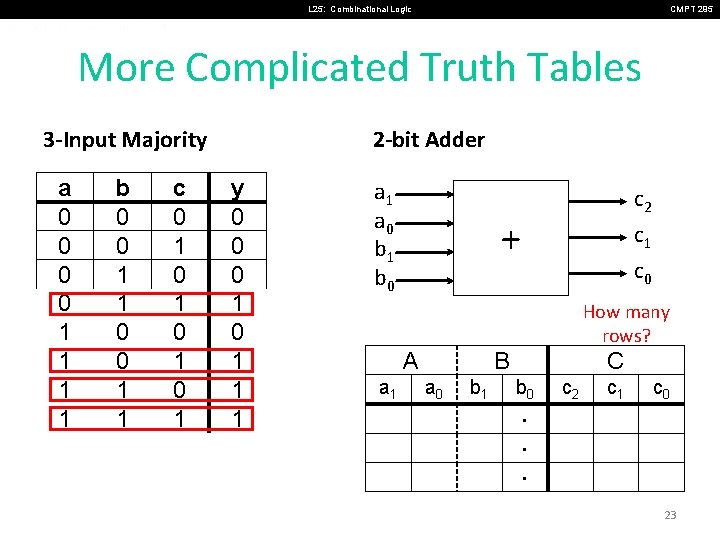
L 25: Combinational Logic CMPT 295 More Complicated Truth Tables 3 -Input Majority a 0 0 1 1 b 0 0 1 1 c 0 1 0 1 2 -bit Adder y 0 0 0 1 1 1 a 0 b 1 b 0 + A a 1 c 2 c 1 c 0 How many rows? B a 0 b 1 C b 0 c 2 c 1 c 0 . . . 23
L 25: Combinational Logic CMPT 295 Agenda • Combinational Logic – Combinational Logic Gates – Truth Tables – Boolean Algebra – Circuit Simplification 24
L 25: Combinational Logic CMPT 295 My Hand Hurts… • Truth tables are huge – Write out EVERY combination of inputs and outputs (thorough, but inefficient) – Finding a particular combination of inputs involves scanning a large portion of the table • There must be a shorter way to represent combinational logic – Boolean Algebra to the rescue! 25
L 25: Combinational Logic CMPT 295 Boolean Algebra • Represent inputs and outputs as variables – Each variable can only take on the value 0 or 1 • Overbar or ¬ is NOT: “logical complement” – e. g. if A is 0, A is 1. If A is 1, then ¬A is 0 For slides, will use ¬A • Plus (+) is 2 -input OR: “logical sum” • Product (·) is 2 -input AND: “logical product” – All other gates and logical expressions can be built from combinations of these ¬AB + A¬B == (NOT(A AND B)) OR (A AND NOT B) 26
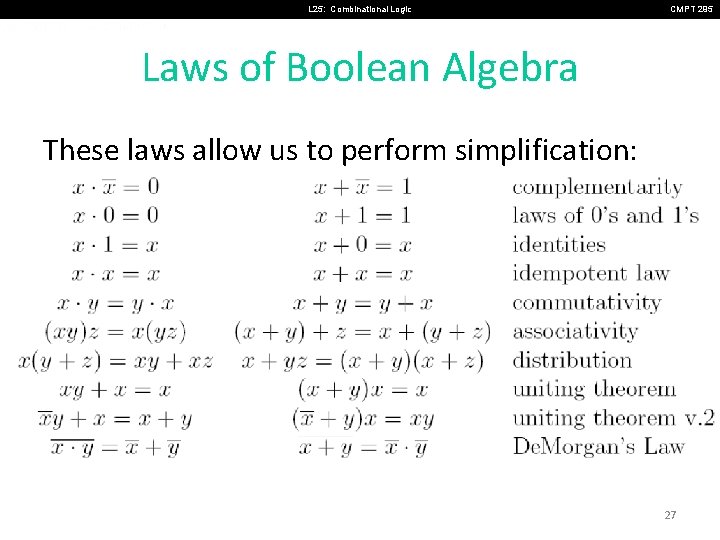
L 25: Combinational Logic CMPT 295 Laws of Boolean Algebra These laws allow us to perform simplification: 27
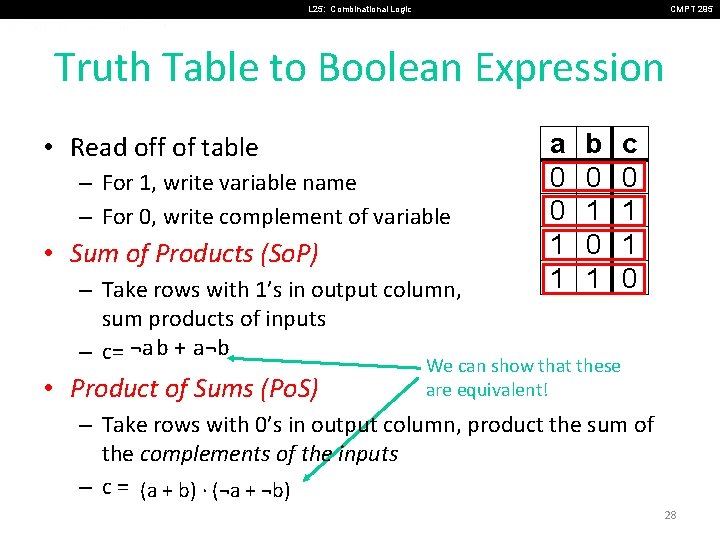
L 25: Combinational Logic CMPT 295 Truth Table to Boolean Expression • Read off of table – For 1, write variable name – For 0, write complement of variable • Sum of Products (So. P) – Take rows with 1’s in output column, sum products of inputs – c= ¬ab + a ¬b • Product of Sums (Po. S) a 0 0 1 1 b 0 1 c 0 1 1 0 We can show that these are equivalent! – Take rows with 0’s in output column, product the sum of the complements of the inputs – c = (a + b) · (¬a + ¬b) 28
L 25: Combinational Logic CMPT 295 Faster Hardware? • Recall: Everything we are dealing with is just an abstraction of transistors and wires – Inputs propagating to the outputs are voltage signals passing through transistor networks – There is always some delay before a CL’s output updates to reflect the inputs • Simpler Boolean expressions ↔ smaller transistor networks ↔ smaller circuit delays ↔ faster hardware 29
L 25: Combinational Logic CMPT 295 Agenda • • • Muxes Sequential Logic Timing Maximum Clock Frequency Finite State Machines Functional Units Summary Bonus Slides • Logisim Intro 30
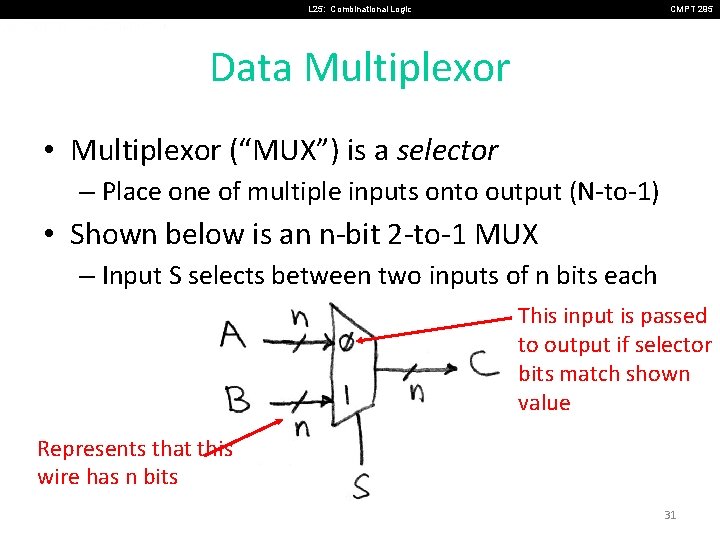
L 25: Combinational Logic CMPT 295 Data Multiplexor • Multiplexor (“MUX”) is a selector – Place one of multiple inputs onto output (N-to-1) • Shown below is an n-bit 2 -to-1 MUX – Input S selects between two inputs of n bits each This input is passed to output if selector bits match shown value Represents that this wire has n bits 31
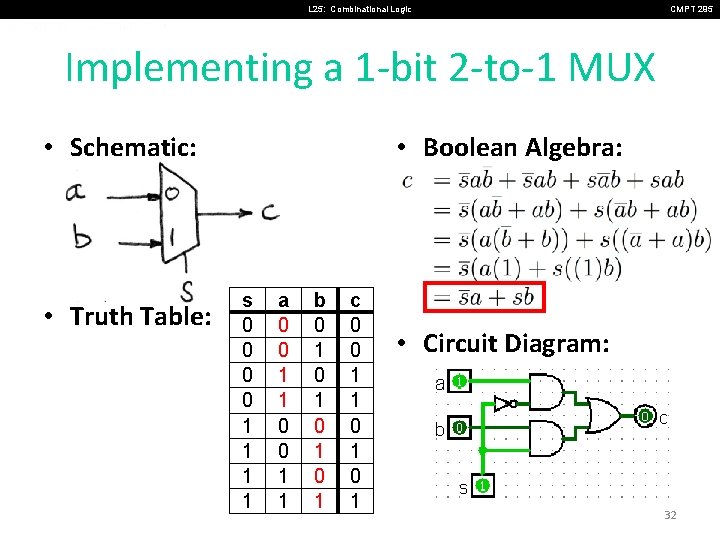
L 25: Combinational Logic CMPT 295 Implementing a 1 -bit 2 -to-1 MUX • Schematic: • Truth Table: • Boolean Algebra: s 0 0 1 1 a 0 0 1 1 b 0 1 0 1 c 0 0 1 1 0 1 • Circuit Diagram: 32
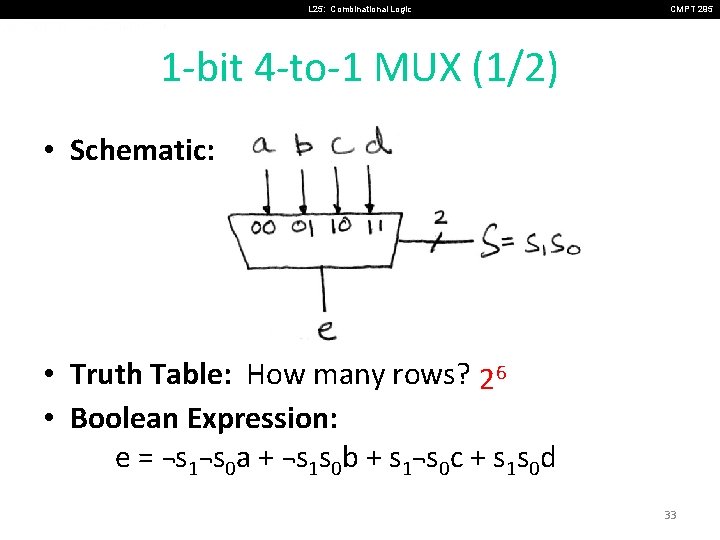
L 25: Combinational Logic CMPT 295 1 -bit 4 -to-1 MUX (1/2) • Schematic: • Truth Table: How many rows? 26 • Boolean Expression: e = ¬s 1 ¬s 0 a + ¬s 1 s 0 b + s 1 ¬s 0 c + s 1 s 0 d 33
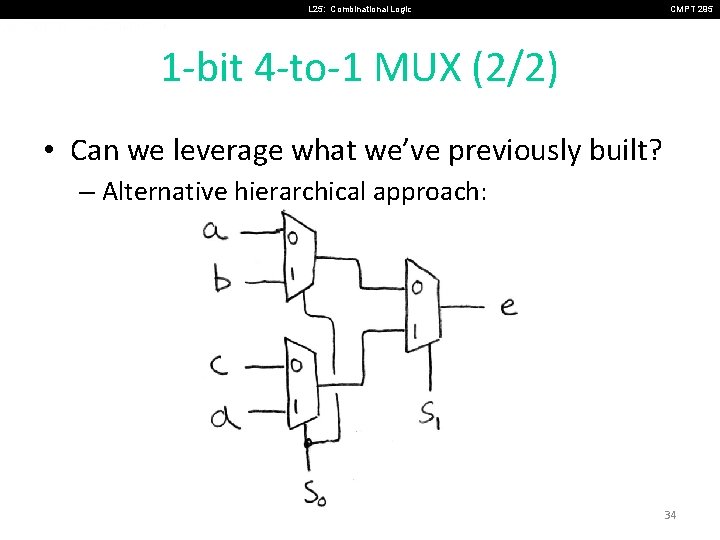
L 25: Combinational Logic CMPT 295 1 -bit 4 -to-1 MUX (2/2) • Can we leverage what we’ve previously built? – Alternative hierarchical approach: 34
L 25: Combinational Logic CMPT 295 Bonus slides (not testable) 35
L 25: Combinational Logic CMPT 295 Agenda • Combinational Logic – Combinational Logic Gates – Truth Tables – Boolean Algebra – Circuit Simplification 36
L 25: Combinational Logic CMPT 295 Manipulating Boolean Algebra • So. P and Po. S expressions can still be long – We wanted to have shorter representation than a truth table! • Boolean algebra follows a set of rules that allow for simplification – Goal will be to arrive at the simplest equivalent expression – Allows us to build simpler (and faster) hardware 37
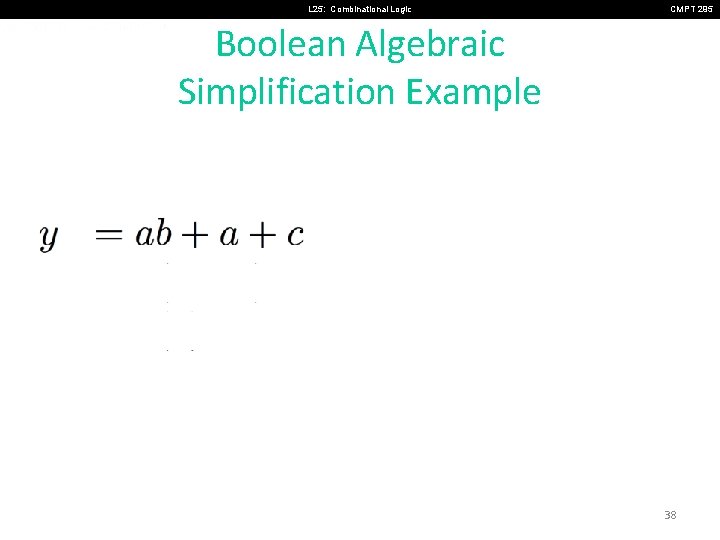
L 25: Combinational Logic CMPT 295 Boolean Algebraic Simplification Example 38
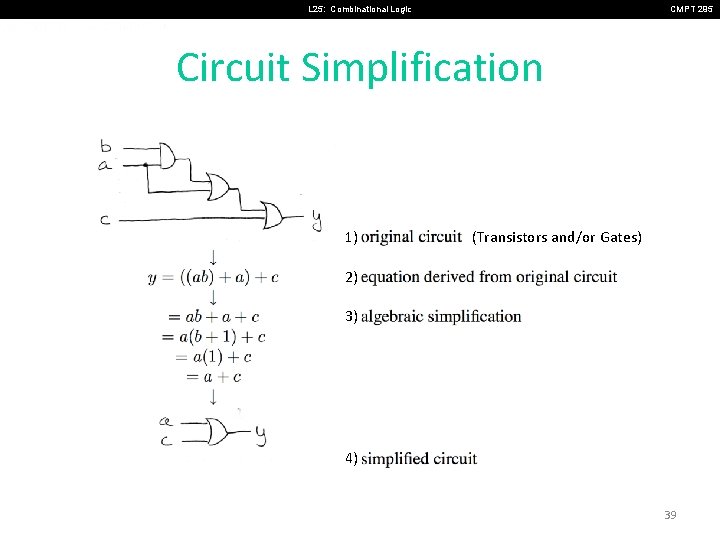
L 25: Combinational Logic CMPT 295 Circuit Simplification 1) (Transistors and/or Gates) 2) 3) 4) 39
L 25: Combinational Logic CMPT 295 Representations of Combinational Logic ✓Text Description ✓Circuit Diagram – Transistors and wires – Logic Gates ✓Truth Table ✓Boolean Expression ✓All are equivalent 40
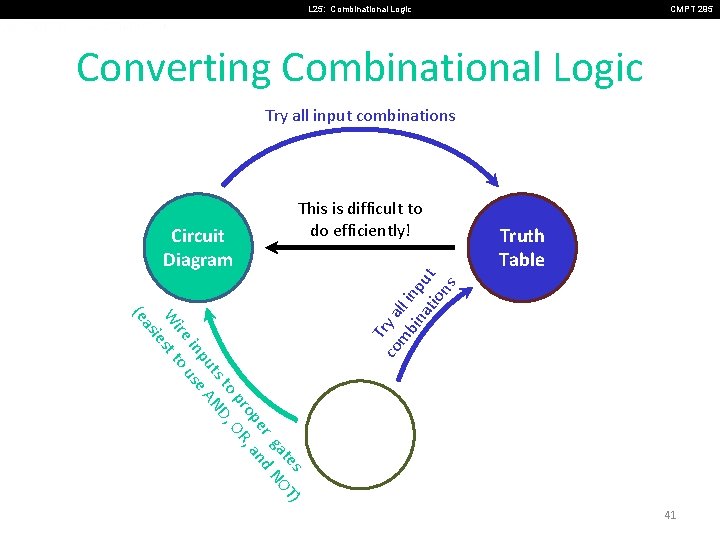
L 25: Combinational Logic CMPT 295 Converting Combinational Logic Try all input combinations So Po r. P Boolean Expression o. S Truth Table Tr co y a m ll i bin np at ut ion s (e als ign s e s te at ga ag h op ug s Pr hro te OT) a t g r d. N pe an ro R, op , O st D ut AN inp use ire o W est t i as Circuit Diagram This is difficult to do efficiently! 41
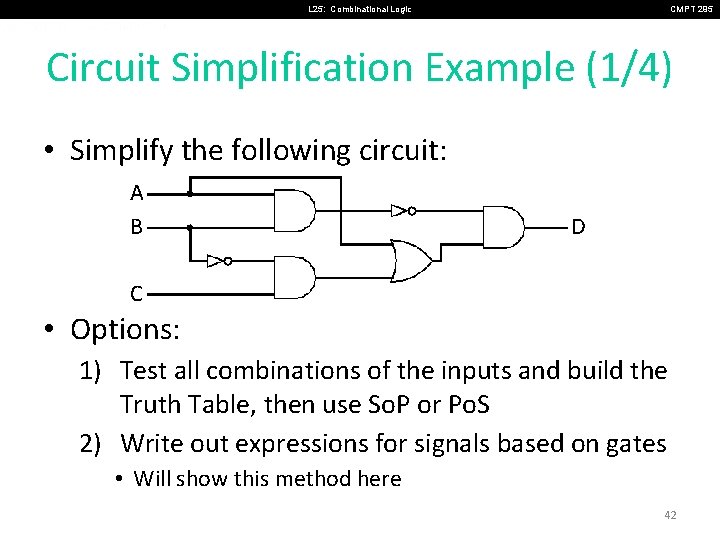
L 25: Combinational Logic CMPT 295 Circuit Simplification Example (1/4) • Simplify the following circuit: A B D C • Options: 1) Test all combinations of the inputs and build the Truth Table, then use So. P or Po. S 2) Write out expressions for signals based on gates • Will show this method here 42
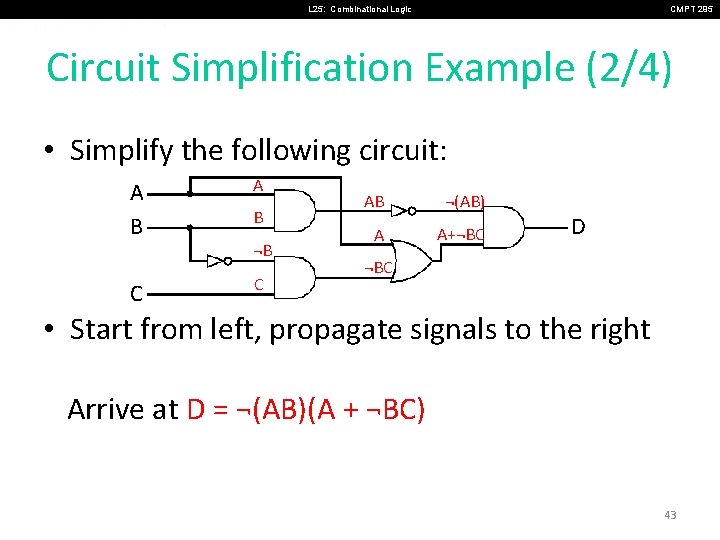
L 25: Combinational Logic CMPT 295 Circuit Simplification Example (2/4) • Simplify the following circuit: A B C A B ¬B C AB ¬(AB) A A+¬BC D ¬BC • Start from left, propagate signals to the right Arrive at D = ¬(AB)(A + ¬BC) 43
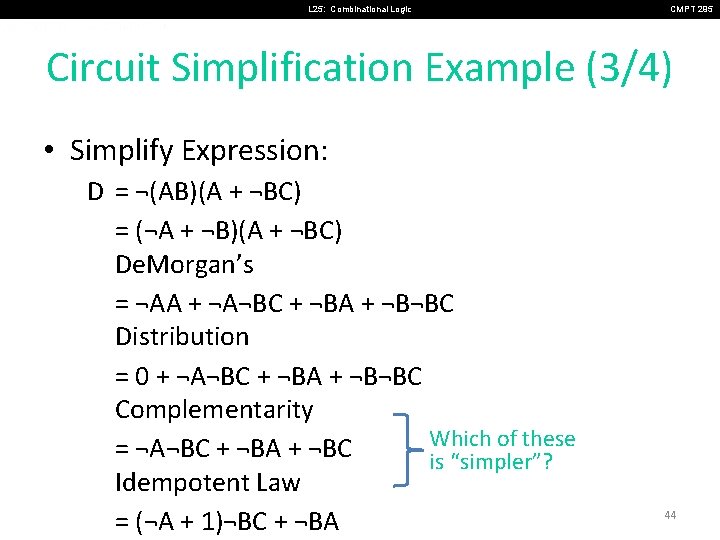
L 25: Combinational Logic CMPT 295 Circuit Simplification Example (3/4) • Simplify Expression: D = ¬(AB)(A + ¬BC) = (¬A + ¬B)(A + ¬BC) De. Morgan’s = ¬AA + ¬A¬BC + ¬BA + ¬B¬BC Distribution = 0 + ¬A¬BC + ¬BA + ¬B¬BC Complementarity Which of these = ¬A¬BC + ¬BA + ¬BC is “simpler”? Idempotent Law = (¬A + 1)¬BC + ¬BA 44
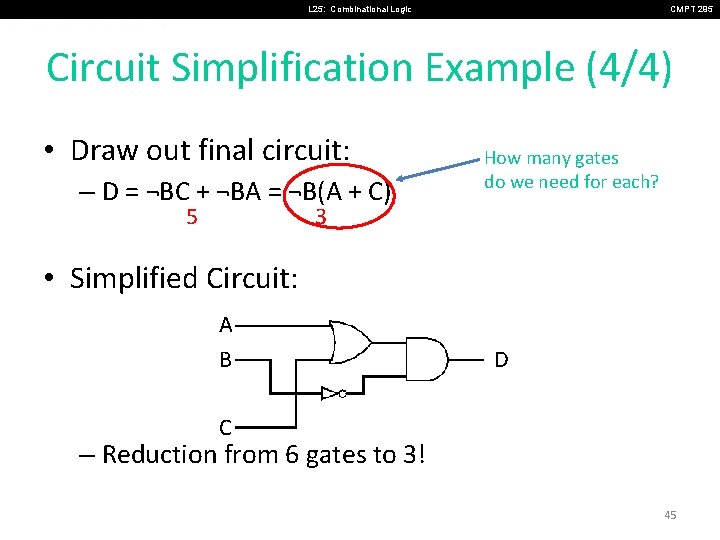
L 25: Combinational Logic CMPT 295 Circuit Simplification Example (4/4) • Draw out final circuit: – D = ¬BC + ¬BA = ¬B(A + C) 5 How many gates do we need for each? 3 • Simplified Circuit: A B D C – Reduction from 6 gates to 3! 45
- Slides: 45