
Tool that might be used to improve the
Tool that might be used to improve the trauma system in the region Witaya Chadbunchachai Trauma and Critical Care Center Khon Kaen Regional Hospital
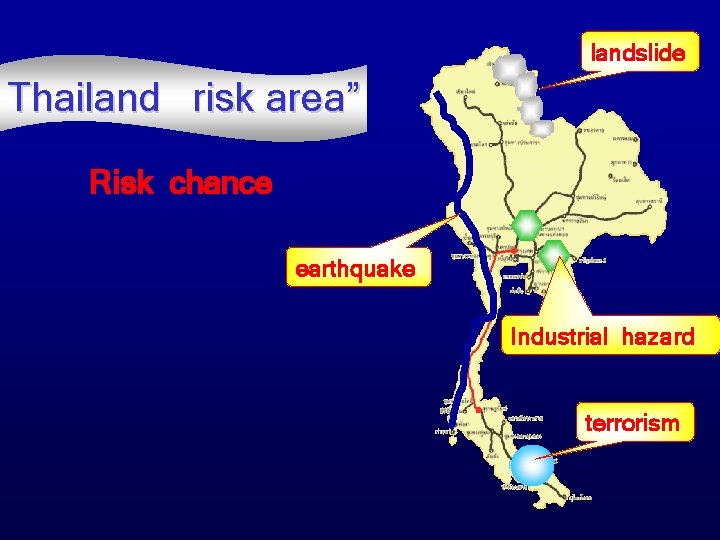
landslide Thailand risk area” Risk chance earthquake Industrial hazard terrorism
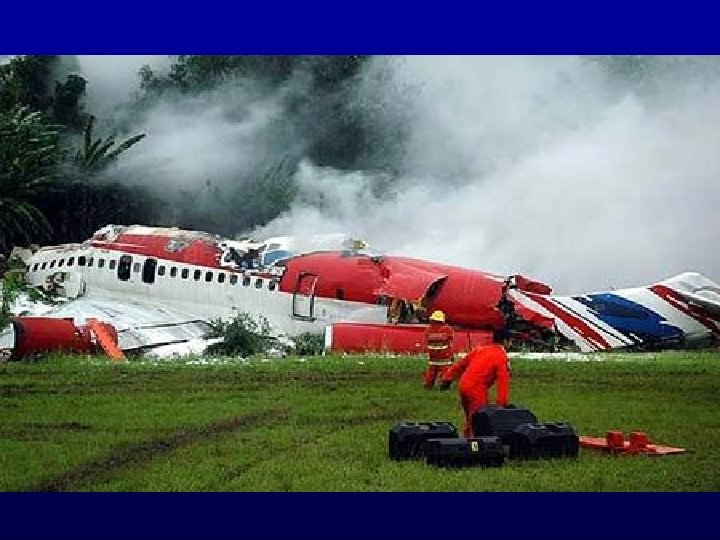
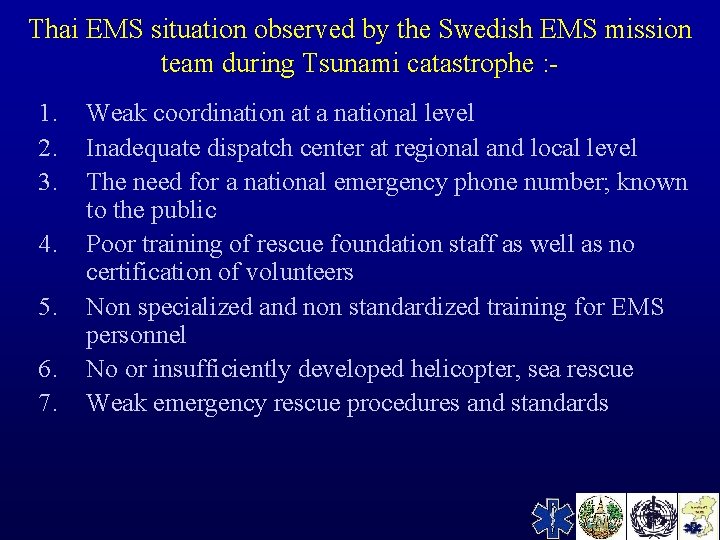
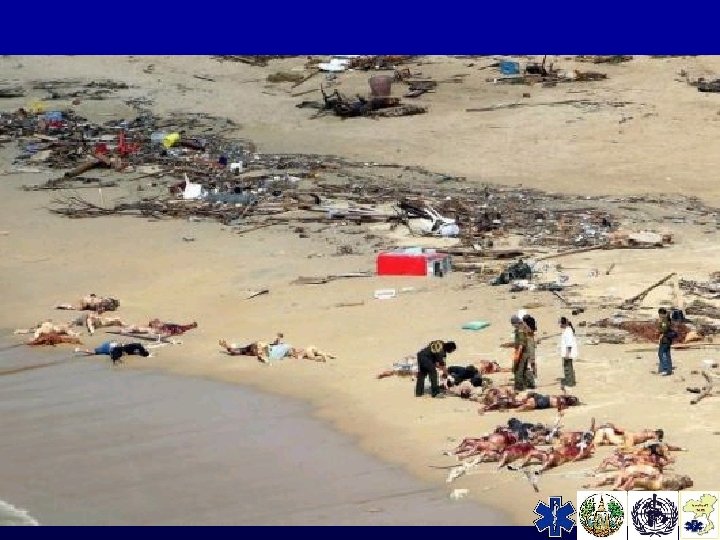
Thai EMS situation observed by the Swedish EMS mission team during Tsunami catastrophe : 1. 2. 3. 4. 5. 6. 7. Weak coordination at a national level Inadequate dispatch center at regional and local level The need for a national emergency phone number; known to the public Poor training of rescue foundation staff as well as no certification of volunteers Non specialized and non standardized training for EMS personnel No or insufficiently developed helicopter, sea rescue Weak emergency rescue procedures and standards

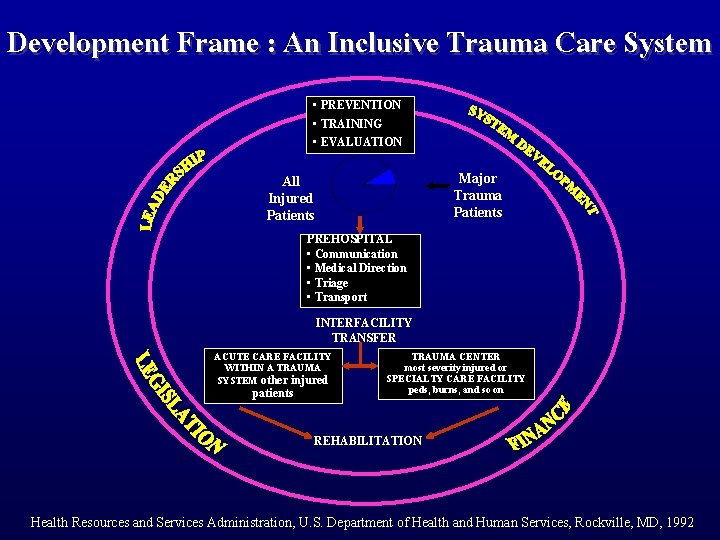
Development Frame : An Inclusive Trauma Care System • PREVENTION • TRAINING • EVALUATION Major Trauma Patients All Injured Patients PREHOSPITAL • Communication • Medical Direction • Triage • Transport INTERFACILITY TRANSFER ACUTE CARE FACILITY WITHIN A TRAUMA SYSTEM other injured patients TRAUMA CENTER most severity injured or SPECIALTY CARE FACILITY peds, burns, and so on REHABILITATION Health Resources and Services Administration, U. S. Department of Health and Human Services, Rockville, MD, 1992
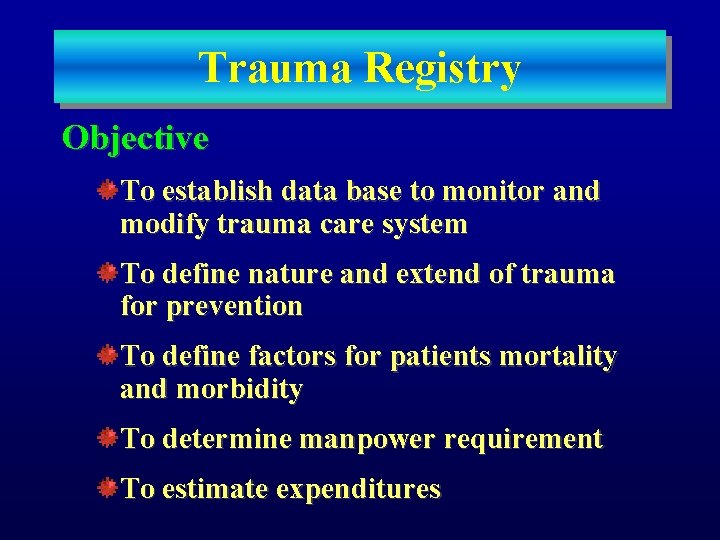
Trauma Registry Objective To establish data base to monitor and modify trauma care system To define nature and extend of trauma for prevention To define factors for patients mortality and morbidity To determine manpower requirement To estimate expenditures
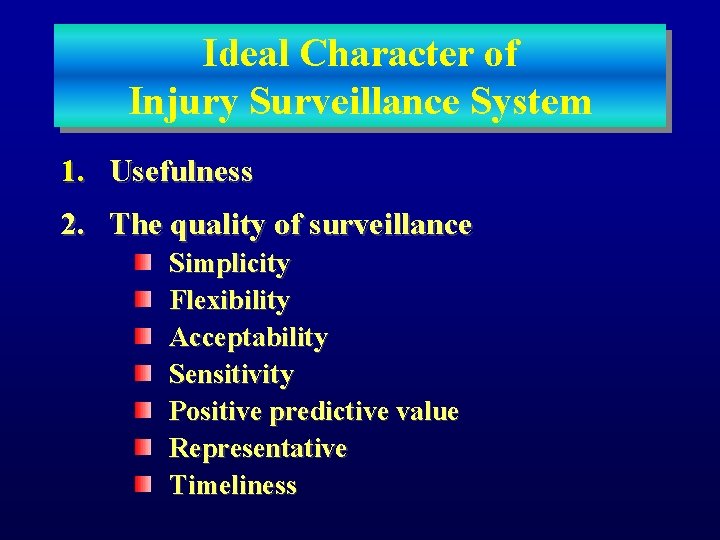
Ideal Character of Injury Surveillance System 1. Usefulness 2. The quality of surveillance Simplicity Flexibility Acceptability Sensitivity Positive predictive value Representative Timeliness
Ideal Character of Injury Surveillance System 3. Validation of Data Collection Methods 4. Reliability of The Coding System
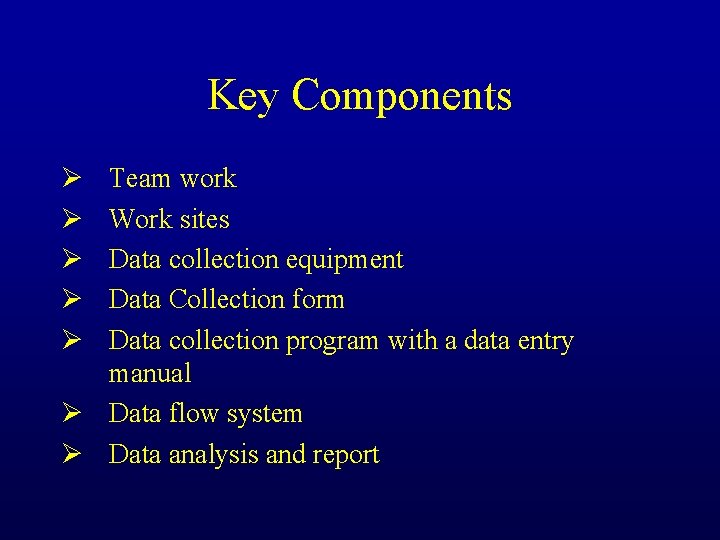
Key Components Ø Ø Ø Team work Work sites Data collection equipment Data Collection form Data collection program with a data entry manual Ø Data flow system Ø Data analysis and report
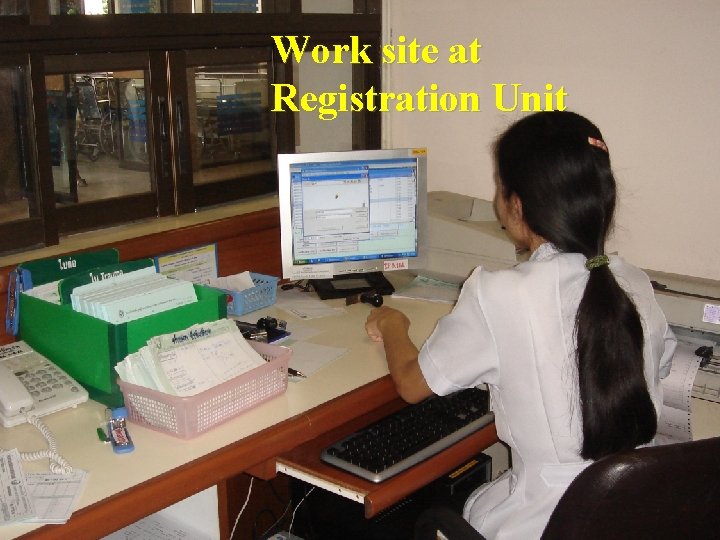
Work site at Registration Unit
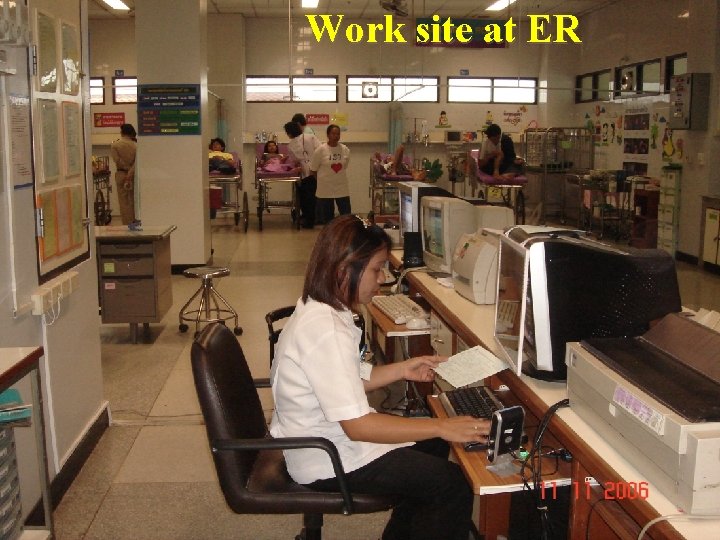
Work site at ER
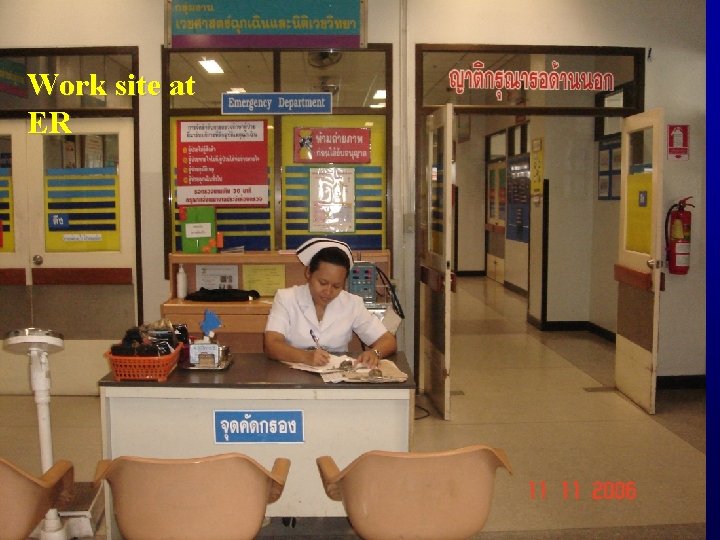
Work site at ER
Minimal Basic Data Set Modified from * Text Book of Trauma Champion & Feliciano Chapter 2 Trauma Scoring
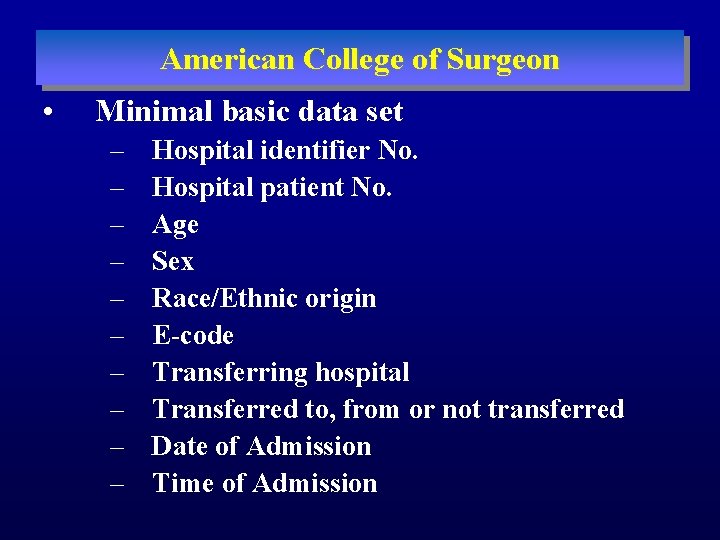
American College of Surgeon • Minimal basic data set – – – – – Hospital identifier No. Hospital patient No. Age Sex Race/Ethnic origin E-code Transferring hospital Transferred to, from or not transferred Date of Admission Time of Admission
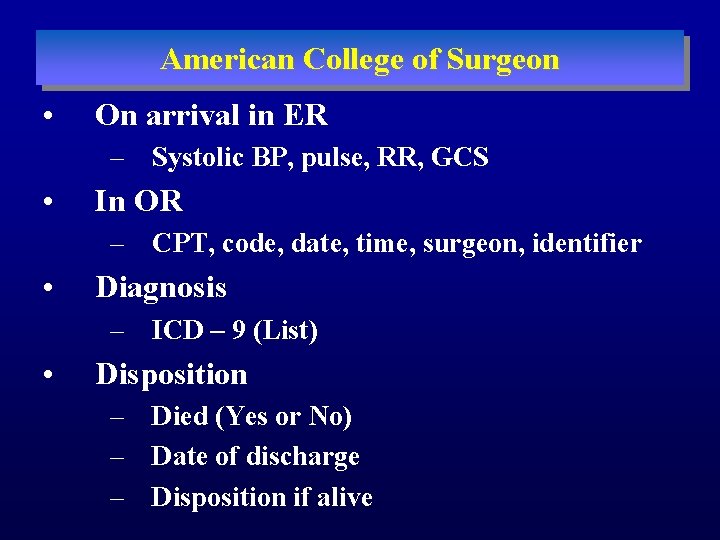
American College of Surgeon • On arrival in ER – Systolic BP, pulse, RR, GCS • In OR – CPT, code, date, time, surgeon, identifier • Diagnosis – ICD – 9 (List) • Disposition – Died (Yes or No) – Date of discharge – Disposition if alive

Data Recording Form
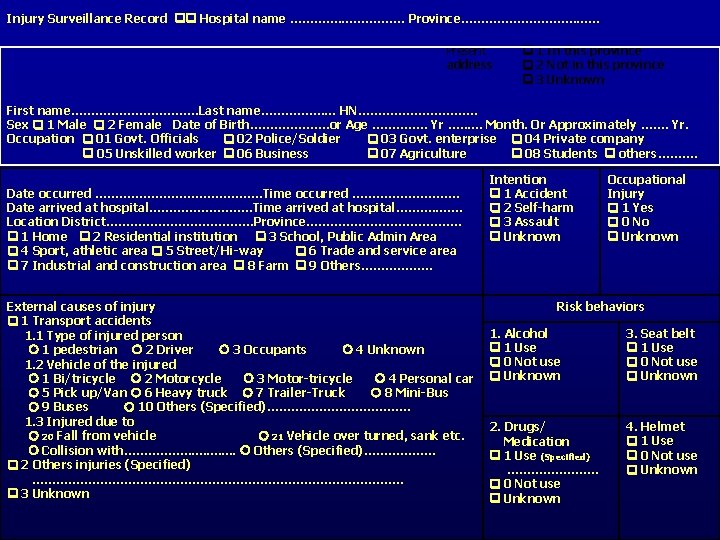
Injury Surveillance Record Hospital name …………. . …………… Province……………. . . Present address 1 In this province 2 Not in this province 3 Unknown First name…………. ……. Last name……………. … HN…………… Sex 1 Male 2 Female Date of Birth……………. . …or Age …………. . Yr …. . . Month. Or Approximately …. … Yr. Occupation 01 Govt. Officials 02 Police/Soldier 03 Govt. enterprise 04 Private company 05 Unskilled worker 06 Business 07 Agriculture 08 Students others………. Date occurred ………………. …. . Time occurred …………… Date arrived at hospital……………. . ………Time arrived at hospital………. . …… Location District………………. Province………………… 1 Home 2 Residential institution 3 School, Public Admin Area 4 Sport, athletic area 5 Street/Hi-way 6 Trade and service area 7 Industrial and construction area 8 Farm 9 Others……………… External causes of injury 1 Transport accidents 1. 1 Type of injured person 1 pedestrian 2 Driver 3 Occupants 4 Unknown 1. 2 Vehicle of the injured 1 Bi/tricycle 2 Motorcycle 3 Motor-tricycle 4 Personal car 5 Pick up/Van 6 Heavy truck 7 Trailer-Truck 8 Mini-Bus 9 Buses 10 Others (Specified)……………… 1. 3 Injured due to 20 Fall from vehicle 21 Vehicle over turned, sank etc. Collision with……………. . . Others (Specified)……………… 2 Others injuries (Specified) ………………………………………… 3 Unknown Intention 1 Accident 2 Self-harm 3 Assault Unknown Occupational Injury 1 Yes 0 No Unknown Risk behaviors 1. Alcohol 1 Use 0 Not use Unknown 3. Seat belt 1 Use 0 Not use Unknown 2. Drugs/ Medication 1 Use (Specified) …………………. . 0 Not use Unknown 4. Helmet 1 Use 0 Not use Unknown
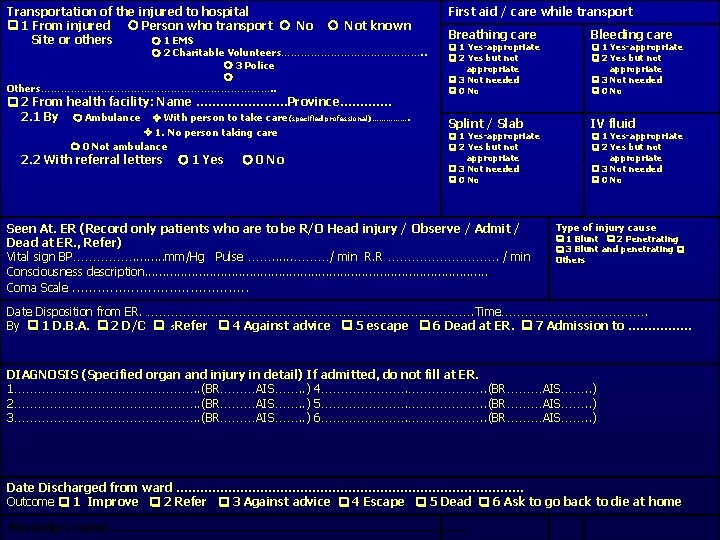
Transportation of the injured to hospital 1 From injured Person who transport No Site or others 1 EMS Not known 2 Charitable Volunteers…………………. . 3 Police Others………………………………. . 2 From health facility: Name ………………. …. Province…………. 2. 1 By Ambulance With person to take care (specified professional)……………. 1. No person taking care 0 Not ambulance 2. 2 With referral letters 1 Yes 0 No First aid / care while transport Breathing care Bleeding care Splint / Slab IV fluid 1 Yes-appropriate 2 Yes but not appropriate 3 Not needed 0 No Seen At. ER (Record only patients who are to be R/O Head injury / Observe / Admit / Dead at ER. , Refer) Vital sign BP……………. . mm/Hg Pulse ……. . . ………/ min R. R ……………. / min Consciousness description. . . . . . Coma Scale. . . . . 1 Yes-appropriate 2 Yes but not appropriate 3 Not needed 0 No Type of injury cause 1 Blunt 2 Penetrating 3 Blunt and penetrating Others Date Disposition from ER. ……………………………………. Time………………. By 1 D. B. A. 2 D/C 3 Refer 4 Against advice 5 escape 6 Dead at ER. 7 Admission to ……………. DIAGNOSIS (Specified organ and injury in detail) If admitted, do not fill at ER. 1……………………. . (BR………AIS……. . ) 4…………………. . (BR………AIS……. . ) 2……………………. . (BR………AIS……. . ) 5…………………. . (BR………AIS……. . ) 3……………………. . (BR………AIS……. . ) 6…………………. . (BR………AIS……. . ) Date Discharged from ward ……………………………………… Outcome 1 Improve 2 Refer 3 Against advice 4 Escape 5 Dead 6 Ask to go back to die at home Recorders name………………………………………
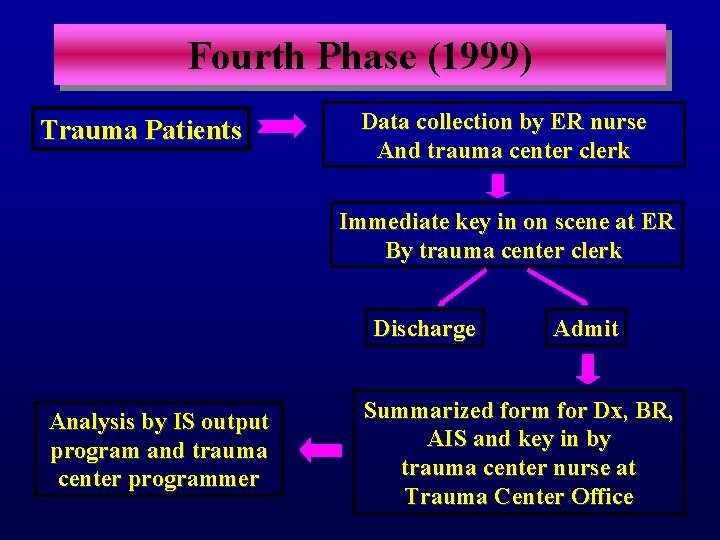
Fourth Phase (1999) Trauma Patients Data collection by ER nurse And trauma center clerk Immediate key in on scene at ER By trauma center clerk Discharge Analysis by IS output program and trauma center programmer Admit Summarized form for Dx, BR, AIS and key in by trauma center nurse at Trauma Center Office
Documents
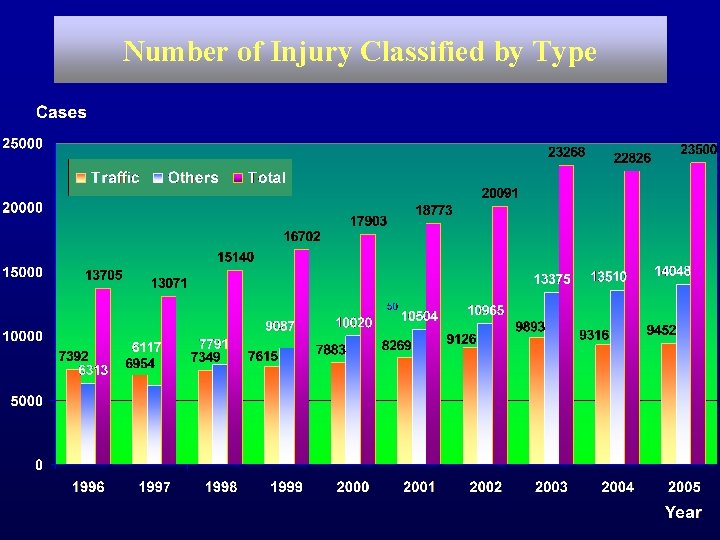
Number of Injury Classified by Type
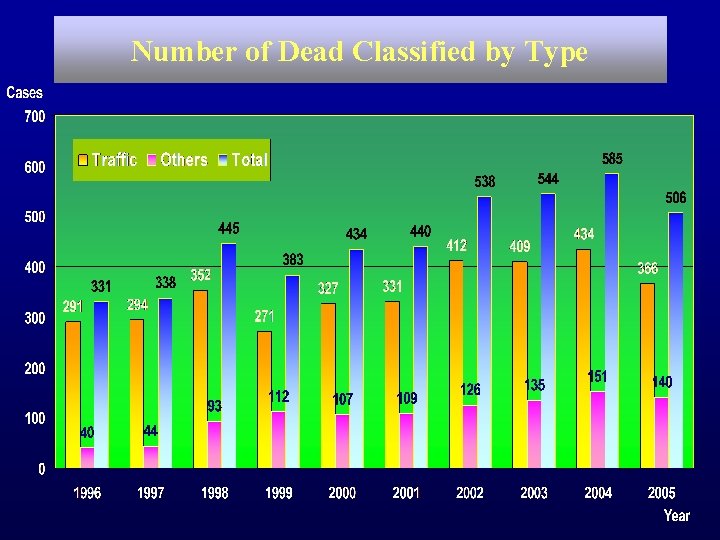
Number of Dead Classified by Type
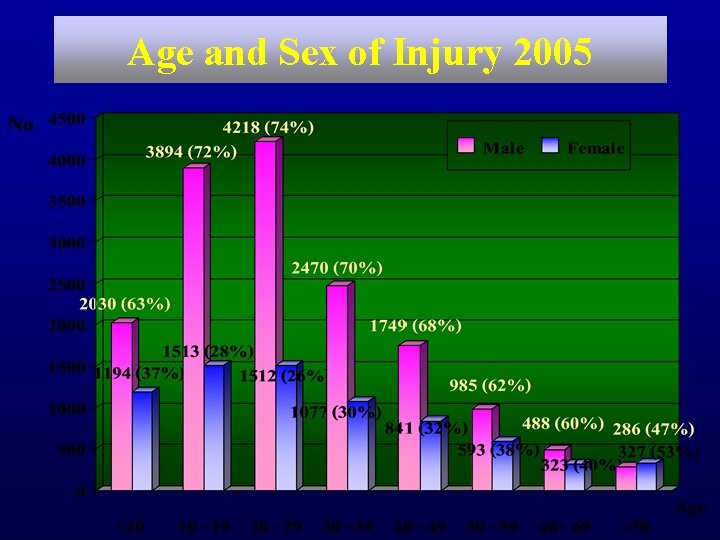
Age and Sex of Injury 2005
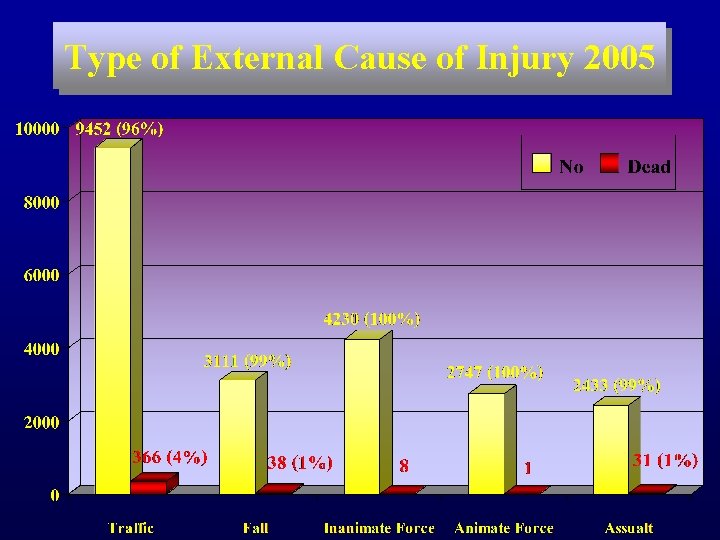
Type of External Cause of Injury 2005
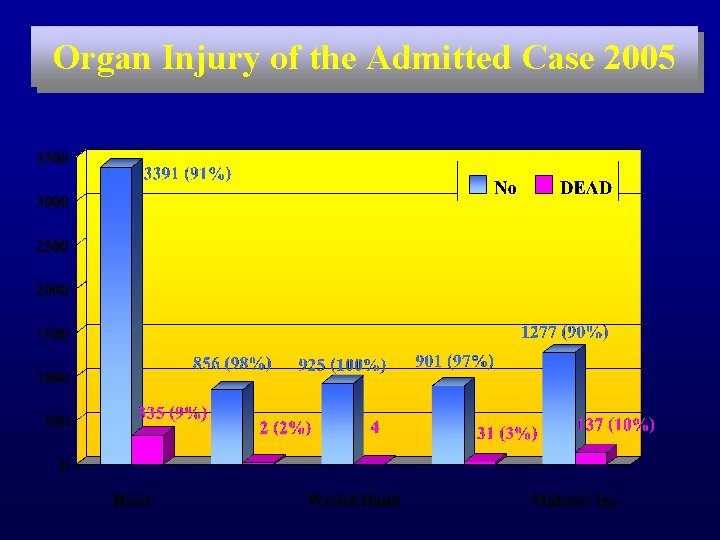
Organ Injury of the Admitted Case 2005
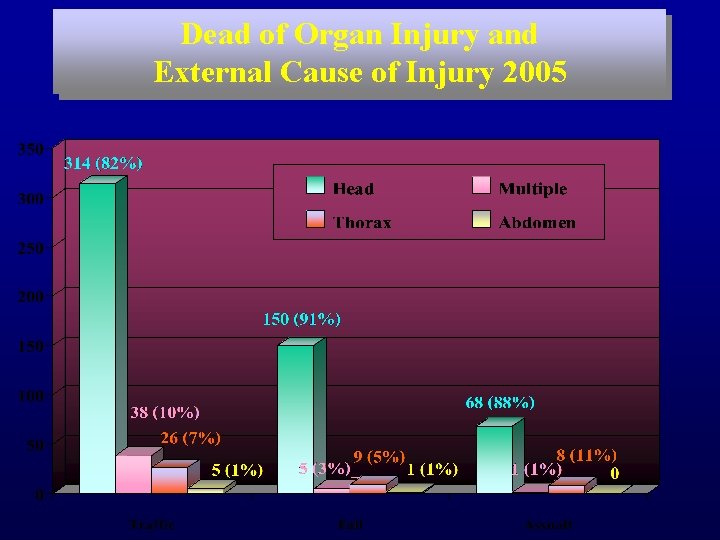
Dead of Organ Injury and External Cause of Injury 2005
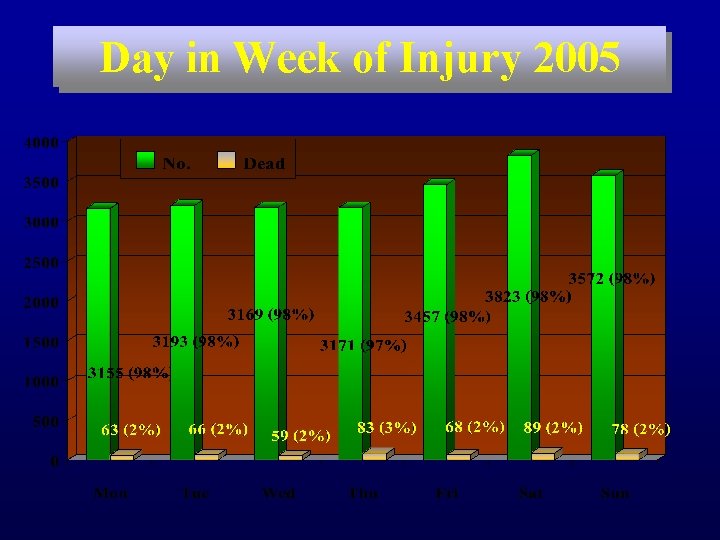
Day in Week of Injury 2005
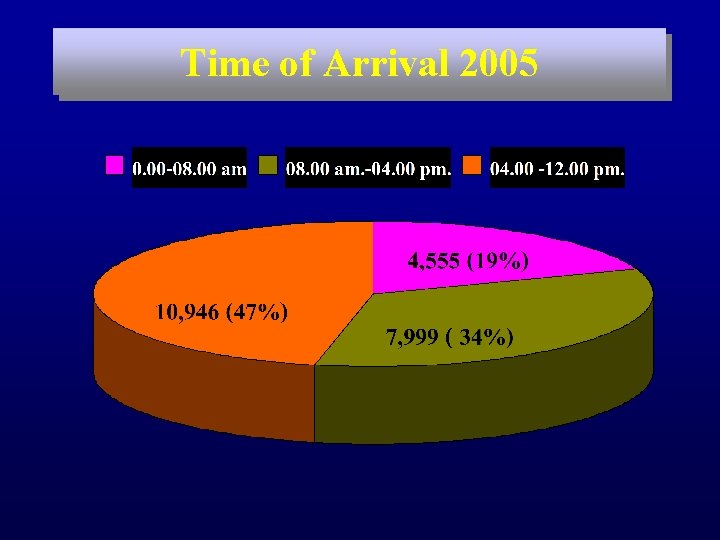
Time of Arrival 2005
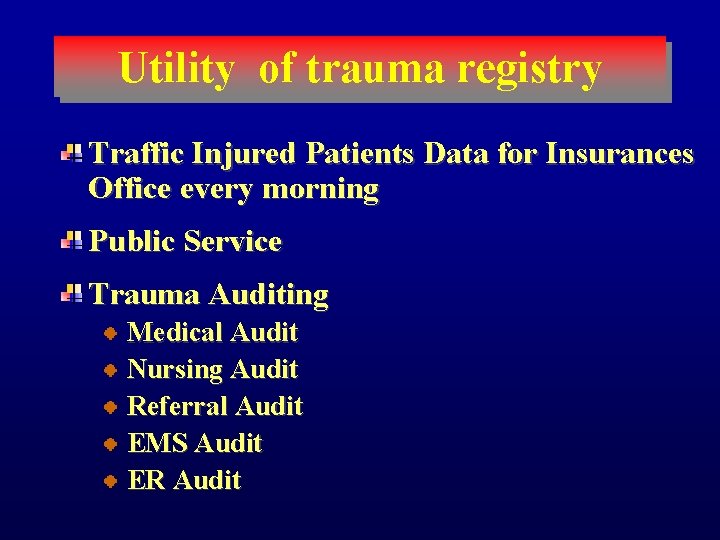
Utility of trauma registry Traffic Injured Patients Data for Insurances Office every morning Public Service Trauma Auditing Medical Audit Nursing Audit Referral Audit EMS Audit ER Audit
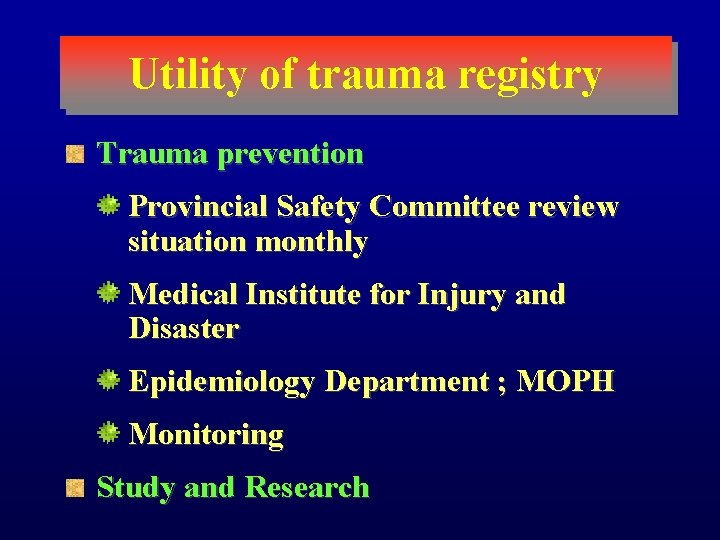
Utility of trauma registry Trauma prevention Provincial Safety Committee review situation monthly Medical Institute for Injury and Disaster Epidemiology Department ; MOPH Monitoring Study and Research
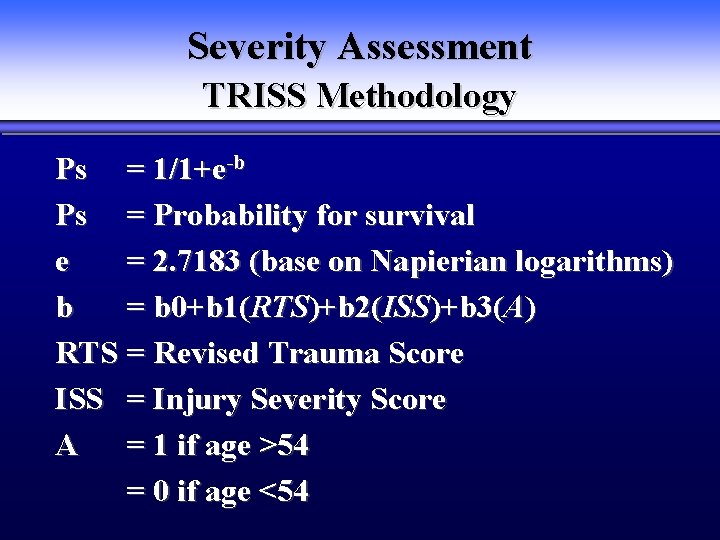
Severity Assessment TRISS Methodology Ps = 1/1+e-b Ps = Probability for survival e = 2. 7183 (base on Napierian logarithms) b = b 0+b 1(RTS)+b 2(ISS)+b 3(A) RTS = Revised Trauma Score ISS = Injury Severity Score A = 1 if age >54 = 0 if age <54
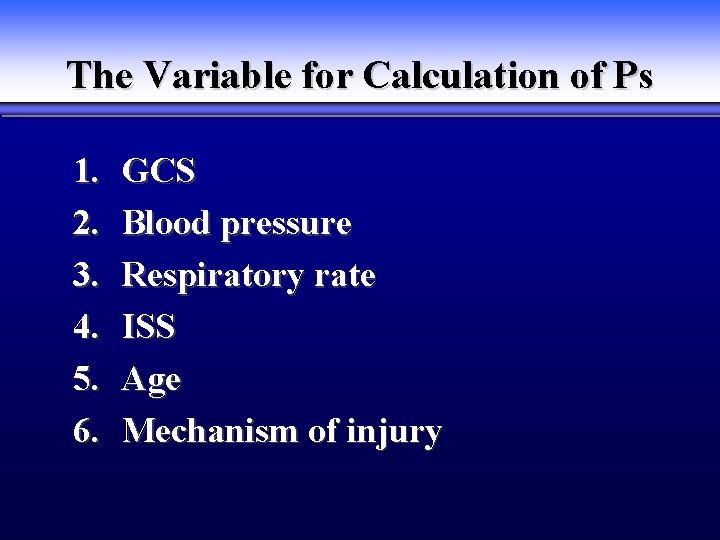
The Variable for Calculation of Ps 1. 2. 3. 4. 5. 6. GCS Blood pressure Respiratory rate ISS Age Mechanism of injury
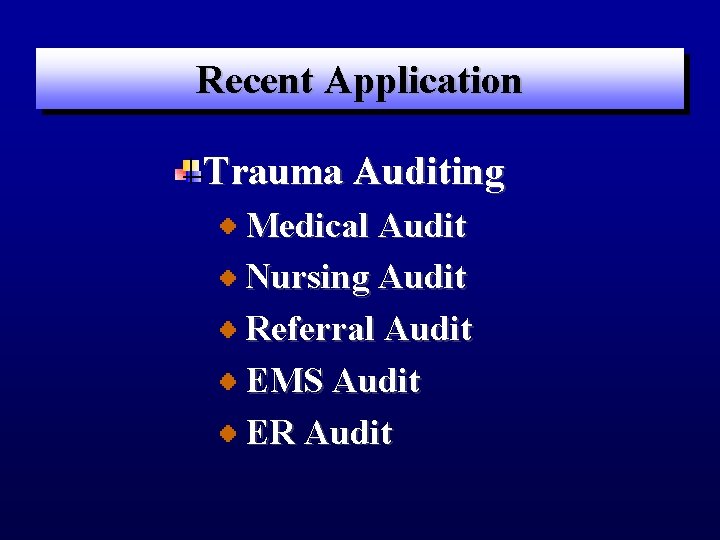
Recent Application Trauma Auditing Medical Audit Nursing Audit Referral Audit EMS Audit ER Audit
Component for Trauma Audit • • Trauma registry Medical record Trauma audit recording form Guideline for recording data and definition • Peer group review
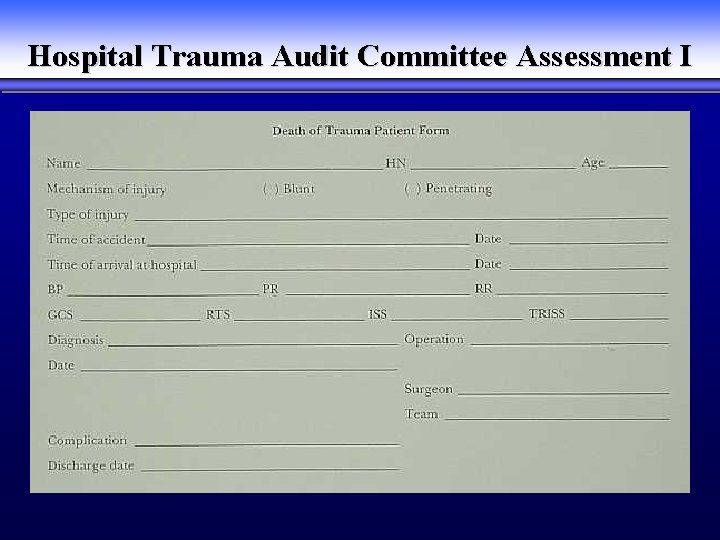
Hospital Trauma Audit Committee Assessment I
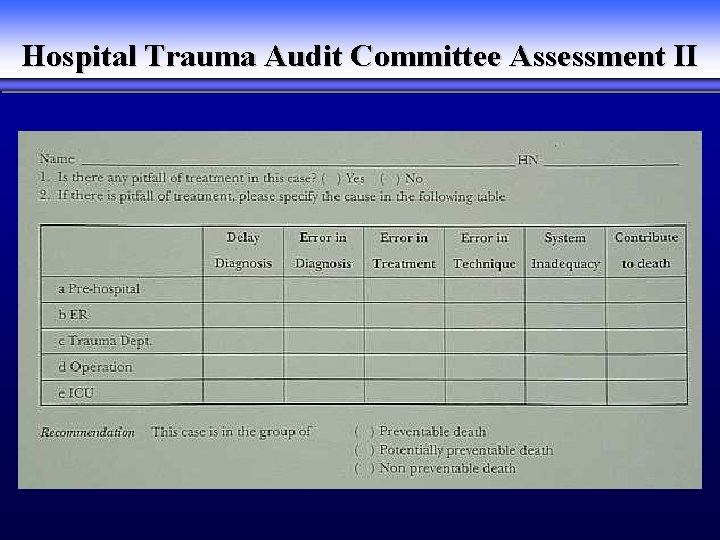
Hospital Trauma Audit Committee Assessment II
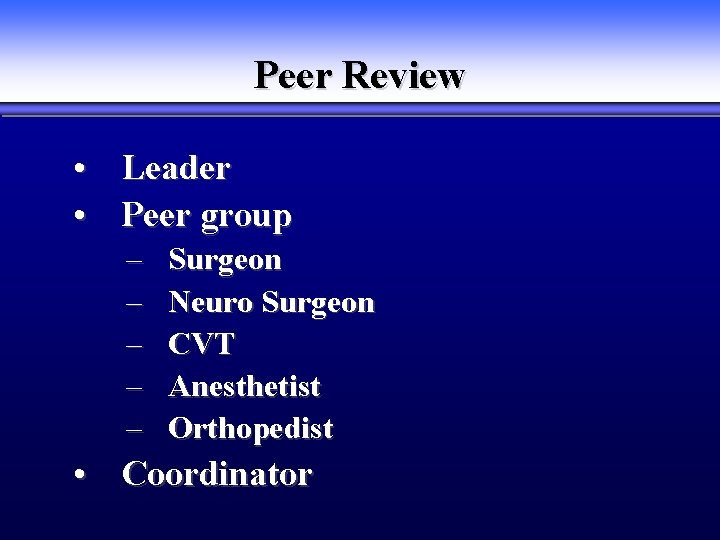
Peer Review • Leader • Peer group – – – Surgeon Neuro Surgeon CVT Anesthetist Orthopedist • Coordinator
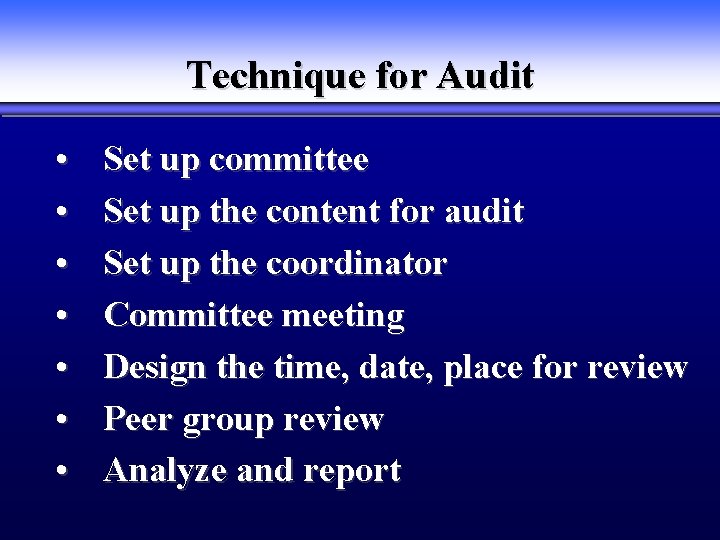
Technique for Audit • • Set up committee Set up the content for audit Set up the coordinator Committee meeting Design the time, date, place for review Peer group review Analyze and report
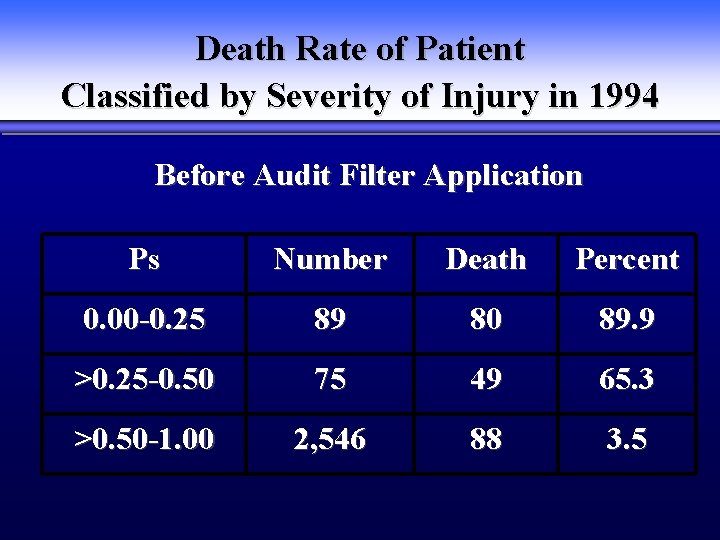
Death Rate of Patient Classified by Severity of Injury in 1994 Before Audit Filter Application Ps Number Death Percent 0. 00 -0. 25 89 80 89. 9 >0. 25 -0. 50 75 49 65. 3 >0. 50 -1. 00 2, 546 88 3. 5
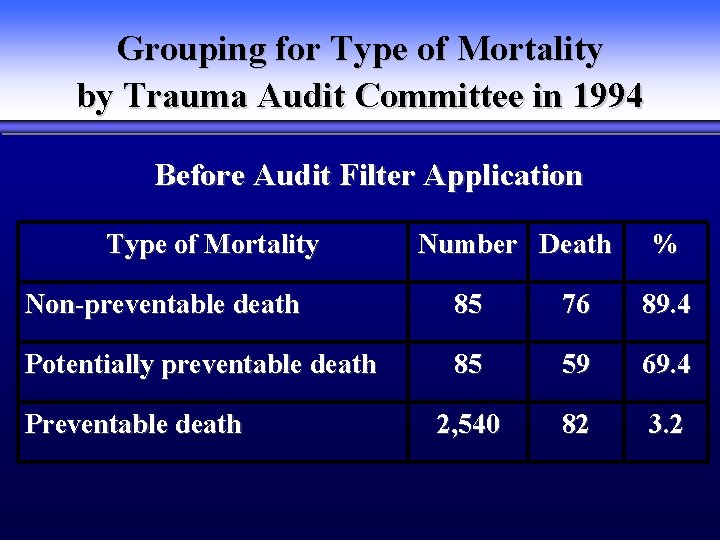
Grouping for Type of Mortality by Trauma Audit Committee in 1994 Before Audit Filter Application Type of Mortality Number Death % Non-preventable death 85 76 89. 4 Potentially preventable death 85 59 69. 4 2, 540 82 3. 2 Preventable death

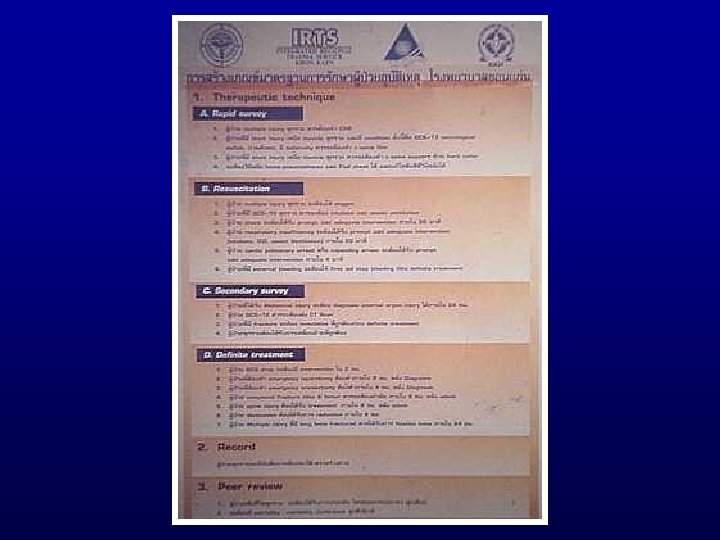
Trauma Care Improvement by Participatory Action Research
Trauma Audit for Trauma Service Development 1994 – 1995
Evaluation of Trauma Audit Project 1996
Medical and Nursing Audit for the Management of Traumatic Patient 1997 - 1998
Study on Performance Following the Key Performance Indicator for Trauma Care Khon Kaen Hospital Witaya Chadbunchachai Trauma and Critical Care Center Khon Kaen Hospital
Conceptual Frame Work • Set up system of medical care quality assessment • Auditing system - dead case peer review • Set up audit filter • Implementation • Evaluation
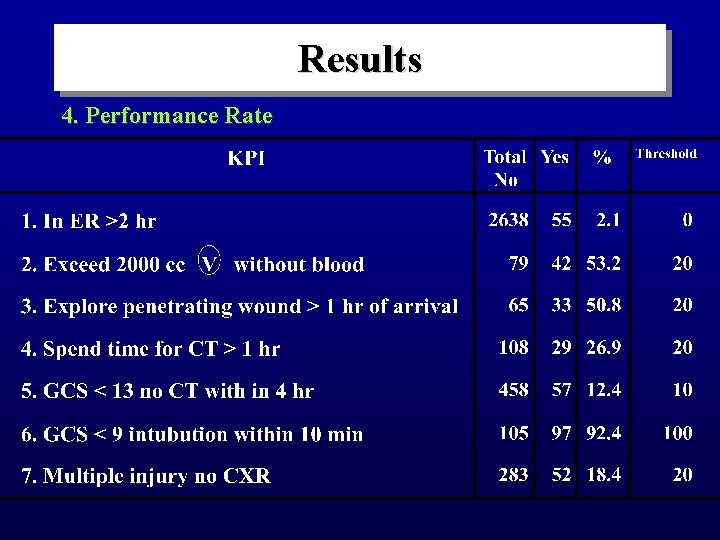
Problems in Previous Projects • Completeness of audit filter • Cooperation of personnel KPIs enhanced the efficiency of trauma care. Copes : [ J. Trauma 1995; 38: 432 -438]
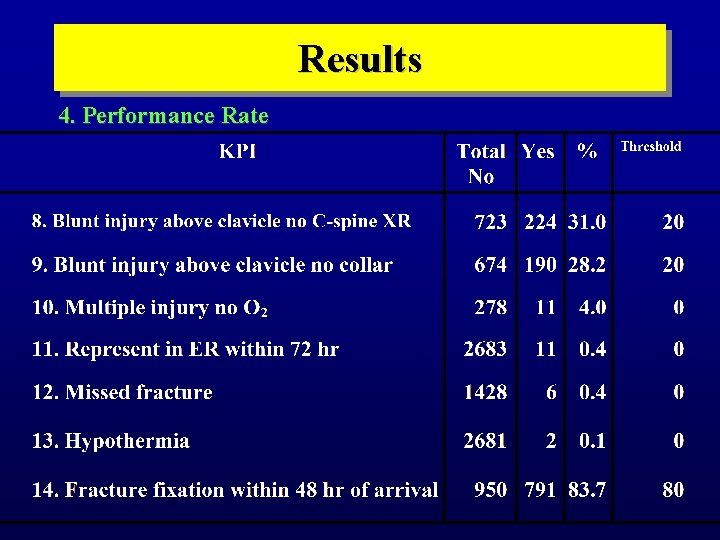
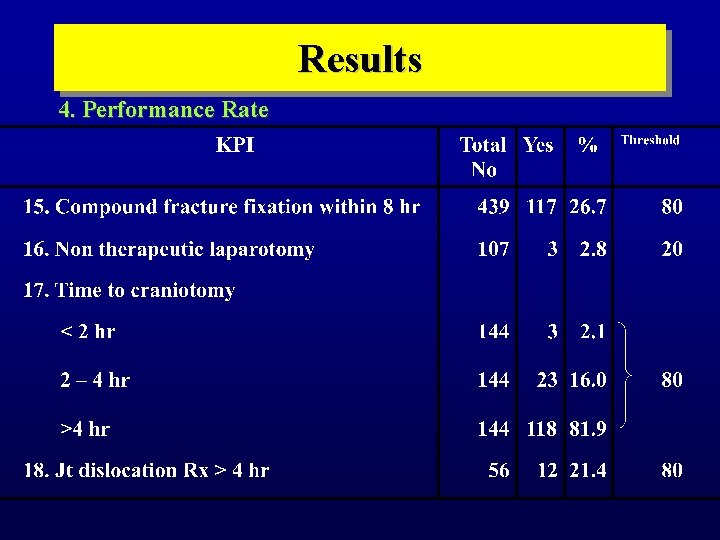
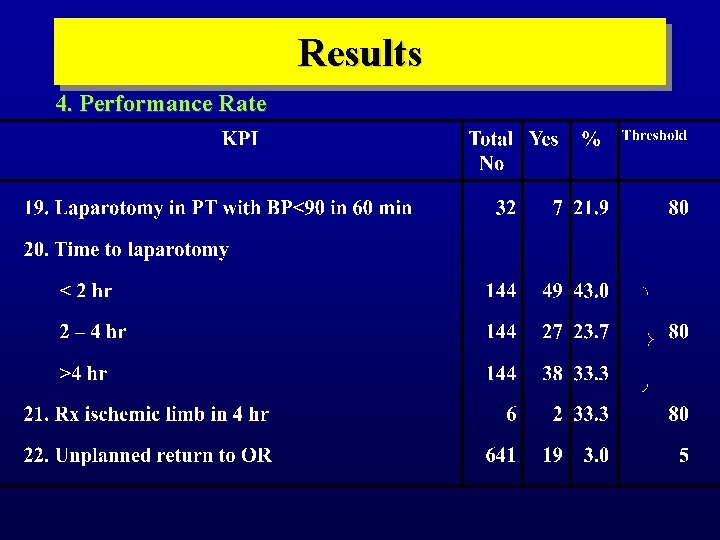
Performance Indicator : - Statistic that reflected the quality of care process leading to outcomes. Performance Management : - Method that manages personnel to comply with KPIs.
Objectives • Establishing the KPIs for trauma care • Establishing the Performance Management System for personnel in trauma care to comply with KPIs
Method 1. Preparation – KPIs establishment • Committee making KPIs • Review by 3 experts – System for performance management • Computer program for collecting data • Collecting data team • Various form (March - April 2000)
Method 2. Implementation – Meeting and training – CME • Morning report • Case conference • MM conference • X-ray conference – Orientation – Solving problem of system inadequacy (May - June 2000)
Method 3. Outcome Study Inclusion - all trauma admission - all trauma dead Exclusion - underlying disease Evaluation - Preventable dead rate - Performance rate - Compare result with 1995, 1998 (July - December 2000)
Method 4. Analysis (January - June 2001)
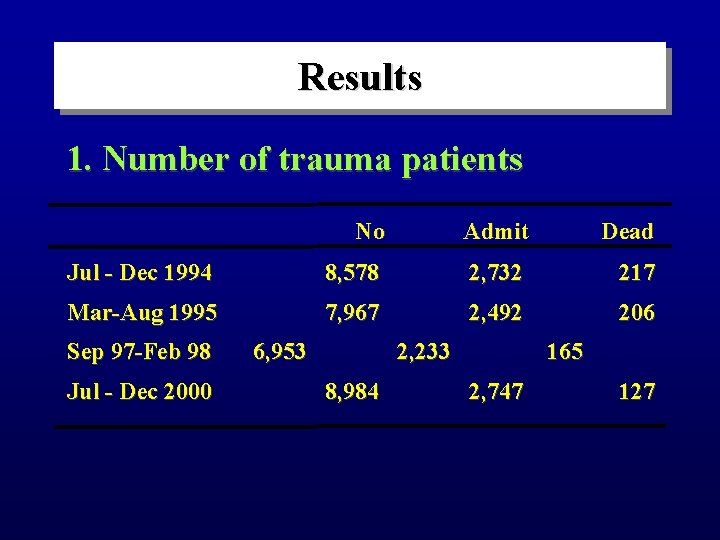
Results 1. Number of trauma patients No Admit Dead Jul - Dec 1994 8, 578 2, 732 217 Mar-Aug 1995 7, 967 2, 492 206 Sep 97 -Feb 98 Jul - Dec 2000 6, 953 2, 233 8, 984 165 2, 747 127
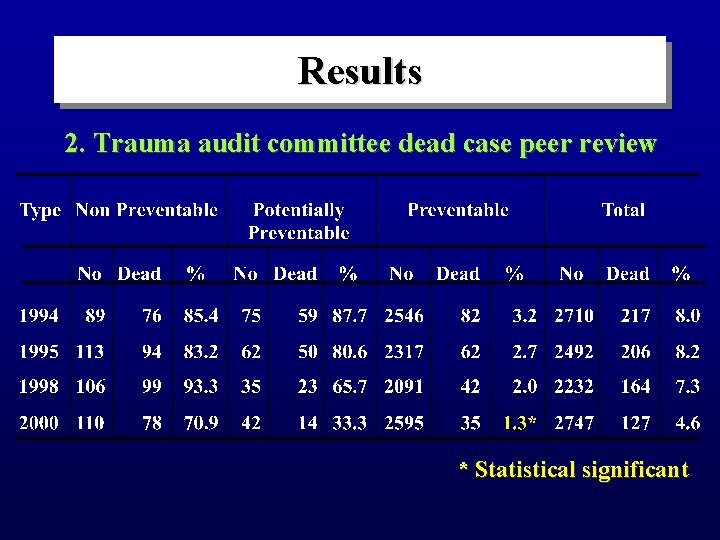
Results 2. Trauma audit committee dead case peer review * Statistical significant
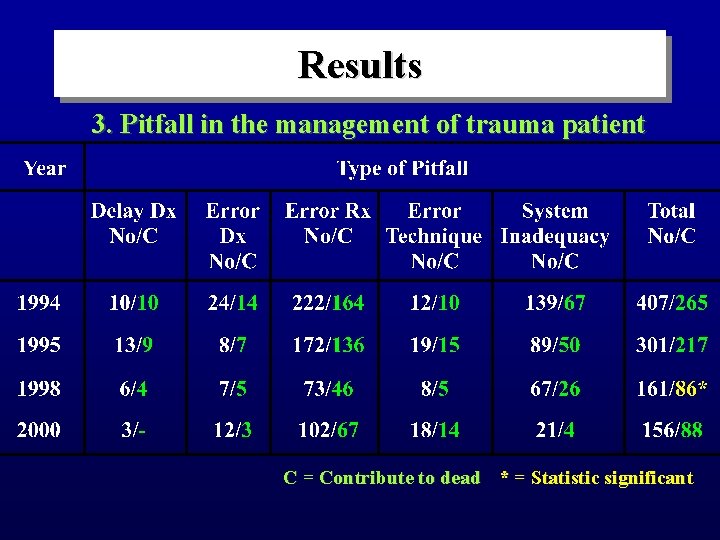
Results 3. Pitfall in the management of trauma patient C = Contribute to dead * = Statistic significant
Results 4. Performance Rate
Results 4. Performance Rate
Results 4. Performance Rate
Results 4. Performance Rate
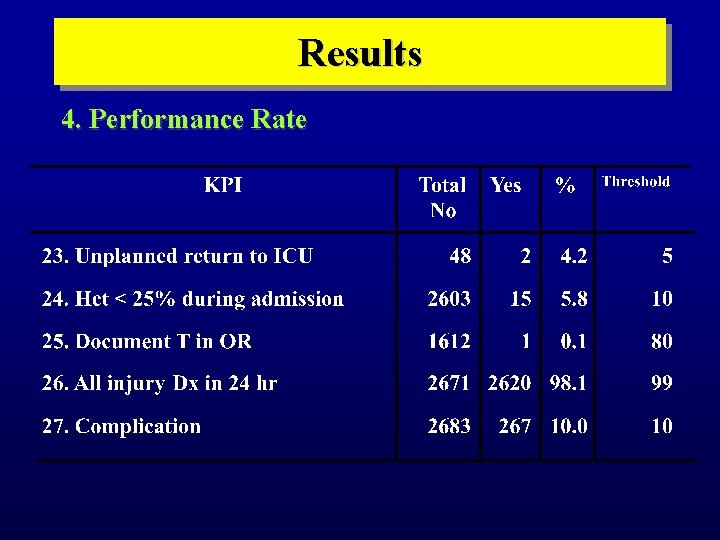
Results 4. Performance Rate

Discussion 1. Establishing the KPIs for trauma care is a major step in improving the quality of care 2. Key success is to make all personnel understand willing to practice the KPIs
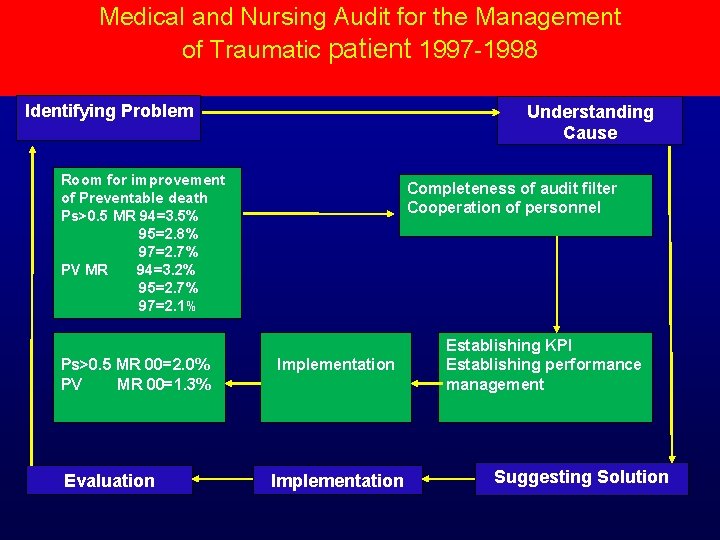
Medical and Nursing Audit for the Management of Traumatic patient 1997 -1998 Identifying Problem Understanding Cause Room for improvement of Preventable death Ps>0. 5 MR 94=3. 5% 95=2. 8% 97=2. 7% PV MR 94=3. 2% 95=2. 7% 97=2. 1% Ps>0. 5 MR 00=2. 0% PV MR 00=1. 3% Evaluation Completeness of audit filter Cooperation of personnel Implementation Establishing KPI Establishing performance management Suggesting Solution
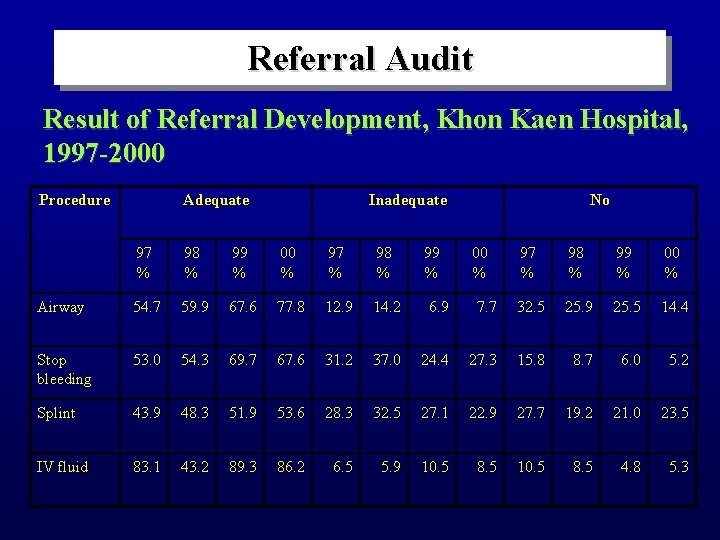
Referral Audit Result of Referral Development, Khon Kaen Hospital, 1997 -2000 Procedure Adequate Inadequate 97 % 98 % 99 % 00 % 97 % 98 % 99 % Airway 54. 7 59. 9 67. 6 77. 8 12. 9 14. 2 6. 9 Stop bleeding 53. 0 54. 3 69. 7 67. 6 31. 2 37. 0 Splint 43. 9 48. 3 51. 9 53. 6 28. 3 IV fluid 83. 1 43. 2 89. 3 86. 2 6. 5 No 00 % 97 % 98 % 99 % 00 % 7. 7 32. 5 25. 9 25. 5 14. 4 27. 3 15. 8 8. 7 6. 0 5. 2 32. 5 27. 1 22. 9 27. 7 19. 2 21. 0 23. 5 5. 9 10. 5 8. 5 4. 8 5. 3
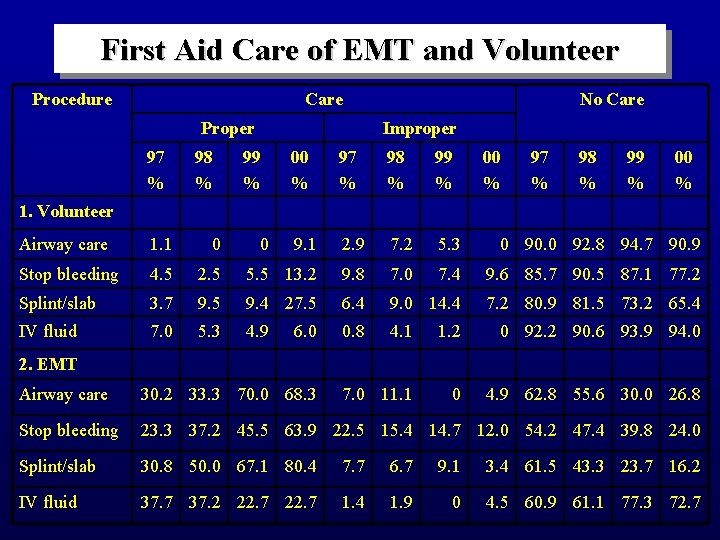
First Aid Care of EMT and Volunteer Procedure Care Proper 97 % 98 % No Care Improper 99 % 00 % 97 % 98 % 99 % 00 % 9. 1 2. 9 7. 2 5. 3 0 90. 0 92. 8 94. 7 90. 9 1. Volunteer Airway care 1. 1 0 0 Stop bleeding 4. 5 2. 5 5. 5 13. 2 9. 8 7. 0 7. 4 9. 6 85. 7 90. 5 87. 1 77. 2 Splint/slab 3. 7 9. 5 9. 4 27. 5 6. 4 9. 0 14. 4 7. 2 80. 9 81. 5 73. 2 65. 4 IV fluid 7. 0 5. 3 4. 9 0. 8 4. 1 1. 2 0 92. 2 90. 6 93. 9 94. 0 7. 0 11. 1 0 4. 9 62. 8 55. 6 30. 0 26. 8 6. 0 2. EMT Airway care 30. 2 33. 3 70. 0 68. 3 Stop bleeding 23. 3 37. 2 45. 5 63. 9 22. 5 15. 4 14. 7 12. 0 54. 2 47. 4 39. 8 24. 0 Splint/slab 30. 8 50. 0 67. 1 80. 4 7. 7 6. 7 9. 1 3. 4 61. 5 43. 3 23. 7 16. 2 IV fluid 37. 7 37. 2 22. 7 1. 4 1. 9 0 4. 5 60. 9 61. 1 77. 3 72. 7
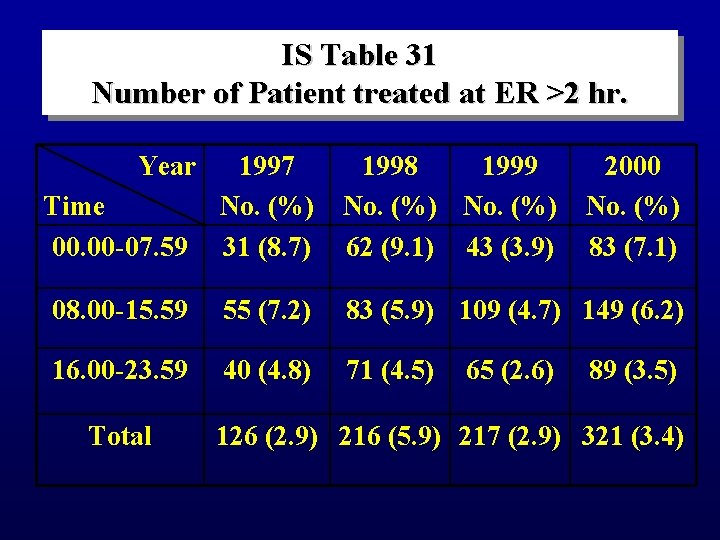
IS Table 31 Number of Patient treated at ER >2 hr. Year Time 00. 00 -07. 59 1997 No. (%) 31 (8. 7) 1998 1999 No. (%) 62 (9. 1) 43 (3. 9) 08. 00 -15. 59 55 (7. 2) 83 (5. 9) 109 (4. 7) 149 (6. 2) 16. 00 -23. 59 40 (4. 8) 71 (4. 5) Total 65 (2. 6) 2000 No. (%) 83 (7. 1) 89 (3. 5) 126 (2. 9) 216 (5. 9) 217 (2. 9) 321 (3. 4)
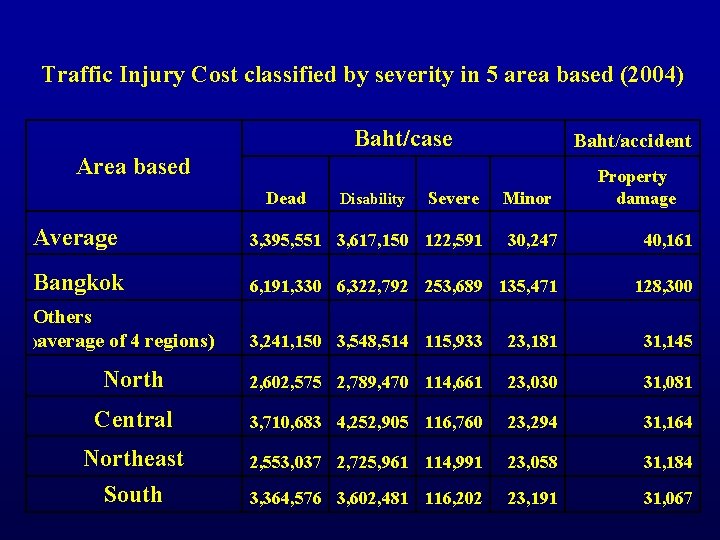
Traffic Injury Cost classified by severity in 5 area based (2004) Baht/case Baht/accident Area based Dead Disability Severe Minor Property damage Average 3, 395, 551 3, 617, 150 122, 591 30, 247 40, 161 Bangkok 6, 191, 330 6, 322, 792 253, 689 135, 471 128, 300 Others )average of 4 regions) 3, 241, 150 3, 548, 514 115, 933 23, 181 31, 145 North 2, 602, 575 2, 789, 470 114, 661 23, 030 31, 081 Central 3, 710, 683 4, 252, 905 116, 760 23, 294 31, 164 Northeast 2, 553, 037 2, 725, 961 114, 991 23, 058 31, 184 South 3, 364, 576 3, 602, 481 116, 202 23, 191 31, 067
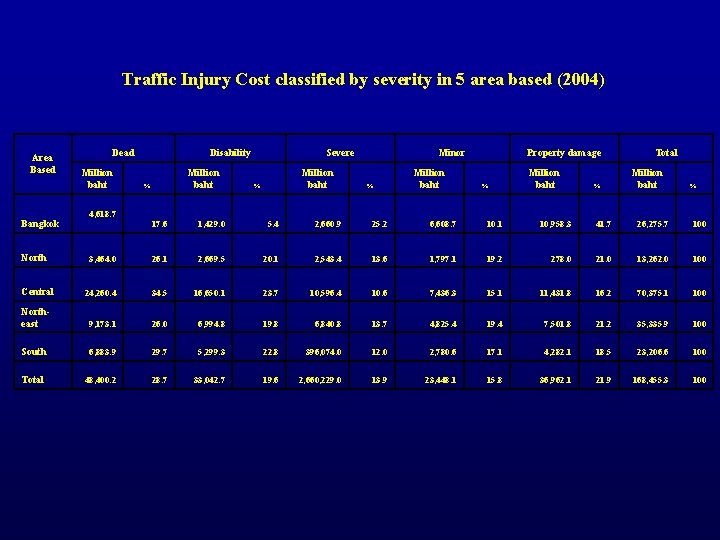
Traffic Injury Cost classified by severity in 5 area based (2004) Area Based Bangkok Dead Million baht Disability Million baht % Severe Million baht % Minor % Million baht Property damage % Million baht % Total Million baht % 4, 618. 7 17. 6 1, 429. 0 5. 4 2, 660. 9 25. 2 6, 608. 7 10. 1 10, 958. 3 41. 7 26, 275. 7 100 3, 464. 0 26. 1 2, 669. 5 20. 1 2, 543. 4 13. 6 1, 797. 1 19. 2 278. 0 21. 0 13, 262. 0 100 Central 24, 260. 4 34. 5 16, 650. 1 23. 7 10, 596. 4 10. 6 7, 436. 3 15. 1 11, 431. 8 16. 2 70, 375. 1 100 Northeast 9, 173. 1 26. 0 6, 994. 8 19. 8 6, 840. 8 13. 7 4, 825. 4 19. 4 7, 501. 8 21. 2 35, 335. 9 100 South 6, 883. 9 29. 7 5, 299. 3 22. 8 396, 074. 0 12. 0 2, 780. 6 17. 1 4, 282. 1 18. 5 23, 206. 6 100 Total 48, 400. 2 28. 7 33, 042. 7 19. 6 2, 660, 229. 0 13. 9 23, 448. 1 15. 8 36, 962. 1 21. 9 168, 455. 3 100 North

EFFECTIVE KNOWLEDGE TRANSFER REQUIRES THE RECIPIENT TO NOT ONLY HAVE A NEED BUT ALSO A DESIRE TO MEET THAT NEED; IT NEEDS THEIR HEARTS AS WELL AS THEIR MINDS. B. J. Campbell, 1998 Global Traffic Safety Trust

Your Committee motivation delication to make to happen make a difference Peter Davison
- Slides: 81