COMPANDING 1 is the process of compressing and

- Slides: 23
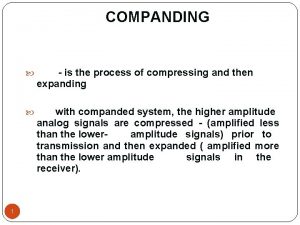
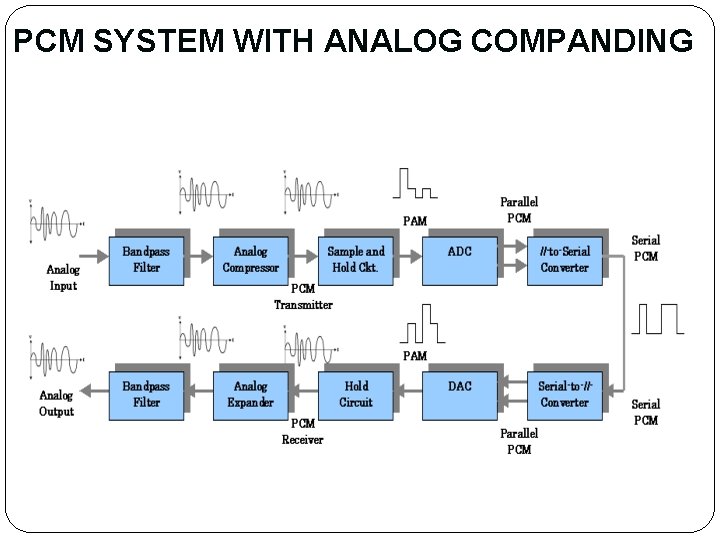
COMPANDING 1 - is the process of compressing and then expanding with companded system, the higher amplitude analog signals are compressed - (amplified less than the loweramplitude signals) prior to transmission and then expanded ( amplified more than the lower amplitude signals in the receiver).
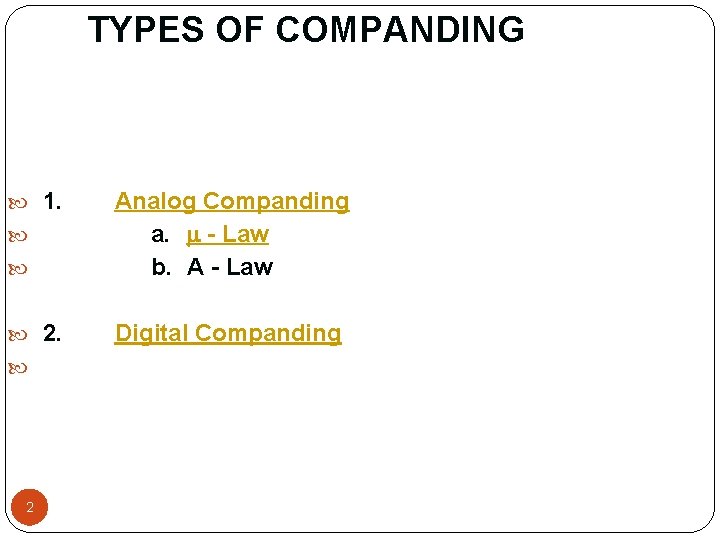
TYPES OF COMPANDING 1. Analog Companding a. - Law b. A - Law 2. Digital Companding 2
PCM SYSTEM WITH ANALOG COMPANDING
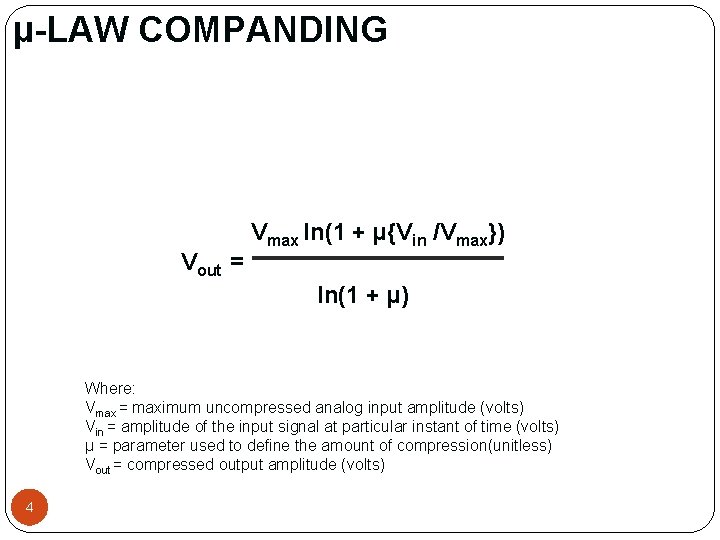
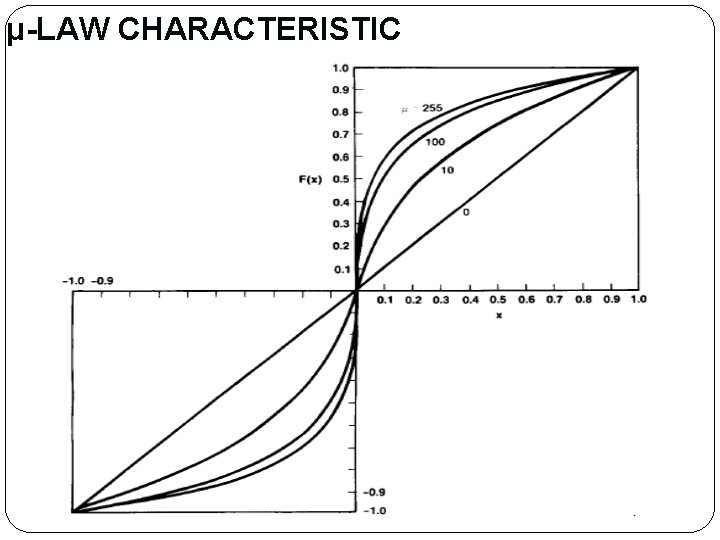
µ-LAW COMPANDING Vout = Vmax ln(1 + µ{Vin /Vmax}) ln(1 + µ) Where: Vmax = maximum uncompressed analog input amplitude (volts) Vin = amplitude of the input signal at particular instant of time (volts) µ = parameter used to define the amount of compression(unitless) Vout = compressed output amplitude (volts) 4
µ-LAW CHARACTERISTIC
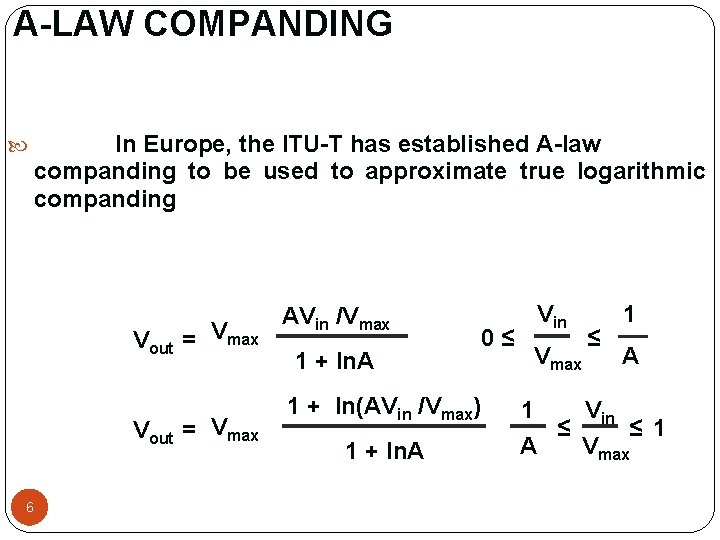
A-LAW COMPANDING In Europe, the ITU-T has established A-law companding to be used to approximate true logarithmic companding Vout = Vmax 6 AVin /Vmax 1 + ln. A 1 + ln(AVin /Vmax) 1 + ln. A 0≤ Vin Vmax ≤ 1 A 1 Vin ≤ ≤ 1 A Vmax
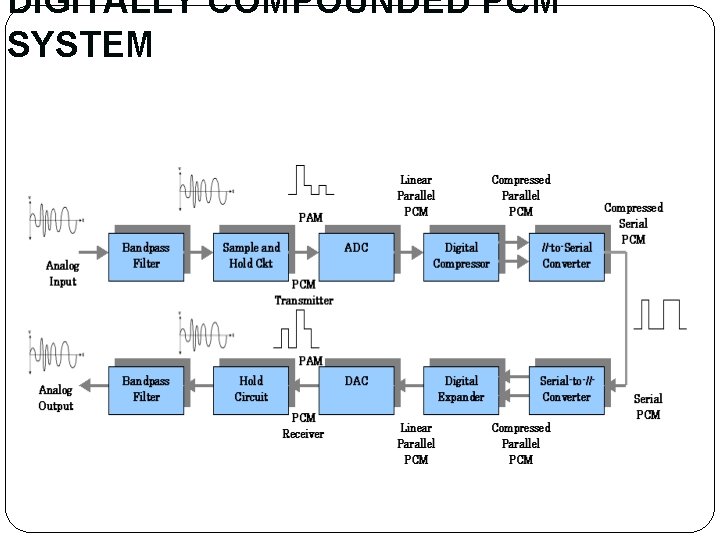
DIGITALLY COMPOUNDED PCM SYSTEM
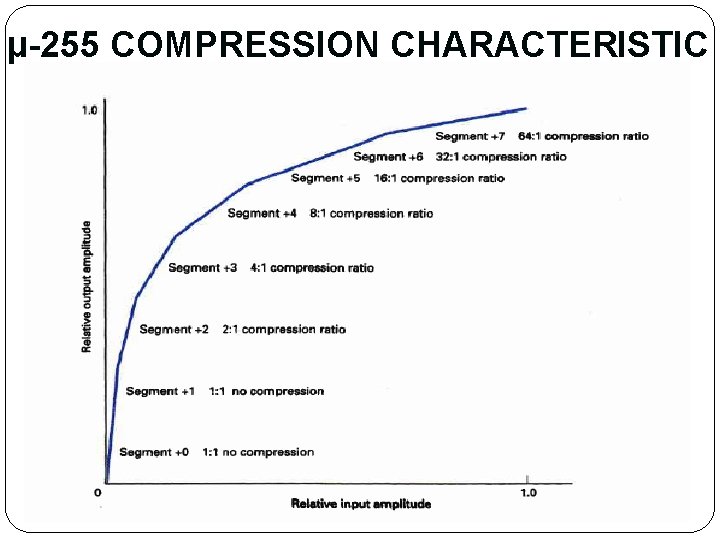
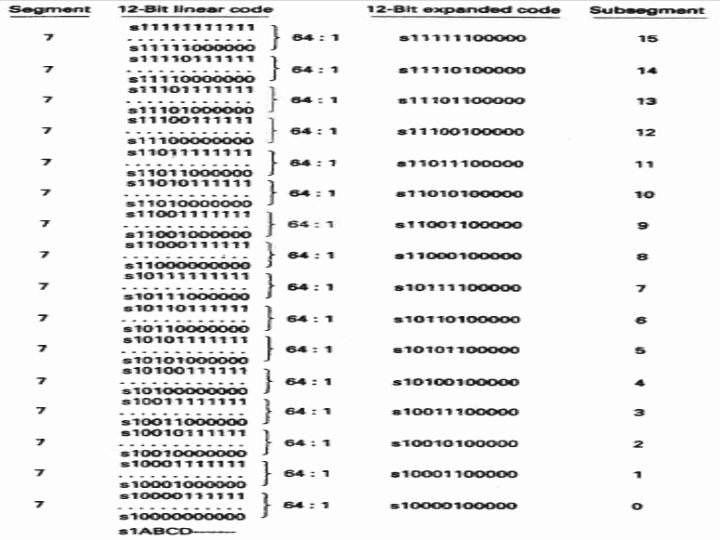
µ-255 COMPRESSION CHARACTERISTIC - µ-law companding is a system that divides the analog signal range into fifteen segments each eventually encoded into eight-bit digital value.
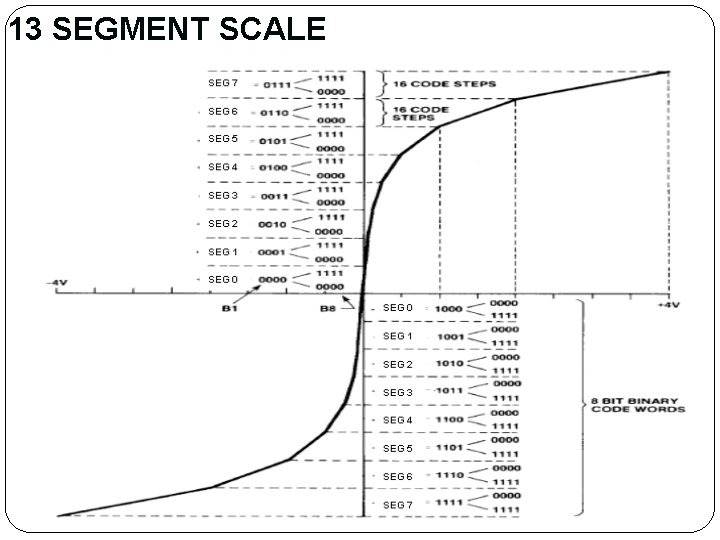
13 SEGMENT SCALE
µ-255 COMPRESSION CHARACTERISTIC
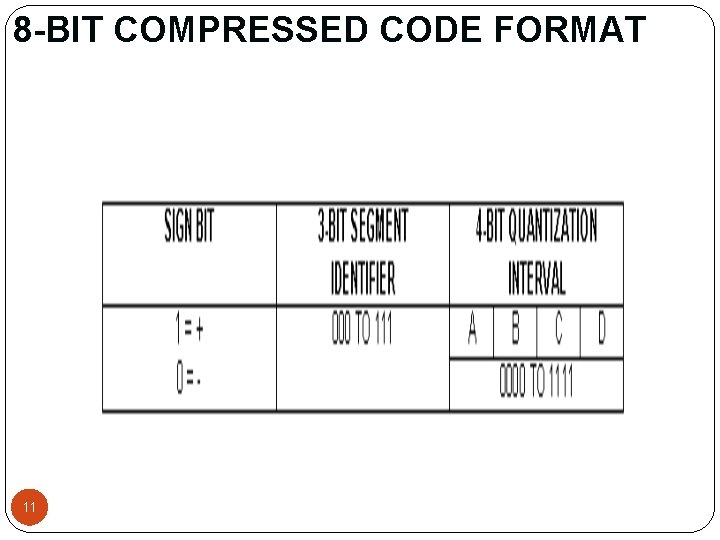
8 -BIT COMPRESSED CODE FORMAT 11
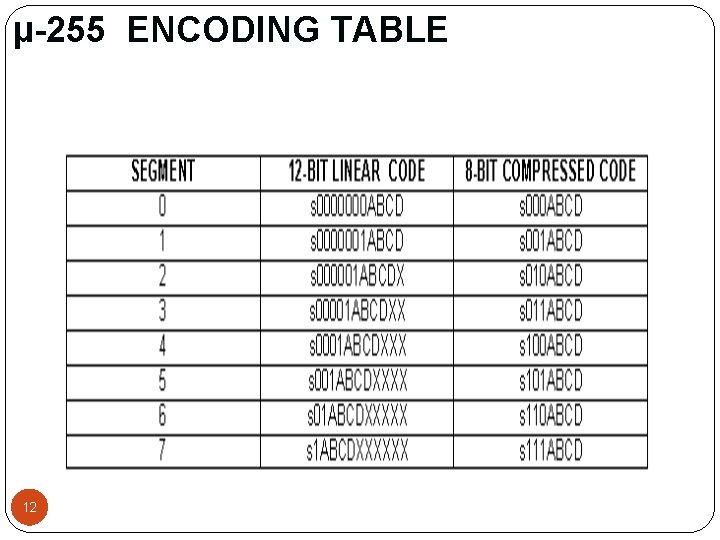
µ-255 ENCODING TABLE 12
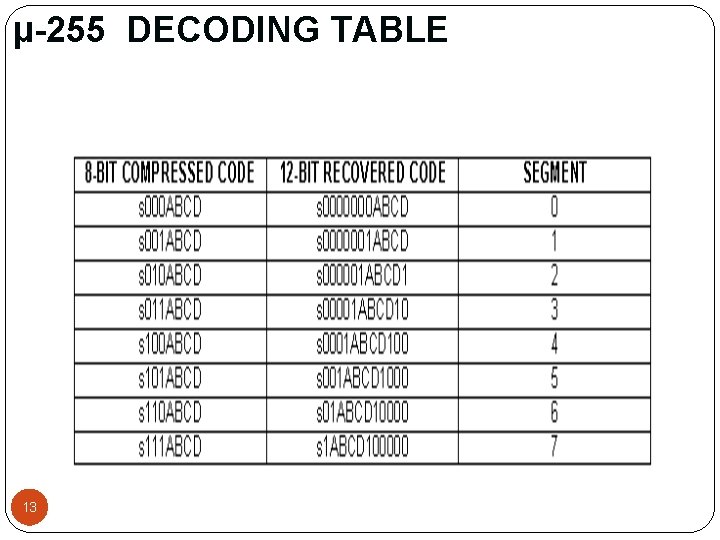
µ-255 DECODING TABLE 13
14
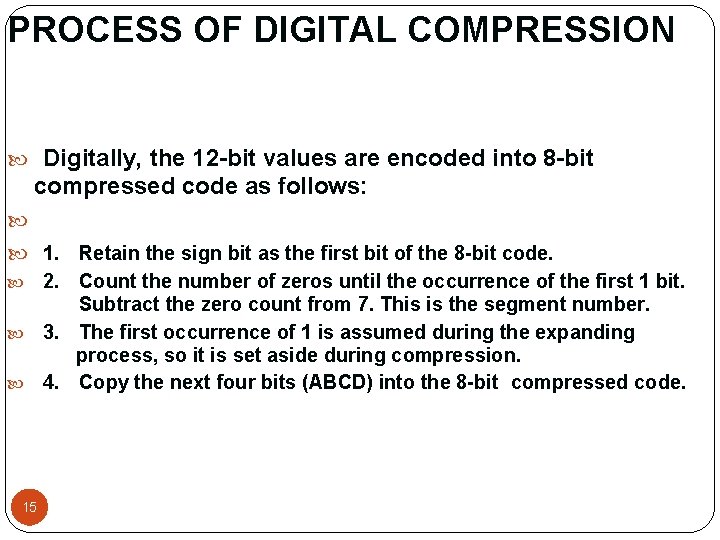
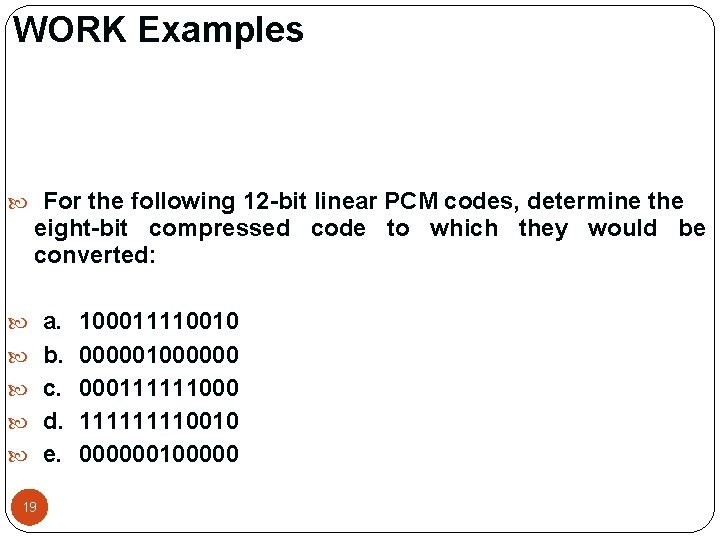
PROCESS OF DIGITAL COMPRESSION Digitally, the 12 -bit values are encoded into 8 -bit compressed code as follows: 1. Retain the sign bit as the first bit of the 8 -bit code. 2. Count the number of zeros until the occurrence of the first 1 bit. Subtract the zero count from 7. This is the segment number. 3. The first occurrence of 1 is assumed during the expanding process, so it is set aside during compression. 4. Copy the next four bits (ABCD) into the 8 -bit compressed code. 15
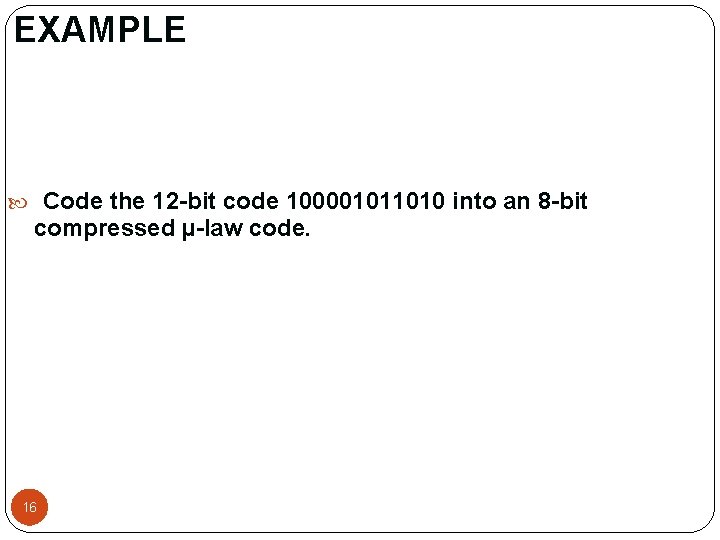
EXAMPLE Code the 12 -bit code 100001011010 into an 8 -bit compressed µ-law code. 16
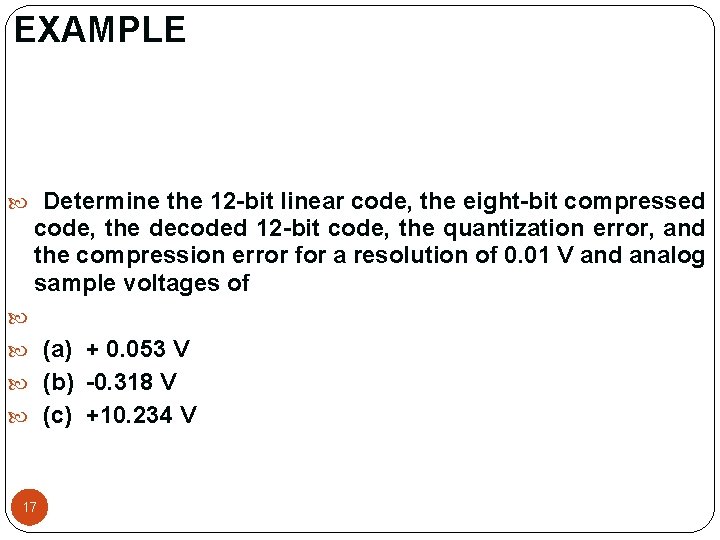
EXAMPLE Determine the 12 -bit linear code, the eight-bit compressed code, the decoded 12 -bit code, the quantization error, and the compression error for a resolution of 0. 01 V and analog sample voltages of (a) + 0. 053 V (b) -0. 318 V (c) +10. 234 V 17
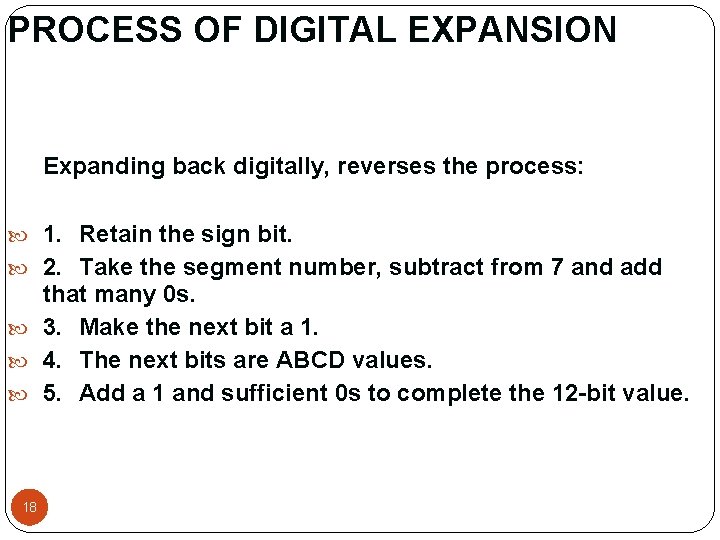
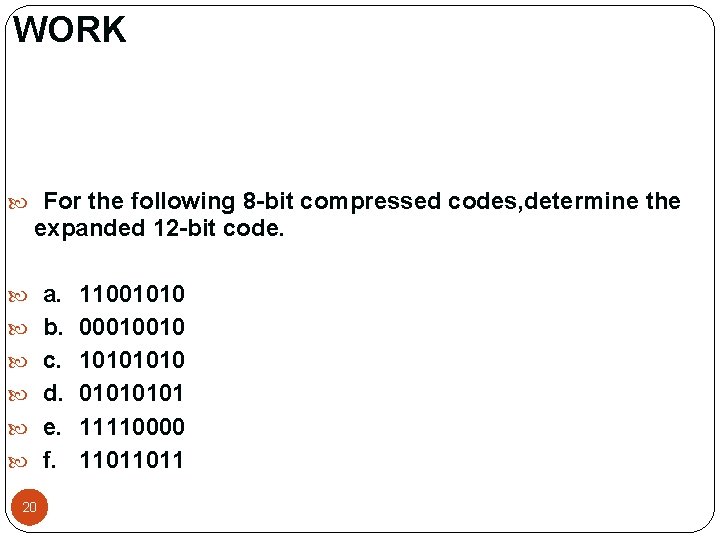
PROCESS OF DIGITAL EXPANSION Expanding back digitally, reverses the process: 1. Retain the sign bit. 2. Take the segment number, subtract from 7 and add that many 0 s. 3. Make the next bit a 1. 4. The next bits are ABCD values. 5. Add a 1 and sufficient 0 s to complete the 12 -bit value. 18
WORK Examples For the following 12 -bit linear PCM codes, determine the eight-bit compressed code to which they would be converted: a. 100011110010 b. 000001000000 c. 000111111000 d. 11110010 e. 000000100000 19
WORK For the following 8 -bit compressed codes, determine the expanded 12 -bit code. a. 11001010 b. 00010010 c. 1010 d. 0101 e. 11110000 f. 20 11011011
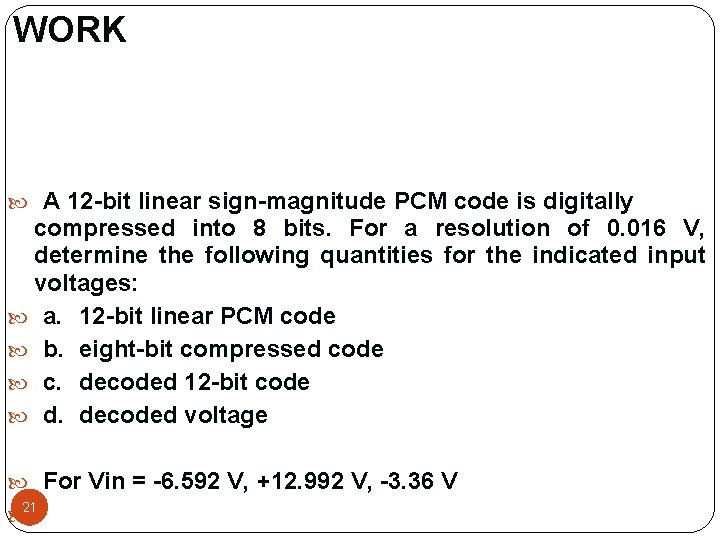
WORK A 12 -bit linear sign-magnitude PCM code is digitally compressed into 8 bits. For a resolution of 0. 016 V, determine the following quantities for the indicated input voltages: a. 12 -bit linear PCM code b. eight-bit compressed code c. decoded 12 -bit code d. decoded voltage For Vin = -6. 592 V, +12. 992 V, -3. 36 V 21
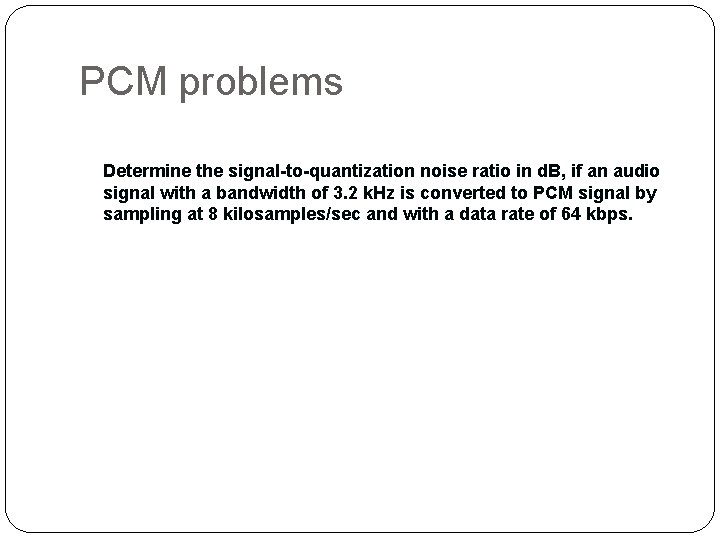
PCM problems Determine the signal-to-quantization noise ratio in d. B, if an audio signal with a bandwidth of 3. 2 k. Hz is converted to PCM signal by sampling at 8 kilosamples/sec and with a data rate of 64 kbps.
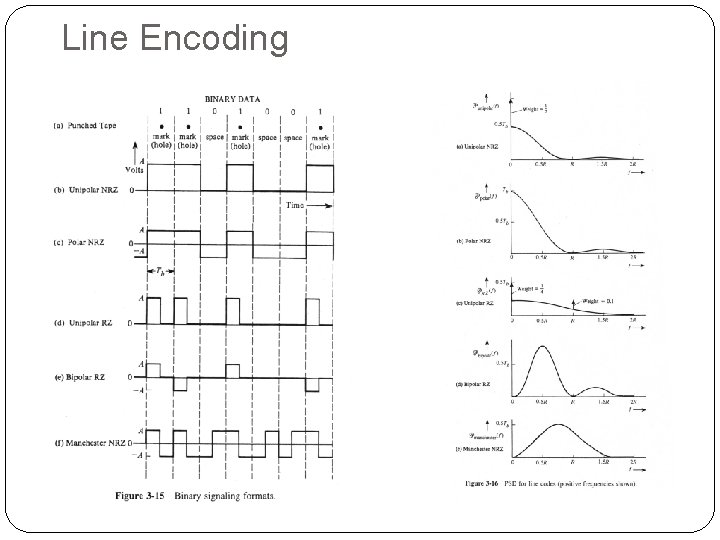
Line Encoding