Chemistry Energy Revision Contents Enthalpy First Law Enthalpy

- Slides: 32
Chemistry Energy Revision
Contents � Enthalpy �First Law �Enthalpy � Enthalpy Change �Simple Calorimeter �Endothermic �Exothermic �Standard Enthalpy Change � Of reaction � Of combustion � Calorimeters for Enthalpy Change of Combustion � Of formation �Bond Enthalpy � Rates of reaction �Rates of Reaction �Collision theory �Surface area �Pressure �Concentration �Temperature �Catalysts �Heterogeneous Catalysis � Equilibrium �Dynamic Equilibrium �Le Chatelier’s Principle �Factors affecting the position of the equilibrium �Ammonia and the Haber Process � Glossary �Enthalpy �Rates of Reaction �Equilibrium
Back to contents Enthalpy � First Law � Enthalpy Change � Calorimeter � Endothermic � Exothermic � Standard Enthalpy Change � Of reaction � Of combustion � Calorimeters for Enthalpy Change of Combustion � Of formation � Bond Enthalpy
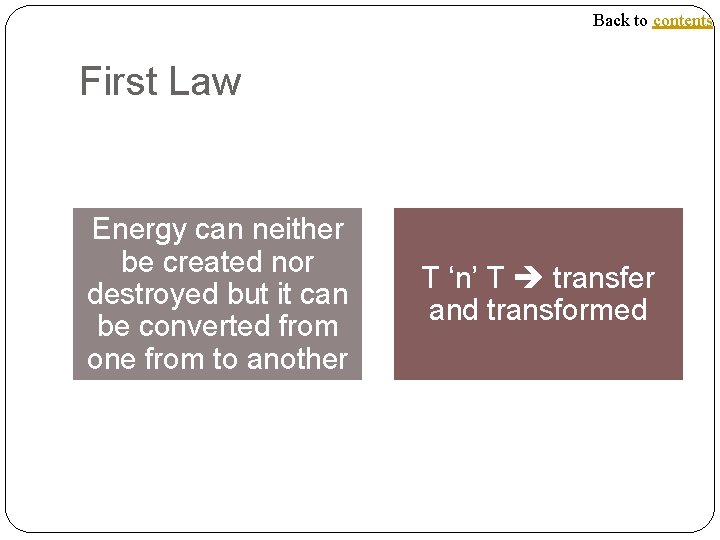
Back to contents First Law Energy can neither be created nor destroyed but it can be converted from one from to another T ‘n’ T transfer and transformed
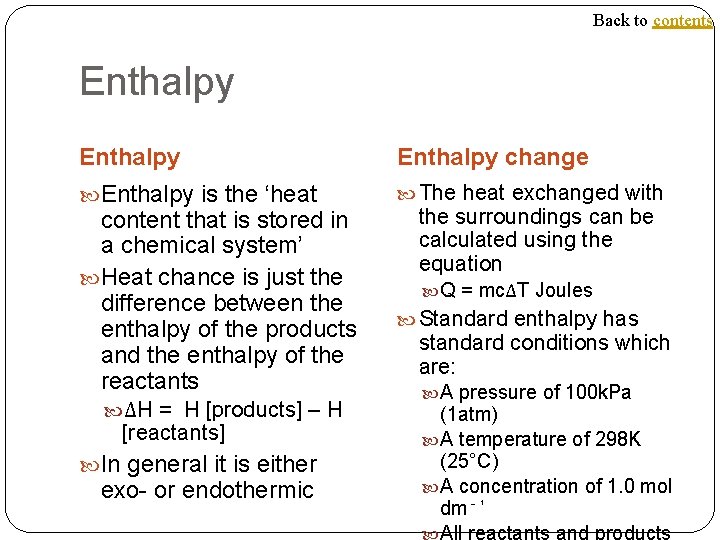
Back to contents Enthalpy change Enthalpy is the ‘heat The heat exchanged with content that is stored in a chemical system’ Heat chance is just the difference between the enthalpy of the products and the enthalpy of the reactants ΔH = H [products] – H [reactants] In general it is either exo- or endothermic the surroundings can be calculated using the equation Q = mcΔT Joules Standard enthalpy has standard conditions which are: A pressure of 100 k. Pa (1 atm) A temperature of 298 K (25°C) A concentration of 1. 0 mol dm⁻¹
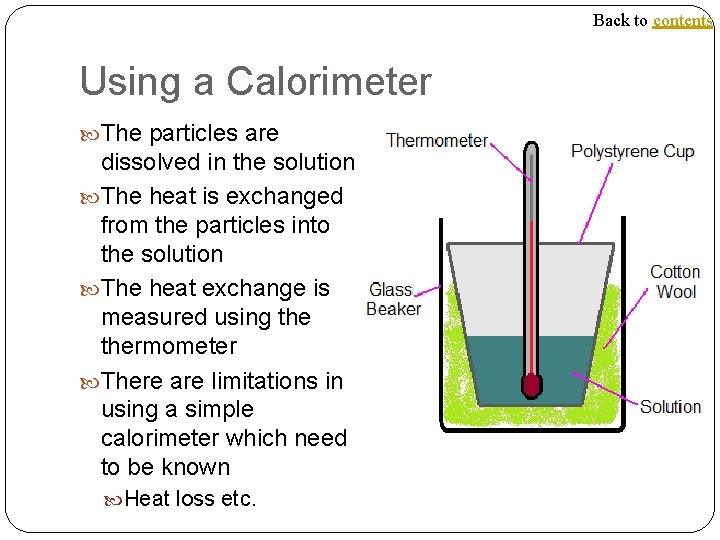
Back to contents Using a Calorimeter The particles are dissolved in the solution The heat is exchanged from the particles into the solution The heat exchange is measured using thermometer There are limitations in using a simple calorimeter which need to be known Heat loss etc.
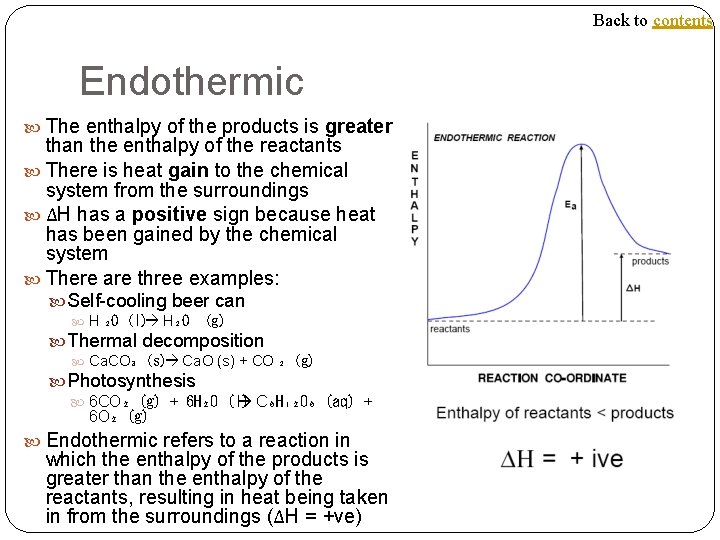
Back to contents Endothermic The enthalpy of the products is greater than the enthalpy of the reactants There is heat gain to the chemical system from the surroundings ΔH has a positive sign because heat has been gained by the chemical system There are three examples: Self-cooling beer can H ₂O (l) H₂O (g) Thermal decomposition Ca. CO₃ (s) Ca. O (s) + CO ₂ (g) Photosynthesis 6 CO₂ (g) + 6 H₂O (l) C₆H₁₂O₆ (aq) + 6 O₂ (g) Endothermic refers to a reaction in which the enthalpy of the products is greater than the enthalpy of the reactants, resulting in heat being taken in from the surroundings (ΔH = +ve)
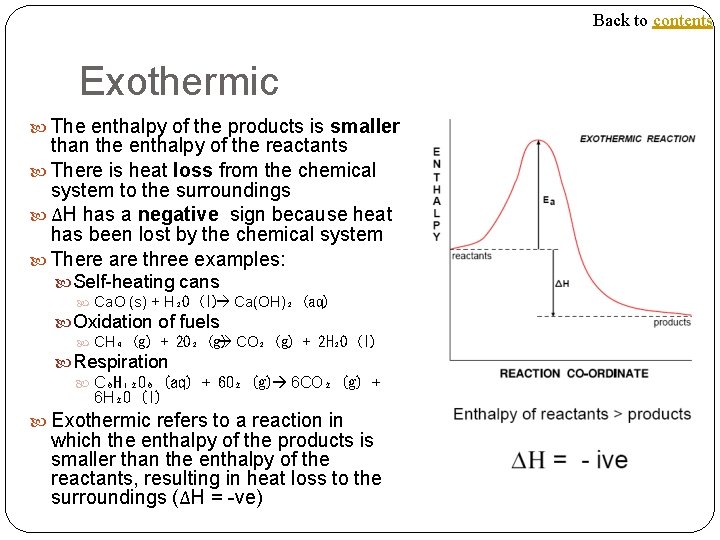
Back to contents Exothermic The enthalpy of the products is smaller than the enthalpy of the reactants There is heat loss from the chemical system to the surroundings ΔH has a negative sign because heat has been lost by the chemical system There are three examples: Self-heating cans Ca. O (s) + H₂O (l) Ca(OH)₂ (aq) Oxidation of fuels CH₄ (g) + 2 O₂ (g) CO₂ (g) + 2 H₂O (l) Respiration C₆H₁₂O₆ (aq) + 6 O₂ (g) 6 CO₂ (g) + 6 H₂O (l) Exothermic refers to a reaction in which the enthalpy of the products is smaller than the enthalpy of the reactants, resulting in heat loss to the surroundings (ΔH = -ve)
Back to contents Standard Enthalpy Change of Reaction (ΔHᵣ) For a standard enthalpy change of reaction we need: An equation This gives the amounts, in mol, of reactants and products An enthalpy change in k. J mol⁻¹ This gives the enthalpy change for the molar quantities in the state equation The standard enthalpy change of reaction is the enthalpy change that accompanies a reaction in the molar quantities expressed in a chemical equation under standard conditions, all reactants and products being in their standard states
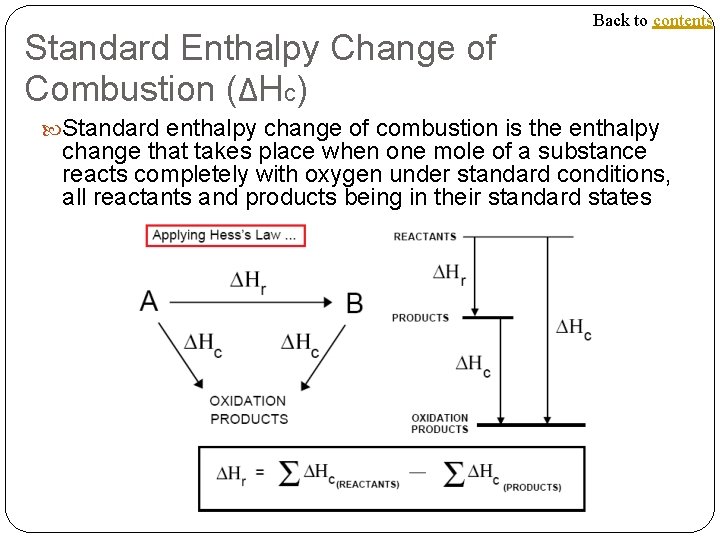
Standard Enthalpy Change of Combustion (ΔHc) Back to contents Standard enthalpy change of combustion is the enthalpy change that takes place when one mole of a substance reacts completely with oxygen under standard conditions, all reactants and products being in their standard states
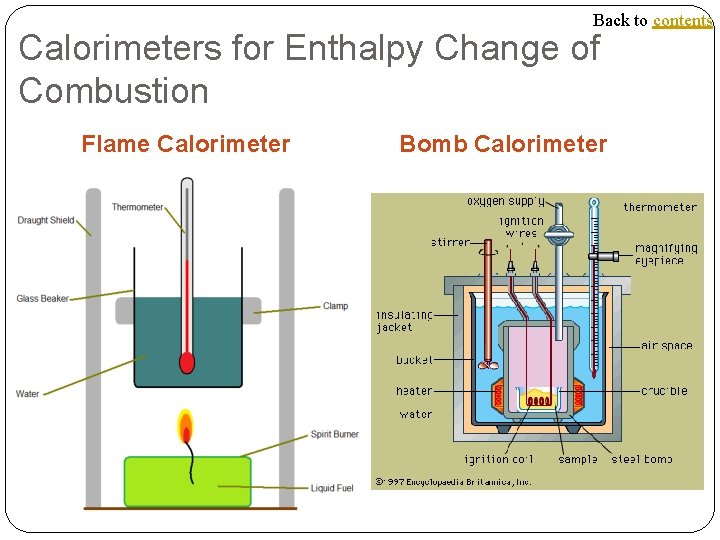
Back to contents Calorimeters for Enthalpy Change of Combustion Flame Calorimeter Bomb Calorimeter
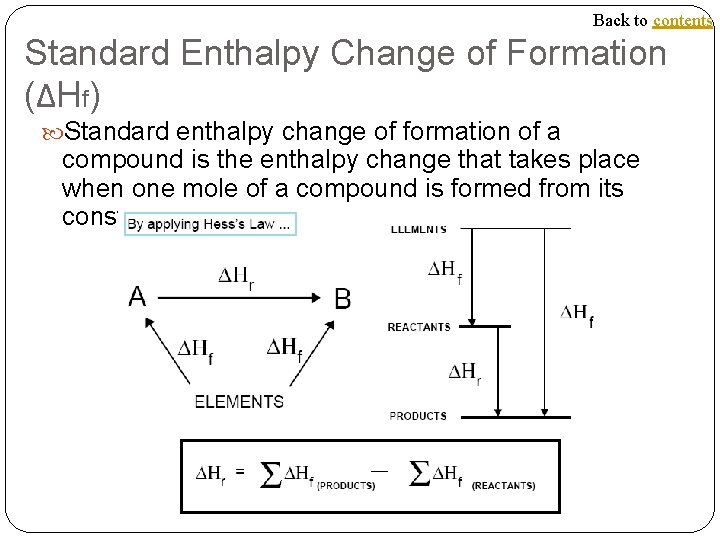
Back to contents Standard Enthalpy Change of Formation (ΔHf) Standard enthalpy change of formation of a compound is the enthalpy change that takes place when one mole of a compound is formed from its constituent elements in their standard states
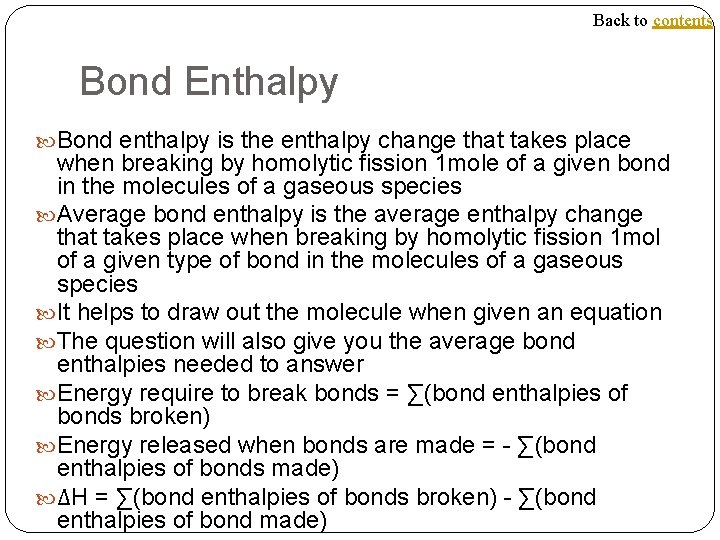
Back to contents Bond Enthalpy Bond enthalpy is the enthalpy change that takes place when breaking by homolytic fission 1 mole of a given bond in the molecules of a gaseous species Average bond enthalpy is the average enthalpy change that takes place when breaking by homolytic fission 1 mol of a given type of bond in the molecules of a gaseous species It helps to draw out the molecule when given an equation The question will also give you the average bond enthalpies needed to answer Energy require to break bonds = ∑(bond enthalpies of bonds broken) Energy released when bonds are made = - ∑(bond enthalpies of bonds made) ΔH = ∑(bond enthalpies of bonds broken) - ∑(bond enthalpies of bond made)
Back to contents Rates of reaction Collision theory Surface area Concentration Pressure Temperature Catalysts
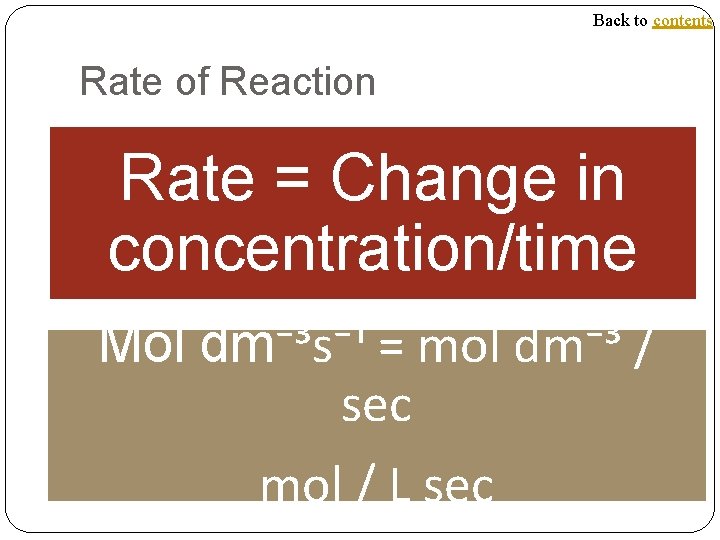
Back to contents Rate of Reaction Rate = Change in concentration/time Mol dm⁻³s⁻¹ = mol dm⁻³ / sec mol / L sec
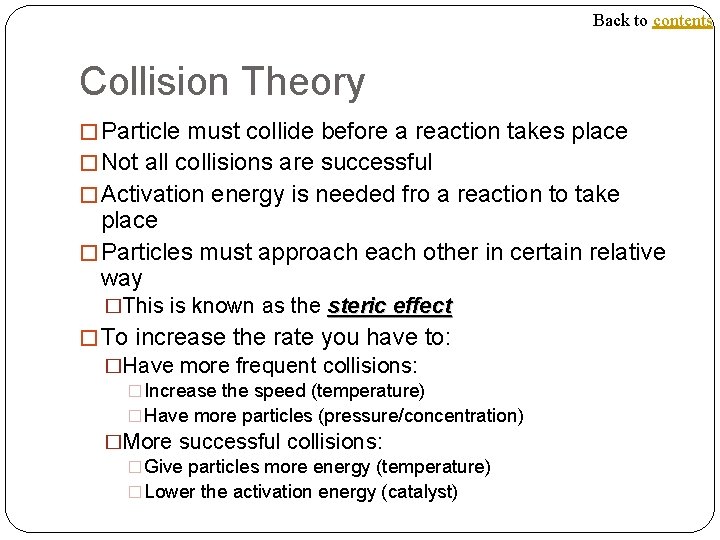
Back to contents Collision Theory � Particle must collide before a reaction takes place � Not all collisions are successful � Activation energy is needed fro a reaction to take place � Particles must approach each other in certain relative way �This is known as the steric effect � To increase the rate you have to: �Have more frequent collisions: � Increase the speed (temperature) � Have more particles (pressure/concentration) �More successful collisions: � Give particles more energy (temperature) � Lower the activation energy (catalyst)
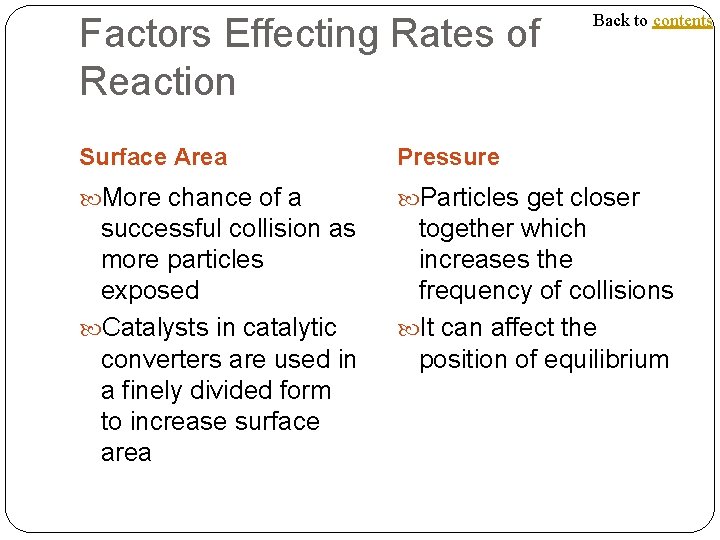
Factors Effecting Rates of Reaction Back to contents Surface Area Pressure More chance of a Particles get closer successful collision as more particles exposed Catalysts in catalytic converters are used in a finely divided form to increase surface area together which increases the frequency of collisions It can affect the position of equilibrium
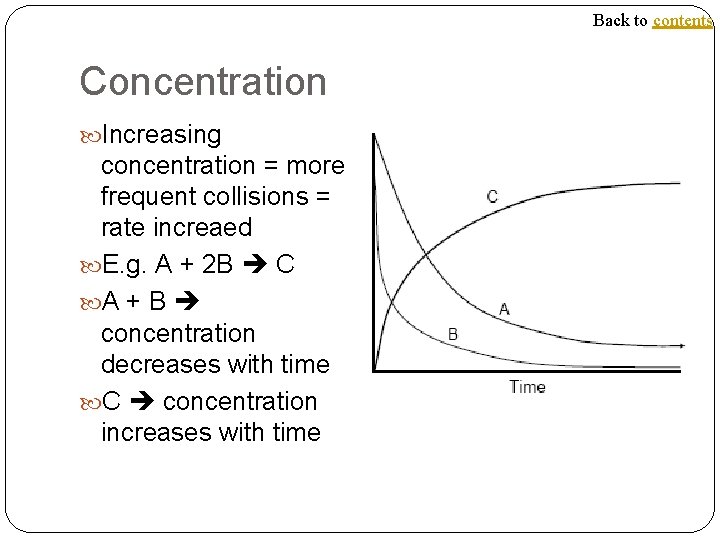
Back to contents Concentration Increasing concentration = more frequent collisions = rate increaed E. g. A + 2 B C A + B concentration decreases with time C concentration increases with time
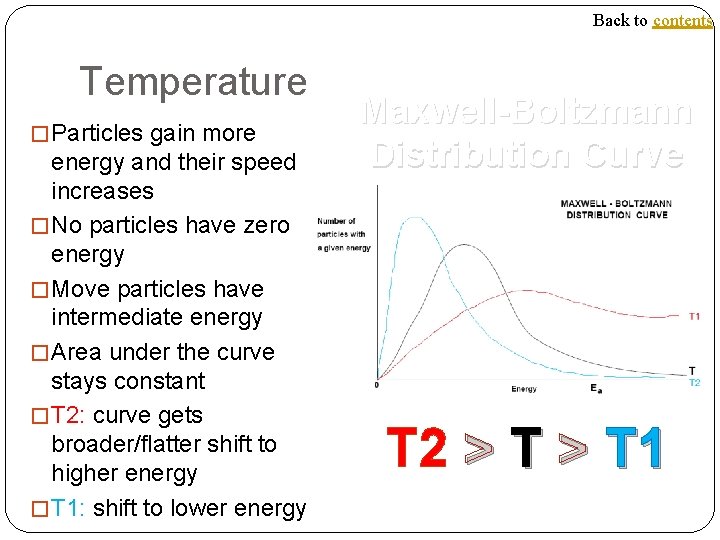
Back to contents Temperature � Particles gain more energy and their speed increases � No particles have zero energy � Move particles have intermediate energy � Area under the curve stays constant � T 2: curve gets broader/flatter shift to higher energy � T 1: shift to lower energy Maxwell-Boltzmann Distribution Curve T 2 > T 1
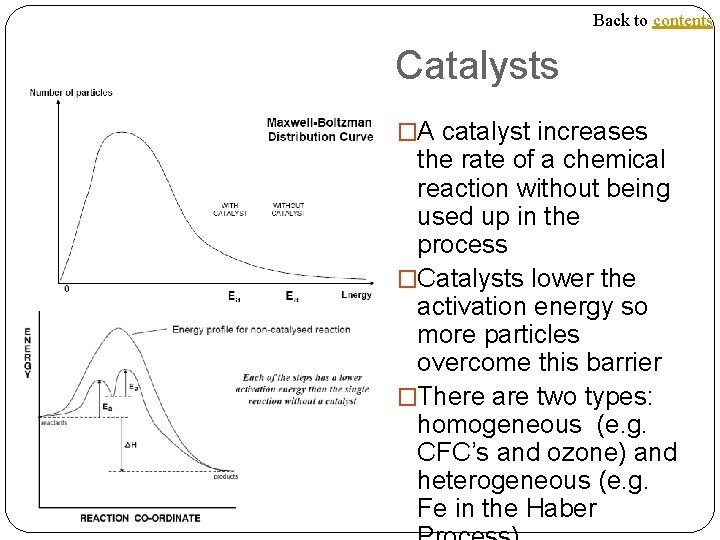
Back to contents Catalysts �A catalyst increases the rate of a chemical reaction without being used up in the process �Catalysts lower the activation energy so more particles overcome this barrier �There are two types: homogeneous (e. g. CFC’s and ozone) and heterogeneous (e. g. Fe in the Haber
Back to contents Catalysts Continued Uses � Used in industry where an increase in temperature would result in lower yield �E. g. Haber Process � They don’t affect equilibrium but do affect the rate of equilibrium � More effective catalysts could result in dramatic savings � They need to be regularly changed as they may become “poisoned” by other chemicals � They are finely divided Catalysts. . . � Allow reactions to take place at lower temperatures: � Saves energy � Reduces CO₂ output � Enable different reactions to be used: � Better atom economy � Reduce waste � Are often enzymes: � Generate specific products � Operates at lower temperatures � Non-poisonous and are biodegradable � Have great economic importance in industry: � Poly(ethene) � Sulphuric acid � Ammonia � Ethanol production � Can reduce pollution:
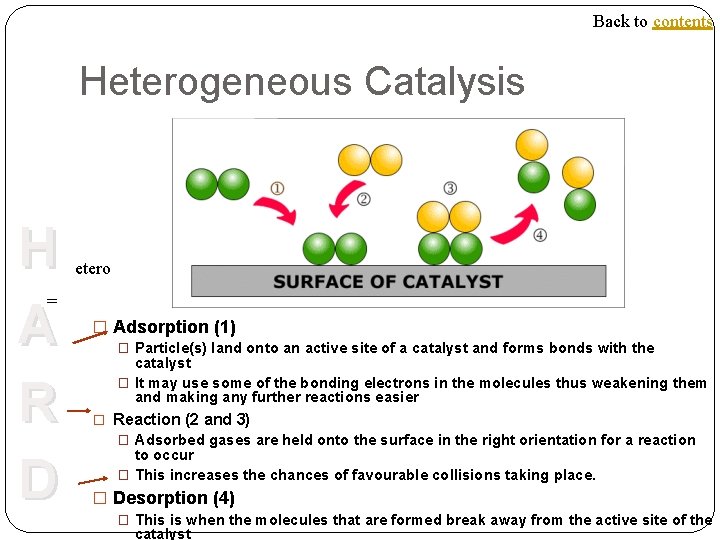
Back to contents Heterogeneous Catalysis H A R D etero = � Adsorption (1) � Particle(s) land onto an active site of a catalyst and forms bonds with the catalyst � It may use some of the bonding electrons in the molecules thus weakening them and making any further reactions easier � Reaction (2 and 3) � Adsorbed gases are held onto the surface in the right orientation for a reaction to occur � This increases the chances of favourable collisions taking place. � Desorption (4) � This is when the molecules that are formed break away from the active site of the catalyst
Back to contents Equilibrium Dynamic Equilibrium Le Chatelier’s Principle Factors affecting the position of the equilibrium Ammonia and the Haber Process
Back to contents Dynamic Equilibrium Dynamic equilibrium • The equilibrium that exists in a closed system when the rate of the forward reaction is equal to the rate of the reverse reaction � Equilibrium only happens during a reversible reaction � There appears to be no change but the system is dynamic �Constant motion of the forward and backward reaction � When a system is in dynamic equilibrium: �The concentrations of the reactants and products are the same �The rate of the forward and backward reaction is equal to each other � An equilibrium only applies in a closed system so there are no materials added or taken away and no
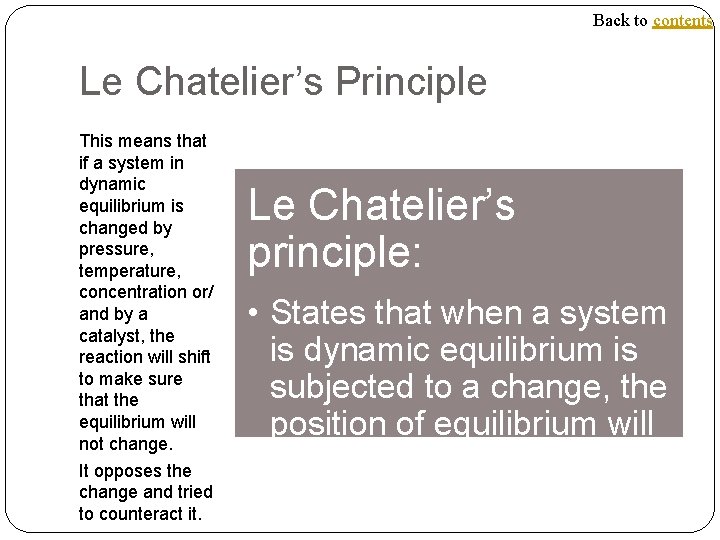
Back to contents Le Chatelier’s Principle This means that if a system in dynamic equilibrium is changed by pressure, temperature, concentration or/ and by a catalyst, the reaction will shift to make sure that the equilibrium will not change. It opposes the change and tried to counteract it. Le Chatelier’s principle: • States that when a system is dynamic equilibrium is subjected to a change, the position of equilibrium will shift to minimise the change
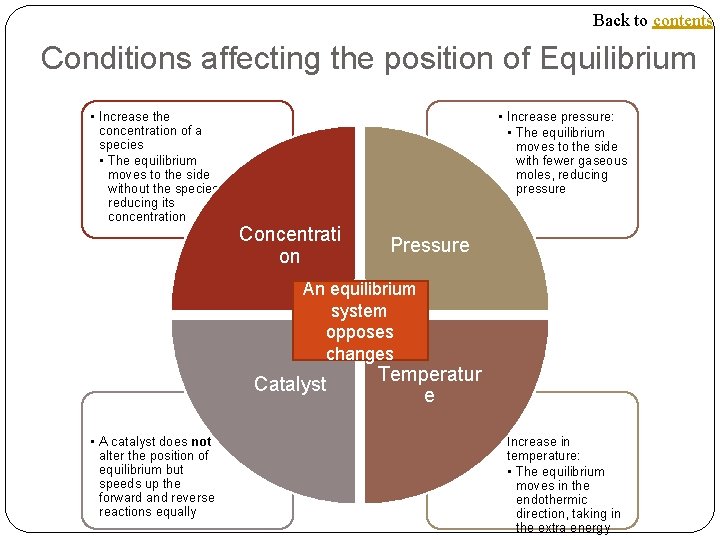
Back to contents Conditions affecting the position of Equilibrium • Increase the concentration of a species • The equilibrium moves to the side without the species, reducing its concentration • Increase pressure: • The equilibrium moves to the side with fewer gaseous moles, reducing pressure Concentrati on Pressure An equilibrium system opposes changes Catalyst • A catalyst does not alter the position of equilibrium but speeds up the forward and reverse reactions equally Temperatur e • Increase in temperature: • The equilibrium moves in the endothermic direction, taking in the extra energy
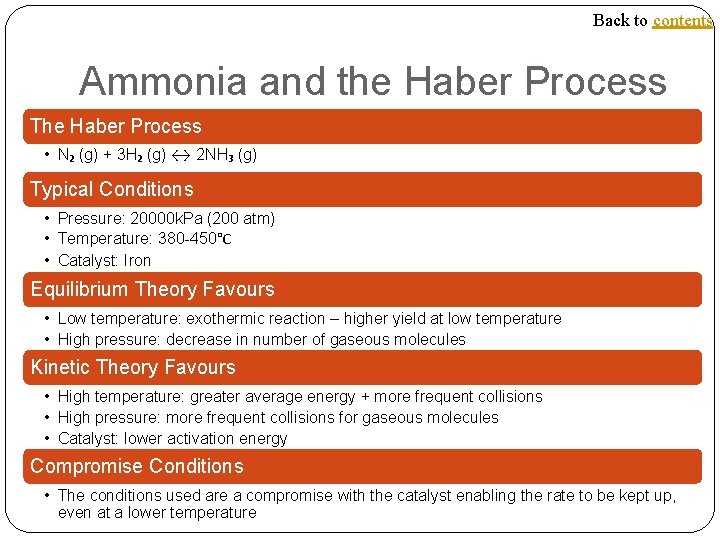
Back to contents Ammonia and the Haber Process The Haber Process • N₂ (g) + 3 H₂ (g) ↔ 2 NH₃ (g) Typical Conditions • Pressure: 20000 k. Pa (200 atm) • Temperature: 380 -450°C • Catalyst: Iron Equilibrium Theory Favours • Low temperature: exothermic reaction – higher yield at low temperature • High pressure: decrease in number of gaseous molecules Kinetic Theory Favours • High temperature: greater average energy + more frequent collisions • High pressure: more frequent collisions for gaseous molecules • Catalyst: lower activation energy Compromise Conditions • The conditions used are a compromise with the catalyst enabling the rate to be kept up, even at a lower temperature
Back to contents Glossary Enthalpy Rates of Reaction Equilibrium
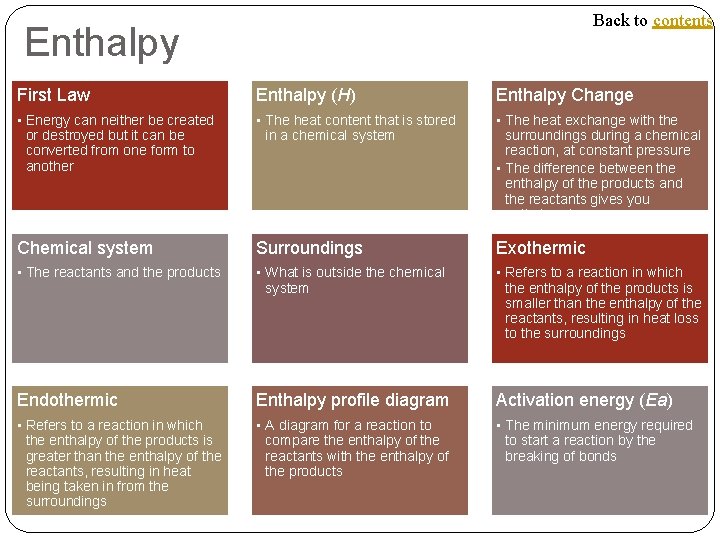
Back to contents Enthalpy First Law Enthalpy (H) Enthalpy Change • Energy can neither be created or destroyed but it can be converted from one form to another • The heat content that is stored in a chemical system • The heat exchange with the surroundings during a chemical reaction, at constant pressure • The difference between the enthalpy of the products and the reactants gives you enthalpy change Chemical system Surroundings Exothermic • The reactants and the products • What is outside the chemical system • Refers to a reaction in which the enthalpy of the products is smaller than the enthalpy of the reactants, resulting in heat loss to the surroundings Endothermic Enthalpy profile diagram Activation energy (Ea) • Refers to a reaction in which the enthalpy of the products is greater than the enthalpy of the reactants, resulting in heat being taken in from the surroundings • A diagram for a reaction to compare the enthalpy of the reactants with the enthalpy of the products • The minimum energy required to start a reaction by the breaking of bonds
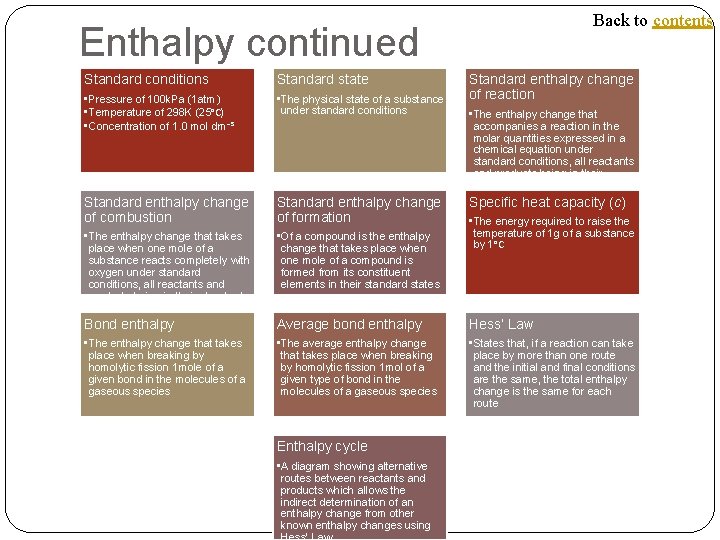
Back to contents Enthalpy continued Standard conditions Standard state • Pressure of 100 k. Pa (1 atm) • Temperature of 298 K (25°C) • Concentration of 1. 0 mol dm⁻³ • The physical state of a substance under standard conditions Standard enthalpy change of combustion Standard enthalpy change of formation • The enthalpy change that takes place when one mole of a substance reacts completely with oxygen under standard conditions, all reactants and products being in their standard states • Of a compound is the enthalpy change that takes place when one mole of a compound is formed from its constituent elements in their standard states Bond enthalpy Average bond enthalpy Hess’ Law • The enthalpy change that takes place when breaking by homolytic fission 1 mole of a given bond in the molecules of a gaseous species • The average enthalpy change that takes place when breaking by homolytic fission 1 mol of a given type of bond in the molecules of a gaseous species • States that, if a reaction can take place by more than one route and the initial and final conditions are the same, the total enthalpy change is the same for each route Enthalpy cycle • A diagram showing alternative routes between reactants and products which allows the indirect determination of an enthalpy change from other known enthalpy changes using Standard enthalpy change of reaction • The enthalpy change that accompanies a reaction in the molar quantities expressed in a chemical equation under standard conditions, all reactants and products being in their standard states Specific heat capacity (c) • The energy required to raise the temperature of 1 g of a substance by 1°C
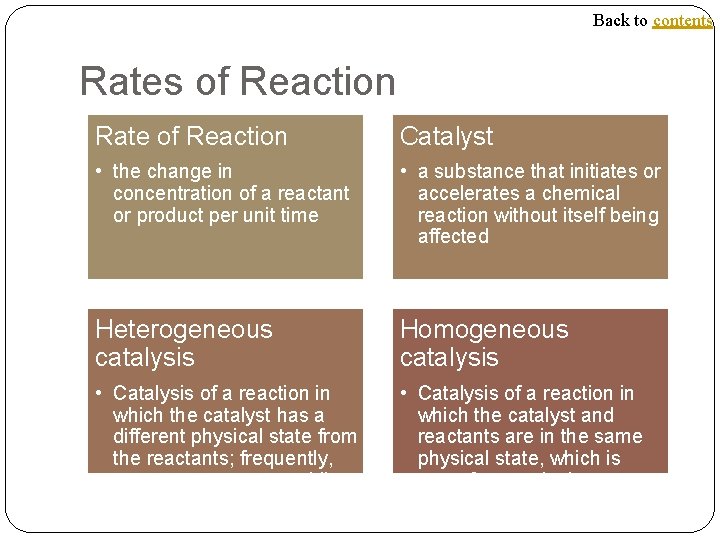
Back to contents Rates of Reaction Rate of Reaction Catalyst • the change in concentration of a reactant or product per unit time • a substance that initiates or accelerates a chemical reaction without itself being affected Heterogeneous catalysis Homogeneous catalysis • Catalysis of a reaction in which the catalyst has a different physical state from the reactants; frequently, reactants are gases whilst the catalyst is a solid • Catalysis of a reaction in which the catalyst and reactants are in the same physical state, which is more frequently the aqueous or gaseous state
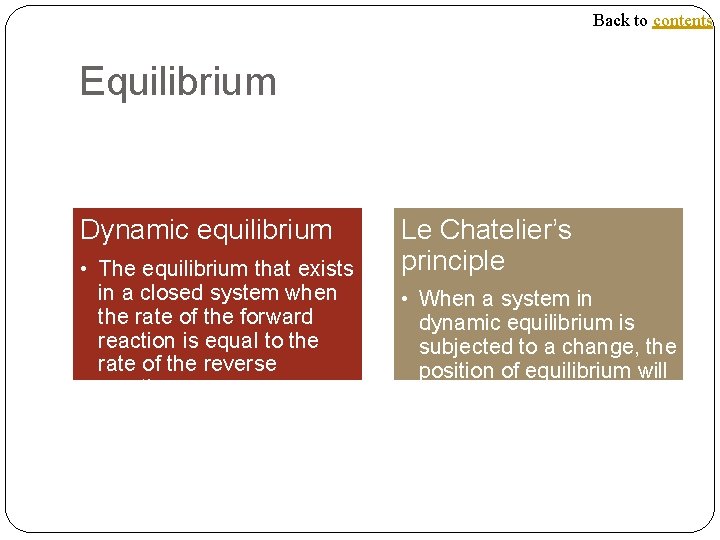
Back to contents Equilibrium Dynamic equilibrium • The equilibrium that exists in a closed system when the rate of the forward reaction is equal to the rate of the reverse reaction Le Chatelier’s principle • When a system in dynamic equilibrium is subjected to a change, the position of equilibrium will shift to minimise the change